An excerpt from “One Last Look”: Charlotte is no ordinary girl

This is currently available at Amazon here:  http://amzn.to/2CqUBcz

…

I’d read about out-of-body experiences, and like everyone else, thought it was nonsense.  Some people claimed to see themselves in the operating theatre, medical staff frantically trying to revive them, and being surrounded by white light.

I was definitely looking down, but it wasn’t me I was looking at.

It was two children, a boy and a girl, with their parents, in a park.

The boy was Alan.  He was about six or seven.  The girl was Louise, and she was five years old.  She had long red hair and looked the image of her mother.

I remember it now, it was Louise’s birthday and we went down to Bournemouth to visit our Grandmother, and it was the last time we were all together as a family.

We were flying homemade kites our father had made for us, and after we lay there looking up at the sky, making animals out of the clouds.  I saw an elephant, Louise saw a giraffe.

We were so happy then.

Before the tragedy.

When I looked again ten years had passed and we were living in hell.  Louise and I had become very adept at survival in a world we really didn’t understand, surrounded by people who wanted to crush our souls.

It was not a life a normal child had, our foster parents never quite the sort of people who were adequately equipped for two broken-hearted children.  They tried their best, but their best was not good enough.

Every day it was a battle, to avoid the Bannister’s and Archie in particular, every day he made advances towards Louise and every day she fended him off.

Until one day she couldn’t.

Now I was sitting in the hospital, holding Louise’s hand.  She was in a coma, and the doctors didn’t think she would wake from it.  The damage done to her was too severe.

The doctors were wrong.

She woke, briefly, to name her five assailants.  It was enough to have them arrested.  It was not enough to have them convicted.

Justice would have to be served by other means.

I was outside the Bannister’s home.

I’d made my way there without really thinking, after watching Louise die.  It was like being on autopilot, and I had no control over what I was doing.  I had murder in mind.  It was why I was holding an iron bar.

Skulking in the shadows.  It was not very different from the way the Bannister’s operated.

I waited till Archie came out.  I knew he eventually would.  The police had taken him to the station for questioning, and then let him go.  I didn’t understand why, nor did I care.

I followed him up the towpath, waiting till he stopped to light a cigarette, then came out of the shadows.

“Wotcha got there Alan?” he asked when he saw me.  He knew what it was, and what it was for.

It was the first time I’d seen the fear in his eyes.  He was alone.

“Justice.”

“For that slut of a sister of yours.  I had nuffing to do with it.”

“She said otherwise, Archie.”

“She never said nuffing, you just made it up.”  An attempt at bluster, but there was no confidence in his voice.

I held up the pipe.  It had blood on it.  Willy’s blood.  “She may or may not have Archie, but Willy didn’t make it up.  He sang like a bird.  That’s his blood, probably brains on the pipe too, Archie, and yours will be there soon enough.”

“He dunnit, not me.  Lyin’ bastard would say anything to save his own skin.”  Definitely scared now, he was looking to run away.

“No, Archie.  He didn’t.  I’m coming for you.  All of you Bannisters.  And everyone who touched my sister.”

It was the recurring nightmare I had for years afterwards.

I closed my eyes and tried to shut out the thoughts, the images of Louise, the phone call, the visit to the hospital and being there when she succumbed to her injuries.  Those were the very worst few hours of my life.

She had asked me to come to the railway station and walk home with her, and I was running late.  If I had left when I was supposed to, it would never have happened and for years afterwards, I blamed myself for her death.

If only I’d not been late…

When the police finally caught the rapists, I’d known all along who they’d be; antagonists from school, the ring leader, Archie Bannister, a spurned boyfriend, a boy whose parents, ubiquitously known to all as ‘the Bannister’s, dealt in violence and crime and who owned the neighbourhood.  The sins of the father had been very definitely passed onto the son.

At school, I used to be the whipping boy, Archie, a few grades ahead of me, made a point of belting me and a few of the other boys, to make sure the rest did as they were told.  He liked Louise, but she had no time for a bully like him, even when he promised he would ‘protect’ me.

I knew the gang members, the boys who tow-kowed to save getting beaten up, and after the police couldn’t get enough information to prosecute them because everyone was too afraid to speak out, I went after Willy.  There was always a weak link in a group, and he was it.

He worked in a factory, did long hours on a Wednesday and came home after dark alone.  It was a half mile walk, through a park.  The night I approached him, I smashed the lights and left it in darkness.  He nearly changed his mind and went the long way home.

He didn’t.

It took an hour and a half to get the names.  At first, when he saw me, he laughed.  He said I would be next, and that was four words more than he knew he should have said.

When I found him alone the next morning I showed him the iron bar and told him he was on the list.  I didn’t kill him then, he could wait his turn, and worry about what was going to happen to him.

When the police came to visit me shortly after that encounter, no doubt at the behest of the Bannister’s, the neighbourhood closed ranks and gave me an ironclad alibi.  The Bannister’s then came to visit me and threatened me.  I told them their days were numbered and showed them the door.

At the trial, he and his friends got off on a technicality.  The police had failed to do their job properly, but it was not the police, but a single policeman, corrupted by the Bannisters.

Archie could help but rub it in my face.  He was invincible.

Joe Collins took 12 bullets and six hours to bleed out.  He apologized, he pleaded, he cried, he begged.  I didn’t care.

Barry Mills, a strong lad with a mind to hurting people, Archie’s enforcer, almost got the better of me.  I had to hit him more times than I wanted to, and in the end, I had to be satisfied that he died a short but agonizing death.

I revisited Willy in the hospital.  He’d recovered enough to recognize me, and why I’d come.  Suffocation was too good for him.

David Williams, second in command of the gang, was as tough and nasty as the Bannisters.  His family were forging a partnership with the Bannister’s to make them even more powerful.  Outwardly David was a pleasant sort of chap, affable, polite, and well mannered.  A lot of people didn’t believe he could be like, or working with, the Bannisters.

He and I met in the pub.  We got along like old friends.  He said Willy had just named anyone he could think of, and that he was innocent of any charges.  We shook hands and parted as friends.

Three hours later he was sitting in a chair in the middle of a disused factory, blindfolded and scared.  I sat and watched him, listened to him, first threatening me, and then finally pleading with me.  He’d guessed who it was that had kidnapped him.

When it was dark, I took the blindfold off and shone a very bright light in his eyes.  I asked him if the violence he had visited upon my sister was worth it.  He told me he was just a spectator.

I’d read the coroner’s report.  They all had a turn.  He was a liar.

He took nineteen bullets to die.

Then came Archie.

The same factory only this time there were four seats.  Anna Bannister, brothel owner, Spike Bannister, head of the family, Emily Bannister, sister, and who had nothing to do with their criminal activities.  She just had the misfortune of sharing their name.

Archie’s father told me how he was going to destroy me, and everyone I knew.

A well-placed bullet between the eyes shut him up.

Archie’s mother cursed me.  I let her suffer for an hour before I put her out of her misery.

Archie remained stony-faced until I came to Emily.  The death of his parents meant he would become head of the family.  I guess their deaths meant as little to him as they did me.

He was a little more worried about his sister.

I told him it was confession time.

He told her it was little more than a forced confession and he had done nothing to deserve my retribution.

I shrugged and shot her, and we both watched her fall to the ground screaming in agony.  I told him if he wanted her to live, he had to genuinely confess to his crimes.  This time he did, it all poured out of him.

I went over to Emily.  He watched in horror as I untied her bindings and pulled her up off the floor, suffering only from a small wound in her arm.  Without saying a word she took the gun and walked over to stand behind him.

“Louise was my friend, Archie.  My friend.”

Then she shot him.  Six times.

To me, after saying what looked like a prayer, she said, “Killing them all will not bring her back, Alan, and I doubt she would approve of any of this.  May God have mercy on your soul.”

Now I was in jail.  I’d spent three hours detailing the deaths of the five boys, everything I’d done; a full confession.  Without my sister, my life was nothing.  I didn’t want to go back to the foster parents; I doubt they’d take back a murderer.

They were not allowed to.

For a month I lived in a small cell, in solitary, no visitors.  I believed I was in the queue to be executed, and I had mentally prepared myself for the end.

Then I was told I had a visitor, and I was expecting a priest.

Instead, it was a man called McTavish. Short, wiry, and with an accent that I could barely understand.

“You’ve been a bad boy, Alan.”

When I saw it was not the priest I told the jailers not to let him in, I didn’t want to speak to anyone.  They ignored me.  I’d expected he was a psychiatrist, come to see whether I should be shipped off to the asylum.

I was beginning to think I was going mad.

I ignored him.

“I am the difference between you living or dying Alan, it’s as simple as that.  You’d be a wise man to listen to what I have to offer.”

Death sounded good.  I told him to go away.

He didn’t.  Persistent bugger.

I was handcuffed to the table.  The prison officers thought I was dangerous.  Five, plus two, murders, I guess they had a right to think that.  McTavish sat opposite me, ignoring my request to leave.

“Why’d you do it?”

“You know why.”  Maybe if I spoke he’d go away.

“Your sister.  By all accounts, the scum that did for her deserved what they got.”

“It was murder just the same.  No difference between scum and proper people.”

“You like killing?”

“No-one does.”

“No, I dare say you’re right.  But you’re different, Alan.  As clean and merciless killing I’ve ever seen.  We can use a man like you.”

“We?”

“A group of individuals who clean up the scum.”

I looked up to see his expression, one of benevolence, totally out of character for a man like him.  It looked like I didn’t have a choice.

Trained, cleared, and ready to go.

I hadn’t realized there were so many people who were, for all intents and purposes, invisible.  People that came and went, in malls, in hotels, trains, buses, airports, everywhere, people no one gave a second glance.

People like me.

In a mall, I became a shopper.

In a hotel, I was just another guest heading to his room.

On a bus or a train, I was just another commuter.

At the airport, I became a pilot.  I didn’t need to know how to fly; everyone just accepted a pilot in a pilot suit was just what he looked like.

I had a passkey.

I had the correct documents to get me onto the plane.

That walk down the air bridge was the longest of my life.  Waiting for the call from the gate, waiting for one of the air bridge staff to challenge me, stepping onto the plane.

Two pilots and a steward.  A team.  On the plane early before the rest of the crew.  A group that was committing a crime, had committed a number of crimes and thought they’d got away with it.

Until the judge, the jury and their executioner arrived.

Me.

Quick, clean, merciless.  Done.

I was now an operational field agent.

I was older now, and I could see in the mirror I was starting to go grey at the sides.  It was far too early in my life for this, but I expect it had something to do with my employment.

I didn’t recognize the man who looked back at me.

It was certainly not Alan McKenzie, nor was there any part of that fifteen-year-old who had made the decision to exact revenge.

Given a choice; I would not have gone down this path.

Or so I kept telling myself each time a little more of my soul was sold to the devil.

I was Barry Gamble.

I was Lenny Buckman.

I was Jimmy Hosen.

I was anyone but the person I wanted to be.

That’s what I told Louise, standing in front of her grave, and trying to apologize for all the harm, all the people I’d killed for that one rash decision.  If she was still alive she would be horrified, and ashamed.

Head bowed, tears streamed down my face.

God had gone on holiday and wasn’t there to hand out any forgiveness.  Not that day.  Not any day.

New York, New Years Eve.

I was at the end of a long tour, dragged out of a holiday and back into the fray, chasing down another scumbag.  They were scumbags, and I’d become an automaton hunting them down and dispatching them to what McTavish called a better place.

This time I failed.

A few drinks to blot out the failure, a blonde woman who pushed my buttons, a room in a hotel, any hotel, it was like being on the merry-go-round, round and round and round…

Her name was Silvia or Sandra, or someone I’d met before, but couldn’t quite place her.  It could be an enemy agent for all I knew or all I cared right then.

I was done.

I’d had enough.

I gave her the gun.

I begged her to kill me.

She didn’t.

Instead, I simply cried, letting the pent up emotion loose after being suppressed for so long, and she stayed with me, holding me close, and saying I was safe, that she knew exactly how I felt.

How could she?  No one could know what I’d been through.

I remembered her name after she had gone.

Amanda.

I remembered she had an imperfection in her right eye.

Someone else had the same imperfection.

I couldn’t remember who that was.

Not then.

I had a dingy flat in Kensington, a place that I rarely stayed in if I could help it.  After five-star hotel rooms, it made me feel shabby.

The end of another mission, I was on my way home, the underground, a bus, and then a walk.

It was late.

People were spilling out of the pub after the last drinks.  Most in good spirits, others slightly more boisterous.

A loud-mouthed chap bumped into me, the sort who had one too many, and was ready to take on all comers.

He turned on me, “Watch where you’re going, you fool.”

Two of his friends dragged him away.  He shrugged them off, squared up.

I punched him hard, in the stomach, and he fell backwards onto the ground.  I looked at his two friends.  “Take him home before someone makes mincemeat out of him.”

They grabbed his arms, lifted him off the ground and took him away.

Out of the corner of my eye, I could see a woman, early thirties, quite attractive, but very, very drunk.  She staggered from the bar, bumped into me, and finished up sitting on the side of the road.

I looked around to see where her friends were.  The exodus from the pub was over and the few nearby were leaving to go home.

She was alone, drunk, and by the look of her, unable to move.

I sat beside her.  “Where are your friends?”

“Dunno.”

“You need help?”

She looked up, and sideways at me.  She didn’t look the sort who would get in this state.  Or maybe she was, I was a terrible judge of women.

“Who are you?” she asked.

“Nobody.”  I was exactly how I felt.

“Well Mr Nobody, I’m drunk, and I don’t care.  Just leave me here to rot.”

She put her head back between her knees, and it looked to me she was trying to stop the spinning sensation in her head.

Been there before, and it’s not a good feeling.

“Where are your friends?” I asked again.

“Got none.”

“Perhaps I should take you home.”

“I have no home.”

“You don’t look like a homeless person.  If I’m not mistaken, those shoes are worth more than my weekly salary.”  I’d seen them advertised, in the airline magazine, don’t ask me why the ad caught my attention.

She lifted her head and looked at me again.  “You a smart fucking arse are you?”

“I have my moments.”

“Have them somewhere else.”

She rested her head against my shoulder.  We were the only two left in the street, and suddenly in darkness when the proprietor turned off the outside lights.

“Take me home,” she said suddenly.

“Where is your place?”

“Don’t have one.  Take me to your place.”

“You won’t like it.”

“I’m drunk.  What’s not to like until tomorrow.”

I helped her to her feet.  “You have a name?”

“Charlotte.”

The wedding was in a small church.  We had been away for a weekend in the country, somewhere in the Cotswolds, and found this idyllic spot.  Graves going back to the dawn of time, a beautiful garden tended by the vicar and his wife, an astonishing vista over hills and down dales.

On a spring afternoon with the sun, the flowers, and the peacefulness of the country.

I had two people at the wedding, the best man, Bradley, and my boss, Watkins.

Charlotte had her sisters Melissa and Isobel, and Isobel’s husband Giovanni, and their daughter Felicity.

And one more person who was as mysterious as she was attractive, a rather interesting combination as she was well over retirement age.  She arrived late and left early.

Aunt Agatha.

She looked me up and down with what I’d call a withering look.  “There’s more to you than meets the eye,” she said enigmatically.

“Likewise I’m sure,” I said.  It earned me an elbow in the ribs from Charlotte.  It was clear she feared this woman.

“Why did you come,” Charlotte asked.

“You know why.”

Agatha looked at me.  “I like you.  Take care of my granddaughter.  You do not want me for an enemy.”

OK, now she officially scared me.

She thrust a cheque into my hand, smiled, and left.

“Who is she,” I asked after we watched her depart.

“Certainly not my fairy godmother.”

Charlotte never mentioned her again.

Zurich in summer, not exactly my favourite place.

Instead of going to visit her sister Isobel, we stayed at a hotel in Beethovenstrasse and Isobel and Felicity came to us.  Her husband was not with her this time.

Felicity was three or four and looked very much like her mother.  She also looked very much like Charlotte, and I’d remarked on it once before and it received a sharp rebuke.

We’d been twice before, and rather than talk to her sister, Charlotte spent her time with Felicity, and they were, together, like old friends.  For so few visits they had a remarkable rapport.

I had not broached the subject of children with Charlotte, not after one such discussion where she had said she had no desire to be a mother.  It had not been a subject before and wasn’t once since.

Perhaps like all Aunts, she liked the idea of playing with a child for a while and then give it back.

Felicity was curious as to who I was, but never ventured too close.  I believed a child could sense the evil in adults and had seen through my facade of friendliness.  We were never close.

But…

This time, when observing the two together, something quite out of left field popped into my head.  It was not possible, not by any stretch of the imagination, but I thought she looked like my mother.

And Charlotte had seen me looking in their direction.  “You seem distracted,” she said.

“I was just remembering my mother.  Odd moment, haven’t done so for a very long time.”

“Why now?”  I think she had a look of concern on her face.

“Her birthday, I guess,” I said, the first excuse I could think of.

Another look and I was wrong.  She looked like Isobel or Charlotte, or if I wanted to believe it possible, Melissa too.

I was crying, tears streaming down my face.

I was in pain, searing pain from my lower back stretching down into my legs, and I was barely able to breathe.

It was like coming up for air.

It was like Snow White bringing Prince Charming back to life.  I could feel what I thought was a gentle kiss and tears dropping on my cheeks, and when I opened my eyes, I saw Charlotte slowly lifting her head, a hand gently stroking the hair off my forehead.

And in a very soft voice, she said, “Hi.”

I could not speak, but I think I smiled.  It was the girl with the imperfection in her right eye.  Everything fell into place, and I knew, in that instant that we were irrevocably meant to be together.

“Welcome back.”

© Charles Heath 2016-2019
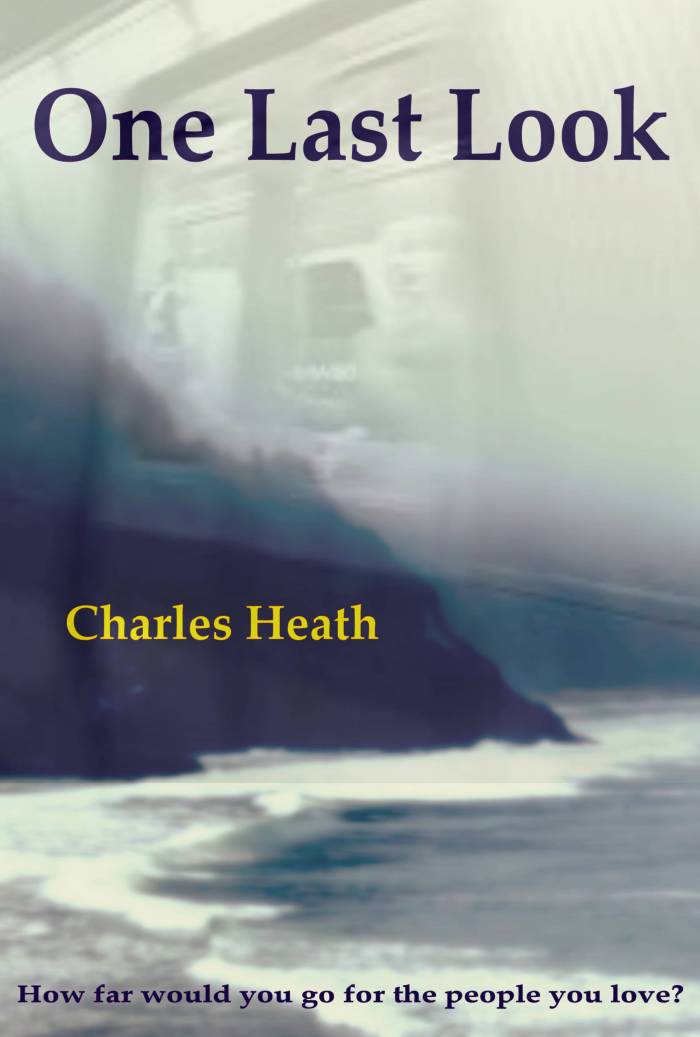
onelastlookcoverfinal2

The cinema of my dreams – Was it just another surveillance job – Episode 52

This story is now on the list to be finished so over the new few weeks, expect a new episode every few days.

The reason why new episodes have been sporadic, there are also other stories to write, and I’m not very good at prioritizing.

But, here we are, a few minutes opened up and it didn’t take long to get back into the groove.

Things are about to get complicated…


We took the elevator down to one of the basement levels, and then along a long poorly lit passageway which in my estimation had taken us to another building.

It would not have surprised me if it had been part of a large underground complex used in the second world war, safe from the overhead bombing raids.  Certainly, a lot of the fittings and paintwork looked very, very old, and I could imagine armed soldiers stationed along the length of the corridor each in his own little cutaway.

At the end, the building was a lot more modern and bright.

There was a large open space, and we headed towards one of the corners where the walls had wallpaper scenic views that if you didn’t know it was a photograph, it could almost be mistaken for a view overlooking the Thames.

It made that corner space more liveable.

There were two desks, more computers, and another girl who appeared like she had been waiting for us.

“I was told you wanted to view CCTV for the day of the recent street bombing.”

If the girl knew what I was looking for, then Monica would already have seen it and most likely had it analyzed by a team of experts.  If it wasn’t for the fact I wanted to see it myself, I might have just gone to her for the official report.

“Yes.”

I sat down beside her, and Joanne remained standing, behind us.

“OK.  There are seven cameras in that location, five of which were working at the time.  There is one across the road from the café, and it provided a good view of the actual explosion.”

She brought it up on the screen and ran it from shortly before O’Connell passed the front.  Then he came into view, walking as though he was purposefully going from one place to the next, almost stopping to look sideways into the café.  A prolonged moment looking through the window told me he had seen the reporter.

We could not see the reporter from our viewpoint.

But it was clear that O’Connell had seen something else because his pace quickened.

Then the explosion happened, and he was caught up in the aftermath, as was I as I had just entered the frame, following diligently.  My effort to look nonchalant, and not following O’Connell was not very good.  If this was a training tape on what not to do, that was me.

Watching it was horrifying, watching myself being blown a short distance across the pavement, followed by rubble.  Watching a dozen other people suffering far worse injuries were far worse.

I saw myself getting gingerly up off the ground, then seeing two men running past in the opposite direction, one of whom was McConnell.  I hadn’t realized at the time it was him.  Then we disappeared out of frame.

“Is there a camera farther along?”

She checked the list, picked a site, and brought up the feed for that timeframe, and just in from on the left-hand side was me, pinned to the ground by two men, and a street policeman, covered in dust walking up to us.

A discussion ensued, then the two men got in the car and drove off.

McConnell then suddenly reappeared from the right-hand side of the frame, walking past me and the policeman now on the ground.

Where had he come from?  How did he manage to get back to the bomb site, if that was where he had gone?

“Can we go back to the bomb site from where we left off before?”

A few seconds before the footage recommenced.

A minute, perhaps a little longer passed as those who had survived were trying to get up, McConnell reappeared from an alley two shops along from café, almost untouched by the blast, and crossed the road.

A few seconds later another person came out of the alley and followed him.

“Can you focus on that person who came out of the alley?”

She stopped the feed, zoomed in, and then cleaned up the blurry image until it showed a woman’s face.

“Who is she?”

She brought up the comments that went with the footage.  It had been already reviewed previously, as part of the investigation into the bombing. 

“They couldn’t formally identify her.”

“Anyone hazard a guess?”

“No.  She’s still a person of interest though.”

I gave the girl a piece of paper with a list of seven of the scientists from the laboratory.  “See if you can find wives of the male scientists.”

Joanne had been intrigued the whole time we had watched the event unfolding.

“That was you caught up in the explosion, wasn’t it?”

The pictures had been grainy and indistinct, so all I looked like was an anonymous blob.  Monica had obviously not told her of my involvement.

“Yes.  And McConnell.  I suspect McConnell did get the hand-off, but not from the journalist.  The journalist was in the café with the wife of the scientist who stole the information, though it would only be speculation to assume they were together, or whether she was there to sell the information, and give it to McConnell.”

“Anna Jacovich, wife of Erich Jacovich.  Microbiologist,” the girl said.

McConnell had lied.

…

© Charles Heath 2020-2022

The cinema of my dreams – I always wanted to see the planets – Episode 11

Perhaps we are not alone…

…

I guess there was more to be worried about than a few scorch marks on the side of a ship.

It did beg the question, in those milliseconds I had to pull myself together, that the agreement everyone was a party to on Earth was that we were not going to have ships with weapons, and the ability to attack one another in space, was just that, between nations on Earth.

What if there was life other than on Earth?

The person I was looking at didn’t look like an alien, or at least not one of our endless stereotypes, but what if there was life other than us, and this was a representation of it?

I guess it was time to take the first step.

“I’m assuming this is some sort of dispute over cargo, or perhaps interstellar freight lines, and if it is, there are proper channels to resolve your issues, not at the end of a laser.” I looked at the weapon in the person’s hand and it looked nothing like anything I’d seen before.

Well, not outside our weapons lab, our there on the edge of space where the occupants were not likely to get snooping visitors.

The helmet with the reflective glass panel gave no indication who was behind it.

“It is not an issue over freight.”

OK. A humanised voice, spoke slowly as if by one feeling their way around the language. Yes, English, but why didn’t they pick French or Spanish, or even Japanese? English was not exactly universal, and the translators in our ears reduced everything to our native tongue. Myrtle’s language was Italian, so she would not be hearing this in English.

“Space lane violation?”

Yes, there were lanes in space so ships didn’t crash into each other. There was some degree of civilization out her in no man’s land.

Time for a different tack.

“Just exactly where are you from?”

In that same moment I heard the Captain’s voice coming over my private communicator, in a very uncaptain like manner. “What in God’s name is that?”

…

© Charles Heath 2021-2022

“Sunday in New York”, a romantic adventure that’s not a walk in the park!

“Sunday in New York” is ultimately a story about trust, and what happens when a marriage is stretched to its limits.

When Harry Steele attends a lunch with his manager, Barclay, to discuss a promotion that any junior executive would accept in a heartbeat, it is the fact his wife, Alison, who previously professed her reservations about Barclay, also agreed to attend, that casts a small element of doubt in his mind.

From that moment, his life, in the company, in deciding what to do, his marriage, his very life, spirals out of control.

There is no one big factor that can prove Harry’s worst fears, that his marriage is over, just a number of small, interconnecting events, when piled on top of each other, points to a cataclysmic end to everything he had believed in.

Trust is lost firstly in his best friend and mentor, Andy, who only hints of impending disaster, Sasha, a woman whom he saved, and who appears to have motives of her own, and then in his wife, Alison, as he discovered piece by piece damning evidence she is about to leave him for another man.

Can we trust what we see with our eyes or trust what we hear?

Haven’t we all jumped to conclusions at least once in our lives?

Can Alison, a woman whose self-belief and confidence is about to be put to the ultimate test, find a way of proving their relationship is as strong as it has ever been?

As they say in the classics, read on!

Purchase:

http://tinyurl.com/Amazon-SundayInNewYork

The A to Z Challenge – 2023 — O is for Obsolete

For the last week before retirement, it was almost unmemorable.

I think I preferred it that way because the company was nothing like when I started, forty-five years ago.  People said I should have been General Manager by now, but the truth was, I liked my ‘behind the scenes’ role better than taking on the responsibility of management.

Now, my role was obsolete.  We no longer ran our own packing, dispatch and delivery service, each component of the department was slowly stripped away and outsourced, to the point now where we threw stuff into boxes and a couple of ruffians and a dilapidated truck came at the end of the day to take it all away.

Online.  That was the catchword.  There was no one over 21 in the company, except for me and the receptionist, who was also slated for retirement a week after me.

She, too, was obsolete.  As an online store, there was no need to have a human interface, so I had no idea what she did with her day.  I was meaning to ask, and that opportunity might just come sooner than I thought.

She just wandered into the tea room.

When she saw me sitting at the same table I had for the last forty-five years, she smiled.  There was a spot for the dispatch teams, a spot for clerical, and once upon a time, the boys and girls had to sit at separate tables.  Now, well, times have changed.  Once, we all had uniforms, and everyone looked like they belonged.  Now, it was difficult to tell the boys from the girls, and dress sense and decorum had long since disappeared.  I wore mine, and Elsie wore hers, the last acts of defiance before we moved on.

She made her tea, the same as she had for many years, resisted the temptation of a doughnut, and then wandered over.  She nodded to an empty chair opposite me, “May I?”

I nodded.  She had more manners than all the others put together.

“Looking forward to retirement,” she asked.

“No.  I have a big empty house that I’d rather not live in, and no one to share it with.”  Mary, the woman I’d married, a company girl, and I had the privilege of living with had lasted forty-four of those years before succumbing to cancer, a year shy of beginning what we were calling our second life together.  We had such plans, but plans were always destined to go awry.

“A shame,” she said.  “Harry decided he didn’t want to wait to have a good time.  Took off with a younger woman.  A week later, he was dead.  Bad heart, I’ll let you make of that what you will.  Probably dodged a bullet, though.”

Pragmatic?  Certainly practical.

“Do you have anything planned?” I asked.

“I’m going around the world in 80 days.  Steam trains, steamships, hot air balloons, camels, elephants, and maybe even the proverbial slow boat to China.  I saw a TV show, and even though you can probably do it in a day, even two, I like the idea of the longer the better.  You?”

“We were going to Paris, Rome, Capri, but I can’t see the point of it now.”

“Well, there’s room for one more on our tour. You should come.  It’s going to be wildly unpredictable, and at least there would be one familiar face.  Give it some thought.”

I was giving it thought on the way back to my office, so much thought I bumped into Rodney, the boy who was about to take over my space. 

I’d been asked to train him, but he told me quite emphatically there was nothing he could learn from an old fossil like me.  Quite blunt and quite obnoxious.  He was no different from the rest of them.  Old people were simply the object of their scorn.  It was not only me; Elsie also got her share of derision too.  We were the dinosaurs.

I apologised, but that didn’t seem to placate him.

“Thank God you will be gone soon enough.”

“Yes, I will, and I’ll have plenty of time on my hands.”

He looked at me oddly.  “You’re barking mad, you old geezer.”  He gave me a sneer, then walked off.

“Don’t say I didn’t warn you,” I said to his retreating back.

Rodney was typical of that younger generation that took everything for granted.  His life was wrapped up in his cell phone, like many others, and once when he thought he lost it, he almost went to pieces.

Not that I had anything to do with what happened, but it did give me ideas.

I made it back to the loading dock just in time for the boss’s special delivery, a half dozen paintings worth nearly twenty million dollars, paintings that were going to be hung in his new house if it ever got finished.  He had been forced to take delivery of them early and decided to use the walk-in safe the previous owners of the building, a bank, had installed.

Not that it had been used in a long time, other than a place where the younger employees went to ‘play’.  They thought no one saw them, but it was obvious what they were doing.  Not that it was any of my business, it was more or less the same some forty years before, only a little more dignified.

It was a fascinating anachronism from a bygone age, and reputed to never been cracked, although several had tried.  Now, though, it would be a doddle for a master safecracker.  If they knew what was in there, which no one but the boss, and several staff members, namely me and Rodney, did.

But I did warn the boss that he should have made better arrangements, but he was tight with his money, which seemed at odds with the way his wife spent it.  The safe, like me, was also obsolete, and I hoped he understood it was no substitute for having them stored in a proper facility.

About a half hour before I was due to leave, I saw Rodney with two men in the alley behind the loading dock.  There was a white anonymous van parked not far from them, and it must be one of the suppliers dropping off a late delivery.

There were several cartons sitting on the edge of the dock.

The two men had baseball caps pulled down to obscure their faces, to avoid being clearly seen by the CCTV camera facing up the alley.  Of course, it was only my suspicious mind that thought they were deliberately trying to avoid being identified.

Rodney saw me approaching the end of the dock and finished his business with them and they turned and headed towards their van.

“Late delivery,” I asked, as he came up the steps beside the dock.

“None of your business, Richards.  Isn’t it time for you to go home?”

“Another half hour.  Paperwork to be done.”

“I can finish up for the day.  You can go, I’ll cover for you.”

Very generous, but he’d never done it before, why start now?  If there wasn’t twenty million dollars worth of paintings in the safe, I might have taken up the offer.  I just muttered a ‘thankyou’; and went back to the office.

A few minutes after that, I called a friend who worked for the police and told him what I’d seen.  It might be nothing, it might be something.  I just thought someone should know, just in case we were robbed.

At office closing time, I got a phone call from Elsie, a rather strange call, asking me to come to the front reception area.  It was no longer used because we never got visitors, and if there were customer issues, they had to complain ‘online’.  She was insistent, so I went.

I could see Elsie at her desk, and five others, three girls and two boys, all dressed to leave for the day.  Had the time clock failed again?”

When I reached the desk, I saw what the problem was.  Three men in balaclavas holding guns pointed at the group.  They were understandably frightened.

The nearest gunman looked at me.  “You Richards?”

That was Rodney’s surname.  My suspicious mind first identified two of the masked men as possibly the two Rodney had been talking to in the alley, and if they were looking for him, was he going to open the safe?  Or simply help them?

“He’s out back, quite possibly gone for the day.”

A look passed between two of the men.

“You’ll do then.”

“For what?”

“Move,” he motioned for all of us to go back the way I had just come, towards the rear.  “And make it snappy.  We haven’t got all day.”

No one moved.

He aimed his gun at the roof and pulled the trigger.  The sound of the gun was deafening, and part of the roof fell down.

“I won’t ask again.”

Elsie went first, the five others next, and then me, but not with several prods from one of the gunmen.  I was hoping it wasn’t a hair trigger, or I’d get accidentally shot.

When we got to the safe door, he stopped us, put the others to one side with one of the gunmen watching them, and said to me, “I want you to open the safe.”

“It needs a key.”

“It’s in the top drawer over there.  Get and it no funny stuff.”

Rodney, or someone, had told them everything they needed to know.  It was the only reason he could know about the paintings.  Rodney was conspicuous by his absence, though, and has asked me to go early, could not have envisaged I’d still be there to help them.

Had he planned it this way to absolve himself of blame?

“If I refuse.”

“That would be dumb.  We’ll start shooting the hostages.  Make no mistake, we will kill them if we have to,” he turned the gun on one of them, then just a fraction wider and pulled the trigger.  Two girls screamed.

“OK, OK.  I get it.”  I did as I was told.

The door was very heavy and needed two people to move it.  When the lock was open, I turned the wheel to disengage the bolts then stood back so two of the three could pull the door open.  From there it took only five minutes to take the paintings.

When the operation was over, the leader motioned towards the inside of the safe.  “Everyone inside.”

“Not a good idea,” I said.  “Shut the door and lock it, there’s no oxygen.  We won’t last longer than two hours.”

“Then pray someone comes to find you.  In, or die prematurely out here.”

No one wanted to die so we all went into the safe.  As he closed the door, one of his friends yelled out to wait, then a few seconds after that Rodney was pushed in, and the door closed  The lock then made that clunking sound when it was engaged and that was it.   Six juniors and two seniors in a dark space.  The girls were close to hysteria.  The boys were not far behind them.

Then a torch light, from one of the cell phones lit up a small space.  We were all gathered just inside the door, but there was a lot of room inside, about the size of the kitchen.  There were boxes sitting against the wall, too heavy to clear out when I had cleaned and swept the inside in preparation for the paintings.

Janine, one of the girls, said, “Is it true we’re going to run out of air?”

“Eventually.  I suggest none of you goes into hysterics, it will use up the air far quicker than if we just sit still and wait.”

Elsie had already found a box to sit on, and I sat next to her.  She didn’t have a cell phone, so I gave her mine after I put the torchlight on.  She seemed oddly unfazed by the turn of events.

“We could use the phone and call the police, or someone to come and get us out.”  James, I think.  He was new.  He had his cell phone in his hand.  “Hell, no.  No signal.  What the…”

“The walls are two feet thick, with metal padding, and the door is eight inches thick steel, I’m not surprised there’s no signal,” I said.

“You’ve been here forever; you should be able to get us out of here.”  Janine was probably the brightest of the six.

“That would be normally the case if we used the safe, but we don’t and haven’t, and this is the first time I’ve seen inside it for a long time.  Not unlike some of you.”

They all put on their innocent faces.  I didn’t really care.

Rodney had been trying to get a signal on his cell phone, walking around the inside, constantly checking for a signal.  He would not get one.

“Did you read the induction manual like I asked you, Rodney,“ I asked him as he sidled past me?

“What induction manual?”

“The one that I said had instructions on how to get out of the safe if you got accidentally locked in.  It apparently happened a lot to the previous owners.”

“You didn’t say anything about a safe.”

No, I probably didn’t, but dropping Rodney into the collective dismay would take their minds off their predicament.

“Anyone got a signal,” He yelled out.

No one had. 

Half an hour passed, and it was interesting to watch people who had no practical experience in problem-solving.  Nor did they understand, as a group, they had a better chance of survival, than individually.

The girls cried for a few minutes, the shock of their situation, and what might happen finally dawning on them.  They were certainly critical of the boys who didn’t know what to do, other than twirl the locking wheel one way then the other, a waste of time unless the key had been used.  Two and three of them tried to push the door, though I was not sure what they were hoping to achieve.

By the end of that half hour, they were all sitting, conserving oxygen, and silently analysing how they were unlucky enough to get into this mess.

I looked at Elsie.  She had the right idea, she was asleep, or pretending to be.  It was a good idea if we ran out of air.  It wasn’t going to be pretty when it happened.  I remembered one of two times we had sneaked in here ourselves, all those years ago.

Then, suddenly Janine asked, “How did the thieves know there were paintings here?”

Time was one of those enemies, you were able to think, over and over, on a single topic.

Rodney said, “Someone told them.  It could be any one of us.  I doubt the boss would tell anyone.”

I was not so sure.  He was having liquidity problems and the insurance on those paintings would solve a lot of those problems.

We went through all the ‘it wasn’t me’s’, until it got to Rodney who was quite emphatic it wasn’t him.”

“So, those men out in the alley before, Rodney, the two who looked exactly like two of the thieves, you didn’t tell them everything they needed to know?”

“I can see what you’re doing.  Took the opportunity to top up your retirement plan, and now we’re all going to die because of your greed.”

It sounded plausible, and it got the desired result, the others were not looking at him as the guilty one.

I shrugged.  “Well, we’ll soon find out.”

An hour and a half after being locked in, the air was getting depleted, and breathing was getting more difficult.

I was floating on the edge of consciousness, and Elsie had dozed off which would help her rather than hinder her.

The others were in various stages of panic, but to their credit, there were no histrionics.

Other ten minutes, I heard the key in the lock, and the bolt being moved.  A minute after that the door opened accompanied by a whistling sound as the air was sucked out, and more breathable air replaced it.

Everyone was too weak to move.

My friend, the policeman, came in and surveyed the bodies, all now in various stages of recovery.  Rodney was getting up off the floor when he took him by the arm.  “I have a few questions,” he said, then escorted him outside.

Elsie woke and looked at me, then the open door.  “What happened?”

“A rescue.”

“Good.  Didn’t want to end my days in this room.”

When we exited the safe, the boss was there.  He apologised to each of the five, Elsie, them me.  He said the thieves had been caught, and identified Rodney as the informant, and they were all under arrest.

The paintings were on their way to a more secure location.

He pulled me aside, and asked, “What made you call the police?  No one else noticed anything.”

“It’s an old fossil thing.  We notice things because our noses are not buried in technology.  We don’t trust everybody, and certainly, anyone new hanging around a fortune in paintings.  I guess I’ll never change.”

“Don’t.  And thanks.  I’ve made arrangements for a supplement to your final payment in appreciation.”

“Thank you, sir”

It turned out to be enough to join Elsie on what I discovered was called the ‘obsolete tour’.

…

©  Charles Heath  2023

The cinema of my dreams – I always wanted to see the planets – Episode 11

Perhaps we are not alone…

…

I guess there was more to be worried about than a few scorch marks on the side of a ship.

It did beg the question, in those milliseconds I had to pull myself together, that the agreement everyone was a party to on Earth was that we were not going to have ships with weapons, and the ability to attack one another in space, was just that, between nations on Earth.

What if there was life other than on Earth?

The person I was looking at didn’t look like an alien, or at least not one of our endless stereotypes, but what if there was life other than us, and this was a representation of it?

I guess it was time to take the first step.

“I’m assuming this is some sort of dispute over cargo, or perhaps interstellar freight lines, and if it is, there are proper channels to resolve your issues, not at the end of a laser.” I looked at the weapon in the person’s hand and it looked nothing like anything I’d seen before.

Well, not outside our weapons lab, our there on the edge of space where the occupants were not likely to get snooping visitors.

The helmet with the reflective glass panel gave no indication who was behind it.

“It is not an issue over freight.”

OK. A humanised voice, spoke slowly as if by one feeling their way around the language. Yes, English, but why didn’t they pick French or Spanish, or even Japanese? English was not exactly universal, and the translators in our ears reduced everything to our native tongue. Myrtle’s language was Italian, so she would not be hearing this in English.

“Space lane violation?”

Yes, there were lanes in space so ships didn’t crash into each other. There was some degree of civilization out her in no man’s land.

Time for a different tack.

“Just exactly where are you from?”

In that same moment I heard the Captain’s voice coming over my private communicator, in a very uncaptain like manner. “What in God’s name is that?”

…

© Charles Heath 2021-2022

The cinema of my dreams – I always wanted to go on a treasure hunt – Episode 50

Here’s the thing…

Every time I close my eyes, I see something different.

I’d like to think the cinema of my dreams is playing a double feature but it’s a bit like a comedy cartoon night on Fox.

But these dreams are nothing to laugh about.

Once again there’s a new installment of an old feature, and we’re back on the treasure hunt.

…

The afternoon and evening passed quickly, once again I found myself having to sift through a pile of outstanding orders that had finished up in the too hard basket for my morning shift counterpart.

There was no use complaining because it would fall on deaf ears and going over Alex’s head would only bring a pile of unwanted scorn on my head. At least it kept me busy, so the time passed quickly.

And in the midst of rummaging around at the back of the shelving in an older part of the warehouse, I’d unearthed an old laptop computer that was probably running a very old version of Windows, or perhaps not even that. It would keep until my next shift, so I buried it where no one else would accidentally find it, and clocked off.

Once again, I wasn’t going straight home. I rang my mother earlier when I knew she would be home before dinner to tell her I would not be home until late. In the end, I had decided to tell her a version of the truth, that I’d met a girl and was in the throes of trying to get to know her. I gave her the name Bethany, not one she would know, and said as much when she asked if she might know her.

I promised I’d bring her home if I thought things were moving in the right direction. She knew my track record with girls so didn’t proverbially hold her breath.

This time, leaving the warehouse I was on full alert, looking for the check shirt man, though I was not expecting him to be wearing the same clothes. I did assume that he knew I worked for the Benderby’s, and where, so he had that advantage.

So began a game of cat and mouse.

It took about an hour to cover the same distance it usually took fifteen minutes, but when I reached the straight stretch of road into the town from the factory site, he had to show himself, and once he did, it was a simple but lengthy task timewise, to lose him. In fact, my route was so convoluted, I nearly got lost myself.

Nadia was waiting, opening the door to the room that was shrouded in darkness. Both of us were dressed in black, I had changed into dark clothes when I came home at lunchtime. Once inside she only used a small light beside the bed, and we looked rather like shadows casting even more sinister shadows.

“I assume we’re going to the mall for something other than just a guided tour?”

I’d been thinking about it off and on, and I wasn’t really interested in looking at stuff she had found poking around in the wreckage as an alternative to being bored.

“I told you, I reckon there’s a torture chamber down there somewhere. The archaeologist is not the only chap the Benderby’s have shaken down.”

“A Cossatino or two?”

“There is a rumor, but that uncle won’t say for sure, otherwise he might find himself in hot water spilling his guts to the Benderby’s. We know someone did.”

“You do realize that it makes me think there’s a morbid side to you.”

“There’s more than that if you want to find out.”

There was something about her, in those close-fitting black clothes she was wearing, accentuating curves in places where they were normally lost in some mindless creation called Haute couture. I wondered, if only for a minute or so, whether she was deliberately trying to catch my attention.

“Perhaps later. I’m not sure whether getting too close to you might be bad for my health.”

Vince was always uppermost in my mind when I was with her. Even though I was a lot older and not the skinny weakling I had been in school, I didn’t think I could take him in a fight and win. Besides, Vince was the sort who always traveled with friends. I couldn’t remember the last time I’d seen him alone. He, like Alex, was the typical bully.

She took a step closer and I could feel the warmth emanating from her.

“You’re close to me now.”

We were standing eye to eye, and it was hard to divert my eyes.

“You can’t tell me we don’t have a little chemistry going here,” she said, smiling.

A cat who ate the canary sort of smile.

“Don’t forget you’re a Cossatino, and a bad, bad girl. I could never take you home to my mother.”

“It‘s not your mother I would be trying to impress.”

Alright, enough. My heart had skipped a beat just thinking about what I could never have. It was wrong on so many levels.

“Are we going to talk, or are we going to get moving?” A tone that broke the moment. She could also have used the name Smidge to have exactly the same effect.

She sighed.

“Let’s go then before I change my mind.”

Interesting. The room had a back door. I wondered if she knew I was being followed.

…

© Charles Heath 2020-2021

The story behind the story: A Case of Working With the Jones Brothers

To write a private detective serial has always been one of the items at the top of my to-do list, though trying to write novels and a serial, as well as a blog, and maintain a social media presence, well, you get the idea.

But I made it happen, from a bunch of episodes I wrote a long, long time ago, used these to start it, and then continue on, then as now, never having much of an idea where it was going to end up, or how long it would take to tell the story.

That, I think is the joy of ad hoc writing, even you, as the author, have as much idea of where it’s going as the reader does.

It’s basically been in the mill since 1990, and although I finished it last year, it looks like the beginning to end will have taken exactly 30 years.  Had you asked me 30 years ago if I’d ever get it finished, the answer would be maybe?

My private detective, Harry Walthenson

I’d like to say he’s from that great literary mold of Sam Spade, or Mickey Spillane, or Phillip Marlow, but he’s not.

But, I’ve watched Humphrey Bogart play Sam Spade with much interest, and modeled Harry and his office on it.  Similarly, I’ve watched Robert Micham play Phillip Marlow with great panache, if not detachment, and added a bit of him to the mix.

Other characters come into play, and all of them, no matter what period they’re from, always seem larger than life.  I’m not above stealing a little of Mary Astor, Peter Lorre or Sidney Greenstreet, to breathe life into beguiling women and dangerous men alike.

Then there’s the title, like

The Case of the Unintentional Mummy – this has so many meanings in so many contexts, though I image back in Hollywood in the ’30s and ’40s, this would be excellent fodder for Abbott and Costello

The Case of the Three-Legged Dog – Yes, I suspect there may be a few real-life dogs with three legs, but this plot would involve something more sinister.  And if made out of plaster, yes, they’re always something else inside.

But for mine, to begin with, it was “The Case of the …”, because I had no idea what the case was going to be about, well, I did, but not specifically.

Then I liked the idea of calling it “The Case of the Brother’s Revenge” because I began to have a notion there was a brother no one knew about, but that’s stuff for other stories, not mine, so then went the way of the others.

Now it’s called ‘A Case of Working With the Jones Brothers’, finished the first three drafts, and at the editor for the last.

I have high hopes of publishing it in early 2021.  It even has a cover.

PIWalthJones1

The A to Z Challenge – 2023 — O is for Obsolete

For the last week before retirement, it was almost unmemorable.

I think I preferred it that way because the company was nothing like when I started, forty-five years ago.  People said I should have been General Manager by now, but the truth was, I liked my ‘behind the scenes’ role better than taking on the responsibility of management.

Now, my role was obsolete.  We no longer ran our own packing, dispatch and delivery service, each component of the department was slowly stripped away and outsourced, to the point now where we threw stuff into boxes and a couple of ruffians and a dilapidated truck came at the end of the day to take it all away.

Online.  That was the catchword.  There was no one over 21 in the company, except for me and the receptionist, who was also slated for retirement a week after me.

She, too, was obsolete.  As an online store, there was no need to have a human interface, so I had no idea what she did with her day.  I was meaning to ask, and that opportunity might just come sooner than I thought.

She just wandered into the tea room.

When she saw me sitting at the same table I had for the last forty-five years, she smiled.  There was a spot for the dispatch teams, a spot for clerical, and once upon a time, the boys and girls had to sit at separate tables.  Now, well, times have changed.  Once, we all had uniforms, and everyone looked like they belonged.  Now, it was difficult to tell the boys from the girls, and dress sense and decorum had long since disappeared.  I wore mine, and Elsie wore hers, the last acts of defiance before we moved on.

She made her tea, the same as she had for many years, resisted the temptation of a doughnut, and then wandered over.  She nodded to an empty chair opposite me, “May I?”

I nodded.  She had more manners than all the others put together.

“Looking forward to retirement,” she asked.

“No.  I have a big empty house that I’d rather not live in, and no one to share it with.”  Mary, the woman I’d married, a company girl, and I had the privilege of living with had lasted forty-four of those years before succumbing to cancer, a year shy of beginning what we were calling our second life together.  We had such plans, but plans were always destined to go awry.

“A shame,” she said.  “Harry decided he didn’t want to wait to have a good time.  Took off with a younger woman.  A week later, he was dead.  Bad heart, I’ll let you make of that what you will.  Probably dodged a bullet, though.”

Pragmatic?  Certainly practical.

“Do you have anything planned?” I asked.

“I’m going around the world in 80 days.  Steam trains, steamships, hot air balloons, camels, elephants, and maybe even the proverbial slow boat to China.  I saw a TV show, and even though you can probably do it in a day, even two, I like the idea of the longer the better.  You?”

“We were going to Paris, Rome, Capri, but I can’t see the point of it now.”

“Well, there’s room for one more on our tour. You should come.  It’s going to be wildly unpredictable, and at least there would be one familiar face.  Give it some thought.”

I was giving it thought on the way back to my office, so much thought I bumped into Rodney, the boy who was about to take over my space. 

I’d been asked to train him, but he told me quite emphatically there was nothing he could learn from an old fossil like me.  Quite blunt and quite obnoxious.  He was no different from the rest of them.  Old people were simply the object of their scorn.  It was not only me; Elsie also got her share of derision too.  We were the dinosaurs.

I apologised, but that didn’t seem to placate him.

“Thank God you will be gone soon enough.”

“Yes, I will, and I’ll have plenty of time on my hands.”

He looked at me oddly.  “You’re barking mad, you old geezer.”  He gave me a sneer, then walked off.

“Don’t say I didn’t warn you,” I said to his retreating back.

Rodney was typical of that younger generation that took everything for granted.  His life was wrapped up in his cell phone, like many others, and once when he thought he lost it, he almost went to pieces.

Not that I had anything to do with what happened, but it did give me ideas.

I made it back to the loading dock just in time for the boss’s special delivery, a half dozen paintings worth nearly twenty million dollars, paintings that were going to be hung in his new house if it ever got finished.  He had been forced to take delivery of them early and decided to use the walk-in safe the previous owners of the building, a bank, had installed.

Not that it had been used in a long time, other than a place where the younger employees went to ‘play’.  They thought no one saw them, but it was obvious what they were doing.  Not that it was any of my business, it was more or less the same some forty years before, only a little more dignified.

It was a fascinating anachronism from a bygone age, and reputed to never been cracked, although several had tried.  Now, though, it would be a doddle for a master safecracker.  If they knew what was in there, which no one but the boss, and several staff members, namely me and Rodney, did.

But I did warn the boss that he should have made better arrangements, but he was tight with his money, which seemed at odds with the way his wife spent it.  The safe, like me, was also obsolete, and I hoped he understood it was no substitute for having them stored in a proper facility.

About a half hour before I was due to leave, I saw Rodney with two men in the alley behind the loading dock.  There was a white anonymous van parked not far from them, and it must be one of the suppliers dropping off a late delivery.

There were several cartons sitting on the edge of the dock.

The two men had baseball caps pulled down to obscure their faces, to avoid being clearly seen by the CCTV camera facing up the alley.  Of course, it was only my suspicious mind that thought they were deliberately trying to avoid being identified.

Rodney saw me approaching the end of the dock and finished his business with them and they turned and headed towards their van.

“Late delivery,” I asked, as he came up the steps beside the dock.

“None of your business, Richards.  Isn’t it time for you to go home?”

“Another half hour.  Paperwork to be done.”

“I can finish up for the day.  You can go, I’ll cover for you.”

Very generous, but he’d never done it before, why start now?  If there wasn’t twenty million dollars worth of paintings in the safe, I might have taken up the offer.  I just muttered a ‘thankyou’; and went back to the office.

A few minutes after that, I called a friend who worked for the police and told him what I’d seen.  It might be nothing, it might be something.  I just thought someone should know, just in case we were robbed.

At office closing time, I got a phone call from Elsie, a rather strange call, asking me to come to the front reception area.  It was no longer used because we never got visitors, and if there were customer issues, they had to complain ‘online’.  She was insistent, so I went.

I could see Elsie at her desk, and five others, three girls and two boys, all dressed to leave for the day.  Had the time clock failed again?”

When I reached the desk, I saw what the problem was.  Three men in balaclavas holding guns pointed at the group.  They were understandably frightened.

The nearest gunman looked at me.  “You Richards?”

That was Rodney’s surname.  My suspicious mind first identified two of the masked men as possibly the two Rodney had been talking to in the alley, and if they were looking for him, was he going to open the safe?  Or simply help them?

“He’s out back, quite possibly gone for the day.”

A look passed between two of the men.

“You’ll do then.”

“For what?”

“Move,” he motioned for all of us to go back the way I had just come, towards the rear.  “And make it snappy.  We haven’t got all day.”

No one moved.

He aimed his gun at the roof and pulled the trigger.  The sound of the gun was deafening, and part of the roof fell down.

“I won’t ask again.”

Elsie went first, the five others next, and then me, but not with several prods from one of the gunmen.  I was hoping it wasn’t a hair trigger, or I’d get accidentally shot.

When we got to the safe door, he stopped us, put the others to one side with one of the gunmen watching them, and said to me, “I want you to open the safe.”

“It needs a key.”

“It’s in the top drawer over there.  Get and it no funny stuff.”

Rodney, or someone, had told them everything they needed to know.  It was the only reason he could know about the paintings.  Rodney was conspicuous by his absence, though, and has asked me to go early, could not have envisaged I’d still be there to help them.

Had he planned it this way to absolve himself of blame?

“If I refuse.”

“That would be dumb.  We’ll start shooting the hostages.  Make no mistake, we will kill them if we have to,” he turned the gun on one of them, then just a fraction wider and pulled the trigger.  Two girls screamed.

“OK, OK.  I get it.”  I did as I was told.

The door was very heavy and needed two people to move it.  When the lock was open, I turned the wheel to disengage the bolts then stood back so two of the three could pull the door open.  From there it took only five minutes to take the paintings.

When the operation was over, the leader motioned towards the inside of the safe.  “Everyone inside.”

“Not a good idea,” I said.  “Shut the door and lock it, there’s no oxygen.  We won’t last longer than two hours.”

“Then pray someone comes to find you.  In, or die prematurely out here.”

No one wanted to die so we all went into the safe.  As he closed the door, one of his friends yelled out to wait, then a few seconds after that Rodney was pushed in, and the door closed  The lock then made that clunking sound when it was engaged and that was it.   Six juniors and two seniors in a dark space.  The girls were close to hysteria.  The boys were not far behind them.

Then a torch light, from one of the cell phones lit up a small space.  We were all gathered just inside the door, but there was a lot of room inside, about the size of the kitchen.  There were boxes sitting against the wall, too heavy to clear out when I had cleaned and swept the inside in preparation for the paintings.

Janine, one of the girls, said, “Is it true we’re going to run out of air?”

“Eventually.  I suggest none of you goes into hysterics, it will use up the air far quicker than if we just sit still and wait.”

Elsie had already found a box to sit on, and I sat next to her.  She didn’t have a cell phone, so I gave her mine after I put the torchlight on.  She seemed oddly unfazed by the turn of events.

“We could use the phone and call the police, or someone to come and get us out.”  James, I think.  He was new.  He had his cell phone in his hand.  “Hell, no.  No signal.  What the…”

“The walls are two feet thick, with metal padding, and the door is eight inches thick steel, I’m not surprised there’s no signal,” I said.

“You’ve been here forever; you should be able to get us out of here.”  Janine was probably the brightest of the six.

“That would be normally the case if we used the safe, but we don’t and haven’t, and this is the first time I’ve seen inside it for a long time.  Not unlike some of you.”

They all put on their innocent faces.  I didn’t really care.

Rodney had been trying to get a signal on his cell phone, walking around the inside, constantly checking for a signal.  He would not get one.

“Did you read the induction manual like I asked you, Rodney,“ I asked him as he sidled past me?

“What induction manual?”

“The one that I said had instructions on how to get out of the safe if you got accidentally locked in.  It apparently happened a lot to the previous owners.”

“You didn’t say anything about a safe.”

No, I probably didn’t, but dropping Rodney into the collective dismay would take their minds off their predicament.

“Anyone got a signal,” He yelled out.

No one had. 

Half an hour passed, and it was interesting to watch people who had no practical experience in problem-solving.  Nor did they understand, as a group, they had a better chance of survival, than individually.

The girls cried for a few minutes, the shock of their situation, and what might happen finally dawning on them.  They were certainly critical of the boys who didn’t know what to do, other than twirl the locking wheel one way then the other, a waste of time unless the key had been used.  Two and three of them tried to push the door, though I was not sure what they were hoping to achieve.

By the end of that half hour, they were all sitting, conserving oxygen, and silently analysing how they were unlucky enough to get into this mess.

I looked at Elsie.  She had the right idea, she was asleep, or pretending to be.  It was a good idea if we ran out of air.  It wasn’t going to be pretty when it happened.  I remembered one of two times we had sneaked in here ourselves, all those years ago.

Then, suddenly Janine asked, “How did the thieves know there were paintings here?”

Time was one of those enemies, you were able to think, over and over, on a single topic.

Rodney said, “Someone told them.  It could be any one of us.  I doubt the boss would tell anyone.”

I was not so sure.  He was having liquidity problems and the insurance on those paintings would solve a lot of those problems.

We went through all the ‘it wasn’t me’s’, until it got to Rodney who was quite emphatic it wasn’t him.”

“So, those men out in the alley before, Rodney, the two who looked exactly like two of the thieves, you didn’t tell them everything they needed to know?”

“I can see what you’re doing.  Took the opportunity to top up your retirement plan, and now we’re all going to die because of your greed.”

It sounded plausible, and it got the desired result, the others were not looking at him as the guilty one.

I shrugged.  “Well, we’ll soon find out.”

An hour and a half after being locked in, the air was getting depleted, and breathing was getting more difficult.

I was floating on the edge of consciousness, and Elsie had dozed off which would help her rather than hinder her.

The others were in various stages of panic, but to their credit, there were no histrionics.

Other ten minutes, I heard the key in the lock, and the bolt being moved.  A minute after that the door opened accompanied by a whistling sound as the air was sucked out, and more breathable air replaced it.

Everyone was too weak to move.

My friend, the policeman, came in and surveyed the bodies, all now in various stages of recovery.  Rodney was getting up off the floor when he took him by the arm.  “I have a few questions,” he said, then escorted him outside.

Elsie woke and looked at me, then the open door.  “What happened?”

“A rescue.”

“Good.  Didn’t want to end my days in this room.”

When we exited the safe, the boss was there.  He apologised to each of the five, Elsie, them me.  He said the thieves had been caught, and identified Rodney as the informant, and they were all under arrest.

The paintings were on their way to a more secure location.

He pulled me aside, and asked, “What made you call the police?  No one else noticed anything.”

“It’s an old fossil thing.  We notice things because our noses are not buried in technology.  We don’t trust everybody, and certainly, anyone new hanging around a fortune in paintings.  I guess I’ll never change.”

“Don’t.  And thanks.  I’ve made arrangements for a supplement to your final payment in appreciation.”

“Thank you, sir”

It turned out to be enough to join Elsie on what I discovered was called the ‘obsolete tour’.

…

©  Charles Heath  2023

An excerpt from “Strangers We’ve Become” – Coming Soon

I wandered back to my villa.

It was in darkness.  I was sure I had left several lights on, especially over the door so I could see to unlock it.

I looked up and saw the globe was broken.

Instant alert.

I went to the first hiding spot for the gun, and it wasn’t there.  I went to the backup and it wasn’t there either.  Someone had found my carefully hidden stash of weapons and removed them.

Who?

There were four hiding spots and all were empty.  Someone had removed the weapons.  That could only mean one possibility.

I had a visitor, not necessarily here for a social call.

But, of course, being the well-trained agent I’d once been and not one to be caught unawares, I crossed over to my neighbor and relieved him of a weapon that, if found, would require a lot of explaining.

Suitably armed, it was time to return the surprise.

There were three entrances to the villa, the front door, the back door, and a rather strange escape hatch.  One of the more interesting attractions of the villa I’d rented was its heritage.  It was built in the late 1700s, by a man who was, by all accounts, a thief.  It had a hidden underground room which had been in the past a vault but was now a wine cellar, and it had an escape hatch by which the man could come and go undetected, particularly if there was a mob outside the door baying for his blood.

It now gave me the means to enter the villa without my visitors being alerted, unless, of course, they were near the vicinity of the doorway inside the villa, but that possibility was unlikely.  It was not where anyone could anticipate or expect a doorway to be.

The secret entrance was at the rear of the villa behind a large copse, two camouflaged wooden doors built into the ground.  I move aside some of the branches that covered them and lifted one side.  After I’d discovered the doors and rusty hinges, I’d oiled and cleaned them, and cleared the passageway of cobwebs and fallen rocks.  It had a mildew smell, but nothing would get rid of that.  I’d left torches at either end so I could see.

I closed the door after me, and went quietly down the steps, enveloped in darkness till I switched on the torch.  I traversed the short passage which turned ninety degrees about halfway to the door at the other end.  I carried the key to this door on the keyring, found it and opened the door.  It too had been oiled and swung open soundlessly.

I stepped in the darkness and closed the door.

I was on the lower level under the kitchen, now the wine cellar, the ‘door’ doubling as a set of shelves which had very little on them, less to fall and alert anyone in the villa.

Silence, an eerie silence.

I took the steps up to the kitchen, stopping when my head was level with the floor, checking to see if anyone was waiting.  There wasn’t.  It seemed to me to be an unlikely spot for an ambush.

I’d already considered the possibility of someone coming after me, especially because it had been Bespalov I’d killed, and I was sure he had friends, all equally as mad as he was.  Equally, I’d also considered it nigh on impossible for anyone to find out it was me who killed him because the only people who knew that were Prendergast, Alisha, a few others in the Department, and Susan.

That raised the question of who told them where I was.

If I was the man I used to be, my first suspect would be Susan.  The departure this morning, and now this was too coincidental.  But I was not that man.

Or was I?

I reached the start of the passageway that led from the kitchen to the front door and peered into the semi-darkness.  My eyes had got used to the dark, and it was no longer an inky void.  Fragments of light leaked in around the door from outside and through the edge of the window curtains where they didn’t fit properly.  A bone of contention upstairs in the morning, when first light shone and invariably woke me up hours before I wanted to.

Still nothing.

I took a moment to consider how I would approach the visitor’s job.  I would get a plan of the villa in my head, all entrances, where a target could be led to or attacked where there would be no escape.

Coming in the front door.  If I was not expecting anything, I’d just open the door and walk-in.  One shot would be all that was required.

Contract complete.

I sidled quietly up the passage staying close to the wall, edging closer to the front door.  There was an alcove where the shooter could be waiting.  It was an ideal spot to wait.

Crunch.

I stepped on some nutshells.

Not my nutshells.

I felt it before I heard it.  The bullet with my name on it.

And how the shooter missed, from point-blank range, and hit me in the arm, I had no idea.  I fired off two shots before a second shot from the shooter went wide and hit the door with a loud thwack.

I saw a red dot wavering as it honed in on me and I fell to the floor, stretching out, looking up where the origin of the light was coming and pulled the trigger three times, evenly spaced, and a second later I heard the sound of a body falling down the stairs and stopping at the bottom, not very far from me.

Two assassins.

I’d not expected that.

The assassin by the door was dead, a lucky shot on my part.  The second was still breathing.

I checked the body for any weapons and found a second gun and two knives.  Armed to the teeth!

I pulled off the balaclava; a man, early thirties, definitely Italian.  I was expecting a Russian.

I slapped his face, waking him up.  Blood was leaking from several slashes on his face when his head had hit the stairs on the way down.  The awkward angle of his arms and legs told me there were broken bones, probably a lot worse internally.  He was not long for this earth.

“Who employed you?”

He looked at me with dead eyes, a pursed mouth, perhaps a smile.  “Not today my friend.  You have made a very bad enemy.”  He coughed and blood poured out of his mouth.  “There will be more …”

Friends of Bespalov, no doubt.

I would have to leave.  Two unexplainable bodies, I’d have a hard time explaining my way out of this mess.  I dragged the two bodies into the lounge, clearing the passageway just in case someone had heard anything.

Just in case anyone was outside at the time, I sat in the dark, at the foot of the stairs, and tried to breathe normally.  I was trying not to connect dots that led back to Susan, but the coincidence was worrying me.

A half-hour passed and I hadn’t moved.  Deep in thought, I’d forgotten about being shot, unaware that blood was running down my arm and dripping onto the floor.

Until I heard a knock on my front door.

Two thoughts, it was either the police, alerted by the neighbors, or it was the second wave, though why would they be knocking on the door?

I stood, and immediately felt a stabbing pain in my arm.  I took out a handkerchief and turned it into a makeshift tourniquet, then wrapped a kitchen towel around the wound.

If it was the police, this was going to be a difficult situation.  Holding the gun behind my back, I opened the door a fraction and looked out.

No police, just Maria.  I hoped she was not part of the next ‘wave’.

“You left your phone behind on the table.  I thought you might be looking for it.”  She held it out in front of her.

When I didn’t open the door any further, she looked at me quizzically, and then asked, “Is anything wrong?”

I was going to thank her for returning the phone, but I heard her breathe in sharply, and add, breathlessly, “You’re bleeding.”

I looked at my arm and realized it was visible through the door, and not only that, the towel was soaked in blood.

“You need to go away now.”

Should I tell her the truth?  It was probably too late, and if she was any sort of law-abiding citizen she would go straight to the police.

She showed no signs of leaving, just an unnerving curiosity.  “What happened?”

I ran through several explanations, but none seemed plausible.  I went with the truth.  “My past caught up with me.”

“You need someone to fix that before you pass out from blood loss.  It doesn’t look good.”

“I can fix it.  You need to leave.  It is not safe to be here with me.”

The pain in my arm was not getting any better, and the blood was starting to run down my arm again as the tourniquet loosened.  She was right, I needed it fixed sooner rather than later.

I opened the door and let her in.  It was a mistake, a huge mistake, and I would have to deal with the consequences.  Once inside, she turned on the light and saw the pool of blood just inside the door and the trail leading to the lounge.  She followed the trail and turned into the lounge, turned on the light, and no doubt saw the two dead men.

I expected her to scream.  She didn’t.

She gave me a good hard look, perhaps trying to see if I was dangerous.  Killing people wasn’t something you looked the other way about.  She would have to go to the police.

“What happened here?”

“I came home from the cafe and two men were waiting for me.  I used to work for the Government, but no longer.  I suspect these men were here to repay a debt.  I was lucky.”

“Not so much, looking at your arm.”

She came closer and inspected it.

“Sit down.”

She found another towel and wrapped it around the wound, retightening the tourniquet to stem the bleeding.

“Do you have medical supplies?”

I nodded.  “Upstairs.”  I had a medical kit, and on the road, I usually made my own running repairs.  Another old habit I hadn’t quite shaken off yet.

She went upstairs, rummaged, and then came back.  I wondered briefly what she would think of the unmade bed though I was not sure why it might interest her.

She helped me remove my shirt, and then cleaned the wound.  Fortunately, she didn’t have to remove a bullet.  It was a clean wound but it would require stitches.

When she’d finished she said, “Your friend said one day this might happen.”

No prizes for guessing who that friend was, and it didn’t please me that she had involved Maria.

“Alisha?”

“She didn’t tell me her name, but I think she cares a lot about you.  She said trouble has a way of finding you, gave me a phone and said to call her if something like this happened.”

“That was wrong of her to do that.”

“Perhaps, perhaps not.  Will you call her?”

“Yes.  I can’t stay here now.  You should go now.  Hopefully, by the time I leave in the morning, no one will ever know what happened here, especially you.”

She smiled.  “As you say, I was never here.”

…

© Charles Heath 2018-2022

strangerscover9