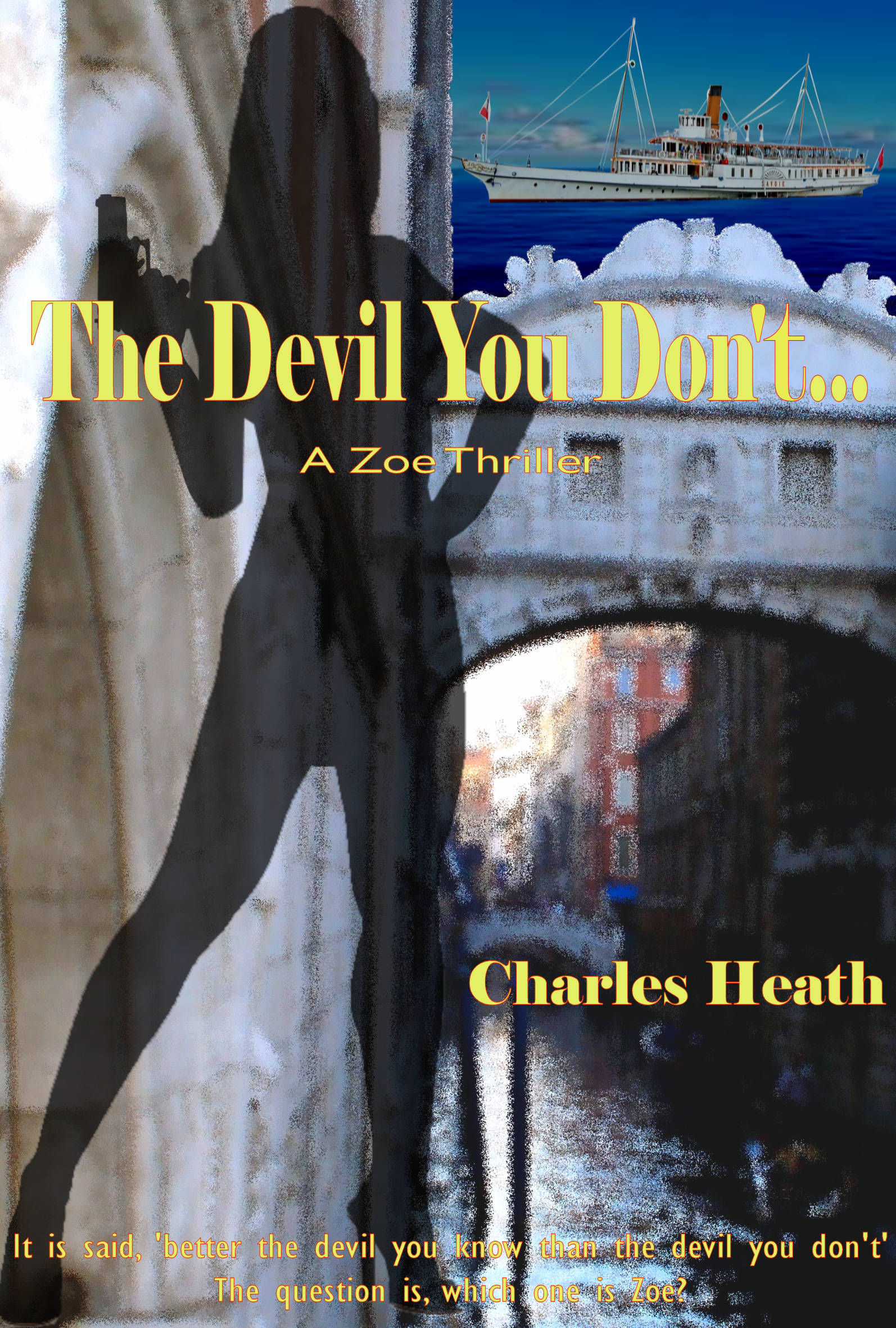
An excerpt from “Strangers We’ve Become” – Coming Soon

I wandered back to my villa.

It was in darkness.  I was sure I had left several lights on, especially over the door so I could see to unlock it.

I looked up and saw the globe was broken.

Instant alert.

I went to the first hiding spot for the gun, and it wasn’t there.  I went to the backup and it wasn’t there either.  Someone had found my carefully hidden stash of weapons and removed them.

Who?

There were four hiding spots and all were empty.  Someone had removed the weapons.  That could only mean one possibility.

I had a visitor, not necessarily here for a social call.

But, of course, being the well-trained agent I’d once been and not one to be caught unawares, I crossed over to my neighbor and relieved him of a weapon that, if found, would require a lot of explaining.

Suitably armed, it was time to return the surprise.

There were three entrances to the villa, the front door, the back door, and a rather strange escape hatch.  One of the more interesting attractions of the villa I’d rented was its heritage.  It was built in the late 1700s, by a man who was, by all accounts, a thief.  It had a hidden underground room which had been in the past a vault but was now a wine cellar, and it had an escape hatch by which the man could come and go undetected, particularly if there was a mob outside the door baying for his blood.

It now gave me the means to enter the villa without my visitors being alerted, unless, of course, they were near the vicinity of the doorway inside the villa, but that possibility was unlikely.  It was not where anyone could anticipate or expect a doorway to be.

The secret entrance was at the rear of the villa behind a large copse, two camouflaged wooden doors built into the ground.  I move aside some of the branches that covered them and lifted one side.  After I’d discovered the doors and rusty hinges, I’d oiled and cleaned them, and cleared the passageway of cobwebs and fallen rocks.  It had a mildew smell, but nothing would get rid of that.  I’d left torches at either end so I could see.

I closed the door after me, and went quietly down the steps, enveloped in darkness till I switched on the torch.  I traversed the short passage which turned ninety degrees about halfway to the door at the other end.  I carried the key to this door on the keyring, found it and opened the door.  It too had been oiled and swung open soundlessly.

I stepped in the darkness and closed the door.

I was on the lower level under the kitchen, now the wine cellar, the ‘door’ doubling as a set of shelves which had very little on them, less to fall and alert anyone in the villa.

Silence, an eerie silence.

I took the steps up to the kitchen, stopping when my head was level with the floor, checking to see if anyone was waiting.  There wasn’t.  It seemed to me to be an unlikely spot for an ambush.

I’d already considered the possibility of someone coming after me, especially because it had been Bespalov I’d killed, and I was sure he had friends, all equally as mad as he was.  Equally, I’d also considered it nigh on impossible for anyone to find out it was me who killed him because the only people who knew that were Prendergast, Alisha, a few others in the Department, and Susan.

That raised the question of who told them where I was.

If I was the man I used to be, my first suspect would be Susan.  The departure this morning, and now this was too coincidental.  But I was not that man.

Or was I?

I reached the start of the passageway that led from the kitchen to the front door and peered into the semi-darkness.  My eyes had got used to the dark, and it was no longer an inky void.  Fragments of light leaked in around the door from outside and through the edge of the window curtains where they didn’t fit properly.  A bone of contention upstairs in the morning, when first light shone and invariably woke me up hours before I wanted to.

Still nothing.

I took a moment to consider how I would approach the visitor’s job.  I would get a plan of the villa in my head, all entrances, where a target could be led to or attacked where there would be no escape.

Coming in the front door.  If I was not expecting anything, I’d just open the door and walk-in.  One shot would be all that was required.

Contract complete.

I sidled quietly up the passage staying close to the wall, edging closer to the front door.  There was an alcove where the shooter could be waiting.  It was an ideal spot to wait.

Crunch.

I stepped on some nutshells.

Not my nutshells.

I felt it before I heard it.  The bullet with my name on it.

And how the shooter missed, from point-blank range, and hit me in the arm, I had no idea.  I fired off two shots before a second shot from the shooter went wide and hit the door with a loud thwack.

I saw a red dot wavering as it honed in on me and I fell to the floor, stretching out, looking up where the origin of the light was coming and pulled the trigger three times, evenly spaced, and a second later I heard the sound of a body falling down the stairs and stopping at the bottom, not very far from me.

Two assassins.

I’d not expected that.

The assassin by the door was dead, a lucky shot on my part.  The second was still breathing.

I checked the body for any weapons and found a second gun and two knives.  Armed to the teeth!

I pulled off the balaclava; a man, early thirties, definitely Italian.  I was expecting a Russian.

I slapped his face, waking him up.  Blood was leaking from several slashes on his face when his head had hit the stairs on the way down.  The awkward angle of his arms and legs told me there were broken bones, probably a lot worse internally.  He was not long for this earth.

“Who employed you?”

He looked at me with dead eyes, a pursed mouth, perhaps a smile.  “Not today my friend.  You have made a very bad enemy.”  He coughed and blood poured out of his mouth.  “There will be more …”

Friends of Bespalov, no doubt.

I would have to leave.  Two unexplainable bodies, I’d have a hard time explaining my way out of this mess.  I dragged the two bodies into the lounge, clearing the passageway just in case someone had heard anything.

Just in case anyone was outside at the time, I sat in the dark, at the foot of the stairs, and tried to breathe normally.  I was trying not to connect dots that led back to Susan, but the coincidence was worrying me.

A half-hour passed and I hadn’t moved.  Deep in thought, I’d forgotten about being shot, unaware that blood was running down my arm and dripping onto the floor.

Until I heard a knock on my front door.

Two thoughts, it was either the police, alerted by the neighbors, or it was the second wave, though why would they be knocking on the door?

I stood, and immediately felt a stabbing pain in my arm.  I took out a handkerchief and turned it into a makeshift tourniquet, then wrapped a kitchen towel around the wound.

If it was the police, this was going to be a difficult situation.  Holding the gun behind my back, I opened the door a fraction and looked out.

No police, just Maria.  I hoped she was not part of the next ‘wave’.

“You left your phone behind on the table.  I thought you might be looking for it.”  She held it out in front of her.

When I didn’t open the door any further, she looked at me quizzically, and then asked, “Is anything wrong?”

I was going to thank her for returning the phone, but I heard her breathe in sharply, and add, breathlessly, “You’re bleeding.”

I looked at my arm and realized it was visible through the door, and not only that, the towel was soaked in blood.

“You need to go away now.”

Should I tell her the truth?  It was probably too late, and if she was any sort of law-abiding citizen she would go straight to the police.

She showed no signs of leaving, just an unnerving curiosity.  “What happened?”

I ran through several explanations, but none seemed plausible.  I went with the truth.  “My past caught up with me.”

“You need someone to fix that before you pass out from blood loss.  It doesn’t look good.”

“I can fix it.  You need to leave.  It is not safe to be here with me.”

The pain in my arm was not getting any better, and the blood was starting to run down my arm again as the tourniquet loosened.  She was right, I needed it fixed sooner rather than later.

I opened the door and let her in.  It was a mistake, a huge mistake, and I would have to deal with the consequences.  Once inside, she turned on the light and saw the pool of blood just inside the door and the trail leading to the lounge.  She followed the trail and turned into the lounge, turned on the light, and no doubt saw the two dead men.

I expected her to scream.  She didn’t.

She gave me a good hard look, perhaps trying to see if I was dangerous.  Killing people wasn’t something you looked the other way about.  She would have to go to the police.

“What happened here?”

“I came home from the cafe and two men were waiting for me.  I used to work for the Government, but no longer.  I suspect these men were here to repay a debt.  I was lucky.”

“Not so much, looking at your arm.”

She came closer and inspected it.

“Sit down.”

She found another towel and wrapped it around the wound, retightening the tourniquet to stem the bleeding.

“Do you have medical supplies?”

I nodded.  “Upstairs.”  I had a medical kit, and on the road, I usually made my own running repairs.  Another old habit I hadn’t quite shaken off yet.

She went upstairs, rummaged, and then came back.  I wondered briefly what she would think of the unmade bed though I was not sure why it might interest her.

She helped me remove my shirt, and then cleaned the wound.  Fortunately, she didn’t have to remove a bullet.  It was a clean wound but it would require stitches.

When she’d finished she said, “Your friend said one day this might happen.”

No prizes for guessing who that friend was, and it didn’t please me that she had involved Maria.

“Alisha?”

“She didn’t tell me her name, but I think she cares a lot about you.  She said trouble has a way of finding you, gave me a phone and said to call her if something like this happened.”

“That was wrong of her to do that.”

“Perhaps, perhaps not.  Will you call her?”

“Yes.  I can’t stay here now.  You should go now.  Hopefully, by the time I leave in the morning, no one will ever know what happened here, especially you.”

She smiled.  “As you say, I was never here.”

© Charles Heath 2018-2022

strangerscover9

Another excerpt from ‘Betrayal’; a work in progress

My next destination in the quest was the hotel we believed Anne Merriweather had stayed at.

I was, in a sense, flying blind because we had no concrete evidence she had been there, and the message she had left behind didn’t quite name the hotel or where Vladimir was going to take her.

Mindful of the fact that someone might have been following me, I checked to see if the person I’d assumed had followed me to Elizabeth’s apartment was still in place, but I couldn’t see him. Next, I made a mental note of seven different candidates and committed them to memory.

Then I set off to the hotel, hailing a taxi. There was the possibility the cab driver was one of them, but perhaps I was slightly more paranoid than I should be. I’d been watching the queue, and there were two others before me.

The journey took about an hour, during which time I kept an eye out the back to see if anyone had been following us. If anyone was, I couldn’t see them.

I had the cab drop me off a block from the hotel and then spent the next hour doing a complete circuit of the block the hotel was on, checking the front and rear entrances, the cameras in place, and the siting of the driveway into the underground carpark. There was a camera over the entrance, and one we hadn’t checked for footage. I sent a text message to Fritz to look into it.

The hotel lobby was large and busy, which was exactly what you’d want if you wanted to come and go without standing out. It would be different later at night, but I could see her arriving about mid-afternoon, and anonymous among the type of clientele the hotel attracted.

I spent an hour sitting in various positions in the lobby simply observing. I had already ascertained where the elevator lobby for the rooms was, and the elevator down to the car park. Fortunately, it was not ‘guarded’ but there was a steady stream of concierge staff coming and going to the lower levels, and, just from time to time, guests.

Then, when there was a commotion at the front door, what seemed to be a collision of guests and free-wheeling bags, I saw one of the seven potential taggers sitting by the front door. Waiting for me to leave? Or were they wondering why I was spending so much time there?

Taking advantage of that confusion, I picked my moment to head for the elevators that went down to the car park, pressed the down button, and waited.

The was no car on the ground level, so I had to wait, watching, like several others, the guests untangling themselves at the entrance, and an eye on my potential surveillance, still absorbed in the confusion.

The doors to the left car opened, and a concierge stepped out, gave me a quick look, then headed back to his desk. I stepped into the car, pressed the first level down, the level I expected cars to arrive on, and waited what seemed like a long time for the doors to close.

As they did, I was expecting to see a hand poke through the gap, a latecomer. Nothing happened, and I put it down to a television moment.

There were three basement levels, and for a moment, I let my imagination run wild and considered the possibility that there were more levels. Of course, there was no indication on the control panel that there were any other floors, and I’d yet to see anything like it in reality.

With a shake of my head to return to reality, the car arrived, the doors opened, and I stepped out.

A car pulled up, and the driver stepped out, went around to the rear of his car, and pulled out a case. I half expected him to throw me the keys, but the instant glance he gave me told him was not the concierge, and instead brushed past me like I wasn’t there.

He bashed the up button several times impatiently and cursed when the doors didn’t open immediately. Not a happy man.

Another car drove past on its way down to a lower level.

I looked up and saw the CCTV camera, pointing towards the entrance, visible in the distance. A gate that lifted up was just about back in position and then made a clunk when it finally closed. The footage from the camera would not prove much, even if it had been working, because it didn’t cover the life lobby, only in the direction of the car entrance.

The doors to the other elevator car opened, and a man in a suit stepped out.

“Can I help you, sir? You seem lost.”

Security, or something else. “It seems that way. I went to the elevator lobby, got in, and it went down rather than up. I must have been in the wrong place.”

“Lost it is, then, sir.” I could hear the contempt for Americans in his tone. “If you will accompany me, please.”

He put out a hand ready to guide me back into the elevator. I was only too happy to oblige him. There had been a sign near the button panel that said the basement levels were only to be accessed by the guests.

Once inside, he turned a key and pressed the lobby button. The doors closed, and we went up. He stood, facing the door, not speaking. A few seconds later, he was ushering me out to the lobby.

“Now, sir, if you are a guest…”

“Actually, I’m looking for one. She called me and said she would be staying in this hotel and to come down and visit her. I was trying to get to the sixth floor.”

“Good. Let’s go over the the desk and see what we can do for you.”

I followed him over to the reception desk, where he signalled one of the clerks, a young woman who looked and acted very efficiently, and told her of my request, but then remained to oversee the proceeding.

“Name of guest, sir?”

“Merriweather, Anne. I’m her brother, Alexander.” I reached into my coat pocket and pulled out my passport to prove that I was who I said I was. She glanced cursorily at it.

She typed the name into the computer, and then we waited a few seconds while it considered what to output. Then, she said, “That lady is not in the hotel, sir.”

Time to put on my best-confused look. “But she said she would be staying here for the week. I made a special trip to come here to see her.”

Another puzzled look from the clerk, then, “When did she call you?”

An interesting question to ask, and it set off a warning bell in my head. I couldn’t say today, it would have to be the day she was supposedly taken.

“Last Saturday, about four in the afternoon.”

Another look at the screen, then, “It appears she checked out Sunday morning. I’m afraid you have made a trip in vain.”

Indeed, I had. “Was she staying with anyone?”

I just managed to see the warning pass from the suited man to the clerk. I thought he had shown an interest when I mentioned the name, and now I had confirmation. He knew something about her disappearance. The trouble was, he wasn’t going to volunteer any information because he was more than just hotel security.

“No.”

“Odd,” I muttered. “I thought she told me she was staying with a man named Vladimir something or other. I’m not too good at pronouncing those Russian names. Are you sure?”

She didn’t look back at the screen. “Yes.”

“OK, now one thing I do know about staying in hotels is that you are required to ask guests with foreign passports their next destination, just in case they need to be found. Did she say where she was going next?” It was a long shot, but I thought I’d ask.

“Moscow. As I understand it, she lives in Moscow. That was the only address she gave us.”

I smiled. “Thank you. I know where that is. I probably should have gone there first.”

She didn’t answer; she didn’t have to, her expression did that perfectly.

The suited man spoke again, looking at the clerk. “Thank you.” He swivelled back to me. “I’m sorry we can’t help you.”

“No. You have more than you can know.”

“What was your name again, sir, just in case you still cannot find her?”

“Alexander Merriweather. Her brother. And if she is still missing, I will be posting a very large reward. At the moment, you can best contact me via the American Embassy.”

Money is always a great motivator, and that thoughtful expression on his face suggested he gave a moment’s thought to it.

I left him with that offer and left. If anything, the people who were holding her would know she had a brother, that her brother was looking for her, and equally that brother had money.

© Charles Heath – 2018-2025

“Sunday in New York”, a romantic adventure that’s not a walk in the park!

“Sunday in New York” is ultimately a story about trust, and what happens when a marriage is stretched to its limits.

When Harry Steele attends a lunch with his manager, Barclay, to discuss a promotion that any junior executive would accept in a heartbeat, it is the fact his wife, Alison, who previously professed her reservations about Barclay, also agreed to attend, that casts a small element of doubt in his mind.

From that moment, his life, in the company, in deciding what to do, his marriage, his very life, spirals out of control.

There is no one big factor that can prove Harry’s worst fears, that his marriage is over, just a number of small, interconnecting events, when piled on top of each other, points to a cataclysmic end to everything he had believed in.

Trust is lost firstly in his best friend and mentor, Andy, who only hints of impending disaster, Sasha, a woman whom he saved, and who appears to have motives of her own, and then in his wife, Alison, as he discovered piece by piece damning evidence she is about to leave him for another man.

Can we trust what we see with our eyes or trust what we hear?

Haven’t we all jumped to conclusions at least once in our lives?

Can Alison, a woman whose self-belief and confidence is about to be put to the ultimate test, find a way of proving their relationship is as strong as it has ever been?

As they say in the classics, read on!

Purchase:

http://tinyurl.com/Amazon-SundayInNewYork

“Trouble in Store” – Short stories my way: Actions have consequences

It’s time for the policewoman to arrive.

There is such a thing as pure dumb luck.

If she had not walked through the door when she did, then Jack wouldn’t have walked away.

From the policewoman’s perspective:

She crossed the street from the corner instead of remaining on the same side of the street as she did every other night.  When she reached the other sidewalk, she was about twenty yards from the nearest window of the store.

As she crossed, she got a better view of the three people in the store and noticed the woman, or girl, was acting oddly as if she had something in her hand, and, from time to time looked down beside her.

A yard or two from the window she stopped, took a deep breath, and then moved slowly, getting a better view of the scene with each step.

Then she saw the gun in the girl’s hand, and the two men, the shopkeeper and a customer facing her both with their hands raised.

It was a convenience store robbery in progress.

She reached for her radio, but it wasn’t there.  She was off duty.  Instead, she withdrew, and called the station on her mobile phone, and reported the robbery.  The officer at the end of the phone said a car would be there in five minutes.

In five minutes there could be dead bodies.

She had to do something, and reached into her bag and pulled out a gun.  Not her service weapon, but one she carried in case of personal danger.

Guns are dangerous weapons in the hands of professional and amateur alike.  You would expect a professional who has trained to use a gun to not have a problem but consider what might happen in exceptional circumstances.

People freeze under pressure.  Alternately, some shoot first and ask questions later.

We have an edgy and frightened girl with a loaded gun, one bullet or thirteen in a magazine, it doesn’t matter.  It only takes one bullet to kill someone.

Then there’s the trigger pressure, light or heavy, the recoil after the shot and whether it causes the bullet to go into or above the intended target, especially if the person has never used a gun.

The policewoman, with training, will need two hands to take the shot, but in getting into the shop she will need one to open the door, and then be briefly distracted before using that hand to steady the other.

It will take a lifetime, even if it is only a few seconds.

Actions have consequences:

The policewoman crouched below the window shelf line so the girl wouldn’t see her and made it to the door before straightening.  She was in dark clothes so the chances were the girl would not see her against the dark street backdrop.

Her hand was on the door handle about to push it inwards when she could feel it being yanked hard from the other side, and the momentum and surprise of it caused her to lose balance and crash into the man who was trying to get out.

What the hell…

A second or two later both were on the floor in a tangled mess, her gun hand caught underneath her, and a glance in the direction of the girl with the gun told her the situation had deteriorated.

The girl had swung the gun around, aimed it at her, and squeezed the trigger twice.

The two bangs in the small room were almost deafening and disorientating.

Behind her, the glass door disintegrated when the bullet hit it.

Neither she nor the man beside her had been hit.

Yet.

She felt a kick in the back and the tickling of glass then broke free as the man she’d run into rolled out of the way.

Quickly on her feet, she saw the girl had gone, and wasted precious seconds getting up off the floor, then out the door to find she had disappeared.

She could hear a siren in the distance.  They’d find her.

If the policewoman had not picked that precise moment to enter the shop, maybe the man would have got away.

Maybe.

If he’d been aware of the fact he was allowed to leave.

He was lucky not to be shot.

Yet there were two shots, and we know at least one of them broke the door’s glass panel.

Next – The end of the story

© Charles Heath 2016-2024

The cinema of my dreams – Was it just another surveillance job – Episode 58

This story is now on the list to be finished so over the new few weeks, expect a new episode every few days.

The reason why new episodes have been sporadic, there are also other stories to write, and I’m not very good at prioritizing.

But, here we are, a few minutes opened up and it didn’t take long to get back into the groove.

Things are about to get complicated…


“You’re not a target.  Yet.”

“Severin?”

“A loose end who was a rather bad blunt instrument, like his friend Maury.  They learned of a plan to steal some military secrets, tried to stop it and in the end almost destroyed 12 months of painstaking undercover work.  O’Connell had it within his grasp, and therefore in safe hands when those two wrecked a perfectly good retrieval.  Four potential agents dead and then there’s you, persistent I will admit, and one other, Jennifer, I believe her name is.”

“But you don’t have O’Connell, do you?”

“My, you have been working hard.  My first mistake was to trust O’Connell.  My second was to underestimate you, Jackson.  I don’t intend to make a third.  You don’t trust me, do you?”

Was it possible I’d get some version of the truth?

“Apparently he didn’t for some reason.”

“You found him.  Jan said you were being all secretive.  There was something you found in that flat in Peaslake.”

“No.  He told me that in the alley.” 

I sensed he knew way more than I did, but I had a missing piece, and he was going to play nice to get it.   The thing is, I didn’t know what that was.  Not the whole truth from me.

“Yes.  Of course, he did.”

“Perhaps it was self-preservation, not that it did much since someone did shoot him.”

“Not with the intention of killing him.  It was all arranged.”

“You knew he would be at that alley?”

“One of three escape routes.  Neither of us anticipated you would be good enough to follow him.  Severin got lucky with you, probably why he made you the lead.”

Severin hadn’t said as much when he told the group before the exercise began, that I would take point.  I thought it was simply because in the prior five tests, I’d only failed one.  Everyone else had varying results.

“Have you seen the CCTV footage of the explosion?”

“Several times.  It must have been harrowing for you to relive that and see how close you came.”

“It did.  But it did afford a view that I missed while preoccupied.  McConnell and the wife of the scientist I believe stole the formulas.”

“Yes, Anna.   What do you make of her?”

“From a single glimpse?”

“A good agent doesn’t need much to form an opinion.  As you know, that opinion could be the difference between life and death.”

He was starting to sound like Severin.  He said we had to be able to judge a book by its cover and make the right decision based on it.  What did I think of Anna?

“Capable, determined.  She survived an explosion that might well have been directed at her.  Not your average scientist’s wife. “

“Did you check her out?”

“Not yet.  I had this thing with Severin.”

“What did he want?”

“I don’t know.  Jan killed him before he could tell me.”

“A guess?”

“He wanted to come in from the cold before he ended up like Maury.  He knew his days were numbered.  It also means that he knew something that someone didn’t want to be repeated.  You, perhaps?  I mean, you can help make the connection.  Your idea for Jan to get his confidence?”

“Hers.  She’s a good agent, so don’t worry about her.  Find O’Connell.  When you do, you will find Anna, and perhaps, a copy of that USB.”

“And if I don’t?”

“Then the department has lost five million pounds.”

© Charles Heath 2020-2023

What I learned about writing: The murky art of plotting (2)

Truth is stranger than fiction

The Unseen Shadows: When “Not Suspicious” Hides a Deadly Truth

In the quiet hum of suburban life, where hedges are trimmed and routines are sacred, sometimes the most chilling stories unfold not with a bang, but with a whisper. A seemingly ordinary day, an ordinary house, and a tragedy that, on the surface, appears tragically straightforward.

This week, a news blurb, easily missed, caught my eye. It spoke of a man and a woman, new in their courtship, found deceased in an ordinary suburban home following a welfare call. Their bodies lay side-by-side on the floor. The initial report was stark, almost dismissive: police were not treating the deaths as suspicious.

And that, my friends, is exactly where our story truly begins.

Because what if “not suspicious” is merely the first layer of a far more intricate, and sinister, narrative? What if that seemingly benign conclusion is precisely the moment when a seasoned investigator should lean a little closer, peer beyond the immediate, and ask: “But what if…?”

In our hypothetical deep dive, the scene, initially dismissed as a tragic dual overdose, starts to sing a different tune – one of carefully orchestrated deception.

The Discordant Notes Begin to Play

For a keen eye, particularly one belonging to someone like Detective Chief Inspector Barnes, the “simple case” quickly unravels:

  1. The Implausible Overdose: The immediate assumption was drugs. Yet, friends of the deceased knew them as anything but recreational users. And even if they were, “lying on the floor at home” didn’t align with their known habits. Most tellingly? No drugs were found in the house, save for residual traces on the bodies themselves. Sniffer dogs confirmed this, finding nothing else. This isn’t just unusual; it suggests a planting of evidence, a narrative carefully constructed.
  2. The Selective Theft: In an upstairs office, a laptop was missing – not the charger or the mouse, just the computer itself. Both their cell phones were also gone. Yet, amidst this targeted disappearance, a significant sum of cash, around £500, was left untouched. If this was a robbery, it was remarkably selective, focusing not on valuables, but on information. A thief with a very particular agenda.
  3. The Silent Bruise: A preliminary examination of the woman’s body revealed bruising on her neck. A subtle mark, easily overlooked, but one that strongly suggested a struggle, a chokehold perhaps. This detail alone pushes the needle firmly away from “natural causes” or “accidental overdose” and towards something far more violent. The coroner’s report would confirm, but the suspicion was planted.
  4. The Ghost in the System: And then, the final, chilling piece of the puzzle. A routine check on the male victim’s name returned an “access denied” flag. In our interconnected world, such a block isn’t accidental. It screams of a hidden identity, a past carefully shielded, perhaps even a life lived undercover.

From Misadventure to Murder

For Detective Chief Inspector Barnes, these four seemingly disparate points converged into a single, inescapable truth. What began as a welfare check, initially deemed tragic but benign, was rapidly transforming into something far more sinister: a potential double murder. The scene, far from being straightforward, was a meticulously staged tableau designed to mislead, to funnel investigators down a path of false assumptions.

This fictional scenario, drawn from the briefest of news items and a “what if” musing, serves as a powerful reminder: appearances can be deceiving. The most unassuming details often hold the key, and sometimes, the loudest silence speaks volumes. It’s a testament to the fact that true investigation isn’t about accepting the obvious, but about questioning everything, about looking for the unseen shadows lurking just beneath the surface of the “not suspicious.”

“Trouble in Store” – Short stories my way: Adding a catalyst

Just when there’s enough complication in the story, we could leave it there with the current three protagonists and see what happens.

But I like mayhem.

So rather than another customer, it’s time to add a complication; an off-duty policeman, or more to the point, policewoman.  A beat cop, if they still exist.

Her back story in a sentence or so:

It had been another long day at the office for Officer Margaret O’Donnell, or, out in the streets, coping with people who either didn’t know or didn’t care about the law.

People who couldn’t cross the road where there were crossings and lights to protect them, silly girls shoplifting on a dare, and boys who thought they were men and could walk on water.

The one they scraped off the road would never get to grow up, and his mother, well, she was not doing another call on a family to give them the bad news.

That was her day.  So far.

What is she doing near the shop?  She lives around the corner.  Perhaps she knows the reputation of the shopkeeper or perhaps not.  It’s not relevant, then, as it is a place she avoids.

Now, she may not have the option.  She sees the shop is still open, past the usual closing time.

Let’s continue:

She came around the corner into the street where she lived and saw the lights were on in the corner store.

She looked at her watch and saw it was ten minutes to midnight.  Long past closing time.  She looked through the window but from the other side of the road and could only see three heads and little else.

Damn, she thought, I’m going to have to check it out.  There were rumours, and she hoped they were not true.

Meanwhile, back in the shop how are the others faring?

The shopkeeper is in an invidious position, he can’t supply the kids with the drugs and get them out, not in front of the customer.

The fact the girl has a gun makes the situation almost impossible.  What would happen if he suggests the customer leave?  Without him, the situation would be simpler.

Alphonse had only a few moments to sum up the situation, and the sum of those deliberations was the remove the only problem, the customer.

He could still salvage this:

The shopkeeper changed his expression to one more placatory, and said quietly to the girl, ‘Look, this is not this chap’s problem.’  He nodded in the direction of the customer.  ‘I’m sure he’d rather not be here, and you would be glad of one less distraction.’

He could see she was wavering, she was not holding the gun so steadily, and the longer this dragged on, the more nervous and unpredictable she would become.

And in the longer game, the customer would sing his praises no matter what happened after he left.

The girl looked at Jack.  The shopkeeper was right.  If he wasn’t here this could be over.  But there was another problem.  It didn’t look like Simmo was in any shape to get away.  In fact, this was looking more like a suicide mission.

She waved the gun in his direction.  ‘Get out now, before I change my mind.’

As the gun turned to the shopkeeper, Jack wasn’t going to wait to be asked twice and started sidling towards the door.

What happens next?

And the story for this section, with a few minor changes:

It had been another long day at the office for Officer Margaret O’Donnell, or, out in the streets, coping with people who either didn’t know or didn’t care about the law.

People who couldn’t cross the road where there were crossings and lights to protect them, silly girls shoplifting on a dare, and boys who thought they were men and could walk on water.

The one they scraped of the road would never get to grow up, and his mother, well, she was not doing another call on a family to give them the bad news.

That was her day.  So far.  For now, she was glad to be getting home, putting her feet up, and forgetting about everything until the next morning when it would start all over again.

Coming around that last corner, the home stretch she called it, she was directly opposite the corner shop, usually closed at this hour of the night.  It was not.  The lights were still on.

She looked at her watch and saw it was ten minutes to midnight, and long past closing time.  She looked through the window but from the other side of the road and could only see three heads and little else.

Damn, she thought, I’m going to have to check it out.  There were rumours, and she hoped they were not true.

The shopkeeper changed his expression to one more placatory, and said quietly to the girl, ‘Look, this is not this chap’s problem.’  He nodded in the direction of the customer.  ‘I’m sure he’d rather not be here, and you would be glad of one less distraction.’

He could see she was wavering, she was not holding the gun so steadily, and the longer this dragged on, the more nervous and unpredictable she would become.

And in the longer game, the customer would sing his praises no matter what happened after he left.

The girl looked at Jack.  The shopkeeper was right.  If he wasn’t here this could be over.  But there was another problem.  It didn’t look like Simmo was in any shape to get away.  In fact, this was looking more like a suicide mission.

She waved the gun in his direction.  ‘Get out now, before I change my mind.’

As the gun turned to the shopkeeper, Jack wasn’t going to wait to be asked twice and started sidling towards the door.

Next:  Actions have consequences

© Charles Heath 2016-2023

Memories of the conversations with my cat – 91

As some may be aware, but many not, Chester, my faithful writing assistant, mice catcher, and general pain in the neck, passed away some years ago.

Recently I was running a series based on his adventures, under the title of Past Conversations with my cat.

For those who have not had the chance to read about all of his exploits I will run the series again from Episode 1

These are the memories of our time together…

20161008_135125_001

This is Chester.

We’re having an interesting time in the quest for self-isolation.

It seems he doesn’t like the idea that we are still going out, and coming back, potentially bringing the virus back.

This, of course, despite the fact that there are no confirmed cases of the virus attacking cats.

That doesn’t mean that Chester might be the first cat that does.

Out of curiosity, and perhaps against my better judgment, I have to ask what his reasoning is.

Old age, he says.  If you are telling me the truth then I’m about 18 cat years old, which means it’s about 126 of your years.

I can see where this is going.  It’s my fault because I’ve left the running count of Coronavirus patients worldwide on one of my computer screens.

As of this morning, there are 393,000 cases worldwide.  He was sitting next to me when I  was looking at the statistical data on the various ages and pre-existing conditions.

For him, apparently, there was only one statistic that mattered.  Anyone over 90 in human years had little chance of surviving.

I reiterate the virus doesn’t attack cats.

I also tell him that I have no intention of getting the virus.  But it raises a point I hadn’t considered.

Going out anywhere always has a risk, whether to the supermarket or the pharmacy which are basically the only places I go.  Then there is the situation of my wife, who is still working and has to go to work.  That is a bigger risk considering one of the staff will be coming back from overseas.

How successful the self-isolation rule is, and whether everyone complies, is a matter of conjecture, and one has to wonder if 14 days in isolation is long enough.

Chester has raised a legitimate point, not necessarily in relation to himself.

Perhaps he might be worried about us.

And if that is the case, will the specter of this virus finally become the catalyst for a change in the relationship between cats and people, where they might realize we are more important to them than they currently believe.

Let’s see what happens.

The cinema of my dreams – Was it just another surveillance job – Episode 57

This story is now on the list to be finished so over the new few weeks, expect a new episode every few days.

The reason why new episodes have been sporadic, there are also other stories to write, and I’m not very good at prioritizing.

But, here we are, a few minutes opened up and it didn’t take long to get back into the groove.

Things are about to get complicated…


I hadn’t realised until I said it out loud to someone who would not understand the significance of it, just how far-fetched the reason was.

But in my newly adopted world, it made perfect sense.

 Spies dealt with many things, mostly the notion of a threat, and the removal of it, whether it is an object like a USB or a person, or persons, who could make the threat become a reality.

This threat started with a laboratory working for the military to produce biological weapons.  Then the funding stopped, for whatever reason, and the laboratory had to cover its losses.

What better way than to hawk the formula on the dark web?

Someone perceived that the laboratory would become a threat and dispatched operatives to monitor the situation.

The worst-case scenario occurs, but from a different standpoint, the outrage of a community-conscious scientist who didn’t like the idea of people creating monstrous weapons and steals the formula to leak to the media.

The laboratory is shut down by the government before the formula could be sold, but there is a copy in play via the scientist.

The scientist, and therefore the threat, neutralised.

The threat then moves to his wife, who contacts someone in the Department, likely but not necessarily Dobbin, who then assigns O’Connell to find the wife and offer a lot of cash for the formula.

She agrees.

Somehow, the planted operatives, Severin and Maury discover the wife and O’Connell’s arrangement.

They create a surveillance group with the intention of monitoring the handover and then try to remove both O’Connell and the wife.

For what reason.  The threat would have been removed unless O’Connell and Dobbin had another agenda.  Why then when Dobbin rescued O’Connell, did O’Connell then turn on him?

A relationship with the wife?

Or was it simply the thought of making a huge sum of money, one both O’Connell and the wife could retire on.  He would not be the first spy to sell his soul for twenty pieces of silver.

But the good news, was we had Severin’s assassin.

The plan from there was to hand her over to the Detective Inspector, who didn’t have an agenda other than getting to the truth and keeping Jan away from Dobbin, or anyone who could set her free.

That plan was quashed the moment I saw Dobbin turn up at the scene.  He knew where Severin would be, he must know Severin was meeting with me, and he had sent Jan.

The fact I was still alive meant he wanted something from me.

The question was whether he knew if Jan had been taken off the playing field.

“What the hell is he doing here?”

It was the exact question in my head, though I was closer to answer than she was.

“Run interference, or worse, take over this case too.”

“I thought that was left in the hands of MI5.”

“He turned up after you left.”

She shrugged.  “Above my pay grade, to be honest.  He can have it.  I prefer to deal with the mundane, common thieves or murderers.  None of this cloak-and-dagger stuff.   I’ll tell my Super about the biological stuff, but you have to admit it is a bit farfetched.  There’s a more rational explanation for these deaths, you just have to look harder.  Now, if there’s nothing else?”

Too late to escape, Dobbin had circled around and reached us before I could disappear.

“You seem to turn up to department crime scenes with alarming regularity, Sam.  Any particular reason you’re here?”

The Detective Inspector had expected him to talk to her, not me.

“He’s just another possible witness on the periphery of a crime.  You’re here because?

“It’s one of our people.  I’m afraid…”

“…you’re going to have to take over?  Be my guest.  Your friend here is altogether far too uncooperative, like the rest of you.  I am going to file a formal complaint.”

.“And I’m sure it will be seen by the relevant people.”

She just shrugged and walked away, waving her hand at no one in particular

I waited until she was out of hearing range and asked, “So, why didn’t Jan shoot me too?”

© Charles Heath 2020-2023

What I learned about writing: The murky art of plotting! (1)

Truth is stranger than fiction

Google Maps: More Than Just Directions – A Portal to Phantom Mysteries?

We all use Google Maps. It’s our trusty co-pilot, guiding us through unfamiliar streets, helping us find the nearest coffee shop, and even letting us snoop on our old childhood homes (admit it, you’ve done it!). But what if I told you that sometimes, beneath the familiar satellite imagery, Google Maps offers a glimpse into something far stranger than your aunt’s meticulously manicured lawn?

Lately, chatter has been building around peculiar anomalies popping up on the platform – digital specters appearing where they absolutely shouldn’t. Imagine panning over a dense, untouched forest, far from any airport, only to find a colossal Airbus A320 or Boeing 737 perfectly intact, sitting in a clearing. No missing plane reports, no emergency landings, just a commercial jetliner chilling amongst the trees. How did it get there? And more importantly, why?

This isn’t an isolated incident. There are numerous reports of cars, sometimes multiple vehicles, resting eerily at the bottom of lakes, visible from above. While many of these are indeed phantom images, some chillingly prove to be real. You might recall the story of the car discovered in a lake in Florida, which, upon investigation, contained the remains of a man who had been missing for over two decades. The digital anomaly led to a very real, very tragic discovery.

So, before we reach for our tinfoil hats, there’s a rational explanation for most of these ghostly appearances. The phenomenon is often an instance of image overlay or “ghosting.” Google Maps stitches together countless satellite and aerial photographs taken at different times. When an object, like a low-flying aircraft, is captured in one image over a particular spot, and a later, object-free image of the same spot is layered on top, a faint “ghost” of the original object can remain visible. The plane in the forest? It’s highly probable it was just flying incredibly low when the initial photograph was taken, leaving its digital imprint on the landscape.

Mystery solved, right? Well, mostly.

But what if, just what if, these digital echoes aren’t always mere glitches? What if, sometimes, they are whispers of something more, waiting to be heard?


Mick knew all about those lonely leisure hours when there was nothing else to do. He wasn’t one for idly scrolling social media; Mick was a tramper, a genuine trailblazer. His idea of relaxation was poring over topographical maps, looking for untouched corners of the world, sketching out potential new paths through forests, and dreaming of odd discoveries. Years ago, one such expedition had led him to uncover a lost village of significant archaeological value. He had a knack for finding things.

One drizzly afternoon, with the rain drumming against his window, Mick found himself drifting through Google Maps, exploring remote stretches of a national forest known for its dense, ancient foliage. He zoomed in, panned around, his cursor tracing imaginary trails. He wasn’t looking for glitches, but for inspiration, for the subtle hints of untamed beauty.

Then he saw it.

Not a ghost, not a blur, but what seemed to be distinct wreckage dispersed in a clearing. Glimpses of what looked like metal fragments, incongruous against the deep green canopy. It wasn’t the clean, whole plane of famous internet anomalies, but a scattering, undeniably man-made and out of place. He noted the date of the photograph – nearly a year prior.

A chill ran down his spine. He immediately checked local news archives, aviation reports, anything about missing small planes or crashes in the area. Nothing. Not a single mention. It was too remote for a simple crash to go unnoticed, yet too significant to be naturally occurring.

He kept the location saved, revisiting it over the next few days. It gnawed at him. Was it a trick of the light? A bizarre anomaly of the photo processing? He called a friend, an equally seasoned bushwalker, and explained his digital discovery, asking him to verify it on his own map.

“Right, mate, I’m looking,” came his friend’s voice over the phone a few minutes later. “Where exactly did you say?”

Mick guided him, pixel by pixel. “See it? Right there, by that cluster of three oaks…”

There was a pause. “Uh, Mick? There’s just… trees.”

Mick’s stomach dropped. He clicked back to his own map. The wreckage was gone. The clearing was pristine, just an unbroken expanse of forest. He felt a wave of self-doubt. Had his mind been playing tricks, wanting to find something remarkable, perhaps fabricating the whole thing?

But then he noticed it. The date of the photograph displayed on his screen had updated. It was no longer the nearly-a-year-old image. It was a new one, taken just a few weeks ago.

The digital ghost had vanished, but the seed of a real-world mystery had been planted. With the rain still falling and nothing better to do, Mick knew exactly what his next walking holiday would entail. He wasn’t just going to look at maps anymore. He was going to see what was really there.