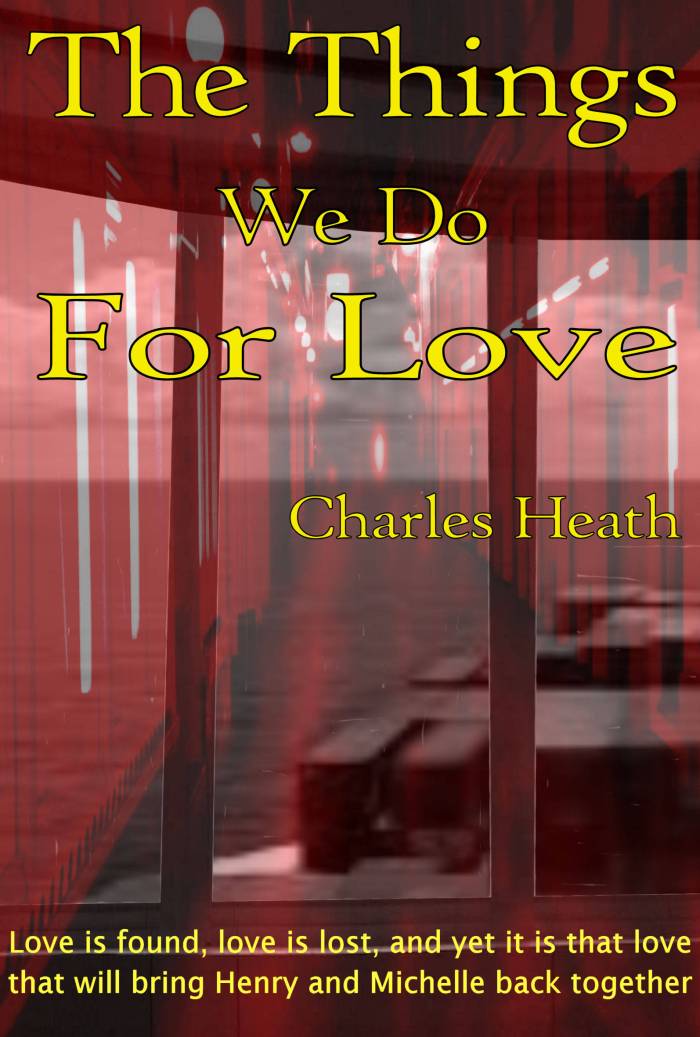
An excerpt from “The Things We Do for Love”; In love, Henry was all at sea!

In the distance, he could hear the dinner bell ringing and roused himself.  Feeling the dampness of the pillow, and fearing the ravages of pent-up emotion, he considered not going down but thought it best not to upset Mrs. Mac, especially after he said he would be dining.

In the event, he wished he had reneged, especially when he discovered he was not the only guest staying at the hotel.

Whilst he’d been reminiscing, another guest, a young lady, had arrived.  He’d heard her and Mrs. Mac coming up the stairs and then shown to a room on the same floor, perhaps at the other end of the passage.

Henry caught his first glimpse of her when she appeared at the door to the dining room, waiting for Mrs. Mac to show her to a table.

She was in her mid-twenties, slim, with long brown hair, and the grace and elegance of a woman associated with countless fashion magazines.  She was, he thought, stunningly beautiful with not a hair out of place, and make-up flawlessly applied.  Her clothes were black, simple, elegant, and expensive, the sort an heiress or wife of a millionaire might condescend to wear to a lesser occasion than dinner.

Then there was her expression; cold, forbidding, almost frightening in its intensity.  And her eyes, piercingly blue and yet laced with pain.  Dracula’s daughter was his immediate description of her.

All in all, he considered, the only thing they had in common was, like him, she seemed totally out of place.

Mrs. Mac came out of the kitchen, wiping her hands on her apron.  She was, she informed him earlier, chef, waitress, hotelier, barmaid, and cleaner all rolled into one.  Coming up to the new arrival she said, “Ah, Miss Andrews, I’m glad you decided to have dinner.  Would you like to sit with Mr. Henshaw, or would you like to have a table of your own?”

Henry could feel her icy stare as she sized up his appeal as a dining companion, making the hair on the back of his neck stand up.  He purposely didn’t look back.  In his estimation, his appeal rating was minus six.  Out of a thousand!

“If Mr. Henshaw doesn’t mind….”  She looked at him, leaving the query in mid-air.

He didn’t mind and said so.  Perhaps he’d underestimated his rating.

“Good.”  Mrs. Mac promptly ushered her over.  Henry stood, made sure she was seated properly and sat.

“Thank you.  You are most kind.”  The way she said it suggested snobbish overtones.

“I try to be when I can.”  It was supposed to nullify her sarcastic tone but made him sound a little silly, and when she gave him another of her icy glares, he regretted it.

Mrs. Mac quickly intervened, asking, “Would you care for the soup?”

They did, and, after writing the order on her pad, she gave them each a look, imperceptibly shook her head, and returned to the kitchen.

Before Michelle spoke to him again, she had another quick look at him, trying to fathom who and what he might be.  There was something about him.

His eyes, they mirrored the same sadness she felt, and, yes, there was something else, that it looked like he had been crying?  There was a tinge of redness.

Perhaps, she thought, he was here for the same reason she was.

No.  That wasn’t possible.

Then she said, without thinking, “Do you have any particular reason for coming here?”  Seconds later she realized she’d spoken it out loud, had hadn’t meant to actually ask, it just came out.

It took him by surprise, obviously not the first question he was expecting her to ask of him.

“No, other than it is as far from civilization, and home, as I could get.”

At least we agree on that, she thought.

It was obvious he was running away from something as well.

Given the isolation of the village and lack of geographic hospitality, it was, from her point of view, ideal.  All she had to do was avoid him, and that wouldn’t be difficult.

After getting through this evening first.

“Yes,” she agreed.  “It is that.”

A few seconds passed, and she thought she could feel his eyes on her and wasn’t going to look up.

Until he asked, “What’s your reason?”

Slightly abrupt in manner, perhaps, because of her question and how she asked it.

She looked up.  “Rest.  And have some time to myself.”

She hoped he would notice the emphasis she had placed on the word ‘herself’ and take due note.  No doubt, she thought, she had completely different ideas of what constituted a holiday than he, not that she had said she was here for a holiday.

Mrs. Mac arrived at a fortuitous moment to save them from further conversation.

Over the entree, she wondered if she had made a mistake coming to the hotel.  Of course, there had been no conceivable way she could know that anyone else might have booked the same hotel, but realized it was foolish to think she might end up in it by herself.

Was that what she was expecting?

Not a mistake then, but an unfortunate set of circumstances, which could be overcome by being sensible.

Yet, there he was, and it made her curious, not that he was a man, by himself, in the middle of nowhere, hiding like she was, but for quite varied reasons.

On discreet observance, whilst they ate, she gained the impression his air of light-heartedness was forced, and he had no sense of humour.

This feeling was engendered by his looks, unruly dark hair, and permanent frown.  And then there was his abysmal taste in clothes on a tall, lanky frame.  They were quality but totally unsuited to the wearer.

Rebellion was written all over him.

The only other thought crossing her mind, and incongruously, was he could do with a decent feed.  In that respect, she knew now from the mountain of food in front of her, he had come to the right place.

“Mr. Henshaw?”

He looked up.  “Henshaw is too formal.  Henry sounds much better,” he said, with a slight hint of gruffness.

“Then my name is Michelle.”

Mrs. Mac came in to take their order for the only main course, gather up the entree dishes, and then return to the kitchen.

“Staying long?” she asked.

“About three weeks.  Yourself?”

“About the same.”

The conversation dried up.

Neither looked at the other, rather at the walls, out the window, towards the kitchen, anywhere.  It was, she thought, unbearably awkward.

Mrs. Mac returned with a large tray with dishes on it, setting it down on the table next to theirs.

“Not as good as the usual cook,” she said, serving up the dinner expertly, “but it comes a good second, even if I do say so myself.  Care for some wine?”

Henry looked at Michelle.  “What do you think?”

“I’m used to my dining companions making the decision.”

You would, he thought.  He couldn’t help but notice the cutting edge of her tone.  Then, to Mrs. Mac, he named a particular White Burgundy he liked, and she bustled off.

“I hope you like it,” he said, acknowledging her previous comment with a smile that had nothing to do with humour.

“Yes, so do I.”

Both made a start on the main course, a concoction of chicken and vegetables that were delicious, Henry thought when compared to the bland food he received at home and sometimes aboard my ship.

It was five minutes before Mrs Mac returned with the bottle and two glasses.  After opening it and pouring the drinks, she left them alone again.

Henry resumed the conversation.  “How did you arrive?  I came by train.”

“By car.”

“Did you drive yourself?”

And he thought, a few seconds later, that was a silly question, otherwise she would not be alone, and certainly not sitting at this table. With him.

“After a fashion.”

He could see that she was formulating a retort in her mind, then changed it, instead, smiling for the first time, and it served to lighten the atmosphere.

And in doing so, it showed him she had another more pleasant side despite the fact she was trying not to look happy.

“My father reckons I’m just another of ‘those’ women drivers,” she added.

“Whatever for?”

“The first and only time he came with me I had an accident.  I ran up the back of another car.  Of course, it didn’t matter to him the other driver was driving like a startled rabbit.”

“It doesn’t help,” he agreed.

“Do you drive?”

“Mostly people up the wall.”  His attempt at humour failed.  “Actually,” he added quickly, “I’ve got a very old Morris that manages to get me where I’m going.”

The apple pie and cream for dessert came and went and the rapport between them improved as the wine disappeared and the coffee came.  Both had found, after getting to know each other better, their first impressions were not necessarily correct.

“Enjoy the food?” Mrs. Mac asked, suddenly reappearing.

“Beautifully cooked and delicious to eat,” Michelle said, and Henry endorsed her remarks.

“Ah, it does my heart good to hear such genuine compliments,” she said, smiling.  She collected the last of the dishes and disappeared yet again.

“What do you do for a living,” Michelle asked in an off-hand manner.

He had a feeling she was not particularly interested, and it was just making conversation.

“I’m a purser.”

“A what?”

“A purser.  I work on a ship doing the paperwork, that sort of thing.”

“I see.”

“And you?”

“I was a model.”

“Was?”

“Until I had an accident, a rather bad one.”

“Oh, I’m sorry.”

So that explained the odd feeling he had about her.

As the evening wore on, he began to think there might be something wrong, seriously wrong with her because she didn’t look too well.  Even the carefully applied makeup, from close, didn’t hide the very pale, and tired look, or the sunken, dark-ringed eyes.

“I try not to think about it, but it doesn’t necessarily work.  I’ve come here for peace and quiet, away from doctors and parents.”

“Then you will not have to worry about me annoying you.  I’m one of those fall-asleep-reading-a-book types.”

Perhaps it would be like ships passing in the night and then smiled to himself about the analogy.

Dinner over, they separated.

Henry went back to the lounge to read a few pages of his book before going to bed, and Michelle went up to her room to retire for the night.

But try as he might, he was unable to read, his mind dwelling on the unusual, yet compellingly mysterious person he would be sharing the hotel with.

Overlaying that original blurred image of her standing in the doorway was another of her haunting expressions that had, he finally conceded, taken his breath away, and a look that had sent more than one tingle down his spine.

She may not have thought much of him, but she had certainly made an impression on him.

© Charles Heath 2015-2024

lovecoverfinal1

“One Last Look”, nothing is what it seems

A single event can have enormous consequences.

A single event driven by fate, after Ben told his wife Charlotte he would be late home one night, he left early, and by chance discovers his wife having dinner in their favourite restaurant with another man.

A single event where it could be said Ben was in the wrong place at the wrong time.

Who was this man? Why was she having dinner with him?

A simple truth to explain the single event was all Ben required. Instead, Charlotte told him a lie.

A single event that forces Ben to question everything he thought he knew about his wife, and the people who are around her.

After a near-death experience and forced retirement into a world he is unfamiliar with, Ben finds himself once again drawn back into that life of lies, violence, and intrigue.

From London to a small village in Tuscany, little by little Ben discovers who the woman he married is, and the real reason why fate had brought them together.

It is available on Amazon here:  http://amzn.to/2CqUBcz

Writing a book in 365 days – 275

Day 275

Poetry, again

The Necessary Madness: Why Poetry Demands a Certain Unsoundness of Mind

There are few pronouncements in literature as instantly arresting and delightfully unsettling as the suggestion that to truly engage with poetry—to write it, or even to enjoy it—requires “a certain unsoundness of mind.”

This quote, often attributed to the Romantic critic and essayist William Hazlitt (though sometimes debated), doesn’t just demand our attention; it challenges the very foundation of how we define sanity, rationality, and the purpose of art.

If the quote holds any truth, it suggests that the purest forms of human expression are found not in the center of logic, but on the fringes of accepted thought.

The Tyranny of the ‘Sound’ Mind

Before we celebrate this poetic madness, we must first define what the “sound mind” represents.

The ‘sound mind’ is the mind built for survival and efficiency. It is pragmatic, literal, and relentlessly focused on the material world. It asks: How does this benefit me? Is this efficient? What is the demonstrable return on investment? A sound mind appreciates a spreadsheet more than a sonnet.

Poetry, by its nature, is profoundly unsound. It is impractical. It sacrifices plain meaning for music, clarity for color, and the material for the transcendent. In the purely economic or rational sense, poetry is useless.

The poet, therefore, must reject the tyranny of the purely rational. They must be willing to stare at a blade of grass not as an element of photosynthesis, but as a small, green miracle demanding an ode. This ability to divert focus from the practical necessities of life to the consuming fire of feeling—this is the first hint of “unsoundness.”

The Poet as the Maximalist of Feeling

When we talk about the “unsoundness” necessary for poetry, we are generally not talking about pathology, but rather maximal sensitivity.

The poet is often someone who feels the world too intensely. They do not merely observe tragedy; they absorb it. They do not just see beauty; they are momentarily blinded by it. This heightened level of empathy and emotional responsiveness is exhausting, destabilizing, and deeply incompatible with the smooth running of mundane life.

To be a poet is to stand permanently outside the insulating wall of detachment that most people build to cope with existence. You must be vulnerable to the overwhelming sensory and emotional data the world constantly provides.

In this context, poetry becomes a necessary defense mechanism. It is the obsessive, painstaking labor of translating this overwhelming internal cacophony into structured sound. The rhyme, the meter, the perfect metaphor—these elements are not arbitrary decorations; they are the cage the poet builds to house their wild, excessive feelings.

Unsoundness is the Engine of Metaphor

Perhaps the greatest sign of poetic “unsoundness” is the absolute reliance on metaphor.

The logical mind deals strictly with A = A. The poetic mind insists that A = B, even when A and B share no literal qualities. It sees a lover’s eyes and calls them stars; it sees a city and calls it a sleeping animal.

This non-linear connection—this immediate leap across the chasm of logic—is the signature mental deviation required for the art form. The poet must briefly abandon empirical reality to create a new reality, one governed by emotional resonance rather than physics.

To create the brilliant, jarring imagery that defines great verse, the poet must be willing to let their mind wander into territory that the logical world deems nonsensical. They must embrace the illogical truth.

The Reader’s Necessary Leap

The quote states that even enjoying poetry demands this mental deviation. This is perhaps the more insidious and intriguing part of the claim.

If the poet is the architect of illogical truth, the reader must be willing to temporarily relocate their own mind to that space.

To truly enjoy a poem, you cannot read it primarily for information. You must allow yourself to be led away from the concrete ground you stand upon. The appreciation of poetry requires the reader to:

  1. Suspend Literal Meaning: To understand why the moon might weep or the wind might whisper secrets, we must momentarily sideline our rational understanding of astronomy and meteorology.
  2. Embrace Emotional Logic: We must prioritize the feeling the poem evokes over the fact it describes.
  3. Accept the Unexplained: We must allow the poem to exist outside the need for easy answers, recognizing that the beauty lies in the ambiguity.

In the brief time we spend with a stanza, we are happily infected by the poet’s particular brand of “madness.” We choose to be unsound, and in that fleeting moment of voluntary irrationality, we find profound emotional clarity.

A Celebration of Necessary Deviance

The history of poetry—from the romantic excess of Lord Byron to the stark, fragmented vision of Sylvia Plath—is littered with geniuses who struggled to align their profound internal lives with the demands of the pragmatic world.

The quote, therefore, is not an insult or a diagnosis. It is a profound observation about the nature of creativity. The “unsoundness of mind” is simply the maximal awareness of the human condition—the courage to feel disproportionately and to articulate those feelings without filtering them through the gauze of acceptable, practical thought.

If sanity is defined by the refusal to look beyond the mundane, then thank heaven for the glorious, necessary unsoundness that gives us the words to describe the sublime.


What Do You Think?

Do you agree that a departure from strict logic is necessary to appreciate poetry? Who is your favorite poet whose work seems to thrive on this “unsoundness” of mind? Share your thoughts in the comments below!

Harry Walthenson, Private Detective – the second case – A case of finding the “Flying Dutchman”

What starts as a search for a missing husband soon develops into an unbelievable story of treachery, lies, and incredible riches.

It was meant to remain buried long enough for the dust to settle on what was once an unpalatable truth, when enough time had passed, and those who had been willing to wait could reap the rewards.

The problem was, no one knew where that treasure was hidden or the location of the logbook that held the secret.

At stake, billions of dollars’ worth of stolen Nazi loot brought to the United States in an anonymous tramp steamer and hidden in a specially constructed vault under a specifically owned plot of land on the once docklands of New York.

It may have remained hidden and unknown to only a few, if it had not been for a mere obscure detail being overheard …

… by our intrepid, newly minted private detective, Harry Walthenson …

… and it would have remained buried.

Now, through a series of unrelated events, or are they, that well-kept secret is out there, and Harry will not stop until the whole truth is uncovered.

Even if it almost costs him his life.  Again.

An excerpt from “Mistaken Identity” – a work in progress

The odds of any one of us having a doppelganger are quite high. Whether or not you got to meet him or her, or be confronted by them was significantly lower. Except of course, unless you are a celebrity.

It was a phenomenon remarkable only for the fact, at times, certain high-profile people, notorious or not, had doubles if only to put off enemies or the general public. Sometimes we see people in the street, people who look like someone we knew, and made the mistake of approaching them like a long lost friend, only to discover an embarrassed individual desperately trying to get away for what they perceive is a stalker or worse.

And then sometimes it is a picture that looms up on a TV screen, an almost exact likeness of you. At first, you are fascinated, and then according to the circumstances, and narrative that is attached to that picture, either flattered or horrified.

For me one turned to the other when I saw an almost likeness of me flash up on the screen when I turned the TV on in my room. What looked to be my photo, with only minor differences, was in the corner of the screen, the newsreader speaking in rapid Italian, so fast I could only translate every second or third word.

But the one word I did recognize was murder. The photo of the man up on the screen was the subject of an extensive manhunt. The crime, the murder of a woman in the very same hotel I was staying, and it was being played out live several floors above me. The gist of the story, the woman had been seen with, and staying with the man who was my double, and, less than an hour ago, the body had been discovered by a chambermaid.

The killer, the announcer said, was believed to be still in the hotel because the woman had died shortly before she had been discovered.

I watched, at first fascinated at what I was seeing. I guess I should have been horrified, but at that moment it didn’t register that I might be mistaken for that man.

Not until another five minutes had passed, and I was watching the police in full riot gear, with a camera crew following behind, coming up a passage towards a room. Live action of the arrest of the suspected killer the breathless commentator said.

Then, suddenly, there was a pounding on the door. On the TV screen, plain to see, was the number of my room.
I looked through the peephole and saw an army of police officers. It didn’t take much to realize what had happened. The hotel staff identified me as the man in the photograph on the TV and called the police.

Horrified wasn’t what I was feeling right then.

It was fear.

My last memory was the door crashing open, the wood splintering, and men rushing into the room, screaming at me, waving guns, and when I put my hands up to defend myself, I heard a gunshot.

And in one very confused and probably near-death experience, I thought I saw my mother and thought what was she doing in Rome?

I was the archetypal nobody.

I lived in a small flat, I drove a nondescript car, had an average job in a low profile travel agency, was single, and currently not involved in a relationship, no children, and according to my workmates, no life.

They were wrong. I was one of those people who preferred their own company, I had a cat, and travelled whenever I could. And I did have a ‘thing’ for Rosalie, one of the reasons why I stayed at the travel agency. I didn’t expect anything to come of it, but one could always hope.

I was both pleased and excited to be going to the conference. It was my first, and the glimpse I had seen of it had whetted my appetite for more information about the nuances of my profession.

Some would say that a travel agent wasn’t much of a job, but to me, it was every bit as demanding as being an accountant or a lawyer. You were providing a customer with a service, and arguably more people needed a travel agent than a lawyer. At least that was what I told myself, as I watched more and more people start using the internet, and our relevance slowly dissipating.

This conference was about countering that trend.

The trip over had been uneventful. I was met at the airport and taken to the hotel where the conference was being held with a number of other delegates who had arrived on the same plane. I had mingled with a number of other delegates at the pre conference get together, including one whose name was Maryanne.

She was an unusual young woman, not the sort that I usually met, because she was the one who was usually surrounded by all the boys, the life of the party. In normal circumstances, I would not have introduced myself to her, but she had approached me. Why did I think that may have been significant? All of this ran through my mind, culminating in the last event on the highlight reel, the door bursting open, men rushing into my room, and then one of the policemen opened fire.

I replayed that last scene again, trying to see the face of my assailant, but it was just a sea of men in battle dress, bullet proof vests and helmets, accompanied by screaming and yelling, some of which I identified as “Get on the floor”.

Then came the shot.

Why ask me to get on the floor if all they were going to do was shoot me. I was putting my hands up at the time, in surrender, not reaching for a weapon.

Then I saw the face again, hovering in the background like a ghost. My mother. Only the hair was different, and her clothes, and then the image was going, perhaps a figment of my imagination brought on by pain killing drugs. I tried to imagine the scene again, but this time it played out, without the image of my mother.

I opened my eyes took stock of my surroundings. What I felt in that exact moment couldn’t be described. I should most likely be dead, the result of a gunshot wound. I guess I should be thankful the shooter hadn’t aimed at anything vital, but that was the only item on the plus side.

I was in a hospital room with a policeman by the door. He was reading a newspaper, and sitting uncomfortably on a small chair. He gave me a quick glance when he heard me move slightly, but didn’t acknowledge me with either a nod, or a greeting, just went back to the paper.

If I still had a police guard, then I was still considered a suspect. What was interesting was that I was not handcuffed to the bed. Perhaps that only happened in TV shows. Or maybe they knew I couldn’t run because my injuries were too serious. Or the guard would shoot me long before my feet hit the floor. I knew the police well enough now to know they would shoot first and ask questions later.

On the physical side, I had a large bandage over the top left corner of my chest, extending over my shoulder. A little poking and prodding determined the bullet had hit somewhere between the top of my rib cage and my shoulder. Nothing vital there, but my arm might be somewhat useless for a while, depending on what the bullet hit on the way in, or through.

It didn’t feel like there were any broken or damaged bones.

That was the good news.

On the other side of the ledger, my mental state, there was only one word that could describe it. Terrified. I was looking at a murder charge and jail time, a lot of it. Murder usually had a long time in jail attached to it.

Whatever had happened, I didn’t do it. I know I didn’t do it, but I had to try and explain this to people who had already made up their minds. I searched my mind for evidence. It was there, but in the confused state brought on by the medication, all I could think about was jail, and the sort of company I was going to have.

I think death would have been preferable.

Half an hour later, maybe longer, I was drifting in an out of consciousness, a nurse, or what I thought was a nurse, came into the room. The guard stood, checked her ID card, and then stood by the door.

She came over and stood beside the bed. “How are you?” she asked, first in Italian, and when I pretended I didn’t understand, she asked the same question in accented English.

“Alive, I guess,” I said. “No one has come and told what my condition is yet. You are my first visitor. Can you tell me?”

“Of course. You are very lucky to be alive. You will be fine and make a full recovery. The doctors here are excellent at their work.”

“What happens now?”

“I check you, and then you have a another visitor. He is from the British Embassy I think. But he will have to wait until I have finished my examination.”

I realized then she was a doctor, not a nurse.

My second visitor was a man, dressed in a suit the sort of which I associated with the British Civil Service.  He was not very old which told me he was probably a recent graduate on his first posting, the junior officer who drew the short straw.

The guard checked his ID but again did not leave the room, sitting back down and going back to his newspaper.

My visitor introduced himself as Alex Jordan from the British Embassy in Rome and that he had been asked by the Ambassador to sort out what he labelled a tricky mess.

For starters, it was good to see that someone cared about what happened to me.  But, equally, I knew the mantra, get into trouble overseas, and there is not much we can do to help you.  So, after that lengthy introduction, I had to wonder why he was here.

I said, “They think I am an international criminal by the name of Jacob Westerbury, whose picture looks just like me, and apparently for them it is an open and shut case.”  I could still hear the fragments of the yelling as the police burst through the door, at the same time telling me to get on the floor with my hands over my head.

“It’s not.  They know they’ve got the wrong man, which is why I’m here.  There is the issue of what had been described as excessive force, and the fact you were shot had made it an all-round embarrassment for them.”

“Then why are you here?  Shouldn’t they be here apologizing?”

“That is why you have another visitor.  I only took precedence because I insisted I speak with you first.  I have come, basically to ask you for a favour.  This situation has afforded us with an opportunity.  We would like you to sign the official document which basically indemnifies them against any legal proceedings.”

Curious.  What sort of opportunity was he talking about?  Was this a matter than could get difficult and I could be charged by the Italian Government, even if I wasn’t guilty, or was it one of those hush hush type deals, you do this for us, we’ll help you out with that.  “What sort of opportunity?”

“We want to get our hands on Jacob Westerbury as much as they do.  They’ve made a mistake, and we’d like to use that to get custody of him if or when he is arrested in this country.  I’m sure you would also like this man brought into custody as soon as possible so you will stop being confused with him.  I can only imagine what it was like to be arrested in the manner you were.  And I would not blame you if you wanted to get some compensation for what they’ve done.  But.  There are bigger issues in play here, and you would be doing this for your country.”

I wondered what would happen if I didn’t agree to his proposal.  I had to ask, “What if I don’t?”

His expression didn’t change.  “I’m sure you are a sensible man Mr Pargeter, who is more than willing to help his country whenever he can.  They have agreed to take care of all your hospital expenses, and refund the cost of the Conference, and travel.  I’m sure I could also get them to pay for a few days at Capri, or Sorrento if you like, before you go home.  What do you say?”

There was only one thing I could say.  Wasn’t it treason if you went against your country’s wishes?

“I’m not an unreasonable man, Alex.  Go do your deal, and I’ll sign the papers.”

“Good man.”

After Alex left, the doctor came back to announce the arrival of a woman, by the way she had announced herself, the publicity officer from the Italian police. When she came into the room, she was not dressed in a uniform.

The doctor left after giving a brief report to the civilian at the door. I understood the gist of it, “The patient has recovered excellently and the wounds are healing as expected. There is no cause for concern.”

That was a relief.

While the doctor was speaking to the civilian, I speculated on who she might be. She was young, not more than thirty, conservatively dressed so an official of some kind, but not necessarily with the police. Did they have prosecutors? I was unfamiliar with the Italian legal system.

She had long wavy black hair and the sort of sultry looks of an Italian movie star, and her presence made me more curious than fearful though I couldn’t say why.

The woman then spoke to the guard, and he reluctantly got up and left the room, closing the door behind him.
She checked the door, and then came back towards me, standing at the end of the bed. Now alone, she said, “A few questions before we begin.” Her English was only slightly accented. “Your name is Jack Pargeter?”

I nodded. “Yes.”

“You are in Rome to attend the Travel Agents Conference at the Hilton Hotel?”

“Yes.”

“You attended a preconference introduction on the evening of the 25th, after arriving from London at approximately 4:25 pm.”

“About that time, yes. I know it was about five when the bus came to collect me, and several others, to take us to the hotel.”

She smiled. It was then I noticed she was reading from a small notepad.

“It was ten past five to be precise. The driver had been held up in traffic. We have a number of witnesses who saw you on the plane, on the bus, at the hotel, and with the aid of closed circuit TV we have established you are not the criminal Jacob Westerbury.”

She put her note book back in her bag and then said, “My name is Vicenza Andretti and I am with the prosecutor’s office. I am here to formally apologize for the situation that can only be described as a case of mistaken identity. I assure you it is not the habit of our police officers to shoot people unless they have a very strong reason for doing so. I understand that in the confusion of the arrest one of our officers accidentally discharged his weapon. We are undergoing a very thorough investigation into the circumstances of this event.”

I was not sure why, but between the time I had spoken to the embassy official and now, something about letting them off so easily was bugging me. I could see why they had sent her. It would be difficult to be angry or annoyed with her.

But I was annoyed.

“Do you often send a whole squad of trigger happy riot police to arrest a single man?” It came out harsher than I intended.

“My men believed they were dealing with a dangerous criminal.”

“Do I look like a dangerous criminal?” And then I realized if it was mistaken identity, the answer would be yes.

She saw the look on my face, and said quietly, “I think you know the answer to that question, Mr. Pargeter.”

“Well, it was overkill.”

“As I said, we are very sorry for the circumstances you now find yourself in. You must understand that we honestly believed we were dealing with an armed and dangerous murderer, and we were acting within our mandate. My department will cover your medical expenses, and any other amounts for the inconvenience this has caused you. I believe you were attending a conference at your hotel. I am very sorry but given the medical circumstances you have, you will have to remain here for a few more days.”

“I guess, then, I should thank you for not killing me.”

Her expression told me that was not the best thing I could have said in the circumstances.

“I mean, I should thank you for the hospital and the care. But a question or two of my own. May I?”

She nodded.

“Did you catch this Jacob Westerbury character?”

“No. In the confusion created by your arrest he escaped. Once we realized we had made a mistake and reviewed the close circuit TV, we tracked him leaving by a rear exit.”

“Are you sure it was one of your men who shot me?”

I watched as her expression changed, to one of surprise.

“You don’t think it was one of my men?”

“Oddly enough no. But don’t ask me why.”

“It is very interesting that you should say that, because in our initial investigation, it appeared none of our officer’s weapons had been discharged. A forensic investigation into the bullet tells us it was one that is used in our weapons, but…”

I could see their dilemma.

“Have you any enemies that would want to shoot you Mr Pargeter?”

That was absurd because I had no enemies, at least none that I knew of, much less anyone who would want me dead.

“Not that I’m aware of.”

“Then it is strange, and will perhaps remain a mystery. I will let you know if anything more is revealed in our investigation.”

She took an envelope out of her briefcase and opened it, pulling out several sheets of paper.

I knew what it was. A verbal apology was one thing, but a signed waiver would cover them legally. They had sent a pretty girl to charm me. Perhaps using anyone else it would not have worked. There was potential for a huge litigation payout here, and someone more ruthless would jump at the chance of making a few million out of the Italian Government.

“We need a signature on this document,” she said.

“Absolving you of any wrong doing?”

“I have apologized. We will take whatever measures are required for your comfort after this event. We are accepting responsibility for our actions, and are being reasonable.”

They were. I took the pen from her and signed the documents.

“You couldn’t add dinner with you on that list of benefits?” No harm in asking.

“I am unfortunately unavailable.”

I smiled. “It wasn’t a request for a date, just dinner. You can tell me about Rome, as only a resident can. Please.”

She looked me up and down, searching for the ulterior motive. When she couldn’t find one, she said, “We shall see once the hospital discharges you in a few days.”

“Then I’ll pencil you in?”

She looked at me quizzically. “What is this pencil me in?”

“It’s an English colloquialism. It means maybe. As when you write something in pencil, it is easy to erase it.”

A momentary frown, then recognition and a smile. “I shall remember that. Thank-you for your time and co-operation Mr. Pargeter. Good morning.”

© Charles Heath 2015-2021

“Trouble in Store” – Short Stories My Way:  The re-write – Part 10

Now that I’ve gone through the story and made quite a few changes, it’s time to look at the story

Jack had heard there were moments where, in a split second, your whole life flashed before your eyes.  His life up to that moment did, and what he saw he didn’t like.

But nor was he very happy about the fact he was nearly out the door before the policewoman on the other side crashed into him and sent both of them sprawling to the floor, and back into the path of danger.

That was about the same fraction of a second he heard the gun go off, twice, or so he thought and knew he was a dead man, waiting for the bullet.  A life-defining fraction of a second.

Another fraction of a second passed as the policewoman tried to unravel the mess they’d become, and in that moment in time he felt a tugging at his sleeve and then, as if in slow motion, the sound of the glass door disintegrating behind him.

What may have been milliseconds in reality seemed like half a lifetime in his mind.  That he was still alive at the end of it was, he thought, a sign.

© Charles Heath 2016-2024

Writing about writing a book – Day 7 continues

Will it ever end?

I’m late.

I’m not usually late.  One thing I always pride myself on is being on time.  If other people have the courtesy to turn up on time, I should too.  It’s one of those old-fashioned traits that was hammered into me when I was young.

I apologize.

It is the first time I have seen Marilyn for over a year, though we have exchanged a few phone calls.  It was much easier to talk to her from a distance, and over something as impersonal as a telephone.

Sitting opposite her was an entirely different proposition.

Like a giddy schoolboy on a first date, I was nervous.  It took me back about 40 years when I did go out with her, but it wasn’t a date.  She wanted to ask me about Hal, the man she eventually married, and the man who was once my best friend.

I was nervous then, but for different reasons, and then I was disappointed.  I guess I had a lot to learn then about life, and women.  I’m not so sure with the passing of time I had learned much at all.

I look at her now, forty years on, and I still see the same woman in front of me that was sitting practically in the same place.  It was the same café, she had selected the venue.  I thought it had burned down long ago and been replaced by a residential tower.

That was next door.

There was something to be said for nostalgia.  I think the furnishings and the building itself was the same as it was back then.

“I’ve been meaning to tell you, Hal and I got a divorce.  It seems your initial assessment of his character all those years ago was correct.”

It had been a passing comment.   He told me monogamy was for idiots, and there was a world of women out there just waiting for the right man.  Him apparently.  All I had said to her was that I didn’t think he was ready to settle down.

“I’m sorry to hear that.  I hope it wasn’t too painful.”

I had nothing to start with so my divorce was painless.  She took everything, not that it amounted to very much.

“The lawyers won, I guess they always win.”

Someone had an eloquent saying about lawyers, but I couldn’t remember who.  I’d have to remember not to quote literature to Marilyn.  She was not a ‘book’ person.

“How come you didn’t tell me?  I’m very good at holding hands.”

She smiles, perhaps remembering the one time we went for a stroll through a park near the university, a day she had come to tell me her problems with Hal.  I was a sympathetic listener, but I longed for more, for what I couldn’t have.

I could still feel the tugs at my heartstrings.

“You had your own problems to deal with.  Besides, I finally had to stand up for myself, after living in the shadows for so long.  You know how it is.”

Yes, I did.  Sacrifice, and not necessarily by the right partner in a marriage.  My ex-wife had told me enough times until I finally agreed with her.

“So now you’re free.”

“As a bird, as they say.  You hungry?” she asks.

“Not really.”

“Neither am I.”


© Charles Heath 2016-2019

The cinema of my dreams – I never wanted to go to Africa – Episode 10

It’s still a battle of wits, but our hero knows he’s in serious trouble.

The problem is, there are familiar faces and a question of who is a friend and who is foe made all the more difficult because the enemy if it is the enemy, doesn’t look or sound or act like the enemy.

Nor does it help when his old mentor walks through the door.


I don’t like surprises.  This dislike had started with a surprise birthday party about 10 years ago and since then I’ve assiduously tried to avoid them.

Of course, there are also surprises you have no control over, and I liked them even less.

Bluff and bravado would only carry me so far.  These people whoever they were would not accept that I knew nothing about what had just happened.

Which I didn’t.

It was not the A interrogation team with a chest full of torture tools and dressed in hazmat suits, but when the harbinger of my fate walked into the room, it was something a lot scarier.

A man I knew well or thought I did until he walked in the door, I had the utmost respected for.

Colonel Bamfield.  My first Commanding Officer, the man who cut me some slack, and made me into a soldier.

Now, all I had was questions, but I was on the wrong side of the table.

The first, what the hell was going on here?

My first inclination was to stand and salute a superior officer, but he was not wearing the uniform, not the proper uniform I was used to seeing him in.  My second inclination was to ask him what he was doing in that room with me, but I didn’t.

Speak when spoken to, and don’t volunteer information.

He too tried the silent treatment, or maybe it was that he was as surprised to see me as I was to see him.

Then, still standing behind the table, looking down on me, he said, “That was some jump you made from a moving helicopter.”  Was there a touch of admiration in his tone?

“Life or death.  Anyone one else is that situation would do the same.”

“Less than you’d think.”

Establishing camaraderie.  Or trying to.  I waited for the next question.

It wasn’t a question but a statement, “We have a problem Alan, and it’s not just with you.”


© Charles Heath 2019

Writing a book in 365 days – 274

Day 274

The day the story found me

The Day the Story Found Me: From Struggle to Sudden Spark

Every writer knows it. That dull ache in the chest, the persistent whisper of doubt, the relentless battle with the blank page. For the struggling writer, it’s a daily grind, a Sisyphean task where the boulder of ambition is constantly rolling back down the hill of reality. Rejection letters pile up, the coffee runs cold, and the endless pursuit of the perfect word feels less like a passion and more like a cruel cosmic joke.

You’ve tried everything. Outlines, free writing, prompts, word sprints. You’ve haunted libraries, notebooks clutched tight, hoping for osmosis to spark some brilliance. You’ve watched other writers soar, their words effortless, their stories finding homes, while yours remain orphans, lingering in the digital ether or gathering dust in a forgotten drawer. The financial strain is real, the sacrifices profound, and the question echoes louder each day: Am I even good enough? Is this all just a delusion?

You’re tired. Bone-deep, soul-weary tired.

And then, it happens.

It rarely comes when you’re looking for it, certainly not when you’re diligently sitting at your desk, forcing words onto the page. No, it’s often in the liminal spaces: while staring out a rain-streaked window on a bus, stirring sugar into cheap coffee at a diner, or perhaps in the hazy, half-awake moments just before dawn.

A vision.

It might be a place you’ve never seen, yet feel instantly familiar – a cobblestone street under a sky of bruised purple, a forgotten lighthouse crumbling into the sea, a bustling market stall overflowing with exotic spices. Or perhaps it’s a scene: a hushed conversation in the shadows, a desperate chase through a moonlit forest, a quiet moment of profound grief or unexpected joy that punches you in the gut with its raw emotion.

Sometimes, it’s a person. A face in a crowd that catches your eye, not because they’re strikingly beautiful, but because their expression holds a story – a flicker of sadness, a mischievous glint, a world-weary sigh. Or a voice, a fragment of dialogue overheard, that resonates with a truth so deep, it feels like it was meant for you alone.

It’s not just an idea; it’s an insistence. It’s a spark that hits the kindling of your tired soul, and suddenly, everything snaps into focus. It’s vivid, overwhelming, and utterly, undeniably real. It demands attention, a story clamoring to be told through your fingers, your voice. It vibrates with life, a fully formed universe begging to be unleashed.

And, suddenly…

The quiet hum of doubt is drowned out by a roar of possibility. The blank page, once a terrifying void, transforms into an eager canvas. Your fingers, which moments ago felt heavy and useless, now fly across the keyboard, barely keeping pace with the torrent of words pouring from your mind. The characters, the settings, the plot twists – they aren’t being invented; they’re being uncovered, as if they’ve always existed, just waiting for you to find them.

The weariness vanishes, replaced by an electrifying surge of energy. Hours bleed into minutes, the outside world fading into a blurry background. The coffee grows cold again, but this time, you don’t notice. You are a conduit, a vessel, connected to something vast and ancient and utterly magical. The story isn’t a task; it’s a fever, a joyous obsession. You are no longer struggling; you are creating. You are finally the writer you always knew you could be, because the story, in all its raw, vibrant glory, has finally found you.

This is the writer’s miracle. The moment when persistence meets pure, unadulterated inspiration. It’s a testament to showing up, even when it feels pointless. Because sometimes, all it takes is one single, unforgettable vision to remind you why you started, and to finally set your wildest tales free.

Have you ever experienced a moment like this? Share your stories of sudden inspiration in the comments below!

What I learned about writing – The evolution of getting words written

I first started writing by longhand, still do, in fact, then graduated to my mother’s portable typewriter, right down to the sticking keys and overused ribbon, then moved upwards into the electric world having a pair of IBM electric typewriters I bought from one of the places I worked as second-hand cast-offs.

Just remembering those days gives me the shudders, from the tangled ribbons and messy hands to using carbon paper, how many times before they were useless?

Then the age of the electric typewriter went the same way as the manual ones, simply because I could no longer buy ribbons for my IBM Selectric, so it, too, had to go the way of the dinosaurs.

It was a good thing, then, that computers and word processing software started at about the same time.   Word Perfect, to begin with, and then, in the early days of Windows, Word, and others.  Sometimes it was easier just to use the text editor, and for convenience, it’s often by choice to get ideas down, quick and dirty.

This was before the days of the internet, where you physically had to do something about finding inspiration.  And that, sometimes, was more difficult that it seems.  I do not have a writing room with large windows looking out on a rural or urban panorama.  The window looks onto a fence, and the house next door.

So much for my dream of owning a castle and having a writing room on the second or third level, with astonishing views.

Which leads me to today.  Enough with the reminiscing.  I have all the tools I need to get on with the job, but that isn’t enough to switch on the brain and start typing perfect prose.  I have to go in search of some inspiration.

It’s just that in that short distance, from, say, the couch where you were reading the latest blog posts in the WordPress reader, and the writer’s chair, your preparation for writing ends up getting confused at some of the blogger’s points because it’s hard to find anything relevant that backs up their assertions, or how things work for them.

I guess success form anyone’s standpoint, is what worked for them.  In relaying that to others, two things come to mind.  It worked for them, but in telling a million others, and they all take the same approach, no, sorry, it ain’t going to work no how.  The other, there’s usually a fee attached to gain the knowledge, and, yes, the same proviso applies.  If everyone does it, it ain’t going to work no how.

But, there you are, my attention has been distracted, and unless I’m about to indulge in writing a version of how to achieve success myself, which I haven’t so I’m not, I’m off track, with an out of balance mindset, and therefore unable to write.

Perhaps I should not read blog posts, but the newspapers.

Or not, because they all have an editorial policy that leans either and one way or another, which means their views are not necessarily unbiased.

I was a journalist once and hated the idea of having to toe the editorial line.  Or as luck would have it, never let the truth get in the way of a good story.  It lends to the theory that you can never quite believe anything the media tells you, which is a very sorry place to be when there are no external influences you can trust.

I’m coming around to thinking that it’s probably best left to the dark hours of the night when you would think all the distractions are behind you.  After all, isn’t that what daytime is for?

Except that’s when the ghosts come out to play.

I think.

Was that the lounge room door opening?