An excerpt from “What Sets Us Apart”, a mystery with a twist

See the excerpt from the story below, just a taste of what’s in store…

http://amzn.to/2Eryfth

whatsetscover

McCallister was old school, a man who would most likely fit in perfectly campaigning on the battlefields of Europe during the Second World War. He’d been like a fish out of water in the army, post-Falklands, and while he retired a hero, he still felt he’d more to give.

He’d applied and was accepted as head of a SWAT team, and, watching him now as he and his men disembarked from the truck in almost military precision, a look passed between Annette, the police liaison officer, and I that said she’d seen it all before. I know I had.

There was a one in four chance his team would be selected for this operation, and she had been hoping it would be one of the other three. While waiting for them to arrive she filled me in on the various teams. His was the least co-operative, and the more likely to make ad-hoc decisions rather than adhere to the plan, or any orders that may come from the officer in charge.

This, she said quite bluntly, was going to end badly.

I still had no idea why Prendergast instructed me to attend the scene of what looked to be a normal domestic operation, but as the nominated expert in the field in these types of situations, it was fairly clear he wasn’t taking any chances. It was always a matter of opinion between us, and generally I lost.

In this case, it was an anonymous report identifying what the authorities believed were explosives in one of the dockside sheds where explosives were not supposed to be.

The only reason why the report was given any credence was the man, while not identifying himself by name, said he’d been an explosive expert once and recognized the boxes. That could mean anything, but the Chief Constable was a cautious man.

With his men settled and preparing their weapons, McCallister came over to the command post, not much more than the SUV my liaison and I arrived in, with weapons, bulletproof vests, and rolls of tape to cordon off the area afterward. We both had coffee, steaming in the cold early morning air. Dawn was slowly approaching and although rain had been forecast it had yet to arrive.

A man by the name of Benson was in charge. He too had groaned when he saw McCallister.

“A fine morning for it.” McCallister was the only enthusiastic one here.

He didn’t say what ‘it’ was, but I thought it might eventually be mayhem.

“Let’s hope the rain stays away. It’s going to be difficult enough without it,” Benson said, rubbing his hands together. We had been waiting for the SWAT team to arrive, and another team to take up their position under the wharf, and who was in the final stages of securing their position.

While we were waiting we drew up the plan. I’d go in first to check on what we were dealing with, and what type of explosives. The SWAT team, in the meantime, were to ensure all the exits to the shed were covered. When I gave the signal, they were to enter and secure the building. We were not expecting anyone inside or out, and no movement had been detected in the last hour since our arrival and deployment.

“What’s the current situation?”

“I’ve got eyes on the building, and a team coming in from the waterside, underneath. Its slow progress, but they’re nearly there. Once they’re in place, we’re sending McKenzie in.”

He looked in my direction.

“With due respect sir, shouldn’t it be one of us?” McCallister glared at me with the contempt that only a decorated military officer could.

“No. I have orders from above, much higher than I care to argue with, so, McCallister, no gung-ho heroics for the moment. Just be ready to move on my command, and make sure you have three teams at the exit points, ready to secure the building.”

McCallister opened his mouth, no doubt to question those orders, but instead closed it again. “Yes sir,” he muttered and turned away heading back to his men.

“You’re not going to have much time before he storms the battlements,” Benson quietly said to me, a hint of exasperation in his tone. “I’m dreading the paperwork.”

It was exactly what my liaison officer said when she saw McCallister arriving.

The water team sent their ‘in position’ signal, and we were ready to go.

In the hour or so we’d been on site nothing had stirred, no arrivals, no departures, and no sign anyone was inside, but that didn’t mean we were alone. Nor did it mean I was going to walk in and see immediately what was going on. If it was a cache of explosives then it was possible the building was booby-trapped in any number of ways, there could be sentries or guards, and they had eyes on us, or it might be a false alarm.

I was hoping for the latter.

I put on the bulletproof vest, thinking it was a poor substitute for full battle armor against an exploding bomb, but we were still treating this as a ‘suspected’ case. I noticed my liaison officer was pulling on her bulletproof vest too.

“You don’t have to go. This is my party, not yours,” I said.

“The Chief Constable told me to stick to you like glue, sir.”

I looked at Benson. “Talk some sense into her please, this is not a kindergarten outing.”

He shrugged. Seeing McCallister had taken all the fight out of him. “Orders are orders. If that’s what the Chief Constable requested …”

Madness. I glared at her, and she gave me a wan smile. “Stay behind me then, and don’t do anything stupid.”

“Believe me, I won’t be.” She pulled out and checked her weapon, chambering the first round. It made a reassuring sound.

Suited up, weapons readied, a last sip of the coffee in a stomach that was already churning from nerves and tension, I looked at the target, one hundred yards distant and thought it was going to be the longest hundred yards I’d ever traversed. At least for this week.

A swirling mist rolled in and caused a slight change in plans.

Because the front of the buildings was constantly illuminated by large overhead arc lamps, my intention had been to approach the building from the rear where there was less light and more cover. Despite the lack of movement, if there were explosives in that building, there’d be ‘enemy’ surveillance somewhere, and, after making that assumption, I believed it was going to be easier and less noticeable to use the darkness as a cover.

It was a result of the consultation, and studying the plans of the warehouse, plans that showed three entrances, the main front hangar type doors, a side entrance for truck entry and exit and a small door in the rear, at the end of an internal passage leading to several offices. I also assumed it was the exit used when smokers needed a break. Our entry would be by the rear door or failing that, the side entrance where a door was built into the larger sliding doors. In both cases, the locks would not present a problem.

The change in the weather made the approach shorter, and given the density of the mist now turning into a fog, we were able to approach by the front, hugging the walls, and moving quickly while there was cover. I could feel the dampness of the mist and shivered more than once.

It was nerves more than the cold.

I could also feel rather than see the presence of Annette behind me, and once felt her breath on my neck when we stopped for a quick reconnaissance.

It was the same for McCallister’s men. I could feel them following us, quickly and quietly, and expected, if I turned around, to see him breathing down my neck too.

It added to the tension.

My plan was still to enter by the back door.

We slipped up the alley between the two sheds to the rear corner and stopped. I heard a noise coming from the rear of the building, and the light tap on the shoulder told me Annette had heard it too. I put my hand up to signal her to wait, and as a swirl of mist rolled in, I slipped around the corner heading towards where I’d last seen the glow of a cigarette.

The mist cleared, and we saw each other at the same time. He was a bearded man in battle fatigues, not the average dockside security guard.

He was quick, but my slight element of surprise was his undoing, and he was down and unconscious in less than a few seconds with barely a sound beyond the body hitting the ground. Zip ties secured his hands and legs, and tape his mouth. Annette joined me a minute after securing him.

A glance at the body then me, “I can see why they, whoever they are, sent you.”

She’d asked who I worked for, and I didn’t answer. It was best she didn’t know.

“Stay behind me,” I said, more urgency in my tone. If there was one, there’d be another.

Luck was with us so far. A man outside smoking meant no booby traps on the back door, and quite possibly there’d be none inside. But it indicated there were more men inside, and if so, it appeared they were very well trained. If that were the case, they would be formidable opponents.

The fear factor increased exponentially.

I slowly opened the door and looked in. A pale light shone from within the warehouse itself, one that was not bright enough to be detected from outside. None of the offices had lights on, so it was possible they were vacant. I realized then they had blacked out the windows. Why hadn’t someone checked this?

Once inside, the door closed behind us, progress was slow and careful. She remained directly behind me, gun ready to shoot anything that moved. I had a momentary thought for McCallister and his men, securing the perimeter.

At the end of the corridor, the extent of the warehouse stretched before us. The pale lighting made it seem like a vast empty cavern, except for a long trestle table along one side, and, behind it, stacks of wooden crates, some opened. It looked like a production line.

To get to the table from where we were was a ten-yard walk in the open. There was no cover. If we stuck to the walls, there was equally no cover and a longer walk.

We needed a distraction.

As if on cue, the two main entrances disintegrated into flying shrapnel accompanied by a deafening explosion that momentarily disoriented both Annette and I. Through the smoke and dust kicked up I saw three men appear from behind the wooden crates, each with what looked like machine guns, spraying bullets in the direction of the incoming SWAT members.

They never had a chance, cut down before they made ten steps into the building.

By the time I’d recovered, my head heavy, eyes watering and ears still ringing, I took several steps towards them, managing to take down two of the gunmen but not the third.

I heard a voice, Annette’s I think, yell out, “Oh, God, he’s got a trigger,” just before another explosion, though all I remember in that split second was a bright flash, the intense heat, something very heavy smashing into my chest knocking the wind out of me, and then the sensation of flying, just before I hit the wall.

I spent four weeks in an induced coma, three months being stitched back together and another six learning to do all those basic actions everyone took for granted. It was twelve months almost to the day when I was released from the hospital, physically, except for a few alterations required after being hit by shrapnel, looking the same as I always had.

But mentally? The document I’d signed on release said it all, ‘not fit for active duty; discharged’.

It was in the name of David Cheney. For all intents and purposes, Alistair McKenzie was killed in that warehouse, and for the first time ever, an agent left the Department, the first to retire alive.

I was not sure I liked the idea of making history.

© Charles Heath 2016-2020

Harry Walthenson, Private Detective – the second case – A case of finding the “Flying Dutchman”

What starts as a search for a missing husband soon develops into an unbelievable story of treachery, lies, and incredible riches.

It was meant to remain buried long enough for the dust to settle on what was once an unpalatable truth, when enough time had passed, and those who had been willing to wait could reap the rewards.

The problem was, no one knew where that treasure was hidden or the location of the logbook that held the secret.

At stake, billions of dollars’ worth of stolen Nazi loot brought to the United States in an anonymous tramp steamer and hidden in a specially constructed vault under a specifically owned plot of land on the once docklands of New York.

It may have remained hidden and unknown to only a few, if it had not been for a mere obscure detail being overheard …

… by our intrepid, newly minted private detective, Harry Walthenson …

… and it would have remained buried.

Now, through a series of unrelated events, or are they, that well-kept secret is out there, and Harry will not stop until the whole truth is uncovered.

Even if it almost costs him his life.  Again.

NANOWRIMO – November 2025 – Day 25

The Third Son of a Duke

In all the investigation of Melbourne of 1915, the more I realised that if we never go looking, we will never find out what history is, what was good, what was bad, what were the prevailing attitudes of the time.

IT gives credence to a few odd sayings I’ve heard over time, ones that are viewed with a great deal of distaste these days, but fifty, seventy, eighty years ago, they were part of what we grew up with.

The thing is, women had it very tough.  That saying you hear a lot, even these days, is ‘it’s a man’s world’, and to a certain degree it is.  Back when I was looking, women could only work until they were married, when it was expected they would stay home, and, dare I say it, attend to the man’s needs.

I have a schoolbook of my mother’s, which she used in 1942, and the back pages are filled with notes on how she was supposed to attend to her husband’s needs.

I showed it to my granddaughters, and they were totally gobsmacked.

This is the thing about the past, and it can be a problem for writers who, if they do not know about the past, can make some fatal flaws in their writing, assuming today’s standards applied back then.

Also, back then, society was very judgmental about a woman’s virtue, and there was very little she could do without society frowning on her or turning her into a pariah.  This was much the same until the sixties, when a lot of that went out the window.

Back in 1915, wow, straight laces and very well behaved. 

However, I suspect, what went on behind closed doors was a different story.

1995 words, for a total of 41245 words.

Writing about writing a book – Day 29

It is hard sometimes to keep the lid on what might be called justification of your position in a company where there are many naysayers and little support from those who are supposed to be working together towards a single conclusion.

Not work against you, or have their own agenda, not only to further their career on the back of your mistakes but take the credit for all your hard work.

Every company has them.

I’ve worked in a few where this has happened, but the deciding factor of whether they’re successful or not is when they have to stand on their own two feet when the source of their reputed good work suddenly is unavailable, and the shit hits the proverbial fan.

What is it called?  Art imitates life.

Benton is the proverbial leader who takes credit, but when it comes to the crunch, can’t pull the rabbit out of the hat.

I guess in writing this little piece, I was subconsciously getting back at someone from a real, but now distant, past.

Perhaps there might be a little more about one of the places I worked cropping up from time to time.

It’s not so much writing about what you know, but writing about what happened, and what you might have wanted to happen.  Invariably it never did, because these credit takers are a cunning lot, and sometimes lay the foundations for getting out from under when there is a disaster.

Unfortunately, I’ve been there too.

It’s called cutting your nose off to spite your face.

Be that as it may, I let this little vent run and see where it goes.

It was my responsibility since I’d recommended it and then won the support of management over his objections, and following that it had become a point of continual contention, a petty war neither of us was going to win.

I tried to keep the joy out of my voice.  He’d also vetoed my recommendation for a full-time network engineer as my alternative, making my job become single-point sensitive.  There was no one to replace me if anything went wrong.

“Sounds like you’re having fun.”  I had to work hard to keep the amusement out of my tone.

“Fun nothing.”  His tone was reaching that exasperation point.  “There is no one else.”

“Why did you approve my holiday if I can’t have one?” I’d stretch his patience just a little more.

“You promised me the network was stable.”

“It is, and has been for the last six months.  I’ve said so in my last six-monthly reports.  You have been reading them, haven’t you?”

Silence.  It said all I needed to know.

I had a choice sentence to deliver, but an ignominious thought popped into my head.  He could probably use this against me, and would if I gave him the opportunity.  Perhaps I should shelve my differences with him for this morning.

Aside from that, there was a shooting, and we didn’t get one of those every day.  Not that it would probably amount to very much.  During the previous week, the office grapevine had been working overtime on the rumour Richardson was having a relationship with one of the ladies in the Accounts department.  It was just the sort of scandal the data entry staff thrived on.

A shooting and a network failure.  I didn’t know which was worse.  Perhaps if it was Benton they’d shot, there might be some justice…

I decided not to argue with him.  “Give me an hour.”

“Half.  Aitchison wants to see you.”

Werner Aitchison was head of Internal Security and a man who took his job seriously.  Enough, that is, to annoy my staff, and me.  He was ex-military intelligence, so ‘they’ said, but he appeared to me like a man out of his depth in this new age of communications.  Computers had proliferated in our company over the last few years, and the technology to go with them spiralling out of control.

We dealt in billions via financial transactions processed on computers, computers which, we were told often enough, were insecure, and easily taken control of outside their environment.  Aitchison was paranoid, and rightly so, but he had a strange way of going about his business.  He and I had butted heads on many occasions, and we may have had our disagreements, but we were good friends and colleagues outside work.

Just in case Benton was accusing me, I said, as sincerely as I could, “I didn’t do it.”

“Of that, I have no doubt.  He has requested a meeting with you at 10 am.  You will be there.”

“I said I would come in to look at the problem.  I didn’t say I was staying.”

“Let me know when you get in.”  That was it.  No ifs.  No buts.  Just a simple, ‘Let me know…’

I seriously considered ignoring him, but somewhere within me, there was that odd sense of loyalty.  Not to Benton, not to the Company, but to someone else, the man who had given me the job in the first place, who had given me every opportunity.

I was doing it for him and would tell him.

When I found out who it was!

© Charles Heath 2016-2025

Writing a book in 365 days – My Story 48

An outline of the premise of the story, in what I would call a pitch to an editor…

The Powder Keg Conference: When Irony Meets Incitement in the Republic of Azmar

The world of international politics often serves up a certain dish of absurdity, but occasionally, the ingredients align for a truly catastrophic meal. We are witnessing such a geopolitical culinary disaster right now, brewing in the fictional Republic of Azmar.

Azmar is, by all measures, a textbook example of modern authoritarianism: a military dictatorship, financially and politically shielded by a major superpower, and helmed by President General Kroll, a man whose personal wealth seems to increase inversely to his country’s freedoms. The regime’s human rights abuses—disappearances, rigged judiciary, suppression of dissent—are not simply allegations; they are an open, festering secret among global watchdog organisations.

And yet, this week, Azmar is throwing a party.

The Irony Convention

In a move that strains the very definition of chutzpah, the Kroll regime is hosting the Global Summit for Progressive Human Rights Advancement.

The contrast is dizzying. While political prisoners languish in overcrowded, secret facilities, the capital city has been scrubbed clean. Banners proclaiming “Justice Through Dialogue” hang from lampposts. The state-run media is ecstatic, broadcasting endless interviews about Azmar’s commitment to “international transparency.”

The goal, of course, is not dialogue. It is legitimisation. The conference is a Potemkin Village, a meticulously constructed facade designed to convince foreign investors and, more importantly, the regime’s international patrons that Azmar is a stable, reforming nation.

And perhaps the most volatile element of this stagecraft? The roster of attendees.

The Ethical Tightrope Walk of the Keynote Speaker

The event has attracted truly renowned figures: Nobel Laureates, celebrated international lawyers, and veteran human rights defenders. These are people whose careers have been defined by fighting the very abuses Azmar exemplifies.

Why are they here? For some, it is the genuine belief that dialogue must occur, even with the devil. For others, it’s the hefty speaking fees and the promise of a global stage. Whatever the motivation, their presence offers the Kroll regime exactly what it craves: a veneer of institutional approval.

When a celebrated author stands at the podium, criticising abstract concepts of oppression while simultaneously shaking hands with the architect of that oppression, the lines between principle and pragmatism blur dangerously. Their words, intended as a critique, are instead absorbed into the regime’s propaganda machine: “See? Even the world’s greatest thinkers endorse Azmar’s path forward.”

It is a tense, ethically compromised theatre. But the real drama is about to erupt just outside the conference hall.

The Return of the Ghost

For years, the domestic unrest in Azmar has been a low, continuous rumble—a simmering resentment against Kroll’s corruption and brutality. The memory of the previous government, the democratically elected administration deposed in the violent coup fifteen years ago, lingered like a ghost, kept alive only by hushed whispers.

That ghost has just materialised.

Simultaneously with the arrival of the international luminaries, news has swept through the Azmari underground that Elias Mendieta, the long-missing son of the deposed and disappeared president, has returned home.

Elias Mendieta represents everything President Kroll is not: legitimacy, democratic mandate, and the promise of a free Azmar. His return is not just political news; it is a profound symbolic act. It transforms simmering discontent into active incitement.

The Collision Course

The timing is either impossibly unlucky for President Kroll or perfectly calculated by Mendieta’s supporters.

Think about the dynamics now at play:

  1. Maximum Global Focus: The world’s major media outlets and human rights organisations are all focused on Azmar due to the conference.
  2. Maximum Internal Tension: The regime has poured all its resources into maintaining a facade of tranquillity, meaning security forces are stretched and focused on keeping the peace in the capital’s diplomatic quarters.
  3. Maximum Ideological Threat: Elias Mendieta, the embodiment of popular resistance and democratic history, is now mobilising supporters in the streets.

This is not a political confrontation that will play out in press releases. This is a dramatic, high-stakes collision.

If Mendieta attempts to make a dramatic public appearance, the regime faces an impossible choice:

  • Option A: Allow him to speak. This instantly delegitimises the conference and risks igniting mass protests that could turn revolutionary.
  • Option B: Arrest or silence him violently. Doing so while Nobel Laureates are debating “the future of free expression” literally blocks away would shatter the carefully constructed facade and invite global condemnation, potentially forcing the major power propping up Kroll to finally step back.

The Republic of Azmar has prepared a gilded stage for a dialogue on human rights, but what is truly about to commence is a revolution.

What could possibly go wrong? Everything. And we are all watching the fuse burn down.

The names and the places are fill-in’s but everything else is on the rollercoaster with no brakes!

What I learned about writing – Memories blur over time

I was reading an article about the bible the other day, and what I gathered to be the writer’s intent was that the end result was an accumulation of many times retold and translated stories.

It sort of relates to another story I read years ago and reenacted with a few friends to check its veracity. What happens is the first person is given the correct story, then having memorised it, relates it to the second and then so on along a chain of ten people.

The end story related by the tenth person, when compared to the original, had only parts of the original story and for some reason new elements that somehow were misinterpretations of original story elements.

This perhaps could be put down to the individual’s upbringing and background, which always gets used in the interpretation of what they are told. We all use different methods to remember things, and this will always impact how we interpret and relate information.

It’s also the same when three different eyewitnesses to an accident will rarely agree on the details. Certain elements will be the same, but others will not.

When families recall events involving all of them, each will remember seminal events differently, and usually, from their perspective, it will revolve around where they perceive they fit in the family hierarchy. A stronger brother or sister will always see it differently from a weaker one.

My childhood memories are basically different to my brothers, and I suspect those events that he fails to recall are deliberately cast away because either they didn’t affect him, or they were so horrible, that he deliberately cast them out.

We all tend to do that. Some memories he has of the so-called old days I have no recollection of.

Memories are a choice. We choose to remember the good ones and cast out the bad. Was that the case when it came to putting the biblical story down on paper (or stone as the case may be).

However we look at it, remember it, or relate it, the old days, the days of yesteryear, will always be different. For me, the 60’s and 70’s were horrible, for everyone else, well that’s another story.

Inspiration, Maybe – Volume 2

50 photographs, 50 stories, of which there is one of the 50 below.

They all start with –

A picture paints … well, as many words as you like.  For instance:

And, the story:

Have you ever watched your hopes and dreams simply just fly away?

Everything I thought I wanted and needed had just left in an aeroplane, and although I said I was not going to, i came to the airport to see the plane leave.  Not the person on it, that would have been far too difficult and emotional, but perhaps it was symbolic, the end of one life and the start of another.

But no matter what I thought or felt, we had both come to the right decision.  She needed the opportunity to spread her wings.  It was probably not the best idea for her to apply for the job without telling me, but I understood her reasons.

She was in a rut.  Though her job was a very good one, it was not as demanding as she had expected, particularly after the last promotion, but with it came resentment from others on her level, that she, the youngest of the group would get the position.

It was something that had been weighing down of her for the last three months, and if noticed it, the late nights, the moodiness, sometimes a flash of temper.  I knew she had one, no one could have such red hair and not, but she had always kept it in check.

And, then there was us, together, and after seven years, it felt like we were going nowhere.  Perhaps that was down to my lack of ambition, and though she never said it, lack of sophistication.  It hadn’t been an issue, well, not until her last promotion, and the fact she had to entertain more, and frankly I felt like an embarrassment to her.

So, there it was, three days ago, the beginning of the weekend, and we had planned to go away for a few days and take stock.  We both acknowledged we needed to talk, but it never seemed the right time.

It was then she said she had quit her job and found a new one.  Starting the following Monday.

Ok, that took me by surprise, not so much that it something I sort of guessed might happen, but that she would just blurt it out.

I think that right then, at that moment, I could feel her frustration with everything around her.

What surprised her was my reaction.  None.

I simply asked where who, and when.

A world-class newspaper, in New York, and she had to be there in a week.

A week.

It was all the time I had left with her.

I remember I just shrugged and asked if the planned weekend away was off.

She stood on the other side of the kitchen counter, hands around a cup of coffee she had just poured, and that one thing I remembered was the lone tear that ran down her cheek.

Is that all you want to know?

I did, yes, but we had lost that intimacy we used to have when she would have told me what was happening, and we would have brainstormed solutions. I might be a cabinet maker but I still had a brain, was what I overheard her tell a friend once.

There’s not much to ask, I said.  You’ve been desperately unhappy and haven’t been able to hide it all that well, you have been under a lot of pressure trying to deal with a group of troglodytes, and you’ve been leaning on Bentley’s shoulder instead of mine, and I get it, he’s got more experience in that place,  and the politics that go with it, and is still an ally.

Her immediate superior and instrumental in her getting the position, but unlike some men in his position he had not taken advantage of a situation like some men would.  And even if she had made a move, which I doubted, that was not the sort of woman she was, he would have politely declined.

One of the very few happily married men in that organisation, so I heard.

So, she said, you’re not just a pretty face.

Par for the course for a cabinet maker whose university degree is in psychology.  It doesn’t take rocket science to see what was happening to you.  I just didn’t think it was my place to jump in unless you asked me, and when you didn’t, well, that told me everything I needed to know.

Yes, our relationship had a use by date, and it was in the next few days.

I was thinking, she said, that you might come with me,  you can make cabinets anywhere.

I could, but I think the real problem wasn’t just the job.  It was everything around her and going with her, that would just be a constant reminder of what had been holding her back. I didn’t want that for her and said so.

Then the only question left was, what do we do now?

Go shopping for suitcases.  Bags to pack, and places to go.

Getting on the roller coaster is easy.  On the beginning, it’s a slow easy ride, followed by the slow climb to the top.  It’s much like some relationships, they start out easy, they require a little work to get to the next level, follows by the adrenaline rush when it all comes together.

What most people forget is that what comes down must go back up, and life is pretty much a roller coaster with highs and lows.

Our roller coaster had just come or of the final turn and we were braking so that it stops at the station.

There was no question of going with her to New York.  Yes, I promised I’d come over and visit her, but that was a promise with crossed fingers behind my back.  After a few months in t the new job the last thing shed want was a reminder of what she left behind.  New friends new life.

We packed her bags, three out everything she didn’t want, a free trips to the op shop with stiff she knew others would like to have, and basically, by the time she was ready to go, there was nothing left of her in the apartment, or anywhere.

Her friends would be seeing her off at the airport, and that’s when I told her I was not coming, that moment the taxi arrived to take her away forever.  I remember standing there, watching the taxi go.  It was going to be, and was, as hard as it was to watch the plane leave.

So, there I was, finally staring at the blank sky, around me a dozen other plane spotters, a rather motley crew of plane enthusiasts.

Already that morning there’s been 6 different types of plane depart, and I could hear another winding up its engines for take-off.

People coming, people going.

Maybe I would go to New York in a couple of months, not to see her, but just see what the attraction was.  Or maybe I would drop in, just to see how she was.

As one of my friends told me when I gave him the news, the future is never written in stone, and it’s about time you broadened your horizons.

Perhaps it was.


© Charles Heath 2020-2021

Coming soon.  Find the above story and 49 others like it in:

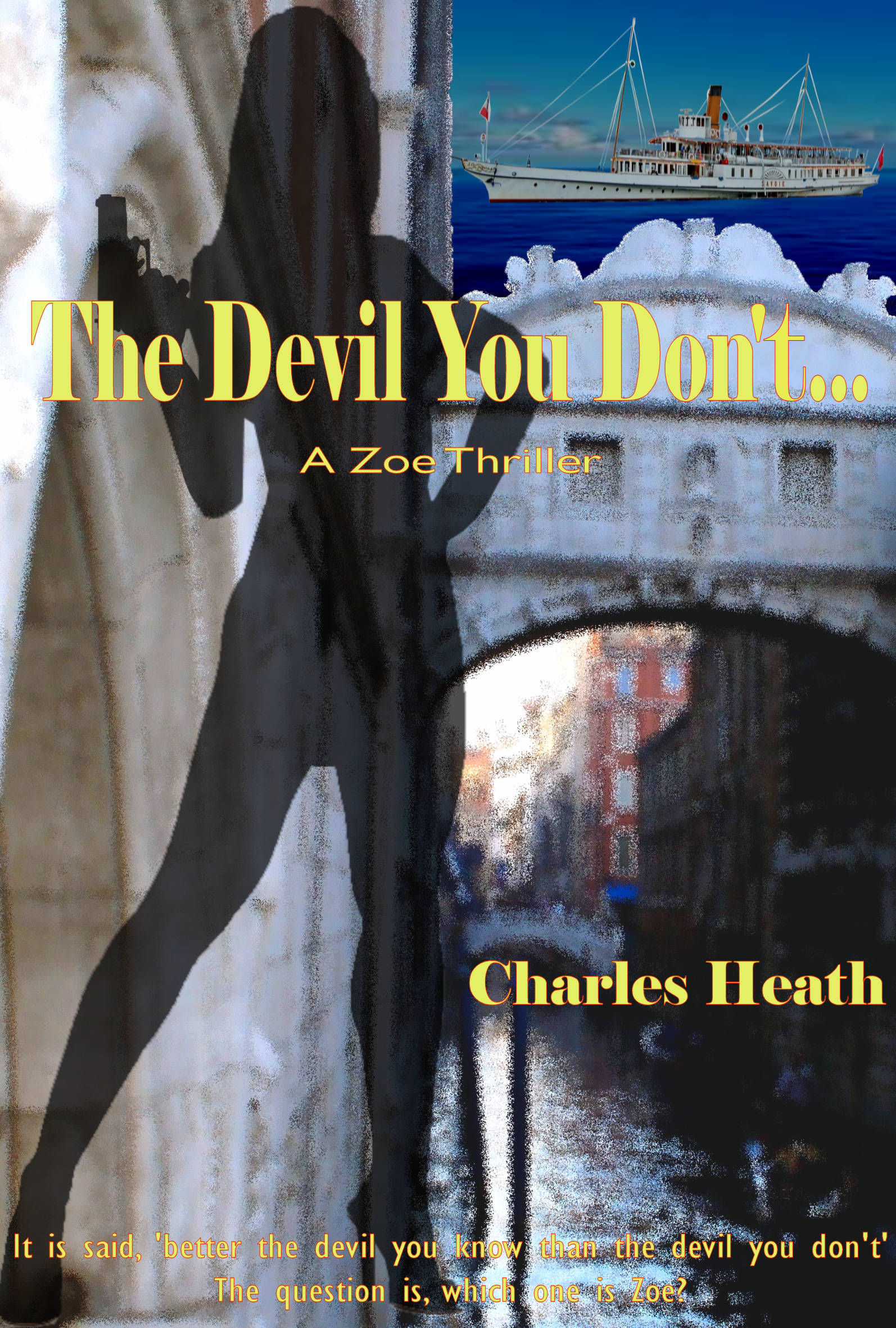
‘The Devil You Don’t’ – A beta reader’s view

It could be said that of all the women one could meet, whether contrived or by sheer luck, what are the odds it would turn out to be the woman who was being paid a very large sum to kill you.

John Pennington is a man who may be lucky in business, but not so lucky in love. He has just broken up with Phillipa Sternhaven, the woman he thought was the one, but relatives and circumstances, and perhaps because she was a ‘princess’, may also have contributed to the end result.

So, what do you do when you are heartbroken?

That is a story that slowly unfolds, from the first meeting with his nemesis on Lake Geneva, all the way to a hotel room in Sorrento, where he learns the shattering truth.

What should have been solace after disappointment, turns out to be something else entirely, and from that point, everything goes to hell in a handbasket.

He suddenly realizes his so-called friend Sebastian has not exactly told him the truth about a small job he asked him to do, the woman he is falling in love with is not quite who she says she is, and he is caught in the middle of a war between two men who consider people becoming collateral damage as part of their business.

The story paints the characters cleverly displaying all their flaws and weaknesses. The locations add to the story at times taking me back down memory lane, especially to Venice where, in those back streets I confess it’s not all that hard to get lost.

All in all a thoroughly entertaining story with, for once, a satisfying end.

Available on Amazon here: https://amzn.to/2Xyh1ow

Writing a book in 365 days – My Story 48

An outline of the premise of the story, in what I would call a pitch to an editor…

The Powder Keg Conference: When Irony Meets Incitement in the Republic of Azmar

The world of international politics often serves up a certain dish of absurdity, but occasionally, the ingredients align for a truly catastrophic meal. We are witnessing such a geopolitical culinary disaster right now, brewing in the fictional Republic of Azmar.

Azmar is, by all measures, a textbook example of modern authoritarianism: a military dictatorship, financially and politically shielded by a major superpower, and helmed by President General Kroll, a man whose personal wealth seems to increase inversely to his country’s freedoms. The regime’s human rights abuses—disappearances, rigged judiciary, suppression of dissent—are not simply allegations; they are an open, festering secret among global watchdog organisations.

And yet, this week, Azmar is throwing a party.

The Irony Convention

In a move that strains the very definition of chutzpah, the Kroll regime is hosting the Global Summit for Progressive Human Rights Advancement.

The contrast is dizzying. While political prisoners languish in overcrowded, secret facilities, the capital city has been scrubbed clean. Banners proclaiming “Justice Through Dialogue” hang from lampposts. The state-run media is ecstatic, broadcasting endless interviews about Azmar’s commitment to “international transparency.”

The goal, of course, is not dialogue. It is legitimisation. The conference is a Potemkin Village, a meticulously constructed facade designed to convince foreign investors and, more importantly, the regime’s international patrons that Azmar is a stable, reforming nation.

And perhaps the most volatile element of this stagecraft? The roster of attendees.

The Ethical Tightrope Walk of the Keynote Speaker

The event has attracted truly renowned figures: Nobel Laureates, celebrated international lawyers, and veteran human rights defenders. These are people whose careers have been defined by fighting the very abuses Azmar exemplifies.

Why are they here? For some, it is the genuine belief that dialogue must occur, even with the devil. For others, it’s the hefty speaking fees and the promise of a global stage. Whatever the motivation, their presence offers the Kroll regime exactly what it craves: a veneer of institutional approval.

When a celebrated author stands at the podium, criticising abstract concepts of oppression while simultaneously shaking hands with the architect of that oppression, the lines between principle and pragmatism blur dangerously. Their words, intended as a critique, are instead absorbed into the regime’s propaganda machine: “See? Even the world’s greatest thinkers endorse Azmar’s path forward.”

It is a tense, ethically compromised theatre. But the real drama is about to erupt just outside the conference hall.

The Return of the Ghost

For years, the domestic unrest in Azmar has been a low, continuous rumble—a simmering resentment against Kroll’s corruption and brutality. The memory of the previous government, the democratically elected administration deposed in the violent coup fifteen years ago, lingered like a ghost, kept alive only by hushed whispers.

That ghost has just materialised.

Simultaneously with the arrival of the international luminaries, news has swept through the Azmari underground that Elias Mendieta, the long-missing son of the deposed and disappeared president, has returned home.

Elias Mendieta represents everything President Kroll is not: legitimacy, democratic mandate, and the promise of a free Azmar. His return is not just political news; it is a profound symbolic act. It transforms simmering discontent into active incitement.

The Collision Course

The timing is either impossibly unlucky for President Kroll or perfectly calculated by Mendieta’s supporters.

Think about the dynamics now at play:

  1. Maximum Global Focus: The world’s major media outlets and human rights organisations are all focused on Azmar due to the conference.
  2. Maximum Internal Tension: The regime has poured all its resources into maintaining a facade of tranquillity, meaning security forces are stretched and focused on keeping the peace in the capital’s diplomatic quarters.
  3. Maximum Ideological Threat: Elias Mendieta, the embodiment of popular resistance and democratic history, is now mobilising supporters in the streets.

This is not a political confrontation that will play out in press releases. This is a dramatic, high-stakes collision.

If Mendieta attempts to make a dramatic public appearance, the regime faces an impossible choice:

  • Option A: Allow him to speak. This instantly delegitimises the conference and risks igniting mass protests that could turn revolutionary.
  • Option B: Arrest or silence him violently. Doing so while Nobel Laureates are debating “the future of free expression” literally blocks away would shatter the carefully constructed facade and invite global condemnation, potentially forcing the major power propping up Kroll to finally step back.

The Republic of Azmar has prepared a gilded stage for a dialogue on human rights, but what is truly about to commence is a revolution.

What could possibly go wrong? Everything. And we are all watching the fuse burn down.

The names and the places are fill-in’s but everything else is on the rollercoaster with no brakes!

“The Things we do for Love”, the story behind the story

This story has been ongoing since I was seventeen, and just to let you know, I’m 72 this year.

Yes, it’s taken a long time to get it done.

Why, you might ask.

Well, I never gave it much interest because I started writing it after a small incident when I was 17, and working as a book packer for a book distributor in Melbourne

At the end of my first year, at Christmas, the employer had a Christmas party, and that year, it was at a venue in St Kilda.

I wasn’t going to go because at that age, I was an ordinary boy who was very introverted and basically scared of his own shadow and terrified by girls.

Back then, I would cross the street to avoid them

Also, other members of the staff in the shipping department were rough and ready types who were not backwards in telling me what happened, and being naive, perhaps they knew I’d be either shocked or intrigued.

I was both adamant I wasn’t coming and then got roped in on a dare.

Damn!

So, back then, in the early 70s, people looked the other way when it came to drinking, and of course, Dutch courage always takes away the concerns, especially when normally you wouldn’t do half the stuff you wouldn’t in a million years

I made it to the end, not as drunk and stupid as I thought I might be, and St Kilda being a salacious place if you knew where to look, my new friends decided to give me a surprise.

It didn’t take long to realise these men were ‘men about town’ as they kept saying, and we went on an odyssey.  Yes, those backstreet brothels where one could, I was told, have anything they could imagine.

Let me tell you, large quantities of alcohol and imagination were a very bad mix.

So, the odyssey in ‘The things we do’ was based on that, and then the encounter with Diana. Well, let’s just say I learned a great deal about girls that night.

Firstly, not all girls are nasty and spiteful, which seemed to be the case whenever I met one. There was a way to approach, greet, talk to, and behave.

It was also true that I could have had anything I wanted, but I decided what was in my imagination could stay there.  She was amused that all I wanted was to talk, but it was my money, and I could spend it how I liked.

And like any 17-year-old naive fool, I fell in love with her and had all these foolish notions.  Months later, I went back, but she had moved on, to where no one was saying or knew.

Needless to say, I was heartbroken and had to get over that first loss, which, like any 17-year-old, was like the end of the world.

But it was the best hour I’d ever spent in my life and would remain so until I met the woman I have been married to for the last 48 years.

As Henry, he was in part based on a rebel, the son of rich parents who despised them and their wealth, and he used to regale anyone who would listen about how they had messed up his life

If only I’d come from such a background!

And yes, I was only a run away from climbing up the stairs to get on board a ship, acting as a purser.

I worked for a shipping company and they gave their junior staff members an opportunity to spend a year at sea working as a purser on a cargo ship that sailed between Melbourne, Sydney and Hobart in Australia.

One of the other junior staff members’ turn came, and I would visit him on board when he would tell me stories about life on board, the officers, the crew, and other events. These stories, which sounded incredible to someone so impressionable, were a delight to hear.

Alas, by that time, I had tired of office work and moved on to be a tradesman at the place where my father worked.

It proved to be the right move, as that is where I met my wife.  Diana had been right; love would find me when I least expected it.

lovecoverfinal1