‘Sunday in New York’ – A beta reader’s view

I’m not a fan of romance novels but …

There was something about this one that resonated with me.

This is a novel about a world generally ruled by perception, and how people perceive what they see, what they are told, and what they want to believe.

I’ve been guilty of it myself as I’m sure we all have at one time or another.

For the main characters Harry and Alison there are other issues driving their relationship.

For Alison, it is a loss of self-worth through losing her job and from losing her mother and, in a sense, her sister.

For Harry, it is the fact he has a beautiful and desirable wife, and his belief she is the object of other men’s desires, and one in particular, his immediate superior.

Between observation, the less than honest motives of his friends, a lot of jumping to conclusions based on very little fact, and you have the basis of one very interesting story.

When it all comes to a head, Alison finds herself in a desperate situation, she realises only the truth will save their marriage.

But is it all the truth?

What would we do in similar circumstances?

Rarely does a book have me so enthralled that I could not put it down until I knew the result. They might be considered two people who should have known better, but as is often the case, they had to get past what they both thought was the truth.

And the moral of this story, if it could be said there is one, nothing is ever what it seems.

…

Available on Amazon here: amzn.to/2H7ALs8

…

Writing a book in 365 days – 140

Day 140

Writing exercise

…

She lost sight of him in the frozen food aisle.

That was the problem with casual surveillance. Take your eyes off the target for one second, and they’re gone.

Of course, you would think there wouldn’t be that many people in the aisle, but it wasn’t the number of people. It was the distractions.

The lady reaching into the freezer and the boy shutting the lid on her, the baby in the stroller screaming its head off, and the mother casually ignoring it, the three or four-year-old pulling stuff off shelves and throwing it on the floor in a temper tantrum.

Distractions that she was supposed to ignore.

“You do realise your target has left the building?”

Her training supervisor had just managed to sneak up on her and, at the sound of his voice, made her jump.

Nerves.

Fear of failing.

A God awful row at home with a husband who didn’t want her to work, and probably would be even more incensed if she told him what she was really doing.

What else could go wrong?

“I know.  I thought it would be easy, but you’re right, there are so many other factors involved.  But, if you say that’s why we have a team, another member would pick them up.”

“And if there was not?”

“I’d be going back and giving the person who organised the job and the team a serve.”

OK, she thought, that was not called for, but that smug, supercilious look was annoying her.

“Are you usually this rambunctious?”

“Do you after use words no one understands when you really meant pain in the ass?”

This girl was trouble.  She had the talent and the ability when she first started, but that had slowed and waned.  It wasn’t a lack of interest.  Something else was going on.

I looked around and realised this was not the place to be discussing her career prospects.

“I saw a cafe outside.  Let me treat you to a cup of coffee and talk about what’s going on.”

Her expression told me that, for her, it was not the time or place and that there probably wasn’t going to be one.

“Is that really necessary?”

“If you want to continue the training program, yes.”

…

From the supermarket to the cafe, I went over the aspects of her file that her training officer had used as justification for her retaining her place in the program.

It was not the first time her name had come up in the weekly meeting to decide which trainees to retire who were not making the grade.

Her name made the list the previous week and was the reason why I’d come out to observe the exercise and her performance.

Her training officer was adamant she should be retained, that whatever was affecting her performance was only temporary.  Of course, most trainees rarely discussed any outside factors that might be affecting them for fear it would get them where she was now.

I didn’t expect any candour now.

I waited until the coffee was delivered before bringing up work, and went straight to the heart of the matter.  “Do you really want to do this job.  It seems to me that you’ve lost interest.”

“I’m juggling stuff.  You know, in preparation for throwing myself into the job.”

“And your husband is on board.  You’ve told him that it will require you to go at any time and hour of the day, for weeks at a time, to places you can’t tell him about?”

It was better to accept single people with no ties and no permanent anchors like partners or residency, but laws ensured we had to take on everyone, irrespective of background.  They simply had to pass a security check.  Having a partner, particularly in the case of female recruits, came with its own particular set of problems

When she didn’t answer straight away. I knew the problem.  She hadn’t told him.

“It’s not a problem.”

“Until it is.  You haven’t told him.  What does he think you’re doing?”

“It wouldn’t matter.  We had this talk before we were married, and he would support me in anything I wanted to do.  He’s happy to see me behind a desk, nine to five, home to cook dinner.”

“That’s not what we do here.  This is anything but nine to five.  Was he like this before you got married?”

“Now I look back, I should have seen the signs.  I guess when you’re in those first initial throes, you are either not looking or choose to ignore anything bad or decide you can work on it later.”

“And now that it’s later?”

“Am I allowed to kill him?” 

I looked into her eyes, and I could see she was deadly serious.  I had no doubt that she could, she would.  My impression, if she channelled that rage into her world, even I’d be scared by her.

“Since that is off the table for obvious reasons, is there anything else that can resolve this problem?”  It was time for her to start thinking outside the box and prove she had the ability she said she had.

She sighed.

“Coffee’s nice for a mall cafe.”

No brilliant solutions.  “Go home and tell him, then decide what you want to do.  You sort that out, get your head back in the game, and there’s a place for you.  You come back, I will be asking him myself if you discussed it and what it means.  Am I understood?”

“Clearly.”

…

That discussion was a whole lot worse than simply losing a target in the freezer aisle.

Losing targets she could get past, at least for a while, but telling Jimmy that his ‘possession’ had a mind of her own and a way cooler job than he ever would, wasn’t going to stoke his alpha male ego.

It was a question of what she wanted.

He did say that he wanted her to pursue whatever career pleased her, but that was back in the days when the only options were law school, architecture, or scientific research.  Jobs that brought in very good salaries that would keep Jeremy in the lifestyle he wanted to become accustomed to.  His joke about her working and him staying home to look after the children was wearing a little thin.  Particularly since he wasn’t ready for children, yet. 

And what did he do?

Plod along in a nine-to-five paper shuffle with sickies once a week so he could have long weekends boozing at home or boozing away with the lads while she worked two jobs and trained.

He’d carefully hidden that trait until after she overheard him tell one of his friends, he landed the fish.  Then he could do what he liked.

Sitting on the train, going back to the flat where they agreed they would live until her studies were over, she had to ask herself why the only things about her marriage were bad memories.

Was her inner self trying to tell her something?

Once home, the trail of clothes running from the bathroom to the bedroom was waiting for her to clean up, after which there were yesterday’s dishes to clean before preparing the evening meal

She looked in the refrigerator and closed it again.  Normally, if she wanted something, she would send him a text of what she needed or to suggest eating out.  Tonight felt like an eating-out night.

Except, she was feeling the first stirrings of rebellion.

She threw everything unwashed or lying around in the kitchen into the bin.  There were two plates left, with chips in them.  She put them on the table, along with a can of beans and a can opener.

Then she tossed his mess of papers and magazines out of what had been her seat and threw it in the corner of the room.  A quick look around, then went into the bedroom and put what she considered essential items into a backpack she had recently bought and put it by the front door.

A plan was forming in her mind, one that might have been unthinkable a week ago.  Well, perhaps a month ago, to be honest.

Then she sat down, facing the door, and waited.

….

It was an hour later than usual.  It didn’t surprise her, because several times in the last month he had gone to a bar with his friends and come home half drunk.  Wisely. 

The door opened, and he burst in, with Walter, one of his friends, in tow.  Yes.  A shade more intoxicated than usual.

“Hi, honey, I’m home.  Brought Wally, didn’t want to go home to his parents, yet.  What’s for dinner?”

And then stopped when he saw her sitting with her arms crossed.

Wally said, “Hello, Agnethe.”

“Hello, Walter, goodbye Walter.”

“But…”

“Get out!”  It was almost as rapid as a bullet.

“See you tomorrow, Jeremy.  Whatever you did, I’d apologise.  Very humbly.”  Walter patted him on the back and left, closing the door very quietly behind him.

Jeremy looked shellshocked, but only for a few seconds until he realised this was his place and therefore his rules.

“You can’t talk to my friends like that. And why aren’t you cooking dinner?”

Belligerent. 

She slowly stood and walked over to him, seeing him for the first time for who he really was.  How the hell had she fallen for a guy like him?  Easy.  He had been someone completely different then.

No.  He acted like someone completely different then.  This is who he always was.

What did that say about her?

“You’re lucky I don’t get what I was going to make and shove it down your throat.”

He looked puzzled for a few moments, then smiled.  “Oh, I get it.  This is a new thing, acting all tough, making me all hot and sweaty.  Things were getting boring in the bedroom.”

She shook her head.

“It’s over, Jeremy.  I’m done.  When I walk through that door, I never want to see you again.”

He finally got it, and the accompanying expression wasn’t nice.  He grabbed her by the front of her shirt and pushed her harshly up against the wall.

“You aren’t going anywhere, bitch.  I own you, and you do what I tell you.  Now, when I let you go, you’re going to make me my dinner.  Then I’ll decide what else you can do for me.”

She relaxed under his grip and put on a compliant expression.  How many times had she been in this position in training, the scenarios far more dangerous than this?

He let her go, and in five seconds, he was on the floor, face slammed into the floorboards with such a crack, she hoped she hadn’t killed him, but just to make sure, she rammed her knee into his back and elicited a grunt. 

Not dead yet.

Hands immobilised, she leaned forward and whispered in his ear, “I’m going to get up and walk out of here.  You decide, stupidly, to retaliate; I will kill you.  That isn’t a threat, it’s a promise.  What I just did then, that’s me being nice.  Trust me when I say you do not want to see me mad.”

…

I’d seen the same expressions on people who had been through the same experience.  Resentment of the people who were holding them back.

Her psychological profile made interesting reading, and it had been a calculated risk sending her home.  So far, she hadn’t hurt him too severely, but if he was as dumb as the report on him said, then he was an inch away from becoming a statistic.

Not a good one.

I knocked on the door to her apartment, two officers, armed, ready to go through the moment she opened the door.

Nothing. 

My assistant was holding an iPad with infrared imaging.  His hand indicated she was still holding him down.

I knocked again.  No urgency.  All her exits were cut off.

I heard a muffled voice from behind the door.  “It’s not locked.”

I looked at the others.  “Wait here, but be ready.”

The two beside me closed up and would remain at the door.  I would go in and not close it.  A voice behind me said, “We’re getting attention.”

“Sort it.”

I opened the door, went in, then left it only slightly ajar.  When I looked down, I could see the man under her was unconscious, and she was getting up slowly, hands outstretched.

When fully upright, hands outstretched, she backed up to the wall.

“You’ve been busy.  Is he…?”

“Simply unconscious.  Don’t need to make things worse with him screaming like a stuck pig.”

“What happened?”

“I told him I was leaving.  He didn’t take it well.  I want the job more than I want him.”

She looked down at him with a look of pure malice.  Then back up at me.  “I’ll do whatever it takes.”

“In three months, you might regret saying that.”

“In three months, I could be in a shit arse jail cell.  I’d prefer not to be.  Why are you here anyway?”

Perhaps it finally dawned on her that my presence was an anomaly.

“Our conversation.  You had to think that at some point, we were watching you and your husband.”

“You could have just asked me.  He’s a scumbag lowlife, he and his mates.  Surveillance for practice.  If you were at it, you’d know what I know.  I was about to kill him when you arrived.”

“Wouldn’t help your cause.  We’ll take it from here.  If you want to join the group, the real group, then once you say “yes”, Agnethe ceases to exist, and a cover story is created to cover that disappearance.  You will leave here ostensibly under arrest, my team will clean the site, and poof, you’re gone.  You cannot come back, you cannot see any of your old friends, family or acquaintances.  Ever.  Do you agree?”

“Yes.”

…

©  Charles Heath  2025

An excerpt from “Echoes from the Past”

Available on Amazon Kindle here:  https://amzn.to/2CYKxu4

…

With my attention elsewhere, I walked into a man who was hurrying in the opposite direction.  He was a big man with a scar running down the left side of his face from eye socket to mouth, and who was also wearing a black shirt with a red tie.

That was all I remembered as my heart almost stopped.

He apologized as he stepped to one side, the same way I stepped, as I also muttered an apology.

I kept my eyes down.  He was not the sort of man I wanted to recognize later in a lineup.  I stepped to the other side and so did he.  It was one of those situations.  Finally getting out of sync, he kept going in his direction, and I towards the bus, which was now pulling away from the curb.

Getting my breath back, I just stood riveted to the spot watching it join the traffic.  I looked back over my shoulder, but the man I’d run into had gone.  I shrugged and looked at my watch.  It would be a few minutes before the next bus arrived.

Wait, or walk?  I could also go by subway, but it was a long walk to the station.  What the hell, I needed the exercise.

At the first intersection, the ‘Walk’ sign had just flashed to ‘Don’t Walk’.  I thought I’d save a few minutes by not waiting for the next green light.  As I stepped onto the road, I heard the screeching of tires.

A yellow car stopped inches from me.

It was a high powered sports car, perhaps a Lamborghini.  I knew what they looked like because Marcus Bartleby owned one, as did every other junior executive in the city with a rich father.

Everyone stopped to look at me, then the car.  It was that sort of car.  I could see the driver through the windscreen shaking his fist, and I could see he was yelling too, but I couldn’t hear him.  I stepped back onto the sidewalk, and he drove on.  The moment had passed and everyone went back to their business.

My heart rate hadn’t come down from the last encounter.   Now it was approaching cardiac arrest, so I took a few minutes and several sets of lights to regain composure.

At the next intersection, I waited for the green light, and then a few seconds more, just to be sure.  I was no longer in a hurry.

At the next, I heard what sounded like a gunshot.  A few people looked around, worried expressions on their faces, but when it happened again, I saw it was an old car backfiring.  I also saw another yellow car, much the same as the one before, stopped on the side of the road.  I thought nothing of it, other than it was the second yellow car I’d seen.

At the next intersection, I realized I was subconsciously heading towards Harry’s new bar.   It was somewhere on 6th Avenue, so I continued walking in what I thought was the right direction.

I don’t know why I looked behind me at the next intersection, but I did.  There was another yellow car on the side of the road, not far from me.  It, too, looked the same as the original Lamborghini, and I was starting to think it was not a coincidence.

Moments after crossing the road, I heard the roar of a sports car engine and saw the yellow car accelerate past me.  As it passed by, I saw there were two people in it, and the blurry image of the passenger; a large man with a red tie.

Now my imagination was playing tricks.

It could not be the same man.  He was going in a different direction.

In the few minutes I’d been standing on the pavement, it had started to snow; early for this time of year, and marking the start of what could be a long cold winter.  I shuddered, and it was not necessarily because of the temperature.

I looked up and saw a neon light advertising a bar, coincidentally the one Harry had ‘found’ and, looking once in the direction of the departing yellow car, I decided to go in.  I would have a few drinks and then leave by the back door if it had one.

Just in case.

© Charles Heath 2015-2020

newechocover5rs

Inspiration, maybe – Volume 1

50 photographs, 50 stories, of which there is one of the 50 below.

They all start with –

A picture paints … well, as many words as you like.  For instance:

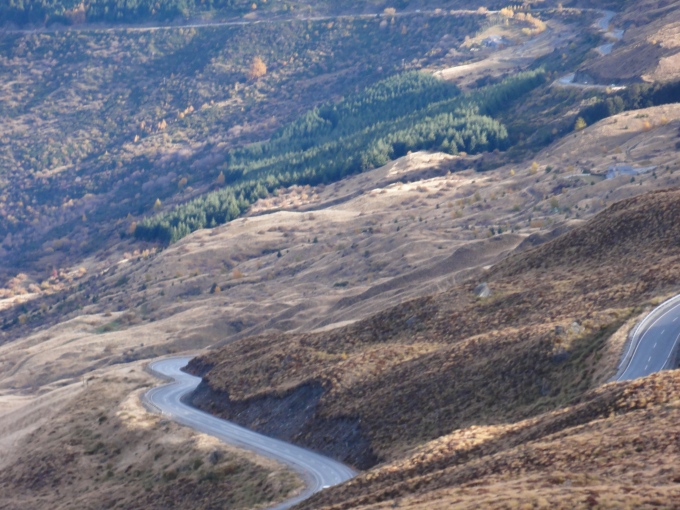
lookingdownfromcoronetpeak

And the story:

It was once said that a desperate man has everything to lose.

The man I was chasing was desperate, but I, on the other hand, was more desperate to catch him.

He’d left a trail of dead people from one end of the island to the other.

The team had put in a lot of effort to locate him, and now his capture was imminent.  We were following the car he was in, from a discrete distance, and, at the appropriate time, we would catch up, pull him over, and make the arrest.

There was nowhere for him to go.

The road led to a dead-end, and the only way off the mountain was back down the road were now on.  Which was why I was somewhat surprised when we discovered where he was.

Where was he going?

“Damn,” I heard Alan mutter.  He was driving, being careful not to get too close, but not far enough away to lose sight of him.

“What?”

“I think he’s made us.”

“How?”

“Dumb bad luck, I’m guessing.  Or he expected we’d follow him up the mountain.  He’s just sped up.”

“How far away?”

“A half-mile.  We should see him higher up when we turn the next corner.”

It took an eternity to get there, and when we did, Alan was right, only he was further on than we thought.”

“Step on it.  Let’s catch him up before he gets to the top.”

Easy to say, not so easy to do.  The road was treacherous, and in places just gravel, and there were no guard rails to stop a three thousand footfall down the mountainside.

Good thing then I had the foresight to have three agents on the hill for just such a scenario.

Ten minutes later, we were in sight of the car, still moving quickly, but we were going slightly faster.  We’d catch up just short of the summit car park.

Or so we thought.

Coming quickly around another corner we almost slammed into the car we’d been chasing.

“What the hell…” Aland muttered.

I was out of the car, and over to see if he was in it, but I knew that it was only a slender possibility.  The car was empty, and no indication where he went.

Certainly not up the road.  It was relatively straightforward for the next mile, at which we would have reached the summit.  Up the mountainside from here, or down.

I looked up.  Nothing.

Alan yelled out, “He’s not going down, not that I can see, but if he did, there’s hardly a foothold and that’s a long fall.”

Then where did he go?

Then a man looking very much like our quarry came out from behind a rock embedded just a short distance up the hill.

“Sorry,” he said quite calmly.  “Had to go if you know what I mean.”

I’d lost him.

It was as simple as that.

I had been led a merry chase up the hill, and all the time he was getting away in a different direction.

I’d fallen for the oldest trick in the book, letting my desperation blind me to the disguise that anyone else would see through in an instant.

It was a lonely sight, looking down that road, knowing that I had to go all that way down again, only this time, without having to throw caution to the wind.

“Maybe next time,” Alan said.

“We’ll get him.  It’s just a matter of time.”

© Charles Heath 2019-2021

Find this and other stories in “Inspiration, maybe”  available soon.

InspirationMaybe1v1

Have you ever…

Started to write a post, get so far, and another theme or idea slips in, and demands to be written first?

I’m on this nostalgia kick, simply because when I turned on the TV to catch up with the latest news, it was on a channel that shows old movies.

In case you don’t realize it, I love old movies, not just those from Hollywood, but also from Britain.

What was on?

An American in Paris.

Well, it had to be one of my favourites, even though I’m not a great fan of Gene Kelly, the sheer majesty of the music more than makes up for the story in between.

Could it be said, then, this was from the golden years of Hollywood? Such bright and cheerful movies such as Singing in the Rain, and An American in Paris, perhaps exemplify the Hollywood musical.

Years before, Fred Astaire and Ginger Rogers were the quintessential musical stars, followed by the likes of Judy Garland and Deanna Durbin, and later Bing Crosby and Frank Sinatra. A couple of musicals, in particular, comes to mind, firstly the Wizard of Oz and then High Society.

Moving forward to more modern times, several stand out in the 1960s, My Fair Lady and Sound of Music. By this time theatregoers were dining on the superb talents of Rogers and Hammerstein, and Learner and Lowe. Of the former, musicals such as Carousel, South Pacific, and The King and I were on my list of favourites.

Even later still in the 1970s, there is Funny Girl, and Hello Dolly, which have a connection to the past with its director, none other than, yes, Gene Kelly.

But it seems once the 60s had passed the notion of the Hollywood blockbuster musical had gone, and we were left with clip shows like That’s Entertainment, put together while Gene Kelly and Fred Astaire were still alive. We still had the film versions of the stage plays, but the lustre had, somehow, gone.

Perhaps it will return, who knows, after all, everything old is usually new again, it just takes time to go full circle.

The cinema of my dreams – I always wanted to see the planets – Episode 32

What does it say when you can’t trust the man in charge?

…

The Admiral was looking tired, possibly the result of being woken, yet again, in the dead hours of the night.

Out in space, we should be keeping earth time, in fact, we probably were, but I didn’t think to check before calling.

The matter was urgent, or at least I thought it was.

I’d just relayed the events leading up to the attack and the result. For some odd reason I didn’t think he looked pleased.

“I sent two shuttles over and they’ve confirmed 11 fatalities and one escapee who transported to the larger ship moments before the attack. I told them to set a geosychronous orbit around the moon coronas until you work out what you want to do with them. Their systems have been encrypted, so they can’t be resurrected.”

“And the base?”

“We understand it’s beneath the surface of the moon, accessible only by transporter. Our physist says she knows where the plutonium is.”

“I take it there are people down there?”

“Skeleton staff. It’s a new base, recently built, but we don’t know its purpose.”

“Definitely not alien then?”

“Unless the criminal world has made the first contact before us, and if they have, it can’t be for the betterment of mankind.”

I was no expert but at that moment I got the distinct impression that the Admiral was hiding something, or had information that might be useful to us.

Until now I hadn’t had time to think about all the events leading up to this point in time, but somewhere in the back of my mind, it had been processing everything that had happened, to do with the ship and even before that.

And the question that leapt out was, why me?

What was the compelling reason to appoint me as first officer to this particular ship at this particular time? I had no doubt there were a hundred others equally or better qualified than I was, and yet, my name was pulled out of the hat, and I could remember distinctly the captain of the ship I’d been completing my training, as surprised as I was that I’d been selected.

Them, out of left field, a memory came back, one o had tried to bury very deep, of an incident no one could explain, let alone comprehend because it was as if it never happened. I had no proof, and there was no one else left alive to corroborate what I believed to be the facts.

Solar stress, it had been called. The psychiatrist who handled the debriefing told me it was nothing more than an over-active imagination, fuelled by overwork, sleep deprivation, and the deaths of my family members on an outpost on the moon when I’d been visiting them.

That diagnosis alone should have prevented my appointment, and yet here I was.

“Then it’s no longer your problem. We’ll take it from here. There’s a ship on its way. Your mission is to proceed as planned.”

“And the other ship that fled? I’m sure they’re no to going to just forgive and forget.”

“The chances are they will. Now they know you have superior firepower, and the speed to hunt them down, they will not be coming back for a second encounter. If you do come across them, you can deal with them as you wish, but that is not the priority. You have your orders.”

The screen went blank.

Yes, he was definitely hiding something.

…

© Charles Heath 2021

A photograph from the inspirational bin – 32

This is a spot behind a group of restaurants at Victoria Point, Queensland.

But it could be anywhere, like a spot we saw on a boat trip on a river in the Daintree, in far north Queensland

So, this could be a spot, not far inland from the ocean where smugglers, or drug runners come ashore, in a place so remote they would never get caught.

Unless an enterprising federal agent comes up with a plan to track them from the ocean side using satellite images, or reported sightings of suspicious activity.

My money is on a random sighting, a vague report files in a small town police station, and a body washed up in shore, apparently the victim of a crocodile attack. Or not a crocodile.

It cold be a fishing trip gone wrong in a backwater stream, a weekend away by a dialled group of friends, who are not really friends, which all comes to a head when one of the friends go missing.

Or, I’d you like the idea of historical drama, a story about the first expedition from the bottom of Australia to the very top, for the first time, with all the hazards of rivers to cross, paths to create though the bush, the heat, the animals, the local inhabitants who have yet to see Europeans.

To be honest, I would not want to be one of those early explorers, especially those who went inland and struck desert, or died just short of their goal.

Just as an aside, we did learn about these people, Hume and Hovell, Blaxland, Wentworth and Lawson, Burke and Wills, and others.

Writing a book in 365 days – 139

Day 138

Just what are you saying?

…

So here’s the thing.

We all have points of view, nurtured from the day we are born to the day we die.

Along the way, these views can change, as does our opinion of many things.

Political beliefs, religion, and the weather.

As a rule, I tend to avoid both politics and religion, simply because most people hold very strong views.

As for the weather, I’m an expert.  After I look out the window.

But…

Even then, there are people with strong views about that because of or not climate change and secret satellites that change weather patterns…

Yes, yet another WTF moment!

So…

The point I’m trying to make is that our personal beliefs sometimes creep into the characters we create.

Al least we think we are creating this particular person, and no matter how hard we try to make them what seems to be the complete antithesis of ourselves, somehow a little shred is there.

I cannot make a completely obnoxious person, no matter how hard it try, because it’s not me.  I don’t know what it’s like to be one.  I have to read about people like that, and delved into Freud’s thoughts on psychosis to gain some level of understanding

And, sadly, I want to believe there is good somewhere in everyone.

It could possibly be one of those issues a writer has to deal with in character development.

Of course, it’s all the easier if you have had to deal with such people.

My father was a monster who beat all of us, but that may have had something to do with the war and fighting the Japanese in the jungle.

My uncle was a paedophile who assaulted both me and my brother, and a lot of others, in a time when he could get away with it

My mother had no idea how to be a mother or care for us in the way a mother should.

These people gave me the background for certain types of characters.

So did a lot of the people I worked with over the years.  People I saw, people in other countries, people from all walks of life.

All, in their own way, shaped who I am and what I believe in.

And I know enough not to impose my beliefs, such as they are, on anyone.

Jane Austen got it right

“For what do we live but to make sport for our neighbours and laughter at them in our turn?”

The cinema of my dreams – I always wanted to go on a treasure hunt – Episode 35

Here’s the thing…

Every time I close my eyes, I see something different.

I’d like to think the cinema of my dreams is playing a double feature but it’s a bit like a comedy cartoon night on Fox.

But these dreams are nothing to laugh about.

Once again there’s a new installment of an old feature, and we’re back on the treasure hunt.

It was an understatement to say I was dreading going to Boggs’ place.

In fact, in the hour it took to get through the morning chores I had time to consider how and why I was in this position.  Boggs was a friend.  We were friends at school and as best we could we had each other’s back when the bullies came out to play.

At times that didn’t amount to much because as everyone knows, bullies hunt in packs.  Six against two wasn’t much of an equation.  And it those days, the teachers spent more time hiding from the students than being in front of them.

It was simply a case of what doesn’t kill you makes you stronger.

It didn’t feel like that, not for a very long time.

But, in the end, misfortune can make strange bedfellows, and in a town that depended on a single industry, it soon became apparent that there were more people against the Benderby’s and the Cossatino’s than for, and in small-town politics, that was more than an evening up.  Out of school and separated from their acolytes, both Alex and Vince found that whatever influence they had once, was now gone, and all that was left was a grunt, and we were basically left alone.

Boggs was the dreamer.

He had idolized his father and when he went missing it broke him.

This map thing was the first signs of Boggs finally coming back to life, but the problem was, it was all pinned on false hopes.  The Sherriff was right.  Boggs was in over his head, playing with the two most vicious families from around here, and it was bad enough that his father had fallen foul of them, the Sherriff was not about to see his son go the same way.  I was going to try and talk Boggs out of it.

Yet, on the other hand, it was people like us who needed a win, just to show there was still hope in this place.  With threats every day that the factory might have to close, there were dark clouds hanging over everyone’s head.

If the factory closed, there was going to be a very large hole in the local economy and a lot of people in financial trouble.  I’m not sure how finding the treasure might solve all of that, but I suspect Boggs’ had something up his sleeve.

I knocked on the door and his mother answered.  She looked harried.  She was a nurse and looked as though she just got home from the night shift at the hospital.  

“Boggs is in his room.”

“How are you this morning?”

“Tired.  And an afternoon shift, which I might not get to if I don’t get some sleep.  You know where he is.  Try not to make any noise.”

“Will do.”

I came in and closed the door, watching her dash off down the passage to the other end of the house.

She could not work endless double shifts for much longer, but like all of us, it was not out of desire but necessity.  She had implored Boggs to get a job and help, but he seemed oblivious to the problem.  I’d tried to speak to him, but he had that insufferable way of just not listening.

Boggs was in his room, sitting on the bed and staring at the ceiling.

I looed up too, but there was nothing there.

“Don’t tell me,” I said, “but you’ve suddenly discovered you’ve got X-Ray vision.”

“If only.  I could use it right now to find something that’s missing>”

“Your cell phone?”  Boggs was always misplacing something, of forgetting it.  I’d lost count how many times he’d misplaced his phone.

“No.  An underground river.”

OK.  That was out of left field.  I had no idea any rivers were missing, or, in fact, they could actually go missing.

Apparently, they could.

“There’s two,” he said.  300 years ago five or take this part of the coastline had several rivers that ran down from the mountain range.  What we now call the hills on the edge of the coastal plain.  There was also a lake, not very large, but it used to have several streams flow into it all year round and had an aqua flow that came out along the coastline.”

“And you figured all of this out from what?  A copy of the treasure map.”

The moment he started quoting rivers, streams, and lakes, I remembered each of those geographical features appeared on several of the map versions.  I had suggested, rather comically, that it would be funny if the treasure was buried in the lake.

It wasn’t all that funny.  It was also possible.

“Imagine this.  Drop anchor out to sea, in other words on the other side of the natural sandbar that formed at the seaward side of the river, get in the longboats and row inshore to the lake, across the lake, up another river to the base of the hills.  Then do a little exploring, north or south, and find a cave.  I reckon the treasure was buried in a cave.  We know there are caves up there, not many, but I think there used to be more.”

“Someone already did a survey with some rather fancy electronic equipment with the same idea in mind.  He found three, not very long, and certainly without treasure.  Two had substantial falls inside, which is why they were buried.”

“There’s more.”

He jumped up off the bed and went over to the robe and opened the door.  Tacked on the back was a copy of an ordnance survey map of this part of the coastline, and a tracing of the treasure map, to the same scale on top.

“As you can see, I think ‘I’ve found the correlation between the real, and what was real 300 years ago.”

Except there’s no rivers and no lake.  And no sand bar as I recall.  There was a small marina in what might have been where the river met the sea, but that’s gone.  They filled it in and build a shopping mall on it.  A huge, now half empty, shopping mall.  A modern wonder 40 years ago that was supposed to bring business and shoppers to the town.  For a few years it did, until another town 50 miles away got the same idea, sold the land for half the price, and made the rents a quarter of what they were here.

They called it progress.

We called it piracy.

“Then we can hardly row our boat inshore and up the stream, if it’s not there.”

I hated to state the obvious.

“But,” he said, looking like the cat who’d swallowed the canary.  “What if it is still there, but we just can’t see it?”

© Charles Heath 2020

An excerpt from “Strangers We’ve Become” – Coming Soon

I wandered back to my villa.

It was in darkness.  I was sure I had left several lights on, especially over the door so I could see to unlock it.

I looked up and saw the globe was broken.

Instant alert.

I went to the first hiding spot for the gun, and it wasn’t there.  I went to the backup and it wasn’t there either.  Someone had found my carefully hidden stash of weapons and removed them.

Who?

There were four hiding spots and all were empty.  Someone had removed the weapons.  That could only mean one possibility.

I had a visitor, not necessarily here for a social call.

But, of course, being the well-trained agent I’d once been and not one to be caught unawares, I crossed over to my neighbor and relieved him of a weapon that, if found, would require a lot of explaining.

Suitably armed, it was time to return the surprise.

There were three entrances to the villa, the front door, the back door, and a rather strange escape hatch.  One of the more interesting attractions of the villa I’d rented was its heritage.  It was built in the late 1700s, by a man who was, by all accounts, a thief.  It had a hidden underground room which had been in the past a vault but was now a wine cellar, and it had an escape hatch by which the man could come and go undetected, particularly if there was a mob outside the door baying for his blood.

It now gave me the means to enter the villa without my visitors being alerted, unless, of course, they were near the vicinity of the doorway inside the villa, but that possibility was unlikely.  It was not where anyone could anticipate or expect a doorway to be.

The secret entrance was at the rear of the villa behind a large copse, two camouflaged wooden doors built into the ground.  I move aside some of the branches that covered them and lifted one side.  After I’d discovered the doors and rusty hinges, I’d oiled and cleaned them, and cleared the passageway of cobwebs and fallen rocks.  It had a mildew smell, but nothing would get rid of that.  I’d left torches at either end so I could see.

I closed the door after me, and went quietly down the steps, enveloped in darkness till I switched on the torch.  I traversed the short passage which turned ninety degrees about halfway to the door at the other end.  I carried the key to this door on the keyring, found it and opened the door.  It too had been oiled and swung open soundlessly.

I stepped in the darkness and closed the door.

I was on the lower level under the kitchen, now the wine cellar, the ‘door’ doubling as a set of shelves which had very little on them, less to fall and alert anyone in the villa.

Silence, an eerie silence.

I took the steps up to the kitchen, stopping when my head was level with the floor, checking to see if anyone was waiting.  There wasn’t.  It seemed to me to be an unlikely spot for an ambush.

I’d already considered the possibility of someone coming after me, especially because it had been Bespalov I’d killed, and I was sure he had friends, all equally as mad as he was.  Equally, I’d also considered it nigh on impossible for anyone to find out it was me who killed him because the only people who knew that were Prendergast, Alisha, a few others in the Department, and Susan.

That raised the question of who told them where I was.

If I was the man I used to be, my first suspect would be Susan.  The departure this morning, and now this was too coincidental.  But I was not that man.

Or was I?

I reached the start of the passageway that led from the kitchen to the front door and peered into the semi-darkness.  My eyes had got used to the dark, and it was no longer an inky void.  Fragments of light leaked in around the door from outside and through the edge of the window curtains where they didn’t fit properly.  A bone of contention upstairs in the morning, when first light shone and invariably woke me up hours before I wanted to.

Still nothing.

I took a moment to consider how I would approach the visitor’s job.  I would get a plan of the villa in my head, all entrances, where a target could be led to or attacked where there would be no escape.

Coming in the front door.  If I was not expecting anything, I’d just open the door and walk-in.  One shot would be all that was required.

Contract complete.

I sidled quietly up the passage staying close to the wall, edging closer to the front door.  There was an alcove where the shooter could be waiting.  It was an ideal spot to wait.

Crunch.

I stepped on some nutshells.

Not my nutshells.

I felt it before I heard it.  The bullet with my name on it.

And how the shooter missed, from point-blank range, and hit me in the arm, I had no idea.  I fired off two shots before a second shot from the shooter went wide and hit the door with a loud thwack.

I saw a red dot wavering as it honed in on me and I fell to the floor, stretching out, looking up where the origin of the light was coming and pulled the trigger three times, evenly spaced, and a second later I heard the sound of a body falling down the stairs and stopping at the bottom, not very far from me.

Two assassins.

I’d not expected that.

The assassin by the door was dead, a lucky shot on my part.  The second was still breathing.

I checked the body for any weapons and found a second gun and two knives.  Armed to the teeth!

I pulled off the balaclava; a man, early thirties, definitely Italian.  I was expecting a Russian.

I slapped his face, waking him up.  Blood was leaking from several slashes on his face when his head had hit the stairs on the way down.  The awkward angle of his arms and legs told me there were broken bones, probably a lot worse internally.  He was not long for this earth.

“Who employed you?”

He looked at me with dead eyes, a pursed mouth, perhaps a smile.  “Not today my friend.  You have made a very bad enemy.”  He coughed and blood poured out of his mouth.  “There will be more …”

Friends of Bespalov, no doubt.

I would have to leave.  Two unexplainable bodies, I’d have a hard time explaining my way out of this mess.  I dragged the two bodies into the lounge, clearing the passageway just in case someone had heard anything.

Just in case anyone was outside at the time, I sat in the dark, at the foot of the stairs, and tried to breathe normally.  I was trying not to connect dots that led back to Susan, but the coincidence was worrying me.

A half-hour passed and I hadn’t moved.  Deep in thought, I’d forgotten about being shot, unaware that blood was running down my arm and dripping onto the floor.

Until I heard a knock on my front door.

Two thoughts, it was either the police, alerted by the neighbors, or it was the second wave, though why would they be knocking on the door?

I stood, and immediately felt a stabbing pain in my arm.  I took out a handkerchief and turned it into a makeshift tourniquet, then wrapped a kitchen towel around the wound.

If it was the police, this was going to be a difficult situation.  Holding the gun behind my back, I opened the door a fraction and looked out.

No police, just Maria.  I hoped she was not part of the next ‘wave’.

“You left your phone behind on the table.  I thought you might be looking for it.”  She held it out in front of her.

When I didn’t open the door any further, she looked at me quizzically, and then asked, “Is anything wrong?”

I was going to thank her for returning the phone, but I heard her breathe in sharply, and add, breathlessly, “You’re bleeding.”

I looked at my arm and realized it was visible through the door, and not only that, the towel was soaked in blood.

“You need to go away now.”

Should I tell her the truth?  It was probably too late, and if she was any sort of law-abiding citizen she would go straight to the police.

She showed no signs of leaving, just an unnerving curiosity.  “What happened?”

I ran through several explanations, but none seemed plausible.  I went with the truth.  “My past caught up with me.”

“You need someone to fix that before you pass out from blood loss.  It doesn’t look good.”

“I can fix it.  You need to leave.  It is not safe to be here with me.”

The pain in my arm was not getting any better, and the blood was starting to run down my arm again as the tourniquet loosened.  She was right, I needed it fixed sooner rather than later.

I opened the door and let her in.  It was a mistake, a huge mistake, and I would have to deal with the consequences.  Once inside, she turned on the light and saw the pool of blood just inside the door and the trail leading to the lounge.  She followed the trail and turned into the lounge, turned on the light, and no doubt saw the two dead men.

I expected her to scream.  She didn’t.

She gave me a good hard look, perhaps trying to see if I was dangerous.  Killing people wasn’t something you looked the other way about.  She would have to go to the police.

“What happened here?”

“I came home from the cafe and two men were waiting for me.  I used to work for the Government, but no longer.  I suspect these men were here to repay a debt.  I was lucky.”

“Not so much, looking at your arm.”

She came closer and inspected it.

“Sit down.”

She found another towel and wrapped it around the wound, retightening the tourniquet to stem the bleeding.

“Do you have medical supplies?”

I nodded.  “Upstairs.”  I had a medical kit, and on the road, I usually made my own running repairs.  Another old habit I hadn’t quite shaken off yet.

She went upstairs, rummaged, and then came back.  I wondered briefly what she would think of the unmade bed though I was not sure why it might interest her.

She helped me remove my shirt, and then cleaned the wound.  Fortunately, she didn’t have to remove a bullet.  It was a clean wound but it would require stitches.

When she’d finished she said, “Your friend said one day this might happen.”

No prizes for guessing who that friend was, and it didn’t please me that she had involved Maria.

“Alisha?”

“She didn’t tell me her name, but I think she cares a lot about you.  She said trouble has a way of finding you, gave me a phone and said to call her if something like this happened.”

“That was wrong of her to do that.”

“Perhaps, perhaps not.  Will you call her?”

“Yes.  I can’t stay here now.  You should go now.  Hopefully, by the time I leave in the morning, no one will ever know what happened here, especially you.”

She smiled.  “As you say, I was never here.”

…

© Charles Heath 2018-2022

strangerscover9