The cinema of my dreams – Was it just another surveillance job – Episode 16

As we all know, writing by the seat of your pants is almost the same as flying by the seat of your pants, a hazardous occupation.

As it happens, I like writing this way because like the reader, I don’t know what to expect next.

And equally, at times, you can write your self into a corner, much like painting, and then have to go back, make a few changes and//or repairs and then move forward.

It’s part of the writing process, only in this case, the changes occur before you’ve finished the novel if you finish.  Quite often a lot of writers get only so far, then the manuscript hits the bottom drawer, to be brought out on a distant rainy day.

Or your cat has mocked your writing ability one too many times.

Therefore, we’re winding back to Episode 16, and moving forward once again, from there.

O’Connor seemed to be more affluent than I because he was living in a flat located in an upmarket building.  Getting into the ground floor required a passkey, one I suspect might also be needed to get in the front door of his flat, but I’d worry about that later.

My first problem was that front door, and it was not until a tradesman exited that I took the opportunity to appear to arrive at the same time, pretending to find my card, and brushing past him as he was exiting.  He ignored me, his hands full, being in a hurry.

It took a day and a half of watching the building, waiting for an opportunity.  His flat was on the third floor and although there was an elevator, I took the stairs, hoping that I wouldn’t run into anyone.

Quickly and quietly, and thankfully without seeing another resident, I came out into the passageway, and it was about ten steps to his front door.  Number 37.  Not far away, in one direction, the end of the passage, and numbers 38, 39, and 40.  In the other, four more flats and the end of the corridor.  Windows at either end, perhaps an escape route.  I would not use the elevator if I had to leave in a hurry.

There were two elevators and one staircase.  Both elevators were stationary on the ground floor.

I knocked lightly on the door to number 37.

No answer.

I knocked a little harder on the door.  It was quite solid, and I had to wonder if the knocking sound penetrated the solid wood.

I checked the lock.  Simple to open.  We’d been given instruction by a master locksmith, and I’d brought my tools.

I waited a minute, checked to see if the elevators were still on the ground floor, then picked the lock and was inside within a minute.

Silence.

I felt along the wall for a light switch, usually by the door, and found it, and flicked it on.  The sudden light was almost blinding, but then my eyes adjusted.

Trashed, much the same as my flat.

But, with a difference.

A woman was stretched out on the floor, unmoving.  I could see, from where I was standing, she had been hit on the back of the head and could see the wound, and a trickle of blood through her hair.

Five steps to reach her, I reached down to check for a pulse.

Yes, she was alive.

I shook her gently.  She didn’t react.  I shook her a little more roughly and she stirred, then, as expected, lashed out.

I caught her hands, saying, “I just found you.  I’m not your enemy.”

Of course, considering I was a stranger in what could be her flat without permission, I was not surprised she continued to struggle until I tried being reassuring.  Then she stopped and asked, “Who are you?”

“A friend of O’Connor.  I worked with him.  Something happened to him at work and he said if that happened, I was to come here.  He didn’t say anything about you, though.”

“I live here, in the flat next door.  I heard a noise and came to investigate.  That’s all I remember.”

I helped her up into a sitting position, and, holding her head in her hands, looked around.  “Did you do this?”

“No.  Just got here.  But it’s the same at my place.  The people who did this are looking for something.  By the look of it, they didn’t find it here either.”

“I’ll get a damp cloth for your head.  It doesn’t look serious but there might be a slight concussion that might need attention.”

She felt the back of her head, and, when she touched the wound, gasped, “It hurts though.”

I stood and went over to the kitchenette.  O’Connor was not much of a cook, the benches looked new, and there was nothing out.  I looked in a draw near the sink and found a cloth, still with the price tag on it.  So were several utensils in the drawer.  I ran it under the water, then went back to her, now off the floor and sitting on one of the two chairs.  I handed her the wet cloth and she put it against the injured part of her head.

I made a mental note, it didn’t look like O’Connor had been here long, if at all.  Something was not right here, and if that was the case, I should take care when saying anything to this woman.

“Who are you again?” she asked.

“I worked with him.  My name is irrelevant.  It’s unlikely that he mentioned me to you, or anyone.  It’s the nature of our work.”

“Why should I believe you?  You could be my attacker.”

“If that were the case, why would I still be here trying to be helpful.”

A good question that elicited a curious expression.

“What do you do, what did Oliver do?”

Alarm bells were going off.  Oliver was not O’Connor’s first name.

“Nothing very interesting, I can assure you, and definitely nothing that would warrant this happening.  If it had only been me, I would have not thought any more of it, but since we worked together, and this has also happened to him, it seems we are mixed up in something bad.”

“Where is he, by the way?”

“I was hoping you could tell me.  If you live next door and know him well enough to be here, he might have told you.”

“No.  He never spoke about work.”

She was trying to stand so I helped her up and held on when it looked like she was about to collapse.  Last time I had a knock to the head, I had dizziness for a minute of two.  Her knock had been a lot harder.”

“Are you alright?”  She didn’t look it.

“I will be, I’m sure.”

I let her go, and she took several steps, then gave me a rather hard look.  “Why are you here again?”

“Trying to find my friend.”

“How did you get in here?”

Rather than make her disorientated, the knock must have sharpened her senses.  Time to test a theory. 

“I think we should call the police now, and report the break-in.”

I pulled out my phone.

“Look, I don’t want to get mixed up in this.  You go, and I report this when I get back home.  And, if you find him, tell him Josephine is looking for him.”

As I thought.  She was not able to explain to the authorities why she was in this flat, as I’m sure she believed I couldn’t either.

She started walking towards the door.  My staying any longer would raise her suspicions about me, and any search I was going to do would have to wait.  I opened the door, she walked out, and I followed shutting the door after me.

I left her standing outside the door and headed for the stairs.  A last glance back showed her still where I left her.  I went down to the first landing, then stopped.  It was part of the training, to treat everyone as suspicious.

Then I heard her voice, as she passed the top of the staircase, on her way back to her flat.  “He was here, looking for the files.  No, he’s gone.”  A minute’s silence, then “On my way.”

Another minute, I heard the elevator car arrive on the third floor.

I quickly ran down the stairs to the ground floor and waited at the door until she came out of the elevator, heading for the door.

Then as she passed through the front door, I came out into the foyer just in time to see a car stop out the front, and a familiar face out through the rear window.

Nobbin.

© Charles Heath 2019-2022

Writing a book in 365 days – 213

Day 213

Grammar with commas, adjectives and parentheses

…

Never let it be said that I would try to have four commas in a sentence.  Not that I would deliberately expect to see how it would sound.

After all, the comma is the point where the reader takes a breath.  One official definition of the comma is to separate clauses or lists of three or more items.

Someone might want to tell the people who create grammar checkers that, because sometimes their suggested edits are a little perplexing.

Of course, the humble comma is also very useful for making the author’s meaning clearer to the reader, who, it seems, is always trying to misinterpret what he or she is trying to say.

Sadly, just about everything I write can be misinterpreted, especially by those strange grammar checkers.  You see, the programmers who are behind such beasts injected their own interpretation, so no matter what you want to say, they change it into something incomprehensible.

Unless, of course, you take charge and override the changes or simply ignore the suggestions.  The problem is, it won’t let it go, underscoring or highlighting what it thinks is wrong and takes you back, like an errant child, expecting you to conform.

Even selecting ignore only lets you think you have won!

But all the same, there are eight rules for using commas, and it doesn’t hurt to at least read what they are so you can make up your own mind.

The next battle, and believe me, I have drawn the line on the battlefield, a line these mechanical behemoths simply roll right over.

I know what words I was to use.  It doesn’t or shouldn’t after what I use because those ate my words.  The checker can not possibly know what I want to convey.

And yet there it is, saying that I have no idea what I’m talking about.

OK.  I get it.  We don’t want to have too much flowery language.  But just what is flowery language?  Acting dumb, I’d say I don’t use flowers to describe stuff.

Then, there’s a lavender aroma, a rose coloured cheek, as yellow as a daffodil.

Who doesn’t know of a yellow daffodil, a red rose, though these days there are red, yellow, white, and pink roses.

Oops, I just used more than four commas in a sentence. 

But there is a good argument for using words that most people would recognise because the last thing you need is reader frustration.  But, again, you still have to take into consideration the narrator or the character and their characteristics.

Lastly, who hasn’t used an afterthought or an explanation in the middle of a sentence just to make sure the reader knows what is going on

I mean, we shouldn’t have to; it should be readily apparent if we had spelled out beforehand, but that little reminder is so that the reader isn’t left scratching their head, which can sometimes happen.

It’s not ideal, but sometimes necessary.

I use it myself, which, of course, isn’t a validation of its use. It’s just the way I write.

It is just another thing on that ever-growing list of pointers that we accumulated as we advance further into the writing mire.

Nothing is ever simple. 

There ain’t no mountain high enough

If only it was as easy to write one line of a song as it is to write a sentence, a paragraph, or a page of a book.  Of course, if you were to ask a songwriter the same question, he or she would probably twist it around, and not without reason.

The bottom line in all scenarios, whether writing a story, writing a song, or writing a letter, at times it feels like it is like climbing a mountain.

It’s why we have waste paper bins, and imaginary shooting practice sessions.  By the way, I don’t get very many scrunched paper balls in.

Curiously, we seem to categorize almost insurmountable problems in terms of climbing mountains.  Of course, I’ve yet to attempt to climb the north face of Mount Everest, but I suspect I’ll have to do a lot of practice to do so.

Maybe that’s what I need to do as a writer.  Practice, not climbing mountains.

Mountains have always been part of the metaphor for overcoming obstacles.  So, metaphorically, to overcome this ‘obstacle’, we can choose to climb over it, blow it up, or tunnel through it.

But the salient point is the same in all cases, obstacles, metaphorical or not, are not insurmountable, they just need time to find a solution.

So, in my case, there are two items to note when it comes to mountains, the first, I prefer to go through a tunnel, and the second, there’s not a mountain I’ve been up that hasn’t had a magnificent view.  Of course, getting to the top has been easy, I just hopped on the tram or the gondola.

After all, isn’t that what they’re there for?

Ok, flippancy aside, I have had to climb a few mountains of my own over the years, and, yes, it’s hard work, and, at times, I’ve wanted to give up.

But, not today.  Today is a good day.

And as the title says, ‘There ain’t no mountain high enough!’


Inspiration, Maybe – Volume 2

50 photographs, 50 stories, of which there is one of the 50 below.

They all start with –

A picture paints … well, as many words as you like.  For instance:

And, the story:

Have you ever watched your hopes and dreams simply just fly away?

Everything I thought I wanted and needed had just left in an aeroplane, and although I said I was not going to, i came to the airport to see the plane leave.  Not the person on it, that would have been far too difficult and emotional, but perhaps it was symbolic, the end of one life and the start of another.

But no matter what I thought or felt, we had both come to the right decision.  She needed the opportunity to spread her wings.  It was probably not the best idea for her to apply for the job without telling me, but I understood her reasons.

She was in a rut.  Though her job was a very good one, it was not as demanding as she had expected, particularly after the last promotion, but with it came resentment from others on her level, that she, the youngest of the group would get the position.

It was something that had been weighing down of her for the last three months, and if noticed it, the late nights, the moodiness, sometimes a flash of temper.  I knew she had one, no one could have such red hair and not, but she had always kept it in check.

And, then there was us, together, and after seven years, it felt like we were going nowhere.  Perhaps that was down to my lack of ambition, and though she never said it, lack of sophistication.  It hadn’t been an issue, well, not until her last promotion, and the fact she had to entertain more, and frankly I felt like an embarrassment to her.

So, there it was, three days ago, the beginning of the weekend, and we had planned to go away for a few days and take stock.  We both acknowledged we needed to talk, but it never seemed the right time.

It was then she said she had quit her job and found a new one.  Starting the following Monday.

Ok, that took me by surprise, not so much that it something I sort of guessed might happen, but that she would just blurt it out.

I think that right then, at that moment, I could feel her frustration with everything around her.

What surprised her was my reaction.  None.

I simply asked where who, and when.

A world-class newspaper, in New York, and she had to be there in a week.

A week.

It was all the time I had left with her.

I remember I just shrugged and asked if the planned weekend away was off.

She stood on the other side of the kitchen counter, hands around a cup of coffee she had just poured, and that one thing I remembered was the lone tear that ran down her cheek.

Is that all you want to know?

I did, yes, but we had lost that intimacy we used to have when she would have told me what was happening, and we would have brainstormed solutions. I might be a cabinet maker but I still had a brain, was what I overheard her tell a friend once.

There’s not much to ask, I said.  You’ve been desperately unhappy and haven’t been able to hide it all that well, you have been under a lot of pressure trying to deal with a group of troglodytes, and you’ve been leaning on Bentley’s shoulder instead of mine, and I get it, he’s got more experience in that place,  and the politics that go with it, and is still an ally.

Her immediate superior and instrumental in her getting the position, but unlike some men in his position he had not taken advantage of a situation like some men would.  And even if she had made a move, which I doubted, that was not the sort of woman she was, he would have politely declined.

One of the very few happily married men in that organisation, so I heard.

So, she said, you’re not just a pretty face.

Par for the course for a cabinet maker whose university degree is in psychology.  It doesn’t take rocket science to see what was happening to you.  I just didn’t think it was my place to jump in unless you asked me, and when you didn’t, well, that told me everything I needed to know.

Yes, our relationship had a use by date, and it was in the next few days.

I was thinking, she said, that you might come with me,  you can make cabinets anywhere.

I could, but I think the real problem wasn’t just the job.  It was everything around her and going with her, that would just be a constant reminder of what had been holding her back. I didn’t want that for her and said so.

Then the only question left was, what do we do now?

Go shopping for suitcases.  Bags to pack, and places to go.

Getting on the roller coaster is easy.  On the beginning, it’s a slow easy ride, followed by the slow climb to the top.  It’s much like some relationships, they start out easy, they require a little work to get to the next level, follows by the adrenaline rush when it all comes together.

What most people forget is that what comes down must go back up, and life is pretty much a roller coaster with highs and lows.

Our roller coaster had just come or of the final turn and we were braking so that it stops at the station.

There was no question of going with her to New York.  Yes, I promised I’d come over and visit her, but that was a promise with crossed fingers behind my back.  After a few months in t the new job the last thing shed want was a reminder of what she left behind.  New friends new life.

We packed her bags, three out everything she didn’t want, a free trips to the op shop with stiff she knew others would like to have, and basically, by the time she was ready to go, there was nothing left of her in the apartment, or anywhere.

Her friends would be seeing her off at the airport, and that’s when I told her I was not coming, that moment the taxi arrived to take her away forever.  I remember standing there, watching the taxi go.  It was going to be, and was, as hard as it was to watch the plane leave.

So, there I was, finally staring at the blank sky, around me a dozen other plane spotters, a rather motley crew of plane enthusiasts.

Already that morning there’s been 6 different types of plane depart, and I could hear another winding up its engines for take-off.

People coming, people going.

Maybe I would go to New York in a couple of months, not to see her, but just see what the attraction was.  Or maybe I would drop in, just to see how she was.

As one of my friends told me when I gave him the news, the future is never written in stone, and it’s about time you broadened your horizons.

Perhaps it was.


© Charles Heath 2020-2021

Coming soon.  Find the above story and 49 others like it in:

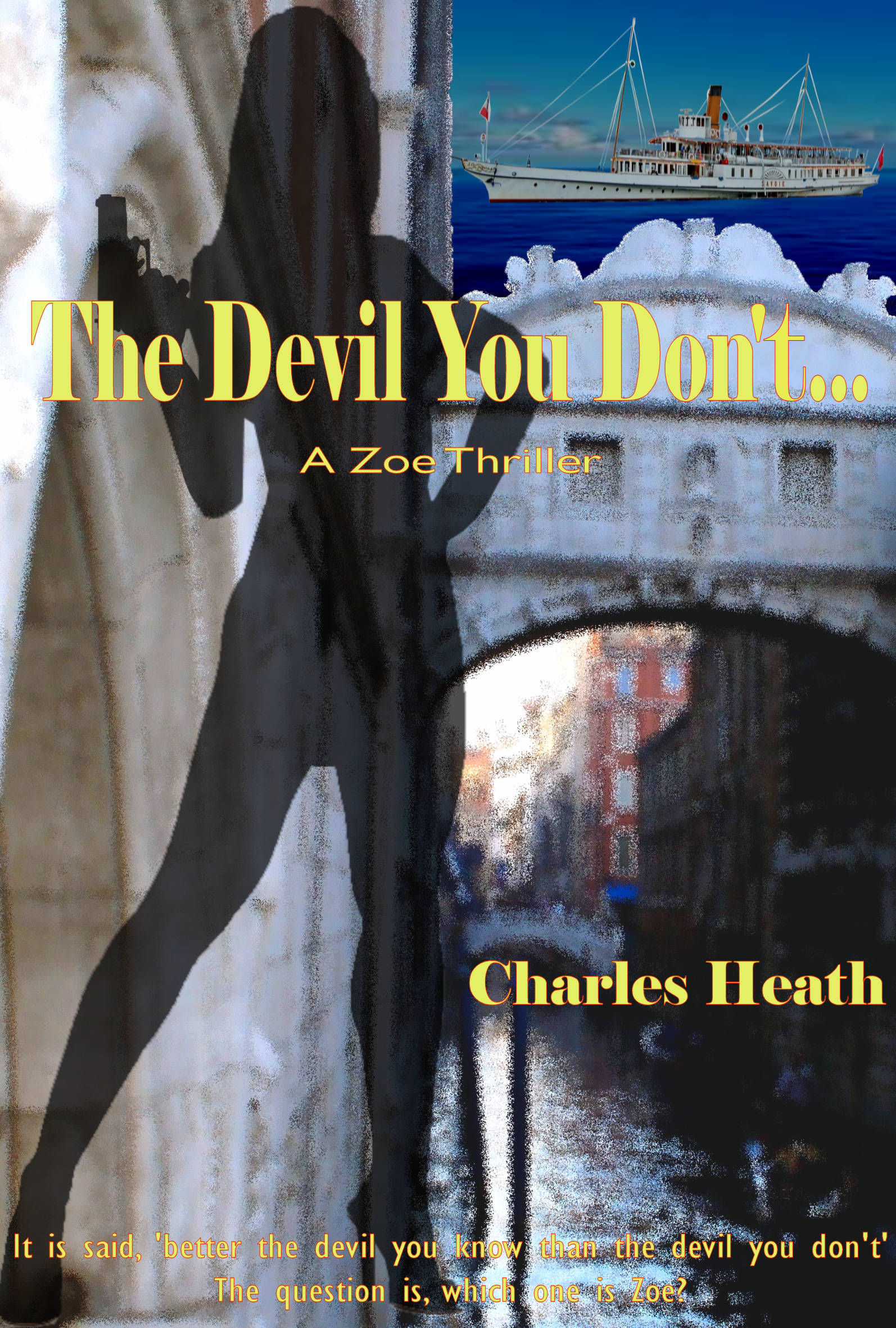
‘The Devil You Don’t’ – A beta reader’s view

It could be said that of all the women one could meet, whether contrived or by sheer luck, what are the odds it would turn out to be the woman who was being paid a very large sum to kill you.

John Pennington is a man who may be lucky in business, but not so lucky in love. He has just broken up with Phillipa Sternhaven, the woman he thought was the one, but relatives and circumstances, and perhaps because she was a ‘princess’, may also have contributed to the end result.

So, what do you do when you are heartbroken?

That is a story that slowly unfolds, from the first meeting with his nemesis on Lake Geneva, all the way to a hotel room in Sorrento, where he learns the shattering truth.

What should have been solace after disappointment, turns out to be something else entirely, and from that point, everything goes to hell in a handbasket.

He suddenly realizes his so-called friend Sebastian has not exactly told him the truth about a small job he asked him to do, the woman he is falling in love with is not quite who she says she is, and he is caught in the middle of a war between two men who consider people becoming collateral damage as part of their business.

The story paints the characters cleverly displaying all their flaws and weaknesses. The locations add to the story at times taking me back down memory lane, especially to Venice where, in those back streets I confess it’s not all that hard to get lost.

All in all a thoroughly entertaining story with, for once, a satisfying end.

…

Available on Amazon here: https://amzn.to/2Xyh1ow

…

Writing a book in 365 days – 213

Day 213

Grammar with commas, adjectives and parentheses

…

Never let it be said that I would try to have four commas in a sentence.  Not that I would deliberately expect to see how it would sound.

After all, the comma is the point where the reader takes a breath.  One official definition of the comma is to separate clauses or lists of three or more items.

Someone might want to tell the people who create grammar checkers that, because sometimes their suggested edits are a little perplexing.

Of course, the humble comma is also very useful for making the author’s meaning clearer to the reader, who, it seems, is always trying to misinterpret what he or she is trying to say.

Sadly, just about everything I write can be misinterpreted, especially by those strange grammar checkers.  You see, the programmers who are behind such beasts injected their own interpretation, so no matter what you want to say, they change it into something incomprehensible.

Unless, of course, you take charge and override the changes or simply ignore the suggestions.  The problem is, it won’t let it go, underscoring or highlighting what it thinks is wrong and takes you back, like an errant child, expecting you to conform.

Even selecting ignore only lets you think you have won!

But all the same, there are eight rules for using commas, and it doesn’t hurt to at least read what they are so you can make up your own mind.

The next battle, and believe me, I have drawn the line on the battlefield, a line these mechanical behemoths simply roll right over.

I know what words I was to use.  It doesn’t or shouldn’t after what I use because those ate my words.  The checker can not possibly know what I want to convey.

And yet there it is, saying that I have no idea what I’m talking about.

OK.  I get it.  We don’t want to have too much flowery language.  But just what is flowery language?  Acting dumb, I’d say I don’t use flowers to describe stuff.

Then, there’s a lavender aroma, a rose coloured cheek, as yellow as a daffodil.

Who doesn’t know of a yellow daffodil, a red rose, though these days there are red, yellow, white, and pink roses.

Oops, I just used more than four commas in a sentence. 

But there is a good argument for using words that most people would recognise because the last thing you need is reader frustration.  But, again, you still have to take into consideration the narrator or the character and their characteristics.

Lastly, who hasn’t used an afterthought or an explanation in the middle of a sentence just to make sure the reader knows what is going on

I mean, we shouldn’t have to; it should be readily apparent if we had spelled out beforehand, but that little reminder is so that the reader isn’t left scratching their head, which can sometimes happen.

It’s not ideal, but sometimes necessary.

I use it myself, which, of course, isn’t a validation of its use. It’s just the way I write.

It is just another thing on that ever-growing list of pointers that we accumulated as we advance further into the writing mire.

Nothing is ever simple. 

In a word: Wall

There’s nothing like ‘hitting the wall’.  It’s a rather quaint expression used when you have used up all your energy and there’s nothing left.  A lot of sportspeople are very familiar with this expression.

But it doesn’t have anything to do with hitting a real wall, you know the sort, made out of plaster, or bricks, or timber.  Some people hit the wall in this case too, and soon find out what it’s like to have a broken hand.

There’s wall street, you know the one, it has a bull in it, and it’s in New York, down that end of the city where the Twin Towers used to be.  It’s rumoured lots of ‘jiggery-pokery’ goes on there.

Try stonewalling, you know, give answers to questions that don’t answer the questions, or find something else to do and put off being questioned.  I’m not sure, however, that’s how Stonewall Jackson got his name.

We can climb the walls, metaphorically speaking, but it is something we don’t actually do when we’re bored.

And, I’m sure everyone has heard of the Great Wall of China.  Even those who travel in space have seen it, from a long, long way away.  I’ve tried walking along it, and up it, yes, parts of it go up the sides of mountains, and it’s challenging.  Maybe you should try it sometime.

Perhaps a few others, just to finish with, like

I got hit by a wall of water – yep, watch out for them tidal waves

There’s a wall between us, nope, not gonna talk to you

His stomach wall is failing, which means he’s in very bad shape, and

He couldn’t get through the wall of players, oh, well, maybe we’ll win the FA cup final next year!

“The Things we do for Love”, the story behind the story

This story has been ongoing since I was seventeen, and just to let you know, I’m 71 this year.

Yes, it’s taken a long time to get it done.

Why, you might ask.

Well, I never gave it much interest because I started writing it after a small incident when I was 17, and working as a book packer for a book distributor in Melbourne

At the end of my first year, at Christmas, the employer had a Christmas party, and that year, it was at a venue in St Kilda.

I wasn’t going to go because at that age, I was an ordinary boy who was very introverted and basically scared of his own shadow and terrified by girls.

Back then, I would cross the street to avoid them

Also, other members of the staff in the shipping department were rough and ready types who were not backwards in telling me what happened, and being naive, perhaps they knew I’d be either shocked or intrigued.

I was both adamant I wasn’t coming and then got roped in on a dare.

Damn!

So, back then, in the early 70s, people looked the other way when it came to drinking, and of course, Dutch courage always takes away the concerns, especially when normally you wouldn’t do half the stuff you wouldn’t in a million years

I made it to the end, not as drunk and stupid as I thought I might be, and St Kilda being a salacious place if you knew where to look, my new friends decided to give me a surprise.

It didn’t take long to realise these men were ‘men about town’ as they kept saying, and we went on an odyssey.  Yes, those backstreet brothels where one could, I was told, have anything they could imagine.

Let me tell you, large quantities of alcohol and imagination were a very bad mix.

So, the odyssey in ‘The things we do’ was based on that, and then the encounter with Diana. Well, let’s just say I learned a great deal about girls that night.

Firstly, not all girls are nasty and spiteful, which seemed to be the case whenever I met one. There was a way to approach, greet, talk to, and behave.

It was also true that I could have had anything I wanted, but I decided what was in my imagination could stay there.  She was amused that all I wanted was to talk, but it was my money, and I could spend it how I liked.

And like any 17-year-old naive fool, I fell in love with her and had all these foolish notions.  Months later, I went back, but she had moved on, to where no one was saying or knew.

Needless to say, I was heartbroken and had to get over that first loss, which, like any 17-year-old, was like the end of the world.

But it was the best hour I’d ever spent in my life and would remain so until I met the woman I have been married to for the last 48 years.

As Henry, he was in part based on a rebel, the son of rich parents who despised them and their wealth, and he used to regale anyone who would listen about how they had messed up his life

If only I’d come from such a background!

And yes, I was only a run away from climbing up the stairs to get on board a ship, acting as a purser.

I worked for a shipping company and they gave their junior staff members an opportunity to spend a year at sea working as a purser on a cargo ship that sailed between Melbourne, Sydney and Hobart in Australia.

One of the other junior staff members’ turn came, and I would visit him on board when he would tell me stories about life on board, the officers, the crew, and other events. These stories, which sounded incredible to someone so impressionable, were a delight to hear.

Alas, by that time, I had tired of office work and moved on to be a tradesman at the place where my father worked.

It proved to be the right move, as that is where I met my wife.  Diana had been right; love would find me when I least expected it.

A long short story that can’t be tamed – I never wanted to be an eyewitness – 9

Nine

I was left alone sitting in front of the bank of monitors that showed the room with Angelina, the room with Gabrielle and Fabio, a standoff brewing, the passage outside the room where two men were waiting, and a series of passageways, and other rooms that were empty.

The Hollywood team were away in their own area monitoring events and working on scenarios and props.  Their number included two

scriptwriters who were working on scenarios of what he might do next, as if they were writing a thriller novel.

My money was on escape.

There was no value in staying, or in choosing either one woman or the other, because men like Fabio only think of themselves when it comes to the crunch.

If Amy told him he could leave, but not take either of the women, he’d take it.

Ten minutes passed, then Amy arrived outside the door to Gabrielle’s room.  She had one of the men pound on the door, then yell out his time was up.  After telling him to stay back from the door, they opened it.

My view of him inside the room showed him standing just back from the arc the door would take as it swung open.  Was he planning something?  If it was me…

“Come on out, it’s time to meet the people who are employing me,” Amy said.

Something new.  There were no people employing her, and she would definitely not hand him over to the police, so I had to ask myself, what was her play here?

Then I noticed how her two guards were standing.  Not exactly in a manner that would stop him if he made a break for it.  Or maybe I was wrong, reading more into it that there was.

Or not.

As one of the men stepped into the room the bring him out, he crashed into him, pushing him into Amy, and then, in turn, pushing her into the other guard, and in the vital few sends it took for them to regain their balance, he was off, running up the passage.

I saw the look on her face when she looked up at the camera.

This was meant to happen.

Then they took off after him.

I kept track of him on the monitors.  He ran madly up the first passage, and when he got to the end and had to go left, he stooped and checked to see where his pursuers were. 

Not far behind, making a lot of noise.

But, as far as I could see, not trying all that hard to catch up with him. 

Around the corner there were several doors.  He tried them but they were locked.  OK.  This was a pre-determined ‘escape’ where he had to take the route she’d organised for him.

At the next corner there was a door that looked like it exited outside the building.  He tried to escape through it, but it had a newish chain and padlock holding it closed.  It opened a little, and there was a tantalising hint of daylight, and freedom just beyond his reach.

The sound of plodding steps pushed him further along the passage, until it opened out into a large area with a roller door on one side.  That was the entrance/exit, where cars came and went.  It had a concrete floor, roof, a number of columns, and no windows.  At one end, the furthest from where he came in from the passage was another door.

About 20 yards into the carpark, he stopped and did a full turn, looking for another exit.  He saw the door at the end but didn’t immediately start running towards it.

He looked back towards the door he had just come through, perhaps expecting to see his pursuers, but I could see Amy and the two men holding back, just out of sight back from the doorway.

The next move was Fabio’s.

He waited a minute, then two, before starting walking towards the door at the other end.  There was no panic in his movements, which suggested he thought the door would be locked like the others.  Maybe he’d worked out this was where he was supposed to be.

For what?

AS expected, when he reached and tried the door, it didn’t open.  He took about twenty steps back in the direction he’d come and stopped.

“OK,” he yelled out, “I’m here for a reason.  Come out, come out, wherever you are?”

I watched her transition from the passage to the carpark.

When she stopped they were about 100 yards apart.

“Why am I here?” he yelled out.

“To meet the people who wanted you rescued.”

“Are you saying my escape wasn’t an escape?”

“You’re here.  I figured you’d have to try eventually.  Why not let it happen on my terms?”

I zoomed in on his face and saw that his expression was one of anger, that she had played him.  But, unarmed, and alone, he was not going anywhere.

A loud clang came from the other end of the carpark, and the door that had been closed to him opened.

He turned, and I could see his intent, to make a dash for the door, except when the first person came into the carpark, he stopped dead.

I recognised the man instantly.

Benito.

…

©  Charles Heath  2024

The cinema of my dreams – Was it just another surveillance job – Episode 15

I’m back home and this story has been sitting on a back burner for a few months, waiting for some more to be written.

The trouble is, there are also other stories to write, and I’m not very good at prioritising.

But, here we are, a few minutes opened up and it didn’t take long to get back into the groove.

Was I working for a ghost?


The question that was foremost in my mind was whether I should call Nobbin, and let him know that I’d met Severin and that his ‘information’ was on a USB.

When I’d mentioned the fact O’Connor said the evidence was somewhere, I knew this evidence was on a USB and could be in one of the hiding places O’Connor had set up with Nobbin.  If not, then it had to be somewhere else, somewhere only O’Connor would know about.

Somehow, I got the impression O’Connor had not trusted either side.  Yes, he was about to tell me where the evidence was, but if that was the case, it meant it was not anywhere where anyone else would know about.

Severin should have curbed his desire for execution a little, and taken O’Connor into custody, and then interrogated him.  It made me wonder, briefly, why Severin would want him dead.  In cases like that, it was because Severin didn’t want O’Connor to talk to me, or anyone else.

Still, he could have tranquilized O’Connor.  I would not have known the difference.

That meant I had to find out more information on O’Connor.

Of course, in just saying that out loud, over a half-full glass of scotch, just to steady the nerves after seeing Severin again, made it sound almost like a running joke.

As if I would be able to find someone who was, for all intents and purposes, a ghost.  That was how we were supposed to be, ghosts, to everyone we knew, including family.  We could no longer talk to anyone because they might become a target used as leverage against us.

That part of my training had been the scariest.  I didn’t have any friends, not real friends anyway, and no family, other than a half-brother who hated me.  I had toyed with the idea of meeting him, after I’d completed the training, just to see if anyone would try to use him as leverage, and then tell them he meant nothing to me.

It was an idea, I doubt if I could do it in reality.  But the thought of it gave me some measure of revenge for all the bullying he had inflicted on me when I was young.  Perhaps that was why I took this job, to prove I was nothing like the person he considered me to be.

Enough of the delving into the shadowy past.

I had a problem that needed solving.  How to find O’Connor.

After a long night of fitful sleep, I woke the next morning with the shreds of a plan.  I’d go into the office and use their computer system to look for him.  Of course, I didn’t expect that there would be any information available to an agent with my security clearance, which was basically to get in and out of the front door and log on to the computer to fill out reports and a timesheet.

It was a surprise, after what Nobbin had said about my employment, that my pass got me in the door.  It did, but I had no doubt somewhere it had register my name in a log somewhere.  I figured I had about half an hour before someone came checking up on me.

The same went for the computer system.  There was a bank of about a dozen computers in a room where the agents could do information searches, and private work, such as reports.  Three others were occupied, and none of those using them looked up when I entered the room.

Not a surprise.  We were taught to keep to ourselves and say nothing about the missions we were attached to anyone else.  In our line of work, secrets were paramount.  We were to become consummate liars because we could never tell anyone the truth about what we did.  If we wanted a cover story, we were to say we were international confidential couriers of documents for legal institutions.

It sounded interesting, but it was quite boring, or at least that was how I described it if anyone asked.

So, ignoring the others, I logged in and found I was still on the employee list.  And, I still had the same level of access I had before.

I ran a search on the name O’Connor.

It came back with five documents, the first of which was his personnel record.  First name, Donald.  A date of birth that made him 27 years old, and an address, in Putney.  I wrote it down.  Marital status, single.  Status, deceased.  Section worked for:  Eight.

There were supposedly eight sections, and the one I worked for was Seven.  Out of interest, I brought up my records.  It was how Severin had found me because my address was on file.  But more interesting was my status, transferred, and my section, three.  Was Nobbin’s section three?

I would ask if I got an opportunity to.

The other four documents were reports, most of which were redacted, or marked restricted.  Or above my pay grade, whatever that was.

But, at least one thing was clear, I had not been fired, just transferred.  I guess I would have to call Nobbin after all.  After I visited O’Connor’s last known residence.

I wasn’t holding my breath expecting to find anything.


© Charles Heath 2019