We were standing off the two ships, each about half the size of our ship.
I wondered briefly if the people on board were thinking the same as us.
What were the people like, friendly or hostile, what weapons the other had, and what technology? We knew they could board us, by beaming in combatants, so I’d sent the third officer to organize the security team and other crew members to spread out through the ship and keep an eye out for boarders.
At the very least they knew we couldn’t send people over to their ships.
I walked over to the communications officer’s console where the communication expert sat, waiting.
“Can we broadcast a message so the other ship can hear us?”
“Assuming they understand any or all of the 32 languages we can convert any message to.”
And, if I read the crew briefing note on her correctly, she could speak fluently in every one of them. Just, perhaps, not alien, but up till now, she didn’t have to.
“The last one I spoke to understood me just fine.”
“Very good. Just speak when you are ready. We’re transmitting now.”
I went back to stand in front of the Captain’s chair though I was not sure why. I took a moment to consider what I should say, then proceeded with, “This is the commanding officer of the Earth space ship “Nautilus” hailing the two ships nearby. We are following the vessel that kidnapped two of our crew members. We have no quarrel with you, and this being the case, we will be proceeding with our pursuit forthwith.”
I put my hand up to indicate the message was done.
“Are systems online and ready to go?” I said in the direction of the helmsman who, like the rest of the crew, were looking at me. Why I wasn’t sure.
The helmsman replied, “Ready when you are.”
I was going to give the alien ships five minutes, then leave. They were either going to board us, or shoot at us, or maybe just let us go.
I looked at the military specialist. “I assume we can retaliate if they start shooting at us?”
“It’s possible if they don’t hit any vital parts of the ship.”
It was a rather sardonic reply, or maybe that was her usual tone. I didn’t get time to reflect on it.
“You might want to reconsider that plan, Earth ship Nautilus.”
It was an accented version of English, British perhaps, but very precise, and most likely the result of a translator.
“Who am I speaking to?”
“You may call me the commanding officer of my spaceship.
“Are you with the people who kidnapped my crew members?”
There was silence, a period where I assumed they were considering a response. Then, “I am not sure what you mean by with but were are of the same people, yes, but the one you speak of is not like us. We have been seeking them as you appear to be, but for different reasons.”
“So why are here, impeding our progress, if you are not helping them?”
“We wanted to see who they have mistreated, and what they have done. This is not the first time they have ventured into uncharted space.”
“Where have you come from?”
“Several thousands of what you call light-years away, in a system similar to yours, only each of the planets have a different people. The people who have taken your crew come from one of the planets who are looking for weapons to fight a war they are losing.”
“Then I think you people are in a great deal of trouble. They have also stolen a shipment of plutonium, which if they know what they’re doing, can be used to make bombs that can render a place unliveable for thousands of what we call years. Believe me when I say it’s a very long time.”
“Nuclear bombs?”
“You’ve heard of them?”
“In a roundabout way. You should know we are currently chasing the people who did this, and we are here to advise against you proceeding with your rescue mission. The people you are chasing have a vastly superior ship, and weapons than you, as I suspect your ship is to you, a marvel, but to us, about a hundred of your earth years behind us. We always believed your differences with your fellow humans would always hinder your space programs to the point where Mars would be the furthest you could travel.”
“You should realize we are out there on the very edge of our galaxy ready to find new ones.”
“That we cannot stop. But I give you this warning, not everyone out there is ready to accept new people from other planets or systems. And they are all more technologically advanced.”
Nothing surprising there.
“We’re still going out there, danger withstanding.”
“Be that on your head. I suggest, however, that you do not follow those who have taken your crew members. We will take care of them, and return your people in due course.”
“Thanks for the warning, but we do not abandon our people.”
“Then don’t say I didn’t warn you.”
Then, before our eyes, the two ships left, or that is to say, disappeared into a bright light that lasted a few seconds before the inky black returned.
“What just happened,” I said before I realized I’d said it out loud.
A voice from behind said, in reply, “I believe they disappeared into what might be described as a wormhole.”
It’s the obvious items in the photograph that you see first, or that your eyes go to first.
The ocean, the beach, the buildings. You can see a shopping mall with MacDonald’s sign above it.
Yes, it’s late afternoon, and you can see long shadows of the buildings.
So, if I asked you what did you see in this photo, what would your reply be?
From a thriller writer or murder mystery writer’s point of view, it’s what you don’t necessarily see.
So, for the purposes of the story, the opening line for the world-weary detective, handing the photo to his partner, “What’s is it you can’t see in this photo?”
A partner that hadn’t been on the job very long, in from the suburbs, and had seen little more than break and enters car theft, and school kids hi-jinks.
“What am I supposed to be looking for?”
“You want to be a detective, or be looking for old ladies cats?”
His partner takes the photo in hand and looks at it again. There has to be a reason why the old man had given it to him, or perhaps there wasn’t and he was just playing with him again.
No, he thought, there has to be something…
And then he saw it, quite by accident. A hand, a gun, and following the line of fire, at the end, what looked like someone in the bushes.
In a photo taken from a higher floor of the building over the road, looking down on what was supposed to be a rooftop recreational area.
Only there had been no report of a missing person or a gunshot wound in the last seven days.
“When was it taken?”
“Two days ago?”
“And no reports of a shooting, or a body?”
“No. And yet the person who took this swears he saw a body, but by the time he came back, there was nothing.”
The detective handed his partner a second photo. Time-stamped five minutes later. With no gun and no body.
The Art of the Pivot: Why Walking Away from Your Manuscript Might Be the Best Thing You Can Do
Every writer knows the romanticized image of the craft: staring blankly at a glowing screen, wrestling with a stubborn sentence at 2:00 AM, fueled by caffeine and sheer willpower. We are told that real writers push through. We are fed mantras about discipline, grit, and hitting our daily word counts no matter what.
But what happens when grit turns into a grind, and the grind turns into a dead end?
If you’ve been staring at the same chapter for weeks, feeling like you’re trying to squeeze blood from a stone, I have a controversial prescription for you: Stop.
Letting go can be the hardest part of writing. But if you are having trouble finishing a manuscript, forcing yourself to stay in the chair out of sheer frustration is usually a recipe for burnout, not a finished book. Instead of staring at a blank page and producing nothing, maybe you should walk away and write something else.
Here is why stepping away is a strategic superpower, and how to overcome the hidden psychological hurdles that keep us chained to failing projects.
The Trap of the Sunk Cost Fallacy
Why is it so hard to abandon a manuscript, even temporarily? Blame human psychology.
The sunk cost fallacy is our tendency to continue investing in something because we’ve already sunk time, emotional energy, and identity into it. You’ve written 40,000 words. You’ve built a complex magic system. You’ve lived with these characters for a year. Throwing it away—or even setting it aside—feels like an admission of failure.
Reframing the narrative: Walking away is not quitting; it’s pivoting.
Writers are like sculptors. Sometimes, you spend hours carving a piece of marble, only to realize the stone has a structural flaw. You don’t keep hammering away until the whole thing shatters. You set it on a shelf, pick up a fresh block, and apply the techniques you just learned to something new.
When you pivot to a new project instead of facing daily writer’s block, you keep your creative muscles moving. You maintain your writing habit without the soul-crushing frustration of a blocked manuscript. And often, while your subconscious is busy drafting a short story or a quirky essay, it solves the plotting hole in your novel behind the scenes.
Beyond the Block: 4 Other Manuscript-Killing Problems to Overcome
While writer’s block gets all the press, a stalled manuscript is usually the symptom of deeper storytelling or psychological issues. If you want to eventually cross the finish line—whether with this project or the next—you need to recognize these four common roadblocks:
1. The “Middle-of-the-Book” Slump
Every writer knows the honeymoon phase: the exhilarating beginning where anything is possible. Then comes the messy middle, where the initial adrenaline wears off, the plot gets tangled, and the ending is still too far away to see.
The Fix: This is the classic signal to take a break. If you force your way through the middle without a compass, you’ll end up with a meandering narrative that requires a massive, painful rewrite later. Write a short story, outline a different novel, or journal for a week. Give your brain distance to regain perspective on the macro-story.
2. Loss of Emotional Connection
If writing feels like doing your taxes, your readers are going to feel that boredom too. Sometimes, we outline a plot years in advance, but by the time we actually write it, we’ve outgrown the premise. Your tastes have changed; your worldview has shifted; the characters no longer resonate.
The Fix: Don’t force enthusiasm. Authenticity bleeds onto the page. If the passion is gone, acknowledge it gracefully. Shelving a manuscript because you’ve evolved as a writer isn’t a failure—it’s proof of growth.
3. Perfectionism and Premature Editing
Many manuscripts die by a thousand paper cuts because the author tries to edit Chapter 1 while struggling to write Chapter 10. You cannot polish a draft that doesn’t exist yet. Perfectionism is just fear in a Sunday best suit—fear of being judged, fear of not being good enough.
The Fix: Lower the bar. Give yourself permission to write badly. As legendary author Shannon Hale put it: “I’m writing a first draft and reminding myself that I’m simply shoveling sand into a box so that later I can build castles.”
4. Lack of a Structural Blueprint
Sometimes the manuscript is stuck simply because you’ve written yourself into a corner. You didn’t plant the necessary seeds in Act I to harvest the climax in Act III, and now the plot logic has collapsed.
The Fix: This requires structural triage, not brute-force writing. If you’re a “pantser” (someone who writes by the seat of their pants), this might be the moment you need to pause, step back, and map out a basic outline to find where the tracks derailed.
How to Let Go (Without Giving Up)
Walking away from a manuscript requires emotional maturity. It means untangling your self-worth from your daily word count. Here is a practical roadmap for hitting pause without losing momentum:
Stage a Formal “Pause”: Don’t just ghost your manuscript out of guilt. Leave a detailed note in your document about where you got stuck and what ideas you were toying with. This makes returning to it later much easier.
Redirect the Energy: Take the exact same writing time you dedicated to the novel and channel it into something entirely different—poetry, flash fiction, blogging, or even free-writing. The goal is to keep the pipeline flowing without the pressure of the “Big Book.”
Trust the Subconscious: The human brain is a master problem-solver, but it can’t work on solutions while you are actively panicking over a blinking cursor. When you step away, you give your mind the freedom to connect disparate dots in the background.
The Bottom Line
Writing a book is a marathon of endurance, but it’s also a dance of intuition. If you are constantly dragging your manuscript across the finish line like a reluctant corpse, pause and ask yourself why.
Drop the guilt. Give yourself permission to walk away, clear your palate, and write something else for a while. You might just find that when you finally return to your manuscript, the fog has lifted, the path is clear, and the words are waiting for you again.
Have you ever abandoned a manuscript only to return to it later with fresh eyes? How did you break through the wall? Let’s talk about the messy reality of writing in the comments below!
To me, reading is an essential part of a writer’s life. We see what others write, we see how others write, and we see what they write about.
It is an education in itself on the genre we eventually want to write for. Call it homework, or very pleasant homework.
But…
Between everything else I have to do around the house, the time set aside for writing, the time set aside for maintaining social media, the time set aside for family, is there any time left?
About an hour before I go to sleep, though that time is considerably shortened if the book is boring.
Fortunately, quite often they are not.
The other problem is the intervals between new books from my favorite authors is getting less as they take on co-writers, such as James Patterson and Clive Cussler. And even more are now getting co-authors which means my to be read list is getting longer and longer.
It seems the only time I can steal more than an hour away is when I go away on holiday. This we try to do several times a year, and this year we’ll be going to Melbourne, and then a week in Tasmania.
There’s only one other problem involved, the fact books are so much cheaper there, and I’ll be buying more.
Damn. It’s a never-ending cycle.
But, at the moment, the list reads like this,
Len Camarda, The Seventh Treasure
Edgar Wallace, The Clue of the new Pin
Nicola Upson, Nine Lessons
Matt Gallagher, Youngblood
Sam Peters, From Darkest Skies
And, of course, about a hundred others.
As odd as it sounds I’m looking forward to the few hours in the plane seeing many airlines are now doing away with inflight entertainment. I’m sure food will be next.
I’d read about out-of-body experiences, and like everyone else, thought it was nonsense. Some people claimed to see themselves in the operating theatre, medical staff frantically trying to revive them, and being surrounded by white light.
I was definitely looking down, but it wasn’t me I was looking at.
It was two children, a boy and a girl, with their parents, in a park.
The boy was Alan. He was about six or seven. The girl was Louise, and she was five years old. She had long red hair and looked the image of her mother.
I remember it now, it was Louise’s birthday and we went down to Bournemouth to visit our Grandmother, and it was the last time we were all together as a family.
We were flying homemade kites our father had made for us, and after we lay there looking up at the sky, making animals out of the clouds. I saw an elephant, Louise saw a giraffe.
We were so happy then.
Before the tragedy.
When I looked again ten years had passed and we were living in hell. Louise and I had become very adept at survival in a world we really didn’t understand, surrounded by people who wanted to crush our souls.
It was not a life a normal child had, our foster parents never quite the sort of people who were adequately equipped for two broken-hearted children. They tried their best, but their best was not good enough.
Every day it was a battle, to avoid the Bannister’s and Archie in particular, every day he made advances towards Louise and every day she fended him off.
Until one day she couldn’t.
Now I was sitting in the hospital, holding Louise’s hand. She was in a coma, and the doctors didn’t think she would wake from it. The damage done to her was too severe.
The doctors were wrong.
She woke, briefly, to name her five assailants. It was enough to have them arrested. It was not enough to have them convicted.
Justice would have to be served by other means.
I was outside the Bannister’s home.
I’d made my way there without really thinking, after watching Louise die. It was like being on autopilot, and I had no control over what I was doing. I had murder in mind. It was why I was holding an iron bar.
Skulking in the shadows. It was not very different from the way the Bannister’s operated.
I waited till Archie came out. I knew he eventually would. The police had taken him to the station for questioning, and then let him go. I didn’t understand why, nor did I care.
I followed him up the towpath, waiting till he stopped to light a cigarette, then came out of the shadows.
“Wotcha got there Alan?” he asked when he saw me. He knew what it was, and what it was for.
It was the first time I’d seen the fear in his eyes. He was alone.
“Justice.”
“For that slut of a sister of yours. I had nuffing to do with it.”
“She said otherwise, Archie.”
“She never said nuffing, you just made it up.” An attempt at bluster, but there was no confidence in his voice.
I held up the pipe. It had blood on it. Willy’s blood. “She may or may not have Archie, but Willy didn’t make it up. He sang like a bird. That’s his blood, probably brains on the pipe too, Archie, and yours will be there soon enough.”
“He dunnit, not me. Lyin’ bastard would say anything to save his own skin.” Definitely scared now, he was looking to run away.
“No, Archie. He didn’t. I’m coming for you. All of you Bannisters. And everyone who touched my sister.”
It was the recurring nightmare I had for years afterwards.
I closed my eyes and tried to shut out the thoughts, the images of Louise, the phone call, the visit to the hospital and being there when she succumbed to her injuries. Those were the very worst few hours of my life.
She had asked me to come to the railway station and walk home with her, and I was running late. If I had left when I was supposed to, it would never have happened and for years afterwards, I blamed myself for her death.
If only I’d not been late…
When the police finally caught the rapists, I’d known all along who they’d be; antagonists from school, the ring leader, Archie Bannister, a spurned boyfriend, a boy whose parents, ubiquitously known to all as ‘the Bannister’s, dealt in violence and crime and who owned the neighbourhood. The sins of the father had been very definitely passed onto the son.
At school, I used to be the whipping boy, Archie, a few grades ahead of me, made a point of belting me and a few of the other boys, to make sure the rest did as they were told. He liked Louise, but she had no time for a bully like him, even when he promised he would ‘protect’ me.
I knew the gang members, the boys who tow-kowed to save getting beaten up, and after the police couldn’t get enough information to prosecute them because everyone was too afraid to speak out, I went after Willy. There was always a weak link in a group, and he was it.
He worked in a factory, did long hours on a Wednesday and came home after dark alone. It was a half mile walk, through a park. The night I approached him, I smashed the lights and left it in darkness. He nearly changed his mind and went the long way home.
He didn’t.
It took an hour and a half to get the names. At first, when he saw me, he laughed. He said I would be next, and that was four words more than he knew he should have said.
When I found him alone the next morning I showed him the iron bar and told him he was on the list. I didn’t kill him then, he could wait his turn, and worry about what was going to happen to him.
When the police came to visit me shortly after that encounter, no doubt at the behest of the Bannister’s, the neighbourhood closed ranks and gave me an ironclad alibi. The Bannister’s then came to visit me and threatened me. I told them their days were numbered and showed them the door.
At the trial, he and his friends got off on a technicality. The police had failed to do their job properly, but it was not the police, but a single policeman, corrupted by the Bannisters.
Archie could help but rub it in my face. He was invincible.
Joe Collins took 12 bullets and six hours to bleed out. He apologized, he pleaded, he cried, he begged. I didn’t care.
Barry Mills, a strong lad with a mind to hurting people, Archie’s enforcer, almost got the better of me. I had to hit him more times than I wanted to, and in the end, I had to be satisfied that he died a short but agonizing death.
I revisited Willy in the hospital. He’d recovered enough to recognize me, and why I’d come. Suffocation was too good for him.
David Williams, second in command of the gang, was as tough and nasty as the Bannisters. His family were forging a partnership with the Bannister’s to make them even more powerful. Outwardly David was a pleasant sort of chap, affable, polite, and well mannered. A lot of people didn’t believe he could be like, or working with, the Bannisters.
He and I met in the pub. We got along like old friends. He said Willy had just named anyone he could think of, and that he was innocent of any charges. We shook hands and parted as friends.
Three hours later he was sitting in a chair in the middle of a disused factory, blindfolded and scared. I sat and watched him, listened to him, first threatening me, and then finally pleading with me. He’d guessed who it was that had kidnapped him.
When it was dark, I took the blindfold off and shone a very bright light in his eyes. I asked him if the violence he had visited upon my sister was worth it. He told me he was just a spectator.
I’d read the coroner’s report. They all had a turn. He was a liar.
He took nineteen bullets to die.
Then came Archie.
The same factory only this time there were four seats. Anna Bannister, brothel owner, Spike Bannister, head of the family, Emily Bannister, sister, and who had nothing to do with their criminal activities. She just had the misfortune of sharing their name.
Archie’s father told me how he was going to destroy me, and everyone I knew.
A well-placed bullet between the eyes shut him up.
Archie’s mother cursed me. I let her suffer for an hour before I put her out of her misery.
Archie remained stony-faced until I came to Emily. The death of his parents meant he would become head of the family. I guess their deaths meant as little to him as they did me.
He was a little more worried about his sister.
I told him it was confession time.
He told her it was little more than a forced confession and he had done nothing to deserve my retribution.
I shrugged and shot her, and we both watched her fall to the ground screaming in agony. I told him if he wanted her to live, he had to genuinely confess to his crimes. This time he did, it all poured out of him.
I went over to Emily. He watched in horror as I untied her bindings and pulled her up off the floor, suffering only from a small wound in her arm. Without saying a word she took the gun and walked over to stand behind him.
“Louise was my friend, Archie. My friend.”
Then she shot him. Six times.
To me, after saying what looked like a prayer, she said, “Killing them all will not bring her back, Alan, and I doubt she would approve of any of this. May God have mercy on your soul.”
Now I was in jail. I’d spent three hours detailing the deaths of the five boys, everything I’d done; a full confession. Without my sister, my life was nothing. I didn’t want to go back to the foster parents; I doubt they’d take back a murderer.
They were not allowed to.
For a month I lived in a small cell, in solitary, no visitors. I believed I was in the queue to be executed, and I had mentally prepared myself for the end.
Then I was told I had a visitor, and I was expecting a priest.
Instead, it was a man called McTavish. Short, wiry, and with an accent that I could barely understand.
“You’ve been a bad boy, Alan.”
When I saw it was not the priest I told the jailers not to let him in, I didn’t want to speak to anyone. They ignored me. I’d expected he was a psychiatrist, come to see whether I should be shipped off to the asylum.
I was beginning to think I was going mad.
I ignored him.
“I am the difference between you living or dying Alan, it’s as simple as that. You’d be a wise man to listen to what I have to offer.”
Death sounded good. I told him to go away.
He didn’t. Persistent bugger.
I was handcuffed to the table. The prison officers thought I was dangerous. Five, plus two, murders, I guess they had a right to think that. McTavish sat opposite me, ignoring my request to leave.
“Why’d you do it?”
“You know why.” Maybe if I spoke he’d go away.
“Your sister. By all accounts, the scum that did for her deserved what they got.”
“It was murder just the same. No difference between scum and proper people.”
“You like killing?”
“No-one does.”
“No, I dare say you’re right. But you’re different, Alan. As clean and merciless killing I’ve ever seen. We can use a man like you.”
“We?”
“A group of individuals who clean up the scum.”
I looked up to see his expression, one of benevolence, totally out of character for a man like him. It looked like I didn’t have a choice.
Trained, cleared, and ready to go.
I hadn’t realized there were so many people who were, for all intents and purposes, invisible. People that came and went, in malls, in hotels, trains, buses, airports, everywhere, people no one gave a second glance.
People like me.
In a mall, I became a shopper.
In a hotel, I was just another guest heading to his room.
On a bus or a train, I was just another commuter.
At the airport, I became a pilot. I didn’t need to know how to fly; everyone just accepted a pilot in a pilot suit was just what he looked like.
I had a passkey.
I had the correct documents to get me onto the plane.
That walk down the air bridge was the longest of my life. Waiting for the call from the gate, waiting for one of the air bridge staff to challenge me, stepping onto the plane.
Two pilots and a steward. A team. On the plane early before the rest of the crew. A group that was committing a crime, had committed a number of crimes and thought they’d got away with it.
Until the judge, the jury and their executioner arrived.
Me.
Quick, clean, merciless. Done.
I was now an operational field agent.
I was older now, and I could see in the mirror I was starting to go grey at the sides. It was far too early in my life for this, but I expect it had something to do with my employment.
I didn’t recognize the man who looked back at me.
It was certainly not Alan McKenzie, nor was there any part of that fifteen-year-old who had made the decision to exact revenge.
Given a choice; I would not have gone down this path.
Or so I kept telling myself each time a little more of my soul was sold to the devil.
I was Barry Gamble.
I was Lenny Buckman.
I was Jimmy Hosen.
I was anyone but the person I wanted to be.
That’s what I told Louise, standing in front of her grave, and trying to apologize for all the harm, all the people I’d killed for that one rash decision. If she was still alive she would be horrified, and ashamed.
Head bowed, tears streamed down my face.
God had gone on holiday and wasn’t there to hand out any forgiveness. Not that day. Not any day.
New York, New Years Eve.
I was at the end of a long tour, dragged out of a holiday and back into the fray, chasing down another scumbag. They were scumbags, and I’d become an automaton hunting them down and dispatching them to what McTavish called a better place.
This time I failed.
A few drinks to blot out the failure, a blonde woman who pushed my buttons, a room in a hotel, any hotel, it was like being on the merry-go-round, round and round and round…
Her name was Silvia or Sandra, or someone I’d met before, but couldn’t quite place her. It could be an enemy agent for all I knew or all I cared right then.
I was done.
I’d had enough.
I gave her the gun.
I begged her to kill me.
She didn’t.
Instead, I simply cried, letting the pent up emotion loose after being suppressed for so long, and she stayed with me, holding me close, and saying I was safe, that she knew exactly how I felt.
How could she? No one could know what I’d been through.
I remembered her name after she had gone.
Amanda.
I remembered she had an imperfection in her right eye.
Someone else had the same imperfection.
I couldn’t remember who that was.
Not then.
I had a dingy flat in Kensington, a place that I rarely stayed in if I could help it. After five-star hotel rooms, it made me feel shabby.
The end of another mission, I was on my way home, the underground, a bus, and then a walk.
It was late.
People were spilling out of the pub after the last drinks. Most in good spirits, others slightly more boisterous.
A loud-mouthed chap bumped into me, the sort who had one too many, and was ready to take on all comers.
He turned on me, “Watch where you’re going, you fool.”
Two of his friends dragged him away. He shrugged them off, squared up.
I punched him hard, in the stomach, and he fell backwards onto the ground. I looked at his two friends. “Take him home before someone makes mincemeat out of him.”
They grabbed his arms, lifted him off the ground and took him away.
Out of the corner of my eye, I could see a woman, early thirties, quite attractive, but very, very drunk. She staggered from the bar, bumped into me, and finished up sitting on the side of the road.
I looked around to see where her friends were. The exodus from the pub was over and the few nearby were leaving to go home.
She was alone, drunk, and by the look of her, unable to move.
I sat beside her. “Where are your friends?”
“Dunno.”
“You need help?”
She looked up, and sideways at me. She didn’t look the sort who would get in this state. Or maybe she was, I was a terrible judge of women.
“Who are you?” she asked.
“Nobody.” I was exactly how I felt.
“Well Mr Nobody, I’m drunk, and I don’t care. Just leave me here to rot.”
She put her head back between her knees, and it looked to me she was trying to stop the spinning sensation in her head.
Been there before, and it’s not a good feeling.
“Where are your friends?” I asked again.
“Got none.”
“Perhaps I should take you home.”
“I have no home.”
“You don’t look like a homeless person. If I’m not mistaken, those shoes are worth more than my weekly salary.” I’d seen them advertised, in the airline magazine, don’t ask me why the ad caught my attention.
She lifted her head and looked at me again. “You a smart fucking arse are you?”
“I have my moments.”
“Have them somewhere else.”
She rested her head against my shoulder. We were the only two left in the street, and suddenly in darkness when the proprietor turned off the outside lights.
“Take me home,” she said suddenly.
“Where is your place?”
“Don’t have one. Take me to your place.”
“You won’t like it.”
“I’m drunk. What’s not to like until tomorrow.”
I helped her to her feet. “You have a name?”
“Charlotte.”
The wedding was in a small church. We had been away for a weekend in the country, somewhere in the Cotswolds, and found this idyllic spot. Graves going back to the dawn of time, a beautiful garden tended by the vicar and his wife, an astonishing vista over hills and down dales.
On a spring afternoon with the sun, the flowers, and the peacefulness of the country.
I had two people at the wedding, the best man, Bradley, and my boss, Watkins.
Charlotte had her sisters Melissa and Isobel, and Isobel’s husband Giovanni, and their daughter Felicity.
And one more person who was as mysterious as she was attractive, a rather interesting combination as she was well over retirement age. She arrived late and left early.
Aunt Agatha.
She looked me up and down with what I’d call a withering look. “There’s more to you than meets the eye,” she said enigmatically.
“Likewise I’m sure,” I said. It earned me an elbow in the ribs from Charlotte. It was clear she feared this woman.
“Why did you come,” Charlotte asked.
“You know why.”
Agatha looked at me. “I like you. Take care of my granddaughter. You do not want me for an enemy.”
OK, now she officially scared me.
She thrust a cheque into my hand, smiled, and left.
“Who is she,” I asked after we watched her depart.
“Certainly not my fairy godmother.”
Charlotte never mentioned her again.
Zurich in summer, not exactly my favourite place.
Instead of going to visit her sister Isobel, we stayed at a hotel in Beethovenstrasse and Isobel and Felicity came to us. Her husband was not with her this time.
Felicity was three or four and looked very much like her mother. She also looked very much like Charlotte, and I’d remarked on it once before and it received a sharp rebuke.
We’d been twice before, and rather than talk to her sister, Charlotte spent her time with Felicity, and they were, together, like old friends. For so few visits they had a remarkable rapport.
I had not broached the subject of children with Charlotte, not after one such discussion where she had said she had no desire to be a mother. It had not been a subject before and wasn’t once since.
Perhaps like all Aunts, she liked the idea of playing with a child for a while and then give it back.
Felicity was curious as to who I was, but never ventured too close. I believed a child could sense the evil in adults and had seen through my facade of friendliness. We were never close.
But…
This time, when observing the two together, something quite out of left field popped into my head. It was not possible, not by any stretch of the imagination, but I thought she looked like my mother.
And Charlotte had seen me looking in their direction. “You seem distracted,” she said.
“I was just remembering my mother. Odd moment, haven’t done so for a very long time.”
“Why now?” I think she had a look of concern on her face.
“Her birthday, I guess,” I said, the first excuse I could think of.
Another look and I was wrong. She looked like Isobel or Charlotte, or if I wanted to believe it possible, Melissa too.
I was crying, tears streaming down my face.
I was in pain, searing pain from my lower back stretching down into my legs, and I was barely able to breathe.
It was like coming up for air.
It was like Snow White bringing Prince Charming back to life. I could feel what I thought was a gentle kiss and tears dropping on my cheeks, and when I opened my eyes, I saw Charlotte slowly lifting her head, a hand gently stroking the hair off my forehead.
And in a very soft voice, she said, “Hi.”
I could not speak, but I think I smiled. It was the girl with the imperfection in her right eye. Everything fell into place, and I knew, in that instant that we were irrevocably meant to be together.
David is a man troubled by a past he is trying to forget.
Susan is rebelling against a life of privilege and an exasperated mother who holds a secret that will determine her daughter’s destiny.
They are two people brought together by chance. Or was it?
When Susan discovers her mother’s secret, she goes in search of the truth that has been hidden from her since the day she was born.
When David realizes her absence is more than the usual cooling off after another heated argument, he finds himself being slowly drawn back into his former world of deceit and lies.
Then, back with his former employers, David quickly discovers nothing is what it seems as he embarks on a dangerous mission to find Susan before he loses her forever.
The Art of the Pivot: Why Walking Away from Your Manuscript Might Be the Best Thing You Can Do
Every writer knows the romanticized image of the craft: staring blankly at a glowing screen, wrestling with a stubborn sentence at 2:00 AM, fueled by caffeine and sheer willpower. We are told that real writers push through. We are fed mantras about discipline, grit, and hitting our daily word counts no matter what.
But what happens when grit turns into a grind, and the grind turns into a dead end?
If you’ve been staring at the same chapter for weeks, feeling like you’re trying to squeeze blood from a stone, I have a controversial prescription for you: Stop.
Letting go can be the hardest part of writing. But if you are having trouble finishing a manuscript, forcing yourself to stay in the chair out of sheer frustration is usually a recipe for burnout, not a finished book. Instead of staring at a blank page and producing nothing, maybe you should walk away and write something else.
Here is why stepping away is a strategic superpower, and how to overcome the hidden psychological hurdles that keep us chained to failing projects.
The Trap of the Sunk Cost Fallacy
Why is it so hard to abandon a manuscript, even temporarily? Blame human psychology.
The sunk cost fallacy is our tendency to continue investing in something because we’ve already sunk time, emotional energy, and identity into it. You’ve written 40,000 words. You’ve built a complex magic system. You’ve lived with these characters for a year. Throwing it away—or even setting it aside—feels like an admission of failure.
Reframing the narrative: Walking away is not quitting; it’s pivoting.
Writers are like sculptors. Sometimes, you spend hours carving a piece of marble, only to realize the stone has a structural flaw. You don’t keep hammering away until the whole thing shatters. You set it on a shelf, pick up a fresh block, and apply the techniques you just learned to something new.
When you pivot to a new project instead of facing daily writer’s block, you keep your creative muscles moving. You maintain your writing habit without the soul-crushing frustration of a blocked manuscript. And often, while your subconscious is busy drafting a short story or a quirky essay, it solves the plotting hole in your novel behind the scenes.
Beyond the Block: 4 Other Manuscript-Killing Problems to Overcome
While writer’s block gets all the press, a stalled manuscript is usually the symptom of deeper storytelling or psychological issues. If you want to eventually cross the finish line—whether with this project or the next—you need to recognize these four common roadblocks:
1. The “Middle-of-the-Book” Slump
Every writer knows the honeymoon phase: the exhilarating beginning where anything is possible. Then comes the messy middle, where the initial adrenaline wears off, the plot gets tangled, and the ending is still too far away to see.
The Fix: This is the classic signal to take a break. If you force your way through the middle without a compass, you’ll end up with a meandering narrative that requires a massive, painful rewrite later. Write a short story, outline a different novel, or journal for a week. Give your brain distance to regain perspective on the macro-story.
2. Loss of Emotional Connection
If writing feels like doing your taxes, your readers are going to feel that boredom too. Sometimes, we outline a plot years in advance, but by the time we actually write it, we’ve outgrown the premise. Your tastes have changed; your worldview has shifted; the characters no longer resonate.
The Fix: Don’t force enthusiasm. Authenticity bleeds onto the page. If the passion is gone, acknowledge it gracefully. Shelving a manuscript because you’ve evolved as a writer isn’t a failure—it’s proof of growth.
3. Perfectionism and Premature Editing
Many manuscripts die by a thousand paper cuts because the author tries to edit Chapter 1 while struggling to write Chapter 10. You cannot polish a draft that doesn’t exist yet. Perfectionism is just fear in a Sunday best suit—fear of being judged, fear of not being good enough.
The Fix: Lower the bar. Give yourself permission to write badly. As legendary author Shannon Hale put it: “I’m writing a first draft and reminding myself that I’m simply shoveling sand into a box so that later I can build castles.”
4. Lack of a Structural Blueprint
Sometimes the manuscript is stuck simply because you’ve written yourself into a corner. You didn’t plant the necessary seeds in Act I to harvest the climax in Act III, and now the plot logic has collapsed.
The Fix: This requires structural triage, not brute-force writing. If you’re a “pantser” (someone who writes by the seat of their pants), this might be the moment you need to pause, step back, and map out a basic outline to find where the tracks derailed.
How to Let Go (Without Giving Up)
Walking away from a manuscript requires emotional maturity. It means untangling your self-worth from your daily word count. Here is a practical roadmap for hitting pause without losing momentum:
Stage a Formal “Pause”: Don’t just ghost your manuscript out of guilt. Leave a detailed note in your document about where you got stuck and what ideas you were toying with. This makes returning to it later much easier.
Redirect the Energy: Take the exact same writing time you dedicated to the novel and channel it into something entirely different—poetry, flash fiction, blogging, or even free-writing. The goal is to keep the pipeline flowing without the pressure of the “Big Book.”
Trust the Subconscious: The human brain is a master problem-solver, but it can’t work on solutions while you are actively panicking over a blinking cursor. When you step away, you give your mind the freedom to connect disparate dots in the background.
The Bottom Line
Writing a book is a marathon of endurance, but it’s also a dance of intuition. If you are constantly dragging your manuscript across the finish line like a reluctant corpse, pause and ask yourself why.
Drop the guilt. Give yourself permission to walk away, clear your palate, and write something else for a while. You might just find that when you finally return to your manuscript, the fog has lifted, the path is clear, and the words are waiting for you again.
Have you ever abandoned a manuscript only to return to it later with fresh eyes? How did you break through the wall? Let’s talk about the messy reality of writing in the comments below!
To write a private detective serial has always been one of the items at the top of my to-do list, though trying to write novels and a serial, as well as a blog, and maintain a social media presence, well, you get the idea.
But I made it happen, from a bunch of episodes I wrote a long, long time ago, used these to start it, and then continued on, then as now, never having much of an idea where it was going to end up, or how long it would take to tell the story.
That, I think, is the joy of ad hoc writing, even you, as the author, have as much of an idea of where it’s going as the reader does.
It’s basically been in the mill since 1990, and although I finished it last year, it looks like the beginning to end will have taken exactly 30 years. Had you asked me 30 years ago if I’d ever get it finished, the answer would be maybe?
My private detective, Harry Walthenson
I’d like to say he’s from that great literary mould of Sam Spade, or Mickey Spillane, or Philip Marlowe, but he’s not.
But I’ve watched Humphrey Bogart play Sam Spade with much interest, and modelled Harry and his office on it. Similarly, I’ve watched Robert Micham play Phillip Marlow with great panache, if not detachment, and added a bit of him to the mix.
Other characters come into play, and all of them, no matter what period they’re from, always seem larger than life. I’m not above stealing a little of Mary Astor, Peter Lorre or Sidney Greenstreet, to breathe life into beguiling women and dangerous men alike.
Then there’s the title, like
The Case of the Unintentional Mummy – this has so many meanings in so many contexts, though I imagine that back in Hollywood in the ’30s and ’40s, this would be excellent fodder for Abbott and Costello
The Case of the Three-Legged Dog – Yes, I suspect there may be a few real-life dogs with three legs, but this plot would involve something more sinister. And if made out of plaster, yes, they’re always something else inside.
But for mine, to begin with, it was “The Case of the …”, because I had no idea what the case was going to be about, well, I did, but not specifically.
Then I liked the idea of calling it “The Case of the Brothers’ Revenge” because I began to have a notion there was a brother no one knew about, but that’s stuff for other stories, not mine, so then it went the way of the others.
Now it’s called ‘A Case of Working With the Jones Brothers’, finished the first three drafts, and I am at the editor for the last reading.
I have high hopes of publishing it in mid-2026. It even has a cover.
This story is now on the list to be finished so over the new few weeks, expect a new episode every few days.
The reason why new episodes have been sporadic, there are also other stories to write, and I’m not very good at prioritizing.
But, here we are, a few minutes opened up and it didn’t take long to get back into the groove.
Things are about to get complicated…
Before I left the building, I got Joanne to take me to the tech division, humorously comparing it the Q branch of James Bond fame, and getting a very stern response.
Also in the basement, it was a nerd in a white coat, in a small room, with shelves of boxes, and three computers on his desk. I think he was just the IT guy, trying to look like he was someone important.
But, he did have a device that could scan for bugs and trackers and made me sign a dozen forms before I could take it with me. A simple test discovered a tracker under the lapel of my jacket, almost invisible.
One of the departments, only used by the department, so it deepened the mystery.
Good to know that when I left the building no one could track me.
When I arrived at the Wimbledon building, Jennifer was waiting for me in the shadows, almost scaring the daylights out of me when she appeared. It gave her a moment of amusement.
“No need to ask if you were followed?”
“Second only to you in avoiding tails. I always thought you had a thing for me, such was your ability to follow me everywhere.”
“It was a passing thought, but we were told not to date fellow trainees. It is good advice, and served as a distraction. Luckily we were not distracted, or we’d be where our fellow classmates are now.”
She followed me into the building and up to the flat.
“Safe house?”
She recognised the hallmarks, the necessity of having another address. Small, off the main roads, but still readily accessible.
“Got is while still in training, hoping I wouldn’t flunk out. You?”
“Didn’t see the need, but now…”
“You can use this if you like. I have a spare key.”
“Until I get my own.”
I got her the key.
Then, “Tonight, I’m going to see Severin. He called me and asked to meet. I suspect he knows about Maury, and if I was in his shoes, I would be worried I’d be next. It will be interesting to hear what he says.”
“And my job?”
“Make sure he doesn’t bring anyone with him, so it’ll be a check of the perimeter. I suspect he will bring along Jan.” I’d sent her a photo of her for identification. “There might also be another, Joanne, one of Monica’s people, but since I scrubbed the tracker, it’s unlikely.” I showed her a photo of Joanne too, taken back at the office when she wasn’t looking.
I also brought out the scanner and ran it over her.
“What’s that?”
“Checks for bugs and trackers.”
She didn’t seem fazed, and the device didn’t register any trackers or bugs, so she had to be clean. It was good that at least one of us was free to work without being instantly recognised. If Jan was there, she would be taken by surprise.
“And if I find either of those two?”
“Neutralise them.”
“In plain sight?”
“Training. You know how to improvise.”
I could see the wry expression on her face. The training we got for that particular aspect did not go according to plan, and two of the ‘targets’ got knocked out, the searchers getting too enthusiastic.
Both Jennifer and I had been ‘targets’ too, but we were not found.
By the time I returned to the Savoie, the rain had finally stopped, and there was a streak of blue sky to offer some hope that the day would improve.
The ship was not crowded, the possibility of bad weather perhaps holding back potential passengers. Of those I saw, a number of them would be aboard for the lunch by Phillippe Chevrier. I thought about it, but the Concierge had told me about several restaurants in Yvoire and had given me a hand-drawn map of the village. I think he came from the area because he spoke with the pride and knowledge of a resident.
I was looking down from the upper deck observing the last of the boarding passengers when I saw a woman, notable for her red coat and matching shoes, making a last-minute dash to get on board just before the gangway was removed. In fact, her ungainly manner of boarding had also captured a few of the other passengers’ attention. Now they would have something else to talk about, other than the possibility of further rain.
I saw her smile at the deckhand, but he did not smile back. He was not impressed with her bravado, perhaps because of possible injury. He looked at her ticket, then nodded dismissively and went back to his duties in getting the ship underway. I was going to check the departure time, but I, like the other passengers, had my attention diverted to the woman in red.
From what I could see, there was something about her. It struck me when the light caught her as she turned to look down the deck, giving me a perfect profile. I was going to say she looked foreign, but here, as in almost anywhere in Europe, that described just about everyone. Perhaps I was just comparing her to Phillipa, so definitively British, whereas this woman was very definitely not.
She was perhaps in her 30’s, slim or perhaps the word I’d use was lissom, and had the look and manner of a model. I say that because Phillipa had dragged me to most of the showings, whether in Milan, Rome, New York, London, or Paris. The clothes were familiar, and in the back of my mind, I had a feeling I’d seen her before.
Or perhaps, to me, all models looked the same.
She looked up in my direction, and before I could divert my eyes, she locked on. I could feel her gaze boring into me, and then it was gone as if she had been looking straight through me. I remained out on deck as the ship got underway, watching her disappear inside the cabin. My curiosity was piqued, so I decided to keep an eye out for her.
I could feel the coolness of the air as the ship picked up speed, not that it was going to be very fast. With stops, the trip would take nearly two hours to get to my destination. It would turn back almost immediately, but I was going to stay until the evening when it returned at about half eight. It would give me enough time to sample the local fare and take a tour of the medieval village.
Few other passengers ventured out on the deck, most staying inside or going to lunch. After a short time, I came back down to the main deck and headed forward. I wanted to clear my head by concentrating on the movement of the vessel through the water, breathing in the crisp, clean air, and letting the peacefulness of the surroundings envelope me.
It didn’t work.
I knew it wouldn’t be long before I started thinking about why things hadn’t worked and what part I played in it. And the usual question that came to mind when something didn’t work out. What was wrong with me?
I usually blamed it on my upbringing.
I had one of those so-called privileged lives, a nanny till I was old enough to go to boarding school, then sent to the best schools in the land. There I learned everything I needed to be the son of a Duke, or, as my father called it in one of his lighter moments, nobility in waiting.
Had this been five or six hundred years ago, I would have needed to have sword and jousting skills, or if it had been a few hundred years later, a keen military mind. If nothing else, I could ride a horse and go on hunts, or did until they became not the thing to do.
I learned six languages, and everything I needed to become a diplomat in the far-flung British Empire, except the Empire had become the Commonwealth, and then, when no one was looking, Britain’s influence in the world finally disappeared. I was a man without a cause, without a vocation, and no place to go.
Computers were the new vogue, and I had an aptitude for programming. I guess that went hand in hand with mathematics, which, although I hated the subject, I excelled in. Both I and another noble outcast used to toss ideas around in school, but when it came to the end of our education, he chose to enter the public service, and I took a few of those ideas we had mulled over and turned them into a company.
About a year ago, I was made an offer I couldn’t refuse. There were so many zeroes on the end of it I just said yes, put the money into a very grateful bank, and was still trying to come to terms with it.
Sadly, I still had no idea what I was going to do with the rest of my life. My parents had asked me to come back home and help manage the estate, and I did for a few weeks. It was as long as it took for my parents to drive me insane.
Back in the city, I spent a few months looking for a mundane job, but there were very few that suited my qualifications, and the rest I think I intimidated simply because of who I was. In that time, I’d also featured on the cover of the Economist and, through my well-meaning accountant, started involving myself with various charities, earning the title ‘philanthropist’.
And despite all of this exposure, even making one of those ubiquitous ‘eligible bachelor’ lists, I still could not find ‘the one’, the woman I wanted to spend the rest of my life with. Phillipa seemed to fit the bill, but in time, she proved to be a troubled soul with ‘Daddy’ issues. I knew that in building a relationship, compromise was necessary, but with her, in the end, everything was a compromise, and what had happened was always going to be the end result.
It was perhaps a by-product of the whole nobility thing. There was a certain expectation I had to fulfil, to my peers, contemporaries, parents and family, and those who either liked or hated what it represented. The problem was, I didn’t feel like I belonged. Not like my friend from schooldays, and now obscure acquaintance, Sebastian. He had been elevated to his Dukedom early when his father died when he was in his twenties. He had managed to fade from the limelight and was rarely mentioned either in the papers or the gossip columns. He was one of the lucky ones.
I had managed to keep a similarly low profile until I met Phillipa. From that moment, my obscurity disappeared. It was, I could see now, part of a plan put in place by Phillipa’s father, a man who hogged the limelight with his daughter, to raise the profile of the family name and through it their businesses. He was nothing if not the consummate self-advertisement.
Perhaps I was supposed to be the last piece of the puzzle, the attachment to the establishment, that link with a class of people he would not normally get in the front door. There was nothing refined about him or his family, and more than once I’d noticed my contemporaries cringe at the mention of his name, or any reference of my association with him.
Yet could I truthfully say I really wanted to go back to the obscurity I had before Phillipa? For all her faults, there were times when she had been fun to be with, particularly when I first met her, when she had a certain air of unpredictability. That had slowly disappeared as she became part of her father’s plan for the future. She just failed to see how much he was using her.
Or perhaps, over time, I had become cynical.
I thought about calling her. It was one of those moments of weakness when I felt alone, more alone than usual.
I diverted my attention back to my surroundings and the shoreline. Out of the corner of my eye, I could see the woman in the red coat, making a move. The red coat was like a beacon, a sort of fire engine red. It was not the sort of coat most of the women I knew would wear, but on her, it looked terrific. In fact, her sublime beauty was the other attribute that was distinctly noticeable, along with the fact that her hair was short rather than long and jet-black.
I had to wrench my attention away from her.
A few minutes later, several other passengers came out of the cabin for a walk around the deck, perhaps to get some exercise, perhaps checking up on me, or perhaps I was being paranoid. I waited till they passed on their way forward, and I turned and headed aft.
I watched the wake sluicing out from under the stern for a few minutes before retracing my steps to the front of the ship, and there I stood against the railing, watching the bow carve its way through the water. It was almost mesmerising. There, I emptied my mind of thoughts about Phillipa and thoughts about the woman in the red coat.
Until a female voice behind me said, “Having a bad day?”
I started, caught by surprise, and slowly turned. The woman in the red coat had somehow got very close to me without my realising it. How did she do that? I was so surprised I couldn’t answer immediately.
“I do hope you are not contemplating jumping. I hear the water is very cold.”
Closer up, I could see what I’d missed when I saw her on the main deck. There was a slight hint of Chinese, or Oriental, in her, particularly around the eyes, and of her hair, which was jet black. An ancestor twice or more removed had left their mark, not in a dominant way, but more subtly, and easily missed except from a very short distance away, like now.
Other than that, she was quite possibly Eastern European, perhaps Russian, though that covered a lot of territory. The incongruity of it was that she spoke with an American accent and was fluent enough for me to believe English was her first language.
Usually, I could ‘read’ people, but she was a clean slate. Her expression was one of amusement, but with cold eyes. My first thought, then, was to be careful.
“No. Not yet.” I coughed to clear my throat because I could hardly speak. And blushed, because that was what I did when confronted by a woman, beautiful or otherwise.
The amusement gave way to a hint of a smile that brightened her demeanour as a little warmth reached her eyes. “So that’s a maybe. Should I change into my lifesaving gear, just in case?”
It conjured up a rather interesting image in my mind until I reluctantly dismissed it.
“Perhaps I should move away from the edge,” I said, moving sideways until I was back on the main deck, a few feet further away. Her eyes had followed me, and when I stopped, she turned to face me again. She did not move closer.
I realised then she had removed her beret and it was in her left side coat pocket. “Thanks for your concern …?”
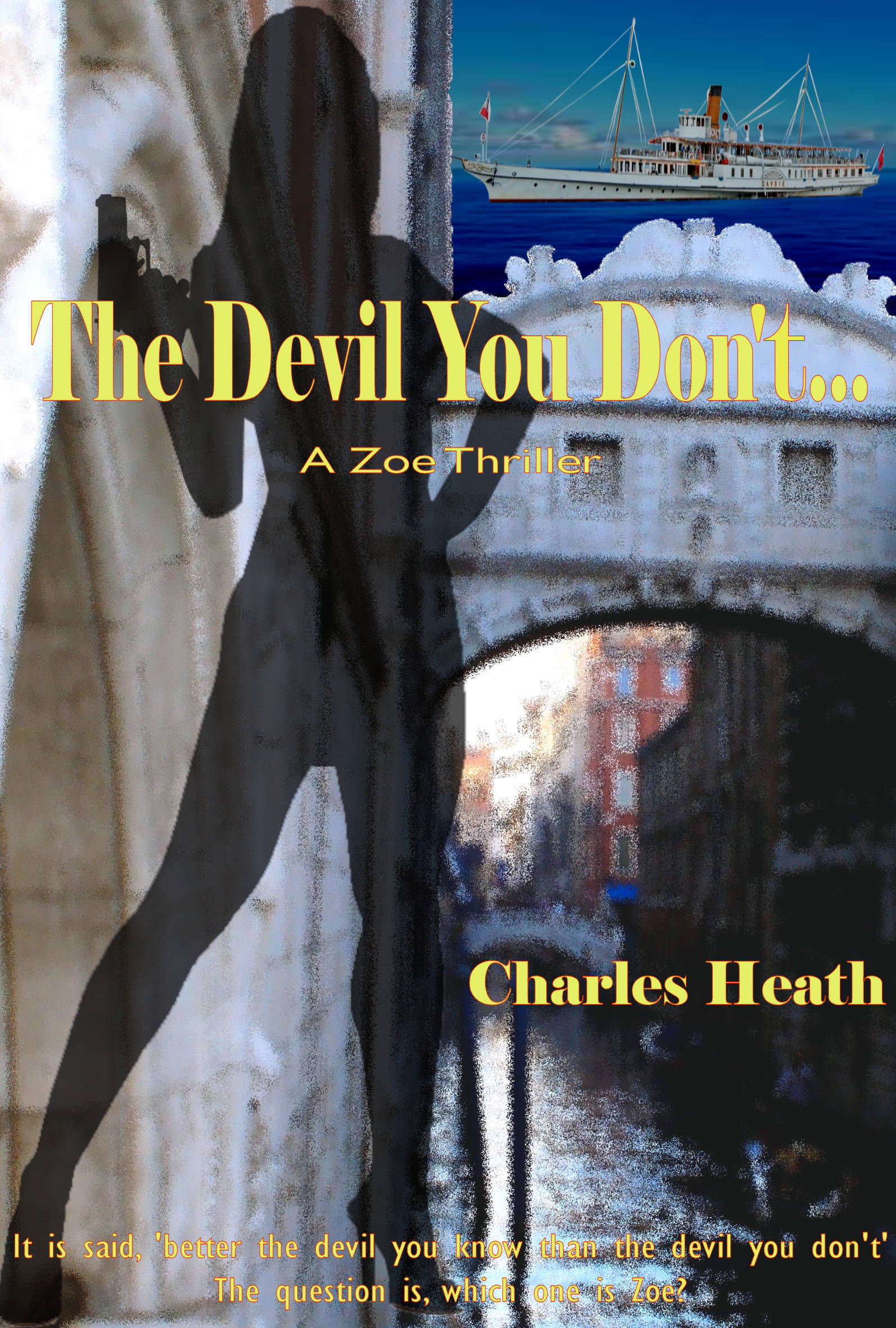
“Zoe.”
“Thanks for your concern, Zoe. By the way, my name is John.”
She smiled again, perhaps in an attempt to put me at ease. “I saw you earlier, you looked so sad, I thought …”
“I might throw myself overboard?”
“An idiotic notion, I admit, but it is better to be safe than sorry.”
Then she tilted her head to one side, then the other, looking intently at me. “You seem to be familiar. Do I know you?”
I tried to think of where I may have seen her before, but all I could remember was what I’d thought earlier when I first saw her; she was a model and had been at one of the showings. If she were, it would be more likely she would remember Phillipa, not me. Phillipa always had to sit in the front row.
“Probably not.” I also didn’t mention the fact that she may have seen my picture in the society pages of several tabloid newspapers because she didn’t look the sort of woman who needed a daily dose of the comings and goings, and, more often than not, scandal associated with so-called celebrities.
She gave me a look, one that told me she had just realised who I was. “Yes, I remember now. You made the front cover of the Economist. You sold your company for a small fortune.”
Of course. She was not the first who had recognised me from that cover. It had raised my profile considerably, but not Sternhaven’s. That article had not mentioned Phillipa or her family. I suspect Grandmother had something to do with that, and it was, now I thought about it, another nail in the coffin that was my relationship with Phillipa.
“I wouldn’t say it was a fortune, small or otherwise, just fortunate.” Each time, I found myself playing down the wealth aspect of the business deal.
“Perhaps then, as the journalist wrote, you were lucky. It is not, I think, a good time for internet-based companies.”
The latter statement was an interesting fact, one she read in the Financial Times, which had made that exact comment recently.
“But I am boring you.” She smiled again. “I should be minding my own business and leaving you to your thoughts. I am sorry.”
She turned to leave and took a few steps towards the main cabin.
“You’re not boring me,” I said, thinking I was letting my paranoia get the better of me. It had been Sebastian, on learning of my good fortune, who had warned me against ‘a certain element here and abroad’ whose sole aim would be to separate me from my money. He was not very subtle when he described their methods.
But I knew he was right. I should have let her walk away.
She stopped and turned around. “You seem nothing like the man I read about in the Economist.”
A sudden and awful thought popped into my head. Those words were part of a very familiar opening gambit. “Are you a reporter?”
I was not sure if she looked surprised or amused. “Do I look like one?”
I silently cursed myself for speaking before thinking, and then immediately ignored my own admonishment. “People rarely look like what they are.”
I saw the subtle shake of the head and expected her to take her leave. Instead, she astonished me.
“I fear we have got off on the wrong foot. To be honest, I’m not usually this forward, but you seemed like you needed cheering up when probably the opposite is true. Aside from the fact that this excursion was probably a bad idea. And,” she added with a little shrug, “perhaps I talk too much.”
I was not sure what I thought of her after that extraordinary admission. It was not something I would do, but it was an interesting way to approach someone and have them ignore their natural instinct. I would let Sebastian whisper in my ear for a little longer and see where this was going.
“Oddly enough, I was thinking the same thing. I was supposed to be travelling with my prospective bride. I think you can imagine how that turned out.”
“She’s not here?”
“No.”
“She’s in the cabin?” Her eyes strayed in that direction for a moment, then came back to me. She seemed surprised I might be travelling with someone.
“No. She is back in England, and the wedding is off. So is the relationship. She dumped me by text.”
OK, why was I sharing this humiliating piece of information with her? I still couldn’t be sure she was not a reporter.
She motioned to an empty seat, back from the edge. No walking the plank today. She moved towards it and sat down. She showed no signs of being cold, nor interested in the breeze upsetting her hair. Phillipa would be having a tantrum about now, being kept outside, and freaking out over what the breeze might be doing to her appearance.
I wondered, if only for a few seconds, if she used this approach with anyone else. I guess I was a little different, a seemingly rich businessman alone on a ferry on Lake Geneva, contemplating the way his life had gone so completely off track.
She watched as I sat at the other end of the bench, leaving about a yard between us. After I leaned back and made myself as comfortable as I could, she said, “I have also experienced something similar, though not by text message. It is difficult, the first few days.”
“I saw it coming.”
“I did not.” She frowned, a sort of lifeless expression taking over, perhaps brought on by the memory of what had happened to her. “But it is done, and I moved on. Was she the love of your life?”
OK, that was unexpected.
When I didn’t answer, she said, “I am sorry. Sometimes I ask personal questions without realising what I’m doing. It is none of my business.” She shivered. “Perhaps we should go back inside.”
She stood and held out her hand. Should I take it and be drawn into her web? I thought of Sebastian. What would he do in this situation?
I took her hand in mine and let her pull me gently to my feet. “Wise choice,” she said, looking up at the sky.