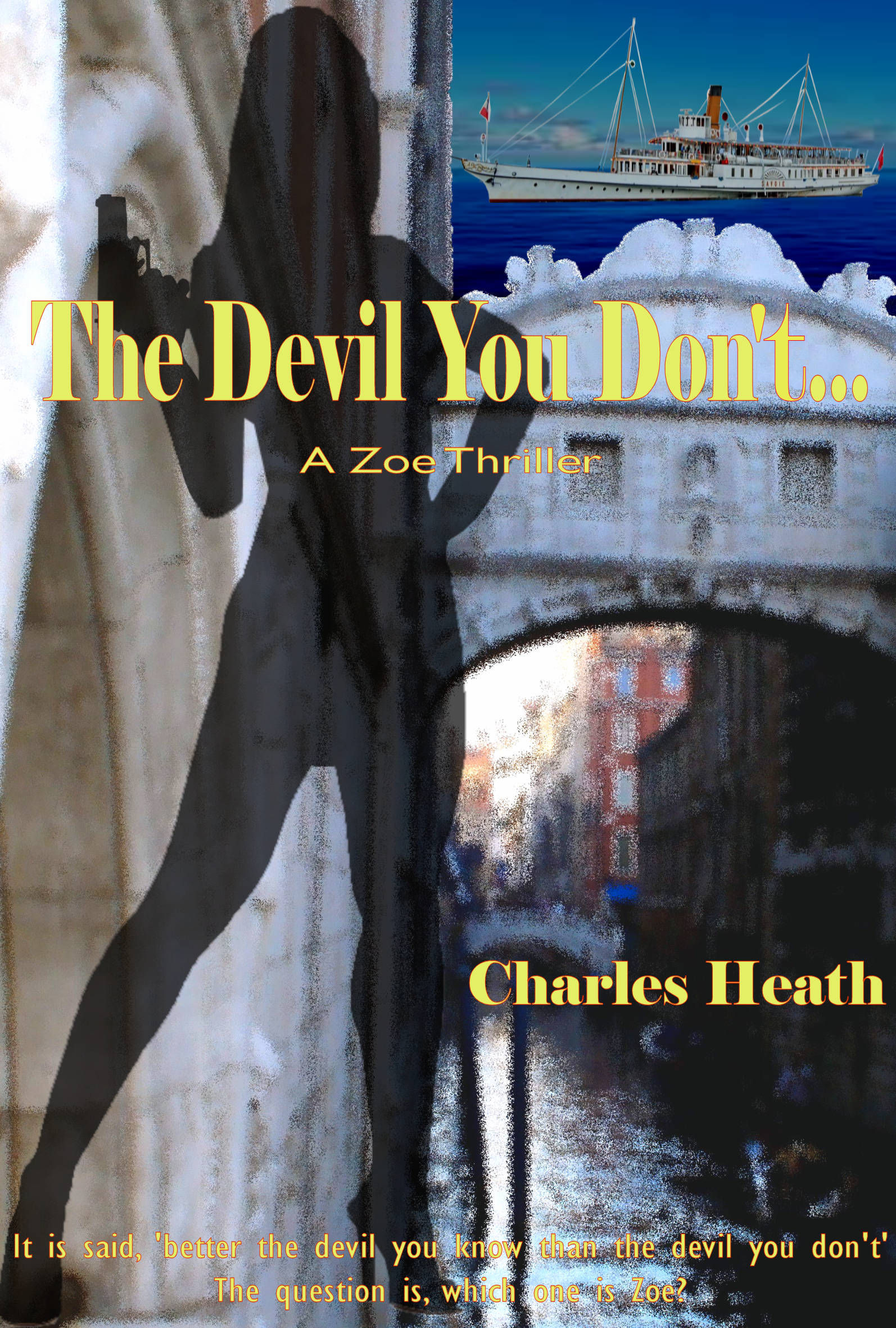
Harry Walthenson, Private Detective – the second case – A case of finding the “Flying Dutchman”

What starts as a search for a missing husband soon develops into an unbelievable story of treachery, lies, and incredible riches.

It was meant to remain buried long enough for the dust to settle on what was once an unpalatable truth, when enough time had passed, and those who had been willing to wait could reap the rewards.

The problem was, no one knew where that treasure was hidden or the location of the logbook that held the secret.

At stake, billions of dollars’ worth of stolen Nazi loot brought to the United States in an anonymous tramp steamer and hidden in a specially constructed vault under a specifically owned plot of land on the once docklands of New York.

It may have remained hidden and unknown to only a few, if it had not been for a mere obscure detail being overheard …

… by our intrepid, newly minted private detective, Harry Walthenson …

… and it would have remained buried.

Now, through a series of unrelated events, or are they, that well-kept secret is out there, and Harry will not stop until the whole truth is uncovered.

Even if it almost costs him his life.  Again.

365 Days of Writing, 2026 – 210/214

Days 213 and 214 – Writing Exercise

I thought the end of my world came from the rejection and subsequent humiliation following my disastrous proposal to a girl I thought loved me as much as I loved her.

It was never going to be that simple.

It was nothing that time would heal.

And it was not my burden to carry on my own.  An event that completely wiped away the horror of that personal failure and replaced it with something far worse.

Created by the pressing of a single button.

June 14th 2029.

It wasn’t as if the world hadn’t already gone to hell in a handbasket.  The whole world had become a tinderbox.  Presidents argued, ultimatums given, elections lost.

It wasn’t just one man who decided the fate of the world.  It was more than that.  Men had decided they wanted power, and to get power they used leverage, and leverage came from withdrawing the one necessity we had come to take for granted.

Fuel.  In every form.  Oil, gas, uranium, water.

A single ultimatum was issued.  No one honestly believed it would be followed through because there had been similar threats before.

No one in their right mind would launch a single nuclear weapon of such destructive power; it would destroy a city and millions of people.

Let alone the secondary effects of radiation poisoning that would be almost an extinction-level event. 

We didn’t understand what all the talk was about, what would happen in the event of nuclear war, and prayed it would never happen.

But on June 14th 2029, it did.

The president, bunkered down, under siege, having refused to acknowledge that he had lost what he called a rigged election, and with nowhere to go, followed through with his threat.

The launching of the missile was televised.

Where it landed was not.  Its launch caused retaliatory strikes, and, in all, five nuclear missiles landed, wiping out in an instant five cities and everyone within the blast range.

Then, within a matter of hours, the smaller but equally destructive missiles started landing and destroying major cities all over the world.

Retaliatory strikes.

No one was safe; millions of people died.

What was remarkable for me was that I survived, because when we learned what was about to happen, the last message to be broadcast, I had wanted to die.

It seemed God had saved me for a reason.

Three months was a long time when trying to find the essentials was a battle in itself.

Yes, survivors banded together and helped each other.  To begin with. But as time passed, resources were harder to find, more people were coming, more mouths to feed and more space to house them, and getting people to agree on a plan of action saw divisions, splinter groups being formed, then the fighting began.

Instead of being grateful to be alive, suddenly we were fighting to stay alive.

I got out of the big city, or what was left of it and headed south.  I had no idea why, other than a belief things had to be better where, hopefully, it was warmer.

We were, someone said, going through what was called a nuclear winter.

I’d found a car abandoned on the side of the highway.  It was surprising someone else hadn’t stolen it.  Perhaps it was the dried blood stains inside and outside that acted as a deterrent.

I was not squeamish.  The owner or occupants were nowhere to be seen, and in fairness, I waited an hour to see if they returned.

They did not.

I drove until it ran out of fuel, parked it, got out, and said a silent prayer for the previous occupants.  It had taken me a hundred miles further south, what would have taken me a week or two on foot.

What was remarkable was the distinct lack of traffic and people.  Some places looked almost intact, except for the lack of people.  Not that I was looking for anyone; I learned the hard way no one could be trusted.

I slept in an abandoned shed that night.  How easy it had become not to expect a warm, comfortable bed, running water, and a meal from the fast food shop around the corner. 

I could not remember what my last hamburger or chicken sandwich tasted like.  

I opened my eyes just after making a wish, the same wish I had made since the day the world as we knew it ended.

I should be grateful I was one of the few who survived.

I should be grateful I had somewhere to sleep that was reasonably sheltered.

I should be grateful I had found a can of beans, and I ate well the night before.

I should be grateful, but I learned very quickly that gratitude got you nowhere.

Once people realised that everything they had known and relied on was gone, primitive instinct took over.  It was, quite literally, every man and woman, for themselves.

But if that wasnt worse enough, that expectation that life could get better was dashed by a second series of calamities, the explosions cause by the bombs had anl rolling effect under the earth’s crust, and not only agitated existing volcanoes, it restarted long since extinct volcanoes, and caused earthquakes particularly around the Pacific rim, and of course, along the very coast I was making my way down.

Today was no better than yesterday, or the day before. Dawn was almost as dark as the hour before, the sun unable to fully penetrate the dust and fallout in the upper atmosphere.

Intermittent lightning strikes lit up in the distance, along with a faint rumble of accompanying thunder.  When it reached land, the storms increased in intensity.

I peered into the gloom and should have been glad I couldn’t see too far into the distance.  It was better not to know what was ahead of me.

It was safe to say my wish had not been granted.

I sighed.

A man in a uniform, perhaps a member of the National Guard sent to keep law and order, came up and said, “If you want to survive this, go south to either Cape Canaveral or Pensacola.  There will be ships taking people to the southern continents.  Tell everybody you see.  We can’t stay here, not for much longer.  There’s a mini ice age coming to the northern hemisphere.”

Then he left, moving quickly.  An army truck went past, then slowed down as it approached him; then he climbed up, and it continued on its way.  Were there others nearby whom he had given the news?

Go south?

To a ship that would take us to safety?

Was anywhere safe?

I guess I would soon find out.  It was time to leave.

I looked around to see if anyone else was about.  There wasn’t.  Those like me who ventured away from their temporary home where it was warm and safe were regarded as troublemakers, and they didn’t stop us.

They were waiting for the government or whatever or whoever was in charge to come and tell them what to do.  From what I’d seen, the only people in charge were those who took control, and those waiting were going to be disappointed.

There may be food, there may be light, and there may be a degree of normality.  But it wasn’t going to last forever. 

I had always wanted to go on that road trip along the coast from Boston to Cape Canaveral.  Not only did NASA launch spaceships from there, but the Disney cruise ships sailed from there. 

Or used to.  It would be interesting to see what was there now.  Or not.  Everyone knew about it being a cruise ship port and would go there.  Instead, I would go to Pensacola.  I suspect there might be naval ships there, and fewer people vying for berths.

I checked the maps I had and saw it was about 1500 km to Pensacola versus about 2000 km for Cape Canaveral.  Less walking, and quicker.  Problem solved.  It was going to take months, but there were no alternatives.

It took a few minutes to put my few possessions into my backpack and set out, not walking on the road, which I learned very quickly was far too dangerous, but back from it, usually hidden.

There were very few vehicles, and those that passed, in either direction, were mostly being driven carefully.  As far as I knew, and checking the gas stations when I had the car, there was no gas, or no electricity to pump the gas into the cars.

I had seen one group pumping fuel out of the ground tanks into a tanker.  Necessity made many people inventors.

A car went past, going quickly.  There were two people on it, a man and a woman.  Perhaps they’d heard to advice to go south.  I watched it head down the road.

A minute later two motorbikes screamed past, going very fast.  Were they chasing the car?  Had those in the car stolen something from the men chasing them?

I watched until the bikes disappeared, and the sound of their machines was muffled by the trees.  None of my business.

It took an hour to get to the bottom of the hill, and another to find a track alongside the road, twisting and turning quite sharply for a few miles.

Almost at the end I noticed an acrid smell, like burning rubber.  Around the corner I could see the reason for it: the car that had passed by was on its side, and closer inspection revealed the driver sprawled out on the roadside gravel.

The car had been torched, and the man was left to die.  Where was the girl?

A groan came from the bushes, and I found her behind a fallen tree.  She had crawled there after being shot and had also been left to die, except she hadn’t.

Died, that it.  But she didn’t look too healthy.  I turned her over and gasped.

What were the odds?  A million to one.

Esther.  It was the very same woman who had turned down my proposal and, as a parting shot, said she still wouldn’t marry me even if I was the last man on earth.

Well, right then I felt like I was the last man on earth, and the feeling was mutual.  She looked up at me in horror, and that was enough.

If I saw her again, it would be too soon.

I started walking.

“Please don’t leave me.”  Pleading, she had used that voice and tone before.  I’d been more naive then.

I stopped.  I don’t know why.  “Why are you here?”

Not, can I help you?  To an outsider, it might seem cruel.

“That man stole my father’s car.  We were heading south.  He tricked us into stopping.  He murdered my parents, and kidnapped me.  I dread to think of what he was going to do.”

A glance confirmed some of what she said.  Blood spattered her dress, bound hands, with raw skin from when she had tried to free herself.

“That dead guy?”

“The murderer and kidnapper.”

“The two men on the motorbikes?”

“Killed him and left me for dead.  Another mouth to feed, they said.  He stole food from them; they got it back and took ours as well.”

“Where were you going?”

“South.  Like we were told to do before that guy hijacked us.  To safety.”

“There is nowhere safe.”

“I’m beginning to think that might be true.  Where are you going?”

“Anywhere but north.”

“Take me with you.”

“I don’t do kidnapping, or waste my time on people who don’t care about me.”

“I made a mistake.”

“No.  You spoke your truth.  I could be one of the last men on earth.  That makes me ineligible to take you anywhere.”

That’s when the tears started.  I shook my head. 

“You cause me infinite embarrassment.  I had to quit my job.  None of my friends would talk to me.  You ruined my life.”

“And all of this, this didn’t have a greater effect on your life?”

“No.  I was already alone and ostracised.  This just made it easier for me to do what I had to.”

“Then just take me to the next settlement, and I’ll be out of your hair.”

“You will be out of my hair if I just leave you here.  Someone else can find you.”

Of course, doing what I wanted because I was angry wasn’t the same as doing the right thing.  Or behaving like everyone else and leaving her.  It wasn’t the first time I’d had my ethical nature exploited, and I would have to harden up if I was to survive the trek south.

I shrugged.  I would cut her free and leave.  She would have to learn to fend for herself like everyone else.

I gave her my most severe expression while I cut the bindings and then waited until she managed to sit up.  The gunshot wound turned out to be her father’s blood after he was shot.

She had nothing but the clothes she wore.  Everything she had was in the car, and had been burned.  I gave her a small bottle of water, and she drank all of it. 

I stood and stepped over the log, ready to resume my trek.  “If you’re coming with me, we’re going.  Now.  I’m following a track alongside the road.  No need to alert anyone to our presence.  And we will not be staying in hotels or eating in restaurants.  There are none.”

She dragged herself to her feet and stretched out.  “You wouldn’t have any pills for a headache, would you?”

She wasn’t going to last five minutes.

An hour later we had travelled further than I thought we would.  Water wasn’t a problem because we intermittently found ourselves beside a running stream with clear water.

As for food, that was going to be a problem.  Animals of any sort were far and few between.  When the food ran out, people started killing animals.  It wasn’t pleasant.  I couldn’t do it.  Not at first.  Now I would kill a chicken or a rabbit, if I could find one.  Or a fish.  Each time I refilled the water bottles, I checked, just in case.

At least she had sturdy shoes, not high heels, and practical clothing.

Midway through the afternoon, a terrible storm hit, and we were lucky to find an old barn that had three walls and half a roof, enough shelter to keep dry, but not necessarily warm.  There was a little hay scattered over the floor, and we gathered it up to use as insulation from the cold.

I tried to remember when I first met her, and what my reasoning was for approaching her.  It was difficult given what I knew now about her, but there had to be a reason why she had come back into my life.

Or it was simply God’s joke on me.

“You scared me,” she said suddenly.  It was the first words she’d spoken since settling in the barn

“What?  When?”

“When you asked me to marry you?”

“Surely you knew that was the next step.”

“It was too soon.  I wanted to get to know you better.  I mean, it was only six months.  You could have asked me to move in with you, and I would have said yes.”

“How’s that different from getting married?”

“It would be like a test run.  You know, try it before you are stuck with it.  That didn’t come out right, but you know what I mean.”

“And you couldn’t have said that, instead of what you did say?”

“I’m sorry.  I was surprised, and then my mind went blank.  To be honest, I don’t even remember what I said, other than it was not my finest hour.”

Indeed not.

“I thought about it a lot.  Seriously, I’m very, very sorry if I hurt you.  It was not my intention.”

I thought about it.  Her manner that night seemed out of character, but I thought that was because it was her true nature.  Too late now.

“What is it like being on your own in this, whatever it is?  I can’t imagine why people have to be so mean to each other.  We left just after the riot.  A lot of people died.  It was terrible.”

“It still is, and it isn’t going to get better.  There’s not enough of anything to go around.  I think there are quite a few people who saw an opportunity once everything broke down.  No leadership, no facilities, so many homeless and dying. It’s hard to save yourself, let alone others.  Places I’ve been, there are a lot of people who can’t look after themselves.  They spent their whole lives letting someone else worry about them.  If we ever get out of this, it’s going to be a long road back.”

“Am I able to travel with you?  You’re not going to dump me at the next town.  I’d rather be with you than anyone else.”

“Why.  You hate me.”

“No.  That’s one thing I never did.  I didn’t want to marry you, but that was all.  I had, I still have feelings for you, as much as you don’t want to believe me.  You have no idea how happy I was to see it was you who rescued me, and not some other monster.”

“Don’t jump to any conclusions just yet.  I’ll see what it’s like in the next settlement.  And if you want to increase your chances, think of some way of getting food.  We’re going to need some by the end of the day. If only to ward off the cold.  If we get sick, it’s more than likely we’ll die.”

I’d seen more than I cared to admit.  People putting their heads down and not waking up.  Even in the safety and relative warmth of the underground carpark I’d found refuge in after the first bombs came.

It wouldn’t be long before I questioned my sanity, after leaving the one place I’d called home, and the relative safety it afforded.

Instinct had told me to leave, and I had.  I’d asked if anyone wanted to come with me.  None did.  Help was coming; we just had to wait.

I simply shrugged and left.

I’d been on the road for a week before running into Esther.  I had obviously left before the riots, but they had been inevitable. 

Soon after the group in the underground carpark, where everyone from several towers had gone seeking shelter, had set up camp, their building now in ruins from the bombs, others started turning up looking for shelter.

We had taken them in, but soon there were too many, and we had to turn them away.  That’s when the trouble started.  Self-elected leaders, people who started giving orders, making rules; it was inevitable.

Then guards were armed, and what was going to happen always would.  I left because it wasn’t right, and I didn’t want to be in a position where I had to kill someone. 

Those first few weeks were difficult.  We were in survival mode.  Our instincts were to help as many as we could.  Until after a month, it was overwhelming.  No one came to tell us everything would be fine.

Outside, the weather made it impossible to go anywhere, and it felt like it was perpetually in darkness.  The first few weeks we had what looked to be acid rain from the fallout.  And some of the people who came to our shelter had radiation sickness.  There was nothing we could do for them, and they couldn’t stay.

The building had a generator, so we had power, but there was only so much diesel to run it.  Rationing had begun when I left, both for the generator and the food.  People were going out in hunting parties, and came back with stories that were hard to believe. 

To me, it was not.  A week before the war started, the newspaper published a story that predicted what would happen if some idiot pressed the button.  So far, everything I’d dreaded had happened.

The thing was, there was no plan for war.  No one expected war because it was never a possibility.  It was simply one man saying he was going to obliterate what he perceived to be his enemy.  Even then it was said nuclear weapons were only a deterrent; they would never be used.

Someone forgot to send our President the memo.

I woke to a murky morning, bitterly cold, and alone.

That was the first revelation.

The second: a storm was raging outside. It was the first thunder strike that woke me, followed by the flash of lightning.

I’d got used to the rolling thunder in the distance.

There would be rain soon enough.

I looked out in the early morning semi-darkness, which wouldn’t improve.  It would be worse when the rain came and would make progress almost impossible.

But, aside from that, where was Esther?

I didn’t hear her leave, and was, for a moment, surprised.  She had nothing, so the fact that there was no sign of her was no indication other than she was not in the barn.

Perhaps she had to go to a makeshift bathroom by the river.  There was one because of the line of trees in the distance.

Perhaps I should go there myself.  I needed to replenish the water bottles.  And it was time to go.

I stashed my bag and grabbed the bottles.  I had got about halfway when a man appeared out of a copse.  He had a gun.  It wasn’t pointed at me, but it could be.

I decided to be friendly.  “Hello there.  You heading south too?”

He had been watching me, most likely to see if I was armed.

“Maybe.”

“You’re a bit far from the road.  Nothing here but a paddock and a river.  And an old barn that’s about to collapse.”

“You got any food?”

Of course.  The gun should have told me this man was a taker, not a sharer.

“Unfortunately no.”

“I don’t believe you.”

And that was par for the course.  It would not matter what I said

I saw him look past me and turned.  Esther.  Coming back from the river.  She stopped when she saw him.

“Who’s your friend?”

“She’s not my friend.  We’re just going south together.”

He shook his head, and the rifle came up, pointing at me.

“Whatever food you’ve got, I want.  Now.”

Once again his attention was drawn towards the river slightly to the left of where Esther was standing.  Another man came running out of the bushes, heading towards the man with the gun.

“They’re lying, Wally.”  He held up two fish.  “They had these fish, and I stole them.  We’re eating well today.”

“Take them and leave,” Esther yelled out.

“And if we don’t?”

“We haven’t got anything else but what we’re wearing.  You’ve taken our food, just go.”

“You’ve got a lot to say for yourself.  Maybe you’d like to come with us, and leave this deadbeat liar.”

I could see she was about to say something that might get us shot, so I said,  “You passed the burning car and dead guy beside it?”

“So?”

“She did that.  With two hands tied behind her back.  How long do you think you’d last before you end up like him?”

“You’re kidding.”

“Want to find out, sunshine.”  She had a knife in her hand, and it looked ugly and menacing.  I hadn’t seen it on her, so she must have had it hidden.

Or found it.

His friend muttered in his ear.

“This is your lucky day.  Can’t waste the ammo, and we ain’t sharing the food.  If I see you again, I will kill both of you.”

They backed away towards the road, then disappeared.  They could come back, but I didn’t think they would.  We were two extra mouths to feed, and I doubted they had any ammo.  If they did, it could have turned out a lot worse.

I waited until Esther joined me.  She didn’t look too disappointed they took the fish

“I didn’t know you had a hunter-gatherer background.”  I was not so handy at fishing or hunting.

“Mt dad took me and my brothers camping as much as he could.  Taught us survival skills.  And how to catch fish with only your hands.”

“You were lucky; I haven’t seen any fish.”

“Not so much.  They are contaminated.  Strange colour.  I wouldn’t have eaten them.  I heard the two of them approach the barn talking.  They’d seen us come here.  They went off to hide and wait for light.  I went down to the river and hoped I’d find some fish and give them to them to get them to go away.  Seems it worked.”

“If they’re contaminated, they will get sick and die.”

“Fitting punishment for stealing.  I actually found something better.  A small box of cans of fruit.  I think someone stuck them near a camping site by the river.  A good Samaritan.  Come, we eat, you get water, we move on.  We can go around them.”

“There will be more.”

“I know.  Let’s go eat.”

We are two cans each and took one each and left the rest.  Someone else, if they decided to be adventurous, would find them and hopefully would do the same.

We couldn’t carry much more than that anyway.

I guess whatever I was thinking about her, I had to put aside.  She was not the helpless person I thought she was, and I was guessing she had to toughen up quickly with her parents.

A car with petrol in it was a prized possession.  All the electric cars, and that was most of those lying around, were dead with no means of recharging the battery.

After that I filled the bottles and then went back to get my bag.  The morning hadn’t improved, but the rain held off.  We both had waterproof coats, though hers wasn’t very thick, but it would do.

Then we took a wider circle route on another path through a different part of the forest.  Like me, she was hoping never to see those two men again.  Sadly, they would not be the last.

The morning slowly dragged into the afternoon, and the rain came.  I had considered staying in the relative safety of the barn, but the weather was never going to improve, and the quicker we went further south, the better.

There had been reports in those brief few days after the bombs when some power was restored, but it was rationed.  We had long been told to get battery radios before any conflict started, and one person had said that a thing called a crystal set would be better.  It did not need batteries, just a wire antenna.

My grandfather had mentioned he had one when he was a child, and I had gone to my father’s house and rummaged in the attic where he kept his father’s stuff and found it.

One problem: it didn’t catch FM, only AM, but amazingly after a month or so we were told all communications would be transmitted on the AM band.  I was one of the lucky people; after the power failed, then the TV and Radio stations, except for a network of AM stations run by the government in case of emergencies.

I hadn’t used it recently.  I was waiting until I got closer to the destination. 

Days turned into weeks.

We passed other people, most walking the road, because it was easier.  There were cars left where they ran out of petrol.  Some people had been sick and died.  There were dead animals.  Plant life was waning through the lack of sunshine, but as we got further south there was slight improvement.

We passed compounds where people had barricaded themselves, where cars were parked, and guards were on makeshift gates.  We did not alert them to our presence.  Those guards had guns, and they would use them.

I doubted they would accept people from the north because of radiation exposure.  We had passed the theoretical safe limit a few days before, and it was interesting to note the wind was coming from the south, after following us for weeks.

Being from the Midwest and nowhere near the nuclear explosion, we had been told the prevailing winds would basically leave us alone, but the devastation to Washington and New York was devastating, with so many killed, and so many who would not survive for very long.

It was as if the Hiroshima and Nagasaki experience had not taught us anything.  I had no idea and didn’t care who, or even if, someone was running the country, but given the fact that people had banded together in communities fending for themselves, I didn’t think there was anyone.

The army and national guard had been out and about soon after the bombs, but that slowly petered out when the petrol and diesel ran out, and the electric cars stopped.  So did everything else.

It took six weeks before anarchy broke out.  It was a surprise we lasted that long.  People thought having a gun gave them leverage. 

I guess Esther knew all about that.  Her father had stopped to help.  It was the last thing he did.  She was never going to make that mistake.  Her father had taught her self-sufficiency as my father had taught me.  Both parents perhaps would see the way the world was going.

My father had been called to Washington a few days before the bomb dropped.  He would not have survived.  Perhaps if he hadn’t answered the phone, he would be still alive.

Some nights we slept under a tree, or in a copse.  We were both light sleepers.  Sometimes there was an outhouse or shed.  There was food if you knew where to look, and water.

In one small town, abandoned, Esther was able to find a backpack and a change of clothes.  We found batteries, some with charge and a torch, candles, matches, little things. 

Some nights she cried, missing her parents and cursing the fools who got us into the mess.  I simply felt numb and helpless.  There was no guarantee that anything would be waiting for us at the end of the trek.

After two months, give or take a few days, I had lost track of the date and time. Like everything, all our devices were run by rechargeable batteries, and there was nowhere to recharge them. We reached the outskirts of a city.

It was odd to see electric cars parked at the recharge station, still plugged in, and no power to run them.  That promise of clean air when we bought one was fulfilled.  No one told us the pollution would come from another source

She tried a few, but none had any power.  One had enough to move about twenty yards.

We were on the top of a hill that overlooked the skyline in the distance.  It just looked like nothing had happened.  We had passed the power station on the side of the river, bereft of people, and not generating power.  It was gas-fired, but we had passed solar farms which were basically useless in the perpetual semi-darkness.

The trip from Chicago to Pensacola was going to take about four or five months, and now we were at the point where we were just about at Montgomery in Alabama, and according to my map we would be able to travel on the Alabama River.  It was a fair distance, but at least we would not have to walk.

But we would have to find a boat.

Of course, had we known what we were heading towards, we might have made a different plan, but with no communication available, we headed there anyway.

And what did we find?

A half million people had arrived before us, all hoping to get on a boat. 

And we were at the back of the line.

©  Charles Heath  2026

An excerpt from “Mistaken Identity” – a work in progress

The odds of any one of us having a doppelganger are quite high. Whether or not you got to meet them or be confronted by them was significantly lower. Except, of course, unless you are a celebrity.

It was a phenomenon remarkable only for the fact that, at times, certain high-profile people, notorious or not, had doubles if only to put off enemies or the general public. Sometimes we see people in the street who look like someone we knew and make the mistake of approaching them like a long-lost friend, only to discover an embarrassed individual desperately trying to get away from what they perceive as a stalker, or worse.

And then sometimes it is a picture that looms up on a TV screen, an almost exact likeness of you. At first, you are fascinated, and then, according to the circumstances and narrative that is attached to that picture, either flattered or horrified.

For me, one turned to the other when I saw an almost likeness of me flash up on the screen when I turned the TV on in my room. What looked to be my photo, with only minor differences, was in the corner of the screen, the newsreader speaking in rapid Italian, so fast I could only translate every second or third word.

But the one word I did recognise was murder. The photo of the man on the screen was the subject of an extensive manhunt. The crime, the murder of a woman in the very same hotel I was staying, and it was being played out live several floors above me. The gist of the story, the woman had been seen with and staying with the man who was my double, and, less than an hour ago, the body had been discovered by a chambermaid.

The killer, the announcer said, was believed to be still in the hotel because the woman had died shortly before she had been discovered.

I watched, at first fascinated by what I was seeing. I guess I should have been horrified, but at that moment it didn’t register that I might be mistaken for that man.

Not until another five minutes had passed, and I was watching the police in full riot gear, with a camera crew following behind, coming up a passage towards a room. Live action of the arrest of the suspected killer, the breathless commentator said.

Then, suddenly, there was a pounding on the door. On the TV screen, plain to see, was the number of my room. I looked through the peephole and saw an army of police officers. It didn’t take much to realise what had happened. The hotel staff identified me as the man in the photograph on the TV and called the police.

Horrified wasn’t what I was feeling right then.

It was fear.

My last memory was the door crashing open, the wood splintering, and men rushing into the room, screaming at me, waving guns, and when I put my hands up to defend myself, I heard a gunshot.

And in one very confused and probably near-death experience, I thought I saw my mother and thought what was she doing in Rome?

I was the archetypal nobody.

I lived in a small flat, I drove a nondescript car, had an average job in a low-profile travel agency, was single, and currently not involved in a relationship, had no children, and, according to my workmates, no life.

They were wrong. I was one of those people who preferred their own company; I had a cat, and travelled whenever I could. And I did have a ‘thing’ for Rosalie, one of the reasons why I stayed at the travel agency. I didn’t expect anything to come of it, but one could always hope.

I was both pleased and excited to be going to the conference. It was my first, and the glimpse I had seen of it had whetted my appetite for more information about the nuances of my profession.

Some would say that a travel agent wasn’t much of a job, but to me, it was every bit as demanding as being an accountant or a lawyer. You were providing a customer with a service, and arguably, more people needed a travel agent than a lawyer. At least that was what I told myself as I watched more and more people start using the internet, and our relevance slowly dissipating.

This conference was about countering that trend.

The trip over had been uneventful. I was met at the airport and taken to the hotel where the conference was being held with several other delegates who had arrived on the same plane. I had mingled with several other delegates at the pre-conference get-together, including one whose name was Maryanne.

She was an unusual young woman, not the sort that I usually met, because she was the one who was usually surrounded by all the boys, the life of the party. In normal circumstances, I would not have introduced myself to her, but she had approached me. Why did I think that may have been significant? All of this ran through my mind, culminating in the last event on the highlight reel, the door bursting open, men rushing into my room, and then one of the policemen opened fire.

I replayed that last scene again, trying to see the face of my assailant, but it was just a sea of men in battle dress, bulletproof vests and helmets, accompanied by screaming and yelling, some of which I identified as “Get on the floor”.

Then came the shot.

Why ask me to get on the floor if all they were going to do was shoot me? I was putting my hands up at the time, in surrender, not reaching for a weapon.

Then I saw the face again, hovering in the background like a ghost. My mother. Only the hair was different, and her clothes, and then the image was going, perhaps a figment of my imagination brought on by pain-killing drugs. I tried to imagine the scene again, but this time it played out without the image of my mother.

I opened my eyes and took stock of my surroundings. What I felt in that exact moment couldn’t be described. I should most likely be dead, the result of a gunshot wound. I guess I should be thankful the shooter hadn’t aimed at anything vital, but that was the only item on the plus side.

I was in a hospital room with a policeman by the door. He was reading a newspaper and sitting uncomfortably on a small chair. He gave me a quick glance when he heard me move slightly, but didn’t acknowledge me with either a nod or a greeting, just went back to the paper.

If I still had a police guard, then I would still be considered a suspect. What was interesting was that I was not handcuffed to the bed. Perhaps that only happened in TV shows. Or maybe they knew I couldn’t run because my injuries were too serious. Or the guard would shoot me long before my feet hit the floor. I knew the police well enough now to know they would shoot first and ask questions later.

On the physical side, I had a large bandage over the top left corner of my chest, extending over my shoulder. A little poking and prodding determined the bullet had hit somewhere between the top of my rib cage and my shoulder. Nothing vital there, but my arm might be somewhat useless for a while, depending on what the bullet hit on the way in or through.

It didn’t feel like there were any broken or damaged bones.

That was the good news.

On the other side of the ledger, my mental state, there was only one word that could describe it. Terrified. I was looking at a murder charge and jail time, a lot of it. Murder usually had a long time in jail attached to it.

Whatever had happened, I didn’t do it. I know I didn’t do it, but I had to try to explain this to people who had already made up their minds. I searched my mind for evidence. It was there, but in the confused state brought on by the medication, all I could think about was jail, and the sort of company I was going to have.

I think death would have been preferable.

Half an hour later, maybe longer, I was drifting in and out of consciousness. A nurse, or what I thought was a nurse, came into the room. The guard stood, checked her ID card, and then stood by the door.

She came over and stood beside the bed. “How are you?” she asked, first in Italian, and when I pretended I didn’t understand, she asked the same question in accented English.

“Alive, I guess,” I said. “No one has come and told me what my condition is yet. You are my first visitor. Can you tell me?”

“Of course. You are very lucky to be alive. You will be fine and make a full recovery. The doctors here are excellent at their work.”

“What happens now?”

“I check you, and then you have another visitor. He is from the British Embassy, I think. But he will have to wait until I have finished my examination.”

I realised then she was a doctor, not a nurse.

My second visitor was a man, dressed in a suit, the sort of which I associated with the British Civil Service.  He was not very old, which told me he was probably a recent graduate on his first posting, the junior officer who drew the short straw.

The guard checked his ID but again did not leave the room, sitting back down and going back to his newspaper.

My visitor introduced himself as Alex Jordan from the British Embassy in Rome, and he had been asked by the Ambassador to sort out what he labelled a tricky mess.

For starters, it was good to see that someone cared about what happened to me.  But, equally, I knew the mantra, get into trouble overseas, and there is not much we can do to help you.  So, after that lengthy introduction, I had to wonder why he was here.

I said, “They think I am an international criminal by the name of Jacob Westerbury, whose picture looks just like me, and apparently, for them, it is an open and shut case.”  I could still hear the fragments of the yelling as the police burst through the door, at the same time telling me to get on the floor with my hands over my head.

“It’s not.  They know they’ve got the wrong man, which is why I’m here.  There is the issue of what had been described as excessive force, and the fact that you were shot had made it an all-around embarrassment for them.”

“Then why are you here?  Shouldn’t they be here apologising?”

“That is why you have another visitor.  I only took precedence because I insisted on speaking with you first.  I have come, basically, to ask you for a favour.  This situation has afforded us an opportunity.  We would like you to sign the official document, which basically indemnifies them against any legal proceedings.”

Curious.  What sort of opportunity was he talking about?  Was this a matter that could get difficult and I could be charged by the Italian Government, even if I wasn’t guilty, or was it one of those hush-hush type deals, you do this for us, we’ll help you out with that?  “What sort of opportunity?”

“We want to get our hands on Jacob Westerbury as much as they do.  They’ve made a mistake, and we’d like to use that to get custody of him if or when he is arrested in this country.  I’m sure you would also like this man brought into custody as soon as possible, so you will stop being confused with him.  I can only imagine what it was like to be arrested in the manner you were.  And I would not blame you if you wanted to get some compensation for what they’ve done.  But.  There are bigger issues in play here, and you would be doing this for your country.”

I wondered what would happen if I didn’t agree to his proposal.  I had to ask, “What if I don’t?”

His expression didn’t change.  “I’m sure you are a sensible man, Mr Pargeter, who is more than willing to help his country whenever he can.  They have agreed to take care of all your hospital expenses, refund the cost of the Conference, and travel.  I’m sure I could also get them to pay for a few days at Capri or Sorrento, if you like, before you go home.  What do you say?”

There was only one thing I could say.  Wasn’t it treason if you went against your country’s wishes?

“I’m not an unreasonable man, Alex.  Go do your deal, and I’ll sign the papers.”

“Good man.”

After Alex left, the doctor came back to announce the arrival of a woman, who had announced herself as the publicity officer from the Italian police. When she came into the room, she was not dressed in a uniform.

The doctor left after giving a brief report to the civilian at the door. I understood the gist of it: “The patient has recovered excellently, and the wounds are healing as expected. There is no cause for concern.”

That was a relief.

While the doctor was speaking to the civilian, I speculated on who she might be. She was young, not more than thirty, conservatively dressed, so an official of some kind, but not necessarily with the police. Did they have prosecutors? I was unfamiliar with the Italian legal system.

She had long, wavy black hair and the sort of sultry looks of an Italian movie star, and her presence made me more curious than fearful, though I couldn’t say why.

The woman then spoke to the guard, and he reluctantly got up and left the room, closing the door behind him. She checked the door and then came back towards me, standing at the end of the bed. Now alone, she said, “A few questions before we begin.” Her English was only slightly accented. “Your name is Jack Pargeter?”

I nodded. “Yes.”

“You are in Rome to attend the Travel Agents Conference at the Hilton Hotel?”

“Yes.”

“You attended a preconference introduction on the evening of the 25th, after arriving from London at approximately 4:25 pm.”

“About that time, yes. I know it was about five when the bus came to collect me, and several others, to take us to the hotel.”

She smiled. It was then that I noticed she was reading from a small notepad.

“It was ten past five to be precise. The driver had been held up in traffic. We have several witnesses who saw you on the plane, on the bus, at the hotel, and with the aid of closed-circuit TV, we have established you are not the criminal Jacob Westerbury.”

She put her notebook back in her bag and then said, “My name is Vicenza Andretti, and I am with the prosecutor’s office. I am here to formally apologise for the situation that can only be described as a case of mistaken identity. I assure you, it is not the habit of our police officers to shoot people unless they have a very strong reason for doing so. I understand that in the confusion of the arrest, one of our officers accidentally discharged his weapon. We are undergoing a very thorough investigation into the circumstances of this event.”

I was not sure why, but between the time I had spoken to the embassy official and now, something about letting them off so easily was bugging me. I could see why they had sent her. It would be difficult to be angry or annoyed with her.

But I was annoyed.

“Do you often send a whole squad of trigger-happy riot police to arrest a single man?” It came out harsher than I intended.

“My men believed they were dealing with a dangerous criminal.”

“Do I look like a dangerous criminal?” And then I realised if it was mistaken identity, the answer would be yes.

She saw the look on my face and said quietly, “I think you know the answer to that question, Mr Pargeter.”

“Well, it was overkill.”

“As I said, we are very sorry for the circumstances you now find yourself in. You must understand that we honestly believed we were dealing with an armed and dangerous murderer, and we were acting within our mandate. My department will cover your medical expenses and any other amounts for the inconvenience this has caused you. I believe you were attending a conference at your hotel. I am very sorry, but given the medical circumstances you have, you will have to remain here for a few more days.”

“I guess, then, I should thank you for not killing me.”

Her expression told me that was not the best thing I could have said in the circumstances.

“I mean, I should thank you for the hospital and the care. But a question or two of my own. May I?”

She nodded.

“Did you catch this Jacob Westerbury character?”

“No. In the confusion created by your arrest, he escaped. Once we realised we had made a mistake and reviewed the closed-circuit TV, we tracked him leaving by a rear exit.”

“Are you sure it was one of your men who shot me?”

I watched as her expression changed to one of surprise.

“You don’t think it was one of my men?”

“Oddly enough, no. But don’t ask me why.”

“It is very interesting that you should say that, because in our initial investigation, it appeared none of our officers’ weapons had been discharged. A forensic investigation into the bullet tells us it was one that is used in our weapons, but…”

I could see their dilemma.

“Have you any enemies that would want to shoot you, Mr Pargeter?”

That was absurd because I had no enemies, at least none that I knew of, much less anyone who would want me dead.

“Not that I’m aware of.”

“Then it is strange, and will perhaps remain a mystery. I will let you know if anything more is revealed in our investigation.”

She took an envelope out of her briefcase and opened it, pulling out several sheets of paper.

I knew what it was. A verbal apology was one thing, but a signed waiver would cover them legally. They had sent a pretty girl to charm me. Perhaps using anyone else would not have worked. There was potential for a huge litigation payout here, and someone more ruthless would jump at the chance of making a few million out of the Italian Government.

“We need a signature on this document,” she said.

“Absolving you of any wrongdoing?”

“I have apologised. We will take whatever measures are required for your comfort after this event. We are accepting responsibility for our actions and are being reasonable.”

They were. I took the pen from her and signed the documents.

“You couldn’t add dinner with you on that list of benefits?” No harm in asking.

“I am unfortunately unavailable.”

I smiled. “It wasn’t a request for a date, just dinner. You can tell me about Rome, as only a resident can. Please.”

She looked me up and down, searching for the ulterior motive. When she couldn’t find one, she said, “We shall see once the hospital discharges you in a few days.”

“Then I’ll pencil you in?”

She looked at me quizzically. “What is this pencil me in?”

“It’s an English colloquialism. It means maybe. As when you write something in pencil, it is easy to erase it.”

A momentary frown, then recognition and a smile. “I shall remember that. Thank you for your time and cooperation, Mr Pargeter. Good morning.”

© Charles Heath 2015-2021

The cinema of my dreams – Was it just another surveillance job? – Episode 3

I’ve had time to think about the next part of this opening sequence.

Long plane rides that leave in the dead of night are always conducive to working through plotlines because being on a plane in economy, the chances of getting any sleep is nigh on impossible.

And yet, this time the impossible is possible, which means that sleeping has overtaken the thinking process, and it will have to wait till I’ve woken up.

Of course, as usual, being in this interesting situation has provided another tangent, which is doing the impossible.  It reminds me of a saying I once heard, ‘if you want the impossible it will take some time if want a miracle, that will take a little longer’.  Temper that with ‘how long is a piece of string?’

When we last visited our intrepid wannabe hero, we were left with a cryptic ‘is anyone ever in the wrong place at the wrong time?’

Sometimes, but not for our particular hero.

It could be worse, I told myself, while the paramedic cleaned up my cuts and abrasions and gave me a concussion test, which, I suspect, might not quite discover if I was or not.  But, at that moment, it didn’t matter.

I’d lost the person I’d been assigned to keep under surveillance.

It was meant to be a doddle, but of course, no one could ever predict what the conditions might be in any exercise, and whilst I was one part of a team effort, it had been on my watch, and I only realized what it was that I’d been doing when a voice in my ear started asking for an update, because it was coming up to the changeover.

I was surprised the noise of the explosion hadn’t been transmitted to the others.  I waited till the paramedic had finished, a minute at most.

“I got caught up in an explosion, a couple of over-enthusiastic bank robbers, and taken down.  The target was ahead of me.”  I gave the team leader the exact location of where I’d last seen the target, then waited.

If the team was functioning properly, one of the other three should have been close enough to predict where the target would be at the change-over point.

“Are you alright?”  It was a question I’d expected earlier.

“Got caught in the aftershock got a few cuts and abrasions, and a ringing in my ears, but otherwise ok.  The paramedics want me to go to the hospital to be checked over, mainly for a concussion, but I’m ok to resume if you want.”

A minute, or two, of silence, then, “Do as they say.  We have the target still under surveillance.”

And that was it, what I regarded as a massive failure, despite the circumstances.

I watched the paramedics load the battered policeman onto a gurney and head towards the ambulance.  I went over to the cuffs and picked them up.  A souvenir of the event, if nothing else.

Lights flashing and siren wailing it left, heading for the hospital.

I took a last look at the scene and started walking away in the direction I was originally heading, and once past the perimeter, walked through the group of bystanders who’d gathered to watch the event unfold.  On the other side, I stopped, took another look back at the scene, and did the proverbial double take.

Standing not ten yards from me was the target.

And a quick look in every direction for the members of the surveillance team showed none of them was anywhere near the target.

I spoke quietly into the communication device.

“Target, I repeat, the target is in sight.  Is anyone nearby by?”

Silence.

So we now have a dilemma, if there is no answer from the team, are they maintaining radio silence, or is something more sinister afoot?

©  Charles Heath  2025

The cinema of my dreams – I always wanted to go on a treasure hunt – Episode 59

Here’s the thing…

Every time I close my eyes, I see something different.

I’d like to think the cinema of my dreams is playing a double feature but it’s a bit like a comedy cartoon night on Fox.

But these dreams are nothing to laugh about.

Once again there’s a new installment of an old feature, and we’re back on the treasure hunt.

Did it upset me that Boggs was a little snarky?  Yes, a bit.

We’d been friends for a long time, the sort who had stuck together at school to keep arm’s length from the bullies and work together on projects and homework.  That friendship had become more important after his father disappeared, and I had believed he appreciated it.

Until this treasure thing.

It hadn’t been there, looking over everything.  The fact of the matter was he had been too young to understand any of it, and his mother wisely kept the extended details of her husband’s obsession away from him, and it was quite by chance he stumbled over his father’s effects in the attic.

Had she destroyed that stuff then perhaps we’d all not in this position?

Life had been more predictable, we avoided Alex and Vince, Nadia was nowhere to be seen, and life just rolled along in unemployed heaven.  Of course, that would have had to change, as it had, because my mother couldn’t continue to support a son in his late teens, and at that age, I should have been looking for both work, and to move on with my life.

The state of the economy, and the town’s fortunes, made that difficult, and I guess it would have been a matter of time before I left, like nearly all of my contemporaries had to the bigger towns and cities for more opportunities.

Benderby and the factory had staved that off, for now.

Other than that, I was rather pleased with the job I had, not too taxing, amenable hours so I could do other stuff, and although the only downside was working with Alex, all I had to do was avoid him, and the warehouse was a large building.

I went home to change and found my mother there, sitting at the kitchen table having a cup of coffee.

“You’re home early,” I said when I saw her.

“On a break.  Had to go to the bank, and it wasn’t much further to come here.  Muriel tells me you’ve been talking to Nadia Cossatino.”

Talking to Nadia to her was the same as spending time with her.  And to my mother, the Cossatino’s were public enemies, close to the number one.

“You taught me to be polite and speak when spoken to.”

It was always good to quote her rules back to her when she was trying to admonish me.

“You know what the Cossatino’s are, Sam.”

“She doesn’t act like one, not now.”

“You know why they sent her away, don’t you?”

Sent away?  That was not what I heard, but then, as a so-called child, what we were told and what was reality were two entirely different things.

“I thought I did, but I’m sure you’re going to tell me the grown-up reason?”

“She stabbed a girl, and instead of going to juvenile detention, they sent her home to Italy where she couldn’t get into any more trouble.”

“Why?”

“Why what?”

“Why did she stab another girl?”

“Do the Cossatino’s need reasons for what they do?  She’s not a very nice person, nor are the family very nice people.  Remember that the next time you see her.”

“She’s nice to me, and I prefer to be polite.  But I’ll take what you said and be careful.”

That said, I was dismissed, lecture given.

I changed and came back to pack a meal for the evening break.  Mother was still sitting at the table.

“I thought you’d be on your way back to work.”

“Not going back today.  I’m not feeling very well.  How is the job going?  I never get to see much of you these days.”

“I’m helping Boggs when I can.”

“Isn’t he on that treasure trail his father started?”

“Yes.  He found a box of his stuff in the attic, and we’ve been trying to make sense of it.”

“There is none.   There was no treasure, just a bunch of maps Boggs’s father made for the Cossatino’s to con people out of their money.”

“What about Ormiston?”

“He was a bigger fool than Boggs.  You don’t want to be humoring Boggs with such nonsense.  You concentrate on doing your job properly and let him follow his father down that rabbit hole.  I feel sorry for Muriel, having two of her family sucked into that mess.”

“And what if it is real?”

She gave me a look that told me the only thing that was real would be her wrath if I persisted with it.  “OK,” I said.  “I’ll try and reason with him, and get him to give it up.”

It was then I noticed the flowers over by the window, a very expensive-looking bouquet in an ornate vase.

“Do you have a secret admirer?”

She looked a little puzzled, then realized what I was talking about.

“Joshua sent them over, thought it might cheer me up.”

Joshua was Alex Benderby’s father, my employer.  Odd that he would be sending my mother flowers.  We were not anywhere near his social circle.

“He’s a kind man, Sam, and we have been friends since school.  I could do with some cheering up.”

I was not sure what she meant by that, but I hope it didn’t mean he would come visiting.  Knowing Benderby was a curse, not a benefit, and I hoped my job wasn’t contingent on her being nice to him.

I shuddered at the thought, said no more, and left for work.

My job was supposed to be my sanctuary, where I could get away from home, the depressive nature of living in the town, and Boggs and his treasure hunt.

It wasn’t an escape from Alex, and not only did he work in the same building, but treated it as his fiefdom, and resented the fact I’d ‘wormed’ my way into his domain.

Under that boastful and arrogant exterior, he really was just an insecure little boy.

But very, very dangerous.

He was leaving when I arrived, having switched from night shift to day, a blessing.  His alternate for the night shift was an uncaring old man who was approaching retirement and didn’t want anything to screw up his exit.

He let me do whatever I wanted so long as it didn’t blow back on him, and I took extra care not to cause offense, or raise any flags.  Stuff came in, stuff went out, the stock register was up to date, and nothing ran out.

It was as simple as that, and even so, Alex still couldn’t get it right so we covered for him.

Alex stopped at the door on the way out, a bad sign.

“You want to tell that clown of a friend, Boggs, to stop poking around the caves.  They’re not a place for amateurs.”

“I didn’t know he was poking around the caves.  Nor that you were.  Any particular reason?”

“It’s called spelunking, dimwit.”

I knew that but wasn’t going to make an issue of it.  He was lucky he could pronounce it let alone know what it was.

“They’re just caves, Alex, with nothing more than a few limestone pinnacles, and bat shit on the floor.  Unless, of course, you think the pirate captain hid his treasure in one of them.  I can’t see how, or why.  They’re a long way from the coast.”

“We’re not looking for treasure.  It doesn’t exist.”

“Then why warn Boggs off?”

He shook his head.  “You’re as daft in the head as he is.  Just tell him not to get in my way.”

With that, he was gone.  A huge sigh of relief, and a long peaceful night ahead of me.

Until the phone rang.

© Charles Heath 2020-2022

What I learned about writing: How to Keep Your Writing Fresh

How to Keep Your Writing Fresh – Ditch the Clichés (and Use a Few Sparingly, If You Must)

Introduction

We’ve all been there: you sit down to write a blog, a sales email, or a novel chapter, and before you know it your prose is peppered with phrases like “think outside the box,” “at the end of the day,” or “the sky’s the limit.” Clichés feel safe because they’re familiar, but they also signal lazy thinking, dilute your voice, and can even turn readers off.

So how do you keep your writing crisp, original, and engaging? And if a cliché is the perfect punchline for a specific moment, how can you wield it without sounding trite? Below is a practical, step‑by‑step guide to help you banish the overused and, when necessary, deploy a cliché with surgical precision.


1. Know What a Cliché Actually Is

DefinitionWhy It’s Problematic
A phrase, idea, or trope that has been overused to the point of losing its original impact.It signals a lack of original thought, can feel generic, and often triggers “mental fatigue” in readers.

Key takeaway: Not every familiar phrase is a cliché. Idioms (“break a leg”) and widely accepted terminology (“search engine optimization”) are fine when they serve a clear purpose.


2. Identify the Clichés in Your Own Writing

  1. Read Aloud – Hearing the words forces you to notice rhythm and repetition.
  2. Highlight “Red Flags” – Words like obviouslybasicallyin today’s fast‑paced worldthink outside the boxwin-win.
  3. Use a Cliché Detector
    • Online tools (e.g., Cliché Finder or ProWritingAid).
    • Browser extensions that underline overused phrases in real time.

Pro tip: Keep a personal “cliché cheat sheet.” Whenever you catch yourself reaching for a tired phrase, jot it down and replace it later.


3. Replace, Not Remove – Strategies for Fresh Alternatives

ClichéWhy It’s OverusedFresh Alternative
“Think outside the box”Corporate buzzword“Explore unconventional angles”
“At the end of the day”Conversational filler“Ultimately” or “When all is said and done”
“The sky’s the limit”Over‑optimistic hype“The possibilities are endless”
“In today’s fast‑paced world”Generic time‑setter“In an era of rapid change”

How to Generate Alternatives:

  • Ask “Why?” – What’s the core idea? Answer that directly.
  • Swap nouns and verbs – Replace box with a concrete image relevant to your niche.
  • Use vivid sensory language – “The horizon expands before us” feels more poetic than “the sky’s the limit.”

4. Embrace Specificity Over Generality

Bad: “She was very happy.”
Good: “She beamed, her eyes sparkling like sunrise on the lake.”

Specific details make the scene vivid, leaving no room for lazy shorthand.


5. When a Cliché Is the Perfect Fit – Use It Sparingly & Strategically

Sometimes a cliché can act as an anchor—a shared cultural reference that instantly connects you with readers. If you decide to keep one, follow these guidelines:

5.1. Make It Contextual

  • Tie it to your unique narrative.
    • Example: Instead of the generic “It’s a win‑win situation,” write, “Our partnership is a win‑win: you get a 20 % discount, and we gain a long‑term client who loves our eco‑friendly packaging.”

5.2. Add a Twist

  • Subvert expectations.
    • Example: “We told the team to think outside the box—but first, we built a bigger box.”
    • This acknowledges the cliché, then flips it, showing cleverness.

5.3. Pair It With Strong Imagery

  • Bolster the cliché with fresh description.
    • Example: “At the end of the day, the city lights flickered like fireflies caught in a jar, reminding us that even the busiest streets need moments of calm.”

5.4. Limit Frequency

  • One per paragraph, maximum two per piece.
    • This keeps the impact high without overwhelming the reader.

6. Practice Exercise: Rewrite the Cliché‑Heavy Paragraph

Original (cliché‑laden):

“In today’s fast‑paced world, businesses need to think outside the box if they want to stay ahead. At the end of the day, it’s all about delivering value and creating win‑win solutions for customers and shareholders alike.”

Revised (cliché‑free):

“In an era of rapid change, companies must explore unconventional strategies to maintain a competitive edge. Ultimately, success hinges on delivering genuine value and forging mutually beneficial relationships with both customers and investors.”

What Changed?

  • Replaced “fast‑paced world” with “era of rapid change.”
  • Swapped “think outside the box” for “explore unconventional strategies.”
  • Substituted “at the end of the day” with “ultimately.”
  • Turned “win‑win solutions” into “mutually beneficial relationships.”

7. Checklist Before Publishing

  •  Did I scan for common clichés?
  •  Have I replaced every red‑flag phrase with a specific, vivid alternative?
  •  If a cliché remains, does it serve a strategic purpose?
  •  Have I added a twist or unique imagery to that cliché?
  •  Is the overall tone consistent with my brand voice?

Conclusion

Clichés are the linguistic equivalent of fast food: instantly satisfying but nutritionally lacking. By actively identifying, replacing, and only strategically preserving a few, you’ll elevate your writing from “just okay” to “memorable.”

Remember: your words are a reflection of your thought process. The more original they are, the more credibility you earn with every sentence. So next time you feel the urge to lean on a tired phrase, pause, dig deeper, and craft something that truly belongs to you—cliché or not.

Happy writing!

Feel free to share your favourite “cliché‑with‑a‑twist” in the comments below.

365 Days of Writing, 2026 – Beyond the second novel

Does a series need to be planned

Plotters vs. Pantsers: Why Even the Most Spontaneous Novelists Need a Series Bible

If you’ve ever reached book three of your epic fantasy or detective series only to realise your protagonist’s eyes magically shifted from piercing blue to emerald green, or that a character who died in chapter four just casually walked back into a scene, you aren’t alone.

Writing a book series is an incredible creative journey, but it is also a marathon of memory. When you live with characters for months—or years—at a time, details blur.

So, when writing a series, does it pay to have a plan for each novel, if only to maintain continuity?

In a word: Absolutely.

While the debate between “plotters” (those who outline meticulously) and “pantsers” (those who write by the seat of their pants) is fierce in the writing community, long-term continuity demands a hybrid approach. Let’s dive into why minor memory lapses happen, the hidden costs of ignoring continuity, and how a simple planning tool can save your sanity (and your readers’ trust).


The Anatomy of Amnesia: How Continuity Errors Happen

Human memory is notoriously unreliable, and when you are knee-deep in the throes of drafting, your brain is prioritising plot momentum, emotional arcs, and dialogue over trivial data.

Over the course of a multi-book series, several common continuity issues inevitably creep in:

  • The Shape-Shifters (Physical Descriptions): Hair colours darken, eye colours shift, scars migrate from the left cheek to the right, and heights fluctuate.
  • The Aging Paradox: Did timeline pacing get a little wobbly? Suddenly, a character who was supposed to be 16 in book one is acting suspiciously like a seasoned 21-year-old by book two, even though only six months have passed in the book’s universe.
  • The Lazarus Effect: Minor characters—or worse, major ones—disappear for a book, only for the author to accidentally reintroduce them with a different name, backstory, or worse, revive them from the dead without explanation.
  • Logistical Lapses: Geography and lore are major culprits. Did the journey from City A to City B take three days on horseback in the first book, but only an afternoon in the sequel? Did a magic system suddenly acquire a new rule (or lose an old one) just to help you write your way out of a corner?

Why Continuity Errors Cost You Readers

You might think, “Surely my readers won’t notice if a character’s eye colour changes.”

Think again.

Today’s readers are deeply engaged. They read with a fine-toothed comb, theorise on forums like Reddit, and discuss books passionately on BookTok and Goodreads. When they spot a glaring continuity error, it pulls them right out of the fictional dream.

Frequent inconsistencies signal a lack of polish. Worse, they break trust. If a reader can’t rely on you to remember basic facts about your own world, they may hesitate to invest their time and money into the next instalment of your series.


Planning Each Novel: The Blueprint for Success

You don’t have to outline every single plot twist, chapter by chapter, if that kills your creative joy. Many successful authors proudly write by the seat of their pants for the actual storytelling.

However, planning for continuity is entirely different from plotting a narrative. To maintain structural integrity across a series, you need a two-pronged strategy:

1. The Individual Novel Outline

Even if you hate strict outlines, having a loose roadmap for each novel ensures that your pacing holds up, subplots resolve, and you don’t write yourself into a narrative dead end. Knowing your destination doesn’t mean you can’t take scenic detours along the way, but it does mean you won’t accidentally drive off a cliff.

2. The Ultimate Weapon: The “Series Bible”

If you take away only one piece of advice from this article, let it be this: Create a Series Bible.

A Series Bible is a centralized, living document (using software like Scrivener, Notion, Google Docs, or a dedicated binder) where you track the immutable facts of your fictional world. It should include:

  • Character Profiles: Full names, nicknames, physical descriptions, birthdays/ages, key relationships, core motivations, and major life events.
  • The Timeline: A master chronological ledger tracking what happens on what day, month, and year across all books.
  • World-Building Lore: Rules of magic, geography, political structures, currency, and technology. Keep a running glossary of invented terms, town names, and historical events.
  • The “Loose Ends” Ledger: A list of unresolved plot threads or lingering questions you need to address in future books.

Strike a Balance: Structure Meets Creativity

Planning doesn’t mean chaining yourself to a spreadsheet. Think of a series outline and a continuity bible not as a cage, but as safety rails. They give you the freedom to drive fast and take creative risks, knowing you won’t crash into a wall of your own making further down the road.

By investing just a little bit of time upfront to track your characters, ages, and world rules, you save yourself hours of agonising developmental edits later—and you deliver a polished, immersive experience that keeps readers coming back for book after book.


Are you a plotter or a pantser? How do you keep track of your series continuity? Let us know your favourite tips and tricks in the comments below!

The story behind the story – Echoes from the Past

The novel ‘Echoes from the Past’ started out as a short story I wrote about 30 years ago, titled ‘The Birthday’.

My idea was to take a normal person out of their comfort zone and led on a short but very frightening journey to a place where a surprise birthday party had been arranged.

Thus, the very large man with a scar and a red tie was created.

So was the friend with the limousine who worked as a pilot.

So were the two women, Wendy and Angelina, who were Flight Attendants that the pilot friend asked to join the conspiracy.

I was going to rework the short story, then about ten pages long, into something a little more.

And like all rewrites, especially those I have anything to do with, it turned into a novel.

There was motivation.  I had told some colleagues at the place where I worked at the time that I liked writing, and they wanted a sample.  I was going to give them the re-worked short story.  Instead, I gave them ‘Echoes from the past’

Originally, it was not set anywhere in particular.

But when considering a location, I had, at the time, recently been to New York in December, and visited Brooklyn and Queens, as well as a lot of New York itself.  We were there for New Year’s, and it was an experience I’ll never forget.

One evening, we were out late and finished up in Brooklyn Heights, near the waterfront, and there was rain and snow; it was cold and wet, and apartment buildings were shimmering in the street light, and I thought, “This is the place where my main character will live”.

It had a very spooky atmosphere, the sort where ghosts would not be unexpected.  I felt more than one shiver go up and down my spine in the few minutes I was there.

I had taken notes, as I always do, of everywhere we went, so I had a ready supply of locations I could use, changing the names in some cases.

Fifth Avenue near the Rockefeller Centre is amazing at first light, and late at night with the Seasonal decorations and lights.

The original main character was a shy man with few friends, hence not expecting the surprise party.  I enhanced that shyness into purposely lonely because of an issue from his past that leaves him always looking over his shoulder and ready to move on at the slightest hint of trouble.  No friends, no relationships, just a very low profile.

Then I thought, what if he breaks the cardinal rule and begins a relationship?

But it is also as much an exploration of a damaged soul as it is the search for a normal life, without having any idea what normal was, and how the understanding of one person can sometimes make all the difference in what we may think or feel.

And, of course, I wanted a happy ending.

Except for the bad guys.

Get it here:  https://amzn.to/2CYKxu4

newechocover5rs

The first case of PI Walthenson – “A Case of Working With the Jones Brothers”

This case has everything: red herrings, jealous brothers, femme fatales, and at the heart of it all, greed.

See below for an excerpt from the book…

Coming soon!

PIWalthJones1

An excerpt from the book:

When Harry took the time to consider his position, a rather uncomfortable position at that, he concluded that he was somehow involved in another case that meant very little to him.

Not that it wasn’t important in some way he was yet to determine, it was just that his curiosity had got the better of him, and it had led to this: sitting in a chair, securely bound, waiting for someone, one of his captors had called Doug.

It was not the name that worried him so much; it was the evil laugh that had come after the name was spoken.

Doug what? Doug the ‘destroyer’, Doug the ‘dangerous’, Doug the ‘deadly’; there were several sinister connotations, and perhaps that was the point of the laugh, to make it more frightening than it was.

But there was no doubt about one thing in his mind right then: he’d made a mistake. A very big. and a costly mistake. Just how big the cost, no doubt, he would soon find out.

His mother and his grandmother, the wisest person he had ever known, had once told him never to eavesdrop.

At the time, he couldn’t help himself, and instead of minding his own business, listening to a one-sided conversation that ended with a time and a place. The very nature of the person receiving the call was, at the very least, sinister, and, because of the cryptic conversation, there appeared to be, or at least to Harry, criminal activity involved.

For several days, he had wrestled with the thought of whether he should go. Stay on the fringe, keep out of sight, observe and report to the police if it was a crime. Instead, he had willingly gone down the rabbit hole.

Now, sitting in an uncomfortable chair, several heat lamps hanging over his head, he was perspiring, and if perspiration could be used as a measure of fear, then Harry’s fear was at the highest level.

Another runnel of sweat rolled into his left eye, and, having his hands tied, it literally made it impossible to clear it. The burning sensation momentarily took his mind off his predicament. He cursed and then shook his head, trying to prevent a recurrence. It was to no avail.

Let the stinging sensation be a reminder of what was right and what was wrong.

It was obvious that it was the right place and the right time, but in considering his current perilous situation, it definitely was the wrong place to be, at the worst possible time.

It was meant to be his escape, an escape from the generations of lawyers, what were to Harry, dry, dusty men who had been in business since George Washington said to the first Walthenson to step foot on American soil, ‘Why don’t you become a lawyer?” when asked what he could do for the great man.

Or so it was handed down as lore, though Harry didn’t think Washington meant it literally, the Walthenson’s, then as now, were not shy of taking advice.

Except, of course, when it came to Harry.

He was, Harry’s father was prone to saying, the exception to every rule. Harry guessed his father was referring to the fact that his son wanted to be a Private Detective rather than a dry, dusty lawyer. Just the clothes were enough to turn Harry off the profession.

So, with a little of the money Harry inherited from one of his aunts, he leased an office in Gramercy Park and had it renovated to look like the Sam Spade detective agency, you know the one, Spade and Archer, and The Maltese Falcon.

There’s a movie and a book by Dashiell Hammett if you’re interested.

So, there it was, painted on the opaque glass inset of the front door, ‘Harold Walthenson, Private Detective’.

There was enough money to hire an assistant, and it took a week before the right person came along, or, more to the point, didn’t just see his business plan as something sinister. Ellen, a tall, cool woman in a long black dress, or so the words of a song in his head told him, fitted in perfectly.

She’d seen the movie, but she said with a grin, Harry was no Humphrey Bogart.

Of course not, he said, he didn’t smoke.

Three months on the job, and it had been a few calls, no ‘real’ cases, nothing but missing animals, and other miscellaneous items. What he really wanted was a missing person. Or perhaps a beguiling, sophisticated woman who was as deadly as she was charming, looking for an errant husband, perhaps one that she had already ‘dispatched’.

Or for a tall, dark and handsome foreigner who spoke in riddles and in heavily accented English, a spy, or perhaps an assassin, in town to take out the mayor. The man was such an imbecile that Harry had considered doing it himself.

Now, in a back room of a disused warehouse, that wishful thinking might be just about to come to a very abrupt end, with none of the romanticised trappings of the business befalling him. No beguiling women, no sinister criminals, no stupid policemen.

Just a nasty little man whose only concern was how quickly or how slowly Harry’s end was going to be.

© Charles Heath 2019-2024

365 Days of writing, 2026 – Beyond the second novel

Does a series need to be planned

Plotters vs. Pantsers: Why Even the Most Spontaneous Novelists Need a Series Bible

If you’ve ever reached book three of your epic fantasy or detective series only to realise your protagonist’s eyes magically shifted from piercing blue to emerald green, or that a character who died in chapter four just casually walked back into a scene, you aren’t alone.

Writing a book series is an incredible creative journey, but it is also a marathon of memory. When you live with characters for months—or years—at a time, details blur.

So, when writing a series, does it pay to have a plan for each novel, if only to maintain continuity?

In a word: Absolutely.

While the debate between “plotters” (those who outline meticulously) and “pantsers” (those who write by the seat of their pants) is fierce in the writing community, long-term continuity demands a hybrid approach. Let’s dive into why minor memory lapses happen, the hidden costs of ignoring continuity, and how a simple planning tool can save your sanity (and your readers’ trust).


The Anatomy of Amnesia: How Continuity Errors Happen

Human memory is notoriously unreliable, and when you are knee-deep in the throes of drafting, your brain is prioritising plot momentum, emotional arcs, and dialogue over trivial data.

Over the course of a multi-book series, several common continuity issues inevitably creep in:

  • The Shape-Shifters (Physical Descriptions): Hair colours darken, eye colours shift, scars migrate from the left cheek to the right, and heights fluctuate.
  • The Aging Paradox: Did timeline pacing get a little wobbly? Suddenly, a character who was supposed to be 16 in book one is acting suspiciously like a seasoned 21-year-old by book two, even though only six months have passed in the book’s universe.
  • The Lazarus Effect: Minor characters—or worse, major ones—disappear for a book, only for the author to accidentally reintroduce them with a different name, backstory, or worse, revive them from the dead without explanation.
  • Logistical Lapses: Geography and lore are major culprits. Did the journey from City A to City B take three days on horseback in the first book, but only an afternoon in the sequel? Did a magic system suddenly acquire a new rule (or lose an old one) just to help you write your way out of a corner?

Why Continuity Errors Cost You Readers

You might think, “Surely my readers won’t notice if a character’s eye colour changes.”

Think again.

Today’s readers are deeply engaged. They read with a fine-toothed comb, theorise on forums like Reddit, and discuss books passionately on BookTok and Goodreads. When they spot a glaring continuity error, it pulls them right out of the fictional dream.

Frequent inconsistencies signal a lack of polish. Worse, they break trust. If a reader can’t rely on you to remember basic facts about your own world, they may hesitate to invest their time and money into the next instalment of your series.


Planning Each Novel: The Blueprint for Success

You don’t have to outline every single plot twist, chapter by chapter, if that kills your creative joy. Many successful authors proudly write by the seat of their pants for the actual storytelling.

However, planning for continuity is entirely different from plotting a narrative. To maintain structural integrity across a series, you need a two-pronged strategy:

1. The Individual Novel Outline

Even if you hate strict outlines, having a loose roadmap for each novel ensures that your pacing holds up, subplots resolve, and you don’t write yourself into a narrative dead end. Knowing your destination doesn’t mean you can’t take scenic detours along the way, but it does mean you won’t accidentally drive off a cliff.

2. The Ultimate Weapon: The “Series Bible”

If you take away only one piece of advice from this article, let it be this: Create a Series Bible.

A Series Bible is a centralized, living document (using software like Scrivener, Notion, Google Docs, or a dedicated binder) where you track the immutable facts of your fictional world. It should include:

  • Character Profiles: Full names, nicknames, physical descriptions, birthdays/ages, key relationships, core motivations, and major life events.
  • The Timeline: A master chronological ledger tracking what happens on what day, month, and year across all books.
  • World-Building Lore: Rules of magic, geography, political structures, currency, and technology. Keep a running glossary of invented terms, town names, and historical events.
  • The “Loose Ends” Ledger: A list of unresolved plot threads or lingering questions you need to address in future books.

Strike a Balance: Structure Meets Creativity

Planning doesn’t mean chaining yourself to a spreadsheet. Think of a series outline and a continuity bible not as a cage, but as safety rails. They give you the freedom to drive fast and take creative risks, knowing you won’t crash into a wall of your own making further down the road.

By investing just a little bit of time upfront to track your characters, ages, and world rules, you save yourself hours of agonising developmental edits later—and you deliver a polished, immersive experience that keeps readers coming back for book after book.


Are you a plotter or a pantser? How do you keep track of your series continuity? Let us know your favourite tips and tricks in the comments below!