Writing a book in 365 days – 247

Day 247

Making sense out of formless rubble

Taming the Chaos: How Art Builds Sanctuaries in a World of Rubble

We’ve all felt it, haven’t we? That creeping sense of overwhelm. The news cycle churns relentlessly, a tidal wave of disconnected events. Our personal lives can feel like a jumble of unfinished tasks and fuzzy anxieties. The world, in its raw, unedited state, can seem like a vast, formless expanse, a “mass of senseless rubble” threatening to swallow us whole.

It’s this very formlessness, this inherent chaos, that I believe lies at the heart of a profound motive for creating art. Whether it’s a sprawling epic novel, a defiant abstract painting, a haunting melody, or even a meticulously arranged bouquet of flowers, art, in its myriad manifestations, is our deeply human act of defiance against the shapeless void.

Think about it. The world, left to its own devices, is a wild, untamed thing. It doesn’t adhere to our neat narratives or our tidy classifications. It’s a messy, unpredictable storm of emotions, events, and experiences – some beautiful, some brutal, and many simply baffling. Trying to grasp it all, to make sense of its sheer scale and complexity, can be an exhausting, and frankly, demoralizing endeavor.

And here’s where the artist steps in, armed not with a bulldozer, but with a brush, a pen, a chisel, or a musical score. The deep motive, as I see it, is to defeat the formlessness of the world. It’s a declaration that we can impose order, that we can find patterns, and that we can create meaning where none immediately presents itself.

Consider the act of storytelling. A novelist takes a stream of consciousness, a tangle of potential plotlines, a cast of characters with complicated motivations, and weaves them into a coherent narrative. A beginning emerges, a middle unfolds, and an end, however bittersweet, is reached. The chaos of human experience is channeled, shaped, and channeled into a form that we can understand, digest, and even learn from. We read a book and, for a time, the bewildering mess of life is held at bay, replaced by the carefully constructed architecture of a fictional universe.

The visual artist does something similar. They stare at a blank canvas, a lump of clay, or a digital void, and begin to impose their vision. They choose colors, shapes, textures, and compositions. They translate the abstract feelings and observations that swirl within them into tangible forms. A Rothko painting, with its vast fields of color, doesn’t necessarily depict a specific object, but it evokes an emotional landscape. It gives form to the ineffable, allowing us to engage with feelings that might otherwise remain formless and elusive.

And this act of creation isn’t just about imposing order on the external world; it’s profoundly about cheering oneself up by constructing forms out of what might otherwise be a mass of senseless rubble. When we feel lost, overwhelmed, or insignificant, the act of creation is an act of empowerment. It’s taking a piece of the formless, the chaotic, the seemingly senseless, and wrestling it into something beautiful, something resonant, something that serves as a small, but potent, sanctuary.

Think of the artist who, after experiencing profound loss, picks up their instrument and composes a lament. They aren’t erasing the pain, but they are giving it a shape, a melody, a rhythm. This act of formalizing grief can be incredibly cathartic, transforming raw emotion into something that can be shared, understood, and perhaps, in time, healed. It’s building a small, sturdy structure of sound against the howling wind of sorrow.

In our own lives, we don’t all need to be professional artists to tap into this motive. Organizing a messy desk, planning a meal, or even meticulously tending a garden are all small acts of form-making. They are ways of bringing order to our immediate surroundings, of saying, “This chaos will not defeat me.”

So, the next time you find yourself staring at the bewildering vastness of the world, feeling a bit lost in the rubble, remember the power of form. Remember that art, in all its glorious diversity, is our innate human response to that formlessness. It’s our way of building beautiful, meaningful sanctuaries, one carefully crafted line, one resonant chord, one poignant word at a time. It’s our quiet, persistent, and ultimately triumphant declaration that even in the face of overwhelming chaos, we can create. And in that creation, we find not only order, but also a much-needed dose of cheer.

An excerpt from “What Sets Us Apart”, a mystery with a twist

See the excerpt from the story below, just a taste of what’s in store…

http://amzn.to/2Eryfth

whatsetscover

McCallister was old school, a man who would most likely fit in perfectly campaigning on the battlefields of Europe during the Second World War. He’d been like a fish out of water in the army, post-Falklands, and while he retired a hero, he still felt he’d more to give.

He’d applied and was accepted as head of a SWAT team, and, watching him now as he and his men disembarked from the truck in almost military precision, a look passed between Annette, the police liaison officer, and I that said she’d seen it all before. I know I had.

There was a one in four chance his team would be selected for this operation, and she had been hoping it would be one of the other three. While waiting for them to arrive she filled me in on the various teams. His was the least co-operative, and the more likely to make ad-hoc decisions rather than adhere to the plan, or any orders that may come from the officer in charge.

This, she said quite bluntly, was going to end badly.

I still had no idea why Prendergast instructed me to attend the scene of what looked to be a normal domestic operation, but as the nominated expert in the field in these types of situations, it was fairly clear he wasn’t taking any chances. It was always a matter of opinion between us, and generally I lost.

In this case, it was an anonymous report identifying what the authorities believed were explosives in one of the dockside sheds where explosives were not supposed to be.

The only reason why the report was given any credence was the man, while not identifying himself by name, said he’d been an explosive expert once and recognized the boxes. That could mean anything, but the Chief Constable was a cautious man.

With his men settled and preparing their weapons, McCallister came over to the command post, not much more than the SUV my liaison and I arrived in, with weapons, bulletproof vests, and rolls of tape to cordon off the area afterward. We both had coffee, steaming in the cold early morning air. Dawn was slowly approaching and although rain had been forecast it had yet to arrive.

A man by the name of Benson was in charge. He too had groaned when he saw McCallister.

“A fine morning for it.” McCallister was the only enthusiastic one here.

He didn’t say what ‘it’ was, but I thought it might eventually be mayhem.

“Let’s hope the rain stays away. It’s going to be difficult enough without it,” Benson said, rubbing his hands together. We had been waiting for the SWAT team to arrive, and another team to take up their position under the wharf, and who was in the final stages of securing their position.

While we were waiting we drew up the plan. I’d go in first to check on what we were dealing with, and what type of explosives. The SWAT team, in the meantime, were to ensure all the exits to the shed were covered. When I gave the signal, they were to enter and secure the building. We were not expecting anyone inside or out, and no movement had been detected in the last hour since our arrival and deployment.

“What’s the current situation?”

“I’ve got eyes on the building, and a team coming in from the waterside, underneath. Its slow progress, but they’re nearly there. Once they’re in place, we’re sending McKenzie in.”

He looked in my direction.

“With due respect sir, shouldn’t it be one of us?” McCallister glared at me with the contempt that only a decorated military officer could.

“No. I have orders from above, much higher than I care to argue with, so, McCallister, no gung-ho heroics for the moment. Just be ready to move on my command, and make sure you have three teams at the exit points, ready to secure the building.”

McCallister opened his mouth, no doubt to question those orders, but instead closed it again. “Yes sir,” he muttered and turned away heading back to his men.

“You’re not going to have much time before he storms the battlements,” Benson quietly said to me, a hint of exasperation in his tone. “I’m dreading the paperwork.”

It was exactly what my liaison officer said when she saw McCallister arriving.

The water team sent their ‘in position’ signal, and we were ready to go.

In the hour or so we’d been on site nothing had stirred, no arrivals, no departures, and no sign anyone was inside, but that didn’t mean we were alone. Nor did it mean I was going to walk in and see immediately what was going on. If it was a cache of explosives then it was possible the building was booby-trapped in any number of ways, there could be sentries or guards, and they had eyes on us, or it might be a false alarm.

I was hoping for the latter.

I put on the bulletproof vest, thinking it was a poor substitute for full battle armor against an exploding bomb, but we were still treating this as a ‘suspected’ case. I noticed my liaison officer was pulling on her bulletproof vest too.

“You don’t have to go. This is my party, not yours,” I said.

“The Chief Constable told me to stick to you like glue, sir.”

I looked at Benson. “Talk some sense into her please, this is not a kindergarten outing.”

He shrugged. Seeing McCallister had taken all the fight out of him. “Orders are orders. If that’s what the Chief Constable requested …”

Madness. I glared at her, and she gave me a wan smile. “Stay behind me then, and don’t do anything stupid.”

“Believe me, I won’t be.” She pulled out and checked her weapon, chambering the first round. It made a reassuring sound.

Suited up, weapons readied, a last sip of the coffee in a stomach that was already churning from nerves and tension, I looked at the target, one hundred yards distant and thought it was going to be the longest hundred yards I’d ever traversed. At least for this week.

A swirling mist rolled in and caused a slight change in plans.

Because the front of the buildings was constantly illuminated by large overhead arc lamps, my intention had been to approach the building from the rear where there was less light and more cover. Despite the lack of movement, if there were explosives in that building, there’d be ‘enemy’ surveillance somewhere, and, after making that assumption, I believed it was going to be easier and less noticeable to use the darkness as a cover.

It was a result of the consultation, and studying the plans of the warehouse, plans that showed three entrances, the main front hangar type doors, a side entrance for truck entry and exit and a small door in the rear, at the end of an internal passage leading to several offices. I also assumed it was the exit used when smokers needed a break. Our entry would be by the rear door or failing that, the side entrance where a door was built into the larger sliding doors. In both cases, the locks would not present a problem.

The change in the weather made the approach shorter, and given the density of the mist now turning into a fog, we were able to approach by the front, hugging the walls, and moving quickly while there was cover. I could feel the dampness of the mist and shivered more than once.

It was nerves more than the cold.

I could also feel rather than see the presence of Annette behind me, and once felt her breath on my neck when we stopped for a quick reconnaissance.

It was the same for McCallister’s men. I could feel them following us, quickly and quietly, and expected, if I turned around, to see him breathing down my neck too.

It added to the tension.

My plan was still to enter by the back door.

We slipped up the alley between the two sheds to the rear corner and stopped. I heard a noise coming from the rear of the building, and the light tap on the shoulder told me Annette had heard it too. I put my hand up to signal her to wait, and as a swirl of mist rolled in, I slipped around the corner heading towards where I’d last seen the glow of a cigarette.

The mist cleared, and we saw each other at the same time. He was a bearded man in battle fatigues, not the average dockside security guard.

He was quick, but my slight element of surprise was his undoing, and he was down and unconscious in less than a few seconds with barely a sound beyond the body hitting the ground. Zip ties secured his hands and legs, and tape his mouth. Annette joined me a minute after securing him.

A glance at the body then me, “I can see why they, whoever they are, sent you.”

She’d asked who I worked for, and I didn’t answer. It was best she didn’t know.

“Stay behind me,” I said, more urgency in my tone. If there was one, there’d be another.

Luck was with us so far. A man outside smoking meant no booby traps on the back door, and quite possibly there’d be none inside. But it indicated there were more men inside, and if so, it appeared they were very well trained. If that were the case, they would be formidable opponents.

The fear factor increased exponentially.

I slowly opened the door and looked in. A pale light shone from within the warehouse itself, one that was not bright enough to be detected from outside. None of the offices had lights on, so it was possible they were vacant. I realized then they had blacked out the windows. Why hadn’t someone checked this?

Once inside, the door closed behind us, progress was slow and careful. She remained directly behind me, gun ready to shoot anything that moved. I had a momentary thought for McCallister and his men, securing the perimeter.

At the end of the corridor, the extent of the warehouse stretched before us. The pale lighting made it seem like a vast empty cavern, except for a long trestle table along one side, and, behind it, stacks of wooden crates, some opened. It looked like a production line.

To get to the table from where we were was a ten-yard walk in the open. There was no cover. If we stuck to the walls, there was equally no cover and a longer walk.

We needed a distraction.

As if on cue, the two main entrances disintegrated into flying shrapnel accompanied by a deafening explosion that momentarily disoriented both Annette and I. Through the smoke and dust kicked up I saw three men appear from behind the wooden crates, each with what looked like machine guns, spraying bullets in the direction of the incoming SWAT members.

They never had a chance, cut down before they made ten steps into the building.

By the time I’d recovered, my head heavy, eyes watering and ears still ringing, I took several steps towards them, managing to take down two of the gunmen but not the third.

I heard a voice, Annette’s I think, yell out, “Oh, God, he’s got a trigger,” just before another explosion, though all I remember in that split second was a bright flash, the intense heat, something very heavy smashing into my chest knocking the wind out of me, and then the sensation of flying, just before I hit the wall.

I spent four weeks in an induced coma, three months being stitched back together and another six learning to do all those basic actions everyone took for granted. It was twelve months almost to the day when I was released from the hospital, physically, except for a few alterations required after being hit by shrapnel, looking the same as I always had.

But mentally? The document I’d signed on release said it all, ‘not fit for active duty; discharged’.

It was in the name of David Cheney. For all intents and purposes, Alistair McKenzie was killed in that warehouse, and for the first time ever, an agent left the Department, the first to retire alive.

I was not sure I liked the idea of making history.

© Charles Heath 2016-2020

“For heaven’s sake…” – a short story

It was a combination of circumstances, not all related, but coming at me out of left field, circumstances that would prevent me from going home when I said I would.

I had every intention of getting there and as a testament to that, I had got to the airport with baggage two hours before departure time and had reached the departure gate with 20 minutes to spare, ready to board the plane.

I’d even got a business class ticket so I could travel in style.

What precipitated the set of circumstances?

A simple phone call. I should have turned the cell phone off five minutes before boarding, but I didn’t because I’d forgotten to, simply because I’d been distracted.

The call was from Penelope, my hard-working and self-sacrificing personal assistant. I had offered to take her with me so we could work on the business plan that had to be presented the day after I was scheduled to return, but she had declined, which, when I thought about it, if she hadn’t, it might have created problems for both of us.

With a huge restructuring going on, I was running behind in getting it completed and had promised to finish it while at home.

The call: to tell me I had left a folder with vital research back on my desk, and she’d come to the airport to deliver it, and she was, in fact, in the terminal building when the boarding call came.

When I met her at the gate, only a few passengers had to be loaded. Being in business class had afforded me a few extra minutes. File delivered, I left her looking exasperated and headed down the boarding ramp.

I was last aboard, and seconds after being seated, the door was closed.

I quickly typed and sent a message to tell everyone I was on the plane, eliciting two responses. My mother was glad that I was finally coming, the other from my elder brother, who said he would believe it when he saw me.

It was not without reason; I’d been in this situation before, on the plane, ready to go.

Last time the plane didn’t leave the gate, a small problem that caused a big delay, so much so, I couldn’t get home.

Not this time. There was a slight lurch as the push tractor started pushing the plane back from the gate. A minute or so later, the pilot fired up the engines, a sure sign of a definite departure. Nothing could stop us now.

It was a reassuring vibration that ran through the plane before the engines settled into a steady whine, a sign of an older plane that had flown many miles in the past and would into the future.

We stopped while the push tractor was disengaged, and then the engines picked up speed and we lurched forward, heading towards the runway for take-off. In some airports, this could take a long time, and tonight it seemed to take forever.

I looked out the window and saw a backdrop of lights against the darkness, but no indication of where we were. It didn’t look like the end of the runway because I could not see any other planes waiting to take off.

Then the engines revved louder for a prolonged period. We didn’t move but remained where we were until the engines returned to what might be called idling speed

It was followed by an announcement from the pilot, “This is the captain speaking. We have encountered an anomaly with one of the engines, so to be on the safe side, we are returning to the gate and will have the engineers have a look at it. I do not anticipate this should take longer than 30 minutes.”

A collective groan went through the aeroplane. Those savvy with these problems would know that the odds were we would not be leaving tonight. The airport curfew would see to that.

But a miracle could still occur.

The plane then started back to the terminal. Another message from the pilot told us we would not be going back to the gate but to a holding area. Time to have a glass of champagne, the steward was offering, before going back to the terminal for an interminable wait.

It seemed the gods did not want me to go back home.

When we got back to the parking spot, three buses and four delays later, I headed for one of the several bars to get a drink and perhaps something decent to eat.

Then I saw Penelope, sitting by herself, a glass of champagne sitting half drunk in front of her.

“What are you doing here?” I said as I slid onto the stool beside her.

She started, as if she had been somewhere else, and turned to see who it was. The faraway look turned into a smile when she recognised me. “Getting drunk.”

“I thought you were going home.” A nod in the direction of the bartender, followed by pointing to her glass and indicating I wanted two, got instant service.

“I saw an ex heading to a plane with his latest squeeze. Made me feel depressed. I heard your plane was returning, so I decided to wait. Better to get drunk with someone you know than drink by yourself or someone you don’t. I’ve had three offers already.”

I wasn’t surprised. She was very attractive, the sort of woman who was the most popular at any of the work functions, but what was equally surprising was that she was not with any of those potential suitors. In fact, as far as I knew, she was not in a relationship.

“No one at home to amuse you?” It was not the sort of question I should be asking, because it was really none of my business.

It elicited a sideways glance as if I stepped over an invisible line.

“Sorry, none of my business.”

She finished off the glass in front of her, just as the new round arrived in front of her. I gave the bartender my credit card and asked him to start a tab. I’d just heard that the plane was going to be another two hours before we’d be leaving.

“I live with two other girls, but they are more interested in finding stray men and getting wasted, not necessarily in that order, and that’s not what I want to do.”

“Get wasted or find stray men?”

I was not sure how anyone had the time and inclination to do that, but a few weeks back, I spent two evenings with a friend of mine whose marriage had fallen apart. The people there seemed either desperate or looking for a one-night stand. It had amused me to discover most of them were married, and not divorced, and that the girls knew what to expect.

“Both apparently.”

“How do you expect to find the man of your dreams if you don’t go looking?”

“I am, this place seems as good as any, but the man of my dreams doesn’t exist.”

The bemused expression and the tone of her voice told me she had had more than one drink before I got there. Even then, judging from several previous parties for work we had attended, she had a much greater capacity for alcohol than I had.

She finished off the glass just brought, and seconds later, her eyes seemed glassy. Perhaps it was time for me to put her in a cab and send her home.

“Another,” she said, “and then you can be responsible for me.”

I had no idea what that meant, and I think, judging by the facial expressions, she didn’t really care.

“Perhaps…”

She didn’t let me finish. “Perhaps you should buy me another drink and lighten up.” And the look that came with it told me not to argue the point.

I got the bartender’s attention, and he responded by bringing two fresh glasses and a bottle. I told him to leave it. It gave me a minute or so to contemplate what she meant by ‘lighten up’. I was so used to seeing her work ethic and diligence; this was a different side to her.

I took a sip and could feel her looking at me. A glance took in the near-permanent bemused expression.

“Are you going to be alright getting home?” It was probably not the question I should have asked, but in the back of my mind, there was a recent briefing given to all of the management on the subject of sexual harassment and intra-office romances.

“I’m fine. It’s not as if I do this a lot, but the last week has been difficult. Not only for me but for you, too. But you have to admit you put yourself under a lot of pressure.”

She was starting to sound like my conscience. It was something I’d been thinking about on the way to the airport, but I decided it was part of the job, and I knew when I accepted the position what it would involve. My predecessor, much older than I was, had fallen on his sword, the pressure destroying his marriage and almost his life.

So I said, lamely, “It goes with the job, unfortunately.”

She shook her head. “No, it doesn’t. They might think it does, but they don’t care. They sit in their ivory tower and watch their minions crash and burn. There’s always someone else waiting in the wings to take your place, believe me.”

It was an interesting perspective, but where did it come from? I knew she had been at the corporation for several years, and I had been lucky enough to draw the long straw when having her assigned to me as my PA when I took the position. One of the other executives had lamented my good fortune, but he had also said she was one of the few who were there to guide what higher management considered management prospects.

I just thought I was lucky.

“I might end up in that ivory tower one day.”

“Why?”

She turned to look directly at me. It made me uncomfortable now, as it had on other occasions, and I had begun to think it might have something to do with unspoken feelings. I liked her, but I doubted that it was reciprocated. And, after the lecture on office romances, I promptly put those feelings in the bottom drawer and locked it.

“Doesn’t everyone aspire to be the best and climb to the top of the corporate ladder?”

“For that, you have to be devious and ruthless, and from what I’ve seen, you’re neither. You’ve heard the expression ‘good guys come last’. It’s true.”

I was guessing that from the people she had worked for, she had firsthand experience. My predecessor was a ‘good guy’, and some said he was eaten alive by the office predators. I knew who they were and avoided them. Perhaps she knew something I didn’t, but when would she have told me? Not tonight, no one could have predicted the plane would break down.

“You’re telling me this now, why?”

“You’re smarter than all of those above you put together. You don’t need them, but they need you. But you won’t get any concessions, not until you get near the top. By then, you will have had to sell your soul to the devil.”

Good to know, on one hand, I was about to sell my soul to the devil, and on the other, that I was smart, just not smart enough to see the wolves in sheep’s clothing.

I noticed she hadn’t touched the latest glass of champagne. Nor was she the languid barfly she’d pretended to be earlier.

“You’re advice, if I’m listening correctly, is that I should be looking for another job.”

“Actually, you shouldn’t be listening to me at all. Too many drinks and I pontificate. Some people become happy, I become,” she shrugged, “unhappy. Take no notice.” She swung around to the front and picked up the glass.

“OK.” I turned around to look at the departures board to see that my flight had been cancelled, and that I should go to the check-in counter. “My plane is completely broken, so it looks like I’m staying here.”

“Or you could take me to dinner.” She looked sideways again, the bemused expression back.

“Wouldn’t that be inappropriate?”

“Only if you were in upper management, married, and asking me to have an affair. Last I looked, you’re not in upper management, not married, so there’s no hint of an affair. For heaven’s sake, it’s only dinner.”

She was right on all counts, and it was only dinner.

“Why not?” I said, more to myself than to her.

“Good. And you’d better get me on the plane too. We need to get that report done, and it’ll be an excuse to stay at a hotel. I know you wouldn’t want to stay in your old room at your parents’ house.”

She was right about that, too. I had long outgrown them, and staying at home would only lead to arguments. “How could you possibly know that?”

She smiled. “You talk in your sleep.”

© Charles Heath 2021-2025

The cinema of my dreams – Was it just another surveillance job – Episode 49

I’m back home and this story has been sitting on the back burner for a few months, waiting for some more to be written.

The trouble is, there are also other stories to write, and I’m not very good at prioritizing.

But, here we are, a few minutes opened up and it didn’t take long to get back into the groove.

Chasing leads, maybe


Needing to know more about Severin, aka David Westcott trumped talking to Jan.  As it stood, it was difficult to know where her allegiances lay, with Dobbin, her handler, or someone else.

I hailed a cab and headed back to the office.  I wanted to spend some time on the computer, hoping I had enough clearance to poke around in the departmental records, in particular personnel.

Just as the taxi dropped me outside the anonymous sandstone building, my phone rang.  I doubt it would be Severin again.

“Where are you?”

Jan.

“I do actually have a life, despite what you or Dobbin might think.  I’m not sure I really want to have anything to do with you after what I saw you people do to Maury.  Aside from the fact that you told me he had found the tracker and disposed of it.  Once you start telling lies, there’s no going back.”

“I had nothing to do with that.”

“You were holding him for the interrogation squad.  That makes you complicit.  It also makes me very wary about what Dobbin will do to me if he thinks I know anything, which I don’t.”

“As far as I’m aware, all we have to do is find O’Connell.”

“And what?  Torture him too if he doesn’t fess up?  I know he doesn’t have it.  I had him under surveillance the whole time.  I frisked him after he was shot.  What do you know that I don’t?”

“No more than you.”

“Not if you’re suggesting that he’s alive.”  This was an interesting conversation, especially after O’Connell himself told me that Dobbin’s cleaners had come and rescued him, which meant Dobbin definitely knew he was still alive.

The question was, how many lies was she going to tell me.

“You know where O’Connell had his real residence.  When were you going to share that piece in information?”

Silence, then, “How?”

“I saw you there.”

“But…”

I knew what she was going to say, when was I going to share.  When I came back, not intending to find a dead body in the hotel room.

“Had you been in the room when I got back, we were going to have a frank conversation about who you’re working for, but I’ve just had that conversation with Dobbin himself.  No doubt he called you right after he dropped me off.

“He’s not happy.”

“Then that’s on him not trusting people.  You want to have a good hard look at what your options are when we next meet.  I’ll admit I haven’t been doing this very long, but one thing I have learned, is not to trust anyone.

“I suggest we meet up later tonight.  Bear in mind that it will be in an open space for obvious reasons, and quite frankly, I’m not sure how Dobbin thinks this collaboration is going to work.  I’ll text you the place and time.”

It might have been a little unfair to take my concerns about Dobbin out on her.  I’m not sure what I had expected would happen when I took this job on, certainly, the instructors had emphasized that being an agent was very dangerous to our health and that we could, ultimately, trust no one, even those closest to us.  Our world by its very nature was one of mistrust, lies, and deceit, that we would eventually not know who we really were and be doing things we never thought we could.

O’Connell was in the same situation, most likely because people were trying to kill him.  It was a small detail that stuck in the back of my mind.

If Severin and Maury wanted O’Connell alive, and that definitely was the end result of the surveillance operation, to allow the drop then to corral him, why would they have sanctioned his execution in the alley?

In fact, how could they know he would end up in that alley.

The only conclusion I could come up with, Dobbin had put a tracker on him, one that he didn’t know about, and also had surveillance on O’Connell.  It made sense because I was sure there were people in that area that didn’t look like they belonged.

So, a tracker on the USB was being tacked by an unidentified as yet party who no doubt wanted the information themselves, not Severin, and not Dobbin.

I shrugged.  I’m sure there would be more questions before the day was out.

© Charles Heath 2020-2022

Writing a book in 365 days – 246

Day 246

Horror stories

From Gothic Gloom to Psychological Dread: The Evolving Art of Horror

The chill that creeps up your spine when you read a truly terrifying tale. It’s a sensation as old as storytelling itself, yet it continues to evolve, morphing and adapting to the anxieties and imaginations of each new era. When we look back at the foundational figures of literary horror, like Edgar Allan Poe and Mary Shelley, we marvel at the sheer ingenuity of their creations. But understanding how they conjured such potent nightmares is key to appreciating the genre’s enduring power, and how authors like William Peter Blatty and Stephen King have, in turn, reshaped its landscape.

The Seeds of Terror: Poe and Shelley’s Gothic Visions

When Edgar Allan Poe penned tales of premature burial, haunted houses, and descent into madness, he tapped into a deep well of human fears. His horror wasn’t always about external monsters; it often lurked within the human psyche. Poe, a master of atmosphere and psychological introspection, drew inspiration from:

  • The Grim Realities of His Time: Poe lived through periods of significant social upheaval and personal tragedy. His own experiences with loss, poverty, and mental illness undoubtedly fueled his explorations of the darker aspects of the human condition.
  • Gothic Literary Traditions: He inherited a rich tradition of Gothic literature, with its crumbling castles, spectral apparitions, and brooding protagonists. Poe took these tropes and infused them with a more visceral, psychological intensity.
  • Scientific and Philosophical Debates: The burgeoning interest in science, death, and the nature of consciousness during his era likely played a role. He explored the fragility of the mind and the terrifying unknown that lay beyond the veil of sanity.

Similarly, Mary Shelley’s creation of Frankenstein wasn’t born in a vacuum. Her “modern Prometheus” was a product of:

  • Intellectual Circles and Revolutionary Ideas: Shelley was surrounded by Romantic poets and thinkers who debated the ethics of scientific advancement and the very essence of life. The scientific experiments of the time, aiming to understand and even replicate life, provided a fertile ground for her imagination.
  • Personal Loss and the Fear of the Unnatural: Shelley experienced profound grief with the loss of her mother and later her own children. This personal experience of death and the potential for “unnatural” creation likely fueled her exploration of a being brought to life through artificial means and the subsequent tragedy that ensued.
  • The Power of Myth and the Sublime: The idea of creating life, of playing God, is an ancient human fascination. Shelley tapped into this, blending it with the Romantic fascination for the sublime – the awe-inspiring, yet terrifying, power of nature and human endeavor.

Both Poe and Shelley, in their distinct ways, explored the anxieties of their times, the fragility of the human mind and body, and the intoxicating, often dangerous, allure of the unknown. Their horror was deeply rooted in the human experience, albeit amplified and distorted for terrifying effect.

The Evolution of Fear: Blatty and King’s Transformative Impact

Fast forward to the latter half of the 20th century, and the landscape of horror had broadened considerably. Authors like William Peter Blatty and Stephen King didn’t just build upon the foundations of their predecessors; they fundamentally altered the architecture of terror.

William Peter Blatty and the Resurgence of Supernatural Dread:

Blatty’s The Exorcist was a seismic event in horror. While supernatural threats existed before, Blatty’s novel brought a visceral, intensely religious horror to the forefront. His genius lay in:

  • Grounding the Supernatural in the Real: He took a seemingly ordinary family and an everyday setting and plunged them into extraordinary, terrifying events. This made the horror feel all the more potent because it could, theoretically, happen to anyone.
  • Exploring Faith and Doubt: The Exorcist delved into the battle between good and evil, faith and disbelief, and the terrifying possibility that malevolent forces could possess and corrupt even the innocent. This psychological and spiritual dimension resonated deeply with audiences.
  • Unflinching Realism in the Face of the Unexplained: Despite the supernatural elements, Blatty presented the demonic possession with a horrifyingly realistic depiction of physical and psychological torment, blurring the lines between the tangible and the infernal.

Stephen King: The Master of Modern Anxiety:

Stephen King, arguably the most prolific and influential horror writer of our time, has transformed the genre by making the mundane terrifying and by tapping into the collective anxieties of modern life. His impact is multifaceted:

  • Relatable Characters and Settings: King excels at creating ordinary people in extraordinary, often horrifying, circumstances. His characters are flawed, relatable, and deeply human, making their struggles against the forces of evil all the more compelling. His settings often feel familiar – small towns, suburban houses – making the intrusion of horror feel all the more shocking.
  • The Breadth of Horror: King’s monsters aren’t confined to ghosts or demons. He explores cosmic horrors (like in It), technological terrors, the monstrousness of human nature, and the psychological horrors of addiction, grief, and trauma. He’s a chameleon, masterfully adapting to and defining various subgenres of horror.
  • The Power of Childhood Fears: Many of King’s most iconic stories tap into the primal fears of childhood – the monster under the bed, the lurking stranger, the loss of innocence. He understands that these early anxieties can linger and become even more potent in adulthood.
  • Social Commentary Woven into Terror: King often uses his horror narratives to explore social issues and contemporary anxieties, from racism and prejudice in The Outsider to the emptiness of consumer culture in The Long Walk. His stories are often a reflection of the world around us, amplified to terrifying proportions.

The Throughline of Fear:

What connects Poe and Shelley to Blatty and King? It’s the fundamental human capacity for fear, coupled with the author’s ability to tap into our deepest anxieties, whether they are existential dread, the fear of the unknown, the fragility of sanity, or the encroaching darkness in the seemingly ordinary.

Poe gave us the internal descent into madness. Shelley showed us the terrifying consequences of unchecked ambition and the “unnatural.” Blatty brought the battle between good and evil into our homes and churches. And King, in his vast and varied career, has made us question the safety of our neighborhoods, the demons within ourselves, and the terrifying possibilities that lurk just a page away.

The art of horror is a constantly evolving beast. It adapts, it transforms, and it continues to enthrall us by reminding us, in the most exhilarating and terrifying ways, of our own vulnerabilities and the vast, mysterious darkness that surrounds us. And for that, we owe a deep debt of gratitude to these masters of the macabre, past and present.

The rainy day effect

I have to say that I prefer that time a month into Autumn (or as it is called in other parts of the world, Fall) when the temperatures become bearable, and often there is the soft patter of rain and it’s a calming effect.

It suits my mood and it helps me with my writing, those days when you don’t feel like going out, you just stare out the window contemplating nothing in particular.  These are days when it’s possible to write like you feel.

Melancholy, reflective.

Unlike a lot of people, I actually like the rain. The pattering of raindrops on the roof and on the leaves of the foliage outside the window, the droplets running down the glass of the windows.

It has a calming effect, a serenity about it, that with a fire burning in the background (and I mean a real fire with burning logs) and soft music, perhaps some gentle jazz, or a symphony (please, not the Pastoral Symphony, but maybe Vivaldi’s Four Seasons).

Moving closer to winter, it gets colder, but not that bone-chilling cold of minus 29 degrees Fahrenheit that Northern Hemisphere winters have) but the 16 degrees centigrade we have, along with the rain and the wind.

Different seasons have different winds.  Summer, they are strong and warm, Autumn, swirling and cool with that rustle through the leaves, Winter, hard and, well, not very cold as they are down south in places like Tasmania, and Spring, the gentle breeze with a hint of the coming summer.

On rare occasions, it can have the unnerving effect, sort of like the wailing of a banshee.  Or a sort of humming sound as it blows through the electricity lines.

It reminds me of a set of allegories I read about a long time ago,

Winter – sad

Spring – hope

Summer – Happy

Autumn – reflective

Perhaps it is a little early for me to be reflective because where I live, Autumn is just about over and Winter is coming.

But, of course, this year will be different.  Aside from the usual spate of colds and flu, we have a bigger problem, the possibility of never shaking off COVID 19.

We may have won a short-term victory but this is war, and as we all know, wars take years to win.

But in self-isolation, there is a silver lining.  I might get to write that trilogy I’ve always wanted to.

Inspiration, Maybe – Volume 2

50 photographs, 50 stories, of which there is one of the 50 below.

They all start with –

A picture paints … well, as many words as you like.  For instance:

And, the story:

Have you ever watched your hopes and dreams simply just fly away?

Everything I thought I wanted and needed had just left in an aeroplane, and although I said I was not going to, i came to the airport to see the plane leave.  Not the person on it, that would have been far too difficult and emotional, but perhaps it was symbolic, the end of one life and the start of another.

But no matter what I thought or felt, we had both come to the right decision.  She needed the opportunity to spread her wings.  It was probably not the best idea for her to apply for the job without telling me, but I understood her reasons.

She was in a rut.  Though her job was a very good one, it was not as demanding as she had expected, particularly after the last promotion, but with it came resentment from others on her level, that she, the youngest of the group would get the position.

It was something that had been weighing down of her for the last three months, and if noticed it, the late nights, the moodiness, sometimes a flash of temper.  I knew she had one, no one could have such red hair and not, but she had always kept it in check.

And, then there was us, together, and after seven years, it felt like we were going nowhere.  Perhaps that was down to my lack of ambition, and though she never said it, lack of sophistication.  It hadn’t been an issue, well, not until her last promotion, and the fact she had to entertain more, and frankly I felt like an embarrassment to her.

So, there it was, three days ago, the beginning of the weekend, and we had planned to go away for a few days and take stock.  We both acknowledged we needed to talk, but it never seemed the right time.

It was then she said she had quit her job and found a new one.  Starting the following Monday.

Ok, that took me by surprise, not so much that it something I sort of guessed might happen, but that she would just blurt it out.

I think that right then, at that moment, I could feel her frustration with everything around her.

What surprised her was my reaction.  None.

I simply asked where who, and when.

A world-class newspaper, in New York, and she had to be there in a week.

A week.

It was all the time I had left with her.

I remember I just shrugged and asked if the planned weekend away was off.

She stood on the other side of the kitchen counter, hands around a cup of coffee she had just poured, and that one thing I remembered was the lone tear that ran down her cheek.

Is that all you want to know?

I did, yes, but we had lost that intimacy we used to have when she would have told me what was happening, and we would have brainstormed solutions. I might be a cabinet maker but I still had a brain, was what I overheard her tell a friend once.

There’s not much to ask, I said.  You’ve been desperately unhappy and haven’t been able to hide it all that well, you have been under a lot of pressure trying to deal with a group of troglodytes, and you’ve been leaning on Bentley’s shoulder instead of mine, and I get it, he’s got more experience in that place,  and the politics that go with it, and is still an ally.

Her immediate superior and instrumental in her getting the position, but unlike some men in his position he had not taken advantage of a situation like some men would.  And even if she had made a move, which I doubted, that was not the sort of woman she was, he would have politely declined.

One of the very few happily married men in that organisation, so I heard.

So, she said, you’re not just a pretty face.

Par for the course for a cabinet maker whose university degree is in psychology.  It doesn’t take rocket science to see what was happening to you.  I just didn’t think it was my place to jump in unless you asked me, and when you didn’t, well, that told me everything I needed to know.

Yes, our relationship had a use by date, and it was in the next few days.

I was thinking, she said, that you might come with me,  you can make cabinets anywhere.

I could, but I think the real problem wasn’t just the job.  It was everything around her and going with her, that would just be a constant reminder of what had been holding her back. I didn’t want that for her and said so.

Then the only question left was, what do we do now?

Go shopping for suitcases.  Bags to pack, and places to go.

Getting on the roller coaster is easy.  On the beginning, it’s a slow easy ride, followed by the slow climb to the top.  It’s much like some relationships, they start out easy, they require a little work to get to the next level, follows by the adrenaline rush when it all comes together.

What most people forget is that what comes down must go back up, and life is pretty much a roller coaster with highs and lows.

Our roller coaster had just come or of the final turn and we were braking so that it stops at the station.

There was no question of going with her to New York.  Yes, I promised I’d come over and visit her, but that was a promise with crossed fingers behind my back.  After a few months in t the new job the last thing shed want was a reminder of what she left behind.  New friends new life.

We packed her bags, three out everything she didn’t want, a free trips to the op shop with stiff she knew others would like to have, and basically, by the time she was ready to go, there was nothing left of her in the apartment, or anywhere.

Her friends would be seeing her off at the airport, and that’s when I told her I was not coming, that moment the taxi arrived to take her away forever.  I remember standing there, watching the taxi go.  It was going to be, and was, as hard as it was to watch the plane leave.

So, there I was, finally staring at the blank sky, around me a dozen other plane spotters, a rather motley crew of plane enthusiasts.

Already that morning there’s been 6 different types of plane depart, and I could hear another winding up its engines for take-off.

People coming, people going.

Maybe I would go to New York in a couple of months, not to see her, but just see what the attraction was.  Or maybe I would drop in, just to see how she was.

As one of my friends told me when I gave him the news, the future is never written in stone, and it’s about time you broadened your horizons.

Perhaps it was.


© Charles Heath 2020-2021

Coming soon.  Find the above story and 49 others like it in:

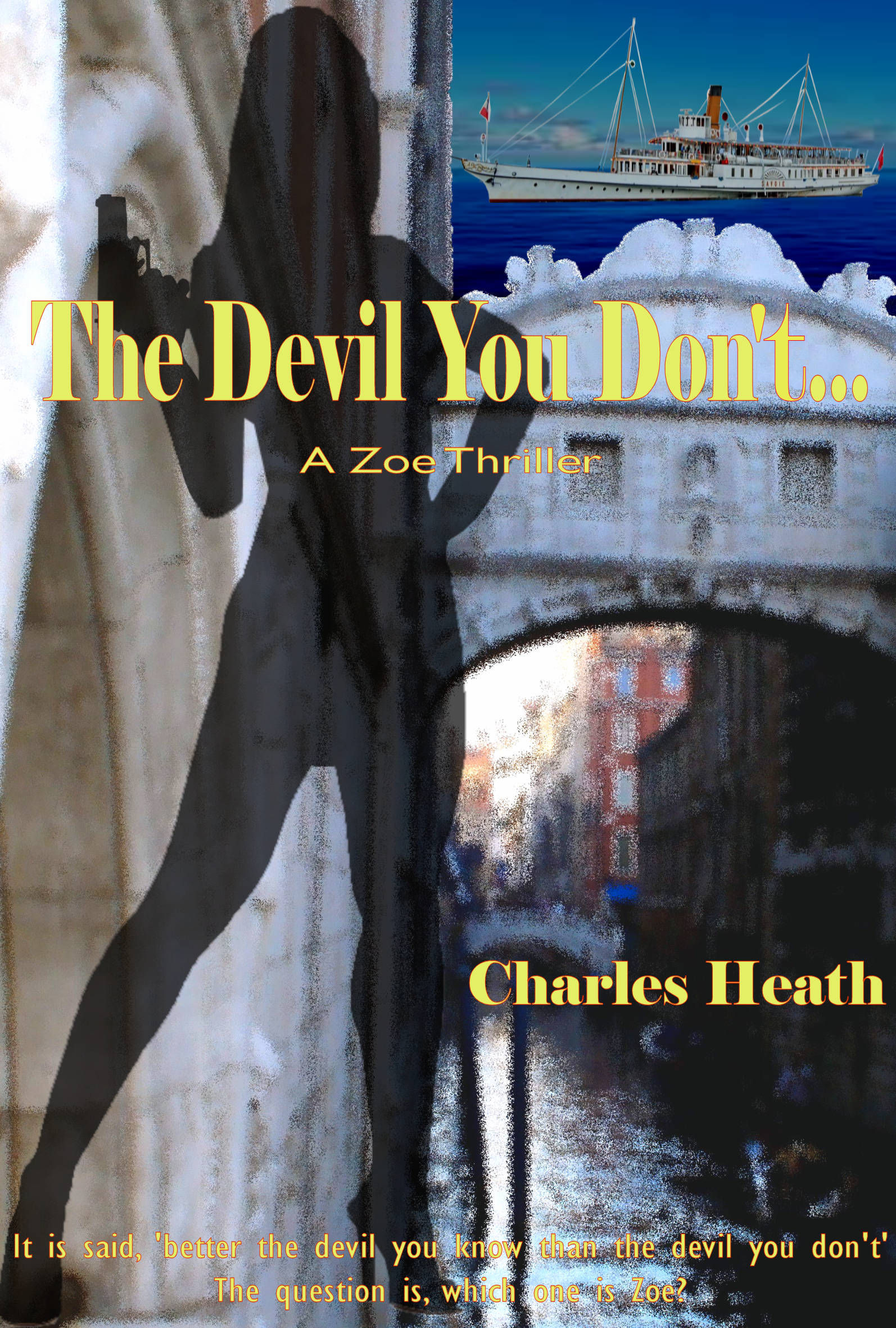
‘The Devil You Don’t’ – A beta reader’s view

It could be said that of all the women one could meet, whether contrived or by sheer luck, what are the odds it would turn out to be the woman who was being paid a very large sum to kill you.

John Pennington is a man who may be lucky in business, but not so lucky in love. He has just broken up with Phillipa Sternhaven, the woman he thought was the one, but relatives and circumstances, and perhaps because she was a ‘princess’, may also have contributed to the end result.

So, what do you do when you are heartbroken?

That is a story that slowly unfolds, from the first meeting with his nemesis on Lake Geneva, all the way to a hotel room in Sorrento, where he learns the shattering truth.

What should have been solace after disappointment, turns out to be something else entirely, and from that point, everything goes to hell in a handbasket.

He suddenly realizes his so-called friend Sebastian has not exactly told him the truth about a small job he asked him to do, the woman he is falling in love with is not quite who she says she is, and he is caught in the middle of a war between two men who consider people becoming collateral damage as part of their business.

The story paints the characters cleverly displaying all their flaws and weaknesses. The locations add to the story at times taking me back down memory lane, especially to Venice where, in those back streets I confess it’s not all that hard to get lost.

All in all a thoroughly entertaining story with, for once, a satisfying end.

Available on Amazon here: https://amzn.to/2Xyh1ow

Writing a book in 365 days – 246

Day 246

Horror stories

From Gothic Gloom to Psychological Dread: The Evolving Art of Horror

The chill that creeps up your spine when you read a truly terrifying tale. It’s a sensation as old as storytelling itself, yet it continues to evolve, morphing and adapting to the anxieties and imaginations of each new era. When we look back at the foundational figures of literary horror, like Edgar Allan Poe and Mary Shelley, we marvel at the sheer ingenuity of their creations. But understanding how they conjured such potent nightmares is key to appreciating the genre’s enduring power, and how authors like William Peter Blatty and Stephen King have, in turn, reshaped its landscape.

The Seeds of Terror: Poe and Shelley’s Gothic Visions

When Edgar Allan Poe penned tales of premature burial, haunted houses, and descent into madness, he tapped into a deep well of human fears. His horror wasn’t always about external monsters; it often lurked within the human psyche. Poe, a master of atmosphere and psychological introspection, drew inspiration from:

  • The Grim Realities of His Time: Poe lived through periods of significant social upheaval and personal tragedy. His own experiences with loss, poverty, and mental illness undoubtedly fueled his explorations of the darker aspects of the human condition.
  • Gothic Literary Traditions: He inherited a rich tradition of Gothic literature, with its crumbling castles, spectral apparitions, and brooding protagonists. Poe took these tropes and infused them with a more visceral, psychological intensity.
  • Scientific and Philosophical Debates: The burgeoning interest in science, death, and the nature of consciousness during his era likely played a role. He explored the fragility of the mind and the terrifying unknown that lay beyond the veil of sanity.

Similarly, Mary Shelley’s creation of Frankenstein wasn’t born in a vacuum. Her “modern Prometheus” was a product of:

  • Intellectual Circles and Revolutionary Ideas: Shelley was surrounded by Romantic poets and thinkers who debated the ethics of scientific advancement and the very essence of life. The scientific experiments of the time, aiming to understand and even replicate life, provided a fertile ground for her imagination.
  • Personal Loss and the Fear of the Unnatural: Shelley experienced profound grief with the loss of her mother and later her own children. This personal experience of death and the potential for “unnatural” creation likely fueled her exploration of a being brought to life through artificial means and the subsequent tragedy that ensued.
  • The Power of Myth and the Sublime: The idea of creating life, of playing God, is an ancient human fascination. Shelley tapped into this, blending it with the Romantic fascination for the sublime – the awe-inspiring, yet terrifying, power of nature and human endeavor.

Both Poe and Shelley, in their distinct ways, explored the anxieties of their times, the fragility of the human mind and body, and the intoxicating, often dangerous, allure of the unknown. Their horror was deeply rooted in the human experience, albeit amplified and distorted for terrifying effect.

The Evolution of Fear: Blatty and King’s Transformative Impact

Fast forward to the latter half of the 20th century, and the landscape of horror had broadened considerably. Authors like William Peter Blatty and Stephen King didn’t just build upon the foundations of their predecessors; they fundamentally altered the architecture of terror.

William Peter Blatty and the Resurgence of Supernatural Dread:

Blatty’s The Exorcist was a seismic event in horror. While supernatural threats existed before, Blatty’s novel brought a visceral, intensely religious horror to the forefront. His genius lay in:

  • Grounding the Supernatural in the Real: He took a seemingly ordinary family and an everyday setting and plunged them into extraordinary, terrifying events. This made the horror feel all the more potent because it could, theoretically, happen to anyone.
  • Exploring Faith and Doubt: The Exorcist delved into the battle between good and evil, faith and disbelief, and the terrifying possibility that malevolent forces could possess and corrupt even the innocent. This psychological and spiritual dimension resonated deeply with audiences.
  • Unflinching Realism in the Face of the Unexplained: Despite the supernatural elements, Blatty presented the demonic possession with a horrifyingly realistic depiction of physical and psychological torment, blurring the lines between the tangible and the infernal.

Stephen King: The Master of Modern Anxiety:

Stephen King, arguably the most prolific and influential horror writer of our time, has transformed the genre by making the mundane terrifying and by tapping into the collective anxieties of modern life. His impact is multifaceted:

  • Relatable Characters and Settings: King excels at creating ordinary people in extraordinary, often horrifying, circumstances. His characters are flawed, relatable, and deeply human, making their struggles against the forces of evil all the more compelling. His settings often feel familiar – small towns, suburban houses – making the intrusion of horror feel all the more shocking.
  • The Breadth of Horror: King’s monsters aren’t confined to ghosts or demons. He explores cosmic horrors (like in It), technological terrors, the monstrousness of human nature, and the psychological horrors of addiction, grief, and trauma. He’s a chameleon, masterfully adapting to and defining various subgenres of horror.
  • The Power of Childhood Fears: Many of King’s most iconic stories tap into the primal fears of childhood – the monster under the bed, the lurking stranger, the loss of innocence. He understands that these early anxieties can linger and become even more potent in adulthood.
  • Social Commentary Woven into Terror: King often uses his horror narratives to explore social issues and contemporary anxieties, from racism and prejudice in The Outsider to the emptiness of consumer culture in The Long Walk. His stories are often a reflection of the world around us, amplified to terrifying proportions.

The Throughline of Fear:

What connects Poe and Shelley to Blatty and King? It’s the fundamental human capacity for fear, coupled with the author’s ability to tap into our deepest anxieties, whether they are existential dread, the fear of the unknown, the fragility of sanity, or the encroaching darkness in the seemingly ordinary.

Poe gave us the internal descent into madness. Shelley showed us the terrifying consequences of unchecked ambition and the “unnatural.” Blatty brought the battle between good and evil into our homes and churches. And King, in his vast and varied career, has made us question the safety of our neighborhoods, the demons within ourselves, and the terrifying possibilities that lurk just a page away.

The art of horror is a constantly evolving beast. It adapts, it transforms, and it continues to enthrall us by reminding us, in the most exhilarating and terrifying ways, of our own vulnerabilities and the vast, mysterious darkness that surrounds us. And for that, we owe a deep debt of gratitude to these masters of the macabre, past and present.

“The Things we do for Love”, the story behind the story

This story has been ongoing since I was seventeen, and just to let you know, I’m 71 this year.

Yes, it’s taken a long time to get it done.

Why, you might ask.

Well, I never gave it much interest because I started writing it after a small incident when I was 17, and working as a book packer for a book distributor in Melbourne

At the end of my first year, at Christmas, the employer had a Christmas party, and that year, it was at a venue in St Kilda.

I wasn’t going to go because at that age, I was an ordinary boy who was very introverted and basically scared of his own shadow and terrified by girls.

Back then, I would cross the street to avoid them

Also, other members of the staff in the shipping department were rough and ready types who were not backwards in telling me what happened, and being naive, perhaps they knew I’d be either shocked or intrigued.

I was both adamant I wasn’t coming and then got roped in on a dare.

Damn!

So, back then, in the early 70s, people looked the other way when it came to drinking, and of course, Dutch courage always takes away the concerns, especially when normally you wouldn’t do half the stuff you wouldn’t in a million years

I made it to the end, not as drunk and stupid as I thought I might be, and St Kilda being a salacious place if you knew where to look, my new friends decided to give me a surprise.

It didn’t take long to realise these men were ‘men about town’ as they kept saying, and we went on an odyssey.  Yes, those backstreet brothels where one could, I was told, have anything they could imagine.

Let me tell you, large quantities of alcohol and imagination were a very bad mix.

So, the odyssey in ‘The things we do’ was based on that, and then the encounter with Diana. Well, let’s just say I learned a great deal about girls that night.

Firstly, not all girls are nasty and spiteful, which seemed to be the case whenever I met one. There was a way to approach, greet, talk to, and behave.

It was also true that I could have had anything I wanted, but I decided what was in my imagination could stay there.  She was amused that all I wanted was to talk, but it was my money, and I could spend it how I liked.

And like any 17-year-old naive fool, I fell in love with her and had all these foolish notions.  Months later, I went back, but she had moved on, to where no one was saying or knew.

Needless to say, I was heartbroken and had to get over that first loss, which, like any 17-year-old, was like the end of the world.

But it was the best hour I’d ever spent in my life and would remain so until I met the woman I have been married to for the last 48 years.

As Henry, he was in part based on a rebel, the son of rich parents who despised them and their wealth, and he used to regale anyone who would listen about how they had messed up his life

If only I’d come from such a background!

And yes, I was only a run away from climbing up the stairs to get on board a ship, acting as a purser.

I worked for a shipping company and they gave their junior staff members an opportunity to spend a year at sea working as a purser on a cargo ship that sailed between Melbourne, Sydney and Hobart in Australia.

One of the other junior staff members’ turn came, and I would visit him on board when he would tell me stories about life on board, the officers, the crew, and other events. These stories, which sounded incredible to someone so impressionable, were a delight to hear.

Alas, by that time, I had tired of office work and moved on to be a tradesman at the place where my father worked.

It proved to be the right move, as that is where I met my wife.  Diana had been right; love would find me when I least expected it.