Writing a book in 365 days – 262

Day 262

The use of idioms, those a reader will recognise and understand

Don’t Let Your Writing Get Lost in the Weeds: The Art of Using Idioms Wisely

We all want our writing to be engaging, vivid, and memorable. We strive for clarity, for that “aha!” moment in our readers’ minds. But sometimes, in our quest for impactful language, we can accidentally end up “clouding the issue.”

That’s where idioms come in. These colorful phrases, like “got it in the bag” or “bite the bullet,” can add personality and a touch of familiar flair to our prose. They’re the linguistic shorthand that allows us to paint a picture, convey a complex emotion, or express a common sentiment without lengthy explanations.

Think about it: instead of saying “we are absolutely certain of success,” “got it in the bag” instantly communicates that victory is assured. Or, “bite the bullet” is a far more evocative way to describe enduring something unpleasant than a simple “tolerate the difficulty.” These phrases resonate because they’re rooted in shared cultural understanding.

However, like any powerful tool, idioms require a deft hand. The key is balance and clarity.

The Pitfall of Obscurity:

One of the biggest mistakes a writer can make is to pepper their work with obscure idioms. While you might think a phrase like “all mouth and no trousers” perfectly captures someone’s boastfulness, if your reader has never encountered it, they’re not just confused – they’re lost. Instead of enhancing understanding, an obscure idiom creates a barrier, forcing the reader to stop and decipher your meaning, breaking the flow of your narrative. Stick to idioms that are generally well-understood by your target audience.

The Danger of Overuse:

On the flip side, too much of a good thing can be detrimental. Imagine reading a paragraph where every other sentence is an idiom. It starts to sound less like natural writing and more like a forced attempt to sound “clever.” This overuse can make your writing feel cluttered and even insincere. Readers might start to feel like they’re being bombarded with clichés rather than genuinely connecting with your message.

So, How Do You Strike the Right Chord?

  1. Know Your Audience: This is paramount. What idioms are common in their everyday language? What will they readily understand? If you’re writing for a general audience, stick to widely recognized idioms.
  2. Purposeful Placement: Use idioms when they truly add value. Do they make your point more concisely? Do they inject personality or emotion? If an idiom doesn’t serve a clear purpose, a more straightforward phrase might be better.
  3. Vary Your Language: Don’t rely solely on idioms. Blend them with clear, direct language. This creates a more natural and sophisticated writing style. An occasional idiom can shine; a constant barrage will dim their impact.
  4. When in Doubt, Leave it Out: If you’re not 100% sure an idiom will be understood, or if you’re worried about overdoing it, it’s often safer to opt for a more explicit phrasing. Clarity should always be the priority.

Idioms are valuable additions to a writer’s toolkit. When used thoughtfully and strategically, they can elevate your writing, making it more engaging and relatable. But remember, the goal is to illuminate, not obfuscate. So, use them wisely, and ensure your readers don’t end up feeling like they’ve been left “out in the cold.”

An excerpt from “Sunday in New York”

Now available on Amazon at:  https://amzn.to/2H7ALs8

Williams’ Restaurant, East 65th Street, New York, Saturday, 8:00 p.m.

We met the Blaine’s at Williams’, a rather upmarket restaurant that the Blaine’s frequently visited, and had recommended.

Of course, during the taxi ride there, Alison reminded me that with my new job, we would be able to go to many more places like Williams’.  It was, at worst, more emotional blackmail, because as far as Alison was concerned, we were well on our way to posh restaurants, the Trump Tower Apartments, and the trappings of the ‘executive set’.

It would be a miracle if I didn’t strangle Elaine before the night was over.  It was she who had filled Alison’s head with all this stuff and nonsense.

Aside from the half frown half-smile, Alison was looking stunning.  It was months since she had last dressed up, and she was especially wearing the dress I’d bought her for our 5th anniversary that cost a month’s salary.  On her, it was worth it, and I would have paid more if I had to.  She had adored it, and me, for a week or so after.

For tonight, I think I was close to getting back on that pedestal.

She had the looks and figure to draw attention, the sort movie stars got on the red carpet, and when we walked into the restaurant, I swear there were at least five seconds silence, and many more gasps.

Even I had a sudden loss of breath earlier in the evening when she came out of the dressing room.  Once more I was reminded of how lucky I was that she had agreed to marry me.  Amid all those self-doubts, I couldn’t believe she had loved me when there were so many others ‘out there’ who were more appealing.

Elaine was out of her seat and came over just as the Head Waiter hovered into sight.  She personally escorted Alison to the table, allowing me to follow like the Queen’s consort, while she and Alison basked in the admiring glances of the other patrons.

More than once I heard the muted question, “Who is she?”

Jimmy stood, we shook hands, and then we sat together.  It was not the usual boy, girl, boy, girl seating arrangement.  Jimmy and I on one side and Elaine and Alison on the other.

The battle lines were drawn.

Jimmy was looking fashionable, with the permanent blade one beard, unkempt hair, and designer dinner suit that looked like he’d slept in it.  Alison insisted I wear a tuxedo, and I looked like the proverbial penguin or just a thinner version of Alfred Hitchcock.

The bow tie had been slightly crooked, but just before we stepped out she had straightened it.  And took the moment to look deeply into my soul.  It was one of those moments when words were not necessary.

Then it was gone.

I relived it briefly as I sat and she looked at me.  A penetrating look that told me to ‘behave’.

When we were settled, Elaine said, in that breathless, enthusiastic manner of hers when she was excited, “So, Harry, you are finally moving up.”  It was not a question, but a statement.

I was not sure what she meant by ‘finally’ but I accepted it with good grace.  Sometimes Elaine was prone to using figures of speech I didn’t understand.  I guessed she was talking about the new job.  “It was supposed to be a secret.”

She smiled widely.  “There are no secrets between Al and I, are there Al?”

I looked at ‘Al’ and saw a brief look of consternation.

I was not sure Alison liked the idea of being called Al.  I tried it once and was admonished.  But it was interesting her ‘best friend forever’ was allowed that distinction when I was not.  It was, perhaps, another indicator of how far I’d slipped in her estimation.

Perhaps, I thought, it was a necessary evil.  As I understood it, the Blaine’s were our mentors at the Trump Tower, because they didn’t just let ‘anyone’ in.  I didn’t ask if the Blaine’s thought we were just ‘anyone’ before I got the job offer.

And then there was that look between Alison and Elaine, quickly stolen before Alison realized I was looking at both of them.  I was out of my depth, in a place I didn’t belong, with people I didn’t understand.  And yet, apparently, Alison did.  I must have missed the memo.

“No,” Alison said softly, stealing a glance in my direction, “No secrets between friends.”

No secrets.  Her look conveyed something else entirely.

The waiter brought champagne, Krug, and poured glasses for each of us.  It was not the cheap stuff, and I was glad I brought a couple of thousand dollars with me.  We were going to need it.

Then, a toast.

To a new job and a new life.

“When did you decide?”  Elaine was effusive at the best of times, but with the champagne, it was worse.

Alison had a strange expression on her face.  It was obvious she had told Elaine it was a done deal, even before I’d made up my mind.  Perhaps she’d assumed I might be ‘refreshingly honest’ in front of Elaine, but it could also mean she didn’t really care what I might say or do.

Instead of consternation, she looked happy, and I realized it would be churlish, even silly if I made a scene.  I knew what I wanted to say.  I also knew that it would serve little purpose provoking Elaine, or upsetting Alison.  This was not the time or the place.  Alison had been looking forward to coming here, and I was not going to spoil it.

Instead, I said, smiling, “When I woke up this morning and found Alison missing.  If she had been there, I would not have noticed the water stain on the roof above our bed, and decide there and then how much I hated the place.” I used my reassuring smile, the one I used with the customers when all hell was breaking loose, and the forest fire was out of control.  “It’s the little things.  They all add up until one day …”  I shrugged.  “I guess that one day was today.”

I saw an incredulous look pass between Elaine and Alison, a non-verbal question; perhaps, is he for real?  Or; I told you he’d come around.

I had no idea the two were so close.

“How quaint,” Elaine said, which just about summed up her feelings towards me.  I think, at that moment, I lost some brownie points.  It was all I could come up with at short notice.

“Yes,” I added, with a little more emphasis than I wanted.  “Alison was off to get some study in with one of her friends.”

“Weren’t the two of you off to the Hamptons, a weekend with some friends?” Jimmy piped up, and immediately got the ‘shut up you fool’ look, that cut that line of conversation dead.  Someone forgot to feed Jimmy his lines.

It was followed by the condescending smile from Elaine, and “I need to powder my nose.  Care to join me, Al?”

A frown, then a forced smile for her new best friend.  “Yes.”

I watched them leave the table and head in the direction of the restroom, looking like they were in earnest conversation.  I thought ‘Al’ looked annoyed, but I could be wrong.

I had to say Jimmy looked more surprised than I did.

There was that odd moment of silence between us, Jimmy still smarting from his death stare, and for me, the Alison and Elaine show.  I was quite literally gob-smacked.

I drained my champagne glass gathering some courage and turned to him.  “By the way, we were going to have a weekend away, but this legal tutorial thing came up.  You know Alison is doing her law degree.”

He looked startled when he realized I had spoken.  He was looking intently at a woman several tables over from us, one who’d obviously forgotten some basic garments when getting dressed.  Or perhaps it was deliberate.  She’d definitely had some enhancements done.

He dragged his eyes back to me.  “Yes.  Elaine said something or other about it.  But I thought she said the tutor was out of town and it had been postponed until next week.  Perhaps I got it wrong.  I usually do.”

“Perhaps I’ve got it wrong.”  I shrugged, as the dark thoughts started swirling in my head again.  “This week or next, what does it matter?”

Of course, it mattered to me, and I digested what he said with a sinking heart.  It showed there was another problem between Alison and me; it was possible she was now telling me lies.  If what he said was true and I had no reason to doubt him, where was she going tomorrow morning, and had she really been with a friend studying today?

We poured some more champagne, had a drink, then he asked, “This promotion thing, what’s it worth?”

“Trouble, I suspect.  Definitely more money, but less time at home.”

“Oh,” raised eyebrows.  Obviously, the women had not talked about the job in front of him, or, at least, not all the details.  “You sure you want to do that?”

At last the voice of reason.  “Me?  No.”

“Yet you accepted the job.”

I sucked in a breath or two while I considered whether I could trust him.  Even if I couldn’t, I could see my ship was sinking, so it wouldn’t matter what I told him, or what Elaine might find out from him.  “Jimmy, between you and me I haven’t as yet decided one way or another.  To be honest, I won’t know until I go up to Barclay’s office and he asks me the question.”

“Barclay?”

“My boss.”

“Elaine’s doing a job for a Barclay that recently moved in the tower a block down from us.  I thought I recognized the name.”

“How did Elaine get the job?”

“Oh, Alison put him onto her.”

“When?”

“A couple of months ago.  Why?”

I shrugged and tried to keep a straight face, while my insides were churning up like the wake of a supertanker.  I felt sick, faint, and wanting to die all at the same moment.  “Perhaps she said something about it, but it didn’t connect at the time.  Too busy with work I expect.  I think I seriously need to get away for a while.”

I could hardly breathe, my throat was constricted and I knew I had to keep it together.  I could see Elaine and Alison coming back, so I had to calm down.  I sucked in some deep breaths, and put my ‘manage a complete and utter disaster’ look on my face.

And I had to change the subject, quickly, so I said, “Jimmy, Elaine told Alison, who told me, you were something of a guru of the cause and effects of the global economic meltdown.  Now, I have a couple of friends who have been expounding this theory …”

Like flicking a switch, I launched into the well-worn practice of ‘running a distraction’, like at work when we needed to keep the customer from discovering the truth.  It was one of the things I was good at, taking over a conversation and pushing it in a different direction.  It was salvaging a good result from an utter disaster, and if ever there was a time that it was required, it was right here, right now.

When Alison sat down and looked at me, she knew something had happened between Jimmy and I.  I might have looked pale or red-faced, or angry or disappointed, it didn’t matter.  If that didn’t seal the deal for her, the fact I took over the dining engagement did.  She knew well enough the only time I did that was when everything was about to go to hell in a handbasket.  She’d seen me in action before and had been suitably astonished.

But I got into gear, kept the champagne flowing and steered the conversation, as much as one could from a seasoned professional like Elaine, and, I think, in Jimmy’s eyes, he saw the battle lines and knew who took the crown on points.  Neither Elaine nor Jimmy suspected anything, and if the truth be told, I had improved my stocks with Elaine.  She was at times both surprised and interested, even willing to take a back seat.

Alison, on the other hand, tried poking around the edges, and, once when Elaine and Jimmy had got up to have a cigarette outside, questioned me directly.  I chose to ignore her, and pretend nothing had happened, instead of telling her how much I was enjoying the evening.

She had her ‘secrets’.  I had mine.

At the end of the evening, when I got up to go to the bathroom, I was physically sick from the pent up tension and the implications of what Jimmy had told me.  It took a while for me to pull myself together; so long, in fact, Jimmy came looking for me.  I told him I’d drunk too much champagne, and he seemed satisfied with that excuse.  When I returned, both Alison and Elaine noticed how pale I was but neither made any comment.

It was a sad way to end what was supposed to be a delightful evening, which to a large degree it was for the other three.  But I had achieved what I set out to do, and that was to play them at their own game, watching the deception, once I knew there was a deception, as warily as a cat watches its prey.

I had also discovered Jimmy’s real calling; a professor of economics at the same University Alison was doing her law degree.  It was no surprise in the end, on a night where surprises abounded, that the world could really be that small.

We parted in the early hours of the morning, a taxi whisking us back to the Lower East Side, another taking the Blaine’s back to the Upper West Side.  But, in our case, as Alison reminded me, it would not be for much longer.  She showed concern for my health, asked me what was wrong.  It took all the courage I could muster to tell her it was most likely something I ate and the champagne, and that I would be fine in the morning.

She could see quite plainly it was anything other than what I told her, but she didn’t pursue it.  Perhaps she just didn’t care what I was playing at.

And yet, after everything that had happened, once inside our ‘palace’, the events of the evening were discarded, like her clothing, and she again reminded me of what we had together in the early years before the problems had set in.

It left me confused and lost.

I couldn’t sleep because my mind had now gone down that irreversible path that told me I was losing her, that she had found someone else, and that our marriage was in its last death throes.

And now I knew it had something to do with Barclay.

© Charles Heath 2015-2020

Sunday In New York

In a word: Good

There is a TV show on at the moment called ‘The Good Place’.

It’s really the bad place which makes you wonder if there really is a ‘good place’.

This started me thinking.

How many people do you know, when you ask them how they are, they say ‘good’.

Can we see behind the facade that is their expression how they really feel?

And how many of us reveal our true feelings?

It seems to me there is an acceptable level of understanding that we take people at their word and move on from there.

And how many times when we suspect there is something wrong, we tend to overlook it in what is regarded as respect for that person?

What if something awful happened?

What if we could have prevented it?

What if we could have tried to gently probe deeper?

The problem is we seem to be too polite and there is nothing wrong with that.

But maybe, just maybe, the next time …

It’s just a thought.


Skeletons in the closet, and doppelgangers

A story called “Mistaken Identity”

How many of us have skeletons in the closet that we know nothing about? The skeletons we know about generally stay there, but those we do not, well, they have a habit of coming out of left field when we least expect it.

In this case, when you see your photo on a TV screen with the accompanying text that says you are wanted by every law enforcement agency in Europe, you’re in a state of shock, only to be compounded by those same police, armed and menacing, kicking the door down.

I’d been thinking about this premise for a while after I discovered my mother had a boyfriend before she married my father, a boyfriend who was, by all accounts, the man who was the love of her life.

Then, in terms of coming up with an idea for a story, what if she had a child by him that we didn’t know about, which might mean I had a half brother or sister I knew nothing about. It’s not an uncommon occurrence from what I’ve been researching.

There are many ways of putting a spin on this story.

Then, in the back of my mind, I remembered a story an acquaintance at work was once telling us over morning tea, that a friend of a friend had a mother who had a twin sister and that each of the sisters had a son by the same father, without each knowing of the father’s actions, both growing up without the other having any knowledge of their half brother, only to meet by accident on the other side of the world.

It was an encounter that in the scheme of things might never have happened, and each would have remained oblivious of the other.

For one sister, the relationship was over before she discovered she was pregnant, and therefore had not told the man he was a father. It was no surprise the relationship foundered when she discovered he was also having a relationship with her sister, a discovery that caused her to cut all ties with both of them and never speak to either from that day.

It’s a story with more twists and turns than a country lane!

And a great idea for a story.

That story is called ‘Mistaken Identity’.

“Trouble in Store” – Short stories my way:  Adding some back story for clarity

I have reworked the first part of the story with a few new elements about the characters and changed a few of the details of how the characters finish up in the shop before the policewoman makes her entrance.

This is part of the new first section is the one that involves the shopkeeper`:


This wasn’t the shopkeeper’s first hold up.  In fact, over the years there had been a dozen.  But only one got reported to the police, and that was only because the robber was shot and killed.

He’d taken a bullet that night, too, which, from the police point of view, made him a concerned citizen simply defending himself.

The rest had been scared off by the double-barrel shotgun he kept under the counter for just such emergencies.

The young punk who came into the shop with his girlfriend had pulled out the pistol and told him if he reached for the shotgun he’d shoot him.  The kid looked unstable and he’d backed away.

When the kid collapsed, he should have gone for the shotgun, but instead, he thought he could get to the gun before the girl realized what was happened.  She wasn’t an addict and clearly looked like she was only along for the ride.  Her expression, when the kid pulled out the gun told him she’d known nothing about her partner’s true intentions.

But, he wasn’t fast enough, and she had the gun pointing at him before he’d got past the counter.

From one pair of unpredictable hands to another.

Like the girl, he was just as surprised when the customer burst in the door, just before closing time.

The situation might have been salvageable before the customer came in the door, getting the girl to go along with the robbery being about money, but there was no denying what the kid on the floor’s problem was.

Damn.

He had to try and salvage the situation simply because there was a lot of money involved, and other people depending on him.  He looked at the boy, on the floor, then the girl.

“Listen to me, young lady, you would be well advised to let this man go as he suggests.  And, please put the gun down before someone gets hurt.  Your friend needs medical help and I can call an ambulance.”

The girl switched her attention back to him.  “No one’s going anywhere, so just shut the hell up and let me think.”

The storekeeper glanced over at the customer. 

He’d seen him come into the shop once or twice, probably lived in the neighborhood, the sort who’d make a reliable witness, either a lawyer or an accountant.  Not like most of the residents just beyond the fringe of respectability.

If only he hadn’t burst into the shop when he did.

© Charles Heath 2016-2020

The cinema of my dreams – Was it just another surveillance job – Episode 64

This story is now on the list to be finished so over the new few weeks, expect a new episode every few days.

The reason why new episodes have been sporadic, there are also other stories to write, and I’m not very good at prioritizing.

But, here we are, a few minutes opened up and it didn’t take long to get back into the groove.

Things are about to get complicated…


There were so many pieces to this puzzle that most of it defied logic.

According to Quigley/O’Connell, Severin and Maury were the security guards at the lab where the USB secrets originated.  Their job had been to make sure the data wasn’t stolen and failed miserably.  But the inference was made that they had helped the person smuggle the data out.

At that time the data was stolen by a male scientist and put on the USB.  That scientist had a wife, Anna. Sometime after the data removal, the male scientist was murdered, and Anna, his wife, got a hold of the USB.

Quigley/O’Connell also asserted that he believed Severin and Maury helped her smuggle the data out of the facility.  Was it possible she was having an affair with one or the other, possibly Severin.  He seemed the more potential candidate.

So fact: data is stolen, data finds its way to Anna, and Severin let her leave the complex with the data.

The next question:  when did the data go up for sale, or, as Quigley/O’Connell said, become available for the newspapers to bid on?  And, following that, when did Dobbin find out, and use O’Connell to arrange for the purchase and delivery of the data.

That then led to when Severin and Maury realised that Anna had double-crossed them because that would be the only reason why they would set up an oversight surveillance team to follow the man they assumed was going to buy the data from Anna.

Why was there a six-month hiatus?  Was it because Anna had to stay in hiding until the ruckus about the theft blew over.  Did the owners of the lab actually tell anyone what had happened?  No, it seems.

So, need to find out why it took six months to seal the deal.

Next fact, Severin’s surveillance operation swings into action when O’Connell; goes to pick up the data.  The date was specific because it had been on Severin’s calendar at the training facility.

The surveillance goes awry.

The café where the meeting is to take place explodes when a bomb goes off.  O’Connell did not go in and was spared.  Whoever was in the café was thought to be killed and the USB was lost.  Later analysis of the CCTV footage at the time showed Anna rising from the ashes.  She still has the USB.

But…

Everyone believed because O’Connell survived the explosion, he had obtained the USB and became the focus of their attention.  And forces the continuation of the surveillance operation, when I tracked him to an alley where he was shot and killed.

Question:  How did the sniper know to be at that alley for the shot?

It is at this point that O’Connell advises he is working for Dobbin.  Thus, Dobbin knows about the USB and the history of it.  Dobbin had arranged to meet O’Connell at that alley, and had he been killed by the sniper or not, was taking him away.  Dobbin no doubt discovers at this point there is no USB in O’Connell’s hands.

Inference:  Dobbin was tracking O’Connell.  He had to be, to know where he was and for his squad to get there so quickly.

New Twist:  O’Connell discovered something about Dobbin, and disappears, presumably to re-hook up with Anna, who is now Josephine.  Dobbin employs me to find O’Connell and the USB but doesn’t say why O’Connell had gone rogue.

Assumption:  Josephine/Anna kills both Severin and Maury.  Why then does she torture Maury before killing him.  He doesn’t have the USB or any information useful to her.

Fact:  Dobbin has Jan on secondment from MI6.  Why, and for what purpose.  Jan is also working with Severin.  Why?  Dobbin says she is using initiative, but what is she after?

Supposition, did Jan kill Severin and Maury.  Based on what I saw at the park when I went to see him, it looked like Jan, but when we caught her, she furiously denied the accusation.  A good act or the truth? 

And if it wasn’t her, then who did kill them, and then more recently O’Connell, and why?

Fact:  Anna still had both the USBs and was running.

Fact:  O’Connell was with Anna up to the point where he was killed.  Logically it had to be Anna, not wanting to share the five million.  Greed trumps common sense.

What was left out of all of this was Monica and what she knew of and was party to, along with her operative, Joanne.  She had always been lurking on the fringe of my investigation, but I was beginning to think I’d been tiled by Joanne the whole time.

They were not in the room, so I had only the people in front of me to fill in the gaps.

© Charles Heath 2020-2023

Writing a book in 365 days – 261

Day 261

A quote by George Sand…

“I knew human nature well enough to depict it; in short, that all of the small tasks of which I was capable, literature, properly speaking, was the one that offered the most chance of success as a profession and – let us not mince words – was the way to earn my bread.”

When the Muse Meets the Mortgage: The Unromantic Truth of My Literary Calling

We’ve all heard the romanticized tales of artists, poets, and writers – struck by inspiration, driven by an insatiable passion, toiling away in garrets for the sheer love of their craft. While there’s undeniable truth to the passion part, there’s another, often unspoken, dimension to the creative life that an ancient, surprisingly honest quote brings into sharp focus:

“I knew human nature well enough to depict it; in short, that all of the small tasks of which I was capable, literature, properly speaking, was the one that offered the most chance of success as a profession and – let us not mince words – was the way to earn my bread.”

Let’s unpack this gem, because it speaks volumes about the pragmatic, often unromantic, journey of finding one’s professional purpose, especially in the arts.

The Unseen Power of Observation

“I knew human nature well enough to depict it.” This isn’t vanity; it’s a profound self-awareness, the very bedrock of a good writer. It speaks to an innate empathy, a keen eye for detail, and an understanding of the intricate dance of human emotions, motivations, and contradictions. Before words can flow, understanding must exist. This is the writer’s superpower: to see beyond the surface, to connect dots, and to translate the universal human experience into relatable narratives.

Many of us possess this kind of observational skill to varying degrees. We notice things others miss. We’re the friends people come to for advice because we “just get it.” For some, this skill is a social asset; for others, it’s the quiet engine of a potential career.

The Litany of “Small Tasks”

“All of the small tasks of which I was capable…” This is where most of us live, isn’t it? We shuffle through life, picking up skills, trying on different hats. We might be competent at a dozen different things – organizing, problem-solving, number-crunching, designing. We can do them, often well enough. But there’s a difference between capability and calling, between competence and conviction.

This phrase beautifully captures the process of elimination. It’s the quiet concession that while we might be able to handle a variety of “small tasks,” none of them ignite that spark, none of them feel like the one. It’s a realistic appraisal of one’s diverse but perhaps diffuse talents, paving the way for the singular realization.

Literature: The Most Probable Path to “Success”

“…literature, properly speaking, was the one that offered the most chance of success as a profession…” This is the pivotal moment. It’s not just about what you love to do, but what you can actually succeed at. And success, in this context, isn’t necessarily about fame or fortune, but about creating a sustainable livelihood from your distinct abilities.

For our anonymous author, the ability to depict human nature wasn’t just a passion; it was a skill that, when applied to literature, offered genuine professional viability. It wasn’t a whimsical choice but a strategic one. “Properly speaking” suggests a serious commitment to the craft – not just dabbling, but mastering the tools, understanding the market (even if that market was different centuries ago), and treating it as a legitimate profession.

It challenges the modern narrative that “following your passion” is enough. Sometimes, passion needs a sturdy bridge of practicality to cross into a career.

Let’s Not Mince Words: Earning My Bread

“…and – let us not mince words – was the way to earn my bread.” This is the mic drop. The raw, beautiful, and utterly human truth. Stripped of all artistic pretense, it comes down to survival. To put food on the table. To pay the rent.

This isn’t a cynical statement; it’s an honest one. For many creatives, the initial lure of their chosen field might be passion or talent, but the sustained effort, the diligent practice, and the strategic career decisions are often fueled by the fundamental need to make a living. There’s immense dignity in earning your bread through your craft, through the very expression of your unique insights and abilities.

The Modern Resonance

This centuries-old observation still holds remarkable power today. How many of us choose our careers not just because we love them, but because through them, we are best equipped to contribute, to find a sense of purpose, and yes, to earn our living?

Perhaps your “literature” isn’t writing stories, but is:

  • Designing elegant user interfaces because you understand human interaction.
  • Building innovative software because you can conceive of efficient systems.
  • Teaching complex subjects because you excel at simplifying knowledge.
  • Crafting beautiful objects because you have an eye for form and function.

The lesson is clear: true professional fulfillment often lies at the intersection of what you’re genuinely good at, what you find meaningful, and what can realistically sustain you. It’s less about a lightning bolt of inspiration and more about a thoughtful, pragmatic assessment of your unique place in the world, and how best to earn your bread with the gifts you possess.

So, what’s your “literature”? What’s the one thing, among all the small tasks you’re capable of, that truly offers you a chance at success, and allows you to earn your bread, no mincing of words required?

What I learned about writing: What’s that coming out of left field?

The Unscheduled Genius: Why Your Best Ideas Always Arrive at the Worst Time

Ever notice how the universe, especially the creative part of it, seems to have a mischievous sense of humor? You meticulously plan your “creative time” – perhaps a tranquil morning, a dedicated hour in your study, or a quiet walk designed to invite inspiration. You set the stage, dim the lights, perhaps even put on some Ravel. And what happens? Crickets. Or worse, a sudden surge of thoughts about what you need from the grocery store.

But then, just when you’re least prepared, least expecting it, and frankly, least wanting it… bing!

The Myth of the “Planned” Muse

We try, don’t we? We attempt to “train our thoughts.” Like you, I’ve tried to cultivate that sacred shower routine, where warm water and the hum of the fan are supposed to unlock the subconscious. Or that quiet spot in the lounge, by the window, away from the digital din. It’s an idyllic vision of creative flow.

You close your eyes, drift along to classical music, patiently waiting for the imagination to kick in. You can’t force it, you know this. It’s a delicate dance, a subtle invitation. But more often than not, the muse remains stubbornly elusive, probably off having a coffee with procrastination.

Modern Life’s Cruel Interventions

And just when you do manage to carve out a moment of potential quiet, the modern world intervenes with a jarring cacophony. That quiet spot by the window? Now it’s a battleground against the relentless chime of the phone, those infuriating scam calls threatening to sever your internet, your telephone – practically every wire that comes into the house. Don’t you just hate that? It’s enough to make you disconnect everything, not just from the internet, but from society itself!

It’s ironic, isn’t it? We create these zones of peace, only for them to be invaded by the very chaos we’re trying to escape.

The “Bing!” Moment: A Master of Inconvenience

The truly infuriating part is that you weren’t even considering a new idea. You’re like me; you’ve already got so many books, so many projects “on the go” that the thought of another one feels like a mild existential threat. But the sad truth is, you have no control over it.

And then it happens.

Five minutes to three. After a frantic call announcing yet another storm in a teacup. You’re racing out the door, setting the alarm, locking the door, keys in hand, mind a whirlwind of imminent tasks and minor crises. Your focus is entirely on the next urgent thing. And then… bing.

The idea is there. Out of left field. Fully formed, shimmering in front of you, a complete narrative arc or a brilliant solution to a plot hole you hadn’t even realized existed. It’s a cruel joke of the brain, choosing the most inconvenient stage for its grand unveiling.

Embracing the Chaos (and Your Phone)

So, what’s a creative soul to do in this beautifully messy dance with inspiration? You adapt. You become a ninja of spontaneous capture. That phone, once a source of incessant distraction and scammer threats, transforms into your saving grace.

Good thing modern technology enables us to speak and drive, to solve all manner of crises and record nascent masterpieces on the go. You’re dictating plot points into your voice notes while navigating traffic, sketching characters mentally during a grocery run, or outlining an entire scene while waiting for the kettle to boil.

Perhaps the trick isn’t to force inspiration into our meticulously planned schedules, but to be ready for it when it inevitably ambushes us. The muse, it seems, thrives on the unexpected, on the edges of chaos, on the very moments when our minds are momentarily released from the rigid confines of expectation.

So next time an idea strikes while you’re battling traffic, dodging scammers, or mid-sprint to an appointment, don’t fight it. Embrace the “bing!” and know you’re not alone in this beautiful, chaotic journey.

Take that, Superman, Batman, Spiderman! We may not fly, but we can capture genius on the run. And let’s be honest, that’s a superpower all its own.

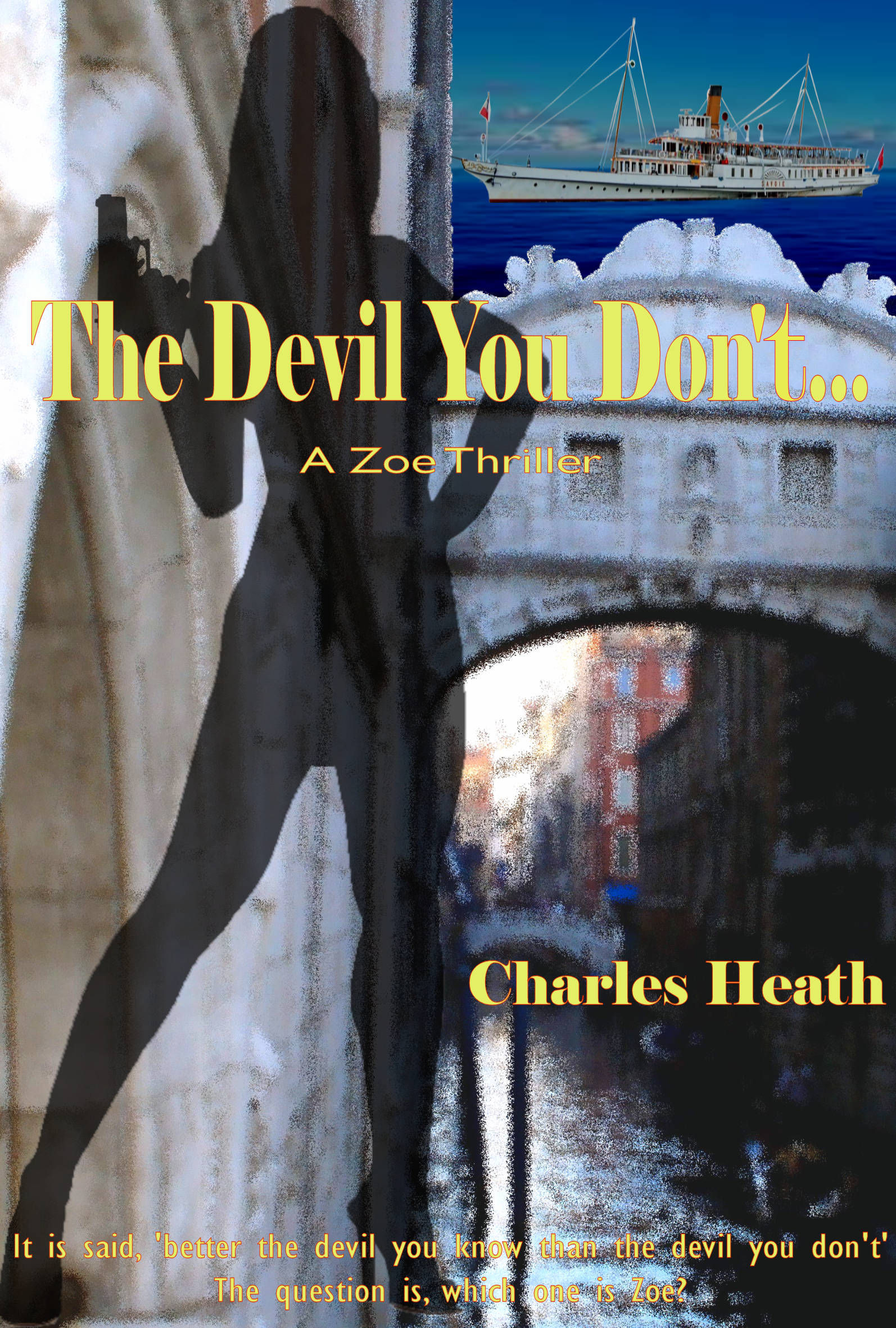
“The Devil You Don’t”, she was the girl you would not take home to your mother!

Now only $0.99 at https://amzn.to/2Xyh1ow

John Pennington’s life is in the doldrums. Looking for new opportunities, and prevaricating about getting married, the only joy on the horizon was an upcoming visit to his grandmother in Sorrento, Italy.

Suddenly he is left at the check-in counter with a message on his phone telling him the marriage is off, and the relationship is over.

If only he hadn’t promised a friend he would do a favour for him in Rome.

At the first stop, Geneva, he has a chance encounter with Zoe, an intriguing woman who captures his imagination from the moment she boards the Savoire, and his life ventures into uncharted territory in more ways than one.

That ‘favour’ for his friend suddenly becomes a life-changing event, and when Zoe, the woman who he knows is too good to be true, reappears, danger and death follow.

Shot at, lied to, seduced, and drawn into a world where nothing is what it seems, John is dragged into an adrenaline-charged undertaking, where he may have been wiser to stay with the ‘devil you know’ rather than opt for the ‘devil you don’t’.

newdevilcvr6

Writing a book in 365 days – 261

Day 261

A quote by George Sand…

“I knew human nature well enough to depict it; in short, that all of the small tasks of which I was capable, literature, properly speaking, was the one that offered the most chance of success as a profession and – let us not mince words – was the way to earn my bread.”

When the Muse Meets the Mortgage: The Unromantic Truth of My Literary Calling

We’ve all heard the romanticized tales of artists, poets, and writers – struck by inspiration, driven by an insatiable passion, toiling away in garrets for the sheer love of their craft. While there’s undeniable truth to the passion part, there’s another, often unspoken, dimension to the creative life that an ancient, surprisingly honest quote brings into sharp focus:

“I knew human nature well enough to depict it; in short, that all of the small tasks of which I was capable, literature, properly speaking, was the one that offered the most chance of success as a profession and – let us not mince words – was the way to earn my bread.”

Let’s unpack this gem, because it speaks volumes about the pragmatic, often unromantic, journey of finding one’s professional purpose, especially in the arts.

The Unseen Power of Observation

“I knew human nature well enough to depict it.” This isn’t vanity; it’s a profound self-awareness, the very bedrock of a good writer. It speaks to an innate empathy, a keen eye for detail, and an understanding of the intricate dance of human emotions, motivations, and contradictions. Before words can flow, understanding must exist. This is the writer’s superpower: to see beyond the surface, to connect dots, and to translate the universal human experience into relatable narratives.

Many of us possess this kind of observational skill to varying degrees. We notice things others miss. We’re the friends people come to for advice because we “just get it.” For some, this skill is a social asset; for others, it’s the quiet engine of a potential career.

The Litany of “Small Tasks”

“All of the small tasks of which I was capable…” This is where most of us live, isn’t it? We shuffle through life, picking up skills, trying on different hats. We might be competent at a dozen different things – organizing, problem-solving, number-crunching, designing. We can do them, often well enough. But there’s a difference between capability and calling, between competence and conviction.

This phrase beautifully captures the process of elimination. It’s the quiet concession that while we might be able to handle a variety of “small tasks,” none of them ignite that spark, none of them feel like the one. It’s a realistic appraisal of one’s diverse but perhaps diffuse talents, paving the way for the singular realization.

Literature: The Most Probable Path to “Success”

“…literature, properly speaking, was the one that offered the most chance of success as a profession…” This is the pivotal moment. It’s not just about what you love to do, but what you can actually succeed at. And success, in this context, isn’t necessarily about fame or fortune, but about creating a sustainable livelihood from your distinct abilities.

For our anonymous author, the ability to depict human nature wasn’t just a passion; it was a skill that, when applied to literature, offered genuine professional viability. It wasn’t a whimsical choice but a strategic one. “Properly speaking” suggests a serious commitment to the craft – not just dabbling, but mastering the tools, understanding the market (even if that market was different centuries ago), and treating it as a legitimate profession.

It challenges the modern narrative that “following your passion” is enough. Sometimes, passion needs a sturdy bridge of practicality to cross into a career.

Let’s Not Mince Words: Earning My Bread

“…and – let us not mince words – was the way to earn my bread.” This is the mic drop. The raw, beautiful, and utterly human truth. Stripped of all artistic pretense, it comes down to survival. To put food on the table. To pay the rent.

This isn’t a cynical statement; it’s an honest one. For many creatives, the initial lure of their chosen field might be passion or talent, but the sustained effort, the diligent practice, and the strategic career decisions are often fueled by the fundamental need to make a living. There’s immense dignity in earning your bread through your craft, through the very expression of your unique insights and abilities.

The Modern Resonance

This centuries-old observation still holds remarkable power today. How many of us choose our careers not just because we love them, but because through them, we are best equipped to contribute, to find a sense of purpose, and yes, to earn our living?

Perhaps your “literature” isn’t writing stories, but is:

  • Designing elegant user interfaces because you understand human interaction.
  • Building innovative software because you can conceive of efficient systems.
  • Teaching complex subjects because you excel at simplifying knowledge.
  • Crafting beautiful objects because you have an eye for form and function.

The lesson is clear: true professional fulfillment often lies at the intersection of what you’re genuinely good at, what you find meaningful, and what can realistically sustain you. It’s less about a lightning bolt of inspiration and more about a thoughtful, pragmatic assessment of your unique place in the world, and how best to earn your bread with the gifts you possess.

So, what’s your “literature”? What’s the one thing, among all the small tasks you’re capable of, that truly offers you a chance at success, and allows you to earn your bread, no mincing of words required?