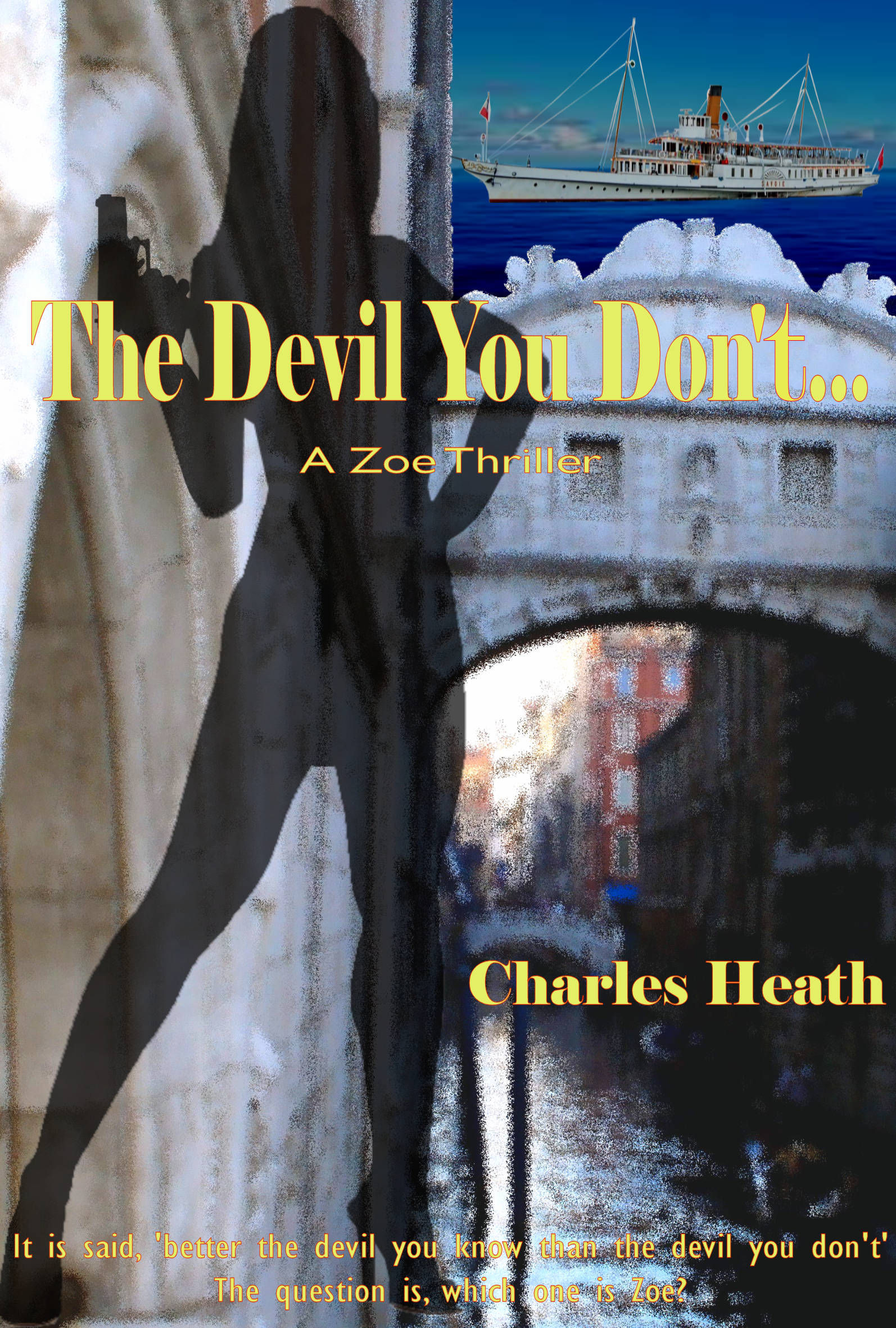
To write a private detective serial has always been one of the items at the top of my to-do list, though trying to write novels and a serial, as well as a blog, and maintain a social media presence, well, you get the idea.
But I made it happen, from a bunch of episodes I wrote a long, long time ago, used these to start it, and then continued on, then as now, never having much of an idea where it was going to end up, or how long it would take to tell the story.
That, I think, is the joy of ad hoc writing, even you, as the author, have as much of an idea of where it’s going as the reader does.
It’s basically been in the mill since 1990, and although I finished it last year, it looks like the beginning to end will have taken exactly 30 years. Had you asked me 30 years ago if I’d ever get it finished, the answer would be maybe?
My private detective, Harry Walthenson
I’d like to say he’s from that great literary mould of Sam Spade, or Mickey Spillane, or Philip Marlowe, but he’s not.
But I’ve watched Humphrey Bogart play Sam Spade with much interest, and modelled Harry and his office on it. Similarly, I’ve watched Robert Micham play Phillip Marlow with great panache, if not detachment, and added a bit of him to the mix.
Other characters come into play, and all of them, no matter what period they’re from, always seem larger than life. I’m not above stealing a little of Mary Astor, Peter Lorre or Sidney Greenstreet, to breathe life into beguiling women and dangerous men alike.
Then there’s the title, like
The Case of the Unintentional Mummy – this has so many meanings in so many contexts, though I imagine that back in Hollywood in the ’30s and ’40s, this would be excellent fodder for Abbott and Costello
The Case of the Three-Legged Dog – Yes, I suspect there may be a few real-life dogs with three legs, but this plot would involve something more sinister. And if made out of plaster, yes, they’re always something else inside.
But for mine, to begin with, it was “The Case of the …”, because I had no idea what the case was going to be about, well, I did, but not specifically.
Then I liked the idea of calling it “The Case of the Brothers’ Revenge” because I began to have a notion there was a brother no one knew about, but that’s stuff for other stories, not mine, so then it went the way of the others.
Now it’s called ‘A Case of Working With the Jones Brothers’, finished the first three drafts, and I am at the editor for the last reading.
I have high hopes of publishing it in mid-2026. It even has a cover.
Bogotá, Colombia’s vibrant capital, is often synonymous with iconic landmarks like Plaza de Bolívar or the towering Monserrate. But beyond the well-trodden tourist trails lies a city rich with untold stories, cultural treasures, and serene escapes that reveal a more authentic side of Colombia. If you’re ready to venture beyond the usual sights, here are five unique experiences that will deepen your connection to Bogotá and its soul.
1. Museo del Chocio: A Private Museum with Heart
Tucked away in a quiet neighbourhood, the Museo del Chocio (also known as the Soul of a Curious Mind) is a one-of-a-kind hidden gem. Founded by Arturo Chocio, a Colombian engineer turned obsessive collector, this intimate museum houses over 70,000 items spanning 11,000 years of human history—pottery, tools, art, and even Egyptian sarcophagi. It’s a labyrinth of wonder for history buffs and collectors’ curious minds, with personal artifacts displayed in a former house. Entry is donation-based, and the museum’s quirky charm offers a rare, personal journey through global cultures. Tip: Visit on a weekday to enjoy the exhibits in peaceful seclusion.
2. Parque Tunal: A Green Oasis with Literary Roots
While many flock to the bustling Parque 93, Parque Tunal is a lesser-known sanctuary where locals unwind. This sprawling park, home to pre-Columbian sculptures and a hidden library, is the perfect spot for a leisurely afternoon. The lush gardens and shaded benches invite reflection, while the Biblioteca Virgilio Bernal—a modern library offering books and events—adds a cultural twist. Tip: Don’t miss the park’s Mirador del Tunal, a hilltop viewpoint offering panoramic city views, especially magical at sunset.
3. Quinta de Bolívar: Step into History at Simón Bolívar’s Home
For a deeper dive into Colombia’s independence story, visit Quinta de Bolívar, the historic home of Simón Bolívar. This preserved country house in San Antonio offers a glimpse into the life of the “Libertador,” with original furniture, mementos, and a beautiful garden. The museum’s child-friendly exhibits and workshops make it ideal for families, while the serene setting is perfect for a picnic. Tip: Combine your visit with a stop at Cafetería La Quinta, a cozy café serving traditional Colombian pastries.
4. La Nuestra de la Asunción: A Cultural Hub in Transition
Once a colonial convent, La Nuestra de la Asunción has evolved into a vibrant arts and community centre. Housed in a restored 19th-century convent, this space hosts rotating art exhibitions, theatre performances, and culinary workshops that celebrate local traditions. The fusion of history and modern creativity here is inspiring, and the nearby Galería del Barco adds a contemporary art flair. Tip: Check the venue’s calendar for weekend workshops—try your hand at making arepas or Colombian coffee.
5. San Agustín Street Art Trail: A Kaleidoscope of Colour
While La Candelaria is famous for its colonial architecture, the San Agustín neighbourhood is a canvas for Bogotá’s vibrant street art scene. Wander through alleys adorned with murals by local and international artists, often infused with social and political commentary. The community’s blend of art, hip cafés, and eclectic shops gives it a bohemian vibe. Tip: Grab a coffee at La Casita del Tio, a beloved spot in the area, and let the murals guide your stroll.
Conclusion: Embrace Bogotá’s Layers
Bogotá is a city of contrasts—where history, nature, and modern creativity collide. By exploring these lesser-known treasures, you’ll uncover a side of the city that locals cherish, one that speaks to resilience, passion, and community. So, trade the crowded queues for quiet pathways, and let Bogotá surprise you with its hidden magic. After all, the best travel stories are born from the detours we take.
By the time I returned to the Savoie, the rain had finally stopped, and there was a streak of blue sky to offer some hope that the day would improve.
The ship was not crowded, the possibility of bad weather perhaps holding back potential passengers. Of those I saw, a number of them would be aboard for the lunch by Phillippe Chevrier. I thought about it, but the Concierge had told me about several restaurants in Yvoire and had given me a hand-drawn map of the village. I think he came from the area because he spoke with the pride and knowledge of a resident.
I was looking down from the upper deck observing the last of the boarding passengers when I saw a woman, notable for her red coat and matching shoes, making a last-minute dash to get on board just before the gangway was removed. In fact, her ungainly manner of boarding had also captured a few of the other passengers’ attention. Now they would have something else to talk about, other than the possibility of further rain.
I saw her smile at the deckhand, but he did not smile back. He was not impressed with her bravado, perhaps because of possible injury. He looked at her ticket, then nodded dismissively and went back to his duties in getting the ship underway. I was going to check the departure time, but I, like the other passengers, had my attention diverted to the woman in red.
From what I could see, there was something about her. It struck me when the light caught her as she turned to look down the deck, giving me a perfect profile. I was going to say she looked foreign, but here, as in almost anywhere in Europe, that described just about everyone. Perhaps I was just comparing her to Phillipa, so definitively British, whereas this woman was very definitely not.
She was perhaps in her 30’s, slim or perhaps the word I’d use was lissom, and had the look and manner of a model. I say that because Phillipa had dragged me to most of the showings, whether in Milan, Rome, New York, London, or Paris. The clothes were familiar, and in the back of my mind, I had a feeling I’d seen her before.
Or perhaps, to me, all models looked the same.
She looked up in my direction, and before I could divert my eyes, she locked on. I could feel her gaze boring into me, and then it was gone as if she had been looking straight through me. I remained out on deck as the ship got underway, watching her disappear inside the cabin. My curiosity was piqued, so I decided to keep an eye out for her.
I could feel the coolness of the air as the ship picked up speed, not that it was going to be very fast. With stops, the trip would take nearly two hours to get to my destination. It would turn back almost immediately, but I was going to stay until the evening when it returned at about half eight. It would give me enough time to sample the local fare and take a tour of the medieval village.
Few other passengers ventured out on the deck, most staying inside or going to lunch. After a short time, I came back down to the main deck and headed forward. I wanted to clear my head by concentrating on the movement of the vessel through the water, breathing in the crisp, clean air, and letting the peacefulness of the surroundings envelope me.
It didn’t work.
I knew it wouldn’t be long before I started thinking about why things hadn’t worked and what part I played in it. And the usual question that came to mind when something didn’t work out. What was wrong with me?
I usually blamed it on my upbringing.
I had one of those so-called privileged lives, a nanny till I was old enough to go to boarding school, then sent to the best schools in the land. There I learned everything I needed to be the son of a Duke, or, as my father called it in one of his lighter moments, nobility in waiting.
Had this been five or six hundred years ago, I would have needed to have sword and jousting skills, or if it had been a few hundred years later, a keen military mind. If nothing else, I could ride a horse and go on hunts, or did until they became not the thing to do.
I learned six languages, and everything I needed to become a diplomat in the far-flung British Empire, except the Empire had become the Commonwealth, and then, when no one was looking, Britain’s influence in the world finally disappeared. I was a man without a cause, without a vocation, and no place to go.
Computers were the new vogue, and I had an aptitude for programming. I guess that went hand in hand with mathematics, which, although I hated the subject, I excelled in. Both I and another noble outcast used to toss ideas around in school, but when it came to the end of our education, he chose to enter the public service, and I took a few of those ideas we had mulled over and turned them into a company.
About a year ago, I was made an offer I couldn’t refuse. There were so many zeroes on the end of it I just said yes, put the money into a very grateful bank, and was still trying to come to terms with it.
Sadly, I still had no idea what I was going to do with the rest of my life. My parents had asked me to come back home and help manage the estate, and I did for a few weeks. It was as long as it took for my parents to drive me insane.
Back in the city, I spent a few months looking for a mundane job, but there were very few that suited my qualifications, and the rest I think I intimidated simply because of who I was. In that time, I’d also featured on the cover of the Economist and, through my well-meaning accountant, started involving myself with various charities, earning the title ‘philanthropist’.
And despite all of this exposure, even making one of those ubiquitous ‘eligible bachelor’ lists, I still could not find ‘the one’, the woman I wanted to spend the rest of my life with. Phillipa seemed to fit the bill, but in time, she proved to be a troubled soul with ‘Daddy’ issues. I knew that in building a relationship, compromise was necessary, but with her, in the end, everything was a compromise, and what had happened was always going to be the end result.
It was perhaps a by-product of the whole nobility thing. There was a certain expectation I had to fulfil, to my peers, contemporaries, parents and family, and those who either liked or hated what it represented. The problem was, I didn’t feel like I belonged. Not like my friend from schooldays, and now obscure acquaintance, Sebastian. He had been elevated to his Dukedom early when his father died when he was in his twenties. He had managed to fade from the limelight and was rarely mentioned either in the papers or the gossip columns. He was one of the lucky ones.
I had managed to keep a similarly low profile until I met Phillipa. From that moment, my obscurity disappeared. It was, I could see now, part of a plan put in place by Phillipa’s father, a man who hogged the limelight with his daughter, to raise the profile of the family name and through it their businesses. He was nothing if not the consummate self-advertisement.
Perhaps I was supposed to be the last piece of the puzzle, the attachment to the establishment, that link with a class of people he would not normally get in the front door. There was nothing refined about him or his family, and more than once I’d noticed my contemporaries cringe at the mention of his name, or any reference of my association with him.
Yet could I truthfully say I really wanted to go back to the obscurity I had before Phillipa? For all her faults, there were times when she had been fun to be with, particularly when I first met her, when she had a certain air of unpredictability. That had slowly disappeared as she became part of her father’s plan for the future. She just failed to see how much he was using her.
Or perhaps, over time, I had become cynical.
I thought about calling her. It was one of those moments of weakness when I felt alone, more alone than usual.
I diverted my attention back to my surroundings and the shoreline. Out of the corner of my eye, I could see the woman in the red coat, making a move. The red coat was like a beacon, a sort of fire engine red. It was not the sort of coat most of the women I knew would wear, but on her, it looked terrific. In fact, her sublime beauty was the other attribute that was distinctly noticeable, along with the fact that her hair was short rather than long and jet-black.
I had to wrench my attention away from her.
A few minutes later, several other passengers came out of the cabin for a walk around the deck, perhaps to get some exercise, perhaps checking up on me, or perhaps I was being paranoid. I waited till they passed on their way forward, and I turned and headed aft.
I watched the wake sluicing out from under the stern for a few minutes before retracing my steps to the front of the ship, and there I stood against the railing, watching the bow carve its way through the water. It was almost mesmerising. There, I emptied my mind of thoughts about Phillipa and thoughts about the woman in the red coat.
Until a female voice behind me said, “Having a bad day?”
I started, caught by surprise, and slowly turned. The woman in the red coat had somehow got very close to me without my realising it. How did she do that? I was so surprised I couldn’t answer immediately.
“I do hope you are not contemplating jumping. I hear the water is very cold.”
Closer up, I could see what I’d missed when I saw her on the main deck. There was a slight hint of Chinese, or Oriental, in her, particularly around the eyes, and of her hair, which was jet black. An ancestor twice or more removed had left their mark, not in a dominant way, but more subtly, and easily missed except from a very short distance away, like now.
Other than that, she was quite possibly Eastern European, perhaps Russian, though that covered a lot of territory. The incongruity of it was that she spoke with an American accent and was fluent enough for me to believe English was her first language.
Usually, I could ‘read’ people, but she was a clean slate. Her expression was one of amusement, but with cold eyes. My first thought, then, was to be careful.
“No. Not yet.” I coughed to clear my throat because I could hardly speak. And blushed, because that was what I did when confronted by a woman, beautiful or otherwise.
The amusement gave way to a hint of a smile that brightened her demeanour as a little warmth reached her eyes. “So that’s a maybe. Should I change into my lifesaving gear, just in case?”
It conjured up a rather interesting image in my mind until I reluctantly dismissed it.
“Perhaps I should move away from the edge,” I said, moving sideways until I was back on the main deck, a few feet further away. Her eyes had followed me, and when I stopped, she turned to face me again. She did not move closer.
I realised then she had removed her beret and it was in her left side coat pocket. “Thanks for your concern …?”
“Zoe.”
“Thanks for your concern, Zoe. By the way, my name is John.”
She smiled again, perhaps in an attempt to put me at ease. “I saw you earlier, you looked so sad, I thought …”
“I might throw myself overboard?”
“An idiotic notion, I admit, but it is better to be safe than sorry.”
Then she tilted her head to one side, then the other, looking intently at me. “You seem to be familiar. Do I know you?”
I tried to think of where I may have seen her before, but all I could remember was what I’d thought earlier when I first saw her; she was a model and had been at one of the showings. If she were, it would be more likely she would remember Phillipa, not me. Phillipa always had to sit in the front row.
“Probably not.” I also didn’t mention the fact that she may have seen my picture in the society pages of several tabloid newspapers because she didn’t look the sort of woman who needed a daily dose of the comings and goings, and, more often than not, scandal associated with so-called celebrities.
She gave me a look, one that told me she had just realised who I was. “Yes, I remember now. You made the front cover of the Economist. You sold your company for a small fortune.”
Of course. She was not the first who had recognised me from that cover. It had raised my profile considerably, but not Sternhaven’s. That article had not mentioned Phillipa or her family. I suspect Grandmother had something to do with that, and it was, now I thought about it, another nail in the coffin that was my relationship with Phillipa.
“I wouldn’t say it was a fortune, small or otherwise, just fortunate.” Each time, I found myself playing down the wealth aspect of the business deal.
“Perhaps then, as the journalist wrote, you were lucky. It is not, I think, a good time for internet-based companies.”
The latter statement was an interesting fact, one she read in the Financial Times, which had made that exact comment recently.
“But I am boring you.” She smiled again. “I should be minding my own business and leaving you to your thoughts. I am sorry.”
She turned to leave and took a few steps towards the main cabin.
“You’re not boring me,” I said, thinking I was letting my paranoia get the better of me. It had been Sebastian, on learning of my good fortune, who had warned me against ‘a certain element here and abroad’ whose sole aim would be to separate me from my money. He was not very subtle when he described their methods.
But I knew he was right. I should have let her walk away.
She stopped and turned around. “You seem nothing like the man I read about in the Economist.”
A sudden and awful thought popped into my head. Those words were part of a very familiar opening gambit. “Are you a reporter?”
I was not sure if she looked surprised or amused. “Do I look like one?”
I silently cursed myself for speaking before thinking, and then immediately ignored my own admonishment. “People rarely look like what they are.”
I saw the subtle shake of the head and expected her to take her leave. Instead, she astonished me.
“I fear we have got off on the wrong foot. To be honest, I’m not usually this forward, but you seemed like you needed cheering up when probably the opposite is true. Aside from the fact that this excursion was probably a bad idea. And,” she added with a little shrug, “perhaps I talk too much.”
I was not sure what I thought of her after that extraordinary admission. It was not something I would do, but it was an interesting way to approach someone and have them ignore their natural instinct. I would let Sebastian whisper in my ear for a little longer and see where this was going.
“Oddly enough, I was thinking the same thing. I was supposed to be travelling with my prospective bride. I think you can imagine how that turned out.”
“She’s not here?”
“No.”
“She’s in the cabin?” Her eyes strayed in that direction for a moment, then came back to me. She seemed surprised I might be travelling with someone.
“No. She is back in England, and the wedding is off. So is the relationship. She dumped me by text.”
OK, why was I sharing this humiliating piece of information with her? I still couldn’t be sure she was not a reporter.
She motioned to an empty seat, back from the edge. No walking the plank today. She moved towards it and sat down. She showed no signs of being cold, nor interested in the breeze upsetting her hair. Phillipa would be having a tantrum about now, being kept outside, and freaking out over what the breeze might be doing to her appearance.
I wondered, if only for a few seconds, if she used this approach with anyone else. I guess I was a little different, a seemingly rich businessman alone on a ferry on Lake Geneva, contemplating the way his life had gone so completely off track.
She watched as I sat at the other end of the bench, leaving about a yard between us. After I leaned back and made myself as comfortable as I could, she said, “I have also experienced something similar, though not by text message. It is difficult, the first few days.”
“I saw it coming.”
“I did not.” She frowned, a sort of lifeless expression taking over, perhaps brought on by the memory of what had happened to her. “But it is done, and I moved on. Was she the love of your life?”
OK, that was unexpected.
When I didn’t answer, she said, “I am sorry. Sometimes I ask personal questions without realising what I’m doing. It is none of my business.” She shivered. “Perhaps we should go back inside.”
She stood and held out her hand. Should I take it and be drawn into her web? I thought of Sebastian. What would he do in this situation?
I took her hand in mine and let her pull me gently to my feet. “Wise choice,” she said, looking up at the sky.
Kill Your Darlings: Why Simple, Strong Words Beat Over-Adjectifying Every Time
We’ve all been there. You’re writing a blog post, a novel, or even a professional email, and you look at a sentence like this:
“The large, menacing, ferocious hound ran quickly across the damp, muddy, desolate field.”
It sounds descriptive, right? But to an experienced reader or an SEO expert looking at user engagement, it actually reads like linguistic clutter. It feels heavy, breathless, and—ironically—weak.
Many writers fall into the trap of believing that the more adjectives they use, the better their writing will become. Surely, adding more descriptors paints a clearer picture?
In reality, trying to use too many adjectives is often a symptom of weak writing. As the old saying goes: Simple, strong words are best—and you should avoid any words that leave people reaching for a dictionary.
Here is why less is almost always more when it comes to adjectives, and how you can transform your writing by embracing simplicity and strength.
The Adjective Trap: Why We Over-Decorate
Why do we do it? Why do we stack adjectives like cordwood?
The Fear of Being Boring: We worry that without modifiers, our writing will sound dry and academic.
The “Show, Don’t Tell” Shortcut: Instead of describing how a character feels through action, we slap an emotion word in front of them (e.g., “the deeply depressed, profoundly sad man”).
The Myth of Granularity: We think precision requires length. We assume that saying “a glistening, shimmering, multifaceted diamond” is more effective than just saying “a diamond.”
The truth? Adjectives are the makeup of writing. A little bit highlights the natural features, but caking it on makes everything look fake, muddy, and overdone.
3 Reasons Why Too Many Adjectives Kill Your Writing
1. They Slow Down the Reader’s Momentum
Good writing has rhythm. It flows like a river, pulling the reader effortlessly downstream. Piling on adjectives acts like dropping boulders into that river. Every extra modifier forces the reader’s brain to pause, process, and adjust the mental image.
Simple and strong: “The ruin stood alone.” or “The rotting cabin stood alone.” (Punchy and immediate.)
2. They Weaken the Noun
Your nouns and verbs should be doing the heavy lifting. When you rely on adjectives to create impact, you rob your primary words of their power.
Instead of writing “a very large, towering hill,” use “a mountain.” Instead of writing “walked very quietly and stealthily,” use “prowled.”
By choosing a stronger noun or verb in the first place, you eliminate the need for adjectives entirely.
3. Obscure Words Alienate Your Audience
Another common pitfall when trying to “elevate” writing is using overly complex, high-register adjectives that most people don’t use in everyday conversation. Words like pusillanimous, lugubrious, or perspicacious.
Unless you are writing for an academic journal, using obscure words doesn’t make you look smart—it makes you hard to read. If a reader has to stop and look up the definition of a word, you’ve broken their immersion. Clear communication always trumps vocabulary flexing. If people have trouble understanding the meaning of your words, they will simply click away.
How to Write with Simplicity and Strength
If you want to clean up your prose, boost your readability, and keep your readers hooked, adopt these three copywriting rules today:
Rule 1: One Adjective is a Maximum, Zero is Often Better
Before you publish a sentence, look at every noun. Does it have two or three adjectives attached to it? Delete at least half of them. Challenge yourself to find the exact right noun instead of modifying a weak one.
Rule 2: Audit Your Adverbs and Adjectives
Run your drafts through a readability checker or read them out loud. If you find yourself using filler modifiers like very, really, truly, quite, or extremely, hit the backspace key. These words are crutches. They signal that the adjective (or verb) that follows isn’t strong enough on its own.
Rule 3: Write for the 8th-Grade Level (Even for Professionals)
Simplicity is not the same as dumbing down. The greatest writers in history—Ernest Hemingway, Stephen King, Maya Angelou—used remarkably simple language. Hemingway’s prose is famous for its punchy, unadorned strength. Write so that a general audience can grasp your meaning instantly, effortlessly, and with maximum emotional resonance.
The Bottom Line
Great writing isn’t about how many impressive words you can cram into a paragraph; it’s about how clearly you can transmit an idea from your brain to the reader’s.
The next time you’re tempted to write “a profoundly complex, deeply fascinating, intricately detailed problem,” stop. Take a breath.
Delete the makeup. Trust your nouns. Use simple, strong words—and let your ideas speak for themselves.
McCallister was old school, a man who would most likely fit in perfectly campaigning on the battlefields of Europe during the Second World War. He’d been like a fish out of water in the army, post-Falklands, and while he retired a hero, he still felt he’d more to give.
He’d applied and was accepted as head of a SWAT team, and, watching him now as he and his men disembarked from the truck in almost military precision, a look passed between Annette, the police liaison officer, and I that said she’d seen it all before. I know I had.
There was a one in four chance his team would be selected for this operation, and she had been hoping it would be one of the other three. While waiting for them to arrive she filled me in on the various teams. His was the least co-operative, and the more likely to make ad-hoc decisions rather than adhere to the plan, or any orders that may come from the officer in charge.
This, she said quite bluntly, was going to end badly.
I still had no idea why Prendergast instructed me to attend the scene of what looked to be a normal domestic operation, but as the nominated expert in the field in these types of situations, it was fairly clear he wasn’t taking any chances. It was always a matter of opinion between us, and generally I lost.
In this case, it was an anonymous report identifying what the authorities believed were explosives in one of the dockside sheds where explosives were not supposed to be.
The only reason why the report was given any credence was the man, while not identifying himself by name, said he’d been an explosive expert once and recognized the boxes. That could mean anything, but the Chief Constable was a cautious man.
With his men settled and preparing their weapons, McCallister came over to the command post, not much more than the SUV my liaison and I arrived in, with weapons, bulletproof vests, and rolls of tape to cordon off the area afterward. We both had coffee, steaming in the cold early morning air. Dawn was slowly approaching and although rain had been forecast it had yet to arrive.
A man by the name of Benson was in charge. He too had groaned when he saw McCallister.
“A fine morning for it.” McCallister was the only enthusiastic one here.
He didn’t say what ‘it’ was, but I thought it might eventually be mayhem.
“Let’s hope the rain stays away. It’s going to be difficult enough without it,” Benson said, rubbing his hands together. We had been waiting for the SWAT team to arrive, and another team to take up their position under the wharf, and who was in the final stages of securing their position.
While we were waiting we drew up the plan. I’d go in first to check on what we were dealing with, and what type of explosives. The SWAT team, in the meantime, were to ensure all the exits to the shed were covered. When I gave the signal, they were to enter and secure the building. We were not expecting anyone inside or out, and no movement had been detected in the last hour since our arrival and deployment.
“What’s the current situation?”
“I’ve got eyes on the building, and a team coming in from the waterside, underneath. Its slow progress, but they’re nearly there. Once they’re in place, we’re sending McKenzie in.”
He looked in my direction.
“With due respect sir, shouldn’t it be one of us?” McCallister glared at me with the contempt that only a decorated military officer could.
“No. I have orders from above, much higher than I care to argue with, so, McCallister, no gung-ho heroics for the moment. Just be ready to move on my command, and make sure you have three teams at the exit points, ready to secure the building.”
McCallister opened his mouth, no doubt to question those orders, but instead closed it again. “Yes sir,” he muttered and turned away heading back to his men.
“You’re not going to have much time before he storms the battlements,” Benson quietly said to me, a hint of exasperation in his tone. “I’m dreading the paperwork.”
It was exactly what my liaison officer said when she saw McCallister arriving.
The water team sent their ‘in position’ signal, and we were ready to go.
In the hour or so we’d been on site nothing had stirred, no arrivals, no departures, and no sign anyone was inside, but that didn’t mean we were alone. Nor did it mean I was going to walk in and see immediately what was going on. If it was a cache of explosives then it was possible the building was booby-trapped in any number of ways, there could be sentries or guards, and they had eyes on us, or it might be a false alarm.
I was hoping for the latter.
I put on the bulletproof vest, thinking it was a poor substitute for full battle armor against an exploding bomb, but we were still treating this as a ‘suspected’ case. I noticed my liaison officer was pulling on her bulletproof vest too.
“You don’t have to go. This is my party, not yours,” I said.
“The Chief Constable told me to stick to you like glue, sir.”
I looked at Benson. “Talk some sense into her please, this is not a kindergarten outing.”
He shrugged. Seeing McCallister had taken all the fight out of him. “Orders are orders. If that’s what the Chief Constable requested …”
Madness. I glared at her, and she gave me a wan smile. “Stay behind me then, and don’t do anything stupid.”
“Believe me, I won’t be.” She pulled out and checked her weapon, chambering the first round. It made a reassuring sound.
Suited up, weapons readied, a last sip of the coffee in a stomach that was already churning from nerves and tension, I looked at the target, one hundred yards distant and thought it was going to be the longest hundred yards I’d ever traversed. At least for this week.
A swirling mist rolled in and caused a slight change in plans.
Because the front of the buildings was constantly illuminated by large overhead arc lamps, my intention had been to approach the building from the rear where there was less light and more cover. Despite the lack of movement, if there were explosives in that building, there’d be ‘enemy’ surveillance somewhere, and, after making that assumption, I believed it was going to be easier and less noticeable to use the darkness as a cover.
It was a result of the consultation, and studying the plans of the warehouse, plans that showed three entrances, the main front hangar type doors, a side entrance for truck entry and exit and a small door in the rear, at the end of an internal passage leading to several offices. I also assumed it was the exit used when smokers needed a break. Our entry would be by the rear door or failing that, the side entrance where a door was built into the larger sliding doors. In both cases, the locks would not present a problem.
The change in the weather made the approach shorter, and given the density of the mist now turning into a fog, we were able to approach by the front, hugging the walls, and moving quickly while there was cover. I could feel the dampness of the mist and shivered more than once.
It was nerves more than the cold.
I could also feel rather than see the presence of Annette behind me, and once felt her breath on my neck when we stopped for a quick reconnaissance.
It was the same for McCallister’s men. I could feel them following us, quickly and quietly, and expected, if I turned around, to see him breathing down my neck too.
It added to the tension.
My plan was still to enter by the back door.
We slipped up the alley between the two sheds to the rear corner and stopped. I heard a noise coming from the rear of the building, and the light tap on the shoulder told me Annette had heard it too. I put my hand up to signal her to wait, and as a swirl of mist rolled in, I slipped around the corner heading towards where I’d last seen the glow of a cigarette.
The mist cleared, and we saw each other at the same time. He was a bearded man in battle fatigues, not the average dockside security guard.
He was quick, but my slight element of surprise was his undoing, and he was down and unconscious in less than a few seconds with barely a sound beyond the body hitting the ground. Zip ties secured his hands and legs, and tape his mouth. Annette joined me a minute after securing him.
A glance at the body then me, “I can see why they, whoever they are, sent you.”
She’d asked who I worked for, and I didn’t answer. It was best she didn’t know.
“Stay behind me,” I said, more urgency in my tone. If there was one, there’d be another.
Luck was with us so far. A man outside smoking meant no booby traps on the back door, and quite possibly there’d be none inside. But it indicated there were more men inside, and if so, it appeared they were very well trained. If that were the case, they would be formidable opponents.
The fear factor increased exponentially.
I slowly opened the door and looked in. A pale light shone from within the warehouse itself, one that was not bright enough to be detected from outside. None of the offices had lights on, so it was possible they were vacant. I realized then they had blacked out the windows. Why hadn’t someone checked this?
Once inside, the door closed behind us, progress was slow and careful. She remained directly behind me, gun ready to shoot anything that moved. I had a momentary thought for McCallister and his men, securing the perimeter.
At the end of the corridor, the extent of the warehouse stretched before us. The pale lighting made it seem like a vast empty cavern, except for a long trestle table along one side, and, behind it, stacks of wooden crates, some opened. It looked like a production line.
To get to the table from where we were was a ten-yard walk in the open. There was no cover. If we stuck to the walls, there was equally no cover and a longer walk.
We needed a distraction.
As if on cue, the two main entrances disintegrated into flying shrapnel accompanied by a deafening explosion that momentarily disoriented both Annette and I. Through the smoke and dust kicked up I saw three men appear from behind the wooden crates, each with what looked like machine guns, spraying bullets in the direction of the incoming SWAT members.
They never had a chance, cut down before they made ten steps into the building.
By the time I’d recovered, my head heavy, eyes watering and ears still ringing, I took several steps towards them, managing to take down two of the gunmen but not the third.
I heard a voice, Annette’s I think, yell out, “Oh, God, he’s got a trigger,” just before another explosion, though all I remember in that split second was a bright flash, the intense heat, something very heavy smashing into my chest knocking the wind out of me, and then the sensation of flying, just before I hit the wall.
I spent four weeks in an induced coma, three months being stitched back together and another six learning to do all those basic actions everyone took for granted. It was twelve months almost to the day when I was released from the hospital, physically, except for a few alterations required after being hit by shrapnel, looking the same as I always had.
But mentally? The document I’d signed on release said it all, ‘not fit for active duty; discharged’.
It was in the name of David Cheney. For all intents and purposes, Alistair McKenzie was killed in that warehouse, and for the first time ever, an agent left the Department, the first to retire alive.
I was not sure I liked the idea of making history.
I didn’t get the last part of the opening sequence sorted until after we arrived in Vancouver. I made a start on it before breakfast was served, though it was rather odd calling it breakfast when outside the plane it was nearly six in the afternoon.
In finishing it much later, I think I’ve come up with a different direction to the one I planned, but in truth, I was never happy with where it was going from the start.
That’s why I prefer to plot on the run so that it doesn’t necessarily get bogged down with a certain result in mind. For me, that is the biggest bugbear is writing to a plan. For some, though, I’m sure it works. For me, not so much.
So, what happened to the rest of the team?
Just in case I’d made a mistake, I kept one eye on the target, who seemed to be consumed by the events unfolding, and another taking a wider search of the surrounding area to make doubly sure the team was still in control of the mission.
They were not.
A hundred yards back in the direction I’d first seen the target heading when the explosion took me out of play, I found one of the team, Jack, a relatively new member of the surveillance division, roughly hidden behind a dumpster, dead, a victim of a clean, accurate, and methodical stab wound to the heart. No noise from the weapon, or the victim.
The target knew we were onto him. It also meant that it was likely the other two members of the team were also out of play, I preferred not to think they might be equally dead, and I didn’t think the chances were good that he might not know about me.
It wasn’t a good sign that he had come back to the site of the explosion because I doubted someone of his stature had time to stand around and watch a search and rescue.
And if he was looking for me I had to make sure he didn’t find me. Good thing then it was exactly what I was thinking when he turned and started to scan the outer perimeter, as I had, and just managed to miss his gaze in my direction.
Yes, he was definitely looking for me, so it was a good bet he had tortured one of the others to get the information he needed.
All the more reason for me to take him down.
I moved closer, all the time keeping him under surveillance and avoiding his searching eyes.
Then, satisfied I was not at this location, he started moving to the next, before I’d last seen him in the distance. It was the epicentre of the explosion and the one where there was a high concentration of police and rescue workers.
He stopped. I used the cover of the confusion, and in a way, a very efficient organization, to move closer.
I saw him take another look around, perhaps he suspected I might be near, then again satisfied, moved on.
It was clear I was not going to be able to take him on while we were in the immediate vicinity of the explosion, there were too many witnesses. Perhaps he was hoping that the abundance of cover would aid his mission.
He stopped again, among a smaller group of observers, and checked both sides of the line. From there he had two choices, to consider if I had retraced my steps, or gone ahead thinking I might catch up to him. Obviously, he’d realized I’d not kept up, and it had been due to the explosion.
Just as he was about to see me on another sweep, a minor explosion of sorts came from the main disaster site, what sounded like part of the structure collapsing, which explained dust rising into the air, and when my attention returned to the spot I’d last seen him, he was gone.
Not a good sign. He could be anywhere.
But he wasn’t just anywhere.
“Sam?”
It was an unfamiliar voice, not expected, but I’d been more or less wary from the moment I lost sight of him. And because I had been alert, it saved me from a far worse injury. I felt the knife thrust through the fleshy part of my side and caught him with my elbow to the side of his head which sent him sprawling and knocking the knife out of his hand and sliding into the area where three bystanders were.
The scuffled turned their attention to him first on the ground, and then hastily getting to his feet and running away, leaving the weapon behind and me chasing after him.
No one said a word.
And this time he didn’t have a very big break on me and driven by rage at what he had done to the members of my team, it didn’t take long to catch up, in a place where we were alone.
In those few steps I’d made up my mind, he was not going to walk away from this.
In the distance, he could hear the dinner bell ringing and roused himself. Feeling the dampness of the pillow and fearing the ravages of pent-up emotion, he considered not going down but thought it best not to upset Mrs Mac, especially after he said he would be dining.
In the event, he wished he had reneged, especially when he discovered he was not the only guest staying at the hotel.
Whilst he’d been reminiscing, another guest, a young lady, had arrived. He’d heard her and Mrs Mac coming up the stairs and then shown to a room on the same floor, perhaps at the other end of the passage.
Henry caught his first glimpse of her when she appeared at the door to the dining room, waiting for Mrs Mac to show her to a table.
She was in her mid-twenties, slim, with long brown hair, and the grace and elegance of a woman associated with countless fashion magazines. She was, he thought, stunningly beautiful with not a hair out of place, and make-up flawlessly applied. Her clothes were black, simple, elegant, and expensive, the sort an heiress or wife of a millionaire might condescend to wear to a lesser occasion than dinner.
Then there was her expression; cold, forbidding, almost frightening in its intensity. And her eyes, piercingly blue and yet laced with pain. Dracula’s daughter was his immediate description of her.
All in all, he considered, the only thing they had in common was, like him, she seemed totally out of place.
Mrs Mac came out of the kitchen, wiping her hands on her apron. She was, she informed him earlier, chef, waitress, hotelier, barmaid, and cleaner all rolled into one. Coming up to the new arrival, she said, “Ah, Miss Andrews, I’m glad you decided to have dinner. Would you like to sit with Mr Henshaw, or would you like to have a table of your own?”
Henry could feel her icy stare as she sized up his appeal as a dining companion, making the hair on the back of his neck stand up. He purposely didn’t look back. In his estimation, his appeal rating was minus six. Out of a thousand!
“If Mr Henshaw doesn’t mind….” She looked at him, leaving the query in mid-air.
He didn’t mind and said so. Perhaps he’d underestimated his rating.
“Good.” Mrs Mac promptly ushered her over. Henry stood, made sure she was seated properly and sat.
“Thank you. You are most kind.” The way she said it suggested snobbish overtones.
“I try to be when I can.” It was supposed to nullify her sarcastic tone, but it made him sound a little silly, and when she gave him another of her icy glares, he regretted it.
Mrs Mac quickly intervened, asking, “Would you care for the soup?”
They did, and, after writing the order on her pad, she gave them each a look, imperceptibly shook her head, and returned to the kitchen.
Before Michelle spoke to him again, she had another quick look at him, trying to fathom who and what he might be. There was something about him.
His eyes mirrored the same sadness she felt, and, yes, there was something else, that it looked like he had been crying. There was a tinge of redness.
Perhaps, she thought, he was here for the same reason she was.
No. That wasn’t possible.
Then she said, without thinking, “Do you have any particular reason for coming here?” Seconds later, she realised she’d spoken it out loud, hadn’t meant to actually ask, it just came out.
It took him by surprise, obviously not the first question he was expecting her to ask of him.
“No, other than it is as far from civilisation, and home as I could get.”
At least we agree on that, she thought.
It was obvious he was running away from something as well.
Given the isolation of the village and lack of geographic hospitality, it was, from her point of view, ideal. All she had to do was avoid him, and that wouldn’t be difficult.
After getting through this evening first.
“Yes,” she agreed. “It is that.”
A few seconds passed, and she thought she could feel his eyes on her and wasn’t going to look up.
Until he asked, “What’s your reason?”
Slightly abrupt in manner, perhaps, because of her question and how she asked it.
She looked up. “Rest. And have some time to myself.”
She hoped he would notice the emphasis she had placed on the word ‘herself’ and take due note. No doubt, she thought, she had completely different ideas of what constituted a holiday than he, not that she had said she was here for a holiday.
Mrs Mac arrived at a fortuitous moment to save them from further conversation.
Over the entree, she wondered if she had made a mistake coming to the hotel. Of course, there had been no conceivable way she could know that anyone else might have booked the same hotel, but she realised it was foolish to think she might end up in it by herself.
Was that what she was expecting?
Not a mistake then, but an unfortunate set of circumstances, which could be overcome by being sensible.
Yet, there he was, and it made her curious, not that he was a man, by himself, in the middle of nowhere, hiding like she was, but for quite varied reasons.
On discreet observation, whilst they ate, she gained the impression his air of light-heartedness was forced, and he had no sense of humour.
This feeling was engendered by his looks, unruly dark hair, and permanent frown. And then there was his abysmal taste in clothes on a tall, lanky frame. They were quality but totally unsuited to the wearer.
Rebellion was written all over him.
The only other thought crossing her mind, and incongruously, was that he could do with a decent feed. In that respect, she knew now from the mountain of food in front of her, he had come to the right place.
“Mr Henshaw?”
He looked up. “Henshaw is too formal. Henry sounds much better,” he said, with a slight hint of gruffness.
“Then my name is Michelle.”
Mrs Mac came in to take their order for the only main course, gather up the entree dishes, and then return to the kitchen.
“Staying long?” she asked.
“About three weeks. Yourself?”
“About the same.”
The conversation dried up.
Neither looked at the other, but rather at the walls, out the window, towards the kitchen, anywhere. It was, she thought, unbearably awkward.
Mrs Mac returned with a large tray with dishes on it, setting it down on the table next to theirs.
“Not as good as the usual cook,” she said, serving up the dinner expertly, “but it comes a good second, even if I do say so myself. Care for some wine?”
Henry looked at Michelle. “What do you think?”
“I’m used to my dining companions making the decision.”
You would, he thought. He couldn’t help but notice the cutting edge of her tone. Then, to Mrs Mac, he named a particular White Burgundy he liked, and she bustled off.
“I hope you like it,” he said, acknowledging her previous comment with a smile that had nothing to do with humour.
“Yes, so do I.”
Both made a start on the main course, a concoction of chicken and vegetables that were delicious, Henry thought when compared to the bland food he received at home and sometimes aboard my ship.
It was five minutes before Mrs Mac returned with the bottle and two glasses. After opening it and pouring the drinks, she left them alone again.
Henry resumed the conversation. “How did you arrive? I came by train.”
“By car.”
“Did you drive yourself?”
And he thought, a few seconds later, that was a silly question; otherwise, she would not be alone, and certainly not sitting at this table. With him.
“After a fashion.”
He could see that she was formulating a retort in her mind, then changed it, instead, smiling for the first time, and it served to lighten the atmosphere.
And in doing so, it showed him she had another, more pleasant side despite the fact she was trying not to look happy.
“My father reckons I’m just another of ‘those’ women drivers,” she added.
“Whatever for?”
“The first and only time he came with me, I had an accident. I ran up the back of another car. Of course, it didn’t matter to him that the other driver was driving like a startled rabbit.”
“It doesn’t help,” he agreed.
“Do you drive?”
“Mostly people up the wall.” His attempt at humour failed. “Actually,” he added quickly, “I’ve got a very old Morris that manages to get me where I’m going.”
The apple pie and cream for dessert came and went, and the rapport between them improved as the wine disappeared and the coffee came. Both had found, after getting to know each other better, that their first impressions were not necessarily correct.
“Enjoy the food?” Mrs Mac asked, suddenly reappearing.
“Beautifully cooked and delicious to eat,” Michelle said, and Henry endorsed her remarks.
“Ah, it does my heart good to hear such genuine compliments,” she said, smiling. She collected the last of the dishes and disappeared yet again.
“What do you do for a living?” Michelle asked in an offhand manner.
He had a feeling she was not particularly interested, and it was just making conversation.
“I’m a purser.”
“A what?”
“A purser. I work on a ship doing the paperwork, that sort of thing.”
“I see.”
“And you?”
“I was a model.”
“Was?”
“Until I had an accident, a rather bad one.”
“Oh, I’m sorry.”
So that explained the odd feeling he had about her.
As the evening wore on, he began to think there might be something wrong, seriously wrong with her because she didn’t look too well. Even the carefully applied makeup, from close, didn’t hide the very pale, tired look, or the sunken, dark-ringed eyes.
“I try not to think about it, but it doesn’t necessarily work. I’ve come here for peace and quiet, away from doctors and parents.”
“Then you will not have to worry about me annoying you. I’m one of those fall-asleep-reading-a-book types.”
Perhaps it would be like ships passing in the night, and then he smiled to himself about the analogy.
Dinner over, they separated.
Henry went back to the lounge to read a few pages of his book before going to bed, and Michelle went up to her room to retire for the night.
But try as he might, he was unable to read, his mind dwelling on the unusual, yet compellingly mysterious person he would be sharing the hotel with.
Overlaying that original blurred image of her standing in the doorway was another of her haunting expressions that had, he finally conceded, taken his breath away, and a look that had sent more than one tingle down his spine.
She may not have thought much of him, but she had certainly made an impression on him.
Every time I close my eyes, I see something different.
I’d like to think the cinema of my dreams is playing a double feature, but it’s more like a comedy-cartoon night on Fox.
But these dreams are nothing to laugh about.
Once again there’s a new instalment of an old feature, and we’re back on the treasure hunt.
…
Three a.m. is meant to be so quiet; you could hear your heart beating.
Ten to, all hell had broken loose when one of the conveyor belts broke, and a replacement was needed, and the engineers were on the clock.
Ten past, the hullabaloo had died down, and back at the desk, I was contemplating a long scotch to calm the nerves. Drinking on the job was not condoned, but not unheard of. I opened the drawer and looked at the bottle, then thought the better of it.
And, when I looked up, Nadia was standing in front of the desk.
She was as quiet as a ninja, and just as dangerous.
“Never a dull moment,” she said, dragging a chair over and sitting down. “I got here a half hour ago and all hell was breaking loose.”
“Conveyor broke. No one wants to see production stop or slide. Too many questions.”
“Fixed?”
“Of course.” I made a note to order a replacement. Better to have two in store, just in case.
“How did you get in?”
Security was tight, not like it used to be, especially after what happened to me.
“I know the guards; they know I’m not a threat.”
I could beg to differ, but I was glad to see her. “Did you know Alex was a caver?”
“A what?”
“One of those people who go scrambling through caves.”
“I doubt it.”
“He used the word spelunking.”
“Which is?”
“Exploring caves.”
“He’s no explorer; I bet he’s looking for the treasure.”
“And so has a million others before him. I seriously doubt the treasure will be in a cave in the hills, which is where all the known caves are. Of course, that doesn’t necessarily include the so-called underground river under the mall, but apparently isn’t.”
“You heard?”
“That the flooding was not necessarily the result of a flood of water from the mountains, yes. A problem with the foundations, it has been suggested.”
“A fact Benderby is working overtime to cover up.”
Nadia seemed well informed. I was guessing the Cossatinos could see an opportunity to blackmail Benderby if they had proof. I wouldn’t put anything past them.
“You know something I don’t?”
“We always know something others don’t.”
“Have I got a dark secret?”
“That depends.”
She smiled, and it worried me.
“Your mother and Joshua Benderby used to be very good friends when they were at school.”
Old news, well, not so old news, but if I hadn’t seen the flowers…
“What are you insinuating?”
“They had a fling before your mother realised what sort of a man he really was and picked your father instead. But, from what I’m told, they were close, and there wasn’t a lot of time between the breakup and you coming along.”
Odd, but that was just the thought that entered my mind at the exact instant she said it.
“But, I look nothing like the Benderby’s.”
“Benderby didn’t look anything like his parents either; it’s a generational thing, so you might want to find a photo of his father and mother, you know, just to settle the nerves. Or a DNA test.”
It was the last thing on my mind. Imagine being a stepbrother to Alex. Wouldn’t that get his nose out of joint, going from the only son and heir to sharing the mantle? I was older than him, too, which gave me more of a claim on the fortune.
No. Not a chance in the world. There wouldn’t be enough money to assuage the horrors of that family. It would be bad enough if they got together now, which wasn’t as unlikely as it sounded. His wife had died, and he hadn’t remarried, or, for that matter, found someone else. Yet.
“Have you come with any other news?”
“No. Just a picnic basket. I thought you might want a late, late supper.”
I am constantly reminded of how curious grandchildren can be when they are not asking you what it was like to live with dinosaurs!
The second eldest, who is a rather clever 19-year-old, considers it interesting that I’m a writer, and, having just met a ‘real’ author who came to visit them at school, asked me a few questions, some of which sounded like those that had been asked of my ‘real’ counterpart.
Like, “How old were you when you first wrote a story, and what was that story about?”
I didn’t think it was when I was at school, but sometime after that, and after a lot of reading. Perhaps it had been one of those moments when a light bulb goes on in your head, and I said to myself, I can write these stories too.
Of course, that wasn’t an answer, so she asked again, when did I start writing?
That required a little thought, and several triggers gave me a date: where I lived at the time, the fact I used my mother’s old portable typewriter, and the fact I had not been long out of school. I was, in fact, about 17. It was 53 years ago; I’ll let you do the math!
What was it about? I couldn’t tell her, but I said I had rescued a lot of old scribbling of mine and put them in a box to look at later when I had the time.
I guess that time had arrived.
And, yes, there was the book, the individually typed pages, some with corrections, unfinished.
The pages were brown with age.
The story, well, I read the first few pages, and it seems I’d started down the thriller path then; the story so far, an agent comes ashore from a trawler to a bleak and isolated village, perhaps on the Scottish coast.
Then there was the inevitable next question: “What was the first story you read that put you on the path to wanting to become a writer?”.
That was easy: Alistair Maclean’s HMS Ulysses. I showed her a copy of the book.
That led to, “but this is about the British Royal Navy in World War 2…”
Perhaps I didn’t answer that correctly; it was after reading about a dozen of his novels, most of which were precursors to the modern-day thriller, perhaps more along the lines of action-adventure.
The next question, understandably: “What was the first book you ever finished?”
That was The Starburst Conspiracy, the manuscript of which was in the box along with another completed novel, and quite a few short stories.
Back in those days, I remembered that I had sent some of my stories off to various publishers, and had entered several short story competitions, all to no avail. And for some years, until I because to old, used to write and enter a novel in the Vogel novel competition but never made it to the shortlist.
It’s probably why I gave up writing for many years, until I worked for an interesting company that had a rich history of phosphate mining in the Pacific and, being given permission to look into the archives, began writing what could only be described as a saga, and by the time I’d left, it was over 1200 closely typed pages long.
I showed the bulky manuscript to her, but by this time her interest had moved to something else.
For me, however, it seemed there was a lot of unfinished business.
“Words are, in my not-so-humble opinion, the most powerful tool we have ever created.” – J.K. Rowling
When a story sweeps us off our feet, a poem makes our hearts ache, or a speech moves a crowd to tears, we instinctively label the author a “gifted” or “talented” writer. It feels as if they possess a mysterious, almost magical ability to conjure whole worlds from thin air.
But is the art of breathing life into language something you’re born with, or can anyone learn to wield it with equal flair? In this post, we’ll explore the science and the folklore behind writing excellence, dissect the myths of the “born writer,” and lay out practical pathways for anyone who wants to transform words into living, breathing experiences.
1. The Allure of the “Natural Talent” Narrative
1.1. Why We Romanticise the Gifted Writer
Heroic storytelling – Just as societies celebrate prodigies in music, sport, and mathematics, literature loves its “genius” figures (Shakespeare, Hemingway, Toni Morrison).
Cognitive bias – The availability heuristic makes us recall the few celebrated authors, overlooking the countless writers who arrived at greatness through deliberate practice.
Cultural mythos – The Romantic era glorified the solitary muse, cementing the idea that true art springs from a mystical well within.
1.2. What Research Really Says
Neuroscientists have mapped the brain activity of skilled writers, and the findings are enlightening:
Brain Region
Role in Writing
What the Data Shows
Broca’s area
Syntax, grammar
Highly active in both novice and expert writers, suggesting that basic language processing is universal.
Prefrontal cortex
Planning, organisation
Shows increased connectivity in seasoned writers, indicating that strategic thinking can be honed.
Default mode network (DMN)
Imagination, mind‑wandering
Stronger activation correlates with creative ideation, but DMN activity can be cultivated through practices like free‑writing.
The takeaway? There are no “magic” brain circuits that only a few possess. The same neural hardware is available to everyone; the difference lies in how it’s trained, wired, and used over time.
2. The Science of Skill Acquisition
2.1. Deliberate Practice—The Engine of Mastery
Psychologist K. Anders Ericsson introduced the concept of deliberate practice: intentional, feedback‑rich, and just beyond your current ability. In writing, this translates to:
Targeted exercises (e.g., “write a scene using only dialogue” or “describe a setting in 100 words”).
Immediate feedback from peers, mentors, or software tools.
Iterative revision—the willingness to rewrite, re‑structure, and re‑think.
2.2. The 10,000‑Hour Rule—A Misinterpretation
Gladwell popularised the idea that 10,000 hours leads to mastery. While practice matters, the quality of those hours matters far more. A novice who writes 10,000 bland sentences won’t rival a diligent writer who spends 2,000 hours on focused storytelling drills.
2.3. Neuroplasticity—Your Brain Can Rewire
Every time you craft a sentence, you’re forging new synaptic pathways. Studies in adult neuroplasticity demonstrate that consistent writing practice enlarges language‑related brain regions and improves narrative comprehension. In short: You can literally rewire yourself to be a better writer.
3. The Role of Reading: The Unsung Curriculum
“If you want to write, write, and if you want to read, read.” – C. S. Lewis
Reading is the foundational apprenticeship for any writer. Here’s why:
Aspect
How Reading Helps
Practical Tip
Vocabulary
Exposure to varied diction builds lexical richness.
Keep a “word‑bank” notebook; add a new, striking word each week.
Structure
Mimic a paragraph in the style of your favourite author, then rewrite it in your voice.
After each book, outline its structure in 5–7 bullet points.
Voice
Understanding expectations lets you subvert or honour them intelligently.
Analysing plot arcs, pacing, and chapter organisation reveals the scaffolding behind stories.
Genre Conventions
Understanding expectations lets you subvert or honor them intelligently.
Read at least three classic works in any genre you plan to write.
In other words—reading is the silent teacher that precedes formal instruction.
4. Teaching the Craft: What Formal Education (and Informal Mentorship) Offers
4.1. What Writing Courses Actually Teach
Fundamentals of Storytelling – Hero’s journey, three‑act structure, conflict types.
Tools of the Trade – Dialogue tags, sensory description, active vs. passive voice.
AI‑assisted tools (Grammarly, ProWritingAid, ChatGPT) – Real‑time suggestions for grammar, style, and even plot brainstorming.
5. Practical Steps to Turn “Potential” into “Prose”
Below is a 12‑week sprint that anyone can follow, regardless of background. Think of it as a bootcamp for the “gift of creating life with words.”
Week
Focus
Action Item
Time Commitment
1
Observation
Keep a daily 5‑minute “sensory log” of what you see, hear, smell.
5 min/day
2
Micro‑Storytelling
Write 100‑word flash fiction using only one sense.
15 min/day
3
Dialogue Drill
Transcribe a real conversation, then rewrite it to reveal subtext.
30 min total
4
Structural Mapping
Outline the plot of your favourite novel in three acts.
1 hour
5
Voice Exploration
Imitate a paragraph from three different authors; then rewrite it in your own voice.
45 min
6
Feedback Loop
Share a 1,000‑word piece with a peer group; receive and integrate feedback.
2 hours
7
Revision Mastery
Take a piece you wrote in Week 2 and perform a macro‑edit (plot, pacing).
1 hour
8
Genre Deep Dive
Read a classic in a new genre; write a 500‑word piece that follows its conventions.
2 hours reading + 1 hour writing
9
Narrative Tension
Write a scene where the stakes are revealed only through action, not exposition.
1 hour
10
Mentor Session
Arrange a 30‑minute call with a more experienced writer (could be via a forum).
30 min
11
Polish & Publish
Edit a short story for submission to a literary journal or online platform.
2 hours
12
Reflection
Write a 500‑word essay on how your writing has changed over the program.
30 min
Consistency beats intensity. Even 15 minutes a day, if focused, yields measurable improvement.
6. Common Myths Debunked
Myth
Reality
“You’re either born a writer or you’re not.”
Writing is a skill that can be systematically improved, much like learning a musical instrument.
“Good writers don’t need to edit.”
Even the most celebrated authors (e.g., Stephen King) claim they spend 90 % of their time editing.
“Inspiration is magical and uncontrollable.”
While moments of inspiration happen, they are often the byproduct of sustained preparation.
“Only formal education matters.”
Self‑directed learning, reading, and community critique often produce equally adept writers.
7. The Bottom Line: Talent Meets Training
The truth lies somewhere in the middle:
Innate predispositions—such as a keen sense of observation, empathy, or an early love for language—can give a head start.
Deliberate practice—the daily grind of writing, reading, revising, and seeking feedback—turns that potential into proficiency.
Guided instruction—whether through a university course, an online tutorial, or a mentorship—provides the scaffolding that accelerates growth.
So, the “gift of creating life with words” isn’t a static, hereditary trait; it’s a dynamic, learnable craft that flourishes when curiosity meets discipline.
8. Takeaway Action: Your First Step Right Now
Grab a notebook (or open a note‑app).
Set a timer for five minutes and write whatever you see out the window, without judging.
Repeat tomorrow, adding one new sensory detail.
In just a week, you’ll have a mini-catalogue of lived experience to draw upon—one of the most valuable reservoirs any writer can own.