The cinema of my dreams – I always wanted to see the planets – Episode 46

Back on the alien vessel

…

Here’s the thing.

I personally believed that we wouldn’t be sitting on this alien vessel unless we had some value, or there was something about the group of so-called criminals that the alien captain didn’t have the authority to take decisive action.

“Hold that thought,” I said to him.  Then, “Number one?”

“Sir?”

“Are you still with the alien group?”

“Yes sir, awaiting orders?”

“Is the spokesman for the prisoners nearby?”

“A moment, sir.”  Silence for a minute, then, “He’s here, sir.”

“You wish to speak to me?” 

An odd thought, they all sounded the same.

“Yes.  I find it odd that the alien captain of this vessel hasn’t just destroyed our vessels and moved on, after all, if they have determined you are all criminals, what would be the difference between being left in a prison, or being executed? 

“I’m not sure what you are getting at.  For all intents and purposes, we are dead, to them and our homeworlds.”

It wasn’t the way he said it, but the way it was spoken.  And what was left unsaid.  It was a moment when you didn’t get the answer you wanted because you didn’t ask the right question.

“Now is not the time to be keeping secrets, because when our host comes back, the situation is going to end badly for you, and just as badly for us.  We’re all still here because you have something they want.  What is it?”

There was silence, but it was not generated by a refusal to speak, but more than the answer might have worse consequences than no answer.

Then, very quietly, he said, “Jai Ti.”

There are only three reasons that drive people to do the unthinkable.  Money, power, and a woman.

“She is not a so-called criminal, is she?”

“No.  She was indiscreet and found herself banished to the same detention center like us.  We are high-level detainees, rather than prisoners, who live in far better conditions than the more common criminal classes.”

“Let me guess, she was a so-called friend of one of the high council or someone of consequence in the political power structure.”

“In a manner of speaking, yes.”

“And they’re worried if she gets free, she might denounce the injustice?”

“She feels she did nothing wrong.  She claims she did not tell anyone, as per her agreement with the individual in question.  The situation is exacerbated by the fact they people have a very strict moral code, and relationships, shall we say, that is extra, and severely frowned upon, and for a leader who is expected to set an example.”

“And this leader…”

“The rules don’t necessarily apply depending on who you are.  Unfortunately, it is a problem across the many homeworlds here.  An enlightened society doesn’t necessarily mean what we and others are led to believe.”

“We have the same problems.  Thank you for your honesty, it may help, it might not.”  I had all I needed.  “Number One.”

“Sir.”

“No need to stay, I have no intention of getting between the passengers or the alien captain, so get back to the ship as quickly as you can and be ready on the bridge.  General?”

“Sir?”

“You are ordered to defend the ship by whatever means at your disposal, without regard to that personnel not aboard.  Do you understand?”

I expected a but because I was basically telling him that if he had to fire upon the Russian ship or the Alien ship, both senior officers and some crew would be in danger.

As far as I was concerned, the ship and 2000 others were more important.

“Under protest, but I understand.  Sir.”

“Number one?”

I also expected to get the standard lecture, which was well within his purview, but instead, “Understood, sir but let’s hope it doesn’t come to that.”

“Second?”

“Sir?”

“You have the bridge until either Number One or I return, otherwise you know what the standing orders are.”

“Understood.”

It was the precise moment the alien captain returned.

“I’ve spoken to the high council.  We are also monitoring a high level of activity on your ship.”

“If it’s a war you want, it’s a war you’ll get.  I think it’s time for the truth, something you have been playing, as we say, fast and loose with.  I told you exactly why we’re here, you haven’t.  I don’t approve of my compatriots’ actions, but he has, as anyone from our world would grant preliminary asylum to anyone who asks for it, pending a thorough investigation.  That investigation starts and ends with two words, Jai Ti.”

For a man with an expressionless face, it wasn’t hard to tell I’d hit the nerve.

“Alas, as you may or may not appreciate, we are in a difficult situation.”

“Dare I say it, but for an enlightened civilization, you seem to have all the same problems we do.  We could have resolved this much earlier had you just stated the facts.”

“Then you are prepared to return the prisoners.”

“Prisoners, yes, but with a suggestion.  The princess, no.  Unfortunately, you’re going to have to censure the leader that broke the rules.”

“And if that’s not possible?”

“Then I will take her home, and whatever happens after that is on his head, and to a lesser extent, yours.”

“Even if it means your ship is destroyed, and all those crew members die needlessly.”

“More have died for less, but noble cause.  Do as you wish, but I strongly advise you not to test our resolve.”

The alien captain turned to the Russian captain.  “If you hand over the prisoners, all of the prisoners, you will free to leave.”

“Sorry.  It’s a tempting offer, but it doesn’t solve the problem for future explorers.  Eliminating us will just bring more, in the not-too-distant future, only they will be hostile.  You might be able to live with the short-term consequences, but given what we are learning about your relations with other worlds, who are they going to blame for the problems you caused in the name of short-term expediency?”

A few seconds later four new aliens appeared, each in a particular style of dress.

Members of the high council?

…

© Charles Heath 2021-2022
November Writing Month – November 2026 – “Lady Agatha Dies” – Day 4

The days you wish you didn’t have children.

…

Children are meant to be the joy in your life, not the bane of your existence.

Of course, keeping the secret from their father might have seemed like a good idea if not out of spite in the beginning.

But the truth was he left, and that was on him.  It was not as if he was going to hang around, not after telling her that it was not the time to be having children, not with her wild partying or the fact he was trying to move on after his stint in the Army and that overseas deployment that had severely scarred many of his friends.

Yes, they were perfectly matched, and both agreed they both soul mates and kindred spirits, but it was not enough to keep them together.  Marrying him to spite her father had the reverse effect, and she still suspected her father had bought him off.

But, whatever the reason, she was left with the parenting, delegated to nannies, then boarding school and servants.  It was no wonder they hated their forever disinterested and absent mother, and because of the bored, mischievous miscreants who were constantly in the news and police stations.

Their latest antics were mild compared to previous escapades, but the school could always see a fundraising opportunity.  And being sent home yet again to consider their situation was all she needed.

Fresh out of her latest and longest stay in hospital, the full extent of her situation was becoming clear.

…

Words today, 2294, for a total of 7161

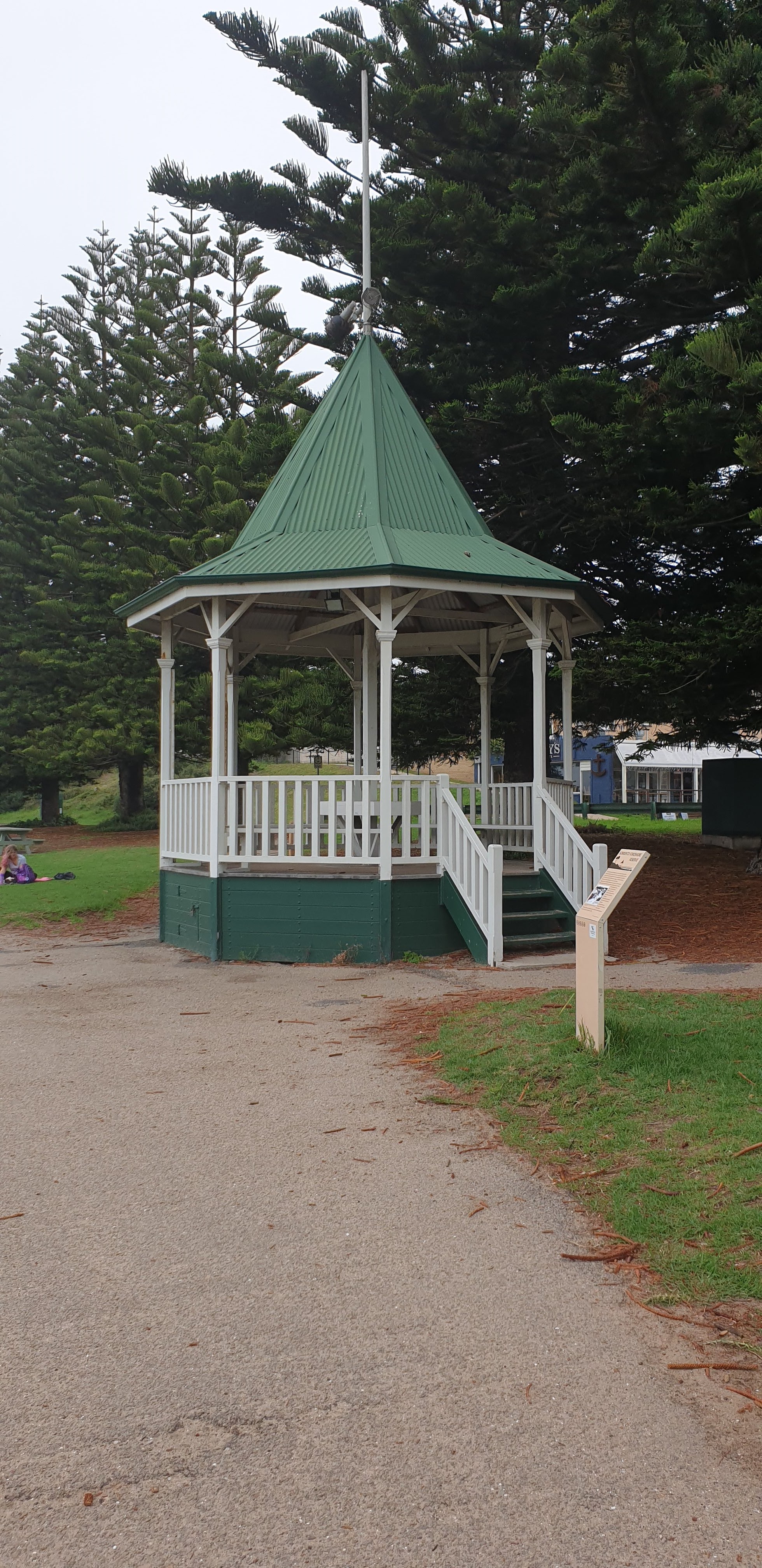
A photograph from the Inspirational bin – 28

Just what everyone needs in their backyard:  A Gazebo, or a small bandstand!

20200215_142419

Often when we go to different places, it gives us ideas, sometimes ideas beyond what is possible.

I have always wanted a gazebo, perhaps not on the same grand scale as the one above, but one where we can put a BBQ and a few seats, and relax on a sunny afternoon.

Shade, a cool breeze, a cold glass of wine or beer, and the aroma of meat cooking on an open flame.

But…

Reality sets in.  The backyard isn’t big enough, so my dream will stay just that.

But as an idea for a story, I suspect this might be the place where you first met the love of your life in circumstances that become the stuff of legends.

It can definitely be a meeting place, whether to carry on illegal activities, whether it’s after sneaking away to be with someone whom others will not approve, or whether it is many, many years later to reminisce, or to reconnect.

As usual, the possibilities are endless.

What I learned about writing – Not everyone can write a political thriller


I don’t understand politics.

The question is, do you really have to?

I mean, all you have to do is read the papers and read between the lines. It doesn’t take much imagination to find something worth writing about

For instance,

How could it possibly happen that a leader of a very powerful country becomes a spy for another?

It doesn’t seem plausible, but is it possible?

It depends, I’m guessing, on power and wealth, well, perhaps not so much the power, but money and wealth are indeed great motivators.

How could it happen when the leader is in the public eye nearly all of the time? And even if that leader has closed-door conversations, which is doubtful, he would be on his own; there would not really be an opportunity to sell out to the other side.

Even an exchange of gifts, like apartments or a dacha, wouldn’t be enough of an incentive, well, not for me anyway. But a clear path to investment in a rival country, maybe.

Perhaps then, rather than becoming a spy, the leader could adopt a policy of appeasement.

We have history to tell us how well that works, and the fact of giving concessions to another country only emboldens it to take advantage of apparent weakness, and then, hey presto, we have another war.

So…

What do we really have?

A lot of speculation and conjecture. It’s easy to construe what might be the truth from a set of circumstances and behavioural patterns of the individuals involved.

It could be likened to two cats circling each other in a cage before the fight begins.

The waters can be muddied by a constant stream of incendiary tweets which fire the readers’ imagination, all intended as a smoke screen, or feelers to see which way the wind is blowing.

Is that leader masterful and clever, or is he a naive fool?

My political thriller might have a working title of,

‘Which Way Does The Wind Blow’

I don’t usually have a title for any of the books until after the first draft, or sometimes something might spring out as it’s being written.

But, for now, let’s sit back and see which way the wind is blowing.

365 Days of Writing, 2026 – 292

Day 292 – Keeping a notebook

…

Dorothy Parker’s lament about the notebook she can never keep—and always promises to start tomorrow—is the ultimate writer’s paradox. It captures the eternal tension between the desire to capture inspiration and the chaotic reality of the creative mind.

Here is a breakdown of why this quote resonates so deeply, both as a portrait of Parker herself and as a universal human truth.


1. The Portrait of a Witty Realist

Dorothy Parker was famous for her biting wit, cynicism, and acute observations of human nature (as a founding member of the legendary Algonquin Round Table). Yet, here she is turning that sharp lens inward.

Instead of romanticising the writing process, she exposes the messy, disorganised truth. The quote is self-deprecating, funny, and deeply relatable. It reminds us that even brilliant minds struggle with the mundane task of object permanence and organisational discipline.

2. The Myth of “Tomorrow”

“I always say I’m going to keep one tomorrow.” Tomorrow is the magical land where all our bad habits are cured. Tomorrow, we will wake up organised, focused, and disciplined. By projecting the solution into the future (“tomorrow”), Parker acknowledges her failure in the present while maintaining a shred of hope. It’s a procrastination loop we all know too well: the intention is pure, but the execution fails, so we reset the clock to the next day.

3. The Irony of the Writer Without a Notebook

For a writer whose stock-in-trade was the clever quip, the biting review, and the memorable turn of phrase, losing her notebook is an occupational hazard. Writers are supposed to be collectors of stray thoughts, overheard dialogue, and fleeting images. Parker’s inability to keep track of her notebook suggests that perhaps the best lines weren’t dutifully written down—they were either remembered through sheer force of wit or lost to the ether forever.

4. The Universal Struggle

You don’t have to be a celebrated author to feel the sting of Parker’s words. We all have our version of the “notebook”:

  • The fitness tracker left in a drawer.
  • The budget spreadsheet we stopped updating by February.
  • The grocery list written on the back of a receipt that is now lost in the abyss of a handbag or car console.

Conclusion

Parker’s quote endures because it normalises our flaws. It tells us that it is okay to be messy, forgetful, and perpetually optimistic about tomorrow. And perhaps, somewhere in that chaos, Dorothy Parker didn’t need the notebook after all—her best material was already living rent-free in her head.

…

Top 5 sights on the road less travelled – Prague

Prague Beyond the Crowds: Five Distinctive Gems for a Serene Escape

Prague. The very name conjures images of fairytale castles, winding cobblestone streets, and the timeless beauty of a city steeped in history. It’s truly magical – but that magic often comes with a hefty dose of crowds, especially in peak season.

If you’re dreaming of experiencing Prague’s unique charm without the elbow-to-elbow shuffling, you’re in luck! The Golden City holds countless hidden treasures that are just as distinctive, beautiful, and rich in history as their more famous counterparts, yet remain wonderfully uncrowded.

As a seasoned traveller and admirer of Prague, I’ve curated a list of five visitor attractions that offer a distinctive experience, breathtaking beauty, and, most importantly, a peaceful retreat from the madding crowds.


1. Vyšehrad: Prague’s Ancient Citadel with Panoramic Views

Often overshadowed by Prague Castle, Vyšehrad is older, equally significant, and immensely more tranquil. Perched on a dramatic rock overlooking the Vltava River, this historic fort and castle complex offers a captivating journey through Czech history, mythology, and art.

Why it’s distinctive:

  • Historical Significance: Believed to be the original seat of the Czech princes before Prague Castle.
  • St. Peter and Paul Basilica: A stunning neo-Gothic church with intricate frescoes and a peaceful atmosphere.
  • Slavín Cemetery: The final resting place of many famous Czech artists, writers, and composers (Dvořák, Smetana, and Mucha), featuring elaborate and beautiful tombstones.
  • Panoramic Views: Breathtaking vistas of the Vltava River, Prague Castle, and the entire city.
  • Rotunda of St. Martin: Prague’s oldest surviving Romanesque rotunda.

Why it’s not crowded: It’s slightly outside the immediate city centre, requiring a short tram or metro ride, which deters many casual tourists. Those who make the effort are rewarded with space, serenity, and discovery.


2. Strahov Monastery Library: A Baroque Masterpiece of Knowledge

Tucked away near Prague Castle, the Strahov Monastery Library is a truly awe-inspiring sight that feels like stepping into another world. While part of a larger monastery that sees some visitors, the library itself often requires pre-booked tours or specific entry, which naturally limits crowd size, allowing for a more intimate viewing experience.

Why it’s distinctive:

  • Philosophical Hall & Theological Hall: Two magnificent Baroque halls housing over 200,000 volumes.
  • Stunning Frescoes: Intricate ceiling frescoes depicting the history of mankind and the pursuit of knowledge.
  • Historical Globes & Curiosities: A collection of ancient globes, natural history specimens, and other fascinating artifacts.
  • Architectural Grandeur: The sheer scale and ornamentation of the halls are breathtaking.

Why it’s not crowded: Its location, slightly up a hill from Prague Castle (though easily walkable), and its specific entry requirements mean it’s not a place for a quick glance. Those who visit are genuinely interested in its unique beauty and history.


3. Wallenstein Garden (Valdštejnská Zahrada): Baroque Splendor in Malá Strana

Just a stone’s throw from the bustling Malá Strana (Lesser Town) square, the Wallenstein Garden is a Baroque masterpiece that often gets overlooked. Belonging to the Wallenstein Palace (home to the Czech Senate), this meticulously maintained garden is a tranquil oasis.

Why it’s distinctive:

  • Manicured Lawns & Hedges: Perfect geometric designs characteristic of Baroque gardens.
  • Exquisite Statues: Bronze sculptures by Adriaen de Vries, depicting mythological figures.
  • The Salla Terrena: A grand triple arch loggia adorned with frescoes, hosting concerts in summer.
  • Artificial Grotto (Grotta): A fantastical, stalactite-lined cave structure that’s utterly unique.
  • Peacocks: Elegant white peacocks roam freely, adding to the garden’s enchanting atmosphere.

Why it’s not crowded: It’s a bit hidden from the main tourist routes, and while many walk past the palace, fewer venture into the garden’s entrance. It’s often free to enter, making it an incredible value for such beauty. (Check seasonal opening times, as it’s typically closed in winter).


4. Vrtba Garden (Vrtbovská Zahrada): A Hidden Terraced Gem

Considered one of Prague’s most beautiful Baroque gardens, the Vrtba Garden is a true hidden gem, tucked away behind a modest archway in Malá Strana. This terraced garden ascends steeply, offering increasingly spectacular views as you climb.

Why it’s distinctive:

  • Intimate Baroque Design: Smaller and more secluded than Wallenstein, with a romantic, secret garden feel.
  • Terraced Levels: Each level reveals new perspectives, fountains, statues, and intricate floral arrangements.
  • Stunning Views: From the top terrace, you get a unique, close-up vista of Prague Castle, St. Nicholas Church, and the red rooftops of Malá Strana.
  • Rich Sculpture & Frescoes: Adorned with works by Matthias Braun and frescoes by Reiner.

Why it’s not crowded: Its rather unassuming entrance on Karmelitská Street means it’s easily missed. There’s a small entrance fee, which further deters casual visitors, ensuring a peaceful and exclusive experience for those who seek it out. (Another seasonal garden, typically closed in winter).


5. Letná Park (Letenské Sady): Iconic Views and Local Vibe

While popular with locals, Letná Park rarely sees the kind of tourist throngs that flood the Charles Bridge. This expansive park stretches along a plateau on the left bank of the Vltava River, offering some of the most iconic panoramic views of Prague.

Why it’s distinctive:

  • The Metronome: Standing on the former site of a gigantic Stalin monument, Prague’s giant metronome is a symbol of passing time and offers a fantastic photo op.
  • Beer Garden: A beloved spot, particularly in warmer months, where you can enjoy a Czech beer with an unparalleled backdrop of the city’s bridges and Old Town.
  • Skate Park & Open Spaces: Popular with skateboarders and locals enjoying a stroll, picnic, or simply relaxing.
  • Breathtaking Vistas: Arguably the best spot to capture the iconic shot of all of Prague’s bridges spanning the Vltava.

Why it’s not crowded: It’s a park designed for space and relaxation, so even with many people, it rarely feels cramped. It requires a bit of an uphill walk (or a short tram ride) from the river, which means it’s a destination rather than a stop on a crowded route.


Embark on a Prague adventure that’s truly yours. By venturing slightly off the most beaten path, you’ll discover a Prague that’s just as magnificent, but far more serene. You’ll not only see distinctive features but also gain a deeper connection to the city’s enduring charm, away from the hustle and bustle.

Have you discovered any other uncrowded Prague gems? Share your favourites in the comments below!

In a word: well

At first, you would think this word has something to do with your health.

You’d be right.  “Are you well?” or “Are you well enough?”

Of course, it can cause some confusion, because how do you measure degrees of wellness.

Reasonably well, very well, not well, or just well.  Not a good descriptive word for the state of your health, maybe.

How about what if the team played well.  Not health this time, but a standard.

There’s ordinary, mediocre, as a team, brilliantly, and then there’s well.

It seems it can be used to describe an outcome.

Well, well.

Hang on, that’s something else again.

What about, then, we use the word to describe a hole in the ground with water at the bottom.

Or not if it is a drought.

A lot of people get water from a well, in fact in the olden days that was a common sight in a village.

What about those environment destroyers, oilmen.  They have oil wells, don’t they?

And when I went to school, there were ink wells on every desk.

Messy too, because I was once the ink monitor.

But if the well’s dried up?

It becomes a metaphor for a whole new bunch of stuff.

OR what about a stairwell?

And at the complexity of it all, for such a small word, tears well up in my eyes.

Top 5 sights on the road less travelled – Berlin

Berlin’s Best-Kept Secrets: 5 Distinctive Attractions Beyond the Crowds

Berlin is a city that pulsates with history, art, and an undeniable energy. From the Brandenburg Gate to Museum Island, its iconic landmarks draw millions of visitors each year. But what if you crave a deeper, more intimate connection with the German capital? What if you want to explore places that offer unique character without fighting through throngs of tourists?

Fear not, intrepid explorer! Berlin is a treasure trove of distinctive attractions that, while captivating, manage to remain refreshingly uncrowded. Step off the well-trodden path and discover these five fantastic spots where you can soak in the atmosphere, history, and beauty at your own pace.


1. Tempelhofer Feld (Tempelhof Field)

Imagine a vast, open expanse in the middle of a bustling city – a former airport transformed into Berlin’s largest urban park. That’s Tempelhofer Feld. Once the site of the Berlin Airlift, this historic tarmac now serves as a unique recreational space where locals and savvy visitors come to fly kites, cycle, rollerblade, garden in community plots, or simply wander and feel the incredible sense of freedom.

Why it’s distinctive: Its sheer scale and stark, industrial beauty are unlike any other park. You can walk or cycle down the actual runways, feeling the ghosts of history under your feet, while enjoying panoramic views of the city skyline. It’s a testament to Berlin’s ability to repurpose its past into vibrant public spaces. Crowd factor: Its immense size ensures you’ll always find quiet corners, even on sunny weekends.


2. Gärten der Welt (Gardens of the World)

Tucked away in the eastern district of Marzahn-Hellersdorf, the “Gardens of the World” is an absolutely stunning, often-overlooked masterpiece of landscape architecture. This sprawling park features meticulously designed themed gardens from around the globe, including an authentic Chinese Garden, a peaceful Japanese Garden, a vibrant Balinese Garden, an English Tudor Rose Garden, and many more.

Why it’s distinctive: It’s a journey around the world in one park! Each garden is an exquisite representation of its cultural heritage, complete with traditional architecture, plants, and water features. The park also boasts a cable car (Seilbahn) that offers fantastic aerial views, adding an extra layer of unique experience. Crowd factor: Due to its location slightly outside the central tourist areas, it attracts primarily locals and those in the know, making for a serene and contemplative visit.


3. Teufelsberg (Devil’s Mountain)

For a taste of Cold War history, street art, and incredible views, head to Teufelsberg. This artificial hill, built from post-WWII rubble, housed a crucial US listening station during the Cold War. Today, the abandoned NSA facility stands as a captivating, eerie ruin, its iconic radar domes covered in vibrant graffiti art.

Why it’s distinctive: It’s a fascinating blend of history, urban exploration, and an open-air art gallery. You can wander through the former listening posts, climb the towers (at your own risk or with permission) for panoramic views across Berlin and Brandenburg, and marvel at the ever-evolving street art. It feels like stepping into a forgotten movie set. Crowd factor: While it has become more popular, its somewhat rugged approach (a short hike up a hill) and relatively low-key management keep the crowds sparse compared to central attractions.


4. Gedenkstätte Berlin-Hohenschönhausen (Stasi Prison Memorial)

This is not a light-hearted attraction, but it is profoundly distinctive and essential for understanding a darker chapter of Berlin’s history. Hohenschönhausen was the main remand prison of the East German secret police (Stasi) where political dissidents were interrogated and tortured. Today, it stands as a powerful memorial and museum.

Why it’s distinctive: The tours, often led by former prisoners or knowledgeable guides, offer an incredibly vivid and harrowing insight into the mechanisms of state oppression. You walk through original cells, interrogation rooms, and work areas, preserving an unvarnished and chilling historical record. It’s a sombre but vital experience that leaves a lasting impression. Crowd factor: While guided tours can have small groups, it’s a quiet, respectful atmosphere, far removed from the general tourist bustle. It demands contemplation, not quick photos.


5. Charlottenburg Palace & Gardens (Focusing on the Gardens & Belvedere)

While Charlottenburg Palace itself can draw a fair number of visitors, its magnificent Baroque gardens and charming subsidiary buildings offer expansive, less-crowded opportunities for exploration. The main palace tickets might have queues, but the vast grounds are free to roam and offer a regal escape.

Why it’s distinctive: As the largest and most significant palace in Berlin, it offers a glimpse into Prussian royal grandeur. But it’s the sheer scale and beauty of the meticulously landscaped gardens – complete with fountains, statues, a charming Orangery, and the tranquil Belvedere teahouse – that truly delight. The Belvedere, housing an exquisite porcelain collection, is often quiet and offers lovely views over the river Spree. Crowd factor: The gardens are so extensive that it’s easy to find solitude, especially away from the main palace entrance. The smaller museums like the Belvedere are also often blissfully uncrowded.


Berlin truly rewards those who are willing to venture slightly beyond the obvious. These five distinctive attractions offer rich historical narratives, breathtaking beauty, and unique experiences – all without the pressing crowds. So, next time you plan a trip to Berlin, consider stepping off the beaten path and uncovering a few of the city’s best-kept secrets. You might just find your new favourite spot.

“The Devil You Don’t”, she was the girl you would not take home to your mother!

Now only $0.99 at https://amzn.to/2Xyh1ow

…

John Pennington’s life is in the doldrums. Looking for new opportunities and prevaricating about getting married, the only joy on the horizon was an upcoming visit to his grandmother in Sorrento, Italy.

Suddenly, he is left at the check-in counter with a message on his phone telling him the marriage is off, and the relationship is over.

If only he hadn’t promised a friend he would do a favour for him in Rome.

At the first stop, Geneva, he has a chance encounter with Zoe, an intriguing woman who captures his imagination from the moment she boards the Savoire, and his life ventures into uncharted territory in more ways than one.

That ‘favour’ for his friend suddenly becomes a life-changing event, and when Zoe, the woman who he knows is too good to be true, reappears, danger and death follow.

Shot at, lied to, seduced, and drawn into a world where nothing is what it seems, John is dragged into an adrenaline-charged undertaking, where he may have been wiser to stay with the ‘devil you know’ rather than opt for the ‘devil you don’t’.

newdevilcvr6

365 Days of Writing, 2026 – 292

Day 292 – Keeping a notebook

…

Dorothy Parker’s lament about the notebook she can never keep—and always promises to start tomorrow—is the ultimate writer’s paradox. It captures the eternal tension between the desire to capture inspiration and the chaotic reality of the creative mind.

Here is a breakdown of why this quote resonates so deeply, both as a portrait of Parker herself and as a universal human truth.


1. The Portrait of a Witty Realist

Dorothy Parker was famous for her biting wit, cynicism, and acute observations of human nature (as a founding member of the legendary Algonquin Round Table). Yet, here she is turning that sharp lens inward.

Instead of romanticising the writing process, she exposes the messy, disorganised truth. The quote is self-deprecating, funny, and deeply relatable. It reminds us that even brilliant minds struggle with the mundane task of object permanence and organisational discipline.

2. The Myth of “Tomorrow”

“I always say I’m going to keep one tomorrow.” Tomorrow is the magical land where all our bad habits are cured. Tomorrow, we will wake up organised, focused, and disciplined. By projecting the solution into the future (“tomorrow”), Parker acknowledges her failure in the present while maintaining a shred of hope. It’s a procrastination loop we all know too well: the intention is pure, but the execution fails, so we reset the clock to the next day.

3. The Irony of the Writer Without a Notebook

For a writer whose stock-in-trade was the clever quip, the biting review, and the memorable turn of phrase, losing her notebook is an occupational hazard. Writers are supposed to be collectors of stray thoughts, overheard dialogue, and fleeting images. Parker’s inability to keep track of her notebook suggests that perhaps the best lines weren’t dutifully written down—they were either remembered through sheer force of wit or lost to the ether forever.

4. The Universal Struggle

You don’t have to be a celebrated author to feel the sting of Parker’s words. We all have our version of the “notebook”:

  • The fitness tracker left in a drawer.
  • The budget spreadsheet we stopped updating by February.
  • The grocery list written on the back of a receipt that is now lost in the abyss of a handbag or car console.

Conclusion

Parker’s quote endures because it normalises our flaws. It tells us that it is okay to be messy, forgetful, and perpetually optimistic about tomorrow. And perhaps, somewhere in that chaos, Dorothy Parker didn’t need the notebook after all—her best material was already living rent-free in her head.

…
