Searching for locations: Mount Ngauruhoe, New Zealand

Mount Ngauruhoe is apparently still an active volcano, has been for 2,500 years or so, and last erupted on 19th February 1975, and reportedly has erupted around 70 times since 1839.

The mountain is usually climbed from the western side, from the Mangatepopo track.

This photo was taken in summer from the Chateau Tongariro carpark.

In late autumn, on one of our many visits to the area, the mountain was covered with a light sprinkling of snow and ice.

On our most recent visit, this year, in winter, it was fully covered in snow.

It can be a breathtaking sight from the distance.

The cinema of my dreams – I always wanted to go on a treasure hunt – Episode 4

Here’s the thing.

Every time I close my eyes, I see something different.

I’d like to think the cinema of my dreams is playing a double feature but it’s a bit like a comedy cartoon night on Fox.

But these dreams are nothing to laugh about.

Once again there’s a new installment of an old feature, and back on the treasure hunt.

“Who the hell is that horrible man?” I asked, still staring after the car, long after it had gone.

I knew trouble when I saw it, and that man was serious trouble.

And the fact he believed there was a treasure map…

“My uncle Rico, he was the one my mother always credited leading my father astray.  Whatever they had been doing back then, it was never anything legal.”

So, he knows about the treasure map?”

“He knows nothing.  He thinks he knows something, he thinks I know something, but he’s not going to get it out of me.”

“What if he comes after me next?”

It was a daunting prospect, and just looking at Rico was enough to scare me.  If he had a machete to back up his insistence I tell the truth?  I shuddered.

“You tell him the truth.  We have a map, we bought it at the bar like everyone else.”

He was right.

“Boggs?”

His aunt yelled out his name in a manner that meant he was in trouble.

He motioned to keep quiet and follow him.

He took one step before she added, “You take one more step away from this house, and you’ll have more than Rico to worry about.”

A shrug, a wan smile, and then he turned back.  “Nothing more today.  See you at the Bar tomorrow, and we’ll start the search.

“Surely you don’t think that map is real?”

“Real enough, with missing pieces, we have to track down.  Tomorrow.”He turned and went back into the house, the wooden screen door slamming shut behind him.

Followed by the raised voice of an angry Aunt.  “What is all this malarkey about a treasure map, and what the hell were you doing in a bar?  I bet it was that Johnson kid leading you astray again.”

Never, according to her, Boggs’ fault, and always mine.

I guess it was time to take one for the team!

© Charles Heath 2019-2021

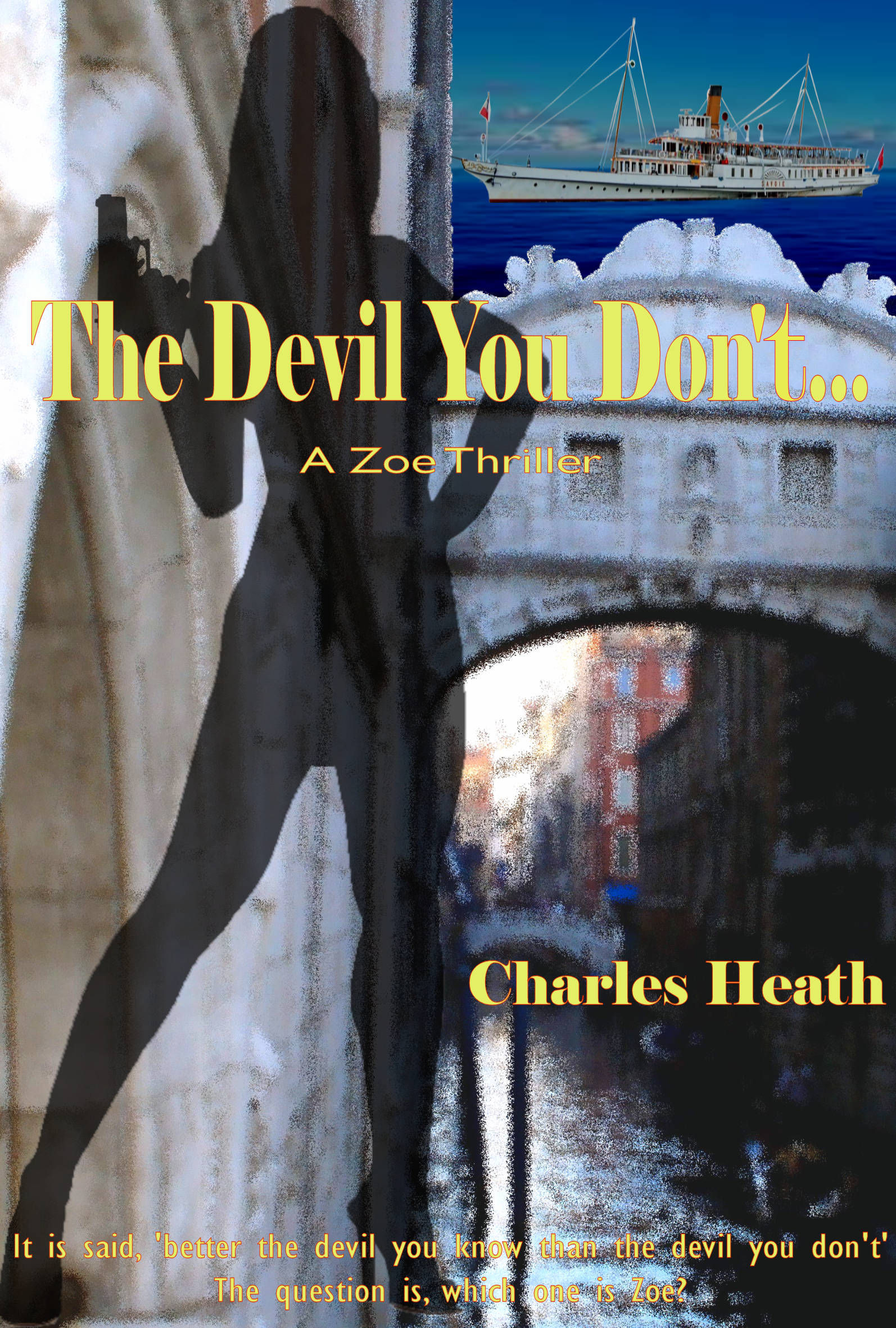
An excerpt from “The Devil You Don’t”

Available on Amazon Kindle here:  https://amzn.to/2Xyh1ow

By the time I returned to the Savoie, the rain had finally stopped, and there was a streak of blue sky to offer some hope the day would improve.

The ship was not crowded, the possibility of bad weather perhaps holding back potential passengers.  Of those I saw, a number of them would be aboard for the lunch by Phillippe Chevrier.  I thought about it, but the Concierge had told me about several restaurants in Yvoire and had given me a hand-drawn map of the village.  I think he came from the area because he spoke with the pride and knowledge of a resident.

I was looking down from the upper deck observing the last of the boarding passengers when I saw a woman, notable for her red coat and matching shoes, making a last-minute dash to get on board just before the gangway was removed.  In fact, her ungainly manner of boarding had also captured a few of the other passenger’s attention.  Now they would have something else to talk about, other than the possibility of further rain.

I saw her smile at the deckhand, but he did not smile back.  He was not impressed with her bravado, perhaps because of possible injury.  He looked at her ticket then nodded dismissively, and went back to his duties in getting the ship underway.  I was going to check the departure time, but I, like the other passengers, had my attention diverted to the woman in red.

From what I could see there was something about her.  It struck me when the light caught her as she turned to look down the deck, giving me a perfect profile.  I was going to say she looked foreign, but here, as in almost anywhere in Europe, that described just about everyone.  Perhaps I was just comparing her to Phillipa, so definitively British, whereas this woman was very definitely not.

She was perhaps in her 30’s, slim or perhaps the word I’d use was lissom, and had the look and manner of a model.  I say that because Phillipa had dragged me to most of the showings, whether in Milan, Rome, New York, London, or Paris.  The clothes were familiar, and in the back of my mind, I had a feeling I’d seen her before.

Or perhaps, to me, all models looked the same.

She looked up in my direction, and before I could divert my eyes, she locked on.  I could feel her gaze boring into me, and then it was gone as if she had been looking straight through me.  I remained out on deck as the ship got underway, watching her disappear inside the cabin.  My curiosity was piqued, so I decided to keep an eye out for her.

I could feel the coolness of the air as the ship picked up speed, not that it was going to be very fast.  With stops, the trip would take nearly two hours to get to my destination.  It would turn back almost immediately, but I was going to stay until the evening when it returned at about half eight.  It would give me enough time to sample the local fare, and take a tour of the medieval village.

Few other passengers ventured out on the deck, most staying inside or going to lunch.  After a short time, I came back down to the main deck and headed forward.  I wanted to clear my head by concentrating on the movement of the vessel through the water, breathing in the crisp, clean air, and let the peacefulness of the surroundings envelope me.

It didn’t work.

I knew it wouldn’t be long before I started thinking about why things hadn’t worked, and what part I played in it.  And the usual question that came to mind when something didn’t work out.  What was wrong with me?

I usually blamed it on my upbringing.

I had one of those so-called privileged lives, a nanny till I was old enough to go to boarding school, then sent to the best schools in the land.  There I learned everything I needed to be the son of a Duke, or, as my father called it in one of his lighter moments, nobility in waiting.

Had this been five or six hundred years ago, I would need to have sword and jousting skills, or if it had been a few hundred years later a keen military mind.  If nothing else I could ride a horse, and go on hunts, or did until they became not the thing to do.

I learned six languages, and everything I needed to become a diplomat in the far-flung British Empire, except the Empire had become the Commonwealth, and then, when no-one was looking, Britain’s influence in the world finally disappeared.  I was a man without a cause, without a vocation, and no place to go.

Computers were the new vogue and I had an aptitude for programming.  I guess that went hand in hand with mathematics, which although I hated the subject, I excelled in.  Both I and another noble outcast used to toss ideas around in school, but when it came to the end of our education, he chose to enter the public service, and I took a few of those ideas we had mulled over and turned them into a company.

About a year ago, I was made an offer I couldn’t refuse.  There were so many zeroes on the end of it I just said yes, put the money into a very grateful bank, and was still trying to come to terms with it.

Sadly, I still had no idea what I was going to do with the rest of my life.  My parents had asked me to come back home and help manage the estate, and I did for a few weeks.  It was as long as it took for my parents to drive me insane.

Back in the city, I spent a few months looking for a mundane job, but there were very few that suited the qualifications I had, and the rest, I think I intimidated the interviewer simply because of who I was.  In that time I’d also featured on the cover of the Economist, and through my well-meaning accountant, started involving myself with various charities, earning the title ‘philanthropist’.

And despite all of this exposure, even making one of those ubiquitous ‘eligible bachelor’ lists, I still could not find ‘the one’, the woman I wanted to spend the rest of my life with.  Phillipa seemed to fit the bill, but in time she proved to be a troubled soul with ‘Daddy’ issues.  I knew that in building a relationship compromise was necessary, but with her, in the end, everything was a compromise and what had happened was always going to be the end result.

It was perhaps a by-product of the whole nobility thing.  There was a certain expectation I had to fulfill, to my peers, contemporaries, parents and family, and those who either liked or hated what it represented.  The problem was, I didn’t feel like I belonged.  Not like my friend from schooldays, and now obscure acquaintance, Sebastian.  He had been elevated to his Dukedom early when his father died when he was in his twenties.  He had managed to fade from the limelight and was rarely mentioned either in the papers or the gossip columns.  He was one of the lucky ones.

I had managed to keep a similarly low profile until I met Phillipa.  From that moment, my obscurity disappeared.  It was, I could see now, part of a plan put in place by Phillipa’s father, a man who hogged the limelight with his daughter, to raise the profile of the family name and through it their businesses.  He was nothing if not the consummate self-advertisement.

Perhaps I was supposed to be the last piece of the puzzle, the attachment to the establishment, that link with a class of people he would not normally get in the front door.  There was nothing refined about him or his family, and more than once I’d noticed my contemporaries cringe at the mention of his name, or any reference of my association with him.

Yet could I truthfully say I really wanted to go back to the obscurity I had before Phillipa?  For all her faults, there were times when she had been fun to be with, particularly when I first met her when she had a certain air of unpredictability.  That had slowly disappeared as she became part of her father’s plan for the future.  She just failed to see how much he was using her.

Or perhaps, over time, I had become cynical.

I thought about calling her.  It was one of those moments of weakness when I felt alone, more alone than usual.

I diverted my attention back to my surroundings and the shoreline.  Out of the corner of my eye, I could see the woman in the red coat, making a move.  The red coat was like a beacon, a sort of fire engine red.  It was not the sort of coat most of the women I knew would wear, but on her, it looked terrific.  In fact, her sublime beauty was the one other attribute that was distinctly noticeable, along with the fact her hair was short, rather than long, and jet black.

I had to wrench my attention away from her.

A few minutes later several other passengers came out of the cabin for a walk around the deck, perhaps to get some exercise, perhaps checking up on me, or perhaps I was being paranoid.  I waited till they passed on their way forward, and I turned and headed aft.

I watched the wake sluicing out from under the stern for a few minutes, before retracing my steps to the front of the ship and there I stood against the railing, watching the bow carve its way through the water.  It was almost mesmerizing.  There, I emptied my mind of thoughts about Phillipa, and thoughts about the woman in the red coat.

Until a female voice behind me said, “Having a bad day?”

I started, caught by surprise, and slowly turned.  The woman in the red coat had somehow got very close me without my realizing it.  How did she do that?  I was so surprised I couldn’t answer immediately.

“I do hope you are not contemplating jumping.  I hear the water is very cold.”

Closer up, I could see what I’d missed when I saw her on the main deck.  There was a slight hint of Chinese, or Oriental, in her particularly around the eyes, and of her hair which was jet black.  An ancestor twice or more removed had left their mark, not in a dominant way, but more subtle, and easily missed except from a very short distance away, like now.

Other than that, she was quite possibly Eastern European, perhaps Russian, though that covered a lot of territory.  The incongruity of it was that she spoke with an American accent, and fluent enough for me to believe English was her first language.

Usually, I could ‘read’ people, but she was a clean slate.  Her expression was one of amusement, but with cold eyes.  My first thought, then, was to be careful.

“No.  Not yet.”  I coughed to clear my throat because I could hardly speak.  And blushed, because that was what I did when confronted by a woman, beautiful or otherwise.

The amusement gave way to a hint of a smile that brightened her demeanor as a little warmth reached her eyes.  “So that’s a maybe.  Should I change into my lifesaving gear, just in case?”

It conjured up a rather interesting image in my mind until I reluctantly dismissed it.

“Perhaps I should move away from the edge,” I said, moving sideways until I was back on the main deck, a few feet further away.  Her eyes had followed me, and when I stopped she turned to face me again.  She did not move closer.

I realized then she had removed her beret and it was in her left side coat pocket.  “Thanks for your concern …?”

“Zoe.”

“Thanks for your concern, Zoe.  By the way, my name is John.”

She smiled again, perhaps in an attempt to put me at ease.  “I saw you earlier, you looked so sad, I thought …”

“I might throw myself overboard?”

“An idiotic notion I admit, but it is better to be safe than sorry.”

Then she tilted her head to one side then the other, looking intently at me.  “You seem to be familiar.  Do I know you?”

I tried to think of where I may have seen her before, but all I could remember was what I’d thought earlier when I first saw her; she was a model and had been at one of the showings.  If she was, it would be more likely she would remember Phillipa, not me.  Phillipa always had to sit in the front row.

“Probably not.”  I also didn’t mention the fact she may have seen my picture in the society pages of several tabloid newspapers because she didn’t look the sort of woman who needed a daily dose of the comings and goings, and, more often than not, scandal associated with so-called celebrities.

She gave me a look, one that told me she had just realized who I was.  “Yes, I remember now.  You made the front cover of the Economist.  You sold your company for a small fortune.”

Of course.  She was not the first who had recognized me from that cover.  It had raised my profile considerably, but not the Sternhaven’s.  That article had not mentioned Phillipa or her family.  I suspect Grandmother had something to do with that, and it was, now I thought about it, another nail in the coffin that was my relationship with Phillipa.

“I wouldn’t say it was a fortune, small or otherwise, just fortunate.”  Each time, I found myself playing down the wealth aspect of the business deal.

“Perhaps then, as the journalist wrote, you were lucky.  It is not, I think, a good time for internet-based companies.”

The latter statement was an interesting fact, one she read in the Financial Times which had made that exact comment recently.

“But I am boring you.”  She smiled again.  “I should be minding my own business and leaving you to your thoughts.  I am sorry.”

She turned to leave and took a few steps towards the main cabin.

“You’re not boring me,” I said, thinking I was letting my paranoia get the better of me.  It had been Sebastian on learning of my good fortune, who had warned me against ‘a certain element here and abroad’ whose sole aim would be to separate me from my money.  He was not very subtle when he described their methods.

But I knew he was right.  I should have let her walk away.

She stopped and turned around.  “You seem nothing like the man I read about in the Economist.”

A sudden and awful thought popped into my head.  Those words were part of a very familiar opening gambit.  “Are you a reporter?”

I was not sure if she looked surprised, or amused.  “Do I look like one?”

I silently cursed myself for speaking before thinking, and then immediately ignored my own admonishment.  “People rarely look like what they are.”

I saw the subtle shake of the head and expected her to take her leave.  Instead she astonished me.

“I fear we have got off on the wrong foot.  To be honest, I’m not usually this forward, but you seemed like you needed cheering up when probably the opposite is true.  Aside from the fact this excursion was probably a bad idea.  And,” she added with a little shrug, “perhaps I talk too much.”

I was not sure what I thought of her after that extraordinary admission. It was not something I would do, but it was an interesting way to approach someone and have them ignoring their natural instinct.  I would let Sebastian whisper in my ear for a little longer and see where this was going.

“Oddly enough, I was thinking the same thing.  I was supposed to be traveling with my prospective bride.  I think you can imagine how that turned out.”

“She’s not here?”

“No.”

“She’s in the cabin?”  Her eyes strayed in that direction for a moment then came back to me.  She seemed surprised I might be traveling with someone.

“No.  She is back in England, and the wedding is off.  So is the relationship.  She dumped me by text.”

OK, why was I sharing this humiliating piece of information with her?  I still couldn’t be sure she was not a reporter.

She motioned to an empty seat, back from the edge.  No walking the plank today.  She moved towards it and sat down.  She showed no signs of being cold, nor interested in the breeze upsetting her hair.  Phillipa would be having a tantrum about now, being kept outside, and freaking out over what the breeze might be doing to her appearance.

I wondered, if only for a few seconds if she used this approach with anyone else.  I guess I was a little different, a seemingly rich businessman alone on a ferry on Lake Geneva, contemplating the way his life had gone so completely off track.

She watched as I sat at the other end of the bench, leaving about a yard between us.  After I leaned back and made myself as comfortable as I could, she said, “I have also experienced something similar, though not by text message.  It is difficult, the first few days.”

“I saw it coming.”

“I did not.”  She frowned, a sort of lifeless expression taking over, perhaps brought on by the memory of what had happened to her.  “But it is done, and I moved on.  Was she the love of your life?”

OK, that was unexpected.

When I didn’t answer, she said, “I am sorry.  Sometimes I ask personal questions without realizing what I’m doing.  It is none of my business.”  She shivered.  “Perhaps we should go back inside.”

She stood, and held out her hand.  Should I take it and be drawn into her web?  I thought of Sebastian.  What would he do in this situation?

I took her hand in mine and let her pull me gently to my feet.  “Wise choice,” she said, looking up at the sky.

It just started to rain.

© Charles Heath 2015-2023

newdevilcvr6

Searching for locations: Chateau Tongariro, New Zealand

This chateau was built in 1929 and was originally intended as a hostel for hikers.

It is now near the  Whakapapa skifield on the slopes of Mount Ruapehu and within  the boundary of the Tongariro National Park

chateautongoriro

We had afternoon tea in the lounge several times, and it is very pleasant in winter with the log fires burning.

togariro2

The interior is still as ornate as it had been in the 1930s.  The chairs are very comfortable, and the atmosphere pleasant.

Mount Ngauruhoe can be seen through the window of the lounge.  This was used a backdrop in the filming of Lord of the Rings.

mount-nz

But…

This place is the ideal setting for a murder, and I can see a story being written very much in the mold of Agatha Christie, with a couple of amateur sleuths who are staying there, trying to solve the crime.

Given the sort of shows being produced in New Zealand currently, for Acorn and other streaming services, this could be turned into a very pleasant two hour diversion with some very unique New Zealand, and foreign, characters.

Or just send the Brokenwood detective crew there!

Writing a book in 365 days – 108

Day 108

So, the keynote here is that as writers, we should not repeat ourselves.

Repeat what?

I think what the bottom line is here is that we shouldn’t write basically the same thing over and over. I noticed that movies tend to take the view that if the first is successful, they just switch a few things around, substitute the bad guy, and it’s business as usual.

This was prevalent with a couple of John Wayne westerns, Rio Bravo and El Dorado. It was much the same with Superman 1, 2 and 3, and the Spiderman movies.

The thing is, I’m almost guilty as charged with several of my books. The problem is to get out of your comfort zone and write something completely different.

I have a YA fantasy story across three volumes about an unlikely princess saving the realm.

I am in the process of writing a Sci-Fi novel simply because I wanted to go into outer space. The only way I’ll ever get there is inside my imagination, and that being the case, it’s a riot.

I keep trying to write a romance novel, it has always fascinated me how the writers of Mills and Boon stories manage to fit them into 187 pages. I try, but brevity doesn’t;t seem to be my thing. At any rate, I get so far, and then it veers off into espionage.

I’m guessing I’m going to have to try harder not to veer off the path.

In a word: Scene

This is an easy one.

It’s a part of a book or film which covers a single event, and predominantly with a set group of characters.

It could also mean it might relate to a particular genre that you like, as in,

I’m part of the jazz scene or the symphonic scene, though I think it had a more sinister context back in the late 60s early 70s.

A scene could also be a landscape (especially in art)

Then, of course, the last thing you want is a child to make a scene in front of others, in a display of temper, or bad manners

This is not to be confused with seen, as in, you should be seen and not heard, an oft used expression by a parent.

You could be seen, especially in places where you were not meant to be, or, conversely, make sure you are seen by the ‘right’ people in the ‘right’ places

Have you seen my dictionary, it’s quite large and heavy

I have seen his bad qualities

I have seen better days, though at the moment I can’t remember when

I have seen them all, sometimes seemingly impossible, but it is generated by exasperation, and generally more like I’ve seen everything now!


“One Last Look”, nothing is what it seems

A single event can have enormous consequences.

A single event driven by fate, after Ben told his wife Charlotte he would be late home one night, he left early, and by chance discovers his wife having dinner in their favourite restaurant with another man.

A single event where it could be said Ben was in the wrong place at the wrong time.

Who was this man? Why was she having dinner with him?

A simple truth to explain the single event was all Ben required. Instead, Charlotte told him a lie.

A single event that forces Ben to question everything he thought he knew about his wife, and the people who are around her.

After a near-death experience and forced retirement into a world he is unfamiliar with, Ben finds himself once again drawn back into that life of lies, violence, and intrigue.

From London to a small village in Tuscany, little by little Ben discovers who the woman he married is, and the real reason why fate had brought them together.

It is available on Amazon here:  http://amzn.to/2CqUBcz

Children are all the same

They just live in different houses

It’s quite remarkable to discover that your children are not unique.

For years I thought that we had spawned monsters that had quite likely come from another planet because the other children in the family seemed so different.

I didn’t realise that the parents had issued death threats if they so much as looked sideways while out.

It was where I suddenly realised that parents of children if taken at their word, could be mass murderers, or at the very best, the worst kind of bullies.

The threats of violence that they used, in any other circumstances would elicit a rather lengthy jail sentence.

I was guilty of it myself, and such threats had come to roll off the tongue so easily that you didn’t really know you were doing it.

If you don’t do this, I’ll kill you. There’s no thought to the significance of this statement, or the consequences if you were to actually do it.

No wonder the children just look at you like you’re deranged.

Of course, there are fewer murderous ways of dealing with the problem, but the sad fact is they have probably driven you into a blind rage and just past into that zone where you really have no idea what you’re saying.

Been there too.

But the revelation that all the other parents are the same, that you see them threatening their children with death or worse.

Then, after they’ve grown up and moved on as all children do, they return on odd occasions for Sunday lunch and there you begin to learn the stuff they did when younger that you never knew about

It’s seeming a rite of passage for all children, and it’s odd to hear others discussing it, especially when you hear someone else referring to their children the same as you do.

Did they come from the same planet too?

That’s when a friend told me the truth of the matter. All children are the same, they just live in different houses.

Ain’t that the truth!

The cinema of my dreams – I always wanted to write a war story – Episode 55

For a story that was conceived during those long boring hours flying in a steel cocoon, striving to keep away the thoughts that the plane and everyone in it could just simply disappear as planes have in the past, it has come a long way.

Whilst I have always had a fascination with what happened during the Second world war, not the battles or fighting, but in the more obscure events that took place, I decided to pen my own little sidebar to what was a long and bitter war.

And, so, it continues…

We were not leaving the castle the way we had found it, but we would blame the Germans.  Carlo understood because he was the one who had selectively destroyed parts of it, but I knew after we’d gone, he would blame us.

When Carlo discovered the empty cells below in the dungeons, he and the boy went back outside and looked for them.  I didn’t have the heart to tell him that Wallace would have ordered them removed and executed because Meyer had been the objective and everything else was a distraction.

Two of Blinky’s soldiers were assigned to bring back Chiara.

Blinky and the rest of his men moved into better quarters and had their first real meal in a week.  We posted sentries, but I didn’t think any Germans would be coming to see what happened.  The sentries were more to tell us when Meyer and his escort arrived.

Blinky would then be the official escort for Meyer back to England.  A plane was on standby waiting for our signal.

Several hours after Carlo left, he returned with Martina and Johanneson, the latter looking very worse for wear.

The last of the traitors.

Carlo shoved him into a chair and bound him very tightly.

“We found the prisoners, all shot.  Fernando’s remnants killed them.  I will make it my business to find every last one of them.  What do you want to do with this traitor?”  He nodded in Johannesen’s direction.

Martina had slumped into a chair.  She still wore the very recent scars of a severe beating and was out on her feet.  Despite that, I got the impression she was glad to be alive.

“Was he responsible for anything that happened while you were in the cells?” I asked her.

“He saved me if that could be called an act of kindness.  He did nothing to save the others.”

“If you had a choice?”

“I’d shoot him.”

“Now hang on.  Since when did good Samaritans get punished?”  Johannesen was outraged.

I shrugged.  “You will be judged on past sins.”

Martina looked up.  “He was the leader of the group that destroyed the church.  It was our original headquarters, down in the basement.  We managed to get away, with a few injuries, but it took out our equipment and radio.”

“There,” he said.  “My intention was destroying infrastructure not lives.”

“Coincidental.”

I got up and walked over to Martina and gave her my gun.  “I’ve done enough killing for today.  Perhaps a small token of retribution for those lost.”

“Chiara?”

“She will be here shortly.  We found her just in time.”

“Thank God for that.”

I don’t think she had it in her to enjoy the moment she executed Johannesen, I don’t think it was worth celebrating a death, more lamenting the loss of yet another person in a war that seemed to be dragging on.

At least he accepted his fate and didn’t plead for his life.

It was mission accomplished.

Blinky’s radioman finally reconnected with Thompson and told him that we were awaiting the arrival of Meyer and that he could tell those up the pipeline it was safe to bring him to the village.  He would then signal when the plane was in the air.  Thompson was pleased enough to give me a ticket back to London.  All we had to do was collect Meyer.

That was Carlo and my job, and for the last time, I went back down into the village and waited.

I was not sure who was more relieved, Meyer or myself.  I’d met him once before the war, at a University in Hamburg where he was working on a top-secret project, and I was studying the archaeology of some old castles nearby.

I’d been tasked to find out what he was doing, my rather bright future in archaeology was never going to take off in those dark months that followed Chamberlain’s peace treaty.  Everyone but him seemed to know that war was inevitable.

He’d spent time telling me about the stars and planets, and how wonderful it would be to visit them one day in the not-too-distant future.  From that, we inferred that the Germans were working on space travel, though you never really could tell what they were up to.

It simply meant if things went bad, we needed to touch base every now and then with Meyer, which I did, in a friendly manner and never directly asking what he was up to.  That contact had paid off, and he had made contact asking me if it was possible to come live in England.

Thompson had been very pleased.

“Herr Atherton,” he said, rather relieved to see me.

“Herr Meyer.”

We shook hands, and then he hugged me like an old friend would.  “You came.”

“You asked.  I do my best?”

“We leave now?’

“We very definitely leave now.”

I left Carlo with the escorts to explain the new arrangements, far away from the castle, and I took Meyer back to the castle.  Along the way we talked, not of rockets and death, but of old times in Berlin, and how Germany used to be before this crazy person called Hitler had sent them down the path to self-destruction.

Perhaps, he said, one day he might be able to return.

I hoped I would not, not until the war ended, but that being a forlorn hope, not until I had a very long, well-earned rest.

But this was Thompson we were talking about, and his favourite saying was ‘There’s no rest for the wicked’.

© Charles Heath 2021-2023

Sayings: Going on a wild goose chase

Who hasn’t been on one of these, particularly if you have an older brother or sister, and they have nothing better to do than give you a hard time.

You know what I mean, going on a mission to find or do something, knowing full well that you won’t find it, or complete it because it was a lost cause to start with.

Yes, it goes very well with another saying, a dog chasing its tail.

We’ve seen that, too, watching the poor dog go round and round without ever achieving anything.

Sounds like my day today.

And it doesn’t stop there, the pointless search could also be described as ‘searching for a needle in a haystack’.

That is, to my mind the very definition of a living nightmare.

The origin of the idiom, well that’s a little more complicated because there isn’t just one definition.

The first:

Coined by William Shakespeare, but not necessarily in the sort of language we can read easily – it’s a bit like my ability to translate Spanish to English. It does, however, refer to a ‘wild goose chase’.

The second:

Refers to, of all things 16th Century horseracing, and because I don’t have a time machine I can’t go back to fact-check. However, it refers to the other riders following the leader around the course, in much the same formation as geese flying through the air.

My little story to go with it:

If you are good at your job, and that is beginning to be noticed, your boss will find one of these ‘wild goose chases’ just for you, in an effort to make you look bad.

It happened to me once: my task was to search the basement, where old records were stored, for a folder that a former employee had thought they had filed it in the wrong storage box, a supposition supported by the fact the folder was now needed to clear up a clerical error and the file wasn’t in the specifically marked storage box.

My job was to search every one of the other 765 boxes stored haphazardly in the basement until I found it.

It was, I was told later, sitting on his desk the whole time, and when I couldn’t find it, was going to swoop in and say he’d found it.

Of course, it went missing before he could, so he got a bollicking for not storing the files properly, and I got the job to clean up the basement. I’m not sure who got the worst punishment.