How many of us have skeletons in the closet that we know nothing about? The skeletons we know about generally stay there, but those we do not, well, they have a habit of coming out of left field when we least expect it.
In this case, when you see your photo on a TV screen with the accompanying text that says you are wanted by every law enforcement agency in Europe, you’re in a state of shock, only to be compounded by those same police, armed and menacing, kicking the door down.
I’d been thinking about this premise for a while after I discovered my mother had a boyfriend before she married my father, a boyfriend who was, by all accounts, the man who was the love of her life.
Then, in terms of coming up with an idea for a story, what if she had a child by him that we didn’t know about, which might mean I had a half brother or sister I knew nothing about. It’s not an uncommon occurrence from what I’ve been researching.
There are many ways of putting a spin on this story.
Then, in the back of my mind, I remembered a story an acquaintance at work was once telling us over morning tea, that a friend of a friend had a mother who had a twin sister and that each of the sisters had a son by the same father, without each knowing of the father’s actions, both growing up without the other having any knowledge of their half brother, only to meet by accident on the other side of the world.
It was an encounter that in the scheme of things might never have happened, and each would have remained oblivious of the other.
For one sister, the relationship was over before she discovered she was pregnant, and therefore had not told the man he was a father. It was no surprise the relationship foundered when she discovered he was also having a relationship with her sister, a discovery that caused her to cut all ties with both of them and never speak to either from that day.
It’s a story with more twists and turns than a country lane!
The Delicate Art of Beta Reading: Who to Trust With Your First Draft (And How to Ask)
Congratulations. You did the impossible. You typed “The End.”
That rush of relief, accomplishment, and sheer terror is the signature cocktail of the first-draft writer. You have a manuscript—a beautiful, messy, wonderful secret—and now you need to expose it to the light.
But who do you trust with your raw, vulnerable creation?
Sending your draft out for feedback is like choosing a mechanic for a car that’s barely held together with duct tape and hope. You don’t need a cheerleader; you need an expert who knows how to spot engine failure. Asking the wrong people can lead to useless praise, crippling negativity, or advice that sends you spiraling down the wrong revision path.
Here is your professional guide on curating the perfect feedback team and asking them the right questions.
Tier 1: The Inner Circle (The Mechanics)
These are the people who will look at the bones of your story. They are not focused on typos or beautiful prose—they are hunting for structural integrity and inherent flaws.
1. The Critique Partner (CP)
Who they are: A fellow working writer. Ideally, someone who writes in your genre or a similar one, and who understands the difference between a first draft and a finished product.
Why you need them: CPs see the craft. They can identify a weak inciting incident, inconsistent character motivation, pacing problems, and major plot holes. They understand the mechanics of story development and won’t confuse their personal preferences with necessary improvements.
The Golden Rule: Choose someone with whom you have an established reciprocal relationship. Critique is a two-way street; you should be dedicated to giving them thoughtful, critical feedback as well.
2. The Professional (The Editor)
Who they are: Someone who understands the publishing industry, perhaps a developmental editor you respect, or a writing coach.
Why you need them: While you might not hire a full developmental editor for your first draft, getting a manuscript evaluation from a professional can save you months of wasted revision time. They offer an objective, market-aware perspective that no friend or spouse can provide.
Tier 2: The Broader Circle (The Target Audience)
Once the structure is sound, you need to know if the book is enjoyable and if it hits the right notes for the people who will actually buy it. This is where you broaden your scope.
3. The Avid Reader
Who they are: Someone who reads 5-10 books per month, specifically in your genre. If you wrote a space opera, they must be a space opera fan. If you wrote gritty domestic suspense, they must devour psychological thrillers.
Why you need them: They represent your market. They are looking purely for the reading experience.
Do the tropes feel fresh?
Is the world immersive?
Did the ending satisfy me as a fan of this type of story?
This group provides essential data on market viability and reader expectation. They don’t care about your comma splices—they care about the emotional arc and the page-turning factor.
4. The “Non-Genre” Neutral Reader
Who they are: A highly literate individual who enjoys good stories but doesn’t necessarily specialize in your genre.
Why you need them: This reader tests the universality of your story. If your narrative relies too heavily on niche terminology or genre conventions, the neutral reader will get lost. If they love the characters, even if they never read Sci-Fi, you know you have something special. Just be careful: if they hate your book, make sure it’s not just because they inherently dislike the genre itself.
The Feedback Blacklist: Who to Avoid Asking
The biggest pitfall for first-time sharers is asking the wrong people—those whose feedback is either too gentle or entirely irrelevant.
Person
Why You Should Avoid Them
Your Spouse/Parents
They love you, not necessarily your draft. They will offer useless kindness that doesn’t help you improve.
People Who Hate Your Genre
They will critique the genre conventions (e.g., “Why did it have dragons?”) rather than your execution (e.g., “The dragons felt unnecessary to the plot.”).
The Overly Critical Coworker
If their feedback is designed to make them feel superior or crush your spirit, it serves no purpose. Seek constructive criticism, not malicious dissection.
Someone Who Doesn’t Read
They won’t understand pacing, structure, or reader expectation. Their notes will likely focus on surface-level issues easily fixed later.
The Secret Ingredient: How to Ask (The Feedback Toolkit)
Sending an email that says, “Tell me what you think,” is a recipe for vague, unhelpful responses. You need to give your readers a job description.
Before sending the manuscript, do three things:
1. Set the Stage (Manage Expectations)
Remind your reader that this is a first draft. It is messy. There are typos. The pacing might be terrible in Act II. This preemptive honesty frees them from trying to be polite about the obvious flaws and allows them to focus on the big picture.
2. Provide Targeted Questions
This is the most critical step. Instead of asking for a general opinion, give them 3–5 specific tasks related to your known weaknesses.
Examples of Targeted Questions:
“Did the protagonist’s actions in Chapter 12 feel consistent with their personality in Chapter 4?” (Testing character arc/consistency)
“Where exactly did you feel the tension drop? (Please mark the page number.)” (Testing pacing)
“Was the antagonist’s motivation clear and compelling, or did they feel like a cliché villain?” (Testing antagonist development)
“As a fan of [Genre], did the opening chapter hook you effectively?” (Testing the entry point/voice)
3. Offer Clear Instructions
Use a common format (Word Doc with Tracked Changes enabled, or Google Docs with Comments). Set a reasonable deadline (4–6 weeks for a novel-length work) and stick to it. If they miss the deadline, move on. Your writing schedule is paramount.
The Final Filter
Once the feedback starts rolling in, the work is not over. Your last, and most important, job is to be the Chief Executive Officer of Your Novel.
Not all feedback is created equal. If one reader hates a scene, but five others loved it, ignore the outlier. If three different people flag the same exact problem (e.g., “The middle section dragged”), you have identified a factual flaw that needs fixing.
Your first draft is an experiment. Feedback is the data. Learn to read the data dispassionately, apply what helps the story, and toss the rest with confidence. Now, take a deep breath, hit ‘send,’ and prepare for the rewrite.
Deal or no deal. That was a game show on TV once, involving briefcases.
Then, if you win…
It’s a big deal!
Or, of course, it is if you get in on the ground floor, which is to say, you’re one of the original investors, it becomes a great deal; it’s meaning, taking part in a financial transaction.
The word ‘deal’ along with big, great, tremendous, and once in a lifetime, feature prominently, but if you are like me by the time you invest the pyramid is about to collapse!
Then you’re in a great deal of trouble, meaning a lot of trouble — at the time, it feels catastrophic.
Or you’re working impossibly long hours to enrich the others above you, it a good deal of effort on your part for no reward.
Or deal with a problem, which is to say cope with or control, though if it’s a problem child, good luck with that.
But enough of the depressing descriptions,
When you play a card game, the first thing to happen is to deal the cards.
The second is to ask yourself if the dealer is dealing from the bottom of the deck, even if it looks like the top.
My father called these dealers ‘card sharps’.
Then there is a piece of wood commonly called deal, usually thin and square though not always so; it can also be a plank of pine or fir.
John Pennington’s life is in the doldrums. Looking for new opportunities, and prevaricating about getting married, the only joy on the horizon was an upcoming visit to his grandmother in Sorrento, Italy.
Suddenly he is left at the check-in counter with a message on his phone telling him the marriage is off, and the relationship is over.
If only he hadn’t promised a friend he would do a favour for him in Rome.
At the first stop, Geneva, he has a chance encounter with Zoe, an intriguing woman who captures his imagination from the moment she boards the Savoire, and his life ventures into uncharted territory in more ways than one.
That ‘favour’ for his friend suddenly becomes a life-changing event, and when Zoe, the woman who he knows is too good to be true, reappears, danger and death follow.
Shot at, lied to, seduced, and drawn into a world where nothing is what it seems, John is dragged into an adrenaline-charged undertaking, where he may have been wiser to stay with the ‘devil you know’ rather than opt for the ‘devil you don’t’.
I have a stab at improving this starting piece every now and then, a project that started about a year or so ago, and I find myself rewriting the start over and over because I’m not satisfied with the characterization.
It’s not so much the storyline, as it is in trying to create sympathy for the character and not find him as dull as ditchwater. He’s improving with age. As writers, we tend to create colourful characters and shy away from those who are dull and boring, because after all, as a reader, you want to become something or someone who is far from ordinary. Well, Graham is starting out ordinary, but he will be anything but by the time I write those words ‘The End’.
I promise.
…
I am the master of my own destiny.
My father had drummed that into me, as well as my older brother and younger sister, over and over, until it became a mantra.
For them.
I could not say I didn’t have the same advantages afforded to them, afforded to me. I did.
But somewhere lost in the translation, someone forgot to tell me that it was only advice, not an order, and mistaking it for the latter, I struck out on my own path.
And for the next ten years, it was a long and winding path that led me to this point in time, in a small room that held nothing to tell me where I came from, or who I really was.
My parents were very wealthy with an Upper Westside Apartment in Manhattan and a holiday house in Martha’s Vineyard, my sister had a successful medical career and married a most eligible bachelor, as expected, and my brother, he was a politician.
I’d not seen any of them in at least five years, and they hadn’t called me.
You see, I was the black sheep of the family. I dropped out of college when it all became too much and drifted. Seasonal labourer, farmhand, factory worker, add job man, and night watchman.
At least now I had a uniform, and a gun, and looked like I’d made something of myself.
It was hard to say why, but just before I was about to head out of the factory to end my shift, those thoughts about them came into my mind. They might be gone, but I guess I would never forget them. I wondered briefly if any of them thought about me.
It was 3 a.m. and it was like standing on the exact epicentre of the South Pole. I’d just stepped from the factory warehouse into the car park.
The car was covered in snow. The weather was clear now, but I could feel more snow coming. A white Christmas? That’s all I needed. I hoped I remembered to put the antifreeze in my radiator this time.
As I approached my car, the light went on inside an SUV parked next to my car. The door opened and what looked to be a woman was getting out of the car.
“Graham?”
It was a voice I was familiar with, though I hadn’t heard it for a long time.
I looked again and was shocked to see my ultra-successful sister, Penelope. She was leaning against the front fender, and from what I could see, didn’t look too well.
How on earth did she find me, after all the years that had passed? Perhaps that sparked my un-conciliatory question, “What do you want?”
I could see the surprise and then the hurt in her expression. Perhaps I had been a little harsh. Whatever she felt, it passed, and she said, “Help.”
My help? Help with what? I was the last person who could help her, or anyone for that matter, with anything. But curiosity got the better of me. “Why?”
“I think my husband is trying to kill me.”
Then, with that said, she slid down the side of the car, and I could see, in the arc lamps lighting the car park, a trail of blood.
My first thought, she needed the help of a doctor, not a stupid brother, then a second thought, call 911, which I did, and hoped like hell they got here in time.
And, yes, there was a third thought that crossed my mind. Whether or not I would be blamed for this event.
Aren’t there more important things to do like writing?
I think reading the 101 things to do to establish your author brand is finally getting to me. I leave this to read the last thing before I go to bed and it’s beginning to give me nightmares.
So, for starters, I’ve created a twitter page but I’m not sure what to do with it. Yet.
Then I created a Facebook page but there is one for authors and I think l have created the wrong one. It’s very confusing.
And reading 10 things an author shouldn’t do, one of them was not to use Facebook. Who to believe?
Now I’m lingering at WordPress after googling writer blogs and got a choice of so many, some free, others quite expensive, and I’m not sure what half the stuff is they’re offering.
There’s also Site blog, and there’s collaborative blogging. Perhaps it’s time to get back to the easy stuff like plotting and writing my book!
That might have been easy if a little voice in my head wasn’t screaming ‘you need a website’.
Once again I’m googling my fingers to the bone trying to decide if I want a free one or pay. At least if I pay there might not be ghastly ads for porn sites. That’s one criticism I read that can be a problem.
I decided to pay a nominal amount but now I strike a new problem, I need to get a domain name such as ‘authorname.com’.
I put in my name and it is taken already so in order not to pay the person who snapped it up in the hope of making a million dollars, or perhaps because he has the same name as me and thought of it first, I have to accept one of the variations.
It then gives me the opportunity to buy right now that particular name because it is free, and I found myself working with a hyphen. It could be worse, I suppose.
It also offers a few extra web domains with different endings such as .com,.info, etc.
What the hell it’s only a few extra dollars and I’ll worry about what to do with them in two years’ time except for the .com which I’ll use now.
The website started and a month paid for, got a .com to link it to, and now all I have to do something with it. No, I’m not a web designer even after I picked a template that looked author like.
It can wait.
Social media investigated but looks like its going to suck up a lot of my time.
Better get back to the book and write my page, or 1000 words, or 2000 words for the day.
I look over at the rubbish bin and it is overflowing. It looks like a scene out of a bad movie, where the writer pretends he’s a pro basketball player who can’t shoot.
It’s just not flowing. I’m beginning to hate Bill as a name. Perhaps I’ll change it to Tarquin. No, that’s not quite a name that suits the character. It leads to a mental debate about what is an appropriate name for a character and sends me off into Google land again to see what various names mean.
The name is Bill until I find something better.
I guess that leads to some introspection on how I see, or what I want, the character to be. So far he’s been married, and divorced, not been much of a husband to his wife, or children, maybe because of what happened to him when he was in the army, something he knows about in a peripheral sense but is about to learn a whole lot more.
Being shot, ending up in a hospital, sparks a memory, in a dream, brought on by a particular type of painkiller, and he is about to remember who and what he was, stuff that he has previously not realized, or knew about. Those last traumatic events in the war zone caused his memory to be wiped.
It’s not the sort of memories certain people want to be brought into the open.
OK, finally something to work with.
I need to work on the dream or nightmare sequence.
It’s still a battle of wits, but our hero knows he’s in serious trouble.
The problem is, there are familiar faces and a question of who is a friend and who is foe made all the more difficult because the enemy if it is the enemy, doesn’t look or sound or act like the enemy.
If at first, you don’t succeed, try a few threats, or leverage.
Or just get rid of the problem
Back in my cell, delivered more forcibly than when they escorted me to the interrogation room, I had time to consider his words.
A tactic, I told myself. Classic divide and conquer.
It was obvious that he wanted me to corroborate his suspicion that Breeman had sent the helicopter out to find his operation. Did it sound like something she would do or any other commanding officer whose jurisdiction this operation fell under?
Why hadn’t they told her? If t was military and being run by our side, why would they keep it secret from their own people, especially when something like what just happened, could happen?
It didn’t make sense.
Unless, of course, it was the CIA. They seemed to be a law unto themselves, except in this case they needed something to incriminate her with in order to have her removed, and replaced with a more sympathetic commanding officer.
It was all too much for a gunnery sergeant like me to understand.
At least I didn’t know anything so I couldn’t tell them anything. A little solace perhaps, but the trouble was, they’d never believe me.
I sighed. Perhaps some sleep before they returned for the next round.
They came in the middle of the night. Or day, I had no idea what it was outside because there were no windows in my cave cell.
They had no intention of being polite, I was dragged up by the scruff of the next and tossed in the direction of the door. When I stumbled, still half asleep and unable to see properly, one of the guards kicked me and said he would do it again if I didn’t get up.
He did anyway because I took too long.
My ribs were hurting when I breathed, as I staggered in front of them, one behind me giving me a shove every two or three steps, perhaps hoping I’d stumble again so he could kick me.
At the interrogation room, a different one this time, he shoved me in and shut the door. I didn’t hear a key in the lock, so perhaps they were hoping I’d try to escape.
There was only one chair in the room, and I sat in it. I couldn’t sit up straight because it hurt, so I had to slump over.
A half hour later a man and a woman, both with white coats like a doctor would wear, came in. Nothing was said. The man took up a position behind me, then held me so I couldn’t move.
The woman then joined him, produced as a syringe, and jabbed it in my neck.
The man let me go, and a few seconds later I fell off the chair onto the floor hitting my head in the process, and a few more after that, it was lights out.
The Editing Dilemma: How To Know When Your Story Is Truly Done
You’ve done it. You’ve wrestled with the blank page, battled plot holes, breathed life into characters, and finally, triumphantly, typed “The End.” A moment of profound satisfaction, right?
Well, yes. And then the next phase begins: editing.
For many writers, this is where the real battle starts. The initial triumph gives way to a creeping anxiety. You read it again. And again. And suddenly, that beautiful, hard-won story feels less like a polished gem and more like a lump of clay you’re endlessly reshaping.
This is the Editing Dilemma: The powerful, almost irresistible temptation to tinker. To adjust just one more sentence, to rephrase that paragraph, to reconsider an entire subplot. The nagging question echoes in your mind: Have I got the story just right?
The Lure of the Endless Tweak
Why do we fall into this loop?
Perfectionism: We want our work to be flawless, to resonate deeply, to stand the test of time.
Love for the Craft: We genuinely enjoy the process of refining, shaping, and polishing.
Fear of Exposure: Once it’s “done,” it’s out there for judgment. Keeping it in edit mode is a form of procrastination, a shield against potential criticism.
The “What If”: What if there’s a better word? A stronger metaphor? A more impactful opening?
While the desire for excellence is admirable, allowing ourselves to be trapped in an endless editing cycle is detrimental. It can lead to burnout, stale prose, and worst of all, a graveyard of unfinished (or unreleased) stories.
So, how do we break free? How do you know when enough is enough?
The Art of Knowing When to Stop Editing
It’s not about achieving absolute perfection – that’s an illusion. It’s about reaching a point of optimal readiness. Here are some strategies to help you recognize it:
Step Away, Then Return with Fresh Eyes: This is non-negotiable. Finish a draft, then put it aside for a few days, a week, or even a month if possible. Work on something else, live your life. When you return, you’ll catch errors and awkward phrasings you swore weren’t there before.
Define Your Editing Passes: Instead of just “editing,” break it down into specific goals.
Pass 1: Big picture – plot, pacing, character arcs.
Pass 2: Scene-level – dialogue, description, showing vs. telling.
Pass 3: Sentence-level – clarity, conciseness, word choice.
Pass 4: Proofreading – grammar, spelling, punctuation. Once you’ve completed these targeted passes, you’ve addressed the major areas.
Read It Aloud (or Use a Text-to-Speech Reader): Your ears catch things your eyes miss. Awkward rhythms, repetitive phrases, clunky sentences – they all become glaringly obvious when spoken. If it sounds good, it probably is good.
Get Objective Feedback: Hand your manuscript to trusted beta readers or, ideally, a professional editor. Their feedback is invaluable. If multiple people are flagging the same issue, address it. If they’re all saying “This is great, just a few tiny tweaks,” it’s a strong sign you’re close. Crucially, listen to their feedback, don’t just collect it.
Look for Diminishing Returns: Are your new edits making a significant difference, or are you just moving commas around, swapping synonyms that are equally good, or changing something back to how it was a few drafts ago? When the changes become tiny, subjective, and don’t improve the core story, you’ve hit the wall of diminishing returns.
Check Your Core Intent: Does the story achieve what you set out to do? Is the message clear? Are the characters compelling? Is the plot resolved? If the answer is yes, then the foundational work is solid. The rest is frosting.
Trust Your Gut – The Deep Quiet: There comes a point, after all the passes, all the feedback, all the hard work, where you feel a profound sense of quietude about the manuscript. It’s not “perfect,” but it feels right. It’s humming. You feel a sense of completion, a subtle understanding that to continue tinkering would be to chip away at its essence rather than enhance it.
The Courage to Let Go
Editing is an essential, transformative part of the writing process. It refines your vision and elevates your craft. But learning when to stop is just as vital as knowing how to start.
Your story isn’t meant to be locked away in an eternal revision loop. It’s meant to be shared, to be experienced, to connect with readers. Have the courage to say, “This is the best I can make it right now.” Celebrate your hard work, and then, with a deep breath, send your story out into the world.
In Beijing Hutongs are formed by lines of traditional courtyard residences, called siheyuan. Neighborhoods were formed by joining many hutongs together. These siheyuan are the traditional residences, usually occupied by a single or extended family, signifying wealth, and prosperity.
Over 500 of these still exist.Many of these hutongs have been demolished, but recently they have become protected places as a means of preserving some Chinese cultural history. They were first established in the Yuan Dynasty (1279-1368)Many of these Hutongs had their main buildings and gates built facing south, and lanes connecting them to other hutongs also ran north to south.
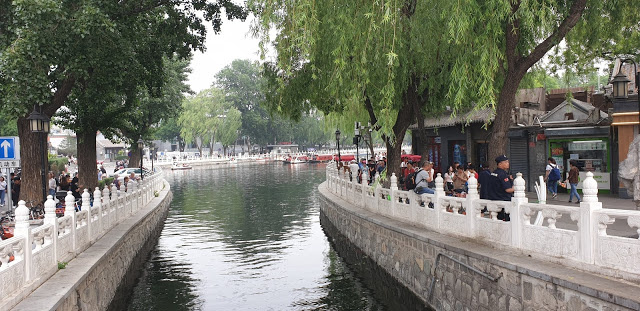
Many hutongs, some several hundred years old, in the vicinity of the Bell Tower and Drum Tower and Shichahai Lake are preserved and abound with tourists, many of which tour the quarter in pedicabs.
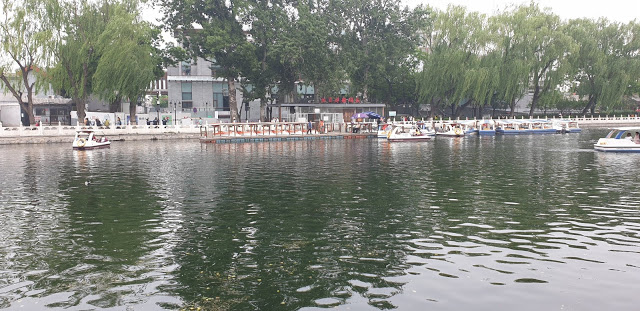
The optional tour also includes a visit to Shichahai, a historic scenic area consisting of three lakes (Qianhai, meaning Front Sea; Houhai, meaning Back Sea and Xihai, meaning West Sea), surrounding places of historic interest and scenic beauty and remnants of old-style local residences, Hutong and Courtyard.
First, we had a short walk through the more modern part of the Hutong area and given some free time for shopping, but we prefer just to meander by the canal.
There is a lake, and if we had the time, there were boats you could take.
With some time to spare, we take a quick walk down one of the alleyways where on the ground level are small shops, and above, living quarters.
Then we go to the bell and drum towers before walking through some more alleys was to where the rickshaws were waiting. The Bell tower
And the Drum tower. Both still working today.
The rickshaw ride took us through some more back streets where it was clear renovations were being made so that the area could apply for world heritage listing. Seeing inside some of the houses shows that they may look dumpy outside but that’s not the case inside.
The rickshaw ride ends outside the house where dinner will be served, and is a not so typical hose but does have all the elements of how the Chinese live, the boy’s room, the girl’s room, the parent’s room, the living area, and the North-south feng shui.
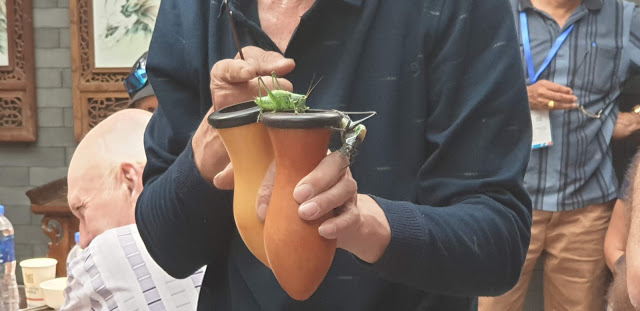
Shortly after we arrive, the cricket man, apparently someone quite famous in Beijing arrives and tells us all about crickets and then grasshoppers, then about cricket racing. He is animated and clearly enjoys entertaining us westerners.
I’m sorry but the cricket stuff just didn’t interest me. Or the grasshoppers.
As for dinner, it was finally a treat to eat what the typical Chinese family eats, and everything was delicious, and the endless beer was a nice touch.
And the last surprise, the food was cooked by a man.
It was the first time in almost a week that I made the short walk to the cafe alone. It was early, and the chill of the morning was still in the air. In summer, it was the best time of the day. When Susan came with me, it was usually much later, when the day was much warmer and less tolerable.
On the morning of the third day of her visit, Susan said she was missing the hustle and bustle of London, and by the end of the fourth she said, in not so many words, she was over being away from ‘civilisation’. This was a side of her I had not seen before, and it surprised me.
She hadn’t complained, but it was making her irritable. The Susan that morning was vastly different to the Susan on the first day. So much, I thought, for her wanting to ‘reconnect’, the word she had used as the reason for coming to Greve unannounced.
It was also the first morning I had time to reflect on her visit and what my feelings were towards her. It was the reason I’d come to Greve: to soak up the peace and quiet and think about what I was going to do with the rest of my life.
I sat in my usual corner. Maria, one of two waitresses, came out, stopped, and there was no mistaking the relief in her manner. There was an air of tension between Susan and Maria I didn’t understand, and it seemed to emanate from Susan rather than the other way around. I could understand her attitude if it was towards Alisha, but not Maria. All she did was serve coffee and cake.
When Maria recovered from the momentary surprise, she said, smiling, “You are by yourself?” She gave a quick glance in the direction of my villa, just to be sure.
“I am this morning. I’m afraid the heat, for one who is not used to it, can be quite debilitating. I’m also afraid it has had a bad effect on her manners, for which I apologise. I cannot explain why she has been so rude to you.”
“You do not have to apologise for her, David, but it is of no consequence to me. I have had a lot worse. I think she is simply jealous.”
It had crossed my mind, but there was no reason for her to be. “Why?”
“She is a woman, I am a woman, she thinks because you and I are friends, there is something between us.”
It made sense, even if it was not true. “Perhaps if I explained…”
Maria shook her head. “If there is a hole in the boat, you should not keep bailing but try to plug the hole. My grandfather had many expressions, David. If I may give you one piece of advice, as much as it is none of my business, you need to make your feelings known, and if they are not as they once were, and I think they are not, you need to tell her. Before she goes home.”
Interesting advice. Not only a purveyor of excellent coffee, but Maria was also a psychiatrist who had astutely worked out my dilemma. What was that expression, ‘not just a pretty face’?
“Is she leaving soon?” I asked, thinking Maria knew more about Susan’s movements than I did.
“You would disappoint me if you had not suspected as much. Susan was having coffee and talking to someone in her office on a cell phone. It was an intense conversation. I should not eavesdrop, but she said being here was like being stuck in hell. It is a pity she does not share your love for our little piece of paradise, is it not?”
“It is indeed. And you’re right. She said she didn’t have a phone, but I know she has one. She just doesn’t value the idea of getting away from the office. Perhaps her role doesn’t afford her that luxury.”
And perhaps Alisha was right about Maria, that I should be more careful. She had liked Maria the moment she saw her. We had sat at this very table, the first day I arrived. I would have travelled alone, but Prendergast, my old boss, liked to know where ex-employees of the Department were, and what they were doing.
She sighed. “I am glad I am just a waitress. Your usual coffee and cake?”
“Yes, please.”
Several months had passed since we had rescued Susan from her despotic father; she had recovered faster than we had thought, and settled into her role as the new Lady Featherington, though she preferred not to use that title, but go by the name of Lady Susan Cheney.
I didn’t get to be a Lord, or have any title, not that I was expecting one. What I had expected was that Susan, once she found her footing as head of what seemed to be a commercial empire, would not have time for details like husbands, particularly when our agreement made before the wedding gave either of us the right to end it.
There was a moment when I visited her recovering in the hospital, where I was going to give her the out, but I didn’t, and she had not invoked it. We were still married, just not living together.
This visit was one where she wanted to ‘reconnect’ as she called it, and invite me to come home with her. She saw no reason why we could not resume our relationship, conveniently forgetting she indirectly had me arrested for her murder, charges both her mother and Lucy vigorously pursued, and had the clone not returned to save me, I might still be in jail.
It was not something I would forgive or forget any time soon.
There were other reasons why I was reluctant to stay with her, like forgetting small details, an irregularity in her character I found odd. She looked the same, she sounded the same, she basically acted the same, but my mind was telling me something was not right. It was not the Susan I first met, even allowing for the ordeal she had been subjected to.
But, despite those misgivings, there was no question in my mind that I still loved her, and her clandestine arrival had brought back all those feelings. But as the days passed, I began to get the impression my feelings were one-sided and she was just going through the motions.
Which brought me to the last argument, earlier, where I said if I went with her, it would be business meetings, social obligations, and quite simply her ‘celebrity’ status that would keep us apart. I reminded her that I had said from the outset I didn’t like the idea of being in the spotlight, and when I reiterated it, she simply brushed it off as just part of the job, adding rather strangely that I always looked good in a suit. The flippancy of that comment was the last straw, and I left before I said something I would regret.
I knew I was not a priority. Maybe somewhere inside me, I had wanted to be a priority, and I was disappointed when I was not.
And finally, there was Alisha. Susan, at the height of the argument, had intimated she believed I had an affair with her, but that elephant was always in the room whenever Alisha was around. It was no surprise when I learned Susan had asked Prendergast to reassign her to other duties.
At least I knew what my feelings for Alisha were, and there were times when I had to remember she was persona non grata. Perhaps that was why Susan had her banished, but, again, a small detail; jealousy was not one of Susan’s traits when I first knew her.
Perhaps it was time to set Susan free.
When I swung around to look in the direction of the lane where my villa was, I saw Susan. She was formally dressed, not in her ‘tourist’ clothes, which she had bought from one of the local clothing stores. We had fun that day, shopping for clothes, a chore I’d always hated. It had been followed by a leisurely lunch, lots of wine and soul searching.
It was the reason why I sat in this corner; old habits die hard. I could see trouble coming from all directions, not that Susan was trouble or at least I hoped not, but it allowed me the time to watch her walking towards the cafe in what appeared to be short, angry steps; perhaps the culmination of the heat wave and our last argument.
She glared at me as she sat, dropping her bag beside her on the ground, where I could see the cell phone sitting on top. She followed my glance down, and then she looked unrepentant back at me.
Maria came back at the exact moment she was going to speak. I noticed Maria hesitate for a second when she saw Susan, then put her smile in place to deliver my coffee.
Neither spoke nor looked at each other. I said, “Susan will have what I’m having, thanks.”
Maria nodded and left.
“Now,” I said, leaning back in my seat, “I’m sure there’s a perfectly good explanation as to why you didn’t tell me about the phone, but that first time you disappeared, I’d guessed you needed to keep in touch with your business interests. I thought it somewhat unwisethat you should come out when the board of one of your companies was trying to remove you, because of what was it, an unexplained absence? All you had to do was tell me there were problems and you needed to remain at home to resolve them.”
My comment elicited a sideways look, with a touch of surprise.
“It was unfortunate timing on their behalf, and I didn’t want you to think everything else was more important than us. There were issues before I came, and I thought the people at home would be able to manage without me for at least a week, but I was wrong.”
“Why come at all. A phone call would have sufficed.”
“I had to see you, talk to you. At least we have had a chance to do that. I’m sorry about yesterday. I once told you I would not become my mother, but I’m afraid I sounded just like her. I misjudged just how much this role would affect me, and truly, I’m sorry.”
An apology was the last thing I expected.
“You have a lot of work to do catching up after being away, and of course, in replacing your mother and gaining the requisite respect as the new Lady Featherington. I think it would be for the best if I were not another distraction. We have plenty of time to reacquaint ourselves when you get past all these teething issues.”
“You’re not coming with me?” She sounded disappointed.
“I think it would be for the best if I didn’t.”
“Why?”
“It should come as no surprise to you that I’ve been keeping an eye on your progress. You are so much better doing your job without me. I told your mother once that when the time came I would not like the responsibilities of being your husband. Now that I have seen what it could possibly entail, I like it even less. You might also want to reconsider our arrangement, after all, we only had a marriage of convenience, and now that those obligations have been fulfilled, we both have the option of terminating it. I won’t make things difficult for you if that’s what you want.”
It was yet another anomaly, I thought; she should look distressed, and I would raise the matter of that arrangement. Perhaps she had forgotten the finer points. I, on the other hand, had always known we would not last forever. The perplexed expression, to me, was a sign she might have forgotten.
Then, her expression changed. “Is that what you want?”
“I wasn’t madly in love with you when we made that arrangement, so it was easy to agree to your terms, but inexplicably, since then, my feelings for you changed, and I would be sad if we parted ways. But the truth is, I can’t see how this is going to work.”
“In saying that, do you think I don’t care for you?”
That was exactly what I was thinking, but I wasn’t going to voice that opinion out loud. “You spent a lot of time finding new ways to make my life miserable, Susan. You and that wretched friend of yours, Lucy. While your attitude improved after we were married, that was because you were going to use me when you went to see your father, and then almost let me go to prison for your murder.”
“I had nothing to do with that, other than to leave, and I didn’t agree with Lucy that you should be made responsible for my disappearance. I cannot be held responsible for the actions of my mother. She hated you; Lucy didn’t understand you, and Millie told me I was stupid for not loving you in return, and she was right. Why do you think I gave you such a hard time? You made it impossible not to fall in love with you, and it nearly changed my mind about everything I’d been planning so meticulously. But perhaps there was a more subliminal reason why I did because after I left, I wanted to believe, if anything went wrong, you would come and find me.”
“How could you possibly know that I’d even consider doing something like that, given what you knew about me?”
“Prendergast made a passing comment when my mother asked him about you; he told us you were very good at finding people and even better at fixing problems.”
“And yet here we are, one argument away from ending it.”
I could see Maria hovering, waiting for the right moment to deliver her coffee, then go back and find Gianna, the café owner, instead. Gianna was more abrupt and, for that reason, was rarely seen serving the customers. Today, she was particularly cantankerous, banging the cake dish on the table and frowning at Susan before returning to her kitchen. Gianna didn’t like Susan either.
Behind me, I heard a car stop, and when she looked up, I knew it was for her. She had arrived with nothing, and she was leaving with nothing.
She stood. “Last chance.”
“Forever?”
She hesitated and then shook away the look of annoyance on her face. “Of course not. I wanted you to come back with me so we could continue working on our relationship. I agree there are problems, but it’s nothing we can’t resolve if we try.”
I had been trying. “It’s too soon for both of us, Susan. I need to be able to trust you, and given the circumstances, and all that water under the bridge, I’m not sure if I can yet.”
She frowned at me. “As you wish.” She took an envelope out of her bag and put it on the table. “When you are ready, it’s an open ticket home. Please make it sooner rather than later. Despite what you think of me, I have missed you, and I have no intention of ending it between us.”
That said, she glared at me for a minute, shook her head, then walked to the car. I watched her get in and the car drive slowly away.