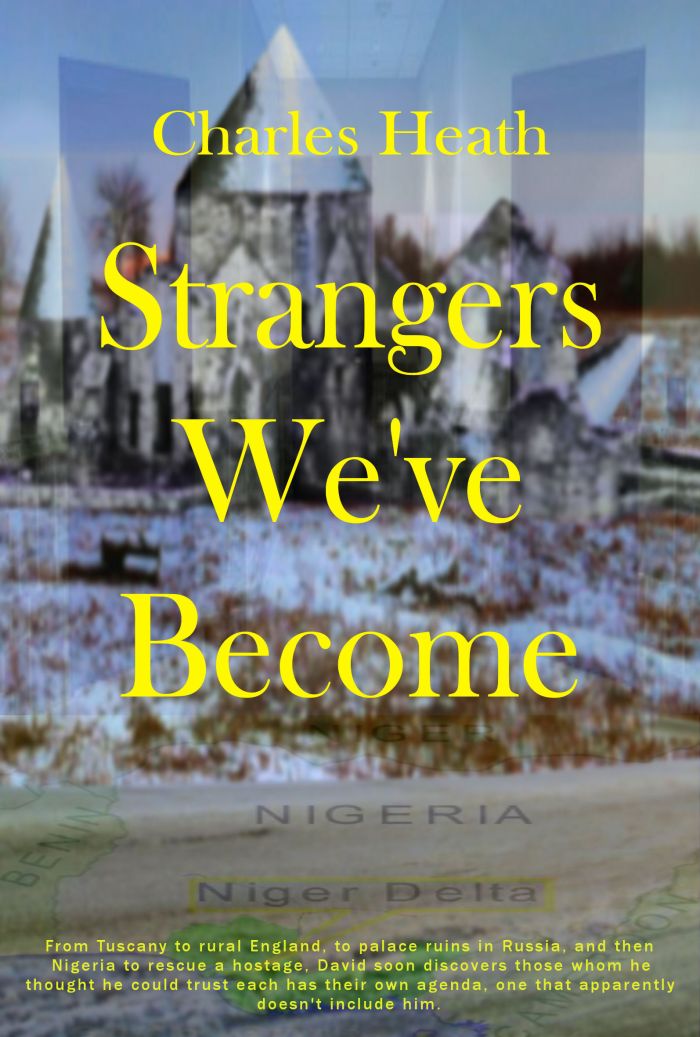
An excerpt from “Strangers We’ve Become” – Coming Soon

I wandered back to my villa.

It was in darkness.  I was sure I had left several lights on, especially over the door so I could see to unlock it.

I looked up and saw the globe was broken.

Instant alert.

I went to the first hiding spot for the gun, and it wasn’t there.  I went to the backup and it wasn’t there either.  Someone had found my carefully hidden stash of weapons and removed them.

Who?

There were four hiding spots and all were empty.  Someone had removed the weapons.  That could only mean one possibility.

I had a visitor, not necessarily here for a social call.

But, of course, being the well-trained agent I’d once been and not one to be caught unawares, I crossed over to my neighbor and relieved him of a weapon that, if found, would require a lot of explaining.

Suitably armed, it was time to return the surprise.

There were three entrances to the villa, the front door, the back door, and a rather strange escape hatch.  One of the more interesting attractions of the villa I’d rented was its heritage.  It was built in the late 1700s, by a man who was, by all accounts, a thief.  It had a hidden underground room which had been in the past a vault but was now a wine cellar, and it had an escape hatch by which the man could come and go undetected, particularly if there was a mob outside the door baying for his blood.

It now gave me the means to enter the villa without my visitors being alerted, unless, of course, they were near the vicinity of the doorway inside the villa, but that possibility was unlikely.  It was not where anyone could anticipate or expect a doorway to be.

The secret entrance was at the rear of the villa behind a large copse, two camouflaged wooden doors built into the ground.  I move aside some of the branches that covered them and lifted one side.  After I’d discovered the doors and rusty hinges, I’d oiled and cleaned them, and cleared the passageway of cobwebs and fallen rocks.  It had a mildew smell, but nothing would get rid of that.  I’d left torches at either end so I could see.

I closed the door after me, and went quietly down the steps, enveloped in darkness till I switched on the torch.  I traversed the short passage which turned ninety degrees about halfway to the door at the other end.  I carried the key to this door on the keyring, found it and opened the door.  It too had been oiled and swung open soundlessly.

I stepped in the darkness and closed the door.

I was on the lower level under the kitchen, now the wine cellar, the ‘door’ doubling as a set of shelves which had very little on them, less to fall and alert anyone in the villa.

Silence, an eerie silence.

I took the steps up to the kitchen, stopping when my head was level with the floor, checking to see if anyone was waiting.  There wasn’t.  It seemed to me to be an unlikely spot for an ambush.

I’d already considered the possibility of someone coming after me, especially because it had been Bespalov I’d killed, and I was sure he had friends, all equally as mad as he was.  Equally, I’d also considered it nigh on impossible for anyone to find out it was me who killed him because the only people who knew that were Prendergast, Alisha, a few others in the Department, and Susan.

That raised the question of who told them where I was.

If I was the man I used to be, my first suspect would be Susan.  The departure this morning, and now this was too coincidental.  But I was not that man.

Or was I?

I reached the start of the passageway that led from the kitchen to the front door and peered into the semi-darkness.  My eyes had got used to the dark, and it was no longer an inky void.  Fragments of light leaked in around the door from outside and through the edge of the window curtains where they didn’t fit properly.  A bone of contention upstairs in the morning, when first light shone and invariably woke me up hours before I wanted to.

Still nothing.

I took a moment to consider how I would approach the visitor’s job.  I would get a plan of the villa in my head, all entrances, where a target could be led to or attacked where there would be no escape.

Coming in the front door.  If I was not expecting anything, I’d just open the door and walk-in.  One shot would be all that was required.

Contract complete.

I sidled quietly up the passage staying close to the wall, edging closer to the front door.  There was an alcove where the shooter could be waiting.  It was an ideal spot to wait.

Crunch.

I stepped on some nutshells.

Not my nutshells.

I felt it before I heard it.  The bullet with my name on it.

And how the shooter missed, from point-blank range, and hit me in the arm, I had no idea.  I fired off two shots before a second shot from the shooter went wide and hit the door with a loud thwack.

I saw a red dot wavering as it honed in on me and I fell to the floor, stretching out, looking up where the origin of the light was coming and pulled the trigger three times, evenly spaced, and a second later I heard the sound of a body falling down the stairs and stopping at the bottom, not very far from me.

Two assassins.

I’d not expected that.

The assassin by the door was dead, a lucky shot on my part.  The second was still breathing.

I checked the body for any weapons and found a second gun and two knives.  Armed to the teeth!

I pulled off the balaclava; a man, early thirties, definitely Italian.  I was expecting a Russian.

I slapped his face, waking him up.  Blood was leaking from several slashes on his face when his head had hit the stairs on the way down.  The awkward angle of his arms and legs told me there were broken bones, probably a lot worse internally.  He was not long for this earth.

“Who employed you?”

He looked at me with dead eyes, a pursed mouth, perhaps a smile.  “Not today my friend.  You have made a very bad enemy.”  He coughed and blood poured out of his mouth.  “There will be more …”

Friends of Bespalov, no doubt.

I would have to leave.  Two unexplainable bodies, I’d have a hard time explaining my way out of this mess.  I dragged the two bodies into the lounge, clearing the passageway just in case someone had heard anything.

Just in case anyone was outside at the time, I sat in the dark, at the foot of the stairs, and tried to breathe normally.  I was trying not to connect dots that led back to Susan, but the coincidence was worrying me.

A half-hour passed and I hadn’t moved.  Deep in thought, I’d forgotten about being shot, unaware that blood was running down my arm and dripping onto the floor.

Until I heard a knock on my front door.

Two thoughts, it was either the police, alerted by the neighbors, or it was the second wave, though why would they be knocking on the door?

I stood, and immediately felt a stabbing pain in my arm.  I took out a handkerchief and turned it into a makeshift tourniquet, then wrapped a kitchen towel around the wound.

If it was the police, this was going to be a difficult situation.  Holding the gun behind my back, I opened the door a fraction and looked out.

No police, just Maria.  I hoped she was not part of the next ‘wave’.

“You left your phone behind on the table.  I thought you might be looking for it.”  She held it out in front of her.

When I didn’t open the door any further, she looked at me quizzically, and then asked, “Is anything wrong?”

I was going to thank her for returning the phone, but I heard her breathe in sharply, and add, breathlessly, “You’re bleeding.”

I looked at my arm and realized it was visible through the door, and not only that, the towel was soaked in blood.

“You need to go away now.”

Should I tell her the truth?  It was probably too late, and if she was any sort of law-abiding citizen she would go straight to the police.

She showed no signs of leaving, just an unnerving curiosity.  “What happened?”

I ran through several explanations, but none seemed plausible.  I went with the truth.  “My past caught up with me.”

“You need someone to fix that before you pass out from blood loss.  It doesn’t look good.”

“I can fix it.  You need to leave.  It is not safe to be here with me.”

The pain in my arm was not getting any better, and the blood was starting to run down my arm again as the tourniquet loosened.  She was right, I needed it fixed sooner rather than later.

I opened the door and let her in.  It was a mistake, a huge mistake, and I would have to deal with the consequences.  Once inside, she turned on the light and saw the pool of blood just inside the door and the trail leading to the lounge.  She followed the trail and turned into the lounge, turned on the light, and no doubt saw the two dead men.

I expected her to scream.  She didn’t.

She gave me a good hard look, perhaps trying to see if I was dangerous.  Killing people wasn’t something you looked the other way about.  She would have to go to the police.

“What happened here?”

“I came home from the cafe and two men were waiting for me.  I used to work for the Government, but no longer.  I suspect these men were here to repay a debt.  I was lucky.”

“Not so much, looking at your arm.”

She came closer and inspected it.

“Sit down.”

She found another towel and wrapped it around the wound, retightening the tourniquet to stem the bleeding.

“Do you have medical supplies?”

I nodded.  “Upstairs.”  I had a medical kit, and on the road, I usually made my own running repairs.  Another old habit I hadn’t quite shaken off yet.

She went upstairs, rummaged, and then came back.  I wondered briefly what she would think of the unmade bed though I was not sure why it might interest her.

She helped me remove my shirt, and then cleaned the wound.  Fortunately, she didn’t have to remove a bullet.  It was a clean wound but it would require stitches.

When she’d finished she said, “Your friend said one day this might happen.”

No prizes for guessing who that friend was, and it didn’t please me that she had involved Maria.

“Alisha?”

“She didn’t tell me her name, but I think she cares a lot about you.  She said trouble has a way of finding you, gave me a phone and said to call her if something like this happened.”

“That was wrong of her to do that.”

“Perhaps, perhaps not.  Will you call her?”

“Yes.  I can’t stay here now.  You should go now.  Hopefully, by the time I leave in the morning, no one will ever know what happened here, especially you.”

She smiled.  “As you say, I was never here.”

© Charles Heath 2018-2022

strangerscover9

365 Days of writing, 2026 – 55

Day 55 – Writing exercise

You make a surprise visit home after a five-year absence…

I was not one of the popular kids at school.  I kept to myself, I put my head down, studied hard, and towards the end, balanced school with chores on the farm and a part-time job at the local hardware store.

There were no special friends, not the sort my sister had, what they called the sisterhood, who hung out together, went to parties, had boyfriends and the angst that went with it.

The boys at my school, to me, were horrible, a mixture of tough and tumble, to borderline bullies.  It didn’t help that their fathers were mostly self-made men who had to fight for everything.

It was almost an ethos.

I went away with the intention of getting a university degree and stayed with my grandmother, on my mother’s side, a gentle soul who could be both acerbic and sweet at the same time.  She taught me a few valuable lessons in living your life in your own way, which she had learned over many years.

I think she had more enemies than friends, but one thing she did have was respect.  Having a vast fortune helped.

After nursing her through the most recent heart attack, forsaking studies to ensure she was looked after, I decided I would return home.  It had been nearly five years, and I had changed considerably.

She insisted that I could not stay away forever, and she was probably right.  My parents were getting older, and my two brothers were less inclined to work on the farm but preferred to waste their time with the rest of the lazy offspring.

It kept the sheriff and his deputies busy, and made entertaining emails from my sister, whose reports were more likely the local paper’s crime watch column. 

So, having not achieved any of my planned objectives, it seemed the best I could hope for was to go home, ingratiate myself with my father and pretend I wanted to inherit the farm as any eldest son and heir should.

..

I had been on planes before, only larger.  We lived in a small town in the middle of ranch territory, and some days it used to feel like we’re were back in the frontier days, cattle as far as the eye could see, rolling hills and backdrop mountains, grass in summer and snow in winter.

It was the beginning of winter, and snow was coming.  Out on the range, there would be a cold wind, one that cut through everything and chilled you to the bone.

I was sure the moment I got home, there would be no time to speak of many things, just change, get your horse and join the others and round up the cattle for the oncoming winter.

Running a ranch never stopped.

The question to consider as we were hurtling through the sky was, did I want to take the reins of running the place or do something else, somewhere else?  After all, I was not the only one who left after graduating high school, and like me, also chose to go to college or university, just in case.

Of what, I wasn’t sure, but as time progressed, being on the land had become a precarious life, and not the romantic, wealth-generating life it once was.  We were not among the wealthier ranchers; whatever fortune we had slowly frittered away keeping the ranch going.  We weren’t poor, but it could only last so long before the inevitable.

This would be the second time, and Daisy had painted a rather grim picture.  My first visit had been hostile, the question of responsibility being thrown around, and I’d refused to accept it.  I said I needed to see the outside world first, and neither of my parents, brothers, nor sister could understand why I would want to.

What was there elsewhere that wasn’t in God’s own country?

After five years, I was inclined to agree with them. 

But I was never quite sure what the others of my generation and situation thought.  In the beginning, we all met up at a Cafe to discuss the differences.  We all intended to go home during the holidays.  Some did, others did not. 

Over time, some found partners, some of whom knew only of city life, and were taken back to meet the family with predictable results.  Others found jobs and made a new life, turning their backs on tradition and family.  Very few returned other than to visit, with very mixed results.

Daisy was across it all, the unofficial custodian of the high school alumni, responsible for reunions and other events involving past students.  She knew where everyone was, or at least those who wanted to be found.  That list, she said, was getting smaller.

The way she painted it this time, I was going home to a ghost town, with the tumble weeds being blown up Main Street, passing from one prairie to the next.

My only thought as I slumped into the seat, just a fraction too small for the frame I’d acquired from my father’s side, was whether or not I believed I had failed. I  didn’t care what anyone else thought.

Not then.

I remembered to get my cell phone out of my carry-on bag and rearranged it around the other bags, some carelessly tossed in.  I had booked the aisle seat, making it easier to get in and out.  The window seat was a smaller space with no manoeuvrability.

It would be taken, and the longer they took to board told me it would be an entitled frequent flyer.  Been there and seen that a few times.

Then, as the flow trickled out and the hostesses started moving through the cabin, closing overhead bin doors, I was beginning to hope that there wasn’t anyone.  The fact that the plane was fully booked suggested that the passenger was a no-show.

Or…

It was a crazy girl overloaded with bags and presents profusely apologising for being late, and, yes, she was sitting next to me.

Damn.

I stepped out of the seat to make it easier for her to get in, and watched her check her boarding pass and then the seat numbers, which to me was ridiculous.  There was only one seat left.

Then she stopped right in front of me.  About a foot shorter, a lopsided grin, and I immediately went back six years to the first moment I ran into the human whirlwind, Josephine Debois.

“Josephine?”

She stopped, the grin going to surprise, then back again to that very expression she had the first time she saw me.

“Andy Ripponsburg.  If I live and breathe!”

The hostess had just seen the Captain glancing out the door that kept the passengers out, and wasn’t out of curiosity.  The door closed, and we were about to leave.

“Best keep the reunion until you’re seated and we’re underway.”

She opened the overhead bin, and everything disappeared into whatever spare space there was. The girl hustled into her seat and buckled her seatbelt up. I got into my seat, and the inspection was done.

Just as I fastened the seatbelt, the plane jolted suddenly, and then it was pushing back from the gate.

Josephine was getting settled.  I had so many thoughts running through my head that it almost hurt.  Where did I begin?  Josephine, the girl who had stolen my heart and then smashed into a million pieces.  Perhaps it was that more than anything else that persuaded me to leave home and vow never to return.

What a shock to learn she had also come to the big city, my big city.

We ran through the safety procedures, the tractor disengaged, and the engines started up, settling into a steady roar.  A minute later, we were heading to the top of the runway.

Two hours and twenty-five minutes.

I didn’t know whether to be nice, stand offish, angry, or just put on my headphones and totally ignore her.  And damn her, she had set my heart racing just by seeing her.  She had that effect.  She always had that effect, and probably always would.

Now settled, she stared out the window.  Perhaps she had finally remembered what had happened and how it destroyed us.  I had thought she was like me, not part of the groups that made life hell for everyone who wasn’t.

Until she and her friends played their prank, and left me embarrassed and humiliated, just the result the mean girls wanted.

I would never, ever forget it.

I intended to ignore her, closing mt eyes and relaxing.  Not that being next to her was knowing she was there was going to make it easy.

And…

In those first few seconds as the plane left the ground, followed by the clunk of the retracting wheels, she had put her hand in mine and held it very tightly for reassurance, her expression one of total fear.

She let go when the plane levelled out.

I glanced sideways, and she was looking at me, a look I was very familiar with, and one I mistook for something else.

“I’m sorry.  Very, very, very sorry for what happened.  I didn’t know what they were doing until it was too late.  I rang your sister, but it was too late.  For everything.”

“Does it matter now?  What happened happened, and I should have expected it.  I was a gullible fool back then, but then what boy that age wrapped up in his first romantic relationship isn’t?”

I’d said as much to Daisy at the time.  She tried to tell me that it wasn’t all as it seemed, but I was too angry and too heartbroken to listen.

“Perhaps it doesn’t matter, as you say.  It’s nice to see you again, Andy.  Perhaps we will run into each other back home.  I would prefer to be friends, if that’s possible.”

I didn’t answer. Right then, I was still too wrapped up in the hurt it caused, and it dismayed me that it could so easily return, after all the effort of putting it behind me.

Ordinarily, when stuck next to someone you wish you weren’t, the flight took ten times longer. This one didn’t. She did not force any conversation, and thus we probably spoke briefly on three occasions.

I buried myself in a paperback book I’d picked up at the airport, and she just pretended to sleep.

After landing, she gathered together her belongings and left the plane. I preferred to wait until the hoards had fought their way off, everyone always in a hurry, and then took my time. I was the last passenger to leave the plane. By that time, the pilot had come out of the cockpit, and I thanked him for the smooth flight.

Daisy would be waiting for me, or at least I hoped she was, as I crossed the tarmac and switched my cell phone from aeroplane mode. As I reached the door into the terminal, there were two beeps, two messages. One from a co-worker wishing me a pleasant break, the other from Daisy saying she was inside, waiting.

When I scanned those who were waiting. I saw Josephine leaving with her mother, not looking back, and then Daisy, sitting in the departure lounge, reading a magazine. I travelled light and would not have to wait for the baggage to be unloaded.

She stood as I came up to her and gave me a hug. It was not the sort of hug you would get after a four-year absence.

“I saw Jo. Did you know…”

“Yes. I was sitting next to her.”

“Wow. That must have been some conversation.”

“Actually, it wasn’t. We probably exchanged a dozen sentences, and that was it. There was nothing to discuss.”

She gave me a look that told me that I had been a thorough bastard, and not for the first time.

“She told me what happened, Andy, and it wasn’t entirely her fault. You know what those girls were like. She just wanted to fit in, and they took advantage of it.”

“It’s done, and there’s no going back, Daisy. She will have moved on, as have I.”

Perhaps it was the way I said it, and I realised it would have been better to remain silent, but I didn’t.

“So, you still have feelings for her.”

“No.”

“Liar.”

It was an hour’s drive to the ranch, time enough to give me the Daisy version of everything that was happening. It was more direct than her weekly letters, at first, and then infrequent emails. Quite simply put, our father had lost any faith he had in his two younger sons, in taking over the management of the ranch, or in being reliable enough to be self-motivated in doing their chores. They would only do the jobs asked of them, but both shied away from accepting any responsibility.

Our father needed to know that someone was going to continue the legacy the family had built up over the last hundred years, and knowing there wasn’t going to be anyone meant he had to seek other solutions. He had finally accepted that he could not continue, so she said I needed to be prepared to accept that there will be hard choices to be made.

One of those included selling out. A reasonable offer had been made, and he was thinking about it.

I had never given a moment’s thought to the fact that there might not be a ranch to come home to one day, or that one day could be as soon as tomorrow.

It was a sobering thought.

The fact that he was getting older, the years of strenuous work, coupled with the stress of management, had all but broken him; he had to hire a manager and several extra staff, and in doing so, it had made the business side of things almost unviable.

Then there was the situation with our mother, who was not getting any younger either, and had suffered several falls that required hospitalisation, and then weeks of bed rest.

Daisy had chosen not to tell me about it in any of her communications in the past, but that, she said, was their decision. They had managed without me, meaning my presence would not make a difference, and I was expecting that I would be met with the same hostility as I had the last time I came home.

Or maybe it would be just indifference.

As we drove through the front gate, I asked, “Do they even know I’m coming home?”

I had told her, and thought she would pass it on. Now, judging from the expression on her face, I don’t think she had. My arrival was going to be like a hand grenade going off in a confined space.

Mother was sitting in a rocking chair on the front veranda when the truck pulled up at the bottom of the steps. I had seen her as we drove up, and she had aged visibly since I last saw her. She stood up and took a cane in her hand to steady herself.

I got out and stood by the door, looking up. The surprise, or perhaps shock, was clear. She had not known I was coming.

Perhaps it was better this way.

She waited until I walked up the stairs and then hugged me. Longer than I expected.

“It is good to see you, Andrew. I have been hoping you would come back, even if it was for a week or two. We all miss you terribly.”

It might not have been the consensus of opinions in that house, but for her, it was sincere and heartfelt.

She tepped back and looked me up and down.

“You are your father’s son, as I knew you would be. Your room has not changed, as much as those useless brothers of yours have tried. We could have arranged a proper homecoming if your sister had told us you were coming.”

“It’s better this way. It saves Dad from being angry for days in advance, and he can just explode when he sees me.”

I could imagine the look on his face, and Daisy was right not to tell them.

“Your father will be pleased to see you, Andrew. He has come to terms with your decision to leave, but like me, I know he wishes you would eventually return before it’s too late. If your sister hasn’t already told you, it might already be too late. We have received an offer, one that is too good to refuse. Matters for another time. Let’s go in, and I’ll get Martha to make some tea. I’m sure she will have some scones somewhere, and I’ll bet you have not been able to find any as good as hers, anywhere.”

“I have not.”

“Oh, and by the way, the offer was made by Josephine’s father, you know, the young lady you were involved with at school. Such a nice girl. They are coming here tonight to discuss the deal. Now you’re here, you might be interested.”

©  Charles Heath  2026

Another excerpt from ‘Betrayal’; a work in progress

My next destination in the quest was the hotel we believed Anne Merriweather had stayed at.

I was, in a sense, flying blind because we had no concrete evidence she had been there, and the message she had left behind didn’t quite name the hotel or where Vladimir was going to take her.

Mindful of the fact that someone might have been following me, I checked to see if the person I’d assumed had followed me to Elizabeth’s apartment was still in place, but I couldn’t see him. Next, I made a mental note of seven different candidates and committed them to memory.

Then I set off to the hotel, hailing a taxi. There was the possibility the cab driver was one of them, but perhaps I was slightly more paranoid than I should be. I’d been watching the queue, and there were two others before me.

The journey took about an hour, during which time I kept an eye out the back to see if anyone had been following us. If anyone was, I couldn’t see them.

I had the cab drop me off a block from the hotel and then spent the next hour doing a complete circuit of the block the hotel was on, checking the front and rear entrances, the cameras in place, and the siting of the driveway into the underground carpark. There was a camera over the entrance, and one we hadn’t checked for footage. I sent a text message to Fritz to look into it.

The hotel lobby was large and busy, which was exactly what you’d want if you wanted to come and go without standing out. It would be different later at night, but I could see her arriving about mid-afternoon, and anonymous among the type of clientele the hotel attracted.

I spent an hour sitting in various positions in the lobby simply observing. I had already ascertained where the elevator lobby for the rooms was, and the elevator down to the car park. Fortunately, it was not ‘guarded’ but there was a steady stream of concierge staff coming and going to the lower levels, and, just from time to time, guests.

Then, when there was a commotion at the front door, what seemed to be a collision of guests and free-wheeling bags, I saw one of the seven potential taggers sitting by the front door. Waiting for me to leave? Or were they wondering why I was spending so much time there?

Taking advantage of that confusion, I picked my moment to head for the elevators that went down to the car park, pressed the down button, and waited.

The was no car on the ground level, so I had to wait, watching, like several others, the guests untangling themselves at the entrance, and an eye on my potential surveillance, still absorbed in the confusion.

The doors to the left car opened, and a concierge stepped out, gave me a quick look, then headed back to his desk. I stepped into the car, pressed the first level down, the level I expected cars to arrive on, and waited what seemed like a long time for the doors to close.

As they did, I was expecting to see a hand poke through the gap, a latecomer. Nothing happened, and I put it down to a television moment.

There were three basement levels, and for a moment, I let my imagination run wild and considered the possibility that there were more levels. Of course, there was no indication on the control panel that there were any other floors, and I’d yet to see anything like it in reality.

With a shake of my head to return to reality, the car arrived, the doors opened, and I stepped out.

A car pulled up, and the driver stepped out, went around to the rear of his car, and pulled out a case. I half expected him to throw me the keys, but the instant glance he gave me told him was not the concierge, and instead brushed past me like I wasn’t there.

He bashed the up button several times impatiently and cursed when the doors didn’t open immediately. Not a happy man.

Another car drove past on its way down to a lower level.

I looked up and saw the CCTV camera, pointing towards the entrance, visible in the distance. A gate that lifted up was just about back in position and then made a clunk when it finally closed. The footage from the camera would not prove much, even if it had been working, because it didn’t cover the life lobby, only in the direction of the car entrance.

The doors to the other elevator car opened, and a man in a suit stepped out.

“Can I help you, sir? You seem lost.”

Security, or something else. “It seems that way. I went to the elevator lobby, got in, and it went down rather than up. I must have been in the wrong place.”

“Lost it is, then, sir.” I could hear the contempt for Americans in his tone. “If you will accompany me, please.”

He put out a hand ready to guide me back into the elevator. I was only too happy to oblige him. There had been a sign near the button panel that said the basement levels were only to be accessed by the guests.

Once inside, he turned a key and pressed the lobby button. The doors closed, and we went up. He stood, facing the door, not speaking. A few seconds later, he was ushering me out to the lobby.

“Now, sir, if you are a guest…”

“Actually, I’m looking for one. She called me and said she would be staying in this hotel and to come down and visit her. I was trying to get to the sixth floor.”

“Good. Let’s go over the the desk and see what we can do for you.”

I followed him over to the reception desk, where he signalled one of the clerks, a young woman who looked and acted very efficiently, and told her of my request, but then remained to oversee the proceeding.

“Name of guest, sir?”

“Merriweather, Anne. I’m her brother, Alexander.” I reached into my coat pocket and pulled out my passport to prove that I was who I said I was. She glanced cursorily at it.

She typed the name into the computer, and then we waited a few seconds while it considered what to output. Then, she said, “That lady is not in the hotel, sir.”

Time to put on my best-confused look. “But she said she would be staying here for the week. I made a special trip to come here to see her.”

Another puzzled look from the clerk, then, “When did she call you?”

An interesting question to ask, and it set off a warning bell in my head. I couldn’t say today, it would have to be the day she was supposedly taken.

“Last Saturday, about four in the afternoon.”

Another look at the screen, then, “It appears she checked out Sunday morning. I’m afraid you have made a trip in vain.”

Indeed, I had. “Was she staying with anyone?”

I just managed to see the warning pass from the suited man to the clerk. I thought he had shown an interest when I mentioned the name, and now I had confirmation. He knew something about her disappearance. The trouble was, he wasn’t going to volunteer any information because he was more than just hotel security.

“No.”

“Odd,” I muttered. “I thought she told me she was staying with a man named Vladimir something or other. I’m not too good at pronouncing those Russian names. Are you sure?”

She didn’t look back at the screen. “Yes.”

“OK, now one thing I do know about staying in hotels is that you are required to ask guests with foreign passports their next destination, just in case they need to be found. Did she say where she was going next?” It was a long shot, but I thought I’d ask.

“Moscow. As I understand it, she lives in Moscow. That was the only address she gave us.”

I smiled. “Thank you. I know where that is. I probably should have gone there first.”

She didn’t answer; she didn’t have to, her expression did that perfectly.

The suited man spoke again, looking at the clerk. “Thank you.” He swivelled back to me. “I’m sorry we can’t help you.”

“No. You have more than you can know.”

“What was your name again, sir, just in case you still cannot find her?”

“Alexander Merriweather. Her brother. And if she is still missing, I will be posting a very large reward. At the moment, you can best contact me via the American Embassy.”

Money is always a great motivator, and that thoughtful expression on his face suggested he gave a moment’s thought to it.

I left him with that offer and left. If anything, the people who were holding her would know she had a brother, that her brother was looking for her, and equally that brother had money.

© Charles Heath – 2018-2025

In a word: Spark

So, as far as I’m concerned the word ‘spark’ is something that is created by a fire, and can create havoc.

But…

Another meaning is that a ‘spark’ is created by a ‘spark plug’ in order to force the pistons of an engine to drive the crankshaft

This leads to…

There is no spark in this relationship, so perhaps it’s going nowhere.  No, we’re not looking for a fiery spark, but a small amount of very intense feeling

Spark?

I was watching God Friended Me last night and I’m sure like many others we were waiting to see that spark that would change their relationship from the friend zone, to something else.

And…

I think it was there.  Of course, we’ll have to wait till next week to find out.

As for the word spark, well there several different meanings, one of which I am familiar with when I was young.

Being called a ‘bright spark’

Depending on who used that remark, it could either mean you were clever or you were a smart ass, which I suspect was the reference to me.

Then, moving on

Saying something inflammatory ‘sparked’ the crowd into action.  A single remark can be equated to a literal ‘spark’ that can ignite a reaction.

A lynching perhaps?

And what about, once upon a time, a ship’s radio officer, he was called ‘sparks’ or ‘sparkie’, also a name that sometimes refers to an electrician.

I can see plenty of uses for this word in a story.

“Sunday in New York”, a romantic adventure that’s not a walk in the park!

“Sunday in New York” is ultimately a story about trust, and what happens when a marriage is stretched to its limits.

When Harry Steele attends a lunch with his manager, Barclay, to discuss a promotion that any junior executive would accept in a heartbeat, it is the fact his wife, Alison, who previously professed her reservations about Barclay, also agreed to attend, that casts a small element of doubt in his mind.

From that moment, his life, in the company, in deciding what to do, his marriage, his very life, spirals out of control.

There is no one big factor that can prove Harry’s worst fears, that his marriage is over, just a number of small, interconnecting events, when piled on top of each other, points to a cataclysmic end to everything he had believed in.

Trust is lost firstly in his best friend and mentor, Andy, who only hints of impending disaster, Sasha, a woman whom he saved, and who appears to have motives of her own, and then in his wife, Alison, as he discovered piece by piece damning evidence she is about to leave him for another man.

Can we trust what we see with our eyes or trust what we hear?

Haven’t we all jumped to conclusions at least once in our lives?

Can Alison, a woman whose self-belief and confidence is about to be put to the ultimate test, find a way of proving their relationship is as strong as it has ever been?

As they say in the classics, read on!

Purchase:

http://tinyurl.com/Amazon-SundayInNewYork

The cinema of my dreams – Was it just another surveillance job – Episode 59

This story is now on the list to be finished so over the new few weeks, expect a new episode every few days.

The reason why new episodes have been sporadic, there are also other stories to write, and I’m not very good at prioritizing.

But, here we are, a few minutes opened up and it didn’t take long to get back into the groove.

Things are about to get complicated…


With Jan safely in custody, probably for about 15 minutes when Dobbin discovered she was in police hands, Jennifer and I were free to chase up O’Connell and maybe we would also find Anna.

It was a long shot at best.

But we had to find out more about Anna Jacovich.  For that, we would have to go back to the office and talk to Joanne.  I told Jennifer what I intended to do and dropped her at the safe house for some much-needed rest before we went after O’Connell.

Then, back in the car, I called the number I had for Joanne.

“Sam.”

“Memorised my number?”

“I like to know who’s calling before I answer.”

“Then this isn’t a restricted line?”

“Restricted enough.”

“I found your little toy?”

Did I hear a sigh? 

“You know the world we live in Sam, trust no one not even your mother.  Hard for me to trust or not trust her, she passed away when I was seven.  Monica said you were good.  What can I do for you?”

“A full workup on Anna Jacovich.  I’m coming into the office now, and will be there in about half an hour.”

“No pressure then?”

“Not at all.”

“Try not to irritate security this time.”

I’m sure I saw a grim expression on the face of the soldier that had been there the last time I tried to run the gauntlet, and then disappointment when my card worked.  I signed in and put the name of the department I was visiting down as Research.

When he asked for a name, I gave him Joanne’s.  No doubt he would call her long before I got to her.

She met me at the second level of defence and then took me to a room where two folders sat at opposite ends of a table, two desk lamps shining light down on them.  The rest of the room was in darkness.

When she shut the door, I said, “Please tell me there in;t a firing squad in black camouflage just waiting to shoot me.”

She smiled.  “If it was more sensitive information, I’d let you read it, then have you shot.  Not today.

That was a relief.  Oddly, I believed that she would if the circumstances warranted it.  Joanne was scary, nor scary than Jan.  It’s the quiet ones you had to worry about.”

We sat.

“Read. Then I’ll answer questions.”

For the ten minutes, it took me to discover that Anna was a biochemist herself, and had worked in a not-so-secret government laboratory that had been unmasked with disastrous results, adding another dimension to the problem.  I was beginning to think she might be the one who created the monster and had set her husband up to take the blame.

If that was the case, she was never going to pass it on to O’Connell or sell it to him, other than to take the money and run.  If that was the case, Severin knew it was her all along, and how dangerous she was.

But and there was a big but in all of this.  She needed an accomplice to get to England, which was O’Connell.  Now he was no longer needed…

Yes, she would also need both Severin and Maury off her tail, and that had been taken care of.

Jan?  Unless I completely misread her, it was not possible she could be the accomplice; she was doing what Dobbin requested.  Or had she?  Dobbin did say she was able to make executive decisions on the fly.

“The threat isn’t O’Connell.  He’s just a pawn.”

“Not just a pretty face then?”

“I never regard my face as pretty.”

She shook her head.  “It’s Anna.  She played Severin and Maury, she played Dobbin, and she played Dobbin’s little toy soldier, O’Connell.  Or Quigley I believe his real name is.  I hesitate to say O’Connell played you.”

“Call a dog a dog, Joanne.  If I had more experience and more information I might have seen that.  You can’t keep people in the dark, and then expect miracles.”

“I’m the messenger, Sam.”

“I’ve been known to shoot messengers, just because I can.”

“Save your bullets for the bad guys.”

“How do I know you and Monica are not the bad guys?”

Another shake of the head.  “OK.  You’ve passed the scepticism test, Sam.  Now put it away.  We have to work together on this.  It’s a condition for continuing to work on the case.”

“And if I don’t?”

“I don’t need to answer that.  But, I get it.  You’re a self-starter and will keep at it, with or without us.  I can see why people like you.  To me, your just another dangerous amateur.”

There were words I could say, but judging by the reek of self-aggrandisement, it would not penetrate the thick hide.

I smiled.  “Not noted for your charm then.”

“No.  Where is Jan?”

“Who?”

“Don’t play games, Sam.  They don’t become you.  You went to see Severin, but he ended up dead, and she shot him.  Why?”

“You read this file?”  I picked it up and dropped it on the table.

She was the sort that read the first page, the preamble, and the last page, the result or desired result.

“I did.”

“Then you know why, as for Jan, if you know I was there when Severin was shot, you’d know where Jan is.”

“She disappeared into the trees.  And no doubt in the wind.  You should know she’s a trained MI5 assassin on loan to Dobbin.”

Who was now in jail somewhere pending the Detective Inspectors leisure, unless she filed a report.  If she did, she would be out now, and looking for O’Connell and Anna.

“Then how should I know?”

She shrugged.  “I thought I’d ask.  I’m not sure I like having to peel away the layers of this story one by one.”

“Be more forthcoming.”  I stood.  I had what I needed.  “If that’s all, I’ll go on with the job.”

“O’Connell?”

“He’s probably dead by now, but I have to find him, one way or another.”

“Keep me in the loop.  Monica wants to know.”

“Of course.”

© Charles Heath 2020-2023

365 Days of writing, 2026 – 54

Day 54 – Anger and confusion as inspiration

When Anger & Confusion Become Creative Fuel

How the messier emotions in our lives can spark our most powerful ideas


“The best art comes from a place of discomfort.” – Anonymous

We’re taught to chase calm, to “think clearly” before we write, paint, design, or launch a new project. Yet some of the most unforgettable works—whether a novel that reshaped a generation, a song that still makes us shiver, or a startup that turned an industry upside‑down—were born from moments of angry frustration or gut‑wrenching confusion.

If you’ve ever felt a surge of irritation while stuck in traffic, or a bewildering swirl of thoughts after a heated argument, you already have a well‑spring of raw material waiting to be transformed. The trick isn’t to suppress those feelings, but to channel them.

Below, we’ll explore why anger and confusion are surprisingly fertile creative soil, look at real‑world examples, and walk through practical steps you can use right now to turn those messy emotions into compelling content, products, or art.


1. Why the “Negative” Emotions Matter

EmotionWhat It Does to Your BrainHow It Helps Creativity
AngerTriggers the amygdala, spikes adrenaline, and heightens focus on perceived threats.Sharpens problem‑solving, fuels urgency, and pushes you to “break the rules” to resolve the tension.
ConfusionActivates the prefrontal cortex as you search for meaning and coherence.Forces you to ask why and how, encouraging divergent thinking and novel connections.
  • Energy Surge – Both anger and confusion release physiological energy (adrenaline, cortisol). When redirected, that energy can become the stamina needed for long writing sessions or intense brainstorming.
  • Narrative Drive – Stories thrive on conflict. Anger supplies a clear antagonist (the source of frustration), while confusion supplies the mystery that keeps the audience hooked.
  • Authenticity – Audiences can sense when a piece is born from genuine feeling. Raw, unfiltered emotion builds trust and resonance.

2. Legends Who Turned Rage & Uncertainty Into Masterpieces

CreatorEmotionResulting WorkWhy It Worked
Vincent Van GoghDeep melancholy & inner turmoil (bordering on confusion)Starry NightThe turbulent sky mirrors his mental state, turning personal chaos into universal beauty.
Kanye WestPublic outrage & indignation after award show snubs“Yeezus” (2013)Aggressive beats and confrontational lyrics harnessed his anger, producing one of his most daring albums.
Malala YousafzaiFear and outrage at oppressionI Am Malala (memoir)The anger at injustice fueled a powerful narrative that inspired global activism.
James DysonFrustration with underperforming vacuum cleanersDyson Cyclone technologyAnger at the status quo drove relentless prototyping, resulting in a market‑disrupting product.

These stories underscore a simple truth: the more personal the friction, the more universal the impact—when you translate your private storm into public art, you give others permission to feel seen.


3. From Internal Turmoil to Tangible Output – A Step‑by‑Step Workflow

TL;DR: Capture, Clarify, Convert, Polish.

Step 1 – Capture the Spark

  • Immediate journal: Keep a small notebook or note‑app on hand. As soon as you feel a flash of anger or a wave of confusion, jot down:
    • What triggered it? (e.g., “Stuck in endless Zoom meetings.”)
    • Physical sensations (e.g., “Heart pounding, jaw clenched.”)
    • One‑sentence “headline” that captures the feeling (“Enough is enough: the meeting apocalypse”).
  • Voice memo: If you’re on the go, record a 30‑second rant. Hearing your own tone later can reveal nuances you missed in writing.

Step 2 – Clarify the Core Question

  • Anger often hides a demand (“I want this to change”).
  • Confusion hides a gap (“I don’t understand why this happened”).
  • Translate each entry into a concrete question:
    • “How can remote work be more humane?”
    • “Why do we default to endless meetings, and what alternatives exist?”

Step 3 – Brainstorm Solutions/Angles

  • Set a timer (10–15 minutes) and list all possible responses—no judgment.
  • Use “yes, and…” improvisation technique to build on each idea.
  • Highlight any that feel contrarian or provocative; anger loves a good rebellion.

Step 4 – Create a First Draft

  • Structure: Problem (the anger/confusion) → Exploration (your research/brainstorm) → Resolution (your insight or call‑to‑action).
  • Write in a voice that mirrors the original emotion: short, punchy sentences for anger; meandering, question‑filled prose for confusion.

Step 5 – Cool‑Down & Polish

  • Take a short break (5–10 minutes) to let the adrenaline subside.
  • Revise for clarity: Replace raw outbursts with purposeful language while preserving intensity.
  • Add humanising details (an anecdote, a metaphor) to help readers connect.

4. Practical Tips for Different Creative Mediums

MediumHarnessing AngerHarnessing Confusion
Writing (blog, fiction, copy)Use strong verbs (“shatter”, “explode”) and short paragraphs to replicate urgency.Embrace open‑ended questions and fragmented sentences that mimic mental looping.
Visual Art / DesignBold, contrasting colors (red, black) and jagged lines convey tension.Layered textures, ambiguous shapes, or “visual riddles” invite viewers to decode the piece.
Music / AudioAggressive tempos, distorted instruments, lyrical repetitions (“I’m done, I’m done”).Dissonant chords, irregular time signatures, spoken‑word interludes that ask “what’s next?”
Product DevelopmentIdentify the pain point that fuels the anger; prototype a solution that eliminates that pain.Map out the confusion journey (user flow gaps) and redesign for clarity, turning uncertainty into elegance.
MarketingCampaigns that call out a common frustration (“Stop waiting for support”) often go viral.Story‑driven ads that pose a mystery (“What happens when…?”) encourage engagement and shares.

5. Avoiding the Pitfalls

RiskWarning SignMitigation
BurnoutYou keep feeding on anger without rest.Schedule “emotion detox” days (no work, just leisure).
Over‑NegativityThe final piece sounds purely bitter, alienating the audience.Balance with hope or solution; end on a constructive note.
Unclear MessagingConfusion remains unresolved for the reader.Ensure the conclusion clearly answers the core question you posed.
Echo ChamberYou only share with people who agree with your rage.Seek diverse feedback; a calm third‑party can spot blind spots.

6. A Mini‑Exercise to Try Right Now

  1. Pick a recent moment of anger or confusion (e.g., the last time a software glitch ruined your workflow).
  2. Write a 150‑word micro‑story that starts with a vivid line of that feeling.
    • Angry example: “The screen froze, and my deadline sprint turned into a marathon of curses.”
    • Confused example: “Why does the ‘Save’ button disappear right when I need it most?”
  3. Identify the underlying demand or question.
  4. Add a single, unexpected twist that resolves the tension in a fresh way.
  5. Read it aloud—does the emotion still feel punchy? If not, sharpen the language.

Do this daily for a week and watch how quickly raw moments become polished ideas.


7. Closing Thoughts: Embrace the Storm

Creativity isn’t a serene garden; it’s a storm‑tossed sea where the fiercest winds generate the biggest waves. Anger and confusion are not obstacles to be sidestepped; they are compasses pointing toward the stories, solutions, and art that matter most.

When you feel that heat rising or your thoughts spiralling, ask yourself:

  • What is this feeling demanding of me?
  • What truth lies hidden beneath the confusion?

Then, grab your notebook, your sketchpad, or your laptop, and turn that turbulence into triumph.


Ready to test the theory? Share a snippet of your angry‑or‑confused‑inspired work in the comments below. Let’s turn the collective noise into a chorus of brilliant ideas. 🚀

If I only had one day to stop over in – Montevideo – what would I do?

One‑Day Stopover in Montevideo?

The One Place That Will Make It Unforgettable – Ciudad Vieja (the Old Town)

You’ve just stepped off an international flight, the scent of the Río de la Plata wafts through the airport, and you have exactly 24 hours to soak up Uruguay’s capital. It’s tempting to scatter your time across beaches, museums, and cafés, but if you want to leave Montevideo with a story you’ll actually retell, focus on one place that compresses the city’s soul into a handful of streets: Ciudad Vieja, the historic Old Town.


Why Ciudad Vieja Wins the One‑Place Challenge

What you getHow it fits a 24‑hour lay‑over
Architecture that narrates 200 years of history – from the neoclassical Palacio Salvo to colonial stone houses.A compact, walkable district (≈ 15 min of strolling) that lets you see it all without a frantic schedule.
Cultural highlights in one block – Plaza Independencia, Solís Theatre, the Museo Torres García, and the iconic Gateway of the Constitution.Each landmark is a quick photo‑op or a 10‑minute peek, yet together they paint a vivid portrait of Uruguay’s past and present.
Food that defines Montevideo – the bustling Mercado del Puerto, legendary parrilla (steak) spots, and artisanal coffee cafés.You can grab a world‑class lunch, a quick snack, or a late‑night bite without leaving the area.
Vibrant street life – tango dancers, street artists, and the ever‑present hum of locals in the plazas.Perfect for those “I’m just wandering” moments that turn strangers into friends.
Easy access – a 10‑minute taxi or 20‑minute walk from Carrasco International Airport.No time wasted on long transfers; you’re in the heart of the city almost instantly.

In short, Ciudad Vieja is Montevideo’s living museum, culinary hub, and social lounge all rolled into one – exactly what a short‑stop traveller needs.


A 6‑Hour “Perfect Day” Itinerary in Ciudad Vieja

Tip: Buy a “Montevideo Card” (USD 5) at the airport. It gives you free entry to several museums and a 30‑minute hop‑on hop‑off bus if you feel like hopping back to the airport later.

TimeActivityWhy it matters
08:30 – ArrivalTaxi/ride‑share from the airport to Plaza Independencia (the gateway to the Old Town).The iconic square introduces you to Montevideo’s blend of modernity and tradition.
09:00 – Palacio SalvoSnap a photo of the city’s most recognizable skyline and, if you’re quick, climb the modest observation deck (≈ 5 min).Built in 1928, it’s Montevideo’s answer to the Eiffel Tower – a symbol of ambition.
09:30 – Solís TheatreWalk inside or simply admire the neoclassical façade; catch a brief guided tour if time allows.One of Latin America’s most prestigious theatres; its interior is a golden‑age gem.
10:00 – Museo Torres GarcíaA 20‑minute dive into the work of Uruguay’s avant‑garde master, Joaquín Torres García.The museum is a hidden treasure that showcases the artistic heartbeat of the nation.
10:45 – Coffee Break @ Café BrasilOrder a “café con leche” and a medialuna (croissant‑like pastry).Montevideans take their coffee seriously; this is a perfect pause to people‑watch.
**11:30 – Walk the Calle Sarandí & Calle ABrowse boutique shops, vintage stores, and street‑art murals.The streets themselves are an open‑air gallery, reflecting the city’s contemporary vibe.
12:30 – Mercado del PuertoLunch: Parrillada (mixed grilled meats) + a glass of Tannat or fresh “mate” from a nearby stall.This historic market is the culinary crown jewel of Ciudad Vieja – think of it as Montevideo’s answer to Buenos Aires’ “steakhouse”.
14:00 – Plaza Matriz & CathedralQuick photo stop at the square and the stunning Cathedral of the Immaculate Conception.The square is where festivals happen; the cathedral dates back to 1740.
14:30 – Souvenir HuntPick up a jar of “dulce de leche”, a handmade leather wallet, or a small “candombe” drum.Take a piece of Montevideo home; everything here is made locally.
15:00 – Return to AirportTaxi/ride‑share back to Carrasco (traffic is usually light during midday).You’ll be back with plenty of time for your next flight, and a head full of stories.

Total Time: ~ 6 hours of immersive experiences, plus travel time. You still have a few hours left for a quick beach walk on the Rambla if you feel adventurous, but you’ll leave Montevideo already feeling like you’ve lived a whole week.


Insider Details That Turn a Quick Visit into a Memory

  1. The “Puerta de la Ciudadela” (Gate of the Citadel) – The original entrance to the old fortified settlement. It’s a perfect photo backdrop, especially at golden hour when the light hits the stone arches just right.
  2. Candombe Rhythms on Sundays – If your layover lands on a Sunday, head to Plaza de la Constitución near the gate. Local “candombe” drummers (Afro‑Uruguayan percussion) perform spontaneous shows that echo the city’s African heritage.
  3. Hidden Courtyard at the Palacio Taranco – Even if you don’t have time for the full museum, pop in for a quick look at the courtyard garden; it’s a serene oasis amid the bustling streets.
  4. The “Feria de Tristán Narvaja” – This flea market runs every Saturday. If your stopover includes a Saturday morning, wander the stalls for vintage books, antiques, and quirky souvenirs. It’s less than a 10‑minute walk from Plaza Independencia.
  5. “Mate” Etiquette – When offered a mate (a traditional infused tea) by a local, accept it! It’s a sign of hospitality. You’ll get a quick lesson in the ritual – sip, pass, repeat.

Practical Tips for the One‑Day Explorer

ConcernSolution
Getting there from the airportPre‑book a reputable ride‑share (Uber, Cabify) or use the official Taxi del Aeropuerto service – they have flat rates for the city center (USD 15‑20).
CurrencyUruguay uses the Uruguayan peso (UYU), but most places in Ciudad Vieja also accept USD and credit cards. Have a few pesos for market stalls.
LanguageSpanish is official; however, most restaurant staff and shop owners speak basic English. A simple “Hola, ¿puedo…?” goes a long way.
SafetyCiudad Vieja is safe during daylight. Keep an eye on belongings in crowded spots like the Mercado del Puerto.
LuggageMost hotels/hostels near the airport offer luggage storage for a few dollars. Free yourself to stroll unburdened.
Time zoneMontevideo is UTC‑3 (no daylight‑saving). Adjust your watch accordingly to avoid missing your connecting flight.

The Bottom Line: One Place, Endless Stories

When you have just a day in a city, the temptation is to chase everything. But the most memorable travel moments happen when you immerse yourself in a single, richly layered neighbourhood. In Montevideo, that neighbourhood is Ciudad Vieja – a compact tapestry of history, art, gastronomy, and music that lets you feel the pulse of Uruguay without racing against the clock.

So the next time your itinerary lists a “one‑day stopover in Montevideo,” skip the checklist and head straight to the Old Town. Walk its cobblestones, taste its smoky grills, listen to its drums, and you’ll leave with a story that fits in a paragraph—but feels like a novel.

Bon voyage, and enjoy the heartbeat of Montevideo! 🌎✈️🗺️

What I learned about writing – Did you always know you wanted to be a writer?

Perhaps not in the beginning, but as time passed, yes.

In my younger years, as an awkward child who didn’t fare well in school, with the sort of boys who treated the weaker kids with aggression, and at home, where we were victims of domestic violence, it became necessary to immerse myself in another world than the one that I lived in.

That’s when I began to invent different lives, mostly generated from reading books morning, noon and night and spending any spare time in the school library, anywhere other than in the schoolyard.

Those books fuelled my imagination. I could be anyone else other than who I was, go anywhere, and do anything. The Secret Seven, The Famous Five, Biggles, Billy Bunter, all those characters that today would never get a fair chance.

Soon, those imaginings became scribbles, and the first story I wrote was one of a spy landing on a distant beach in another country and executing a mission which, when I look back, was rather strange, but it kept me busy.

Then a thousand or so books later, fuelled by Alistair MacLean, Hammond Innes, James Patterson, Clive Cussler, Steve Berry, David Baldacci, and countless others, I improved my writing skills, the story became more focused and less childish, and I decided thrillers were the go.

And when romance didn’t seem to work out all that well, I decided to write myself into one, imagining how it would be. For that, I devoured a few Mills and Boons, but when it came time to write a similar story, it got halfway, then veered into thriller territory.

I think, in that first effort, I was not the hero, but the forever-tired, always battling to stay alive and discovering the love of his life, found ways they could not be together. A bit like real life at times.

In my latest effort, I used to read stories for my grandchildren, and then foolishly one night told her I would write a better fair tale. After 11 years, much toiling and excuses for not having it done, I have finished it. 3 volumes, 1,000 plus pages, it is an epic.

Did I always want to be a writer?

Maybe I did and just didn’t realise it back when I was too young to know.

If I only had one day to stop over in – Santiago – what would I do?

One Day in Santiago? Make It Unforgettable With One Iconic Stop

Your 24‑hour layover, a single must‑see spot, and a story you’ll retell forever.


Why One Place Can Change a Whole Day

A layover is a sprint, not a marathon. You’re juggling luggage, flight‑times, and the inevitable jet‑lag, so the temptation is to “see everything.” The truth is, quality beats quantity. Pick a destination that captures the soul of the city, offers a splash of culture, a pinch of adventure, and an unbeatable view for that Instagram‑ready shot — and you’ve got a day you’ll remember long after you’re back on the tarmac.

In Santiago, that place is Cerro San Cristóbal, the crown jewel of the city’s sprawling Parque Metropolitano. It’s a natural high point, a cultural hub, and a shortcut to the essence of Chile’s capital, all wrapped into one unforgettable experience.


Cerro San Cristóbal: The One‑Stop‑Shop for a Memorable Stopover

What it offersWhy it matters for a 1‑day layover
Panoramic 360° city viewInstantly see Santiago’s skyline, Andes backdrop, and the Pacific Ocean on a clear day.
Easy access via funicular or cable carNo need for a long trek; you’re up in minutes.
Cultural landmarks (Statue of the Virgin, historic shrine, Japanese garden)A taste of Chilean faith, history, and international flair.
Botanical garden & zooA quick stroll among native flora or a peek at local wildlife if you have extra minutes.
Food & drink (Café San Cristóbal, food trucks)Refuel with a Chilean coffee, a “completo” hot dog, or a fresh fruit jug.
Free or low‑cost entryKeeps your budget intact for the rest of the trip.

How to Turn the Visit Into a Perfect 24‑Hour Itinerary

1️⃣ Before You Land – Set Yourself Up for Success

ActionDetails
Store your luggageUse lockers at Estación Central (metro Line 1) or the SCL Airport “Baggage Concierge” (≈ USD 4 per bag, 8‑hour limit).
Grab a Metro cardPurchase a Bip! card at the airport (cash or card) – it works on Metro, buses, and the funicular.
Check the weatherSantiago’s climate is Mediterranean: sunny most of the year, cool evenings in winter. Pack a light jacket for the summit.
Download the “Metro de Santiago” appReal‑time train arrivals, route maps, and fare calculator.

2️⃣ Morning – Touch Down, Freshen Up, Head to the City

  • 07:00 – 08:00 – Clear customs, store bags, and catch the Airport Express Bus (Bus 184) to Estación Pajaritos (Metro Line 1).
  • 08:30 – Hop on the Metro (green line) toward “Los Dominicos.” Get off at “Baquedano” (the interchange for Line 5) and transfer to Line 5 (green) toward “Plaza de Maipú.”
  • 09:00 – Arrive at “Plaza de Maipo” station – a short 5‑minute walk to the base of Cerro San Cristóbal.

3️⃣ Mid‑Morning – Ascend to the Summit

  • 09:10 – Purchase a funicular ticket (≈ CLP 650, ~USD 0.80). The ride is a nostalgic wooden carriage that climbs steeply in ~3 minutes.
  • 09:15 – Step out at the Cerro San Cristóbal station and follow the paved path to the Statue of the Virgin Mary (the highest point).
  • 09:30 – 10:30 – Take in the view. Snap panoramas of the Andes, the Mapocho River, and the bustling downtown. If you’re lucky, you’ll see snow‑capped peaks—perfect for those “I’m in the Andes” photos.

4️⃣ Late Morning – A Taste of Chilean Culture

  • 10:30 – 11:30 – Wander down to the Santiago Metropolitan Park:
    • Japanese Garden – A serene oasis with koi ponds and traditional tea houses.
    • Santuario de la Inmaculada Concepción – A small chapel with historic murals.
    • Botanical Terrace – Spot native flora like caupolí and copihue (Chile’s national flower).

5️⃣ Lunch Break – Eat Like a Local

  • 11:30 – 12:30 – Head to Café San Cristóbal (right near the funicular exit). Order a “café con leche” and a completo (hot dog topped with avocado, mayo, tomato, and sauerkraut). Pair it with a freshly squeezed “mote con huesillos” (a sweet peach‑nectar drink) for a truly Chilean experience.

6️⃣ Early Afternoon – Quick City Sweep (Optional)

If you have a few extra hours before your next flight, you can:

  • **Take the Cerro San Cristóbal cable car (Teleférico) down to Pío Nero station and hop on Metro Line 5 to “Baquedano.”
  • Stroll through Plaza de Armas, the historic heart of Santiago, to see the Catedral Metropolitana and Museo Histórico Nacional (both free).
  • Grab a quick pastel de choclo (corn pie) from a street vendor.

7️⃣ Return to the Airport

  • 13:30 – 14:30 – Retrieve your luggage at the locker, catch the Metro back to Estación Pajaritos, then the Airport Express Bus to SCL.
  • 15:00 – Arrive at the terminal, giving you plenty of time for security and a relaxed boarding.

Insider Pro Tips – Make the Most of Your Cerro San Cristóbal Visit

TipWhy It Helps
Visit on a weekdayFewer locals and tourists mean shorter lines for the funicular and more space for photos.
Bring a compact rain jacketEven on sunny days, a sudden drizzle can roll in from the Andes.
Carry a small power bankYou’ll be snapping photos and using maps non‑stop.
Buy a “Bip!” card before you landSaves you from hunting for a ticket booth after a long flight.
Ask the funicular operator for the “best photo spot” – usually the bench right in front of the Virgin statue.Locals know the golden hour lighting.
Don’t skip the Japanese Garden – it’s a hidden gem that many tourists miss.Adds a tranquil break to your high‑altitude adventure.

The Bottom Line: One Stop, Unlimited Memories

When you have only 24 hours in a vibrant capital like Santiago, you don’t need to cram every museum and market into your schedule. Cerro San Cristóbal delivers a panoramic snapshot of the city, a dose of Chilean culture, and a dash of adventure—all accessible within an hour of the airport.

Takeaway: If you can only see one place during a brief stopover in Santiago, climb Cerro San Cristóbal. From the moment the funicular pulls you up to when you sip a glass of fresh juice beneath the Andean peaks, you’ll carry a piece of Chile home with you.


Ready to make your layover legendary?

Pack a light jacket, grab a Bip! card, and set your sights on the hill that watches over Santiago. Your one‑day adventure starts at the top — and the memories will stay with you forever. Safe travels! 

✈️🌄