In a word: Holiday

Some call time off from work whether it is for a day, a few days, a couple of weeks, or maybe longer, a holiday.

Or leave, leave of absence, annual leave, or long service leave.

Others may call it a vacation.

It depends on what part of the world you live in.

But the end result is the same, you do not go to work, so you stay home and do all those things that have mounted up, you drive up, and for some reason, it is always up, to the cabin, for a little hunting shooting fishing, or you get on a plane or a ship and try to get as far away from home and work as possible.

That’s called going overseas. It seems if there is an ocean between where you go and where you live, no one will be able to disturb you.

Sorry, I bet you didn’t leave that mobile phone or iPad at home did you?

But, of course, there are a few other obscure references to the word holiday.

For instance,

It can be a day set aside to commemorate an event or a person, a day when you are not expected to work, e.g. Memorial Day, Christmas Day, or Good Friday. In Britain, they used to be called Bank Holidays.

It can be a specified period that you may be excused from completing a task or doing something such as getting a one-year tax exemption, which might also be called a one-year tax holiday.

Yes, now that is an obscure reference, particularly when no tax department would ever grant anyone an exemption of any sort.

An excerpt from “The Devil You Don’t”

Available on Amazon Kindle here:  https://amzn.to/2Xyh1ow

…

By the time I returned to the Savoie, the rain had finally stopped, and there was a streak of blue sky to offer some hope the day would improve.

The ship was not crowded, the possibility of bad weather perhaps holding back potential passengers.  Of those I saw, a number of them would be aboard for the lunch by Phillippe Chevrier.  I thought about it, but the Concierge had told me about several restaurants in Yvoire and had given me a hand-drawn map of the village.  I think he came from the area because he spoke with the pride and knowledge of a resident.

I was looking down from the upper deck observing the last of the boarding passengers when I saw a woman, notable for her red coat and matching shoes, making a last-minute dash to get on board just before the gangway was removed.  In fact, her ungainly manner of boarding had also captured a few of the other passenger’s attention.  Now they would have something else to talk about, other than the possibility of further rain.

I saw her smile at the deckhand, but he did not smile back.  He was not impressed with her bravado, perhaps because of possible injury.  He looked at her ticket then nodded dismissively, and went back to his duties in getting the ship underway.  I was going to check the departure time, but I, like the other passengers, had my attention diverted to the woman in red.

From what I could see there was something about her.  It struck me when the light caught her as she turned to look down the deck, giving me a perfect profile.  I was going to say she looked foreign, but here, as in almost anywhere in Europe, that described just about everyone.  Perhaps I was just comparing her to Phillipa, so definitively British, whereas this woman was very definitely not.

She was perhaps in her 30’s, slim or perhaps the word I’d use was lissom, and had the look and manner of a model.  I say that because Phillipa had dragged me to most of the showings, whether in Milan, Rome, New York, London, or Paris.  The clothes were familiar, and in the back of my mind, I had a feeling I’d seen her before.

Or perhaps, to me, all models looked the same.

She looked up in my direction, and before I could divert my eyes, she locked on.  I could feel her gaze boring into me, and then it was gone as if she had been looking straight through me.  I remained out on deck as the ship got underway, watching her disappear inside the cabin.  My curiosity was piqued, so I decided to keep an eye out for her.

I could feel the coolness of the air as the ship picked up speed, not that it was going to be very fast.  With stops, the trip would take nearly two hours to get to my destination.  It would turn back almost immediately, but I was going to stay until the evening when it returned at about half eight.  It would give me enough time to sample the local fare, and take a tour of the medieval village.

Few other passengers ventured out on the deck, most staying inside or going to lunch.  After a short time, I came back down to the main deck and headed forward.  I wanted to clear my head by concentrating on the movement of the vessel through the water, breathing in the crisp, clean air, and let the peacefulness of the surroundings envelope me.

It didn’t work.

I knew it wouldn’t be long before I started thinking about why things hadn’t worked, and what part I played in it.  And the usual question that came to mind when something didn’t work out.  What was wrong with me?

I usually blamed it on my upbringing.

I had one of those so-called privileged lives, a nanny till I was old enough to go to boarding school, then sent to the best schools in the land.  There I learned everything I needed to be the son of a Duke, or, as my father called it in one of his lighter moments, nobility in waiting.

Had this been five or six hundred years ago, I would need to have sword and jousting skills, or if it had been a few hundred years later a keen military mind.  If nothing else I could ride a horse, and go on hunts, or did until they became not the thing to do.

I learned six languages, and everything I needed to become a diplomat in the far-flung British Empire, except the Empire had become the Commonwealth, and then, when no-one was looking, Britain’s influence in the world finally disappeared.  I was a man without a cause, without a vocation, and no place to go.

Computers were the new vogue and I had an aptitude for programming.  I guess that went hand in hand with mathematics, which although I hated the subject, I excelled in.  Both I and another noble outcast used to toss ideas around in school, but when it came to the end of our education, he chose to enter the public service, and I took a few of those ideas we had mulled over and turned them into a company.

About a year ago, I was made an offer I couldn’t refuse.  There were so many zeroes on the end of it I just said yes, put the money into a very grateful bank, and was still trying to come to terms with it.

Sadly, I still had no idea what I was going to do with the rest of my life.  My parents had asked me to come back home and help manage the estate, and I did for a few weeks.  It was as long as it took for my parents to drive me insane.

Back in the city, I spent a few months looking for a mundane job, but there were very few that suited the qualifications I had, and the rest, I think I intimidated the interviewer simply because of who I was.  In that time I’d also featured on the cover of the Economist, and through my well-meaning accountant, started involving myself with various charities, earning the title ‘philanthropist’.

And despite all of this exposure, even making one of those ubiquitous ‘eligible bachelor’ lists, I still could not find ‘the one’, the woman I wanted to spend the rest of my life with.  Phillipa seemed to fit the bill, but in time she proved to be a troubled soul with ‘Daddy’ issues.  I knew that in building a relationship compromise was necessary, but with her, in the end, everything was a compromise and what had happened was always going to be the end result.

It was perhaps a by-product of the whole nobility thing.  There was a certain expectation I had to fulfill, to my peers, contemporaries, parents and family, and those who either liked or hated what it represented.  The problem was, I didn’t feel like I belonged.  Not like my friend from schooldays, and now obscure acquaintance, Sebastian.  He had been elevated to his Dukedom early when his father died when he was in his twenties.  He had managed to fade from the limelight and was rarely mentioned either in the papers or the gossip columns.  He was one of the lucky ones.

I had managed to keep a similarly low profile until I met Phillipa.  From that moment, my obscurity disappeared.  It was, I could see now, part of a plan put in place by Phillipa’s father, a man who hogged the limelight with his daughter, to raise the profile of the family name and through it their businesses.  He was nothing if not the consummate self-advertisement.

Perhaps I was supposed to be the last piece of the puzzle, the attachment to the establishment, that link with a class of people he would not normally get in the front door.  There was nothing refined about him or his family, and more than once I’d noticed my contemporaries cringe at the mention of his name, or any reference of my association with him.

Yet could I truthfully say I really wanted to go back to the obscurity I had before Phillipa?  For all her faults, there were times when she had been fun to be with, particularly when I first met her when she had a certain air of unpredictability.  That had slowly disappeared as she became part of her father’s plan for the future.  She just failed to see how much he was using her.

Or perhaps, over time, I had become cynical.

I thought about calling her.  It was one of those moments of weakness when I felt alone, more alone than usual.

I diverted my attention back to my surroundings and the shoreline.  Out of the corner of my eye, I could see the woman in the red coat, making a move.  The red coat was like a beacon, a sort of fire engine red.  It was not the sort of coat most of the women I knew would wear, but on her, it looked terrific.  In fact, her sublime beauty was the one other attribute that was distinctly noticeable, along with the fact her hair was short, rather than long, and jet black.

I had to wrench my attention away from her.

A few minutes later several other passengers came out of the cabin for a walk around the deck, perhaps to get some exercise, perhaps checking up on me, or perhaps I was being paranoid.  I waited till they passed on their way forward, and I turned and headed aft.

I watched the wake sluicing out from under the stern for a few minutes, before retracing my steps to the front of the ship and there I stood against the railing, watching the bow carve its way through the water.  It was almost mesmerizing.  There, I emptied my mind of thoughts about Phillipa, and thoughts about the woman in the red coat.

Until a female voice behind me said, “Having a bad day?”

I started, caught by surprise, and slowly turned.  The woman in the red coat had somehow got very close me without my realizing it.  How did she do that?  I was so surprised I couldn’t answer immediately.

“I do hope you are not contemplating jumping.  I hear the water is very cold.”

Closer up, I could see what I’d missed when I saw her on the main deck.  There was a slight hint of Chinese, or Oriental, in her particularly around the eyes, and of her hair which was jet black.  An ancestor twice or more removed had left their mark, not in a dominant way, but more subtle, and easily missed except from a very short distance away, like now.

Other than that, she was quite possibly Eastern European, perhaps Russian, though that covered a lot of territory.  The incongruity of it was that she spoke with an American accent, and fluent enough for me to believe English was her first language.

Usually, I could ‘read’ people, but she was a clean slate.  Her expression was one of amusement, but with cold eyes.  My first thought, then, was to be careful.

“No.  Not yet.”  I coughed to clear my throat because I could hardly speak.  And blushed, because that was what I did when confronted by a woman, beautiful or otherwise.

The amusement gave way to a hint of a smile that brightened her demeanor as a little warmth reached her eyes.  “So that’s a maybe.  Should I change into my lifesaving gear, just in case?”

It conjured up a rather interesting image in my mind until I reluctantly dismissed it.

“Perhaps I should move away from the edge,” I said, moving sideways until I was back on the main deck, a few feet further away.  Her eyes had followed me, and when I stopped she turned to face me again.  She did not move closer.

I realized then she had removed her beret and it was in her left side coat pocket.  “Thanks for your concern …?”

“Zoe.”

“Thanks for your concern, Zoe.  By the way, my name is John.”

She smiled again, perhaps in an attempt to put me at ease.  “I saw you earlier, you looked so sad, I thought …”

“I might throw myself overboard?”

“An idiotic notion I admit, but it is better to be safe than sorry.”

Then she tilted her head to one side then the other, looking intently at me.  “You seem to be familiar.  Do I know you?”

I tried to think of where I may have seen her before, but all I could remember was what I’d thought earlier when I first saw her; she was a model and had been at one of the showings.  If she was, it would be more likely she would remember Phillipa, not me.  Phillipa always had to sit in the front row.

“Probably not.”  I also didn’t mention the fact she may have seen my picture in the society pages of several tabloid newspapers because she didn’t look the sort of woman who needed a daily dose of the comings and goings, and, more often than not, scandal associated with so-called celebrities.

She gave me a look, one that told me she had just realized who I was.  “Yes, I remember now.  You made the front cover of the Economist.  You sold your company for a small fortune.”

Of course.  She was not the first who had recognized me from that cover.  It had raised my profile considerably, but not the Sternhaven’s.  That article had not mentioned Phillipa or her family.  I suspect Grandmother had something to do with that, and it was, now I thought about it, another nail in the coffin that was my relationship with Phillipa.

“I wouldn’t say it was a fortune, small or otherwise, just fortunate.”  Each time, I found myself playing down the wealth aspect of the business deal.

“Perhaps then, as the journalist wrote, you were lucky.  It is not, I think, a good time for internet-based companies.”

The latter statement was an interesting fact, one she read in the Financial Times which had made that exact comment recently.

“But I am boring you.”  She smiled again.  “I should be minding my own business and leaving you to your thoughts.  I am sorry.”

She turned to leave and took a few steps towards the main cabin.

“You’re not boring me,” I said, thinking I was letting my paranoia get the better of me.  It had been Sebastian on learning of my good fortune, who had warned me against ‘a certain element here and abroad’ whose sole aim would be to separate me from my money.  He was not very subtle when he described their methods.

But I knew he was right.  I should have let her walk away.

She stopped and turned around.  “You seem nothing like the man I read about in the Economist.”

A sudden and awful thought popped into my head.  Those words were part of a very familiar opening gambit.  “Are you a reporter?”

I was not sure if she looked surprised, or amused.  “Do I look like one?”

I silently cursed myself for speaking before thinking, and then immediately ignored my own admonishment.  “People rarely look like what they are.”

I saw the subtle shake of the head and expected her to take her leave.  Instead she astonished me.

“I fear we have got off on the wrong foot.  To be honest, I’m not usually this forward, but you seemed like you needed cheering up when probably the opposite is true.  Aside from the fact this excursion was probably a bad idea.  And,” she added with a little shrug, “perhaps I talk too much.”

I was not sure what I thought of her after that extraordinary admission. It was not something I would do, but it was an interesting way to approach someone and have them ignoring their natural instinct.  I would let Sebastian whisper in my ear for a little longer and see where this was going.

“Oddly enough, I was thinking the same thing.  I was supposed to be traveling with my prospective bride.  I think you can imagine how that turned out.”

“She’s not here?”

“No.”

“She’s in the cabin?”  Her eyes strayed in that direction for a moment then came back to me.  She seemed surprised I might be traveling with someone.

“No.  She is back in England, and the wedding is off.  So is the relationship.  She dumped me by text.”

OK, why was I sharing this humiliating piece of information with her?  I still couldn’t be sure she was not a reporter.

She motioned to an empty seat, back from the edge.  No walking the plank today.  She moved towards it and sat down.  She showed no signs of being cold, nor interested in the breeze upsetting her hair.  Phillipa would be having a tantrum about now, being kept outside, and freaking out over what the breeze might be doing to her appearance.

I wondered, if only for a few seconds if she used this approach with anyone else.  I guess I was a little different, a seemingly rich businessman alone on a ferry on Lake Geneva, contemplating the way his life had gone so completely off track.

She watched as I sat at the other end of the bench, leaving about a yard between us.  After I leaned back and made myself as comfortable as I could, she said, “I have also experienced something similar, though not by text message.  It is difficult, the first few days.”

“I saw it coming.”

“I did not.”  She frowned, a sort of lifeless expression taking over, perhaps brought on by the memory of what had happened to her.  “But it is done, and I moved on.  Was she the love of your life?”

OK, that was unexpected.

When I didn’t answer, she said, “I am sorry.  Sometimes I ask personal questions without realizing what I’m doing.  It is none of my business.”  She shivered.  “Perhaps we should go back inside.”

She stood, and held out her hand.  Should I take it and be drawn into her web?  I thought of Sebastian.  What would he do in this situation?

I took her hand in mine and let her pull me gently to my feet.  “Wise choice,” she said, looking up at the sky.

It just started to rain.

…

© Charles Heath 2015-2023

newdevilcvr6

“Trouble in Store” – Short stories my way:  Jack, the girl, and the shopkeeper

I have reworked the first part of the story with a few new elements about the characters and changed a few of the details of how the characters finish up in the shop before the policewoman makes her entrance.

This is part of the new first section is the one that involves the Jack, the girl, and the shopkeeper


Jack exchanged a look with the shopkeeper, who in return gave him a slight shrug as if to say he had no idea what this was about.

He could see the girl was not strung out on drugs; if she was it would be a good bet both would be shot or dead by now.  She was just the unfortunate partner of a boy who was on drugs and had found herself in a dangerous position.

Beth, his wife, had told him she didn’t like nor trust the shopkeeper and that her friend in the same apartment block had told her he had been seen selling drugs to youths who hung around just before he closed.  She had warned him it would not be safe, but he had ignored her.

It was a bit late to tell her she was right.

He took a half step towards the door, judging the distance and time it would take to open the door and get out.

Too far, and he would be too slow, his reward for running; a bullet in the back.

Perhaps another half step when she wasn’t looking.


The shopkeeper changed his expression to one more placatory, and said quietly to the girl, “Look, this is not this chap’s problem.”  He nodded in the direction of the customer.  “I’m sure he’d rather not be here, and you would glad of one less distraction.”

He could see she was wavering.  She was not holding the gun so steadily, and the longer this dragged on, the more nervous and unpredictable she would become.

And in the longer game, the customer would sing his praises no matter what happened if he could get him out of the shop alive and well.

This could still be a win-win situation.


The girl looked at Jack.  The shopkeeper was right.  If he wasn’t here this could be over. 

But there was another problem.  It didn’t look like Simmo was in any shape to getaway.  In fact, this was looking more like a suicide mission.

She waved the gun in his direction.  ‘Get out now, before I change my mind.’

As the gun turned to the shopkeeper, Jack wasn’t going to wait to be asked twice and started sidling towards the door.


© Charles Heath 2016-2020

‘Jungle Cruise’ – a review

Having gone on several of the Disney rides in locations other than in the US, I had no first-hand knowledge of what it might be like.

That aside, I have had a wealth of old movie viewing to fuel my imagination for what to expect, and those experiences didn’t let me down. Hollywood’s vision of the jungle has not changed much in the last 50 odd years.

And, with the Humphrey Bogart classic, The African Queen, firmly planted in the back of my mind, and this latest venture set in the same period, I was ready for anything the jungle could throw at me.

In this outing, the premise is a treasure hunt, not for actual treasure, but a life saving flower that grows on a tree somewhere in the jungle. Adventurers have been seeking it for many centuries, including a hapless expedition of Spaniards.

It was, as it should be, the stuff of legends.

We have all the usual suspects, man eating natives, poison darts, killer creatures including lots of snakes (and I hate snakes), rapids and waterfalls. And, yes, there’s the boat being saved at the last second from going over the edge. I had to wonder if that was a ‘feature’ of the ride in reality.

Visually, the jungle never looked better. If indeed, it was the actual jungle.

Like ‘The Mummy’ there is the hapless brother providing the comic light relief, and, I have to say, he did it quite well.

There is the strong willed, self-sufficient woman ready to face any danger, well, just about everything, except for one simple fear, for which it seems all superheroes have that makes them human.

And the fact she wears pants is the running gag.

Then there’s the Skipper, not the captain, of the boat, who needs no introduction. Oddly though, he drives the boat like it’s an instalment of Fast and Furious. And for those who remember a kangaroo called Skippy, will not be surprised by the heroines retort when he calls her ‘pants’.

Of course, it would not be as exciting if there wasn’t the archetypal baddie and being set around the time of the first world war, it had to be a German who is seeking the ‘prize’ in order to win the war for Germany. It was played with just about the right amount of dripping menace.

For light-hearted entertainment, and one of the better two hours I’ve spent in a movie theatre, there are, surprisingly, a few twists and turns you don’t expect.

Then there is an obvious rapport between the two leads, sometimes missing in stories like these, but their relationship didn’t get in the way of reaching the satisfactory conclusion.

All in all, it was one of the more entertaining films I’ve seen in a while, one where at the end, I found myself wanting more. Perhaps it will be like Pirates of the Caribbean, and we’ll get to go on another ‘cruise’.

The cinema of my dreams – I always wanted to write a war story – Episode 24

For a story that was conceived during those long boring hours flying in a steel cocoon, striving to keep away the thoughts that the plane and everyone in it could just simply disappear as planes have in the past, it has come a long way.

Whilst I have always had a fascination with what happened during the second world war, not the battles or fighting, but in the more obscure events that took place, I decided to pen my own little sidebar to what was a long and bitter war.

And, so, it continues…


While waiting for Carlo and Chiara to return with the villagers, and taking some time to consider the plan that had almost formed in my mind, I went back to my room, which, I was guessing was once used for wine storage, because now that I had taken a moment to stop and consider my surroundings, I could smell the aroma of spilled wine.

With a little more light, I could see the arches within which the bottles would be stacked.  I’d also noticed while I’d been outside, that there were vines everywhere, albeit in bad shape as the people who tended them had either left, or been taken away, or shot.

Red grapes if I was not mistaken, though I had no idea what the variety might be.

If the war dragged on much longer, it would do a lot of damage to the wine-growing districts, and I doubted, when the Germans were here, they had any interest in tending the vines, but just drink the wine, and then probably not with the appreciation it deserved.

That had certainly been the case up at the castle before fate turned against me.  Perhaps that was where all of the wine from this cellar had been taken for safekeeping, once the locals thought the Germans had gone forever.  Maybe that was the reason why Leonardo spent so much of his time at the castle, the free wine.

Jack had returned from what I assumed was an inspection of our new quarters and was sitting on the ground next to me.  I wondered what he made of everything he had seen.  It was certainly not a dog’s life being caught in the middle of a war.  

“It’s a fine mess we’re in,” I said to him, and he looked back with uncomprehending eyes.  I would have to brush up on my German.  Or maybe Italian.  It only just occurred to me that he was probably someone’s dog from around here.  We’d only run into each other a few miles away.

“Yes, and I’m sure if you spoke English you could tell me a thing or two.  But, alas, you can’t, so a piece of advice.  Try to keep out of trouble, and by that, next time I go out, you might want to stay here.”

I shrugged.  Things must be bad; I’m talking to a dog.

Martina stopped outside the entrance.  “I heard voices.  Who are you talking to?”

“The dog.  He’s the only one who’s making any sense at the moment.”

“Are you sure he’s not a German spy.  Or, in fact, it’s a he?”

“You probably know as much as I do.  Anything happening?”

“Carlo’s back with a dozen or so of those who want to stay alive.  Chiara has a few more.  The rest have other places to hide if they need to.  We’ve told them to expect a raid.  Leonardo and a few of his men have been out looking for you and told everyone that you are a German spy and that he’ll pay them a lot of money for information about where you are or who’s hiding you.  He doesn’t understand everyone hates him, they always have.”

“Good to know if I run into him, he won’t be happy to see me.”

“This plan of yours?”

“Wallace will be getting edgy about the men he sent out, those men we ambushed at Chiara’s place.  It depends on who he sends, and where they go, but I was thinking we could prepare another ambush at Chiara’s.  All we have to do is wait because I’m sure they’ll get there eventually.”

“And if I know Leonardo, he’ll send them straight to my farm.  He knows that both Carlo and I, and the other two you’ve met were the other four who refused to join him in going up to the castle to make peace.  It seems he’s made a bad choice.”

“Wallace didn’t.  He needs someone like Leonardo to find us.  You’re probably right.  I was thinking Carlo and I could go.  No sense sending all of us, and if anything happens, there will be someone left to carry on.”

“You don’t sound too confident.  You are a soldier, aren’t you?”

“In a manner of speaking.  But I was not trained to be a commando, and not necessarily on the front line, or in this case behind enemy lines.”

“You’re not one of those rich kids whose father bought a commission, so you didn’t have to fight?”

Interesting the ideas foreigners had about elements of the army.  I was not sure if that was done anymore, at least not in this war.

“I have poor parents, that is if they have survived the bombs falling on London.  Refused to give in to Hitler’s aggression.”

I tried to convince them to go to the countryside, just to be safe, but one of the places they thought of going, had also been bombed, so as far as they were concerned, nowhere in England was safe.

“But yes, they did teach me how to shoot, and I know my way around several different types of gun.”  My mind flicked to the sniper rifle and the damage that could do.  

I’d be definitely taking that with me.

I saw her turn her head, and then heard the sound of new arrivals.  Chiara had returned.

“Time’s up for planning.”

I told the dog to stay, but as usual, he ignored me.  We went back into the main cavern where a dozen more people were settling in various places along one wall.  They looked as though they’d packed for a reasonably long stay.

But what worried me was the way they looked at me.  Those rumors Leonardo spread, I was hoping no one believed him.  Above the sound of voices, I could hear Marina speaking to them in Italian, hopefully, to tell them I was not a threat.

I found Carlo. 

“I have a small job to do.  After our last exercise at Chiara’s my old commander will no doubt send someone down to the village to seek answers, and I’m hoping you’ll come with me so we can convince them of the error of their ways.”

He smiled.  There was no mirth in it, and I knew I didn’t have to say anything more.

I saw movement coming from a group of people, and among them the boy I’d met earlier, Enrico.  He had jumped up off the floor when he saw me and came over.

“What are we going to do now.  I mean, we’re not going to sit here and do nothing.”

Boyish enthusiasm.  He had not been shot at yet, and to him, it was all a bit of a game.  I remembered back to the start of the war, and the number of boys who lied about their age, hardly waiting for the war to be declared.  They had no idea what a real war was, and if they had known, they would not have been so recklessly enthusiastic.

“You’re going to stay here and protect your family and all the others here.”

“No.  I want to be useful, fight the bastards.”

Carlo gave him one of his dark stares.  “You will stay here and help others if anything goes wrong.  Out there,” he pointed towards the entrance, “out there, if you’re not careful, you will die.”

Martina had seen him talking to us and came over.

“Enrico, we’ve talked about this.  Go back to your family.”

A last pleading look in case we changed our minds, then he reluctantly returned to his group.

Carlo handed me the sniper rifle and a pistol, a luger, probably captured from a German earlier, when they were in occupation.

“Good luck,” Martina said.

© Charles Heath 2019-2020

Mistaken Identity – The Editor’s Draft – Day 17

I have been working on the story, the editor is asking for a second draft after making suggested changes – and I’m now working on it

…

What’s it like turning around and not finding your shadow lurking behind you, watching every move.

Down at the stationhouse (it sounds just like what is said on a TV show called Murdoch Mysteries) he finally gets the message across that he’s not the infamous Jacob.

He also suddenly realises that until his doppelganger is brought to justice, this was going to be a new sort of normal for him.

The thing is, how did an exact copy of him walk the earth and no one seem to notice. He was a criminal before, but perhaps he hadn’t killed anyone before. It’s an interesting question.

Meanwhile I;ve been thinking about the connection between the Jack and Jacob, and it seems to me the best, and possibly only explanation, is that his mother’s sister, the one that was supposedly killed in a native attack in Africa, lived on, came back to England, found his mother (her sister) and took the first man she ever loved (and had a child with) away from her, and basically did the same thing.

What are the odds, though, the same man father two identical children, one each from identical twins. Talk about a twist in the tale!

The burning question should be, why didn’t his mother tell him about her twin sister?

It also adds some context to Jack’s sighting of what he thought was his mother, and the fact he was bothered about the man with her. Every right to, the man was Jacob.

And, his memory is telling him that his Aunt was the one who shot him, not the police. It might need to be refined a little more, but the clues are there.

Not a very productive day today.

Today’s effort amounts to 1,504 words, for a total, so far, of 41,422.

More tomorrow.

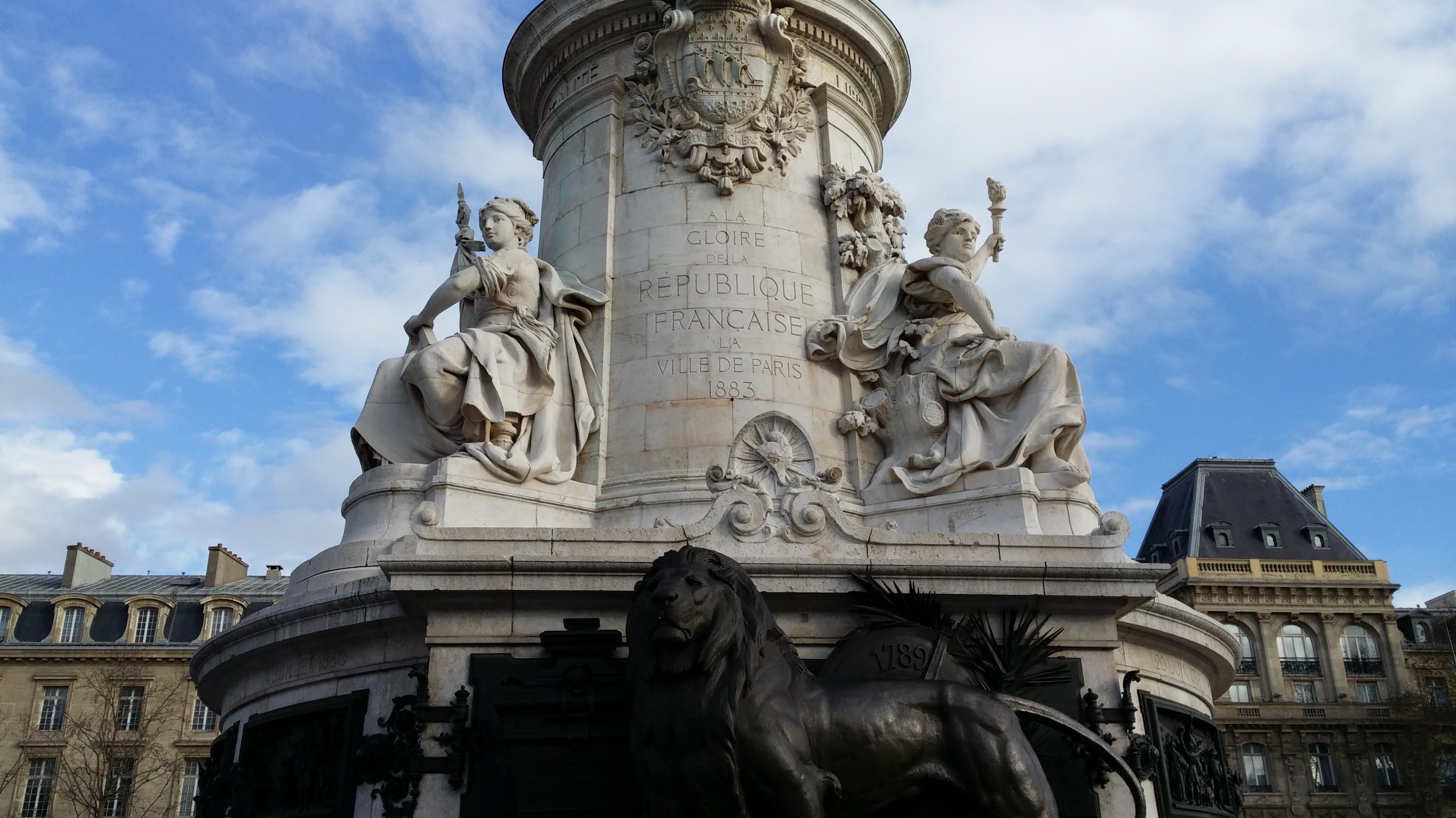
Searching for locations: Paris, France: Place de la Republique

Whilst a rather important place for the French, for us visitors, it has a convenient hotel located just behind the square, and an underground, or Metro station, underneath.

2014-01-07 11.43.05

Added to that was equally convenient cafes, one of which, The Cafe Republique, we had dinner every night.  The service and food were excellent, and we had no problems with the language barriers.

At the top of the monument is a bronze statue of Marianne, said to be the personification of France.

2014-01-07 11.43.41

Surrounding Marianne is three more statues, representing liberty, equality, and fraternity.

2014-01-07 11.43.32

At the base is a lion guarding what is said to be a ballot box.

Monday came and went, and now it’s Tuesday

I had so many things planned, those little bits and pieces that seem to get away from you.

It’s now Thursday night and I have only just come back to this post to write some more or maybe finish it, but that should you some idea of how easy simple things can get away from me.

To fill in the gaps in the story, I started to make a list of those bits and pieces, and that was the first mistake.

I frightened myself.

Tuesday disappeared in writing down what was on my writing slate. For instance,

Episodes 11 to 15 of the murder story, because my characters are having a fight in my head

The treasure hunt story is done, just needs a few tweaks

Episode 47 of the Castello di Brolio story, where the Germans are about to find themselves on the wrong end of the war

Episode 1 of the WW2 story – this has a start but is it Episode 1.  What bothers me is that I wrote some of this on the plane, but it disappeared somewhere, so I’m not sure when this may get done.

Writing instead of insomnia  is actually giving me insomnia

Episodes 151 through 177 of Being Inspired, Maybe – Volume 4. This is a series of photographs, and the story inspired by them.  Volume 3 is at first draft, and photo association with the stories.

Just about finished editing Volume 2, and I’m about to publish Volume 1.

Episodes 60 through 63 of PI Walthenson’s second case, new additions to the story, and although there is a title, the jury’s still out on whether it’ll be adopted.  There’s an interesting dynamic developing between the son and the mother, a woman whom he is discovering to be nothing like the one he thought he knew.

And, don’t get me started on where I am with Strangers We’ve Become, I just finished the 10th read and edit.  The book is done but rereading told me, or the cat did far more emphatically, there are a few gaps.  This needs to get done, and I need to stick the courage to the sticking point.

Wednesday arrived and I was looking at the list wondering what I was going to do next and realized that I’d been putting off writing the next few posts on the travelling blog which desperately need to be done.

So…

Travelling blog times two, and now it’s Thursday.

Damn, where did the week go?

The cinema of my dreams – Was it just another surveillance job – Episode 2

Back to the explosion at what was first thought to be at a takeaway.  Certainly, it had been levelled, but so had several other building in the near vicinity, but we haven’t got to that part yet.

The boredom of the flight is still giving me an opportunity to explore the opening sequence a little further, where we left our man on the scene under tight police guard.


In five minutes, perhaps less, the whole scene had turned into countless vehicles with red and blue flashing lights, screams from the victims, and yelling from the rescuers.

I was still under police guard, but coming from the other side of the scene, a rather battered and bleeding street policeman came running towards us, stopping short of the man standing back, the one I assumed was in charge.

“Tell me you’ve got them,” he gasped, then looking from the man in charge to me then back again, looking very concerned.

“We have.” He looked very calm and pleased with himself.

“What?  Him?” He nodded in my direction. “He was blown up in the blast and from what I saw was chasing the real culprits, two men covered in dust, one of whom was carrying a large duffel bag.”

“This guy was caught running from the scene.”

I decided to add my bit to the discussion.  “Your car drove straight past them.  I can’t see how you missed them.”

He was starting to look worried.  “We were given your exact description from an anonymous tip.”

The battered policeman bent over and the collapsed to the ground.  Two of my captors went towards him, but he motioned them away.  “Of course you did, by the two men escaping.  Get after them, before it’s too late.  And free this guy.  He’s got nothing to do with the blast.”

After removing the cuffs they jumped back in their car and headed back in the direction they came.  Too late now, the two men would be long gone.

I went over to the policeman on the ground just as another ambulance pulled up and as the paramedics got out, I motioned to them to come and attend him.

“What happened,” I asked him

“A bank robbery, the clowns used far too much explosive and almost brought the building down on them.  Not so lucky for the neighbours.”

He was looking around, then stopped, looking at the place where I’d just been held down. I followed his gaze and then saw what he saw.  The cuffs were still on the ground where the man who removed them had obviously dropped them.

His expression changed, and for a moment I thought he was going to explode.

“What’s wrong.”  Obviously, something was but I couldn’t see it.

“The cuffs.  We haven’t used those for years now.  They weren’t real police.”

My mind clicked into gear at the same time as he uttered the words.

They were there to help the others escape whilst holding us both up with a phony arrest.  I wonder what they would do if they hadn’t been sent after their fellow robbers.

The battered policeman just sighed and lay down on the pavement and let the paramedics work on him.

Only then did we notice he had a piece of an iron bar sticking out of his side.

Then, of course, people just  don’t happen to be in the wrong place at the wrong time.

Or do they?


© Charles Heath 2019

Searching for locations: The Mary Valley Rattler, Gympie, Queensland, Australia

I have a passion for visiting transport museums, to see old trains, planes, buses, cars, even ships if it’s possible.

This has led to taking a number of voyages on the TSS Earnslaw in Queenstown, New Zealand.

Many, many, many years ago on Puffing Billy, a steam train in the Dandenongs, Victoria, Australia.

The steam train in Kingston, New Zealand, before it was closed down, but hopefully it will reopen sometime in the future.

The London Transport Museum in London England, which had a lot of buses.

The Workshops Railway Museum in Ipswich, Queensland, where once the many steam engines were built and maintained, and now had only a handful of engines remaining.

However, in the quest for finding and experiencing old transportation methods, we came across the Mary Valley Rattler, which runs out of Gympie, Queensland, Australia.

The ride begins in Gympie at the old Gympie Railway station, and as can be seen below, is one of the relics of the past, and, nothing like the new more modern stations.  Thankfully.

If you’re going to have a vintage train, then you have to have a vintage station.

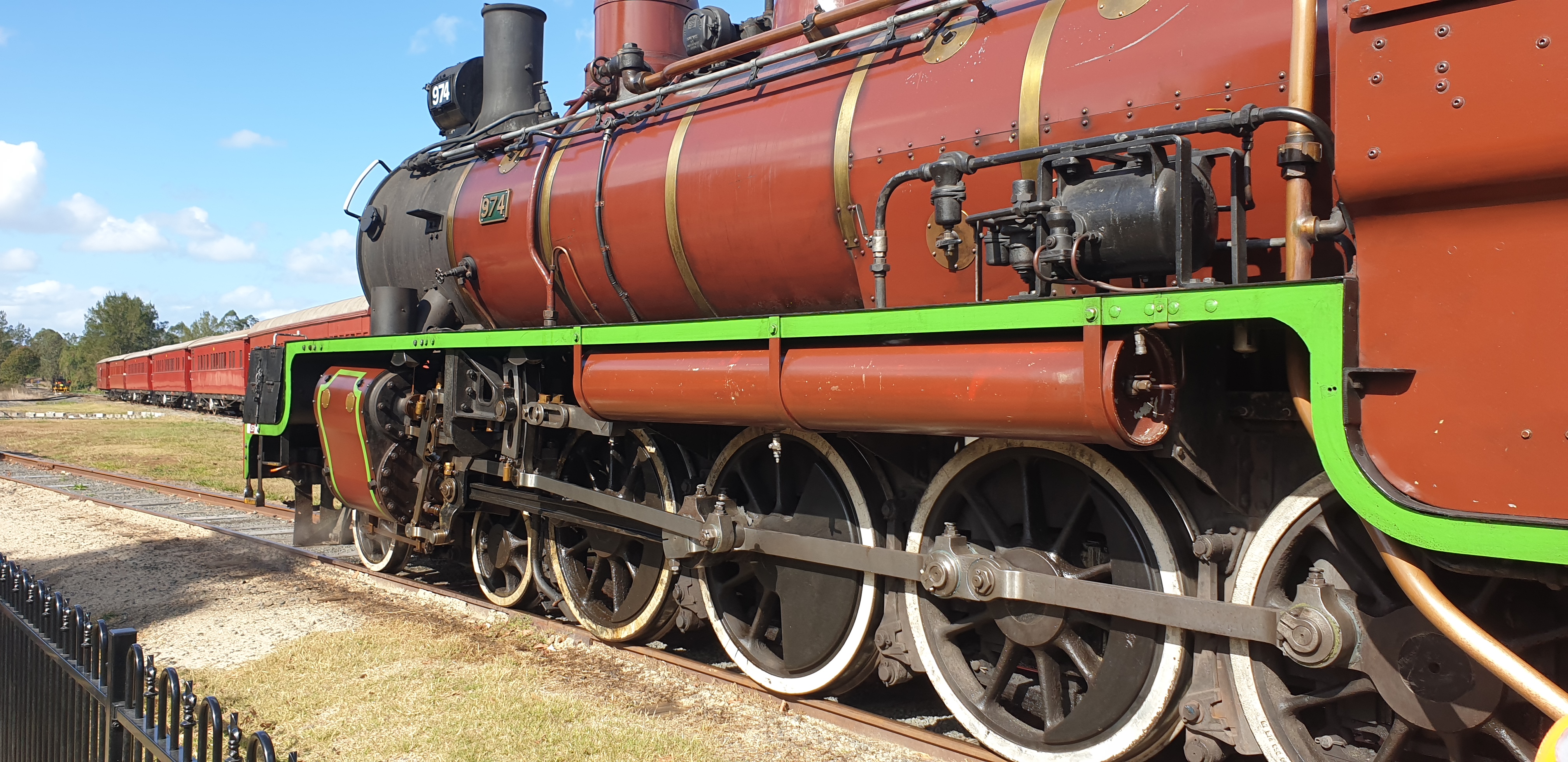
The Class of engine, seen below, is the C17, a superheated upgrade to the C16 it was based on, and first run in 1903.  This particular engine was built in 1951, although the first of its type was seen in  1920 and the last of 227 made in 1953.  It was the most popular of the steam engines used by Queensland Railways.

The C designation meant it had four driving axels and 17 was the diameter of the cylinder, 17 inches.  It is also known as a 4-8-0 steam locomotive
 and nicknamed one of the “Brown Bombers” because of its livery, brown with green and red trimming.

Also, this engine was built in Maryborough, not far from Gympie by Walkers Limited, one of 138.

This photo was taken as the train returned from Amamoor, a trip that takes up to an hour.

The locomotive is detached from the carriages, then driven to the huge turntable to turn around for the return journey to Amamoor.

This is the locomotive heading down to the water station, and then taking on water.  After that, it will switch lines, and reverse back to reconnect the carriages for the trip to Amamoor.

The carriages are completely restored and are extremely comfortable.  It brings back, for me, many memories of riding in older trains in Melbourne when I was a child.

The trains, then, were called Red Rattlers.

This is the locomotive climbing one of the hilly parts of the line before crossing over the Mary River on a trestle bridge.

This is the engine at Amamoor near the picnic area where young children and excited parents and grandparents can get on the locomotive itself and look inside where the driver sits.

And, no, I didn’t volunteer to shovel coal.

This particular locomotive spent most of its working life between Townsville and Mount Isa and was based in Cloncurry, Charters Towers, and Townsville, before being sent, at the end of its useful days in the late 1960s, to the Ipswich Railway Workshops.