The story behind the story: A Case of Working With the Jones Brothers

To write a private detective serial has always been one of the items at the top of my to-do list, though trying to write novels and a serial, as well as a blog, and maintain a social media presence, well, you get the idea.

But I made it happen, from a bunch of episodes I wrote a long, long time ago, used these to start it, and then continue on, then as now, never having much of an idea where it was going to end up, or how long it would take to tell the story.

That, I think is the joy of ad hoc writing, even you, as the author, have as much idea of where it’s going as the reader does.

It’s basically been in the mill since 1990, and although I finished it last year, it looks like the beginning to end will have taken exactly 30 years.  Had you asked me 30 years ago if I’d ever get it finished, the answer would be maybe?

My private detective, Harry Walthenson

I’d like to say he’s from that great literary mold of Sam Spade, or Mickey Spillane, or Phillip Marlow, but he’s not.

But, I’ve watched Humphrey Bogart play Sam Spade with much interest, and modelled Harry and his office on it.  Similarly, I’ve watched Robert Micham play Phillip Marlow with great panache, if not detachment, and added a bit of him to the mix.

Other characters come into play, and all of them, no matter what period they’re from, always seem larger than life.  I’m not above stealing a little of Mary Astor, Peter Lorre or Sidney Greenstreet, to breathe life into beguiling women and dangerous men alike.

Then there’s the title, like

The Case of the Unintentional Mummy – this has so many meanings in so many contexts, though I imagine that back in Hollywood in the ’30s and ’40s, this would be excellent fodder for Abbott and Costello

The Case of the Three-Legged Dog – Yes, I suspect there may be a few real-life dogs with three legs, but this plot would involve something more sinister.  And if made out of plaster, yes, they’re always something else inside.

But for mine, to begin with, it was “The Case of the …”, because I had no idea what the case was going to be about, well, I did, but not specifically.

Then I liked the idea of calling it “The Case of the Brother’s Revenge” because I began to have a notion there was a brother no one knew about, but that’s stuff for other stories, not mine, so then went the way of the others.

Now it’s called ‘A Case of Working With the Jones Brothers’, finished the first three drafts, and at the editor for the last.

I have high hopes of publishing it in early 2021.  It even has a cover.
PIWalthJones1

Writing about writing a book – Day 20

It is a day of rest although writers are ready and able to work on any given day at any hour of the day or night when an idea or thought comes to them.

I’m trying not to think, but that’s not working.

I’ve been going over the reasons for writing the first draft of the book 30 odd years ago and it had something to do with the fact I was working with personal computers and local area networking when both were in their infancy, and I wanted to blend this knowledge into a story.

Of course, I’d always wanted to write thrillers, and this presented the opportunity to use computers as a basis for a worldwide conspiracy.  How easy it is these days to do just that, but back in those days, it was a lot of hard work.

I remember sitting in a meeting when the company I was working for at the time had just implemented a network and personal computer to replace the mainframe and dumb terminals, also looking to leverage the new technologies of spreadsheets and word-processing, effectively making accounts staff more productive, and removing typists and moving into the world of centralized word processing.  It was not a new idea with Wangwriter, but using PC’s was.

One of the departmental managers got up to give his take on the new technology, this about six months after implementation, and after a lot of teething troubles caused mainly by people who were vehemently resisting change, and his message was, it should not be called ‘networking’, but ‘not working’, in reference to the number of times the network went down.

But this is a digression.  Computers are only a part of the story.

The story also goes back to a time when there was a clear demarcation between the management levels.  Management offices were oasis’s whereas the staff worked in a stark desert-like environment.  When one came to work for such an organization, it was with the belief that you start at the bottom, and over time, you work your way up the ladder.  There was, very definitely, class distinction, and the various management levels never mixed, at work or socially, except within their own level.

There were Managers, Assistant Managers, and Manager’s Assistants, a typing pool, a secretary, that young, or old, lady who did so many jobs for their boss, that these days it would be considered demeaning.  They were dedicated to their jobs and irreplaceable.  There was no such person as a Personal Assistant.

Nor was such a thing as sexual harassment.  One company I worked in where one of the Assistant Managers was sexually abusing an office girl, her complaints didn’t get a prosecution as it would now, it just had him transferred to another branch.  Reprehensible, yes, and thankfully no longer a problem, except of course, in Fifty Shades of Grey which apparently condones such behavior.

There were department heads, General Managers, and Board Members.  The upper management level and participants were in a world of their own, one few could ever aspire to.  This is the world in which Transworld, my fictitious (but based on a very real) company lives.

I have to work on my company structure to make sure it is right.

Now I have two charts.  A timeline, for both Bill, and the story, and a hierarchy for the office management and staff.

This is beginning to be more complicated than I thought.


© Charles Heath 2016-2020

Children are all the same

They just live in different houses

…

It’s quite remarkable to discover that your children are not unique.

For years I thought that we had spawned monsters that had quite likely come from another planet because the other children in the family seemed so different.

I didn’t realise that the parents had issued death threats if they so much as looked sideways while out.

It was where I suddenly realised that parents of children if taken at their word, could be mass murderers, or at the very best, the worst kind of bullies.

The threats of violence that they used, in any other circumstances would elicit a rather lengthy jail sentence.

I was guilty of it myself, and such threats had come to roll off the tongue so easily that you didn’t really know you were doing it.

If you don’t do this, I’ll kill you. There’s no thought to the significance of this statement, or the consequences if you were to actually do it.

No wonder the children just look at you like you’re deranged.

Of course, there are fewer murderous ways of dealing with the problem, but the sad fact is they have probably driven you into a blind rage and just past into that zone where you really have no idea what you’re saying.

Been there too.

But the revelation that all the other parents are the same, that you see them threatening their children with death or worse.

Then, after they’ve grown up and moved on as all children do, they return on odd occasions for Sunday lunch and there you begin to learn the stuff they did when younger that you never knew about

It’s seeming a rite of passage for all children, and it’s odd to hear others discussing it, especially when you hear someone else referring to their children the same as you do.

Did they come from the same planet too?

That’s when a friend told me the truth of the matter. All children are the same, they just live in different houses.

Ain’t that the truth!

The cinema of my dreams – I always wanted to see the planets – Episode 1

I’d been on the starship for almost three hours when…

…

The captain was coming up from the earth station by transport, not wanting to trust the transporters, and I’d just finished the orientation of the ship by the second officer, and had arrived on the bridge to see various crew members hunched over their consoles.

The captain had told me, before stepping onto the transport, that we would be leaving the dock shortly after he arrived.

Nothing I’d seen so far had led me to believe it would be going anywhere, anytime soon.

Nevertheless, the crew briefing had run smoothly, the second officer assigned to correlate the complaints/problems list, and everyone else had taken their assigned positions. 

I was waiting for the captain, standing beside the ‘chair’, ready to hand over.  In any other situation, we would be off to an illustrious start.

Until the dulcet tones of the Chief Engineer rang through the bridge, uttering those fateful words, “the warp coil has had a catastrophic failure”.

This was at odds with another statement he had made earlier when I was in Engineering, and given I was told the Chief Engineer was prone to hyperbole; his statement ‘they just don’t make warp coils like they used to’ hadn’t exactly filled me with confidence, but I had been expecting we would be ready to depart.

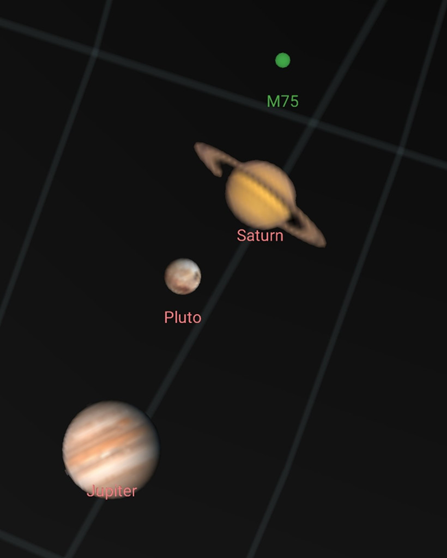
I had been looking at the screen, an overlay of the window that looked out over space, or at this moment, the space dock, where there was a representation of the planets that were ‘out there’.

I had been curious about M75, but the helmsman, a rather taciturn chap who seemed to resent the fact he was assigned to this ship, just shrugged and said, “it’s something, somewhere, but not of much interest,” then went back to his console.

If this was Star Trek, we’d be ejecting the warp coil by now, but in the space dock, that didn’t seem to me to be a viable option.

“How long before we can get this bucket of bolts moving,” I ask the Chief.

“I’m going as fast as I can.”

Yes, words ripped right out of the script of a Star Trek episode, I thought. A sad case of life imitating art.

A strange whistling sound emanated from the speakers, then the whoosh of the elevator just before the doors opened. OK, new ship, squeaky doors, another item to be put on the ‘look at’ list after the shakedown cruise.

The Captain had arrived.

“Why are dock workers still on the ship, Number One.”

For a moment there, I thought I was talking to John Luc Picard.

“Faulty warp coil. You know how it goes, save a billion by outsourcing to the cheapest supplier.”

The captain didn’t appreciate my sardonic humour, or my apparent disdain in outsourcing what we had once built ourselves.

He gave me a frown, a slight shake of his head, then said, “I’ll be in my quarters. Let me know when we’re about to leave.”

He didn’t wait for acknowledgement and disappeared through another squeaky door. More repairs.

The Chief’s voice then came over the speaker. “I can give you impulse speed, warp speed will take a little longer.”

“Doesn’t that refer to miracles over the impossible,” I ask.

“Perhaps.  But in the meantime, I need a specific spanner and the replicators are down. So, now we have to fix them first, before moving on. Might take a while.”

I look around the crew, seeing their expectant faces drop with disappointment.

Outer space was going to have to wait a little longer.

…

© Charles Heath 2021

“The Document” – a thirty-day revision – Day 19

This book has been written for some time and the manuscript was sitting in a box with half a dozen others gathering dust and not quite as complete, so this month it is going to get the makeover, a first draft for the editor.

And so it begins…

…

Finally, we’ve got the internet back

…

After two days in the technological wilderness, we are back, which must say something about the human condition.

I’m sure, one day, the internet will collapse and billions of us will go through the same withdrawal symptoms I just did, and there’ll be a lot of clean rooms around.

Even so, there are those two items that were very prevalent when I went to school, pencils. HB or 2B, or coloured, and lined paper in what was called an exercise book, 48 pages, 64 pages, 96 pages or 128 pages.

I am yet to equate words to an exercise book page, but that’s the least of my problems.

Still working on the new killer, and a perfect match for the hero.  Yes, I’m hoping we can have a happy ending for at least two characters.

The others, well, you reap what you sow!

Searching for locations: Shaolin Kung Fu, near Zhengzhou City, Henan Province, China

After leaving the hotel in Zhengzhou, which was once one of the eight ancient capitals of China, we are going to Dengfeng city, the home of China’s most famous martial art – Shaolin Kung Fu.

The Shaolin Temple nearby is the origin of Chinese Zen Buddhism, and the Songyang Academy, called “the Centre of Heaven and Earth” is located 87 Km from Zhengzhou, or, as we were advised, a 2-hour drive.  It will be scenic because we are heading towards the mountains.

As one of the four ancient Song Dynasty Academies, Songyang Academy is one of many schools in the province.  It is both on a large scale, is quite spectacular, and is a comprehensive Wushu training base where students are trained to spread the Shaolin Wushu Kung fu style at home and abroad.

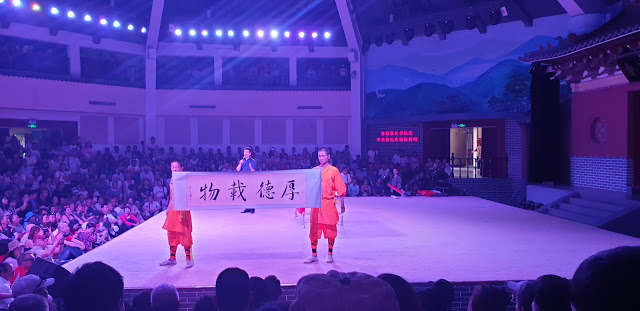
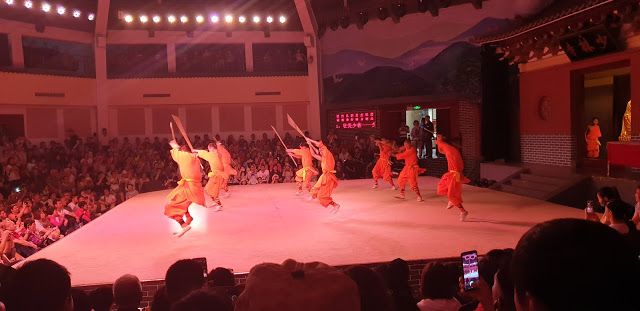
There is a 500-seat demonstration hall where you are able to observe 30 minutes of various martial arts in shows starting on the hour.

Outside there is a specific area that generally has about 600 trainees learning kung fu elements during the day but can hold 5,000 people when outdoor performances are required.

The kung fu school

The thing you notice most about the kung fu school is its size and then the number of buses which tells you that it is a popular tourist stop.

And with that size comes long distances between the car park and the venues we need to go to, the first of which is about half a km, and that’s just to get to the ticket plaza.

But, it is pleasantly set out and is quite a large number of shops for both souvenirs and food

We pass by some of the students going through their paces

From there it’s another long, long walk to the show arena, where we’re supposed to see various kung fu elements on display.  We watched this for a few minutes, then headed off towards the hall for a more intense demonstration of kung fu, and because there is limited seating we have to start lining up at the head of the queue to get a seat.

But…

Everyone else has the same idea and we join the throng which then becomes a ride, and true to the Chinese they start finding ways to push in, even using the imaginary friend somewhere ahead in the queue.

The doors open and then it’s open slather, with the hoards pushing from behind and sliding up the side to get in first.  We go with the tide, and manage to get in and find a seat though we were separated from three of our group.

It was an interesting show even though not one word of English was spoken, which from our point of view was a disappointment because we had no idea what was going on.

However…

It wasn’t hard to follow

What the performers were doing was relatively self-explanatory, and quite fascinating, especially the guy who broke a sword over his head, and the guy who stopped two spears penetrating the neck, both examples of very disciplined men.

Boys gave a demonstration of kung fu moves, and intensity and age increased as this progressed to the end.

Next, we were taken in hand by an instructor in Tai chi or an equivalent, I was not quite sure what it was called, and went through the twelve or maybe more moves that constituted a morning or afternoon exercise session or it could be just for relaxation.  I lasted the first session but it was a little difficult to do with my sore limbs and a bad back.

Not that I could remember any of it now other than hands overhead, hands in front, bent knees, and a few gentle kung fu hand moves.

Perhaps when I get home I might seek out someone to show me the moves.

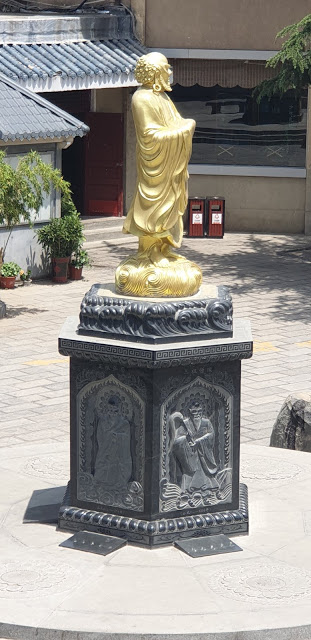
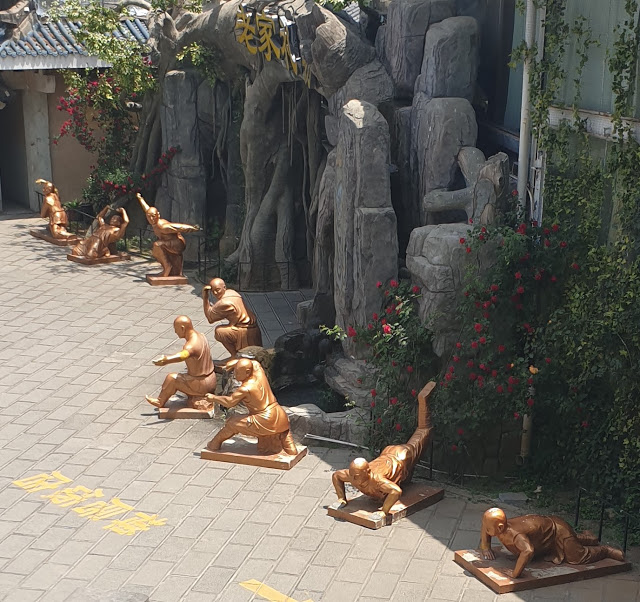
Whilst the others were following their training instructor, I wandered about, finding a large statue

 
And some smaller statues

Lunch in the Zen Restaurant

After all that exercise it was time to have lunch purportedly the same food as the king fu masters.
It’s in the Zen restaurant, aptly named, and the food when it came, came thick and fast, but some of it wasn’t very nice, meat with bones, tofu, a tasteless soup, but some good dishes like the vegetables and noodles with meat, without bones.

The only problem was nothing to drink except a pot of hot water.  No tea, no cold water, and if you wanted a cold drink you had to pay for it.  After paying 550 yuan why should we have to pay more for a drink when we have not had to so far.

But no cold water?  That was just not on, and when we brought this to the attention of the tour guide she just simply ignored us.  We just didn’t get anything.

That basically tainted the whole experience.

After lunch, there was the Shaolin Temple and the Pogoda Forest to visit.

Will it be time to get on the plane yet?

What I wanted to say is the world is going to hell in a handbasket, but the truth is, it’s probably just me.

If it’s possible, and seeing it’s the only time we can go away, as we live in the southern hemisphere, it seems logical to go north.

OK, that’s probably not as rational as it sounded in my head a few seconds ago, because where we’re planning to go it’s about minus 16 degrees.

Where on earth could it be that cold, other than the north pole?  Lake Louise.  Canada.  Somewhere up in those snow-peaked mountains.

Why do we want to go there?

Because it’s there.  Because we have been there before and it literally took our breath away (notwithstanding the severe cold).  And, no doubt after we’ve been there in the dead of winter, we might have decided we won’t want to go back?  Who knows.

But…

Oh, yes, there’s a but…

I need some good background for a story I’m writing, and if you’re going to do the winter thing, or the white Christmas thing, when your Christmases are usually 40 degrees Celsius in the shade, then Canada is the place to do it.

Aside from the fact, we might run into Detective Murdoch (from Murdoch Mysteries) in Toronto, and, definitely, the Maple Leafs, yes, I can see myself saying ‘go leafs go’, whilst sipping on a large glass of Molsen beer.

Then, perhaps we’ll go to New York for a week.  Perhaps everything will be still shut down, but maybe not.  Hopefully, there will be snow in Central Park, or, if not, the squirrels, and if not them, perhaps a movie star or two walking their dog.

One can always hope.

The cinema of my dreams – Was it just another surveillance job – Episode 35

I’m back home and this story has been sitting on a back burner for a few months, waiting for some more to be written.

The trouble is, there are also other stories to write, and I’m not very good at prioritizing.

But, here we are, a few minutes opened up and it didn’t take long to get back into the groove.

Chasing leads, maybe


She gave me a minute to think about the situation, and then said what I was thinking, “So he could be anywhere?”

“He was dead.  I felt for a pulse.  There wasn’t one.”

I could interpret that expression on her face, ‘you’re not a doctor’.

She turned another page, read a few lines, then made a note at the bottom.

It read, if my deciphering was up to scratch, ‘doesn’t know if subject dead or not’.

She looked up again.  “It appears these documents are out there,” she waved her hand in the air, “somewhere.  Fortunately, they have not turned up, not has someone tried to sell them back or to the newspapers, so we’re lucky.  So far.  That isn’t going to last for much longer.  Every extra day out there is another chance for the government to be embarrassed.”

“You know what the contents are?”

“Don’t be silly.  That’s above my pay grade, and besides, you and I are better off not knowing.  So, what you need to do is find O’Connell and/or find the documents on this USB drive.”

She slid a card across the table.  It had a name and a telephone number.  Monica Sherive.  A mobile number, a burner no doubt that couldn’t be traced back to her.

“You find either, you tell me first.”

“Nobbin?”

“Second, and when I tell you.”

“So you don’t trust him either?”

“At the moment, for both you and I have to be careful who we trust.”

I added her to the list of people I couldn’t trust, not that she had told me I could trust her.  Yet.

“And if I get contacted by Severin again?”

“Have you?”

I had thought about not telling her about that brief meeting where he told me about the USB drive, but it couldn’t do any harm.  At least she hadn’t asked me if I knew about the USB, which was something, I suppose.

“Yes.  Once.  Told me to keep my head down.  And asked me if O’Connell had time to talk to me.  It was the same answer I gave him back in the alley.  No.  I’d just managed to corner him when he was shot.”

“By Severin, or this other fellow,” she shuffled back several pages, then said, “Maury?”

“No.  That was what was odd about it.  The shot came from somewhere else.  A sniper I would have thought.”

And, my brain suddenly moving into overdrive, piecing together what might be a coincidence, but in our business, they were rarely coincidences.  A sniper shot him., say Nobbin or one of his people, he looks dead, waits for a call to the cleaners, intercepts it, and collects the so-called dead O’Connell.  It was a good conspiracy theory.

And as far-fetched as one.

Severin had to have the body somewhere, trying to figure out how to bring O’Connell back to life so he could torture the USB location out of him.

Hell, that was as twisted as the conspiracy theory.

Time to change the subject.  “Do you have any idea who Severin and Maury are?”

She went to the back of the file and pulled out some photographs, mug shots perhaps of staff members.  She put five faces in front of me and asked me if the two were there.

They were.  The first, with the name of David Westcott, and the fourth with the name of Bernie Salvin.

“Who are they?”

“They used to work in the training department for ten or so years ago.  Westcott was also a handler for several years.  They both requested a transfer to operations, and we give a mission.  Six agents were assigned, and all six were killed, an investigation after the fact found that their identities had been leaked to the enemy before they reached the target.”

“They gave them up?”

“Nobody knows for sure.  There were others in that group, but in the end, the department retired them all.  All their years in training served them well.  We found the place where you were trained.”

Another photograph of the main building.  I nodded.

“It was an old training facility closed down five years ago.  It was just sitting there waiting for an enterprising crew.  It won’t happen again.  Needless to say, we haven’t been able to find either of them, only the people they employed, who believed it was in good faith.  A mess in other words.  Now, go.  Find me answers.”

She stood.  The meeting was over.

© Charles Heath 2020

“Sunday in New York”, a romantic adventure that’s not a walk in the park!

“Sunday in New York” is ultimately a story about trust, and what happens when a marriage is stretched to its limits.

When Harry Steele attends a lunch with his manager, Barclay, to discuss a promotion that any junior executive would accept in a heartbeat, it is the fact his wife, Alison, who previously professed her reservations about Barclay, also agreed to attend, that casts a small element of doubt in his mind.

From that moment, his life, in the company, in deciding what to do, his marriage, his very life, spirals out of control.

There is no one big factor that can prove Harry’s worst fears, that his marriage is over, just a number of small, interconnecting events, when piled on top of each other, points to a cataclysmic end to everything he had believed in.

Trust is lost firstly in his best friend and mentor, Andy, who only hints of impending disaster, Sasha, a woman whom he saved, and who appears to have motives of her own, and then in his wife, Alison, as he discovered piece by piece damning evidence she is about to leave him for another man.

Can we trust what we see with our eyes or trust what we hear?

Haven’t we all jumped to conclusions at least once in our lives?

Can Alison, a woman whose self-belief and confidence is about to be put to the ultimate test, find a way of proving their relationship is as strong as it has ever been?

As they say in the classics, read on!

Purchase:

http://tinyurl.com/Amazon-SundayInNewYork

Searching for locations: Terracotta Warriors and Horses Museum, X’ian, China

Terracotta Warriors and Horses Museum

A little history, and anecdotal advice first:

In 1974 a 26-year-old farmer, Yang Jide, was drilling a well and found fragments of the terracotta soldiers and bronze weapons.

What was discovered later was one of the biggest attended burial pits of China’s first feudal Emperor, Qin Shi Huang.  In the following years remains had been found in 3 pits, yielding at least 8,000 soldiers and horses, and over 100 chariots.  The soldiers were infantry, cavalry, and others.

Emperor Qin was born in 259 BC and died in 210 BC.  He began building a mausoleum for himself at the foot of Mount Li when he was 13.  Construction took 38 years, from 247 BC to 208 BC.  It was divided into 3 stages and involved 720,000 conscripts.

The pits of pottery figures are 1.5 km east of Emperor Qin’s mausoleum.  Pit 1 has about 6,000 terracotta armored warriors and horses and 40 wooden chariots.  Pit 2 is estimated to have over 900 terracotta warriors and 350 terracotta horses with about 90 wooden chariots.  Pit 3 had so far yielded only 66 pottery figures and one chariot drawn by four horses.

Official records say it was discovered later that it was likely Xiang Yu, a rebel, intentionally damaged the Mausoleum and the soldiers in the pits, by setting fire to the wooden roof rafters, and these fell on and broke the warriors into pieces.

However, we were told that after the terracotta warriors were completed, the Emperor ordered the builders to be killed so that they would not tell anyone about the warriors, and then of those that remained alive deliberately smashed all of the artifacts.

The thing is, all of the terracotta figures that have been found are in pieces, and they need computers to piece them back together again.

The visit:
The first impression is the size of the car park and the number of buses parked in the lot, and a hell of a lot more outside up the road an off on side streets.  Obviously, it costs money to park in the parking lot.

The other first impressions; the numbers waiting to get in were not as many as yesterday outside the forbidden city, in fact, a lot less.

Be warned there’s a long walk from the entrance gate where your bags are scanned and a body scan as well, before admittance.  This walk is through a landscaped area which it is expect might sometime in the future reveal more soldiers, or other artifacts.

At the end of the walk that takes about ten minutes, you can get a one-way ride to the second checkpoint, but we opted not to as no one else in our group did.

That walk is the warm-up exercise to an organized viewing of the exhibits after going through a second ticket checkpoint.  On the other side, we had to hand our tickets back to the tour guide which was disappointing not to end up with a memento of actually having been there.

So, on the other side in the courtyard, the guide told us the most important parts of the exhibition, that we should spend most of the time looking at pit 1, and then spent a little time in 2 which is only there in the first stages of excavation.  Then move onto the museum if only to see the replica chariots.

We do.

The chariots were small but interesting

The horses were better and intricately detailed

These are soldiers, perhaps complete examples of those types found in the end pit.

This is one of the archers.  You can tell by the way he wears his hair.

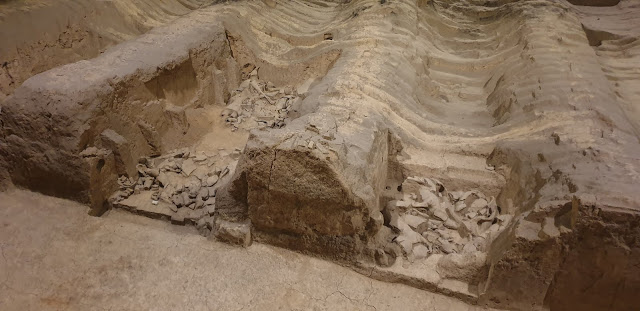
Pit 2

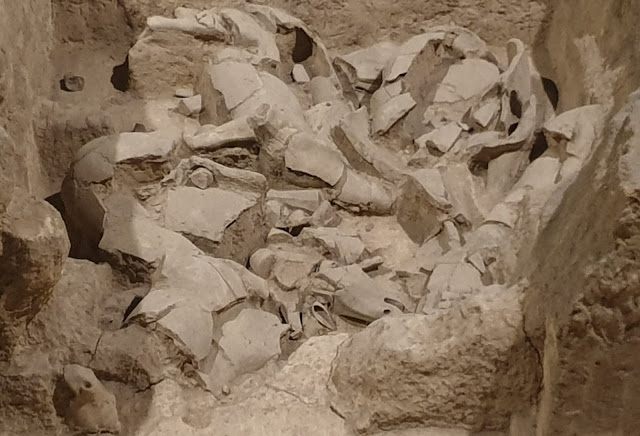
The excavation of this pit has only just begun, so it is possible to see where they have carefully removed the top cover, and you can see the broken parts of the warriors lying in a heap.

Some parts of the warriors are more discernible closer up

These parts are carefully extracted and taken to the ‘hospital’ where they are digitised and the computer will match each part with the warrior it belongs to.

Pit 1

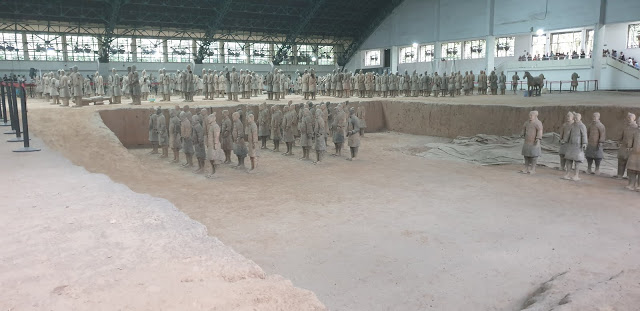
This has quite a number of standing soldiers that have been glued back together, but not necessarily complete and I notice a number if the statues were incomplete. And if they cannot find the missing pieces, then they are not added to or filled in.

The scale of the pit is enormous, and they have hardly scratched the surface in the restoration process.

What is there is a number of horses as well.

That’s at the front of the pit, a long line of statues, and what is clear is the location of the well where the first fragments were found by a farmer.

There are about eight lines of soldiers, and some lining the sides.

Midway down there is a large area currently under excavation

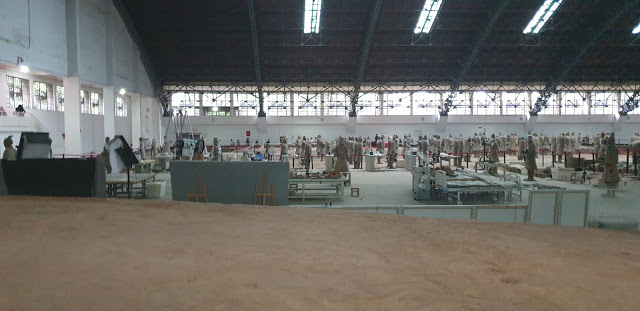
At the back is the hospital where the soldiers are reassembled.  There’s nearly a hundred in the various stages of rebuilding.  These days the soldiers are rebuilt using computer imaging.

The hospital area is where they are put back together

And these are some of the statues in various stages of reconstruction

Another two views of the size and scale of the reconstruction project

The coffee shop is also a sales centre, but there are too many people waiting for coffee and too few places to sit down.