Self-published authors are fully aware that perhaps the easiest part of the writing journey is the actual writing. Well, compared to the marketing aspect I believe it is.
I have read a lot of articles, suggestions and tips and tricks to market the book to the reading public. It is, to say the least, a lot harder to market eBooks than perhaps their hard or paper-covered relatives.
This is despite the millions of eReaders out there.
Then there is that other fickle part of the publishing cycle, the need for reviews.
Proper reviews of course.
As we are learning, reviews can be bought, and in more ways than one. What happened to finding writers of the same genre and offering to buy one copy and write a review in return for a buy one copy and write a review.
I’ve noticed that all the current best selling novelists do the same for their fellow novelists though I guess when you get to be a best-seller, you might not have to buy a copy, so I can only dream of attaining such lofty heights in the publishing world.
But until I reach such rarefied air, I guess I have to figure out how to appeal to my fellow writers, and, of course, hope that my work is good enough.
It might be a start in getting through that difficult cycle, more reviews means more sales, etc. And getting those first sales and reviews …
Therein lies the conundrum. It is a question of paying for advertising or working it out for ourselves. I guess if I were to get more sales, I could afford the advertising … yes, back on the merry-go-round!
And yet, the harder the road, the more I enjoy what I do. It is exhilarating while writing, it is a joy to finish the first draft, it is an accomplishment when it is published, but when you sell that first book, well, there is no other feeling like it.
I am inspired.
Now as for that advertisement and where to post it…
As soon as I stepped off the shuttle in the cargo bay, the third officer was waiting for me.
“The captain asked me to escort you up to his day room.”
Unusual. The captain could have just called me on the private communicator if there was a need for secrecy, if that was what this was.
“Any reason why he would send you?”
“Didn’t want you getting lost, sir.”
I knew I should not have admitted to him that I had got a little confused finding my way around, but that was because the dockyard people had blocked off several passageways.
“No. I guess not.”
The Third was a man of little humour, and particularly didn’t think any of my jokes were funny. On station, he was all serious and unamused.
Now, he had his serious face on, and I thought it best not to ask what to expect.
He took a different route to the bridge than what I would have taken, a much shorter and more direct route. It was obvious he had studied the plans of the ship and knew it backwards. I on the other hand, was not that prepared, but it meant I would have to.
He went as far as the door to the day room, and left me there. I didn’t need to announce myself, the doors just opened, whisper quiet, showing me the room I could expect one day when I got my own ship.
Or at the very least, I could dream.
The doors closed behind me, and I walked forward into the room proper, and first saw the captain sitting at his desk, and then a figure standing beside and back a step, behind him.
There was a weapon in his hand, but it was by his side.
And something else I noticed, the figure looked just like the three I’d seen on the other ship.
The captain saw me looking at him.
“This is the captain from the vessel that just arrived as those assailants on the cargo ship were ‘rescued’.
He, or she, looked human under the clothes and helmet, but could be almost anything.
“Does he…”
“Speak our language, yes, and a lot of others. And he would like our help.”
I looked at the invitation, a feeling of dread coming over me. It was not entirely unexpected but like a great many things that had suddenly come into my life, it caused equal measures of fear and excitement.
The gold edging and the perfect script displaying my name in the exact centre of the envelope made it almost unique. Very few people ever received such an invitation.
I held it in my hand for a longer than necessary, then put it down on the desk carefully, as if it would explode if I dropped it.
My first instinct, driven by fear, was not to accept.
But, fear or not, there was no question of me not attending. Circumstances had painted me into a corner; I’d agreed to go a long time ago when I thought there was no chance it would come to pass.
Way back then, I had been compared to the aspiring painter in an attic having to die before I made any sort of impression. In those days people thought it amusing. I thought it was amusing. Kirsty, in particular, had thought it was as impossible as I had.
Now it was not amusing. Not even remotely.
My life was once quiet, peaceful, sedate, even boring. That didn’t mean I lacked imagination, it was just not out on display for everyone to see. Inspired by reading endless books, I had the capacity to transport myself into another world, divorced from reality, where my boring existence became whatever I wanted it to be.
It was also instrumental in bringing Kirsty into my life. In reality, I thought she’d never take a second look at me, let alone a first. So I pretended to be someone else. Original, witty, charming, underneath more scared than I’d ever known.
And yet she knew, she’d always known and didn’t care.
As we spent more time together, she discovered I liked to write, not finish anything, just start, write a hundred pages, then lose interest. Like everything I did. Start, and never finish.
Why not? It would never be published. It would never succeed.
So she bribed me. If I didn’t finish my first book and send it away, I couldn’t marry her. It didn’t matter if it was rejected, all I had to do was finish a book, and send it.
The thought of marrying her had not entered my mind, because I hadn’t thought she would. Incentive enough, I picked out one of the unfinished manuscripts and humoured her. She read bits of it, not saying a word. Sometimes she’d put a note or two on the manuscript, her equivalent to sweet nothings, and with it I gained inner confidence in my own ability, not only to write but in many other aspects of my life.
When it was finished, it was Kirsty who sent it off. She read it, packaged it, addressed it, and sent it before I had a chance to change her mind. Once gone, I heaved a huge sigh of relief. It was done. That was, as far as I was concerned, the end of it.
It was not possible that one letter could change a person’s life so dramatically. I came home to the all-knowing smile, and mischievous whimsicality that had always suggested trouble.
Trouble indeed!
My book was accepted. With a cheque called an advance. For more money than I knew what to do with.
This was followed not long after by publication. And a dramatic change to my life, one I didn’t want. To become a public person, to face an enormous number of people, people I didn’t know.
I went back to being scared.
Kirsty smiled at me and told me how wonderful I looked in my monkey suit. Why couldn’t I go in jeans and a dress shirt? All the best actors in Hollywood did it.
“This is not Hollywood. You’re not an actor.” It was a simple, practical, answer.
The hell I wasn’t. I could act sick, dying, fake a heart attack, anything. “What am I going to say?”
“You could talk about books.” Quiet, efficient, oozing the confidence I didn’t feel.
She didn’t fuss. She took it in her stride. She dressed in her usual simple elegance, in a manner that made me love to be seen with her. I couldn’t tie my tie, so she did it for me. She straightened my jacket because I couldn’t do that either. Nerves. Can’t live with them, can’t live without them. Or was that a reference to wives, or mistresses, or something else?
The palms of my hands were sweating. Meatball hands, I thought, the sort of palms that betrayed the pretenders. Me, I was the pretender. My neck felt too large for the shirt. Beads of sweat formed on my brow. Where was a sponge when you needed one?
“I can’t do this.”
“You can.”
We hadn’t even left the hotel yet.
“How long before the execution.”
She looked at me with her whimsical smile. “Long enough for me to give you a hard time.”
I lost count of the number of times I had to go to the bathroom, for one thing, or another. Nerves I said. Perhaps a dozen Valium or something similar. Did I have any? Had she hidden them? Why did she keep smiling?
In the car, I looked at my watch at least a dozen times. I couldn’t breathe. It was too hot, too cold. She held my hand, and it served best to stop the trembling that had set in. Why did I agree to this? Why?
We were greeted by the Events Manager, who was polite and genuinely interested. He took us inside where he introduced the interviewer, another woman who oozed confidence and charm, who went over the format and generally tried to set me at ease.
I didn’t let Kirsty’s hand go. Not yet. She was my lifeline, the umbilical cord. When it was severed, I knew I was going to die.
Bathroom? Where was the bathroom? Hell, five minutes to go, and I felt like passing out. No, Kirsty couldn’t come in. Comb my hair. Straighten my tie, no it was straight. Maybe I could hide in here? I looked around. No, maybe not.
Time.
The cue man was standing beside me, hand gently on my back. He knew the score. He knew I would turn and run the first chance I got. Kirsty was on the other side, smiling. Did she know too?
Then the announcement, my cue to walk on.
The gentle shove, the bright lights, the deafening applause, the seemingly endless walk to the chair, dear God, would I make it without tripping over?
How many times had I made this trip? I stood, facing the audience, waved, then sat. It was the fifteenth. You’d think I’d learned by now.
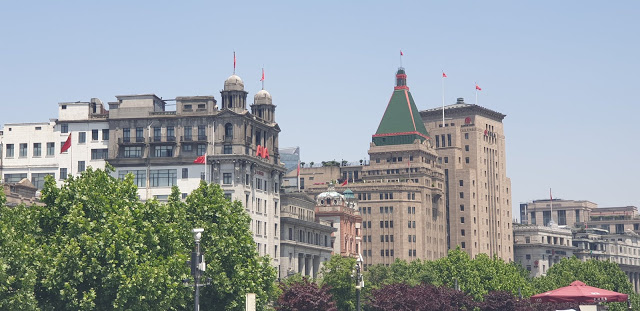
The architecture along the Bund or Waitan is a living museum of the colonial history of the 1800s. The area centers on a section of Zhongshan Road within the former Shanghai International Settlement.
The word bund means an embankment or an embanked quay. It was initially a British settlement; later the British and American settlements were combined in the International Settlement.
The Bund is a mile-long stretch of waterfront promenade along the Huangpu River. There are 52 buildings of various architectural styles, including Gothic, baroque, and neoclassical styles. The area is often referred to as “the museum of buildings”.
Building styles include Romanesque Revival, Gothic Revival, Renaissance Revival, Baroque Revival, Neo-Classical or Beaux-Arts, as well as a number in Art Deco style.
Having seen these buildings initially the night before, mostly lit up, our viewing this morning was from the land side, and particularly interesting in that the colonial architecture was really fascinating considering their location, but not surprising given Shanghai’s history. A lot of these buildings would be more at home in London, that out in the far east.
What happened yesterday is history, but that’s not necessarily how we view what is history and what isn’t.
Similarly what is and what isn’t history is usually decided on by academics, because history texts that are used in schools are not written by ‘the man in the street’ authors. They’re usually university types who specialise in a particular field, or specialise section of history.
Even then one doubts that what is written is not a consensus of a panel.
So, when we talk about re-writing history, that takes a very brave bunch of people who want to buck the norm.
Our history, that which was taught when I went to school,. about our own country, Australia, started in 1770. Some brave soul tried to say it began earlier than that, before Captain Cook and the British arrived, out up a flag pole, and declared it belonged to Britain, like in 1606 when the Dutch explorer Willem Janszoon landed on the Cape York peninsula, only it wasn’t called that then.
And he might have been as surprised as Captain Cook that there were people here to observe their arrival. Yes, people had been living in this country for tens of thousands of years before the Europeans arrived.
But that was not what we were taught. No, Captain Cook, 1770, the a fleet of ships in 1788, and off we run as a new country, and a dumping ground for Britain’s convicts. Our history starts there, and then meanders through time, dividing the country up into states, having famous explorers like Burke and Wills, and Blaxland, Wentworth, and Lawson, Hume and Hovell.
And we commemorate all these people and those who were in charge over the years, with names of states, cities, rivers, mountains, everything under the sun. You’ve only got to glance at the list of hundreds of these forefathers and explorers to see just how many places in this country were named after them.
No heed was taken of what they may have been called before because no one really understood the languages of the first people who lived here. And they never seem to rate as a matter of study for us children back then.
Now, as people have begun to realise our history goes way, way back, and that there should be a nod to those inhabitants, they are considering re-writing some of our history to incorporate these people. And change the names of places to their original. A famous instance of recent renaming is of Ayers Rock, now called Uluru.
Even then, Australian History didn’t rate very highly, and I have to say, as a child at school 50 odd years ago, I learned more about the British Empire/Commonwealth, and about the English kings and queens, than we did about our own Governor Generals, Prime Ministers and State Premiers.
Could I tell you the name of our first Prime Minister? No. I can say when Australia became Australia, yes. 1901. Can I tell you the first King of England? Yes, William the Conqueror in 1066. There were kings before that but they only ruled of parts of England.
But over the years since I have read the odd book of Australian History but for some reason it never quite seems as colourful or as interesting as that of England or Scotland, or even some of the European countries.
Now, since I’ve been reading about what’s happening in the United States I have begin to take an interest in American history, and it, too, seems to suffer the same problems we have with ours, a bunch of academics decided what it was, and what it would not include, and then there is this thing called the 1619 project.
Wow, that seems to have stirred up a hornet’s nest.
I’m back home and this story has been sitting on the back burner for a few months, waiting for some more to be written.
The trouble is, there are also other stories to write, and I’m not very good at prioritizing.
But, here we are, a few minutes opened up and it didn’t take long to get back into the groove.
Chasing leads, maybe
“You haven’t been truthful with me, have you?”
That was Dobbin’s opening shot once we were in the car and out in traffic. It was as if he was worried someone would be listening in on our conversation.
“Says the spider to the fly. Isn’t it the nature of this business not to play all your cards at once?”
“You’ve been in this business all of five minutes. You don’t get the right to play cards.”
“I’m still alive, no thanks to anyone but my own skill.”
I could see the disdain in his expression, and the annoyance in his eyes. Perhaps he was a man used to getting his own way. I was expecting a retort, but he said nothing.
“How many different organizations do you work for, or is it none, and you just have fake IDs to get you in the door?”
“Need to know. Have you found O’Connell yet?”
“He’s dead. I saw him killed in an alley. I’m sure Maury and Severin had him shot, no coincidence they turned up just after he hit the ground. I searched the body, there was nothing on it. Before he was shot, he told me to speak to you. I did. Anything else I’m doing is for my own protection. Assigning Jan to befriend me, then play me would have been a good plan if I hadn’t found out. I know she found O’Connell’s other residence, but I’m willing to bet she found as much as I did nothing. Your people do that to Maury?”
“In a manner of speaking. He wasn’t going to talk, and we couldn’t let him back on the street.”
“And knowing that I would go back to the hotel, what were you hoping for, that I would get arrested for his murder?”
“We were hoping you would glean information from her handler, or the police. Seems both are either tight-lipped, or they know nothing. Her handler is an incompetent fool.”
“Where is she?”
“Waiting for you at her apartment. I want the pair of you to find O’Connell. He either has the information, or he knows where it is. They found the charred remains of a body in the cafe where the explosion was, a freelance reporter, who, according to his editor, had the story of the century. No other details, though.”
“That either means military or industrial secrets. Why would the reporter want to meet with O’Connell?”
“That’s not your concern.”
“Well, you’re wrong if you think O’Connell had the USB. He didn’t get inside the cafe before it blew up, I know, I was there, and witness the whole event. You know the drill, he goes past, checking to see if the target is in place, then makes sure the location is clear, then goes back and facilitates the handover. He only just got past the front when the bomb went off. I’m sure you’ve seen the CCTV footage.”
Yes, his expression told me he had.
“So how do you come to the conclusion he still has it?”
Never cite logical arguments to a man who lives in a fantasy world.
“Law of averages tells me there is a copy, and O’Connell would have made sure there was a backup plan, and location.”
It then struck me, after having talked to O’Connell, and knowing Dobbin knew O’Connell was still alive because he had rescued him from the alley and Severin’s cleaners. It was not just a matter of getting him to admit it, and the fact O’Connell had done a runner on him.
“You seem convinced O’Connell is still alive.”
He glared at me. Truth or dare?
“Because he is. The trouble is, he’s gone to ground and I can’t raise him. He was supposed to wait a few days in a safe place while we hunted down Severin and Maury. We had one, but not the other. I doubt he’ll surface before he gets word that Severin has been neutralized. Every hour that information is still out there, is the chance it will fall into the wrong hands, so we need him and the information found.”
“You think he’s gone rogue.”
“I don’t think anything.
The car stopped outside O’Connell’s apartment block.
“Place nice with Jan, and find him and the information.
I got out of the car and watched it rejoin the traffic.
Before heading to the front entrance, my phone rang. Odd, because only two people knew my number, and it was neither of those two.
Curiosity overcame reluctance to answer. “Yes.”
“I’m texting a meeting point. Be there at six.” The line went dead before I could say anything. Four hours.
No doubting the voice. Severin. And he sounded scared.
I wondered if he knew what had happened to his partner in crime.
So, the first treat for the day is the high-speed magnetic train, something we only learned about after arriving in China and was not on any of the pre-tour documentation.
The train line connects Shanghai Pudong International Airport and Longyang Road Station (in the outskirts of central Pudong). It is the oldest commercial maglev still in operation, and the first commercial high-speed maglev with cruising speed of 431 km/h (268 mph). At full speed, the journey takes 7 minutes and 20 seconds to complete the distance of about 30 km.
Construction of the line began on March 1, 2001 and public services commenced on 1 January 2004. It was built by a joint venture of Siemens and ThyssenKrupp from Kassel, Germany.
But, like visiting anything from a hotel, first we have to drive to the station and because we are leaving at 8, its peak hour traffic, and it takes 1 hour 10 minutes to get there.
The train also has a practical use and that is to take passengers from Shanghai to Pudong international airport as well as for those train enthusiasts, which is what we are.
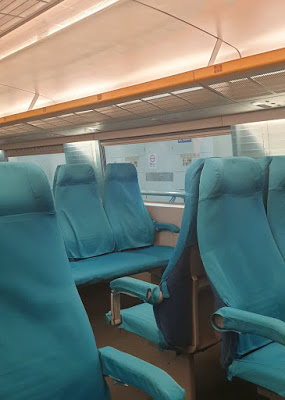
On the train, it has the same sleek look as the bullet trains, but it is completely different, and you are able to see from the front of the train to the back.
Reputed to travel at 431 kph we take a seat and it is not long before the doors shut, and a loud humming noise is soon replaced by what sounds like an engine, then we start moving. It sounds just like a normal train, and is a lot noisier than a normal bullet train.
Seating on the train was nothing special, as one might expect
It didn’t take long before it hits the advertised speed of 431 kph. This is not sustained for very long, because the distance is on 40 odd kilometers, and the whole trip takes about 7 minutes.
We go to the airport, and then we come back. Is it worth the price, yes. If you are a train enthusiast.
50 photographs, 50 stories, of which there is one of the 50 below.
They all start with –
A picture paints … well, as many words as you like. For instance:
And, the story:
Have you ever watched your hopes and dreams simply just fly away?
Everything I thought I wanted and needed had just left in an aeroplane, and although I said I was not going to, i came to the airport to see the plane leave. Not the person on it, that would have been far too difficult and emotional, but perhaps it was symbolic, the end of one life and the start of another.
But no matter what I thought or felt, we had both come to the right decision. She needed the opportunity to spread her wings. It was probably not the best idea for her to apply for the job without telling me, but I understood her reasons.
She was in a rut. Though her job was a very good one, it was not as demanding as she had expected, particularly after the last promotion, but with it came resentment from others on her level, that she, the youngest of the group would get the position.
It was something that had been weighing down of her for the last three months, and if noticed it, the late nights, the moodiness, sometimes a flash of temper. I knew she had one, no one could have such red hair and not, but she had always kept it in check.
And, then there was us, together, and after seven years, it felt like we were going nowhere. Perhaps that was down to my lack of ambition, and though she never said it, lack of sophistication. It hadn’t been an issue, well, not until her last promotion, and the fact she had to entertain more, and frankly I felt like an embarrassment to her.
So, there it was, three days ago, the beginning of the weekend, and we had planned to go away for a few days and take stock. We both acknowledged we needed to talk, but it never seemed the right time.
It was then she said she had quit her job and found a new one. Starting the following Monday.
Ok, that took me by surprise, not so much that it something I sort of guessed might happen, but that she would just blurt it out.
I think that right then, at that moment, I could feel her frustration with everything around her.
What surprised her was my reaction. None.
I simply asked where who, and when.
A world-class newspaper, in New York, and she had to be there in a week.
A week.
It was all the time I had left with her.
I remember I just shrugged and asked if the planned weekend away was off.
She stood on the other side of the kitchen counter, hands around a cup of coffee she had just poured, and that one thing I remembered was the lone tear that ran down her cheek.
Is that all you want to know?
I did, yes, but we had lost that intimacy we used to have when she would have told me what was happening, and we would have brainstormed solutions. I might be a cabinet maker but I still had a brain, was what I overheard her tell a friend once.
There’s not much to ask, I said. You’ve been desperately unhappy and haven’t been able to hide it all that well, you have been under a lot of pressure trying to deal with a group of troglodytes, and you’ve been leaning on Bentley’s shoulder instead of mine, and I get it, he’s got more experience in that place, and the politics that go with it, and is still an ally.
Her immediate superior and instrumental in her getting the position, but unlike some men in his position he had not taken advantage of a situation like some men would. And even if she had made a move, which I doubted, that was not the sort of woman she was, he would have politely declined.
One of the very few happily married men in that organisation, so I heard.
So, she said, you’re not just a pretty face.
Par for the course for a cabinet maker whose university degree is in psychology. It doesn’t take rocket science to see what was happening to you. I just didn’t think it was my place to jump in unless you asked me, and when you didn’t, well, that told me everything I needed to know.
Yes, our relationship had a use by date, and it was in the next few days.
I was thinking, she said, that you might come with me, you can make cabinets anywhere.
I could, but I think the real problem wasn’t just the job. It was everything around her and going with her, that would just be a constant reminder of what had been holding her back. I didn’t want that for her and said so.
Then the only question left was, what do we do now?
Go shopping for suitcases. Bags to pack, and places to go.
Getting on the roller coaster is easy. On the beginning, it’s a slow easy ride, followed by the slow climb to the top. It’s much like some relationships, they start out easy, they require a little work to get to the next level, follows by the adrenaline rush when it all comes together.
What most people forget is that what comes down must go back up, and life is pretty much a roller coaster with highs and lows.
Our roller coaster had just come or of the final turn and we were braking so that it stops at the station.
There was no question of going with her to New York. Yes, I promised I’d come over and visit her, but that was a promise with crossed fingers behind my back. After a few months in t the new job the last thing shed want was a reminder of what she left behind. New friends new life.
We packed her bags, three out everything she didn’t want, a free trips to the op shop with stiff she knew others would like to have, and basically, by the time she was ready to go, there was nothing left of her in the apartment, or anywhere.
Her friends would be seeing her off at the airport, and that’s when I told her I was not coming, that moment the taxi arrived to take her away forever. I remember standing there, watching the taxi go. It was going to be, and was, as hard as it was to watch the plane leave.
So, there I was, finally staring at the blank sky, around me a dozen other plane spotters, a rather motley crew of plane enthusiasts.
Already that morning there’s been 6 different types of plane depart, and I could hear another winding up its engines for take-off.
People coming, people going.
Maybe I would go to New York in a couple of months, not to see her, but just see what the attraction was. Or maybe I would drop in, just to see how she was.
As one of my friends told me when I gave him the news, the future is never written in stone, and it’s about time you broadened your horizons.
This book has been written for some time and the manuscript was sitting in a box with half a dozen others gathering dust and not quite as complete, so this month it is going to get the makeover, a first draft for the editor.
And so it begins…
…
Just crossed the finish line
…
That’s it for another edition.
67,941 words written, but if I sat down now to contemplate what I’ve just done, the post-it notes would get in the way.
Oh, there was so much revision to do!
But, at least I managed to revise a complete novel in a month which is what I try to do each year, and then worry about editing and refining the next work in progress for the next eleven.
Not looking forward to that job, no sir.
Of course, the ending is nothing like what I envisioned the first time around, but when does it ever once the characters take over.
Until November for the next new novel, or something momentous, I bid you all a good night.
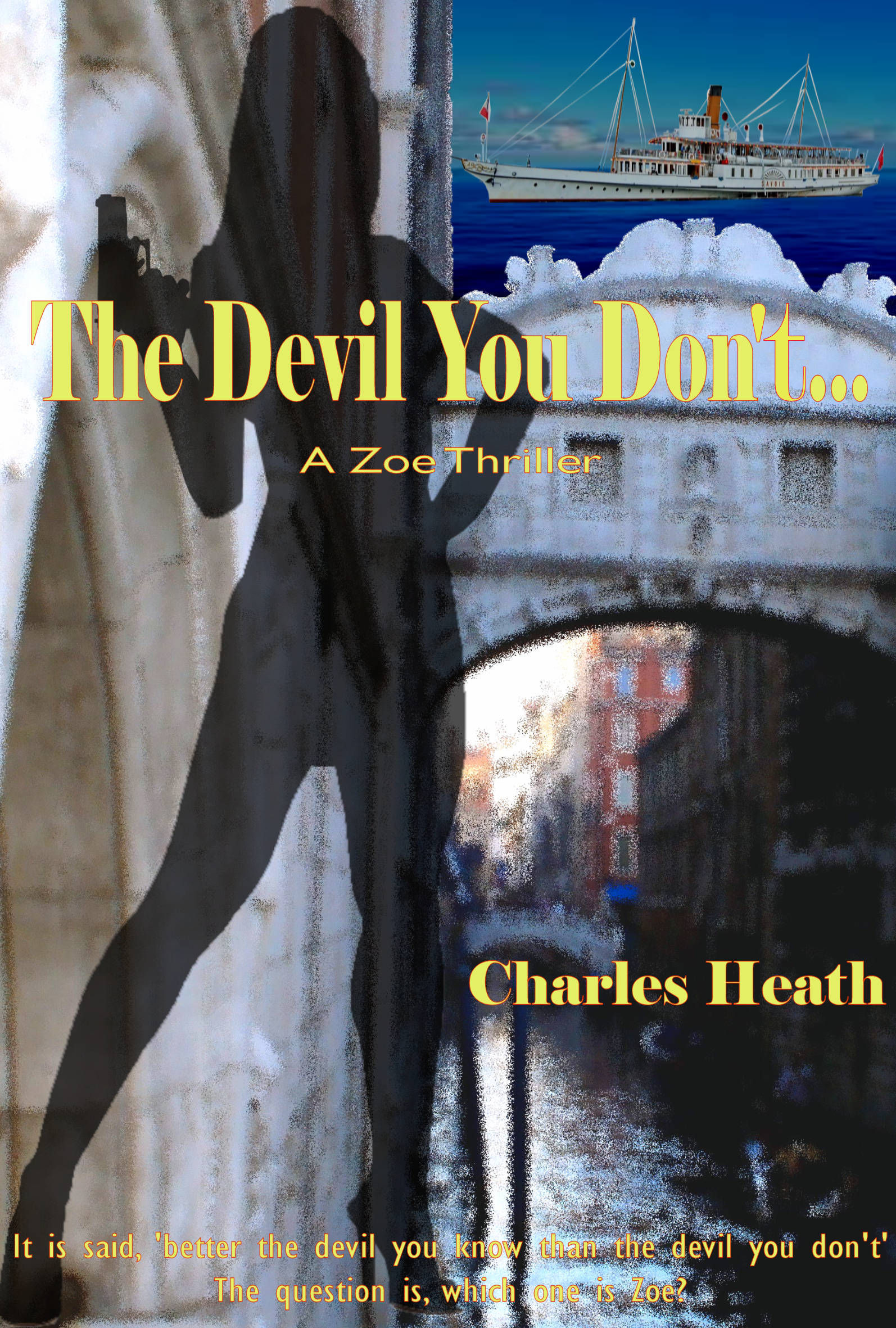
It could be said that of all the women one could meet, whether contrived or by sheer luck, what are the odds it would turn out to be the woman who was being paid a very large sum to kill you.
John Pennington is a man who may be lucky in business, but not so lucky in love. He has just broken up with Phillipa Sternhaven, the woman he thought was the one, but relatives and circumstances, and perhaps because she was a ‘princess’, may also have contributed to the end result.
So, what do you do when you are heartbroken?
That is a story that slowly unfolds, from the first meeting with his nemesis on Lake Geneva, all the way to a hotel room in Sorrento, where he learns the shattering truth.
What should have been solace after disappointment, turns out to be something else entirely, and from that point, everything goes to hell in a handbasket.
He suddenly realizes his so-called friend Sebastian has not exactly told him the truth about a small job he asked him to do, the woman he is falling in love with is not quite who she says she is, and he is caught in the middle of a war between two men who consider people becoming collateral damage as part of their business.
The story paints the characters cleverly displaying all their flaws and weaknesses. The locations add to the story at times taking me back down memory lane, especially to Venice where, in those back streets I confess it’s not all that hard to get lost.
All in all a thoroughly entertaining story with, for once, a satisfying end.