An excerpt from “Mistaken Identity” – a work in progress

The odds of any one of us having a doppelganger are quite high. Whether or not you got to meet him or her, or be confronted by them was significantly lower. Except of course, unless you are a celebrity.

It was a phenomenon remarkable only for the fact, at times, certain high-profile people, notorious or not, had doubles if only to put off enemies or the general public. Sometimes we see people in the street, people who look like someone we knew, and made the mistake of approaching them like a long lost friend, only to discover an embarrassed individual desperately trying to get away for what they perceive is a stalker or worse.

And then sometimes it is a picture that looms up on a TV screen, an almost exact likeness of you. At first, you are fascinated, and then according to the circumstances, and narrative that is attached to that picture, either flattered or horrified.

For me one turned to the other when I saw an almost likeness of me flash up on the screen when I turned the TV on in my room. What looked to be my photo, with only minor differences, was in the corner of the screen, the newsreader speaking in rapid Italian, so fast I could only translate every second or third word.

But the one word I did recognize was murder. The photo of the man up on the screen was the subject of an extensive manhunt. The crime, the murder of a woman in the very same hotel I was staying, and it was being played out live several floors above me. The gist of the story, the woman had been seen with, and staying with the man who was my double, and, less than an hour ago, the body had been discovered by a chambermaid.

The killer, the announcer said, was believed to be still in the hotel because the woman had died shortly before she had been discovered.

I watched, at first fascinated at what I was seeing. I guess I should have been horrified, but at that moment it didn’t register that I might be mistaken for that man.

Not until another five minutes had passed, and I was watching the police in full riot gear, with a camera crew following behind, coming up a passage towards a room. Live action of the arrest of the suspected killer the breathless commentator said.

Then, suddenly, there was a pounding on the door. On the TV screen, plain to see, was the number of my room.
I looked through the peephole and saw an army of police officers. It didn’t take much to realize what had happened. The hotel staff identified me as the man in the photograph on the TV and called the police.

Horrified wasn’t what I was feeling right then.

It was fear.

My last memory was the door crashing open, the wood splintering, and men rushing into the room, screaming at me, waving guns, and when I put my hands up to defend myself, I heard a gunshot.

And in one very confused and probably near-death experience, I thought I saw my mother and thought what was she doing in Rome?

…

I was the archetypal nobody.

I lived in a small flat, I drove a nondescript car, had an average job in a low profile travel agency, was single, and currently not involved in a relationship, no children, and according to my workmates, no life.

They were wrong. I was one of those people who preferred their own company, I had a cat, and travelled whenever I could. And I did have a ‘thing’ for Rosalie, one of the reasons why I stayed at the travel agency. I didn’t expect anything to come of it, but one could always hope.

I was both pleased and excited to be going to the conference. It was my first, and the glimpse I had seen of it had whetted my appetite for more information about the nuances of my profession.

Some would say that a travel agent wasn’t much of a job, but to me, it was every bit as demanding as being an accountant or a lawyer. You were providing a customer with a service, and arguably more people needed a travel agent than a lawyer. At least that was what I told myself, as I watched more and more people start using the internet, and our relevance slowly dissipating.

This conference was about countering that trend.

The trip over had been uneventful. I was met at the airport and taken to the hotel where the conference was being held with a number of other delegates who had arrived on the same plane. I had mingled with a number of other delegates at the pre conference get together, including one whose name was Maryanne.

She was an unusual young woman, not the sort that I usually met, because she was the one who was usually surrounded by all the boys, the life of the party. In normal circumstances, I would not have introduced myself to her, but she had approached me. Why did I think that may have been significant? All of this ran through my mind, culminating in the last event on the highlight reel, the door bursting open, men rushing into my room, and then one of the policemen opened fire.

I replayed that last scene again, trying to see the face of my assailant, but it was just a sea of men in battle dress, bullet proof vests and helmets, accompanied by screaming and yelling, some of which I identified as “Get on the floor”.

Then came the shot.

Why ask me to get on the floor if all they were going to do was shoot me. I was putting my hands up at the time, in surrender, not reaching for a weapon.

Then I saw the face again, hovering in the background like a ghost. My mother. Only the hair was different, and her clothes, and then the image was going, perhaps a figment of my imagination brought on by pain killing drugs. I tried to imagine the scene again, but this time it played out, without the image of my mother.

I opened my eyes took stock of my surroundings. What I felt in that exact moment couldn’t be described. I should most likely be dead, the result of a gunshot wound. I guess I should be thankful the shooter hadn’t aimed at anything vital, but that was the only item on the plus side.

I was in a hospital room with a policeman by the door. He was reading a newspaper, and sitting uncomfortably on a small chair. He gave me a quick glance when he heard me move slightly, but didn’t acknowledge me with either a nod, or a greeting, just went back to the paper.

If I still had a police guard, then I was still considered a suspect. What was interesting was that I was not handcuffed to the bed. Perhaps that only happened in TV shows. Or maybe they knew I couldn’t run because my injuries were too serious. Or the guard would shoot me long before my feet hit the floor. I knew the police well enough now to know they would shoot first and ask questions later.

On the physical side, I had a large bandage over the top left corner of my chest, extending over my shoulder. A little poking and prodding determined the bullet had hit somewhere between the top of my rib cage and my shoulder. Nothing vital there, but my arm might be somewhat useless for a while, depending on what the bullet hit on the way in, or through.

It didn’t feel like there were any broken or damaged bones.

That was the good news.

On the other side of the ledger, my mental state, there was only one word that could describe it. Terrified. I was looking at a murder charge and jail time, a lot of it. Murder usually had a long time in jail attached to it.

Whatever had happened, I didn’t do it. I know I didn’t do it, but I had to try and explain this to people who had already made up their minds. I searched my mind for evidence. It was there, but in the confused state brought on by the medication, all I could think about was jail, and the sort of company I was going to have.

I think death would have been preferable.

…

Half an hour later, maybe longer, I was drifting in an out of consciousness, a nurse, or what I thought was a nurse, came into the room. The guard stood, checked her ID card, and then stood by the door.

She came over and stood beside the bed. “How are you?” she asked, first in Italian, and when I pretended I didn’t understand, she asked the same question in accented English.

“Alive, I guess,” I said. “No one has come and told what my condition is yet. You are my first visitor. Can you tell me?”

“Of course. You are very lucky to be alive. You will be fine and make a full recovery. The doctors here are excellent at their work.”

“What happens now?”

“I check you, and then you have a another visitor. He is from the British Embassy I think. But he will have to wait until I have finished my examination.”

I realized then she was a doctor, not a nurse.

…

My second visitor was a man, dressed in a suit the sort of which I associated with the British Civil Service.  He was not very old which told me he was probably a recent graduate on his first posting, the junior officer who drew the short straw.

The guard checked his ID but again did not leave the room, sitting back down and going back to his newspaper.

My visitor introduced himself as Alex Jordan from the British Embassy in Rome and that he had been asked by the Ambassador to sort out what he labelled a tricky mess.

For starters, it was good to see that someone cared about what happened to me.  But, equally, I knew the mantra, get into trouble overseas, and there is not much we can do to help you.  So, after that lengthy introduction, I had to wonder why he was here.

I said, “They think I am an international criminal by the name of Jacob Westerbury, whose picture looks just like me, and apparently for them it is an open and shut case.”  I could still hear the fragments of the yelling as the police burst through the door, at the same time telling me to get on the floor with my hands over my head.

“It’s not.  They know they’ve got the wrong man, which is why I’m here.  There is the issue of what had been described as excessive force, and the fact you were shot had made it an all-round embarrassment for them.”

“Then why are you here?  Shouldn’t they be here apologizing?”

“That is why you have another visitor.  I only took precedence because I insisted I speak with you first.  I have come, basically to ask you for a favour.  This situation has afforded us with an opportunity.  We would like you to sign the official document which basically indemnifies them against any legal proceedings.”

Curious.  What sort of opportunity was he talking about?  Was this a matter than could get difficult and I could be charged by the Italian Government, even if I wasn’t guilty, or was it one of those hush hush type deals, you do this for us, we’ll help you out with that.  “What sort of opportunity?”

“We want to get our hands on Jacob Westerbury as much as they do.  They’ve made a mistake, and we’d like to use that to get custody of him if or when he is arrested in this country.  I’m sure you would also like this man brought into custody as soon as possible so you will stop being confused with him.  I can only imagine what it was like to be arrested in the manner you were.  And I would not blame you if you wanted to get some compensation for what they’ve done.  But.  There are bigger issues in play here, and you would be doing this for your country.”

I wondered what would happen if I didn’t agree to his proposal.  I had to ask, “What if I don’t?”

His expression didn’t change.  “I’m sure you are a sensible man Mr Pargeter, who is more than willing to help his country whenever he can.  They have agreed to take care of all your hospital expenses, and refund the cost of the Conference, and travel.  I’m sure I could also get them to pay for a few days at Capri, or Sorrento if you like, before you go home.  What do you say?”

There was only one thing I could say.  Wasn’t it treason if you went against your country’s wishes?

“I’m not an unreasonable man, Alex.  Go do your deal, and I’ll sign the papers.”

“Good man.”

…

After Alex left, the doctor came back to announce the arrival of a woman, by the way she had announced herself, the publicity officer from the Italian police. When she came into the room, she was not dressed in a uniform.

The doctor left after giving a brief report to the civilian at the door. I understood the gist of it, “The patient has recovered excellently and the wounds are healing as expected. There is no cause for concern.”

That was a relief.

While the doctor was speaking to the civilian, I speculated on who she might be. She was young, not more than thirty, conservatively dressed so an official of some kind, but not necessarily with the police. Did they have prosecutors? I was unfamiliar with the Italian legal system.

She had long wavy black hair and the sort of sultry looks of an Italian movie star, and her presence made me more curious than fearful though I couldn’t say why.

The woman then spoke to the guard, and he reluctantly got up and left the room, closing the door behind him.
She checked the door, and then came back towards me, standing at the end of the bed. Now alone, she said, “A few questions before we begin.” Her English was only slightly accented. “Your name is Jack Pargeter?”

I nodded. “Yes.”

“You are in Rome to attend the Travel Agents Conference at the Hilton Hotel?”

“Yes.”

“You attended a preconference introduction on the evening of the 25th, after arriving from London at approximately 4:25 pm.”

“About that time, yes. I know it was about five when the bus came to collect me, and several others, to take us to the hotel.”

She smiled. It was then I noticed she was reading from a small notepad.

“It was ten past five to be precise. The driver had been held up in traffic. We have a number of witnesses who saw you on the plane, on the bus, at the hotel, and with the aid of closed circuit TV we have established you are not the criminal Jacob Westerbury.”

She put her note book back in her bag and then said, “My name is Vicenza Andretti and I am with the prosecutor’s office. I am here to formally apologize for the situation that can only be described as a case of mistaken identity. I assure you it is not the habit of our police officers to shoot people unless they have a very strong reason for doing so. I understand that in the confusion of the arrest one of our officers accidentally discharged his weapon. We are undergoing a very thorough investigation into the circumstances of this event.”

I was not sure why, but between the time I had spoken to the embassy official and now, something about letting them off so easily was bugging me. I could see why they had sent her. It would be difficult to be angry or annoyed with her.

But I was annoyed.

“Do you often send a whole squad of trigger happy riot police to arrest a single man?” It came out harsher than I intended.

“My men believed they were dealing with a dangerous criminal.”

“Do I look like a dangerous criminal?” And then I realized if it was mistaken identity, the answer would be yes.

She saw the look on my face, and said quietly, “I think you know the answer to that question, Mr. Pargeter.”

“Well, it was overkill.”

“As I said, we are very sorry for the circumstances you now find yourself in. You must understand that we honestly believed we were dealing with an armed and dangerous murderer, and we were acting within our mandate. My department will cover your medical expenses, and any other amounts for the inconvenience this has caused you. I believe you were attending a conference at your hotel. I am very sorry but given the medical circumstances you have, you will have to remain here for a few more days.”

“I guess, then, I should thank you for not killing me.”

Her expression told me that was not the best thing I could have said in the circumstances.

“I mean, I should thank you for the hospital and the care. But a question or two of my own. May I?”

She nodded.

“Did you catch this Jacob Westerbury character?”

“No. In the confusion created by your arrest he escaped. Once we realized we had made a mistake and reviewed the close circuit TV, we tracked him leaving by a rear exit.”

“Are you sure it was one of your men who shot me?”

I watched as her expression changed, to one of surprise.

“You don’t think it was one of my men?”

“Oddly enough no. But don’t ask me why.”

“It is very interesting that you should say that, because in our initial investigation, it appeared none of our officer’s weapons had been discharged. A forensic investigation into the bullet tells us it was one that is used in our weapons, but…”

I could see their dilemma.

“Have you any enemies that would want to shoot you Mr Pargeter?”

That was absurd because I had no enemies, at least none that I knew of, much less anyone who would want me dead.

“Not that I’m aware of.”

“Then it is strange, and will perhaps remain a mystery. I will let you know if anything more is revealed in our investigation.”

She took an envelope out of her briefcase and opened it, pulling out several sheets of paper.

I knew what it was. A verbal apology was one thing, but a signed waiver would cover them legally. They had sent a pretty girl to charm me. Perhaps using anyone else it would not have worked. There was potential for a huge litigation payout here, and someone more ruthless would jump at the chance of making a few million out of the Italian Government.

“We need a signature on this document,” she said.

“Absolving you of any wrong doing?”

“I have apologized. We will take whatever measures are required for your comfort after this event. We are accepting responsibility for our actions, and are being reasonable.”

They were. I took the pen from her and signed the documents.

“You couldn’t add dinner with you on that list of benefits?” No harm in asking.

“I am unfortunately unavailable.”

I smiled. “It wasn’t a request for a date, just dinner. You can tell me about Rome, as only a resident can. Please.”

She looked me up and down, searching for the ulterior motive. When she couldn’t find one, she said, “We shall see once the hospital discharges you in a few days.”

“Then I’ll pencil you in?”

She looked at me quizzically. “What is this pencil me in?”

“It’s an English colloquialism. It means maybe. As when you write something in pencil, it is easy to erase it.”

A momentary frown, then recognition and a smile. “I shall remember that. Thank-you for your time and co-operation Mr. Pargeter. Good morning.”

…

© Charles Heath 2015-2021

Once Upon a Time… – A short story

Everyone knows someone who has a child that will not go to sleep.

You can set the bedtime at whatever early hour you like, but by the time they actually fall asleep, there have been two or three hours of up and down, in and out of bed, and at least one episode of a scary master lurking under the bed, or, worse, outside the window.

After exhausting every method of achieving a result and failing, I thought I’d try reading.

The first book I picked up was, yes, you guessed it, about monsters. In fact, nearly every book for kids was about monsters, witches, ogres, dragons, and vampires.

I put them back and sighed. I would have to come up with a story of my own.

It started with, “Once upon a time…”

“But that,” May said, “only applies to fairy tales.”

“Well, this is going to be a fairy tale of sorts. Minus the fire-breathing dragons, and nasty trolls under drawbridges.”

“It’s not going to be much of a story, then. In fairy tales, there’s always a knight who slays the dragon and rides off with the princess.”

This was going to be a tough ask. I thought of going back to the book pile, but, then, I could do this.

“So,” I began again, “Once upon a time there was a princess, who lived in a castle with her father, the king, her mother, the queen, and her brother, the steadfast and trusty knight in shining armour.”

“Why is their armour always shining?”

I was going to tell her to save the questions until after the story, by which time I had hoped I’d bored her enough to choose sleep over criticism. I was wrong.

“Because a knight always has to have shiny armour, otherwise the king would be disappointed.”

“Does the knight spend all night shining his armour?”

“No. He has an apprentice who cleans the armor, and attends to anything else the knight needs.”

“And then he becomes a knight?”

“In good time. The apprentice is usually a boy of about 11 or 12 years old. First, he learns what it means to be a knight, then he has to do years of training until he comes of age.” I saw the question coming, and got in first, “When he is about 21 years old.”

She looked at me, and that meant I had to continue the story.

“The princess was very lucky and lived a very different life than her subjects, except she wished she had their freedom to play, and do ordinary things like cooking or collecting food from the markets. Because she was a princess, she had to stay in the castle, and spend most of her time learning how to be a princess, and a queen, because when it was time, she would marry a prince who would become a king.”

“Doesn’t sound too lucky to me, being stuck as home. I like the idea of getting somebody to do everything for me though. She does have maids, doesn’t she?”

“Yes. And, you’re right, she has everything done for her, including getting dressed. A maid to clean, a maid to dress her, a maid to bring her snacks. And it was these maids she envied.”

Maybe I should not make the story too interesting, or she’ll never go to sleep.

“Well, one day, she decided to change places with one of her maids. They were almost identical and when they exchanged clothes, the other maids could not tell they had changed places. At the end of the day, when the maids went home, the princess headed to the house where the maid she had taken the place of lived.

It was very different from the castle, and the room she usually had. The mother was at home, cooking the food for the evening meal, and it was nothing like what she usually had. A sort of soup with scraps of meat in it. There was a loaf of bread on the table. The father came home after working all day in the fields, very tired. They ate and then went to bed. Her bed was straw and a piece of cloth that hardly covered her. At least, by the fire, it was warm. It didn’t do anything for the pangs of hunger because there had barely been enough for all of them.

The next morning she returned to the castle and changed places back again. When the maid she changed places with asked about her experience of what it was like in their life, the princess said she was surprised. She had never been told about how the people who served the king lived, and she had assumed that they were well looked after. Now she had experienced what it was like to be a subject, she was going to investigate it further.

After all, she told the maid, I have to have all the facts if I’m going to approach the king.

And she thought to herself, a lot more courage than she had.

But, instead of lessons today, she was going to demand to be taken on a tour outside the castle and to see the people.

“This sounds like it’s not going to have a happy ending.”

No, I thought. Maybe I’ll get the dragon that her brother failed to slay to eat her.

“It will. Patience. But that’s enough for tonight. If you want to know what happens, you’ll have to go to sleep and then, tomorrow night, the story continues.”

I tucked her in, turned down the night light so it was only a glow, just enough to see where I was going, and left.

If I was lucky she would go to sleep. The only problem was, I had to come up with more of the story.

Outside the door, her mother, Christine, was smiling. “Since when did you become an expert on Princesses?”

“When I married one.”

—-

© Charles Heath 2020-2023

Monday, Monday…

It was a song, sung by the Mommas and Papas I think.  I suspect that will show my age.

I don’t like Mondays – another song, not sure who sang it.

Well, it’s official, I don’t like Mondays.

I’ve been procrastinating since last Thursday, telling myself I have to get the next part of one of my stories written, but I keep putting it off.  I have to go to Africa, the Niger Delta to be exact.  It can wait, I’m not ready for the steaming jungle and hostile villagers yet.

I didn’t do anything on Sunday, and, as a writer, I guess that’s not very good.  I’m supposed to be writing a page, or a hundred or thousand words a day, just to keep the juices flowing.

I’m not in the mood.  I sit and stare at the computer screen, and nothing is coming.  Is this the first sign of writer’s block?

I dig out several articles on how to overcome it, and start putting their suggestions into action.  No.  No.  Maybe.  No.  I don’t think it’s writer’s block.

Perhaps I need some inspiration so I go to my tablet playlist, and spend 10 minutes trying to find the headphones carelessly discarded by one of my grandchildren the last time they were here.

And, yes, the tablet was left in the middle of playing a Minecraft video which drained the battery.  Now I can’t find the charger!

Back at the computer, holding a dead tablet, and a pair of headphones, inspiration is as far away as the mythical light at the end of the tunnel.  Today it is an oncoming express train.
Perhaps a pen and paper will work.

An idea pops into my head ….

Is it possible the passing of a weekend could change the course of your life?  An interesting question, one to ponder as I sat on the floor of a concrete cell, with only the sound of my breathing, and the incessant screams coming from a room at the end of the corridor.

It was my turn next.  That was what the grinning ape of a guard said in broken English.  He looked like a man who relished his job.

What goes through your mind at a time like this, waiting, waiting for the inevitable?  Will I survive, what will they do to me, will it hurt?

The screaming stops abruptly, and a terrible silence falls over the facility.

Then, looking in the direction of where the screams had come from, I hear the clunk of the door latch being opened, and then the slow nerve-tingling screech of rusty metal as the door opens slowly.

Oh God, Oh God, Oh God, no.

No writer’s block.  But I have to stop watching late-night television

The cinema of my dreams – I always wanted to see the planets – Episode 51

We have a possible situation

…

I was walking slowly along the passage leading to the elevator on my way back to the bridge when the First Officer’s voice broke my thoughts.

“Captain?”

“Number one?”

“Could you come to the bridge; we have a possible situation.”

“On my way.”

A ‘possible situation’ for Number One that could mean almost anything, from an engineering calamity to a standoff with 100 alien battleships.  I was hoping for the calamity in engineering.

When I arrived on the bridge it was calm.  Was I expecting panic?

Number one stood, relinquishing the captain’s chair.

“On screen,” he said as I crossed the deck to join him.

A magnified vision of three alien spaceships appeared ahead.

“Between us and the Princesses home planet.  If we can see them, they can see us.  I suspect they knew we were coming.  I’ve slowed down to give us some preparation time.”

Of course.  Given her reservations about going home, the time she’d been away, the fact she had been living with the enemy, and the changing of power, it was not dissimilar to events that had happened through history on our own homework.

Was it too much to expect things would be different, and better than what we had?

“What do you think, friendly or hostile?”

“We should treat every encounter as hostile until proven otherwise.  A friendly response would not be three ships blocking our path.”

My sentiments exactly.  “General and team to the bridge.”

A few seconds later, “Acknowledged.”

“How far away are they?”

“We could be there in 30 minutes,” the navigator said.

“Can we scan for life signs, weapons, anything?”

“Not until we’re closer.  From here all we can see is their ships.”

The General and three others that made up his bridge attack team arrived on the bridge.

“What do we have?” He asked as he crossed to his station.

“Three ships waiting for us.”

“Same as the last vessel we encountered?”

“We have to get closer.  You better get ready for a fight.  I don’t think these people are going to be as friendly as the others.”

“You have information on these people.”

“Only from what the princess told me.  They have been constantly at war with themselves and others, with ever-changing governments.”  It had painted an interesting picture and one that might leave them battle-hardened or battle weary.

“Same old same old then.” 

It was, at times, no different from where we came.  Even with lessons learned from the past we still had pockets of war between stronger and weaker countries, these days mostly over dwindling resources.

“Let’s just hope their weapons are not superior to ours.”  It was a thought that I should have kept to myself.

“I’m sure we are as well-equipped as we possibly can be, given we had no idea if or what we would or could be up against.  The weapons are far superior to anything we have back home.”

Which had been the reason why in the first instance we didn’t know about, and once out here, could not get close enough back in each orbit to use them.  Our masters had theoretically considered everything.

Those weapons included nuclear-tipped torpedoes designed to travel through space, high-intensity laser beams that would cut through almost anything, including the alien alloy that this ship was constructed of, and a defensive tool, the ability to absorb shock waves and explosions and laser beams, what might be called shields.

The limited tests back home showed they worked, but out here in space against aliens with superior technology, w we were you to prove their worth.

Perhaps today would be the day.

“You have the bridge Number one.  Stay on course and speed and let me know when we are either hailing range.”

That would give me about a half hour.  I had more questions for the princess.

…

© Charles Heath 2021-2022

“Betrayal” – the penultimate final draft – Day 8

I’m sure I’ve been down this road more than once, and with the same novel, but whereas the last edit, which was probably the second or third, finished up in the pile, then forgotten.

I’m doing an active update to all my works in progress, and sending them to the editor, after going through the manuscript once again, with a view to publishing.  Hopefully, before the year is out.

…

Ideas are muddying the plan.

As the story progresses through part two, the anticipated conclusion to this part has changed a little.

This then makes the lead into part three a lot more cohesive in terms of teasing out the storyline in the direction I was hoping to take.

The problem is that I had made a start on the first chapter of part three originally but as I recall, it wasn’t quite running as smoothly as it should.  You know the feeling, the words are there, but you’re not very satisfied with them.

Now I am.

This means that chapters two and three will follow without any apprehension.

However, I am getting a little ahead of myself because I still have to finish of the last two chapters of part two.

So, it’s back to work.

Searching for locations: Driving in ice and snow, Canada

This morning started with a visit to the car rental place in Vancouver.  It reinforced the notion that you can be given the address and still not find the place.  It happened in Washington where it was hiding in the back of the main railway station, and it happened again in Vancouver when it was hidden inside a hotel.

We simply walked straight past it.  Pity there wasn’t a sign to let people know.

However…

We went in expecting a Grand Jeep Cherokee and walked out with a Ford Flex, suitable for three people and four large suitcases.  It actually seats 7, but forget the baggage, you’d be lucky to get two large suitcases in that configuration.

It is more than adequate for our requirements.

Things to note, it was delivered with just over a quarter of a tank of gas, and it had only done about 11,000 km, so it’s relatively new.  It’s reasonably spacious, and when the extra seats are folded down, there is plenty of baggage space.

So far, so good.

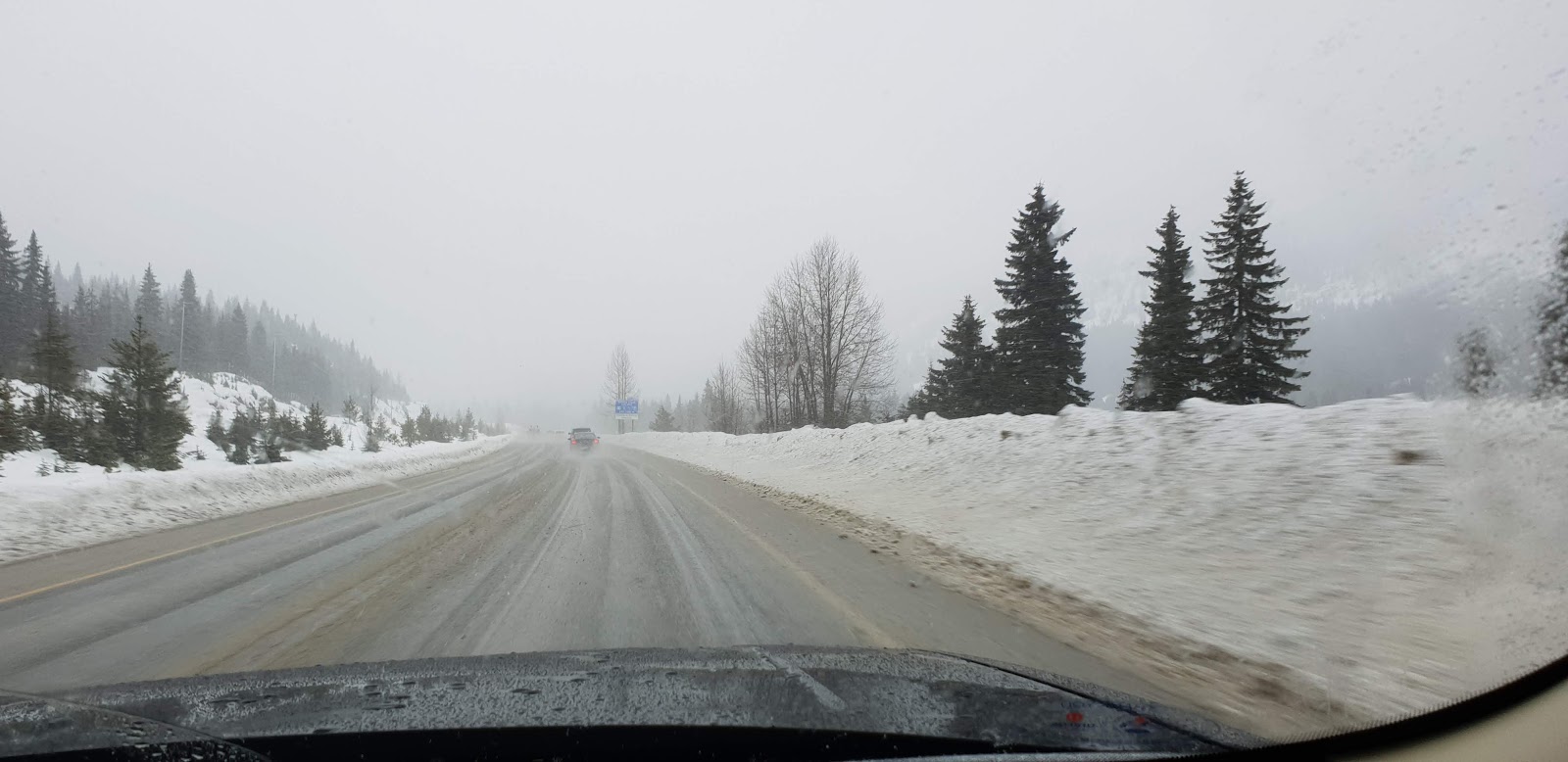
We finally leave the hotel at about half-past ten, and it is raining.  It is a simple task to get on Highway 1, the TransCanada Highway, initially, and then onto Highway 5, the Coquihalla Highway for the trip to Kamloops.

It rains all the way to the top of the mountain, progress hampered from time to time by water sprays from both vehicles and trucks.  The rain is relentless.  At the top of the mountain, the rain turns into snow and the road surface to slush.  It’s 0 degrees, but being the afternoon, I was not expecting it to turn to ice very quickly.

On the other side of the mountain, closer to Kamloops, there was sleet, then rain, then nothing, the last 100kms or so, in reasonably dry conditions.

Outside Kamloops, and in the town itself, there was evidence of snow recently cleared, and slushy roads.  Cars in various places were covered in snow, indicating the most recent falls had been the night before.

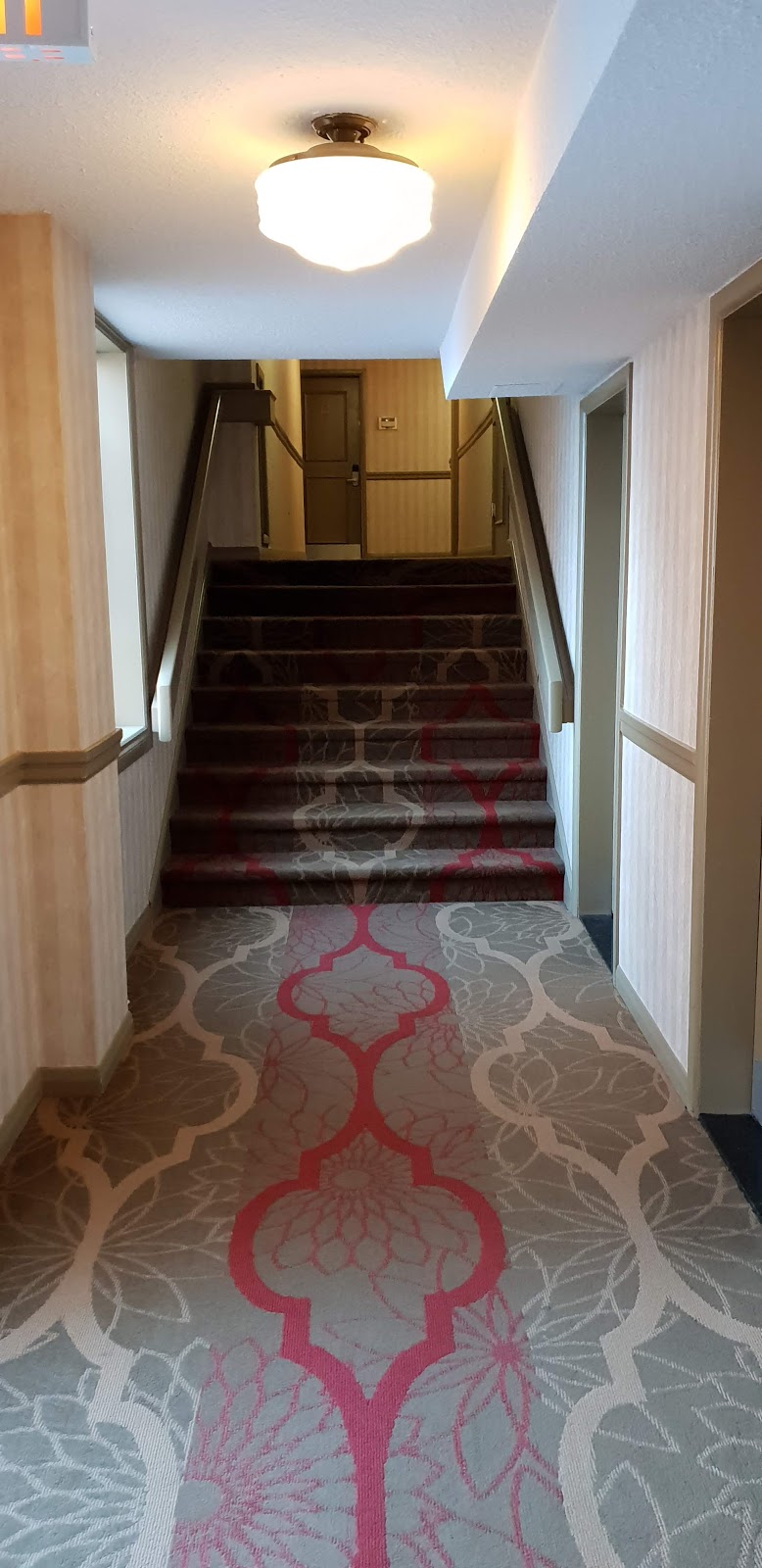
We’re staying at the Park Hotel, a heritage building, apparently built in the later 1920s.  In the style of the time, it is a little like a rabbit warren with passages turning off in a number of directions, and showing it is spread across a number of different buildings.

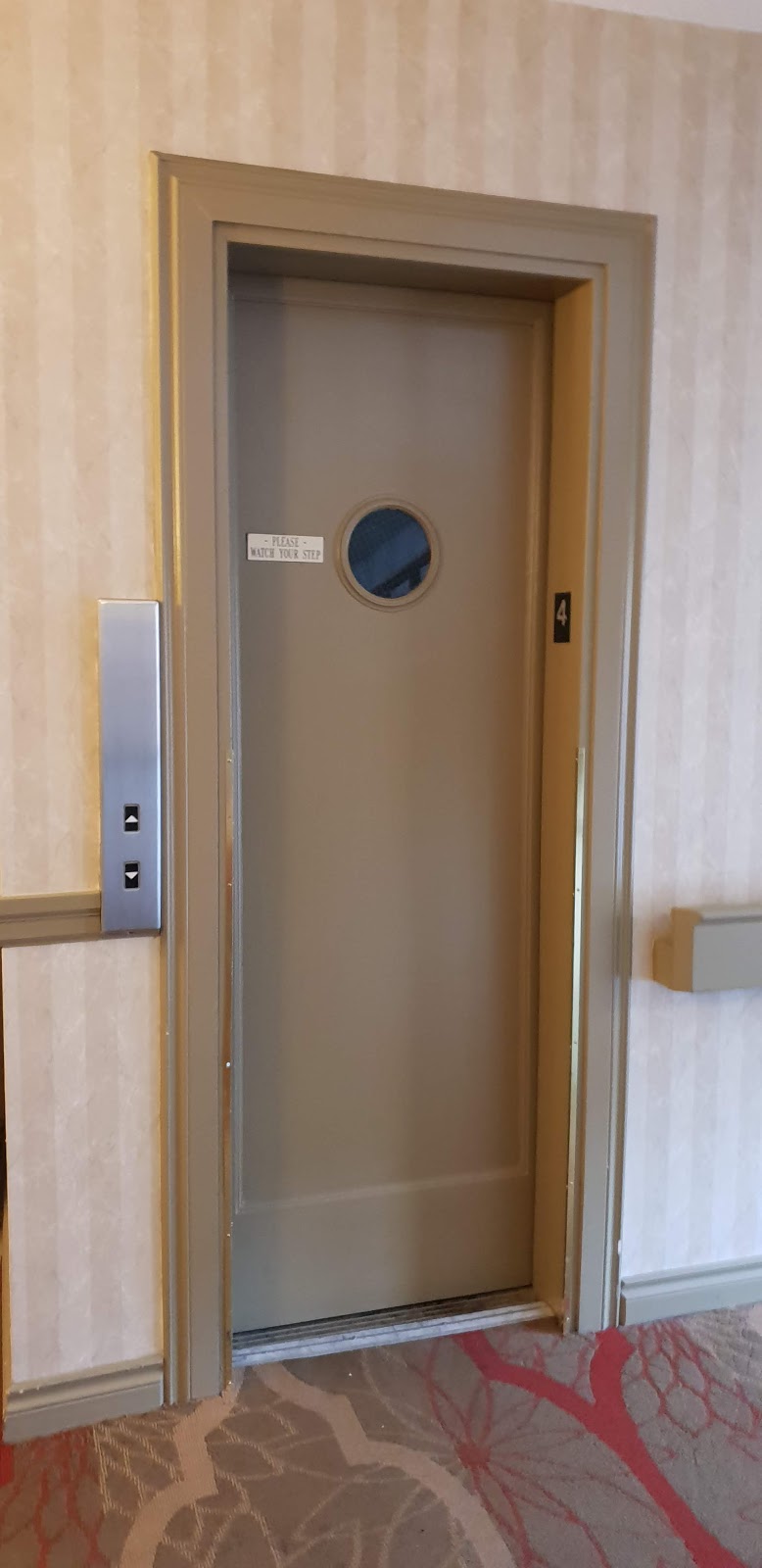
It has the original Otis elevator that can take a maximum of four passengers, and a sign on the wall that says “no horseplay inside the elevator” which is a rather interesting expression that only someone of my vintage would understand.  And, for those without a sense of humor, you definitely couldn’t fit a horse in it to play with.

The thing is, how do you find a balance between keeping the old world charm with modern-day expectations.  You can’t.  Some hotels try valiantly to get that balance.  Here, it is simply old world charm, which I guess we should be grateful for because sooner rather than later it’s going to disappear forever.

In my writer’s mind, given the importance of the railways, this was probably a thriving place for travelers, and once upon a time, there were a lot more hotels like this one.

My cell phone is going off

I’m back to writing, sitting at the desk, pad in front of me, pen in hand.

The only thing lacking, an idea.

It’s 9:03 am, too early to start on a six-pack.

To be honest, the last thing I needed was a distraction, and, having forgotten to put my cell phone on silent, it starts buzzing, indicating there are new messages, or notifications from all those social media sites like Twitter, Facebook, WordPress, Blogger…

Then the advice from all the so-called marketing gurus starts to swirl around in my head, and instead of writing, I’m now fretting over my social media presence.

The more I read the more it bothers me that if I don’t have the right social media presence if I do not start to build an email list, all of my efforts in writing a book will come to naught.

That’s when I start trawling the internet for information on marketing and found a plethora of people offering any amount of advice for anything between a ‘small amount’ to a rather large amount that gives comprehensive coverage of most social media platforms for periods of a day, a week or a month. 

I move on to the people who offer advice for a cost on how to build a following, how to build a web presence, how to get a thousand Twitter followers, how to get thousands of email followers before the launch.

The trouble is I’m writing a novel, not a nonfiction book, or have some marvelous 30-page ebook on how to do something, for free just to drive people to my site.

I’m a novelist, not a handyman so those ideas while good is not going to help me.

Yet another problem to wrestle with along with actually creating a product to sell in the first place.

Except I’m supposed to be writing for the love of it without the premeditated idea of writing for gain or getting rich quick.

What am I missing here?

So should l be writing short stories and offering them for free to drive people to my site?  These would have to be genre-specific so it needs time and effort and fit into a convenient size story that will highlight or showcase my talent.

Some time ago I created a website on one of those so-called free sites, but it’s rather basic and not great. Of course, if I want it to be better, all I have to do is hand over a great wad of money I don’t have to make it better. So much for free!

I don’t think I will have a good night’s sleep again with all of these social media problems I’m having.

Oh well, back to the book.  It’s time to have a nightmare of a different sort!

The cinema of my dreams – It all started in Venice – Episode 19

An interview with Jaime Meyers

…

I went in and closed the door, leaning against it.  She glared at me, for a moment not recognising who it was, then the expression changed.

And it gave me a tell.

“You’re supposed to be in Venice,” she said, with a hint of amusement in her tone.

“You’re not supposed to be in here, and yet here you are.”

“It’s all part of a witch hunt.  We’ve been down this road before, and like the last time, and the time before that, they’ve got nothing on me.  They know it and you should know it too, but if you’re retired, why are you here?”

“Your new best friend forever, Larry.  You know he wants me dead.”

“He says you killed his brother, but he’s never said anything about killing you, just getting justice for his brother.  Through the legal system.”

“Of course he would say that.  I assure you I had nothing to do with his brother’s death but that’s another story.”  I crossed to the chair and sat down taking a moment to look at her.

Drugs, alcohol and stress had taken the shine off what had once been a stunningly beautiful young woman.  The loss of her father and betrayal of her husband had taken their toll.

“If that’s the case perhaps you should tell me what happened so I can make up my own mind.  After all, there are always two sides to a story.”

I shook my head.  “That would be a pointless exercise.  Let’s talk about you instead, and the reason why you’re sitting in that chair.  Larry.  Until you took up with him, we had no idea who you were or what you were doing and had no reason to find out.  Larry, on the other hand, well, he’s shoulder deep in a shit pile of criminal activity, and my old boss, when I used to work for him, is very interested in everyone who even looks sideways at him.  So, bottom line, you’re only here because of him, and because of him I know everything there is to know about.”

“So you say, but there’s nothing to know.  Never was, and Larry is just a friend who’s going through a rough patch.”

“If you mean losing out on a fifty-million pound inheritance because he killed his brother is a rough patch, then your right.”

“I don’t know anything about that.  All I know is his wife is being difficult.”

“That’s the same line all married men use.”

Her expression sharpened conveying annoyance.  “It’s not that sort of relationship.” 

“Not what his wife is telling his mother back in Sorrento.  And that’s saying something considering how much Brenda hates his mother.”

A change in expression.  Another tell, a nerve hit.

“How do I know this?”  I asked the question for her.  “Simple, and perhaps I will give you a side of the story.  His mother crossed paths with one of my investigations back when I worked in intelligence as an analyst and I got to know her quite well.  As a favourable, knowing I was in a position to help, she asked me to watch over his brother, her youngest son.”

I could see the question before she could ask it.

“Before you tell me I didn’t do a very good job, I was at the handoff Larry sent him to that went bad, one he was told would be a simple briefcase exchange, and ended up having to defend him in what became an impossible situation.”

“What was in the briefcases?”

An odd question but I could see from the furrowed brow that she had seized on a significant detail.

“I don’t know and didn’t ask.  In my position, it was better not to know, but you can guess.  I’m sure you are aware of Larry’s interests.”

She didn’t say, but she knew.  My guess had been drugs on one side and money on the other.  It was anything but a simple job and my reasoning was Larry tried to keep it low-key using a lesser-known courier without backup, and someone found out.  With drugs and cask on that scale, it was too much of a temptation to pass up.

“Anyway, he was shot, not fatally, I patched him up, he called Larry and I stayed with him until Larry arrived, but left before Larry saw me, for obvious reasons.  If you talk to his mother she will verify everything I said.  She was still talking to him after I left and up to the point where he could see Larry coming.  After that. He was DOA at the hospital.  You can draw your own conclusions but 50 million is a great incentive to use a particular situation to get rid of a problem.”

“An interesting story, as you say, but I’m not likely to be asking anyone anything because I’m just not interested, in you or him.”

“As I said before, a pointless exercise.  But, interested or not, you will be helping us with our problem with Larry and his explosives.”

“‘I know nothing about that.”

“Well, let’s talk about something you do know about.  Emily Broadhurst, or to Wendy, Aunt May.”

The look on that fraction a second was both malevolent and fearful.

“I don’t know what you’re talking about.”

I shrugged.  “I thought you might say that.”  I took out my cell phone and dialled one of the two numbers displayed.  “Let’s bring them in and have a chat, see what they have to say.”  A voice answered on the other end.  “George.  Bring them in.”

“Stop.”  She glared at her lawyer.  “Give us the room.”

“I strongly suggest…”

“Give me the room.  Your objection is noted.”

Her lawyer reluctantly got up and left the room.  She glared at the policewoman standing by the door.

“Pretend she’s not here,” I said.  “She has to be here for your safety and is the very soul of discretion.”  I looked up at the camera.  “This is not to be recorded or observed, so camera off.”  I waited until the red light below the camera went off.

I could see she was about to say something, more than likely regrettable, but understandable.

“Let me say this before you say something you will regret.  You’ve been lying to me.  I don’t ask questions I don’t have answers to.  Because you started working with Larry, we went the extra mile on your life and operations.  You were there when the crates were delivered, as was Larry himself and he told you what was in there.  So, where there’s one lie, what is there you can say that cannot be taken with a grain of salt.”

“Be that as it may…”

“No.  You are the head of a criminal organisation.  It might be dressed up very cleverly to look like something else, but we have a very clear view of what goes on.  To be honest, we don’t care.  You’re not the focus of my ex-bosses obsession.  And, believe me when I tell you, I don’t like being Larry’s target.”

“Then make him disappear.”

“Unfortunately, despite what you and others might think, we did not unilaterally kill people for no reason, and, even if I still worked for that organisation, I wasn’t able to make people disappear.  The paperwork would be horrendous, along with endless external, internal and government reviews.”

“Then what do you want me to do?  I’m not an informer, nor will I become an informant.”  Spoken by a person who still thought they had a choice.

“You’re going to do what you negotiate with the police, who, despite your endless denials, are aware of the truth.  So, first things first, you are going to ignore Larry, and not proceed with any of the arrangements you may have agreed with him..  You can do that with plausible deniability, telling him leaving C4 in your warehouse was not an act of good faith since the police now want your hide for it.  Once again I will reiterate, I’m not interested in you, and nor is my ex-boss, so you are in a unique position to use whatever knowledge you have as leverage for your freedom.”

“And the matter you brought up?”

“Will never see the light of day, or be mentioned by anyone ever again.  Unless you break our agreement.  I used to have the best investigative team on the planet, and they can find anyone or anything, so if you’re thinking of running, don’t.  My ex-boss will have no hesitation in destroying you and your organisation.”

“And yet you say you work for no one.”

“Haven’t for years.  I retired and hope to stay that way, but my wife died, and Larry decided to come after me.  At the moment I don’t have much to live for, so if you want to get in my bad books, believe me you’ll not live to regret it.  When I walk out of this room, don’t get in my sights.”

“And why should I take you at your word?”

“I swear it on my wife’s grave.  Good enough?”

It seemed it was.

© Charles Heath 2022

An excerpt from “If Only” – a work in progress

Investigation of crimes doesn’t always go according to plan, nor does the perpetrator get either found or punished.

That was particularly true in my case.  The murderer was incredibly careful in not leaving any evidence behind, to the extent that the police could not rule out whether it was a male or a female.

At one stage the police thought I had murdered my own wife though how I could be on a train at the time of the murder was beyond me.  I had witnesses and a cast-iron alibi.

The officer in charge was Detective First Grade Gabrielle Walters.  She came to me on the day after the murder seeking answers to the usual questions like, when was the last time you saw your wife, did you argue, the neighbors reckon there were heated discussions the day before.

Routine was the word she used.

Her fellow detective was a surly piece of work whose intention was to get answers or, more likely, a confession by any or all means possible.  I could sense the raging violence within him.  Fortunately, common sense prevailed.

Over the course of the next few weeks, once I’d been cleared of committing the crime, Gabrielle made a point of keeping me informed of the progress.

After three months the updates were more sporadic, and when, for lack of progress, it became a cold case, communication ceased.

But it was not the last I saw of Gabrielle.

The shock of finding Vanessa was more devastating than the fact she was now gone, and those images lived on in the same nightmare that came to visit me every night when I closed my eyes.

For months I was barely functioning, to the extent I had all but lost my job, and quite a few friends, particularly those who were more attached to Vanessa rather than me.

They didn’t understand how it could affect me so much, and since it had not happened to them, my tart replies of ‘you wouldn’t understand’ were met with equally short retorts.  Some questioned my sanity, even, for a time, so did I.

No one, it seemed, could understand what it was like, no one except Gabrielle.

She was by her own admission, damaged goods, having been the victim of a similar incident, a boyfriend who turned out to be an awfully bad boy.  Her story varied only in she had been made to witness his execution.  Her nightmare, in reliving that moment in time, was how she was still alive and, to this day, had no idea why she’d been spared.

It was a story she told me one night, some months after the investigation had been scaled down.  I was still looking for the bottom of a bottle and an emotional mess.  Perhaps it struck a resonance with her; she’d been there and managed to come out the other side.

What happened become our secret, a once-only night together that meant a great deal to me, and by mutual agreement, it was not spoken of again.  It was as if she knew exactly what was required to set me on the path to recovery.

And it had.

Since then, we saw each about once a month in a cafe.   I had been surprised to hear from her again shortly after that eventful night when she called to set it up, ostensibly for her to provide me with any updates on the case, but perhaps we had, after that unspoken night, formed a closer bond than either of us wanted to admit.

We generally talked for hours over wine, then dinner and coffee.  It took a while for me to realize that all she had was her work, personal relationships were nigh on impossible in a job that left little or no spare time for anything else.

She’d always said that if I had any questions or problems about the case, or if there was anything that might come to me that might be relevant, even after all this time, all I had to do was call her.

I wondered if this text message was in that category.  I was certain it would interest the police and I had no doubt they could trace the message’s origin, but there was that tiny degree of doubt, about whether or not I could trust her to tell me what the message meant.

I reached for the phone then put it back down again.  I’d think about it and decide tomorrow.

© Charles Heath 2018-2020

Searching for locations: – Lake Louise, Canada, ice, snow, and cold

The Fairmont at Lake Louise, in Canada, is noted for its ice castle in winter.  This has been created by the ice sculptor, Lee Ross since 2007, using about 150 blocks of ice, each weighing roughly 300 pounds.

When I first saw it, from a distance, looked like it was made out of plastic  It’s not.  Venturing out into the very, very cold, a close inspection showed it was made of ice.


And, it’s not likely to melt in a hurry given the temperature when I went down to look at it was hovering around minus 10 degrees Fahrenheit.


And that was the warmest part of the day.