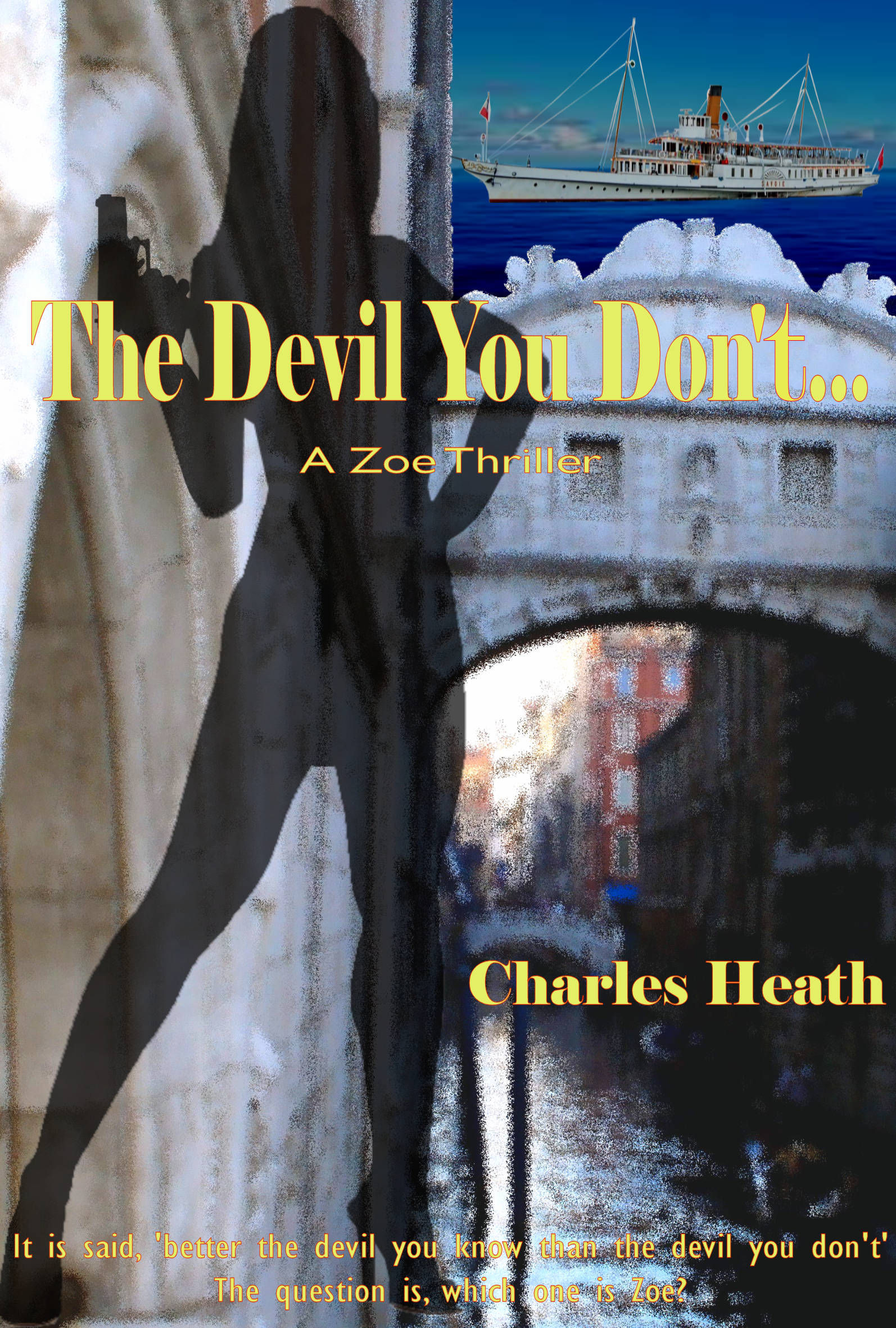
“The Devil You Don’t”, she was the girl you would not take home to your mother!

Now only $0.99 at https://amzn.to/2Xyh1ow

John Pennington’s life is in the doldrums. Looking for new opportunities, and prevaricating about getting married, the only joy on the horizon was an upcoming visit to his grandmother in Sorrento, Italy.

Suddenly he is left at the check-in counter with a message on his phone telling him the marriage is off, and the relationship is over.

If only he hadn’t promised a friend he would do a favour for him in Rome.

At the first stop, Geneva, he has a chance encounter with Zoe, an intriguing woman who captures his imagination from the moment she boards the Savoire, and his life ventures into uncharted territory in more ways than one.

That ‘favour’ for his friend suddenly becomes a life-changing event, and when Zoe, the woman who he knows is too good to be true, reappears, danger and death follow.

Shot at, lied to, seduced, and drawn into a world where nothing is what it seems, John is dragged into an adrenaline-charged undertaking, where he may have been wiser to stay with the ‘devil you know’ rather than opt for the ‘devil you don’t’.

newdevilcvr6

Top 5 sights on the road less travelled – Majorca

Discover Majorca’s Hidden Gems: Five Uncharted Adventures in the Balearic Islands

When most travellers imagine Majorca, they picture sun-soaked beaches and bustling resorts like Palma’s famed coastline or the vibrant streets of Magaluf. While these are undeniably iconic, the island’s true magic lies just beyond the well-trodden path. From misty wetlands to ancient ruins, here are five off-the-beaten-path experiences to unearth Majorca’s soul.


1. Sa Calobra & Es Carbó Beach: A Scenic Drive to Seclusion

Tucked between the jagged cliffs of the Serra de Tramuntana mountains and the turquoise Mediterranean lies Sa Calobra, a coastal village so remote that reaching its crown jewel—Es Carbó Beach—feels like a treasure hunt. The journey begins with a hairpin-turn road from Deia, where winding ascents give way to panoramic views.

Why It’s Hidden: While Es Carbó is a postcard-perfect cove, its inaccessibility deters large crowds. The beach is reached via a 30-minute walk down a steep path, but the reward is a secluded spot with crystal-clear waters and soft sands, where you’ll likely have it mostly to yourself.

Pro Tip: Visit in midday or later to avoid the earliest crowds—and don’t forget a picnic. The walk back up is tough, but the views are worth every step!


2. S’Albufera Natural Park: A Tranquil Wetland Escape

Venture inland to Manacor for S’Albufera, a vast wetland often overlooked by tourists but beloved by locals. This marshy haven, once a haven for pirates, is now a UNESCO-recognised site teeming with biodiversity. Herons, flamingos, and wild boars roam freely through lagoons and rice paddies.

Why It’s Hidden: Unlike Majorca’s coastal attractions, S’Albufera offers a meditative, almost otherworldly atmosphere, where you can kayak through still waters or rent a bike to explore rural trails.

Pro Tip: Visit in early spring or fall for optimal birdwatching. The park also hosts cultural festivals celebrating traditional Majorcan crafts and music.


3. Valley de Ses Eres: A Mountain Retreat with Ancient Roots

Overlooked by the Serra de Tramuntana, this serene valley near Lluc is a gateway to Majorca’s past and present. Its rugged landscapes hide old shepherds’ huts and “sa garriga” (wild scrubland) that’s home to wild herbs and fragrant thyme. The highlight is Llac de L’Alfàbia (Alfàbia Lake), a man-made reservoir reflected like a mirror against the hills.

Why It’s Hidden: This valley is a hiker’s paradise but lacks the signage and crowds of more commercialised routes. It’s where locals come to unwind, offering a chance to connect with the island’s pastoral heritage.

Pro Tip: Start your hike at the Monastery of Lluc, a stunning medieval site, and continue to the lake for a picnic. The 360-degree mountain views at sunset are unmatched.


4. Es Castell Winery: Sip on History in Manacor

Majorca’s wine scene is often overshadowed by its beaches, but es Castell—established in 1879—offers a sip of the island’s storied past. This historic winery, once the largest in the Mediterranean, now offers guided tours through its Romanesque cellars and lush vineyards.

Why It’s Hidden: While Palma’s wine bars draw crowds, es Castell remains a quiet cultural gem. Here, you can taste Málaga and Moscatel wines while learning about the island’s Moorish and Roman influences.

Pro Tip: Take the free guided tour and combine your visit with a stroll through Manacor’s charming old town. Picnic on-site with local cheeses and olive oil for a true taste of Majorca.


5. Cúber Waterfalls: An Adventurous Hike Rewarded

Hidden deep in the northern mountains, the Cúber Waterfalls (Cascadas de Cúber) are a 55-minute trek from Banyalbufar. The trail winds through wild olive groves and pine forests before revealing a lush, multi-tiered waterfall crashing into a pool—a perfect refreshment point.

Why It’s Hidden: The hike is well worth the effort, but requires a bit of stamina, keeping the crowds at bay. The waterfall’s natural beauty and the surrounding tranquillity make it one of Majorca’s best-kept secrets.

Pro Tip: Hike in the morning when the trails are cooler, and bring sturdy shoes. Post-hike, stop by Banyalbufar, a quiet village known for its pottery and panoramic views.


Final Thoughts: Let the Road Less Travelled Define Your Majorca
Majorca is more than a beach destination—it’s a canvas of mountains, wetlands, and centuries-old stories. By stepping off the tourist trail, you’ll discover the island’s soul: quiet, resilient, and full of surprises. So, park your car, trade the map for a sense of adventure, and let Majorca’s hidden corners leave you in awe.

Got a local favourite? Share your own “road less travelled” tip in the comments below!

Another excerpt from “Strangers We’ve Become” – A sequel to ‘What Sets Us Apart’

It was the first time in almost a week that I made the short walk to the cafe alone.  It was early, and the chill of the morning was still in the air.  In summer, it was the best time of the day.  When Susan came with me, it was usually much later, when the day was much warmer and less tolerable.

On the morning of the third day of her visit, Susan said she was missing the hustle and bustle of London, and by the end of the fourth she said, in not so many words, she was over being away from ‘civilisation’.  This was a side of her I had not seen before, and it surprised me.

She hadn’t complained, but it was making her irritable.  The Susan that morning was vastly different to the Susan on the first day.  So much, I thought, for her wanting to ‘reconnect’, the word she had used as the reason for coming to Greve unannounced.

It was also the first morning I had time to reflect on her visit and what my feelings were towards her.  It was the reason I’d come to Greve: to soak up the peace and quiet and think about what I was going to do with the rest of my life.

I sat in my usual corner.  Maria, one of two waitresses, came out, stopped, and there was no mistaking the relief in her manner.  There was an air of tension between Susan and Maria I didn’t understand, and it seemed to emanate from Susan rather than the other way around.  I could understand her attitude if it was towards Alisha, but not Maria.  All she did was serve coffee and cake.

When Maria recovered from the momentary surprise, she said, smiling, “You are by yourself?”  She gave a quick glance in the direction of my villa, just to be sure.

“I am this morning.  I’m afraid the heat, for one who is not used to it, can be quite debilitating.  I’m also afraid it has had a bad effect on her manners, for which I apologise.  I cannot explain why she has been so rude to you.”

“You do not have to apologise for her, David, but it is of no consequence to me.  I have had a lot worse.  I think she is simply jealous.”

It had crossed my mind, but there was no reason for her to be.  “Why?”

“She is a woman, I am a woman, she thinks because you and I are friends, there is something between us.”

It made sense, even if it was not true.  “Perhaps if I explained…”

Maria shook her head.  “If there is a hole in the boat, you should not keep bailing but try to plug the hole.  My grandfather had many expressions, David.  If I may give you one piece of advice, as much as it is none of my business, you need to make your feelings known, and if they are not as they once were, and I think they are not, you need to tell her.  Before she goes home.”

Interesting advice.  Not only a purveyor of excellent coffee, but Maria was also a psychiatrist who had astutely worked out my dilemma.  What was that expression, ‘not just a pretty face’?

“Is she leaving soon?” I asked, thinking Maria knew more about Susan’s movements than I did.

“You would disappoint me if you had not suspected as much.  Susan was having coffee and talking to someone in her office on a cell phone.  It was an intense conversation.  I should not eavesdrop, but she said being here was like being stuck in hell.  It is a pity she does not share your love for our little piece of paradise, is it not?”

“It is indeed.  And you’re right.  She said she didn’t have a phone, but I know she has one.  She just doesn’t value the idea of getting away from the office.  Perhaps her role doesn’t afford her that luxury.”

And perhaps Alisha was right about Maria, that I should be more careful.  She had liked Maria the moment she saw her.  We had sat at this very table, the first day I arrived.  I would have travelled alone, but Prendergast, my old boss, liked to know where ex-employees of the Department were, and what they were doing.

She sighed.  “I am glad I am just a waitress.  Your usual coffee and cake?”

“Yes, please.”

Several months had passed since we had rescued Susan from her despotic father; she had recovered faster than we had thought, and settled into her role as the new Lady Featherington, though she preferred not to use that title, but go by the name of Lady Susan Cheney.

I didn’t get to be a Lord, or have any title, not that I was expecting one.  What I had expected was that Susan, once she found her footing as head of what seemed to be a commercial empire, would not have time for details like husbands, particularly when our agreement made before the wedding gave either of us the right to end it.

There was a moment when I visited her recovering in the hospital, where I was going to give her the out, but I didn’t, and she had not invoked it.  We were still married, just not living together.

This visit was one where she wanted to ‘reconnect’ as she called it, and invite me to come home with her.  She saw no reason why we could not resume our relationship, conveniently forgetting she indirectly had me arrested for her murder, charges both her mother and Lucy vigorously pursued, and had the clone not returned to save me, I might still be in jail.

It was not something I would forgive or forget any time soon.

There were other reasons why I was reluctant to stay with her, like forgetting small details, an irregularity in her character I found odd.  She looked the same, she sounded the same, she basically acted the same, but my mind was telling me something was not right.  It was not the Susan I first met, even allowing for the ordeal she had been subjected to.

But, despite those misgivings, there was no question in my mind that I still loved her, and her clandestine arrival had brought back all those feelings.  But as the days passed, I began to get the impression my feelings were one-sided and she was just going through the motions.

Which brought me to the last argument, earlier, where I said if I went with her, it would be business meetings, social obligations, and quite simply her ‘celebrity’ status that would keep us apart.  I reminded her that I had said from the outset I didn’t like the idea of being in the spotlight, and when I reiterated it, she simply brushed it off as just part of the job, adding rather strangely that I always looked good in a suit.  The flippancy of that comment was the last straw, and I left before I said something I would regret.

I knew I was not a priority.  Maybe somewhere inside me, I had wanted to be a priority, and I was disappointed when I was not.

And finally, there was Alisha.  Susan, at the height of the argument, had intimated she believed I had an affair with her, but that elephant was always in the room whenever Alisha was around.  It was no surprise when I learned Susan had asked Prendergast to reassign her to other duties. 

At least I knew what my feelings for Alisha were, and there were times when I had to remember she was persona non grata.  Perhaps that was why Susan had her banished, but, again, a small detail; jealousy was not one of Susan’s traits when I first knew her.

Perhaps it was time to set Susan free.

When I swung around to look in the direction of the lane where my villa was, I saw Susan.  She was formally dressed, not in her ‘tourist’ clothes, which she had bought from one of the local clothing stores.  We had fun that day, shopping for clothes, a chore I’d always hated.  It had been followed by a leisurely lunch, lots of wine and soul searching.

It was the reason why I sat in this corner; old habits die hard.  I could see trouble coming from all directions, not that Susan was trouble or at least I hoped not, but it allowed me the time to watch her walking towards the cafe in what appeared to be short, angry steps; perhaps the culmination of the heat wave and our last argument.

She glared at me as she sat, dropping her bag beside her on the ground, where I could see the cell phone sitting on top.  She followed my glance down, and then she looked unrepentant back at me.

Maria came back at the exact moment she was going to speak.  I noticed Maria hesitate for a second when she saw Susan, then put her smile in place to deliver my coffee.

Neither spoke nor looked at each other.  I said, “Susan will have what I’m having, thanks.”

Maria nodded and left.

“Now,” I said, leaning back in my seat, “I’m sure there’s a perfectly good explanation as to why you didn’t tell me about the phone, but that first time you disappeared, I’d guessed you needed to keep in touch with your business interests.  I thought it somewhat unwisethat you should come out when the board of one of your companies was trying to remove you, because of what was it, an unexplained absence?  All you had to do was tell me there were problems and you needed to remain at home to resolve them.”

My comment elicited a sideways look, with a touch of surprise.

“It was unfortunate timing on their behalf, and I didn’t want you to think everything else was more important than us.  There were issues before I came, and I thought the people at home would be able to manage without me for at least a week, but I was wrong.”

“Why come at all.  A phone call would have sufficed.”

“I had to see you, talk to you.  At least we have had a chance to do that.  I’m sorry about yesterday.  I once told you I would not become my mother, but I’m afraid I sounded just like her.  I misjudged just how much this role would affect me, and truly, I’m sorry.”

An apology was the last thing I expected.

“You have a lot of work to do catching up after being away, and of course, in replacing your mother and gaining the requisite respect as the new Lady Featherington.  I think it would be for the best if I were not another distraction.  We have plenty of time to reacquaint ourselves when you get past all these teething issues.”

“You’re not coming with me?”  She sounded disappointed.

“I think it would be for the best if I didn’t.”

“Why?”

“It should come as no surprise to you that I’ve been keeping an eye on your progress.  You are so much better doing your job without me.  I told your mother once that when the time came I would not like the responsibilities of being your husband.  Now that I have seen what it could possibly entail, I like it even less.  You might also want to reconsider our arrangement, after all, we only had a marriage of convenience, and now that those obligations have been fulfilled, we both have the option of terminating it.  I won’t make things difficult for you if that’s what you want.”

It was yet another anomaly, I thought; she should look distressed, and I would raise the matter of that arrangement.  Perhaps she had forgotten the finer points.  I, on the other hand, had always known we would not last forever.  The perplexed expression, to me, was a sign she might have forgotten.

Then, her expression changed.  “Is that what you want?”

“I wasn’t madly in love with you when we made that arrangement, so it was easy to agree to your terms, but inexplicably, since then, my feelings for you changed, and I would be sad if we parted ways.  But the truth is, I can’t see how this is going to work.”

“In saying that, do you think I don’t care for you?”

That was exactly what I was thinking, but I wasn’t going to voice that opinion out loud.  “You spent a lot of time finding new ways to make my life miserable, Susan.  You and that wretched friend of yours, Lucy.  While your attitude improved after we were married, that was because you were going to use me when you went to see your father, and then almost let me go to prison for your murder.”

“I had nothing to do with that, other than to leave, and I didn’t agree with Lucy that you should be made responsible for my disappearance.  I cannot be held responsible for the actions of my mother.  She hated you; Lucy didn’t understand you, and Millie told me I was stupid for not loving you in return, and she was right.  Why do you think I gave you such a hard time?  You made it impossible not to fall in love with you, and it nearly changed my mind about everything I’d been planning so meticulously.  But perhaps there was a more subliminal reason why I did because after I left, I wanted to believe, if anything went wrong, you would come and find me.”

“How could you possibly know that I’d even consider doing something like that, given what you knew about me?”

“Prendergast made a passing comment when my mother asked him about you; he told us you were very good at finding people and even better at fixing problems.”

“And yet here we are, one argument away from ending it.”

I could see Maria hovering, waiting for the right moment to deliver her coffee, then go back and find Gianna, the café owner, instead.  Gianna was more abrupt and, for that reason, was rarely seen serving the customers.  Today, she was particularly cantankerous, banging the cake dish on the table and frowning at Susan before returning to her kitchen.  Gianna didn’t like Susan either.

Behind me, I heard a car stop, and when she looked up, I knew it was for her.  She had arrived with nothing, and she was leaving with nothing.

She stood.  “Last chance.”

“Forever?”

She hesitated and then shook away the look of annoyance on her face.  “Of course not.  I wanted you to come back with me so we could continue working on our relationship.  I agree there are problems, but it’s nothing we can’t resolve if we try.”

I had been trying.  “It’s too soon for both of us, Susan.  I need to be able to trust you, and given the circumstances, and all that water under the bridge, I’m not sure if I can yet.”

She frowned at me.  “As you wish.”  She took an envelope out of her bag and put it on the table.  “When you are ready, it’s an open ticket home.  Please make it sooner rather than later.  Despite what you think of me, I have missed you, and I have no intention of ending it between us.”

That said, she glared at me for a minute, shook her head, then walked to the car.  I watched her get in and the car drive slowly away.

No kiss, no touch, no looking back. 

© Charles Heath 2018-2025

strangerscover9

Writing a book in 365 days – 335

Day 335

Patterns, images and words

Breaking Free from Conventional Patterns: A Guide to Classicist, Modernist, and Personalised Visual Storytelling

As creatives, we’re often influenced by the styles and trends of our time. When it comes to visual storytelling, two dominant patterns have emerged: classicism and modernism. While these styles have their roots in art and architecture, they also extend to the world of design, writing, and even social media. But what happens when we want to break free from these conventional patterns and forge our own path? In this post, we’ll explore the characteristics of classicist and modernist patterns, discuss the pros and cons of using them, and provide guidance on creating your own unique visual language.

Classicism: Timeless Elegance

Classicism is characterised by:

  • Symmetry and balance
  • Ornate details and embellishments
  • Traditional typography and serif fonts
  • Earthy colours and muted tones
  • References to historical and cultural icons

Classical patterns evoke a sense of tradition, sophistication, and timelessness. They’re often associated with luxury brands, high-end products, and institutions that value heritage and prestige. If you’re aiming to create a sense of authority, trust, and stability, classicist patterns might be the way to go.

Modernism: Bold Innovation

Modernist patterns, on the other hand, are marked by:

  • Clean lines and minimalism
  • Geometric shapes and abstract forms
  • Sans-serif fonts and bold typography
  • Bright colours and bold contrasts
  • Emphasis on functionality and simplicity

Modernist patterns embody the spirit of innovation, progress, and experimentation. They’re commonly used in tech, design, and creative industries that prioritize forward thinking and cutting-edge ideas. If you want to convey a sense of dynamism, creativity, and forward momentum, modernist patterns might be your best bet.

The Risks of Conventional Patterns

While both classicist and modernist patterns have their advantages, relying too heavily on them can lead to:

  • Lack of originality and uniqueness
  • Overuse and clichés
  • Inability to stand out in a crowded market
  • Limited creative freedom and expression

Creating Your Own Patterns: The Power of Personalisation

So, what if you want to break free from these conventional patterns and create something truly unique? The good news is that you can! By combining elements from different styles, experimenting with new forms and shapes, and incorporating personal touches, you can develop a visual language that reflects your brand’s personality and values.

Here are some tips for creating your own patterns:

  1. Experiment with hybrids: Mix and match elements from classicism and modernism to create a style that’s both timeless and innovative.
  2. Draw from personal experiences: Incorporate patterns and motifs that reflect your personal story, interests, or cultural background.
  3. Play with typography: Use custom fonts, handwritten scripts, or unconventional typography to add a touch of personality to your designs.
  4. Incorporate natural elements: Use organic shapes, textures, and colours to bring a sense of warmth and authenticity to your visual storytelling.
  5. Keep it simple: Don’t be afraid to strip away unnecessary elements and focus on simplicity and clarity.

Conclusion

In the world of visual storytelling, patterns and styles can be both a blessing and a curse. While classicist and modernist patterns have their advantages, they can also limit our creative potential and lead to clichés. By embracing the power of personalisation and experimentation, we can break free from conventional patterns and create a visual language that’s truly unique and reflective of our brand’s personality. So, don’t be afraid to take risks, try new things, and forge your own path. The possibilities are endless, and the results can be truly remarkable.

An excerpt from “The Things We Do for Love”; In love, Henry was all at sea!

In the distance, he could hear the dinner bell ringing and roused himself.  Feeling the dampness of the pillow and fearing the ravages of pent-up emotion, he considered not going down but thought it best not to upset Mrs Mac, especially after he said he would be dining.

In the event, he wished he had reneged, especially when he discovered he was not the only guest staying at the hotel.

Whilst he’d been reminiscing, another guest, a young lady, had arrived.  He’d heard her and Mrs Mac coming up the stairs and then shown to a room on the same floor, perhaps at the other end of the passage.

Henry caught his first glimpse of her when she appeared at the door to the dining room, waiting for Mrs Mac to show her to a table.

She was in her mid-twenties, slim, with long brown hair, and the grace and elegance of a woman associated with countless fashion magazines.  She was, he thought, stunningly beautiful with not a hair out of place, and make-up flawlessly applied.  Her clothes were black, simple, elegant, and expensive, the sort an heiress or wife of a millionaire might condescend to wear to a lesser occasion than dinner.

Then there was her expression; cold, forbidding, almost frightening in its intensity.  And her eyes, piercingly blue and yet laced with pain.  Dracula’s daughter was his immediate description of her.

All in all, he considered, the only thing they had in common was, like him, she seemed totally out of place.

Mrs Mac came out of the kitchen, wiping her hands on her apron.  She was, she informed him earlier, chef, waitress, hotelier, barmaid, and cleaner all rolled into one.  Coming up to the new arrival, she said, “Ah, Miss Andrews, I’m glad you decided to have dinner.  Would you like to sit with Mr Henshaw, or would you like to have a table of your own?”

Henry could feel her icy stare as she sized up his appeal as a dining companion, making the hair on the back of his neck stand up.  He purposely didn’t look back.  In his estimation, his appeal rating was minus six.  Out of a thousand!

“If Mr Henshaw doesn’t mind….”  She looked at him, leaving the query in mid-air.

He didn’t mind and said so.  Perhaps he’d underestimated his rating.

“Good.”  Mrs Mac promptly ushered her over.  Henry stood, made sure she was seated properly and sat.

“Thank you.  You are most kind.”  The way she said it suggested snobbish overtones.

“I try to be when I can.”  It was supposed to nullify her sarcastic tone, but it made him sound a little silly, and when she gave him another of her icy glares, he regretted it.

Mrs Mac quickly intervened, asking, “Would you care for the soup?”

They did, and, after writing the order on her pad, she gave them each a look, imperceptibly shook her head, and returned to the kitchen.

Before Michelle spoke to him again, she had another quick look at him, trying to fathom who and what he might be.  There was something about him.

His eyes mirrored the same sadness she felt, and, yes, there was something else, that it looked like he had been crying.  There was a tinge of redness.

Perhaps, she thought, he was here for the same reason she was.

No.  That wasn’t possible.

Then she said, without thinking, “Do you have any particular reason for coming here?”  Seconds later, she realised she’d spoken it out loud, hadn’t meant to actually ask, it just came out.

It took him by surprise, obviously not the first question he was expecting her to ask of him.

“No, other than it is as far from civilisation, and home as I could get.”

At least we agree on that, she thought.

It was obvious he was running away from something as well.

Given the isolation of the village and lack of geographic hospitality, it was, from her point of view, ideal.  All she had to do was avoid him, and that wouldn’t be difficult.

After getting through this evening first.

“Yes,” she agreed.  “It is that.”

A few seconds passed, and she thought she could feel his eyes on her and wasn’t going to look up.

Until he asked, “What’s your reason?”

Slightly abrupt in manner, perhaps, because of her question and how she asked it.

She looked up.  “Rest.  And have some time to myself.”

She hoped he would notice the emphasis she had placed on the word ‘herself’ and take due note.  No doubt, she thought, she had completely different ideas of what constituted a holiday than he, not that she had said she was here for a holiday.

Mrs Mac arrived at a fortuitous moment to save them from further conversation.

Over the entree, she wondered if she had made a mistake coming to the hotel.  Of course, there had been no conceivable way she could know that anyone else might have booked the same hotel, but she realised it was foolish to think she might end up in it by herself.

Was that what she was expecting?

Not a mistake then, but an unfortunate set of circumstances, which could be overcome by being sensible.

Yet, there he was, and it made her curious, not that he was a man, by himself, in the middle of nowhere, hiding like she was, but for quite varied reasons.

On discreet observation, whilst they ate, she gained the impression his air of light-heartedness was forced, and he had no sense of humour.

This feeling was engendered by his looks, unruly dark hair, and permanent frown.  And then there was his abysmal taste in clothes on a tall, lanky frame.  They were quality but totally unsuited to the wearer.

Rebellion was written all over him.

The only other thought crossing her mind, and incongruously, was that he could do with a decent feed.  In that respect, she knew now from the mountain of food in front of her, he had come to the right place.

“Mr Henshaw?”

He looked up.  “Henshaw is too formal.  Henry sounds much better,” he said, with a slight hint of gruffness.

“Then my name is Michelle.”

Mrs Mac came in to take their order for the only main course, gather up the entree dishes, and then return to the kitchen.

“Staying long?” she asked.

“About three weeks.  Yourself?”

“About the same.”

The conversation dried up.

Neither looked at the other, but rather at the walls, out the window, towards the kitchen, anywhere.  It was, she thought, unbearably awkward.

Mrs Mac returned with a large tray with dishes on it, setting it down on the table next to theirs.

“Not as good as the usual cook,” she said, serving up the dinner expertly, “but it comes a good second, even if I do say so myself.  Care for some wine?”

Henry looked at Michelle.  “What do you think?”

“I’m used to my dining companions making the decision.”

You would, he thought.  He couldn’t help but notice the cutting edge of her tone.  Then, to Mrs Mac, he named a particular White Burgundy he liked, and she bustled off.

“I hope you like it,” he said, acknowledging her previous comment with a smile that had nothing to do with humour.

“Yes, so do I.”

Both made a start on the main course, a concoction of chicken and vegetables that were delicious, Henry thought when compared to the bland food he received at home and sometimes aboard my ship.

It was five minutes before Mrs Mac returned with the bottle and two glasses.  After opening it and pouring the drinks, she left them alone again.

Henry resumed the conversation.  “How did you arrive?  I came by train.”

“By car.”

“Did you drive yourself?”

And he thought, a few seconds later, that was a silly question; otherwise, she would not be alone, and certainly not sitting at this table. With him.

“After a fashion.”

He could see that she was formulating a retort in her mind, then changed it, instead, smiling for the first time, and it served to lighten the atmosphere.

And in doing so, it showed him she had another, more pleasant side despite the fact she was trying not to look happy.

“My father reckons I’m just another of ‘those’ women drivers,” she added.

“Whatever for?”

“The first and only time he came with me, I had an accident.  I ran up the back of another car.  Of course, it didn’t matter to him that the other driver was driving like a startled rabbit.”

“It doesn’t help,” he agreed.

“Do you drive?”

“Mostly people up the wall.”  His attempt at humour failed.  “Actually,” he added quickly, “I’ve got a very old Morris that manages to get me where I’m going.”

The apple pie and cream for dessert came and went, and the rapport between them improved as the wine disappeared and the coffee came.  Both had found, after getting to know each other better, that their first impressions were not necessarily correct.

“Enjoy the food?” Mrs Mac asked, suddenly reappearing.

“Beautifully cooked and delicious to eat,” Michelle said, and Henry endorsed her remarks.

“Ah, it does my heart good to hear such genuine compliments,” she said, smiling.  She collected the last of the dishes and disappeared yet again.

“What do you do for a living?” Michelle asked in an offhand manner.

He had a feeling she was not particularly interested, and it was just making conversation.

“I’m a purser.”

“A what?”

“A purser.  I work on a ship doing the paperwork, that sort of thing.”

“I see.”

“And you?”

“I was a model.”

“Was?”

“Until I had an accident, a rather bad one.”

“Oh, I’m sorry.”

So that explained the odd feeling he had about her.

As the evening wore on, he began to think there might be something wrong, seriously wrong with her because she didn’t look too well.  Even the carefully applied makeup, from close, didn’t hide the very pale, tired look, or the sunken, dark-ringed eyes.

“I try not to think about it, but it doesn’t necessarily work.  I’ve come here for peace and quiet, away from doctors and parents.”

“Then you will not have to worry about me annoying you.  I’m one of those fall-asleep-reading-a-book types.”

Perhaps it would be like ships passing in the night, and then he smiled to himself about the analogy.

Dinner over, they separated.

Henry went back to the lounge to read a few pages of his book before going to bed, and Michelle went up to her room to retire for the night.

But try as he might, he was unable to read, his mind dwelling on the unusual, yet compellingly mysterious person he would be sharing the hotel with.

Overlaying that original blurred image of her standing in the doorway was another of her haunting expressions that had, he finally conceded, taken his breath away, and a look that had sent more than one tingle down his spine.

She may not have thought much of him, but she had certainly made an impression on him.

© Charles Heath 2015-2024

lovecoverfinal1

In a word: Right

Am I right?  Or is that correct?

In the moral sense, or in answering a question?

Do I have a right to …

As an entitlement?

Maybe

But right means generally to be correct, but the word itself can be used, like many others in a variety of ways

Such as, do we have any rights any more, since the government is slowly shutting down our freedoms, and, you guessed it, rights.

What about a right angle, we know this as being an angle of 90 degrees

How about I right a wrong, returning a bad situation to a good one?

Are you left-handed or right-handed?

Are you one of those people who can’t tell their left from their right?

And who was it that decided what was your left or your right, ever thought about that?  I didn’t until just now.  Good luck finding an answer on Google.

And how many times have you wished you were in the right place at the right time???

Then, of course, if English is a second language, how about confusing right with write.

Means something quite different, doesn’t it?

How about rite?  Yes, I guess if we were in the habit of chopping chicken heads off and dancing around a fire, that might be its meaning,

But…

It too has a lot of different meanings

Are you confused yet?

An excerpt from “If Only” – a work in progress

Investigation of crimes doesn’t always go according to plan, nor does the perpetrator get either found or punished.

That was particularly true in my case.  The murderer was incredibly careful in not leaving any evidence behind, to the extent that the police could not rule out whether it was a male or a female.

At one stage the police thought I had murdered my own wife though how I could be on a train at the time of the murder was beyond me.  I had witnesses and a cast-iron alibi.

The officer in charge was Detective First Grade Gabrielle Walters.  She came to me on the day after the murder seeking answers to the usual questions like, when was the last time you saw your wife, did you argue, the neighbors reckon there were heated discussions the day before.

Routine was the word she used.

Her fellow detective was a surly piece of work whose intention was to get answers or, more likely, a confession by any or all means possible.  I could sense the raging violence within him.  Fortunately, common sense prevailed.

Over the course of the next few weeks, once I’d been cleared of committing the crime, Gabrielle made a point of keeping me informed of the progress.

After three months the updates were more sporadic, and when, for lack of progress, it became a cold case, communication ceased.

But it was not the last I saw of Gabrielle.

The shock of finding Vanessa was more devastating than the fact she was now gone, and those images lived on in the same nightmare that came to visit me every night when I closed my eyes.

For months I was barely functioning, to the extent I had all but lost my job, and quite a few friends, particularly those who were more attached to Vanessa rather than me.

They didn’t understand how it could affect me so much, and since it had not happened to them, my tart replies of ‘you wouldn’t understand’ were met with equally short retorts.  Some questioned my sanity, even, for a time, so did I.

No one, it seemed, could understand what it was like, no one except Gabrielle.

She was by her own admission, damaged goods, having been the victim of a similar incident, a boyfriend who turned out to be an awfully bad boy.  Her story varied only in she had been made to witness his execution.  Her nightmare, in reliving that moment in time, was how she was still alive and, to this day, had no idea why she’d been spared.

It was a story she told me one night, some months after the investigation had been scaled down.  I was still looking for the bottom of a bottle and an emotional mess.  Perhaps it struck a resonance with her; she’d been there and managed to come out the other side.

What happened become our secret, a once-only night together that meant a great deal to me, and by mutual agreement, it was not spoken of again.  It was as if she knew exactly what was required to set me on the path to recovery.

And it had.

Since then, we saw each about once a month in a cafe.   I had been surprised to hear from her again shortly after that eventful night when she called to set it up, ostensibly for her to provide me with any updates on the case, but perhaps we had, after that unspoken night, formed a closer bond than either of us wanted to admit.

We generally talked for hours over wine, then dinner and coffee.  It took a while for me to realize that all she had was her work, personal relationships were nigh on impossible in a job that left little or no spare time for anything else.

She’d always said that if I had any questions or problems about the case, or if there was anything that might come to me that might be relevant, even after all this time, all I had to do was call her.

I wondered if this text message was in that category.  I was certain it would interest the police and I had no doubt they could trace the message’s origin, but there was that tiny degree of doubt, about whether or not I could trust her to tell me what the message meant.

I reached for the phone then put it back down again.  I’d think about it and decide tomorrow.

© Charles Heath 2018-2020

Third son of a Duke – The research behind the story – 17

All stories require some form of research, quite often to place a character in a place at a particular time, especially if it is in a historical context. This series will take you through what it was like in 1914 through 1916.

Port Said in 1915: A Crucible of War and Transition Compared to 1913

Abstract:

This paper examines the transformation of Port Said, Egypt, between 1913 and 1915, focusing on the significant shifts brought about by the burgeoning Great War. It analyses the port’s socio-economic landscape, architectural development, and burgeoning strategic importance, contrasting the relative normalcy of 1913 with the heightened military presence and disruption of 1915. Furthermore, the paper reconstructs the visual and sensory experience of soldiers, nurses, and doctors disembarking at Port Said’s troop staging points in 1915, highlighting the stark contrast between their expectations and the emergent realities of wartime transit, and the critical role the port played as a gateway to the Egyptian front and beyond.

1. Introduction:

Port Said, strategically situated at the northern terminus of the Suez Canal, was a city accustomed to a ceaseless flow of maritime traffic and a diverse cosmopolitan population. In the pre-war years, it represented a vital nexus of global trade, a sophisticated hub for imperial transit, and a burgeoning tourist destination. However, the outbreak of the First World War in 1914 irrevocably altered the trajectory of this vibrant city. By 1915, Port Said had transitioned from a bustling commercial port to a critical strategic asset, a staging ground for Allied troops, and a crucial logistical centre. This paper aims to delineate the salient differences in the character of Port Said between 1913 and 1915, and to vividly portray the experience of military personnel disembarking there, particularly for those destined for troop staging points in Egypt.

2. Port Said in 1913: A Hub of Commerce and Cosmopolitanism

In 1913, Port Said was a city thriving on its unique geographical position. The Suez Canal, opened in 1869, had transformed this once-modest fishing village into a major international port.

  • Economic Landscape: The economy was dominated by shipping, bunkering (coaling of steamships), and associated services. Large shipping companies operated offices, and a significant workforce was employed in loading, unloading, and servicing vessels. Warehouses, customs houses, and repair yards were prominent features. The presence of numerous hotels, restaurants, and shops catering to affluent travellers and sailors from across the globe contributed to a lively and international atmosphere. The city was a point of departure and arrival for passengers travelling between Europe and Asia, Africa, or Australia, fostering a sense of global interconnectedness. Commercial activity was robust, driven by the constant stream of merchant vessels navigating the Canal.
  • Urban Development and Architecture: Port Said boasted a distinctive blend of architectural styles. European colonial influences were evident in its grand hotels, like the Hotel des Voyageurs and the Continental, along with administrative buildings. French architectural styles were particularly prevalent, reflecting early French involvement in the Canal’s construction. The city centre featured wide avenues, shaded by trees, and elegant buildings designed for commerce and leisure. The waterfront promenade, the Ramleh, was a popular social gathering place, lined with cafés and offering panoramic views of the bustling harbour. Despite its colonial overlay, Egyptian architectural elements and local marketplaces also co-existed, creating a unique urban fabric.
  • Social Fabric: The population was a heterogeneous mix of Egyptians (predominantly from the Nile Delta), Greeks, Italians, British, French, Maltese, and other nationalities, each contributing to the port’s cosmopolitan character. This diversity brought a vibrant cultural exchange, reflected in the city’s cuisine, languages, and social customs. While social stratification existed, with European residents and business owners at the top, the shared economic interests tied to the Canal fostered a degree of inter-ethnic interaction. The atmosphere was generally one of relative peace and prosperity, characterised by the rhythm of maritime trade.
  • Strategic Value (Pre-War): While its strategic importance was recognised, it was primarily viewed through the lens of facilitating global trade and maintaining open sea lanes for imperial powers, particularly Britain and France. The Canal was a protected waterway, but a significant military presence within the city itself was less pronounced than it would soon become.

3. Port Said in 1915: A City Mobilised for War

By 1915, the outbreak of the Great War had dramatically reshaped Port Said. The port’s role shifted from a commercial hub to a vital military logistical node, a gateway to the burgeoning conflict in the Middle East and a transit point for reinforcements.

  • Economic Reorientation: The demands of war transformed the port’s economy. While commercial shipping continued, it was increasingly overshadowed by military transport. Coaling stations became crucial for naval resupply, and shipyards focused on repairs for military vessels. Warehouses were repurposed for storing military equipment and supplies. The influx of military personnel and the associated logistical needs spurred a boom in certain sectors, such as catering, transportation, and accommodation for transient military personnel. However, the disruption to regular trade routes and the increased cost of goods also impacted the civilian economy.
  • Military Infrastructure and Presence: The most striking change was the pervasive military presence. The city’s infrastructure was adapted to accommodate troop movements and military operations. Barracks and temporary camps were likely established. Docks were dedicated to the rapid disembarkation and loading of troops and supplies. Naval patrols increased, and the Canal itself became a heavily guarded military zone, with fortifications and defensive positions being strengthened. The visual landscape would have been dominated by uniformed men, military vehicles, and the distinctive silhouettes of troopships alongside naval vessels.
  • Urban Transformation and Atmosphere: The cosmopolitan charm of 1913 was largely supplanted by a more sombre and utilitarian atmosphere. While tourist hotels might have been requisitioned for officers or nurses, the general ambience would have felt more regimented and anxious. The presence of censorship and increased security measures would have been palpable. The once leisurely promenade might have become a site of military activity or a place where weary soldiers sought brief respite. The sounds of the port would have shifted from the clatter of commerce to the din of troop movements, the rumble of military engines, and the distant sounds of naval activity.
  • Social and Demographic Shifts: The influx of soldiers, nurses, and doctors dramatically altered the demographic balance. The local civilian population would have been increasingly interacting with and serving the military. New social dynamics would have emerged, with a greater emphasis on military hierarchy and a more guarded interaction between civilians and the transient military population. The presence of wounded soldiers returning from campaigns would have also begun to introduce a sombre element to the city’s life.
  • Heightened Strategic Importance: In 1915, Port Said was no longer just a waypoint for trade; it was a crucial strategic asset in the defence of the Suez Canal and the projection of Allied power into the Middle East. The Ottoman Empire’s proximity and the threat of an attack on the Canal made Port Said a frontier city, albeit one protected by the vastness of the Mediterranean.

4. Disembarking at Port Said in 1915: The Soldier’s, Nurse’s, and Doctor’s Perspective

For soldiers, nurses, and doctors arriving at Port Said in 1915, the experience would have been a stark departure from peacetime travel, marked by the immediate realities of war and transit.

4.1. For the Soldier:

  • The Journey: Soldiers would have likely spent weeks crammed into the holds or on the decks of crowded troopships, enduring rough seas, monotonous rations, and the constant anticipation of the unknown. The smell of sweat, stale air, and engine oil would have been pervasive.
  • The Arrival: As the troopship approached Port Said, the first visual impressions would be of the vast, busy harbour, dotted with warships and a multitude of merchant vessels. The distinctive outline of the city, with its European-style architecture and minarets, might have offered a fleeting sense of exoticism, quickly overshadowed by the military presence. The air, humid and carrying the scent of the sea and perhaps coal smoke, would be a welcome change from the confines of the ship.
  • Disembarkation: Disembarking would be a chaotic but efficient process. Soldiers, weighed down by their kit, would clamber down gangplanks or be lowered by nets onto the quay. The immediate impression would be of noise and activity: the barking of commands, the rumble of lorries, the shouts of stevedores, and the general din of a military operation. The sheer number of men in uniform, from various Allied nations, would be overwhelming.
  • The Staging Point Experience: Port Said served as a crucial staging point. Soldiers would be quickly processed, likely herded into temporary holding areas, or directly loaded onto smaller vessels or trains bound for more permanent encampments or forward positions within Egypt. The experience would be one of constant movement and little respite. The immediate need for sanitation, fresh water, and basic comfort would be paramount. The heat, a stark contrast to European climates, would be a significant factor, especially if arriving during the warmer months.
  • Psychological Impact: The sight of organised military machinery, the potential glimpse of wounded soldiers being treated or evacuated, and the constant reminders of the war effort would instil a sense of purpose but also a degree of apprehension. The initial promise of adventure might be tempered by the harsh reality of military logistics and the looming threat of conflict.

4.2. For the Nurse and Doctor:

  • The Journey: While perhaps enjoying slightly better accommodation than the average soldier, nurses and doctors would still experience the challenges of long sea voyages, including potential seasickness and the limited amenities. Their journey was driven by duty and a desire to serve, often with a sense of urgency.
  • The Arrival: The sight of Port Said would likely be one of organised chaos and a palpable sense of purpose. They would recognise the strategic importance of the location and the immense logistical undertaking. The European architecture might offer a brief moment of familiarity and comfort.
  • Disembarkation and Processing: Nurses and doctors would likely disembark at designated areas, often closer to medical facilities or designated accommodation. They might be met by military officials who would guide them to their assignments. Instead of heavy kit, they would carry medical bags and personal effects.
  • The Staging Point and Hospital Experience: Port Said in 1915 would have been a hub for medical evacuation and preparation. Hospitals, either existing civilian facilities commandeered or newly established military hospitals, would be active. Nurses and doctors would be immediately assessing casualties, preparing for incoming wounded, or being briefed on their roles in the wider theatre of war. The infrastructure would be geared towards efficiency and medical care, with a constant flow of patients and medical supplies. The heat and the tropical environment would present additional challenges for medical practice, requiring acclimatisation and specific protocols.
  • Psychological Impact: For medical personnel, the experience would be a mix of professional determination and emotional strain. The sight of wounded men, the urgent demands of medical care, and the understanding of the immense scale of the conflict would be deeply impactful. Port Said would represent the frontline of care, the initial point of contact for suffering, and the gateway to the medical challenges of the Egyptian and broader Middle Eastern campaigns. The relative order of their arrival might offer a sense of manageable purpose, but the overwhelming task ahead would be ever-present.

5. Conclusion:

The transformation of Port Said between 1913 and 1915 was a profound testament to the disruptive power of total war. The vibrant cosmopolitan port of 1913, characterized by its bustling commercial activity and leisurely international transit, had by 1915 become a highly militarized logistical hub. The architectural and urban fabric, while retaining some of its pre-war character, was now dominated by the machinery of war. For soldiers, nurses, and doctors disembarking for troop staging points in Egypt, Port Said in 1915 presented a stark and immediate immersion into the realities of global conflict. It was a place of transit, processing, and preparation, a crucible where the optimism of departure met the exigencies of war, and a critical gateway to the battles and challenges unfolding on the Egyptian front and beyond. The sensory experience – the sights, sounds, and smells – would have been a dramatic departure from peacetime, signalling a new and demanding chapter in their lives and in the history of this strategic Egyptian port.

“Second Thoughts”, a short story

Get me to the church on time.

It was a tune out of My Fair Lady, and it was in my head the moment I woke up that morning.  And this day was, to quote some immortal’s line, was supposed to be the happiest day of my life.

But, somehow, it didn’t feel like that and lying under the warm covers of my bed, perhaps for the last time at my parent’s home, the last place I thought I’d find myself, I began to consider how it was I had ended up in this situation.

It was not a question of who the bride was, we had been friends from an early age and used to joke about getting married, but at the age of six or seven, that was a concept rather than something we might act on in the future.

Except that was how it panned out, and, not for the reasons one might think would lead to such an eventuality.

Yes, we were close friends till the early teens, then my family went in one direction, New York, and her family went in another, San Francisco, and in each place both families built successful businesses.

Josephine, the intended bride, and I met off and on over the next fifteen years, some of that mutually when we were at university together, and, I might add, living together.  Even then, there had been no suggestion of permanency because we each had to go home to eventually work in the family business.

In those few years, it had been easy because there had been no expectations by either of us.  We simply came together, stayed together, and parted at the end both happy to have enjoyed the experience.

Then, several events changed the course of our lives.

My father died unexpectedly at a crucial point in the company’s expansion, and without his direction, it began to flounder.  Then, Josephine arrived in New York to open a branch of her family’s business, and just happened to arrive on the day of my father’s funeral.

I thought it a coincidence and was grateful for her support at a time when I needed it.

A month after that, one of the lead investors in the new expansion plan pulled out, as was his right because the loan had been contingent on my father overseeing the project.  It was the end of a very bad week, and instead of being the last to leave the office, I left early, called up an old friend, Rollo, who had followed us to New York, and we went to his favourite bar.

He suggested a night on the town was called for and I agreed with him.  I think by that time I’d had enough of the problems for a few days.  But with Rollo, I learned no invitation was without its twists and turns, so when he said his sister was bringing a friend, I had to act happy even if I didn’t feel like it.  Her friends could be a little strange.

Another coincidence, the friend was Josephine.  Hearing from her once maybe, but twice in the same week, I didn’t think so, so I let it pass.  Yet despite my reservations, in the end, I had to admit I was glad to see her because the last thing I wanted to do was entertain a quirky woman I didn’t know.

Long story short, Josephine’s family business came aboard as the replacement investor, but not without some rather stringent requirements, and though no one on either side would admit it, it was suggested that perhaps Josephine and I would make an excellent match.  After all, we were childhood friends, had lived together without the problems that sometimes came with it, and we would be working very closely together.

I proposed, she accepted, and everyone was happy.

Well, not everyone.

I was down in the dining room getting breakfast, before the wedding, when Rollo arrived.  It went without saying Rollo was going to be the best man.

Curiously, he was neither surprised nor shocked to learn of my proposal, but it was a surprise to learn, in a roundabout way, he wasn’t exactly happy for me.  It was not anything I could put my finger on, but more of a feeling I had.  And, to be honest, before I had proposed to her, I was sure that Rollo had feelings for her, and at times I thought how much more sense it would make if they were together.

I’d even asked him once or twice if he liked her, and he just said they were friends.

The other side of that equation was his sister, Adrienne, who was, I thought, charming, funny, and sometimes a little offbeat, which is why I was drawn to her.  Over time, I think I may have developed feelings for her, but by the time those feelings were rising to the surface, I was advised that a woman of Josephine’s standing was more my type.

My mother could be very annoying at times, and whilst she might be looking after her son’s best interests, she was also looking after the company’s interests as best she could.  I suspect Josephine’s parents were the same, hoping their daughter would marry advantageously.

Rollo, being on the outside, had summed it up perfectly, ‘if this had been the eighteenth century there’s no doubt you two would be the perfect match’.

“You look as happy as I feel,” I said when I saw him.

“It’s going to be a big day, church wedding, in Latin of all languages, then the society event of the year.  What’s not to be happy about?”

Put like that, I shrugged.  “A registry office, burger and chips at the local diner, then a few days in the Catskills would have sufficed.”

“And on what planet do you think you are right now?”

I didn’t answer.  I simply poured another cup of black coffee and sat down.  It was a large room, with seats for a dozen, and I was the only one up.  I had expected a room full of family members, of which at least twenty were upstairs right now recovering from last night’s festivities.

Rollo poured some tea into a cup and sat opposite.  “OK.  What’s wrong?  Wedding day jitters?”

Could he read my mind?

“It just doesn’t seem right.  I mean, it seems we have been on this track forever, but you know, there’s something missing.”

“Love?”

Exactly.  It was another of those thoughts I had just before I got out of bed.  I liked her, maybe I loved her once, when I didn’t really know what love was, but now?  I don’t know what it was I felt about her.  I had been expecting those mythical thunderbolts to strike, but as the days, weeks, and months wore on, it just didn’t happen.

It was almost if we were going through the motions.

“It feels like it’s going to be a marriage of convenience.”  There, I said it.

And I expected Rollo to start having a fit.  Instead, he concentrated on putting three spoonful’s of sugar into his tea and stirring.  And stirring.  And stirring.

“Say something,” I said.  “Anything.  Tell me I’m being stupid, tell me to get out of my funk and screw my courage to the sticking place, or whatever it is you say in times like this.”

“It’s not like you to drop a bomb like this at a time like this…”

I felt he had more to say, the good part where he’d call me an ass, and then tell me to get my shit together.  It wouldn’t be the first time.

“But…”

“But I rather get the impression this wedding might not be going ahead.”

“It has to.  God knows how many people have put themselves out to be here.  It was, my mother said, a logistical nightmare.”

“It wouldn’t be the first time this has happened.”

“You’re supposed to be arguing for the wedding, not against it.”

“I would if I knew your heart was in it.  But it isn’t, is it?  I think you’ve spent so much time trying to please everyone else, that you have forgotten about yourself.  I know you’re not happy.  I also happen to know that Jo isn’t either.”

“You’ve spoken to her?”

“Just before I got here.  Call her.  You two need to talk.  In the meantime, you’re going to have to repay a huge debt after I somehow manage to sort this mess out.  My car’s outside.  Leave now, and I’ll let you know when it’s safe to return.”

“Where will I go?”

He smiled.  “I’m sure you’ll know by the time you get in the car.”

It was reckless and would cause a lot of pain and anguish for my mother, but I considered how much more pain it would cause to Josephine if I didn’t call it off.

I made the call on the way upstairs to finish dressing.

“I’m assuming you’ve spoken to Rollo?”  She didn’t wait for me to speak.

“You feel the same way?”

“It started out with the best of intentions, but I can’t help thinking if we were right for each other we would have married after university.  We are best friends, Alan, and I don’t think it’s ever going to progress from there.  I know you feel that too, it’s just the pressure from our families has managed to mask our true feelings.”

“Do you have any idea what sort of storm is about to erupt?”

“Everyone will get over it.  There’s too much at stake on both sides for there to be any real or lasting consequences.  I guess Rollo is going to have his work cut out for him.  I’ll see you one the other side.”

She didn’t say what other side, but I suspect it meant when the dust had settled.

I literally ran downstairs, mainly because I heard movement and didn’t want to run into anyone, and out the door towards Rollo’s car.

Once again I had to admire the fact he had exquisite taste in cars, and the one he’d brought was no exception, a Lamborghini, yellow, fast, and he knew I wanted to drive it.

What I didn’t expect. His sister, Phoebe, sitting in the passenger seat.

© Charles Heath 2019

The 2am Rant: I should be on holiday but…

You would think that going away for a few days, you would be able to drag yourself away from writing.

You would think, after doing it every day for the last six months, it would be time to take a break. But, the trouble with good intentions and being in a different place, there’s a ton of new and different places and things to write about.

We are away primarily for a wedding, with part of it being a Chinese Tea Ceremony, and at course I’ve been reading up on it, and there is any number of descriptions, making it difficult to get a clear idea of what happens.

I guess I’m going to have to wait until the day, next Friday.

In between, there will be a dinner that will have as the centrepiece, Peking duck, my absolute favourite duck dish.

I had it last in Hong Kong two years back before the riots at the restaurant in the Peninsular hotel, and it was exquisite.

Then it’s my brother’s 70th birthday. As he is working feverishly on the family history, and having jetted off many times overseas tracking down the long lost relatives we knew nothing about, it’ll be time for a progress report.

I must admit that some of those relatives have roused my writer’s curiosity. When I helped clear out my parent’s house after they moved into a retirement home, we found a great deal of ancestral material, the most interesting of which is, would you believe, was about my mother.

We have found a whole lot of letters she received from her first boyfriend and then from my father. It shows a side to her I never knew about, and a side to my father that given what I know of him, is totally out of character.

There will no doubt be more on this subject later.

And finally but not least there was a baby announcement, always a subject of much joy and happiness.

This is only day two. There is definitely more to come.