“Trouble in Store” – Short stories my way:  Reimagining the main character

I’ve been looking at the start again, and something about it is nagging at me.

The main character needs a little work, and the start doesn’t exactly grab by the lapels of your coat.

Not yet.


The fact that smoking might kill him yet was, at that moment, an understatement.   If he was honest, when he told Maisie he had given them up, it should have been the truth.

And if it had been, he would not be in the situation he was.  A lame excuse to go down to the corner shop, had him panicking about getting there before the shop closed at 11 p.m.

His momentum propelled him through the door, causing the customer warning bell to ring loudly as the door bashed into it, and before the sound had died away, he knew he was in trouble.

It took a second, perhaps three, to sum up the situation. 

A young girl, about 16 or 17, scared, looking sideways at a man on the ground, then Alphonse, and then Jack.  He recognized the gun, a Luger, German, relic of WW2, perhaps the boy or her father’s souvenir, or more likely a stolen weapon, now pointing at him then Alphonse, then back to him.

Jack took another second or two to consider if he could disarm her.  No, the distance was too great.  He put his hands out where she could see them.  No sudden movements, try to remain calm, but his heart rate up to the point of cardiac arrest.  No point making a bad situation worse.

Pointing with the gun, she said, “Move closer to the counter where I can see you better.”

Everything but her hand was steady as a rock.  The only telltale signs of stress, the beads of perspiration on her brow and the slight tremor of her gun hand. 

It was 40 degrees Fahrenheit in the shop; almost mind-numbing.

Jack shivered and then did as he was told. 

A few seconds more for him to decide she was going to be unpredictable.

“What’s wrong with your friend?”  Jack tried the friendly approach after he’d taken the three steps sideways necessary to reach the counter.

The shopkeeper, Alphonse, who, Jack noted seemed to have aged another ten years in the last few months, spoke instead; “I suspect he’s an addict, looking for a score.  At the end of his tether, my guess, and here to get some money for a fix.”

A simple hold up that had gone very wrong. 

Wrong time, wrong place, in more ways than one Jack thought, now realizing he had walked into a very dangerous situation.  She didn’t look like a user.  The boy on the ground; he did, and he looked like he was going through the beginnings of withdrawal.

Oddly, though, when he first came in Jack had noticed a look pass between the shopkeeper and the girl.

 Then, as the tense silence reached an almost unbearable level, she said, “All you had to do was give us the stuff, and we wouldn’t be here, now.”  She was glaring back at Alphonse.  “You can still make this right.”

She used the word ‘stuff’ not money.  A flicker of memory jumped out of the depths on Jack’s mind, something discussed at the dinner table with their neighbors, something about the shop as a pick-up point for drugs.

The boy on the floor, he was not here for the money.

Jack thought he’d try another approach.  “Look, I don’t want trouble, and you don’t want trouble.  I’ll go, forget this ever happened.  You might want to do the same.  There’s nothing you can do for him now.”

The boy was intermittently writhing and moaning.  It looked to Jack like it might be more than just withdrawal.

The girl looked at the man on the ground, at the door, and back again, like she was thinking.  The gun, though, still moved between him and the shopkeeper.

Another assessment of the girl; she was completely out of place here, now.  It was evident she was from a better class of people, a different part of town.  Caught up in a downward spiral because of her acquaintance on the floor.

Caught in a situation she was not equipped to deal with.


© Charles Heath 2018-2020

I should have paid more attention…

When I was back in school in what seems like a lifetime ago, I realise I should have paid more attention.

Why?

Because for some odd reason, we were taught more about American and English history than that of our own country, Australia.

We cannot use the excuse that we haven’t been around all that long, because we have, something like 1770, which led to settlement by the English in 1788 or so, but the first landing was in 1606 by a Dutchman.

Of course, these are vague memories of a social studies lesson that briefly touched on our origins, but only to re-affirm our allegiances to Britain. While it wasn’t the Empire when I was in school, it was the Commonwealth and our atlases still had the ‘wherever the map is red is where the British claimed as theirs’, and there were quite a lot of red countries.

But, hey, that pales into insignificance the stuff we learned about England, from the time of William the Conqueror in 1066 through to the modern day. I could at one stage of my life relate from memory all of the kings and queens of England.

I know all about the industrial revolution, and travel between Australia and England from the days of sailing, right through to the Airbus A380.

It’s why I have a preference for reading the English classics of Jane Austen and others of that golden era and watching period TV, recreated so lavishly by the BBC and ITV in England.

And of course, we were brought up on a steady diet of American TV shows, and films, like our country never existed, and was notorious for producing laughable TV shows of the poorest quality, despite the actors who tried very hard to make it seem believable.

I could not name one Australian prime minister and have trouble telling who is the current prime minister. Well maybe not, this Covid thing has had his face on the TV every day for nearly a year, but he’s the first. I couldn’t tell you who he took over from, nor who the leader of the opposition is.

It’s probably the reason why over the years people have often said we should become one of the states of the US.

Nowadays we’re trying to put a wall between us and them so China might not see us as an outpost of the US, and come in and attack us. The trouble is 28 million people versus 1.6 billion doesn’t give us any leverage. Come to think of it, the 360 million Americans wouldn’t stand a chance against an invasion of 1.6 billion either.

I’m not sure why it matters any more, because we’ll soon be back to the heady heights of the cold war days in the 50s and 60s, where the only deterrent to perceived enemies was the threat of nuclear annihilation.

It’s the one option where 360 million people could defeat an enemy of 16. billion.

But … there’s only one small problem …

We’ll all be dead.

As horrifying as that might sound, there is one other problem that might just do the same but not destroy any infrastructure. A pandemic. A virus that can’t be cured, a virus that can mutate and adapt so there is no effective vaccine.

Dystopian? It’s sure a great idea for a story. There’s been a few, but those always have a few survivors, ready willing and able to get along and rebuild the world having learned the lessons of past failures.

This time? I don’t think the next story will have a happy ending. In it though, the aggressors are not going to be better off than the rest, because they forget to build in a fail-safe, or couldn’t. Or it just got out before they finished perfecting it and synthesizing an antidote.

That’s something else we learned a lot about. Nuclear holocausts, and their effect. It reminds me of the day our class was taken to see a movie about the effects of a nuclear war. Was it to scare us, or prepare us? Back then, a nuclear war was more likely than a change of government in this country.

If it was to educate my generation of people who are now the in the government and positions of power, they failed.

So, if I had my time over, I would insist on learning about my country, and the people who have inhabited it for tens of thousands of years, without the need for cars, houses, cigarettes and booze, and definitely without the need for nuclear weapons and ideals of aggression towards other countries.

Now, where’s that pesky time machine…

The cinema of my dreams – I always wanted to go on a treasure hunt – Episode 58

Here’s the thing…

Every time I close my eyes, I see something different.

I’d like to think the cinema of my dreams is playing a double feature but it’s a bit like a comedy cartoon night on Fox.

But these dreams are nothing to laugh about.

Once again there’s a new installment of an old feature, and we’re back on the treasure hunt.

…

It was only an hours’ worth of skimming newspapers, for the dates I’d discovered at the cemetery, and the month around the time that Boggs’s father had disappeared, because the date of death for Friedrich Ormiston had a familiar ring to it.

They’d both apparently died in the same year, within months of each other.

Of course, there was a twist.

Neither of the two men’s bodies had been found, and both missing person’s cases had remained open for the specified period before being declared legally dead.  I knew that to be the case for Boggs’s father, but I had not really known the details of the circumstances.

The paper had played up the disappearance of both men, pushing the Treasure hunt aspect knowing it would bring in readers, and perhaps get picked up by the big city papers.  It had got a television crew down briefly, I remembered that much, and the fact Boggs had wanted nothing to do with it.  

The story, though, was interesting, that everyone remembered that fateful night in the bar when he had been telling anyone who would listen that he had found ‘the’ clue to the treasure’s whereabouts, and the drunker he got, the more outlandish the story.

A number of people who were visiting the town because suspects simply because they were out of towners, and subsequently cleared in the ensuing investigation.  What had turned up was the fact he owed a great deal of one to loan sharks, and one in particular, who was in town to collect on a prior loan for a fruitless search, and who was a prime suspect.

In the end, the price of his freedom was to forgo the collection of the debt.

Yet another was unmasked as a fellow treasure hunter with a dubious past, having been jailed for earlier transgressions of stealing other’s finds, but he claimed he was not a legitimate treasure hunter, and that he was in town at the request of Benderby, to oversee the dredging of a part of the bay for more coins.  It had been a fruitless endeavor.

But despite his assertions, no one really believed Boggs’s father’s claims and had dismissed it as the usual ravings that had become his mantra for many years.  Only his son believed him.

Boggs himself had made the newspaper, a photo of him by the grave where his father’s spirit rather than body had been buried, vowing to prove his father right.

What added to the legend was the disappearance and apparent death of Ormiston not long after.  The story of his search for the treasure was long and fruitless, one of dissipating the family fortune in search of another.

His disappearance was attributed to the fact he had become erratic and forgetful, the town doctor at the time telling the coroner’s inquest that he had early onset dementia and was prone to wandering off.  This time it had been his downfall.

A search had been mounted and all the cave systems were checked, known to be the places he frequented the most, and when a new rockslide was discovered in one of the caves, it was assumed he had ventured too far and been trapped.  Several attempts were made to clear the way, but the fall had been far too extensive and had to be abandoned.

Every few years the paper revisited Boggs’s disappearance, but there was no new information, and after ten years nothing more was written.  It seemed that Lenny had a continued interest in the Treasure hunt because he had filed a number of newspaper reports, making it easy for me to get the gist of the story.

Then, several months ago, he had written a new story, a small piece that I had missed, reporting on Boggs’s discovery of a new map of the coastline, one that suggested that the site of the ill-fated mall was, in fact, an entrance to the cave system where the treasure may have been placed.  It referenced a survey that had been made before the second world war, one that hinted that the cave system was much larger than originally thought, and quite likely went all the way to the mountains, the origin of an ancient underground river.

The fact the mall site had been the victim of flooding made that seemed to make that assumption plausible, but apparently, no one else had seen that particular map, and Boggs had not been forthcoming in sharing it with the reporter.

But aside from those few paragraphs nothing more was said.

It explained what Boggs was doing when we went to the mall site.

All of that was condensed into a page of notes in my notepad, where it would have to stay for a day or so because I had to go home, change and go to work.

Perhaps tomorrow I would get to talk to Boggs about it.

As luck would have it, I ran into Boggs just up the street where he was coming out of the hardware store with a skein of rope slung over his shoulder.

“Just the person I’m looking for,” I said.

His look told me that I was the last person he wanted to see.

“I’m busy, Sam.  Can we do this another time?”

“Planning a lynching?”  My eyes went from him to the rope, and back.

“Climbing.  I’m going away for a few days, get away from everything, and do something other than think about treasure.”

“Probably a good idea.  I’m sorry I haven’t been much of help lately, with work and stuff.”

“How’s Nadia?”

It was a pointed question, and I knew he had seen me with her.  I had thought it might be Alex.

“Being Nadia, leopards don’t change their spots, and I’m trying to keep the enemies close so I can track what they’re up to.”

“There’s close and then there’s too close, Sam.”

“True, but it’s not what you think.”

“I don’t know what to think anymore.  Let’s just leave it at that, and I’ll call you when I get back.”

I knew the tone, and I could smell a burnt bridge.  Maybe it was time to give him some space, and I could get on with a bit of research and bring it to him when he was in a more receptive frame of mind. 

“As you wish.  Be careful out there.”

…

© Charles Heath 2020-2022

The Things We Do For Love – The final editor’s draft – Day 4

…

That first encounter outside the confines of the hotel has shaken him.  He realises that he really has no understanding of women and that his first love with Jane has done nothing to prepare him.

It only reinforces the notion that he should simply avoid her where possible.

Yet, over dinner, she tells him her story, not the real story, but close enough to the truth.  In doing so, allowing the door to be ajar, she realises this could become complicated very quickly.

And yet, despite her resolution to remain aloof, she is curious.  Who is this Henry?

The beach quickly becomes Henry’s thinking place.  He ruminates on what a friend on board the ship, Radly, might think of his situation.  Radly is a lady’s man and would have swept Michelle off her feet by now.

Michelle reappears, and, curious about him, asks him who he is, those usual questions, where he lives, and what he does.

Why?  If she is only there to hide, why get involved?

…

Travelling after a pandemic: Destination Hobart – 4

Hobart in June – Winter – Day 4 – Tuesday

…

Day 4 – Tuesday

We’re up early because there’s an informal breakfast put on by the resort at 9, with waffles, ice cream, and berries.

It also meant that we will be able to embark on an adventure a lot earlier than we have been previously, somewhere about 10:30.

Breakfast ends at about 10 and we take a few minutes to decide what we’re going to do.  The best option is the go-to Port Arthur, nearly 100km away, about an hour and a half drive.

The weather is great considering so far we’ve had rain and more rain, insidious cold, and snow, so for the day to be sunny with blue skies is as if the planets have lined up.

Nearly 100 km driving in rain to visit a penal colony 8n the rain was not a good prospect.

Along the way, there are a number of scenic points and intermittent views of the water which in places gives views out to sea, but it seems mostly over estuaries because the water is quite calm.

Only as we approach Port Arthur do we get to see the ocean stretch out to the horizon, and there are lookout points over rocks that display the end result of the ocean’s fury with land.

There are several viewing points for landmarks such as the Blowhole. These we will stop at on the way back

Along with a lavender factory and cafe.

Not far from that lavender factory is a Tasmanian Devil union, which seems to be an odd name for scything, but we don’t stop to see exactly what it is

Just at noon, we arrive at the Port Arthur site to be greeted by two overflow carparks, then a three-tiered carpark.  We try for the first, and closest, and get a park, more by good luck than anything else.

Good luck getting into the settlement other than through the edifice built across the whole front.  This is how you make people feel secure.  Not even an ant could get past it.

There us a restaurant, a Cafe, a gift shop, and entrance.  The cost is $45 for an adult, $20 for children, and $36 for us.

And from what I can see if the settlement, and the activities included in the admission price, we could not do any of it, so coming was not exactly a waste of time, we had to come to at least see it.

Maybe when Rosemary can walk again.

We spend time in the gift shop, I get a book that had photos of what we’re missing, sad then we head back.

Lunch at a seafood restaurant beckons.

On the way back we visit the Lavender farm, and, of course, pick up a few lavender items.

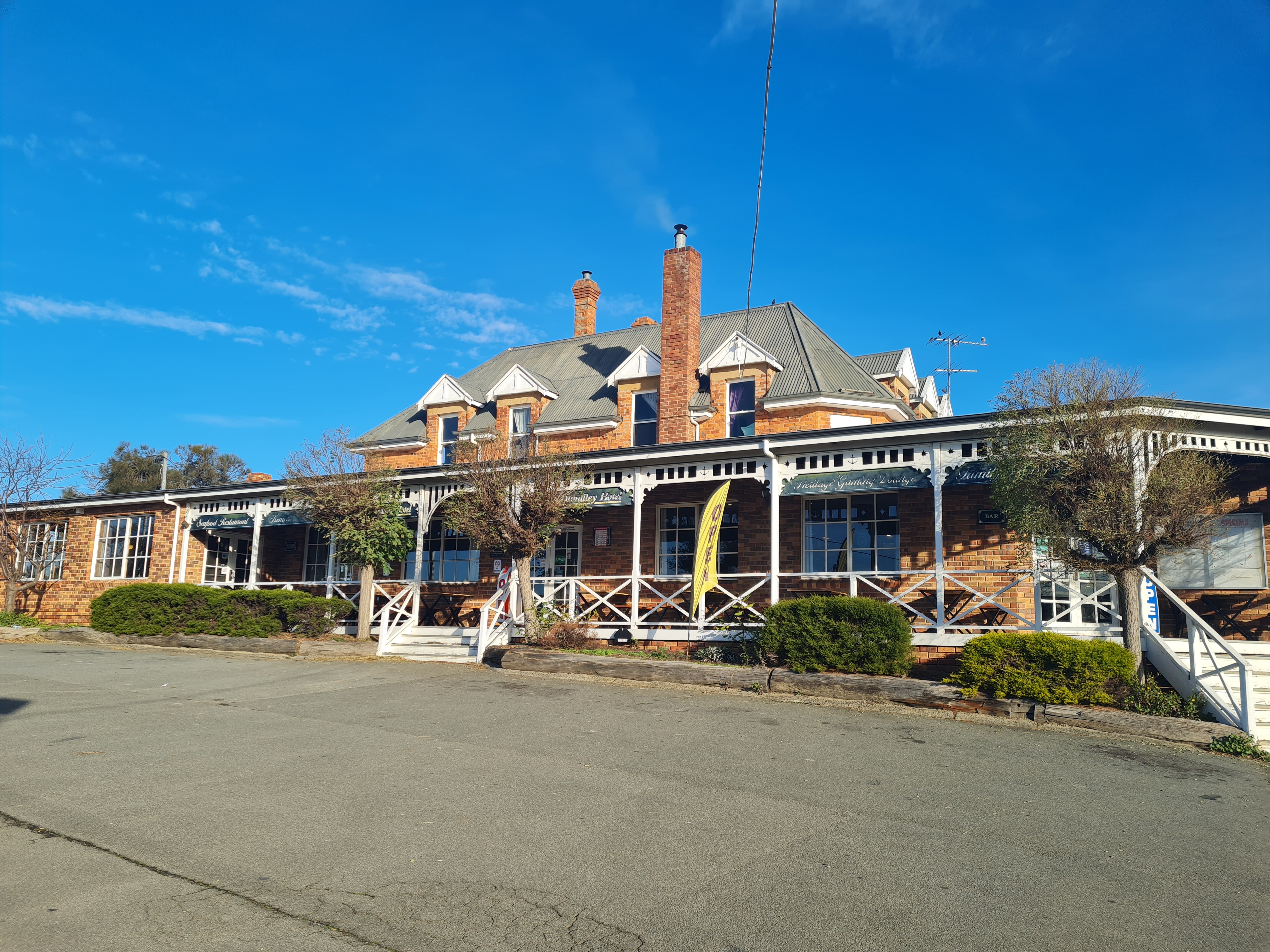
Hotel Dunally Seafood Restaurant, or so the sign outside says.

We saw this place on the way to Poet Arthur and if time allowed, we would check it out for lunch.

About 1 30 pm we go in.

Sadly, the locally caught Flounder is unavailable, no one had been able to go out and get it, so there is no fresh fish at all, not even the flathead.

Asked about the flathead, but it’s frozen seafood out of a bag and fried.  For a seafood restaurant, it’s very disappointing that it lacks fresh seafood.

We opt for the seafood bake, with chips and salad.  It’s not going to be fresh seafood, but maybe the closest thing to it, with prawns, scallops, and calamari, as well as fish pieces.

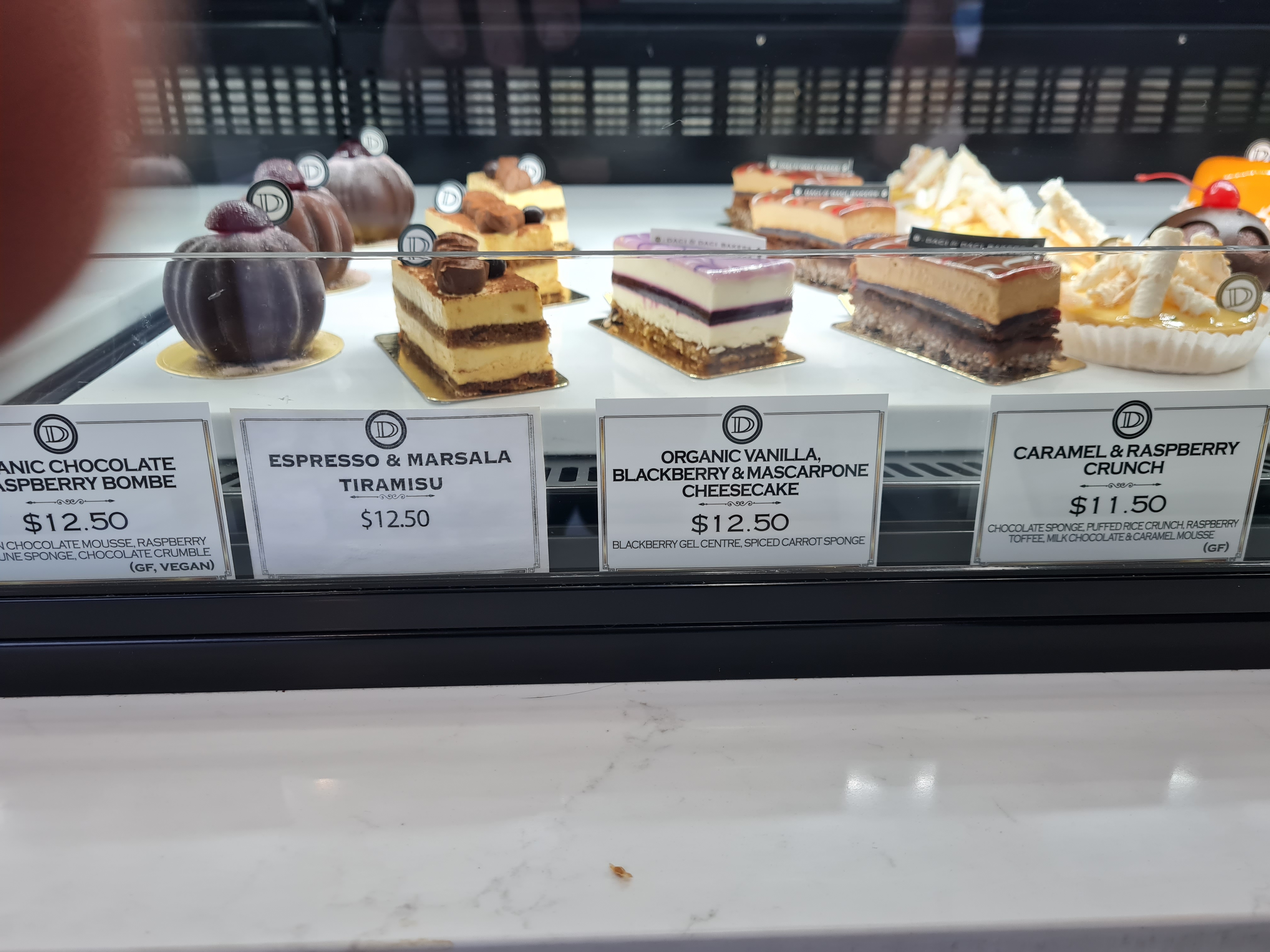
WE then decided to go back to Daci and Daci again, for another cake.

And got a look at some of the other cakes

Endless flight – a short story

It had been billed as the longest commercial flight in the world.  London to Sydney.

Previous times it had been flown, it was devoid of passengers and cargo, except for a few reporters and airline staff; not more than about 20.

The plane, state of the art, was capable of flying twenty-one hours straight.  We would only need Nineteen and a half.  It was the first flight of its kind, and we were the first to participate in what was being touted as history-making.

I was on board only because I’d won a competition.  To be honest, I couldn’t believe my luck.

I guess it was the same for the other 287 of us on board.  With baggage and cargo included, oh, and not forgetting fuel, I guess our biggest concern was getting off the ground.

It wasn’t long before that fear had been dispelled, though for a moment more than one of us thought we might not get into the air.  There were collective sighs of relief when we finally lurched into the air.

Once the seat belt sign went off, the First Officer spoke to the passengers, more or less telling us we were going to make history and to sit back and enjoy the in-flight service.

I guess it was ironic that as someone who didn’t like flying I was in this plane.  The thing is, I didn’t expect to win the competition.  But, I was on board for the experience and was going to make the most of it.  I’d brought half a dozen crossword books.

I woke from an uneasy sleep about two hours before I e plane was due to land.  The cabin lights had come on, and breakfast was about to be served.

Everyone else was in varying states of awareness.  Some hadn’t slept at all, which was what usually happened to me, and they looked like I felt.  Bleary-eyed and half awake.

I looked at the flight path in the headrest in front of me, and it said we had about an hour and fifty minutes, and from the outset, precisely on time.  We’d had headwinds and tailwinds but neither had any lasting effect on our arrival time.

Something else did.  After breakfast had been cleared away, and we were all getting ready for the last hour of the flight, word came through from the flight deck that we had to go into a holding pattern due to a problem on the ground.

The first question on everyone’s mind, did we have enough fuel.  The Captain, this time, allayed that fear.

But, I was sitting over the wing where I could see the engine.  I was not an expert but I thought I’d heard a murmur, the sort an engine made where the fuel supply was running out.

Perhaps not.  Perhaps it was my overwrought imagination after not enough proper sleep.

Another half-hour passed, and I could feel a change in the plane’s flight.  I was now listening and waiting and interpreting.  The Captain said the problem was resolved and we were cleared to land.

That’s when the engine outside my window stuttered, if only for a fraction of a second.

Fortunately, we were well into our descent, and I could see the ground below.  Now, going through some low cloud, the ride became bumpy, and I was sure it was covering the more frequent stuttering of the engine, and once, I was not the only one to hear it.

As the wheels went down and clunked into place, I think the engine stopped, though I couldn’t be sure, because there was little or no change in the plane’s flight other than a slight change in the plane’s speed but not its rate of descent, and none of us would have been any wiser had the pilot, in his usual calm manner, not told us there was a small problem with one of the engines but there was no problem with landing, and we would be on the ground in ten minutes.

In fact, the landing was, as any other I’d been on, flawless, even though I was sure I heard a slight stutter in the other ending, but by that time we were on the ground.

The only difference between this and any other landing was the accompaniment of several emergency services trucks, and the fact we were not going to a gate.  Instead, we were taken to a bay not far from the runways, and then calmly taken off the plane.

From the ground, just before being loaded onto a bus, I could see the plane, and it looked the same as it had any other time.

What did bother me was several words spoken by what looked to be an engineer.  He said, “That plane was literally flying on vapor.  What you’re seeing is 228 of the luckiest people in the world.”

If ever there was an excuse to buy a lottery ticket…

…

© Charles Heath 2020-2021

Inspiration, Maybe – Volume Two

50 photographs, 50 stories, of which there is one of the 50 below.

They all start with –

A picture paints … well, as many words as you like.  For instance:

And, the story:

Have you ever watched your hopes and dreams simply just fly away?

Everything I thought I wanted and needed had just left in an aeroplane, and although I said I was not going to, i came to the airport to see the plane leave.  Not the person on it, that would have been far too difficult and emotional, but perhaps it was symbolic, the end of one life and the start of another.

But no matter what I thought or felt, we had both come to the right decision.  She needed the opportunity to spread her wings.  It was probably not the best idea for her to apply for the job without telling me, but I understood her reasons.

She was in a rut.  Though her job was a very good one, it was not as demanding as she had expected, particularly after the last promotion, but with it came resentment from others on her level, that she, the youngest of the group would get the position.

It was something that had been weighing down of her for the last three months, and if noticed it, the late nights, the moodiness, sometimes a flash of temper.  I knew she had one, no one could have such red hair and not, but she had always kept it in check.

And, then there was us, together, and after seven years, it felt like we were going nowhere.  Perhaps that was down to my lack of ambition, and though she never said it, lack of sophistication.  It hadn’t been an issue, well, not until her last promotion, and the fact she had to entertain more, and frankly I felt like an embarrassment to her.

So, there it was, three days ago, the beginning of the weekend, and we had planned to go away for a few days and take stock.  We both acknowledged we needed to talk, but it never seemed the right time.

It was then she said she had quit her job and found a new one.  Starting the following Monday.

Ok, that took me by surprise, not so much that it something I sort of guessed might happen, but that she would just blurt it out.

I think that right then, at that moment, I could feel her frustration with everything around her.

What surprised her was my reaction.  None.

I simply asked where who, and when.

A world-class newspaper, in New York, and she had to be there in a week.

A week.

It was all the time I had left with her.

I remember I just shrugged and asked if the planned weekend away was off.

She stood on the other side of the kitchen counter, hands around a cup of coffee she had just poured, and that one thing I remembered was the lone tear that ran down her cheek.

Is that all you want to know?

I did, yes, but we had lost that intimacy we used to have when she would have told me what was happening, and we would have brainstormed solutions. I might be a cabinet maker but I still had a brain, was what I overheard her tell a friend once.

There’s not much to ask, I said.  You’ve been desperately unhappy and haven’t been able to hide it all that well, you have been under a lot of pressure trying to deal with a group of troglodytes, and you’ve been leaning on Bentley’s shoulder instead of mine, and I get it, he’s got more experience in that place,  and the politics that go with it, and is still an ally.

Her immediate superior and instrumental in her getting the position, but unlike some men in his position he had not taken advantage of a situation like some men would.  And even if she had made a move, which I doubted, that was not the sort of woman she was, he would have politely declined.

One of the very few happily married men in that organisation, so I heard.

So, she said, you’re not just a pretty face.

Par for the course for a cabinet maker whose university degree is in psychology.  It doesn’t take rocket science to see what was happening to you.  I just didn’t think it was my place to jump in unless you asked me, and when you didn’t, well, that told me everything I needed to know.

Yes, our relationship had a use by date, and it was in the next few days.

I was thinking, she said, that you might come with me,  you can make cabinets anywhere.

I could, but I think the real problem wasn’t just the job.  It was everything around her and going with her, that would just be a constant reminder of what had been holding her back. I didn’t want that for her and said so.

Then the only question left was, what do we do now?

Go shopping for suitcases.  Bags to pack, and places to go.

Getting on the roller coaster is easy.  On the beginning, it’s a slow easy ride, followed by the slow climb to the top.  It’s much like some relationships, they start out easy, they require a little work to get to the next level, follows by the adrenaline rush when it all comes together.

What most people forget is that what comes down must go back up, and life is pretty much a roller coaster with highs and lows.

Our roller coaster had just come or of the final turn and we were braking so that it stops at the station.

There was no question of going with her to New York.  Yes, I promised I’d come over and visit her, but that was a promise with crossed fingers behind my back.  After a few months in t the new job the last thing shed want was a reminder of what she left behind.  New friends new life.

We packed her bags, three out everything she didn’t want, a free trips to the op shop with stiff she knew others would like to have, and basically, by the time she was ready to go, there was nothing left of her in the apartment, or anywhere.

Her friends would be seeing her off at the airport, and that’s when I told her I was not coming, that moment the taxi arrived to take her away forever.  I remember standing there, watching the taxi go.  It was going to be, and was, as hard as it was to watch the plane leave.

So, there I was, finally staring at the blank sky, around me a dozen other plane spotters, a rather motley crew of plane enthusiasts.

Already that morning there’s been 6 different types of plane depart, and I could hear another winding up its engines for take-off.

People coming, people going.

Maybe I would go to New York in a couple of months, not to see her, but just see what the attraction was.  Or maybe I would drop in, just to see how she was.

As one of my friends told me when I gave him the news, the future is never written in stone, and it’s about time you broadened your horizons.

Perhaps it was.


© Charles Heath 2020-2021

Coming soon.  Find the above story and 49 others like it in:

Travelling after a pandemic: Destination Hobart – 3

Hobart in June – Winter – Day 3 – Monday

…

Day 3 – Monday

We agreed not to plan what we were going to do today, but I had this idea we should go north or the opposite direction to yesterday.

That meant our destination, following the hop on hop off bus route was to head towards the Botanic Gardens.

Bur first, Rosemary had expressed a desire to go down to the water’s edge to have a look, giving an excellent view of the coastline at what was called Battery Point.

I tried to get there, but there were no roads that specifically went down to the water’s edge, but we did eventually drive-up Salamanca place, where we had walked a few days before.

It was not the same, but it did give us time to look at the line of sandstone buildings that had been there a long time and had been repurposed as Sn arts precinct.

Of course, there was only one flaw in the plan, Rosemary was not able to walk any great distance, so we were limited to what could be seen from the car.

But…

There was really nothing to see, just cars parked haphazardly on the side of the road near an entrance that led down some steps, or a few cars in a proper car park too far away from the entrance.

I was not sure what to make of it other than it was an exercise-intensive effort just to get from the car park to the gate, and then you had to walk around the gardens.

It was all too much.

Government House was on the same road, but it was not open to the public, nor was it in sight of the road, do no photographic moment there, so we were doubly disappointed.

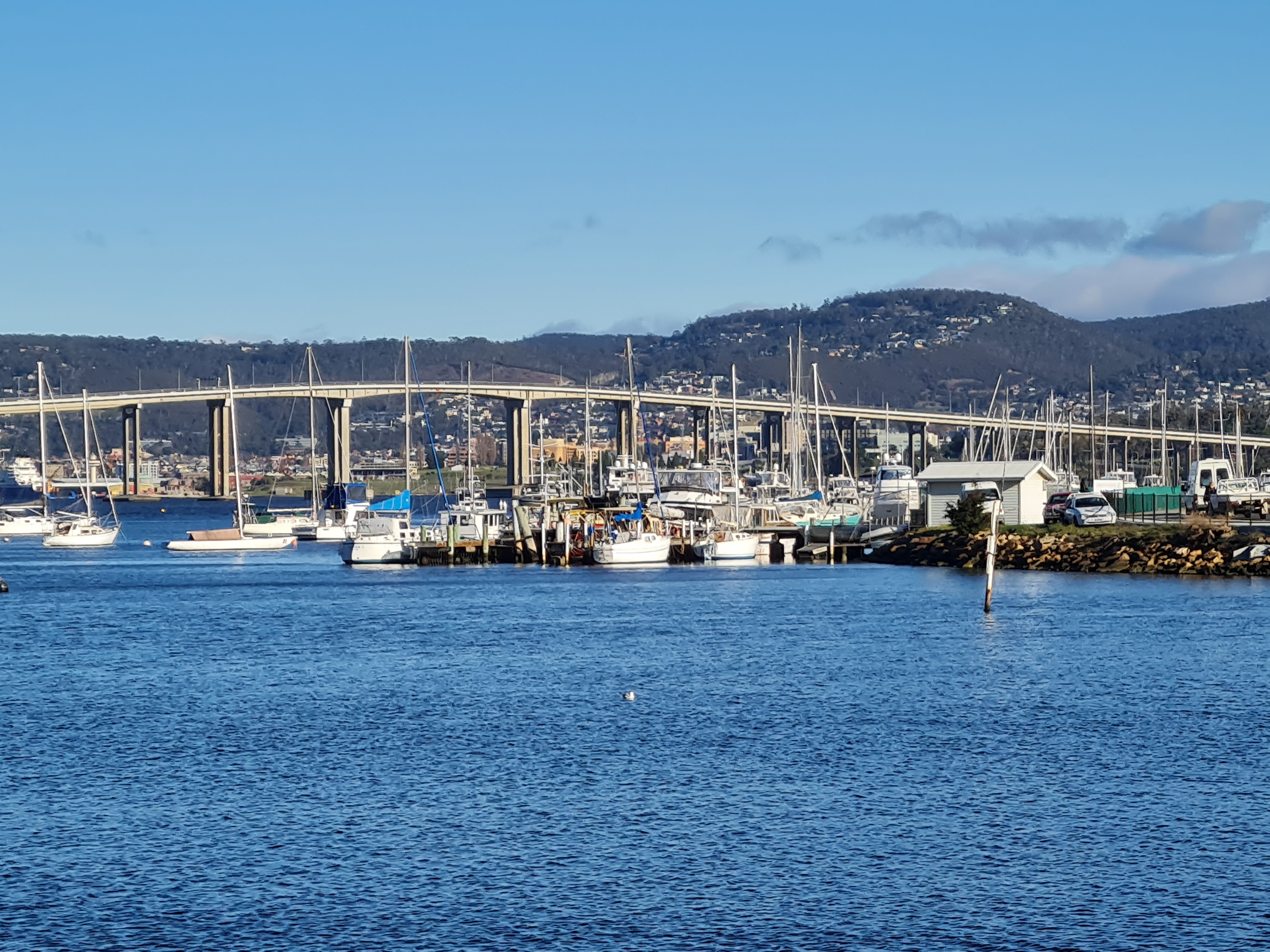
The next phase of our unplanned tour was to go over the Tasman Bridge, perhaps to see the other side of the bay that we could see from our apartment.

Except…

When we got over the other side we veered left to follow the Derwent towards Lindisfarne where there was a yacht basin and several yacht clubs, one of which promised a view while you drank coffee.

Only problem, no parking spaces.

A good idea, unable to be acted on.

Instead, we drove around the esplanade, and continued on our way to Glenorchy, after not being able to get that coffee with a view.

Back on the main road, we take the Glenorchy exit and doesn’t take long to get there, though, by the time we’ve driven through the suburban area, we’re back on the main Hobart Road.

It was a case of don’t blink or you’ll miss it.  We missed Glenorchy.

Change of plans, looking for that elusive coffee, we head for the center of Hobart shopping, Centrepoint, hoping in that center there will be a coffee shop.  Of course, it’s Queen’s Birthday holiday so it’s possible nothing is open.

In the end, we found a parking space nearby. And a Hudson’s.  Coffee and a toasted sandwich went down very well. 

So, once again, we didn’t get to the places we were hoping to get to.  This is what tomorrow, we’re not going to state a place to visit.

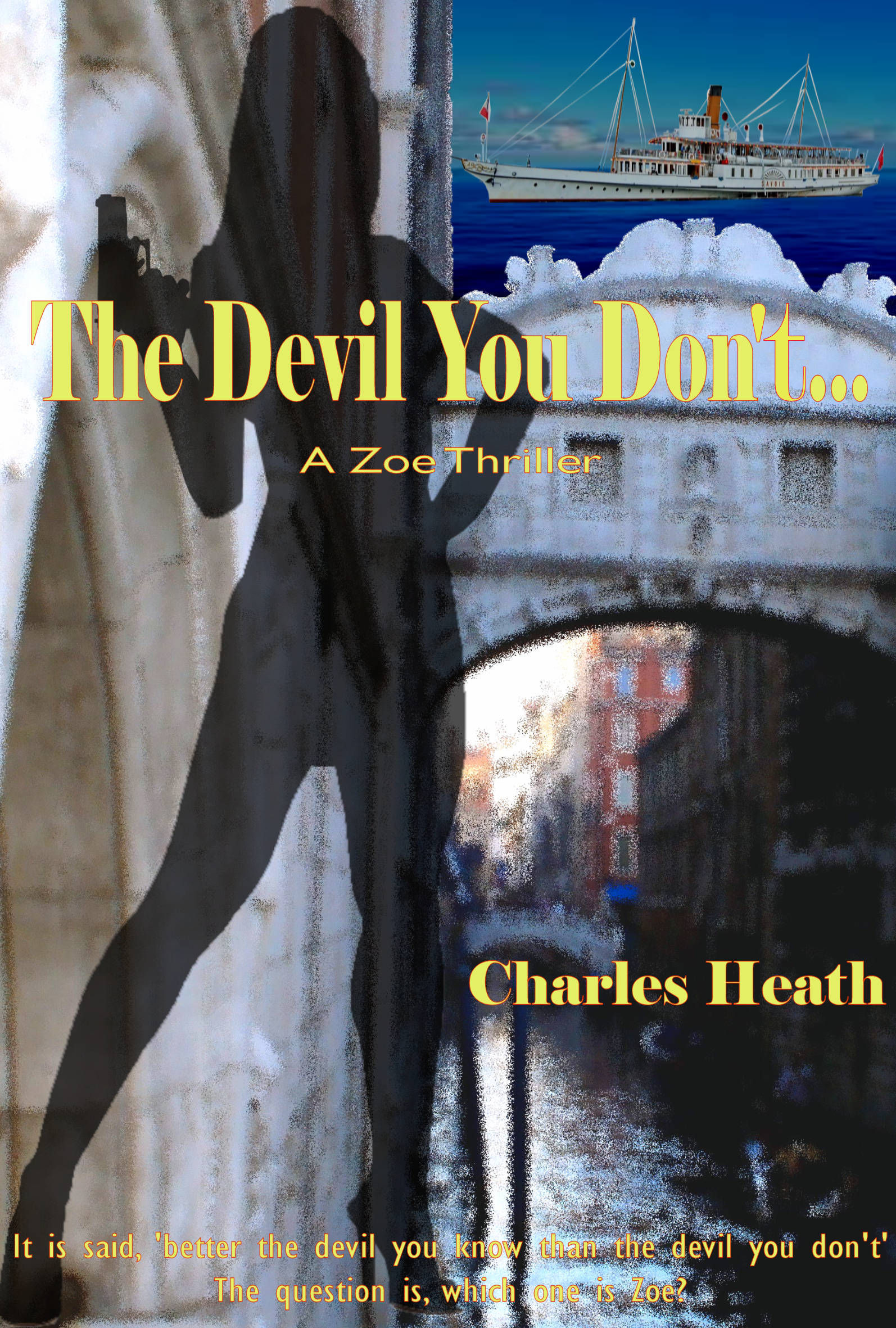
‘The Devil You Don’t’ – A beta reader’s view

It could be said that of all the women one could meet, whether contrived or by sheer luck, what are the odds it would turn out to be the woman who was being paid a very large sum to kill you.

John Pennington is a man who may be lucky in business, but not so lucky in love. He has just broken up with Phillipa Sternhaven, the woman he thought was the one, but relatives and circumstances, and perhaps because she was a ‘princess’, may also have contributed to the end result.

So, what do you do when you are heartbroken?

That is a story that slowly unfolds, from the first meeting with his nemesis on Lake Geneva, all the way to a hotel room in Sorrento, where he learns the shattering truth.

What should have been solace after disappointment, turns out to be something else entirely, and from that point, everything goes to hell in a handbasket.

He suddenly realizes his so-called friend Sebastian has not exactly told him the truth about a small job he asked him to do, the woman he is falling in love with is not quite who she says she is, and he is caught in the middle of a war between two men who consider people becoming collateral damage as part of their business.

The story paints the characters cleverly displaying all their flaws and weaknesses. The locations add to the story at times taking me back down memory lane, especially to Venice where, in those back streets I confess it’s not all that hard to get lost.

All in all a thoroughly entertaining story with, for once, a satisfying end.

…

Available on Amazon here: https://amzn.to/2Xyh1ow

…

The Things We Do For Love – The final editor’s draft – Day 4

…

That first encounter outside the confines of the hotel has shaken him.  He realises that he really has no understanding of women and that his first love with Jane has done nothing to prepare him.

It only reinforces the notion that he should simply avoid her where possible.

Yet, over dinner, she tells him her story, not the real story, but close enough to the truth.  In doing so, allowing the door to be ajar, she realises this could become complicated very quickly.

And yet, despite her resolution to remain aloof, she is curious.  Who is this Henry?

The beach quickly becomes Henry’s thinking place.  He ruminates on what a friend on board the ship, Radly, might think of his situation.  Radly is a lady’s man and would have swept Michelle off her feet by now.

Michelle reappears, and, curious about him, asks him who he is, those usual questions, where he lives, and what he does.

Why?  If she is only there to hide, why get involved?

…