In a word: Anonymous

Which is how I feel sometimes.

It can be a paradox in that an ordinary man may strive to be recognised, that is, to rise above his inherent anonymity simply because he feels he has something more to offer mankind than just making up the numbers.

But sadly, that desire will often be met with staunch resistance, not because there’s an active campaign against him, it’s just the way of the world.

The fact is, most of us will always be anonymous to the rest of the world, but in being so in that respect it’s that anonymity we can live with.  However, it’s far more significant if we become anonymous to those around us.  And, sadly, it can happen.

It’s when we take someone for granted.

At the other end of the scale, there is the celebrity, who has finally found fame, discovers that fame is not all it’s cracked up to be.  You find that meteoric rise from obscurity an adrenaline rush, and you’re no longer anonymous.

But all that changes when you are constantly bailed up in the street by well-meaning but annoying fans when you are being chased by the paparazzi and magazine reporters who thrive not on the fact that you are famous but watching and waiting for you to stumble.

Some often forget that there’s always a camera on them, or there’s a reporter lurking in the shadows, looking for the next scoop, capturing that awkward inexplicable moment when the celebrity is seen with someone who’s not their spouse, or worse, if it could be that, they get drunk and make a fool of themselves.

Do I really want to lose that anonymity that I have?

Not really.  It seems to me like it might be the lesser of two evils.

An excerpt from “What Sets Us Apart”, a mystery with a twist

See the excerpt from the story below, just a taste of what’s in store…

http://amzn.to/2Eryfth

whatsetscover

McCallister was old school, a man who would most likely fit in perfectly campaigning on the battlefields of Europe during the Second World War. He’d been like a fish out of water in the army, post-Falklands, and while he retired a hero, he still felt he’d more to give.

He’d applied and was accepted as head of a SWAT team, and, watching him now as he and his men disembarked from the truck in almost military precision, a look passed between Annette, the police liaison officer, and I that said she’d seen it all before. I know I had.

There was a one in four chance his team would be selected for this operation, and she had been hoping it would be one of the other three. While waiting for them to arrive she filled me in on the various teams. His was the least co-operative, and the more likely to make ad-hoc decisions rather than adhere to the plan, or any orders that may come from the officer in charge.

This, she said quite bluntly, was going to end badly.

I still had no idea why Prendergast instructed me to attend the scene of what looked to be a normal domestic operation, but as the nominated expert in the field in these types of situations, it was fairly clear he wasn’t taking any chances. It was always a matter of opinion between us, and generally I lost.

In this case, it was an anonymous report identifying what the authorities believed were explosives in one of the dockside sheds where explosives were not supposed to be.

The only reason why the report was given any credence was the man, while not identifying himself by name, said he’d been an explosive expert once and recognized the boxes. That could mean anything, but the Chief Constable was a cautious man.

With his men settled and preparing their weapons, McCallister came over to the command post, not much more than the SUV my liaison and I arrived in, with weapons, bulletproof vests, and rolls of tape to cordon off the area afterward. We both had coffee, steaming in the cold early morning air. Dawn was slowly approaching and although rain had been forecast it had yet to arrive.

A man by the name of Benson was in charge. He too had groaned when he saw McCallister.

“A fine morning for it.” McCallister was the only enthusiastic one here.

He didn’t say what ‘it’ was, but I thought it might eventually be mayhem.

“Let’s hope the rain stays away. It’s going to be difficult enough without it,” Benson said, rubbing his hands together. We had been waiting for the SWAT team to arrive, and another team to take up their position under the wharf, and who was in the final stages of securing their position.

While we were waiting we drew up the plan. I’d go in first to check on what we were dealing with, and what type of explosives. The SWAT team, in the meantime, were to ensure all the exits to the shed were covered. When I gave the signal, they were to enter and secure the building. We were not expecting anyone inside or out, and no movement had been detected in the last hour since our arrival and deployment.

“What’s the current situation?”

“I’ve got eyes on the building, and a team coming in from the waterside, underneath. Its slow progress, but they’re nearly there. Once they’re in place, we’re sending McKenzie in.”

He looked in my direction.

“With due respect sir, shouldn’t it be one of us?” McCallister glared at me with the contempt that only a decorated military officer could.

“No. I have orders from above, much higher than I care to argue with, so, McCallister, no gung-ho heroics for the moment. Just be ready to move on my command, and make sure you have three teams at the exit points, ready to secure the building.”

McCallister opened his mouth, no doubt to question those orders, but instead closed it again. “Yes sir,” he muttered and turned away heading back to his men.

“You’re not going to have much time before he storms the battlements,” Benson quietly said to me, a hint of exasperation in his tone. “I’m dreading the paperwork.”

It was exactly what my liaison officer said when she saw McCallister arriving.

The water team sent their ‘in position’ signal, and we were ready to go.

In the hour or so we’d been on site nothing had stirred, no arrivals, no departures, and no sign anyone was inside, but that didn’t mean we were alone. Nor did it mean I was going to walk in and see immediately what was going on. If it was a cache of explosives then it was possible the building was booby-trapped in any number of ways, there could be sentries or guards, and they had eyes on us, or it might be a false alarm.

I was hoping for the latter.

I put on the bulletproof vest, thinking it was a poor substitute for full battle armor against an exploding bomb, but we were still treating this as a ‘suspected’ case. I noticed my liaison officer was pulling on her bulletproof vest too.

“You don’t have to go. This is my party, not yours,” I said.

“The Chief Constable told me to stick to you like glue, sir.”

I looked at Benson. “Talk some sense into her please, this is not a kindergarten outing.”

He shrugged. Seeing McCallister had taken all the fight out of him. “Orders are orders. If that’s what the Chief Constable requested …”

Madness. I glared at her, and she gave me a wan smile. “Stay behind me then, and don’t do anything stupid.”

“Believe me, I won’t be.” She pulled out and checked her weapon, chambering the first round. It made a reassuring sound.

Suited up, weapons readied, a last sip of the coffee in a stomach that was already churning from nerves and tension, I looked at the target, one hundred yards distant and thought it was going to be the longest hundred yards I’d ever traversed. At least for this week.

A swirling mist rolled in and caused a slight change in plans.

Because the front of the buildings was constantly illuminated by large overhead arc lamps, my intention had been to approach the building from the rear where there was less light and more cover. Despite the lack of movement, if there were explosives in that building, there’d be ‘enemy’ surveillance somewhere, and, after making that assumption, I believed it was going to be easier and less noticeable to use the darkness as a cover.

It was a result of the consultation, and studying the plans of the warehouse, plans that showed three entrances, the main front hangar type doors, a side entrance for truck entry and exit and a small door in the rear, at the end of an internal passage leading to several offices. I also assumed it was the exit used when smokers needed a break. Our entry would be by the rear door or failing that, the side entrance where a door was built into the larger sliding doors. In both cases, the locks would not present a problem.

The change in the weather made the approach shorter, and given the density of the mist now turning into a fog, we were able to approach by the front, hugging the walls, and moving quickly while there was cover. I could feel the dampness of the mist and shivered more than once.

It was nerves more than the cold.

I could also feel rather than see the presence of Annette behind me, and once felt her breath on my neck when we stopped for a quick reconnaissance.

It was the same for McCallister’s men. I could feel them following us, quickly and quietly, and expected, if I turned around, to see him breathing down my neck too.

It added to the tension.

My plan was still to enter by the back door.

We slipped up the alley between the two sheds to the rear corner and stopped. I heard a noise coming from the rear of the building, and the light tap on the shoulder told me Annette had heard it too. I put my hand up to signal her to wait, and as a swirl of mist rolled in, I slipped around the corner heading towards where I’d last seen the glow of a cigarette.

The mist cleared, and we saw each other at the same time. He was a bearded man in battle fatigues, not the average dockside security guard.

He was quick, but my slight element of surprise was his undoing, and he was down and unconscious in less than a few seconds with barely a sound beyond the body hitting the ground. Zip ties secured his hands and legs, and tape his mouth. Annette joined me a minute after securing him.

A glance at the body then me, “I can see why they, whoever they are, sent you.”

She’d asked who I worked for, and I didn’t answer. It was best she didn’t know.

“Stay behind me,” I said, more urgency in my tone. If there was one, there’d be another.

Luck was with us so far. A man outside smoking meant no booby traps on the back door, and quite possibly there’d be none inside. But it indicated there were more men inside, and if so, it appeared they were very well trained. If that were the case, they would be formidable opponents.

The fear factor increased exponentially.

I slowly opened the door and looked in. A pale light shone from within the warehouse itself, one that was not bright enough to be detected from outside. None of the offices had lights on, so it was possible they were vacant. I realized then they had blacked out the windows. Why hadn’t someone checked this?

Once inside, the door closed behind us, progress was slow and careful. She remained directly behind me, gun ready to shoot anything that moved. I had a momentary thought for McCallister and his men, securing the perimeter.

At the end of the corridor, the extent of the warehouse stretched before us. The pale lighting made it seem like a vast empty cavern, except for a long trestle table along one side, and, behind it, stacks of wooden crates, some opened. It looked like a production line.

To get to the table from where we were was a ten-yard walk in the open. There was no cover. If we stuck to the walls, there was equally no cover and a longer walk.

We needed a distraction.

As if on cue, the two main entrances disintegrated into flying shrapnel accompanied by a deafening explosion that momentarily disoriented both Annette and I. Through the smoke and dust kicked up I saw three men appear from behind the wooden crates, each with what looked like machine guns, spraying bullets in the direction of the incoming SWAT members.

They never had a chance, cut down before they made ten steps into the building.

By the time I’d recovered, my head heavy, eyes watering and ears still ringing, I took several steps towards them, managing to take down two of the gunmen but not the third.

I heard a voice, Annette’s I think, yell out, “Oh, God, he’s got a trigger,” just before another explosion, though all I remember in that split second was a bright flash, the intense heat, something very heavy smashing into my chest knocking the wind out of me, and then the sensation of flying, just before I hit the wall.

I spent four weeks in an induced coma, three months being stitched back together and another six learning to do all those basic actions everyone took for granted. It was twelve months almost to the day when I was released from the hospital, physically, except for a few alterations required after being hit by shrapnel, looking the same as I always had.

But mentally? The document I’d signed on release said it all, ‘not fit for active duty; discharged’.

It was in the name of David Cheney. For all intents and purposes, Alistair McKenzie was killed in that warehouse, and for the first time ever, an agent left the Department, the first to retire alive.

I was not sure I liked the idea of making history.

© Charles Heath 2016-2020

“Trouble in Store” – Short Stories my way: Annalisa’s story

 It’s time to look at what’s been written for the unfortunate Annalisa, who had been caught up in a situation that is rapidly getting out of her control, not that she had it under control in the first place.  Perhaps it’s time to start reassessing her bad boy phase and think about a new lifestyle. 

Drugs, for her, were fun to begin with, but she kept doing them and now it had got her into this predicament…

…

Annalisa looked at the two men facing her.

Simmo, the boy on the floor, had told her that the shopkeeper would be a pushover, he was an old man who’d just hand over the drugs, rather than cause trouble for himself.

Where Simmo had discovered the shopkeeper’s true vocation, dispensing drugs to the neighbourhood addicts, she didn’t know, but it was not the first place like this they had visited.

She had always known Simmo had a problem, but he had assured her he had it under control.  Until a month ago, when he tried something new.

It had changed him.

The breaking point came earlier that day when seeing how sick he was, she threatened to leave.  It brought out the monster within him, and he threatened to kill her.  Not long after he had changed into a whimpering child pleading with her to stay, that he hadn’t meant anything he’d said before.

All he needed was one more ‘score’ to get his ‘shit’ together, and he would do as she asked, and find help.

She believed him.

He said he knew a place not far from the apartment, a small shop where what he needed was available, and said he had the money.

That should have been the first sign he was not telling the truth because she had been funding his habit until her parents cut off the money supply.  She suspected her father had put a private detective on to find her, had, and reported back, and rather than make a scene, just cut her off so she would have to come home or starve.  Her father was no better than Simmo.

And, as soon as they stepped into the shop, Simmo pulled out the gun,

Instead of the shopkeeper cowering like Simmo said he would, he had laughed at them and told them to get out.  Simmo started ranting and waving the gun around, then all of a sudden collapsed. 

There was a race for the gun which spilled out of Simmo’s hand, and she won. 

That was just before the customer burst into the shop.

It had been shortly before closing time.  Simmo had said there would be no one else around.

Wrong again.

Now she had another problem to deal with, a man who was clearly as scared shitless as she was.

This was worse than any bad hair day, or getting out of the wrong side of bed day, this was, she was convinced, the last day of her life.

She heard a strange sound come from beside her and looked down.  There was a trickle of blood coming out of his mouth and Simmo was making strange sounds like he was choking.

Any other time she might have been concerned, but the hard reality of it was, Simmo was never going to change.  She was only surprised at the fact it took so long for her to realize it.

As for the man standing in front of her, she was safe from the shopkeeper with him around, so he would have to stay.

“No.  Stay.”

Another glance at the shopkeeper told her she had made the right decision, his expression said it all.  Gun or no gun, the moment she was alone with him, he would kill her.

© Charles Heath 2018-2022

I should have paid more attention…

When I was back in school in what seems like a lifetime ago, I realise I should have paid more attention.

Why?

Because for some odd reason, we were taught more about American and English history than that of our own country, Australia.

We cannot use the excuse that we haven’t been around all that long, because we have, something like 1770, which led to settlement by the English in 1788 or so, but the first landing was in 1606 by a Dutchman.

Of course, these are vague memories of a social studies lesson that briefly touched on our origins, but only to re-affirm our allegiances to Britain. While it wasn’t the Empire when I was in school, it was the Commonwealth and our atlases still had the ‘wherever the map is red is where the British claimed as theirs’, and there were quite a lot of red countries.

But, hey, that pales into insignificance the stuff we learned about England, from the time of William the Conqueror in 1066 through to the modern day. I could at one stage of my life relate from memory all of the kings and queens of England.

I know all about the industrial revolution, and travel between Australia and England from the days of sailing, right through to the Airbus A380.

It’s why I have a preference for reading the English classics of Jane Austen and others of that golden era and watching period TV, recreated so lavishly by the BBC and ITV in England.

And of course, we were brought up on a steady diet of American TV shows, and films, like our country never existed, and was notorious for producing laughable TV shows of the poorest quality, despite the actors who tried very hard to make it seem believable.

I could not name one Australian prime minister and have trouble telling who is the current prime minister. Well maybe not, this Covid thing has had his face on the TV every day for nearly a year, but he’s the first. I couldn’t tell you who he took over from, nor who the leader of the opposition is.

It’s probably the reason why over the years people have often said we should become one of the states of the US.

Nowadays we’re trying to put a wall between us and them so China might not see us as an outpost of the US, and come in and attack us. The trouble is 28 million people versus 1.6 billion doesn’t give us any leverage. Come to think of it, the 360 million Americans wouldn’t stand a chance against an invasion of 1.6 billion either.

I’m not sure why it matters any more, because we’ll soon be back to the heady heights of the cold war days in the 50s and 60s, where the only deterrent to perceived enemies was the threat of nuclear annihilation.

It’s the one option where 360 million people could defeat an enemy of 16. billion.

But … there’s only one small problem …

We’ll all be dead.

As horrifying as that might sound, there is one other problem that might just do the same but not destroy any infrastructure. A pandemic. A virus that can’t be cured, a virus that can mutate and adapt so there is no effective vaccine.

Dystopian? It’s sure a great idea for a story. There’s been a few, but those always have a few survivors, ready willing and able to get along and rebuild the world having learned the lessons of past failures.

This time? I don’t think the next story will have a happy ending. In it though, the aggressors are not going to be better off than the rest, because they forget to build in a fail-safe, or couldn’t. Or it just got out before they finished perfecting it and synthesizing an antidote.

That’s something else we learned a lot about. Nuclear holocausts, and their effect. It reminds me of the day our class was taken to see a movie about the effects of a nuclear war. Was it to scare us, or prepare us? Back then, a nuclear war was more likely than a change of government in this country.

If it was to educate my generation of people who are now the in the government and positions of power, they failed.

So, if I had my time over, I would insist on learning about my country, and the people who have inhabited it for tens of thousands of years, without the need for cars, houses, cigarettes and booze, and definitely without the need for nuclear weapons and ideals of aggression towards other countries.

Now, where’s that pesky time machine…

The cinema of my dreams – I always wanted to go on a treasure hunt – Episode 58

Here’s the thing…

Every time I close my eyes, I see something different.

I’d like to think the cinema of my dreams is playing a double feature but it’s a bit like a comedy cartoon night on Fox.

But these dreams are nothing to laugh about.

Once again there’s a new installment of an old feature, and we’re back on the treasure hunt.

…

It was only an hours’ worth of skimming newspapers, for the dates I’d discovered at the cemetery, and the month around the time that Boggs’s father had disappeared, because the date of death for Friedrich Ormiston had a familiar ring to it.

They’d both apparently died in the same year, within months of each other.

Of course, there was a twist.

Neither of the two men’s bodies had been found, and both missing person’s cases had remained open for the specified period before being declared legally dead.  I knew that to be the case for Boggs’s father, but I had not really known the details of the circumstances.

The paper had played up the disappearance of both men, pushing the Treasure hunt aspect knowing it would bring in readers, and perhaps get picked up by the big city papers.  It had got a television crew down briefly, I remembered that much, and the fact Boggs had wanted nothing to do with it.  

The story, though, was interesting, that everyone remembered that fateful night in the bar when he had been telling anyone who would listen that he had found ‘the’ clue to the treasure’s whereabouts, and the drunker he got, the more outlandish the story.

A number of people who were visiting the town because suspects simply because they were out of towners, and subsequently cleared in the ensuing investigation.  What had turned up was the fact he owed a great deal of one to loan sharks, and one in particular, who was in town to collect on a prior loan for a fruitless search, and who was a prime suspect.

In the end, the price of his freedom was to forgo the collection of the debt.

Yet another was unmasked as a fellow treasure hunter with a dubious past, having been jailed for earlier transgressions of stealing other’s finds, but he claimed he was not a legitimate treasure hunter, and that he was in town at the request of Benderby, to oversee the dredging of a part of the bay for more coins.  It had been a fruitless endeavor.

But despite his assertions, no one really believed Boggs’s father’s claims and had dismissed it as the usual ravings that had become his mantra for many years.  Only his son believed him.

Boggs himself had made the newspaper, a photo of him by the grave where his father’s spirit rather than body had been buried, vowing to prove his father right.

What added to the legend was the disappearance and apparent death of Ormiston not long after.  The story of his search for the treasure was long and fruitless, one of dissipating the family fortune in search of another.

His disappearance was attributed to the fact he had become erratic and forgetful, the town doctor at the time telling the coroner’s inquest that he had early onset dementia and was prone to wandering off.  This time it had been his downfall.

A search had been mounted and all the cave systems were checked, known to be the places he frequented the most, and when a new rockslide was discovered in one of the caves, it was assumed he had ventured too far and been trapped.  Several attempts were made to clear the way, but the fall had been far too extensive and had to be abandoned.

Every few years the paper revisited Boggs’s disappearance, but there was no new information, and after ten years nothing more was written.  It seemed that Lenny had a continued interest in the Treasure hunt because he had filed a number of newspaper reports, making it easy for me to get the gist of the story.

Then, several months ago, he had written a new story, a small piece that I had missed, reporting on Boggs’s discovery of a new map of the coastline, one that suggested that the site of the ill-fated mall was, in fact, an entrance to the cave system where the treasure may have been placed.  It referenced a survey that had been made before the second world war, one that hinted that the cave system was much larger than originally thought, and quite likely went all the way to the mountains, the origin of an ancient underground river.

The fact the mall site had been the victim of flooding made that seemed to make that assumption plausible, but apparently, no one else had seen that particular map, and Boggs had not been forthcoming in sharing it with the reporter.

But aside from those few paragraphs nothing more was said.

It explained what Boggs was doing when we went to the mall site.

All of that was condensed into a page of notes in my notepad, where it would have to stay for a day or so because I had to go home, change and go to work.

Perhaps tomorrow I would get to talk to Boggs about it.

As luck would have it, I ran into Boggs just up the street where he was coming out of the hardware store with a skein of rope slung over his shoulder.

“Just the person I’m looking for,” I said.

His look told me that I was the last person he wanted to see.

“I’m busy, Sam.  Can we do this another time?”

“Planning a lynching?”  My eyes went from him to the rope, and back.

“Climbing.  I’m going away for a few days, get away from everything, and do something other than think about treasure.”

“Probably a good idea.  I’m sorry I haven’t been much of help lately, with work and stuff.”

“How’s Nadia?”

It was a pointed question, and I knew he had seen me with her.  I had thought it might be Alex.

“Being Nadia, leopards don’t change their spots, and I’m trying to keep the enemies close so I can track what they’re up to.”

“There’s close and then there’s too close, Sam.”

“True, but it’s not what you think.”

“I don’t know what to think anymore.  Let’s just leave it at that, and I’ll call you when I get back.”

I knew the tone, and I could smell a burnt bridge.  Maybe it was time to give him some space, and I could get on with a bit of research and bring it to him when he was in a more receptive frame of mind. 

“As you wish.  Be careful out there.”

…

© Charles Heath 2020-2022

The Things We Do For Love – The final editor’s draft – Day 4

…

That first encounter outside the confines of the hotel has shaken him.  He realises that he really has no understanding of women and that his first love with Jane has done nothing to prepare him.

It only reinforces the notion that he should simply avoid her where possible.

Yet, over dinner, she tells him her story, not the real story, but close enough to the truth.  In doing so, allowing the door to be ajar, she realises this could become complicated very quickly.

And yet, despite her resolution to remain aloof, she is curious.  Who is this Henry?

The beach quickly becomes Henry’s thinking place.  He ruminates on what a friend on board the ship, Radly, might think of his situation.  Radly is a lady’s man and would have swept Michelle off her feet by now.

Michelle reappears, and, curious about him, asks him who he is, those usual questions, where he lives, and what he does.

Why?  If she is only there to hide, why get involved?

…

Travelling after a pandemic: Destination Hobart – 4

Hobart in June – Winter – Day 4 – Tuesday

…

Day 4 – Tuesday

We’re up early because there’s an informal breakfast put on by the resort at 9, with waffles, ice cream, and berries.

It also meant that we will be able to embark on an adventure a lot earlier than we have been previously, somewhere about 10:30.

Breakfast ends at about 10 and we take a few minutes to decide what we’re going to do.  The best option is the go-to Port Arthur, nearly 100km away, about an hour and a half drive.

The weather is great considering so far we’ve had rain and more rain, insidious cold, and snow, so for the day to be sunny with blue skies is as if the planets have lined up.

Nearly 100 km driving in rain to visit a penal colony 8n the rain was not a good prospect.

Along the way, there are a number of scenic points and intermittent views of the water which in places gives views out to sea, but it seems mostly over estuaries because the water is quite calm.

Only as we approach Port Arthur do we get to see the ocean stretch out to the horizon, and there are lookout points over rocks that display the end result of the ocean’s fury with land.

There are several viewing points for landmarks such as the Blowhole. These we will stop at on the way back

Along with a lavender factory and cafe.

Not far from that lavender factory is a Tasmanian Devil union, which seems to be an odd name for scything, but we don’t stop to see exactly what it is

Just at noon, we arrive at the Port Arthur site to be greeted by two overflow carparks, then a three-tiered carpark.  We try for the first, and closest, and get a park, more by good luck than anything else.

Good luck getting into the settlement other than through the edifice built across the whole front.  This is how you make people feel secure.  Not even an ant could get past it.

There us a restaurant, a Cafe, a gift shop, and entrance.  The cost is $45 for an adult, $20 for children, and $36 for us.

And from what I can see if the settlement, and the activities included in the admission price, we could not do any of it, so coming was not exactly a waste of time, we had to come to at least see it.

Maybe when Rosemary can walk again.

We spend time in the gift shop, I get a book that had photos of what we’re missing, sad then we head back.

Lunch at a seafood restaurant beckons.

On the way back we visit the Lavender farm, and, of course, pick up a few lavender items.

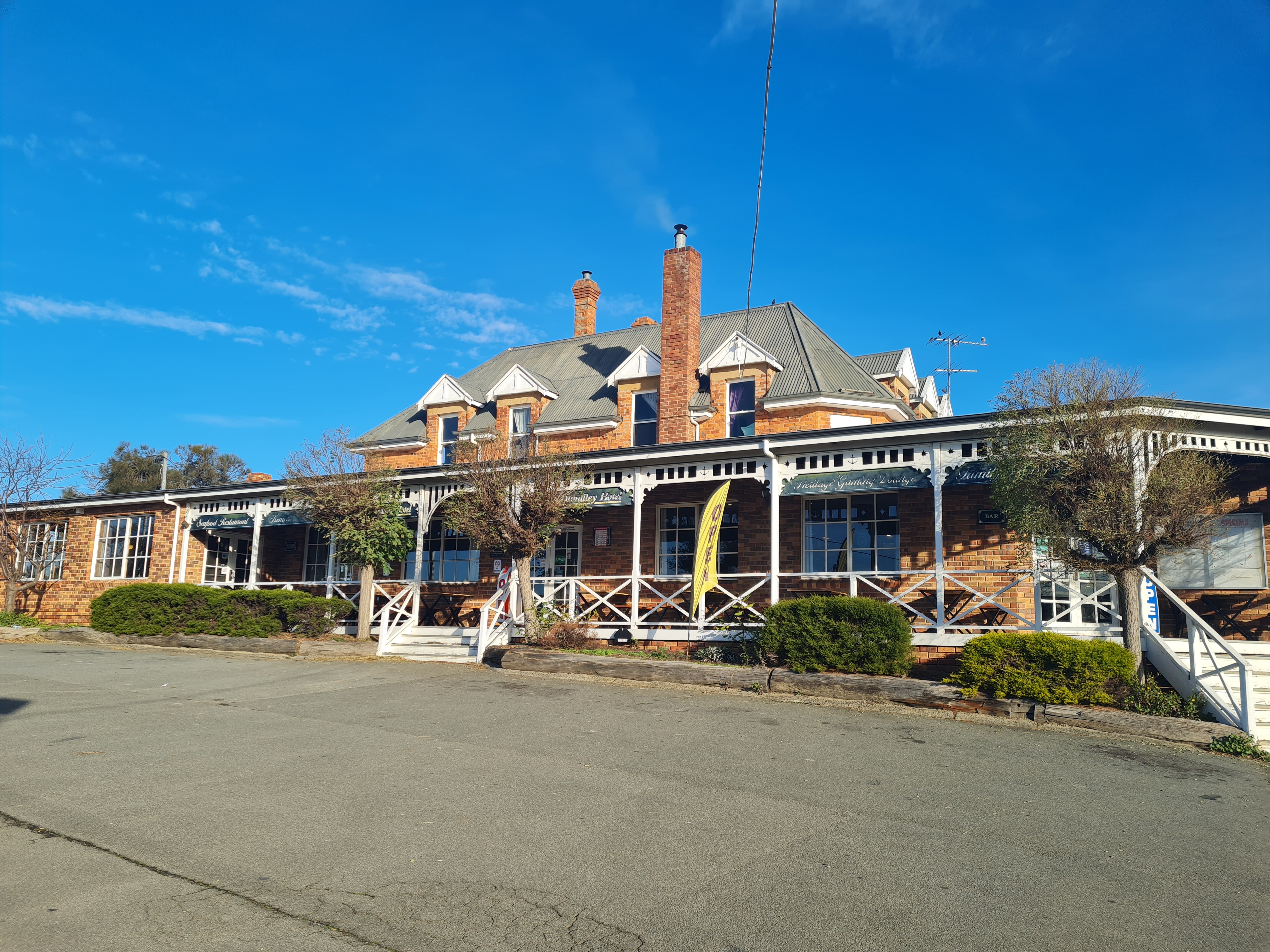
Hotel Dunally Seafood Restaurant, or so the sign outside says.

We saw this place on the way to Poet Arthur and if time allowed, we would check it out for lunch.

About 1 30 pm we go in.

Sadly, the locally caught Flounder is unavailable, no one had been able to go out and get it, so there is no fresh fish at all, not even the flathead.

Asked about the flathead, but it’s frozen seafood out of a bag and fried.  For a seafood restaurant, it’s very disappointing that it lacks fresh seafood.

We opt for the seafood bake, with chips and salad.  It’s not going to be fresh seafood, but maybe the closest thing to it, with prawns, scallops, and calamari, as well as fish pieces.

WE then decided to go back to Daci and Daci again, for another cake.

And got a look at some of the other cakes

Endless flight – a short story

It had been billed as the longest commercial flight in the world.  London to Sydney.

Previous times it had been flown, it was devoid of passengers and cargo, except for a few reporters and airline staff; not more than about 20.

The plane, state of the art, was capable of flying twenty-one hours straight.  We would only need Nineteen and a half.  It was the first flight of its kind, and we were the first to participate in what was being touted as history-making.

I was on board only because I’d won a competition.  To be honest, I couldn’t believe my luck.

I guess it was the same for the other 287 of us on board.  With baggage and cargo included, oh, and not forgetting fuel, I guess our biggest concern was getting off the ground.

It wasn’t long before that fear had been dispelled, though for a moment more than one of us thought we might not get into the air.  There were collective sighs of relief when we finally lurched into the air.

Once the seat belt sign went off, the First Officer spoke to the passengers, more or less telling us we were going to make history and to sit back and enjoy the in-flight service.

I guess it was ironic that as someone who didn’t like flying I was in this plane.  The thing is, I didn’t expect to win the competition.  But, I was on board for the experience and was going to make the most of it.  I’d brought half a dozen crossword books.

I woke from an uneasy sleep about two hours before I e plane was due to land.  The cabin lights had come on, and breakfast was about to be served.

Everyone else was in varying states of awareness.  Some hadn’t slept at all, which was what usually happened to me, and they looked like I felt.  Bleary-eyed and half awake.

I looked at the flight path in the headrest in front of me, and it said we had about an hour and fifty minutes, and from the outset, precisely on time.  We’d had headwinds and tailwinds but neither had any lasting effect on our arrival time.

Something else did.  After breakfast had been cleared away, and we were all getting ready for the last hour of the flight, word came through from the flight deck that we had to go into a holding pattern due to a problem on the ground.

The first question on everyone’s mind, did we have enough fuel.  The Captain, this time, allayed that fear.

But, I was sitting over the wing where I could see the engine.  I was not an expert but I thought I’d heard a murmur, the sort an engine made where the fuel supply was running out.

Perhaps not.  Perhaps it was my overwrought imagination after not enough proper sleep.

Another half-hour passed, and I could feel a change in the plane’s flight.  I was now listening and waiting and interpreting.  The Captain said the problem was resolved and we were cleared to land.

That’s when the engine outside my window stuttered, if only for a fraction of a second.

Fortunately, we were well into our descent, and I could see the ground below.  Now, going through some low cloud, the ride became bumpy, and I was sure it was covering the more frequent stuttering of the engine, and once, I was not the only one to hear it.

As the wheels went down and clunked into place, I think the engine stopped, though I couldn’t be sure, because there was little or no change in the plane’s flight other than a slight change in the plane’s speed but not its rate of descent, and none of us would have been any wiser had the pilot, in his usual calm manner, not told us there was a small problem with one of the engines but there was no problem with landing, and we would be on the ground in ten minutes.

In fact, the landing was, as any other I’d been on, flawless, even though I was sure I heard a slight stutter in the other ending, but by that time we were on the ground.

The only difference between this and any other landing was the accompaniment of several emergency services trucks, and the fact we were not going to a gate.  Instead, we were taken to a bay not far from the runways, and then calmly taken off the plane.

From the ground, just before being loaded onto a bus, I could see the plane, and it looked the same as it had any other time.

What did bother me was several words spoken by what looked to be an engineer.  He said, “That plane was literally flying on vapor.  What you’re seeing is 228 of the luckiest people in the world.”

If ever there was an excuse to buy a lottery ticket…

…

© Charles Heath 2020-2021

Friday night at a hotel bar

It’s a writer’s paradise for characters

…

I’m not a night person and even less so a pub person, except perhaps for a Sunday lunch, for what is usually an incomparable steak.

But tonight is different.

We’re meeting people who have come up from Melbourne for a wedding, people we haven’t seen for a long time.

I’m not a conversationalist, so I leave them to it, and go on a character hunt.

And the pickings are rich.

My first victim, If she could be called that, is the one I call the lady in the red dress.

She’s on the other side of 40, with a sort of earthy attractiveness about her.  The first thing to notice, for her age, the dress is too short.  Maybe that’s the fashion and I’m just an old fogey, but it does say something.

She’s definitely single, or perhaps a player, certainly a flirt.  She holds the stage, and talks with her hands, and those around her are captivated.

The untidy hair loosely collected in a hair tie tells me she carries a sort of messy but not messy look, and I wonder at the state of her residence.  It’s a leap I know, but small signs indicate bigger things.

I’ve counted two glasses of beer in an hour and a half, so she is sensible, aware of her surroundings, and of the three men she has spent her time with, it’s hard to pick a winner.  It’s not hard to captivate a loser.

Next comes the party girls three 20 somethings dressed to be noticed, and overly animated and screams look at us.

Oops, they just parked themselves nearby with the very expensive and exotic-looking matching cocktails.  There’s the obligatory selfie together, and then a casual look around to see what’s on offer.

I don’t think there’s a lot, but my standards and their standards are most likely miles apart.

Hang on, news flash, they’re a part of another group nearby, several older office workers who could be the so-called chaperones, or just having a quiet drink before having to go home to any of, a family, a car, an empty flat, or blessed relief the week is finally over.

Next door to us is a family group, the kids are teens, and I’m wondering if the boys are boyfriends.  The mother is an older, very attractive version of the daughter.

Perhaps it’s an experience for the girls because I don’t see a man who could act as a husband unless it’s the second time around with a younger version.

Why not.  Men do it, why can’t women.  But out on the town with your teenage children?

The bar’s entertainment … a single guy playing the guitar, along with backing music that makes him sound better, but people seem to agree that it’s good but not brilliant.

He’s singing covers, which may have made him just so so, perhaps if he sang his own material it might take him to the next level.

But, who cares, no one seems to be listening, the noise level of what seems like a thousand concurrent conversations drowning out any appreciation.  

Of course, it’s headache-inducing because he has the volume so high, just to get over the ambient noise, and in doing so, it takes away the intrinsic musicality of it all, and it’s just more noise to contend with.

I suppose it’s better than canned music.

OK, news flash, the red dress had moved down the table and settled on a prospect, about 15 years younger.  Her animation has intensified, and yes, there’s the casual brushing against him, like a cat marking its territory.

The night is young, and it’s looking good.  I’m not going to pretend I have given a passing thought to spending a few minutes with her, for character creation purposes only.

And yes, we now have a sing-along.  At half-past eight, it’s a bit early for the crowd to be too exuberant.

A squeal shatters the, well, not silence, and is one of the groups pretending like someone had dripped ice down the back of a dress that has no back, the next phase of attention-getting.

And, attention directed their way, they do a little dance, skol the drinks, and with all eyes on them, head to the bar for round two, or is that three.  Several others join them, but they don’t need to do the dance.  The lack of clothes more than makes up for the squeals.

If these are the modern mating rituals a lot has changed in the last 50 years.  Or perhaps not, I’m just too old to remember.

Skeletons in the closet, and doppelgangers

A story called “Mistaken Identity”

…

How many of us have skeletons in the closet that we know nothing about? The skeletons we know about generally stay there, but those we do not, well, they have a habit of coming out of left field when we least expect it.

In this case, when you see your photo on a TV screen with the accompanying text that says you are wanted by every law enforcement agency in Europe, you’re in a state of shock, only to be compounded by those same police, armed and menacing, kicking the door down.

I’d been thinking about this premise for a while after I discovered my mother had a boyfriend before she married my father, a boyfriend who was, by all accounts, the man who was the love of her life.

Then, in terms of coming up with an idea for a story, what if she had a child by him that we didn’t know about, which might mean I had a half brother or sister I knew nothing about. It’s not an uncommon occurrence from what I’ve been researching.

There are many ways of putting a spin on this story.

Then, in the back of my mind, I remembered a story an acquaintance at work was once telling us over morning tea, that a friend of a friend had a mother who had a twin sister and that each of the sisters had a son by the same father, without each knowing of the father’s actions, both growing up without the other having any knowledge of their half brother, only to meet by accident on the other side of the world.

It was an encounter that in the scheme of things might never have happened, and each would have remained oblivious of the other.

For one sister, the relationship was over before she discovered she was pregnant, and therefore had not told the man he was a father. It was no surprise the relationship foundered when she discovered he was also having a relationship with her sister, a discovery that caused her to cut all ties with both of them and never speak to either from that day.

It’s a story with more twists and turns than a country lane!

And a great idea for a story.

That story is called ‘Mistaken Identity’.