“Sunday in New York”, a romantic adventure that’s not a walk in the park!

“Sunday in New York” is ultimately a story about trust, and what happens when a marriage is stretched to its limits.

When Harry Steele attends a lunch with his manager, Barclay, to discuss a promotion that any junior executive would accept in a heartbeat, it is the fact his wife, Alison, who previously professed her reservations about Barclay, also agreed to attend, that casts a small element of doubt in his mind.

From that moment, his life, in the company, in deciding what to do, his marriage, his very life, spirals out of control.

There is no one big factor that can prove Harry’s worst fears, that his marriage is over, just a number of small, interconnecting events, when piled on top of each other, points to a cataclysmic end to everything he had believed in.

Trust is lost firstly in his best friend and mentor, Andy, who only hints of impending disaster, Sasha, a woman whom he saved, and who appears to have motives of her own, and then in his wife, Alison, as he discovered piece by piece damning evidence she is about to leave him for another man.

Can we trust what we see with our eyes or trust what we hear?

Haven’t we all jumped to conclusions at least once in our lives?

Can Alison, a woman whose self-belief and confidence is about to be put to the ultimate test, find a way of proving their relationship is as strong as it has ever been?

As they say in the classics, read on!

Purchase:

http://tinyurl.com/Amazon-SundayInNewYork

In a word: will

Now that I’ve hit the age of 65, I now have to give some consideration to creating a will.

You know, that document that specifies which child gets what, or if you think any or all of them don’t deserve what’s left of the hard-earned millions, which cat or dog will inherit a fortune.

A will is both a reason for siblings or beneficiaries to kill to get a reward or the fact you have to make one so that the state doesn’t inherit your fortune.

This is only one use of the word.

Another might be that it’s possible to have something like the will to carry on.

Carry on what?

Life, a marriage, a business relationship.

Does it require will power, or is it a matter of where there’s a will there’s a way?

I will come over. I will turn up tomorrow.

In this sense, it is promoting futility.

Of course, seeing is believing.

And as a bit of self-serving advertising, I’m going to promote a new story, actually titled, The Will.

Inheritance can resolve monetary problems, and not only that, set one of the siblings up financially for life. All they have to do is wrest the family home from the dying fingers of a mother who had seen it all.

Into the mix comes the grandson, a man who sometimes is a son but mostly a grandson, someone who doesn’t fit in, who doesn’t want to follow family tradition, and who prefers to go to his grandmothers rather than going home to his family.

He is constantly appalled at his mother’s lack of respect for her mother and suddenly finds himself in the middle of a battle between his grandmother and her daughter, his mother, over the family estate.

Who will win?

That’s a question that will be answered when you read the book.

A to Z Blog Challenge – April 2024 – E is for Eccentric

…

It often came as a surprise to anyone who knew me that I reached adulthood with anything that resembled sanity.

My parents died early in my life, when j was about seven, probably a good age, if it could be said that there was anything good about it, having been shoved in a boarding school, and having parents who travelled the world as diplomats.  They had been interested in everything bar their son, so consequently I didn’t miss them as much as I should.

But…

What to do with a seven-year-old that no one really wanted.  I remember sitting in the headmaster’s office waiting to be taken to the funeral.  I didn’t know what to expect, all the headmaster had said was that my grandparents were coming.

That gave me a choice.  My father’s parents, the severe, strict, bible-thumping minister and his wife, a more sinister-looking pair than anything I’d seen before and was positively petrified when we visited them twice a year.

Then there were my mother’s parents who lived in a castle, not the fairy tale sort, but one with over a hundred rooms and a dungeon, and places where children should never venture.  Of course, telling a child no was the same as saying go for it, and that was a source of contention.

Needless to say, I knew who I wanted it to be.

Equally, I knew who I wanted to live with, but we always never got what we wanted, or so I had been told repeatedly by everyone.

So, until I was old enough to leave school and fend for myself, I had to split my time between the two, not that there was much left after school.  And, yes, neither took me out of boarding school, deciding that a break in my routine would be a disaster.

Nobody thought to ask me my opinion.

When I left school, finally, it was with the necessary qualifications, but not necessarily life skills.  Those were supposedly learned in the family environment.  Of the two, if I strictly applied what I learned in those few brief weeks at home each year was, on one hand, eccentric based on based on the notion I would become a minister, or eccentricity based on the notion I would become lord of the manor.

At no time was it suggested I would become a diplomat, even though I had applied when my parents’ old boss who came to the funeral offered me a pass to join the ranks after graduation.  You know, like father like son.

It gave me an escape, to get away from the stifling life I’d had for the past twelve years, standing at the station waiting for the train to take me away from basically everything I knew, and everyone, it seemed like the end of the world.

Perhaps then, had I not accepted an invitation to go on a holiday with Horace Arbuthnot Esq., my life might have turned out a lot differently.

Or not.  After all, destiny is what it was because it was not written in stone.

Twenty years on, when looking back, it seemed almost an eternity.

That summer, the year I turned eighteen, was memorable for many reasons.  I started out being introduced to Horace’s family and acquaintances as the eccentric Mr Alexander Wilberstone, the only son of highly regarded diplomatic problem solvers who disappeared mysteriously in the uncharted jungle of Africa.

The way he spun the tale was so much different from the reality of what happened, being gunned down on the back streets of Nairobi in a random drive-by shooting. I was, at that time, almost as mysterious as my parents, and the sort of character that added street cred to a lonely boy with no friends.

I didn’t tell him I was in the same boat, but since I was heading for the minister’s manse anything other than that was a godsend.  Besides, I like Horace and the tales he spun to make his ordinary life far more interesting.  And the fact he used my looks and charm to get girls to come and talk to us.

That was the second memorable thing about that year, Anna Louise Romano, an American girl with her family visiting Italian relations in Florence. 

She had a friend who I eventually discovered had been planning to meet Horace in Italy and it only dawned on me later why he seemed to move about constantly seeking tourist attractions and after each visit, noticing his mounting despair.

That of course led to the third thing about turning eighteen, it unlocked my inheritance which was, when an old dusty lawyer in an old dusty office right out of a Dickens novel, told me one dusty afternoon in London.  It was, to an eighteen-year-old, an unimaginably large sum to do whatever I liked.

Within reason, of course.  The minister and the lord of the manor had taught me one thing; to be miserly.

Perhaps Horace had known about it. He certainly knew everything about everyone, ensuring he was not bullied or his friends, the advantage of which I recognised early on.  He was always perpetually short on funds and was always going to pay me back, the mysteriously unavailable funds just about to drop when…  well put any excuse you like in there.

I didn’t mind paying his way.  Twelve years of friendship needed repaying.  And I regarded it my job to ensure he got to meet the love of his life. As for myself, just enough time to fall hopelessly in love, to spend the most incredible four weeks of my life, and then watch her slip through my fingers like the sands of an hourglass.

Horace was lucky, though, in time, he convinced me that very little came to anyone being lucky.  He married his girl, moved to Tuscany, started a vineyard and winery, and told me I had a home any time I wanted one.

I travelled the world, noted all the shortcomings of travel agencies, and everything else in between and created an app that solved firstly my problems and then everyone else’s and sold it for a staggeringly large sum, more staggering than the original inheritance, and on the very day of my thirty-eighth birthday moved into a quaint loft in Brooklyn, New York, to contemplate my next venture.

And as it happened, Horace and Beverly were in the city, and I was taking them to dinner, a sort of birthday party to celebrate everything.  All that was missing was the girl I could share my life with.

I’d tried over the years, but there was never that one, not the Anna Louise Remano that I fell in love with and would never forget, as much as I tried to.  But don’t get me wrong.  I was happy.  I had experienced in those few short weeks what many couples never could in a lifetime.

The restaurant was not far from the apartment, and I’d invited Horace to stay with me, far less expensive than a hotel, and easier for me to show them the city starting the next day.  They had brought their children two remarkable but seemingly unrelated people who had ideas of their own that didn’t include being seen with us old people.  I hired a nanny, much to their dismay.  Until they met her.

We walked, the evening warm but not hot.  It was an ideal time of the year.  Horace was different. He’d lost weight and was looking fit and healthy, more than he had when he was a child.  Life in the countryside, hard work, and finding the perfect partner had cast a spell on him.  I was happy for him. His life had always been harder than mine.

But there was something.  It was like he had a secret, and it was going to burst out of him.  He was making small talk, and he only ever did that when he had a secret and was trying hard not to spill it

Until that moment…

When we reached the restaurant, he opened the door for me.  Usually, it was the other way around.  I gestured for Beverly to go first, but she hung back.

Had he invited one of our old friends, one I hadn’t seen for a long time.  He’d been skirting around the old memories, the time we had been in Florence, taken the train to Piza and driven to Venice.

The mention of Venice had brought back a flood of memories, all of which involved what I had believed to be the love of my life.

Anna Louise Romano.

And the moment I stepped through that door, I knew she was there.  It didn’t matter that the restaurant was crowded, I had that tingling sensation go up and down my spine.

And it was as if the crowd parted and there standing before me was the girl herself, all grown up and as beautiful as the first day I saw her.

Then he was beside me.  “Surprise!”

“How? Where?”

“You were just two ships passing in the night, Alex.  She’s recovering from a nasty divorce, so treat her with kid gloves.  Who knows what might happen?”

…

Memories of the conversations with my cat – 85

As some may be aware, but many not, Chester, my faithful writing assistant, mice catcher, and general pain in the neck, passed away some months ago.

Recently I was running a series based on his adventures, under the title of Past Conversations with my cat.

For those who have not had the chance to read about all of his exploits I will run the series again from Episode 1

These are the memories of our time together…

20151219_163915

This is Chester.  We’ve just got the news that our granddaughters’ dog had been taken to the vet.

It’s serious.

But it’s a dog, Chester mutters.  Perhaps I should get sick…

Don’t tell me you’re feeling unloved again.

He sits on my desk, again, giving me the steely-eyed look.

This is about the litter again, isn’t it?

We changed his litter for a cheaper brand.  For some reason, it’s getting more expensive to keep a cat, and the usual brand of litter jumped to nearly double what it was when we first bought it.

He just sticks his nose in the air and refuses to answer.

Well, I’m sorry, but we must economize.

Perhaps then you could use a cheaper brand of toilet paper.

OK, where did that come from?

Four-ply luxury while I get shredded paper.

He jumps off the desk and walks off, but not before saying, this isn’t over.

I can see this is going to be another test of wills.

And who is going to lose!

The cinema of my dreams – Was it just another surveillance job – Episode 34

I’m back home and this story has been sitting on a back burner for a few months, waiting for some more to be written.

The trouble is, there are also other stories to write, and I’m not very good at prioritizing.

But, here we are, a few minutes opened up and it didn’t take long to get back into the groove.

Chasing leads, maybe

…

She had brought a file.  It looked the same as the last one she brought with her, the one with my name on it.

This time it was thicker.

Intelligence gathering at its finest.  There’d be stuff in there that even I didn’t know about me.

She didn’t open it, just looked at me.

“What have you been doing?”

“Working?”

“For whom?”

“Nobbin, of course.  I am now assigned to his section.  Did you do that?”

“He did.  He tells me you’re working on the O’Connell investigation.”

“Is that what it’s called.  He never told me that.  And I had to find out where I’d been assigned by logging onto a computer.  An email or a letter would have made my life a little easier.”

“You’re just lucky you’re still working here.  Now, tell me more about this Severin character.”

“I told you everything I knew the last time you spoke to me.  Apparently, you seemed to know who it was.  Perhaps you might tell me, too.”

“It’s…”

“And,” I interrupted, “don’t tell me it’s above my pay grade.  I was potentially working for traitors and could have finished up in jail for treason.”

“You might still get there.”

Then why hadn’t she had me arrested and thrown in a dungeon the last time we met?  There was an easy answer to that question.  She needed me out in the field.  Nobbin needed me in the field.  They presumably needed me to remain available to Severin for whatever reason.

“What do you want?”

She opened the file, turned a few pages, and stopped at a yellow sheet of paper.  I wasn’t able to read it upside down, but it had very small spidery writing on it.

Then she looked at me again.

“Some secret documents appear to have gone missing.  We believe that is to say Director Dobbin thinks these may have been on a USB drive that was in the possession of O’Connell at the time of his death.  You were there at the time of his death.  You can see where this is going…”

No matter which answers I gave it was the wrong one, which led to do not pass go and do not collect two hundred dollars, or pounds as the case may be.

“I haven’t got it, and he didn’t tell me where it was, and I saw him die.”

“If you say so.”  She went back to the file and turned some more pagers.

“What do you mean?”

She looked up.  “So far, there’s no body been recovered, or any evidence there was a shooting where you said it was.”

“Are you trying to tell me he’s alive, because if you are, then I must be a very poor judge of people who have no pulse.  He was not about to get up and walk away.”

“Did you see the body removed?”

Now there’s an interesting point.  I had done as I was told and left when told to.  I assumed Severin would sort the problem out, in fact, hadn’t he called in the cleaners?  I saw a white van.

Actually, when I thought about it, I had no idea what happened after I left.  And, now that I remember, I didn’t see anyone get out of the white van.

Could bodies get up and walk?

I was beginning to think they could.

…

© Charles Heath 2020-2022

First Dig Two Graves – the editor’s second draft – Day 29

This book has finally come back from the Editor, so this month it is going to get a second revision, a second draft for the editor, and beta readers.

…

In a day of going over old ground and making it new again, I have revisited Zoe’s residence in Paris at the time John called, and found it empty, except for some kid who was all ‘get lost or suffer the consequences.’

Who is he?  We flesh that story out, and how it relates to Zoe and those early days in the story.

Similarly, I’m not happy still with how Worthington discovers Zoe, and this is going to need some more work, and definitely a rewrite.

In fact, I might have to revisit his whole appearance in the story and make it a little less bombastic and a little more subdued seething anger.

The whole Marseilles episode is good, it’s just the end and this discovery of who is behind Zoe’s abduction that needs a little work.  This is where we sow the enigmatic sees of Romanov and his purpose for wanting Zoe if it is not revenge like it is assumed.

Similarly, that whole thing with the Russian Minister and Anton needs a lot more work because there appears to be a connection between him and Romanov, but there’s not.  This is just Olga leaning on her connections to get a result.

Then Zoe takes off to find Romanov, or is it those seeking revenge, it’s not quite clear, and leaves John to contemplate his future.  Perhaps a piece here between them that sets the tone for the relationship over the coming months would be good, and the trigger that sets John off on a quest to find her.

His excuses at the moment are wishy-washy at best.

Phew!!!  Never knew self-criticism could be so harsh!

…

Today’s writing, with Zoe languishing in a dungeon waiting for a white knight, 0 words, for a total of 8,871.

Searching for locations: Just how hard can it be to see some snow?

You would think it is a relatively simple thing to get to the snow.

Of course, there are a few necessities like skis, boots, poles, and warm dry clothing, but that can all be bought or rented when you get there, or if you are an enthusiast, you already have the gear.

So, you get in the car, set the navigator, and off you go.  Till you get within 20 k of the ski field, it’s all plain sailing, everyone is excited, and mentally preparing.

Then it all starts to go sideways.

Those last few kilometers to the top are going to be arduous particularly if it’s been snowing and the roads are icy, but the weather is fine with blue skies and no recent snow falls.  Were expecting a slow drive and a parking spot.

The road is open.

But…

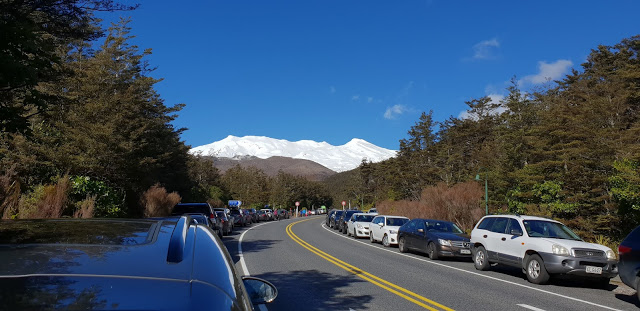
So late in the morning, a sign at the bottom of the mountain warns all the car parks at the ski field are full, but we venture on anyway.

As you can see, the cars are parked so far away from the ski fields, the prospective skiers have to almost run a marathon before they get there!

And for some odd reason, we picked the very day everyone in New Zealand also wanted to go up to the ski fields so parking, even near the Chateau Tongariro was gone and there were endless cars looking for parking spots and traffic wardens had their hands full trying to keep traffic moving
So, for us and everyone else, everything stops at Chateau Tongariro, and from there the only vehicles allowed up are buses.

It’s about 10:30 and we are advised the only way we were getting to see snow was to take a bus

Now, there are two types of busses.  You can go up on a local bus, from Whakapapa Village that costs $20 a person which in the context of the cost of skiing not very much, but if you’re not, it’s quite expensive.

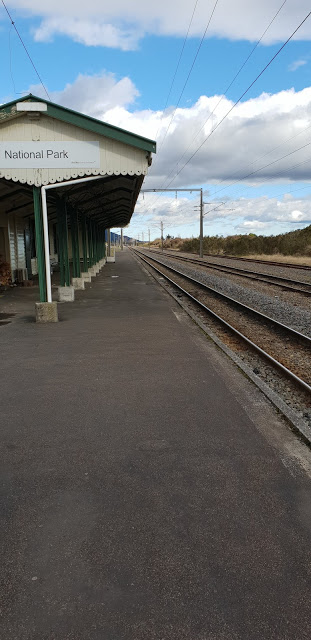
The second, one we were advised to use, operates from a place called National Park, about 9 km away, a snow shuttle that costs $6 each.  The trouble is by the time we were ready to go there, to catch a shuttle, there were no more shuttles.

We did not know what to expect when we got to ‘National Park’, but being a railway station makes sense.  It’s the only place with a very large carpark!

Oh, well, there’s always tomorrow.

NANOWRIMO – April 2024 – “The One That Got Away” – Day 4

The days you wish you didn’t have children.

…

Children are meant to be the joy in your life, not the bane of your existence.

Of course, keeping the secret from their father might have seemed like a good idea if not out of spite in the beginning.

But the truth was he left, and that was on him.  It was not as if he was going to hang around, not after telling her that it was not the time to be having children, not with her wild partying or the fact he was trying to move on after his stint in the Army and that overseas deployment that had severely scarred many of his friends.

Yes, they were perfectly matched, and both agreed they both soul mates and kindred spirits, but it was not enough to keep them together.  Marrying him to spite her father had the reverse effect, and she still suspected her father had bought him off.

But, whatever the reason, she was left with the parenting, delegated to nannies, then boarding school and servants.  It was no wonder they hated their forever disinterested and absent mother, and because of the bored, mischievous miscreants who were constantly in the news and police stations.

Their latest antics were mild compared to previous escapades, but the school could always see a fundraising opportunity.  And being sent home yet again to consider their situation was all she needed.

Fresh out of her latest and longest stay in hospital, the full extent of her situation was becoming clear.

…

Words today, 2294, for a total of 7161

An excerpt from “What Sets Us Apart”, a mystery with a twist

See the excerpt from the story below, just a taste of what’s in store…

http://amzn.to/2Eryfth

whatsetscover

McCallister was old school, a man who would most likely fit in perfectly campaigning on the battlefields of Europe during the Second World War. He’d been like a fish out of water in the army, post-Falklands, and while he retired a hero, he still felt he’d more to give.

He’d applied and was accepted as head of a SWAT team, and, watching him now as he and his men disembarked from the truck in almost military precision, a look passed between Annette, the police liaison officer, and I that said she’d seen it all before. I know I had.

There was a one in four chance his team would be selected for this operation, and she had been hoping it would be one of the other three. While waiting for them to arrive she filled me in on the various teams. His was the least co-operative, and the more likely to make ad-hoc decisions rather than adhere to the plan, or any orders that may come from the officer in charge.

This, she said quite bluntly, was going to end badly.

I still had no idea why Prendergast instructed me to attend the scene of what looked to be a normal domestic operation, but as the nominated expert in the field in these types of situations, it was fairly clear he wasn’t taking any chances. It was always a matter of opinion between us, and generally I lost.

In this case, it was an anonymous report identifying what the authorities believed were explosives in one of the dockside sheds where explosives were not supposed to be.

The only reason why the report was given any credence was the man, while not identifying himself by name, said he’d been an explosive expert once and recognized the boxes. That could mean anything, but the Chief Constable was a cautious man.

With his men settled and preparing their weapons, McCallister came over to the command post, not much more than the SUV my liaison and I arrived in, with weapons, bulletproof vests, and rolls of tape to cordon off the area afterward. We both had coffee, steaming in the cold early morning air. Dawn was slowly approaching and although rain had been forecast it had yet to arrive.

A man by the name of Benson was in charge. He too had groaned when he saw McCallister.

“A fine morning for it.” McCallister was the only enthusiastic one here.

He didn’t say what ‘it’ was, but I thought it might eventually be mayhem.

“Let’s hope the rain stays away. It’s going to be difficult enough without it,” Benson said, rubbing his hands together. We had been waiting for the SWAT team to arrive, and another team to take up their position under the wharf, and who was in the final stages of securing their position.

While we were waiting we drew up the plan. I’d go in first to check on what we were dealing with, and what type of explosives. The SWAT team, in the meantime, were to ensure all the exits to the shed were covered. When I gave the signal, they were to enter and secure the building. We were not expecting anyone inside or out, and no movement had been detected in the last hour since our arrival and deployment.

“What’s the current situation?”

“I’ve got eyes on the building, and a team coming in from the waterside, underneath. Its slow progress, but they’re nearly there. Once they’re in place, we’re sending McKenzie in.”

He looked in my direction.

“With due respect sir, shouldn’t it be one of us?” McCallister glared at me with the contempt that only a decorated military officer could.

“No. I have orders from above, much higher than I care to argue with, so, McCallister, no gung-ho heroics for the moment. Just be ready to move on my command, and make sure you have three teams at the exit points, ready to secure the building.”

McCallister opened his mouth, no doubt to question those orders, but instead closed it again. “Yes sir,” he muttered and turned away heading back to his men.

“You’re not going to have much time before he storms the battlements,” Benson quietly said to me, a hint of exasperation in his tone. “I’m dreading the paperwork.”

It was exactly what my liaison officer said when she saw McCallister arriving.

The water team sent their ‘in position’ signal, and we were ready to go.

In the hour or so we’d been on site nothing had stirred, no arrivals, no departures, and no sign anyone was inside, but that didn’t mean we were alone. Nor did it mean I was going to walk in and see immediately what was going on. If it was a cache of explosives then it was possible the building was booby-trapped in any number of ways, there could be sentries or guards, and they had eyes on us, or it might be a false alarm.

I was hoping for the latter.

I put on the bulletproof vest, thinking it was a poor substitute for full battle armor against an exploding bomb, but we were still treating this as a ‘suspected’ case. I noticed my liaison officer was pulling on her bulletproof vest too.

“You don’t have to go. This is my party, not yours,” I said.

“The Chief Constable told me to stick to you like glue, sir.”

I looked at Benson. “Talk some sense into her please, this is not a kindergarten outing.”

He shrugged. Seeing McCallister had taken all the fight out of him. “Orders are orders. If that’s what the Chief Constable requested …”

Madness. I glared at her, and she gave me a wan smile. “Stay behind me then, and don’t do anything stupid.”

“Believe me, I won’t be.” She pulled out and checked her weapon, chambering the first round. It made a reassuring sound.

Suited up, weapons readied, a last sip of the coffee in a stomach that was already churning from nerves and tension, I looked at the target, one hundred yards distant and thought it was going to be the longest hundred yards I’d ever traversed. At least for this week.

A swirling mist rolled in and caused a slight change in plans.

Because the front of the buildings was constantly illuminated by large overhead arc lamps, my intention had been to approach the building from the rear where there was less light and more cover. Despite the lack of movement, if there were explosives in that building, there’d be ‘enemy’ surveillance somewhere, and, after making that assumption, I believed it was going to be easier and less noticeable to use the darkness as a cover.

It was a result of the consultation, and studying the plans of the warehouse, plans that showed three entrances, the main front hangar type doors, a side entrance for truck entry and exit and a small door in the rear, at the end of an internal passage leading to several offices. I also assumed it was the exit used when smokers needed a break. Our entry would be by the rear door or failing that, the side entrance where a door was built into the larger sliding doors. In both cases, the locks would not present a problem.

The change in the weather made the approach shorter, and given the density of the mist now turning into a fog, we were able to approach by the front, hugging the walls, and moving quickly while there was cover. I could feel the dampness of the mist and shivered more than once.

It was nerves more than the cold.

I could also feel rather than see the presence of Annette behind me, and once felt her breath on my neck when we stopped for a quick reconnaissance.

It was the same for McCallister’s men. I could feel them following us, quickly and quietly, and expected, if I turned around, to see him breathing down my neck too.

It added to the tension.

My plan was still to enter by the back door.

We slipped up the alley between the two sheds to the rear corner and stopped. I heard a noise coming from the rear of the building, and the light tap on the shoulder told me Annette had heard it too. I put my hand up to signal her to wait, and as a swirl of mist rolled in, I slipped around the corner heading towards where I’d last seen the glow of a cigarette.

The mist cleared, and we saw each other at the same time. He was a bearded man in battle fatigues, not the average dockside security guard.

He was quick, but my slight element of surprise was his undoing, and he was down and unconscious in less than a few seconds with barely a sound beyond the body hitting the ground. Zip ties secured his hands and legs, and tape his mouth. Annette joined me a minute after securing him.

A glance at the body then me, “I can see why they, whoever they are, sent you.”

She’d asked who I worked for, and I didn’t answer. It was best she didn’t know.

“Stay behind me,” I said, more urgency in my tone. If there was one, there’d be another.

Luck was with us so far. A man outside smoking meant no booby traps on the back door, and quite possibly there’d be none inside. But it indicated there were more men inside, and if so, it appeared they were very well trained. If that were the case, they would be formidable opponents.

The fear factor increased exponentially.

I slowly opened the door and looked in. A pale light shone from within the warehouse itself, one that was not bright enough to be detected from outside. None of the offices had lights on, so it was possible they were vacant. I realized then they had blacked out the windows. Why hadn’t someone checked this?

Once inside, the door closed behind us, progress was slow and careful. She remained directly behind me, gun ready to shoot anything that moved. I had a momentary thought for McCallister and his men, securing the perimeter.

At the end of the corridor, the extent of the warehouse stretched before us. The pale lighting made it seem like a vast empty cavern, except for a long trestle table along one side, and, behind it, stacks of wooden crates, some opened. It looked like a production line.

To get to the table from where we were was a ten-yard walk in the open. There was no cover. If we stuck to the walls, there was equally no cover and a longer walk.

We needed a distraction.

As if on cue, the two main entrances disintegrated into flying shrapnel accompanied by a deafening explosion that momentarily disoriented both Annette and I. Through the smoke and dust kicked up I saw three men appear from behind the wooden crates, each with what looked like machine guns, spraying bullets in the direction of the incoming SWAT members.

They never had a chance, cut down before they made ten steps into the building.

By the time I’d recovered, my head heavy, eyes watering and ears still ringing, I took several steps towards them, managing to take down two of the gunmen but not the third.

I heard a voice, Annette’s I think, yell out, “Oh, God, he’s got a trigger,” just before another explosion, though all I remember in that split second was a bright flash, the intense heat, something very heavy smashing into my chest knocking the wind out of me, and then the sensation of flying, just before I hit the wall.

I spent four weeks in an induced coma, three months being stitched back together and another six learning to do all those basic actions everyone took for granted. It was twelve months almost to the day when I was released from the hospital, physically, except for a few alterations required after being hit by shrapnel, looking the same as I always had.

But mentally? The document I’d signed on release said it all, ‘not fit for active duty; discharged’.

It was in the name of David Cheney. For all intents and purposes, Alistair McKenzie was killed in that warehouse, and for the first time ever, an agent left the Department, the first to retire alive.

I was not sure I liked the idea of making history.

© Charles Heath 2016-2020
Searching for locations: Mount Ngauruhoe, New Zealand

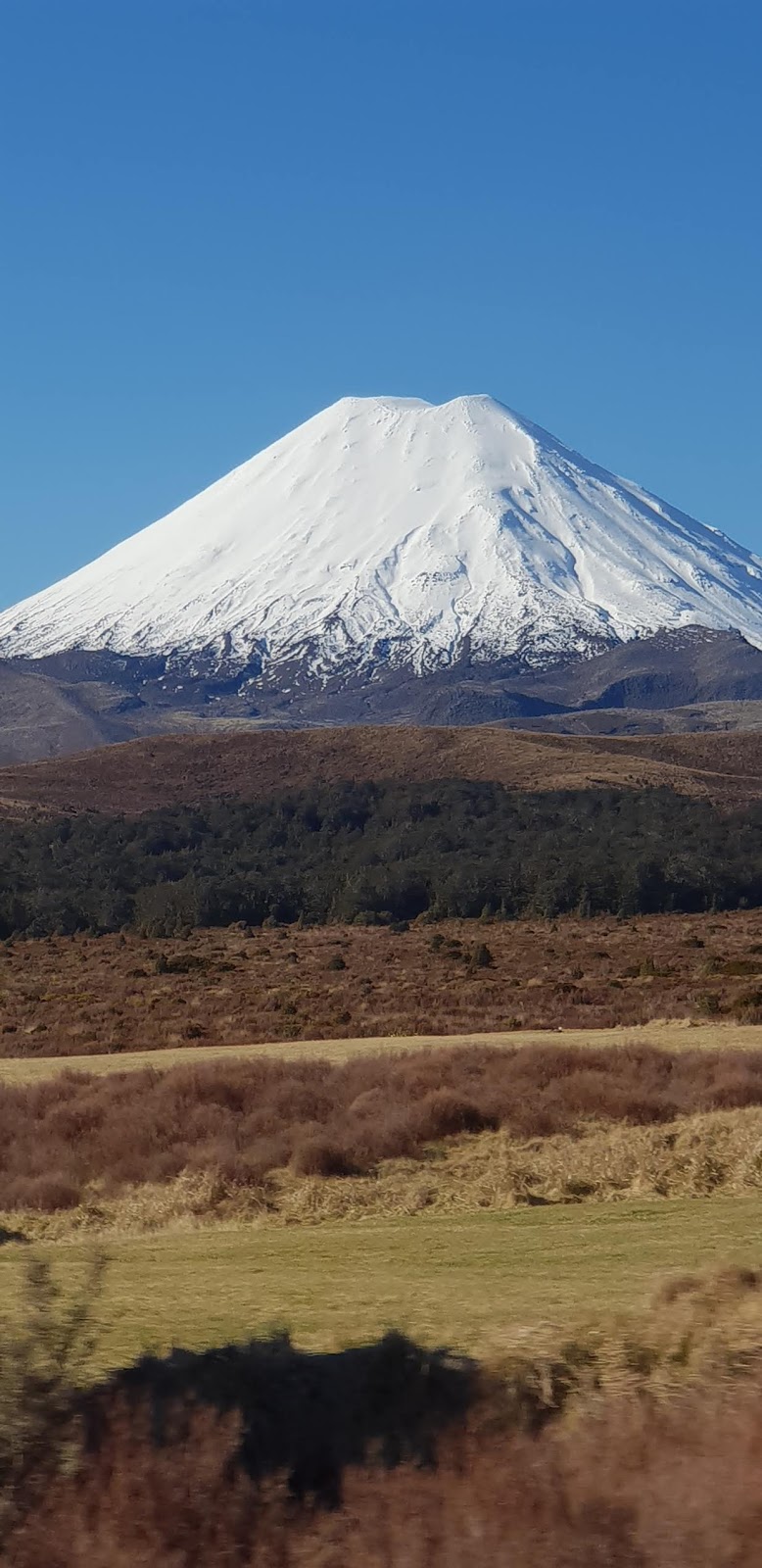
Mount Ngauruhoe is apparently still an active volcano, has been for 2,500 years or so, and last erupted on 19th February 1975, and reportedly has erupted around 70 times since 1839.

The mountain is usually climbed from the western side, from the Mangatepopo track.

This photo was taken in summer from the Chateau Tongariro carpark.

In late autumn, on one of our many visits to the area, the mountain was covered with a light sprinkling of snow and ice.

On our most recent visit, this year, in winter, it was fully covered in snow.

It can be a breathtaking sight from the distance.