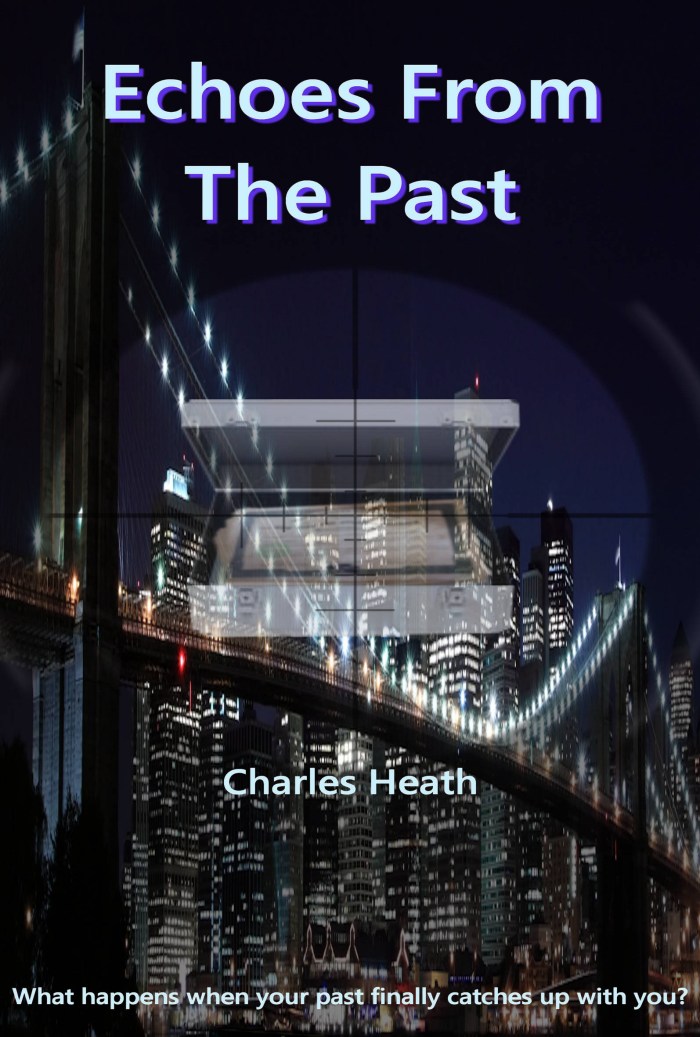
The novel ‘Echoes from the past’ started out as a short story I wrote about 30 years ago, titled ‘The birthday’.
My idea was to take a normal person out of their comfort zone and led on a short but very frightening journey to a place where a surprise birthday party had been arranged.
Thus the very large man with a scar and a red tie was created.
So was the friend with the limousine who worked as a pilot.
So were the two women, Wendy and Angelina, who were Flight Attendants that the pilot friend asked to join the conspiracy.
I was going to rework the short story, then about ten pages long, into something a little more.
And like all re-writes, especially those I have anything to do with, it turned into a novel.
There was motivation. I had told some colleagues at the place where I worked at the time that I liked writing, and they wanted a sample. I was going to give them the re-worked short story. Instead, I gave them ‘Echoes from the past’
Originally it was not set anywhere in particular.
But when considering a location, I had, at the time, recently been to New York in December, and visited Brooklyn and Queens, as well as a lot of New York itself. We were there for New Years, and it was an experience I’ll never forget.
One evening we were out late, and finished up in Brooklyn Heights, near the waterfront, and there was rain and snow, it was cold and wet, and there were apartment buildings shimmering in the street light, and I thought, this is the place where my main character will live.
It had a very spooky atmosphere, the sort where ghosts would not be unexpected. I felt more than one shiver go up and down my spine in the few minutes I was there.
I had taken notes, as I always do, of everywhere we went so I had a ready supply of locations I could use, changing the names in some cases.
Fifth Avenue near the Rockefeller center is amazing at first light, and late at night with the Seasonal decorations and lights.
The original main character was a shy and man of few friends, hence not expecting the surprise party. I enhanced that shyness into purposely lonely because of an issue from his past that leaves him always looking over his shoulder and ready to move on at the slightest hint of trouble. No friends, no relationships, just a very low profile.
Then I thought, what if he breaks the cardinal rule, and begins a relationship?
But it is also as much an exploration of a damaged soul, as it is the search for a normal life, without having any idea what normal was, and how the understanding of one person can sometimes make all the difference in what we may think or feel.
As children, we all played hide and seek, where one person counted to a hundred and all the others hid themselves and you had to find them.
I was the spoilsport; I gave up looking very quickly because the kids I played with were very good at hiding.
You have some hide
Well, this means someone you know and probably hate has insulted you, or you’d you something you really did want to know
It’s an old expression often used by my mother on her sister, mostly because her sister was wiser and more sensible and sometimes sailed too close to the wind telling her the painful truth
Sailing too close to the wind? Yes, quite an interesting analogy – saying what is true without heed to the consequences or taking unnecessary risks.
We spent the morning in the hide
Ah, to be a birdwatcher. These are in my experience a very strange bunch. I prefer to be a trainspotter, but then we have been described as a very strange bunch.
However, not to be distracted, birdwatchers hand out in hides and camouflaged buildings where they can observe birds in their natural habitat without disturbing them.
And the camera some of these watchers have a very expensive.
Then, of course, there are the hunters, who lie in wait for say duck season to start, then shoot them.
It’s not my idea of fun, nor does it seem sporting.
We use cowhide to make shoes
After sending it to the tannery. Animal hides have Bern used over the centuries for many purposes such as clothes, shoes and bags.
Sheep hides make excellent fluffy mats beside the bed.
Mink hides were once used in fur coats, but now it’s frowned upon.
This case has everything, red herrings, jealous brothers, femme fatales, and at the heart of it all, greed.
See below for an excerpt from the book…
Coming soon!
An excerpt from the book:
When Harry took the time to consider his position, a rather uncomfortable position at that, he concluded that he was somehow involved in another case that meant very little to him.
Not that it wasn’t important in some way he was yet to determine, it was just that his curiosity had got the better of him, and it had led to this: sitting in a chair, securely bound, waiting for someone one of his captors had called Doug.
It was not the name that worried him so much, it was the evil laugh that had come after the name was spoken.
Doug what? Doug the ‘destroyer’, Doug the ‘dangerous’, Doug the ‘deadly’; there was any number of sinister connotations, and perhaps that was the point of the laugh, to make it more frightening than it was.
But there was no doubt about one thing in his mind right then: he’d made a mistake. A very big. and costly, mistake. Just how big the cost, no doubt he would soon find out.
His mother, and his grandmother, the wisest person he had ever known, had once told him never to eavesdrop.
At the time he couldn’t help himself and instead of minding his own business, listening to a one-sided conversation which ended with a time and a place. The very nature of the person receiving the call was, at the very least, sinister, and, because of the cryptic conversation, there appeared to be, or at least to Harry, criminal activity involved.
For several days he had wrestled with the thought of whether he should go. Stay on the fringe, keep out of sight, observe and report to the police if it was a crime. Instead, he had willingly gone down the rabbit hole.
Now, sitting in an uncomfortable chair, several heat lamps hanging over his head, he was perspiring, and if perspiration could be used as a measure of fear, then Harry’s fear was at the highest level.
Another runnel of sweat rolled into his left eye, and, having his hands tied, literally, it made it impossible to clear it. The burning sensation momentarily took his mind off his predicament. He cursed and then shook his head trying to prevent a re-occurrence. It was to no avail.
Let the stinging sensation be a reminder of what was right and what was wrong.
It was obvious that it was the right place and the right time, but in considering his current perilous situation, it definitely was the wrong place to be, at the worst possible time.
It was meant to be his escape, an escape from the generations of lawyers, what were to Harry, dry, dusty men who had been in business since George Washington said to the first Walthenson to step foot on American soil, ‘Why don’t you become a lawyer?” when asked what he could do for the great man.
Or so it was handed down as lore, though Harry didn’t think Washington meant it literally, the Walthenson’s, then as now, were not shy of taking advice.
Except, of course, when it came to Harry.
He was, Harry’s father was prone to saying, the exception to every rule. Harry guessed his father was referring to the fact his son wanted to be a Private Detective rather than a dry, dusty lawyer. Just the clothes were enough to turn Harry off the profession.
So, with a little of the money Harry inherited from one of his aunts, he leased an office in Gramercy Park and had it renovated to look like the Sam Spade detective agency, you know the one, Spade and Archer, and The Maltese Falcon.
There’s a movie and a book by Dashiell Hammett if you’re interested.
So, there it was, painted on the opaque glass inset of the front door, ‘Harold Walthenson, Private Detective’.
There was enough money to hire an assistant, and it took a week before the right person came along, or, more to the point, didn’t just see his business plan as something sinister. Ellen, a tall cool woman in a long black dress, or so the words of a song in his head told him, fitted in perfectly.
She’d seen the movie, but she said with a grin, Harry was no Humphrey Bogart.
Of course not, he said, he didn’t smoke.
Three months on the job, and it had been a few calls, no ‘real’ cases, nothing but missing animals, and other miscellaneous items. What he really wanted was a missing person. Or perhaps a beguiling, sophisticated woman who was as deadly as she was charming, looking for an errant husband, perhaps one that she had already ‘dispatched’.
Or for a tall, dark and handsome foreigner who spoke in riddles and in heavily accented English, a spy, or perhaps an assassin, in town to take out the mayor. The man was such an imbecile Harry had considered doing it himself.
Now, in a back room of a disused warehouse, that wishful thinking might be just about to come to a very abrupt end, with none of the romanticized trappings of the business befalling him. No beguiling women, no sinister criminals, no stupid policemen.
Just a nasty little man whose only concern was how quickly or how slowly Harry’s end was going to be.
I remembered once hearing my mother say after my father had died suddenly, that she regretted not doing more travelling when he was alive. I also remembered her often saying there never seemed to be enough time to get everything done, that there would be time enough later on to do all those things they never seemed to get around to doing.
It was a familiar lament made by many others during what seemed to be, rapidly passing years. Until, inevitably, something completely unexpected happened, and equally inevitably, all those plans became moot.
For Janine and me that moment came when we were both sitting in the doctor’s surgery right after he told us the test results were not as good as he had hoped, and more tests were needed before he could positively tell us what was wrong. Those words of my mother’s came back and hit me like a ton of bricks.
Janine had been tired much more than usual, and lately, everything had become much more difficult. It was harder to get up in the morning, harder to contemplate cooking, let alone eating, and all those daily chores were more of a chore than before. When I asked him to hazard a guess as to what the problem was, he refused to speculate but said it was possible he would know more after the next round of tests.
To be honest, I think he knew already.
I think Janine did, too, and was prepared to put a name to it simply because she was now living the same sort of life her mother had, as had her mother before her. A rare and debilitating form of cancer.
Janine had known it was hereditary, but when it hadn’t affected her the same time as her mother and grandmother, she had believed it had slipped a generation. Her mother had the first effects of it in her late 30s and died just before she turned 45. Janine had reached 45 and wasn’t expecting it. It could still be something else, the doctor said, but his expression that day was not one of hope.
After that first day, I wondered if our lives would end in a sea of regret, wishing that with the benefit of hindsight, we would have done things differently. But there was a silver lining. About a year before, we had talked about the possibility of her getting ill and had drawn up a bucket list and began to tick items off it. Had Janine always known subconsciously that this might happen?
It was a question I was never going to ask her.
We had moved into the room we both knew was going to be Janine’s final home. She was too weak and in too much pain to be far from the hospital, and this was, the doctor said, the final leg of the race.
I wanted to believe her when she told me she had made her peace with God and the rest of the world, and that she was not going to go out with any regrets. We had not finished the bucket list, but we had given it a good shake. I tried to be stoic in the face of her impending death, but sometimes, that was a little hard.
We had been looking forward to growing old together, and it was one regret I found hard to reconcile.
Her favourite saying had become better to have loved and lost than to never have loved at all.
And then, one morning, she had asked, “Why was Margaret, given who she was and how badly she treated people and the fact you were one of them, was your first love?”
Margaret had been the subject of many a conversation in those first few months we dated after Margaret had effectively dumped me. It had made Janine angry, and for that reason, Margaret was persona non grata
It was something I’d not thought about in a long time. I guess it had been on her mind, especially when in the beginning she had said she always believed she had been my second choice.
“You were never a second choice or the rebound girl,” I said then as I did now.
And while I wanted to believe that was true, to a certain extent it was a lie. If the truth be told, she had been there and had always had a ‘thing’ for me, and my sister had always maintained Janine had hoped Margaret would revert to type, untrustworthy to the point of inevitably letting me down. My sister had also always believed Janine and I would end up together. In her eyes, we were much better suited, and as time passed had proved.
But Janine asked in the next breath, had I always held a torch for Margaret, with the hope that one day she would come to her senses?
“When you accepted my proposal, my heart was never anywhere but with you,” I said, wondering why she was bringing the matter up now. “I never had any intention of taking her back, or talking to her, not after what she did.”
“You had not the tiniest regret that you wouldn’t get to be with your first love? After all, that’s the one that makes the most impact on your life and how it plays out over time. I always believed part of you was always with her.”
Why would she think such a thing when I had never given her the impression that I was anywhere but with her?
“I have no regrets marrying you. None. Margaret sowed the seeds of her destruction for better or worse, and I was not inclined to rescue her or help her in any way when everything fell apart. Going to see her a few months back was not because I was still interested in her or thinking we might get back together. Just seeing her and what she had become was reason enough to stay away. No, believe me when I say she was a bullet dodged.”
I didn’t understand why Margaret was even a subject for discussion in her last few weeks when we should have been reminiscing on what we had. It caused me some concern she should ever think that she was not the woman I had wanted to be with for the rest of my life.
And what had brought this on? I had not mentioned Margaret since that night I left her at the restaurant, and I had made a point of not talking to Margaret either over the phone or by email. She had tried to contact me, and I had ignored her. There was nothing she could say that would make me think that she and I should be together. Ever.
So, I had to ask why she was so worried about my loyalty or that she could ever think that my heart belonged to anyone else but her. I had, I said, never given her reason to ever think it was not.
“Because she is about six rooms up the passage from here on life support. She tried to commit suicide and I suspected that might have been because of something you said or did.”
It bothered me that she could think that, but I guess it was not entirely unexpected given her state of mind. Margaret had never been the subject of any conversation when she was well.
When we first started dating, I told her exactly where I stood regarding Margaret, and it had never wavered since. It had helped that Margaret was wise enough to stay away. I might have done something stupid had she shown her face, even after her relationship with William had fallen apart.
I was never going to be her second choice or backup plan. But I could see, now, those thoughts had crossed Janine’s mind, how the fear of being a second choice could be considered. The thing is I had no idea how to reassure her I was not interested in Margaret, in a coma or not.
A few days later, though, when I put my head in the door of the room where Margaret was sleeping, I realised it was a mistake. I should have realised Janine would have spies everywhere. She was not normally this paranoid, but in her heightened state, everything would have a meaning even if I couldn’t comprehend what it was.
When I walked into the room, she had that expression on her face that I equated to trouble. Much like being on the Titanic just before it sank.
“You went to see her,” she said before I could even sit down.
“It would seem out of place if I was not curious as to her condition. And given the fact she was in a coma and didn’t know I was there, and the fact it was only for a few minutes, is hardly worth mentioning for obvious reasons. You should not have told me if you didn’t want me to go there.”
Her health deteriorated rapidly, the doctor saying that once the pain reached a certain level, she would become virtually comatose because of the pain medicine. That morning I reassured her that Margaret meant nothing to me and despaired that our last conversation was not of happier times. The doctor had said the medication would mess with her thoughts, so I should just nod and agree.
That afternoon she slipped into the final stage, and for all intents and purposes, looked like an angel sleeping. Twenty-three hours later, the longest period of my life, she died peacefully. She opened her eyes just before passing and smiled.
As some may be aware, but many not, Chester, my faithful writing assistant, mice catcher, and general pain in the neck, passed away some months ago.
Recently I was running a series based on his adventures, under the title of Past Conversations with my cat.
For those who have not had the chance to read about all of his exploits I will run the series again from Episode 1
These are the memories of our time together…
…
Even now, I still believe he is here with us, in spirit, though sometimes I swear I hear him coming down the passage, or is sitting on the floor, behind me in the office, waiting to hear the next piece of writing and offer his often sage comments.
But, no. When I turn around he’s not there, and I stop, for a moment or two, and remember.
…
This was Chester.
For a few days, we have been monitoring Chester.
He hasn’t been talkative, in fact, I have been mistaking his usual taciturn nature in the mornings for what it really was.
A total lack of interest in anything.
He did not come down in the morning. OK, so, sometimes he cracks a hissy fit and totally ignores me.
But, this is different.
After a few days, he returns and gives me the benefit of his wisdom.
Today, he hasn’t shown up at all, so I went looking for him.
He was in his usual hiding spot, lying down. I give him a pat, he opens his eyes and looks at me. This is a cat who is not well.
I pick him up, and there’s no immediate fight back. He doesn’t normally like to be carried anywhere. Today, he’s putty in my hands.
I call the vet. She can fit him in now if I run. I’m running.
He goes into his carry basket without a fight. OK, now I know something is definitely wrong.
There’s not a sound between home and the clinic. Usually, he screams the place down, trying to get him into the carrier, and then makes as much noise as possible when driving.
Today there is nothing, not even a whimper.
The vet comes out. She has been seeing him for the last ten years and they are well acquainted.
We see her every six months. Without fail, for shots and stuff.
I take him out of the carrier and he lies down on the metal bench.
She looks at him, then picks him up.
She weighs him.
He’s lost two kilos, and that’s a lot for a cat.
I can see it’s bad news.
It is.
He’s 19 years old, long past the average life expectancy.
To keep him alive now would be inhumane. He has, apparently, reached the end of his life, and has lost the desire to eat or to do anything. There was nothing I could have done to prevent it.
She says, it just happens.
It will be quick and it will be painless.
I can see in his eyes that it’s what he wants.
I said goodbye, went outside and sat in the car, and cried.
There’s going to be a lot more tears before this day is out.
I’m back home and this story has been sitting on the back burner for a few months, waiting for some more to be written.
The trouble is, there are also other stories to write, and I’m not very good at prioritizing.
But, here we are, a few minutes opened up and it didn’t take long to get back into the groove.
Chasing leads, maybe
Needing to know more about Severin, aka David Westcott trumped talking to Jan. As it stood, it was difficult to know where her allegiances lay, with Dobbin, her handler, or someone else.
I hailed a cab and headed back to the office. I wanted to spend some time on the computer, hoping I had enough clearance to poke around in the departmental records, in particular personnel.
Just as the taxi dropped me outside the anonymous sandstone building, my phone rang. I doubt it would be Severin again.
“Where are you?”
Jan.
“I do actually have a life, despite what you or Dobbin might think. I’m not sure I really want to have anything to do with you after what I saw you people do to Maury. Aside from the fact that you told me he had found the tracker and disposed of it. Once you start telling lies, there’s no going back.”
“I had nothing to do with that.”
“You were holding him for the interrogation squad. That makes you complicit. It also makes me very wary about what Dobbin will do to me if he thinks I know anything, which I don’t.”
“As far as I’m aware, all we have to do is find O’Connell.”
“And what? Torture him too if he doesn’t fess up? I know he doesn’t have it. I had him under surveillance the whole time. I frisked him after he was shot. What do you know that I don’t?”
“No more than you.”
“Not if you’re suggesting that he’s alive.” This was an interesting conversation, especially after O’Connell himself told me that Dobbin’s cleaners had come and rescued him, which meant Dobbin definitely knew he was still alive.
The question was, how many lies was she going to tell me.
“You know where O’Connell had his real residence. When were you going to share that piece in information?”
Silence, then, “How?”
“I saw you there.”
“But…”
I knew what she was going to say, when was I going to share. When I came back, not intending to find a dead body in the hotel room.
“Had you been in the room when I got back, we were going to have a frank conversation about who you’re working for, but I’ve just had that conversation with Dobbin himself. No doubt he called you right after he dropped me off.
“He’s not happy.”
“Then that’s on him not trusting people. You want to have a good hard look at what your options are when we next meet. I’ll admit I haven’t been doing this very long, but one thing I have learned, is not to trust anyone.
“I suggest we meet up later tonight. Bear in mind that it will be in an open space for obvious reasons, and quite frankly, I’m not sure how Dobbin thinks this collaboration is going to work. I’ll text you the place and time.”
It might have been a little unfair to take my concerns about Dobbin out on her. I’m not sure what I had expected would happen when I took this job on, certainly, the instructors had emphasized that being an agent was very dangerous to our health and that we could, ultimately, trust no one, even those closest to us. Our world by its very nature was one of mistrust, lies, and deceit, that we would eventually not know who we really were and be doing things we never thought we could.
O’Connell was in the same situation, most likely because people were trying to kill him. It was a small detail that stuck in the back of my mind.
If Severin and Maury wanted O’Connell alive, and that definitely was the end result of the surveillance operation, to allow the drop then to corral him, why would they have sanctioned his execution in the alley?
In fact, how could they know he would end up in that alley.
The only conclusion I could come up with, Dobbin had put a tracker on him, one that he didn’t know about, and also had surveillance on O’Connell. It made sense because I was sure there were people in that area that didn’t look like they belonged.
So, a tracker on the USB was being tacked by an unidentified as yet party who no doubt wanted the information themselves, not Severin, and not Dobbin.
I shrugged. I’m sure there would be more questions before the day was out.
This book has finally reached the Final Editor’s draft, so this month it is going to get the last revision, and a reread for the beta readers.
…
There’s nothing like having a travel agent on hand when you need to make some urgent bookings because your travel arrangements have gone up in smoke.
Anyone else would have had the devil’s own job sorting out their travel arrangements.
And, yes, Maryanne is coming along for the ride. Is she feeling obligated to look after him, or is there some other reason? As yet, it’s not clear.
But it’s a day of planes, trains and automobiles, attempts to locate his mother so he can find out more about what’s going on, and then get home where it may, or may not be, safe.
So much for having a holiday.
So much for going to his first conference. There’s going to be some explaining to the head agent.
It seems that this novel, going on the amount of writing so far, is going to be bigger than 50,000 words, at the halfway mark, or near enough, I’m at 35,000 words, give or take, which indicates a story of 70,000 words.
We will have to wait and see what happens. I have more planning to do.
To start with, we first joined this tour at stop number 6.
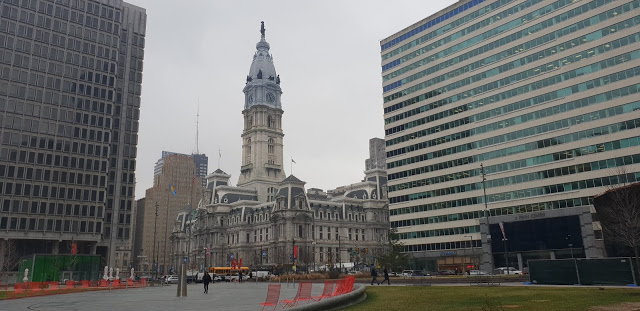
We had to find it first and that meant some pedestrian navigation, which took us first to the City Hall, a rather imposing structure, which we found later had a profound effect on Philadelphia sports teams.
According to the map, stop number 6 is Reading Terminal Market, Convention Centre, on 12th street on Filbert. This was where we bought the tickets and boarded the bus that had a rather interesting guide aboard.
His favorite says was “And we’re good to go.”
Soon we would discover that his commentary was more orientated towards a younger audience, not that it bothered us.
Given the time restraints, we had, this was always going to be about looking and learning.
Stop number 7
City hall, Love Park.
This we had seen on our walk from where we left the car at the Free Library, near the Swann Memorial Fountain in Logan Park, the landmark that Rebecca had remembered from her last visit to Philadelphia. Of course, then, it was not quite so frozen.
Love park, of course, was only notable to us in that it had a sculpture in place with the word Love rather stylized. Apart from that, you’d hardly know it as a park
The city hall, well, that was something else, and when we looked at it, before going on the tour, it was a rather magnificent stone edifice.
After, well the guide filled us in, tallest building, highest and largest monument on William Penn, you get the gist. 37 feet tall, when eclipsed, the Philly sports teams all suffered slumps of one kind or another, until the problem was rectified. Interesting story.
Stop number 8
18th Street and the Benjamin Franklin Parkway, or Logan Circle
This is the location of the Cathedral Basilica of Saints Peter and Paul. A place where the Pope decided to give an audience and sent the city into a spin.
The same church has very high windows for the reason in the early days there was a problem with people wanting to throw Molotov cocktails through the windows. A bit hard when they’re so high up.
Benjamin Franklin Parkway, of course, is interesting in itself as an avenue, not only for all of the flags of many nations of those who chose to live in Philadelphia. We found ours, the one for Australia
This was also the stop where we needed to get off once the tour was finished, and time to head to the car, and go home, but that’s another story.
Stop number 10
Is that the stature of the Thinker, made famous, at least for me, from the old Dobie Gillis episodes, of God knows how many years ago?
Or, maybe it’s just the Rodin Museum on Benjamin Franklin Parkway.
There’s a whole story to go with that Statue and the fact it is one of many all over the world.
This one was made in France, cast in 1919 in Bronze, and is approximately 200cm x 130 cm by 140cm.
Stop number 11
Eastern State Penitentiary. NW corner of 22nd Street and Fairmont Avenue.
This had a rather interesting story attached to it and had something to do with ghosts, but I wasn’t listening properly to the guide’s monologue.
But, later research shows, the fact it was once the most famous and expensive prison in the world. Many also think it is haunted and is a favorite for visiting paranormal visitors.
Built around 1829, it was the first prison to have separate cells for prisoners. It held, at various times, the likes of Al Capone and Willie Sutt
Stop number 18
The Philadelphia Museum of art, where we stop for a few minutes and look at the steps which were immortalized in the movie Rocky, yes he ran god knows how far to end up on the top of these steps.
Sorry, but I’m not that fit that I would attempt walking up them. The view is just fine from inside the bus. Of course, they might consider cleaning the windows a little so the view was clearer, but because it’s basically Perspex and scratched so that might not be possible.
Stop number 17
Back at Logan Circle, or Square if you prefer, but on the other side, closer to the Franklin Institute. Benjamin Franklin’s name is used a lot in this city.
After that, it’s a blur, the Academy of Music, the University of the Arts, Pennsylvania Hospital, South Street, Vietnam Veterans Memorial, the USS Olympia, Penn’s Landing, and past the National Liberty Museum. I’m sure somewhere in that blur was the intention of seeing the Liberty Bell, but I think I heard that it was not on show, and only a replica could be seen.
So much for the getting as an opportunity to see the real liberty bell, crack and all..
We get off and stop number 27, or Number 1, I was not quite sure.
What were we after? The definitive Philly Cheese Steak.
A dreaded visit to the boarding school to see the twins, her children being looked after until he arrived to collect them, brought back a whole raft of memories of his time at school, and not in a good way.
Resentful, sullen, definitely the result of substance abuse, and a whole lot of those issues, they instantly dislike, and disbelieve he’s their father, not that it matters, he had the documentary proof.
Agatha’s assessment of the headmaster was spot on, a man who would exploit the plight of a family to extract a sizable donation to forget anything that might be detrimental to the school and the family. It was the nature of business where the rich were concerned.
Michael was annoyed that it hadn’t taken very long before he slipped into her murky world.
That old expression ‘give them an inch and they’ll take a mile’ comes home to roost, and he is led on a brief odyssey before the children’s solution is found. A month in a new type of detox was going to be the first stage of their rehabilitation.
“Sunday in New York” is ultimately a story about trust, and what happens when a marriage is stretched to its limits.
When Harry Steele attends a lunch with his manager, Barclay, to discuss a promotion that any junior executive would accept in a heartbeat, it is the fact his wife, Alison, who previously professed her reservations about Barclay, also agreed to attend, that casts a small element of doubt in his mind.
From that moment, his life, in the company, in deciding what to do, his marriage, his very life, spirals out of control.
There is no one big factor that can prove Harry’s worst fears, that his marriage is over, just a number of small, interconnecting events, when piled on top of each other, points to a cataclysmic end to everything he had believed in.
Trust is lost firstly in his best friend and mentor, Andy, who only hints of impending disaster, Sasha, a woman whom he saved, and who appears to have motives of her own, and then in his wife, Alison, as he discovered piece by piece damning evidence she is about to leave him for another man.
Can we trust what we see with our eyes or trust what we hear?
Haven’t we all jumped to conclusions at least once in our lives?
Can Alison, a woman whose self-belief and confidence is about to be put to the ultimate test, find a way of proving their relationship is as strong as it has ever been?