In a word: Under

Under by itself is a rather boring word, you know, under the moon, under the sea, under the influence, which is not hard to be if you’ve been hypnotised or after a few drinks.

Under is anything beneath something else.

But let’s add it to some other words like,

Underrated, which means it is better than what others give it credit for.

Underwear is what you would wear underneath your clothes.

An understudy is a person who takes over a lead role when the lead is incapacitated. And how many understudies are guilty of harming the lead, in order to get a big break?

And not get away with it?

Understood, an agreement that might or might not be in writing that something will happen, that is, it is understood that I will be the next president.

Or not. Who on earth would really want to be president of anything?

So in the spirit of trying to confuse everyone all of the time, I have a conundrum in the form of a question, what is the difference between under and underneath?

To me there is none, you can be under the sea or underneath the sea, or under the table or underneath the table, but then there’s another, you can be under the influence but not underneath the influence, though technically you could, if you wanted to use confusing English.

And, just to add to the confusion further, I can say that the submarine sailed under the sea, underneath the sea, but, in actual fact, it doesn’t.

What is under the sea is the sand, or sea bed, and a submarine does not plough its way through the sand, does it?

What we really should be saying is that a submarine moves through the water.

Just saying…

An excerpt from “What Sets Us Apart”, a mystery with a twist

See the excerpt from the story below, just a taste of what’s in store…

http://amzn.to/2Eryfth

whatsetscover

McCallister was old school, a man who would most likely fit in perfectly campaigning on the battlefields of Europe during the Second World War. He’d been like a fish out of water in the army, post-Falklands, and while he retired a hero, he still felt he’d more to give.

He’d applied and was accepted as head of a SWAT team, and, watching him now as he and his men disembarked from the truck in almost military precision, a look passed between Annette, the police liaison officer, and I that said she’d seen it all before. I know I had.

There was a one in four chance his team would be selected for this operation, and she had been hoping it would be one of the other three. While waiting for them to arrive she filled me in on the various teams. His was the least co-operative, and the more likely to make ad-hoc decisions rather than adhere to the plan, or any orders that may come from the officer in charge.

This, she said quite bluntly, was going to end badly.

I still had no idea why Prendergast instructed me to attend the scene of what looked to be a normal domestic operation, but as the nominated expert in the field in these types of situations, it was fairly clear he wasn’t taking any chances. It was always a matter of opinion between us, and generally I lost.

In this case, it was an anonymous report identifying what the authorities believed were explosives in one of the dockside sheds where explosives were not supposed to be.

The only reason why the report was given any credence was the man, while not identifying himself by name, said he’d been an explosive expert once and recognized the boxes. That could mean anything, but the Chief Constable was a cautious man.

With his men settled and preparing their weapons, McCallister came over to the command post, not much more than the SUV my liaison and I arrived in, with weapons, bulletproof vests, and rolls of tape to cordon off the area afterward. We both had coffee, steaming in the cold early morning air. Dawn was slowly approaching and although rain had been forecast it had yet to arrive.

A man by the name of Benson was in charge. He too had groaned when he saw McCallister.

“A fine morning for it.” McCallister was the only enthusiastic one here.

He didn’t say what ‘it’ was, but I thought it might eventually be mayhem.

“Let’s hope the rain stays away. It’s going to be difficult enough without it,” Benson said, rubbing his hands together. We had been waiting for the SWAT team to arrive, and another team to take up their position under the wharf, and who was in the final stages of securing their position.

While we were waiting we drew up the plan. I’d go in first to check on what we were dealing with, and what type of explosives. The SWAT team, in the meantime, were to ensure all the exits to the shed were covered. When I gave the signal, they were to enter and secure the building. We were not expecting anyone inside or out, and no movement had been detected in the last hour since our arrival and deployment.

“What’s the current situation?”

“I’ve got eyes on the building, and a team coming in from the waterside, underneath. Its slow progress, but they’re nearly there. Once they’re in place, we’re sending McKenzie in.”

He looked in my direction.

“With due respect sir, shouldn’t it be one of us?” McCallister glared at me with the contempt that only a decorated military officer could.

“No. I have orders from above, much higher than I care to argue with, so, McCallister, no gung-ho heroics for the moment. Just be ready to move on my command, and make sure you have three teams at the exit points, ready to secure the building.”

McCallister opened his mouth, no doubt to question those orders, but instead closed it again. “Yes sir,” he muttered and turned away heading back to his men.

“You’re not going to have much time before he storms the battlements,” Benson quietly said to me, a hint of exasperation in his tone. “I’m dreading the paperwork.”

It was exactly what my liaison officer said when she saw McCallister arriving.

The water team sent their ‘in position’ signal, and we were ready to go.

In the hour or so we’d been on site nothing had stirred, no arrivals, no departures, and no sign anyone was inside, but that didn’t mean we were alone. Nor did it mean I was going to walk in and see immediately what was going on. If it was a cache of explosives then it was possible the building was booby-trapped in any number of ways, there could be sentries or guards, and they had eyes on us, or it might be a false alarm.

I was hoping for the latter.

I put on the bulletproof vest, thinking it was a poor substitute for full battle armor against an exploding bomb, but we were still treating this as a ‘suspected’ case. I noticed my liaison officer was pulling on her bulletproof vest too.

“You don’t have to go. This is my party, not yours,” I said.

“The Chief Constable told me to stick to you like glue, sir.”

I looked at Benson. “Talk some sense into her please, this is not a kindergarten outing.”

He shrugged. Seeing McCallister had taken all the fight out of him. “Orders are orders. If that’s what the Chief Constable requested …”

Madness. I glared at her, and she gave me a wan smile. “Stay behind me then, and don’t do anything stupid.”

“Believe me, I won’t be.” She pulled out and checked her weapon, chambering the first round. It made a reassuring sound.

Suited up, weapons readied, a last sip of the coffee in a stomach that was already churning from nerves and tension, I looked at the target, one hundred yards distant and thought it was going to be the longest hundred yards I’d ever traversed. At least for this week.

A swirling mist rolled in and caused a slight change in plans.

Because the front of the buildings was constantly illuminated by large overhead arc lamps, my intention had been to approach the building from the rear where there was less light and more cover. Despite the lack of movement, if there were explosives in that building, there’d be ‘enemy’ surveillance somewhere, and, after making that assumption, I believed it was going to be easier and less noticeable to use the darkness as a cover.

It was a result of the consultation, and studying the plans of the warehouse, plans that showed three entrances, the main front hangar type doors, a side entrance for truck entry and exit and a small door in the rear, at the end of an internal passage leading to several offices. I also assumed it was the exit used when smokers needed a break. Our entry would be by the rear door or failing that, the side entrance where a door was built into the larger sliding doors. In both cases, the locks would not present a problem.

The change in the weather made the approach shorter, and given the density of the mist now turning into a fog, we were able to approach by the front, hugging the walls, and moving quickly while there was cover. I could feel the dampness of the mist and shivered more than once.

It was nerves more than the cold.

I could also feel rather than see the presence of Annette behind me, and once felt her breath on my neck when we stopped for a quick reconnaissance.

It was the same for McCallister’s men. I could feel them following us, quickly and quietly, and expected, if I turned around, to see him breathing down my neck too.

It added to the tension.

My plan was still to enter by the back door.

We slipped up the alley between the two sheds to the rear corner and stopped. I heard a noise coming from the rear of the building, and the light tap on the shoulder told me Annette had heard it too. I put my hand up to signal her to wait, and as a swirl of mist rolled in, I slipped around the corner heading towards where I’d last seen the glow of a cigarette.

The mist cleared, and we saw each other at the same time. He was a bearded man in battle fatigues, not the average dockside security guard.

He was quick, but my slight element of surprise was his undoing, and he was down and unconscious in less than a few seconds with barely a sound beyond the body hitting the ground. Zip ties secured his hands and legs, and tape his mouth. Annette joined me a minute after securing him.

A glance at the body then me, “I can see why they, whoever they are, sent you.”

She’d asked who I worked for, and I didn’t answer. It was best she didn’t know.

“Stay behind me,” I said, more urgency in my tone. If there was one, there’d be another.

Luck was with us so far. A man outside smoking meant no booby traps on the back door, and quite possibly there’d be none inside. But it indicated there were more men inside, and if so, it appeared they were very well trained. If that were the case, they would be formidable opponents.

The fear factor increased exponentially.

I slowly opened the door and looked in. A pale light shone from within the warehouse itself, one that was not bright enough to be detected from outside. None of the offices had lights on, so it was possible they were vacant. I realized then they had blacked out the windows. Why hadn’t someone checked this?

Once inside, the door closed behind us, progress was slow and careful. She remained directly behind me, gun ready to shoot anything that moved. I had a momentary thought for McCallister and his men, securing the perimeter.

At the end of the corridor, the extent of the warehouse stretched before us. The pale lighting made it seem like a vast empty cavern, except for a long trestle table along one side, and, behind it, stacks of wooden crates, some opened. It looked like a production line.

To get to the table from where we were was a ten-yard walk in the open. There was no cover. If we stuck to the walls, there was equally no cover and a longer walk.

We needed a distraction.

As if on cue, the two main entrances disintegrated into flying shrapnel accompanied by a deafening explosion that momentarily disoriented both Annette and I. Through the smoke and dust kicked up I saw three men appear from behind the wooden crates, each with what looked like machine guns, spraying bullets in the direction of the incoming SWAT members.

They never had a chance, cut down before they made ten steps into the building.

By the time I’d recovered, my head heavy, eyes watering and ears still ringing, I took several steps towards them, managing to take down two of the gunmen but not the third.

I heard a voice, Annette’s I think, yell out, “Oh, God, he’s got a trigger,” just before another explosion, though all I remember in that split second was a bright flash, the intense heat, something very heavy smashing into my chest knocking the wind out of me, and then the sensation of flying, just before I hit the wall.

I spent four weeks in an induced coma, three months being stitched back together and another six learning to do all those basic actions everyone took for granted. It was twelve months almost to the day when I was released from the hospital, physically, except for a few alterations required after being hit by shrapnel, looking the same as I always had.

But mentally? The document I’d signed on release said it all, ‘not fit for active duty; discharged’.

It was in the name of David Cheney. For all intents and purposes, Alistair McKenzie was killed in that warehouse, and for the first time ever, an agent left the Department, the first to retire alive.

I was not sure I liked the idea of making history.

© Charles Heath 2016-2020

Motive, means, and opportunity – Episode 13

…

Just who is this Alexander Bergman?

…

Bryson was fully aware that you can only get answers to the questions according to what you know about a victim.  It’s why no one told him about Bergman having any military service or anything that might be relevant outside his usual business, and affairs.

A conversation between Worthey and Bergman’s daughter raised the possibility of military service, most likely in the Army, and equally likely somewhere in the Middle East, but a follow-up conversation between Worthey and her over the phone produced no further results.

It did yield one more interesting fact, that the daughter was from an earlier rather brief marriage and that Sandra had remained with the mother and had known nothing about her father until the mother had died and left his details in a letter to be given to her.

Her acquaintance with him had been relatively brief, six months at most, and in that time, she had failed to find out anything about him other than he was selfish and inconsiderate, and that it was no surprise her mother had not told her about him.

She was surprised to learn that he had made her a beneficiary of his will, not that it would amount to much.

Bryson then moved on to his most recent spouse, Stacy.  She had been number four.  The most she could say about the other three was that the first was a mistake, the second lasted exactly six weeks, and the third was to an older woman, a rich widow, Stacy said, who died in suspicious circumstances.

It was where Stacy said, Bergman got the funds to set up his business.

Stacy had first met Bergman in a night club where she was a dancer, no, not an exotic dancer, and he had been with wife number three at the time.  She should have realized that Bergman was not trustworthy when he asked to date her on the pretext that he and his current wife were estranged and were in the process of divorcing.

She hadn’t realized at the time that her death might have been suspicious, just that she had conveniently died so she and Bergman were free to marry.

She knew nothing about any military service, he did not mention it.  He said he had once worked for an international aid organization and had often travelled and remained overseas for months at a time, but those visits had been curtailed once he married her.  However, he frequently made flying visits to both suppliers and clients, but these, she was assured, were all in America.

She had never seen him with a passport, had seen his travel arrangements from time to time in the form of itineraries, and on several occasions had asked her to go with him, but she had declined.  She did not travel well in aeroplanes.

Wendy Anderson proved to be a more difficult case to get information out of.

It was clear from the outset she knew a lot more than she admitted to.  The call on the telephone started badly and ended abruptly.  He sent Worthey and several officers to arrest her and bring her back to the station.

Once in the interview room, a lawyer by her side, Bryson told her, “At the moment I’m half inclined to charge you with obstruction.  I asked a simple question, do you know whether Alexander Berman was in the military/  It isn’t a difficult question.”

“It is as if what he did was something he was not supposed to mention or talk about.”

“He obviously told you.”

“I can keep a secret.  I made a solemn promise never to repeat to anyone what he told me.”

“He’s now dead, that hardly seems relevant.  What is relevant is the fact that whatever it is he did might have some direct effect on why he’s dead.”

“It wasn’t that spectacular.  If you’re looking for a murderer look no further than James.”

‘So you keep saying, but the facts say otherwise.  I assume you knew he had four wives, the most recent Stacy, and that he has a daughter, Sandra.”

“Did he?”

“You mean in all of the thirty-odd years you have known him he never mentioned it?  Or the fact he was briefly married to one Annabelle Bentley, shortly after he graduated from University?”

Bryson was observing Wendy Anderson very carefully and when he mentioned the daughter, she showed genuine surprise.  That wasn’t the same when he asked her about military service.

“If he did have a daughter, I’m sure it was a surprise to him as well.  Perhaps they had parted, and she was pregnant and forgot or deliberately didn’t tell him. 

It was a logical assumption, Bryson thought.

“And as far as I was aware, Alex was in the National Guard for a brief period, arising from his time in a cadet corps when he was much younger, something his father made him do.  I had no idea if he carried that forward, and he never mentioned it.”

“How do you explain the obvious absences?”

“The charity work involved staying overseas for long periods.  From time to time I would visit him in various locations.  Not one was he in uniform, or anywhere near military action.  If he was, he hid it well.”

Or she just wasn’t all that observant.

“You have other matters you wish to ask me about?: she asked.

Perhaps it was time to throw the car among the pigeons.

“We have managed to get access to the text messages on one of Bergman’s cell phones, and there is a considerable exchange of sometimes very explicit tests between yourself and the deceased, as well as some attached photographs which suggest that your relationship is not what you are portraying it as.  That phone is currently missing.  Now, I will ask you once again, what was the nature of your relationship with the deceased.”

An almost priceless expression on her face, surely she had some idea if anything happened to her boyfriend the police would be looking at his phone records.

“And you were not the only woman he was conducting this type of relationship with.  We have, so far, found three others, equally as intense, shall we say.  The nature of the text messages and the tenor of one of the last he sent you, which I’m sure you are aware of, where he said he would have no hesitation in showing your husband those photographs, gives you a clear motive.  And, if you say your husband has a gun, I’m assuming you know where it is, and how to gain access to it, if you follow my meaning.”

It was very clear by her expression she did.  “I did not kill him.  He did not tell me what he was about to do, though I did ask him to destroy those photographs.  Equally, if Bergman intended to use those photographs to get my husband to sign the divorce papers, for whatever reason, then would that equally give James motive?”

It would, or it might have been a case of good riddance, but Bryson could not allow his snap judgement of wither to interfere in an unbiased investigation.

Yes, the expression had changed again, he thought, having realised what she’d said.  It was apparent to him she was truly angry at a husband, but for different reasons, none of which were attached to Bergman, but she had been handed a perfect opportunity to set him up for the murder.

And one thing was certain about her.  She was making it noticeably clear to him that she wanted her husband to take the fall for the murder.

“Just so you know, we believe there is another phone, the one that he received a message to meet him at the Zoo carpark at 10pm.  There was evidence in the car and on his person of perfume, Mrs Anderson, not unlike what you are wearing now.”

…

© Charles Heath 2019-2023

“Second Thoughts”, a short story

Get me to the church on time.

It was a tune out of My Fair Lady, and it was in my head the moment I woke up that morning.  And this day was, to quote some immortal’s line, was supposed to be the happiest day of my life.

But, somehow, it didn’t feel like that and lying under the warm covers of my bed, perhaps for the last time at my parent’s home, the last place I thought I’d find myself, I began to consider how it was I had ended up in this situation.

It was not a question of who the bride was, we had been friends from an early age and used to joke about getting married, but at the age of six or seven, that was a concept rather than something we might act on in the future.

Except that was how it panned out, and, not for the reasons one might think would lead to such an eventuality.

Yes, we were close friends till the early teens, then my family went in one direction, New York, and her family went in another, San Francisco, and in each place both families built successful businesses.

Josephine, the intended bride, and I met off and on over the next fifteen years, some of that mutually when we were at university together, and, I might add, living together.  Even then, there had been no suggestion of permanency because we each had to go home to eventually work in the family business.

In those few years, it had been easy because there had been no expectations by either of us.  We simply came together, stayed together, and parted at the end both happy to have enjoyed the experience.

Then, several events changed the course of our lives.

My father died unexpectedly at a crucial point in the company’s expansion, and without his direction, it began to flounder.  Then, Josephine arrived in New York to open a branch of her family’s business, and just happened to arrive on the day of my father’s funeral.

I thought it a coincidence and was grateful for her support at a time when I needed it.

A month after that, one of the lead investors in the new expansion plan pulled out, as was his right because the loan had been contingent on my father overseeing the project.  It was the end of a very bad week, and instead of being the last to leave the office, I left early, called up an old friend, Rollo, who had followed us to New York, and we went to his favourite bar.

He suggested a night on the town was called for and I agreed with him.  I think by that time I’d had enough of the problems for a few days.  But with Rollo, I learned no invitation was without its twists and turns, so when he said his sister was bringing a friend, I had to act happy even if I didn’t feel like it.  Her friends could be a little strange.

Another coincidence, the friend was Josephine.  Hearing from her once maybe, but twice in the same week, I didn’t think so, so I let it pass.  Yet despite my reservations, in the end, I had to admit I was glad to see her because the last thing I wanted to do was entertain a quirky woman I didn’t know.

Long story short, Josephine’s family business came aboard as the replacement investor, but not without some rather stringent requirements, and though no one on either side would admit it, it was suggested that perhaps Josephine and I would make an excellent match.  After all, we were childhood friends, had lived together without the problems that sometimes came with it, and we would be working very closely together.

I proposed, she accepted, and everyone was happy.

Well, not everyone.

I was down in the dining room getting breakfast, before the wedding, when Rollo arrived.  It went without saying Rollo was going to be the best man.

Curiously, he was neither surprised nor shocked to learn of my proposal, but it was a surprise to learn, in a roundabout way, he wasn’t exactly happy for me.  It was not anything I could put my finger on, but more of a feeling I had.  And, to be honest, before I had proposed to her, I was sure that Rollo had feelings for her, and at times I thought how much more sense it would make if they were together.

I’d even asked him once or twice if he liked her, and he just said they were friends.

The other side of that equation was his sister, Adrienne, who was, I thought, charming, funny, and sometimes a little offbeat, which is why I was drawn to her.  Over time, I think I may have developed feelings for her, but by the time those feelings were rising to the surface, I was advised that a woman of Josephine’s standing was more my type.

My mother could be very annoying at times, and whilst she might be looking after her son’s best interests, she was also looking after the company’s interests as best she could.  I suspect Josephine’s parents were the same, hoping their daughter would marry advantageously.

Rollo, being on the outside, had summed it up perfectly, ‘if this had been the eighteenth century there’s no doubt you two would be the perfect match’.

“You look as happy as I feel,” I said when I saw him.

“It’s going to be a big day, church wedding, in Latin of all languages, then the society event of the year.  What’s not to be happy about?”

Put like that, I shrugged.  “A registry office, burger and chips at the local diner, then a few days in the Catskills would have sufficed.”

“And on what planet do you think you are right now?”

I didn’t answer.  I simply poured another cup of black coffee and sat down.  It was a large room, with seats for a dozen, and I was the only one up.  I had expected a room full of family members, of which at least twenty were upstairs right now recovering from last night’s festivities.

Rollo poured some tea into a cup and sat opposite.  “OK.  What’s wrong?  Wedding day jitters?”

Could he read my mind?

“It just doesn’t seem right.  I mean, it seems we have been on this track forever, but you know, there’s something missing.”

“Love?”

Exactly.  It was another of those thoughts I had just before I got out of bed.  I liked her, maybe I loved her once, when I didn’t really know what love was, but now?  I don’t know what it was I felt about her.  I had been expecting those mythical thunderbolts to strike, but as the days, weeks, and months wore on, it just didn’t happen.

It was almost if we were going through the motions.

“It feels like it’s going to be a marriage of convenience.”  There, I said it.

And I expected Rollo to start having a fit.  Instead, he concentrated on putting three spoonful’s of sugar into his tea and stirring.  And stirring.  And stirring.

“Say something,” I said.  “Anything.  Tell me I’m being stupid, tell me to get out of my funk and screw my courage to the sticking place, or whatever it is you say in times like this.”

“It’s not like you to drop a bomb like this at a time like this…”

I felt he had more to say, the good part where he’d call me an ass, and then tell me to get my shit together.  It wouldn’t be the first time.

“But…”

“But I rather get the impression this wedding might not be going ahead.”

“It has to.  God knows how many people have put themselves out to be here.  It was, my mother said, a logistical nightmare.”

“It wouldn’t be the first time this has happened.”

“You’re supposed to be arguing for the wedding, not against it.”

“I would if I knew your heart was in it.  But it isn’t, is it?  I think you’ve spent so much time trying to please everyone else, that you have forgotten about yourself.  I know you’re not happy.  I also happen to know that Jo isn’t either.”

“You’ve spoken to her?”

“Just before I got here.  Call her.  You two need to talk.  In the meantime, you’re going to have to repay a huge debt after I somehow manage to sort this mess out.  My car’s outside.  Leave now, and I’ll let you know when it’s safe to return.”

“Where will I go?”

He smiled.  “I’m sure you’ll know by the time you get in the car.”

It was reckless and would cause a lot of pain and anguish for my mother, but I considered how much more pain it would cause to Josephine if I didn’t call it off.

I made the call on the way upstairs to finish dressing.

“I’m assuming you’ve spoken to Rollo?”  She didn’t wait for me to speak.

“You feel the same way?”

“It started out with the best of intentions, but I can’t help thinking if we were right for each other we would have married after university.  We are best friends, Alan, and I don’t think it’s ever going to progress from there.  I know you feel that too, it’s just the pressure from our families has managed to mask our true feelings.”

“Do you have any idea what sort of storm is about to erupt?”

“Everyone will get over it.  There’s too much at stake on both sides for there to be any real or lasting consequences.  I guess Rollo is going to have his work cut out for him.  I’ll see you one the other side.”

She didn’t say what other side, but I suspect it meant when the dust had settled.

I literally ran downstairs, mainly because I heard movement and didn’t want to run into anyone, and out the door towards Rollo’s car.

Once again I had to admire the fact he had exquisite taste in cars, and the one he’d brought was no exception, a Lamborghini, yellow, fast, and he knew I wanted to drive it.

What I didn’t expect. His sister, Phoebe, sitting in the passenger seat.

© Charles Heath 2019

The cinema of my dreams – I always wanted to see the planets – Episode 41

Nothing is ever what it seems

…

I didn’t have the luxury of taking a moment to consider what I was going to do, other than to draw the inevitable conclusion that whatever I did, there would be consequences.

One thought did cross my mind, in relation to the alien ship and her Captain, why hadn’t they exercised their superior capability, stopped the Russian ship, and taken the offenders away themselves.  And, given the captain was prepared to destroy my ship, why had he let the Russians go?

“The Russian ship is hailing us, sir.”

“Very good, I’ll be there in a moment.”

They had waited a long time before asking our intentions, so what had they been waiting for?  The fact they appeared to be immobilized was, to me, a little too convenient.  Also, they had to know the alien ship was nearby, but even that raised the question of why they were standing off, and not alongside us.

Something was not right about this whole scenario.

I came on to the bridge, Number One standing in front of the Captain’s chair, the bridge crew waiting expectantly.

“Get the Russian ship’s Captain on screen.”

A moment later he appeared, with a depleted bridge crew, different from the last time we spoke.

“What can I do for you?”

“Why is the alien vessel here?”

“I think you know the answer to that question.”

“What did he tell you?”

“How about you tell me why you think he’s here?”

Why was his concern more about the alien vessel than the state of their propulsion unit?  Unless there was nothing wrong with it.

Silence.

I motioned to the comms officer to cut our side of the conversation.

“General?”

He had taken up a position behind the defense team.

“Sir?”

“If they try to move or power weapons, stop them.”

“Yes, sir.”

“Russian ship powering up propulsion, sir.”

“General?”

“Just say the word.”

“Comms.”

A gesture told me the artesian ship was back online.

“Do not try to leave or we will disable your ship.”

A tense few seconds before the navigator said, “powering down.”

“Good choice.  Now, prepare to be boarded.  Any resistance will be met with force.  Am I understood, Captain?”

A measured reluctance in his tone when he said, “Yes.”

“Number one, boarding team assembled?”

“Yes, sir.”

“Good.  Any resistance is to be dealt with severely.  If the Captain or a representative of the ship wants to come with their crew members, let them.   Bring those on the list back here.”

“Understood.  Sir.”

The Russian captain was still on the screen.

“You have no right or jurisdiction to do what you are doing, and I will be recording this as an act of piracy.”

“Will that be with the international space agency?”

“My superiors, we have already alerted them to the situation.”

“As far as I am aware, your superiors did not register your flight plan as per the treaty that they are signatories to.  Also, you are on a ship that no one knows about.  All of that could be forgiven though, but you had to cause what can I call it, an Intergalactic incident which may yet setback relations with an alien race for a long time.  You would be well advised to tell me now what the hell happened so I can at least try and save you from very severe consequences.”

On a secondary channel that number one had switched to after arriving at the Russian vessel, I heard, “what do you mean you cannot dock?”

The pilot replied, “They haven’t initiated the docking sequence.”

“Is it an incompatible system?”

“No, it’s exactly the same as ours.  It’s like they’ve ripped everything off.  They’re stalling.”

To the captain of the Russian ship, I said, “I get it.  No Captain likes to have his ship boarded.  But this is not the time.”  To the General, “Target their propulsion unit.  On my mark…”

“You are making a mistake,” the Russian captain said.

“Docking initiated.  It is exactly like our system, right down to the override authorization code.”  Number one had the same thought that just come to mind.  Then, “Lieutenant, don’t hesitate to use force if you have to. We have to assume anyone on the other side of the door is a potential hostile.  Counting down, three, two, one…”

I heard the whoosh of the door, and then utter silence, broken only by Number One, “What the hell…”

…

© Charles Heath 2021-2022

“Opposites Attract” – The Editor’s first draft  – Day 11

This book was the effort put into the last NaNoWriMo November 2023 exercise. I have now picked it back up, and working on a more polished first draft for the Editor.

…

A visit to New York

…

I remember my first trip to New York.  We came via Los Angeles, and we were late arriving and therefore missed our outgoing flight.

It was winter, but in LA it was not cold.  That first trip we didn’t really know what cold was about.

Then, New York had been suffering from snowstorms and the weather was so bad it had stopped arrivals.  We were delayed, then got on the plane, and waited, and waited, until the pilot decided we were going, come hell or high water.

What happened?

We arrived at two in the morning, at a terminal that hadn’t been used for years, along with four or five other planes and thousands of bags sans carousels.

It was the stuff of memories, no matter how much hardship was thrown at us.

Of course, none of this is relevant to the story.  Our boy is summoned to New York, gets a ride in the corporate jet, and is staying at a swanky hotel.

There will, he knows, be a price to be paid.

But, reunited with the love of his life, all is good.

For now.

…

Searching for locations: The Henan Museum, Zhengzhou, Henan Province, China

The Henan Museum is one of the oldest museums in China.  In June 1927, General Feng Yuxiang proposed that a museum be built, and it was completed the next year.  In 1961, along with the move of the provincial capital, Henan Museum moved from Kaifeng to Zhengzhou.

It currently holds about 130,000 individual pieces, more of which are mostly cultural relics, bronze vessels of the Shang and Zhou Dynasties, and pottery and porcelain wares of the various dynasties.

Eventually, we arrive at the museum and get off the bus adjacent to a scooter track and despite the efforts of the guide, there’s no stopping them from nearly running us over.

We arrive to find the museum has been moved to a different and somewhat smaller building nearby as the existing, and rather distinctively designed, building is being renovated.

While we are waiting for the tickets to enter, we are given another view of industrial life in that there is nothing that resembles proper health and safety on worksites in this country, and the workers are basically standing on what looks to be a flimsy bamboo ladder with nothing to stop them from falling off.

The museum itself has exhibits dating back a few thousand years and consist of bronze and ceramic items.  One of the highlights was a tortoiseshell with reportedly the oldest know writing ever found.

Other than that it was a series of cooking utensils, a table, and ceramic pots, some in very good condition considering their age.

 
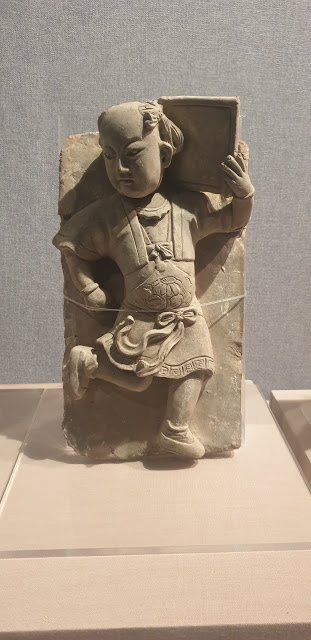
There were also small sculptures

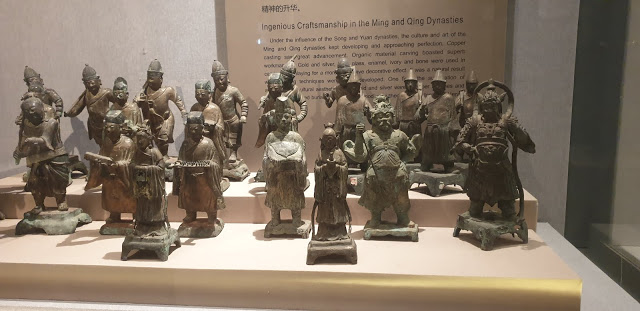
an array of small figures

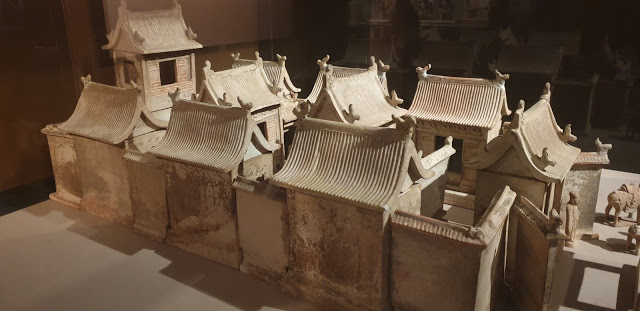
and a model of a settlement

20 minutes was long enough.

The End is never The End

Can you actually say you know the exact moment a story is done, finished, and that’s it?

For me, the end never quite seems to be the end, that point where you finally draw a line in the sand and say, that’s it, I’m done, step away from the typewriter.

But are we ever satisfied the story is done, can we not make one more change, it’s just a little tweak, it won’t take long.

Please!

My editor tolerated three ‘minor’ changes.

Firstly, a change of name for a character

Secondly, consistency of word use, such as times and contractions

Thirdly, I wasn’t happy with the overall story, and it needed some more action. More writing, more editing, more prevaricating.

It took three weeks to sort out all of those issues, and last night I send the final draft to the Editor.

It’s like watching your child go to school on their first day. Not knowing what will happen but expecting everything will be fine.

This morning I sat in front of the computer, a blank sheet of paper on the screen. I know it’s not a matter of starting the next story from scratch; I have so many started and finished, sitting in the wings to be ‘tinkered with’.

It’s my way of savoring the moment.

Just before I dive back into the murky waters.

Skeletons in the closet, and doppelgangers

A story called “Mistaken Identity”

…

How many of us have skeletons in the closet that we know nothing about? The skeletons we know about generally stay there, but those we do not, well, they have a habit of coming out of left field when we least expect it.

In this case, when you see your photo on a TV screen with the accompanying text that says you are wanted by every law enforcement agency in Europe, you’re in a state of shock, only to be compounded by those same police, armed and menacing, kicking the door down.

I’d been thinking about this premise for a while after I discovered my mother had a boyfriend before she married my father, a boyfriend who was, by all accounts, the man who was the love of her life.

Then, in terms of coming up with an idea for a story, what if she had a child by him that we didn’t know about, which might mean I had a half brother or sister I knew nothing about. It’s not an uncommon occurrence from what I’ve been researching.

There are many ways of putting a spin on this story.

Then, in the back of my mind, I remembered a story an acquaintance at work was once telling us over morning tea, that a friend of a friend had a mother who had a twin sister and that each of the sisters had a son by the same father, without each knowing of the father’s actions, both growing up without the other having any knowledge of their half brother, only to meet by accident on the other side of the world.

It was an encounter that in the scheme of things might never have happened, and each would have remained oblivious of the other.

For one sister, the relationship was over before she discovered she was pregnant, and therefore had not told the man he was a father. It was no surprise the relationship foundered when she discovered he was also having a relationship with her sister, a discovery that caused her to cut all ties with both of them and never speak to either from that day.

It’s a story with more twists and turns than a country lane!

And a great idea for a story.

That story is called ‘Mistaken Identity’.

Searching for locations: The Pagoda Forest, near Zhengzhou City, Henan Province, China

The pagoda forest

After another exhausting walk, by now the heat was beginning to take its toll on everyone, we arrived at the pagoda forest.

A little history first:

The pagoda forest is located west of the Shaolin Temple and the foot of a hill.  As the largest pagoda forest in China, it covers approximately 20,000 square meters and has about 230 pagodas build from the Tang Dynasty (618-907) to the Qing Dynasty (1644-1911).

Each pagoda is the tomb of an eminent monk from the Shaolin Temple.  Graceful and exquisite, they belong to different eras and constructed in different styles.  The first pagoda was thought to be built in 791.

It is now a world heritage site.

No, it’s not a forest with trees it’s a collection of over 200 pagodas, each a tribute to a head monk at the temple and it goes back a long time.  The tribute can have one, three, five, or a maximum of seven layers.  The ashes of the individual are buried under the base of the pagoda.

The size, height, and story of the pagoda indicate its accomplishments, prestige, merits, and virtues. Each pagoda was carved with the exact date of construction and brief inscriptions and has its own style with various shapes such as a polygonal, cylindrical, vase, conical and monolithic.

This is one of the more recently constructed pagodas

There are pagodas for eminent foreign monks also in the forest.

From there we get a ride back on the back of a large electric wagon

to the front entrance courtyard where drinks and ice creams can be bought, and a visit to the all-important happy place.

Then it’s back to the hotel.