In a word: Pad

Here is another of those three letter words that can have so many meanings that it is nigh on impossible to pin it down.

You have to use it in a sentence which all but explains it.

For instance,

A pad might be a writing pad, or a note pad, something on which you can write, notes, stories, anything really, even doodles.

Cats, dogs, a lot of animals have padded feet.  I’d say, for a cat, those pads would be like shock absorbers.

You can pad an expense account with false expenditure in an accounting sense, I’m sure a lot of people are tempted to do so.

I know places, where a single man might live, is called a bachelor pad.  So many men like to think they may have one, but it takes money to buy the accouterments of seduction.

Then there’s a medical dressing, a square of gauze called a pad, usually absorbent and soaked in disinfectant to help protect and repair a wound.

Shoulder pads, for broader shoulders

KInee pads, for when crashing off a bike

Shin pads for soccer, and ice hockey players

A helipad which is for helicopter landings and takeoffs, much the same as a launch pad for rockets.  Unfortunately, rockets do not generally have a tendency to land, not unless they are bombs, like the V1 and V2 rockets of WW2.

It could also be someone walking around a house in socks, the man stealthily approached the thief, padding silently in his socks so he wouldn’t be heard.

And lastly,

A place for frogs to hang out, ie, the flat leaves of a water Lilly.

Any more?

I’m sure there is, just let me know.


Inspiration, maybe – Volume 1

50 photographs, 50 stories, of which there is one of the 50 below.

They all start with –

A picture paints … well, as many words as you like.  For instance:

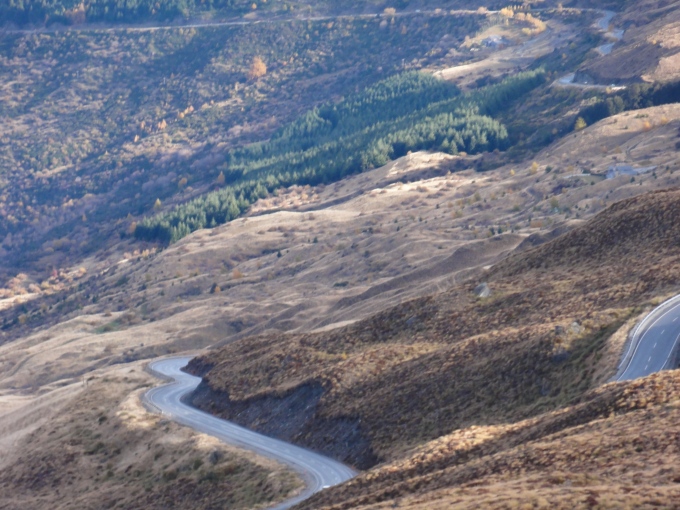
lookingdownfromcoronetpeak

And the story:

It was once said that a desperate man has everything to lose.

The man I was chasing was desperate, but I, on the other hand, was more desperate to catch him.

He’d left a trail of dead people from one end of the island to the other.

The team had put in a lot of effort to locate him, and now his capture was imminent.  We were following the car he was in, from a discrete distance, and, at the appropriate time, we would catch up, pull him over, and make the arrest.

There was nowhere for him to go.

The road led to a dead-end, and the only way off the mountain was back down the road were now on.  Which was why I was somewhat surprised when we discovered where he was.

Where was he going?

“Damn,” I heard Alan mutter.  He was driving, being careful not to get too close, but not far enough away to lose sight of him.

“What?”

“I think he’s made us.”

“How?”

“Dumb bad luck, I’m guessing.  Or he expected we’d follow him up the mountain.  He’s just sped up.”

“How far away?”

“A half-mile.  We should see him higher up when we turn the next corner.”

It took an eternity to get there, and when we did, Alan was right, only he was further on than we thought.”

“Step on it.  Let’s catch him up before he gets to the top.”

Easy to say, not so easy to do.  The road was treacherous, and in places just gravel, and there were no guard rails to stop a three thousand footfall down the mountainside.

Good thing then I had the foresight to have three agents on the hill for just such a scenario.

Ten minutes later, we were in sight of the car, still moving quickly, but we were going slightly faster.  We’d catch up just short of the summit car park.

Or so we thought.

Coming quickly around another corner we almost slammed into the car we’d been chasing.

“What the hell…” Aland muttered.

I was out of the car, and over to see if he was in it, but I knew that it was only a slender possibility.  The car was empty, and no indication where he went.

Certainly not up the road.  It was relatively straightforward for the next mile, at which we would have reached the summit.  Up the mountainside from here, or down.

I looked up.  Nothing.

Alan yelled out, “He’s not going down, not that I can see, but if he did, there’s hardly a foothold and that’s a long fall.”

Then where did he go?

Then a man looking very much like our quarry came out from behind a rock embedded just a short distance up the hill.

“Sorry,” he said quite calmly.  “Had to go if you know what I mean.”

I’d lost him.

It was as simple as that.

I had been led a merry chase up the hill, and all the time he was getting away in a different direction.

I’d fallen for the oldest trick in the book, letting my desperation blind me to the disguise that anyone else would see through in an instant.

It was a lonely sight, looking down that road, knowing that I had to go all that way down again, only this time, without having to throw caution to the wind.

“Maybe next time,” Alan said.

“We’ll get him.  It’s just a matter of time.”

© Charles Heath 2019-2021

Find this and other stories in “Inspiration, maybe”  available soon.

InspirationMaybe1v1

NANOWRIMO – November 2025 – Day 2

The Third Son of a Duke

WE needed a central character

So, in writing the outline, I came up with a premise that might change, but it seems a likely scenario, given that the title of the book is The Third Son of a Duke. It means that he is like having a spare tyre, or in the same position as the younger brother who is heir to the throne.

Here, it’s nothing quite so radical, just that he will inherit the title or the estate, which goes to the eldest son, yes, no equality, because I set it to start in the year 1913, that is, the Christmas before the First World War.  Remember, I was going to wrap something big around the story, and you can’t get any bigger than a world war. 

It’s a time when the classes were starting to break down and the aristocracy was becoming less relevant to everyone else.  It’s the Edwardian Era, and everyone is clinging to the last vestiges of the ruling class and the working class.  What was eminently workable in the 1800s is no longer viable. Nobility is finding it harder or impossible to maintain their lifestyles, fortunes are being lost, and a new class of wealthy people are emerging.

In 1913, there were still first class, second class, and third class.  On ships, on trains, and in life.  And something else is in the air, the coming of the Suffragette.  Women no longer want to stay at home, do as they were told and have no say over their lives.

We are going to start in that small world of classes, travelling together on a ship, one of the biggest for that time, with over 1300 passengers.

Soon.

Today, 1235 words, for a total of 3025 words.

Writing about writing a book – Day 17

There is more, and it has been forming in my mind overnight after I read, and re-read yesterday’s work.


This operation was led by two ex American army lieutenants who had served in the Vietnam war and afterward searching for lost comrades.  The Colonel told me they had spent a few years looking for lost POW’s held in camps just over the border in Cambodia or Laos and had a good track record in the jungle.  He trusted them and said I could too.

I thought it odd he felt the need to reassure me.

He said they’d had marginal success, but my own impression was that they were ex CIA, gone rogue, and were part of the burgeoning drug trade that had sprung up during and after the war had ended.   For all that, I had also begun to suspect the Colonel had sold out and we were more about protecting the criminals rather than trying to catch them, and for me, that unquestioning obedience he demanded was beginning to slip.

They also had the look of men who had spent their time sampling the product, and as such were treading a fine line between sanity and insanity.  Still, at first, they didn’t seem all that different to us.

Thoroughly soaked, we made the camp on schedule, planned the attack, and carried it out.  Only there was no one there, it was empty, and had been for some time.  I turned to question the two ‘experts’.

Pity then I hadn’t noticed his partner coming up from behind.  If I had, my situation may have been very, very, different.


When I woke up, it was not in a nice warm or comfortable bed.  It was a dirt floor.  I looked up and realized I was in a hut.  Daytime, very hot, with sharp, bright shards of light leaking through the cracks in the wall and around the doorway.

My head was hurting, as was just about every other part of me, but a cursory examination showed nothing was broken.  Yet.

It took only a moment for clarity to return, and the realization we were prisoners.  Survivors from the group, the only survivors.

The other occupant, a soldier whom I only knew by his first name, Barry, stirred, and then rolled over.

“Where are we?” he asked.

‘In a hut.”

“Where?”

“Your guess is as good as mine.”

He groaned, and then tried to sit up, only to slowly sink back down again.  Perhaps he had tried harder to escape and paid a heavier price.

“This is not looking good,” he said.

“No.”  An understatement, I thought, but to my knowledge, this was the first time I’d heard they took prisoners.  Usually, everyone was summarily executed, and the bodies set up as an example to others.

I heard the sound of boots on gravel coming towards the hut, then, in an instant, the harsh light coming in, temporarily blinding me as the door was yanked open.

When my eyes adjusted I saw two bulky men holding machine guns standing behind another, a short Chinese, with a very familiar face.

Where?  When?

Then I remembered.  A week ago, in Hong Kong, at a hastily arranged meeting between Davenport and the police who were supposed to be helping us with information on a smuggling group known to be operating in the Vietnam/Cambodia/Laos area.  He was the Chinese liaison, connected with the Government.

Apparently not.

This was bad.  Very, very bad.

“Mr. Chandler.  So nice of you to join us.  Colonel Davenport and I are so disappointed in you.”

© Charles Heath 2015-2023

The cinema of my dreams – I never wanted to go to Africa – Episode 25

Our hero knows he’s in serious trouble.

The problem is, there are familiar faces and the question of who is a friend and who is a foe is made all the more difficult because of the enemy, if it was the enemy, simply because it didn’t look or sound or act like the enemy.

Now, it appears, his problems stem from another operation he participated in.

When I woke up, it was in a whole new world, but not necessarily of pain.

It was a different room, not quite dark, not hot or cold, and looked much like a hospital room layout with a hospital bed, and bright lights outside the doors.

I had no idea if it was daylight or night.  Classic disorientation procedure before a different sort of interrogation.

What I also realised, though I was not sure why was that the casts and bandages I had back at the previous base hospital were gone, and everything looked, well, different.

That there was nothing wrong with me.

It’s a terrible thing to realise your own people had basically told you a web of lies about your condition, and how the mind adjusted to those lies.  And yet, I would have sworn on a stack of bibles my pain was real.

Drugs.  Not only could they do good, but they could also do some very bad things, to the mind and the body.  At a guess, I would say it was for Breeman’s benefit.  If I’d come back in one piece there would be a truckload of questions.

So, I’d been moved, and kept under the whole time.  And if there was nothing wrong with me, why was I still in what looked like a hospital?  Maybe it wasn’t.  There was only one bed in the room.  Perhaps it was a cell for recovering transportees.

My worst fears then, a black site.

My waking must have triggered an alarm because I heard the door open and someone come into the room.  The exact position of the door was hidden by a curtain, but I could see the light from outside intensify when it opened and slowly drop ass it closed.

The curtain moved on its rings to show a man in a white coat, perhaps a doctor, but more likely the interrogator or his assistant coming to check the viability of their target.

I had to ask, “Where am I?”

“In a camp, at a location, I’m not at liberty to disclose.”

“When did I get here?”

“Yesterday, late last night.  It was busy.  We had three new arrivals.  You must be on the right side because you didn’t arrive in chains, the other two did.”

He took my temperature, blood pressure and some other tests, and wrote the numbers on a page in a file.

“You haven’t reacted to the serum we gave you.  That’s good.”  He saw my look of concern.  “Oh, it’s only used for transporting injured people from one base to another.  It helps to minimise the external forces causing them unnecessary pain.”

“Apparently I’m not injured.”

“No.  Not quite sure what happened there, but, whatever happened, it’s above my pay grade.  By the way, don’t try to leave this room.  There’s a guard outside who had been told to shoot first and ask questions later.  I’ve seen the results of her work.”

It had to be Monroe.

That means Lallo would be around soon enough.

© Charles Heath 2019

Writing a book in 365 days – 289

Day 289

I don’t want to retire – just yet!

Not Done Yet: Why I Won’t Put the Pen Down (Unless You Pry It Loose)

There are moments in life that hit you like a carefully aimed brick. The day you realize you’re paying full price for admission instead of the student rate. The first time a colleague suggests you mentor them because they “remember reading your work when they were in college.”

But nothing compares to the quiet horror of the Mirror Shock.

You wake up, perhaps a little stiffly, wander into the bathroom, and catch a truly unguarded reflection. And there it is: concrete evidence that the passage of time is not just an abstract concept discussed by philosophers—it’s etched onto your face. Suddenly, you realize old age hasn’t approached politely; it has just snuck up on you, giggling maniacally from the periphery.

And with that physical realization comes the societal whisper, amplified by well-meaning friends and persistent internal voices: The notion of putting the pen away, hanging up the computer, finally taking a step back has come.

It’s time to retire.

And yet, for some of us, that suggestion feels less like liberation and more like an existential threat.


The Conflict: Passion vs. The Sabbatical Police

Retirement, in its classic definition, is a beautiful idea: the well-deserved pause. Years of hard work traded for limitless travel, afternoon naps, and the blissful freedom from deadlines.

For most folks, the idea of having their primary tool—a calculator, a hammer, a briefcase—confiscated sounds glorious.

But for those of us whose professional lives are intrinsically tied to creation, communication, and connectivity—the writers, the consultants, the artists, the lifelong learners—the pen and the keyboard aren’t just tools. They are conduits. They are how we process the world, how we contribute, and often, who we fundamentally are.

When the world suggests you stop doing the thing that makes you you, the reaction isn’t gratitude; it’s cognitive dissonance.

The mirror may be showing a few new wrinkles, but the internal drive—the wellspring of ideas, the need to connect dots, the urge to capture a thought before it vanishes—is still running at high speed. The engine hasn’t sputtered; it’s just settled into a low, rumbling idle.

The Heresy of the Hard Stop

The assumption that everyone must pivot from 100 mph to 0 mph on their 65th birthday is an outdated construct of a mid-20th-century economy. When work involved significant physical strain or rote, repetitive tasks, the need for a hard break was undeniable.

But in the creative, intellectual, and digital spheres, the opposite is often true. Our knowledge, our networks, and our insight are compounding assets that only increase with time.

Why, then, should we stop when we are finally reaching the peak of our observational powers?

If your professional life has been one long, passionate conversation with the world, cutting off the microphone simply because the calendar dictates it feels absurd. It’s like telling a seasoned musician to stop writing songs because their hair is graying.

For those of us who feel this way, the concept of retirement is not an ending; it’s a necessary (and perhaps slightly aggressive) re-negotiation.


My Mantra: Cold, Dead Hands and the Keyboard

If you are facing the societal pressure to step away, and feel an absolute, visceral refusal blooming in your chest, congratulations—you are likely one of the few who understands the true meaning of the rebellious mantra:

The computer/pen has to be confiscated out of my cold, dead hands.

This isn’t stubbornness; it’s the ultimate expression of professional identity. It’s the declaration that my purpose is not dependent on my age, but on my ability to contribute.

If you share this fierce dedication, the answer isn’t to quit. The answer is to adapt the way you work, without surrendering the work itself.

How to Defy Retirement Without Burning Out

If you’ve decided you’re not hanging up your boots, you need a strategy to prove that your value increases with age, proving that the Mirror Shock was an alarm clock, not a finish line.

1. Shift from Production to Curation

You don’t need to write five articles a week, but you can distill a lifetime of experience into one powerful annual essay or a keynote speech. Instead of being the primary producer, become the ultimate curator, mentor, and editor. Your job moves from generating volume to providing invaluable context.

2. Embrace the Scalpel, Ditch the Sledgehammer

Scale back without cutting off. If your schedule was fifty hours, trim it to twenty of the most impactful hours. Eliminate the administrative drudgery and focus solely on the projects that truly engage your intellect and creativity. Preserve your energy for the soul work.

3. Redefine “Success”

Success is no longer measured in promotions or quarterly earnings. It’s measured in impact, legacy, and genuine enjoyment. If a project stops being fun, drop it. Your experience has earned you the right to be highly selective.

4. The Laptop is the Travel Companion

One of the great promises of retirement is travel. Why separate the two? If your work is digital, your office is portable. The pen doesn’t need to be put away; it simply needs a passport. Continue writing, designing, or consulting from places that inspire you.


The Final Word

The sudden realization of age is a profound moment. It forces you to confront mortality, but more importantly, it forces you to confront the passion that still burns within.

They say you spend your lifetime building a career so you can eventually stop. But for the dedicated writer, creator, or thinker, the career is the life. We don’t want to stop doing it; we just want the freedom to keep doing it better, smarter, and with fewer corporate meetings.

I’ve looked in the mirror, acknowledged the lines, and heard the societal call to step aside. But the pen is still in my hand, the laptop is still charged, and there are far too many thoughts left unwritten.

Tell the Sabbatical Police they’ll need to bring heavy equipment. Because until the very end, this keyboard is mine.
Searching for locations: The Lingering Gardens, Suzhou, China

The Lingering Garden

These gardens are very tightly put together and are interspersed with buildings that you can go in and look at as distinct from just looking in from the outside.

There are lots of paths that wind around interspersed with rocks which may or may not be sculpted, and equally interspersed with trees, bushes, and small plants.  In the middle is a lake which usually has lotus plants in bloom, but they are not in season.

The gardens were built around a small lake that was filled with fish of all sizes and colours

The buildings were also a contrast for those built for the men

and those for the women

In the middle of the garden was a significant rock pillar

surrounded by certain areas of the garden that had smaller rock formations


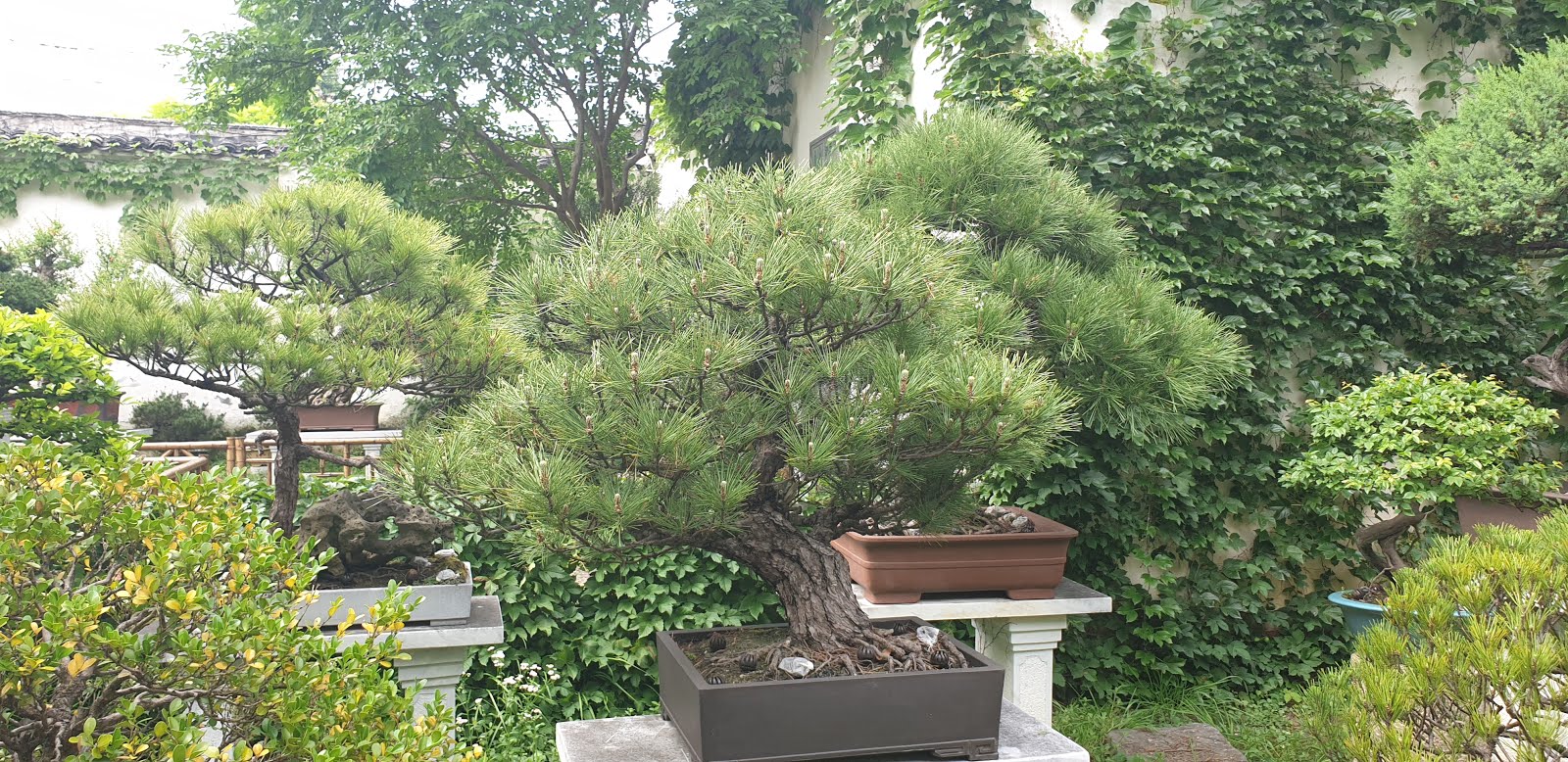
At the end of the garden is a large collection of bonsai trees, some of which are quite exquisite.

What I learned about writing – Not to use Figures of Speech

I found this explanation on the internet for what figures of speech are: ‘a word or phrase used in a non-literal sense for rhetorical or vivid effect.’

We as writers should not use these in our writing because most people might not understand their use.  I think it sometimes adds a degree of whimsy to the story.

I remember some years ago when I was working with a Russian chap who’d not been in the country very long, and though he had a reasonable use of English, he was not quite up with our figures of speech.

And made me realise when he kept asking me what they meant, just how many I used in everyday use.

Most of these figures of speech use descriptions that do not necessarily match the word being described, such as ‘I dance like I have two left feet’.

And that pretty much sums up how good I can dance.  But …

‘Like a bat out of hell’, not sure how this got into the vernacular

‘Like a bull in a China shop’, describes a toddler let loose

‘More front than Myers’, as my mother used to say, but in context, Myers is the Australian version of the English Selfridges or Harrods or Paris Galleries Lafayette.  It refers to the width of the street frontage of the stores

‘As mad as a hatter’, though not necessarily of the millinery kind, but, well, you can guess

‘As nutty as a fruitcake’, provided your fruitcake has nuts in it

You can see, if you get the references, they are somewhat apt, and, yes, they sometimes creep into my stories.

First Dig Two Graves

A sequel to “The Devil You Don’t”

Revenge is a dish best served cold – or preferably so when everything goes right

Of course, it rarely does, as Alistair, Zoe’s handler, discovers to his peril. Enter a wildcard, John, and whatever Alistair’s plan for dealing with Zoe was dies with him.

It leaves Zoe in completely unfamiliar territory.

John’s idyllic romance with a woman who is utterly out of his comfort zone is on borrowed time. She is still trying to reconcile her ambivalence, after being so indifferent for so long.

They agree to take a break, during which she disappears. John, thinking she has left without saying goodbye, refuses to accept the inevitable, calls on an old friend for help in finding her.

After the mayhem and being briefly reunited, she recognises an inevitable truth: there is a price to pay for taking out Alistair; she must leave and find them first, and he would be wise to keep a low profile.

But keeping a low profile just isn’t possible, and enlisting another friend, a private detective and his sister, a deft computer hacker, they track her to the border between Austria and Hungary.

What John doesn’t realise is that another enemy is tracking him to find her too. It could have been a grand tour of Europe. Instead, it becomes a race against time before enemies old and new converge for what will be an inevitable showdown.

Searching for locations: West Lake, Hangzhou, China

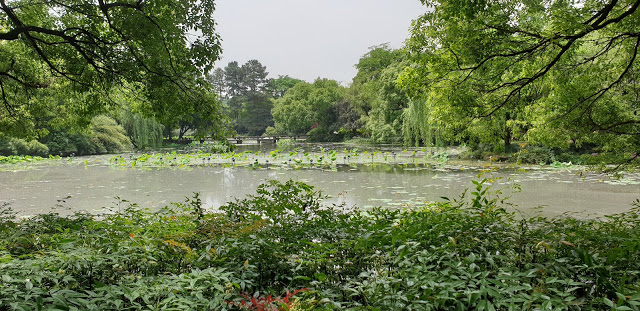
West Lake is a freshwater lake in Hangzhou, China. It is divided into five sections by three causeways. There are numerous temples, pagodas, gardens, and artificial islands within the lake.

Measuring 3.2 kilometers (2 miles) in length, 2.8 kilometers (1.7 miles) in width, and 2.3 meters (7.5 feet) in average depth, the lake spreads itself in an area totaling 6.5 square kilometers (2.5 square miles).

The earliest recorded name for West Lake was the “Wu Forest River”, but over time it changed to two distinct names.  One is “Qiantang Lake”, due to the fact that Hangzhou was called “Qiantang” in ancient times.  The other, “West Lake”, due to the lake being west of the city

It’s about to get busy, with a number of activities planned, and the warmth of the day is starting to make an impact.

The tour starts in the car park about a kilometer away, but the moment we left the car park we were getting a taste of the park walking along a tree-lined avenue.

When we cross the road, once again dicing with death with the silent assassins on motor scooters.

We are in the park proper, and it is magnificent, with flowers, mostly at the start hydrangeas and then any number of other trees and shrubs, some carved into other flower shapes like a lotus.

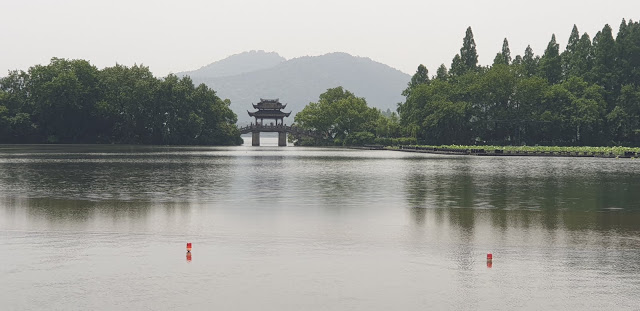
Then there was the lake and the backdrop of bridges and walkways.

.

And if you can tune out the background white noise the place would be great for serenity and relaxation.

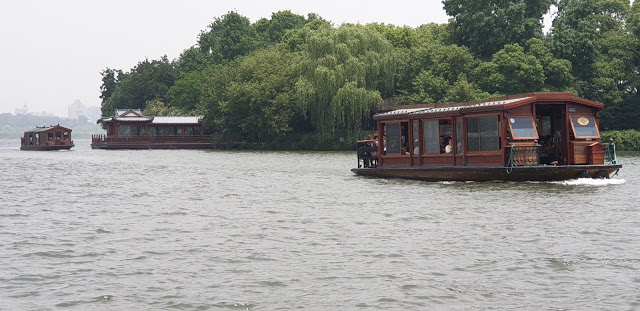
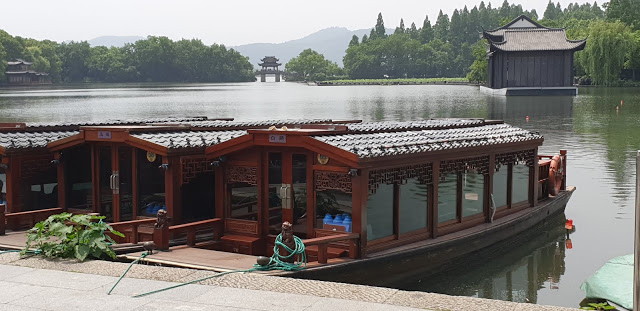
That, in fact, was how the boat ride panned out, about half an hour or more gliding across the lake in an almost silent boat, by an open window, with the air and the majestic scenery.

No, not that boat, which would be great to have lunch on while cruising, but the boat below:

Not quite in the same class, but all the same, very easy to tune out and soak it in.

It was peaceful, amazingly quiet, on a summery day

A pagoda in the hazy distance, an island we were about to circumnavigate.

Of all the legends, the most touching one is the love story between Bai Suzhen and Xu Xi’an. Bai Suzhen was a white snake spirit and Xu Xi’an was a mortal man.

They fell in love when they first met on a boat on the West Lake, and got married very soon after.

However, the evil monk Fa Hai attempted to separate the couple by imprisoning Xu Xi’an. Bai Suzhen fought against Fa Hai and tried her best to rescue her husband, but she failed and was imprisoned under the Leifeng Pagoda by the lake.

Years later the couple was rescued by Xiao Qing, the sister of Baisuzhen, and from then on, Bai Suzhen and Xu Xi’an lived together happily.

The retelling of the story varied between tour guides, and on the cruise boat, we had two.  Our guide kept to the legend, the other tour guide had a different ending.

Suffice to say it had relevance to the two pagodas on the far side of the lake.

There was a cafe or restaurant on the island, but that was not our lunch destination.

Nor were the buildings further along from where we disembarked.

All in all the whole cruise took about 45 minutes and was an interesting break from the hectic nature of the tour.

Oh yes, and the boat captain had postcards for sale.  We didn’t buy any.

Lunch

At the disembarkation point there was a mall that sold souvenirs and had a few ‘fast food’ shops, and a KFC, not exactly what we came to China for, but it seemed like the only place in town a food cautious Australian could eat at.

And when tried to get in the door, that’s where at least 3 busloads were, if they were not in the local Starbucks.  Apparently, these were the places of first choice wherever we went.

The chicken supply by the time we got to the head of the line amounted to pieces at 22.5 RMB a piece and nuggets.  Everything else had run out, and for me, there were only 5 pieces left.  Good thing there were chips.

And Starbucks with coffee and cheesecake.

At least the setting for what could have been a picnic lunch was idyllic.