An excerpt from “If Only” – a work in progress

Investigation of crimes doesn’t always go according to plan, nor does the perpetrator get either found or punished.

That was particularly true in my case.  The murderer was incredibly careful in not leaving any evidence behind, to the extent that the police could not rule out whether it was a male or a female.

At one stage the police thought I had murdered my own wife though how I could be on a train at the time of the murder was beyond me.  I had witnesses and a cast-iron alibi.

The officer in charge was Detective First Grade Gabrielle Walters.  She came to me on the day after the murder seeking answers to the usual questions like, when was the last time you saw your wife, did you argue, the neighbors reckon there were heated discussions the day before.

Routine was the word she used.

Her fellow detective was a surly piece of work whose intention was to get answers or, more likely, a confession by any or all means possible.  I could sense the raging violence within him.  Fortunately, common sense prevailed.

Over the course of the next few weeks, once I’d been cleared of committing the crime, Gabrielle made a point of keeping me informed of the progress.

After three months the updates were more sporadic, and when, for lack of progress, it became a cold case, communication ceased.

But it was not the last I saw of Gabrielle.

The shock of finding Vanessa was more devastating than the fact she was now gone, and those images lived on in the same nightmare that came to visit me every night when I closed my eyes.

For months I was barely functioning, to the extent I had all but lost my job, and quite a few friends, particularly those who were more attached to Vanessa rather than me.

They didn’t understand how it could affect me so much, and since it had not happened to them, my tart replies of ‘you wouldn’t understand’ were met with equally short retorts.  Some questioned my sanity, even, for a time, so did I.

No one, it seemed, could understand what it was like, no one except Gabrielle.

She was by her own admission, damaged goods, having been the victim of a similar incident, a boyfriend who turned out to be an awfully bad boy.  Her story varied only in she had been made to witness his execution.  Her nightmare, in reliving that moment in time, was how she was still alive and, to this day, had no idea why she’d been spared.

It was a story she told me one night, some months after the investigation had been scaled down.  I was still looking for the bottom of a bottle and an emotional mess.  Perhaps it struck a resonance with her; she’d been there and managed to come out the other side.

What happened become our secret, a once-only night together that meant a great deal to me, and by mutual agreement, it was not spoken of again.  It was as if she knew exactly what was required to set me on the path to recovery.

And it had.

Since then, we saw each about once a month in a cafe.   I had been surprised to hear from her again shortly after that eventful night when she called to set it up, ostensibly for her to provide me with any updates on the case, but perhaps we had, after that unspoken night, formed a closer bond than either of us wanted to admit.

We generally talked for hours over wine, then dinner and coffee.  It took a while for me to realize that all she had was her work, personal relationships were nigh on impossible in a job that left little or no spare time for anything else.

She’d always said that if I had any questions or problems about the case, or if there was anything that might come to me that might be relevant, even after all this time, all I had to do was call her.

I wondered if this text message was in that category.  I was certain it would interest the police and I had no doubt they could trace the message’s origin, but there was that tiny degree of doubt, about whether or not I could trust her to tell me what the message meant.

I reached for the phone then put it back down again.  I’d think about it and decide tomorrow.

© Charles Heath 2018-2020

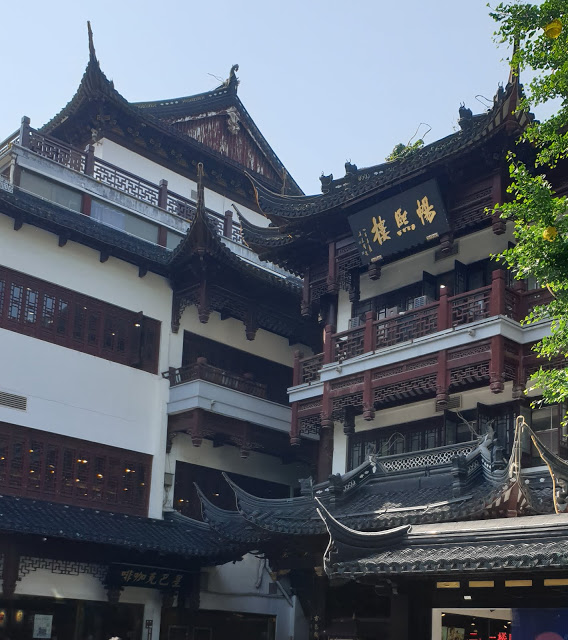
Searching for locations: Old Shanghai, China

The old Shanghai refers to a small area of Shanghai that used to be walled in and remained that way until about 1912 when all but a small section of the wall was demolished.  With the advent of the concessions, Old Shanghai became the administrative center until later when it became a shopping complex.

Now it has many restored historical buildings as well as new buildings in a somewhat traditional style that has become one of Shanghai’s main tourist attractions, housing many shops and restaurants.

The “Old Town” is not exclusively old, as you still have a chance to take in the atmosphere if you wander into the quaint side streets.

But, on first viewing walking down the street towards the complex, I’m not sure I’d go as far as to say this is in reality old Shanghai, except for what appears to be a true representation of it architecturally. 

The buildings, which are shops and restaurants, are set out symmetrically, with streets, alleyways, and squares which may prove that it was specially built for the tourists, and no mechanized traffic.

Anyway…

The buildings are magnificent, and a photographer’s delight, and you’d finish up having hundreds of photos by the time you leave.  All the buildings are exquisite representations of traditional Chinese architecture. 

As for buying stuff, remember if you’re not Chinese you have the sucker tourist stamp on your forehead, so be prepared to walk away if the vendors will not bargain.  

Nothing here is worth the price tag and in our group discounts like from 130 RMB to 50 RMB and from 1 for 1,200 to 2 for 950 RMB are common.

Here common t-shirts that we can get for 3 dollars back home start at 150 RMB which is roughly 35 dollars.  It’s that kind of market.

We end up is a tea room, on the third floor of the meeting point below, and discover all the tour guides sitting around a table counting money, and I have to say it’s the most $50 notes I’ve ever seen in one place.  
It is, we were told, where they discussed ‘strategy’.

An excerpt from “One Last Look”: Charlotte is no ordinary girl

This is currently available at Amazon herehttp://amzn.to/2CqUBcz

I’d read about out-of-body experiences, and like everyone else, thought it was nonsense.  Some people claimed to see themselves in the operating theatre, medical staff frantically trying to revive them, and being surrounded by white light.

I was definitely looking down, but it wasn’t me I was looking at.

It was two children, a boy and a girl, with their parents, in a park.

The boy was Alan.  He was about six or seven.  The girl was Louise, and she was five years old.  She had long red hair and looked the image of her mother.

I remember it now, it was Louise’s birthday and we went down to Bournemouth to visit our Grandmother, and it was the last time we were all together as a family.

We were flying homemade kites our father had made for us, and after we lay there looking up at the sky, making animals out of the clouds.  I saw an elephant, Louise saw a giraffe.

We were so happy then.

Before the tragedy.

When I looked again ten years had passed and we were living in hell.  Louise and I had become very adept at survival in a world we really didn’t understand, surrounded by people who wanted to crush our souls.

It was not a life a normal child had, our foster parents never quite the sort of people who were adequately equipped for two broken-hearted children.  They tried their best, but their best was not good enough.

Every day it was a battle, to avoid the Bannister’s and Archie in particular, every day he made advances towards Louise and every day she fended him off.

Until one day she couldn’t.

Now I was sitting in the hospital, holding Louise’s hand.  She was in a coma, and the doctors didn’t think she would wake from it.  The damage done to her was too severe.

The doctors were wrong.

She woke, briefly, to name her five assailants.  It was enough to have them arrested.  It was not enough to have them convicted.

Justice would have to be served by other means.

I was outside the Bannister’s home.

I’d made my way there without really thinking, after watching Louise die.  It was like being on autopilot, and I had no control over what I was doing.  I had murder in mind.  It was why I was holding an iron bar.

Skulking in the shadows.  It was not very different from the way the Bannister’s operated.

I waited till Archie came out.  I knew he eventually would.  The police had taken him to the station for questioning, and then let him go.  I didn’t understand why, nor did I care.

I followed him up the towpath, waiting till he stopped to light a cigarette, then came out of the shadows.

“Wotcha got there Alan?” he asked when he saw me.  He knew what it was, and what it was for.

It was the first time I’d seen the fear in his eyes.  He was alone.

“Justice.”

“For that slut of a sister of yours.  I had nuffing to do with it.”

“She said otherwise, Archie.”

“She never said nuffing, you just made it up.”  An attempt at bluster, but there was no confidence in his voice.

I held up the pipe.  It had blood on it.  Willy’s blood.  “She may or may not have Archie, but Willy didn’t make it up.  He sang like a bird.  That’s his blood, probably brains on the pipe too, Archie, and yours will be there soon enough.”

“He dunnit, not me.  Lyin’ bastard would say anything to save his own skin.”  Definitely scared now, he was looking to run away.

“No, Archie.  He didn’t.  I’m coming for you.  All of you Bannisters.  And everyone who touched my sister.”

It was the recurring nightmare I had for years afterwards.

I closed my eyes and tried to shut out the thoughts, the images of Louise, the phone call, the visit to the hospital and being there when she succumbed to her injuries.  Those were the very worst few hours of my life.

She had asked me to come to the railway station and walk home with her, and I was running late.  If I had left when I was supposed to, it would never have happened and for years afterwards, I blamed myself for her death.

If only I’d not been late…

When the police finally caught the rapists, I’d known all along who they’d be; antagonists from school, the ring leader, Archie Bannister, a spurned boyfriend, a boy whose parents, ubiquitously known to all as ‘the Bannister’s, dealt in violence and crime and who owned the neighbourhood.  The sins of the father had been very definitely passed onto the son.

At school, I used to be the whipping boy, Archie, a few grades ahead of me, made a point of belting me and a few of the other boys, to make sure the rest did as they were told.  He liked Louise, but she had no time for a bully like him, even when he promised he would ‘protect’ me.

I knew the gang members, the boys who tow-kowed to save getting beaten up, and after the police couldn’t get enough information to prosecute them because everyone was too afraid to speak out, I went after Willy.  There was always a weak link in a group, and he was it.

He worked in a factory, did long hours on a Wednesday and came home after dark alone.  It was a half mile walk, through a park.  The night I approached him, I smashed the lights and left it in darkness.  He nearly changed his mind and went the long way home.

He didn’t.

It took an hour and a half to get the names.  At first, when he saw me, he laughed.  He said I would be next, and that was four words more than he knew he should have said.

When I found him alone the next morning I showed him the iron bar and told him he was on the list.  I didn’t kill him then, he could wait his turn, and worry about what was going to happen to him.

When the police came to visit me shortly after that encounter, no doubt at the behest of the Bannister’s, the neighbourhood closed ranks and gave me an ironclad alibi.  The Bannister’s then came to visit me and threatened me.  I told them their days were numbered and showed them the door.

At the trial, he and his friends got off on a technicality.  The police had failed to do their job properly, but it was not the police, but a single policeman, corrupted by the Bannisters.

Archie could help but rub it in my face.  He was invincible.

Joe Collins took 12 bullets and six hours to bleed out.  He apologized, he pleaded, he cried, he begged.  I didn’t care.

Barry Mills, a strong lad with a mind to hurting people, Archie’s enforcer, almost got the better of me.  I had to hit him more times than I wanted to, and in the end, I had to be satisfied that he died a short but agonizing death.

I revisited Willy in the hospital.  He’d recovered enough to recognize me, and why I’d come.  Suffocation was too good for him.

David Williams, second in command of the gang, was as tough and nasty as the Bannisters.  His family were forging a partnership with the Bannister’s to make them even more powerful.  Outwardly David was a pleasant sort of chap, affable, polite, and well mannered.  A lot of people didn’t believe he could be like, or working with, the Bannisters.

He and I met in the pub.  We got along like old friends.  He said Willy had just named anyone he could think of, and that he was innocent of any charges.  We shook hands and parted as friends.

Three hours later he was sitting in a chair in the middle of a disused factory, blindfolded and scared.  I sat and watched him, listened to him, first threatening me, and then finally pleading with me.  He’d guessed who it was that had kidnapped him.

When it was dark, I took the blindfold off and shone a very bright light in his eyes.  I asked him if the violence he had visited upon my sister was worth it.  He told me he was just a spectator.

I’d read the coroner’s report.  They all had a turn.  He was a liar.

He took nineteen bullets to die.

Then came Archie.

The same factory only this time there were four seats.  Anna Bannister, brothel owner, Spike Bannister, head of the family, Emily Bannister, sister, and who had nothing to do with their criminal activities.  She just had the misfortune of sharing their name.

Archie’s father told me how he was going to destroy me, and everyone I knew.

A well-placed bullet between the eyes shut him up.

Archie’s mother cursed me.  I let her suffer for an hour before I put her out of her misery.

Archie remained stony-faced until I came to Emily.  The death of his parents meant he would become head of the family.  I guess their deaths meant as little to him as they did me.

He was a little more worried about his sister.

I told him it was confession time.

He told her it was little more than a forced confession and he had done nothing to deserve my retribution.

I shrugged and shot her, and we both watched her fall to the ground screaming in agony.  I told him if he wanted her to live, he had to genuinely confess to his crimes.  This time he did, it all poured out of him.

I went over to Emily.  He watched in horror as I untied her bindings and pulled her up off the floor, suffering only from a small wound in her arm.  Without saying a word she took the gun and walked over to stand behind him.

“Louise was my friend, Archie.  My friend.”

Then she shot him.  Six times.

To me, after saying what looked like a prayer, she said, “Killing them all will not bring her back, Alan, and I doubt she would approve of any of this.  May God have mercy on your soul.”

Now I was in jail.  I’d spent three hours detailing the deaths of the five boys, everything I’d done; a full confession.  Without my sister, my life was nothing.  I didn’t want to go back to the foster parents; I doubt they’d take back a murderer.

They were not allowed to.

For a month I lived in a small cell, in solitary, no visitors.  I believed I was in the queue to be executed, and I had mentally prepared myself for the end.

Then I was told I had a visitor, and I was expecting a priest.

Instead, it was a man called McTavish. Short, wiry, and with an accent that I could barely understand.

“You’ve been a bad boy, Alan.”

When I saw it was not the priest I told the jailers not to let him in, I didn’t want to speak to anyone.  They ignored me.  I’d expected he was a psychiatrist, come to see whether I should be shipped off to the asylum.

I was beginning to think I was going mad.

I ignored him.

“I am the difference between you living or dying Alan, it’s as simple as that.  You’d be a wise man to listen to what I have to offer.”

Death sounded good.  I told him to go away.

He didn’t.  Persistent bugger.

I was handcuffed to the table.  The prison officers thought I was dangerous.  Five, plus two, murders, I guess they had a right to think that.  McTavish sat opposite me, ignoring my request to leave.

“Why’d you do it?”

“You know why.”  Maybe if I spoke he’d go away.

“Your sister.  By all accounts, the scum that did for her deserved what they got.”

“It was murder just the same.  No difference between scum and proper people.”

“You like killing?”

“No-one does.”

“No, I dare say you’re right.  But you’re different, Alan.  As clean and merciless killing I’ve ever seen.  We can use a man like you.”

“We?”

“A group of individuals who clean up the scum.”

I looked up to see his expression, one of benevolence, totally out of character for a man like him.  It looked like I didn’t have a choice.

Trained, cleared, and ready to go.

I hadn’t realized there were so many people who were, for all intents and purposes, invisible.  People that came and went, in malls, in hotels, trains, buses, airports, everywhere, people no one gave a second glance.

People like me.

In a mall, I became a shopper.

In a hotel, I was just another guest heading to his room.

On a bus or a train, I was just another commuter.

At the airport, I became a pilot.  I didn’t need to know how to fly; everyone just accepted a pilot in a pilot suit was just what he looked like.

I had a passkey.

I had the correct documents to get me onto the plane.

That walk down the air bridge was the longest of my life.  Waiting for the call from the gate, waiting for one of the air bridge staff to challenge me, stepping onto the plane.

Two pilots and a steward.  A team.  On the plane early before the rest of the crew.  A group that was committing a crime, had committed a number of crimes and thought they’d got away with it.

Until the judge, the jury and their executioner arrived.

Me.

Quick, clean, merciless.  Done.

I was now an operational field agent.

I was older now, and I could see in the mirror I was starting to go grey at the sides.  It was far too early in my life for this, but I expect it had something to do with my employment.

I didn’t recognize the man who looked back at me.

It was certainly not Alan McKenzie, nor was there any part of that fifteen-year-old who had made the decision to exact revenge.

Given a choice; I would not have gone down this path.

Or so I kept telling myself each time a little more of my soul was sold to the devil.

I was Barry Gamble.

I was Lenny Buckman.

I was Jimmy Hosen.

I was anyone but the person I wanted to be.

That’s what I told Louise, standing in front of her grave, and trying to apologize for all the harm, all the people I’d killed for that one rash decision.  If she was still alive she would be horrified, and ashamed.

Head bowed, tears streamed down my face.

God had gone on holiday and wasn’t there to hand out any forgiveness.  Not that day.  Not any day.

New York, New Years Eve.

I was at the end of a long tour, dragged out of a holiday and back into the fray, chasing down another scumbag.  They were scumbags, and I’d become an automaton hunting them down and dispatching them to what McTavish called a better place.

This time I failed.

A few drinks to blot out the failure, a blonde woman who pushed my buttons, a room in a hotel, any hotel, it was like being on the merry-go-round, round and round and round…

Her name was Silvia or Sandra, or someone I’d met before, but couldn’t quite place her.  It could be an enemy agent for all I knew or all I cared right then.

I was done.

I’d had enough.

I gave her the gun.

I begged her to kill me.

She didn’t.

Instead, I simply cried, letting the pent up emotion loose after being suppressed for so long, and she stayed with me, holding me close, and saying I was safe, that she knew exactly how I felt.

How could she?  No one could know what I’d been through.

I remembered her name after she had gone.

Amanda.

I remembered she had an imperfection in her right eye.

Someone else had the same imperfection.

I couldn’t remember who that was.

Not then.

I had a dingy flat in Kensington, a place that I rarely stayed in if I could help it.  After five-star hotel rooms, it made me feel shabby.

The end of another mission, I was on my way home, the underground, a bus, and then a walk.

It was late.

People were spilling out of the pub after the last drinks.  Most in good spirits, others slightly more boisterous.

A loud-mouthed chap bumped into me, the sort who had one too many, and was ready to take on all comers.

He turned on me, “Watch where you’re going, you fool.”

Two of his friends dragged him away.  He shrugged them off, squared up.

I punched him hard, in the stomach, and he fell backwards onto the ground.  I looked at his two friends.  “Take him home before someone makes mincemeat out of him.”

They grabbed his arms, lifted him off the ground and took him away.

Out of the corner of my eye, I could see a woman, early thirties, quite attractive, but very, very drunk.  She staggered from the bar, bumped into me, and finished up sitting on the side of the road.

I looked around to see where her friends were.  The exodus from the pub was over and the few nearby were leaving to go home.

She was alone, drunk, and by the look of her, unable to move.

I sat beside her.  “Where are your friends?”

“Dunno.”

“You need help?”

She looked up, and sideways at me.  She didn’t look the sort who would get in this state.  Or maybe she was, I was a terrible judge of women.

“Who are you?” she asked.

“Nobody.”  I was exactly how I felt.

“Well Mr Nobody, I’m drunk, and I don’t care.  Just leave me here to rot.”

She put her head back between her knees, and it looked to me she was trying to stop the spinning sensation in her head.

Been there before, and it’s not a good feeling.

“Where are your friends?” I asked again.

“Got none.”

“Perhaps I should take you home.”

“I have no home.”

“You don’t look like a homeless person.  If I’m not mistaken, those shoes are worth more than my weekly salary.”  I’d seen them advertised, in the airline magazine, don’t ask me why the ad caught my attention.

She lifted her head and looked at me again.  “You a smart fucking arse are you?”

“I have my moments.”

“Have them somewhere else.”

She rested her head against my shoulder.  We were the only two left in the street, and suddenly in darkness when the proprietor turned off the outside lights.

“Take me home,” she said suddenly.

“Where is your place?”

“Don’t have one.  Take me to your place.”

“You won’t like it.”

“I’m drunk.  What’s not to like until tomorrow.”

I helped her to her feet.  “You have a name?”

“Charlotte.”

The wedding was in a small church.  We had been away for a weekend in the country, somewhere in the Cotswolds, and found this idyllic spot.  Graves going back to the dawn of time, a beautiful garden tended by the vicar and his wife, an astonishing vista over hills and down dales.

On a spring afternoon with the sun, the flowers, and the peacefulness of the country.

I had two people at the wedding, the best man, Bradley, and my boss, Watkins.

Charlotte had her sisters Melissa and Isobel, and Isobel’s husband Giovanni, and their daughter Felicity.

And one more person who was as mysterious as she was attractive, a rather interesting combination as she was well over retirement age.  She arrived late and left early.

Aunt Agatha.

She looked me up and down with what I’d call a withering look.  “There’s more to you than meets the eye,” she said enigmatically.

“Likewise I’m sure,” I said.  It earned me an elbow in the ribs from Charlotte.  It was clear she feared this woman.

“Why did you come,” Charlotte asked.

“You know why.”

Agatha looked at me.  “I like you.  Take care of my granddaughter.  You do not want me for an enemy.”

OK, now she officially scared me.

She thrust a cheque into my hand, smiled, and left.

“Who is she,” I asked after we watched her depart.

“Certainly not my fairy godmother.”

Charlotte never mentioned her again.

Zurich in summer, not exactly my favourite place.

Instead of going to visit her sister Isobel, we stayed at a hotel in Beethovenstrasse and Isobel and Felicity came to us.  Her husband was not with her this time.

Felicity was three or four and looked very much like her mother.  She also looked very much like Charlotte, and I’d remarked on it once before and it received a sharp rebuke.

We’d been twice before, and rather than talk to her sister, Charlotte spent her time with Felicity, and they were, together, like old friends.  For so few visits they had a remarkable rapport.

I had not broached the subject of children with Charlotte, not after one such discussion where she had said she had no desire to be a mother.  It had not been a subject before and wasn’t once since.

Perhaps like all Aunts, she liked the idea of playing with a child for a while and then give it back.

Felicity was curious as to who I was, but never ventured too close.  I believed a child could sense the evil in adults and had seen through my facade of friendliness.  We were never close.

But…

This time, when observing the two together, something quite out of left field popped into my head.  It was not possible, not by any stretch of the imagination, but I thought she looked like my mother.

And Charlotte had seen me looking in their direction.  “You seem distracted,” she said.

“I was just remembering my mother.  Odd moment, haven’t done so for a very long time.”

“Why now?”  I think she had a look of concern on her face.

“Her birthday, I guess,” I said, the first excuse I could think of.

Another look and I was wrong.  She looked like Isobel or Charlotte, or if I wanted to believe it possible, Melissa too.

I was crying, tears streaming down my face.

I was in pain, searing pain from my lower back stretching down into my legs, and I was barely able to breathe.

It was like coming up for air.

It was like Snow White bringing Prince Charming back to life.  I could feel what I thought was a gentle kiss and tears dropping on my cheeks, and when I opened my eyes, I saw Charlotte slowly lifting her head, a hand gently stroking the hair off my forehead.

And in a very soft voice, she said, “Hi.”

I could not speak, but I think I smiled.  It was the girl with the imperfection in her right eye.  Everything fell into place, and I knew, in that instant that we were irrevocably meant to be together.

“Welcome back.”

© Charles Heath 2016-2019

onelastlookcoverfinal2

Writing a book in 365 days – 293

Day 293

Show, Don’t Tell: Painting Pictures with Your Words

We’ve all heard the writing advice: “Don’t use adjectives to describe.” It sounds like a recipe for bland, uninspired prose. “I feel terrible,” or “It was a delightful surprise” – these phrases are so common, they barely register. The instruction isn’t to eliminate description, but to evolve it. The real challenge, and immense reward, lies in crafting your words so that your reader experiences the feeling you want to convey, arriving at their own perfect description.

Think of yourself as a painter, not a labeler. A painter doesn’t just write “sad” over a canvas. They blend blues and grays, create drooping lines, and shade in hollows under the eyes. They evoke sadness through imagery, through the subtle manipulation of color and form. Your words are your brushstrokes.

So, how do you achieve this evocative power? It’s about engaging your reader’s senses and emotions, and letting them do the heavy lifting. Here’s how to move beyond tired adjectives and paint vivid pictures that resonate:

1. Embrace Sensory Details: The Five Pillars of Experience

Adjectives often serve as a shortcut to describe a sensory input. Instead of saying something was “loud,” show the impact of that loudness.

  • Instead of: The music was loud.
  • Try: The bass vibrated through the floorboards, rattling the glassware on the counter. My ears rang long after the final chord.

This immediately tells the reader about the volume and its physical, visceral effect.

  • Instead of: The food was delicious.
  • Try: The aroma of roasting garlic and rosemary filled the air, mingling with the sweet scent of caramelized onions. The first bite melted on my tongue, a perfect balance of savory and tangy.

Here, the reader can almost taste and smell the food, leading them to their own conclusion of deliciousness.

2. Focus on Actions and Reactions: What Do They Do?

How does your character, or the subject of your description, behave when experiencing a certain emotion or state? Their actions are far more telling than a simple adjective.

  • Instead of: She was angry.
  • Try: Her jaw clenched, and a muscle pulsed in her cheek. She slammed the cupboard door shut, the sound echoing through the silent kitchen. Her gaze, sharp and unwavering, bore into him.

These actions paint a picture of contained fury, a volcano ready to erupt.

  • Instead of: It was a surprising victory.
  • Try: The scoreboard blinked, then blinked again, showing the impossible score. A collective gasp swept through the stadium, followed by a roar that shook the foundations. Players stumbled over each other, faces a mixture of disbelief and elation.

The crowd’s reaction, the players’ astonishment – these are powerful indicators of surprise.

3. Use Vivid Verbs and Specific Nouns: The Building Blocks of Power

Often, a strong verb or a precise noun can carry the weight of an adjective.

  • Instead of: He was a timid person.
  • Try: He shuffled his feet, his eyes darting to the floor whenever someone spoke to him. His voice was a low murmur, barely audible above the din.

The verbs “shuffled” and “darting” create an image of hesitation and nervousness.

  • Instead of: The city was beautiful at night.
  • Try: The cityscape shimmered, a galaxy of twinkling lights against the velvet darkness. Neon signs bled vibrant colors onto the rain-slicked streets, painting fleeting masterpieces.

“Shimmered,” “twinkling,” and “bled” are much more evocative than “beautiful.”

4. Show Internal States Through Physical Manifestations: The Body Knows

Emotions often manifest physically. By describing these physical cues, you allow the reader to infer the internal state.

  • Instead of: He was nervous.
  • Try: His palms were slick with sweat, and he kept running his tongue over his dry lips. A tremor ran through his leg as he tried to stand still.

This shows the physical symptoms of nervousness.

  • Instead of: She was happy.
  • Try: A wide smile stretched across her face, crinkling the corners of her eyes. She bounced on the balls of her feet, humming a tuneless melody.

The physical expression of joy is undeniable.

5. Employ Figurative Language: Similes and Metaphors

Similes and metaphors are your secret weapons for painting abstract concepts in concrete terms.

  • Instead of: The idea was terrible.
  • Try: The idea landed with the sickening thud of a lead weight in the pit of her stomach.

The metaphor clearly conveys the negative impact of the idea.

  • Instead of: The conversation was enjoyable.
  • Try: The conversation flowed like a gentle stream, each remark a smooth stone polished by friendly tides.

This simile creates a sense of ease and pleasure.

The Power of the Reader’s Interpretation

When you “show” instead of “tell,” you invite your reader into an active role. You’re not dictating their feelings; you’re providing the raw material for them to discover those feelings. This is where the magic happens. Your reader, drawing on their own experiences and emotions, will fill in the blanks with the perfect adjective, the precise nuance, the exact word that resonates most deeply with them.

So, the next time you find yourself reaching for a familiar adjective, pause. Ask yourself: What does this feel like? What does it look like? What does it sound like? What does it do? By painting with your words, you’ll create a richer, more immersive, and ultimately more unforgettable experience for your readers. Let them come to their own delightful surprise, and you’ll know you’ve truly succeeded.

In a word: Blank

Yes, I’m drawing a blank, which means I have no idea

It seems that I do this a lot these days, perhaps one of the perils of being a writer

But…

Using blank in a story doesn’t necessarily convey the antagonist is clueless, more likely he or she just used one in a gun, put there by a person who didn’t want to get shot.

No, still drawing a blank on this one.

A blank space means there’s nothing in it, and you see a lot of these in crosswords and sudoku, even when the user has been toiling for hours

I’m thinking anyone who met me might misinterpret my blank expression, well, it’s not too expressive in the first place

Perhaps before the coin becomes a coin; it is a piece of blank metal to begin with.  How good would it be to get a one-sided coin, that’d be worth a lot?

And the very worst description of blank; having a blank piece of paper in front of you, and you really are drawing a blank!

NANOWRIMO – November 2025 – Day 5

The Third Son of a Duke

I have been on an ocean voyage.

Once.

It might not seem like that when I say it was supposed to be an overnight crossing from Devonport to Melbourne in a ship called the Princess of Tasmania, and the stretch of water was Bass Strait, one of the top five worst stretches of open seas in the world.

I know that for a fact.

We had stabilisers and still corkscrewed while facing into the huge seas for eight or six hours before it subsided enough for us to continue.

Everyone was seasick.  It was a terrible crossing, and all I remember was wishing I were dead after dry reaching for hours.

So, here we are, March 1914, leaving Plymouth after a rather rough crossing from Tilbury and maintaining contact, just, with the southern British coastline, just leaving for Gibraltar, about to cross the Bay of Biscay.

Those passengers have no idea what they’re in for, but I do.  Rough seas, corkscrew motion, and questions why the Line said that the ship could handle this sort of ocean weather, and by day two, more than half the ship is down with sea sickness.

And, if you’re not, then good luck trying to eat in the dining room with the ship’s motion.

Four days later, off the Portuguese coast, a semblance of normality returns, though by this time a new benchmark for normal had to be set.  The sun is out, the weather is less blustery and wet, and the seas are calmer.

I have a copy of a seagoer’s diary for a similar ship at the same time.  For me, it would be fun.  I’m not so sure what those who had never been on a ship before might have thought of it.

At least in the second class, they were above the waterline.

1785 words, for a total of 8010 words.

Writing about writing a book – Day 19 Continues

I’ve just been watching Air America, a fictionalised movie of goings on that could hardly be believed as possible, and yet there is the CIA and some of the stuff they’ve done, well, it gives pause for thought.

So, I asked Google for an opinion

Cargo of Shadows: Unpacking the CIA’s Air America and the Vietnam War’s Dark Underbelly

The Vietnam War, a conflict already steeped in tragedy and controversy, has spawned countless legends and dark whispers. Among the most enduring is the story of Air America – a seemingly innocent civilian airline operating in Southeast Asia, but widely believed to be a clandestine arm of the CIA, flying not just supplies, but also engaging in drug trafficking, weapon running, and other “shady operations.”

So, how likely is it that the CIA had a thing called Air America running in the Vietnam War, shifting drugs and weapons, and running shady operations? Let’s unpack the layers of secrecy and come to a conclusion that’s more nuanced than a simple yes or no.


What Was Air America, Officially?

From 1950 to 1976, Air America was a U.S. proprietary airline, owned and operated by the CIA. Its official mission was to provide air support for covert operations in Southeast Asia, particularly Laos, which was caught in a brutal “Secret War” between the Royal Lao Government and the communist Pathet Lao, supported by North Vietnam.

Given that Laos was officially neutral, direct U.S. military involvement was prohibited. Enter Air America. Operating out of bases like Udorn in Thailand and Long Tieng in Laos, its pilots, often ex-military, flew everything from fixed-wing transports like C-47s and C-123s to helicopters like the Bell 204/205 (Huey).

Their supposed tasks were benign: resupplying remote outposts, ferrying personnel, evacuating refugees, and delivering humanitarian aid. But beneath this veneer of legitimacy lay a far more complex and morally ambiguous reality.

The “Secret War” and Plausible Deniability

The need for Air America stemmed directly from the CIA’s efforts to fight communism in Indochina without direct military intervention. The agency armed and advised indigenous forces, most notably the Hmong ethnic minority led by General Vang Pao, who became key allies against the Pathet Lao.

These were guerrilla fighters operating in incredibly difficult, mountainous terrain. Regular supply lines were impossible. Air America became their lifeline, delivering weapons, ammunition, food, and other necessities to sustain the fight. This aspect – running weapons and essential supplies to proxy forces – is not just likely; it is a documented and undeniable fact of Air America’s mission. That was its primary, stated (within covert circles) purpose.

The Allegations: Drugs and Shady Operations

Now, to the darker allegations:

  1. Drug Trafficking (Opium & Heroin): This is where the story gets truly controversial. The highlands of Laos were part of the “Golden Triangle,” a prime opium-producing region. Many of the Hmong, the CIA’s primary allies, were traditional opium growers. As their communities were disrupted by war, and as they fought on the CIA’s behalf, their need for income became desperate.
    • The Allegation: Air America aircraft, it is widely claimed, were used to transport raw opium and even refined heroin from remote poppy fields to larger airfields for distribution. Some accounts suggest the CIA actively facilitated this trade, either directly profiting or, more plausibly, “turning a blind eye” or even assisting the drug trade of their allies to fund their war effort and secure their loyalty.
    • The Evidence: While no smoking-gun document has ever explicitly shown the CIA itself directly running a drug syndicate for profit, numerous credible historical accounts, particularly Alfred W. McCoy’s seminal book “The Politics of Heroin: CIA Complicity in Global Drug Trafficking,” present substantial circumstantial evidence and eyewitness testimonies. McCoy argues that the CIA’s actions created an environment where drug trafficking flourished, and that Air America aircraft were indeed used to move drugs, sometimes out of necessity for their allies, sometimes as a means of payment, and sometimes simply because they were the only available transport. The U.S. State Department even acknowledged that Lao government generals, who were U.S. allies, were involved in the drug trade.
    • Likelihood: It is highly probable that Air America aircraft, wittingly or unwittingly by some of its personnel, transported opium and heroin for its allies. It is also highly probable that the CIA, at a minimum, tolerated or ignored the drug trade of its Hmong and Lao allies, understanding it was a vital source of income for them to continue fighting. Whether the CIA itself directly profited from this trade is less clear and less substantiated, but its indirect complicity in facilitating it, or at least enabling it by controlling the only air transport network, is very difficult to dispute.
  2. Shady Operations: This is a broad category, but given the nature of a covert airline operating in a secret war, it’s almost a given.
    • Personnel Insertion/Extraction: Dropping off or picking up intelligence operatives, special forces (often disguised as civilians), and allied commanders in hostile territory.
    • Intelligence Gathering: Reconnaissance flights, monitoring enemy movements.
    • Black Operations: While less commonly documented in detail, the infrastructure of Air America certainly provided the means for clandestine actions, sabotage, or psychological warfare if needed.
    • Likelihood: Undoubtedly true. These “shady operations” are exactly what a covert intelligence agency’s proprietary airline is designed for. The entire existence of Air America was a “shady operation” in itself, designed to obscure U.S. involvement.

Conclusion: How Likely?

Let’s break it down:

  • Running Air America as a CIA front airline: 100% likely. This is an officially acknowledged historical fact.
  • Shifting weapons and essential supplies to proxy forces: 100% likely. This was the core mission and extensively documented.
  • Running other “shady operations” (covert personnel transport, intelligence gathering, etc.): Extremely likely, bordering on certainty. This is standard operating procedure for a covert airline.
  • Shifting drugs (opium/heroin) for profit or as a critical part of their allies’ financing: Highly probable. While direct CIA profit is debated, the evidence strongly suggests Air America’s network was used to facilitate drug transport for its allies, and the CIA was, at minimum, complicit through tolerance or indirect assistance, seeing it as a necessary evil to maintain the war effort.

The story of Air America is a stark reminder of the moral compromises and complex realities of covert warfare. In the shadows of neutrality, an airline became an indispensable tool for a secret war, its legacy forever entwined with both heroism and the dark underbelly of the Golden Triangle’s illicit trade. It’s a testament to how far nations will go, and what lines they will blur, in the pursuit of geopolitical objectives.


You are free to make up your own mind, but it does give pause for thought…

What are your thoughts on Air America’s role in the Vietnam War? Share your perspective in the comments below!

The cinema of my dreams – I never wanted to go to Africa – Episode 28

Our hero knows he’s in serious trouble.

The problem is, there are familiar faces and a question of who is a friend and who is foe made all the more difficult because of the enemy, if it was the enemy, simply because it didn’t look or sound or act like the enemy.

Now, it appears, his problems stem from another operation he participated in.

I was escorted to a small room that adjoined the interview room, and I was separated from the main event by a one-way mirror.

It was a cliché, but not surprising.

The interrogation room was much the same as an office, with a table, two chairs, and on the side, a cabinet, closed up, an interesting addition to what might be called a boring room.

It was currently empty, and I was the only one in this small room, sitting at a counter, looking in.  In front of me was a stack of writing pads, pens and pencils.  I wondered if I was the only party that was about to observe Lallo and the new arrival.

Five minutes passed before the door to the room next door opened and a hooded man was led in.  His hands were cuffed, and his legs had chains, standard prisoner gear.  

From the man’s manner and body language, it appeared to me as though he was surprised he was being treated so badly, and was not forcefully resistant, but wasn’t making it easy for his captors.

He was asked to sit, and when he didn’t he was forced to sit, with some force, and then his hands were locked onto the metal bar at the table.  His legs were locked to a lower bar.  A precaution in case he decided to attack his interrogator.

One thing I knew for sure, this man would not give up information willingly.

Once he was secured, one guard took up station inside the door, and the other left.  That’s when Lallo made his appearance.  He came in, put a file on the desk, nodded to the guard who remove3d the hood, and then he sat.

I’d expected to see Lallo in full uniform.  He was not.  He was, if anything, dressed casually.  The man on the other side was in a cream suit, very crumpled and slightly stained as if he had not changed during the entire journey from capture to this room.

No doubt part of his conditioning.

“Mr Jacobi, that is your name isn’t it?”

The man stared at him sullenly.  I got the impression he was usually the one asking the questions, not the other way around.

The man lifted his head and stared straight at Lallo.  It was not a look I’d want to be on the end of, but Lallo, I suspect, had been on the end of a lot worse.  And a closer inspection of his face, and features, I noticed that someone had already started the harsher form of interrogation.

“You know this already.  I am an employee of the United States Government, your Government, and you will regret treating me like this.”

“That may be so, but you have failed to define what part of the Government it is you work for.  Is it the CIA?”

Another withering stare, followed by, “You people are so incompetent, the left-hand does not know what the right hand is doing.  I require a telephone so that I can contact my liaison, and this farce will stop, and you will be reprimanded very severely.”

“I seriously doubt anyone knows you are missing yet.  Maybe after a week or so, but we know you keep to yourself, and very few people know your business, a situation, I assure you, benefits us more than it benefits you.  So I will assume you are Jacobi.”

There was a knock on the door, and Monroe came in with a small box, handed it to Lallo, and then left again.

Lallo looked in the box, then pulled out a plastic evidence bag with a mobile phone in it, and put it on the table.  “This is the phone you use to call General Bahti, your contact inside the current government.  It seems it is not registered with a telephone network in your country, but another, shall we say neutral, country.

He reached into the box and pulled out another plastic evidence bag also with mobile phone in it.  “This phone,” he held it up, “is the one you use to talk to the, shall we call them the local resistance.  It’s so much nicer than calling them rebels.”

The man’s eyes followed each bag from the box to the table.  He was almost expressionless.

Then Lallo pulled out another bag, with another phone, “This is the phone which you make and receive calls from your American contact.  It is what we call a burner phone, and was given to you, we think, on a recent visit to this country, by that contact.  I am assuming this is the person you wish to call and who will stop this farce.”

If Lallo was expecting the man to break down there and then, he was sadly mistaken.  There was little if any movement in his expression, perhaps just enough for Lallo to assume he’d got the men behind the phones correct.  That he was basically unmoved at Lallo’s revelations told me this man had a resolve Lallo was going to find hard to shake.

Lallo took the third phone out of the evidence bag and pushed it across the table towards the man.  “You can call your contact now, and you can tell him I would like to speak to him.”

© Charles Heath 2019-2022

Writing a book in 365 days – 291/292

Days 291 and 292

Writing exercise

Taking a cross-country trek together, two people discover secrets about each other.

It was a silly ritual, but when four of us graduated high school, we made a pact on Prom Night that we would meet up every year, New Year’s Eve, on the 81st floor lookout of the Empire State Building, every year until we couldn’t, literally the only excuse not to be there was death.

We thought it was original, but of course, lots of movies immortalised the same thing, making it a little passe. And with it, there were gaps when others didn’t make it.

I, on the other hand, had been to every one. When others didn’t, I was disappointed, but then that wasn’t the only disappointment in my life.

John Rogers, who was keen on Alison West, prom king and queen, didn’t stay together very long; their fields of study and universities meant the tyranny of distance would eventually take its toll. Daniel Franks, that was me, and Marjourie Leyton were not a couple but had gone to the prom together, because we could have been an item, but neither of us pressed it. We parted and saw each other from time to time, and now, mostly at the Empire State Building. She was the second most attended member.

We had eventually all gone in different directions, and the last time we met was at the high school reunion. The other three were married, successful, great partners and children they were proud to show off, and I, well, I was the odd one out. The girl that I wanted to marry just didn’t know I existed, and though I had tried with others, from home and away, it just didn’t have the same thing about it.

Maybe one day, before I die.

The cell phone rang shrilly, waking me from a restless sleep. I glanced over at the clock on the far bedside table, and it read 2:37 a.m.

I normally had it switched off overnight for just that reason, not to be woken in the middle of the night. It was always difficult to fall asleep; it was far worse if I was woken soon after.

I looked at the screen. ‘Private Number’.

No one that I would normally answer. I let it ring out and then switched it off.

Five minutes later, another cell phone rang, a phone that I had used three times in eighteen years, the last time precipitating the most anxious three weeks of my life.

It was a call I could not ignore.

I dragged myself out of bed and got to it just as it rang out. No matter, I knew who it was, and called straight back.

“Danny. Bad time?”

“Very.”

“Still a light sleeper?”

“One eye open and a gun under the pillow, some things never change. What do you want, Fred?”

“Texting an address. Extraction. You have thirteen hours and five minutes.”

After the last time he called, I thought I’d drawn a line under this sort of affair. “I don’t do this anymore.”

“You left the phone on. Naughty boy. Sorry. On your horse.”

The phone went dead.

I glared at it, then put it on the desk. It chimed. Message, the address, and when I looked it up, it was a back alley in the financial district of St Louis in Illinois. I lived in Minneapolis in Minnesota, and to get to St Louis in Missouri, and would have to take I-35 south. Easy as. It was just that it was a 9-hour drive, without breaks, so I just had enough time to get there.

I shook my head, considering I should just ring back and say I was done with him and his antics.

Should, but wouldn’t. Perhaps this was what I needed to get me out of the despondency I’d fallen into.

A half hour later, refreshed and ready to go, I headed to the lockup at the rear of the property I lived on and dragged the cover off the 2016 Silver Ford Fusion sedan. It was once described as the ultimate invisible car, and the reason why I owned one. It had fifteen sets of plates, and today it was running with my home state. That would change when I got to St Louis, and again, depending on where I was told to take the target.

When I reached Cedar Rapids, I stopped for an hour for coffee and breakfast of pancakes, bacon and eggs, at a diner where the place was clean, the staff were friendly, and the service was quick. The food wasn’t bad either.

Outside St Louis I changed the plates and paperwork, changed into different clothes, the sort that when the police asked a witness to describe me, it would be average height, average weight, average clothes, you know, check shirt, well-worn North Face parka, well-worn hiking boots, faded well-worn jeans, and a well-worn face that had had spent a lot of time outdoors.

The sort of person a mother wouldn’t recognise if he were standing next to her on a bus. It was the part of the training I liked the most – becoming invisible.

Then, ten minutes before the appointed time, I sent the location to a burner number, a street corner where I could stop for just long enough for someone to get in, and we could keep moving. This was a critical part of the operation and required precision timing. The only thing that could mess this up was an accident, and I’d checked the route; nothing was going to cause a problem.

At the precise moment, I stopped the car, released the door lock, and someone got in the back. They were covered, protected from the cold, and I didn’t look other than to make sure they were in and the door closed before I drove off. In all, I was there for 7 seconds.

After sending an acknowledgement text to the boss, he sent the destination. There was generally no conversation with the target; it was pick up and deliver. Food was in a hamper on the back seat. We would not be stopping for anything other than gas and restroom visits.

There was no communication with the target; it was just my job to take them from point A to point B, which this time, was outside Saks, Fifth Avenue, New York. I would have guessed a safe house, not a place where the target could do some indulgent shopping. I sighed inwardly.

A glance in the back told me very little, other than this time it was a woman, and that she would not be recognisable as anyone I would know or attempt to guess at. Because we both worked for the same man, she would have the same training as I had, except I didn’t get to go into the field as a primary agent; I had only qualified for work in Section 5, support services.

There had been times when I was disappointed, but sometimes running support could also be as dangerous as an agent on the ground, especially when it was a hot extraction.

At the first restroom stop, I pulled into the carpark close to the building, and she got out, taking a small backpack with her. I had not seen it when she got in, but that meant little. I waited half an hour, the maximum time before I had to go check, but she reappeared, having changed her appearance, but still as anonymous as before.

I was not meant to, but I watched her walk from the front door of the cafe, towards the car before turning to the front as she neared. It reminded me of someone from a distant past, but exactly who eluded me.

The door shut, and I drove off.

Once past the city limits, she asked, quite unexpectedly, “What’s your name?” The voice was distorted through the mask.

“Against protocol, ma’am.”

“We’re out in the middle of nowhere. Surely it doesn’t matter.”

“Not my call. The boss is insistent. No names, no conversation.”

I heard a sigh, and then she settled into the seat. The car wasn’t exactly the most comfortable, but Services had upgraded the seating, especially for the driver, knowing how long we might have to drive in a single sitting. Moving an agent was by car. Any other form of travel left a trail.

A half hour later, I heard the sounds of sleep. I would get mine after I dropped her off.

Darkness settled slowly until the inky blackness swallowed us up, and then it was a matter of watching the headlights of the cars opposite come and go, and the cars and trucks behind and in front pass or get passed. There was a reasonable amount of traffic, and for the first few hours of darkness, it was almost boring.

There was no movement from the back seat.

Then, “I need a break. Find some facilities.”

I checked the GPS and there was one ten minutes ahead. “Ten minutes or so.”

“Thanks.”

Ten minutes, I pulled off the main road and stopped at a BP petrol station at a place called Straughan. She got out and went inside. I filled the tank with Premium, paid the bill in cash and got back in the car.

That’s when I saw a car, sitting in the truck park, no lights, but suddenly, the flaring of a match lit a cigarette. Not enough light to see the driver’s face, but an outline. A large man in a small car.

It could be nothing.

The door opened and closed. I started the car and drove out slowly. I watched the car behind me. It didn’t move. I turned and went back the way we came to the on ramp of the I-70 and soon was back up to speed.

Back on the highway, I switched on the cruise control and relaxed. A glance every now and then in the exterior rear vision mirror showed the usual traffic, except after an hour, a set of headlights appeared a distance back and then stayed there, sometimes falling back, sometimes moving faster, but never beyond a certain point.

Damn!

It could be my imagination, but I didn’t think so. There was that car on the side of the road back at the gas station, but the fact that it had taken hours to locate us suggested only one possibility.

“Excuse me?”

A few seconds of silence, then “I thought we were not to speak.”

“True, but there might be a problem. I would like you to check everything you have and make sure there isn’t a tracking device.”

“We have a tail?”

“We might, or it might be my paranoia.”

“It’s not possible.”

“Humour me.”

I heard her mutter something under her breath, and then reluctantly search. A minute later, a sharp gasp, the window opening and then closing.

“How?” I asked.

“I was with the target, who seemed a little more anxious than usual. I left as soon as I could without raising suspicion, called the controller and requested extraction. There were other red flags, and it was time.”

“Once they realise you tossed the tracker, the excitement begins.”

I had three guns, a modified car that could outrun the car behind me, theoretically, but they had time to set up a blockage further along, depending on how desperate they were to capture my passenger. I guess we’d soon find out.

“Settle in. This could take a while.”

Except, not long after, the headlights appeared behind me again. There were two trackers. I wouldn’t bother her about the second, just wait and see what they were prepared to do. I was on a major highway, and there were a lot of trucks to use as cover.

At the next gas station, near Akron, I sent a text message requesting another car and a device that would knock out anything transmitting a signal, which meant we would not have any communications. That would not be a problem for the short time it took for us to get away. I also requested her to double-check everything she had with her and on, just to make sure.

I didn’t ask, and she didn’t say whether there was another device, but it was clear she had completely changed everything and left the other clothes and belongings behind.

At Akron, we changed cars.

I also made an alarming discovery. The woman in the back of my car was a girl I used to know back in high school, the one who never gave me a second look. When I did know her, it was she who had suggested, with the grades I had, that I should apply to the FBI. She didn’t say she was, but it surprised me that she suggested it.

Annabel Tyler.

Undercover agent for? I was tempted to ask, but it was not my business. She wouldn’t remember me, not if she had evolved into many different identities and personas. She probably didn’t know who she was herself.

We lost the tail. There were no more trackers, and I arrived at Saks Fifth Avenue.

When I stopped the car outside the building, she leaned forward and offered a card. It had a number scribbled on it.

“What’s this?”

“My number, Daniel. I was far too focused on turning into whatever this is I am now, and lost sight of everything that should matter. I’m tired and need a break. You call this number, and I;’ll answer, any time of the day or night.”

“Why?”

“You now know my secret, and I know yours. You are the only person I can trust. What do you think? Don’t disappoint me a second time.”

And then she was gone. Just like that. Into thin air. I put the card in my pocket and pulled out into the traffic.

©  Charles Heath  2025

Searching for locations: Old Shanghai, China

The old Shanghai refers to a small area of Shanghai that used to be walled in and remained that way until about 1912 when all but a small section of the wall was demolished.  With the advent of the concessions, Old Shanghai became the administrative center until later when it became a shopping complex.

Now it has many restored historical buildings as well as new buildings in a somewhat traditional style that has become one of Shanghai’s main tourist attractions, housing many shops and restaurants.

The “Old Town” is not exclusively old, as you still have a chance to take in the atmosphere if you wander into the quaint side streets.

But, on first viewing walking down the street towards the complex, I’m not sure I’d go as far as to say this is in reality old Shanghai, except for what appears to be a true representation of it architecturally. 

The buildings, which are shops and restaurants, are set out symmetrically, with streets, alleyways, and squares which may prove that it was specially built for the tourists, and no mechanized traffic.

Anyway…

The buildings are magnificent, and a photographer’s delight, and you’d finish up having hundreds of photos by the time you leave.  All the buildings are exquisite representations of traditional Chinese architecture. 

As for buying stuff, remember if you’re not Chinese you have the sucker tourist stamp on your forehead, so be prepared to walk away if the vendors will not bargain.  

Nothing here is worth the price tag and in our group discounts like from 130 RMB to 50 RMB and from 1 for 1,200 to 2 for 950 RMB are common.

Here common t-shirts that we can get for 3 dollars back home start at 150 RMB which is roughly 35 dollars.  It’s that kind of market.

We end up is a tea room, on the third floor of the meeting point below, and discover all the tour guides sitting around a table counting money, and I have to say it’s the most $50 notes I’ve ever seen in one place.  
It is, we were told, where they discussed ‘strategy’.