Writing a book in 365 days – 294

Day 294

Writing Exercise

My brother was horrible. Aside from being the favoured son, he made sure both my sister and I got nothing from our parents. When they were alive and even when they were dead.

He knew that I wanted the family house. He didn’t care about those things, just what it was worth, and when my father left it to him, he decided to keep it. Not live in it. Just keep it because he could, all the while just doing enough to keep it from being condemned by the local authorities.

Then, twenty years down the track, he called me. We hadn’t spoken in years. And I wouldn’t have if he hadn’t called. He’d decided to sell me the house.

If…

I agreed to three demands.

First, I had to get back together with my first girlfriend, Jennifer Williams, whom I had parted with after she had admitted cheating on me with my brother. He did that to nearly every girl I met, whether they cheated or not. They thought our whole family was rotten, and given his actions, I had to agree with them. That would be impossible; she had moved to Canada.

Second, I had to secure a letter of apology from my friend Jacob over some perceived slight twenty years ago that had cost him a job. It hadn’t been Jacob, per se, who did it; he had done it because I asked him. It would stretch the friendship, but he would do it if I asked.

Third, and the one that would ruin everything I had ever worked for, was to give him 51 per cent control of my companies. He had always been jealous and had always wanted to be a shareholder, but I had blocked him at every turn. He was a monster, and 51 per cent would ruin a lot of innocent lives; he would destroy them simply out of spite. I’d still be rich beyond averice, but I would never recover from it.

So, the point was, did I want the house that much?

As you can imagine, he had to believe that there was something in or about the house that made it possible for him to use the leverage he thought he had.

Ever since the house had been built in the late 1700s by a man who had been believed to be a notorious pirate, and coincidentally, an ancestor of ours, rumours abounded of a huge treasure hidden either in the house or the grounds, and somewhere in the house was the treasure map to tell where it was hidden.

That was the story my father used to tell us when we were children, and my brother lapped it up. Three generations of my father’s family had almost gone mad looking for it, including my father, and I had no doubt Jeremy had spent the last 20 years looking for the treasure and the map. 20 years on, I would have known if he found either. I think I knew what the inside of the house would look like, completely ripped to pieces. The surrounding land now looked like a WW2 bomb site.

He hadn’t found it, so he was going with the notion I knew where it was.

Of course, I didn’t, but he would never accept that. And if I gave him what he asked, he would instantly boast that my success was really his success and that somehow I had stolen it from him.

I would be better off taking a contract out on his life and then admitting it to the police.

I took his letter of demands and went to visit him in his trailer park caravan, which, if it was the one our parents owned, would be in very bad shape now. I drove down to Brighton in the oldest, worst-looking car I could find. Showing signs of wealth would simply be a red rag to a bull.

He met me on the specially built verandah in shorts and a singlet, three months away from dying a terrible death. I’d only just found out: Cancer. Stage 4.

He gave me the standard sullen look, the one he used to give when he had stolen something from me. I stayed at the bottom of the stairs.

“Took your time. Where are the documents?” He could see the envelope I had.

“There are no documents, Jeremy. It’s three flyers from Funeral Homes for you to choose from before you go. I’m happy to pay for it.”

“That’s not part of the deal.”

“There is no deal. I don’t want the house. I don’t want anything from you.”

He sighed. “I knew you’d be like this. No matter. We just have to move to Plan B.”

“What Plan B?”

“You need an incentive. Remember Jennifer Williams? I sent her a message that you wanted to see her, did it in your name. Offered her a million bucks. People are stupid when it comes to money. Didn’t even check to see if it really came from you.”

This didn’t sound very good. What had he done?

“So?”

“She’s kind of tied up at the house, and the house is rigged with explosives. You know, the sort that go boom.” his gesturing didn’t make it sound any better, but he smirked at the thought of the house going boom.

“You’re mad.”

“No. I was cheated. By you, and by everyone. If you had cut me in on your company, we’d both be rich and no skin off your nose.”

“You would have run it into the ground like everything else you did. You wouldn’t have taken a subordinate role. I don’t need you ruining everything.”

“Whatever. You have three hours to come back with the documents. If you go near the house, it will go boom; if you do anything I don’t like, the house will go boom, and her death is on you. She told everyone she was coming back for you.”

I shook my head, speechless.

“Two hours and fifty-eight minutes, don’t be late.”

My mind was just about in full meltdown. Jeremy had gone way past the fringe lunatic and was well on the way to a psychopathic murderer.

Whatever way I looked at it, I was up the proverbial creek.

Unless…

It took half an hour to get back to my office and drag out the seven boxes of papers my father had left with me. It was the detailed notes of his exploration of the property for the location of the treasure map and the treasure, neither of which he had found a trace of.

But there had to be something about the house in there I could use to get in and save Jennifer.

Or die trying. My life would not be worth anything if she were harmed.

And, my mind told me that even if I signed over everything, he would simply blow up the house anyway, just to implicate me in her murder, so basically, I was in a no-win situation.

Box 1, nothing, box 2, equally nothing, and time was ticking away.

Box 3, Box 4, Box 5. Papers were scattered everywhere, on desks and on the floor. Nothing. Half an hour gone, time was relentlessly moving forward.

Box 6. A map. Old. Contours. The English called these maps ordnance surveys. There was an X, a dotted line, and another X.

X marks the spot? What spot?

There was a tracing of a street map that overlaid the survey, and the X marked a building. I wrote down the address, 15 minutes away, and literally ran to the car.

An hour and a half, about, gone. I stopped outside a two-story run-down residence. It was clear by the height of the overgrowth that no one lived there. It took a few minutes to get to the front door, then try it. I was expecting it to be locked. It wasn’t.

Once inside, I turned on the flashlight and looked around. Remarkably clean for a house that hadn’t been used in recent years. I walked up the passage to the rear of the building and into the kitchen. A door was open, perhaps a pantry, and I looked in. There was a trap door in the floor.

I tried it and it swung open. Steps going down. Was it the wine cellar? This house backed onto a hill, so it was likely that there was an underground cellar. I went down slowly; the wooden steps might have decayed. There was a strong odour of wine and damp.

A flash of light in the direction I thought was towards the hill, and I could see the brick arches where the wine had been stored. There were a few broken and empty bottles in the arches, but no usable wine. What was this place, and how did my father know about it?

I went to the rear of the cellar, counting 24 arches, and then between two an iron gate, rusting, but showing signs of recent use. I opened it, and another flask of light showed it was a tunnel.

X to X. Did it go from the street to the old house? Was this an escape tunnel built by our forefathers to escape the British during the fight for independence? That was another story my father used to tell us, that we were among the original patriots. I thought he was joking.

I followed it to the end, where there was another gate, half ajar, as if whoever used it last didn’t bother closing it. It was another wine cellar. I never knew our old house had one. I don’t think my brother did either, unless he found it in his search for the treasure.

And then, playing the light around the walls, I stopped at a tarpaulin, relatively new, covering something. I pulled it off, and there was a figure lying on the ground inside a cage.

Jennifer Williams.

She moved when I aimed the light at her, then lifted her head. “Oliver?”

“It is.” I looked at the cage, and saw there was a lock keeping the door closed, so she couldn;t escape.

“What the hell is going on?” She was still groggy from being drugged.

“My brother is playing one of his games. I’m sorry you had to get mixed up in it.”

“Jeremy? He doesn’t look well.”

“Dying. Stage four cancer. This is his last play to destroy me before he dies.”

I looked around and found an iron bar, one of a dozen or so in a pile in one of the wine arches. It took several minutes to break the lock off the cage and get her out. The drugs were still affecting her mobility, though she seemed more alert now.

“There are bombs somewhere down here. I remember him telling me that if you didn’t pay up, he was going to blow the house up.”

“No surprises there.”

“He also said that you buried a body down here. Edgar something or other. A school prank gone wrong. I don’t remember any Edgar from school days.”

“Come, this way. We don’t have much time.” I led her back down the tunnel to the house.

Halfway, she stopped, blocking the way.

“Did you?”

“Did I what?”

“Kill someone and hide the body under the house?”

Then it dawned on me. He had a dozen plan B’s in place just in case I did manage to find and save her. A story of malfeasance, told with just enough sincerity to make her believe it. After all, the filthy rich always manage to get away with everything, including murder.

“No.”

“Oliver, Oliver, Oliver…” A crackly voice that sounded like someone was strangling Jeremy filled the tunnel. “Always trying to be the hero. You do remember what I told you if you tried to rescue Jennifer or go near the house.”

“Jeremy, is that you?”

“Of course. Welcome to my little brother’s nightmare.”

“You said he killed someone and buried them under the house.”

“Oh, slight mistake. I did that. Little shit was too nosy, so I hit him with a brick. Killed him. Sorry state of affairs. Had to make him disappear. It’s why the house has to go boom. Even if Oliver saved you, he wouldn’t save you. I knew you wouldn’t pay up, Oliver, so you can die too.”

“This is between you and your brother, not me. I’m leaving.”

“Can’t. The gate is locked. Better lock than the cage. Iron bars won’t help you now. You have five minutes to say your goodbyes. Then … boom.” The laughter lasted until the volume died.

Five minutes.

I looked for the camera, because he had to be watching us squirm. A minute to find two, another minute to smash the lights that he had turned on, obviously to watch us.

“Follow me.”

By the time I reached the gate, another minute, I tried it, and it was shut.

“Next idea.”

I reached down and tried pulling on the lock. It was a desperate and useless thing to do, but…

It opened. It felt wet and corroded. I opened the gate, dragged her through, shut it again and holding her hand, pulled her towards an arch structure as far away from the gate as possible, acting as a wall between us and possible rubble from an explosion.

There was no time to try and get upstairs into the house. I had to hope the cellar wasn’t rigged too, and that the arch structure would withstand the explosion.

I’d set the timer on my watch, and it was nearly time. Five … four … three … two … one … Boom. We could both feel the percussive aftereffect of the explosions; there were about ten in all, followed by a blast of air, dust, and debris as far as the gate, but not much into the cellar. But it had destroyed the tunnel, and had we been in it, we would have been suffocated in the collapse.

I had been holding her very close, protecting her with my body. If we were going to suffer a collapse, at least one of us should walk away from it. I let her go, and she stumbled back, trying to brush the dust off her clothes. The effects of the drugs had worn off, and I think she had just realised just how close we had been to death.

All because she had once been my friend. Now, I’m not so sure she would want to stay any longer than she had to.

“You’re safe now. We should get out of here in case he comes to check.”

“I doubt we’ll ever be safe while he still breathes. We have to go to the police.”

“Of course. The moment we get out of here.”

We went back up to the pantry and then back outside. It was cool and clear, and it was good to breathe clean air again. There were people in the street, looking in the direction of where they thought the explosion came from.

A police car, sirens blaring and lights flashing, came around the corner just up from the house and screeched to a halt not far from us. Two police officers got out, and from behind the doors, with guns pointing at us, screamed for us to get down on the ground with our hands behind our heads.

Or else.

It was stating the obvious to say that things were about to go from bad to worse.

We were arrested on suspicion of using explosives in a suburban setting and destroying a house that had a heritage listing, as well as the alleged murder of Edgar Bruinski, whose body was also allegedly in the house I just blew up. With my accomplice.

Now the mad bomber and his accomplice were sitting in an interview room at a police station, awaiting interrogation. It had a camera, and the light was blinking, meaning it was recording us. Perhaps they were waiting for us to turn on each other.

“From one small hole to another,” Jennifer sighed. “I knew I should have worn my worst clothes, but there was that prospect it might have been you, after all these years.” She shook her head. “i should have guessed it was Jeremy all along. You would not have made the offer of money to get me here.”

“Why did you then?”

“People are stupid when it comes to money, and I haven’t had the best of luck over the last few years, money or men for that matter. I thought I would find out if leaving you all those years ago was a mistake.”

“Was it?”

“A mistake? No. Not at the time, but I’ve had a lot of time to think about it, and when I pieced together the events, I realised it couldn’t have been you, but your brother and those horrid friends of his.”

That was the moment a detective came into the room. I could feel Jennifer stiffen beside me in fear, or something else, but it was definite she knew who he was.

He sat down and introduced himself. I saw Jennifer shake her head. “No. That’s not who you are, and we both know it.”

He looked at her, a very dark expression on his face. “I think you are mistaken …” He opened a file, and there was a photo of Jennifer. “Miss Williams.”

“Mistaken or not, Detective, I am entitled to a lawyer and I’d like to call one now.”

“Soon. Just a few preliminary questions.”

I looked up at the camera. “Whoever is watching this, if this circus persists for a moment longer, there will be serious repercussions.” Then it came to me why she was afraid. I knew who the man was across the table.

A long time ago, when Jeremy had got into trouble, he had been rescued by a policeman who had been first on the crime scene. He had been an acquaintance of my father’s, and back then, he was in a situation where Jeremy’s troubles would have reflected back on him and ruined a deal he was about to make. Money changed hands, and of course, the gentle threats people with an advantage make. Across the table was his son, and one of the delinquents that Jeremy used to run with.

Another of Jeremy’s fallback plans.

I felt her squeeze my hand. I was right.

“So, Tolliver. Back to helping the scum of this city? Like father, like son.”

He was out of his chair and almost on me by the time two officers got into the room to restrain him. Just in time.

After they dragged him out, a more senior detective came in. He didn’t sit. “I’m sorry, but that was necessary. He’s been under surveillance for a while, and he’s been very careful. Your brother Jeremy is in custody, but it will only be short-lived. I think you know his circumstances.” He looked at Jennifer. “I’m sorry we didn’t live up to your expectations over protecting you, but thank you for the recording of Jeremy’s confession.” He looked at me. “Your father didn’t help matters by handing out bribes when he should have allowed the police to do their job. Not your fault, but those are the facts. At least now we can give Edgar’s family some closure. Don’t leave the city, we might have some more questions. As for now, you’re free to go.”

Once outside again, we walked a short distance to a small park area and sat on one of the benches. I needed time just to breathe. And consider what the detective had said.

“What just happened?” I had to ask.

“When you, or as it were, Jeremy called, I called the detective who was originally investigating the disappearance of Edgar. I had been with Edgar that day, and he had told me that he had a special party to go to, but wouldn’t tell me where or with whom. Of course, I suspected it was Jeremy and his friends and their so-called initiation they put chaps like Edgar through, leading them to believe they would gain admission to his circle of friends, but the reality was just a pile of humiliation and little else.”

I knew about Jeremy and his friends, and the process. He had done it to me, too, and I dared to fight back. Three of his friends got more than just bloody noses, but they didn’t come near me again.

“That was the trouble that would have caused your father a lot more. Tolliver was there, too, and he got his father to get them out of trouble, and there’s always a price to pay. Edgar gets no justice, and the Tolliver family profited handsomely. When I got the call, I told him there was a chance we could get either of you to tell the truth. I didn’t think you might know anything about it, but Jeremy was a chance. When I arrived, I went to see him. I knew straight away it wasn’t you who had asked me to come back. He drugged me and the rest you know.”

“The recording of the confession?”

“Cell phone in the tunnel. Up until then, nothing. He must have thought we were going to die. He was one of the two officers in that first car that arrested us. A little lax in protecting me, but it was worth it in the end.”

“Nearly dying?”

“My life hasn’t been that great, Oliver. I spent what little money I had coming back here, half hoping to see you again. And, here we are. Not under the best of circumstances, but we share a common bond, survivors. I didn’t thank you for trying to protect me back there in the cellar. If those bricks had fallen on us, well…” She suddered, then put her hand on mine. “Perhaps you could take me to dinner, after I get a change of clothes, and I can thank you properly.”

“I’m surprised you would want anything to do with my family.”

“He was the bad apple, Oliver, not you. I’ve seen what you’ve done with your life. Is your sister still alive?”

“She left as soon as she could escape. She said I should have gone with her, but I couldn’t leave my mother with my father and Jeremy, even though there wasn’t much I could do. When she died, I left the day after the funeral. My father wasn’t inherently bad, but it seems Jeremy inherited all the worst traits of his.”

“And you got all the good traits. Now…” She stood and held out her hand. “Let us not dwell on the past, or Jeremy, or what just happened. Food, wine, conversation, and whatever happens after that, that is up to you.” She smiled, and it changed her, almost back to the girl I used to know a long time ago.

I took her hand and stood. I was not sure what was supposed to happen, but it turned into a hug and perhaps the beginning of the rest of my life.

©  Charles Heath  2025

Another excerpt from “Strangers We’ve Become” – A sequel to ‘What Sets Us Apart’

It was the first time in almost a week that I made the short walk to the cafe alone.  It was early, and the chill of the morning was still in the air.  In summer, it was the best time of the day.  When Susan came with me, it was usually much later, when the day was much warmer and less tolerable.

On the morning of the third day of her visit, Susan said she was missing the hustle and bustle of London, and by the end of the fourth she said, in not so many words, she was over being away from ‘civilisation’.  This was a side of her I had not seen before, and it surprised me.

She hadn’t complained, but it was making her irritable.  The Susan that morning was vastly different to the Susan on the first day.  So much, I thought, for her wanting to ‘reconnect’, the word she had used as the reason for coming to Greve unannounced.

It was also the first morning I had time to reflect on her visit and what my feelings were towards her.  It was the reason I’d come to Greve: to soak up the peace and quiet and think about what I was going to do with the rest of my life.

I sat in my usual corner.  Maria, one of two waitresses, came out, stopped, and there was no mistaking the relief in her manner.  There was an air of tension between Susan and Maria I didn’t understand, and it seemed to emanate from Susan rather than the other way around.  I could understand her attitude if it was towards Alisha, but not Maria.  All she did was serve coffee and cake.

When Maria recovered from the momentary surprise, she said, smiling, “You are by yourself?”  She gave a quick glance in the direction of my villa, just to be sure.

“I am this morning.  I’m afraid the heat, for one who is not used to it, can be quite debilitating.  I’m also afraid it has had a bad effect on her manners, for which I apologise.  I cannot explain why she has been so rude to you.”

“You do not have to apologise for her, David, but it is of no consequence to me.  I have had a lot worse.  I think she is simply jealous.”

It had crossed my mind, but there was no reason for her to be.  “Why?”

“She is a woman, I am a woman, she thinks because you and I are friends, there is something between us.”

It made sense, even if it was not true.  “Perhaps if I explained…”

Maria shook her head.  “If there is a hole in the boat, you should not keep bailing but try to plug the hole.  My grandfather had many expressions, David.  If I may give you one piece of advice, as much as it is none of my business, you need to make your feelings known, and if they are not as they once were, and I think they are not, you need to tell her.  Before she goes home.”

Interesting advice.  Not only a purveyor of excellent coffee, but Maria was also a psychiatrist who had astutely worked out my dilemma.  What was that expression, ‘not just a pretty face’?

“Is she leaving soon?” I asked, thinking Maria knew more about Susan’s movements than I did.

“You would disappoint me if you had not suspected as much.  Susan was having coffee and talking to someone in her office on a cell phone.  It was an intense conversation.  I should not eavesdrop, but she said being here was like being stuck in hell.  It is a pity she does not share your love for our little piece of paradise, is it not?”

“It is indeed.  And you’re right.  She said she didn’t have a phone, but I know she has one.  She just doesn’t value the idea of getting away from the office.  Perhaps her role doesn’t afford her that luxury.”

And perhaps Alisha was right about Maria, that I should be more careful.  She had liked Maria the moment she saw her.  We had sat at this very table, the first day I arrived.  I would have travelled alone, but Prendergast, my old boss, liked to know where ex-employees of the Department were, and what they were doing.

She sighed.  “I am glad I am just a waitress.  Your usual coffee and cake?”

“Yes, please.”

Several months had passed since we had rescued Susan from her despotic father; she had recovered faster than we had thought, and settled into her role as the new Lady Featherington, though she preferred not to use that title, but go by the name of Lady Susan Cheney.

I didn’t get to be a Lord, or have any title, not that I was expecting one.  What I had expected was that Susan, once she found her footing as head of what seemed to be a commercial empire, would not have time for details like husbands, particularly when our agreement made before the wedding gave either of us the right to end it.

There was a moment when I visited her recovering in the hospital, where I was going to give her the out, but I didn’t, and she had not invoked it.  We were still married, just not living together.

This visit was one where she wanted to ‘reconnect’ as she called it, and invite me to come home with her.  She saw no reason why we could not resume our relationship, conveniently forgetting she indirectly had me arrested for her murder, charges both her mother and Lucy vigorously pursued, and had the clone not returned to save me, I might still be in jail.

It was not something I would forgive or forget any time soon.

There were other reasons why I was reluctant to stay with her, like forgetting small details, an irregularity in her character I found odd.  She looked the same, she sounded the same, she basically acted the same, but my mind was telling me something was not right.  It was not the Susan I first met, even allowing for the ordeal she had been subjected to.

But, despite those misgivings, there was no question in my mind that I still loved her, and her clandestine arrival had brought back all those feelings.  But as the days passed, I began to get the impression my feelings were one-sided and she was just going through the motions.

Which brought me to the last argument, earlier, where I said if I went with her, it would be business meetings, social obligations, and quite simply her ‘celebrity’ status that would keep us apart.  I reminded her that I had said from the outset I didn’t like the idea of being in the spotlight, and when I reiterated it, she simply brushed it off as just part of the job, adding rather strangely that I always looked good in a suit.  The flippancy of that comment was the last straw, and I left before I said something I would regret.

I knew I was not a priority.  Maybe somewhere inside me, I had wanted to be a priority, and I was disappointed when I was not.

And finally, there was Alisha.  Susan, at the height of the argument, had intimated she believed I had an affair with her, but that elephant was always in the room whenever Alisha was around.  It was no surprise when I learned Susan had asked Prendergast to reassign her to other duties. 

At least I knew what my feelings for Alisha were, and there were times when I had to remember she was persona non grata.  Perhaps that was why Susan had her banished, but, again, a small detail; jealousy was not one of Susan’s traits when I first knew her.

Perhaps it was time to set Susan free.

When I swung around to look in the direction of the lane where my villa was, I saw Susan.  She was formally dressed, not in her ‘tourist’ clothes, which she had bought from one of the local clothing stores.  We had fun that day, shopping for clothes, a chore I’d always hated.  It had been followed by a leisurely lunch, lots of wine and soul searching.

It was the reason why I sat in this corner; old habits die hard.  I could see trouble coming from all directions, not that Susan was trouble or at least I hoped not, but it allowed me the time to watch her walking towards the cafe in what appeared to be short, angry steps; perhaps the culmination of the heat wave and our last argument.

She glared at me as she sat, dropping her bag beside her on the ground, where I could see the cell phone sitting on top.  She followed my glance down, and then she looked unrepentant back at me.

Maria came back at the exact moment she was going to speak.  I noticed Maria hesitate for a second when she saw Susan, then put her smile in place to deliver my coffee.

Neither spoke nor looked at each other.  I said, “Susan will have what I’m having, thanks.”

Maria nodded and left.

“Now,” I said, leaning back in my seat, “I’m sure there’s a perfectly good explanation as to why you didn’t tell me about the phone, but that first time you disappeared, I’d guessed you needed to keep in touch with your business interests.  I thought it somewhat unwisethat you should come out when the board of one of your companies was trying to remove you, because of what was it, an unexplained absence?  All you had to do was tell me there were problems and you needed to remain at home to resolve them.”

My comment elicited a sideways look, with a touch of surprise.

“It was unfortunate timing on their behalf, and I didn’t want you to think everything else was more important than us.  There were issues before I came, and I thought the people at home would be able to manage without me for at least a week, but I was wrong.”

“Why come at all.  A phone call would have sufficed.”

“I had to see you, talk to you.  At least we have had a chance to do that.  I’m sorry about yesterday.  I once told you I would not become my mother, but I’m afraid I sounded just like her.  I misjudged just how much this role would affect me, and truly, I’m sorry.”

An apology was the last thing I expected.

“You have a lot of work to do catching up after being away, and of course, in replacing your mother and gaining the requisite respect as the new Lady Featherington.  I think it would be for the best if I were not another distraction.  We have plenty of time to reacquaint ourselves when you get past all these teething issues.”

“You’re not coming with me?”  She sounded disappointed.

“I think it would be for the best if I didn’t.”

“Why?”

“It should come as no surprise to you that I’ve been keeping an eye on your progress.  You are so much better doing your job without me.  I told your mother once that when the time came I would not like the responsibilities of being your husband.  Now that I have seen what it could possibly entail, I like it even less.  You might also want to reconsider our arrangement, after all, we only had a marriage of convenience, and now that those obligations have been fulfilled, we both have the option of terminating it.  I won’t make things difficult for you if that’s what you want.”

It was yet another anomaly, I thought; she should look distressed, and I would raise the matter of that arrangement.  Perhaps she had forgotten the finer points.  I, on the other hand, had always known we would not last forever.  The perplexed expression, to me, was a sign she might have forgotten.

Then, her expression changed.  “Is that what you want?”

“I wasn’t madly in love with you when we made that arrangement, so it was easy to agree to your terms, but inexplicably, since then, my feelings for you changed, and I would be sad if we parted ways.  But the truth is, I can’t see how this is going to work.”

“In saying that, do you think I don’t care for you?”

That was exactly what I was thinking, but I wasn’t going to voice that opinion out loud.  “You spent a lot of time finding new ways to make my life miserable, Susan.  You and that wretched friend of yours, Lucy.  While your attitude improved after we were married, that was because you were going to use me when you went to see your father, and then almost let me go to prison for your murder.”

“I had nothing to do with that, other than to leave, and I didn’t agree with Lucy that you should be made responsible for my disappearance.  I cannot be held responsible for the actions of my mother.  She hated you; Lucy didn’t understand you, and Millie told me I was stupid for not loving you in return, and she was right.  Why do you think I gave you such a hard time?  You made it impossible not to fall in love with you, and it nearly changed my mind about everything I’d been planning so meticulously.  But perhaps there was a more subliminal reason why I did because after I left, I wanted to believe, if anything went wrong, you would come and find me.”

“How could you possibly know that I’d even consider doing something like that, given what you knew about me?”

“Prendergast made a passing comment when my mother asked him about you; he told us you were very good at finding people and even better at fixing problems.”

“And yet here we are, one argument away from ending it.”

I could see Maria hovering, waiting for the right moment to deliver her coffee, then go back and find Gianna, the café owner, instead.  Gianna was more abrupt and, for that reason, was rarely seen serving the customers.  Today, she was particularly cantankerous, banging the cake dish on the table and frowning at Susan before returning to her kitchen.  Gianna didn’t like Susan either.

Behind me, I heard a car stop, and when she looked up, I knew it was for her.  She had arrived with nothing, and she was leaving with nothing.

She stood.  “Last chance.”

“Forever?”

She hesitated and then shook away the look of annoyance on her face.  “Of course not.  I wanted you to come back with me so we could continue working on our relationship.  I agree there are problems, but it’s nothing we can’t resolve if we try.”

I had been trying.  “It’s too soon for both of us, Susan.  I need to be able to trust you, and given the circumstances, and all that water under the bridge, I’m not sure if I can yet.”

She frowned at me.  “As you wish.”  She took an envelope out of her bag and put it on the table.  “When you are ready, it’s an open ticket home.  Please make it sooner rather than later.  Despite what you think of me, I have missed you, and I have no intention of ending it between us.”

That said, she glared at me for a minute, shook her head, then walked to the car.  I watched her get in and the car drive slowly away.

No kiss, no touch, no looking back. 

© Charles Heath 2018-2025

strangerscover9

In a word: Maybe

This word, where I live, had taken on a new meaning.  We have telephone scammers who ask your name when you answer the phone, and when you say yes, they hang up.

It doesn’t take much imagination how they can use that recording.

So, I now answer the phone with maybe, which confuses the real callers who want to know if it is you.

Of course, maybe is one of those words that have so many meaning, but the best one is to use it while you have time to think of a proper answer.

For example, did you get the potatoes?  You haven’t been out, it slipped your mind, or you just plain forgot, but run with a ‘maybe’ so you can judge the reaction.

Angry face, you know no matter what, you’re in trouble.

Genial face, you know that it didn’t really matter and all is forgiven.

Then there’s the person who doesn’t know you and comes up to you in a crowded room.  Are you [put name here]?

Maybe.  We want to know if we’re in trouble, or if it for something good.

Using ‘maybe’ in writing probably isn’t the best word to us, but I like defying the experts.  You can always find a maybe or two in any of my books.

NANOWRIMO – November 2025 – Day 6

The Third Son of a Duke

It was the golden age of travel, where the opulence of the Titanic filtered down into the ships that went in the opposite direction.

It was also the golden age for migration from England to Australia, with ships leaving from a number of ports, a wave that had started in the mid-1800s.

I discovered which ship my grandmother took from Tilbury to Melbourne, the RMS “Orama”, over 10,000 tons and the latest iteration in the design that saw four of five similar ships before it, run by the Orient Shipping Line, and these ships departed every 14 days.

First class, second class, and third class, which sounds so much better than steerage.  The second-class ticket cost 40 pounds, which could be regarded as a small fortune back then, when wages were about 80 pounds a year.

My grandmother had a little inheritance money, and having cousins living in Australia, I am sure her intention was to simply visit them for a while and then go back home.

Of course, there was just one problem.

World War One was brewing in Europe. 

Perhaps if she thought it might all blow up, she could have stayed at home. But I think there was another reason why she was making such a journey.

1610 words, for a total of 9620 words.

The story behind the story: A Case of Working With the Jones Brothers

To write a private detective serial has always been one of the items at the top of my to-do list, though trying to write novels and a serial, as well as a blog, and maintain a social media presence, well, you get the idea.

But I made it happen, from a bunch of episodes I wrote a long, long time ago, used these to start it, and then continue on, then as now, never having much of an idea where it was going to end up, or how long it would take to tell the story.

That, I think is the joy of ad hoc writing, even you, as the author, have as much idea of where it’s going as the reader does.

It’s basically been in the mill since 1990, and although I finished it last year, it looks like the beginning to end will have taken exactly 30 years.  Had you asked me 30 years ago if I’d ever get it finished, the answer would be maybe?

My private detective, Harry Walthenson

I’d like to say he’s from that great literary mold of Sam Spade, or Mickey Spillane, or Phillip Marlow, but he’s not.

But, I’ve watched Humphrey Bogart play Sam Spade with much interest, and modelled Harry and his office on it.  Similarly, I’ve watched Robert Micham play Phillip Marlow with great panache, if not detachment, and added a bit of him to the mix.

Other characters come into play, and all of them, no matter what period they’re from, always seem larger than life.  I’m not above stealing a little of Mary Astor, Peter Lorre or Sidney Greenstreet, to breathe life into beguiling women and dangerous men alike.

Then there’s the title, like

The Case of the Unintentional Mummy – this has so many meanings in so many contexts, though I imagine that back in Hollywood in the ’30s and ’40s, this would be excellent fodder for Abbott and Costello

The Case of the Three-Legged Dog – Yes, I suspect there may be a few real-life dogs with three legs, but this plot would involve something more sinister.  And if made out of plaster, yes, they’re always something else inside.

But for mine, to begin with, it was “The Case of the …”, because I had no idea what the case was going to be about, well, I did, but not specifically.

Then I liked the idea of calling it “The Case of the Brother’s Revenge” because I began to have a notion there was a brother no one knew about, but that’s stuff for other stories, not mine, so then went the way of the others.

Now it’s called ‘A Case of Working With the Jones Brothers’, finished the first three drafts, and at the editor for the last.

I have high hopes of publishing it in early 2021.  It even has a cover.

PIWalthJones1

Writing about writing a book – Day 20

It is a day of rest although writers are ready and able to work on any given day at any hour of the day or night when an idea or thought comes to them.

I’m trying not to think, but that’s not working.

I’ve been going over the reasons for writing the first draft of the book 30 odd years ago and it had something to do with the fact I was working with personal computers and local area networking when both were in their infancy, and I wanted to blend this knowledge into a story.

Of course, I’d always wanted to write thrillers, and this presented the opportunity to use computers as a basis for a worldwide conspiracy.  How easy it is these days to do just that, but back in those days, it was a lot of hard work.

I remember sitting in a meeting when the company I was working for at the time had just implemented a network and personal computer to replace the mainframe and dumb terminals, also looking to leverage the new technologies of spreadsheets and word-processing, effectively making accounts staff more productive, and removing typists and moving into the world of centralized word processing.  It was not a new idea with Wangwriter, but using PC’s was.

One of the departmental managers got up to give his take on the new technology, this about six months after implementation, and after a lot of teething troubles caused mainly by people who were vehemently resisting change, and his message was, it should not be called ‘networking’, but ‘not working’, in reference to the number of times the network went down.

But this is a digression.  Computers are only a part of the story.

The story also goes back to a time when there was a clear demarcation between the management levels.  Management offices were oasis’s whereas the staff worked in a stark desert-like environment.  When one came to work for such an organization, it was with the belief that you start at the bottom, and over time, you work your way up the ladder.  There was, very definitely, class distinction, and the various management levels never mixed, at work or socially, except within their own level.

There were Managers, Assistant Managers, and Manager’s Assistants, a typing pool, a secretary, that young, or old, lady who did so many jobs for their boss, that these days it would be considered demeaning.  They were dedicated to their jobs and irreplaceable.  There was no such person as a Personal Assistant.

Nor was such a thing as sexual harassment.  One company I worked in where one of the Assistant Managers was sexually abusing an office girl, her complaints didn’t get a prosecution as it would now, it just had him transferred to another branch.  Reprehensible, yes, and thankfully no longer a problem, except of course, in Fifty Shades of Grey which apparently condones such behavior.

There were department heads, General Managers, and Board Members.  The upper management level and participants were in a world of their own, one few could ever aspire to.  This is the world in which Transworld, my fictitious (but based on a very real) company lives.

I have to work on my company structure to make sure it is right.

Now I have two charts.  A timeline, for both Bill, and the story, and a hierarchy for the office management and staff.

This is beginning to be more complicated than I thought.


© Charles Heath 2016-2020

The cinema of my dreams – I never wanted to go to Africa – Episode 29

Our hero knows he’s in serious trouble.

The problem is, there are familiar faces and a question of who is a friend and who is foe made all the more difficult because of the enemy, if it was the enemy, simply because it didn’t look or sound or act like the enemy.

Now, it appears, his problems stem from another operation he participated in.


I had to wonder if Lallo had already called the number on the phone he had handed Jacobi, and then considered, if that was the case, there would be no need for Jacobi to call anyone.  Or Lallo had got an answer, just not the answer he was expecting.

Jacobi looked at the phone, and I got the impression he was weighing his options.  The first was how long Lallo would hold him in custody.  That I think we could both assumed to be forever if necessary.  There was, no doubt, a cell at a black site with his name on it already.  The second, if he did call his contact, would that contact co-operate, though it was hard what it was Lallo was expecting Jacobi’s co-operation for.

But there was no doubt Lallo had a plan.

Jacobi took a moment to consider any further options I hadn’t thought of, and then made the call.  We were only going to get one side of the call.

A raised eyebrow indicated Jacobi had an answer on the other end.

“It’s me.”

Why did everyone say it’s me when asked to identify themselves, or as in the case announce themselves?

“No.  An unfortunate set of circumstances, and a gross breach of our agreement.  I am supposed to have autonomy of operations at home.  These bumbling idiots may have blown my cover.”

Somehow, the fact he was sitting in a small room told me his cover was more than likely a myth.  If this was our supposed point man in the failed operation I’d been on, then I could see why it cost a lot of good men their lives.

He had been playing both sides of the fence and sold us out.

“You would have to ask them.”

A moment later he handed the phone to Lallo.  “Prepare to die,” was all Jacobi said.

It didn’t move Lallo in the slightest,

He took the phone and asked, “Whom am I speaking to?”

The expression change told me that it was most likely none of his business.

“This man is responsible for the deaths of a good many men.”  A minute’s silence, then, “I doubt that would be the case considering the number of phones and their credentials.  He had been playing you, and perhaps many others.”

The silence was a lot longer, but the expressions changing by the minute told me that Lallo was not going to get what he wanted.

“No, that is not going to happen, not in the circumstances you describe.  I will be sending him back, yes, but for another mission.  I think it’s time you realized he’s been feeding you false intel for some time.”  Silence again, then, “By the time you do, he will no longer be here, there.  I’m sorry.”

He disconnected the call and put the phone back in the plastic evidence bag.

Then he sat, and gave Jacobi a long, hard stare.

No effect.

“What is happening,” Jacobi finally asked.

“You’re going home.”

“Good.  I expect once I get back there you will leave me alone.”

“On the contrary, Mr Jacobi, you will not be going back alone.  In fact, I’m sending you back with my team, and we are going to extract the same people you were supposed to help us extract the last time.”

“I had nothing to do with that.  It was simply your incompetence.”

“Be that as it may, you will do as I ask.”

“You are a fool.  Why would I do anything for you, and especially since they are both probably dead now, or, if not, past the point of saving.”

“You will then want to hope that isn’t the case, simply because if they are, then three members of your family will be executed.  You can say goodbye to them before you leave, or tell them you will see them again, it’s your choice.”

Lallo, it seems, was no fool, and had ensured he had the necessary leverage.  There was no mistaking the shock on Jacobi’s face.

“You lie.”

Lallo got up from his seat and knocked on the door.  It opened and two men brought in a large screen connected to a computer on a trolley.  They moved it to the vacant wall and left.  Lallo pressed several keys and a picture came up on the screen.  A woman and two small children, and judging from the expression on Jacobi’s face, exactly who he was hoping he would not see.

There were two hooded soldiers either side with guns loosely pointing in their direction.

“One word from me, and they will be shot.  Considering the treachery you have perpetrated, it’s taking a great deal of restraint for me not to give the order to kill them.”

He took a few seconds to regain his composure.  “This serves no purpose,” Jacobi said in a rising pitch, “your people are most likely dead.  It has been a long time.”

“I don’t think so.  We have word from a different source, a more reliable source, that they are still alive.  Barely, but alive, serving a life sentence for treason.  And helping the General with information.  All you need to do is get a small team of mine in and assist them to effect an escape.  They come home alive and, well, your family lives.  They don’t come back alive, well, I don’t think that’s an option, is it?”

Jacobi was in an invidious position of being damned if he did help us, or damned if he didn’t.  Either way, it didn’t guarantee his co-operation or assistance.  Painted into a corner, sometimes people like Jacobi chose the easy road, sacrificing everything to stay alive.  No doubt, until this predicament, he was well in favour with Bahti, and from what I’d heard, Bahti was not a man to cross.  There was a graveyard in the prison that was full of the remains of his enemies.  And people who were once his friends.

I knew firsthand what it was like to be between the proverbial rock and a hard place, and unfortunately, there was no upside.  No doubt the team leader of this new folly would have orders to shoot Jacobi once his work was done.  Lallo would not be able to leave a man in his position alive because of what he knew.

And from my perspective, I felt sorry for the team Lallo had selected to go on what could quite possibly be another suicide mission.


© Charles Heath 2019

Writing a book in 365 days – 293

Day 293

Show, Don’t Tell: Painting Pictures with Your Words

We’ve all heard the writing advice: “Don’t use adjectives to describe.” It sounds like a recipe for bland, uninspired prose. “I feel terrible,” or “It was a delightful surprise” – these phrases are so common, they barely register. The instruction isn’t to eliminate description, but to evolve it. The real challenge, and immense reward, lies in crafting your words so that your reader experiences the feeling you want to convey, arriving at their own perfect description.

Think of yourself as a painter, not a labeler. A painter doesn’t just write “sad” over a canvas. They blend blues and grays, create drooping lines, and shade in hollows under the eyes. They evoke sadness through imagery, through the subtle manipulation of color and form. Your words are your brushstrokes.

So, how do you achieve this evocative power? It’s about engaging your reader’s senses and emotions, and letting them do the heavy lifting. Here’s how to move beyond tired adjectives and paint vivid pictures that resonate:

1. Embrace Sensory Details: The Five Pillars of Experience

Adjectives often serve as a shortcut to describe a sensory input. Instead of saying something was “loud,” show the impact of that loudness.

  • Instead of: The music was loud.
  • Try: The bass vibrated through the floorboards, rattling the glassware on the counter. My ears rang long after the final chord.

This immediately tells the reader about the volume and its physical, visceral effect.

  • Instead of: The food was delicious.
  • Try: The aroma of roasting garlic and rosemary filled the air, mingling with the sweet scent of caramelized onions. The first bite melted on my tongue, a perfect balance of savory and tangy.

Here, the reader can almost taste and smell the food, leading them to their own conclusion of deliciousness.

2. Focus on Actions and Reactions: What Do They Do?

How does your character, or the subject of your description, behave when experiencing a certain emotion or state? Their actions are far more telling than a simple adjective.

  • Instead of: She was angry.
  • Try: Her jaw clenched, and a muscle pulsed in her cheek. She slammed the cupboard door shut, the sound echoing through the silent kitchen. Her gaze, sharp and unwavering, bore into him.

These actions paint a picture of contained fury, a volcano ready to erupt.

  • Instead of: It was a surprising victory.
  • Try: The scoreboard blinked, then blinked again, showing the impossible score. A collective gasp swept through the stadium, followed by a roar that shook the foundations. Players stumbled over each other, faces a mixture of disbelief and elation.

The crowd’s reaction, the players’ astonishment – these are powerful indicators of surprise.

3. Use Vivid Verbs and Specific Nouns: The Building Blocks of Power

Often, a strong verb or a precise noun can carry the weight of an adjective.

  • Instead of: He was a timid person.
  • Try: He shuffled his feet, his eyes darting to the floor whenever someone spoke to him. His voice was a low murmur, barely audible above the din.

The verbs “shuffled” and “darting” create an image of hesitation and nervousness.

  • Instead of: The city was beautiful at night.
  • Try: The cityscape shimmered, a galaxy of twinkling lights against the velvet darkness. Neon signs bled vibrant colors onto the rain-slicked streets, painting fleeting masterpieces.

“Shimmered,” “twinkling,” and “bled” are much more evocative than “beautiful.”

4. Show Internal States Through Physical Manifestations: The Body Knows

Emotions often manifest physically. By describing these physical cues, you allow the reader to infer the internal state.

  • Instead of: He was nervous.
  • Try: His palms were slick with sweat, and he kept running his tongue over his dry lips. A tremor ran through his leg as he tried to stand still.

This shows the physical symptoms of nervousness.

  • Instead of: She was happy.
  • Try: A wide smile stretched across her face, crinkling the corners of her eyes. She bounced on the balls of her feet, humming a tuneless melody.

The physical expression of joy is undeniable.

5. Employ Figurative Language: Similes and Metaphors

Similes and metaphors are your secret weapons for painting abstract concepts in concrete terms.

  • Instead of: The idea was terrible.
  • Try: The idea landed with the sickening thud of a lead weight in the pit of her stomach.

The metaphor clearly conveys the negative impact of the idea.

  • Instead of: The conversation was enjoyable.
  • Try: The conversation flowed like a gentle stream, each remark a smooth stone polished by friendly tides.

This simile creates a sense of ease and pleasure.

The Power of the Reader’s Interpretation

When you “show” instead of “tell,” you invite your reader into an active role. You’re not dictating their feelings; you’re providing the raw material for them to discover those feelings. This is where the magic happens. Your reader, drawing on their own experiences and emotions, will fill in the blanks with the perfect adjective, the precise nuance, the exact word that resonates most deeply with them.

So, the next time you find yourself reaching for a familiar adjective, pause. Ask yourself: What does this feel like? What does it look like? What does it sound like? What does it do? By painting with your words, you’ll create a richer, more immersive, and ultimately more unforgettable experience for your readers. Let them come to their own delightful surprise, and you’ll know you’ve truly succeeded.

Searching for locations: The Maglev (Magnetic Levitation) Train, Shanghai, China

So, the first treat for the day is the high-speed magnetic train, something we only learned about after arriving in China and was not on any of the pre-tour documentation.

The train line connects Shanghai Pudong International Airport and Longyang Road Station (in the outskirts of central Pudong).  It is the oldest commercial maglev still in operation, and the first commercial high-speed maglev with cruising speed of 431 km/h (268 mph).  At full speed, the journey takes 7 minutes and 20 seconds to complete the distance of about 30 km.

Construction of the line began on March 1, 2001 and public services commenced on 1 January 2004.  It was built by a joint venture of Siemens and ThyssenKrupp from Kassel, Germany.

But, like visiting anything from a hotel, first we have to drive to the station and because we are leaving at 8, its peak hour traffic, and it takes 1 hour 10 minutes to get there.

The train also has a practical use and that is to take passengers from Shanghai to Pudong international airport as well as for those train enthusiasts, which is what we are.

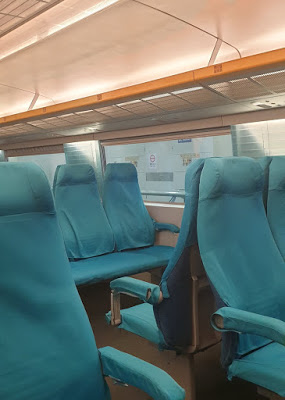
On the train, it has the same sleek look as the bullet trains, but it is completely different, and you are able to see from the front of the train to the back.

Reputed to travel at 431 kph we take a seat and it is not long before the doors shut, and a loud humming noise is soon replaced by what sounds like an engine, then we start moving.  It sounds just like a normal train, and is a lot noisier than a normal bullet train.

Seating on the train was nothing special, as one might expect

It didn’t take long before it hits the advertised speed of 431 kph.  This is not sustained for very long, because the distance is on 40 odd kilometers, and the whole trip takes about 7 minutes.

We go to the airport, and then we come back.  Is it worth the price, yes.  If you are a train enthusiast.

What I learned about writing – A writer isn’t just a writer

Is he, or she?

No, we have any number of other functions, so the notion that we can sit down all day, every day and just write is a misnomer.

I know for a fact I can’t.

I have jobs to do around the house, and therein lies the problem.

I sit down, once the jobs for that part of the day are done, and fire up the computer, or sometimes sharpen the pencils.

Then, free to write, it’s like starting the lawnmower, wait till it settles into a steady rhythm, and then, as you begin to mow the lawn, it runs out of petrol.

Yes, that’s happened to me a few times and only goes to highlight the other problems.

When you have to do something else, your mind is happily working on the book, story, article, piece, or whatever, and then, when you sit down, your mind is on the next lot of chores.

Only the most disciplined mind can separate the two so that each allotted time is allotted to the task.

Me, I suck at that.

Like now.  I want to get on with one of my longer stories, and my mind is telling me I have to write a blog post.

So, I’m writing the blog post.

I know that tomorrow I’m not going to get much writing time because the grandchildren are over for a mini stay, and we’re going to see Doolittle.

But can I get it done now?

No.  In the background, the Australia vs India one-day cricket match is murmuring, and we’re not doing so good.  It’s a necessary distraction, but I still haven’t learned to multitask.

Perhaps it’s too late for that.

Anyway, I have to go.  We just got a wicket, and the tide is turning.

I hope!