I guess the point is that I have at least crystallised my thoughts on paper so that I can do something with them. After all, anything is better than nothing, isn’t it?
Sometimes I wonder. I look back on a lot of the stuff I wrote forty or fifty years ago and it looks bad. The thing is, then, I thought it was great, and that I was destined to do great things with the written word.
Pity, all this time later, I’ve turned into a self-critical monster, where it seems nothing I write is any good.
So, does that mean we need to be less critical of our work? After all, through the years, when I’ve shared novels and short stories with others, they have all universally said they’re quite good.
So…
It’s time to go back to the previous day’s work and rework it. Yes, the idea that I wanted to write about is where I wanted the story to go, it’s just the execution.
The problem is, since then a few other ideas have been running around in the back of my head, and these could be added or used to further the current plotline.
The other problem is, it is one of the six stories that I’m writing by the seat of my pants, you know, the way some pilots like to fly a plane, without all that computer backup. Similarly, this is the way I sometimes like to write.
It’s as much a surprise to me is it is to the reader.
There’s good arguments for having planned the story from start to finish, but with these, I like to write it and see where it takes me. They’re episodic, so sometimes I get to write three of four episodes at a time, and these would most likely in a book become a chapter.
Last night I wrote two episodes, but it seems that it might need pointers back in previous episodes, because we all like to leave a trail of crumbs for the reader so when they get to the denouement, they remember, ah yes, back in chapter two such and such happened, but why am I only remembering it now?
Ok, enough convincing myself I’m a good writer, it’s time to get back to work…
Nearly every city has a high building, a tower, or a large Ferris wheel.
London had the London eye Paris has the Eiffel tower The Galata in Istanbul The CN Tower in Toronto The towers of San Gimignano Pisa has a leaning tower
We’ve managed to see all of the above bar the Galata in Istanbul. One day we might get there.
But, on this side of the world, there are two, the Sydney Tower, and the Sky Tower in Auckland, which we just visited recently.
It’s not a tall tower, but it definitely gives great vies of Auckland, particularly to the north
The mountain in the background at the top of the photo is of a volcano on Rangitoto Island. When we were visiting, there were reports that it might become active again.
To give a height perspective, it didn’t seem all that far down to the apartment building and gardens nearby.
50 photographs, 50 stories, of which there is one of the 50 below.
They all start with –
A picture paints … well, as many words as you like. For instance:
And, the story:
Have you ever watched your hopes and dreams simply just fly away?
Everything I thought I wanted and needed had just left in an aeroplane, and although I said I was not going to, i came to the airport to see the plane leave. Not the person on it, that would have been far too difficult and emotional, but perhaps it was symbolic, the end of one life and the start of another.
But no matter what I thought or felt, we had both come to the right decision. She needed the opportunity to spread her wings. It was probably not the best idea for her to apply for the job without telling me, but I understood her reasons.
She was in a rut. Though her job was a very good one, it was not as demanding as she had expected, particularly after the last promotion, but with it came resentment from others on her level, that she, the youngest of the group would get the position.
It was something that had been weighing down of her for the last three months, and if noticed it, the late nights, the moodiness, sometimes a flash of temper. I knew she had one, no one could have such red hair and not, but she had always kept it in check.
And, then there was us, together, and after seven years, it felt like we were going nowhere. Perhaps that was down to my lack of ambition, and though she never said it, lack of sophistication. It hadn’t been an issue, well, not until her last promotion, and the fact she had to entertain more, and frankly I felt like an embarrassment to her.
So, there it was, three days ago, the beginning of the weekend, and we had planned to go away for a few days and take stock. We both acknowledged we needed to talk, but it never seemed the right time.
It was then she said she had quit her job and found a new one. Starting the following Monday.
Ok, that took me by surprise, not so much that it something I sort of guessed might happen, but that she would just blurt it out.
I think that right then, at that moment, I could feel her frustration with everything around her.
What surprised her was my reaction. None.
I simply asked where who, and when.
A world-class newspaper, in New York, and she had to be there in a week.
A week.
It was all the time I had left with her.
I remember I just shrugged and asked if the planned weekend away was off.
She stood on the other side of the kitchen counter, hands around a cup of coffee she had just poured, and that one thing I remembered was the lone tear that ran down her cheek.
Is that all you want to know?
I did, yes, but we had lost that intimacy we used to have when she would have told me what was happening, and we would have brainstormed solutions. I might be a cabinet maker but I still had a brain, was what I overheard her tell a friend once.
There’s not much to ask, I said. You’ve been desperately unhappy and haven’t been able to hide it all that well, you have been under a lot of pressure trying to deal with a group of troglodytes, and you’ve been leaning on Bentley’s shoulder instead of mine, and I get it, he’s got more experience in that place, and the politics that go with it, and is still an ally.
Her immediate superior and instrumental in her getting the position, but unlike some men in his position he had not taken advantage of a situation like some men would. And even if she had made a move, which I doubted, that was not the sort of woman she was, he would have politely declined.
One of the very few happily married men in that organisation, so I heard.
So, she said, you’re not just a pretty face.
Par for the course for a cabinet maker whose university degree is in psychology. It doesn’t take rocket science to see what was happening to you. I just didn’t think it was my place to jump in unless you asked me, and when you didn’t, well, that told me everything I needed to know.
Yes, our relationship had a use by date, and it was in the next few days.
I was thinking, she said, that you might come with me, you can make cabinets anywhere.
I could, but I think the real problem wasn’t just the job. It was everything around her and going with her, that would just be a constant reminder of what had been holding her back. I didn’t want that for her and said so.
Then the only question left was, what do we do now?
Go shopping for suitcases. Bags to pack, and places to go.
Getting on the roller coaster is easy. On the beginning, it’s a slow easy ride, followed by the slow climb to the top. It’s much like some relationships, they start out easy, they require a little work to get to the next level, follows by the adrenaline rush when it all comes together.
What most people forget is that what comes down must go back up, and life is pretty much a roller coaster with highs and lows.
Our roller coaster had just come or of the final turn and we were braking so that it stops at the station.
There was no question of going with her to New York. Yes, I promised I’d come over and visit her, but that was a promise with crossed fingers behind my back. After a few months in t the new job the last thing shed want was a reminder of what she left behind. New friends new life.
We packed her bags, three out everything she didn’t want, a free trips to the op shop with stiff she knew others would like to have, and basically, by the time she was ready to go, there was nothing left of her in the apartment, or anywhere.
Her friends would be seeing her off at the airport, and that’s when I told her I was not coming, that moment the taxi arrived to take her away forever. I remember standing there, watching the taxi go. It was going to be, and was, as hard as it was to watch the plane leave.
So, there I was, finally staring at the blank sky, around me a dozen other plane spotters, a rather motley crew of plane enthusiasts.
Already that morning there’s been 6 different types of plane depart, and I could hear another winding up its engines for take-off.
People coming, people going.
Maybe I would go to New York in a couple of months, not to see her, but just see what the attraction was. Or maybe I would drop in, just to see how she was.
As one of my friends told me when I gave him the news, the future is never written in stone, and it’s about time you broadened your horizons.
Apparently, we are still discussing the implements with which we choose to put words on paper, and it seems that choice of implement might make a difference.
I have a degree of scepticism because I generally get words down on my phone, the only implement that is nearby at all times., no matter where I am.
Of course, many years ago I always travelled with little pocket-sized notebooks and a pen, rather than a pencil, to write. I still have all of these, several hundred in fact, in several shoeboxes in the cupboard in my writing room.
Over the years I have accumulated many A5-sized notebooks I bought where there were stationery sales, and now use these to both make notes or write. I tend not to use the smaller notebooks now, but I have a hundred or so sitting in a drawer just in case.
But do you like to write using a biro, with smudgy ink, a pen with a rollerball tip with less smudge, a felt-tip pen, which, depending on the paper type, can leach through, making it difficult to write on both sides, a fountain pen with ink, the old-fashioned way of writing letters, and some of the older writers back in the day?
I remember my early days in school, grade three in fact, when we switched from pencil to pen and ink. It was very messy, to begin with, but I remember vividly being the ink monitor, the one who filled the ink wells, and discovering my schoolmate’s prelidiction for stuffing bits of blotting paper into the well for whatever reason.
Even now it would be a messy way to write.
But the choice is yours.
Tomorrow, at last, we get to do some more writing.
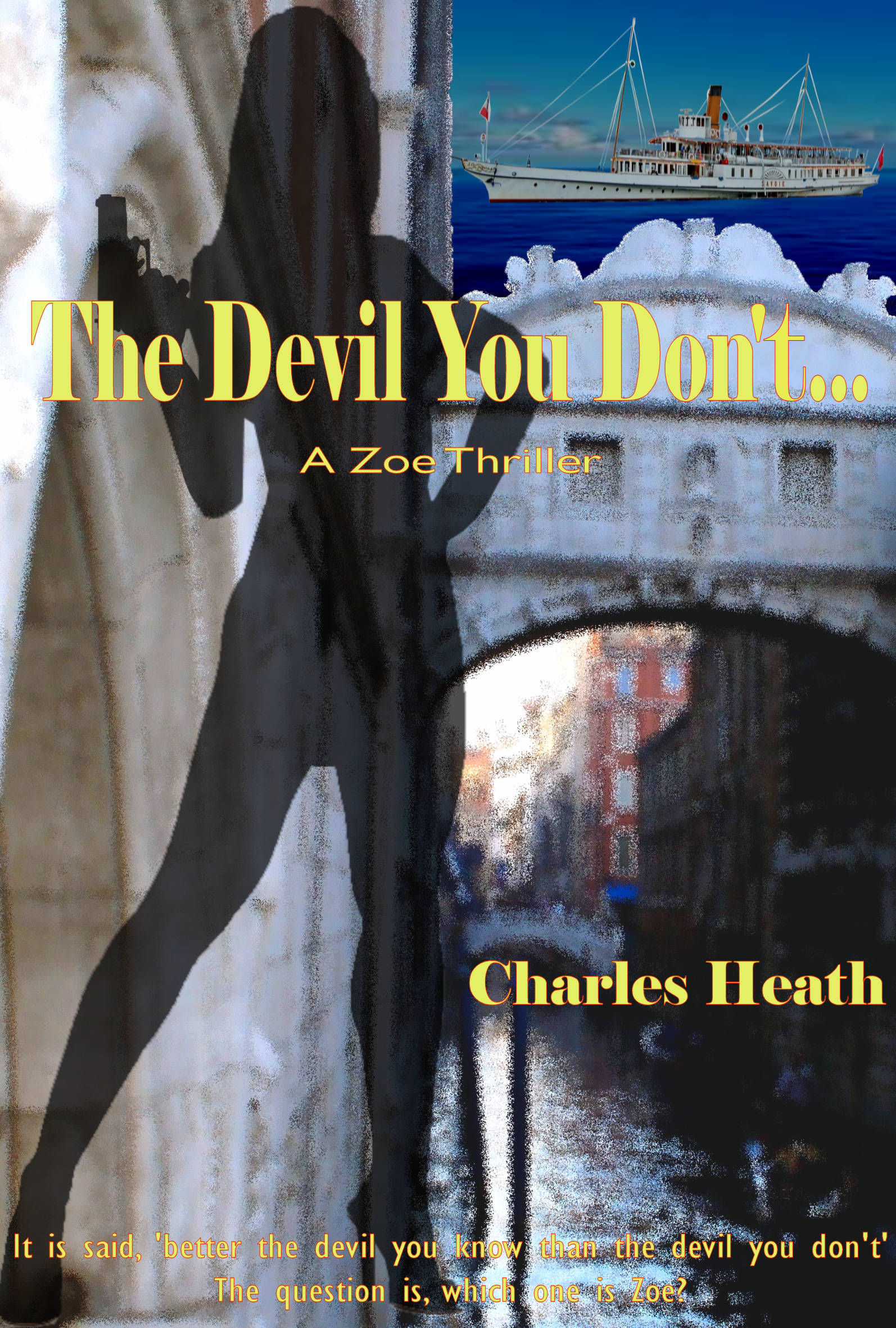
It could be said that of all the women one could meet, whether contrived or by sheer luck, what are the odds it would turn out to be the woman who was being paid a very large sum to kill you.
John Pennington is a man who may be lucky in business, but not so lucky in love. He has just broken up with Phillipa Sternhaven, the woman he thought was the one, but relatives and circumstances, and perhaps because she was a ‘princess’, may also have contributed to the end result.
So, what do you do when you are heartbroken?
That is a story that slowly unfolds, from the first meeting with his nemesis on Lake Geneva, all the way to a hotel room in Sorrento, where he learns the shattering truth.
What should have been solace after disappointment, turns out to be something else entirely, and from that point, everything goes to hell in a handbasket.
He suddenly realizes his so-called friend Sebastian has not exactly told him the truth about a small job he asked him to do, the woman he is falling in love with is not quite who she says she is, and he is caught in the middle of a war between two men who consider people becoming collateral damage as part of their business.
The story paints the characters cleverly displaying all their flaws and weaknesses. The locations add to the story at times taking me back down memory lane, especially to Venice where, in those back streets I confess it’s not all that hard to get lost.
All in all a thoroughly entertaining story with, for once, a satisfying end.
I had hoped never to see Rodby again, and yet here I was in that oppressively warm wood polish-smelling office of his, sitting uncomfortably opposite him, a very large and clear desk between us.
In all the time I’d known him, and those visits to his office, there had never been anything on it. Not even a phone.
The last time I was in this position, to inform him of my retirement, I’d been reluctant to put the resignation envelope on the pristine surface.
Significantly, it was a month to the day after I left Larry’s mother’s house in Sorrento.
The day after I went with Cecilia to her audition, and she smashed it, getting the role from a rather astonished casting director, and director. He was calling it a possible break-out performance, in a whole different language that I didn’t understand.
That same night I found Juliet dining alone in the hotel restaurant and told her the good news, but her brother had already called her. We had dinner, and it could have been more, but there was that Cecilia thing in the back of her mind so we parted as friends.
And at a loose end, Venice no longer hold any significance for me, I moved back to London.
I should have gone to Paris. There, it would have been harder for Alfie to find me.
He had been giving me the ‘come back’ look, one that I had taken a long time to learn how to ignore.
Seeing he wasn’t making any impact, he said, “They found Larry.”
An enigmatic statement. Who found Larry?
“The Italian police recovered the body, in a little-used area of Lake Como. No signs of physical damage, not shot or stabbed, but apparently, he died of natural causes. We’re still waiting for a definitive coroner’s report. You never really elaborated on what happened at his mother’s house.”
My report was short and lacked detail, more notable for what I didn’t say rather than what I did.
“Nothing to tell. Brenda just told him his days of running the organization were over, she and Jaime Meyers had collaboratively taken over, and things would be different. I notice several other hard-line criminals have been taken off the streets since, so Inspector Crowley’s arrangement with her is working. A win-win situation. And you don’t have to deal with Larry anymore.”
“That’s the problem. If something is too good to be true, it generally is. I have to wonder what has replaced him.”
“I’m retired sir. No longer interested. Why am I here?”
I could see he had more, possibly to pique my interest, but just shrugged.
“Nothing of any importance. I thought you might want to know what happened to Larry. And Martha wants me to go to the opera tonight and she specifically asked me to ask you, and as you know she does not take no for an answer.”
I shrugged. He was right about his wife, a force of nature to be reckoned with. I had met her several times, and she had been intrigued with Violetta and had been devastated when she learned of her death.
“Then I guess I’d better dust off the monkey suit.”
“Good. I’ll text you where and when and send a driver to pick you up.”
Well, long ago someone told me that, but I don’t think the message stuck because every now and then a cliche will appear.
Of course, the reason we don’t use them is that people generally will not know what they mean, and I dread to think what the translators must do when translating English to another language.
I mean, who doesn’t know what a wild goose chase is?
For those who don’t: “a foolish and hopeless search for or pursuit of something unattainable”.
Some might use it to describe their efforts to be published. I know, at times, that almost became my mantra until I discovered self-publishing.
Where it came from: In 1593, when discussing horsemanship, ‘a type of 16th-century horse race where everyone had to try to follow the erratic course of the lead horse like wild geese have to follow their leader in formation’.
I would have liked to have been there to see it.
By and large, they should not be used, and I only use them because they fit the character who is using them.
And, just the other day I was writing a short story which, it turns out, uses a number of metaphors or cliches for dramatic effect, and which are also explained
I’m back home and this story has been sitting on a back burner for a few months, waiting for some more to be written.
The trouble is, there are also other stories to write, and I’m not very good at prioritizing.
But, here we are, a few minutes opened up and it didn’t take long to get back into the groove.
Chasing leads, maybe
Jan hailed a taxi and had it drop us off a block from her building. It was agreed that we would not just arrive out the front and trust to luck that everything would be fine.
I had a feeling that Nobbin would have come to the same conclusion I had, that it was possible the USB might be in the neighbor’s flat. I’m sure Josephine hadn’t thought of that possibility. Severin had, but I suspect he might not know of the cat.
Nor would Nobbin.
We did a circuit of the building before going in. There were no suspicious cars, nr anyone lurking in the shadows. If we had surveillance, it was really good, or there was none. I preferred to think the latter option was right. After all, neither Nobbin nor Severin knew exactly where I was.
Jan unlicked the front door and we went into the brightly lit foyer.
During the day there was a concierge sitting at the desk. At night, it was empty. The building manager couldn’t afford 24-hour security, beyond the bright lights, and camera in each quadrant recording the comings and goings of residents. I’m not sure how Josephine got in, but I would have like to have the time to go through the old footage to check on O’Connell in the past, and Josephine, if she came through the front door, recently.
I glanced at the monitor, at present on screen saver mode, then followed Jan to the elevator lobby.
She pressed the button to go up, and the doors to the left-hand elevator opened. We stepped in, she pressed the floor button, the doors closed, and we slowly went up.
It hesitated at the floor, jerked up about an inch or two, then a click signified it was level and the doors opened.
I could see her door from the elevator. As we got closer, I could see it was open, ajar by about half an inch. There was no tell-tale strip of light behind the opening so it could mean someone was in her flat searching by torchlight, or there was no one there.
After a minute waiting to see if there was a moving light somewhere in the flat, it remained dark.
Standing behind me, I could see she had pulled a gun out of her handbag and had it in one hand ready to use. She could have used it any time since we first met, but she hadn’t.
I pushed the door open slowly, and thankfully it didn’t make a creaking sound. Wide enough to walk in, I took a few tentative steps into the first room. There was little light, and my eyes took a while to adjust to the darkness.
I could feel her going past me, further into the room, and with the gun raised and in two hands to steady the shot. She took more steps, slowly towards the passage leading to her bedroom, I assumed, as it was a reverse copy of that next door, O’Connell’s.
There was no one in this part of the flat, and she had disappeared up the corridor and into her room. Nothing there either.
“Clear,” she called out.
I stepped back to close and lock the door. At the same time, she switched on the main room light and for a second it was almost blinding.
When my sight cleared, I could see the signs of a search, furniture tipped over, books dragged from the shelves, other items tossed on the floor, one of which was a vase, now broken into a number of pieces.
“Looks like they were in a hurry,” she said.
“Or frustrated.” I could see clear marks of an item that had been thrown against the wall and dented the plasterwork. The broken shards of the ornament were on the ground beneath the indentation.
I heard her sigh when she saw the broken pieces.
“Not the best way to treat a genuine Wedgewood antique.”
She disappeared into the bedroom again, and I could hear her calling the cat, Tibbles. Interesting name for a cat.
I didn’t hear it answer back. It was probably traumatized after the breaking and the smashing of crockery.
I had a quick look in places I thought the cat might hide, but it was not in any of them. And, oddly enough, no traces of cat hair. Usually, cats left fur wherever they lay down. At least one cat I knew did that.
She came back empty-handed.
“I think it’s done a runner,” she said. “He’s not in the usual place he hides, nor under the bed, or under the covers, as he sometimes does, usually when I’m trying to sleep.”
“Well, it was a good idea. We might have to search outside. The cat was allowed to go outside?”
“He’d escape, yes, but no. O’Connell thought if he got out, he’d get run over. It’s a reasonably busy road outside.”
“Better out there than in here, though. Open windows?”
She did a quick check, but none were open.
“Did O’Connell ever come in here?”
“Once or twice, but he only dropped in if he was going away to ask if I would look after the cat, or when he came back. Never further than the front door.”
“Knowing who is was, now, do you think he might have come in and hidden the USB in here?”
“He might, but there isn’t anywhere I could think he could put it.”
“But that doesn’t mean he didn’t.”
Both of us heard the scratching sound at the front door, not the sort made by a cat trying to get in, but by someone using a tool to unlock the door.
Suburbia, yes, reddish sky at night, yes, but what else might it be?
For just a moment, close your eyes, toss away everything you might accept as normal, and then, after a minute, open them again, and look at the photo with a new perspective.
Imagine…
It took two days for the dust to settle, figuratively and literally.
We heard screaming jet fighters overhead, followed by multiple explosions, then nothing but smoke and ash. We assumed one of the jets had crashed.
Two days the media was saying it was an unfortunate accident.
On the third day, we discovered it was the result of multiple missile strikes on our power stations and oil refineries. The jets had arrived too late to stop the attack.
And we only found out because an Army officer who lived in our street came home to collect his family and told us to leave, go anywhere but stay in the city.
The ash in the air was going to get worse, the sun was going to disappear altogether, and, well, he didn’t stay long enough to tell us the rest, but already the air was almost unbreathable.
But the leaving was easy, just take what we could in the car. The problem was, everyone had the same idea, and by the time we reached the highway, it was a virtual carpark.
By then, it was day four.
That’s when the bombs started to fall.
It might not be an exact match for the photo, but that was the idea that came from it.
I’m sure there could be a far simpler and more pleasant story to be told.