365 Days of writing, 2026 – 269/270

Days 269/270 – Writing Exercise – An argument where a personality changes

…

You think you know someone, and in the end you do not know them at all.

I had seen it happen with my father, but I had been warned about him, what the war had done to him. And how different he had been when he returned.

I did not know him before the war, but the things my mother’s parents said made him out to be the gentlest, kindest man on God’s green earth.  I believe them. Because when I was very young I had seen it with my own eyes.

He had been that kind and gentle man.

But then, just as I turned thirteen, that unlucky number I dreaded, he changed.  Not instantly, and not with any discernible symptoms.

Little signs, a moment of irritability, having a routine interrupted.  Life in the house was orderly: up at seven, breakfast at eight, he was gone by eight thirty, and we were off to school not long after that.  At three, got out of school, home by three thirty, mother cooking dinner for five pm precisely, our father getting home at four thirty, and reading the paper until five.

Sometimes the timetable slipped; something went wrong, we were delayed at school, he would get home late, but it never warranted more than a comment and an assurance it wouldn’t happen again, and if it did, it wasn’t an insurmountable problem.

Until it did, and that first time, for just an instant, I saw someone I didn’t recognise, and it frightened me.

The following week, my older brother got into trouble at school, and my mother had to front up to the headmaster’s office.  It made her late and put the dinner schedule out.  He raised his voice, and my parents argued.  I may not have been very old, but I knew that circumstances had made it impossible for her, and yet he had blamed her, not for being tardy with dinner, but that she was to blame for my older brother’s mischievous nature.

I could not see how that was possible.

I asked her the next morning, after he left for work, and my older brother had gone to school by himself.  She said there were miscreants in her family, not explaining what miscreants were, or what they did, or how he knew about them.

We had not, as far as I could remember, visited or communicated with any of our uncles and aunts on either side, and rarely saw my mother’s mother, and sometimes went to see my father’s mother.  I had never seen my mother’s father, though I did remember my father saying something very bad about him when they were having a private argument in their room.  I had only vague memories of my father’s father, and that they were of a monster, ten feet tall, scaring the living hell out of me.

He probably wasn’t, but that was all I remembered of him.

…

A week slid past.  Something I didn’t know about myself suddenly presented itself.  I had heard my mother referring to me as her ‘little scamp’.  I mean, I didn’t think I was little, but like any parent, they give you labels.  My brother was gregarious.  My mother liked using big words without explaining them.

Perhaps I could get into what she called ‘mischief’.  Trouble did seem to have a habit of following me around, and playing backyard cricket, as we did sometimes in that half hour between when our father came home, and dinner was served.

It was a small backyard, and he always warned us not to hit the ball hard.  I had to, didn’t I, just that once, and it went over the fence.  It had done so before without much fanfare, but this time, it annoyed him.  He told me to go around, ask the neighbour if I could get the ball, and apologise.

I would not.

That was the first time I received what might be called corporal punishment.  My father smacked me.  Hard.  It hurt.  I cried.  And my mother admonished him, saying, strangely, that punishment might have happened in his house, but it was not going to happen in hers.

He simply said it was not her house; it was his, and he would mete out punishment for ‘unruly’ behaviour, whenever and however he saw fit.  Oddly, it was the first time it had happened.

My opinion of him had slipped from someone I thought was kind to someone mean, as happened when a child is punished.  I had not been punished for what I believed were far worse infractions, another of my mother’s big words, so why this time?

It can be said children can be foolish.  I guess I was about to learn the error of my ways. 

Several days later, my mother called us for dinner.  On rare occasions we were allowed to do homework, or study in our room.  My brother went; I wanted to finish the chapter of my book.  It was not the first time, but the most recent occurrence, my father had given me a warning.  I ignored it because in previous instances there had been warnings, but no punishment.

A child doesn’t understand consequences.  Maybe at school, where if you did misbehave in class there was punishment, and it happened. 

I came into the room, and my father glared at me.  My mother was looking at my father.

“Come here.” 

By this time, I think I was about to find out there were going to be consequences, but I still couldn’t equate it with what had happened in the past.

“You were told not to be late.”  He smacked me.  Hard.  “Now sit down.”

“No.”  I had no idea where that came from.

“What did you say?”

“I’m going to my room.”

“Sit down.”  He said it in such a way that I knew now I had pushed him too far.

He stood, came over and slapped me on the side of the face so hard I fell on the floor.  My mother leapt out of her chair, knocking it over and came over to stand between me and him, a furious expression on her face.

“You promised me that you would not be like your father.  He may have beaten you and your brothers, but I will not have it in this house.”

I stayed on the floor, holding my face.  It really hurt, and I was crying.

“Then discipline your brats.”

“They are your brats too, but this is not the way.  Your father was a monster.  I told you that when he beat both of them for simply moving his newspaper.  You said then that you would never be like your father.  You are.  Right now.”

“And with your family you think you can take the high moral ground?  Your father was a pathetic excuse of a man who killed himself.  What would you know about anything?”

She hit him.

He punched her back; she fell backwards and hit her head on the door of the cabinet and went quiet.  I crawled over to her and shook her shoulder, saying, “Mum, Mum, wake up, please,” and sobbing.

My father looked down on me.  “This is your fault.”

I could see my brother was about to say something but then closed his mouth. 

No remorse, no recognition of what he had done.  He sat down again, as if nothing had happened.  My mother stirred, looked at me, then got up.  He watched her until she was standing.

“Come, Robert, I’ll take you to your room,” she said, while looking at my father. 

He was going to speak, then didn’t.

Whatever I may have thought of my father and my mother in the past, that was gone.  It was replaced by fear, the kind that made me think twice before I did anything that might upset him.

And that wasn’t out of respect, because I knew that the way we had lived our lives up until this moment in time, in a carefree and relaxed environment, was never going to be the same again.  He had changed; my mother had changed in a way I never thought was possible.

…

Many years later I learned from my brother that my father, a few weeks before ‘the incident’, he had a recurrence of the nightmares brought on by his war experiences.  He had never talked about them, not until recently, but the nightmares brought on sleeplessness, which brought on irritability and tiredness, which triggered a complete change of character.

He reverted to what he ‘knew ’, which was the characterisation of his own family life, which had been brutal and unrelenting, the reason why he left home very young and volunteered in the army to get away from his father.

That period in our lives lasted for nearly six months, during which all three of us found ourselves at the end of his tongue and hand, sometimes so bad, we had to skip school lest someone ask questions, questions that could not be explained away.

Until he collapsed and had to be taken to hospital with a recurrence of malaria, which had previously caused him to spend a few months in the hospital after returning from New Guinea.

They eventually called it a nervous breakdown.  He was there for a month.  We didn’t visit him.  When he came home, he apologised and said it would never happen again, but the damage had been done, and my mother was never the same, towards him, or towards us.

The thing is, no matter how hard you try to bury these memories, they stick in your mind, and nothing will ever remove what happened that day.  That first day I was on the floor, too frightened to get up.  Later, I hid under my bed, too frightened to come out.

And whatever my nature had been before the incident, it changed me, turning me into a frightened, unconfident child who preferred to live in any fantasy world other than the reality that was life in that house.  These days, what happened to us was hidden behind closed doors, and few people talked about it.  Not like today, when bullies like my father can go to jail.

At least, in my case, I did not perpetuate the cycle of violence.  It stopped with me.  Perhaps if it could be said anything good came out of it, it was that.

…

©  Charles Heath  2026

“Echoes From The Past”, the past doesn’t necessarily stay there


What happens when your past finally catches up with you?

…

Christmas is just around the corner, a time to be with family. For Will Mason, an orphan since he was fourteen, it is a time for reflection on what his life could have been, and what it could be.

Until a chance encounter brings back to life the reasons for his twenty years of self-imposed exile from a life only normal people could have. From that moment, Will’s life slowly starts to unravel, and it’s obvious to him that it’s time to move on.

This time, however, there is more at stake.

Will has broken his number one rule: don’t get involved.

With his nemesis, Eddie Jamieson, suddenly within reach, and a blossoming relationship with an office colleague, Maria, about to change everything, Will has to make a choice. Quietly leave, or finally, make a stand.

But as Will soon discovers, when other people are involved, there are going to be terrible consequences no matter what choice he makes.

…

https://amzn.to/2CYKxu4

newechocover5rs

‘What Sets Us Apart’ – A beta reader’s view

There’s something to be said for a story that starts like a James Bond movie, throwing you straight in the deep end, a perfect way of getting to know the main character, David, or is that Alistair?

A retired spy, well, not so much a spy as a retired errand boy, David’s rather wry description of his talents, and a woman that most men would give their left arm for, not exactly the ideal couple, but there is a spark in a meeting that may or may not have been a setup.

But as the story progressed, the question I kept asking myself was why he’d bother.

And, page after unrelenting page, you find out.

Susan is exactly the sort of woman to pique his interest.  Then, inexplicably, she disappears.  That might have been the end of it, but Prendergast, that shadowy enigma, David’s ex-boss who loves playing games with real people, gives him an ultimatum: find her or come back to work.

Nothing like an offer that’s a double-edged sword!

A dragon for a mother, a sister he didn’t know about, Susan’s BFF who is not what she seems or a friend indeed, and Susan’s father, who, up till David meets her, couldn’t be less interested, his nemesis proves to be the impossible dream, and he’s always just that one step behind.

When the rollercoaster finally came to a halt, and I could start breathing again, it was an ending that was completely unexpected.

I’ve been told there’s a sequel in the works.

Bring it on!

…

The book can be purchased here:  http://amzn.to/2Eryfth

…

The cinema of my dreams – I always wanted to see the planets – Episode 23

Where did that ship come from?

…

When I stepped out on to the bridge number one was waiting, “we received a distress call a few minutes ago, and we’ve been trying to get the ship back to get the details. Then, it just appeared.

Not far off the Port bow, another ship, about half the size of ours was not moving, and it was clear we were doing a circuit to check he outside if the ship.

“It’s the ‘Ionosphere’, one of the research vessels, but according to our records, it should be off Jupiter.”

“Is there anyway we can find out if anyone is alive on board?”

“Our sensors are not clever enough to discern life forms, at least nit yet.  They’re working on it, and it’s going to be in the next upgrade.  We basically restricted to what’s going on outside.”

“Then we’d better send a shuttle, see what’s going on.  Gather a team, take the military rather than security, and a systems expert, and head it up yourself.”

“I’ll let you know when we depart.”

“Make it sooner rather than later, there may be people who need help.  Better add a doctor to the team.”

He nodded and headed towards the elevator, calling up the shuttle bay.

The ‘Ionosphere’ was one of three older research vessels with a crew of about 290, mostly scientists.  The fact it was drifting was not a good sign.

Chalmers was the duty scientist on the bridge, and I went over to his station.

“Are you familiar with the ‘Ionosphere’?”

“Yes sir.  Spent about 6 months on the first exploration to the edge of our universe, surveying and analysing Pluto.”

“Am I correcting on assuming she was lately at Jupiter?”

“Yes sir.  She had been deployed to Saturn first, then Jupiter.”

“You hadn’t heard officially or unofficially she was due back at earth space dock any time soon?”

“No sir.  In fact I was just communicating with a colleague on board a day or so back, who said they had, or though they had discovered an anomaly in space, and had deviated towards it to investigate.  Whatever it was, it had sent some of their instruments crazy.”

Number one’s voice came over the communication system, announcing the shuttle had left the bay and was encountered to the other ship.  A minute later we could see it.

In the same instant, a thought crossed my mind, one that might explain how the ship was not far from us, and on the same course.

“Can you tell me if if Jupiter and Uranus are in alignment, along our projected trajectory?”

“As a matter of fact, they are.”

I was not the greatest scientific mind on the ship, that was why we had a first class scientific team aboard, but I could think outside the box, where some of the scientific minds were closed to ‘out there’ possibilities.

That’s why it didn’t seem impossible to me that the Ionosphere ‘hitched a ride’ in what might be called a wormhole, that sort of anomaly that Jerome Kennedy had been talking about.  It struck me that these worm holes could be like black holes and ships could enter them and come out the other side, a very great distance away, in a very short time.

It would explain how the enemy ship had disappeared, but it didn’t explain why we were able to follow a trail.

That would be a matter for Kennedy

Number one was back on the communications system with a report. “We’ve docked and come on board. At first we thought everyone was dead, there were people on the floor and hunched over in their seats, but the environment is intact and work, and they are mostly unconscious. I have gone directly to the bridge and we’ve woken the Captain. He has no idea what happened, they were investigating what he calls a ripple, and then nothing till we woke him. We’re going to look at the logs and see if what happened has been recorded.”

“Very good.”

Fifteen minutes possibly longer passed when he reported back, not exactly in the serious manner I would expect. “You are not going to believe this, sir, but the ship has just travelled a distance that would normally take them several months, in less than an hour. They were at Jupiter, sir, but that was, according to their log, no more than two hours ago.”

…

© Charles Heath 2021

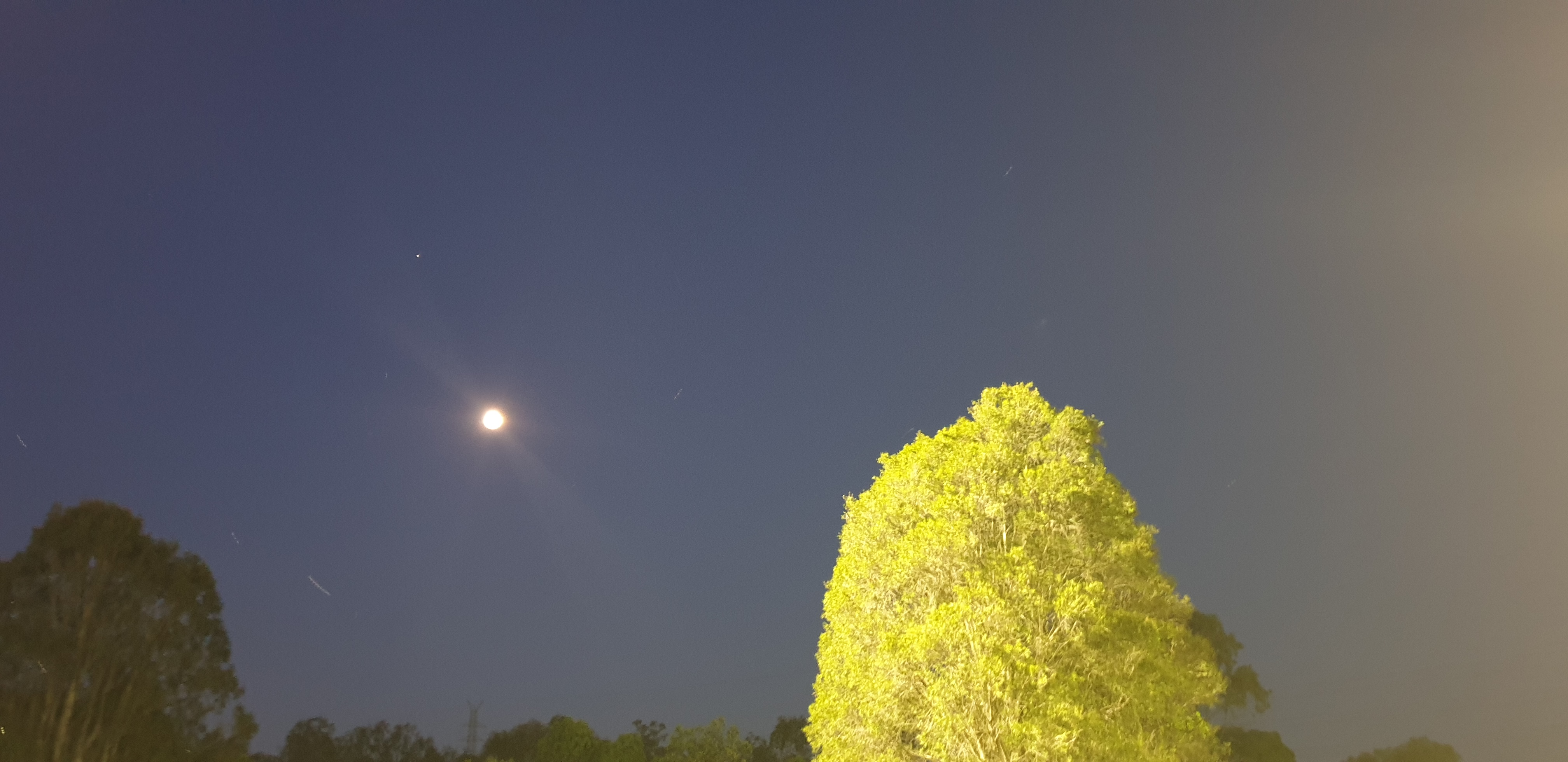
A photograph from the inspirational bin – 5

I found this:

The innocuous explanation for this photo is that I took it at my grand daughter’s little athletics competition, now most sensibly being held on Friday evenings.

For those who don’t know how the weather can be in Brisbane, Queensland, it is generally hot, particularly from November when temperatures are between 35 and 40 degrees centigrade.

But not only is it hot but humidity, the real problem, is around 100 percent.

So at the moment we have reasonably cool evenings, ideal conditions for the young athletes.

But, where a photo could be innocuous there can a more interesting, if not sinister description.

Lurking in the back of my mind, and perhaps a lot of others, that there might be an unidentified flying object somewhere in the sky.

Of course, there might not be any, but it doesn’t mean that we stop looking, or assume, sometimes that a moving light in the sky isn’t a UFO.

And its been said that humans are quite arrogant in thinking that we are the only people in the universe.

Personally, I don’t think we are, and I keep an eye on the sky every time I’m out at night, perhaps the most likely time we might see one.

The only issue I might have is that if I am that lucky to see one, or that it lands nearby, what I would do when confronted by an alien.

And, yes, there’s definitely a story in that.

What I learned about writing – Time Management is very, very important

Do you have days when you feel like you’ve achieved nothing, even after getting through what might appear to be a lot?  It’s the ancillary stuff that’s the bugbear of anyone who simply wants to get on with what’s important, and that’s writing.

You know, sit down in front of a blank page on the computer, on your writing desk, if you have one, ready for the words to come.

Except there’s the email to check.

Then there are ads to be sent out on Twitter and the general Twitter feed to look at just to keep up with what’s happening out there.

Then there’s the news usually that arrives on my desktop computer, the feed from the major papers around the world, for me, the New York Times, in the US, the Times in The UK and the Australian, in my country.

And, dammit, each has a challenging crossword that I really don’t have time to do, well, not in the morning.

Then there’s the stuff that has to be done around the house. I’m home, but my wife still works, so there’s washing, cooking, and domestic tasks to be done, which eats into the day.

Sometimes it’s not until mid-morning before I get to sit down with a cup of tea.

The point is, it’s not conducive to writing during the day because you can’t get a run at it, time enough to think about what you’re going to write before committing it to paper.

That is, before the phone rings with another scammer and breaks your concentration.  Right, I hear you, cut the phone off.

So, three phone calls later, I’m about to give up.  It’s time to get dinner on with family coming.  Perhaps I’ll have a few bottles of beer instead.

This is why I write at night, sometimes after ten.  No phone calls, no distractions.  Well, that’s not necessarily true because what you didn’t get done earlier has a way of backing up if you don’t get through it promptly.

Perhaps I’ll get a blog post or two done, another episode of the trip to China, upload another photo to Instagram and look at the current novel I’m in the middle of editing.

By that time, it will be two am, way past anyone’s decent time to go to bed.  In fact, it’s ten past two, and I’ve got an early morning.

365 Days of writing, 2026 – Beyond the second novel

Plan in Advance

…

Plan in Advance: The Secret to Launching a Bestselling Book Series

I can hear the “pantsers” among you—those writers who love to fly by the seat of their pants and discover the story as they write—letting out a collective sigh!

We get it. Rigid outlines can feel like a straitjacket for your creativity. But here is the hard truth every successful series author knows: some level of planning is non-negotiable when you are writing a book series.

Exactly how much outlining you do is entirely up to you. You might be an extreme outliner who maps out every chapter, or a flexible planner who just needs a general roadmap. Either way, at the very least, there are two critical questions you need to answer before you ever type the words “Chapter One.”

Let’s dive into what those questions are and why answering them early will save you from major heartbreak down the road.


Question 1: Is There Room for the Story to Continue?

Imagine this: You’ve stumbled upon a brilliant, juicy historical event. It’s dramatic, it’s filled with high stakes, and it practically writes itself. You pour your heart into Book One, and it’s a masterpiece.

Then comes the pressure from your readers: “When is Book Two coming out?”

Panic sets in. You realize that the incredible historical event you based the first book on was a one-hit wonder. You’ve burned through your best material, and you have nowhere left to go.

To build a sustainable book series, you have to think long-term. Before committing to a series, ask yourself:

  • Are there other events to leverage? If you are writing historical fiction, look at the timeline surrounding your first book. Are there subsequent historical events, cultural shifts, or political changes that your characters can stumble into in the following years?
  • Are there broader plot opportunities? Can you expand the world, introduce new conflicts, or pull back the curtain on a larger, overarching mystery that spans multiple volumes?

If the well runs dry the moment your first book ends, you don’t have a series—you have a standalone novel with sequel anxiety.


Question 2: Is There Room for Character Growth?

Characters are the beating heart of any great series. Readers fall in love with your protagonists, and they want to follow them on a journey of personal evolution.

However, a common trap for debut series authors is wrapping everything up too neatly in Book One.

Make sure you aren’t closing down the avenues for your character to change and grow. If your protagonist achieves all their goals, heals all their trauma, finds their ultimate love, and reaches absolute perfection by the end of the first novel, where is left for them to go?

When planning your first book, leave your characters with room to breathe—and room to fail. Ensure that:

  • Their internal arc is ongoing. Maybe they solved the murder, but they still struggle with trust.
  • New flaws are exposed. As they solve one problem, perhaps their actions inadvertently create a new personal flaw or challenge they must face in the next installment.
  • Their relationships are evolving. Leave room for friendships to fracture, romances to hit bumps, or new alliances to form.

If your character has nowhere to grow, readers will lose interest by book two because the protagonist has become stagnant.


The Special Case of the Standalone-in-a-Series

What if you don’t want a sprawling, interconnected epic fantasy or a continuous thriller arc? What if you intend for each book in your series to be a standalone—meaning it can be read and enjoyed completely on its own, without requiring readers to read the previous books (think Agatha Christie’s Hercule Poirot or many romance series)?

If this is your approach, you breathe a little easier: You won’t have to worry about expansive, multi-book story arcs.

However, you aren’t completely off the hook! Even in a standalone-per-book series, you still have to:

  1. Consider future plot opportunities: You need a formula or a fresh well of ideas so you can drop your recurring characters into brand-new adventures time and time again.
  2. Ensure your main characters have staying power: Your recurring protagonist (like a detective, a roving adventurer, or a matchmaker) needs to be dynamic, interesting, and flexible enough to carry multiple books on their own shoulders without exhausting the reader’s patience.

Strike the Right Balance

Planning a book series doesn’t mean you have to kill the magic of discovery. It simply means laying down a foundation strong enough to support a skyscraper, rather than just a one-room cabin.

By taking a step back to evaluate your future plot potential and your characters’ growth trajectories, you set yourself up for long-term publishing success.

Are you a pantser or a planner? How do you map out your book series? Let us know in the comments below!

…

In a word: Zip

Which, unfortunately, I do not have a lot of in my step.

At last, we have reached the end of the alphabet because I’m running out of zip to write these blogs.

So…

Zip is the sing, the energy, the spring we have in our step, that usually gets us from a to b quickly.  Without this zest, we would need to take a bus, train, or cab.

Then comes the variations like …

Zip code, we all have one of these, though in some countries it is called a postcode.

Zip it up, meaning do not speak, especially if you’re about to spill a secret.

A zip, which is a part of some types of clothing, usually in trousers, jeans, and skirts to name a few.  Some dresses have long zips, some short, all seem to get tangled at one time or another, or, in the most embarrassing of situations, split.

Then there is a colloquial use of the word zip, meaning nothing, zilch, zero, in other words, a basis for of z words.

And that’s about as much zeal I’m going to show for writing this blog, and I’m going to close the book on it.

Thank you, and goodnight.

Inspiration, Maybe – Volume 2

50 photographs, 50 stories, of which there is one of the 50 below.

They all start with –

A picture paints … well, as many words as you like.  For instance:

And, the story:

Have you ever watched your hopes and dreams simply fly away?

Everything I thought I wanted and needed had just left in an aeroplane, and although I said I was not going to, I came to the airport to see the plane leave.  Not the person on it, that would have been far too difficult and emotional, but perhaps it was symbolic, the end of one life and the start of another.

But no matter what I thought or felt, we had both come to the right decision.  She needed the opportunity to spread her wings.  It was probably not the best idea for her to apply for the job without telling me, but I understood her reasons.

She was in a rut.  Though her job was a very good one, it was not as demanding as she had expected, particularly after the last promotion, but with it came resentment from others on her level that she, the youngest of the group, would get the position.

It was something that had been weighing her down for the last three months, and if she noticed it, the late nights, the moodiness, sometimes a flash of temper.  I knew she had one; no one could have such red hair and not, but she had always kept it in check.

And then there was us, together, and after seven years, it felt like we were going nowhere.  Perhaps that was down to my lack of ambition, and though she never said it, lack of sophistication.  It hadn’t been an issue, well, not until her last promotion, and the fact that she had to entertain more, and frankly, I felt like an embarrassment to her.

So, there it was, three days ago, the beginning of the weekend, and we had planned to go away for a few days and take stock.  We both acknowledged we needed to talk, but it never seemed the right time.

It was then that she said she had quit her job and found a new one.  Starting the following Monday.

Ok, that took me by surprise, not so much that it was something I sort of guessed might happen, but that she would just blurt it out.

I think that right then, at that moment, I could feel her frustration with everything around her.

What surprised her was my reaction.  None.

I simply asked who, where, and when.

A world-class newspaper in New York, and she had to be there in a week.

A week.

It was all the time I had left with her.

I remember just shrugging and asking if the planned weekend away was off.

She stood on the other side of the kitchen counter, hands around a cup of coffee she had just poured, and that one thing I remembered was the lone tear that ran down her cheek.

Is that all you want to know?

I did, yes, but we had lost the intimacy we used to have, where she would have told me what was happening, and we would have brainstormed solutions. I might be a cabinet maker, but I still had a brain, was what I overheard her tell a friend once.

There’s not much to ask, I said.  You’ve been desperately unhappy and haven’t been able to hide it all that well, you have been under a lot of pressure trying to deal with a group of troglodytes, and you’ve been leaning on Bentley’s shoulder instead of mine, and I get it, he’s got more experience in that place,  and the politics that go with it, and is still an ally.

Her immediate superior was instrumental in her getting the position, but unlike some men in his position, he had not taken advantage of the situation like some might.  And even if she had made a move, which I doubted, that was not the sort of woman she was, he would have politely declined.

One of the very few happily married men in that organisation, so I heard.

So, she said, you’re not just a pretty face.

Par for the course for a cabinet maker whose university degree is in psychology.  It doesn’t take rocket science to see what was happening to you.  I just didn’t think it was my place to jump in unless you asked me, and when you didn’t, well, that told me everything I needed to know.

Yes, our relationship had a use-by date, and it was in the next few days.

I was thinking, she said, that you might come with me; you can make cabinets anywhere.

I could, but I think the real problem wasn’t just the job.  It was everything around her and going with her that would just be a constant reminder of what had been holding her back. I didn’t want that for her and said so.

Then the only question left was, what do we do now?

Go shopping for suitcases.  Bags to pack, and places to go.

Getting on the roller coaster is easy.  At the beginning, it’s a slow, easy ride, followed by the slow climb to the top.  It’s much like some relationships; they start out easy, they require a little work to get to the next level, followed by the adrenaline rush when it all comes together.

What most people forget is that what comes down must go back up, and life is pretty much a roller coaster with highs and lows.

Our roller coaster had just come out of the final turn, and we were braking so that it would stop at the station.

There was no question of going with her to New York.  Yes, I promised I’d come over and visit her, but that was a promise with crossed fingers behind my back.  After a few months in the new job, the last thing she’d want was a reminder of what she left behind.  New friends, new life.

We packed her bags, threw out everything she didn’t want, a free trip to the op shop with stuff she knew others would like to have, and basically, by the time she was ready to go, there was nothing left of her in the apartment, or anywhere.

Her friends would be seeing her off at the airport, and that’s when I told her I was not coming; that moment, the taxi arrived to take her away forever.  I remember standing there, watching the taxi go.  It was going to be, and was, as hard as it was to watch the plane leave.

So, there I was, finally staring at the blank sky, around me a dozen other plane spotters, a rather motley crew of plane enthusiasts.

Already that morning, there had been 6 different types of planes departing, and I could hear another winding up its engines for take-off.

People coming, people going.

Maybe I would go to New York in a couple of months, not to see her, but just to see what the attraction was.  Or maybe I would drop in, just to see how she was.

As one of my friends told me when I gave him the news, the future is never written in stone, and it’s about time you broadened your horizons.

Perhaps it was.


© Charles Heath 2020-2026

…

Coming soon.  Find the above story and 49 others like it in:

365 Days of writing, 2026 – Beyond the second novel

Plan in Advance

…

Plan in Advance: The Secret to Launching a Bestselling Book Series

I can hear the “pantsers” among you—those writers who love to fly by the seat of their pants and discover the story as they write—letting out a collective sigh!

We get it. Rigid outlines can feel like a straitjacket for your creativity. But here is the hard truth every successful series author knows: some level of planning is non-negotiable when you are writing a book series.

Exactly how much outlining you do is entirely up to you. You might be an extreme outliner who maps out every chapter, or a flexible planner who just needs a general roadmap. Either way, at the very least, there are two critical questions you need to answer before you ever type the words “Chapter One.”

Let’s dive into what those questions are and why answering them early will save you from major heartbreak down the road.


Question 1: Is There Room for the Story to Continue?

Imagine this: You’ve stumbled upon a brilliant, juicy historical event. It’s dramatic, it’s filled with high stakes, and it practically writes itself. You pour your heart into Book One, and it’s a masterpiece.

Then comes the pressure from your readers: “When is Book Two coming out?”

Panic sets in. You realize that the incredible historical event you based the first book on was a one-hit wonder. You’ve burned through your best material, and you have nowhere left to go.

To build a sustainable book series, you have to think long-term. Before committing to a series, ask yourself:

  • Are there other events to leverage? If you are writing historical fiction, look at the timeline surrounding your first book. Are there subsequent historical events, cultural shifts, or political changes that your characters can stumble into in the following years?
  • Are there broader plot opportunities? Can you expand the world, introduce new conflicts, or pull back the curtain on a larger, overarching mystery that spans multiple volumes?

If the well runs dry the moment your first book ends, you don’t have a series—you have a standalone novel with sequel anxiety.


Question 2: Is There Room for Character Growth?

Characters are the beating heart of any great series. Readers fall in love with your protagonists, and they want to follow them on a journey of personal evolution.

However, a common trap for debut series authors is wrapping everything up too neatly in Book One.

Make sure you aren’t closing down the avenues for your character to change and grow. If your protagonist achieves all their goals, heals all their trauma, finds their ultimate love, and reaches absolute perfection by the end of the first novel, where is left for them to go?

When planning your first book, leave your characters with room to breathe—and room to fail. Ensure that:

  • Their internal arc is ongoing. Maybe they solved the murder, but they still struggle with trust.
  • New flaws are exposed. As they solve one problem, perhaps their actions inadvertently create a new personal flaw or challenge they must face in the next installment.
  • Their relationships are evolving. Leave room for friendships to fracture, romances to hit bumps, or new alliances to form.

If your character has nowhere to grow, readers will lose interest by book two because the protagonist has become stagnant.


The Special Case of the Standalone-in-a-Series

What if you don’t want a sprawling, interconnected epic fantasy or a continuous thriller arc? What if you intend for each book in your series to be a standalone—meaning it can be read and enjoyed completely on its own, without requiring readers to read the previous books (think Agatha Christie’s Hercule Poirot or many romance series)?

If this is your approach, you breathe a little easier: You won’t have to worry about expansive, multi-book story arcs.

However, you aren’t completely off the hook! Even in a standalone-per-book series, you still have to:

  1. Consider future plot opportunities: You need a formula or a fresh well of ideas so you can drop your recurring characters into brand-new adventures time and time again.
  2. Ensure your main characters have staying power: Your recurring protagonist (like a detective, a roving adventurer, or a matchmaker) needs to be dynamic, interesting, and flexible enough to carry multiple books on their own shoulders without exhausting the reader’s patience.

Strike the Right Balance

Planning a book series doesn’t mean you have to kill the magic of discovery. It simply means laying down a foundation strong enough to support a skyscraper, rather than just a one-room cabin.

By taking a step back to evaluate your future plot potential and your characters’ growth trajectories, you set yourself up for long-term publishing success.

Are you a pantser or a planner? How do you map out your book series? Let us know in the comments below!

…