The Cinema of my dreams – Was it just another surveillance job – Episode 61

This story is now on the list to be finished so over the new few weeks, expect a new episode every few days.

The reason why new episodes have been sporadic, there are also other stories to write, and I’m not very good at prioritizing.

But, here we are, a few minutes opened up and it didn’t take long to get back into the groove.

Things are about to get complicated…


The Detective Inspector came back twenty minutes later.

“Latest news that I can tell you, is both the bodies belong to older people, we think the owner and one other.  They were not in the fire, but some distance from the house.”

“Murdered?”

“People don’t shoot themselves in the back.  They were trying to escape.”

The mother and a friend perhaps.  Anna or someone else cleaning up?  Was she getting ready to leave or gone already?

“No other body?”

“You think someone else was here?”

“Our agent, male, mid-thirties.  He was here the last time I saw him.”

“Not so far, but I’ll tell them to widen the search.”

Had O’Connell escaped, or was he with her, and he was not simply a means to an end?  The facts, as I knew them, didn’t seem to fit that scenario.

What worried me was that Dobbin hadn’t shown up yet.  Could it be he was finally one step behind?  I could only hope so.  I didn’t want to run into him if and when I found Anna.

If Anna and O’Connell were about to leave, it would be reasonable to assume they’d go home, pack then leave.  O’Connell’s flat at the same block where Josephine lived.

When we arrived at the front entrance to the block I had that sensation of being watched.  It was possible Dobbin had the place under surveillance and I cursed myself for not checking to see if there was a back entrance.

I tried to see where the surveillance would be, places I would hide, if not in plain sight, but nothing was readily apparent.  Of course, it could be the paranoia setting in.

If this was what the spy’s life was like, I was beginning to like it less and less.  There were so many lies told by so many people it was impossible to tell what the truth was any more.

But it beat being a clerk in an office any day of the week.

And I didn’t get to work alongside people like Jennifer either.

“You sure we can get into this place.  I’m starting to feel exposed out here.”  She was shivering, because of the cold.

The temperature had dropped considerably in the last half hour.

I entered the code and the door opened.  “Yes.”

I ushered her in and followed, taking a last look outside.  Yes.  Just caught a glimpse of a man on the corner almost out of sight.  He was on his phone, so that would mean we would have minutes rather than enough time to do anything before someone arrived.

Would it be Dobbin, Jan, Monica or Joanne?

The list of interested parties was getting longer.

We almost jogged up the three flights of stairs, then on the landing, I went first, and Jennifer stayed back, gun in hand, ready for anything.

At least I hoped she was.

We were taught how to pick almost any lock in the shortest [possible time.  Of course, in practice, when not under pressure, you could do it in seconds.

Now, because of the cold, my hands were slightly numb, and the pressure was mounting so things didn’t quite work the way they should, it took longer.  A minute whereas in practice, seconds.

I drew my gun and opened the door carefully.

Nothing but darkness.

We had prearranged that Jennifer would wait outside until I gave her an all-clear, or if I didn’t come back in two minutes she should come in after me.

I went in but left the door ajar.  Closed, fumbling to open it in a panic would get me killed.  Little details.

Silence.

There didn’t appear to be anyone in the flat.  Remembering the layout, I headed towards the passage leading to the bedroom, and about half way across the room, I kicked my foot into something.

A body?

I went back and switched on the light.

A body indeed.

O’Connell.

Dead, a bullet to the head.

…

© Charles Heath 2020-2023

An excerpt from “Mistaken Identity” – a work in progress

The odds of any one of us having a doppelganger are quite high. Whether or not you got to meet them or be confronted by them was significantly lower. Except, of course, unless you are a celebrity.

It was a phenomenon remarkable only for the fact that, at times, certain high-profile people, notorious or not, had doubles if only to put off enemies or the general public. Sometimes we see people in the street who look like someone we knew and make the mistake of approaching them like a long-lost friend, only to discover an embarrassed individual desperately trying to get away from what they perceive as a stalker, or worse.

And then sometimes it is a picture that looms up on a TV screen, an almost exact likeness of you. At first, you are fascinated, and then, according to the circumstances and narrative that is attached to that picture, either flattered or horrified.

For me, one turned to the other when I saw an almost likeness of me flash up on the screen when I turned the TV on in my room. What looked to be my photo, with only minor differences, was in the corner of the screen, the newsreader speaking in rapid Italian, so fast I could only translate every second or third word.

But the one word I did recognise was murder. The photo of the man on the screen was the subject of an extensive manhunt. The crime, the murder of a woman in the very same hotel I was staying, and it was being played out live several floors above me. The gist of the story, the woman had been seen with and staying with the man who was my double, and, less than an hour ago, the body had been discovered by a chambermaid.

The killer, the announcer said, was believed to be still in the hotel because the woman had died shortly before she had been discovered.

I watched, at first fascinated by what I was seeing. I guess I should have been horrified, but at that moment it didn’t register that I might be mistaken for that man.

Not until another five minutes had passed, and I was watching the police in full riot gear, with a camera crew following behind, coming up a passage towards a room. Live action of the arrest of the suspected killer, the breathless commentator said.

Then, suddenly, there was a pounding on the door. On the TV screen, plain to see, was the number of my room. I looked through the peephole and saw an army of police officers. It didn’t take much to realise what had happened. The hotel staff identified me as the man in the photograph on the TV and called the police.

Horrified wasn’t what I was feeling right then.

It was fear.

My last memory was the door crashing open, the wood splintering, and men rushing into the room, screaming at me, waving guns, and when I put my hands up to defend myself, I heard a gunshot.

And in one very confused and probably near-death experience, I thought I saw my mother and thought what was she doing in Rome?

…

I was the archetypal nobody.

I lived in a small flat, I drove a nondescript car, had an average job in a low-profile travel agency, was single, and currently not involved in a relationship, had no children, and, according to my workmates, no life.

They were wrong. I was one of those people who preferred their own company; I had a cat, and travelled whenever I could. And I did have a ‘thing’ for Rosalie, one of the reasons why I stayed at the travel agency. I didn’t expect anything to come of it, but one could always hope.

I was both pleased and excited to be going to the conference. It was my first, and the glimpse I had seen of it had whetted my appetite for more information about the nuances of my profession.

Some would say that a travel agent wasn’t much of a job, but to me, it was every bit as demanding as being an accountant or a lawyer. You were providing a customer with a service, and arguably, more people needed a travel agent than a lawyer. At least that was what I told myself as I watched more and more people start using the internet, and our relevance slowly dissipating.

This conference was about countering that trend.

The trip over had been uneventful. I was met at the airport and taken to the hotel where the conference was being held with several other delegates who had arrived on the same plane. I had mingled with several other delegates at the pre-conference get-together, including one whose name was Maryanne.

She was an unusual young woman, not the sort that I usually met, because she was the one who was usually surrounded by all the boys, the life of the party. In normal circumstances, I would not have introduced myself to her, but she had approached me. Why did I think that may have been significant? All of this ran through my mind, culminating in the last event on the highlight reel, the door bursting open, men rushing into my room, and then one of the policemen opened fire.

I replayed that last scene again, trying to see the face of my assailant, but it was just a sea of men in battle dress, bulletproof vests and helmets, accompanied by screaming and yelling, some of which I identified as “Get on the floor”.

Then came the shot.

Why ask me to get on the floor if all they were going to do was shoot me? I was putting my hands up at the time, in surrender, not reaching for a weapon.

Then I saw the face again, hovering in the background like a ghost. My mother. Only the hair was different, and her clothes, and then the image was going, perhaps a figment of my imagination brought on by pain-killing drugs. I tried to imagine the scene again, but this time it played out without the image of my mother.

I opened my eyes and took stock of my surroundings. What I felt in that exact moment couldn’t be described. I should most likely be dead, the result of a gunshot wound. I guess I should be thankful the shooter hadn’t aimed at anything vital, but that was the only item on the plus side.

I was in a hospital room with a policeman by the door. He was reading a newspaper and sitting uncomfortably on a small chair. He gave me a quick glance when he heard me move slightly, but didn’t acknowledge me with either a nod or a greeting, just went back to the paper.

If I still had a police guard, then I would still be considered a suspect. What was interesting was that I was not handcuffed to the bed. Perhaps that only happened in TV shows. Or maybe they knew I couldn’t run because my injuries were too serious. Or the guard would shoot me long before my feet hit the floor. I knew the police well enough now to know they would shoot first and ask questions later.

On the physical side, I had a large bandage over the top left corner of my chest, extending over my shoulder. A little poking and prodding determined the bullet had hit somewhere between the top of my rib cage and my shoulder. Nothing vital there, but my arm might be somewhat useless for a while, depending on what the bullet hit on the way in or through.

It didn’t feel like there were any broken or damaged bones.

That was the good news.

On the other side of the ledger, my mental state, there was only one word that could describe it. Terrified. I was looking at a murder charge and jail time, a lot of it. Murder usually had a long time in jail attached to it.

Whatever had happened, I didn’t do it. I know I didn’t do it, but I had to try to explain this to people who had already made up their minds. I searched my mind for evidence. It was there, but in the confused state brought on by the medication, all I could think about was jail, and the sort of company I was going to have.

I think death would have been preferable.

…

Half an hour later, maybe longer, I was drifting in and out of consciousness. A nurse, or what I thought was a nurse, came into the room. The guard stood, checked her ID card, and then stood by the door.

She came over and stood beside the bed. “How are you?” she asked, first in Italian, and when I pretended I didn’t understand, she asked the same question in accented English.

“Alive, I guess,” I said. “No one has come and told me what my condition is yet. You are my first visitor. Can you tell me?”

“Of course. You are very lucky to be alive. You will be fine and make a full recovery. The doctors here are excellent at their work.”

“What happens now?”

“I check you, and then you have another visitor. He is from the British Embassy, I think. But he will have to wait until I have finished my examination.”

I realised then she was a doctor, not a nurse.

…

My second visitor was a man, dressed in a suit, the sort of which I associated with the British Civil Service.  He was not very old, which told me he was probably a recent graduate on his first posting, the junior officer who drew the short straw.

The guard checked his ID but again did not leave the room, sitting back down and going back to his newspaper.

My visitor introduced himself as Alex Jordan from the British Embassy in Rome, and he had been asked by the Ambassador to sort out what he labelled a tricky mess.

For starters, it was good to see that someone cared about what happened to me.  But, equally, I knew the mantra, get into trouble overseas, and there is not much we can do to help you.  So, after that lengthy introduction, I had to wonder why he was here.

I said, “They think I am an international criminal by the name of Jacob Westerbury, whose picture looks just like me, and apparently, for them, it is an open and shut case.”  I could still hear the fragments of the yelling as the police burst through the door, at the same time telling me to get on the floor with my hands over my head.

“It’s not.  They know they’ve got the wrong man, which is why I’m here.  There is the issue of what had been described as excessive force, and the fact that you were shot had made it an all-around embarrassment for them.”

“Then why are you here?  Shouldn’t they be here apologising?”

“That is why you have another visitor.  I only took precedence because I insisted on speaking with you first.  I have come, basically, to ask you for a favour.  This situation has afforded us an opportunity.  We would like you to sign the official document, which basically indemnifies them against any legal proceedings.”

Curious.  What sort of opportunity was he talking about?  Was this a matter that could get difficult and I could be charged by the Italian Government, even if I wasn’t guilty, or was it one of those hush-hush type deals, you do this for us, we’ll help you out with that?  “What sort of opportunity?”

“We want to get our hands on Jacob Westerbury as much as they do.  They’ve made a mistake, and we’d like to use that to get custody of him if or when he is arrested in this country.  I’m sure you would also like this man brought into custody as soon as possible, so you will stop being confused with him.  I can only imagine what it was like to be arrested in the manner you were.  And I would not blame you if you wanted to get some compensation for what they’ve done.  But.  There are bigger issues in play here, and you would be doing this for your country.”

I wondered what would happen if I didn’t agree to his proposal.  I had to ask, “What if I don’t?”

His expression didn’t change.  “I’m sure you are a sensible man, Mr Pargeter, who is more than willing to help his country whenever he can.  They have agreed to take care of all your hospital expenses, refund the cost of the Conference, and travel.  I’m sure I could also get them to pay for a few days at Capri or Sorrento, if you like, before you go home.  What do you say?”

There was only one thing I could say.  Wasn’t it treason if you went against your country’s wishes?

“I’m not an unreasonable man, Alex.  Go do your deal, and I’ll sign the papers.”

“Good man.”

…

After Alex left, the doctor came back to announce the arrival of a woman, who had announced herself as the publicity officer from the Italian police. When she came into the room, she was not dressed in a uniform.

The doctor left after giving a brief report to the civilian at the door. I understood the gist of it: “The patient has recovered excellently, and the wounds are healing as expected. There is no cause for concern.”

That was a relief.

While the doctor was speaking to the civilian, I speculated on who she might be. She was young, not more than thirty, conservatively dressed, so an official of some kind, but not necessarily with the police. Did they have prosecutors? I was unfamiliar with the Italian legal system.

She had long, wavy black hair and the sort of sultry looks of an Italian movie star, and her presence made me more curious than fearful, though I couldn’t say why.

The woman then spoke to the guard, and he reluctantly got up and left the room, closing the door behind him. She checked the door and then came back towards me, standing at the end of the bed. Now alone, she said, “A few questions before we begin.” Her English was only slightly accented. “Your name is Jack Pargeter?”

I nodded. “Yes.”

“You are in Rome to attend the Travel Agents Conference at the Hilton Hotel?”

“Yes.”

“You attended a preconference introduction on the evening of the 25th, after arriving from London at approximately 4:25 pm.”

“About that time, yes. I know it was about five when the bus came to collect me, and several others, to take us to the hotel.”

She smiled. It was then that I noticed she was reading from a small notepad.

“It was ten past five to be precise. The driver had been held up in traffic. We have several witnesses who saw you on the plane, on the bus, at the hotel, and with the aid of closed-circuit TV, we have established you are not the criminal Jacob Westerbury.”

She put her notebook back in her bag and then said, “My name is Vicenza Andretti, and I am with the prosecutor’s office. I am here to formally apologise for the situation that can only be described as a case of mistaken identity. I assure you, it is not the habit of our police officers to shoot people unless they have a very strong reason for doing so. I understand that in the confusion of the arrest, one of our officers accidentally discharged his weapon. We are undergoing a very thorough investigation into the circumstances of this event.”

I was not sure why, but between the time I had spoken to the embassy official and now, something about letting them off so easily was bugging me. I could see why they had sent her. It would be difficult to be angry or annoyed with her.

But I was annoyed.

“Do you often send a whole squad of trigger-happy riot police to arrest a single man?” It came out harsher than I intended.

“My men believed they were dealing with a dangerous criminal.”

“Do I look like a dangerous criminal?” And then I realised if it was mistaken identity, the answer would be yes.

She saw the look on my face and said quietly, “I think you know the answer to that question, Mr Pargeter.”

“Well, it was overkill.”

“As I said, we are very sorry for the circumstances you now find yourself in. You must understand that we honestly believed we were dealing with an armed and dangerous murderer, and we were acting within our mandate. My department will cover your medical expenses and any other amounts for the inconvenience this has caused you. I believe you were attending a conference at your hotel. I am very sorry, but given the medical circumstances you have, you will have to remain here for a few more days.”

“I guess, then, I should thank you for not killing me.”

Her expression told me that was not the best thing I could have said in the circumstances.

“I mean, I should thank you for the hospital and the care. But a question or two of my own. May I?”

She nodded.

“Did you catch this Jacob Westerbury character?”

“No. In the confusion created by your arrest, he escaped. Once we realised we had made a mistake and reviewed the closed-circuit TV, we tracked him leaving by a rear exit.”

“Are you sure it was one of your men who shot me?”

I watched as her expression changed to one of surprise.

“You don’t think it was one of my men?”

“Oddly enough, no. But don’t ask me why.”

“It is very interesting that you should say that, because in our initial investigation, it appeared none of our officers’ weapons had been discharged. A forensic investigation into the bullet tells us it was one that is used in our weapons, but…”

I could see their dilemma.

“Have you any enemies that would want to shoot you, Mr Pargeter?”

That was absurd because I had no enemies, at least none that I knew of, much less anyone who would want me dead.

“Not that I’m aware of.”

“Then it is strange, and will perhaps remain a mystery. I will let you know if anything more is revealed in our investigation.”

She took an envelope out of her briefcase and opened it, pulling out several sheets of paper.

I knew what it was. A verbal apology was one thing, but a signed waiver would cover them legally. They had sent a pretty girl to charm me. Perhaps using anyone else would not have worked. There was potential for a huge litigation payout here, and someone more ruthless would jump at the chance of making a few million out of the Italian Government.

“We need a signature on this document,” she said.

“Absolving you of any wrongdoing?”

“I have apologised. We will take whatever measures are required for your comfort after this event. We are accepting responsibility for our actions and are being reasonable.”

They were. I took the pen from her and signed the documents.

“You couldn’t add dinner with you on that list of benefits?” No harm in asking.

“I am unfortunately unavailable.”

I smiled. “It wasn’t a request for a date, just dinner. You can tell me about Rome, as only a resident can. Please.”

She looked me up and down, searching for the ulterior motive. When she couldn’t find one, she said, “We shall see once the hospital discharges you in a few days.”

“Then I’ll pencil you in?”

She looked at me quizzically. “What is this pencil me in?”

“It’s an English colloquialism. It means maybe. As when you write something in pencil, it is easy to erase it.”

A momentary frown, then recognition and a smile. “I shall remember that. Thank you for your time and cooperation, Mr Pargeter. Good morning.”

…

© Charles Heath 2015-2021
The cinema of my dreams – I always wanted to see the planets – Episode 26

Where the hell are we?

…

When I opened my eyes, there was a moment where I felt I was rising up from the bottom of the ocean, holding my breath, and heading towards the light.

I was in the captain’s seat, and as my vision focussed, I sucked in a huge breath and sat up. There were others in front of me still slumped over their consoles, barely visible in the emergency lighting.

I tried standing intending to go over to the navigation console and felt my legs buckling under me, and had to sit down again.

I heard a groan from behind me, followed by, “What happened?”

It was the Chief Engineer.

I turned just as he attempted to stand and collapsed to the floor.

I tried again, with more success, and walked slowly over to him. That was when a different sort of light illuminated the bridge and, when I turned to see what it was, just saw the edge of a planet come into view.

We were very close, and it seemed the ship had adopted a circumnavigation path. The ship also seemed to be slowly rotating, hence the changing view of the planet.

Others were stirring. I helped the Chief Engineer up.

“Whatever happened,” I said, “we seemed to have traveled to an as-yet-unnamed planet.”

“Mars perhaps?” He sat back at his console.

A voice yelled out, “not Mars sir, Uranus. And in the distance, that reddish-colored moon is Oberon I think.”

Exactly where the alien ship had said there was a colony, under the ice surface.

I turned to the Engineer, “Chief, what’s the state of the ship?”

“It apparently is on standby, awaiting our command. It is as the Navigator says, we are at Uranus, in a geosynchronous orbit.”

The moon that we believed to be Oberon came up on the screen, and standing off it was three ships, the two that we had encountered, and a larger ship, no doubt belonging to the kidnappers.

“Do you have the elapsed time since we started the test?” I was curious how long we had been unconscious.

I would also like to know why were ended up unconscious, but that was a matter for later. The other problem; the three ships would soon discover our arrival and would be curious themselves, and I didn’t like the odds if we had to go into battle.

“Sixty-five earth minutes, sir.”

I’m sure he would tell me just how fast we had traveled soon enough. “I’ve got to get back down to engineering. I’ll have a report as soon as possible, but, if required, we’re on standby for any operation you deem necessary.”

“Very good.” Then, “Any chance we arrived un-noticed?” I asked the navigator.

“No sir. We were just scanned, so they know something is out there.”

I found it surprising that the kidnappers had told me precisely where they were going. Perhaps they had not expected our ship could follow them, and that, until just over an hour ago, was exactly our thoughts too.

“Is it possible to scan the moon, and the planet?”

“In the process of doing so, sir.”

I went over to the military console where the officer was quickly checking all the systems. “Everything online and available?”

“As far as I can tell. We should be able to retaliate if we have to.”

“It may be sooner than we think. One of the ships, a smaller one, is heading in this direction.”

I yelled out, “Anyone needing medical assistance?”

No one replied. It seems they had all suffered the same malaise I had, a period of unconsciousness. Then a series of reports filled the bridge as each officer reported their systems were online and ready.

I then asked the ship’s department heads to report in, and each came back, not asking the obvious question, but to say everything, and everyone, was ok.

Five minutes later, the ship could be seen approaching us, stopping in indeterminable distance from us, but it was quite close, close enough to make out the detail of the outer hull, and, I noticed, for one of the scientists to scan the vessel and take photographs for reference if we needed to know about it later. The first alien ship in our database.

Then a voice came over the communications system, not one of ours. “Hailing earth ship’s captain. We are sending one of your crew back to you, we do not know what is wrong with him.”

The next instant the captain, in a prone poisition, appeared on the deck in front of the chair. “Medical team to the bridge,” I said.

I went over to him, and he appeared asleep. I checked for a pulse, and there wasn’t one. He was cold, and not a good sign.”

“We have him,” I said. “What happened?”

“He collapsed. Our medical people tell me from what they know of your physiology, that he has stopped breathing, and possibly had what you call a heart attack. I assure you we did not harm him, or your other crew member in any way.”

One of the ship’s doctors came out of the elevator and ran over to us, and immediately did a scan. We were the first ship, the first people, in fact, to use the new technology which was supposed to diagnose most of the problems humans could suffer in a matter of minutes.

“He’s dead, sir,” the doctor pronounced. He had brought several others on the medical team, along with the means to transport him back to the hospital.

They carefully lifted the captain onto the mobile stretcher. “Permission to leave, sir?”

I nodded.

The alien captain, if it was him, came back, “We would like to know how your ship managed to get here so quickly. Our knowledge of your technology makes it impossible for you to travel such distances as you have, and especially in that ship.”

“We’re trying to work that out ourselves. Would you like to tell us how you can move so quickly yourself?”

“We have nothing to hide. Perhaps we could meet and discuss it.”

…

© Charles Heath 2021

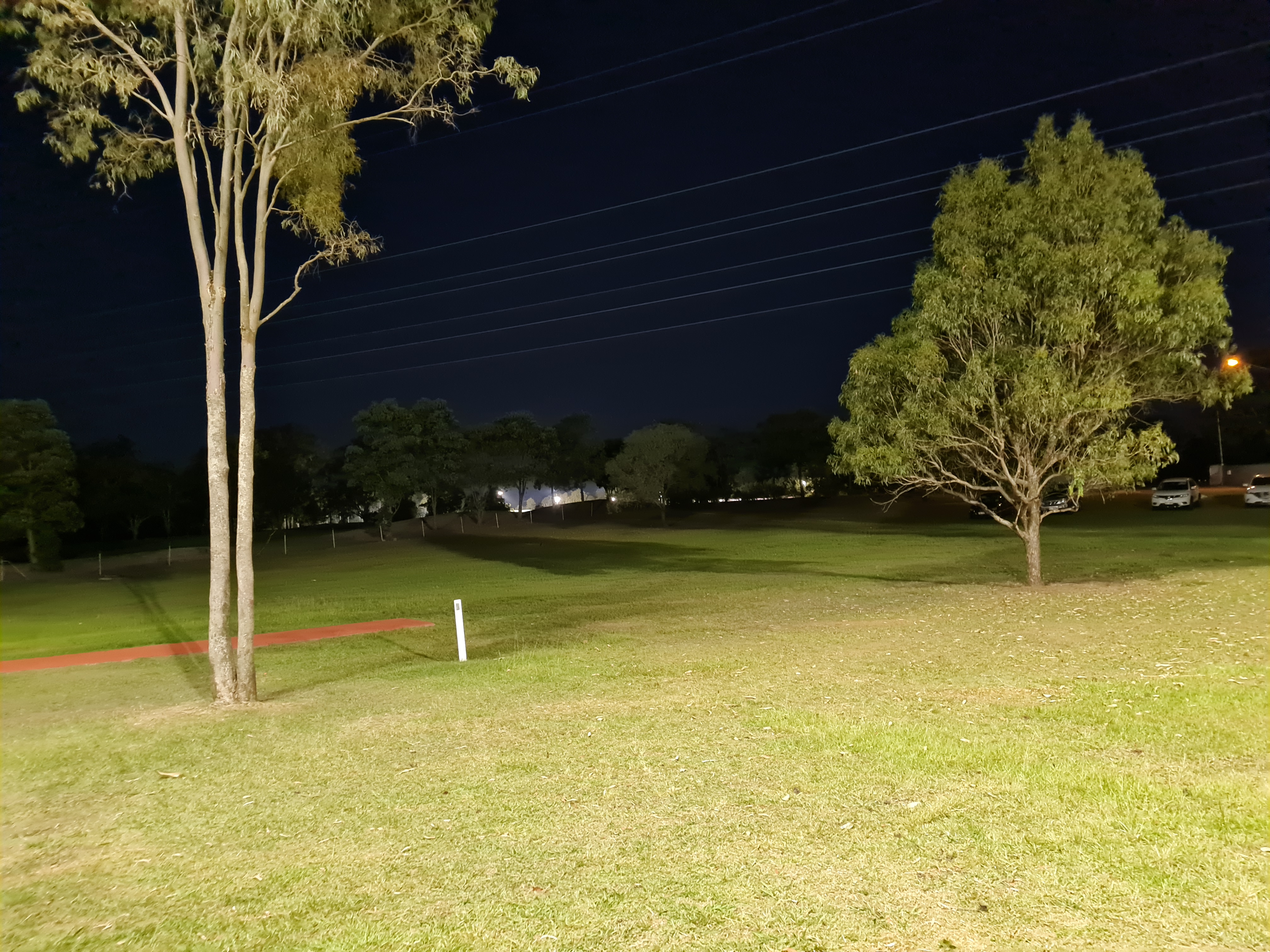
A photograph from the inspirational bin – 8

A picture can paint a thousand words, or more, or less, but…

…

The interesting thing about a place in the dark, in the distance, and behind a chain wire fence usually means something. Especially when there are mysterious lights involved.

We were at a night sports event, watching over a thousand screaming and yelling kids from five to eighteen pretending to compete in a variety of athletic events.

I was there to nominally to support my granddaughter in her endeavours, but right at that moment, on the far side of the track, what I was really there to see was what was behind the wire fence

“Are you watching, Poppy?”

Well, at that moment I wasn’t, but I did turn just in time to see her clear a meter high high jump and execute an elegent backflip, a result no doubt of the ballet training she had since the age of four. Seven years later those lessons had transformed into a high jumper with a great future.

Except, she couldn’t really care less. It was more about the parents and athletic organisers expectations, than hers. I was there, she told me in a secretive tone, to tell everyone to back off.

if you think spying was a dangerous occupation, then let me tell you trying to navigate a safe path between child and parents, and then the rest of the word, forget it.

So, with my trusty phone camera, slightly modified, I was pretending to take pictures of surrounding trees in the high density lighting for the athletics oval, whilst zooming in on the real target.

And, about to take the money shot, I could feel a tugging on the side of my jacket.

I looked down to see the petulant face of a child not happy.

“You said you were coming to see me perform.”

I had. I looked over at the woman the boss had assigned as my ‘date’, Nancy, and whom I’d introduced as a long time friend who deigned to suffer my invitation so she could meet the girl I was always talking about.

“Yes, Poppy,” she said with an evil undertone. “You said you wanted to see her high jumps. You’d better get over there, while I take some pictures of the trees for you.”

“Why do you want pictures of dumb old trees?” That was a question I would have asked myself, and I didn’t quite have an answer for it.

Nancy did. “Because he’s odd like that. It’s one of the quirks I like about him.” She took the camera out of my hand and shooed us off.

And, heading back to the high jump, she asked, “What’s a quirk?”

“Just ask your father later. He knows all about quirks.”

…

© Charles Heath 2021

What I learned about writing – Always write down a story, start or end, for later.

My mind will not rest.

Down here, it is summer, and the last few days have been exhaustingly hot, well, it is summer after all, but tonight it is particularly hot.

So, as I can’t sleep, I’m lying on the couch staring at the ceiling, otherwise known as the cinema of my dreams.

Where am I?

Well, it has to be someplace other than here, of course.

…

I’d seen the Trevi Fountain in the movies, but, until now, it just seemed like any other fountain, only larger.

In reality, it was much more than that, and, so it seemed, it was also that for many other people.  Mid-afternoon on a warm sunny day, they were all standing in awe.

Perhaps some were making a wish, and I saw several toss coins in.  There would be a lot of money in there, and I couldn’t help but think about what sort of job it would be to retrieve it.

Odd too, I thought, if they hadn’t, how many old and rare coins might be somewhere on the floor.  Of course, I only thought of the aesthetic value rather than the practicality of the water system that the Romans had built long before such feats of engineering were being contemplated.

No, I was here on holiday. 

After years of travelling to a great many places for my job, one that never really gave me any time for sightseeing, I’d decided it was time to indulge in a little tourism.

Before this, I’d been to the Colosseum, the old ruins, the Spanish Steps, and the Parthenon.  This was going to wrap up in the afternoon.

“So, are you here on business or pleasure?”

I turned to see Giuseppe, a man I’d had a rather complicated working relationship in the past, and one who was not informed that I was coming to Italy.

The fact that he was here was no surprise.  It was, however, surprising that he could sneak up on me.  It showed I was slipping, or, more than likely, I was more susceptible to being distracted.

“I am but a humble tourist.  I’m sorry, but you have been following me for nothing.”

“Why is it I find that difficult to believe?”

Because of what I used to do, but it was not something I would openly admit.  And the only reason he was standing there was that someone else had made a mistake, and it had required a bit of diplomacy to smooth the waters.

Unfortunately, that had destroyed my invisibility in Italy and most of Europe.  A stark reminder of why, these days, I spend most of my time in semi-retirement at home.

“As difficult as it might be to understand, having your cover blown makes it impossible to continue, verified by the fact you’re here now.  Was it a red flag on my name, or facial recognition?”

He sighed, the man who had heard it all before.  “Just remember, we’re watching you.”

A last shake of his head, he walked over to a car parked a short distance away, got in, and drove off.  I had no doubt he was not the only one who had been watching me.

“It seems you were right.”

Another voice, this time a woman, and expected.  Carla had been waiting in the coffee shop for Giuseppe or someone like him to make an appearance.

“They were not exactly hiding the fact that they had me under surveillance.”

She handed me the coffee with a smile.

“That means we can have some fun, does it not?”

That had been the plan.  I knew if I entered Italy using the identity I used the last time, it would put them on alert and prompt a reaction.

“It still doesn’t mean they won’t suspect something is afoot.”

“And since when did you start doubting yourself?”

Since my last operation fell apart because I made one simple mistake that no agent would have made in a million years.  But I had, and it almost ended two careers.

The other person had just handed me the coffee and unaccountably seemed less angry with me than she should be.

“You of all people should know the answer to that.”

She sighed and took my hand in hers.  “What I do know is that there’s a very clever operation afoot and you’re the one who planned it.  And far from being on the sidelines, we have a new and important role to play.  And speaking of play, it’s time you and I got into our roles.  Oh, and just for the record, I still love you and I know how you feel about me, and before I brought you coffee, I made a wish.”

So had I, and it had been answered.

…

It was another of those dreams that might lead somewhere.  We’ll just have to wait and see.

…

© Charles Heath 2023-2025

365 Days of Writing, 2026 – 272

Day 272 – Writing Exercise

…

The one thing they tell you about writing is to not be put off by criticism.

In fact the one basic tenet I try to get across as the most important, if you want to be a writer, is to take criticism as the best form of encouragement.

The second, you are writing for yourself, not for the masses out there, because there are writers who churn out pulp fiction.  You may do that one day, but first be the best writer you can.

Then once you’ve finished that first draft, you can send it out to a respected and qualified group of beta readers, but be prepared to get constructive criticism.

It was a pity I didn’t take my own advice.

I always wanted to be a writer. I spent most of my spare time scribbling on notepads, buying a typewriter and turning scribbles into typed pages.

I was always going to finish it.

Then I met a girl, Samantha Biggins, and I took a sojourn.  With marriage and work and juggling everything else, writing took a step back.

Until we decided to get a bigger house.

While getting ready for the move, I found all of my work packed into a half dozen boxes.  Marked “Toss” in Samantha’s scrawl.

I’d told her once that I wanted to be a writer, and she told me to be practical.  Unless I became a best-selling author, there was no money in it.

She was right, but I was not tossing it.

When she asked why I was keeping it, I asked her to read what I’d written; she did, and then simply told me not to give up my day job.

Five more years of being abjectly unhappy, I found out she was having an affair with my best friend.  He is no longer my best friend; she is no longer my wife; there were no children; she refused to become a mother, and it all ended on a sour note.

I quit my job, moved, changed my name, and became an associate professor teaching students to write. 

It was the best of both worlds, teaching writing, and writing that first novel.

…

It was a new intake for my class, twenty-three souls who thought they wanted to become writers.  On average, only fifteen would survive, and perhaps one or two would continue after the classes ended.

Day one, they were full of enthusiasm, or at least most of them were.

When I told them their first assignment was to write a ten-thousand-word story over the next four weeks, applying what they learned, that enthusiasm waned.

This was not the class to use as a break between the hard stuff.  The next class dropped to twenty.

After two weeks, the student with the mt enthusiasm, Charlene, stopped on her way out the door and asked, “Are you a writer?”

Of all of them, she was the most promising, but that might be because she was a mature-age student, finally doing the university degree she would have if she had not got pregnant before graduating high school.

She was a little too forthcoming in her introduction of herself.

I wondered where this was leading.  “Yes.”

“Published?”

“No.  Still working on that first blockbuster.”

“When did you start writing?”

“About 13 or 14 years old.”

“In all that time…”

This was not going to be a time when I defended myself.

“Sometimes life gets in the way, and your priorities change.  I took a ten-year sabbatical, if you could call it that.  It happens.  Sometimes the idea of becoming a published author has to be put aside because food and rent don’t appear out of thin air.”

“Wouldn’t you just find a job that allows you to do both?”

“That’s the final lesson.  It took me ten years to figure that one out.”

“So you didn’t go to university and have to survive while studying?”

“My university studies were paid for.  The struggle came afterwards.”

She shrugged.  “We all get there, I guess, in our own time.  You want anyone to beta read your stuff, I’m available.”

I was not sure how to take that, so it was best avoided.  “If I do, I’ll let you know “

She left with an expression I couldn’t fathom.

…

Charlene’s story, exactly 10,000 words, was a story of struggle.  It had me from the first page.

And it made me think she was a faculty spy, sent to see if I knew what I was doing.  To be truthful, it was my second year at it, and it was a learning process.  My first wasn’t so great.

Teaching wasn’t the same as doing.

The other nineteen varied in length, from a thousand to five thousand words.  Stories started and petered out, some with a strong start and then hitting that invisible brick wall.  Several were in the realm of fantasy, but none could go down the superhero with humility path.

It gave me a lot of scope.

Most were glad they would not be revisiting that story until towards the end of the year.

During the previous year, I thought about restarting my book, even starting to unpack the writing boxes, but it went into recess again when I told myself I had to write class lessons and prompt papers 

In other words, I found any excuse not to write.

But during the summer break, when I finally stopped prevaricating, I dragged everything out of the boxes, arranged my writing nook, and put a piece of paper in the typewriter.

Nothing came.

I pulled out the notepads and decided I would write longhand.  That went from writing to planning to maybe I’ll do it tomorrow.

I was still prevaricating at the start of the year, and perhaps it was going to go into a recess like the year before.

Then I woke in the middle of the night, halfway through the first semester, thinking I should retype and edit the story I gave Samantha to read, and see what Charlene’s thought.

Perhaps I was looking for compliments.  If I was, then maybe I should just burn it and move on.

That morning’s lesson, we were going to visit non-fiction, and we were all going to embark on a genealogical expedition. 

I found the previous year the notion of having relatives that go back in time, and where they came from, was as much of a writing adventure for me as it was for them.  It also honed another important writing skill; research.

I was shocked to discover I came from England and Germany.  There were Irish, Welsh, Scots, but no Americans.  There was even a little Scandinavian.  They were mostly agricultural labourers, though there was the odd publican and shop owner.

I often wondered how I could be related to any of those given my school results.

Charlene’s relatives, going back, were famous, or maybe they would have been if she hadn’t noticed that a cousin had been previously down that path, and picked the most interesting rather than the actual people who were her forebears.

Who wouldn’t do that if they were looking for a more interesting story?  After all, they had been dead for a long time and were not going to argue the point.

…

By the end of the first semester I had rewritten the first three chapters, the magic amount I thought would set up the story, and would be what I would send to a publisher for appraisal.

It had been a lot of long nights and ruthlessness I hadn’t thought was in me.    Sometimes it was not so much about what was on the page as having the backbone to throw out what was simply padding.

It was my own advice echoing in my head: 200 tightly written pages trumped 500 pages of mostly fluff.

Last day of semester, after setting an assignment to be delivered the first day back, I called Charlene over and handed her the brown, anonymous envelope.

“My marching orders,” she asked.

“The first three chapters.  If you want to read it.  I don’t usually give anyone anything, not after the last time.”

She looked at me with a quizzical expression.

“A long story that involves an ex, and it would be in poor taste to air what most people would call petty grievances.”

“We all have them.”

“Petty differences or exes?”

“Both.  But let me guess, you finally gave in to showing your work to your spouse and you got everything but what you wanted.”

“I was told not to give up my day job.”

She smiled, or perhaps it was something else.  “I was told to stick to what women like me did best: cooking, cleaning, and babies.  After that comment, I did none of the above.”

“I stopped writing.”

“So did I.  And you were right.  Life gets in the way.  I have coffee some mornings at the Three Moon cafe.  If you pick the right day, I’ll give you my honest opinion.”

She left before I could think of a suitable reply.

…

Perception is everything.

Rather than working on my novel, I spent the time fretting over the implications of Charlene’s invitation.

And, yes, it was an invitation.

That I had all sorts of feelings about the matter, right down to reading and rereading the rule book five times, the answer was always going to be the same.

It was verboten.

If it wasn’t my imagination running wild.  If it was not what I thought it was.

Normally it was not something I would think about.  And, like I said, it might be just my overactive imagination.  It had happened to a colleague the previous year.  He had ignored it, and when push came to shove, the university sacked him, even when her had done nothing to encourage the relationship.

It was for him either the devil or the deep blue sea.  Even when the girl in question told the Dean, eventually, that he had never been interested, and she did it out of spite.

It was an ugly world we lived in sometimes.

So, armed with the rule book, I reluctantly went to the Three Moon café.  She was not there, but I felt like a coffee and stayed, pretending to be one of my characters, on surveillance while waiting for the contact with the top secret information.

It wasn’t hard to pick out the university types, or the students. After all, I had heard of it from class members, a place where good food was reasonably priced, better than living on fast food and coffee

Other than the business types.

I tried not to look like a university associate professor, but as some of my students said, it was an acquired look.  Not even changing the style of my clothes worked.

One of my latest group of budding writers had said that a professor in a five-thousand-dollar suit and expensive shoes, even a Rolex watch, was still a professor.

I knew it was me she was talking about.

My coffee arrived, but it was not the waitress who took the order; it was Charlene.  She slid into the booth’s opposite seat.

“You have waitressing skills?”

“Among many others.  Navy SEAL.  Cabinet minister.  Short order chef.  A girl has to be multi-talented.  I work here, off and on.”

It was hard to tell if she was telling me off for categorising her, and if I thought about it, I probably did, and without thinking.

“Perhaps I should apologise.  Sometimes I say stuff without thinking, but it doesn’t excuse what I said.  I’m sorry.”

I was going to have to categorise these expressions of hers.  It was fascinating to watch it change.  This one: perhaps disdain.

“Apology accepted.  Better than most of those tinder dates, but what can you expect?”

“Never used a dating app.  I just think it’s too much effort, and knowing my luck, she would secretly be an axe murderer.”

“Ah, about that…”

I could see, after a moment of apprehension, that she was joking.  Or at least I hope she was.

She pulled the envelope, now creased and crumpled, and put it on the table between us.

I looked at it, but said nothing.

I had left the university rule book on the table, and she had noticed it.  It was a quick glance, one that I wasn’t supposed to see.

“Impressive daytime reading,” a glance, then back.

“Still trying to grapple with being an associate professor, which alternately makes me feel like an aging know-it-all, or just simply a weirdo.”

“What have you learned?”

“The hundred and twenty-two ways of getting into deep water and drowning.”

“Metaphorically speaking.  I still haven’t been able to find the campus pool.”

It was the subject of students’ quests, and an exercise for writing a piece on executing a question, taking something ordinary and turning it into treasure.  It was the imagination test.

She was watching me, over the top of her coffee cup, contemplating or planning my demise.  Talking to her was going to be a slow dance.

“You’re writing, in your mind, a scene, you and I.  There was a flicker of a smile.  Hopes dashed or triumph.”

“No.”  I would go with something a little more topical.  “What’s a girl like you doing the writing course?”

Expressing change, nose wrinkle, eyebrows lift fractionally.  Surprise?

“I want to be a better writer.”

“I don’t think so.  You’re almost there, from what I’m reading of your work.”

“Maybe I just want a break from work.  Working afternoons at the café and nights cleaning up after the grubs that pretend they’re human has taken its toll.”

There was paid in-house eyes, along with a self-realisation that may or may not be what I thought it was.  It was the sort of pain I’d never had to endure.

She ordered another coffee.  Mine was going cold.

Then she came out with it.  “We’re not supposed to be here together, or anywhere.  If you’re checking the rules, it could mean one of two things.  You’re wondering about my motives, or you’re wondering about yours.”

“Or I’m looking for ways to cure my insomnia.”  I picked the book up.  “Reading this, or trying to, is better than any sleeping pill.”  I put it down again.  ” We can meet like this; there just can’t be any other reason than to discuss the coursework.”

“And you thought…”

“I don’t think.  I’m just telling you what I read, just before it put me to sleep.  I’m not going to bore you with details.  Perhaps we could talk about my train wreck book.”

Another smile, less warmth.  Perhaps I was unconsciously trying to be unworthy of her attention. 

“It’s anything but a train wreck, but it does tell me a lot about you.  No, its good.  Can’t wait to see more.”  She watched my reaction before adding, “Do you dance?”

I made a mental note to curse the person that gave me an imagination, because it was working overtime.

“Ballroom, or that uncoordinated wriggling?”

She laughed, perhaps imagining what I meant by uncoordinated wriggling.  I’d seen it once when I agreed to go out with a girl a friend had recommended.  She had been trying to be something she was not.

“I’ll let you ponder that, until the next batch of pages.”

With that she made an exit, which was so much more than just leaving.

And sitting there, after ordering another coffee, a realisation came over me.  I needed a museum.  Not in the sense that I would pursue romantically, but someone who could stoke the fires of inspiration, because I could see the next part of the story.

And I hadn’t felt like this in a decade.

…

©  Charles Heath  2026

The story behind the story – Echoes from the Past

The novel ‘Echoes from the Past’ started out as a short story I wrote about 30 years ago, titled ‘The Birthday’.

My idea was to take a normal person out of their comfort zone and led on a short but very frightening journey to a place where a surprise birthday party had been arranged.

Thus, the very large man with a scar and a red tie was created.

So was the friend with the limousine who worked as a pilot.

So were the two women, Wendy and Angelina, who were Flight Attendants that the pilot friend asked to join the conspiracy.

I was going to rework the short story, then about ten pages long, into something a little more.

And like all rewrites, especially those I have anything to do with, it turned into a novel.

There was motivation.  I had told some colleagues at the place where I worked at the time that I liked writing, and they wanted a sample.  I was going to give them the re-worked short story.  Instead, I gave them ‘Echoes from the past’

Originally, it was not set anywhere in particular.

But when considering a location, I had, at the time, recently been to New York in December, and visited Brooklyn and Queens, as well as a lot of New York itself.  We were there for New Year’s, and it was an experience I’ll never forget.

One evening, we were out late and finished up in Brooklyn Heights, near the waterfront, and there was rain and snow; it was cold and wet, and apartment buildings were shimmering in the street light, and I thought, “This is the place where my main character will live”.

It had a very spooky atmosphere, the sort where ghosts would not be unexpected.  I felt more than one shiver go up and down my spine in the few minutes I was there.

I had taken notes, as I always do, of everywhere we went, so I had a ready supply of locations I could use, changing the names in some cases.

Fifth Avenue near the Rockefeller Centre is amazing at first light, and late at night with the Seasonal decorations and lights.

The original main character was a shy man with few friends, hence not expecting the surprise party.  I enhanced that shyness into purposely lonely because of an issue from his past that leaves him always looking over his shoulder and ready to move on at the slightest hint of trouble.  No friends, no relationships, just a very low profile.

Then I thought, what if he breaks the cardinal rule and begins a relationship?

But it is also as much an exploration of a damaged soul as it is the search for a normal life, without having any idea what normal was, and how the understanding of one person can sometimes make all the difference in what we may think or feel.

And, of course, I wanted a happy ending.

Except for the bad guys.

…

Get it here:  https://amzn.to/2CYKxu4

newechocover5rs

365 Days of Writing, 2026 – 272

Day 272 – Writing Exercise

…

The one thing they tell you about writing is to not be put off by criticism.

In fact the one basic tenet I try to get across as the most important, if you want to be a writer, is to take criticism as the best form of encouragement.

The second, you are writing for yourself, not for the masses out there, because there are writers who churn out pulp fiction.  You may do that one day, but first be the best writer you can.

Then once you’ve finished that first draft, you can send it out to a respected and qualified group of beta readers, but be prepared to get constructive criticism.

It was a pity I didn’t take my own advice.

I always wanted to be a writer. I spent most of my spare time scribbling on notepads, buying a typewriter and turning scribbles into typed pages.

I was always going to finish it.

Then I met a girl, Samantha Biggins, and I took a sojourn.  With marriage and work and juggling everything else, writing took a step back.

Until we decided to get a bigger house.

While getting ready for the move, I found all of my work packed into a half dozen boxes.  Marked “Toss” in Samantha’s scrawl.

I’d told her once that I wanted to be a writer, and she told me to be practical.  Unless I became a best-selling author, there was no money in it.

She was right, but I was not tossing it.

When she asked why I was keeping it, I asked her to read what I’d written; she did, and then simply told me not to give up my day job.

Five more years of being abjectly unhappy, I found out she was having an affair with my best friend.  He is no longer my best friend; she is no longer my wife; there were no children; she refused to become a mother, and it all ended on a sour note.

I quit my job, moved, changed my name, and became an associate professor teaching students to write. 

It was the best of both worlds, teaching writing, and writing that first novel.

…

It was a new intake for my class, twenty-three souls who thought they wanted to become writers.  On average, only fifteen would survive, and perhaps one or two would continue after the classes ended.

Day one, they were full of enthusiasm, or at least most of them were.

When I told them their first assignment was to write a ten-thousand-word story over the next four weeks, applying what they learned, that enthusiasm waned.

This was not the class to use as a break between the hard stuff.  The next class dropped to twenty.

After two weeks, the student with the mt enthusiasm, Charlene, stopped on her way out the door and asked, “Are you a writer?”

Of all of them, she was the most promising, but that might be because she was a mature-age student, finally doing the university degree she would have if she had not got pregnant before graduating high school.

She was a little too forthcoming in her introduction of herself.

I wondered where this was leading.  “Yes.”

“Published?”

“No.  Still working on that first blockbuster.”

“When did you start writing?”

“About 13 or 14 years old.”

“In all that time…”

This was not going to be a time when I defended myself.

“Sometimes life gets in the way, and your priorities change.  I took a ten-year sabbatical, if you could call it that.  It happens.  Sometimes the idea of becoming a published author has to be put aside because food and rent don’t appear out of thin air.”

“Wouldn’t you just find a job that allows you to do both?”

“That’s the final lesson.  It took me ten years to figure that one out.”

“So you didn’t go to university and have to survive while studying?”

“My university studies were paid for.  The struggle came afterwards.”

She shrugged.  “We all get there, I guess, in our own time.  You want anyone to beta read your stuff, I’m available.”

I was not sure how to take that, so it was best avoided.  “If I do, I’ll let you know “

She left with an expression I couldn’t fathom.

…

Charlene’s story, exactly 10,000 words, was a story of struggle.  It had me from the first page.

And it made me think she was a faculty spy, sent to see if I knew what I was doing.  To be truthful, it was my second year at it, and it was a learning process.  My first wasn’t so great.

Teaching wasn’t the same as doing.

The other nineteen varied in length, from a thousand to five thousand words.  Stories started and petered out, some with a strong start and then hitting that invisible brick wall.  Several were in the realm of fantasy, but none could go down the superhero with humility path.

It gave me a lot of scope.

Most were glad they would not be revisiting that story until towards the end of the year.

During the previous year, I thought about restarting my book, even starting to unpack the writing boxes, but it went into recess again when I told myself I had to write class lessons and prompt papers 

In other words, I found any excuse not to write.

But during the summer break, when I finally stopped prevaricating, I dragged everything out of the boxes, arranged my writing nook, and put a piece of paper in the typewriter.

Nothing came.

I pulled out the notepads and decided I would write longhand.  That went from writing to planning to maybe I’ll do it tomorrow.

I was still prevaricating at the start of the year, and perhaps it was going to go into a recess like the year before.

Then I woke in the middle of the night, halfway through the first semester, thinking I should retype and edit the story I gave Samantha to read, and see what Charlene’s thought.

Perhaps I was looking for compliments.  If I was, then maybe I should just burn it and move on.

That morning’s lesson, we were going to visit non-fiction, and we were all going to embark on a genealogical expedition. 

I found the previous year the notion of having relatives that go back in time, and where they came from, was as much of a writing adventure for me as it was for them.  It also honed another important writing skill; research.

I was shocked to discover I came from England and Germany.  There were Irish, Welsh, Scots, but no Americans.  There was even a little Scandinavian.  They were mostly agricultural labourers, though there was the odd publican and shop owner.

I often wondered how I could be related to any of those given my school results.

Charlene’s relatives, going back, were famous, or maybe they would have been if she hadn’t noticed that a cousin had been previously down that path, and picked the most interesting rather than the actual people who were her forebears.

Who wouldn’t do that if they were looking for a more interesting story?  After all, they had been dead for a long time and were not going to argue the point.

…

By the end of the first semester I had rewritten the first three chapters, the magic amount I thought would set up the story, and would be what I would send to a publisher for appraisal.

It had been a lot of long nights and ruthlessness I hadn’t thought was in me.    Sometimes it was not so much about what was on the page as having the backbone to throw out what was simply padding.

It was my own advice echoing in my head: 200 tightly written pages trumped 500 pages of mostly fluff.

Last day of semester, after setting an assignment to be delivered the first day back, I called Charlene over and handed her the brown, anonymous envelope.

“My marching orders,” she asked.

“The first three chapters.  If you want to read it.  I don’t usually give anyone anything, not after the last time.”

She looked at me with a quizzical expression.

“A long story that involves an ex, and it would be in poor taste to air what most people would call petty grievances.”

“We all have them.”

“Petty differences or exes?”

“Both.  But let me guess, you finally gave in to showing your work to your spouse and you got everything but what you wanted.”

“I was told not to give up my day job.”

She smiled, or perhaps it was something else.  “I was told to stick to what women like me did best: cooking, cleaning, and babies.  After that comment, I did none of the above.”

“I stopped writing.”

“So did I.  And you were right.  Life gets in the way.  I have coffee some mornings at the Three Moon cafe.  If you pick the right day, I’ll give you my honest opinion.”

She left before I could think of a suitable reply.

…

Perception is everything.

Rather than working on my novel, I spent the time fretting over the implications of Charlene’s invitation.

And, yes, it was an invitation.

That I had all sorts of feelings about the matter, right down to reading and rereading the rule book five times, the answer was always going to be the same.

It was verboten.

If it wasn’t my imagination running wild.  If it was not what I thought it was.

Normally it was not something I would think about.  And, like I said, it might be just my overactive imagination.  It had happened to a colleague the previous year.  He had ignored it, and when push came to shove, the university sacked him, even when her had done nothing to encourage the relationship.

It was for him either the devil or the deep blue sea.  Even when the girl in question told the Dean, eventually, that he had never been interested, and she did it out of spite.

It was an ugly world we lived in sometimes.

So, armed with the rule book, I reluctantly went to the Three Moon café.  She was not there, but I felt like a coffee and stayed, pretending to be one of my characters, on surveillance while waiting for the contact with the top secret information.

It wasn’t hard to pick out the university types, or the students. After all, I had heard of it from class members, a place where good food was reasonably priced, better than living on fast food and coffee

Other than the business types.

I tried not to look like a university associate professor, but as some of my students said, it was an acquired look.  Not even changing the style of my clothes worked.

One of my latest group of budding writers had said that a professor in a five-thousand-dollar suit and expensive shoes, even a Rolex watch, was still a professor.

I knew it was me she was talking about.

My coffee arrived, but it was not the waitress who took the order; it was Charlene.  She slid into the booth’s opposite seat.

“You have waitressing skills?”

“Among many others.  Navy SEAL.  Cabinet minister.  Short order chef.  A girl has to be multi-talented.  I work here, off and on.”

It was hard to tell if she was telling me off for categorising her, and if I thought about it, I probably did, and without thinking.

“Perhaps I should apologise.  Sometimes I say stuff without thinking, but it doesn’t excuse what I said.  I’m sorry.”

I was going to have to categorise these expressions of hers.  It was fascinating to watch it change.  This one: perhaps disdain.

“Apology accepted.  Better than most of those tinder dates, but what can you expect?”

“Never used a dating app.  I just think it’s too much effort, and knowing my luck, she would secretly be an axe murderer.”

“Ah, about that…”

I could see, after a moment of apprehension, that she was joking.  Or at least I hope she was.

She pulled the envelope, now creased and crumpled, and put it on the table between us.

I looked at it, but said nothing.

I had left the university rule book on the table, and she had noticed it.  It was a quick glance, one that I wasn’t supposed to see.

“Impressive daytime reading,” a glance, then back.

“Still trying to grapple with being an associate professor, which alternately makes me feel like an aging know-it-all, or just simply a weirdo.”

“What have you learned?”

“The hundred and twenty-two ways of getting into deep water and drowning.”

“Metaphorically speaking.  I still haven’t been able to find the campus pool.”

It was the subject of students’ quests, and an exercise for writing a piece on executing a question, taking something ordinary and turning it into treasure.  It was the imagination test.

She was watching me, over the top of her coffee cup, contemplating or planning my demise.  Talking to her was going to be a slow dance.

“You’re writing, in your mind, a scene, you and I.  There was a flicker of a smile.  Hopes dashed or triumph.”

“No.”  I would go with something a little more topical.  “What’s a girl like you doing the writing course?”

Expressing change, nose wrinkle, eyebrows lift fractionally.  Surprise?

“I want to be a better writer.”

“I don’t think so.  You’re almost there, from what I’m reading of your work.”

“Maybe I just want a break from work.  Working afternoons at the café and nights cleaning up after the grubs that pretend they’re human has taken its toll.”

There was paid in-house eyes, along with a self-realisation that may or may not be what I thought it was.  It was the sort of pain I’d never had to endure.

She ordered another coffee.  Mine was going cold.

Then she came out with it.  “We’re not supposed to be here together, or anywhere.  If you’re checking the rules, it could mean one of two things.  You’re wondering about my motives, or you’re wondering about yours.”

“Or I’m looking for ways to cure my insomnia.”  I picked the book up.  “Reading this, or trying to, is better than any sleeping pill.”  I put it down again.  ” We can meet like this; there just can’t be any other reason than to discuss the coursework.”

“And you thought…”

“I don’t think.  I’m just telling you what I read, just before it put me to sleep.  I’m not going to bore you with details.  Perhaps we could talk about my train wreck book.”

Another smile, less warmth.  Perhaps I was unconsciously trying to be unworthy of her attention. 

“It’s anything but a train wreck, but it does tell me a lot about you.  No, its good.  Can’t wait to see more.”  She watched my reaction before adding, “Do you dance?”

I made a mental note to curse the person that gave me an imagination, because it was working overtime.

“Ballroom, or that uncoordinated wriggling?”

She laughed, perhaps imagining what I meant by uncoordinated wriggling.  I’d seen it once when I agreed to go out with a girl a friend had recommended.  She had been trying to be something she was not.

“I’ll let you ponder that, until the next batch of pages.”

With that she made an exit, which was so much more than just leaving.

And sitting there, after ordering another coffee, a realisation came over me.  I needed a museum.  Not in the sense that I would pursue romantically, but someone who could stoke the fires of inspiration, because I could see the next part of the story.

And I hadn’t felt like this in a decade.

…

©  Charles Heath  2026

The first case of PI Walthenson – “A Case of Working With the Jones Brothers”

This case has everything: red herrings, jealous brothers, femme fatales, and at the heart of it all, greed.

See below for an excerpt from the book…

Coming soon!

PIWalthJones1

An excerpt from the book:

…

When Harry took the time to consider his position, a rather uncomfortable position at that, he concluded that he was somehow involved in another case that meant very little to him.

Not that it wasn’t important in some way he was yet to determine, it was just that his curiosity had got the better of him, and it had led to this: sitting in a chair, securely bound, waiting for someone, one of his captors had called Doug.

It was not the name that worried him so much; it was the evil laugh that had come after the name was spoken.

Doug what? Doug the ‘destroyer’, Doug the ‘dangerous’, Doug the ‘deadly’; there were several sinister connotations, and perhaps that was the point of the laugh, to make it more frightening than it was.

But there was no doubt about one thing in his mind right then: he’d made a mistake. A very big. and a costly mistake. Just how big the cost, no doubt, he would soon find out.

His mother and his grandmother, the wisest person he had ever known, had once told him never to eavesdrop.

At the time, he couldn’t help himself, and instead of minding his own business, listening to a one-sided conversation that ended with a time and a place. The very nature of the person receiving the call was, at the very least, sinister, and, because of the cryptic conversation, there appeared to be, or at least to Harry, criminal activity involved.

For several days, he had wrestled with the thought of whether he should go. Stay on the fringe, keep out of sight, observe and report to the police if it was a crime. Instead, he had willingly gone down the rabbit hole.

Now, sitting in an uncomfortable chair, several heat lamps hanging over his head, he was perspiring, and if perspiration could be used as a measure of fear, then Harry’s fear was at the highest level.

Another runnel of sweat rolled into his left eye, and, having his hands tied, it literally made it impossible to clear it. The burning sensation momentarily took his mind off his predicament. He cursed and then shook his head, trying to prevent a recurrence. It was to no avail.

Let the stinging sensation be a reminder of what was right and what was wrong.

It was obvious that it was the right place and the right time, but in considering his current perilous situation, it definitely was the wrong place to be, at the worst possible time.

It was meant to be his escape, an escape from the generations of lawyers, what were to Harry, dry, dusty men who had been in business since George Washington said to the first Walthenson to step foot on American soil, ‘Why don’t you become a lawyer?” when asked what he could do for the great man.

Or so it was handed down as lore, though Harry didn’t think Washington meant it literally, the Walthenson’s, then as now, were not shy of taking advice.

Except, of course, when it came to Harry.

He was, Harry’s father was prone to saying, the exception to every rule. Harry guessed his father was referring to the fact that his son wanted to be a Private Detective rather than a dry, dusty lawyer. Just the clothes were enough to turn Harry off the profession.

So, with a little of the money Harry inherited from one of his aunts, he leased an office in Gramercy Park and had it renovated to look like the Sam Spade detective agency, you know the one, Spade and Archer, and The Maltese Falcon.

There’s a movie and a book by Dashiell Hammett if you’re interested.

So, there it was, painted on the opaque glass inset of the front door, ‘Harold Walthenson, Private Detective’.

There was enough money to hire an assistant, and it took a week before the right person came along, or, more to the point, didn’t just see his business plan as something sinister. Ellen, a tall, cool woman in a long black dress, or so the words of a song in his head told him, fitted in perfectly.

She’d seen the movie, but she said with a grin, Harry was no Humphrey Bogart.

Of course not, he said, he didn’t smoke.

Three months on the job, and it had been a few calls, no ‘real’ cases, nothing but missing animals, and other miscellaneous items. What he really wanted was a missing person. Or perhaps a beguiling, sophisticated woman who was as deadly as she was charming, looking for an errant husband, perhaps one that she had already ‘dispatched’.

Or for a tall, dark and handsome foreigner who spoke in riddles and in heavily accented English, a spy, or perhaps an assassin, in town to take out the mayor. The man was such an imbecile that Harry had considered doing it himself.

Now, in a back room of a disused warehouse, that wishful thinking might be just about to come to a very abrupt end, with none of the romanticised trappings of the business befalling him. No beguiling women, no sinister criminals, no stupid policemen.

Just a nasty little man whose only concern was how quickly or how slowly Harry’s end was going to be.

…

© Charles Heath 2019-2024

The cinema of my dreams – Was it just another surveillance job – Episode 60

This story is now on the list to be finished so over the new few weeks, expect a new episode every few days.

The reason why new episodes have been sporadic, there are also other stories to write, and I’m not very good at prioritizing.

But, here we are, a few minutes opened up and it didn’t take long to get back into the groove.

Things are about to get complicated…


Joanne let me get away far too easily. 

When I got back to my car, I ran the scanner over it.  One tracker was easily found, another that took a full half hour to find, and some very strange stares from people on the sidewalk.

I put them both on another car and then went back to the safe house.  Knowing O’Connell was just a pawn meant there wasn’t a hurry to find him.  Anna had everything she needed from him, and now he was of little use to her.  The only question was whether he was still alive.

Jennifer had taken my pyjamas and my bed in the master bedroom, so I was relegated to the spare. 

Not happy.

We needed a plan.  In all the excitement I’d forgotten O’Connell had three places, the original apartment with Herman, his mother’s house in Peaslake, and the apartment in Bromley.

I was up before Jennifer, making coffee, when she came out.

She made my pyjamas look good.  And there was the distraction factor Maury was prone to banging on about.

“How did it go at the office?”

“Turns out Anna Jakovich, the apparent seller of the USB, is a biochemist herself, one who was involved in a laboratory disaster, and discharged as part of the problem.  Make of that what you will, but it looks like her husband was just the fall guy.”

“Of course, it all makes sense then.  Gets the husband to steal the data on the pretext they’re saving the world, then kills him, and pins the blame on him if anything goes wrong. gets us to stump up several million pounds, then ditches O’Connell and runs with the money, and the USB, to bilk another unsuspecting government, like the Russians, or the Chinese.”

“Can you read minds?”

“No.  Got a call from Dobbin, though I have no idea how he found my number since it’s a burner.  Seems he finally found the file on Anna, presumably the same one you got.

“He doesn’t know you’re involved.”

“He does now.  He figured you’d seek help from your classmates that were still on the books.  There’s two of us, me and Miss Desirable, Yolanda.”

“Didn’t she leave the Severin School of wannabes before qualifying?”

“And went straight to the city office of the department and offered up all details on our once fearless leaders for a second chance.  On the books, and back in training, training we might be able to use.”

“Possibly.  The question is, of course, whether she knew what they were planning…”

“Dobbin says she was fooling about with Severin, or perhaps that was Maury…”

“Then Dobbin or Monica or both knew in advance what was going to happen and could have prevented a tragedy if that was the case.  I don’t think she quite knew everything.”

“Well, what I know now is that we’re simply pawns in a much larger game, dancing to a tune that is completely out of key.  Makes things all the more interesting, don’t you think.  By my estimation when we complete our mission, we’re likely to end up like Severin, we just have to work out which one it is before we reach our expiry date.  That coffee smells divine, by the way.  We’re not going anywhere until I’ve had a cup.”

At least she hadn’t decided to go back to her old life.  Not yet anyway.

We tackled Peaslake first.  It was a free-standing house, and we had reasonably covered access that gave us entry to the property with minimal chance of observation.

When we were close, I was nearly run off the road by a fire engine, in a hurry.  Closer still we could see a plume of smoke rising from behind the trees, and when we reached the top of the street, we could see where the fire engine was going.

O’Connell’s house was on fire.

I parled the car and we went to join the throng of nearby residents, all with nothing better to do.

“What happened?” Jennifer asked one of the residents.

“There was an explosion, a fireball, someone said they thought it was a gas tank, and then a fire started.  It was fully ablaze by the time the first fire engine arrived.”

The firefighters had most of the blaze subdued, and we could see the house was destroyed. 

Was it Anna or O’Connell, or both covering their tracks?  The house had become compromised when Jennifer and I turned up.

Five minutes later the Detective Inspector and her Sargent arrived.

“Should I be worried now you’re here,” she asked when she saw me.

“It belonged to the mother of one of our officers who is involved in the case I’m working on.”

“He has the information?”

“No, or maybe.  We don’t know.  We do know there’s a woman involved who was working with our agent.”

“Oh.  I’ve been told there are two bodies found inside, one man and one woman.  Nothing else yet, but I’m going to talk to the forensic team waiting to see if they know any more.  Don’t go anywhere, I may need to talk to you.”

“Just a question.  You didn’t let Jan out, did you?”

She looked puzzled.  “Jan?”

“The girl who shot Severin.”

“Oh, her.  MI5 came and took her away the moment my back was turned.  Why?”

“She probably did this.”

“You might have told me she was dangerous.  Who is she?”

“An MI5 assassin.”

She sighed.  “You people are a law unto yourselves.  Don’t go anywhere.  I’ll be back.”

We watched her stomp away.

“Well,” Jennifer said, “that just made our life a little more difficult.”

…

© Charles Heath 2020-2023