I’m guessing no one ever wanted to think about criminals in space.
With the Chief Engineer working on the status and availability of our propulsion unit, and the status of the ship’s systems after the jump to a speed that was probably never considered at design time. All the heads of departments had reported back little or no damage other than crew blackouts. And, a systematic check of all crew by the medical staff showed no one had suffered any side effects. Well, none that were showing in the last hour or so.
That gave me some time to consider just how it might be possible for pirates to exist.
The cost was astronomical, to the point where many governments had pooled their resources to get where we were now, scraping at the edges of our so-called known galaxy. There were just too many zeros at the end of the numbers that simply represented the investment in the ship I was on.
But the thought of criminal activity, that wasn’t on the radar, well, not mine anyway.
As we progressed with new ships replacing the old, it was not hard to assume that someone with a lot of money and will could get their hands on an old ship or two, and find people who were willing to commit crimes, particularly if they were already at a penal colony under limited supervision.
Perhaps they had hoped to stay off the radar, but unfortunately ran into us, a ship that could move as fast as they could, and chase them down. Of course, that led to another thought, right at that moment, one that told me that it was not in their best interests to have us reporting their existence.
if what I thought to be true, was, then it would simply be a matter of destroying their ships and sending them back to Mars, but they still had a bargaining chip, our nuclear scientist. We had to rescue her first.
And I thought meeting aliens was going to be difficult.
…
It was time to have a chat with Lt Colonel Baxter about this ship’s capabilities, defense-wise, and rather than summon him to the bridge, I thought a low-key approach might be better.
He was expecting me.
“You’ve spoken to O’Mara?” O’Mara was the scanning specialist.
“I assume the previous captain had been briefed on the possibility we might run into pirates?”
It felt weird calling them pirates because most of history portrayed them as being on the high seas.
“It was mentioned in passing. We were never expected to run into any, but aside from that, there’s very little intelligence on them. We’re only just hearing about the breakout at the Mars mining outpost.”
“Sounds like bad luck. Of all the places in space we can go, we had to end up in the same sector. Have you spoken to your superiors back home?”
From what I had read on the trip to join ship, the military were on board for defense purposes, if we needed to be defended, otherwise our own security people would take care of any problems we encountered. We were not on a mission to seek out trouble, but explore, particularly galaxies beyond our own.
Our mission was not to get involved problems like pirates, labour disputes, or matters that were the providence of the so-called space police. The need for such an authority had only just been recognised, and being new, were still in the throes of getting ships and personnel, and a workable frame of reference.
“I have. Their preference is for us to stay on mission, and not engage, unless of course, we’re attacked.”
“At which point we can retaliate.”
“With full force and effect, yes, but only as a last resort. I recognize the need to rescue our crew member, but if it means compromise, perhaps it’s best not to engage. That being said, I believe O’Mara has a plan to rescue her without causing any problems.”
He could have mentioned that, but I suspect he didn’t want to come to me with something that might not work.
“Just the same, I would like you on the bridge while we’re within hailing distance of what O’Mara informs me, are pirate ships.”
It was a relic from the past, put back together by a dedicated group of volunteers who had not wanted the last vestiges of the past to disappear.
Train enthusiasts, the called themselves.
They’d put together a steam locomotive, five carriages, a restaurant car, and the conductor’s car. The original train might have been twice to three times as long, but these days, the tourist market rarely filled the train.
I was one of a group who made it their mission to visit and rate every vintage train, not only in this country, but all over the world. It was a sad state of affairs when I first began, with locomotives and carriages dropping out of the system due to lack of funds, but more disheartening, the lack of government assistance in keeping it’s heritage alive.
It seemed money was short, and there were better things to spend it on, like two brand new 737-800 jets just to ferry the prime minister and government officials around. Just think of what that quarter of a billion dollars could have bought in heritage.
But it is what it is.
What I had before me was one of the most recent restorations to check out, and on first glance, it was remarkable just how lifelike and true to age it was.
Of course, I was of an age that could remember the old railway carriages, what were called red rattlers because of the ill fitting windows that went up and down, allow fresh air, or in days gone by, smoke from the locomotive hauling the train. I had not travelled during the last glorious years of steam, but the carriages had lived on briefly before the advent of the sterile aluminum tin cans with uncomfortably hard seats.
These carriages were built for comfort, and my first experience had been a five hour trip from Melbourne to Wangaratta, in Victoria, on my way to Mt Buffalo Chalet, a guesthouse owned by the Railways.
That too had been a remarkable old chalet style guest house with a room and all the dining included. I always left after the week having put on weight. Breakfast, morning tea, lunch, afternoon tea, and dinner, every day, and high tea on Sunday.
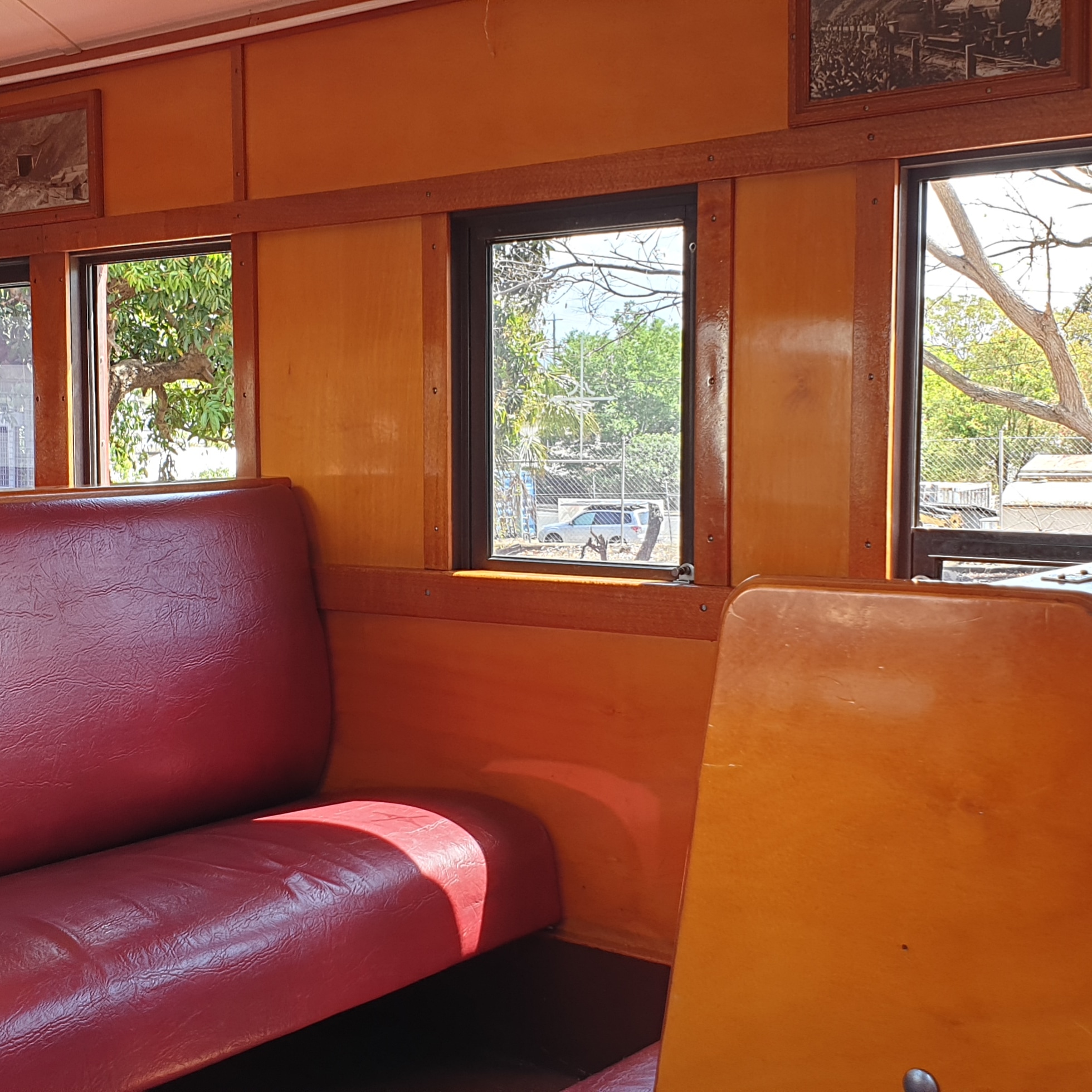
But this carriage, the polished wood that had shellac rather than varnish, highlighting the timber’s grain, the leather seats with generous padding, the curved ceilings with hanging lights, windows the could be opened and closed, allowing fresh air to circulate.
There was also a carriage with the passageway, and five or six separate compartments, each sitting six passengers. I remembered these well, having quite often ridden in one to work for some years when the country trains still ran.
It was always remarkable how a sight or a scent could trigger such memories.
For this carriage on this train, it used to ply the Gympie to Brooloo branch line from about 1915 onwards.
That was the history. It only went as far as Amamoor these days, it was still long enough to capture the sensation of riding the rails back in what is always referred to as the good old days, even if they were not.
Of course, literally, that might mean I’m standing at the top of a craggy cliff looking down at a bed of rocks. One that would hurt a lot if I landed there.
Metaphorically speaking, there are many connotations of what that precipice might be.
It might mean, in an argument, you’re about to say something you’ll regret or can’t take back.
It might mean you are one action away from turning into someone you never thought you’d become, and doing something you thought you’d never do.
It might mean you are one thought or idea away from solving a problem. Like the title of your next book. Or the formula to create a warp drive.
Or perhaps a simpler problem, like where the money is coming from to pay next week’s bills.
My precipice?
The next plotline for my current NaNoWriMo project.
And, no, I’m not usually one of these writers who plan the whole novel before writing it.
But for me, ideas like this just happen, and I usually write my stories in the same manner as it would be for the reader, not knowing what will happen next.
So…
It’s cold and wet at the top of the cliff…
Damn! Just had an idea. Got to take that leap of faith.
“Nothing Turns Out Quite in the Way You First Thought It Would”: Unraveling Agatha Christie’s Masterclass in Misdirection
“Nothing turns out quite in the way you first thought it would.”
If there is a single sentence that encapsulates the entire literary legacy of Agatha Christie, the Queen of Mystery, this is it. While not penned as a plot synopsis, this sentiment serves as the heartbeat of every locked-room murder, every gathering of wealthy suspects in a snowbound mansion, and every ticking-clock international conspiracy she ever crafted.
Christie didn’t just write whodunits; she wrote masterclasses in human expectation. She understood that the human brain loves patterns, leaps to conclusions, and is easily blinded by its own biases.
In this post, we’re going to explore why this philosophy defines Christie’s enduring genius, how she used it to trick generations of readers, and what this truth about life and storytelling can teach us beyond the final chapter.
The Anatomy of a Christie Twist: Playing with Perceptions
Why do we fall for Agatha Christie’s tricks time and time again? Because she understood the difference between seeing and observing—a distinction famously highlighted by her most brilliant creation, Hercule Poirot.
When we pick up a mystery novel, we enter a silent contract with the author. We want to solve the puzzle. We gather the clues, analyse the alibis, and try to outsmart the detective. But Christie’s brilliance lies in subverting the very tools we use to solve her puzzles.
1. The Obvious Suspect vs. The Unseen Observer
In classics like The Murder of Roger Ackroyd or And Then There Were None, Christie sets up an expectation. She presents a clear suspect or a traditional formula, luring us into a false sense of security. We think we know the rules of the game.
Then, she pulls the rug out from under us. The narrator is the killer. The person we thought was dead is actually running the show. The least likely person—often the unassuming governess, the quiet doctor, or the bumbling sidekick—turns out to be the mastermind.
2. Psychological Misdirection
Christie rarely relied on cheap tricks or hidden clues revealed only on the final page. Instead, she used psychological misdirection. She played on our societal prejudices and assumptions:
We assume the butler didn’t do it because that’s a cliché. (Until Christie makes the butler do it—or makes us suspect him so thoroughly that we miss the real culprit).
We dismiss the elderly spinster or the eccentric foreign detective as harmless.
We assume people act out of rational, linear motives (greed, jealousy), when in reality, human emotion is messy, contradictory, and entirely unpredictable.
By the time the truth is revealed in the drawing-room denouement, we are left staring at the page, muttering, “Of course! It was right there the whole time!”
Life Imitates Art: Why Nothing Ever Goes to Plan
Beyond the realm of fiction, Christie’s words—“Nothing turns out quite in the way you first thought it would”—resonate deeply with the human experience.
How often do we map out our lives with the precision of a Poirot timeline, only for reality to hand us a completely different script?
Career paths twist and turn into unexpected industries.
Relationships evolve in ways we never anticipated during the first flush of romance.
Challenges we dread turn out to be catalysts for our greatest growth, while moments we expected to bring pure joy sometimes carry unforeseen complexities.
We live in a constant state of plotting. We form hypotheses about our careers, our friends, and our futures. And yet, life is the ultimate mystery writer. It loves a good plot twist.
Rather than viewing this unpredictability with fear, Christie’s work invites us to embrace it. The thrill of a mystery isn’t knowing the ending from page one; it’s the journey of discovering that the truth is far more intricate, surprising, and fascinating than we ever could have imagined.
Lessons from the Queen of Crime
What can we take away from Agatha Christie’s philosophy of unexpected outcomes? Here are three ways to apply the Queen of Crime’s wisdom to daily life:
Question Your Assumptions: When faced with a problem, pause. Are you reacting to the facts, or are you reacting to your preconceived notions about how things should be?
Expect the Unexpected: Rigidity leads to frustration. When life deviates from your master plan, treat it not as a disaster, but as an intriguing plot twist.
Look for the Unseen Clues: Sometimes, the most important details in our lives are the ones we dismiss as insignificant. Pay attention to the quiet moments, the subtle shifts, and the perspectives you usually overlook.
The Enduring Magic of the Unexpected
Agatha Christie remains the best-selling fiction writer of all time for a reason. She tapped into a universal truth: we are endlessly fascinated by the gap between what we expect and what actually happens.
Whether she was writing about cyanide in a teacup or the winding, unpredictable nature of human fate, Christie reminded us that certainty is an illusion. The real magic happens in the twists, the turns, and the stunning realisations that change everything we thought we knew.
So, the next time life doesn’t turn out quite the way you thought it would, channel your inner Hercule Poirot. Adjust your lapel, embrace the complexity of the puzzle, and get ready for a brilliant twist.
What is the biggest plot twist life has handed you so far? Did it turn out better—or stranger—than you first thought? Let’s discuss in the comments below!
In the current times, the word needle is very polarising.
Will you have the vaccine, or not. Is one of the reasons simply because you hate needles?
I know I do and have a fear factor of 100%. Fortunately, I got very sick a few years ago and spent 10 days in the hospital, and was forced to have multiple needles every day.
Now it’s not so hard
But, I digress.
A needle is one of those things used in the medical profession mainly to deliver vaccines and medicine. It is a very small cylinder.
A needle can be used to sew up a garment or make repairs. This is a smallish piece of metal with an eyelet.
A needle can also be used to stitch up wounds, though it’s best you have a local anesthetic first.
Another way of using needles is to describe tiny icicles which hurt when they hit your face or your eyes. It is called a needle effect.
Then, another use of the word, is to needle someone, that is to say, bombard them with questions, or annoy them.
It’s a pointer on a dial, like that of a fuel gauge, which for me, always seems to hover just above empty. It can also be on a compass, where heading north is not always clear especially where magnets are nearby.
A fir tree’s leaves are more like needles.
You need one to play a record on a gramophone, not that they exist anymore.
Paradoxically it can also be used to describe a pointy rock or an obelisk-like “Cleopatra’s Needle”
David is a man troubled by a past he is trying to forget.
Susan is rebelling against a life of privilege and an exasperated mother who holds a secret that will determine her daughter’s destiny.
They are two people brought together by chance. Or was it?
When Susan discovers her mother’s secret, she goes in search of the truth that has been hidden from her since the day she was born.
When David realizes her absence is more than the usual cooling off after another heated argument, he finds himself being slowly drawn back into his former world of deceit and lies.
Then, back with his former employers, David quickly discovers nothing is what it seems as he embarks on a dangerous mission to find Susan before he loses her forever.
To write a private detective serial has always been one of the items at the top of my to-do list, though trying to write novels and a serial, as well as a blog, and maintain a social media presence, well, you get the idea.
But I made it happen, from a bunch of episodes I wrote a long, long time ago, used these to start it, and then continued on, then as now, never having much of an idea where it was going to end up, or how long it would take to tell the story.
That, I think, is the joy of ad hoc writing, even you, as the author, have as much of an idea of where it’s going as the reader does.
It’s basically been in the mill since 1990, and although I finished it last year, it looks like the beginning to end will have taken exactly 30 years. Had you asked me 30 years ago if I’d ever get it finished, the answer would be maybe?
My private detective, Harry Walthenson
I’d like to say he’s from that great literary mould of Sam Spade, or Mickey Spillane, or Philip Marlowe, but he’s not.
But I’ve watched Humphrey Bogart play Sam Spade with much interest, and modelled Harry and his office on it. Similarly, I’ve watched Robert Micham play Phillip Marlow with great panache, if not detachment, and added a bit of him to the mix.
Other characters come into play, and all of them, no matter what period they’re from, always seem larger than life. I’m not above stealing a little of Mary Astor, Peter Lorre or Sidney Greenstreet, to breathe life into beguiling women and dangerous men alike.
Then there’s the title, like
The Case of the Unintentional Mummy – this has so many meanings in so many contexts, though I imagine that back in Hollywood in the ’30s and ’40s, this would be excellent fodder for Abbott and Costello
The Case of the Three-Legged Dog – Yes, I suspect there may be a few real-life dogs with three legs, but this plot would involve something more sinister. And if made out of plaster, yes, they’re always something else inside.
But for mine, to begin with, it was “The Case of the …”, because I had no idea what the case was going to be about, well, I did, but not specifically.
Then I liked the idea of calling it “The Case of the Brothers’ Revenge” because I began to have a notion there was a brother no one knew about, but that’s stuff for other stories, not mine, so then it went the way of the others.
Now it’s called ‘A Case of Working With the Jones Brothers’, finished the first three drafts, and I am at the editor for the last reading.
I have high hopes of publishing it in mid-2026. It even has a cover.
“Nothing Turns Out Quite in the Way You First Thought It Would”: Unraveling Agatha Christie’s Masterclass in Misdirection
“Nothing turns out quite in the way you first thought it would.”
If there is a single sentence that encapsulates the entire literary legacy of Agatha Christie, the Queen of Mystery, this is it. While not penned as a plot synopsis, this sentiment serves as the heartbeat of every locked-room murder, every gathering of wealthy suspects in a snowbound mansion, and every ticking-clock international conspiracy she ever crafted.
Christie didn’t just write whodunits; she wrote masterclasses in human expectation. She understood that the human brain loves patterns, leaps to conclusions, and is easily blinded by its own biases.
In this post, we’re going to explore why this philosophy defines Christie’s enduring genius, how she used it to trick generations of readers, and what this truth about life and storytelling can teach us beyond the final chapter.
The Anatomy of a Christie Twist: Playing with Perceptions
Why do we fall for Agatha Christie’s tricks time and time again? Because she understood the difference between seeing and observing—a distinction famously highlighted by her most brilliant creation, Hercule Poirot.
When we pick up a mystery novel, we enter a silent contract with the author. We want to solve the puzzle. We gather the clues, analyse the alibis, and try to outsmart the detective. But Christie’s brilliance lies in subverting the very tools we use to solve her puzzles.
1. The Obvious Suspect vs. The Unseen Observer
In classics like The Murder of Roger Ackroyd or And Then There Were None, Christie sets up an expectation. She presents a clear suspect or a traditional formula, luring us into a false sense of security. We think we know the rules of the game.
Then, she pulls the rug out from under us. The narrator is the killer. The person we thought was dead is actually running the show. The least likely person—often the unassuming governess, the quiet doctor, or the bumbling sidekick—turns out to be the mastermind.
2. Psychological Misdirection
Christie rarely relied on cheap tricks or hidden clues revealed only on the final page. Instead, she used psychological misdirection. She played on our societal prejudices and assumptions:
We assume the butler didn’t do it because that’s a cliché. (Until Christie makes the butler do it—or makes us suspect him so thoroughly that we miss the real culprit).
We dismiss the elderly spinster or the eccentric foreign detective as harmless.
We assume people act out of rational, linear motives (greed, jealousy), when in reality, human emotion is messy, contradictory, and entirely unpredictable.
By the time the truth is revealed in the drawing-room denouement, we are left staring at the page, muttering, “Of course! It was right there the whole time!”
Life Imitates Art: Why Nothing Ever Goes to Plan
Beyond the realm of fiction, Christie’s words—“Nothing turns out quite in the way you first thought it would”—resonate deeply with the human experience.
How often do we map out our lives with the precision of a Poirot timeline, only for reality to hand us a completely different script?
Career paths twist and turn into unexpected industries.
Relationships evolve in ways we never anticipated during the first flush of romance.
Challenges we dread turn out to be catalysts for our greatest growth, while moments we expected to bring pure joy sometimes carry unforeseen complexities.
We live in a constant state of plotting. We form hypotheses about our careers, our friends, and our futures. And yet, life is the ultimate mystery writer. It loves a good plot twist.
Rather than viewing this unpredictability with fear, Christie’s work invites us to embrace it. The thrill of a mystery isn’t knowing the ending from page one; it’s the journey of discovering that the truth is far more intricate, surprising, and fascinating than we ever could have imagined.
Lessons from the Queen of Crime
What can we take away from Agatha Christie’s philosophy of unexpected outcomes? Here are three ways to apply the Queen of Crime’s wisdom to daily life:
Question Your Assumptions: When faced with a problem, pause. Are you reacting to the facts, or are you reacting to your preconceived notions about how things should be?
Expect the Unexpected: Rigidity leads to frustration. When life deviates from your master plan, treat it not as a disaster, but as an intriguing plot twist.
Look for the Unseen Clues: Sometimes, the most important details in our lives are the ones we dismiss as insignificant. Pay attention to the quiet moments, the subtle shifts, and the perspectives you usually overlook.
The Enduring Magic of the Unexpected
Agatha Christie remains the best-selling fiction writer of all time for a reason. She tapped into a universal truth: we are endlessly fascinated by the gap between what we expect and what actually happens.
Whether she was writing about cyanide in a teacup or the winding, unpredictable nature of human fate, Christie reminded us that certainty is an illusion. The real magic happens in the twists, the turns, and the stunning realisations that change everything we thought we knew.
So, the next time life doesn’t turn out quite the way you thought it would, channel your inner Hercule Poirot. Adjust your lapel, embrace the complexity of the puzzle, and get ready for a brilliant twist.
What is the biggest plot twist life has handed you so far? Did it turn out better—or stranger—than you first thought? Let’s discuss in the comments below!
By the time I returned to the Savoie, the rain had finally stopped, and there was a streak of blue sky to offer some hope that the day would improve.
The ship was not crowded, the possibility of bad weather perhaps holding back potential passengers. Of those I saw, a number of them would be aboard for the lunch by Phillippe Chevrier. I thought about it, but the Concierge had told me about several restaurants in Yvoire and had given me a hand-drawn map of the village. I think he came from the area because he spoke with the pride and knowledge of a resident.
I was looking down from the upper deck observing the last of the boarding passengers when I saw a woman, notable for her red coat and matching shoes, making a last-minute dash to get on board just before the gangway was removed. In fact, her ungainly manner of boarding had also captured a few of the other passengers’ attention. Now they would have something else to talk about, other than the possibility of further rain.
I saw her smile at the deckhand, but he did not smile back. He was not impressed with her bravado, perhaps because of possible injury. He looked at her ticket, then nodded dismissively and went back to his duties in getting the ship underway. I was going to check the departure time, but I, like the other passengers, had my attention diverted to the woman in red.
From what I could see, there was something about her. It struck me when the light caught her as she turned to look down the deck, giving me a perfect profile. I was going to say she looked foreign, but here, as in almost anywhere in Europe, that described just about everyone. Perhaps I was just comparing her to Phillipa, so definitively British, whereas this woman was very definitely not.
She was perhaps in her 30’s, slim or perhaps the word I’d use was lissom, and had the look and manner of a model. I say that because Phillipa had dragged me to most of the showings, whether in Milan, Rome, New York, London, or Paris. The clothes were familiar, and in the back of my mind, I had a feeling I’d seen her before.
Or perhaps, to me, all models looked the same.
She looked up in my direction, and before I could divert my eyes, she locked on. I could feel her gaze boring into me, and then it was gone as if she had been looking straight through me. I remained out on deck as the ship got underway, watching her disappear inside the cabin. My curiosity was piqued, so I decided to keep an eye out for her.
I could feel the coolness of the air as the ship picked up speed, not that it was going to be very fast. With stops, the trip would take nearly two hours to get to my destination. It would turn back almost immediately, but I was going to stay until the evening when it returned at about half eight. It would give me enough time to sample the local fare and take a tour of the medieval village.
Few other passengers ventured out on the deck, most staying inside or going to lunch. After a short time, I came back down to the main deck and headed forward. I wanted to clear my head by concentrating on the movement of the vessel through the water, breathing in the crisp, clean air, and letting the peacefulness of the surroundings envelope me.
It didn’t work.
I knew it wouldn’t be long before I started thinking about why things hadn’t worked and what part I played in it. And the usual question that came to mind when something didn’t work out. What was wrong with me?
I usually blamed it on my upbringing.
I had one of those so-called privileged lives, a nanny till I was old enough to go to boarding school, then sent to the best schools in the land. There I learned everything I needed to be the son of a Duke, or, as my father called it in one of his lighter moments, nobility in waiting.
Had this been five or six hundred years ago, I would have needed to have sword and jousting skills, or if it had been a few hundred years later, a keen military mind. If nothing else, I could ride a horse and go on hunts, or did until they became not the thing to do.
I learned six languages, and everything I needed to become a diplomat in the far-flung British Empire, except the Empire had become the Commonwealth, and then, when no one was looking, Britain’s influence in the world finally disappeared. I was a man without a cause, without a vocation, and no place to go.
Computers were the new vogue, and I had an aptitude for programming. I guess that went hand in hand with mathematics, which, although I hated the subject, I excelled in. Both I and another noble outcast used to toss ideas around in school, but when it came to the end of our education, he chose to enter the public service, and I took a few of those ideas we had mulled over and turned them into a company.
About a year ago, I was made an offer I couldn’t refuse. There were so many zeroes on the end of it I just said yes, put the money into a very grateful bank, and was still trying to come to terms with it.
Sadly, I still had no idea what I was going to do with the rest of my life. My parents had asked me to come back home and help manage the estate, and I did for a few weeks. It was as long as it took for my parents to drive me insane.
Back in the city, I spent a few months looking for a mundane job, but there were very few that suited my qualifications, and the rest I think I intimidated simply because of who I was. In that time, I’d also featured on the cover of the Economist and, through my well-meaning accountant, started involving myself with various charities, earning the title ‘philanthropist’.
And despite all of this exposure, even making one of those ubiquitous ‘eligible bachelor’ lists, I still could not find ‘the one’, the woman I wanted to spend the rest of my life with. Phillipa seemed to fit the bill, but in time, she proved to be a troubled soul with ‘Daddy’ issues. I knew that in building a relationship, compromise was necessary, but with her, in the end, everything was a compromise, and what had happened was always going to be the end result.
It was perhaps a by-product of the whole nobility thing. There was a certain expectation I had to fulfil, to my peers, contemporaries, parents and family, and those who either liked or hated what it represented. The problem was, I didn’t feel like I belonged. Not like my friend from schooldays, and now obscure acquaintance, Sebastian. He had been elevated to his Dukedom early when his father died when he was in his twenties. He had managed to fade from the limelight and was rarely mentioned either in the papers or the gossip columns. He was one of the lucky ones.
I had managed to keep a similarly low profile until I met Phillipa. From that moment, my obscurity disappeared. It was, I could see now, part of a plan put in place by Phillipa’s father, a man who hogged the limelight with his daughter, to raise the profile of the family name and through it their businesses. He was nothing if not the consummate self-advertisement.
Perhaps I was supposed to be the last piece of the puzzle, the attachment to the establishment, that link with a class of people he would not normally get in the front door. There was nothing refined about him or his family, and more than once I’d noticed my contemporaries cringe at the mention of his name, or any reference of my association with him.
Yet could I truthfully say I really wanted to go back to the obscurity I had before Phillipa? For all her faults, there were times when she had been fun to be with, particularly when I first met her, when she had a certain air of unpredictability. That had slowly disappeared as she became part of her father’s plan for the future. She just failed to see how much he was using her.
Or perhaps, over time, I had become cynical.
I thought about calling her. It was one of those moments of weakness when I felt alone, more alone than usual.
I diverted my attention back to my surroundings and the shoreline. Out of the corner of my eye, I could see the woman in the red coat, making a move. The red coat was like a beacon, a sort of fire engine red. It was not the sort of coat most of the women I knew would wear, but on her, it looked terrific. In fact, her sublime beauty was the other attribute that was distinctly noticeable, along with the fact that her hair was short rather than long and jet-black.
I had to wrench my attention away from her.
A few minutes later, several other passengers came out of the cabin for a walk around the deck, perhaps to get some exercise, perhaps checking up on me, or perhaps I was being paranoid. I waited till they passed on their way forward, and I turned and headed aft.
I watched the wake sluicing out from under the stern for a few minutes before retracing my steps to the front of the ship, and there I stood against the railing, watching the bow carve its way through the water. It was almost mesmerising. There, I emptied my mind of thoughts about Phillipa and thoughts about the woman in the red coat.
Until a female voice behind me said, “Having a bad day?”
I started, caught by surprise, and slowly turned. The woman in the red coat had somehow got very close to me without my realising it. How did she do that? I was so surprised I couldn’t answer immediately.
“I do hope you are not contemplating jumping. I hear the water is very cold.”
Closer up, I could see what I’d missed when I saw her on the main deck. There was a slight hint of Chinese, or Oriental, in her, particularly around the eyes, and of her hair, which was jet black. An ancestor twice or more removed had left their mark, not in a dominant way, but more subtly, and easily missed except from a very short distance away, like now.
Other than that, she was quite possibly Eastern European, perhaps Russian, though that covered a lot of territory. The incongruity of it was that she spoke with an American accent and was fluent enough for me to believe English was her first language.
Usually, I could ‘read’ people, but she was a clean slate. Her expression was one of amusement, but with cold eyes. My first thought, then, was to be careful.
“No. Not yet.” I coughed to clear my throat because I could hardly speak. And blushed, because that was what I did when confronted by a woman, beautiful or otherwise.
The amusement gave way to a hint of a smile that brightened her demeanour as a little warmth reached her eyes. “So that’s a maybe. Should I change into my lifesaving gear, just in case?”
It conjured up a rather interesting image in my mind until I reluctantly dismissed it.
“Perhaps I should move away from the edge,” I said, moving sideways until I was back on the main deck, a few feet further away. Her eyes had followed me, and when I stopped, she turned to face me again. She did not move closer.
I realised then she had removed her beret and it was in her left side coat pocket. “Thanks for your concern …?”
“Zoe.”
“Thanks for your concern, Zoe. By the way, my name is John.”
She smiled again, perhaps in an attempt to put me at ease. “I saw you earlier, you looked so sad, I thought …”
“I might throw myself overboard?”
“An idiotic notion, I admit, but it is better to be safe than sorry.”
Then she tilted her head to one side, then the other, looking intently at me. “You seem to be familiar. Do I know you?”
I tried to think of where I may have seen her before, but all I could remember was what I’d thought earlier when I first saw her; she was a model and had been at one of the showings. If she were, it would be more likely she would remember Phillipa, not me. Phillipa always had to sit in the front row.
“Probably not.” I also didn’t mention the fact that she may have seen my picture in the society pages of several tabloid newspapers because she didn’t look the sort of woman who needed a daily dose of the comings and goings, and, more often than not, scandal associated with so-called celebrities.
She gave me a look, one that told me she had just realised who I was. “Yes, I remember now. You made the front cover of the Economist. You sold your company for a small fortune.”
Of course. She was not the first who had recognised me from that cover. It had raised my profile considerably, but not Sternhaven’s. That article had not mentioned Phillipa or her family. I suspect Grandmother had something to do with that, and it was, now I thought about it, another nail in the coffin that was my relationship with Phillipa.
“I wouldn’t say it was a fortune, small or otherwise, just fortunate.” Each time, I found myself playing down the wealth aspect of the business deal.
“Perhaps then, as the journalist wrote, you were lucky. It is not, I think, a good time for internet-based companies.”
The latter statement was an interesting fact, one she read in the Financial Times, which had made that exact comment recently.
“But I am boring you.” She smiled again. “I should be minding my own business and leaving you to your thoughts. I am sorry.”
She turned to leave and took a few steps towards the main cabin.
“You’re not boring me,” I said, thinking I was letting my paranoia get the better of me. It had been Sebastian, on learning of my good fortune, who had warned me against ‘a certain element here and abroad’ whose sole aim would be to separate me from my money. He was not very subtle when he described their methods.
But I knew he was right. I should have let her walk away.
She stopped and turned around. “You seem nothing like the man I read about in the Economist.”
A sudden and awful thought popped into my head. Those words were part of a very familiar opening gambit. “Are you a reporter?”
I was not sure if she looked surprised or amused. “Do I look like one?”
I silently cursed myself for speaking before thinking, and then immediately ignored my own admonishment. “People rarely look like what they are.”
I saw the subtle shake of the head and expected her to take her leave. Instead, she astonished me.
“I fear we have got off on the wrong foot. To be honest, I’m not usually this forward, but you seemed like you needed cheering up when probably the opposite is true. Aside from the fact that this excursion was probably a bad idea. And,” she added with a little shrug, “perhaps I talk too much.”
I was not sure what I thought of her after that extraordinary admission. It was not something I would do, but it was an interesting way to approach someone and have them ignore their natural instinct. I would let Sebastian whisper in my ear for a little longer and see where this was going.
“Oddly enough, I was thinking the same thing. I was supposed to be travelling with my prospective bride. I think you can imagine how that turned out.”
“She’s not here?”
“No.”
“She’s in the cabin?” Her eyes strayed in that direction for a moment, then came back to me. She seemed surprised I might be travelling with someone.
“No. She is back in England, and the wedding is off. So is the relationship. She dumped me by text.”
OK, why was I sharing this humiliating piece of information with her? I still couldn’t be sure she was not a reporter.
She motioned to an empty seat, back from the edge. No walking the plank today. She moved towards it and sat down. She showed no signs of being cold, nor interested in the breeze upsetting her hair. Phillipa would be having a tantrum about now, being kept outside, and freaking out over what the breeze might be doing to her appearance.
I wondered, if only for a few seconds, if she used this approach with anyone else. I guess I was a little different, a seemingly rich businessman alone on a ferry on Lake Geneva, contemplating the way his life had gone so completely off track.
She watched as I sat at the other end of the bench, leaving about a yard between us. After I leaned back and made myself as comfortable as I could, she said, “I have also experienced something similar, though not by text message. It is difficult, the first few days.”
“I saw it coming.”
“I did not.” She frowned, a sort of lifeless expression taking over, perhaps brought on by the memory of what had happened to her. “But it is done, and I moved on. Was she the love of your life?”
OK, that was unexpected.
When I didn’t answer, she said, “I am sorry. Sometimes I ask personal questions without realising what I’m doing. It is none of my business.” She shivered. “Perhaps we should go back inside.”
She stood and held out her hand. Should I take it and be drawn into her web? I thought of Sebastian. What would he do in this situation?
I took her hand in mine and let her pull me gently to my feet. “Wise choice,” she said, looking up at the sky.
This story is now on the list to be finished so over the new few weeks, expect a new episode every few days.
The reason why new episodes have been sporadic, there are also other stories to write, and I’m not very good at prioritizing.
But, here we are, a few minutes opened up and it didn’t take long to get back into the groove.
Things are about to get complicated…
I was straight back to the scenario where O’Connell was expendable after performing his role, and that Anna was cleaning up before leaving, or she had already gone.
O’Connell had no doubt told her about the Peasdale address, and the fact he’d told me, and she might have assumed that there would be a window of opportunity to get some belongings at her flat.
Would she be there?
I switched off the light, backtracked to the door, and then went back outside into the passage. Jennifer appeared beside me.
“O’Connell’s in there, dead. Shot in the head.”
“Your friend?”
I’m not sure how she came up with the designation, ‘Your Friend’, but after the shortened version of my time with Josephine, and the fact we had a hotel room together, could have inspired such a thought.
I went to her flat and listened at the door.
Nothing. There was no light showing under the door, so this could be a fruitless exercise. The same operation as before, Jennifer waited outside, and I would go in. It didn’t take as long to pick her lock. Practise.
I opened the door, the gun in hand, and went slowly into the room.
There was a glow from what might be a night light coming from the end of the passage where the bedroom was.
She was in, or she forgot to turn off the light.
It was also not so dark in this flat, with several pilot lights casting red, blue or green hues over the furniture and floor. It took a few seconds for my eyes to adjust.
“Drop the gun, Sam.”
Josephine, now just discernible across the room, a gun of her own aimed at me.
I shot her. Without hesitation.
She was taken utterly by surprise, dropping her own weapon and spinning sideways into the arm of the chair, lost balance and crashed down to the floor.
Jennifer was in the door and had it closed behind her, and switched on the light. We were both blinded for a second, enough time for Josephine to reach for her weapon which hadn’t fallen very far from her and for Jennifer to shoot her gun hand.
I remembered in that instant, that Jennifer scored the highest in gun training. She would be ‘deadly’ Maury had said.
“OK, enough, what the hell was that for?” Jo said, stretching out on the floor and holding the hand that Jennifer shot.
“You played me, Anna.”
“Operation necessity. I had to know what you were up to. O’Connell said you were going to be a problem.”
“Did you kill him?”
“Me? No. He was dead when I got here. We were here just to get our away bags. How did you guess?”
“Lucky. I was going to the other flat, but I figured it was too new for O’Connell to probably tell you. He may have been planning to double-cross you too. It seems the way of things in this op. Where are the USBs?”
“What makes you think I have them?”
“The fact you just said them, when all we knew for sure was there was only one. I assume you have one each for safety’s sake, and coming back here, one or other of you was going to pull a double cross.”
“Until someone else got another idea. Right now, you have a window of opportunity, Sam. A big payday, for the two of you.”
“Tempting, but no. I’m not in this for the money.”
“Then you’re a fool. No one does anything except line their own pockets. If you give the USBs to your chief, what do you think they’re going to do? O’Connell got five million, the person who gave him the money will get ten at the very least. They’re not interested in saving the world, Sam.”
She was probably right.
I looked at Jennifer. “Are you in this for the money, Jennifer?”
“I just want my old life back.”
“Then keep an eye on the door, we’ll be having visitors very soon. Anyone who comes through it using a key, disarm them. Don’t hesitate.”
Back to Anna. “Where are they? Bear in mind I have no qualms about shooting you until you do tell me, so make it easy on yourself, because the next thing I shoot at is your knees.”
A moment’s thought, and a shot into the wall that just missed her head, decided the matter.
“In the backpack pocket.”
She nodded her head in the direction of the backpack sitting on the kitchen bench.
I went over and in the third pocket I opened there were two USBs in a plastic bag.
“What are you going to do with them?”
“Destroy them. The world doesn’t need any more pandemics any time soon.” I went over to the microwave oven and put them in and set it running.