In a word: Line

The English language has some marvelous words that can be used so as to have any number of meanings

For instance,

Draw a line in the sand

We would all like to do this with our children, our job, our relationships, but for some reason, the idea sounds really good in our heads, but it never quite works out in reality. What does it mean, whatever it is, this I’d where it ends or changes because it can’t keep going the way it is.

Inevitably it leads to,

You’ve crossed the line

Which at some point in our lives, and particularly when children, we all do a few times until, if we’re lucky we learn where that line is. It’s usually considered 8n tandem with pushing boundaries.

Of course, there is

A line you should never cross

And I like to think we all know where that is. Unfortunately, some do not and often find their seemingly idyllic life totally shattered beyond repair. An affair from either side of a marriage or relationship can do that.

You couldn’t walk a straight line if you tried

While we might debate what straight might mean in this context, for this adaptation it means staying on the right side of legality. Some people find a life of crime more appealing than doing honest days work.

This goes hand in hand with,

You’re spinning me a line

Which means you are being somewhat loose with the truth, perhaps in explaining where you’ve been and what you’ve been doing. I think sometimes liars forget they need to have good memories.

Then there are the more practical uses of the word, such as

I have a new line of products

Is that a new fishing line?

Those I think most of us get, but it’s the more ambiguous that we have trouble with. Still, ambiguity is a writer’s best friend and we can make up a lot of stuff from just using one word.

“The Things We Do For Love” – Coming soon


Is love the metaphorical equivalent to ‘walking the plank’; a dive into uncharted waters?

For Henry the only romance he was interested in was a life at sea, and when away from it, he strived to find sanctuary from his family and perhaps life itself.  It takes him to a small village by the sea, a place he never expected to find another just like him, Michelle, whom he soon discovers is as mysterious as she is beautiful.

Henry had long since given up the notion of finding romance, and Michelle couldn’t get involved for reasons she could never explain, but in the end both acknowledge that something happened the moment they first met.  

Plans were made, plans were revised, and hopes were shattered.

A chance encounter causes Michelle’s past to catch up with her, and whatever hope she had of having a normal life with Henry, or anyone else, is gone.  To keep him alive she has to destroy her blossoming relationship, an act that breaks her heart and shatters his.

But can love conquer all?

It takes a few words of encouragement from an unlikely source to send Henry and his friend Radly on an odyssey into the darkest corners of the red light district in a race against time to find and rescue the woman he finally realizes is the love of his life.

The cover, at the moment, looks like this:

lovecoverfinal1

Is love the metaphorical equivalent to ‘walking the plank’; a dive into uncharted waters?

For Henry the only romance he was interested in was a life at sea, and when away from it, he strived to find sanctuary from his family and perhaps life itself.  It takes him to a small village by the sea, s place he never expected to find another just like him, Michelle, whom he soon discovers is as mysterious as she is beautiful.

Henry had long since given up the notion of finding romance, and Michelle couldn’t get involved for reasons she could never explain, but in the end both acknowledge that something happened the moment they first met.  

Plans were made, plans were revised, and hopes were shattered.

A chance encounter causes Michelle’s past to catch up with her, and whatever hope she had of having a normal life with Henry, or anyone else, is gone.  To keep him alive she has to destroy her blossoming relationship, an act that breaks her heart and shatters his.

But can love conquer all?

It takes a few words of encouragement from an unlikely source to send Henry and his friend Radly on an odyssey into the darkest corners of the red light district in a race against time to find and rescue the woman he finally realizes is the love of his life.

The cover, at the moment, looks like this:

lovecoverfinal1

Writing about writing a book – Day 16

As we now know Bill realizes that he had been captured and interrogated by someone, ostensibly Chinese, but not exactly from the Viet Kong

I’ve been pondering how Bill ends up in the hands of the Chinese, well, I know how he does, and this needs to be put down.

Some pieces of the puzzle are coming together.

”’

Davenport arrived at the airstrip where I was waiting in a makeshift building, with windows, easy chairs, a self-serve bar, and best of all air conditioning.  Waiting for the chopper that was bringing in my replacement from Singapore airport.

He didn’t normally come to see us off so I thought it either odd or just a change of heart.  He had brought the shiny Cadillac, an ostentatious piece of Americana that never failed to capture the local’s imagination.

Davenport was, I soon discovered, a man who liked to impress upon the world how great America was.  I hadn’t the heart to tell him it failed on me.

He had crisp fatigues on and looked as though he had just stepped out of the shower, very clean, very cool, and very refreshed.  The car’s air-conditioning would have helped.  We all got that first ride from the strip to the camp in that car, and it was memorable, to say the least.

The driver stayed in the car, engine running, as he stepped into the lounge.  “Chandler.”

“Sir.”  No snapping to attention, neither of us was in uniform.

“There’s been a change of plans.”

“Sir.”  This didn’t sound very good.

“Your replacement is not coming.  Some trouble on the plane over.  Can’t spare a man so you will have to fill in.  I’m sorry.”

I went to say that I’d done my rotation, but the look on his face told me it would fall on deaf ears, so instead, I shrugged, let the driver, who had appeared out of the car as if on cue, collect my case, and followed Davenport out to the car.

It was definitely cooler in the car.  Davenport slid in the other side, the driver closing his door, then got in himself.  I had to close my own.  We headed back towards the camp slowly.

“We need 6 men for this op, Bill.  I’ll find some way of making this up to you.”

I shrugged.  “If you say so.”

I’d been looking forward to getting out of the jungle and getting back to civilization, as well as Ellen, who had been waiting patiently for the last six months.  She would not be very happy when I finally got to tell her.

“Oh, but the way, I took the liberty of calling your wife and apologizing on your behalf and said you’d probably be another week at the most.  She didn’t seem to mind.  She sounds like a nice lady.”

“She is.  She has to put up with me.”

“Yes.  We all have that problem.”

I listened to the hum of the air conditioning, the only other sound inside the car.  Usually, Davenport had a symphony playing over the radio, but not today.  He seemed different, more aloof, but, then, after the altercation, I had with him recently, we hadn’t spoken much after that.  Not unless we had to.

“The job isn’t difficult,” he said when we were nearing the compound.  “Another prison camp, and this time the intel is solid.  Buggers were careless and we’ve got some pictures.  The only problem is getting there.  It’s going to be a bit of a hike.”

Another of his understatements.  I could remember the last ‘bit of a hike’.  “When do we leave?”

“First light tomorrow.  Chopper to the drop zone then a day’s march to the camp.  RV at the drop zone from day 4 till you get there.”

“Who’s in charge?”  I’d run the last operation so I was hoping it would carry forward.

“If you’d been staying instead of being a last-minute replacement, it would have been you.  Instead, we had to bring in a couple of specialists who have been on the ground here quite some time.  They know the terrain and the people.”

New guys.  I hated new guys.  Especially those who purport to have experience on the ground.  Invariably they didn’t and I’d had words with Davenport more than once about it, especially when we had such a high attrition rate.  I believed it was only a miracle that I had lasted this long, and I was now tempting providence this time around.

“I hope they are better than the last two.”

“They are.  I picked them myself.  At least you will be there to keep them on the straight and narrow.

Which was exactly what I didn’t want.

Damn.

Back at the compound, I dragged myself back to my old quarters, hoping they hadn’t given away my billet just yet.  It was a hut if you could call it that, which had seen better days, but it kept the rain out.

I shared it with another soldier, or ex, I didn’t really know, and he was not the sort of man you asked, and even less talkative than most.  I knew his name was Barry McDougall, that he was Scottish, he didn’t wear a kilt and had killed men with his bare hands, one in a barroom fight.

Allegedly.

I was not surprised.  He was six feet six inches tall, all muscle, and always surly, and unlike many of the English that had come and gone, didn’t complain about the heat.

I dumped my bag on the locker at the end of the bed and sat in one of the two well worn easy chairs.  Barry was in the other, reading.

He lowered the paper and looked at me.  “Back, huh?”

“Yes.”

“Miss the chopper?”

“No.”

“Beer’s cold.”

“Thanks.”

I got up and went to the fridge.  One of the perks of the job.  An endless supply of cold beer.

“Get me one too.”

I did and passed it to him, the sat down again.  He took the beer and went back to his paper.

“Seen the new guys,” I asked.

A voice from behind the paper, “Yes.”

“Any good?”

“No.”

“Another fun run in the jungle then?”

“Looks like it.”

We drank in silence.  What more could be said?

There is more but I have to let the words jumble around in my head while I sleep.  More on this tomorrow!

…

© Charles Heath 2018-2023

Do you ever feel like you’re teetering on the edge of a precipice?

I am teetering on the edge of a precipice.

Of course, literally, that might mean I’m standing at the top of a craggy cliff looking down at a bed of rocks.

One that would hurt a lot if I landed there.

But there are many ideas of what that precipice might be, metaphorically.

It might mean, in an argument, you’re about to say something you’ll regret or can’t take back.

It might mean you are one action away from turning your parent. or someone else, into a green-eyed monster, and do something you thought you’d never do.

Pushing them to the precipice.

It might mean you are one thought or idea away from solving a problem.

Like the title of your next book.

Or the formula to create a warp drive.

Or perhaps a simpler problem like where the money is coming from to pay next weeks bills.

My precipice?

The next plotline for my current NaNoWriMo project.

And, no, I’m not usually one of these writers who plan the whole novel before writing it.

But ideas like this, they just happen.

I usually write my stories in the same manner it would be for the reader, not knowing what will happen next, but it’s hard not to.

It’s cold and wet at the top of the cliff …

Damn!  Just had an idea.  Got to go.

The cinema of my dreams – I always wanted to write a war story – Episode 52

For a story that was conceived during those long boring hours flying in a steel cocoon, striving to keep away the thoughts that the plane and everyone in it could just simply disappear as planes have in the past, it has come a long way.

Whilst I have always had a fascination with what happened during the Second world war, not the battles or fighting, but in the more obscure events that took place, I decided to pen my own little sidebar to what was a long and bitter war.

And, so, it continues…

…

Carlo had returned, as promised, just over an hour later, and over the map, he showed where the explosives had been placed, under the tank, and where the men were camped.

They were set to go off in the early morning, giving them several hours before they had to assemble for the assault.  According to Carlo, the explosives would neutralise the tank and immobilise about 30 of the enemy.

That was only one problem.

The other was the men that the new commandant had sent out of the castle to presumably hunt down Atherton and whatever resistance was left.  They were noisy and failed to see Carlo following them, listening to their conversation.

It was obvious they were not trained for stealth.

The first mission was to take those men out of the equation.

Then there was a third problem, the last of the resistance in the castle, those left behind by Fernando, had taken all the prisoners out of the castle and executed them.

Carlo had then killed those men and left them with the bodies of the murdered defectors, and, unlike his German counterparts, he had undertaken it swiftly and silently.

Our force of eight moved quietly in the direction Carlo last saw the soldiers heading, he assumed towards the underground wine cellar where Martina had taken me after I had been captured.

We managed to hide Chiara in a spot where the enemy if they came to the church, would not find her.  The plan was to find them before they got to or left the cellar.

Of course, like any plan, it could always be guaranteed to go wrong.

The last time I went from the cellar to the church, it had been by an old truck, and by my estimation, it would take us about half an hour by foot.  It might, by the time we got there, and found them missing, make us late for the main event.

I looked at my watch about a dozen times on that trek, fretting about time which for some odd reason seemed to be passing faster than usual.

Then, Carlo was waving his hands, a signal I assumed was to tell us to stop.  We were not far from the cellar.  I recognised the landmark used to find it.  We formed up in a line just inside the thicket line, a bunch of overgrown bushes providing excellent cover.

Beyond that, we could see intermittent flashes of light from torches.  The soldiers were making no attempt to hide their presence.

Blinky was beside me.  “What the hell are they playing at?”

“Perhaps they thought if they made a bold attack we’d wilt under the surprise.”

“Or just shoot them.  Why are we waiting?”

“Carlo is ascertaining their position.”

“You trust this Carlo.  He could be leading us into a trap up at the castle.”

I was surprised he’d taken this long to express his reservations.  “Don’t be surprised if he kills everyone in the German squad himself.  His home was in that castle.  It was his life.  They killed his friends.  He is not forgiving.”

Jack chose that moment to return from wherever he’d gone soon after we reached the thicket.  He had come with me from the church, and I wondered if he knew just how dangerous it could be.  He flopped down beside me, waiting.

“What’s with the dog?”

“We found each other at an ambush.  Been with me ever since.  I have no idea if he’s German, or Italian, or if he understands English.  But there’s no questioning his loyalty, he helped me take down Jackerby.

“Well, just as long as I don’t trip over him in the fray of battle.”

We watched the German soldiers who remained on sentry duty when I thought the entrance to the cellar was, and I assumed the others were down in the cellar.

It was what Carlo said was the case when he returned.

Ten in the cellar, two on guard, though I would not call what they were doing sentry duty.  They were smoking and talking, guns leaning up against a tree.

Easy shots for our sniper who at this moment had both in his sights.

Carlo kneeled beside me and said, “Cover your ears, pass it on.”

I did, and thirty seconds later there was a huge explosion followed by a storm of soil particles falling on his.  The sniper, in the instance following the boom, shot the two sentries.

German forces were eliminated.

The only issue was the castle was now alerted to our presence, so our arrival at the castle was going to be a little more difficult.

…

© Charles Heath 2021-2023

“The Document” – a thirty-day revision – Day 15

This book has been written for some time and the manuscript was sitting in a box with half a dozen others gathering dust and not quite as complete, so this month it is going to get the makeover, a first draft for the editor.

And so it begins…

…

Half way there

…

Yes, 15 days down and 15 days to go.

At this point my hand is starting to cramp from the toils of writing, yes, I’m one of those writers who often puts words to paper longhand.

Two weeks is a long time, but I think this sort of exercise is what’s needed if you want to write a novel every year, though this one is going to come out with more than 50,000 words.

I think there are about three more chapters to go to end part two, then I can get onto the big finale in part three.

It has turned out to be a bigger project than I originally thought, and I didn’t think I could stretch it to 50,000 words. Now, I’m hoping to keep it to about 60,000.

Still, no need to get ahead of myself. Murphy’s law may yet rear its ugly head.

Searching for locations: Hutongs, Beijing, China

What are Hutongs?

In Beijing, Hutongs are formed by lines of traditional courtyard residences, called siheyuan.  Neighbourhoods were formed by joining many hutongs together. These siheyuan are the traditional residences, usually occupied by a single or extended family, signifying wealth, and prosperity. 

Over 500 of these still exist. Many of these hutongs have been demolished, but recently they have become protected places as a means of preserving some Chinese cultural history.  They were first established in the Yuan Dynasty (1279-1368)Many of these Hutongs had their main buildings and gates built facing south, and lanes connecting them to other hutongs also ran north to south.

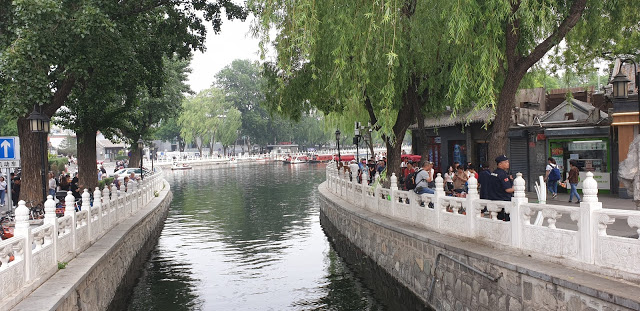
Many hutongs, some several hundred years old, in the vicinity of the Bell Tower and Drum Tower and Shichahai Lake are preserved and abound with tourists, many of which tour the quarter in pedicabs.

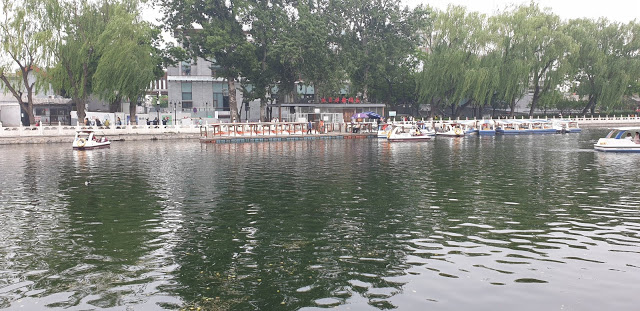
The optional tour also includes a visit to Shichahai, a historic scenic area consisting of three lakes (Qianhai, meaning Front Sea; Houhai, meaning Back Sea and Xihai, meaning West Sea), surrounding places of historic interest and scenic beauty and remnants of old-style local residences, Hutong and Courtyard.  

First, we had a short walk through the more modern part of the Hutong area and given some free time for shopping, but we prefer just to meander by the canal.  

There is a lake, and if we had the time, there were boats you could take.

With some time to spare, we take a quick walk down one of the alleyways where on the ground level are small shops, and above, living quarters.

Then we go to the bell and drum towers before walking through some more alleys was to where the rickshaws were waiting.
The Bell tower

And the Drum tower. Both still working today.

The rickshaw ride took us through some more back streets where it was clear renovations were being made so that the area could apply for world heritage listing.  Seeing inside some of the houses shows that they may look dumpy outside but that’s not the case inside.

The rickshaw ride ends outside the house where dinner will be served, and is a not so typical hose but does have all the elements of how the Chinese live, the boy’s room, the girl’s room, the parent’s room, the living area, and the North-south feng shui.

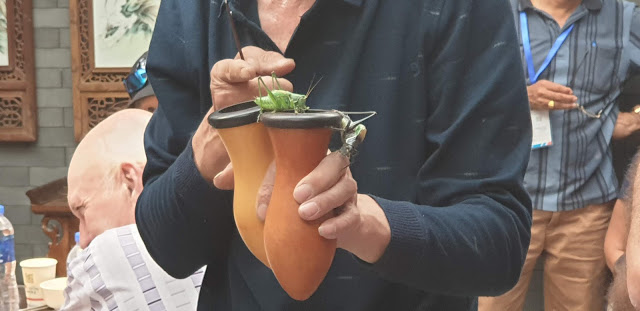
Shortly after we arrive, the cricket man, apparently someone quite famous in Beijing arrives and tells us all about crickets and then grasshoppers, then about cricket racing.  He is animated and clearly enjoys entertaining us westerners.

I’m sorry but the cricket stuff just didn’t interest me.  Or the grasshoppers.

As for dinner, it was finally a treat to eat what the typical Chinese family eats, and everything was delicious, and the endless beer was a nice touch.

And the last surprise, the food was cooked by a man.

It’s dark, it’s late, it’s raining…

Yes, it’s dark and late at night on this side of the world, and I’m guessing where you are, it’s probably winter, the sun’s disappeared, the day is freezing cold, and you’re having a hard time keeping warm.

Here, in the so-called land down under, which surprisingly a lot of people from the other side of the world do not know about, it is wet, and cool where it should be sunny and hot as well as humid.

Now, hang on, that can’t be true others don’t know about us, because we all know the world is round and there has to be something or somewhere opposite.  I know that north we have China, and Europe, and further away, the United States.

Been to China, Europe and the United States, so I know you’re all there, somewhere.

And, as you can see, the rain and the cold have amped up the boredom factor and pushed me to do anything other than writing.  I have three jobs I’m supposed to be doing,

  1. Editing the second Walthenson PI, a Private Detective novel
  2. Writing two episodes of a serial story about surveillance going wrong, and
  3. Finishing off some new travel blog posts

None of them is appealing to me at the moment.

Instead, I find myself looking at what is shown on Winter TV in the US, one of which is reruns of Snowpiercer and is suitably cold.  It’s also complicated, and sometimes a little hard to follow which means it takes two viewings to understand what’s going on.  It will be interesting to see where series three leads us … and I’m hoping Melanie will be back

Fascinating.

Then there are several of my favourites, FBI, The Rookie, a show called The Equalizer, a new version of an old TV show I used to watch many years ago.  Another will be the next series of Bridgerton, which was odd but interesting since we like those Jane Austen-like programs.  Now hopefully there will be another series of Miss Scarlett and the Duke, set in Victorian England.

And as for the blacklist, since Liz left it had gone downhill … let’s hope they find something to lift it, like Liz’s evil twin sister!  Perhaps wisely they wrapped it up, and it’s over.

There’s more, but I better get back to work.

The cinema of my dreams – Was it just another surveillance job – Episode 31

I’m back home and this story has been sitting on a back burner for a few months, waiting for some more to be written.

The trouble is, there are also other stories to write, and I’m not very good at prioritizing.

But, here we are, a few minutes opened up and it didn’t take long to get back into the groove.

Chasing leads, maybe


Was it too late to admit that I was way in over my head?

Of course, it should not come as a surprise that Jan would know of his alter ego if she was the friend she said she was.  Her name was on that scrap of paper with part of the address, and I should have guessed.

Again, my lack of knowledge and training was letting me down.

Now it seemed I had both Severin and Maury, Nobbin and Josephine, and Jan all working against me.

He had more enemies that I did, which begged the question, what the hell was he in to?  What could he possibly have found that was so damaging?

Perhaps I’d find that out if or when I found the missing USB drive.

In the meantime, I had to get back to the hotel before Jan did and try and keep a straight face.

But just as I started to put the seat belt on, another figure was walking from the road towards the front door.  A man, tall, with a purposeful stride.  

The light was still on so I would get to see who it was once he reached the door.  Then I saw the front door open, and Jan standing in it.  A second later I saw the face, just as he passed through the doorway and the door shut.

Severin.

She had lied.  So, why was it making me so angry?

I should have realized the whole Maury thing was a setup.  She hadn’t called her office, she had called Severin, and he can’t have been far away to get there in the time he had.

So, why didn’t he drag me off?

Easy.  So I would see the need to keep working with Jan, and in doing so, when I found the USB I’d tell her, and the next minute I’d get whacked over the head, and lose it.

Damn.

I was being played like a finely tuned fiddle.

But at least I knew about the car and had removed any evidence and the letters that were left on the ground inside the door.  It was something, and she would not find anything to help her, even if she knew he had a car.  It meant I was one step ahead of her.

After thanking a last look at the block, I left.  Better to find somewhere else to stay, just for tonight, and then go back to the hotel in Charing Cross and see if she returned.

I found a small hotel just off Bromley Road, a short distance down Avondale Road.  Out of the way and unassuming, with car parking that couldn’t be seen from the main road.  The late hour raised an eyebrow, but I used the excuse of getting in late from the airport.  After all, it was 02:30 in the morning and I was surprised there was anyone available on the front counter.

He gave me a room tucked away in a corner where there was only one entrance, and I could see anyone coming.  I wasn’t expecting anything, but just in case I had checked the car for a tracker.

None that I could find.

I needed sleep, but lying there staring at the ceiling, I replayed the arrival of Jan at the flat, followed by Severin.  It was a reminder that I should not believe or trust anyone.

It reminded me of the words of one of the instructors who said, one morning, quite abruptly, that we were about to become the loneliest people in the world.  If we trusted anyone, even if they were from our own side, it could mean one thing and one thing only.  Death.

We could not and should not trust anyone.

We should not believe a word of anything anyone tells us.

We should not recruit anyone from outside the service because unless they could be fully vetted, they could be your undoing.

We could not have friends, and certainly no romantic interests otherwise they would be used as leverage against us.

It was the worse hour lecture we’d been given, and the instructor had told us he had left the best till last.  It was time to decide whether we wanted to go on or bail.  Several had.

I didn’t think, then, it would be a problem.

Now, I was beginning to think otherwise.


© Charles Heath 2020

An excerpt from “What Sets Us Apart”, a mystery with a twist

See the excerpt from the story below, just a taste of what’s in store…

http://amzn.to/2Eryfth

whatsetscover

McCallister was old school, a man who would most likely fit in perfectly campaigning on the battlefields of Europe during the Second World War. He’d been like a fish out of water in the army, post-Falklands, and while he retired a hero, he still felt he’d more to give.

He’d applied and was accepted as head of a SWAT team, and, watching him now as he and his men disembarked from the truck in almost military precision, a look passed between Annette, the police liaison officer, and I that said she’d seen it all before. I know I had.

There was a one in four chance his team would be selected for this operation, and she had been hoping it would be one of the other three. While waiting for them to arrive she filled me in on the various teams. His was the least co-operative, and the more likely to make ad-hoc decisions rather than adhere to the plan, or any orders that may come from the officer in charge.

This, she said quite bluntly, was going to end badly.

I still had no idea why Prendergast instructed me to attend the scene of what looked to be a normal domestic operation, but as the nominated expert in the field in these types of situations, it was fairly clear he wasn’t taking any chances. It was always a matter of opinion between us, and generally I lost.

In this case, it was an anonymous report identifying what the authorities believed were explosives in one of the dockside sheds where explosives were not supposed to be.

The only reason why the report was given any credence was the man, while not identifying himself by name, said he’d been an explosive expert once and recognized the boxes. That could mean anything, but the Chief Constable was a cautious man.

With his men settled and preparing their weapons, McCallister came over to the command post, not much more than the SUV my liaison and I arrived in, with weapons, bulletproof vests, and rolls of tape to cordon off the area afterward. We both had coffee, steaming in the cold early morning air. Dawn was slowly approaching and although rain had been forecast it had yet to arrive.

A man by the name of Benson was in charge. He too had groaned when he saw McCallister.

“A fine morning for it.” McCallister was the only enthusiastic one here.

He didn’t say what ‘it’ was, but I thought it might eventually be mayhem.

“Let’s hope the rain stays away. It’s going to be difficult enough without it,” Benson said, rubbing his hands together. We had been waiting for the SWAT team to arrive, and another team to take up their position under the wharf, and who was in the final stages of securing their position.

While we were waiting we drew up the plan. I’d go in first to check on what we were dealing with, and what type of explosives. The SWAT team, in the meantime, were to ensure all the exits to the shed were covered. When I gave the signal, they were to enter and secure the building. We were not expecting anyone inside or out, and no movement had been detected in the last hour since our arrival and deployment.

“What’s the current situation?”

“I’ve got eyes on the building, and a team coming in from the waterside, underneath. Its slow progress, but they’re nearly there. Once they’re in place, we’re sending McKenzie in.”

He looked in my direction.

“With due respect sir, shouldn’t it be one of us?” McCallister glared at me with the contempt that only a decorated military officer could.

“No. I have orders from above, much higher than I care to argue with, so, McCallister, no gung-ho heroics for the moment. Just be ready to move on my command, and make sure you have three teams at the exit points, ready to secure the building.”

McCallister opened his mouth, no doubt to question those orders, but instead closed it again. “Yes sir,” he muttered and turned away heading back to his men.

“You’re not going to have much time before he storms the battlements,” Benson quietly said to me, a hint of exasperation in his tone. “I’m dreading the paperwork.”

It was exactly what my liaison officer said when she saw McCallister arriving.

The water team sent their ‘in position’ signal, and we were ready to go.

In the hour or so we’d been on site nothing had stirred, no arrivals, no departures, and no sign anyone was inside, but that didn’t mean we were alone. Nor did it mean I was going to walk in and see immediately what was going on. If it was a cache of explosives then it was possible the building was booby-trapped in any number of ways, there could be sentries or guards, and they had eyes on us, or it might be a false alarm.

I was hoping for the latter.

I put on the bulletproof vest, thinking it was a poor substitute for full battle armor against an exploding bomb, but we were still treating this as a ‘suspected’ case. I noticed my liaison officer was pulling on her bulletproof vest too.

“You don’t have to go. This is my party, not yours,” I said.

“The Chief Constable told me to stick to you like glue, sir.”

I looked at Benson. “Talk some sense into her please, this is not a kindergarten outing.”

He shrugged. Seeing McCallister had taken all the fight out of him. “Orders are orders. If that’s what the Chief Constable requested …”

Madness. I glared at her, and she gave me a wan smile. “Stay behind me then, and don’t do anything stupid.”

“Believe me, I won’t be.” She pulled out and checked her weapon, chambering the first round. It made a reassuring sound.

Suited up, weapons readied, a last sip of the coffee in a stomach that was already churning from nerves and tension, I looked at the target, one hundred yards distant and thought it was going to be the longest hundred yards I’d ever traversed. At least for this week.

A swirling mist rolled in and caused a slight change in plans.

Because the front of the buildings was constantly illuminated by large overhead arc lamps, my intention had been to approach the building from the rear where there was less light and more cover. Despite the lack of movement, if there were explosives in that building, there’d be ‘enemy’ surveillance somewhere, and, after making that assumption, I believed it was going to be easier and less noticeable to use the darkness as a cover.

It was a result of the consultation, and studying the plans of the warehouse, plans that showed three entrances, the main front hangar type doors, a side entrance for truck entry and exit and a small door in the rear, at the end of an internal passage leading to several offices. I also assumed it was the exit used when smokers needed a break. Our entry would be by the rear door or failing that, the side entrance where a door was built into the larger sliding doors. In both cases, the locks would not present a problem.

The change in the weather made the approach shorter, and given the density of the mist now turning into a fog, we were able to approach by the front, hugging the walls, and moving quickly while there was cover. I could feel the dampness of the mist and shivered more than once.

It was nerves more than the cold.

I could also feel rather than see the presence of Annette behind me, and once felt her breath on my neck when we stopped for a quick reconnaissance.

It was the same for McCallister’s men. I could feel them following us, quickly and quietly, and expected, if I turned around, to see him breathing down my neck too.

It added to the tension.

My plan was still to enter by the back door.

We slipped up the alley between the two sheds to the rear corner and stopped. I heard a noise coming from the rear of the building, and the light tap on the shoulder told me Annette had heard it too. I put my hand up to signal her to wait, and as a swirl of mist rolled in, I slipped around the corner heading towards where I’d last seen the glow of a cigarette.

The mist cleared, and we saw each other at the same time. He was a bearded man in battle fatigues, not the average dockside security guard.

He was quick, but my slight element of surprise was his undoing, and he was down and unconscious in less than a few seconds with barely a sound beyond the body hitting the ground. Zip ties secured his hands and legs, and tape his mouth. Annette joined me a minute after securing him.

A glance at the body then me, “I can see why they, whoever they are, sent you.”

She’d asked who I worked for, and I didn’t answer. It was best she didn’t know.

“Stay behind me,” I said, more urgency in my tone. If there was one, there’d be another.

Luck was with us so far. A man outside smoking meant no booby traps on the back door, and quite possibly there’d be none inside. But it indicated there were more men inside, and if so, it appeared they were very well trained. If that were the case, they would be formidable opponents.

The fear factor increased exponentially.

I slowly opened the door and looked in. A pale light shone from within the warehouse itself, one that was not bright enough to be detected from outside. None of the offices had lights on, so it was possible they were vacant. I realized then they had blacked out the windows. Why hadn’t someone checked this?

Once inside, the door closed behind us, progress was slow and careful. She remained directly behind me, gun ready to shoot anything that moved. I had a momentary thought for McCallister and his men, securing the perimeter.

At the end of the corridor, the extent of the warehouse stretched before us. The pale lighting made it seem like a vast empty cavern, except for a long trestle table along one side, and, behind it, stacks of wooden crates, some opened. It looked like a production line.

To get to the table from where we were was a ten-yard walk in the open. There was no cover. If we stuck to the walls, there was equally no cover and a longer walk.

We needed a distraction.

As if on cue, the two main entrances disintegrated into flying shrapnel accompanied by a deafening explosion that momentarily disoriented both Annette and I. Through the smoke and dust kicked up I saw three men appear from behind the wooden crates, each with what looked like machine guns, spraying bullets in the direction of the incoming SWAT members.

They never had a chance, cut down before they made ten steps into the building.

By the time I’d recovered, my head heavy, eyes watering and ears still ringing, I took several steps towards them, managing to take down two of the gunmen but not the third.

I heard a voice, Annette’s I think, yell out, “Oh, God, he’s got a trigger,” just before another explosion, though all I remember in that split second was a bright flash, the intense heat, something very heavy smashing into my chest knocking the wind out of me, and then the sensation of flying, just before I hit the wall.

I spent four weeks in an induced coma, three months being stitched back together and another six learning to do all those basic actions everyone took for granted. It was twelve months almost to the day when I was released from the hospital, physically, except for a few alterations required after being hit by shrapnel, looking the same as I always had.

But mentally? The document I’d signed on release said it all, ‘not fit for active duty; discharged’.

It was in the name of David Cheney. For all intents and purposes, Alistair McKenzie was killed in that warehouse, and for the first time ever, an agent left the Department, the first to retire alive.

I was not sure I liked the idea of making history.

© Charles Heath 2016-2020