Writing about writing a book – Day 18

It’s time to go back to working on Bill’s backstory now that we’ve filled in some of the gaps.

Like some TV shows and books, some of the action sometimes takes the form of flashbacks.

In Starburst, Bill has a complete backstory, of a time that he had mainly forced into the deep dark part of his memory, waiting for something or someone to trigger it.

This whole back story, from the moment he entered the war zone, to the moment his war ended, and those that participated throughout that time, will be in the form of flashbacks, the first of which is triggered by the painkiller Bill is given after being shot in the Aitcheson incident.

These flashbacks will not necessarily be in any sort of order, but I have been thinking about this part of the story and produced an outline of the sequences I will require, give or take.  There may be more, or less, depending on how the story progresses.

…

Part 1 – From arrival in the war zone to being assigned to Davenport’s squad

Being sent to, and the first patrol in Vietnam

Death and mayhem some months after sent to Vietnam

First meeting Barry in army mobile hospital

R and R in Saigon, with the first of the Vietnamese girls

Psychiatric help, time in the stockade

No soldier who trains for war, nor can they have a real idea what war is like, and certainly a war in the jungle, on the enemy’s terms.  Bill is like any other soldier, happy to go into service, but soon the reality, and death becomes apparent.

Endless rain, endless heat, endless and sometimes needless death, and a deep mistrust of those whom you are supposed to protect, start to work on the mind of a person young enough not to understand what is going on.

Then, when trying to blot out the memories of death, enemy and friend alike, something has to give.  Of course, the last place you want to end up in the stockade.

…

Part 2 – A lifeline, and a pass into the so-called Davenport Operation

Training as a spy?

Colonel, calling Bill into a briefing on the Davenport operation

Talking to the Commanding officer in Stockade, as a preliminary to Davenport service

…

Was Bill sent to the stockade because he committed an act of folly, or his incarceration a part of a much larger plan, a plan to have an inside man to report on Davenport?

It’s not the first time someone higher up the chain of command has had ideas of trying to find out what Davenport is doing, and where only rumors abound of his ‘interests’.  Agents had been sent in before, and those agents had disappeared.

Was Bill about to be the next, or was he just in the wrong place at the wrong time?

There is more, but I’m still working on it.

…

© Charles Heath 2015-2023

What do these mean?

I’ve been reading the latest headlines and picked out a few:

The seems to be a currency war,

Oil prices are set to rise in line with a cut in production,

Some tankers will not be plying the Hormuz strait,

There was a massive power outage in the UK,

Gold prices are rising,

North Korea is shooting missiles into the sea

The USA needs more missiles,

There are Chinese survey vessels in the South China Sea,

In Russia there is an explosion on a secret base with nuclear implications, and,

There might be a global recession coming.

What do all these events mean?  Nothing really when taken individually, but when you start combining them, then the thriller writer in me starts to see all sorts of conspiracies and plotlines for stories.

For instance

Take that explosion in Russia, and the fact the word nuclear is attached to it, and then look at the massive power outage in the UK.  What if that site was a laboratory, working on small,  powerful bombs that can easily be carried, installed, in or around vital infrastructure, and in that quest for smaller and more powerful something goes wrong.

After all, isn’t that what testing is for?

And the fact there’s been one major event involving vital infrastructure, should we be looking for more?  Then there are a few problems with bombs being attached to tankers in the Hormuz Strait.  Does anyone see the potential for an apocalyptic event coming on?

Then the North Koreans are firing test missiles, and the US calling for more missiles to add to their arsenal.  Are they using North Korea as an excuse?  Or is there something more sinister going on with Chinese survey vessels in the South China Sea?  What if they’re not survey vessels?

Then there’s a small matter of rising oil prices.  Whilst the same report might say that the rise is due to OPEC cutting output, there could be other reasons, such as the currency war that’s about to erupt, and will this pre-emp a global recession.  A good indicator of impending disaster, wars, and other maladies is the rising price of gold.

The gold market goes into overdrive when currency starts to lose value, recessions are coming or have arrived, or there is about to be a war, or there is one.  The US and China are facing off, the US and half the middle east are a disaster waiting to happen, and, hang on, North Korea is being provocative, and in a late development, India and Pakistan are facing off over Kashmir.

Are we surprised people are turning to gold?

Maybe I should go back to doing the crossword, and ignoring the news.

The cinema of my dreams – I always wanted to write a war story – Episode 54

For a story that was conceived during those long boring hours flying in a steel cocoon, striving to keep away the thoughts that the plane and everyone in it could just simply disappear as planes have in the past, it has come a long way.

Whilst I have always had a fascination with what happened during the Second world war, not the battles or fighting, but in the more obscure events that took place, I decided to pen my own little sidebar to what was a long and bitter war.

And, so, it continues…

…

When Carlo stopped, I was out of breath and gasping.  We all were.  The smoke was getting more intense.  At times it had made navigation almost impossible.

In front of us were more trees, but these looked different to those we had passed through.  I watched Carlo walk back and forth a few yards each way, then disappear into the bushes.  A minute later he put his head out and said, “This way.”

We followed him.  It was a hidden entrance down to a drain that was quite deep and headed back towards the castle one way and into the forest the other.

If the fire kept up by tomorrow the cover would be gone.

It was still a hard walk through the bushes, but we made it to a wireframe and door with a lock on it.  It looked ancient as if it hadn’t been used in decades, even longer.

Carlo produced a rather odd looking key and unlocked it.  I would have thought it was rusted shut, but appearances were deceptive.  The lock was almost new.

But the gate had not been used for a long time and it took Carlo a few minutes to force it to open.  It had rusted shut.  When it did finally move, it was with a very loud screeching sound.

We filed in and he relocked it.  Anyone thinking they heard something and came to investigate; it would end up on the other side of the gate.

So far so good.

For a moment I was back in my element, the archaeologist exploring caves, a wooden fire torch lighting the way, dampness underfoot, and the trickling of water down the walls.  All around the dankness from continual dampness.

It was easy the pretend if only for a few minutes I had not been caught up in the war, that I was on a quest for lost treasure, hidden away at the end of a labyrinth.

The reality was we were quite literally in an ancient sewer and the original builders of the castle had used an underground waterway to tap into to remove waste.  It was far more effective than modern systems and used the earth’s own ecology.

Inside the castle, the places where the waste used to drop down into the waterway had been covered over by trapdoors that were still there, and that was how we were going to gain access, through rooms that were no longer used.

We were going in via four access points, two men at each door, and mine with one of Blinkys men would be going into the area where the soldiers were camping to mop up whatever the bombs left behind, before closing off an exit.

Carlo had reserved the last one for himself and the boy, where he hoped to find Wallace and the new German commander.

Our cue to move: the bombs going off.

We just had time to get to the point and lower the trapdoors. Then climb up onto the floor and wait by the door.  From the other side, Carlo said, anyone in the castle would only see a continuation of the wall panelling.

We made it with seconds to spare.

We were closest to the bombs and the percussive effect was disorientating for a few seconds before we pushed through the door and into the smoke and dust raised by the explosions.

As the dust settled, we could see dead soldiers, and mess everywhere.  If a soldier was still alive, we shot them, systematically picking our way through the debris.  I counted thirty-one dead by the time we reached the other side, the other exit from the space.

In the distance, we could hear sporadic gunfire coming from other parts of the castle, and then, after taking up our position, near the tank, we waited.

Three soldiers came bursting out of the exit and we shot them too..

Ten minutes later Carlo yelled out, “It’s me, don’t shoot.”  Then he stepped out the door.  “It is done.”

The castle was ours.

“You wish to speak to your old commander before I execute him?

“Wallace?”

He nodded.

“Sure”

I followed him into the castle and walked through familiar passageways and rooms, much had not changed in a long time.

Wallace and the new commander were tied up in the dining room.  The remnants of a meal and several empty bottles of wine were on the table.

Wallace watched me from the doorway until I stood before him.

“I knew it was a mistake letting you go.  Jackerby was convinced you were a stupid fool who would unwittingly lead us directly to the resistance.  I told him you were cleverer than you looked.”

“And yet…”

“Perhaps I was tired of people like you being killed needlessly.  What just happened, that was a waste of human life.”

“I didn’t start the war, and for the record, I didn’t want any part of it.  Unfortunately, higher authorities deemed otherwise, and here I am.  This is not a victory to savour.”

“A victory nonetheless.”

I shrugged.  “It didn’t have to be like this, but at least we’ve weeded out a few more traitors.”

“Then no point asking for mercy?”

“No.”

With that said Carlo executed both men.

…

© Charles Heath 2021-2023

“The Document” – a thirty-day revision – Day 17

This book has been written for some time and the manuscript was sitting in a box with half a dozen others gathering dust and not quite as complete, so this month it is going to get the makeover, a first draft for the editor.

And so it begins…

…

Coping without technology

…

There are no more surprises at least for today.

We have no internet, the power company came along and removed an old pole and that was the end of it.

It’s amazing what you can’t do when there’s no internet and then all the things you said you would do one day if only you had the time.

This morning’s word count accumulates quickly without the distractions so I had the afternoon to finally clean up my workspace.

Now I can’t find anything.

Searching for locations: Terracotta Warriors and Horses Museum, X’ian, China

Terracotta Warriors and Horses Museum

A little history, and anecdotal advice first:

In 1974 a 26-year-old farmer, Yang Jide, was drilling a well and found fragments of the terracotta soldiers and bronze weapons.

What was discovered later was one of the biggest attended burial pits of China’s first feudal Emperor, Qin Shi Huang.  In the following years remains had been found in 3 pits, yielding at least 8,000 soldiers and horses, and over 100 chariots.  The soldiers were infantry, cavalry, and others.

Emperor Qin was born in 259 BC and died in 210 BC.  He began building a mausoleum for himself at the foot of Mount Li when he was 13.  Construction took 38 years, from 247 BC to 208 BC.  It was divided into 3 stages and involved 720,000 conscripts.

The pits of pottery figures are 1.5 km east of Emperor Qin’s mausoleum.  Pit 1 has about 6,000 terracotta armored warriors and horses and 40 wooden chariots.  Pit 2 is estimated to have over 900 terracotta warriors and 350 terracotta horses with about 90 wooden chariots.  Pit 3 had so far yielded only 66 pottery figures and one chariot drawn by four horses.

Official records say it was discovered later that it was likely Xiang Yu, a rebel, intentionally damaged the Mausoleum and the soldiers in the pits, by setting fire to the wooden roof rafters, and these fell on and broke the warriors into pieces.

However, we were told that after the terracotta warriors were completed, the Emperor ordered the builders to be killed so that they would not tell anyone about the warriors, and then of those that remained alive deliberately smashed all of the artifacts.

The thing is, all of the terracotta figures that have been found are in pieces, and they need computers to piece them back together again.

The visit:
The first impression is the size of the car park and the number of buses parked in the lot, and a hell of a lot more outside up the road an off on side streets.  Obviously, it costs money to park in the parking lot.

The other first impressions; the numbers waiting to get in were not as many as yesterday outside the forbidden city, in fact, a lot less.

Be warned there’s a long walk from the entrance gate where your bags are scanned and a body scan as well, before admittance.  This walk is through a landscaped area which it is expect might sometime in the future reveal more soldiers, or other artifacts.

At the end of the walk that takes about ten minutes, you can get a one-way ride to the second checkpoint, but we opted not to as no one else in our group did.

That walk is the warm-up exercise to an organized viewing of the exhibits after going through a second ticket checkpoint.  On the other side, we had to hand our tickets back to the tour guide which was disappointing not to end up with a memento of actually having been there.

So, on the other side in the courtyard, the guide told us the most important parts of the exhibition, that we should spend most of the time looking at pit 1, and then spent a little time in 2 which is only there in the first stages of excavation.  Then move onto the museum if only to see the replica chariots.

We do.

The chariots were small but interesting

The horses were better and intricately detailed

These are soldiers, perhaps complete examples of those types found in the end pit.

This is one of the archers.  You can tell by the way he wears his hair.

Pit 2

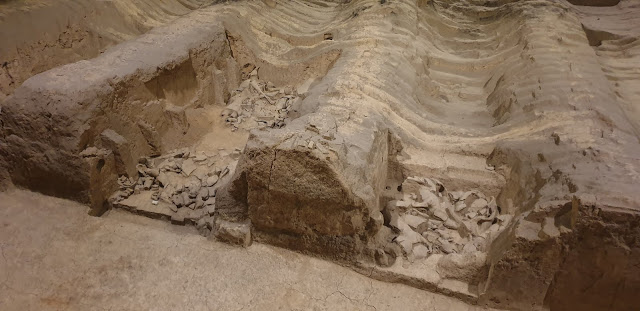
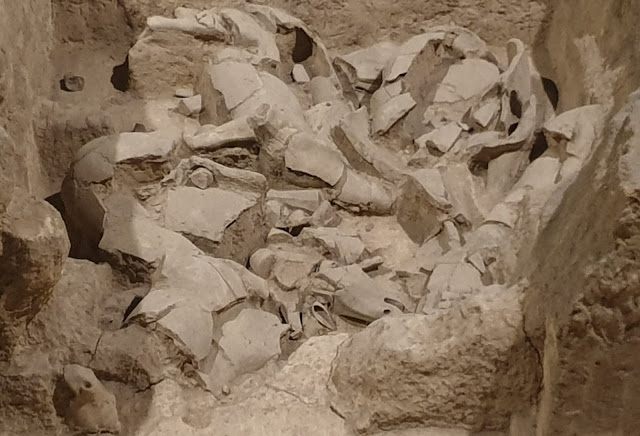
The excavation of this pit has only just begun, so it is possible to see where they have carefully removed the top cover, and you can see the broken parts of the warriors lying in a heap.

Some parts of the warriors are more discernible closer up

These parts are carefully extracted and taken to the ‘hospital’ where they are digitised and the computer will match each part with the warrior it belongs to.

Pit 1

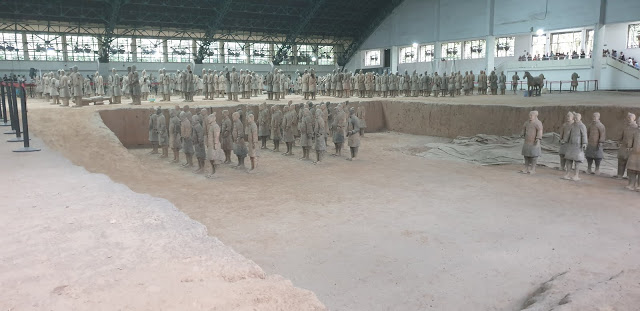
This has quite a number of standing soldiers that have been glued back together, but not necessarily complete and I notice a number if the statues were incomplete. And if they cannot find the missing pieces, then they are not added to or filled in.

The scale of the pit is enormous, and they have hardly scratched the surface in the restoration process.

What is there is a number of horses as well.

That’s at the front of the pit, a long line of statues, and what is clear is the location of the well where the first fragments were found by a farmer.

There are about eight lines of soldiers, and some lining the sides.

Midway down there is a large area currently under excavation

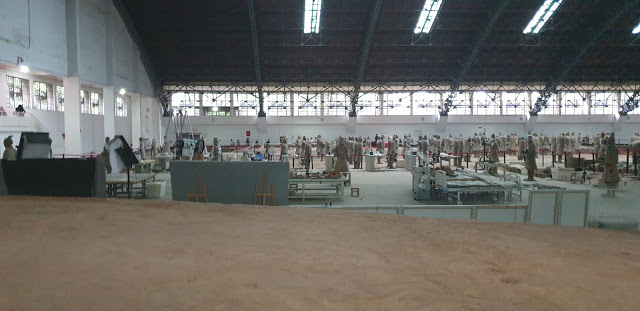
At the back is the hospital where the soldiers are reassembled.  There’s nearly a hundred in the various stages of rebuilding.  These days the soldiers are rebuilt using computer imaging.

The hospital area is where they are put back together

And these are some of the statues in various stages of reconstruction

Another two views of the size and scale of the reconstruction project

The coffee shop is also a sales centre, but there are too many people waiting for coffee and too few places to sit down.

Character development: children in stories

It seems that there are many ways of bringing children to life in your stories.

The most obvious is your own, but those traits might seem so polarised they and others might realise who they are based on, with the distress that comes with it.

Then there are the children of your friends and relationships, definitely fodder for many stories because those children are definitely far worse than your own, or better perhaps.

It leaves you questioning where you went wrong, or why you didn’t get the manual when the hospital kicked to the kerb with this screaming bundle of joy, their words not yours.

So we start with real-life experiences.

To muddy the waters so they don’t get the impression you’re paying out on them, you can always add the traits of those you see in the shopping malls.

Shopping malls are a gold mine for behavioural traits, from the very worst tantrum thrower to the best behaved. For my money and proven time and time again, those well-dressed, very well-behaved children are purely evil.

With the tantrum thrower, what you see if what you get.

With the well-behaved, you spend all of your time watching your back and waiting for the knife to penetrate your spine between the fourth and fifth vertebrae. You just know instinctively they’re medical school prodigies.

Of course, there are one or two good children, Santa has to have a reason for existence, but they are like 1,000 ounce gold nuggets; very, very hard to find.

The cinema of my dreams – Was it just another surveillance job – Episode 33

I’m back home and this story has been sitting on a back burner for a few months, waiting for some more to be written.

The trouble is, there are also other stories to write, and I’m not very good at prioritizing.

But, here we are, a few minutes opened up and it didn’t take long to get back into the groove.

Chasing leads, maybe


Monica, from the last interrogation, had brought a file.  It looked the same as the last one she brought with her, the one with my name on it.

This time it was thicker.

Intelligence gathering at its finest.  There’d be stuff in there that even I didn’t know about me.

She didn’t open it, just looked at me.

“What have you been doing?”

“Working?”

“For whom?”

“Nobbin, of course.  I am now assigned to his section.  Did you do that?”

“He did.  He tells me you’re working on the O’Connell investigation.”

“Is that what it’s called.  He never told me that.  And I had to find out where I’d been assigned by logging onto a computer.  An email or letter would have made my life a little easier.”

“You’re just lucky you’re still working here.  Now, tell me more about this Severin character.”

“I told you everything I knew the last time you spoke to me.  Apparently, you seemed to know who it was.  Perhaps you might tell me, too.”

“It’s…”

“And,” I interrupted, “don’t tell me it’s above my pay grade.  I was potentially working for traitors and could have finished up in jail for treason.”

“You might still get there.”

Then why hadn’t she had me arrested and thrown in a dungeon the last time we met?  There was an easy answer to that question.  She needed me out in the field.  Nobbin needed me in the field.  They presumably needed me to remain available to Severin for whatever reason.

“What do you want?”

She opened the file, turned a few pages, and stopped at a yellow sheet of paper.  I wasn’t able to read it upside down, but it had very small spidery writing on it.

Then she looked at me again.

“Some secret documents appear to have gone missing.  We believe that is to say Director Dobbin thinks these may have been on a USB drive that was in the possession of O’Connell at the time of his death.  You were there at the time of his death.  You can see where this is going…”

No matter which answers I gave it was the wrong one, which led to do not pass go and do not collect two hundred dollars, or pounds as the case may be.

“I haven’t got it, and he didn’t tell me where it was, and I saw him die.”

“If you say so.”  She went back to the file and turned some more pagers.

“What do you mean?”

She looked up.  “So far, there’s no body been recovered, or any evidence there was a shooting where you said it was.”

“Are you trying to tell me he’s alive, because if you are, then I must be a very poor judge of people who have no pulse.  He was not about to get up and walk away.”

“Did you see the body removed?”

Now there’s an interesting point.  I had done as I was told and left when told to.  I assumed Severin would sort the problem out, in fact, hadn’t he called in the cleaners?  I saw a white van.

Actually, when I thought about it, I had no idea what happened after I left.  And, now that I remember, I didn’t see anyone get out of the white van.

Could bodies get up and walk?

I was beginning to think they could.

© Charles Heath 2020

Searching for locations: Hutongs, Beijing, China

What are Hutongs?

In Beijing, Hutongs are formed by lines of traditional courtyard residences, called siheyuan.  Neighbourhoods were formed by joining many hutongs together. These siheyuan are the traditional residences, usually occupied by a single or extended family, signifying wealth, and prosperity. 

Over 500 of these still exist. Many of these hutongs have been demolished, but recently they have become protected places as a means of preserving some Chinese cultural history.  They were first established in the Yuan Dynasty (1279-1368)Many of these Hutongs had their main buildings and gates built facing south, and lanes connecting them to other hutongs also ran north to south.

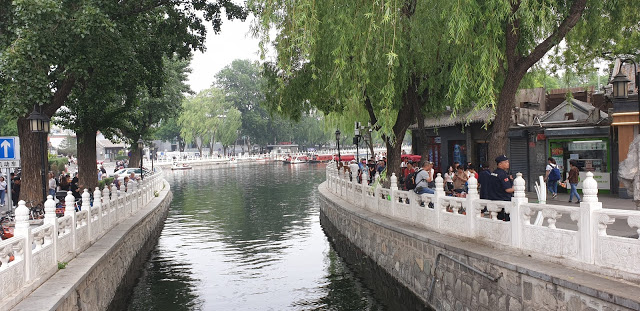
Many hutongs, some several hundred years old, in the vicinity of the Bell Tower and Drum Tower and Shichahai Lake are preserved and abound with tourists, many of which tour the quarter in pedicabs.

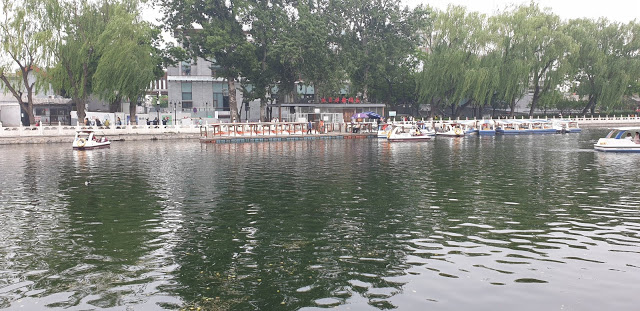
The optional tour also includes a visit to Shichahai, a historic scenic area consisting of three lakes (Qianhai, meaning Front Sea; Houhai, meaning Back Sea and Xihai, meaning West Sea), surrounding places of historic interest and scenic beauty and remnants of old-style local residences, Hutong and Courtyard.  

First, we had a short walk through the more modern part of the Hutong area and given some free time for shopping, but we prefer just to meander by the canal.  

There is a lake, and if we had the time, there were boats you could take.

With some time to spare, we take a quick walk down one of the alleyways where on the ground level are small shops, and above, living quarters.

Then we go to the bell and drum towers before walking through some more alleys was to where the rickshaws were waiting.
The Bell tower

And the Drum tower. Both still working today.

The rickshaw ride took us through some more back streets where it was clear renovations were being made so that the area could apply for world heritage listing.  Seeing inside some of the houses shows that they may look dumpy outside but that’s not the case inside.

The rickshaw ride ends outside the house where dinner will be served, and is a not so typical hose but does have all the elements of how the Chinese live, the boy’s room, the girl’s room, the parent’s room, the living area, and the North-south feng shui.

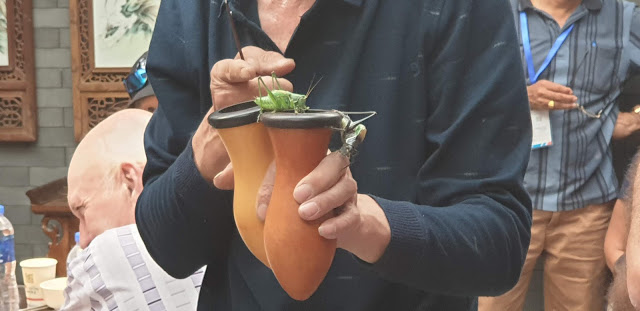
Shortly after we arrive, the cricket man, apparently someone quite famous in Beijing arrives and tells us all about crickets and then grasshoppers, then about cricket racing.  He is animated and clearly enjoys entertaining us westerners.

I’m sorry but the cricket stuff just didn’t interest me.  Or the grasshoppers.

As for dinner, it was finally a treat to eat what the typical Chinese family eats, and everything was delicious, and the endless beer was a nice touch.

And the last surprise, the food was cooked by a man.

“The Devil You Don’t”, she was the girl you would not take home to your mother!

Now only $0.99 at https://amzn.to/2Xyh1ow

…

John Pennington’s life is in the doldrums. Looking for new opportunities, and prevaricating about getting married, the only joy on the horizon was an upcoming visit to his grandmother in Sorrento, Italy.

Suddenly he is left at the check-in counter with a message on his phone telling him the marriage is off, and the relationship is over.

If only he hadn’t promised a friend he would do a favour for him in Rome.

At the first stop, Geneva, he has a chance encounter with Zoe, an intriguing woman who captures his imagination from the moment she boards the Savoire, and his life ventures into uncharted territory in more ways than one.

That ‘favour’ for his friend suddenly becomes a life-changing event, and when Zoe, the woman who he knows is too good to be true, reappears, danger and death follow.

Shot at, lied to, seduced, and drawn into a world where nothing is what it seems, John is dragged into an adrenaline-charged undertaking, where he may have been wiser to stay with the ‘devil you know’ rather than opt for the ‘devil you don’t’.

newdevilcvr6

“The Document” – a thirty-day revision – Day 15

This book has been written for some time and the manuscript was sitting in a box with half a dozen others gathering dust and not quite as complete, so this month it is going to get the makeover, a first draft for the editor.

And so it begins…

…

Half way there

…

Yes, 15 days down and 15 days to go.

At this point my hand is starting to cramp from the toils of writing, yes, I’m one of those writers who often puts words to paper longhand.

Two weeks is a long time, but I think this sort of exercise is what’s needed if you want to write a novel every year, though this one is going to come out with more than 50,000 words.

I think there are about three more chapters to go to end part two, then I can get onto the big finale in part three.

It has turned out to be a bigger project than I originally thought, and I didn’t think I could stretch it to 50,000 words. Now, I’m hoping to keep it to about 60,000.

Still, no need to get ahead of myself. Murphy’s law may yet rear its ugly head.