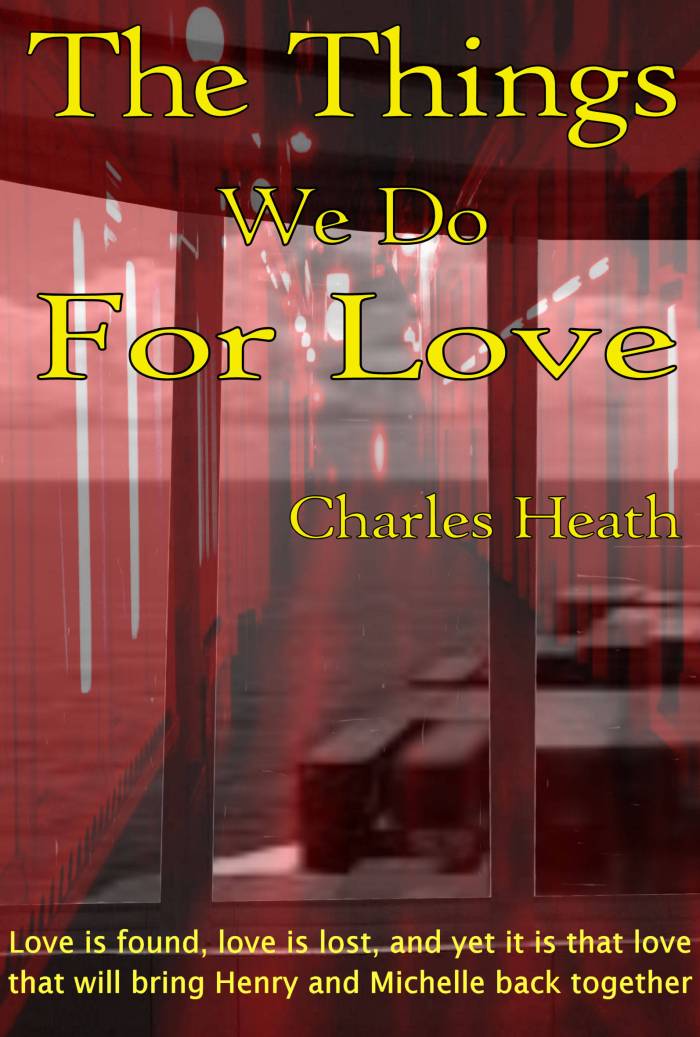
An excerpt from “The Things We Do For Love”; In love, Henry was all at sea!

In the distance he could hear the dinner bell ringing and roused himself.  Feeling the dampness of the pillow, and fearing the ravages of pent up emotion, he considered not going down but thought it best not to upset Mrs. Mac, especially after he said he would be dining.

In the event, he wished he had reneged, especially when he discovered he was not the only guest staying at the hotel.

Whilst he’d been reminiscing, another guest, a young lady, had arrived.  He’d heard her and Mrs. Mac coming up the stairs, and then shown to a room on the same floor, perhaps at the other end of the passage.

Henry caught his first glimpse of her when she appeared at the door to the dining room, waiting for Mrs. Mac to show her to a table.

She was about mid-twenties, slim, long brown hair, and the grace and elegance of a woman associated with countless fashion magazines.  She was, he thought, stunningly beautiful with not a hair out of place, and make-up flawlessly applied.  Her clothes were black, simple, elegant, and expensive, the sort an heiress or wife of a millionaire might condescend to wear to a lesser occasion than dinner.

Then there was her expression; cold, forbidding, almost frightening in its intensity.  And her eyes, piercingly blue and yet laced with pain.  Dracula’s daughter was his immediate description of her.

All in all, he considered, the only thing they had in common was, like him, she seemed totally out of place.

Mrs. Mac came out of the kitchen, wiping her hands on her apron.  She was, she informed him earlier, chef, waitress, hotelier, barmaid, and cleaner all rolled into one.  Coming up to the new arrival she said, “Ah, Miss Andrews, I’m glad you decided to have dinner.  Would you like to sit with Mr. Henshaw, or would you like to have a table of your own?”

Henry could feel her icy stare as she sized up his appeal as a dining companion, making the hair on the back on his neck stand up.  He purposely didn’t look back.  In his estimation, his appeal rating was minus six.  Out of a thousand!

“If Mr. Henshaw doesn’t mind….”  She looked at him, leaving the query in mid-air.

He didn’t mind and said so.  Perhaps he’d underestimated his rating.

“Good.”  Mrs. Mac promptly ushered her over.  Henry stood, made sure she was seated properly and sat.

“Thank you.  You are most kind.”  The way she said it suggested snobbish overtones.

“I try to be when I can.”  It was supposed to nullify her sarcastic tone but made him sound a little silly, and when she gave him another of her icy glares, he regretted it.

Mrs. Mac quickly intervened, asking, “Would you care for the soup?”

They did, and, after writing the order on her pad, she gave them each a look, imperceptibly shook her head, and returned to the kitchen.

Before Michelle spoke to him again, she had another quick look at him, trying to fathom who and what he might be.  There was something about him.

His eyes, they mirrored the same sadness she felt, and, yes, there was something else, that it looked like he had been crying?  There was a tinge of redness.

Perhaps, she thought, he was here for the same reason she was.

No.  That wasn’t possible.

Then she said, without thinking, “Do you have any particular reason for coming here?”  Seconds later she realized she’s spoken it out loud, had hadn’t meant to actually ask, it just came out.

It took him by surprise, obviously not the first question he was expecting her to ask of him.

“No, other than it is as far from civilization, and home, as I could get.”

At least we agree on that, she thought.

It was obvious he was running away from something as well.

Given the isolation of the village and lack of geographic hospitality, it was, from her point of view, ideal.  All she had to do was avoid him, and that wouldn’t be difficult.

After getting through this evening first.

“Yes,” she agreed.  “It is that.”

A few seconds passed, and she thought she could feel his eyes on her and wasn’t going to look up.

Until he asked, “What’s your reason?”

Slight abrupt in manner, perhaps as a result of her question, and the manner in which she asked it.

She looked up.  “Rest.  And have some time to myself.”

She hoped he would notice the emphasis she had placed on the word ‘herself’ and take due note.  No doubt, she thought,  she had completely different ideas of what constituted a holiday than he, not that she had actually said she was here for a holiday.

Mrs. Mac arrived at a fortuitous moment to save them from further conversation.

Over the entree, she wondered if she had made a mistake coming to the hotel.  Of course, there had been no possible way she could know than anyone else might have booked the same hotel, but realized it was foolish to think she might end up in it by herself.

Was that what she was expecting?

Not a mistake then, but an unfortunate set of circumstances, which could be overcome by being sensible.

Yet, there he was, and it made her curious, not that he was a man, by himself, in the middle of nowhere, hiding like she was, but for very different reasons.

On discreet observance whilst they ate, she gained the impression his air of light-heartedness was forced and he had no sense of humor.

This feeling was engendered by his looks, unruly dark hair, and permanent frown.  And then there was his abysmal taste in clothes on a tall, lanky frame.  They were quality but totally unsuited to the wearer.

Rebellion was written all over him.

The only other thought crossing her mind, and rather incongruously, was he could do with a decent feed.  In that respect, she knew now from the mountain of food in front of her, he had come to the right place.

“Mr. Henshaw?”

He looked up.  “Henshaw is too formal.  Henry sounds much better,” he said, with a slight hint of gruffness.

“Then my name is Michelle.”

Mrs. Mac came in to take their order for the only main course, gather up the entree dishes, then return to the kitchen.

“Staying long?” she asked.

“About three weeks.  Yourself?”

“About the same.”

The conversation dried up.

Neither looked at the other, rather at the walls, out the window, towards the kitchen, anywhere.  It was, she thought, almost unbearably awkward.

Mrs. Mac returned with a large tray with dishes on it, setting it down on the table next to theirs.

“Not as good as the usual cook,” she said, serving up the dinner expertly, “but it comes a good second, even if I do say so myself.  Care for some wine?”

Henry looked at Michelle.  “What do you think?”

“I’m used to my dining companions making the decision.”

You would, he thought.  He couldn’t help but notice the cutting edge of her tone.  Then, to Mrs. Mac, he named a particular White Burgundy he liked and she bustled off.

“I hope you like it,” he said, acknowledging her previous comment with a smile that had nothing to do with humor.

“Yes, so do I.”

Both made a start on the main course, a concoction of chicken and vegetables that were delicious, Henry thought, when compared to the bland food he received at home and sometimes aboard my ship.

It was five minutes before Mrs. Mac returned with the bottle and two glasses.  After opening it and pouring the drinks, she left them alone again.

Henry resumed the conversation.  “How did you arrive?  I came by train.”

“By car.”

“Did you drive yourself?”

And he thought, a few seconds later, that was a silly question, otherwise she would not be alone, and certainly not sitting at this table. With him.

“After a fashion.”

He could see that she was formulating a retort in her mind, then changed it, instead, smiling for the first time, and it served to lighten the atmosphere.

And in doing so, it showed him she had another more pleasant side despite the fact she was trying not to look happy.

“My father reckons I’m just another of ‘those’ women drivers,” she added.

“Whatever for?”

“The first and only time he came with me I had an accident.  I ran up the back of another car.  Of course, it didn’t matter to him the other driver was driving like a startled rabbit.”

“It doesn’t help,” he agreed.

“Do you drive?”

“Mostly people up the wall.”  His attempt at humor failed.  “Actually,” he added quickly, “I’ve got a very old Morris that manages to get me where I’m going.”

The apple pie and cream for dessert came and went and the rapport between them improved as the wine disappeared and the coffee came.  Both had found, after getting to know each other better, their first impressions were not necessarily correct.

“Enjoy the food?” Mrs. Mac asked, suddenly reappearing.

“Beautifully cooked and delicious to eat,” Michelle said, and Henry endorsed her remarks.

“Ah, it does my heart good to hear such genuine compliments,” she said, smiling.  She collected the last of the dishes and disappeared yet again.

“What do you do for a living,” Michelle asked in an off-hand manner.

He had a feeling she was not particularly interested and it was just making conversation.

“I’m a purser.”

“A what?”

“A purser.  I work on a ship doing the paperwork, that sort of thing.”

“I see.”

“And you?”

“I was a model.”

“Was?”

“Until I had an accident, a rather bad one.”

“Oh, I’m sorry.”

So that explained the odd feeling he had about her.

As the evening had worn on, he began to think there might be something wrong, seriously wrong with her because she didn’t look too well.  Even the carefully applied makeup, from close up, didn’t hide the very pale, and tired look, or the sunken, dark ringed eyes.

“I try not to think about it, but it doesn’t necessarily work.  I’ve come here for peace and quiet, away from doctors and parents.”

“Then you will not have to worry about me annoying you.  I’m one of those fall-asleep-reading-a-book types.”

Perhaps it would be like ships passing in the night and then smiled to himself about the analogy.

Dinner now over, they separated.

Henry went back to the lounge to read a few pages of his book before going to bed, and Michelle went up to her room to retire for the night.

But try as he might, he was unable to read, his mind dwelling on the unusual, yet the compellingly mysterious person he would be sharing the hotel with.

Overlaying that original blurred image of her standing in the doorway was another of her haunting expressions that had, he finally conceded, taken his breath away, and a look that had sent more than one tingle down his spine.

She may not have thought much of him, but she had certainly made an impression on him.

© Charles Heath 2015-2020
lovecoverfinal1

In a word: More

Well, I want more!  Don’t we all, in fact, the more we get, the more we want.

That form of more is almost always attainable.

Or in other circumstances, I could like chicken legs more than chicken wings.

…

Or should we say, not to be confused with moor.

Like moor the boat, tug, ship, raft, canoe, or anything that floats.

Like taking a long walk across the moor, a piece of uncultivated land that is well grassed, or sometimes, in spooky stories, even swampy.

Just avoid the moor where the hound of the Baskervilles is lurking.

…

And here’s something obscure, More is the language of the Mossi from Burkino Faso

Or a Moor is a member of north-western African Muslim of mixed Arab and Berber descent

“One Last Look”, nothing is what it seems

A single event can have enormous consequences.

A single event driven by fate, after Ben told his wife Charlotte he would be late home one night, he left early, and by chance discovers his wife having dinner in their favourite restaurant with another man.

A single event where it could be said Ben was in the wrong place at the wrong time.

Who was this man? Why was she having dinner with him?

A simple truth to explain the single event was all Ben required. Instead, Charlotte told him a lie.

A single event that forces Ben to question everything he thought he knew about his wife, and the people who are around her.

After a near-death experience and forced retirement into a world he is unfamiliar with, Ben finds himself once again drawn back into that life of lies, violence, and intrigue.

From London to a small village in Tuscany, little by little Ben discovers who the woman he married is, and the real reason why fate had brought them together.

It is available on Amazon here:  http://amzn.to/2CqUBcz

“Going out of my mind…” – a short story


Accidents can happen.

Sometimes they’re your fault, sometimes they’re not.

The accident I was in was not. Late at night driving home from work, a car came speeding out of a side street and T-boned my car.

It could have been worse, though the person who said it had a quite different definition of the word worse than I did.

To start with, I lost three months of my life in a coma, and even when I surfaced, it took another month to realize what had happened. Then came two months of working out my recovery plan.

If that wasn’t trial enough, what someone else might describe as the ‘last straw that broke the camel’s back’, my wife of 22 years decided to send me a text that morning, what was six months in hospital, to the day.

“I’m sorry, Joe, but enough is enough. I cannot visit you anymore, and for the sake of both our sanity, I think it’s time to draw a line in the sand. I know what happened isn’t your fault but given the prognosis, I don’t think I can cope with the situation. I need time to think about what will happen next and to do so, I’ll be going home to spend some time with family. Once again, I’m so sorry not to be doing this in person. I’ll let you know what I decide in due course. In the meantime, you have my best wishes for your recovery.”

In other words, goodbye. Her family lived in England, about 12,000 miles away in another hemisphere, and the likelihood of her returning was remote. We had meant to visit them, and had, in fact, booked the tickets shortly before the accident. I guess she couldn’t wait any longer.

My usual nurse came in for the first visit on this shift. She had become the familiar face on my journey, the one who made it worth waking up every morning.

“You look a little down in the dumps this morning. What’s up?”

She knew it couldn’t be for medical reasons because the doctor just yesterday had remarked how remarkable my recovery had been in the last week or so. Even I had been surprised given all the previous negative reports.

“Ever broken up by text?”

“What do you mean?”

“Frances has decided she no longer wants to be involved. I can’t say I blame her, she has put her whole life on hold because of this.”

“That’s surprising. She’s never shown any disappointment.”

“Six months have been a long time for everyone. We were supposed to be going home so she could see her family. Maybe that’s what it’s all about.”

I gave her the phone and she read the message.

Then she handed it back. “That’s goodbye, Tom. I’m sorry. And no, I’ve never had a breakup by text, but I guess there could always be a first time.”

She spent the next ten minutes going through the morning ritual, then said, “I’ve heard there’s a new doctor coming to visit you. Whatever has happened in the last few days had tongues wagging, and you might just become the next modern miracle. Fame and fortune await.”

“Just being able to walk again will be miracle enough.”

That had been the worst of it. The prognosis that it was likely I’d never be able to walk again, or work, and the changes to our lives that would cause. I knew Frances was bitterly disappointed that she might become the spouse who had to spend the rest of her life looking after, and though she had said it didn’t matter, that she would be there for me, deep down I knew a commitment like that took more internal fortitude than she had.

She ran her own business, managed three children into adulthood, and had a life other than what we had together. When I was fit and able, and nothing got in the way, it had worked. Stopping everything to cater to my problems had severely curtailed her life. Something had to give, and it had.

But, as I said, I didn’t blame her. She had tried, putting in a brave face day after day but once the daily visits slipped to every other day, to once a week, I knew then the ship was heading towards the rocks.

This morning it foundered.

I pondered the situation for an hour before I sent a reply. “I believe you have made the right decision. It’s time to call it, go home and take some time to consider what to do next is right. In normal circumstances, we would not be considering any of this, but these are not normal circumstances. But, just in case you are worried about the effect of all of this on me, don’t. I will get over it, whatever the result is, and what you need to do first and foremost is to concentrate on what is best for you. If that means drawing a line on this relationship, so be it. All I want for you is for you to be happy, and clearly, having to contend with this, and everything else on your plate, is not helping. I am glad we had what time we had together and will cherish the memories forever, and I will always love you, no matter what you decide.”

It was heartfelt, and I meant it. But life was not going to be the same without her.

…

I’d dozed off after sending the message, and only woke again when my usual doctor came into the room on his morning rounds, the usual entourage of doctors and interns in tow. I’d been a great case for sparking endless debate on the best route for my recovery among those fresh out of medical school. Some ideas were radical, others pie in the sky, but one that seemed implausible had got a hearing, and then the go-ahead, mainly because there was little else that apparently could be done.

That doctor, and now another I hadn’t seen before was standing in the front row, rather than at the back.

The doctor in charge went through the basics of the case, as he did every day, mainly because the entourage changed daily. Then, he deferred to the radical doctor as I decided to call her.

She went through the details of a discovery she had made, and the recommendation she’d made as a possible road to recovery, one which involved several radical operations which had been undertaken by the elderly man standing beside her. When I first met him, I thought he was an escaped patient from the psychiatric ward, not the pre-eminent back surgeon reputed to be the miracle worker himself.

It seemed, based on the latest x-rays that a miracle had occurred, but whether it was or not would be known for another week. Then, if all went well, I would be able to get out of bed, and, at the very least, be able to stand on my own. In the meantime, I had endless sessions of physio in the lead-up to the big event. Six months in bed had taken its toll on everything, and the week’s work was going to correct some of that.

It meant there was hope, and despite what I said and thought, hope was what I needed.

There had been ups and downs before this, fuelled by a morning when I woke up and found I could wriggle my toes. It was after the second operation, and I thought, given the number of pain killers, it had been my imagination.

When I mentioned it, there was some initial excitement, and, yes, it was true, I wasn’t going out of my mind, it was real. The downside was, I couldn’t move anything else, and other than an encouraging sign, as the days passed, and nothing more happened, the faces got longer.

Then, the physiotherapist moved in and started working on the areas that should be coming back to life. I felt little, maybe the pain killers again, until the next, and perhaps the last operation. I managed to lift my left leg a fraction of an inch.

But we’d been here before, and I wasn’t going to hold my breath.

…

Annabel, the daughter that lived on the other side of the country, finally arrived to visit me. I had thought, not being so far away she might have come earlier, but a few phone calls had sorted out her absence. Firstly, there was not much use visiting a coma patient, second, she was in a delicate stage of her professional career and a break might be the end of it, and thirdly, she accepted that I didn’t want to see her until I was much better.

She was not very happy about it, but it was a costly venture for her, in terms of time, being away from a young family, and just getting there.

Now, the time had come. She had a conference to attend, and I was happy to play second fiddle.

After the hugs and a few tears, she settled in the uncomfortable bedside chair.

“You don’t look very different than the last time I saw you,” she said.

“Hospitals have perfected the art of hiding the worst of it, but it’s true. The swelling had receded, the physios have revived the muscles, and I have a little movement again.”

“The injuries are not permanent?”

“Oh, they’re permanent but not as bad as first thought.”

“Pity my mother isn’t here.”

“She was, day after day, through the darkest period. I wouldn’t wish that on anyone. But your mother is an independent woman, and she has always been free to do what she wants, and I would not have had it any other way.”

“But deserting you in the middle of all this…”

“It’s been very debilitating on her. I can understand her reasons, and so should you. She will still be your mother no matter what happens to us.”

There had been a number of phone calls, from each of the children, decrying her actions after she had sent a text message to each of them telling them what she was doing. She had not told them she was leaving, in so many words, but leaving the door ajar, perhaps to allay their fears she was deserting them too. Annabel had been furious. The other two, not so much.

“And this latest development?”

I had also told her about the miracle worker, and the possibilities, without trying to get hopes up.

“On a scale of one to ten, it’s a three. We’ve been here before, so I’m going to save the excitement for when it happens, if it happens.”

“And if it doesn’t?”

It was a question I’d asked myself a number of times, one that I didn’t want an answer to. Hope was staving it off, each day a new day of discovery, and a day closer to the idea I might walk again. I had to believe it would happen, if not the next day, the next week, month, year, that it would eventually happen.

For now, all I had to do was stand on my own two feet.

It was ironic, in a way, that simple statement. ‘Stand on your own two feet’. Right then, it seemed so near, and yet, at the same time, so far away.

I didn’t answer that question, but did what I usually did with visitors, run a distraction and talk about everything else. This visit was no exception. I had a lot of catching up to do.

It’s odd how some call the day of momentous events D-Day because to me nothing would be more momentous than the invasion of France during the second world war.

Others were not quite of the same opinion. It was going to be a momentous day.

It started the same as any other.

The morning routine when the duty nurse came to do the checks. Then the physio, now a permanent fixture mid-morning, just after the tea lady arrived. Deliberate, I thought, to deprive me of my tea break, and some unbelievably delicious coconut cookies.

Then the routine changed, and the escort arrived to take me down to the room where the physio had set up an obstacle course. It looked like one, and I’d told him so when I first saw it, and he had said by the time he was finished with me, I’d be able to go from start to finish without breaking a sweat.

In my mind perhaps, but not with this broken body. I didn’t say that because I was meant to be positive.

An entourage arrived for the main event. I would have been happier to fail in front of the doctor, the miracle worker, and the physio, but it seemed everyone wanted a front-row seat. If it worked, the physio confided in me, there was fame and fortune being mentioned in Lancet, which was a prestigious medical journal.

Expectations were running high.

The physio had gone through the program at least a hundred times, and the previous day we had got to the point where I was sitting on the side of the bed. We’d tried this ordinary maneuver several times, previously without success under my own steam but this morning, for some reason it was different.

I was able to sit up, and then, with a struggle move my legs part of the way, and with a little help for the rest.

What was encouraging, was being able to swing my legs a short distance. It was those simple things that everyone could do without thinking, that had seemed impossible not a month before, that got people excited. I didn’t know how I felt other than I missed those simple things.

Then the moment had arrived. Hushed silence.

There was a structure in place. All I had to do was pull myself across, at the same time sliding off the bed and into a standing position. There was a safety harness attached so that if my grip slipped it would prevent me from falling.

It was probably not the time to tell them the pain in my lower back was getting worse.

So, like I’d been instructed, and going one step further than the day before, I reached out, grabbed the bars, and pulled myself up and over, at the same time, sliding off the side of the bed. I could feel the tug of the safety harness which told me I had left the safety of the bed, and was in mid motion.

I could feel my legs straightening, and then very softly landing on the floor, the safety harness letting my body drop down slowly.

The pain increased exponentially as the weight came down onto my legs, but my body had stopped moving. I could not feel the tightness of the harness, but a rather odd sensation in my legs.

All that time I had been concentrating so hard that I had heard nothing, not even the encouraging words from the physio.

Until I realized, from the noise around me, that it had worked. I was standing on my own two feet, albeit a little shakily.

And I heard the physio say, in his inimitable way, “Today you just landed on the moon. Tomorrow, it’s going to be one small step for mankind. Well done.”

…

© Charles Heath 2021

Just when you think you’ve found the right wordprocessor

It was as if Microsoft Word was sent down from that place in the universe where a group of torturers sit around a table to find new ways of making our lives just that little bit more difficult.

I mean, most of the time it works really well and behaves itself.

But…

Then there are the times, usually when you are stressed about a deadline, or you are nearly at the end of what you believe to be the most brilliant writing you have ever put on paper.

Then…

Disaster strikes.

It could be the power goes off, even for just a few seconds, but it’s enough to kill the computer.  It could be that you have reached the end and closed Word down, thinking that it had autosaved, all the while ignoring that little pop up that says, ‘do you want to save your work’?

It’s been a long day, night, or session.  You’re tired and your mind is elsewhere, as it always is at the end.

You always assume that autosave is on.  It was the last time, it has been since the day you installed it however long ago that was.

So…

When the power comes back on, you start the computer, go into Word, and it brings back all the windows you had open when the power failed, and the one with the brilliant piece you just wrote, it’s just a blank sheet.

Or up to where it last autosaved, which is nowhere near the end.

Or it didn’t save at all.

You forget the software updated recently and that always brings changes.  Usually unwanted changes.

By which time you have that sinking feeling that all is lost, deadline missed, brilliant work lost, it’s the end of the world.

You promise yourself you’re going to get Scrivener, or something else, where this doesn’t happen.

Or if you’re like me, you put the cat on the keyboard and tell him to sort the mess out.

The cinema of my dreams – I always wanted to see the planets – Episode 31

A meeting with a nuclear scientist

…

Tara Benson was not my idea of a typical nuclear physicist, but then I always had been a bad judge of matching occupations to personnel.

I had read her biography and service record, mainly the one-paragraph summary, and it said she was one of the best in the world.

Criteria indeed for anyone on this ship apparently, though I didn’t regard myself as fitting into the category, someone must have thought I had the potential.

On the way down I had a few moments to contemplate her ordeal, not only being taken prisoner, but being transported back in the manner we had used, when it was a means I would not willingly use on myself.

It was why the first thought I had when I saw her was to apologise.

She was sitting in one of the special chairs that could analyse everything about you, what ailed you, what diseases you had, the state of your body.

When I had my first medical examination, they put me in an earlier model of that chair and it picked up the missing anatomical parts, the fact I once had several broken bones, that I was slightly anaemic, and the reason why I sometimes had bouts of indigestion.

They fixed all that, and a slight imperfection in my eyesight which I didn’t know about.

The doctor was looking at the monitor when I arrived.

“How is she?”

“Better than we expected. Other than being exposed to radiation for longer than prescribed, and which we can fix, she is in perfect health.”

“Mentally?”

“You can ask her yourself. I’m about to sign off on her going back to work, after a good night’s sleep.”

He spoke to her for a minute or so, then helped her up out of the chair.

“I assume you are the new captain,” she said when she saw me.

“Not by choice, but for the time being, yes.”

“I have a few questions, if I may?”

“Now?”

“If it’s possible”

There was a consultation room free, so I escorted her inside and closed the door. It was odd, I thought, that she sat behind the desk.

I also felt like she was making a mental assessment of me, perhaps thinking that I was not what she might have considered Captain material. To a certain extent, I may have once agreed with her, because everyone expected a captain to be much older and therefore wiser.

It was an analogy I’d heard before.

“Whose idea was it to transport me across to this vessel?”

I had expected that the means might be questionable, but in the moment, and considered along with the course of action I’d taken, it was the right decision.

“Mine. After discussion, of course, with the relevant experts. The risk was acceptable, proven by the fact you’re here now, and relatively unharmed.”

“It was a surprise, I’ll grant you that, and a first. From what I managed to overhear, the plutonium was sent down to their bunker to provide power to the facility, under the surface of the moon, and only accessible by the transporter. Given the risks, it also surprised me they were so committed to using it.”

“Since most of that crew were escaped convicts from the Mars mining prison, any means would be acceptable.”

“Prisoners, not aliens?”

“Yes. The ships were old personnel transports, and the big ship, where you were being held, an old freighter.”

“The Orion.”

I knew it well and surprised that I’d not recognised it. They had managed to disguise it well.

“A ship, I’m sure, you might be familiar with,” she added.

Perhaps my captain’s bland expression was not so bland.

“Ancient history,” I said, “from a time that I would rather leave in the past.”

There was a story, and not a pretty one, of a voyage not so long after commissioning, where systems failed and crew members died, all part of the experience in those early years in space. The quest for profits had outweighed the necessity for proper testing, and we had borne the brunt of the ‘test as you go’ mentality that had reigned before Space Command had taken over.

“You must tell me, one day.”

Her expression was one of curiosity and not one to be mistaken for anything else.

“Is there anything else?”

“If you are considering retrieving the plutonium, let me know and I’ll be happy to help. I suspect the people on Venus would like to see it sooner rather than later.”

“You know where this base is?”

“Of course.”

“Good. I’ll let you know after I’ve spoken to the security people.”

…

© Charles Heath 2021-2023

“The Enemy Within” – a thirty-day revision – Day 18

This book has also been written for some time, like The Document, and the manuscript was also sitting in a box with half a dozen others gathering dust and not quite as complete, so this month it is going to get the makeover, a first draft for the editor.

And so it begins…

…

Finally, there’s going to be a funeral

…

For Jack, it might also be a time to get some answers if the right people turn up to it.

And it’s in Scotland, so there would be time to get some Scotch Whiskey

It’s cold and snowing, a bleak setting for the last moments of his mentor’s stay above ground.

Very few attend the funeral, but there is one notable attendee, the countess. Jack does not get to see her at the funeral and will have to find where she is staying.

At the inn where he has a room, there’s a motley collection of individuals in the bar. Jack is checking for trouble, but it does not eventuate.

Not that night.

Then when it comes, he barely manages to get away, but that only lasts for a short time. Two assassins, he realizes he is a marked man.

Why?

They crash their car in the icy conditions and neither survives.

Talking to the countess, she gives him nothing to work with, only that she fears for her life and has two permanent bodyguards.

Searching for locations: Oreti Village – No two sunrises are the same – 2

Oreti Village, Pukawa Bay, North Island, New Zeland

On the southern tip of Lake Taupo

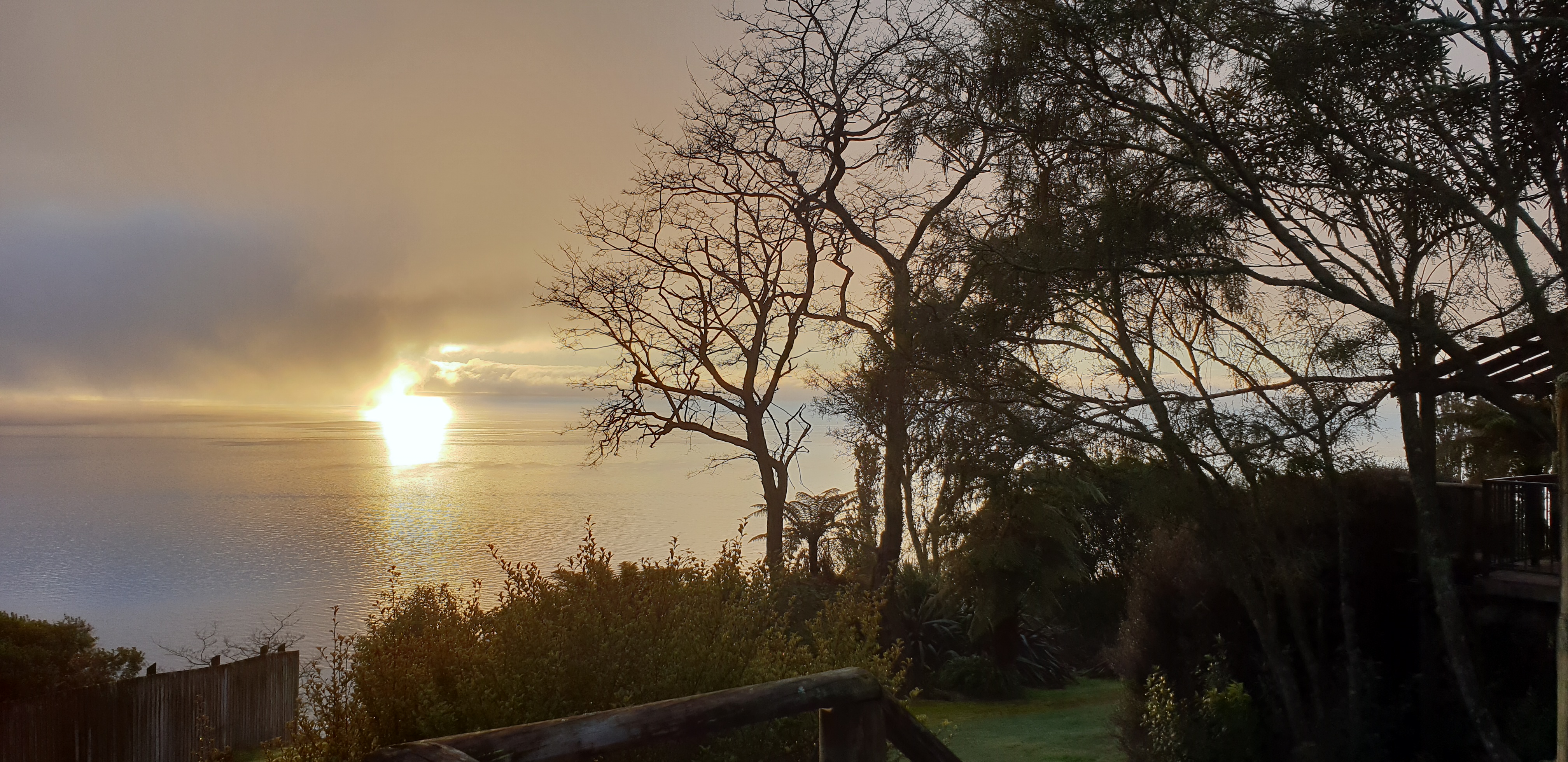
Our first morning there, a Saturday.  Winter.  Cold.  And a beautiful sunrise.

20180812_073230

This was taken from the balcony, overlooking the lake.

The sun is just creeping up over the horizon

20180812_073241

It gradually gets lighter, and then the sun breaks free of the low cloud

It lights up the balcony

20180811_074651

And the trees just beyond, a cascade of colorful ferns.

20180811_074622

It looks like it’s going to be a fine day, our first for this trip, and we will be heading to the mountains to see snow, for the first time for two of our granddaughters.

I am my own worst enemy, again!

I think most authors are.

Just when you think that the story is done, and you’re on the third re-read, just to make sure…

Damn!

I don’t like the way that chapter reads, and what’s worse, it’s about the tenth time I’ve looked at it.

It doesn’t matter the last three times you read it, it was just fine, or, the editor has read it and the chapter passed without any major comment.

I think the main problem I have is letting go.  For some odd reason, certain parts of a story sometimes seem to me as though they are not complete, or can be missing a vital clue or connection for the continuity of the story.

That, of course, happens when you rewrite a section that is earlier on in the story, and then have to make ongoing changes.

Yes, I hear the stern warnings, that I should have made a comprehensive outline at the beginning, but the trouble is, I can change the ending, as I’m writing it and then have to go back and add the hooks earlier on.  Not the best method, but isn’t that what an editor is for, to pick up the missed connections, and out of the blue events that happen for no reason?

I find that often after leaving a finished story for a month before the next reading, the whole picture must formulate itself in my head, so when I re-read, there was always a problem, one I didn’t want to think about until the re-read.

Even then it might survive a second pass.

I know the scene is in trouble when I get to it and alarm bells are going off.  I find anything else to do but look at it.

So, here I am, making major changes.

But, at least now I am satisfied with where it’s going.

Only 325 pages to go!

The cinema of my dreams – Was it just another surveillance job – Episode 66

This story is now on the list to be finished so over the new few weeks, expect a new episode every few days.

The reason why new episodes have been sporadic, there are also other stories to write, and I’m not very good at prioritizing.

But, here we are, a few minutes opened up and it didn’t take long to get back into the groove.

Things are about to get complicated…


Behind me, I could see Dobbin moving towards the door.

“You really don’t want to do this,” I said.

“He offered me a better deal.”

“I give you these, you will probably have about an hour, two at the most before he kills you.”

She shrugged.   She was a deadly shot, so it was not an option to talk her out of it.  I threw the plastic bag to her.

“This way, at least, you live.  You’re good, but too trusting.”

Dobbin opened the door.  “Enough chit-chat; let’s go before someone else turns up.  Walk away Jackson, don’t do anything you’ll regret.”

I watched them leave, then turned to Anna.  “This should please you immensely.”

“You mean you couldn’t see it coming?  Hell, with all that analysis it wasn’t hard to work out Dobbin was the one orchestrating everything.”

I pulled out my phone and dialled Joanne’s number.  When she answered I said, “They just left.”

“With the data?”

“With what they think is the data.”

“You have it?”

“No.  O’Connell had it, and someone got to him.  He’s dead next door, by the way, and we have two medical cases, one relatively serious, both requiring an ambulance sooner rather than later.”

“On it.  And thanks.”

I went over to Anna and sat beside her.

Jan was glaring at us.  “You said no one would get shot.”

We watched her slide over and join us against the wall.

“I said Jennifer was an unknown quantity.  I didn’t think she’d take me so literally, but on the other hand, the signs were there.  In training, she shot at three of the recruits.”

“Well, she didn’t recognise me, which, I guess, is something.”

“Who are you again?” Jan asked her.

“Yolanda.  I was at the training camp with Sam.  Severin made a pass at me, I kicked him in the you know what’s, and he kicked me out.  I never gave back the comms unit, and I used to listen in to the exercises and discovered they’d finally been activated, so I went to have a look.  Things got very scary when the target started taking out the surveillance team.  They were out of their depth.  Then I caught up with Sam, called him, and asked him what was going on.  He said the target was going to the café and for me to go around the back, no time for hello’s.  A minute or so later I see a guy toss something into the back of the café and take off.  Then it goes up and all hell broke loose.  Naturally, I got the hell out of there, and called him later, asked if he needed some off-book help, and here I am.”

“Could have been the death of you.”

“Nah.  Sam and I were the best two of that bunch, and then maybe Jennifer.  Damn that bitch to hell now.  Hope they give us five minutes with her.”

“So,” I could see Jan was still wrestling with details.  “Anna died in that explosion?”

“Yes.”

“Did you know who Anna was?”

“Not at first, but when I saw a photo of her, and the similarities I shared with her, Sam suggested I take her place, and we took it from there.  Sam told me where I could find O’Connell and it wasn’t hard to reconnect, it was six months and he didn’t notice the changes in Anna, which, to me, is a sign of bad tradecraft.  He still had the money, I pretended to still have the USB but not with me but back at the flat.  He tested the USB and found the right level of encryption, then gave me the five million pounds, and we parted.  Now he’s dead.  When Sam arrived, I thought it was going to be me next.”

“How did you know what sort of encryption was on the USB?”

Good question.  Jan was thinking outside the box, which is what any agent should be doing.

“We spend a few weeks off and on in training, studying encryption techniques, but concentrated on one, for reasons we were never told.  I realized that it was related to the eventual mission.  It wasn’t hard to emulate.  I made up about a dozen USBs just in case.”

“Just out of curiosity, what’s on those USB’s?”

“A PDF copy of War and Peace.”

…

© Charles Heath 2020-2023