As accomplished as we can be at putting words on paper, what is it that makes it so difficult to sit in a chair with a camera on you, and saying words rather than writing them?
Er and um seem to crop up a lot in verbal speech.
OK, it was a simple question; “What motivates you to write?”
Damn.
My brain just turned to mush, and the words come out sounding like a drunken sailor after a night out on the town.
The written answer to the question is simple; “The idea that someone will read what I have written, and quite possibly enjoy it; that is motivation enough.”
It highlights the difficulties of the novice author.
Not only are there the constant demands of creating a ‘brand’ and building a ‘following’, there is also the need to market oneself, and the interview is one of the more effective ways of doing this.
If only I can settle the nerves.
I mean, really, it is only my granddaughter who is conducting the interview, and the questions are relatively simple.
The trouble is, I’ve never had to do it before, well, perhaps in an interview for a job, but that is less daunting. That usually sticks to a predefined format.
Here the narrative can go in any direction. There are set questions, but the interviewer, in her inimitable manner, can sometimes slide a question in out of left field.
For instance, “Your character Zoe the assassin, is she based on someone you know, or an amalgam of other characters you’ve read about or seen in movies?”
That was an interesting question, and one that has several answers, but the one most relevant was; “It was the secret alter ego of one of the women I used to work with. I asked her one day if she wasn’t doing what she was, what she would like to do. It fascinated me that other people had a desire to be something more exotic in an alter ego.”
Of course, the next question was about what I wanted to be in an alter ego.
Down here, it is summer, and the last few days have been rather hot, well, it is summer after all, but tonight it is particularly hot.
So, as I can’t sleep, I’m lying on the couch staring at the ceiling, otherwise known as the cinema of my dreams.
Where am I?
Well, the location is in keeping with the weather, hot, humid, and cold drinks are mandatory.
I’m going to get another one now!
…
There is such a thing as being in the right place at the right time, as much as there is being in the wrong place at the wrong time.
I think I got a dose of both that morning.
I ignored the call from Boggs reluctantly, but I still had the world-weary look on my mother’s face fresh in my memory. As much as I didn’t want to, I headed towards the warehouse and the office where old man Benderby would be, in his Italian suit and cigar, the signs of his prosperity.
Everyone hated him.
In the employee car park, opposite the front gate, I could see Rico and one of Benderby’s sons in earnest conversation. The sons were as bad as the father, and because we went to school with them, and they were bullies then, not much had changed.
I was curious and tried to get closer, without being seen.
Benderby Junior was yelling, “You’re as useless as that brother in law of yours. He thought he was smarter than us too, and look what happened to him. You still owe us ten grand Rico, and my father is getting impatient.”
“Look, I have a special project, it’ll take a few weeks, then you’ll get your money.”
“It better not be some treasure hunt I hear you’re on. There is no treasure. That was what your brother in law tried to float, said he had a real map but never showed it to anyone. It doesn’t exist. He offered to sell it to me. Do I look like a fool?”
“No. But, it’s real. I’ve seen it.”
Benderby just shook his head. “Tell you what. Bring it to me, and if I think it’s real, then we’ll talk.”
With that, Benderby Junior walked off.
Rico didn’t look happy. Not surprising, because if Benderby thought it was real, then Rico just lost the rights to the treasure. Or, most likely, any part of it.
Telling Benderby was the last thing he should have done.
I went it to the office where I was greeted by the girl on reception. I;d been to school with her, and she had been friends with Alex Benderby. It was how she got the job. It was not what you knew, it was who you knew.
I also knew Alex Benderby, but it was not the same. He didn’t like people who were smarter than he was, we were, he once told me, threats. To what, I had no idea.
“Sam. How are you, haven’t seen you for a while.”
We had been friends of a sort at school, but now working for Benderby, she moved in different social circles.
“Fine, Jenny, as well as can be expected.” Not one for small talk, I cut to the chase. “I came to see if there was a job. My mother keeps at me to do something with my life other than hanging out at home waiting for a ship to come in.”
“I thought you were going to university?”
“Needs money we haven’t got.
At that moment Alex walked in and saw me. His face was all hostility.
“What are you doing here?”
“The same as every other unemployed person is, looking for work.”
“I thought you university types were too good to work in the warehouse?” No mistaking the sneer in his tone, or the superiority.
“Alex.” A bark from behind made both Alex and Jenny jump. “Get the hell back to work.” Then he saw me. “You’re Grace’s kid, Sam?”
“Yes, sir.” I may hate him but I still knew how to be polite.
“Grace told me you were coming down.” He looked at Jenny. “Tell Williams I’m sending over his new paperwork guy. Tell him I said to treat him properly or he’ll answer to me.” Then back at me. “Say hello to your mother from e when you see her. And that she still owed me dinner.”
Then he was gone.
“Congratulations,” Jenny said. “Right place, right time.”
I’m sure I’ve been down this road more than once, and with the same novel, but whereas the last edit, which was probably the second or third, finished up in the pile, then forgotten.
I’m doing an active update to all my works in progress, and sending them to the editor, after going through the manuscript once again, with a view to publishing. Hopefully, before the year is out.
…
As a result of a sit down with Chester, who has been keeping an eye on the progress of the project, or at least that’s what he thinks, we’ve decided that there’s going to be a slight change.
Plan or not, writing the story was always going to go the way the characters want to go, and I’ve decided that the two protagonists are not going to have a happily ever after.
They can’t.
It was a pie in the sky notion that they could given the nature of their professions. But it’s not only that, it comes down to the plans their employer has for them, and it certainly isn’t for them to be together.
So, the way it’s written they were about to have that intimate moment when commonsense took over, and instead of being together, they are apart in her apartment.
She wanted him to stay, he wanted to stay, but there are forces in play that dictate caution.
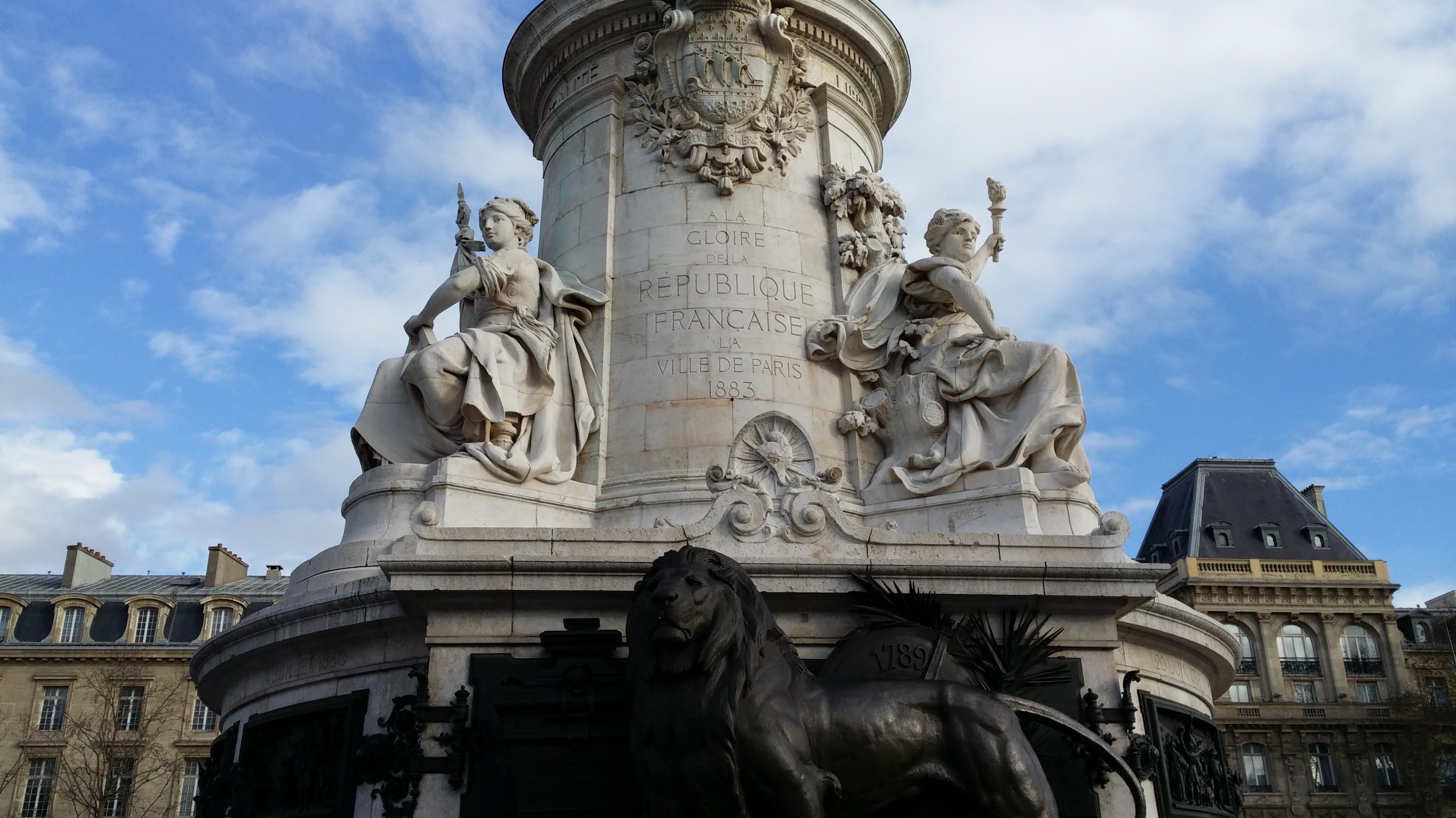
Whilst a rather important place for the French, for us visitors, it has a convenient hotel located just behind the square, and an underground, or Metro station, underneath.
Added to that was equally convenient cafes, one of which, The Cafe Republique, we had dinner every night. The service and food were excellent, and we had no problems with the language barriers.
At the top of the monument is a bronze statue of Marianne, said to be the personification of France.
Surrounding Marianne is three more statues, representing liberty, equality, and fraternity.
At the base is a lion guarding what is said to be a ballot box.
I can see how it is that a writer’s life is one that, at times, has to be shut off from the outside world.
It’s a bit hard to keep a stream of thoughts going when in one ear is some banal detective show, and in the other, a conversation that you have to keep up with. I know how hard it is because I’ve tried doing three things at once, and failed miserably in all three.
So, out I slink to the writing room and start by re-reading the previous chapters, to get back into the plot. I should remember where I am, and get straight to it, but the devil is in the detail.
Going back, quite often I revise, and a plotline is tweaked, and a whole new window is opened. God, I wish I didn’t do that!
Then I get to the blank page, ready to go, and…
The phone rings.
Damn. Damn. Damn.
Phone answered, back to the blank page, no, it’s gone, got yo go back, blast, another revision, and back to the blank page.
Half an hour shot to pieces.
The phone rings again.
Blast scam callers. I nearly rip the cord out of the wall.
All through this the cat just watches, and, is that a knowing smile?
It can’t be, I’ve just learned that cats can’t smile, or make any sort of face.
I’m sure his thoughts are not a vague or scrambled, or wrestling with the ploys of several stories on the go, getting locations right, getting characters to think and do their thing with a fair degree of continuity.
The cat’s world is one of which chair to lie on, where is that elusive mouse be it real or otherwise, and is this fool going to feed me, and please, please, don’t let it be the lasagna. I am not that cat!
Unlike other professions, it’s a steady, sometimes frustrating, slog where you can’t just walk away, have a great time, and come back and pick up where you left off. Stories have to be written from beginning to end, not a bit here and a bit there.
It’s a bit like running a marathon. You are in a zone, the first few miles are the hardest, the middle is just getting the rhythm and breathing under control, and then you hope you get to the end because it can seem that you’ve been going forever and the end is never in sight.
But, when you reach the end, oh, isn’t the feeling one of pure joy and relief.
Sorry, not there yet.
And no comment is required from the cat gallery, thankyou!
What was it that found me finding ways to run into a woman that I really didn’t want to run into or see again? And yet, it seemed everything I did, since Rodby reappeared in my life, revolved around her.
And it crossed my mind, while I was trying to find where she was living in London, that having a mother like Vittoria might have contributed to her ‘downfall’. The biography of Vittoria wasn’t that of a society angel, more the pretender who was little more than a petty criminal worming her way into a field of rich pickings.
She’d been in service in the count’s residence, and as much as I hoped wasn’t a continuation of the old practice of masters having their way with their employees, or servants back in the old days, he might have forced himself on her, but I suspect it was the other way around.
If she was a grifter then she would have made him aware of the girl he sired, and if he was good about it, would have adequately compensated her, if only to keep it quiet. Very adequately and for a long time until he died. I suspect the countess didn’t know, and like most women in those sorts of marriages, probably didn’t want to know.
The reason why there was no surveillance in Juliet was because no one had found a starting reference point. In other words, no one knew where she was. And Cecilia was right, London was a big place if I wanted to pound the pavement looking for her.
The file said an internet search on her was performed, but the only information relevant to her they found was her fall from grace and very little beyond that date range. It seemed Juliet Ambrose only existed for three years before I first met her.
That meant she had been someone else before that, most likely Juliet, the name of her mother at the time. That, of course, suggested one of two eventualities, that she wanted to escape her mother, or the Count’s family because of her mother, and changed her own name, or her mother had informed on some fellow criminals to leverage a free ticket and going into a form of witness protection.
Knowing Juliet as I did, the former was more likely than the latter.
Now there was a new possibility that wasn’t a scenario in the file. Had the count told anyone about the daughter, and the mother’s no doubt incessant demands? That could be a reason for a hitman to remove the problem or problems.
I looked at the biography for Vittoria Romano again and noted she had a number of aka’s, Gallo, Rossi, and her birth name Moretti.
A quick search told me the Italian version of Juliet was Giulietta, so I put Giulietta Moretti into the search engine and waited all of 35 nanoseconds to get the obligatory 20,000,000 hits. Popular girl.
But…
There on page three of endless pages on a fading Italian Rock and Roll singer, there was a picture, albeit of Juliet in her younger days, taken on the grounds of a mansion in Sorrento. The Count had a place in Sorrento, and I looked it up in the list provided.
Yes. It still belonged to the family. I tucked that away in the mental notes stored at the back of my mind. It would be worth a visit when I went looking for the Countess.
A further search through 32 useless pages of items found another.
Giulietta Moretti published a paper in a medical journal about a year ago on the effects on the human body caused by car crashes, and it was getting recognition by her peers. So much so, that she had been asked by a group of surgeons to talk about it at a conference in Blackpool.
The day after tomorrow.
And…
It had an address where she worked in London, a morgue in one of the larger hospitals. I now had a starting point.
My curiosity then switched to Alessandro.
I wondered if he knew the background of Vittoria. Surely his brother would have alerted him to the trouble she was causing him. Or, and this was a huge leap, had the Count not told anyone about her, thinking he had alone contained the problem.
If Alessandro knew then was he in cahoots with Vittoria in removing the Countess from the playing field.
What bothered me was that I saw Alessandro at the hotel at the same time as the countess, and I had no doubt he was the problem she needed to attend to. How had he managed to spirit her away, if he did? If not, why would she sneak out of the hotel and disappear?
Was it something to do with that meeting between her and Alessandro? All good questions for a Detective Inspector.
It was particularly troublesome that our surveillance on the main players managed to lose two of them for a lengthy period. No one had thought to stay in the hotel and were relying on the hotel’s own CCTV. That, of course, showed nothing other than the countess and Alessandro arriving, and nothing after that.
There were a dozen CCTV camera feeds and I had them sent to my phone and that afternoon went through all of them, looking for anomalies, people ridiculously disguised, large crates or cases that could hide bodies, anything to show she had left, albeit disguised.
What she would want to be seen was anyone’s guess, but it may have had something to do with Alessandro. What bothered me, though, was a report from the people who installed the CCTV system at the hotel. It was interesting that it found its way to the Department, but not as interesting as the fact the number installed, and locations, didn’t match the number that had returned video for the time. A second sheet noted that seven of the CCTV cameras were not in operation at the time, with no reason given.
As for Alessandro, he and I were going to have a talk sooner rather than later, and I was going to use my Detective Inspector warrant card for the second time.
Long ago, when developing guises, I got the chance to follow around a real detective inspector and learned the ropes. He was a good detective and a better teacher. It was my first item on the list for the next morning.
This case has everything, red herrings, jealous brothers, femme fatales, and at the heart of it all, greed.
See below for an excerpt from the book…
Coming soon!
An excerpt from the book:
When Harry took the time to consider his position, a rather uncomfortable position at that, he concluded that he was somehow involved in another case that meant very little to him.
Not that it wasn’t important in some way he was yet to determine, it was just that his curiosity had got the better of him, and it had led to this: sitting in a chair, securely bound, waiting for someone one of his captors had called Doug.
It was not the name that worried him so much, it was the evil laugh that had come after the name was spoken.
Doug what? Doug the ‘destroyer’, Doug the ‘dangerous’, Doug the ‘deadly’; there was any number of sinister connotations, and perhaps that was the point of the laugh, to make it more frightening than it was.
But there was no doubt about one thing in his mind right then: he’d made a mistake. A very big. and costly, mistake. Just how big the cost, no doubt he would soon find out.
His mother, and his grandmother, the wisest person he had ever known, had once told him never to eavesdrop.
At the time he couldn’t help himself and instead of minding his own business, listening to a one-sided conversation which ended with a time and a place. The very nature of the person receiving the call was, at the very least, sinister, and, because of the cryptic conversation, there appeared to be, or at least to Harry, criminal activity involved.
For several days he had wrestled with the thought of whether he should go. Stay on the fringe, keep out of sight, observe and report to the police if it was a crime. Instead, he had willingly gone down the rabbit hole.
Now, sitting in an uncomfortable chair, several heat lamps hanging over his head, he was perspiring, and if perspiration could be used as a measure of fear, then Harry’s fear was at the highest level.
Another runnel of sweat rolled into his left eye, and, having his hands tied, literally, it made it impossible to clear it. The burning sensation momentarily took his mind off his predicament. He cursed and then shook his head trying to prevent a re-occurrence. It was to no avail.
Let the stinging sensation be a reminder of what was right and what was wrong.
It was obvious that it was the right place and the right time, but in considering his current perilous situation, it definitely was the wrong place to be, at the worst possible time.
It was meant to be his escape, an escape from the generations of lawyers, what were to Harry, dry, dusty men who had been in business since George Washington said to the first Walthenson to step foot on American soil, ‘Why don’t you become a lawyer?” when asked what he could do for the great man.
Or so it was handed down as lore, though Harry didn’t think Washington meant it literally, the Walthenson’s, then as now, were not shy of taking advice.
Except, of course, when it came to Harry.
He was, Harry’s father was prone to saying, the exception to every rule. Harry guessed his father was referring to the fact his son wanted to be a Private Detective rather than a dry, dusty lawyer. Just the clothes were enough to turn Harry off the profession.
So, with a little of the money Harry inherited from one of his aunts, he leased an office in Gramercy Park and had it renovated to look like the Sam Spade detective agency, you know the one, Spade and Archer, and The Maltese Falcon.
There’s a movie and a book by Dashiell Hammett if you’re interested.
So, there it was, painted on the opaque glass inset of the front door, ‘Harold Walthenson, Private Detective’.
There was enough money to hire an assistant, and it took a week before the right person came along, or, more to the point, didn’t just see his business plan as something sinister. Ellen, a tall cool woman in a long black dress, or so the words of a song in his head told him, fitted in perfectly.
She’d seen the movie, but she said with a grin, Harry was no Humphrey Bogart.
Of course not, he said, he didn’t smoke.
Three months on the job, and it had been a few calls, no ‘real’ cases, nothing but missing animals, and other miscellaneous items. What he really wanted was a missing person. Or perhaps a beguiling, sophisticated woman who was as deadly as she was charming, looking for an errant husband, perhaps one that she had already ‘dispatched’.
Or for a tall, dark and handsome foreigner who spoke in riddles and in heavily accented English, a spy, or perhaps an assassin, in town to take out the mayor. The man was such an imbecile Harry had considered doing it himself.
Now, in a back room of a disused warehouse, that wishful thinking might be just about to come to a very abrupt end, with none of the romanticized trappings of the business befalling him. No beguiling women, no sinister criminals, no stupid policemen.
Just a nasty little man whose only concern was how quickly or how slowly Harry’s end was going to be.
We have been to Paris a number of times over the years.
The last time we visited Paris we brought the two eldest grandchildren. We took the Eurostar train from St Pancras station direct to Disneyland, then took the free bus from the station to the hotel. The train station was directly outside Disneyland.
We stayed at the Dream Castle Hotel, rather than Disneyland itself as it was a cheaper option and we had a family room that was quite large and breakfast was included every morning. Then it was a matter of getting the free bus to Disneyland.
We spent three days, time which seem to pass far too quickly, and we didn’t get to see everything. They did, however, find the time to buy two princess dresses, and then spent the rest of the time playing dress-ups whenever they could.
In Paris, we stayed at the Crown Plaza at Republique Square.
We took the children to the Eiffel Tower where the fries, and the carousel at the bottom of the tower, seemed to be more memorable than the tower itself. The day we visited, the third level was closed. The day was cold and windy so that probably accounted for the less than memorable visit. To give you some idea of conditions, it was the shortest queue to get in I’ve ever seen.
We traveled on the Metro where it was pointed out to me that the trains actually ran on rubber tires, something I had not noticed before. It was a first for both children to travel on a double-decker train.
The same day, we went to the Louvre.
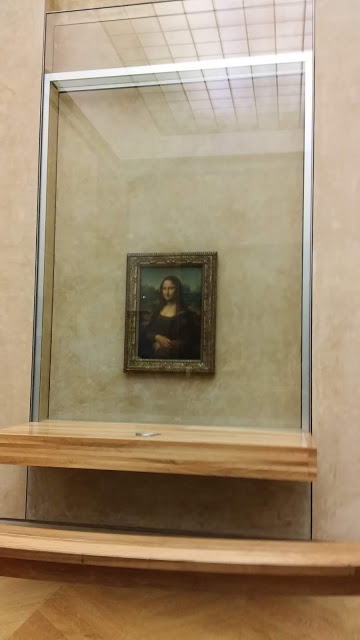
Here, it was cold, wet and windy while we waited, Once inside we took the girls to the Mona Lisa, and after a walk up and down a considerable numkber of stairs, one said, “and we walked all this way to see this small painting”.
It quickly became obvious their idea of paintings were the much larger ones hanging in other galleries.
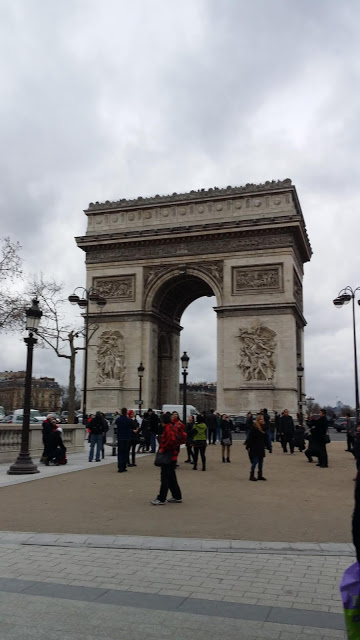
We also took them to the Arc de Triomphe.
We passed, and for some reason had to go into, the Disney shop, which I’m still wondering why after spending a small fortune at Disneyland itself.
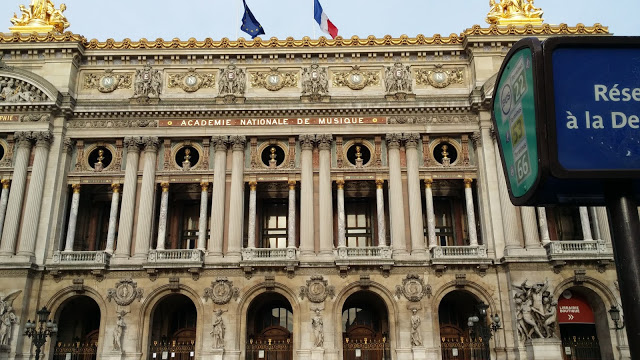
Next on the tour list was the Opera House.
where one of the children thought she saw the ghost and refused to travel in one of the elevators. At least it was quite amazing inside with the marble, staircases, and paintings on the roof.
Sadly, I don’t think they were all that interested in architecture, but at the Opera House, they did actually get to see some ballet stars from the Russian Bolshoi ballet company practicing. As we were leaving the next day we could not go and see a performance.
Last but not least was Notre Dame with its gargoyles and imp[osing architecture.
All in all, traveling with children and experiencing Paris through their eyes made it a more memorable experience.
The first we visited Paris was at the end of a whirlwind bus tour, seven countries in seven days or something like that. It was a relief to get to Paris and stay two nights if only to catch our breath.
I remember three events from that tour, the visit to the Eiffel Tower, the tour of the night lights, not that we were able to take much in from the inside of the bus, and the farewell dinner in one of the tour guides specially selected restaurants. The food and atmosphere were incredible. It was also notable for introducing us to a crepe restaurant in Montmartre, another of the tour guide’s favorite places.
On that trip to Paris, we also spent an afternoon exploring the Palace of Versailles.
The next time we visited Paris we flew in from London. OK, it was a short flight, but it took all day. From the hotel to the airport, the wait at the airport, departure, flying through time zones, arrival at Charles De Gaulle airport, now there’s an experience, and waiting for a transfer that never arrived, but that’s another story.
I can’t remember where we stayed the first time, it was somewhere out in the suburbs, but the second time we stayed at the Hilton near both the Eiffel Tower and the Australian Embassy, notable only because the concierge was dating an Australian girl working in the Embassy. That was our ticket for special treatment, which at times you need to get around in Paris.
It was the year before 2000 and the Eiffel Tower was covered in lights, and every hour or so it looked like a bubbling bottle of champagne. It was the first time we went to Level 3 of the Tower, and it was well worth it. The previous tour only included Level 2. This time we were acquainted with the fries available on the second level, and down below under the tower.
This time we acquainted ourselves with the Metro, the underground railway system, to navigate our way around to the various tourist spots, such as Notre Dame de Paris, The Louvre, Sacre-Coeur Basilica, and Les Invalides, and, of course, the trip to the crepe restaurant.
We also went to the Louvre for the express purpose of seeing the Mona Lisa, and I came away slightly disappointed. I had thought it to be a much larger painting. We then went to see the statue of Venus de Milo and spent some time trying to get a photo of it without stray visitors walking in front of us. Aside from that, we spent the rest of the day looking at the vast number of paintings, and Egyptian artifacts in the Museum.
We also visited the Opera House which was architecturally magnificent.
The third time we visited Paris we took our daughter, who was on her first international holiday. This time we stayed in a quaint Parisian hotel called Hotel Claude Bernard Saint Germain, (43 Rue Des Ecoles, Paris, 75005, France), recommended to us by a relation who’d stayed there the year before. It was small, and the elevator could only fit two people or one person and a suitcase. Our rooms were on the 4th floor, so climbing the stairs with luggage was out of the question.
It included breakfast and wifi, and it was quite reasonable for the four days we stayed there.
It was close to everything you could want, down the hill to the railway station, and a square where on some days there was a market, and for those days when we were hungry after a day’s exploring, a baguette shop where rolls and salad were very inexpensive and very delicious.
To our daughter we appeared to be experienced travelers, going on the Metro, visiting the Louvre, going, yes once again, to the crepe restaurant and the Basilica at Montmartre, Notre Dame, and this time by boat to the Eiffel Tower. We were going to do a boat rode on the Seine the last time but ran out of time.
We have some magnificent photos of the Tower from the boat.
Lunch on one of the days was at a restaurant not far from the Arc de Triomphe, where our daughter had a bucket of mussels. I was not as daring and had a hamburger and fries. Then we went to the center of the Arch and watched the traffic.
Our first time in Paris the bus driver got into the roundabout just to show us the dangers of driving in an unpredictable situation where drivers seem to take huge risks to get out at their exit. Needless to say, we survived that experience, though we did make a number of circuits.
There was something about this one that resonated with me.
This is a novel about a world generally ruled by perception, and how people perceive what they see, what they are told, and what they want to believe.
I’ve been guilty of it myself as I’m sure we all have at one time or another.
For the main characters Harry and Alison there are other issues driving their relationship.
For Alison, it is a loss of self-worth through losing her job and from losing her mother and, in a sense, her sister.
For Harry, it is the fact he has a beautiful and desirable wife, and his belief she is the object of other men’s desires, and one in particular, his immediate superior.
Between observation, the less than honest motives of his friends, a lot of jumping to conclusions based on very little fact, and you have the basis of one very interesting story.
When it all comes to a head, Alison finds herself in a desperate situation, she realises only the truth will save their marriage.
But is it all the truth?
What would we do in similar circumstances?
Rarely does a book have me so enthralled that I could not put it down until I knew the result. They might be considered two people who should have known better, but as is often the case, they had to get past what they both thought was the truth.
And the moral of this story, if it could be said there is one, nothing is ever what it seems.
I’m sure I’ve been down this road more than once, and with the same novel, but whereas the last edit, which was probably the second or third, finished up in the pile, then forgotten.
I’m doing an active update to all my works in progress, and sending them to the editor, after going through the manuscript once again, with a view to publishing. Hopefully, before the year is out.
…
As a result of a sit down with Chester, who has been keeping an eye on the progress of the project, or at least that’s what he thinks, we’ve decided that there’s going to be a slight change.
Plan or not, writing the story was always going to go the way the characters want to go, and I’ve decided that the two protagonists are not going to have a happily ever after.
They can’t.
It was a pie in the sky notion that they could given the nature of their professions. But it’s not only that, it comes down to the plans their employer has for them, and it certainly isn’t for them to be together.
So, the way it’s written they were about to have that intimate moment when commonsense took over, and instead of being together, they are apart in her apartment.
She wanted him to stay, he wanted to stay, but there are forces in play that dictate caution.