Searching for locations: The Beijing Zoo, and Pandas, China

Beijing Zoo

Founded in 1906 during the late Qing dynasty, it is the oldest Zoo in China.  It also has an aquarium and has 450 land-based species, some of which are rare and endemic to China like the Giant Panda, and 500 marine-based species.  Other rare animals to be seen are the Red Panda, the Golden Snub-nosed Monkey, the South China Tiger, the White Lipped deer, the Chinese alligator, the Yak, and the Snow Leopard.
Most of the original animals were bought in 1908 from Germany by the viceroy of Liangjiang Duanfang.  The Zoo first opened on June 16th, 1908.
Currently, the Zoo grounds resemble classical Chinese gardens, and among the attractions are a number of Qing dynasty buildings to view, as well as an Elephant hall, a Lion and tiger hall, a Monkey hall, and a Panda hall.  In all, there are 30 halls.
The Zoo is located at 137 Xizhimen WaiDajie in Xicheng district, near the 2nd ring road.

We are primarily at the Zoo to see the Pandas, and there is a specific hall devoted to them, and by the way, it costs extra to see them.  Everyone in our group is particularly interested in seeing them because it’s rare that any can be found anywhere else in the world.
Perhaps if there had been more time, another hour, maybe, it might have made all the difference, but I think that extra time might have clashed with the pearl factory, and that, for obvious reasons, was deemed to be more important.

Our first stop is in the Panda hall.

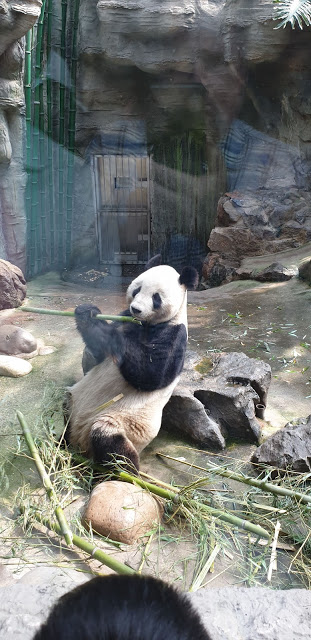
There are two pandas that we can see, one of whom is a little camera shy, and the other, above, who is demonstrating how pandas eat bamboo.  They are behind a large glass wall, and you have to wait for the opportunity to get a good photo, and, sometimes only enough to include the top of the head of the person in front of you.  Unfortunately, the Chinese visitors don’t understand the polite excuse me in English, and, can at times, be rude enough to shove their way to the front.

What is also a problem is the uncooperativeness of the pandas to pose for photos.  I guess there’s no surprise there given the thousands of visitors every day with only one purpose in mind.  We counted ourselves lucky to get the photos we did.

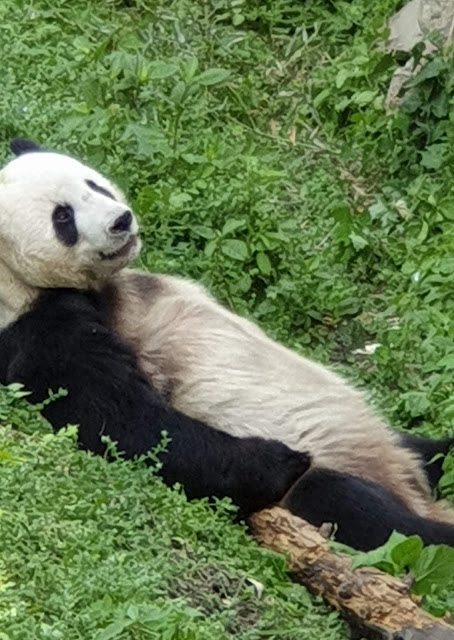
The hall itself is built on to the external enclosure where there are a number of giant pandas some of whom that were on show were relatively lethargic, as though they had a big weekend, and we’re sleeping it off, like this panda below:

Then, remarkably, we came across one that decided to be a little more energetic and did a walk in front of hundreds of Chinese who had undoubtedly come to show their children the animals.

This Panda was also easier to photograph whereas the other panda, one chewing on a morning feast of bamboo, saw a lot of pushing and shoving by the spectators to get the best spot to take his photograph.  Having manners just doesn’t cut it here, so do what you have to to get that photograph.

We also saw a couple of monkeys that were also in the panda enclosure, but they were not much of a side benefit.  They may have been there to use the Panda’s exercise equipment, though it was not quite like what we use. There was no time really to wander off to see much else, but apparently, there were also red pandas, and surprisingly, a category called Australian animals.  But who goes to another country to view your own animals? The cutest animals were the stuffed pandas, and they were quite reasonably priced.

“What Sets Us Apart”, a mystery with a twist

David is a man troubled by a past he is trying to forget.

Susan is rebelling against a life of privilege and an exasperated mother who holds a secret that will determine her daughter’s destiny.

They are two people brought together by chance. Or was it?

When Susan discovers her mother’s secret, she goes in search of the truth that has been hidden from her since the day she was born.

When David realizes her absence is more than the usual cooling off after another heated argument, he finds himself being slowly drawn back into his former world of deceit and lies.

Then, back with his former employers, David quickly discovers nothing is what it seems as he embarks on a dangerous mission to find Susan before he loses her forever.

Find the kindle version on Amazon here:  http://amzn.to/2Eryfth

whatsetscover

“Strangers We’ve Become” – The final countdown to publishing in 26 days

Your friends are not my friends

…

So, integration into the Featherington empire is not going according to plan.

Whose plan, it might be asked.

Instead of just settling into a life of luxury and being the plus one for a woman who simply needed a consort, David has the nagging feeling everything around him is not as it should be.

He could cite the pain-killing drugs sending him into a world of conspiracies and hallucinations, that not everything around him was suspicious.

Take, for instance, her new business partners, far too handsome for their own good, and why is Susan flirting so openly with them?

Then there are the three Russian maids.  See no evil, hear no evil, speak evil, if they’re maids, why did they look and act like Russian spies?

Perhaps an old friend might be able to clear that up for him/

And why does the old family Butler, the only authentic person, other than the housekeeper who truly is both British to the core, and as genuine as they get, whispering in David’s ear that the mistress has changed, and he is concerned/

On day one in the London residence, it doesn’t take long to realize the walls have both eyes and ears, and thus the game’s afoot.

Once more he finds himself back in the murky world of lies and deceit.

…

The worst part of it is that he has no tangible truth that anything is amiss, and truth be told, David just wants everything to go back to the way it was.

An excerpt from “The Things We Do For Love”; In love, Henry was all at sea!

In the distance he could hear the dinner bell ringing and roused himself.  Feeling the dampness of the pillow, and fearing the ravages of pent up emotion, he considered not going down but thought it best not to upset Mrs. Mac, especially after he said he would be dining.

In the event, he wished he had reneged, especially when he discovered he was not the only guest staying at the hotel.

Whilst he’d been reminiscing, another guest, a young lady, had arrived.  He’d heard her and Mrs. Mac coming up the stairs, and then shown to a room on the same floor, perhaps at the other end of the passage.

Henry caught his first glimpse of her when she appeared at the door to the dining room, waiting for Mrs. Mac to show her to a table.

She was about mid-twenties, slim, long brown hair, and the grace and elegance of a woman associated with countless fashion magazines.  She was, he thought, stunningly beautiful with not a hair out of place, and make-up flawlessly applied.  Her clothes were black, simple, elegant, and expensive, the sort an heiress or wife of a millionaire might condescend to wear to a lesser occasion than dinner.

Then there was her expression; cold, forbidding, almost frightening in its intensity.  And her eyes, piercingly blue and yet laced with pain.  Dracula’s daughter was his immediate description of her.

All in all, he considered, the only thing they had in common was, like him, she seemed totally out of place.

Mrs. Mac came out of the kitchen, wiping her hands on her apron.  She was, she informed him earlier, chef, waitress, hotelier, barmaid, and cleaner all rolled into one.  Coming up to the new arrival she said, “Ah, Miss Andrews, I’m glad you decided to have dinner.  Would you like to sit with Mr. Henshaw, or would you like to have a table of your own?”

Henry could feel her icy stare as she sized up his appeal as a dining companion, making the hair on the back on his neck stand up.  He purposely didn’t look back.  In his estimation, his appeal rating was minus six.  Out of a thousand!

“If Mr. Henshaw doesn’t mind….”  She looked at him, leaving the query in mid-air.

He didn’t mind and said so.  Perhaps he’d underestimated his rating.

“Good.”  Mrs. Mac promptly ushered her over.  Henry stood, made sure she was seated properly and sat.

“Thank you.  You are most kind.”  The way she said it suggested snobbish overtones.

“I try to be when I can.”  It was supposed to nullify her sarcastic tone but made him sound a little silly, and when she gave him another of her icy glares, he regretted it.

Mrs. Mac quickly intervened, asking, “Would you care for the soup?”

They did, and, after writing the order on her pad, she gave them each a look, imperceptibly shook her head, and returned to the kitchen.

Before Michelle spoke to him again, she had another quick look at him, trying to fathom who and what he might be.  There was something about him.

His eyes, they mirrored the same sadness she felt, and, yes, there was something else, that it looked like he had been crying?  There was a tinge of redness.

Perhaps, she thought, he was here for the same reason she was.

No.  That wasn’t possible.

Then she said, without thinking, “Do you have any particular reason for coming here?”  Seconds later she realized she’s spoken it out loud, had hadn’t meant to actually ask, it just came out.

It took him by surprise, obviously not the first question he was expecting her to ask of him.

“No, other than it is as far from civilization, and home, as I could get.”

At least we agree on that, she thought.

It was obvious he was running away from something as well.

Given the isolation of the village and lack of geographic hospitality, it was, from her point of view, ideal.  All she had to do was avoid him, and that wouldn’t be difficult.

After getting through this evening first.

“Yes,” she agreed.  “It is that.”

A few seconds passed, and she thought she could feel his eyes on her and wasn’t going to look up.

Until he asked, “What’s your reason?”

Slight abrupt in manner, perhaps as a result of her question, and the manner in which she asked it.

She looked up.  “Rest.  And have some time to myself.”

She hoped he would notice the emphasis she had placed on the word ‘herself’ and take due note.  No doubt, she thought,  she had completely different ideas of what constituted a holiday than he, not that she had actually said she was here for a holiday.

Mrs. Mac arrived at a fortuitous moment to save them from further conversation.

Over the entree, she wondered if she had made a mistake coming to the hotel.  Of course, there had been no possible way she could know than anyone else might have booked the same hotel, but realized it was foolish to think she might end up in it by herself.

Was that what she was expecting?

Not a mistake then, but an unfortunate set of circumstances, which could be overcome by being sensible.

Yet, there he was, and it made her curious, not that he was a man, by himself, in the middle of nowhere, hiding like she was, but for very different reasons.

On discreet observance whilst they ate, she gained the impression his air of light-heartedness was forced and he had no sense of humor.

This feeling was engendered by his looks, unruly dark hair, and permanent frown.  And then there was his abysmal taste in clothes on a tall, lanky frame.  They were quality but totally unsuited to the wearer.

Rebellion was written all over him.

The only other thought crossing her mind, and rather incongruously, was he could do with a decent feed.  In that respect, she knew now from the mountain of food in front of her, he had come to the right place.

“Mr. Henshaw?”

He looked up.  “Henshaw is too formal.  Henry sounds much better,” he said, with a slight hint of gruffness.

“Then my name is Michelle.”

Mrs. Mac came in to take their order for the only main course, gather up the entree dishes, then return to the kitchen.

“Staying long?” she asked.

“About three weeks.  Yourself?”

“About the same.”

The conversation dried up.

Neither looked at the other, rather at the walls, out the window, towards the kitchen, anywhere.  It was, she thought, almost unbearably awkward.

Mrs. Mac returned with a large tray with dishes on it, setting it down on the table next to theirs.

“Not as good as the usual cook,” she said, serving up the dinner expertly, “but it comes a good second, even if I do say so myself.  Care for some wine?”

Henry looked at Michelle.  “What do you think?”

“I’m used to my dining companions making the decision.”

You would, he thought.  He couldn’t help but notice the cutting edge of her tone.  Then, to Mrs. Mac, he named a particular White Burgundy he liked and she bustled off.

“I hope you like it,” he said, acknowledging her previous comment with a smile that had nothing to do with humor.

“Yes, so do I.”

Both made a start on the main course, a concoction of chicken and vegetables that were delicious, Henry thought, when compared to the bland food he received at home and sometimes aboard my ship.

It was five minutes before Mrs. Mac returned with the bottle and two glasses.  After opening it and pouring the drinks, she left them alone again.

Henry resumed the conversation.  “How did you arrive?  I came by train.”

“By car.”

“Did you drive yourself?”

And he thought, a few seconds later, that was a silly question, otherwise she would not be alone, and certainly not sitting at this table. With him.

“After a fashion.”

He could see that she was formulating a retort in her mind, then changed it, instead, smiling for the first time, and it served to lighten the atmosphere.

And in doing so, it showed him she had another more pleasant side despite the fact she was trying not to look happy.

“My father reckons I’m just another of ‘those’ women drivers,” she added.

“Whatever for?”

“The first and only time he came with me I had an accident.  I ran up the back of another car.  Of course, it didn’t matter to him the other driver was driving like a startled rabbit.”

“It doesn’t help,” he agreed.

“Do you drive?”

“Mostly people up the wall.”  His attempt at humor failed.  “Actually,” he added quickly, “I’ve got a very old Morris that manages to get me where I’m going.”

The apple pie and cream for dessert came and went and the rapport between them improved as the wine disappeared and the coffee came.  Both had found, after getting to know each other better, their first impressions were not necessarily correct.

“Enjoy the food?” Mrs. Mac asked, suddenly reappearing.

“Beautifully cooked and delicious to eat,” Michelle said, and Henry endorsed her remarks.

“Ah, it does my heart good to hear such genuine compliments,” she said, smiling.  She collected the last of the dishes and disappeared yet again.

“What do you do for a living,” Michelle asked in an off-hand manner.

He had a feeling she was not particularly interested and it was just making conversation.

“I’m a purser.”

“A what?”

“A purser.  I work on a ship doing the paperwork, that sort of thing.”

“I see.”

“And you?”

“I was a model.”

“Was?”

“Until I had an accident, a rather bad one.”

“Oh, I’m sorry.”

So that explained the odd feeling he had about her.

As the evening had worn on, he began to think there might be something wrong, seriously wrong with her because she didn’t look too well.  Even the carefully applied makeup, from close up, didn’t hide the very pale, and tired look, or the sunken, dark ringed eyes.

“I try not to think about it, but it doesn’t necessarily work.  I’ve come here for peace and quiet, away from doctors and parents.”

“Then you will not have to worry about me annoying you.  I’m one of those fall-asleep-reading-a-book types.”

Perhaps it would be like ships passing in the night and then smiled to himself about the analogy.

Dinner now over, they separated.

Henry went back to the lounge to read a few pages of his book before going to bed, and Michelle went up to her room to retire for the night.

But try as he might, he was unable to read, his mind dwelling on the unusual, yet the compellingly mysterious person he would be sharing the hotel with.

Overlaying that original blurred image of her standing in the doorway was another of her haunting expressions that had, he finally conceded, taken his breath away, and a look that had sent more than one tingle down his spine.

She may not have thought much of him, but she had certainly made an impression on him.

© Charles Heath 2015-2020

lovecoverfinal1

In a word: Under

Under by itself is a rather boring word, you know, under the moon, under the sea, under the influence, which is not hard to be if you’ve been hypnotised or after a few drinks.

Under is anything beneath something else.

But let’s add it to some other words like,

Underrated, which means it is better than what others give it credit for.

Underwear is what you would wear underneath your clothes.

An understudy is a person who takes over a lead role when the lead is incapacitated. And how many understudies are guilty of harming the lead, in order to get a big break?

And not get away with it?

Understood, an agreement that might or might not be in writing that something will happen, that is, it is understood that I will be the next president.

Or not. Who on earth would really want to be president of anything?

So in the spirit of trying to confuse everyone all of the time, I have a conundrum in the form of a question, what is the difference between under and underneath?

To me there is none, you can be under the sea or underneath the sea, or under the table or underneath the table, but then there’s another, you can be under the influence but not underneath the influence, though technically you could, if you wanted to use confusing English.

And, just to add to the confusion further, I can say that the submarine sailed under the sea, underneath the sea, but, in actual fact, it doesn’t.

What is under the sea is the sand, or sea bed, and a submarine does not plough its way through the sand, does it?

What we really should be saying is that a submarine moves through the water.

Just saying…

“One Last Look”, nothing is what it seems

A single event can have enormous consequences.

A single event driven by fate, after Ben told his wife Charlotte he would be late home one night, he left early, and by chance discovers his wife having dinner in their favourite restaurant with another man.

A single event where it could be said Ben was in the wrong place at the wrong time.

Who was this man? Why was she having dinner with him?

A simple truth to explain the single event was all Ben required. Instead, Charlotte told him a lie.

A single event that forces Ben to question everything he thought he knew about his wife, and the people who are around her.

After a near-death experience and forced retirement into a world he is unfamiliar with, Ben finds himself once again drawn back into that life of lies, violence, and intrigue.

From London to a small village in Tuscany, little by little Ben discovers who the woman he married is, and the real reason why fate had brought them together.

It is available on Amazon here:  http://amzn.to/2CqUBcz

A photograph from the Inspirational bin – 33

This is countryside somewhere inside the Lamington National Park in Queensland. It was one of those days where the rain come and went…

We were spending a week there, in the middle of nowhere on a working macadamia farm in a cottage, one of four, recuperating from a long exhausting lockdown.

It was not cold, and we were able to sit out of the verandah for most of the day, watching the rain come and pass over on its way up the valley, listing to the gentle pitter-patter of the rain on the roof and nearby leaves.

But as for inspiration:

This would be the ideal setting for a story about life, failed romance, or a couple looking to find what it was they lost.

It could be a story about recovering from a breakdown, or a tragic loss, to be anywhere else but in the middle of dealing with the constant reminders of what they had.

It could be a safe house, and as we all know, safe houses in stories are rarely safe houses, where it is given away by someone inside the program, or the person who it’s assigned to give it away because they can’t do as they’re supposed to; lay low.

Then there’s camping, the great outdoors, for someone who absolutely hates being outdoors, or those who go hunting, and sometimes become the hunted.

Oh, and watch out for the bears!

“The End of the Road”, a short story

The End of the Road

The man who had said that we would never make the distance was right.

It had been my idea to go ‘troppo’, forsake everything, hop on a motorbike and go around Australia.  I was, at that stage fed up with everything and, catching Harry in one of his low spots, he decided there and then he would join me.

For the first few days, we believed we were stark staring mad and talked about calling it quits, but perseverance made all the difference.  After two months we were glad we had the resolve to keep going, and in that time we had managed to see more of the Australian countryside than we’d seen all our lives.

That was until this particular morning when we arrived in Berrigum, what could have been called a one-horse town.  It consisted of one hotel, one general store (that sold everything from toothpicks to petrol) and an agricultural machinery depot.  It also had a station and some wheat silos, and this appeared to be the only reason for a town in this particular spot in the middle of nowhere.

And it was the railway station that interested Harry, who was, by this time, getting a little homesick and fed up with his motorbike.

After coughing and spluttering for the last week it had finally died, and the five-mile walk to Berrigum had not helped either his temper, or his disposition, and had only served to firm his resolve to return home.

It was hot but not unbearably so, unlike a hot summer’s day in the city, and even worse still in public transport.  For miles around as we tramped those five miles all we could see was acres and acres of wheat, but no sign of life.  It was the same when we reached the town.  It appeared all the people were either hiding or had left.  Harry suspected the latter given the state of the road, and the buildings, more or less the epitome of a ghost town.

Standing at the end of what could have been called the main street with only our own dust for company, one look took in the whole town.  In a car, one wouldn’t have given it a second look, if one had time to give it a first.  I didn’t remember seeing neither any speed restriction signs nor signpost advertising a town ahead.

And since no amount of argument could sway him from his resolve, the first objective was to get a train timetable, if such a thing existed, and make arrangements for Harry’s return.

The station was as deserted as the town itself, and a quick glance in the stationmaster’s office showed no sign of life.

Leaving the bikes on the platform outside the office, we headed for the hotel for both a drink and make enquiries about rail services.  Being a hot day and the morning’s tramp somewhat hot and dusty, we were looking forward to a cold glass (or two) of beer.

The hotel looked as though it was a hundred years old though there was no doubting a few relentless summers would reduce it to the same state.  It was as bad inside as out, though the temperature was several degrees lower, and we could sit down in what appeared to be the main bar.  We were the only occupants and still to find any sign of life.  Overhead, two fans were struggling to move the hot air around.

More than once Harry reckoned it was a ghost town and I was beginning to believe him when, after five minutes, no one arrived.

After ten, we stood, ready to leave, only to stop halfway out of our chairs when a voice behind us said, “Surely you’re not going back out there without refreshment?”

“I was beginning to think the town was deserted,” I said.

“It is during the day, but when the sun goes down…”

I didn’t ask.  We followed him to the bar where he had stationed himself behind the counter.  “The name is Jack.”  He stretched out his hand towards us.  “We don’t bother with last names here.”

“Bill,” I said, shaking it, and nodding to Harry, “Harry.”

Harry nodded and shook his hand too.

“The first one’s on the house.”  He poured three glasses and put ours in front of us.  “Cheers.”

In all cases, it went down without touching the sides (as they say) and he poured a second, at the same time asking, “What brings you to our little corner of the earth?”

“Just passing through,” I said, “Or at least for me.”

“And you?”  Jack looked at Harry.

“I can’t hack the pace.  I can truthfully say I have thoroughly enjoyed the trip so far, except for a few mishaps, but for me, it’s time to get back to the big smoke.  My ‘do your own thing’ has run out of momentum.  Do you know if there is a train that goes anywhere important?”

The publican looked at him almost pityingly.  “Important, eh?”  He rubbed his chin feigning thought.  “You make it sound like you are in purgatory.”

“Aren’t we?”

I suppose one could hardly blame Harry for his attitude.  After all, at the beginning, he had numerous accidents, caught a virus that stayed with him (and a couple of torrential downpours had done little to help it), and now his motorbike had finally died.  No wonder his humour was at an all-time low.

For a moment I thought the publican was going to tell Harry what he thought of him, but then he smiled and the tension passed.  “Perhaps to a city fellow like you it might be,” he said.  “The mail train which has a passenger carriage comes through once a week, and, my good man, you’re in luck.  Today’s the day.”

“Good.  How do I get a ticket?”

“You’d have to see the Station Master.”

“And where might he be at the moment?  We were at the station a while back and there was no sign of life.”

“Nor will there be until the train comes.  Meanwhile, there’s time enough for lunch.  I’m sure you will stay?”  He looked questioningly at us.

I looked at Harry, who nodded.

“Why not.”

Over lunch, we talked.

I remember not so long ago when I had to attend a large number of lunches where the talk was of business, or, if anything, mostly about subjects that I had no interest in.  It was always some posh restaurant, time seemed important, the atmosphere never really relaxed, and to get into a relaxed state it took a large amount of alcohol to deaden the despair and distaste of that one had to fete in order to secure their business.

How different it was here.

We talked about the country, and, after seeing as much of it, and worked on it as we had to fund our odyssey, we could talk about it authoritatively.  And, most of all, it was interesting.

The atmosphere too was entirely different than it had been in the city.  Out here the people were always friendly, people always willing to stop and talk, particularly farmers; share a drink or some food.

There was none of this carefree purposefulness in the city, and more than once I’d thought of the fact one could travel in the same train with the same people for year after year and still not know any of them.  It was the same at work.  Even after five years I still hadn’t known three-quarters of the office staff, and most of them probably didn’t want to know me.  Harry was virtually the only real friend I’d had at work.

But here, in ‘the middle of nowhere’ as Harry had called it, I felt as though I’d known the publican all of my life instead of the few short hours.

Some hours later and after much argument, where Jack and I tried to talk Harry into staying (Jack said he knew someone who could fix anything including Harry’s bike), Harry remained unconvinced and resolute.  Jack, to round off the occasion (we were the first real guests from outside he had had in a week) provided another on-the-house ale and then saw us to the station.  “After all”, he had said, “I’ve nothing else to do at the moment.”

By that time the station was showing a little more life than it had before.  A station assistant, moving several parcels with a hand trolley, slowly ambled towards the end of the platform.

And whether it could be called a platform was a debatable point.  It was a gravel and grass affair that looked more like part of cutting through a hill than a station.

At the station, Jack portentously announced he was also the stationmaster and would be only too happy to take care of Harry’s requirements.  It would be, he added, “the first passenger ticket sold for several months.”  Certainly, the ticket he handed Harry bore witness to that.  It had yellowed with age.

One would have thought with the imminent arrival of the train there would be more people, but no.  The only event had been the station assistant’s stroll to the end of the platform and back.  Now both he and Jack had disappeared into the office and we were left alone on the platform.  Very little in the whole town stirred, nor had it the whole time we’d been there.

“Well,” I said to break the silence.  “I’m sorry to see you going through with it.  I thought I might have been able to talk you out of it…”  I shrugged, leaving the sentence unfinished.

“I’m sorry to be going too, but a body can take only so much bad luck, and God knows that’s all I’ve had.”

“Yes.”  I couldn’t think of much else to say.  “But it’s been good to have your company these last few months.”

“And you.  When do you think you’ll get back?”

“When I get sick of it I suppose.”

“Look us up then when you get back.”

“I will.”

Thankfully the appearance of the train in the distance broke off the conversation.  I had begun to think of what it was going to be like out on the road with no one to talk to but myself.  The thought was a little depressing and I tried not to let it show.

We said little else until the train pulled in, three flat cars, seven enclosed wagons, a passenger carriage and the guard’s van.  The train stopped with only part of the passenger carriage and the guard’s van at the station.

The guard took aboard the parcels the station assistant had left for him earlier, and then put those that were for Berrigum on the trolley.

I shook Harry’s hand and said I’d see him around.  Then he, the motorbike, and the guard were aboard and the train was off, disappearing slowly into the afternoon haze.

The station assistant then repeated his amble to the end of the platform to collect the hand trolley.

“Staying or moving on.”  Jack had come up behind me and gave me a bit of a start.

“Staying I guess, until tomorrow or maybe later.”

“I had heard one of the farm hands is leaving tomorrow heading back to Sydney.  There could be a vacancy.”

“Sounds like a plan,” I said.

“I could put in a word for you.”

“Thanks.”

Jack just grinned and we headed for the hotel.

© Charles Heath 2016-2019

The cinema of my dreams – I always wanted to go on a treasure hunt – Episode 29

Here’s the thing…

Every time I close my eyes, I see something different.

I’d like to think the cinema of my dreams is playing a double feature but it’s a bit like a comedy cartoon night on Fox.

But these dreams are nothing to laugh about.

Once again there’s a new instalment of an old feature, and we’re back on the treasure hunt.


“Where is he?” I asked, hardly disguising the annoyance in my tone.

“In the toilet.”

A minor relief, but what the hell was she doing in his room?

“You do know Vince is responsible for Boggs being attacked, and me too, by the way.  There was no mistaking that thug even if he was hiding behind a balaclava.

“You’re not telling me anything I didn’t know already.  And it might be my fault.  I told him, no, he all but beat it out of me, about the map and Boggs, and you, and Alex.”

“So, I can expect to see Alex in here sometime soon?”

“No.  The Benderby’s have their own private hospital.  No one will get to hear about it, except maybe when there is the retaliation.  This who map and treasure thing is about to get a whole lot more problematical.”

Boggs chose to return from the bathroom and stopped dead in his tracks when he saw me.  “How did you manage to get past the head of Gestapo, Nurse Jamieson?”

“I had an angel show me the way.  How are you?”

“This is a hospital; how do you think I feel.”

The nurse was right, he looked worse than he was.  The bruising was going to be very colourful in the coming days, before everything settled down.

“Vince?”

“Like I could tell who it was.  Only Vince can sound like Vince even where he’s trying not to sound like Vince.”

“Did he get the map.”

“One of them, but not necessarily the right one, just a better one.”

Boggs got back onto the bed and lay back.  I got the impression he was putting on a brave face for Nadia.  But it didn’t explain why she was there.

“What are you doing here,” I asked, with just a shade less annoyance.

“I heard what Vince did and I cam to apologise.  You were next,.” She said to me, “But, seriously guys, you were the masters of your own destinies with this map thing.  You don’t even know if it’s real or just another of a host of hoaxes.  Old man Cossatino reckons that Boggs’s dad created a lot of different variations, in the hope of selling them as the real thing.  He was, after all, just a common con man, and not very good at it.”

The patriarch of the Cossatino’s the one she referred to as Old Man Cossatino, was Nadia’s grandfather, and although Nadia’s father was nominally in charge of the clan, everyone knew who the real leader was.  And Old Man Cossatino was someone you didn’t cross, and that went for the Benderby’s too.

Boggs’s dad had worked for the Cossatino’s at one time, and it would not surprise me if it was Cossatino’s idea to create all the bogus maps, just to make money.  I couldn’t see Boggs’s dad having the brains to mount a scheme such as Nadia described.

It surprised me that I had forgotten about that.  Way back, when my father was still picking a side, he had said there’d been a rumour going around that a new map for the treasure had been found, and that both the Cossatino’s and the Benderby’s were in a bidding war for it, along with some other unsavoury characters.

And the rumour died as fast as it had risen, and not long after Boggs’s dad disappeared, later to turn up dead.  One rumour, he had gone looking for the treasure, though no one proffered an answer as to how he might have come across the original map which he had, at one time, claimed, and another, Cossatino had him make it up, then killed him so he would never reveal the truth.

That original map had never seen the light of day, nor mentioned since.

It didn’t explain why Vince was on the warpath.

“What’s Vince up to?  I thought you guys had the original map?”

She looked surprised.  “First I’m hearing about it.”

I realised then she would have been as young as I was, and Boggs, which was about five or six.  Precognitive memories.  She might have been too young to remember.  I only remembered it because my father had continually bagged Boggs’s father as a fool who should have got a real job and support his family, rather than let others do it for him, a veiled reference about the times Boggs stayed over and ate with us.

But it was not lost on Boggs.

“There’s any number of maps, yes.  I found a lot of them in Dad’s stuff in the shed.  I suspect those were the ones created for the Cossatino’s to sell privately, and I also think he double-crossed them and kept one particular map, the one he called ‘the map’ for himself, which may have been the original.”

That I was guessing, was the map Boggs had now.  “And you’re telling me that’s the one you said you found, and…”

“I still have it.  Vince has one of the half dozen that all seem to be slightly different, different enough from the original to keep him happy for a while.”

“What was the point of sending him to me?”

“I needed more time to figure out which variation to give him.  I’m hoping now, if he thinks it’s the original, he’ll start looking for it.  Save us a lot of time and effort if he does the groundwork.  And I’m sorry about what happened to you.  If it’s any consolation, I knew he wouldn’t hurt you.”

It seemed to me, judging from the expression on Nadia’s face, that discussing the fact Vince didn’t have the right may prompt her to tell him.  She was a Cossatino first, after all, and had for years toed the family line.

Maybe she’d changed, but I wish Boggs was not so trusting.

“That’s nonsense Boggs,” Nadia said.  “My brother doesn’t go easy on anyone.”

“How did you get in here?”

No mistaking that voice of authority.  The head of the hospital Gestapo had arrived.  She glared at me.  “You’d better leave before I call both the hospital security staff and the police.”  Then she looked at Nadia, who was getting out of the seat.  “You should know better.”  Much kinder voice for Nadia, suggesting they were acquainted.

She probably helped old man Cossatino with his interrogations.

“Had you told me how Boggs was, I would not be here.”  I’m not sure why I decided to take a stand with her.

“Don’t be impertinent.  You can see how he is, now leave while I’m in a good mood.”

I’d hate to see her when she was in a bad mood.

“Tomorrow,” Boggs said.  “I’m sure they’ll let me have visitors by then.”

I waved and left.  Nadia stayed back for a moment, then joined me in the passage.

“What were you really doing here,” I asked her.  “It’s bot as if you had any reason to visit Boggs, other than to cause trouble.”

“I came to apologise.  My brother can be a moron sometimes.”

“Does he know you’re here?”

“No.  And I want to keep it that way.”

“It’s Vince we’re talking about, or has he gone soft.  From what I witness during our encounter, it seems he’s got worse.”

“Which is why I don’t want to see him.  You want to come back to the room and have a few drinks.  Maybe we could talk about old times, you know, trash Alex?”

“Sounds good to me.”

A nightcap with Nadia.  I would never have thought that possible, even in my wildest dreams.  Had she changed, or was she up to something?

Time would tell.


© Charles Heath 2019

“Strangers We’ve Become” – The final countdown to publishing in 25 days

Some people just don’t go away

…

Why do all the heads of clandestine operations look like they’re a hundred years old?…

Prendergast is no exception.

David thought once he had inexplicably exited the service, he would no longer see or hear of the old man again.

Susan had to disappear, and David has to go after her, and yes, he needed the old departmental resources.  And, it didn’t take long to realise taking anything from Prendergast came with a steep price.

Except for Alisha.  She takes more than a passing interest in David and has him on her radar, so when he gets into trouble, she’s there.  More than once.

Like himself, she was not a resource that Prendergast could completely control, and she is investigating, off book, an interesting relationship between Susan and Russia, so it was inevitable David and Alisha’s paths should cross again.

David is also intrigued that Prendergast is apparently more involved with Susan than ever before, an added complication to his path back into her life.

And with everything Prendergast did, there was always an ulterior motive. 

It might be to police that promise he made, that he got back together with Susan, or go back to work for Prendergast, or it might not.

It was yet another layer of intrigue surrounding the mysterious enigma that was the new Lady Featherington.

…