Searching for locations: Central Park, New York

It’s a place to go and spot the movie stars, or perhaps their dogs.

It’s a place to go for long walks on idyllic spring or autumn days

It’s a place to go to look at a zoo, though I didn’t realize there was one until I made a wrong turn.

It’s a place to go for a horse and carriage ride, although it does not last that long

It’s a place to go to look at statues, fountains, architecture, and in winter, an ice skating rink

I’m sure there’s a whole lot more there that I don’t know about.

I have to say I’ve only visited in winter, and the first time there was snow, the second, none.

Both times it was cold, but this didn’t seem to deter people.

But…
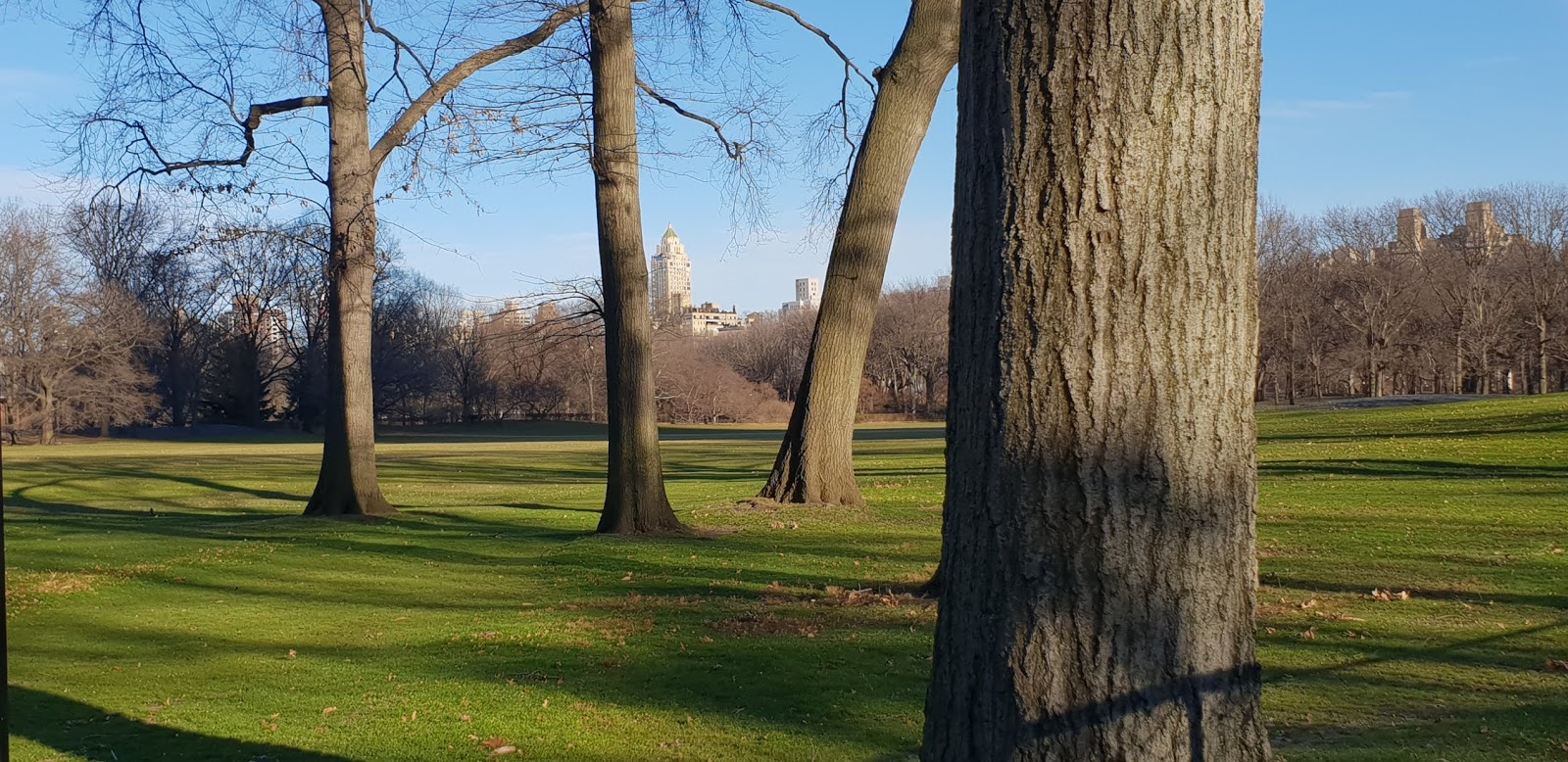
We decided to go visit another part of the park, this time walking to West 67th Street before crossing Central Park West and into the park where Sheep Meadow is.

Once upon a time sheep did graze on the meadow, but these days it is designated a quiet area inspiring calm and refreshing thoughts, except for a period in the 1960s where there was more than one counter-culture protest, or love in, going on.

And, there’s the sign to say it was Sheep Meadow,
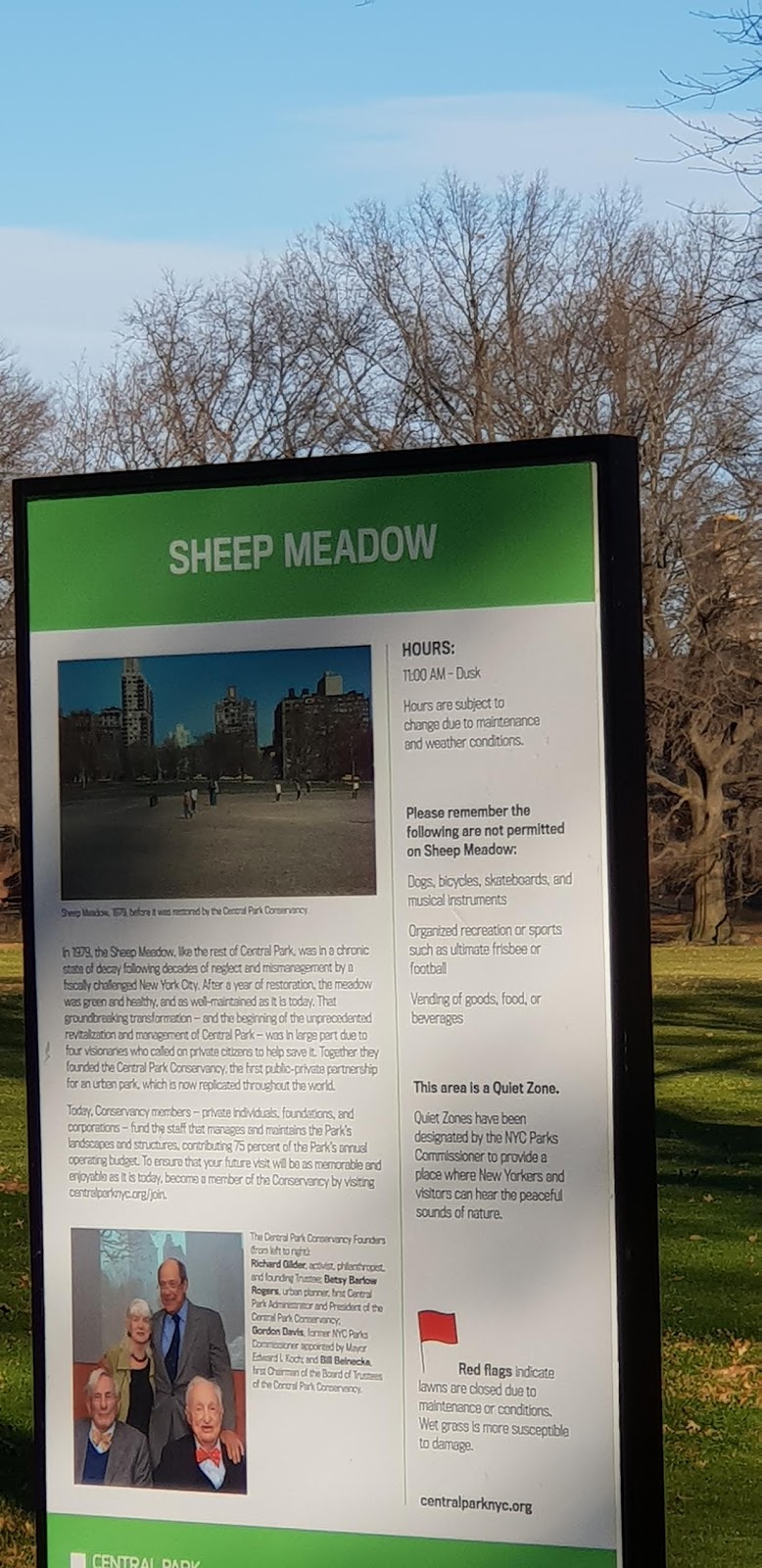
and that’s the meadow behind the sign,

Well, I don’t see any sheep, but of course, that’s not why the meadow is named or should there be any sheep on it.  That greenery that can be seen, restoring for the spring, was a very expensive addition to the park.

As a matter of fact, there is nothing was on it, because signs were up to say the meadow was closed for the winter, a new and interesting variation on the ‘Don’t Walk On The Grass’ signs.

I’m sure I could climb the fence, or, maybe not.  I’m a bit old to be climbing fences.

So, unable to walk on the grass, we tossed an imaginary coin, should we go towards West 110th Street, or back to West 59th Street.

West 59th Street won.

and, just in case we had any strange ideas about walking on the grass, the fence was there to deter us.  Perhaps if we had more determination…

One positive aspect of the park is that you could never get lost, and the tall buildings surrounding the park are nearly always visible through the trees, more so in winter because there is no foliage, maybe less so later in the year.

There is also a lot of very large rocky type hills, or outcrops where people seem to stand on, king of the mountain style, or sit to have a picnic lunch, quickly before it freezes.

Yes, it is cold outside and seems more so in the park.

I wondered briefly if it ever got foggy, then this place would be very spooky, particularly after the sun goes down.

Writers need to have many alter egos, don’t they?

I have often wondered just how much or how little of the author’s personality and experiences end up in a fictional character.

Have they climbed mountains,

Have they escaped from what is almost the inescapable,

Have they been shot, tortured, or worse,

Have they been dumped, or divorced,

Have they travelled to dangerous places, or got locked up in a foreign jail?

We research, read, and I guess experience some or all of the above on the way to getting the book written, but it’s perhaps an interesting fundamental question.

Who am I today?  Or, more to the point, who do I want to be today?

Or it can be a question, out of left field, in an interview; “Who are you?”

My initial reaction was to say, “I’m a writer.”  But that wasn’t the answer the interviewer is looking for.

Perhaps if she had asked, “Who are you when you’re writing your latest story?” it would make more sense.

Am I myself today?

Am I some fictional character an amalgam of a lot of other people?

Have I got someone definite in mind when I start writing the story?

The short answer might be, “I usually want to be someone other than what I am now.  It’s fiction.  I can be anyone or anything I want, provided, of course, I know the limitations of the character.”

“So,” she says, “what if you want to be a fireman?”

“I don’t want to be a fireman.”

“But if the story goes in the direction where you need a fireman…”

“What is this thing you have with firemen?”  I’m shaking my head.  How did we get off track?

“Just saying.”

“Then I’d have to research the role, but I’m not considering adding a fireman anytime soon.”

She sighs.  “Your loss.”

Moving on.

And there is that other very interesting question; “Who would you like to be if you could be someone else?”

A writer in that period between the wars, perhaps like an F Scott Fitzgerald or Ernest Hemingway, in Paris, or if it is a fictional character, Jay Gatsby.

He’s just the sort of person who is an enigma wrapped up in a mystery.

“The Things We Do For Love”

Would you give up everything to be with the one you love?

…

Is love the metaphorical equivalent to ‘walking the plank’; a dive into uncharted waters?

For Henry, the only romance he was interested in was a life at sea, and when away from it, he strived to find sanctuary from his family and perhaps life itself.  It takes him to a small village by the sea, a place he never expected to find another just like him, Michelle, whom he soon discovers is as mysterious as she is beautiful.

Henry had long since given up the notion of finding romance, and Michelle couldn’t get involved for reasons she could never explain, but in the end, both acknowledge that something happened the moment they first met.  

Plans were made, plans were revised, and hopes were shattered.

A chance encounter causes Michelle’s past to catch up with her, and whatever hope she had of having a normal life with Henry, or anyone else, is gone.  To keep him alive she has to destroy her blossoming relationship, an act that breaks her heart and shatters his.

But can love conquer all?

It takes a few words of encouragement from an unlikely source to send Henry and his friend Radly on an odyssey into the darkest corners of the red-light district in a race against time to find and rescue the woman he finally realizes is the love of his life.

The cover, at the moment, looks like this:

lovecoverfinal1

Is love the metaphorical equivalent to ‘walking the plank’; a dive into uncharted waters?

For Henry the only romance he was interested in was a life at sea, and when away from it, he strived to find sanctuary from his family and perhaps life itself.  It takes him to a small village by the sea, s place he never expected to find another just like him, Michelle, whom he soon discovers is as mysterious as she is beautiful.

Henry had long since given up the notion of finding romance, and Michelle couldn’t get involved for reasons she could never explain, but in the end both acknowledge that something happened the moment they first met.  

Plans were made, plans were revised, and hopes were shattered.

A chance encounter causes Michelle’s past to catch up with her, and whatever hope she had of having a normal life with Henry, or anyone else, is gone.  To keep him alive she has to destroy her blossoming relationship, an act that breaks her heart and shatters his.

But can love conquer all?

It takes a few words of encouragement from an unlikely source to send Henry and his friend Radly on an odyssey into the darkest corners of the red light district in a race against time to find and rescue the woman he finally realizes is the love of his life.

The cover, at the moment, looks like this:

lovecoverfinal1

Searching for locations: Washington DC, USA

Washington is a city with bright shiny buildings and endless monuments, each separated by a long walk or a taxi ride if you can find one.

We might have picked the wrong day, shortly after New Year’s Day when the crowds were missing along with everything else.  Or, conversely, it was probably the right time to go, when we didn’t have to battle the crowds.

Sunny but very cold, the walking warmed us up.

First stop was the Lincoln Memorial

DSC00833

It was built to honor the 16th President of the United States, Abraham Lincoln.

It is located on the western end of the National Mall in Washington, D.C., across from the Washington Monument.

DSC00834

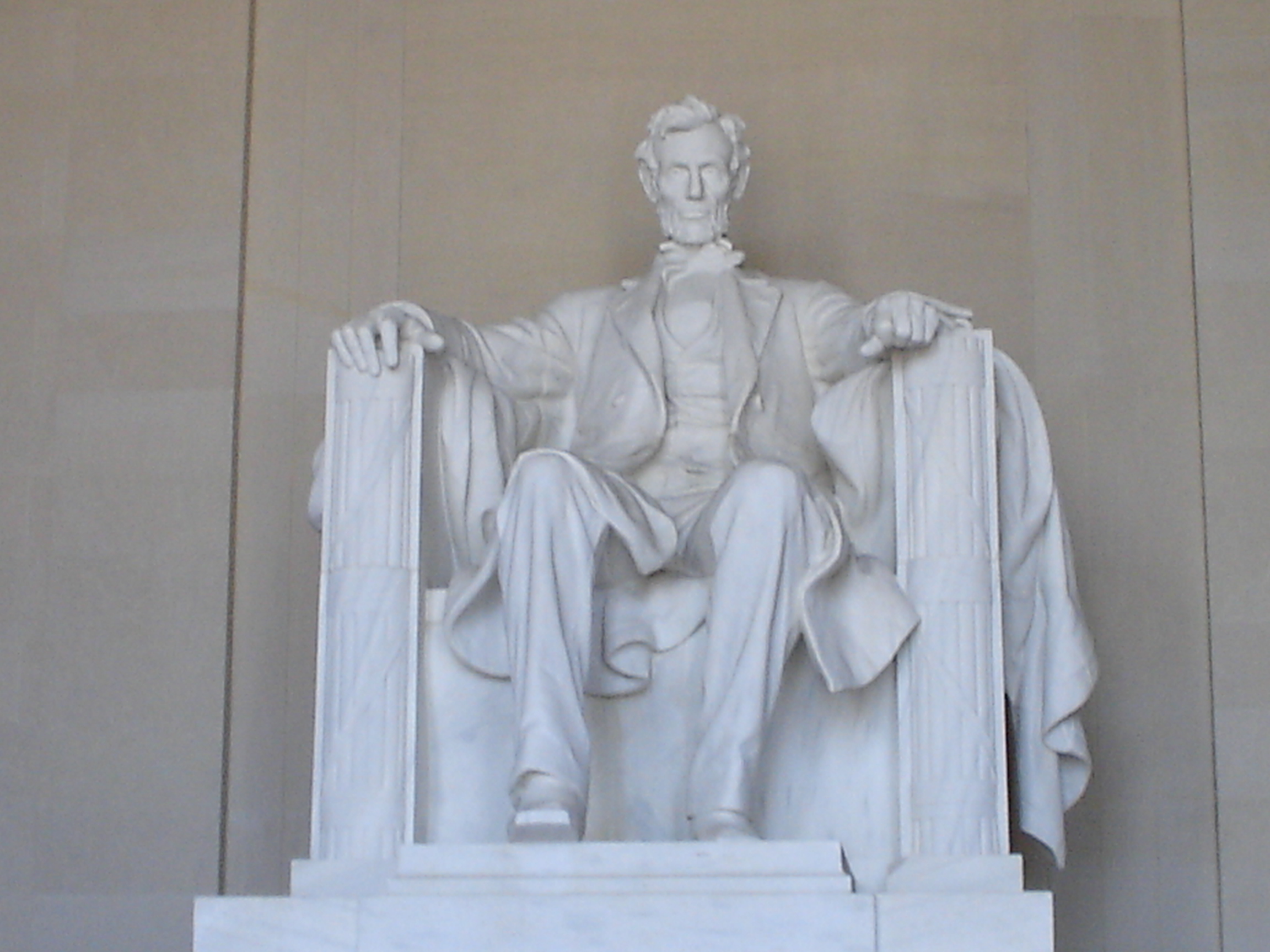
The building is in the form of a Greek Doric temple and contains a large seated sculpture of Abraham Lincoln and inscriptions of two well-known speeches by Lincoln.

The next stop was the Washington Monument

DSC00840

The Washington Monument is an obelisk on the National Mall in Washington, D.C., built to commemorate George Washington. Construction of the monument began in 1848 and not completed until 1888.  It was officially opened October 9, 1888.


We then took a taxi ride to the Jefferson Memorial

DSC00851

This monument is dedicated to Thomas Jefferson (1743–1826), one of the most important of the American Founding Fathers as the main drafter and writer of the Declaration of Independence.

Construction of the building began in 1939 and was completed in 1943.

The bronze statue of Jefferson was added in 1947.

An excerpt from “If Only” – a work in progress

Investigation of crimes doesn’t always go according to plan, nor does the perpetrator get either found or punished.

That was particularly true in my case.  The murderer was incredibly careful in not leaving any evidence behind, to the extent that the police could not rule out whether it was a male or a female.

At one stage the police thought I had murdered my own wife though how I could be on a train at the time of the murder was beyond me.  I had witnesses and a cast-iron alibi.

The officer in charge was Detective First Grade Gabrielle Walters.  She came to me on the day after the murder seeking answers to the usual questions like, when was the last time you saw your wife, did you argue, the neighbors reckon there were heated discussions the day before.

Routine was the word she used.

Her fellow detective was a surly piece of work whose intention was to get answers or, more likely, a confession by any or all means possible.  I could sense the raging violence within him.  Fortunately, common sense prevailed.

Over the course of the next few weeks, once I’d been cleared of committing the crime, Gabrielle made a point of keeping me informed of the progress.

After three months the updates were more sporadic, and when, for lack of progress, it became a cold case, communication ceased.

But it was not the last I saw of Gabrielle.

The shock of finding Vanessa was more devastating than the fact she was now gone, and those images lived on in the same nightmare that came to visit me every night when I closed my eyes.

For months I was barely functioning, to the extent I had all but lost my job, and quite a few friends, particularly those who were more attached to Vanessa rather than me.

They didn’t understand how it could affect me so much, and since it had not happened to them, my tart replies of ‘you wouldn’t understand’ were met with equally short retorts.  Some questioned my sanity, even, for a time, so did I.

No one, it seemed, could understand what it was like, no one except Gabrielle.

She was by her own admission, damaged goods, having been the victim of a similar incident, a boyfriend who turned out to be an awfully bad boy.  Her story varied only in she had been made to witness his execution.  Her nightmare, in reliving that moment in time, was how she was still alive and, to this day, had no idea why she’d been spared.

It was a story she told me one night, some months after the investigation had been scaled down.  I was still looking for the bottom of a bottle and an emotional mess.  Perhaps it struck a resonance with her; she’d been there and managed to come out the other side.

What happened become our secret, a once-only night together that meant a great deal to me, and by mutual agreement, it was not spoken of again.  It was as if she knew exactly what was required to set me on the path to recovery.

And it had.

Since then, we saw each about once a month in a cafe.   I had been surprised to hear from her again shortly after that eventful night when she called to set it up, ostensibly for her to provide me with any updates on the case, but perhaps we had, after that unspoken night, formed a closer bond than either of us wanted to admit.

We generally talked for hours over wine, then dinner and coffee.  It took a while for me to realize that all she had was her work, personal relationships were nigh on impossible in a job that left little or no spare time for anything else.

She’d always said that if I had any questions or problems about the case, or if there was anything that might come to me that might be relevant, even after all this time, all I had to do was call her.

I wondered if this text message was in that category.  I was certain it would interest the police and I had no doubt they could trace the message’s origin, but there was that tiny degree of doubt, about whether or not I could trust her to tell me what the message meant.

I reached for the phone then put it back down again.  I’d think about it and decide tomorrow.

© Charles Heath 2018-2020

The Things We Do For Love – The final editor’s draft – Day 29

…

What is a love story without a happy ending?

It’s just all the trials and tribulations in between that make it seem like it’s all too much effort with nothing but pain and misery punctuated by a few moments of utter delight.

I’m sure a story where everything works like clockwork might have been easier, but the thought of having some meaty characters standing between them and ultimate happiness was more interesting.

The idea of Emile, or the Turk, being an affable person, was modelled on Sidney Greenstreet, a rather interesting actor in Hollywood in the 1940s and 1950s, and I’d just seen his performance in The Maltese Falcon.

When I first started the story, I wanted Michelle to have a secret, but at the time, it wasn’t for her to be a prostitute, simply a fashion model who fell in with the wrong crowd and got into trouble with drugs and the high life.

But that wasn’t interesting enough.  By that time, I was dabbling in the thriller genre, and realised I couldn’t write a Mills and Boon-type book, so it veered into thriller territory.

Who doesn’t like a guy who wants to rescue a fallen angel?

Why not make the fallen angel an avenging angel?  Her friends help her escape, and then she decided to help her friends escape to the freedom she fleetingly had, and now, determined, would have again.

But, the idea of freedom and the actual getting of it are two entirely different concepts.  400 pages worth of angst, setbacks, love found, and love lost, the love found again.  Henry might be a little too naïve, but he had to be to provide the extreme contrast in backgrounds and notions of what life is like.

…

‘What Sets Us Apart’ – A beta readers view

There’s something to be said for a story that starts like a James Bond movie, throwing you straight in the deep end, a perfect way of getting to know the main character, David, or is that Alistair?

A retired spy, well not so much a spy as a retired errand boy, David’s rather wry description of his talents, and a woman that most men would give their left arm for, not exactly the ideal couple, but there is a spark in a meeting that may or may not have been a setup.

But as the story progressed, the question I kept asking myself was why he’d bother.

And, page after unrelenting page, you find out.

Susan is exactly the sort of woman to pique his interest.  Then, inexplicably, she disappears.  That might have been the end to it, but Prendergast, that shadowy enigma, David’s ex-boss who loves playing games with real people, gives him an ultimatum, find her or come back to work.

Nothing like an offer that’s a double-edged sword!

A dragon for a mother, a sister he didn’t know about, Susan’s BFF who is not what she seems or a friend indeed, and Susan’s father who, up till David meets her, couldn’t be less interested, his nemesis proves to be the impossible dream, and he’s always just that one step behind.

When the rollercoaster finally came to a halt, and I could start breathing again, it was an ending that was completely unexpected.

I’ve been told there’s a sequel in the works.

Bring it on!

…

The book can be purchased here:  http://amzn.to/2Eryfth

…

In a word: Port

So, I wonder if it’s true, any port in a storm, except perhaps Marseilles.

Or, if you are a lothario-type sailor, you would have a girl in every port.

Yes, the most common definition of a port is a place where ships dock.

And, while talking of ships we don’t call the sides left and right, we call them port and starboard.  Just in case you didn’t know, port is on the left side of the ship when facing forward.

And of course, ships have portholes, i.e. windows, traditionally round and rather small.

It could be an alcoholic drink, imbibed mostly after dinner with coffee and cigars, though no one seems to smoke cigars anymore.

There is still coffee, for now.  No doubt sometime in the future someone will link it to death and dying, and it will fall out of favour, like sugar, weedkillers and asbestos.

The best port seems to come from Portugal, strange about that.

You can port a program (app in phone speak) from one platform to another, which basically means from Android to Apple IOS, but not without a reasonable amount of work.

It can also be an outlet plug on a computer that accepts cables from other devices (USB) and many years ago, a printer port, and a serial port.

In certain places in the world a port is a child’s schoolbag, a definition I was not aware of until we moved to a different state.

I’m still having a problem with it 30 years on.

The story behind the story: A Case of Working With the Jones Brothers

To write a private detective serial has always been one of the items at the top of my to-do list, though trying to write novels and a serial, as well as a blog, and maintain a social media presence, well, you get the idea.

But I made it happen, from a bunch of episodes I wrote a long, long time ago, used these to start it, and then continue on, then as now, never having much of an idea where it was going to end up, or how long it would take to tell the story.

That, I think is the joy of ad hoc writing, even you, as the author, have as much idea of where it’s going as the reader does.

It’s basically been in the mill since 1990, and although I finished it last year, it looks like the beginning to end will have taken exactly 30 years.  Had you asked me 30 years ago if I’d ever get it finished, the answer would be maybe?

My private detective, Harry Walthenson

I’d like to say he’s from that great literary mold of Sam Spade, or Mickey Spillane, or Phillip Marlow, but he’s not.

But, I’ve watched Humphrey Bogart play Sam Spade with much interest, and modelled Harry and his office on it.  Similarly, I’ve watched Robert Micham play Phillip Marlow with great panache, if not detachment, and added a bit of him to the mix.

Other characters come into play, and all of them, no matter what period they’re from, always seem larger than life.  I’m not above stealing a little of Mary Astor, Peter Lorre or Sidney Greenstreet, to breathe life into beguiling women and dangerous men alike.

Then there’s the title, like

The Case of the Unintentional Mummy – this has so many meanings in so many contexts, though I imagine that back in Hollywood in the ’30s and ’40s, this would be excellent fodder for Abbott and Costello

The Case of the Three-Legged Dog – Yes, I suspect there may be a few real-life dogs with three legs, but this plot would involve something more sinister.  And if made out of plaster, yes, they’re always something else inside.

But for mine, to begin with, it was “The Case of the …”, because I had no idea what the case was going to be about, well, I did, but not specifically.

Then I liked the idea of calling it “The Case of the Brother’s Revenge” because I began to have a notion there was a brother no one knew about, but that’s stuff for other stories, not mine, so then went the way of the others.

Now it’s called ‘A Case of Working With the Jones Brothers’, finished the first three drafts, and at the editor for the last.

I have high hopes of publishing it in early 2021.  It even has a cover.

PIWalthJones1

Writing about writing a book – Day 13 extra

There’s nothing worse than an interrogation by children, particularly when they are brutally honest.  To make matters worse, I had two inquisitors, and it was clear they had spent some time before getting in the car to organize a coordinated plan of attack.

But, first, a little history.

Back in happier times, in other words before the eventual separation and divorce, we were known as nanna and poppy. I was, most of the time, referred to as grumpy poppy, and the two, girls adored their nanna.

She always had a way with children, and, it was also the case, with our own two sons.  They preferred her to me, for obvious reasons, I had to be bad cop all the time.

When we separated, and this was an eventuality that we both agreed on, and it was, I thought, quite amicable.  There was no underlying reason, like one or other of us cheating, but that we had, over time, simply drifted apart because we had separate ideas about life.

Since I was the nonpreferred grandparent, I decided to see less of the children and allow them more time to be with their nanna.  Sometimes we appeared together, like at birthdays and Christmas, but normally I kept my distance.

No one seemed to complain about my absences, least of all my own children, which spoke volumes, to me, about what they thought of me.

Now, out of the blue, I get this call to pick up my granddaughters from school. It was not as if their nanna was as so overloaded with things to so, so it seemed to me it was some sinister plot, but to what end, I could hardly imagine.

I’d find out soon enough.

The girls were waiting in the drop zone and got in the car.  It didn’t phase them that it was me, and I had thought they may have a problem since I was in a different car. But they seemed to know what to look for.

There was silence until we exited the school grounds, they went to a church primary school and perhaps they didn’t want to risk God’s judgment on me.

The older child fired the first salvo, “Nanna says you have a girlfriend.”

Ok, not the first question I was expecting.

Then the younger girl followed up with the second salvo, “is she going to become our new nanna?”

To them, these were serious questions.  But had they been inspired by their current nanna, and they were to get answers.  She’d know I wouldn’t lie to them.

I stopped at the traffic lights.

“If your nanna saw me with a friend having lunch the other day, then it’s quite possible it may have looked like that, but, no, I don’t have a girlfriend, and for what it’s worth, I’m not ready to embark on that journey again for a while.  As for the other question, there will never be a new or any other sort of nanna other than the one you have already.”

Speech timed to perfection.  The lights changed to green.

I let that sink in and then after a minute asked a question of my own.  “How come your nanna is not picking you up today?”

I notice the two give each other a look and wonder how young does a child have to be to understand what a lie is or be able to keep a secret.

“We were told that you would be collecting us today, that’s all.”

A question then for whoever is at home when I drop them off.

I notice a rather prolonged look from the younger girl, perhaps searching for a truth of her own in my expression, or that she was trying to read my thoughts.  Whatever she saw, she asked, “Do you still go to work?”

“In a manner of speaking.  I work for myself these days.”

“With computers?”

“Not anymore.  I thought I might try writing a novel.  Before, there never seemed to be enough time in a day to do anything, but now things are a little easier.”

Then the older girl chimed in, “Nanna says that it’s a bit late for you to become a writer.”

Yes, I can see it now, the rest of the family sitting around the dinner table saying that I’d finally lost my marbles doing what I always wanted to rather than what I had to.

And my ex had always said I would be wasting my time from the very first time I’d mentioned it to her.  So much for confiding your hopes and dreams in your so-called lifelong partner who is supposed to support you.  I know I had supported her through various career changes, no matter what the consequences.

“What do you think I should do?”

It would be interesting to get their perspective.

“If you don’t have a real job, how do you pay the bills?”

A practical question.  Just the sort my ex would have posed if she was here.

“You’d be surprised what you can do when you put your mind to it.  I manage.”

There was no doubt a dozen other questions to be asked, but the capacity for a child to remember was about three or four.  And then they had to remember my answers so they could relay them.

Hopefully, the interrogation was over.