In a word: Saw or Sore or Soar

In the first or second instance of the word Sore, we all know this malady can sometimes fester into something a lot worse.

Or that a person could be a sore loser

Or after spending an hour on the obstacle course, they come off very sore and sorry.  I never quite understood why they should be sorry because no one ever apologises to an inanimate object.  Or do they?

Or perhaps he was sore at his friend for not telling him the truth.

Then, there’s another meaning, saw, which can mean the past tense of seeing, that is, I saw them down by the pool.

I could also use a saw, you know, that thing that cuts through wood, steel, plastic, almost anything.  And yes, it’s possible someone might actually saw through a loaf of bread.

There are hand saws, electric saws, band saws, coping saws, and even a bread knife, all of these have one thing in common, a serrated edge with teeth of different sizes, designed to cut, smoothly or roughly depending on the size.

Add it to bones, and you have Captain Kirk’s description of his medical officer on the Enterprise.  I’m not sure any doctor would like to be addressed as saw-bones.

But then, confusingly in the way only English can do, there’s another word that sounds exactly the same, soar

This, of course, means hovering up there in the heavens, with or without propulsion or oxygen.

Yes, it’s difficult to soar with eagles when you work with turkeys.  I’ve always liked this expression though most of the time people don’t quite understand what it means.

Writing about writing a book – Day 24, a missing piece of the puzzle

There’s always the necessity for creating backstories so that the reader doesn’t come across a part of the story that doesn’t make sense.

Perhaps one of my failings is that I have to go over what I’ve already written, sometimes to make sure there is continuity and that what I’ve written makes sense.

This collection of memories our main character is having serves the purpose of setting up later plot points, but more importantly, is supposed to give the reader an idea of what the main character has gone through before arriving at the start of the story.

This part will serve to provide a little more information on the relationship between Bill and Barry, though I rather like the nickname I gave him.

…

“Bastards,” Killer muttered.

We called him ‘Killer’ because it was the nickname the Army had given him.  We were sharing the guard duty and had spoken briefly over the watch, but up till then, the silence had stretched over an hour or so.  It didn’t take long for anyone to realize he was a man of few words.

He’d been in the regular army for years and asked for the posting.  He’d made Sergeant several times, only to lose those same stripes for fighting, usually after R&R and a bout of heavy drinking.  Now assigned to our platoon to lend his experience, the conscripts were expecting him to ‘look after’ them.  Other than myself and the Lieutenant, he was the only other regular soldier.  Unfortunately for them, he hated both conscripts and the Viet Cong in varying degrees, and depending on his mood there was little tolerance left for the rest of us.

“The people who sent us here or the people trying to kill us?” I asked before I realized I’d spoken.

I didn’t hear the reply, the skies opening up with another torrential downpour that lasted for about five minutes, and going as fast as it came.  When the sun finally came up, it would make the atmosphere steamy, hot, and unbearable.  It was quite warm now, and I was feeling both uncomfortable, and fatigued.

Killer looked just as stoic as he had before the rain.  He looked at me.  “Damn weather.  Worse than home.”

“Scotland?”

“Scapa Flow, Kirkwall.  I should have been an engineer on ships like my father, but I was too stupid.  Joined the Army, finished up here.  What’s your excuse?”

“Square peg in a round hole.  The army seems to handle us in its stride.”  It was more or less the truth.  I joined the Army to get away from my parents.

“That it does.  That it does.”

The rain came and went, during which the rest of the camp roused and went about its business.  It had been a long night for some, still getting over the shock of the attack, and the ever-pervading thought the enemy was still out there, biding their time.  It would be, for them, a waiting game, waiting for the conditions to wear us down, and lose concentration as inevitably we would.

Certainly, by the time we were relieved from sentry duty, I felt I was in no condition to match wits with a donkey, let alone the enemy on his own home ground.  When I stumbled over to the mess area and looked at the tired and haggard looks on the faces of the platoon, I realized that went for all of us.

Killer and I managed to get about an hour’s rest before the call came to move out, rain or no rain, and after a breakfast to make anyone ill, we left.  For hours it rained.  No one spoke as we strained to listen over the rain spattering on the undergrowth, all the time expecting the unexpected.  That was the benefit of the surprise attack; we no longer took for granted we would be safe.

Water gathered in pools along the trail, hiding any chance of seeing landmines.  Rainwater and sweat ran into our eyes, making it difficult to see.  Water leaked everywhere, making it very uncomfortable.  This was not war.  This was utter stupidity.

I was about to remark on the futility of it all to the Lieutenant, who had taken the lead, when one second he was talking to me and the next he crashed to the ground, a sniper’s bullet killing him instantly.   Someone yelled “Contact” and we hit the ground, bullets flying all around us. 

Too late, I thought, as I felt the hit of what seemed to be a large rock, then the searing pain in my leg, just as I hit the ground…


© Charles Heath 2015-2021

The cinema of my dreams – I never wanted to go to Africa – Episode 7

Alone, and awaiting your fate, minutes become hours, hours become a lifetime

Now that I’ve gone down the rabbit hole, it’s time to find out what sort of trouble is waiting.  It might be hot in the desert, but I think it’s going to get hotter in the underground lair.

…

“We can do this the easy way or the hard way, your choice.”

There was always a choice, I’m sure, but at the end of the day, it always ended up bring the hard way.

It had been a long, and somewhat sleepless, night, pondering the whys and wherefores of what just happened.

I’m guessing I was supposed to die, like the pilot, now I was a thorn in their side.

The two men sent to collect me were purposefully selected for terror value, a sign that if I was contemplating anything other than full co-operation, these were the sort of men I would have to deal with.

The reality, on the other hand, was sometimes completely different.

I still hadn’t got proof that this was an enemy, or rogue, unit, so no point panicking yet.

“Let’s try the easy way first,” I said, getting off the stretcher and standing.

One remained outside the room, the other, after unlocking the door, ventured as far as the doorway.  He seemed disappointed at my choice.

I walked between them further into the labyrinth until we reached another doorway, this with an opaque glass window, and though it I could see there was someone already in the room.

He opened the door, ushered me in, giving that little push in the back that was to remind me of the controlled force he had and would unleash.  A nod in the direction of the room’s occupant, he withdrew and closed the door.

The occupant was an older man, in his 60s, the sort one would mistake as a university professor, but on reality was a master torturer in the guise of an interrogator.

We had them, I’d heard about them, but this was a first.

“Sit, Mr. James.”

All this politeness was a front, it had to be, designed perhaps to take me off my guard.

There was a table on one side with two chairs opposite each other.  It wasn’t much of a table and the chairs looked cheap and uncomfortable, for both of us.

There was nothing else in the room and nothing on the table.  The discussion no doubt would be recorded, or perhaps the man had a very good memory.

To make a good first impression, I sat.

For five minutes I could feel him looking at me, trying to make me feel uncomfortable.  It was disconcerting, but I had decided to speak when spoken to.

And wait.

…

What happens next, not even I know.

Yet.

© Charles Heath 2019

“The Document” – the editor’s second draft – Day 15

This book has finally come back from the Editor, so this month it is going to get a second revision, a second draft for the editor, and beta readers.

And so it begins…

…

Half way there

…

Yes, 15 days down and 15 days to go.

At this point my hand is starting to cramp from the toils of writing, yes, I’m one of those writers who often puts words to paper longhand.

Two weeks is a long time, but I think this sort of exercise is what’s needed if you want to write a novel every year, though this one is going to come out with more than 50,000 words.

I think there are about three more chapters to go to end part two, then I can get onto the big finale in part three.

It has turned out to be a bigger project than I originally thought, and I didn’t think I could stretch it to 50,000 words. Now, I’m hoping to keep it to about 60,000.

Still, no need to get ahead of myself. Murphy’s law may yet rear its ugly head.

Searching for locations: Toronto, Canada

The touristy things

On the way to the Hall of Fame, we found an ice skating rink

The Hockey hall of fame

The hockey hall of fame is a very large exhibition which would take a whole day to see everything.  We sat through a very informative history of the game and the origins of the NHL, which for people who do not have hockey as a sport in their country, is saying something.

We follow the Maple Leafs, coincidentally Toronto’s franchise in the NHL, and we have been here before for a game, which they lost.  It didn’t matter, I was staggered by the energy and enthusiasm both the players and the fans put into making it a memorable experience.

I’m hoping for a repeat experience.

…

St Lawrence Market

We walked 1.8 km to the market and it was closed which is about right for us as we have a knack for turning up and the place is closed, for instance, the Canadian Club Distillery in Windsor, Canada.

Perhaps tomorrow, before or after the game.

…

Red Lobster

Ok, we’ve been here before and it was beyond any expectations anyone could have for a restaurant chain.

This was no different from the last.

What more could you want, scallops, shrimp, and a fried lobster tail all drowned in a superb garlic butter sauce.

Add a side of mash potatoes, and a 20oz glass of beer, and there is the definition of heaven on a plate.

…

St Lawrence Market, again

Snowing, but not heavily

St Lawrence market, everything is very expensive, crab legs $120 per kg, lobster, $50 to $80 per kg.  Oddly everything is quoted per pound, and it’s a good thing that we can convert lbs to kg.

It is, to say the least, a disappointment.

…

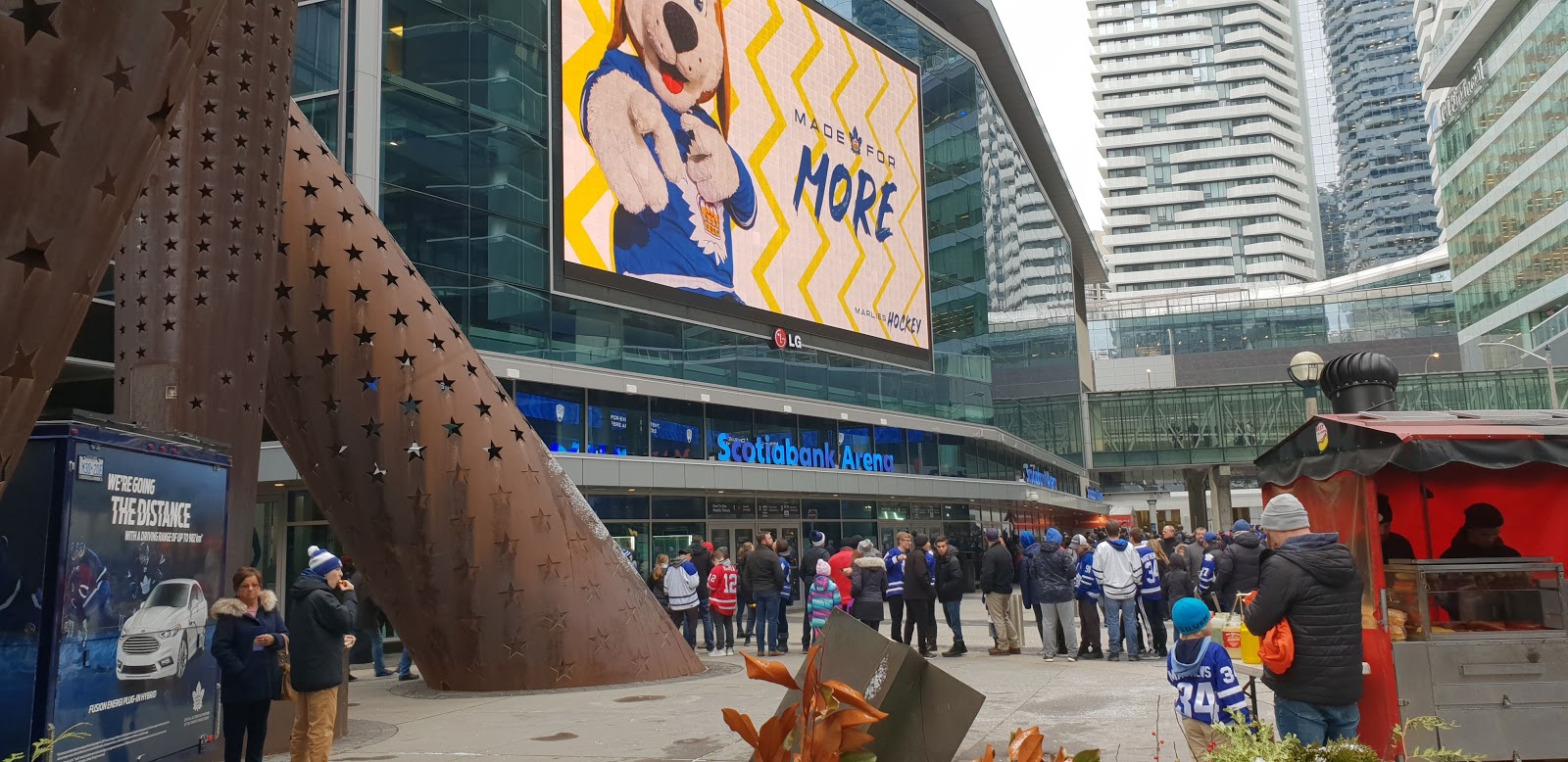
Ice Hockey at the Scotiabank Arena

There was a definite buzz in the air, and heading towards the stadium was both us, and many other Toronto supporters.  Blue Maple Leaf jerseys were in abundance.

We’ve been before, and the last time the Leafs lost.

What else is new?

They have had a very good season so far, and are second on the ladder overall, so it was not without the expectation that they might win this one.


Never have an expectation.

They lost.

But…

It was an incredible game that was none stop action.  It seems to me that you require a lot of skill and skating talent to play this game.  I certainly couldn’t, and freely admit that I’d probably last about five minutes.

The score didn’t reflect the play, but in the end, the Leafs lost 4 – 3, at the end of the three periods.

…

Souvenir hunting and other stuff

I woke tired and exhausted, not looking forward to walking around Toronto.

Got up early to do the walking.

Oh, did I tell you, this hotel has a laundry and it is the bugbear of staying in major hotels, not being able to wash clothes?

Breakfast is included, but it is the main meal of the day so we feast.  The selection is incredible.

We had to go back to the Maple Leafs franchise shop to exchange a Maple Leafs Jersey, which was no trouble.

So near to the CN tower, we go in to shop for souvenirs, of which there were plenty.  I liked the stuffed mooses and beavers.

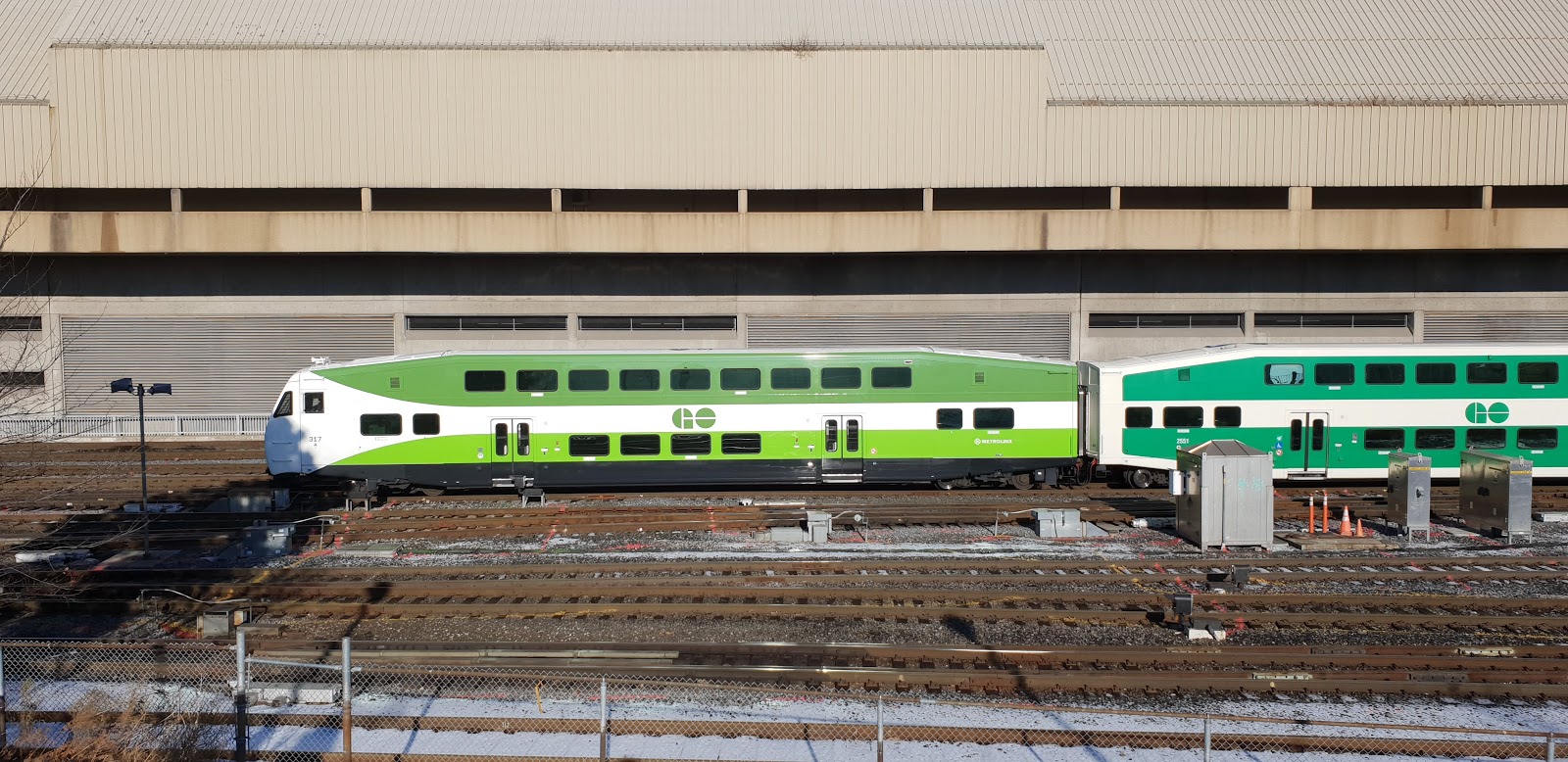
We’ve been up the tower so it’s back to the Union Station and a short stay upstairs, a little bar overlooking the Toronto Pearson train line.

Time for tasting some Canadian ales, the first a Mill Street tank house ale, the second a Mill Street hopped and confused.  Seriously, that’s what they were called.

The drinking mood music was old hits like Queen and a little bit of country and western.

We had a good view of the trains, too.

Union Station

Like all main stations very large very tall ceilings and openings that lead to the tracks of which there are about 24, and an underground system

Much the same as all large railway terminals and probably far busier in times gone by.

…

Dining, but not necessarily dinner

Not far from the station, and opposite to clock tower belonging to the old city hall was a restaurant called Bannock.

There I had a Moosehead Cracked Canoe lager, a light ale, and a house special since 1929, a chicken pot pie, and it was very good.

Digging into the past

It seems rather strange reading letters that were written by my parents before they were married.

They’re not love letters, but just words, words that knowing my father and mother as I do, seem so totally at odds with that knowledge.

The thing is, I never knew anything of theirs from that era existed, even though I knew my mother was a hoarder, and we didn’t discover the extent of that phobia until it was time to move them from their last residence to the retirement home.

There were cases and boxes filled with papers, letters, cuttings, and everything else in between.  Nothing had been thrown out.

And whilst I knew those letters existed, there was the yuk factor involved, such that I would never want to read them because, well, that was my parents’ stuff.

So, all of it was sorted, most of it thrown away, and only what we thought was of any intrinsic value was kept.  Those letters were part of the ‘keep’ pile and ended up in an old metal steamer trunk, and there they have lived for about ten years.

With the recent cleaning of my office, much to Chester’s disdain, the trunk suddenly looked out of place in a clean room.

My grandchildren ‘found’ this trunk and started looking through the contents and finished up with the letters.

And, being the curious people, they were, they started reading them, of course, stumbling over understanding the handwriting, which was based on what we learned in school, cursive script.  That meant I had to interpret the writing for them.

Talk about morbid curiosity!

And like I said, in reading them, formed the impression that these two correspondents were nothing like the people I knew growing up.

These letters dated from 1948 and 1949 when they were married in June of 1949.  There was no doubt it was a different time, and they were different people.  My mother came from a country town and went to work in Melbourne around that time.  I know that during the war, those years from 1939 to 1945 she was a student at Dandenong High School.

It was odd to realize that considering we eventually moved to Dandenong, and that may have had something to do with it.

My father served in the war till 1946, and then after being discharged from the army, worked as a projectionist until he went overseas for nearly a year, ostensibly to see how the war had affected Europe.  After that, he went back to being a projectionist at the Athenaeum in Melbourne, and later on, not knowing much of his work history, he would always tell us about the movies, especially those that came up on television.

There’s more I’m sure, like the fact my mother had another chap on the go at the same time, but it seems he was not interested in settling down.

Perhaps more will come to light in further reading, but like it said, it seems very strange to be reading those letters, much like walking over a grave; it gives me the odd shiver down the spine.

No doubt, the next time the grandchildren visit there will be another installment.

They, at least, think the story is fascinating.

“Echoes From The Past”, the past doesn’t necessarily stay there


What happens when your past finally catches up with you?

…

Christmas is just around the corner, a time to be with family. For Will Mason, an orphan since he was fourteen, it is a time for reflection on what his life could have been, and what it could be.

Until a chance encounter brings back to life the reasons for his twenty years of self-imposed exile from a life only normal people could have. From that moment Will’s life slowly starts to unravel and it’s obvious to him it’s time to move on.

This time, however, there is more at stake.

Will has broken his number one rule, don’t get involved.

With his nemesis, Eddie Jamieson, suddenly within reach, and a blossoming relationship with an office colleague, Maria, about to change everything, Will has to make a choice. Quietly leave, or finally, make a stand.

But as Will soon discovers, when other people are involved there is going to be terrible consequences no matter what choice he makes.

https://amzn.to/2CYKxu4

newechocover5rs

Searching for locations: Lake Louise to Toronto, via Calgary

All the worries we thought we might have in getting from Lake Louise to Calgary, in the end, it was just like driving to work, only a little longer.

When we left the Fairmont, the car had two frozen bottles of water and a frozen donut, left in the car for the two days we were there, so hiding in the garage might not be a good idea.

At the garage where we refueled, it was so cold I could barely clean the windows and glad to get back into the warmth inside the car.

Thankfully as we got closer to Calgary, it got warmer.

We bypass the city going to the airport, but, as it turns out, we would not have had much time to look around anyway.It’s nice to go to an airport and actually find the car rental returns first go with adequate signing to get there.

Returning the car took a few extra minutes because we were at the end of a dozen or so others who turned up at the same time.  All good, they remembered giving us a half full petrol tank.

At the check-in, it is very smooth sailing, the kiosk working and once the booking reference was entered, it spat out the desired number of boarding passes and baggage tags.

Then to baggage drop, through customs where I managed to lose my jacket, which is amazing that you would be allowed to leave anything behind.

So…

We have an hour and a half to kill, so a long soda and two long island teas settle the pre-flight nerves if we had any to start with.

Time to consider the vagaries of the flight.

Today we’re on an Airbus a320, and we are seated in the very last row, row 33.  It’s always a bad thing to look up planes on seatguru.com, because it has painted them as the worst on the plane.

What’s the downside, sometimes the seat pitch is less than further up the plane, the seats don’t recline and you get the seat in front in your face, and you get the constant flushing of the toilets.  And my major bugbear there’s no overhead luggage space.

What’s the reality?

To begin with, the seats recline, but not very much.  We’ll wait till the plane is cruising before judging how far the seats recline in front of us.

The seat pitch is good and it doesn’t feel like were cramped into a small space, but again this is relative to what happens with the seat in front.

Overhead baggage space, none whatsoever, so if you don’t get on first you are basically screwed.  We were almost first to the rear of the plane so I suspect others also know about the lack of overhead bin space.

Being at the read most part of the plane affords you a view of how the baggage handlers treat your baggage, and it’s interesting, to say the least.  They smile a lot, so I suspect that a few bags might get the ‘treatment’.

Enough already.

We’re now backing out of the bay ready to leave.

We’re getting endless announcements in foreign languages so when next I fly with Air Canada I should at least learn French.

Or not…

Ah, the smell of kerosene floods our end of the plane.  So much for air quality, which so it happens is being covered in the safety video at the exact same time.

But as it turned out, the flight was uneventful.

An excerpt from “What Sets Us Apart”, a mystery with a twist

See the excerpt from the story below, just a taste of what’s in store…

http://amzn.to/2Eryfth

whatsetscover

McCallister was old school, a man who would most likely fit in perfectly campaigning on the battlefields of Europe during the Second World War. He’d been like a fish out of water in the army, post-Falklands, and while he retired a hero, he still felt he’d more to give.

He’d applied and was accepted as head of a SWAT team, and, watching him now as he and his men disembarked from the truck in almost military precision, a look passed between Annette, the police liaison officer, and I that said she’d seen it all before. I know I had.

There was a one in four chance his team would be selected for this operation, and she had been hoping it would be one of the other three. While waiting for them to arrive she filled me in on the various teams. His was the least co-operative, and the more likely to make ad-hoc decisions rather than adhere to the plan, or any orders that may come from the officer in charge.

This, she said quite bluntly, was going to end badly.

I still had no idea why Prendergast instructed me to attend the scene of what looked to be a normal domestic operation, but as the nominated expert in the field in these types of situations, it was fairly clear he wasn’t taking any chances. It was always a matter of opinion between us, and generally I lost.

In this case, it was an anonymous report identifying what the authorities believed were explosives in one of the dockside sheds where explosives were not supposed to be.

The only reason why the report was given any credence was the man, while not identifying himself by name, said he’d been an explosive expert once and recognized the boxes. That could mean anything, but the Chief Constable was a cautious man.

With his men settled and preparing their weapons, McCallister came over to the command post, not much more than the SUV my liaison and I arrived in, with weapons, bulletproof vests, and rolls of tape to cordon off the area afterward. We both had coffee, steaming in the cold early morning air. Dawn was slowly approaching and although rain had been forecast it had yet to arrive.

A man by the name of Benson was in charge. He too had groaned when he saw McCallister.

“A fine morning for it.” McCallister was the only enthusiastic one here.

He didn’t say what ‘it’ was, but I thought it might eventually be mayhem.

“Let’s hope the rain stays away. It’s going to be difficult enough without it,” Benson said, rubbing his hands together. We had been waiting for the SWAT team to arrive, and another team to take up their position under the wharf, and who was in the final stages of securing their position.

While we were waiting we drew up the plan. I’d go in first to check on what we were dealing with, and what type of explosives. The SWAT team, in the meantime, were to ensure all the exits to the shed were covered. When I gave the signal, they were to enter and secure the building. We were not expecting anyone inside or out, and no movement had been detected in the last hour since our arrival and deployment.

“What’s the current situation?”

“I’ve got eyes on the building, and a team coming in from the waterside, underneath. Its slow progress, but they’re nearly there. Once they’re in place, we’re sending McKenzie in.”

He looked in my direction.

“With due respect sir, shouldn’t it be one of us?” McCallister glared at me with the contempt that only a decorated military officer could.

“No. I have orders from above, much higher than I care to argue with, so, McCallister, no gung-ho heroics for the moment. Just be ready to move on my command, and make sure you have three teams at the exit points, ready to secure the building.”

McCallister opened his mouth, no doubt to question those orders, but instead closed it again. “Yes sir,” he muttered and turned away heading back to his men.

“You’re not going to have much time before he storms the battlements,” Benson quietly said to me, a hint of exasperation in his tone. “I’m dreading the paperwork.”

It was exactly what my liaison officer said when she saw McCallister arriving.

The water team sent their ‘in position’ signal, and we were ready to go.

In the hour or so we’d been on site nothing had stirred, no arrivals, no departures, and no sign anyone was inside, but that didn’t mean we were alone. Nor did it mean I was going to walk in and see immediately what was going on. If it was a cache of explosives then it was possible the building was booby-trapped in any number of ways, there could be sentries or guards, and they had eyes on us, or it might be a false alarm.

I was hoping for the latter.

I put on the bulletproof vest, thinking it was a poor substitute for full battle armor against an exploding bomb, but we were still treating this as a ‘suspected’ case. I noticed my liaison officer was pulling on her bulletproof vest too.

“You don’t have to go. This is my party, not yours,” I said.

“The Chief Constable told me to stick to you like glue, sir.”

I looked at Benson. “Talk some sense into her please, this is not a kindergarten outing.”

He shrugged. Seeing McCallister had taken all the fight out of him. “Orders are orders. If that’s what the Chief Constable requested …”

Madness. I glared at her, and she gave me a wan smile. “Stay behind me then, and don’t do anything stupid.”

“Believe me, I won’t be.” She pulled out and checked her weapon, chambering the first round. It made a reassuring sound.

Suited up, weapons readied, a last sip of the coffee in a stomach that was already churning from nerves and tension, I looked at the target, one hundred yards distant and thought it was going to be the longest hundred yards I’d ever traversed. At least for this week.

A swirling mist rolled in and caused a slight change in plans.

Because the front of the buildings was constantly illuminated by large overhead arc lamps, my intention had been to approach the building from the rear where there was less light and more cover. Despite the lack of movement, if there were explosives in that building, there’d be ‘enemy’ surveillance somewhere, and, after making that assumption, I believed it was going to be easier and less noticeable to use the darkness as a cover.

It was a result of the consultation, and studying the plans of the warehouse, plans that showed three entrances, the main front hangar type doors, a side entrance for truck entry and exit and a small door in the rear, at the end of an internal passage leading to several offices. I also assumed it was the exit used when smokers needed a break. Our entry would be by the rear door or failing that, the side entrance where a door was built into the larger sliding doors. In both cases, the locks would not present a problem.

The change in the weather made the approach shorter, and given the density of the mist now turning into a fog, we were able to approach by the front, hugging the walls, and moving quickly while there was cover. I could feel the dampness of the mist and shivered more than once.

It was nerves more than the cold.

I could also feel rather than see the presence of Annette behind me, and once felt her breath on my neck when we stopped for a quick reconnaissance.

It was the same for McCallister’s men. I could feel them following us, quickly and quietly, and expected, if I turned around, to see him breathing down my neck too.

It added to the tension.

My plan was still to enter by the back door.

We slipped up the alley between the two sheds to the rear corner and stopped. I heard a noise coming from the rear of the building, and the light tap on the shoulder told me Annette had heard it too. I put my hand up to signal her to wait, and as a swirl of mist rolled in, I slipped around the corner heading towards where I’d last seen the glow of a cigarette.

The mist cleared, and we saw each other at the same time. He was a bearded man in battle fatigues, not the average dockside security guard.

He was quick, but my slight element of surprise was his undoing, and he was down and unconscious in less than a few seconds with barely a sound beyond the body hitting the ground. Zip ties secured his hands and legs, and tape his mouth. Annette joined me a minute after securing him.

A glance at the body then me, “I can see why they, whoever they are, sent you.”

She’d asked who I worked for, and I didn’t answer. It was best she didn’t know.

“Stay behind me,” I said, more urgency in my tone. If there was one, there’d be another.

Luck was with us so far. A man outside smoking meant no booby traps on the back door, and quite possibly there’d be none inside. But it indicated there were more men inside, and if so, it appeared they were very well trained. If that were the case, they would be formidable opponents.

The fear factor increased exponentially.

I slowly opened the door and looked in. A pale light shone from within the warehouse itself, one that was not bright enough to be detected from outside. None of the offices had lights on, so it was possible they were vacant. I realized then they had blacked out the windows. Why hadn’t someone checked this?

Once inside, the door closed behind us, progress was slow and careful. She remained directly behind me, gun ready to shoot anything that moved. I had a momentary thought for McCallister and his men, securing the perimeter.

At the end of the corridor, the extent of the warehouse stretched before us. The pale lighting made it seem like a vast empty cavern, except for a long trestle table along one side, and, behind it, stacks of wooden crates, some opened. It looked like a production line.

To get to the table from where we were was a ten-yard walk in the open. There was no cover. If we stuck to the walls, there was equally no cover and a longer walk.

We needed a distraction.

As if on cue, the two main entrances disintegrated into flying shrapnel accompanied by a deafening explosion that momentarily disoriented both Annette and I. Through the smoke and dust kicked up I saw three men appear from behind the wooden crates, each with what looked like machine guns, spraying bullets in the direction of the incoming SWAT members.

They never had a chance, cut down before they made ten steps into the building.

By the time I’d recovered, my head heavy, eyes watering and ears still ringing, I took several steps towards them, managing to take down two of the gunmen but not the third.

I heard a voice, Annette’s I think, yell out, “Oh, God, he’s got a trigger,” just before another explosion, though all I remember in that split second was a bright flash, the intense heat, something very heavy smashing into my chest knocking the wind out of me, and then the sensation of flying, just before I hit the wall.

I spent four weeks in an induced coma, three months being stitched back together and another six learning to do all those basic actions everyone took for granted. It was twelve months almost to the day when I was released from the hospital, physically, except for a few alterations required after being hit by shrapnel, looking the same as I always had.

But mentally? The document I’d signed on release said it all, ‘not fit for active duty; discharged’.

It was in the name of David Cheney. For all intents and purposes, Alistair McKenzie was killed in that warehouse, and for the first time ever, an agent left the Department, the first to retire alive.

I was not sure I liked the idea of making history.

© Charles Heath 2016-2020

“The Document” – the editor’s second draft – Day 15

This book has finally come back from the Editor, so this month it is going to get a second revision, a second draft for the editor, and beta readers.

And so it begins…

…

Half way there

…

Yes, 15 days down and 15 days to go.

At this point my hand is starting to cramp from the toils of writing, yes, I’m one of those writers who often puts words to paper longhand.

Two weeks is a long time, but I think this sort of exercise is what’s needed if you want to write a novel every year, though this one is going to come out with more than 50,000 words.

I think there are about three more chapters to go to end part two, then I can get onto the big finale in part three.

It has turned out to be a bigger project than I originally thought, and I didn’t think I could stretch it to 50,000 words. Now, I’m hoping to keep it to about 60,000.

Still, no need to get ahead of myself. Murphy’s law may yet rear its ugly head.