In a word: Line

The English language has some marvelous words that can be used so as to have any number of meanings

For instance,

Draw a line in the sand

We would all like to do this with our children, our job, our relationships, but for some reason, the idea sounds really good in our heads, but it never quite works out in reality. What does it mean, whatever it is, this I’d where it ends or changes because it can’t keep going the way it is.

Inevitably it leads to,

You’ve crossed the line

Which at some point in our lives, and particularly when children, we all do a few times until, if we’re lucky we learn where that line is. It’s usually considered 8n tandem with pushing boundaries.

Of course, there is

A line you should never cross

And I like to think we all know where that is. Unfortunately, some do not and often find their seemingly idyllic life totally shattered beyond repair. An affair from either side of a marriage or relationship can do that.

You couldn’t walk a straight line if you tried

While we might debate what straight might mean in this context, for this adaptation it means staying on the right side of legality. Some people find a life of crime more appealing than doing honest days work.

This goes hand in hand with,

You’re spinning me a line

Which means you are being somewhat loose with the truth, perhaps in explaining where you’ve been and what you’ve been doing. I think sometimes liars forget they need to have good memories.

Then there are the more practical uses of the word, such as

I have a new line of products

Is that a new fishing line?

Those I think most of us get, but it’s the more ambiguous that we have trouble with. Still, ambiguity is a writer’s best friend and we can make up a lot of stuff from just using one word.

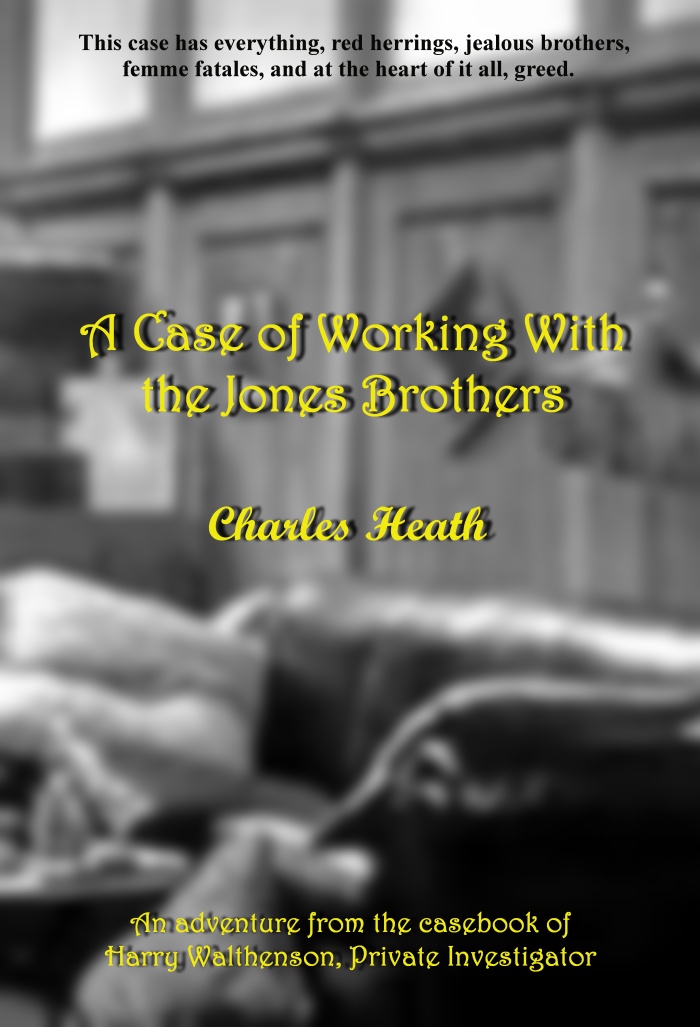
The first case of PI Walthenson – “A Case of Working With the Jones Brothers”

This case has everything, red herrings, jealous brothers, femme fatales, and at the heart of it all, greed.

See below for an excerpt from the book…

Coming soon!
PIWalthJones1

An excerpt from the book:

When Harry took the time to consider his position, a rather uncomfortable position at that, he concluded that he was somehow involved in another case that meant very little to him.

Not that it wasn’t important in some way he was yet to determine, it was just that his curiosity had got the better of him, and it had led to this: sitting in a chair, securely bound, waiting for someone one of his captors had called Doug.

It was not the name that worried him so much, it was the evil laugh that had come after the name was spoken.

Doug what? Doug the ‘destroyer’, Doug the ‘dangerous’, Doug the ‘deadly’; there was any number of sinister connotations, and perhaps that was the point of the laugh, to make it more frightening than it was.

But there was no doubt about one thing in his mind right then: he’d made a mistake. A very big. and costly, mistake. Just how big the cost, no doubt he would soon find out.

His mother, and his grandmother, the wisest person he had ever known, had once told him never to eavesdrop.

At the time he couldn’t help himself and instead of minding his own business, listening to a one-sided conversation which ended with a time and a place. The very nature of the person receiving the call was, at the very least, sinister, and, because of the cryptic conversation, there appeared to be, or at least to Harry, criminal activity involved.

For several days he had wrestled with the thought of whether he should go. Stay on the fringe, keep out of sight, observe and report to the police if it was a crime. Instead, he had willingly gone down the rabbit hole.

Now, sitting in an uncomfortable chair, several heat lamps hanging over his head, he was perspiring, and if perspiration could be used as a measure of fear, then Harry’s fear was at the highest level.

Another runnel of sweat rolled into his left eye, and, having his hands tied, literally, it made it impossible to clear it. The burning sensation momentarily took his mind off his predicament. He cursed and then shook his head trying to prevent a re-occurrence. It was to no avail.

Let the stinging sensation be a reminder of what was right and what was wrong.

It was obvious that it was the right place and the right time, but in considering his current perilous situation, it definitely was the wrong place to be, at the worst possible time.

It was meant to be his escape, an escape from the generations of lawyers, what were to Harry, dry, dusty men who had been in business since George Washington said to the first Walthenson to step foot on American soil, ‘Why don’t you become a lawyer?” when asked what he could do for the great man.

Or so it was handed down as lore, though Harry didn’t think Washington meant it literally, the Walthenson’s, then as now, were not shy of taking advice.

Except, of course, when it came to Harry.

He was, Harry’s father was prone to saying, the exception to every rule. Harry guessed his father was referring to the fact his son wanted to be a Private Detective rather than a dry, dusty lawyer. Just the clothes were enough to turn Harry off the profession.

So, with a little of the money Harry inherited from one of his aunts, he leased an office in Gramercy Park and had it renovated to look like the Sam Spade detective agency, you know the one, Spade and Archer, and The Maltese Falcon.

There’s a movie and a book by Dashiell Hammett if you’re interested.

So, there it was, painted on the opaque glass inset of the front door, ‘Harold Walthenson, Private Detective’.

There was enough money to hire an assistant, and it took a week before the right person came along, or, more to the point, didn’t just see his business plan as something sinister. Ellen, a tall cool woman in a long black dress, or so the words of a song in his head told him, fitted in perfectly.

She’d seen the movie, but she said with a grin, Harry was no Humphrey Bogart.

Of course not, he said, he didn’t smoke.

Three months on the job, and it had been a few calls, no ‘real’ cases, nothing but missing animals, and other miscellaneous items. What he really wanted was a missing person. Or perhaps a beguiling, sophisticated woman who was as deadly as she was charming, looking for an errant husband, perhaps one that she had already ‘dispatched’.

Or for a tall, dark and handsome foreigner who spoke in riddles and in heavily accented English, a spy, or perhaps an assassin, in town to take out the mayor. The man was such an imbecile Harry had considered doing it himself.

Now, in a back room of a disused warehouse, that wishful thinking might be just about to come to a very abrupt end, with none of the romanticized trappings of the business befalling him. No beguiling women, no sinister criminals, no stupid policemen.

Just a nasty little man whose only concern was how quickly or how slowly Harry’s end was going to be.

© Charles Heath 2019

A photograph from the inspirational bin – 54

What story does it inspire?

…

…

It could be a dark and stormy night.

It could be the catalyst for someone who makes a decision to join the space program and head for the moon.

It could be that there is already a space program, there are bases on the moon, and we’re about to head off to Mars.

It could be just someone skulking in the dark up to no good cursing the fact the moon just came out from under the clouds and exposed their position.

Or it could be a war story, ships on the ocean stalking the enemy under the cover of darkness, only to be foiled by the moon, which sometimes can be quite bright.

I often wonder what it might have been like in the North Atlantic between America and England when the convoys were hoping to get to England without being sunk. A dark moonless night would have helped.

There are so many reasons why the moon could be important to a story. Perhaps I will write one now!

Memories of the conversations with my cat – 73

As some may be aware, but many not, Chester, my faithful writing assistant, mice catcher, and general pain in the neck, passed away some years ago.

Recently I was running a series based on his adventures, under the title of Past Conversations with my cat.

For those who have not had the chance to read about all of his exploits I will run the series again from Episode 1

These are the memories of our time together…

This is Chester. He has suddenly become delusional.

I’m not sure if a cat can become so, but since I gave him a role in one of my stories, he’s started acting weirdly.

I’m sure if he could wear sunglasses indoors he would. As it is, it’s head in the air, looking straight ahead, ignoring everything and everyone around him.

I think about opening the concertina doors that lead into the dining room just to see if he crashes into them.

He thinks, no doubt, that I think he’s just sniffing the air to see if there are any mice to be caught, but I’m on to him.

As he strolls past I say, “Perhaps I might turn that role into a walk on.”

He stops in mid step, and turns his head.

“You can’t. I’ve read the latest chapter. I’m integral to the plot.”

I smile. “You do realise often the best roles end up on the cutting room floor, or in this case, perhaps I’ll start editing early. There’s such a thing as the delete key.”

Smug, or is that haughty, look gone.

“Just go back to being your usual self,” I say, “and I’ll reconsider your role.”

“Does that mean no fresh fish for lunch today?”

“Don’t push your luck.”

I’m sure cats can’t shrug, but he gives it his best shot, and continues on his way minus the attitude.

For now. Who knows what tomorrow will bring

The cinema of my dreams – Was it just another surveillance job – Episode 22

I’m back home and this story has been sitting on a back burner for a few months, waiting for some more to be written.

The trouble is, there are also other stories to write, and I’m not very good at prioritising.

But, here we are, a few minutes opened up and it didn’t take long to get back into the groove.

An unlikely ally?

When we were far enough away, not far from the bridge that crossed the Thames towards the Houses of Parliament, and with the London Eye in the foreground, I slackened my pace.  There were enough people around to afford us cover if Maury and his team realised quickly enough what we had done to escape.

“What now?” she asked.

“Go back to your people, tell them you’ve been compromised, but only on the basis that your flat was tossed, don’t mention Nobbin or Severin unless you feel compelled you have to, and make sure you don’t go back to the flat.  Both of them will have it staked out by now.”

“And what are you doing to do?”

“Try and play them off against each other, which probably won’t work.  I’m not nearly good enough at this caper yet.  Unfortunately, I’m going to have to talk to both of them and tell them I’m onto McConnell, though that will hardly be a surprise to either of them.  After that, find somewhere safe to figure out what to do next.”

“Who was that back at the station?”

“A chap called Maury, and I think he’s one of Severin’s hatchet men.  He was one of those who trained me and several others.”

“You do realise what you’re saying?”

“That my situation is so screwed up, yes, I know.”

It was when I stopped to think about it.  Trained by a rogue group no one knew about, or so they said, and transferred to another group, but not told about it, well, not officially, anyway.

“Maybe we should keep each other’s back.  I mean, if what you say is true, if I go back to my people and tell them about this, it’s likely I’ll be putting a target on my back too.”

True.  I had considered that, but not that we might team up.  It would introduce a third group to the game, and it might be one too many, or act as a catalyst leading to catastrophic consequences.

“What are you saying?”  I asked her, just in case I was misinterpreting what she was saying.

“I’m not safe, you’re not safe, together we might be.  I might have something useful about O’Connell, but I wouldn’t know if it was useful of not.  You at least know what to look for, and basically who to avoid.  Who knows, we might make a great team.”

We might.  But it would have to be predicated on trust, and, right now, I was not sure if I could trust her.  That pen thing, she might have precipitated it, and was working with Severin.  It seemed logical in the circumstances.

But what was that saying, keep your friends close, and your enemies closer?  I’d soon find out.

“Ok.  What do you think we should do first?”

“Find a hotel, an obscure one, nearby, and you call your so-called friends, and see what happens, as you said.”

I nodded.  “Sounds like a plan.”

And, I thought to myself, ideal for her if she was insinuating herself into my world, much the same as she had in O’Connell’s case.  In was now in my nature to suspect everyone and everything, because a few words of one lesson came back to haunt me.  We trust people because we instinctively want to believe them, and in this line of work, the people we come across are good and sincere storytellers.

It was a question of how much truth they weaved into their story, that made it believable.  I wanted to believe her, but the facts, circumstantial or otherwise, pointed me in the other direction.

I would have to wait and see and make sure I was prepared for the worst.

It was Jan’s idea t stay near the Charing Cross station in a hotel that I would not normally stay in because of the cost.  I let Jan do the check-in and when we arrived at the room, I discovered she hadn’t booked two rooms, but a Studio Suite with two single beds and a sofa bed.

Apparently, we were brother and sister, which made sense after I had overheard some of the conversation with the check-in clerk.  I didn’t hear what her excuse was for lack of luggage.  Perhaps the airline had lost it, but I had to admit the girl could think on her feet.

Once inside the room, it felt cramped, but the beds looked comfortable, and it had a minibar.

“Before you make any calls, you need to disable the GPS in your phone.”

“They’ll still be able to track it.”

“Not if you are on it for a short period, and we are outside the hotel.”

Well, before that I need a drink.”

“So, do I.  Give me a minute to freshen up and we’ll go down to the bar.  It’ll be a lot cheaper than the minibar.  Then I think we both need to get some supplies.”

I wondered if this is what it was like to be married.


© Charles Heath 2019

First Dig Two Graves – the editor’s second draft – Day 17

This book has finally come back from the Editor, so this month it is going to get a second revision, a second draft for the editor, and beta readers.

…

Yesterday there was a moment where I went back over the plot, and whilst that exercise was a success in a way, it also got me thinking, and like always, I couldn’t sleep, thinking about how the timeline was working, but the narrative wasn’t.

Yes, I made the fatal mistake of considering editing in the middle of a writing marathon.

What brought this self-destructive mood on? A movie. No relevance at all to my story, but it was a study in interactions between disparate people, which is what I have going on between John and Zoe.

It works in the first story because they are thrown together and everything is new and crazy.

In the second, the premise is that the novelty of the thing they had is wearing off.

Zoe needs to keep occupied and doing something other than all she’s ever known is not exactly on her to-do list.

Of course, that’s all put on hold because she is now a target because of the death of Alistair, and it’s a problem she has to take care of. Alone.

I realize now there needs to be some discussion around this, and the way the story starts does not set the scene.

Similarly, there should be more definition of the relationship as it stands, or not as the case may be, and reasons why John decides to go after her, if only to get the truth because he believes she is using the people seeking revenge as an excuse to keep him at arm’s length.

And, from her perspective, it’s not so much she doesn’t want to be with him, it’s because she doesn’t want him to end up dead, given the sort of people she was up against. Not being able to articulate her feelings, as it’s not something she really knew how to do, there’s bound to be some confusion.

Inevitably he is going to find her, and when they d, the reasons why they are together are clear, but there are still many reasons why he shouldn’t be there. Her life is not the sort of life he would want, by choice, and it’s not going to improve, so where is this thing going to take them?

I haven’t thought it through, so I’m going to take some time out to sort it out. I’m 47,000 odd words into the narrative, so I have a day, two at the most to review, and perhaps rewrite to get the missing perspective I’m looking for

…

Today’s writing, a part of the assessment of their relationship underway, 560 words, for a total of 47,626.

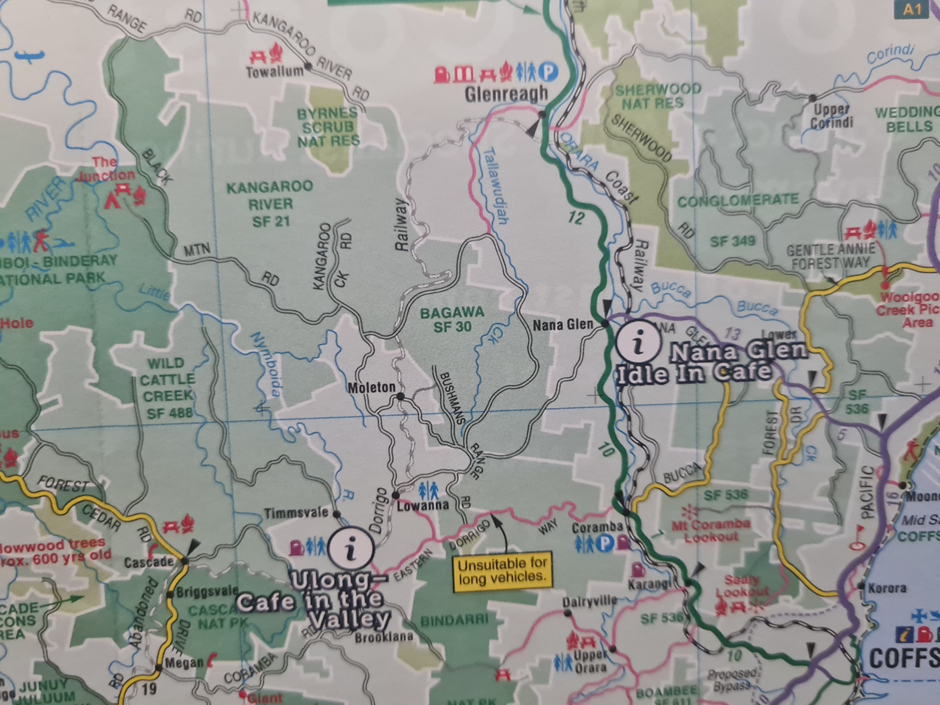
Searching for locations – Coramba – Lowanna, New South Wales, Australia

Once a bustling railway

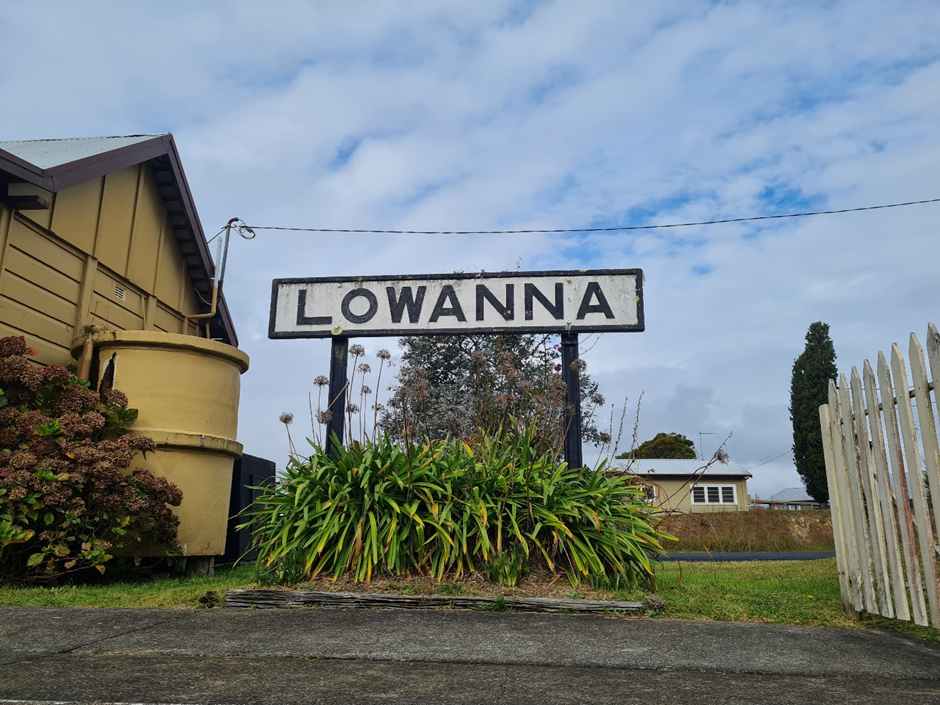
When You pick up a document that describes tourist attractions in Coffs Harbour, there’s one about the Orara Valley, and what caught my eye was firstly the Lowanna Railway Station.

To get there, you pass through Coramba, which has a railway line running through it, but any attempt to find the railway station will be met with disappointment.

But …

That’s not the railway story, that is the Glenreagh to Dorrigo line, first mooted in 1906, but not getting started until 1910, then halted because of the First World War and not completed until December 1924, and ran until October 1972.

However, back to Coramba…

The North Coast railway (the primary rail route in the Mid North Coast and Northern Rivers regions of New South Wales) passes through Coramba, which had a now-closed railway station from 1922.  An attempt to find the station took us to a private residence, which obviously was once the station.

And then to the right historic station, in Lowanna…

Lowanna was the largest of the intermediate stations. It was an attended station, with a crossing loop and siding. Most of the timber was loaded at this location. 

Opened  23-Dec-1924 and Closed 20-Sep-1975

What we were really looking for was the Lowanna Railway Station, which, when we put it in the GPS almost got us lost.  We eventually found the refurbished station, and a rather run down platform, and rail tracks.

Lowanna was on the Dorrigo branch and lies on the north coast of NSW.  It branches off the North Coast Line at Glenreagh and climbs up to the Dorrigo Plateau.

The Dorrigo area was settled in the early 1900s by pastoralists and tree fellers. Due to the steep terrain, it was decided to build a railway to allow products to be brought to nearby port towns. Several routes were surveyed, with the route from Glenreagh eventually chosen. The line climbs 664m over a length of 69km.

Apart from the endpoints of Dorrigo and Glenreagh, the station on this line was very small, often consisting of a short platform with a small shelter. The major traffic on this line was timber.

Where is that glamorous life of an Author?

I’m currently sitting in my car waiting to pick the grandchildren up from school wondering where that dream of the glamorous life of an author went.

Can it be said that any author leads a glamorous life, except for maybe J K Rowling, James Patterson, and a handful of others?

That dream is of course only a dream.  I did not start this writing caper to become rich and famous or live a glamorous life.  I started It, and it continues in the same vein, that I have a lot of stories in my head that I want to get on paper.

If anyone else wants to read them, then that’s a bonus.  If I happen to make enough money, rather than live high on the hog, an expression my father often used to describe the rich, I would happily invest in programs that get young people reading more.

It also strikes me that it would be difficult to write a literary novel in the vein of Jane Austen or the Bronte sisters, to name a few because modern-day life has no real meaning like it did then.

Instant news, instant communications, and the rest of the country, as well as the world, do close, we can go anywhere, and communicate instantly.  In the days of classic literature, the protagonist’s exchange of letters, and the arduous traveling to another part of the same country would be enough to generate a chapter, or the visit itself could generate several.

But those tales of life were always about people of means, not the ordinary people.  Stories that have the minutiae of daily life do not appeal.  No one wants to read about their lives, they want to be transported to another world where there is no such inanity like cooking, cleaning, washing, and picking up children.

I’m using this time to write another episode or chapter, or, in this case, a blog post.

As any parent will tell you, it is the calm before the storm.

“Sunday in New York”, a romantic adventure that’s not a walk in the park!

“Sunday in New York” is ultimately a story about trust, and what happens when a marriage is stretched to its limits.

When Harry Steele attends a lunch with his manager, Barclay, to discuss a promotion that any junior executive would accept in a heartbeat, it is the fact his wife, Alison, who previously professed her reservations about Barclay, also agreed to attend, that casts a small element of doubt in his mind.

From that moment, his life, in the company, in deciding what to do, his marriage, his very life, spirals out of control.

There is no one big factor that can prove Harry’s worst fears, that his marriage is over, just a number of small, interconnecting events, when piled on top of each other, points to a cataclysmic end to everything he had believed in.

Trust is lost firstly in his best friend and mentor, Andy, who only hints of impending disaster, Sasha, a woman whom he saved, and who appears to have motives of her own, and then in his wife, Alison, as he discovered piece by piece damning evidence she is about to leave him for another man.

Can we trust what we see with our eyes or trust what we hear?

Haven’t we all jumped to conclusions at least once in our lives?

Can Alison, a woman whose self-belief and confidence is about to be put to the ultimate test, find a way of proving their relationship is as strong as it has ever been?

As they say in the classics, read on!

Purchase:

http://tinyurl.com/Amazon-SundayInNewYork

Searching for locations: The Bund, Shanghai, China

The Bund

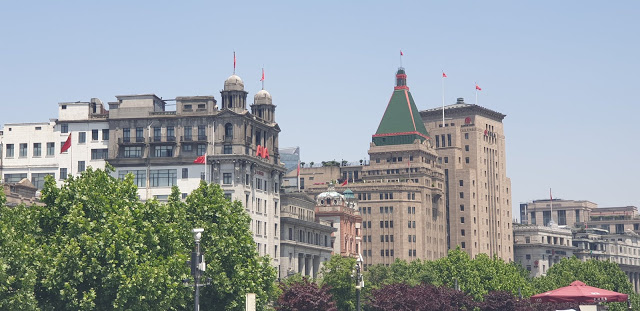
The architecture along the Bund or Waitan is a living museum of the colonial history of the 1800s.  The area centers on a section of Zhongshan Road within the former Shanghai International Settlement.

The word bund means an embankment or an embanked quay.   It was initially a British settlement; later the British and American settlements were combined in the International Settlement.

The Bund is a mile-long stretch of waterfront promenade along the Huangpu River. There are 52 buildings of various architectural styles, including Gothic, baroque, and neoclassical styles. The area is often referred to as “the museum of buildings”.

Building styles include Romanesque Revival, Gothic Revival, Renaissance Revival, Baroque Revival, Neo-Classical or Beaux-Arts, as well as a number in Art Deco style.

Having seen these buildings initially the night before, mostly lit up, our viewing this morning was from the land side, and particularly interesting in that the colonial architecture was really fascinating considering their location, but not surprising given Shanghai’s history.  A lot of these buildings would be more at home in London, that out in the far east.

The Bund waterfront is about two kilometers long and impossible to cover in the time allowed for this part of the tour.

There was just enough time to get photos of the waterfront and the old buildings.

Some of these buildings had odd shapes, like one on the far right that looks like a bottle opener.

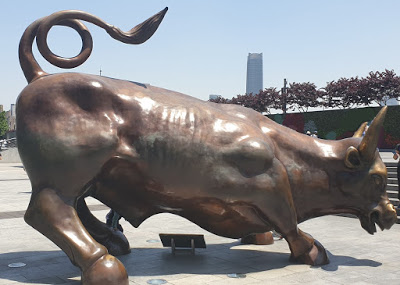
And, for some odd reason, a bull.

On the other side of the water, the sights that had been quite colorful the night before, were equally impressive though somewhat diminished by the haze.