This word, where I live, had taken on a new meaning. We have telephone scammers who ask your name when you answer the phone, and when you say yes, they hang up.
It doesn’t take much imagination how they can use that recording.
So, I now answer the phone with maybe, which confuses the real callers who want to know if it is you.
Of course, maybe is one of those words that have so many meaning, but the best one is to use it while you have time to think of a proper answer.
For example, did you get the potatoes? You haven’t been out, it slipped your mind, or you just plain forgot, but run with a ‘maybe’ so you can judge the reaction.
Angry face, you know no matter what, you’re in trouble.
Genial face, you know that it didn’t really matter and all is forgiven.
Then there’s the person who doesn’t know you and comes up to you in a crowded room. Are you [put name here]?
Maybe. We want to know if we’re in trouble, or if it for something good.
Using ‘maybe’ in writing probably isn’t the best word to us, but I like defying the experts. You can always find a maybe or two in any of my books.
John Pennington’s life is in the doldrums. Looking for new opportunities, and prevaricating about getting married, the only joy on the horizon was an upcoming visit to his grandmother in Sorrento, Italy.
Suddenly he is left at the check-in counter with a message on his phone telling him the marriage is off, and the relationship is over.
If only he hadn’t promised a friend he would do a favour for him in Rome.
At the first stop, Geneva, he has a chance encounter with Zoe, an intriguing woman who captures his imagination from the moment she boards the Savoire, and his life ventures into uncharted territory in more ways than one.
That ‘favour’ for his friend suddenly becomes a life-changing event, and when Zoe, the woman who he knows is too good to be true, reappears, danger and death follow.
Shot at, lied to, seduced, and drawn into a world where nothing is what it seems, John is dragged into an adrenaline-charged undertaking, where he may have been wiser to stay with the ‘devil you know’ rather than opt for the ‘devil you don’t’.
It was odd because when I had gone to bed the previous evening, it had been quite warm, after one of those balmy autumn days. We had all been basking in what seemed to be an endless heatwave and finally getting some relief, and the last thing I’d seen was storm clouds gathering on the horizon.
It had been the strangest of summers, unprecedented, and as some of the more radical climate change so-called experts said, the beginning of the end.
The more rational scientists, the people the government relied on to advise them, had said that changes were occurring though not in a manner that rang ring alarm bells, but it was not part of the normal weather patterns.
Storms like that being predicted were normal, what was not normal, was feeling cold.
Also, I’d woken to an eerie darkness because there didn’t seem to be any lights on in the room. A few minutes later, that darkness had given way to a murky light as dawn broke, and I shivered.
Something was not right.
I looked at the clock, and it had stopped. I checked my phone, and it had a seventy per cent charge where it should be full. The charger was not working. A few seconds later, I tried the light switch.
Nothing. There was no power.
Another shiver went through me, but this time, it was generated by fear. I was being drawn to the window, and then when I looked out, what I saw took my breath away.
What in hell’s name had happened?
Outside, there was nothing but snow as far as the eye could see.
I’d gone to sleep after spending a few hours on a warm balmy night with Tricia, the waitress from the flat above, over a cold bottle of white wine.
Over the last few weeks, we had talked about this, about that, about nothing at all, slowly discovering that spending these few hours together relieved the boredom and inanity of our mundane lives.
For me, it had given me the hope of something else in the future than of being nothing of consequence and going nowhere.
That landing we had sat on only a few hours before was now deep in snow. If it was January, I wouldn’t give it a second thought, but this was September.
I threw on some warm clothes, buried in the bottom drawer and smelling of mothballs because I wasn’t supposed to need them for a few more months. It looked bleak outside, and I wanted to see just how bad it was close up.
After another look out the window to make sure I wasn’t seeing things, I went downstairs where there were a dozen or more people in the foyer and more out on the sidewalk, most of whom had looks of stunned disbelief.
As I descended the stairs it got colder, and with the door open, we could all feel the breeze swirling the lightly falling snow outside and in through the opening. The building supervisor was rugged up, standing by the door, making sure it closed after someone entered or left.
I knew most of those downstairs. I also recognised the looks on their faces.
Fear.
“What’s happening,” I asked. “Aside from the obvious.”
Mr Jacobson, the oldest member of our little enclave and the most educated, peered out the door and then looked at me. “It seems winter has come early this year.”
There was a hint of irony in his tone. The previous day had been in the low seventies, and the weather forecast had been for rain. Instead of rain, we got snow. How was that possible? I’m sure he would tell me if I asked, but I was not sure I’d understand him. He was a scientist in his previous life before forced retirement.
“Or, if it isn’t that…” I said, perhaps expecting him to complete the sentence. I knew he had a thing about climate change, even though everyone else had dismissed it when it seemed the planet’s climate appeared to have readjusted itself a few years back.
Some said it was a miracle. Some said we were all worried about nothing, but some said it was a sign, one last chance to stop going down the path we were on. If it was a reprieve, we ignored it.
Mr Jacobsen had told everyone that adjustment was only temporary, but he’d been saying the same thing for the last few years, and nothing had happened. Now he was simply the man who cried wolf.
“Mother Earth has been waiting patiently to take her revenge, and because we preferred to be complacent, this is just the beginning.” Mr. Jacobson wasn’t saying it out of spite, I believed he knew what was happening but couldn’t explain it in words any of us would understand.
But Harry Johnson, the man who knew everything but knew nothing, threw in his two cents worth. “You scientists have been banging on about this nonsense for decades, and nothing has happened. This is an aberration. Something had to give after an abnormally hot summer. It’ll be gone in a day or two. Mark my words.”
Mr Jacobson shook his head, but he said nothing more. There was no point. No one was going to believe him now. “There’s no power,” he said to me. “And it’s going to get colder. They should have insulated the power stations when they had the chance, but they didn’t. My advice, to everyone, get some extra blankets.”
“Or head south,” someone yelled out.
“You think it’s going to be better there?” Someone else asked.
“Out in that cold.” Another resident, one from a few floors above me, came in from outside shivering as if to emphasise his point. “You wouldn’t get far. The police are saying it only goes as far south as Washington, but everyone has the same idea, and the roads are clogged with people trying to get out of the city. They also say we’re actually not as badly off as those further north.”
“I didn’t see any police outside,” Harry Johnson said, and I’ve been out a few times.”
“They’re moving from building to building, telling people to stay indoors and keep warm until the power is back on. There is only limited transport options and office buildings and shopping centres are closed due to the blackout. They say we should tune into the radio for further information. Didn’t any of you take notice after the last disaster when we were told to be prepared in case it happened again?”
“That was different,” Harry muttered.
“How? This is worse. Then they rationed power, but we had power, and trucks and transport could move. This time, we have no power at all, and nothing can move because of the snow and icy conditions. This is going to take a while for the authorities to fix. If the weather changes out there, and it doesn’t look like it will change any time soon. Go to your apartments and keep warm. Find a radio and keep yourselves informed.”
There was murmuring, and a few complaints about people telling them what to do, but within five minutes, they were all trudging back up the stairs. With nothing more to see, I went back up the stairs myself. When I got to my apartment, Tricia was outside the door, dressed in her ski gear.
“What happened? Where’s the heat. I just woke up freezing.”
“Mr Jabobson says it’s Mother Nature taking revenge on us horrible humans.”
“The mad scientist?”
It was one of several names the residents gave him.
“I don’t think he’s as mad as we want to believe he is. He says it’s going to get colder and we need extra blankets.”
“I could get mine, bring them down, and we could share if you like. I know you’d like to be with me as much as I would like to be with you. It’s as good a reason as any. I am assuming you like me as much as I like being with you.”
I hadn’t expected whatever we had to move quickly, but I had thought my feelings towards her were not fully reciprocated. I didn’t want to take advantage of the situation, but it was a sensible idea.
“I do, and I’m happy if you’re happy. I don’t think the heat or the power will be back in a hurry, so we are not likely to be going far.”
“Then let’s go up and fetch the blankets.”
It was coincidental that recently, I had been reading about doomsday events. The oil crisis was not likely to happen again, and someone had thought about that Hormuz bottleneck, built alternative pipelines, and considered a lot more scenarios again after the recent mini-crisis. Then there was the possibility of a meteor crashing into the earth and knocking us out of orbit, but that was a bit more extreme and unlikely.
Nor was it because I was one of those prepper types who were hoarding necessities in an underground bunker, but because for a few months, about a year ago, the Middle East went up in flames and the oil supply briefly stopped, again.
It just proved that we should never put politicians in charge of trying to de-escalate a potential war. For those few months, it began with anarchy until the order was restored, and everything was rationed until common sense prevailed.
We saw what could happen, and it wasn’t pretty.
This, however, was a different problem. What could be a prelude to the next ice age had just arrived on our doorstep, and it would be interesting to know what was happening, even get a weather report that could tell us it was temporary. If we had learned anything from the past, people needed to be kept informed.
Even if they told us a lie, that everything would get better soon, it would be better than nothing. After the last crisis, everyone was aware that there had been precious little truth spoken as time passed, and inaction was met with unrest. It came very close to martial law, and no one wanted to see that again.
After that, I bought a small battery-operated radio, knowing there would be a designated radio station that had its own power supply to advise people of what was happening and what to do in a crisis like this; once Tricia and I were comfortable and warm, we tuned in to the station. It wasn’t confidence-inspiring, and the deadpan announcer’s voice only added a sense of the sinister to the news.
It definitely wasn’t good.
What we did learn; the snow basically blanketed the whole of the northern hemisphere from the north pole to the latitude below Washington, though there were snowy conditions for a further hundred miles south past that point. It was similar to the southern hemisphere, where it reached as far up as the bottom of Tasmania, an island south of mainland Australia.
And it wasn’t predicted to stop snowing for a few days at the very least. The poles were apparently clouded over and in a similar situation to being fogged in. There, the temperatures were a lot, lot colder.
No one was commenting on why it was happening, only that it was an unexpected turn of events that was not expected to last, and that the city’s services would be soon operating on a reduced scale, predicted to be within 24 hours, and that people, unless they were designated as working for essential services, should stay home until advised otherwise.
They acknowledged that power stations had been temporarily disabled by an abnormal amount of snow. The drifts had also caused problems in the substations and along the feeder lines, whatever that meant.
Then, the message looped after saying to stay tuned for any change in the situation. At the very least, they would advise the latest weather report on the hour. That was twenty minutes away.
We both listened to the weather report, and we both agreed that the wording was a signal. Not necessarily to us, but to others, and that was most likely to say things were not going to get better in the short term and to prepare for trouble.
The announcement underlined the necessity that we all stayed in place, the conditions would soon improve, and, shortly after that, another announcer said there would be limited power returning in a matter of hours.
A specific number wasn’t mentioned. It was as close to saying that no one knew definitely.
After several minutes of a rather sombre symphony playing softly in the background, both of us agreed it was weird because New York was never this quiet, ever. Tricia said to no one in particular, “What are they not saying?”
She was right. The announcer had spoken for nearly half an hour and told us nothing we already didn’t know. In words we really didn’t understand.
“My father always said that when people start using big words, they’re trying to hide the truth.”
“It’s not getting better, is it?”
“We don’t know. Mr Jacobson, the man you call the mad scientist, said that winter had come early, and while he made it sound like a joke, I don’t think he meant it that way. I’m going to see him and ask him what he’s going to do.”
“Don’t you think he’s crazy?”
Everybody did. Especially after he lost his job after telling anyone who would listen that exactly what happened was going to happen. Maybe if it had been five years ago, someone might have listened.
“No.”
Outside the door, we could hear raised voices. Had Harry decided to tell Mr Jacobson to keep his theories to himself. “I’d better go and see what’s happening.”
By the time I got the door open, it was to see Jacobson being escorted by two policemen. I ran up to them before they descended the stairs, yelling out, “He’s not mad, just concerned like all of us.”
He stopped and turned to me. “It’s fine, Alex. I’m going to have a talk with the meteorologists. They requested I go and meet with them. Remember what we talked about a few months back?”
For the moment, I couldn’t, but I had made a note of it on my phone.
“No matter. When you do, it’s Z. Do you understand? Z.”
I repeated it, and he nodded. Then they continued down the stairs, a few of the residents following.
On the way back to my apartment, I tried to remember what it was we were talking about. He had been, I remembered now, rather disjointed, as though he was having a hard time articulating what he wanted to say. He’d been more distracted than normal, but I had put it down to the anniversary of his wife’s death. It had hit him very hard, and I could only imagine what it would be like for him.
I went in and closed the door behind me. Tricia was still under the blankets. “What was it?”
“Jacobson, your mad scientist, was being taken away by the police. He says he’s been taken to see the meteorologists.”
“Or the loony bin. I heard Harry say more than once Jacobson was a loose cannon.”
“Harry wouldn’t know his ass from his elbow. Jacobson reminded me of something we talked about a few months ago. It might not be relevant; he was rambling more than usual at that time. He asked me to write it down, so all I have to do is find the notes on my cell phone.”
Which then took the next two hours to go through. I hadn’t realised that I’d accumulated so much junk over the years, nor so many photographs of New York all through the year, a visual reminder of what it was like before the snow.
“We will have to think about food soon,” Tricia said. “I usually only cater from day to day, like everyone.”
It was probably what a lot of people inside and outside the building were also thinking about, and given what happened the last time food supplies were interrupted, it could get ugly very quickly.
That was why I stocked up on some essential long-life items like milk, canned meat, vegetables, and fruit. Enough for two people to last a month.
“The thing I do remember from talking to Jacobson several months ago was to store up some essential items in case the oil stopped again. He said it was prudent these days to have supplies because of how things are in the Middle East.”
Tensions never die down there, and rockets were always flying about threatening to extend the current conflict between Israel and the Palestinians into a wider war with Lebanon, Syria, and Iran.
Who knew we’d have something else to worry about.
“For you, perhaps.”
“For two. I have always included you in my disaster plan.”
“Then believe me when I say you are the first.”
“I know how that feels. But only if you want me to. I don’t want you to feel obligated or have to do anything in return.”
She leaned over and kissed me on the cheek. “I know. Now, what was the mad scientist trying to tell you?”
I found the relevant document file and scrolled through the pages, a whole mass of disjointed and in places almost unintelligible notes. Jacobson had been reciting stuff so fast that I could hardly get it down. His wife had been an expert on shorthand, and he forgot that I was not her.
But then I got to the section that had a ‘Z’ on it, in capitals and bolded so that it stood out. He must have slowed down by then.
“It says that Plan Z was to get ready for an ELE event.”
“ELE, what is that?”
“Can’t remember, hang on.” I scrolled through a few more pages and then stopped reading. It was not on the page, but I suddenly remembered what it was.
An apt description of what happened when the meteor struck Earth and killed all the dinosaurs. I said, “It’s what is known as an Extinction Level Event.”
“I thought that was when meteors were coming.”
“It could also be a deadly virus like Covid, or an ice age, though that wouldn’t kill everyone, but it would make things very difficult to survive. Maybe that’s not what he specifically meant. Perhaps it’s just some of the suggestions he made if such a thing happened.”
“He did say z, plan z.”
“No, just Z, but he did say it was what we had been talking about, and that was the only z I can remember, or made notes on. And if they’re pulling him back to be an advisor after scoffing at his ideas, then what they’re not telling us is quite telling if you ask me. If you don’t mind the irony of it all.”
It was met with a wan smile from her. “What did you think we should do?”
I shrugged. “If It was just me alone, I’d probably head south. There’s no transport, so I’m not sure what I’d use.”
“And go where?”
“Always wanted to go to California, and that’s past the current freeze line. Somewhere where there’s power for starters, though.”
“I’ve got a car. It’s not a very good one, but I used to hang out in my dad’s workshop, and I pretty much know everything there is about cars and trucks.”
“And you waitress?”
“Girl mechanics don’t get far, just hit on. Lasted a week before I hit one jerk with a spanner. They’re very useful for teaching jerks lessons. Do you have any hidden talents?”
“Aside from washing dishes, not really. I can read, not comics, but textbooks and learn from them. Very good at trivia questions. I can program computers, and I have a funny little program running at the moment collecting every digitised book on the planet. Useful, of course, to no one but me.”
“Every book?”
I shrugged. “That can be freely downloaded, yes.”
“Why?”
“The usual reason, because I can.”
“How about speaking other languages, like Russian, or German?”
“Yes, several. Why?”
“Another quirk, I guess, that I have too. I can speak about six or seven different languages. I just can for some reason. Helps to talk to the customers at the diner when their English is kaput.”
Interesting. But time for a change of subject. “Does the car have petrol?”
“Diesel.”
“Spare fuel?”
“Some. So, we have a car, we have food, we have blankets and warm clothes. Still might not be enough. We certainly will not get on the roads with the stay-at-home order in place, but when things get better, it’s a possible plan.”
Another announcement had just been made, that if you had no reason to be on the street, stay at home, until further notice. There was also a specific reference to looting and the fact that perpetrators would be apprehended. This time, they were not waiting until everything went to hell.
“The question is, and don’t take this the wrong way if I was to consider going anywhere, I would not want to leave you here, not while this is all going on. And if it does pass, I would consider going south, but again, I don’t want to leave you unless…”
“I have something better to do with my life, or I have a secret boyfriend or ex-husband, or maybe I just don’t like you. What you see is what you get, Alex. I don’t want to be alone, and yet that’s what always happens. The type of guys I get to meet, well, you’re not one of them. Let’s see what happens in the next few days when we are so close; bad habits are bound to surface. I’m not perfect.”
“Neither am I. Nor do I have many dates. Talking to you on the fire escape has been the highlight of my life. Make of that what you will.”
It was hard to tell what she was thinking, though, at times, it was easy enough to gauge her mood. At the moment, with everything, there was an element of fear, tinged with something else. But the fact she wanted to stay with me and see what happened was a good sign.
She took my hand in hers and held it with both of hers. “I’m not sure if I should curse or thank this weather. But one thing is for sure, it brought us together in a way I never expected, though part of me was hoping something might develop. Lives such as ours don’t give scope for much, but it doesn’t mean we can’t try. Plan for two. I think soon, we’re going to be in for a hell of a ride if we can get in front of it. That said, in the meantime, what have you got to eat?”
I have reworked the first part of the story with a few new elements about the characters and changed a few of the details of how the characters finish up in the shop before the policewoman makes her entrance.
This is part of the new first section is the one that involves the shopkeeper`:
This wasn’t the shopkeeper’s first hold up. In fact, over the years there had been a dozen. But only one got reported to the police, and that was only because the robber was shot and killed.
He’d taken a bullet that night, too, which, from the police point of view, made him a concerned citizen simply defending himself.
The rest had been scared off by the double-barrel shotgun he kept under the counter for just such emergencies.
The young punk who came into the shop with his girlfriend had pulled out the pistol and told him if he reached for the shotgun he’d shoot him. The kid looked unstable and he’d backed away.
When the kid collapsed, he should have gone for the shotgun, but instead, he thought he could get to the gun before the girl realized what was happened. She wasn’t an addict and clearly looked like she was only along for the ride. Her expression, when the kid pulled out the gun told him she’d known nothing about her partner’s true intentions.
But, he wasn’t fast enough, and she had the gun pointing at him before he’d got past the counter.
From one pair of unpredictable hands to another.
Like the girl, he was just as surprised when the customer burst in the door, just before closing time.
The situation might have been salvageable before the customer came in the door, getting the girl to go along with the robbery being about money, but there was no denying what the kid on the floor’s problem was.
Damn.
He had to try and salvage the situation simply because there was a lot of money involved, and other people depending on him. He looked at the boy, on the floor, then the girl.
“Listen to me, young lady, you would be well advised to let this man go as he suggests. And, please put the gun down before someone gets hurt. Your friend needs medical help and I can call an ambulance.”
The girl switched her attention back to him. “No one’s going anywhere, so just shut the hell up and let me think.”
The storekeeper glanced over at the customer.
He’d seen him come into the shop once or twice, probably lived in the neighborhood, the sort who’d make a reliable witness, either a lawyer or an accountant. Not like most of the residents just beyond the fringe of respectability.
If only he hadn’t burst into the shop when he did.
This story is now on the list to be finished so over the new few weeks, expect a new episode every few days.
The reason why new episodes have been sporadic, there are also other stories to write, and I’m not very good at prioritizing.
But, here we are, a few minutes opened up and it didn’t take long to get back into the groove.
Things are about to get complicated…
With Jan safely in custody, probably for about 15 minutes when Dobbin discovered she was in police hands, Jennifer and I were free to chase up O’Connell and maybe we would also find Anna.
It was a long shot at best.
But we had to find out more about Anna Jacovich. For that, we would have to go back to the office and talk to Joanne. I told Jennifer what I intended to do and dropped her at the safe house for some much-needed rest before we went after O’Connell.
Then, back in the car, I called the number I had for Joanne.
“Sam.”
“Memorised my number?”
“I like to know who’s calling before I answer.”
“Then this isn’t a restricted line?”
“Restricted enough.”
“I found your little toy?”
Did I hear a sigh?
“You know the world we live in Sam, trust no one not even your mother. Hard for me to trust or not trust her, she passed away when I was seven. Monica said you were good. What can I do for you?”
“A full workup on Anna Jacovich. I’m coming into the office now, and will be there in about half an hour.”
“No pressure then?”
“Not at all.”
“Try not to irritate security this time.”
I’m sure I saw a grim expression on the face of the soldier that had been there the last time I tried to run the gauntlet, and then disappointment when my card worked. I signed in and put the name of the department I was visiting down as Research.
When he asked for a name, I gave him Joanne’s. No doubt he would call her long before I got to her.
She met me at the second level of defence and then took me to a room where two folders sat at opposite ends of a table, two desk lamps shining light down on them. The rest of the room was in darkness.
When she shut the door, I said, “Please tell me there in;t a firing squad in black camouflage just waiting to shoot me.”
She smiled. “If it was more sensitive information, I’d let you read it, then have you shot. Not today.
That was a relief. Oddly, I believed that she would if the circumstances warranted it. Joanne was scary, nor scary than Jan. It’s the quiet ones you had to worry about.”
We sat.
“Read. Then I’ll answer questions.”
For the ten minutes, it took me to discover that Anna was a biochemist herself, and had worked in a not-so-secret government laboratory that had been unmasked with disastrous results, adding another dimension to the problem. I was beginning to think she might be the one who created the monster and had set her husband up to take the blame.
If that was the case, she was never going to pass it on to O’Connell or sell it to him, other than to take the money and run. If that was the case, Severin knew it was her all along, and how dangerous she was.
But and there was a big but in all of this. She needed an accomplice to get to England, which was O’Connell. Now he was no longer needed…
Yes, she would also need both Severin and Maury off her tail, and that had been taken care of.
Jan? Unless I completely misread her, it was not possible she could be the accomplice; she was doing what Dobbin requested. Or had she? Dobbin did say she was able to make executive decisions on the fly.
“The threat isn’t O’Connell. He’s just a pawn.”
“Not just a pretty face then?”
“I never regard my face as pretty.”
She shook her head. “It’s Anna. She played Severin and Maury, she played Dobbin, and she played Dobbin’s little toy soldier, O’Connell. Or Quigley I believe his real name is. I hesitate to say O’Connell played you.”
“Call a dog a dog, Joanne. If I had more experience and more information I might have seen that. You can’t keep people in the dark, and then expect miracles.”
“I’m the messenger, Sam.”
“I’ve been known to shoot messengers, just because I can.”
“Save your bullets for the bad guys.”
“How do I know you and Monica are not the bad guys?”
Another shake of the head. “OK. You’ve passed the scepticism test, Sam. Now put it away. We have to work together on this. It’s a condition for continuing to work on the case.”
“And if I don’t?”
“I don’t need to answer that. But, I get it. You’re a self-starter and will keep at it, with or without us. I can see why people like you. To me, your just another dangerous amateur.”
There were words I could say, but judging by the reek of self-aggrandisement, it would not penetrate the thick hide.
I smiled. “Not noted for your charm then.”
“No. Where is Jan?”
“Who?”
“Don’t play games, Sam. They don’t become you. You went to see Severin, but he ended up dead, and she shot him. Why?”
“You read this file?” I picked it up and dropped it on the table.
She was the sort that read the first page, the preamble, and the last page, the result or desired result.
“I did.”
“Then you know why, as for Jan, if you know I was there when Severin was shot, you’d know where Jan is.”
“She disappeared into the trees. And no doubt in the wind. You should know she’s a trained MI5 assassin on loan to Dobbin.”
Who was now in jail somewhere pending the Detective Inspectors leisure, unless she filed a report. If she did, she would be out now, and looking for O’Connell and Anna.
“Then how should I know?”
She shrugged. “I thought I’d ask. I’m not sure I like having to peel away the layers of this story one by one.”
“Be more forthcoming.” I stood. I had what I needed. “If that’s all, I’ll go on with the job.”
“O’Connell?”
“He’s probably dead by now, but I have to find him, one way or another.”
This book has finally reached the Final Editor’s draft, so this month it is going to get the last revision, and a reread for the beta readers.
…
So, here’s a question.
If your mother and her twin sister are identical twins, how will Jack know that he has rescued the right woman?
We all know how some identical twins like to play tricks on their friends, by substituting each other. It’s a wicked game on the unsuspecting, but for a criminal, it’s a ploy that just might work.
But there’s that other issue we have between the son and the mother, quite a few years of lying and half-truths to get past, and a great deal of explanation.
Perhaps their reuniting is not going to go the way the mother or the son thinks.
Meanwhile, Jack is working on the idea of visiting his real father and trying to get some explanations out of him.
And, where is Maryanne?
Is it a bit late in the day to say that I’m not quite sure how this is going to end because one is not coming to me that will satisfy tying up the loose ends.
I suspect tomorrow will be the day when the last planning will be done. It may cost a day of words, but it will get the story done.
It’s the pointy end of the project and it has to come together.
When I started the story, it was the day after Agatha was found dead. From there it was a story of how her ex-husband charted a path through the tangled web of her life and business.
It was going to be one told through the various people in her life and the effect they had, good and bad. It was also meant to be a story of taking something good and twisting it, which is not what always happens but can.
I had always believed that being rich is a curse rather than a blessing, because you eventually start worrying about those around you who want to take it away, the fact, in the end, you can’t trust anyone.
I guess that it doesn’t happen a lot in real life.
Or maybe it does.
Is this why we believe rich people are eccentric?
These are only a few questions that are going to get a much bigger airing in the first edit, because at the moment, there are arts I’m not happy with.
I know who is responsible for her death. Now. For almost the whole of the story, I was like the reader, waiting to find out, and speculating along the way. It’s not who you think.
To write a private detective serial has always been one of the items at the top of my to-do list, though trying to write novels and a serial, as well as a blog, and maintain a social media presence, well, you get the idea.
But I made it happen, from a bunch of episodes I wrote a long, long time ago, used these to start it, and then continue on, then as now, never having much of an idea where it was going to end up, or how long it would take to tell the story.
That, I think is the joy of ad hoc writing, even you, as the author, have as much idea of where it’s going as the reader does.
It’s basically been in the mill since 1990, and although I finished it last year, it looks like the beginning to end will have taken exactly 30 years. Had you asked me 30 years ago if I’d ever get it finished, the answer would be maybe?
My private detective, Harry Walthenson
I’d like to say he’s from that great literary mold of Sam Spade, or Mickey Spillane, or Phillip Marlow, but he’s not.
But, I’ve watched Humphrey Bogart play Sam Spade with much interest, and modelled Harry and his office on it. Similarly, I’ve watched Robert Micham play Phillip Marlow with great panache, if not detachment, and added a bit of him to the mix.
Other characters come into play, and all of them, no matter what period they’re from, always seem larger than life. I’m not above stealing a little of Mary Astor, Peter Lorre or Sidney Greenstreet, to breathe life into beguiling women and dangerous men alike.
Then there’s the title, like
The Case of the Unintentional Mummy – this has so many meanings in so many contexts, though I imagine that back in Hollywood in the ’30s and ’40s, this would be excellent fodder for Abbott and Costello
The Case of the Three-Legged Dog – Yes, I suspect there may be a few real-life dogs with three legs, but this plot would involve something more sinister. And if made out of plaster, yes, they’re always something else inside.
But for mine, to begin with, it was “The Case of the …”, because I had no idea what the case was going to be about, well, I did, but not specifically.
Then I liked the idea of calling it “The Case of the Brother’s Revenge” because I began to have a notion there was a brother no one knew about, but that’s stuff for other stories, not mine, so then went the way of the others.
Now it’s called ‘A Case of Working With the Jones Brothers’, finished the first three drafts, and at the editor for the last.
I have high hopes of publishing it in early 2021. It even has a cover.
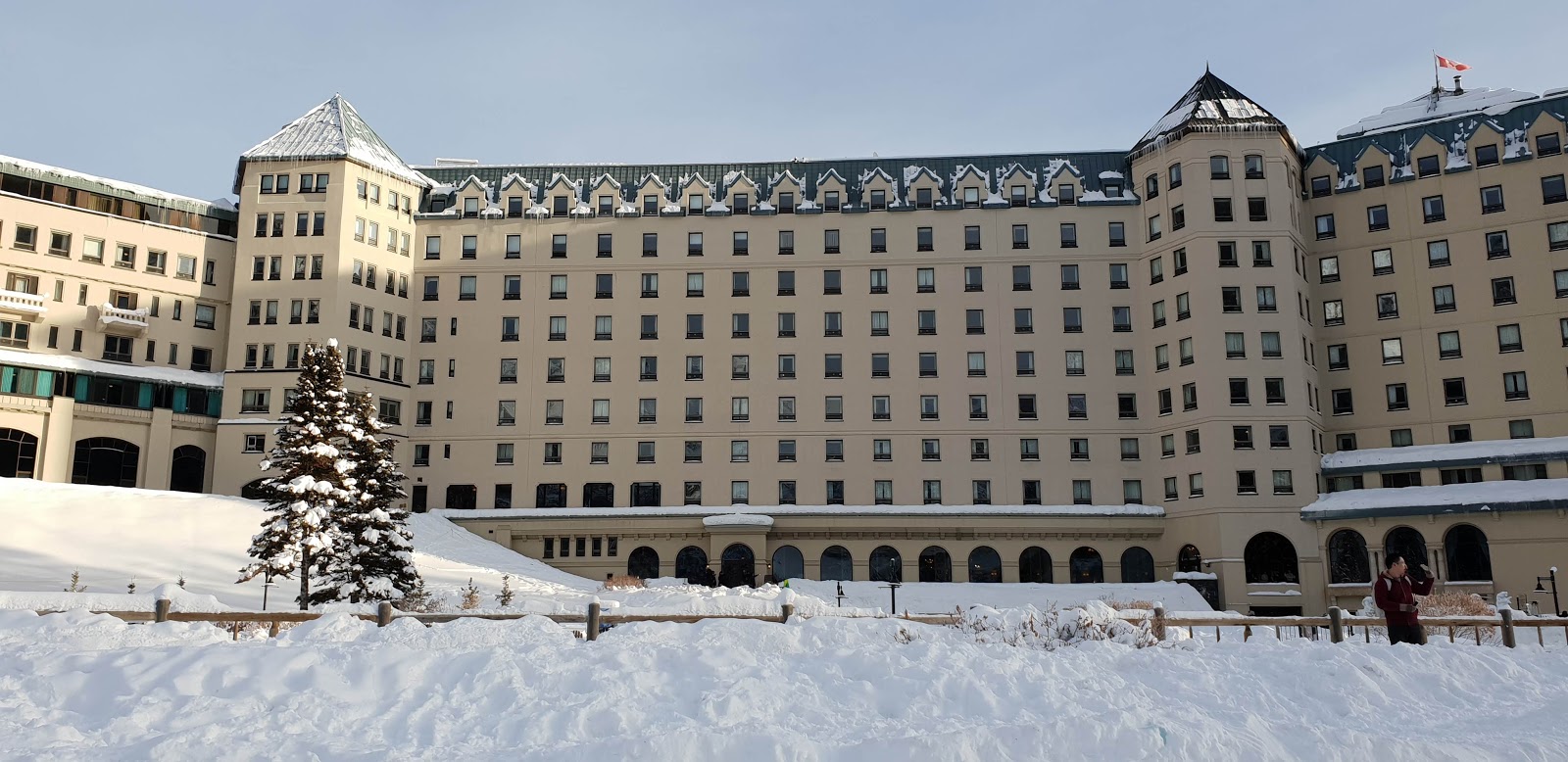
I was not sure what I was expecting to see when we first arrived at the Fairmont Hotel at Lake Louise, Alberta, Canada.
I’d seen endless photographs both in Winter and in Summer, and the problem with photos is that they never quite prepare you for reality.
That’s not to say that our first impression was of incredible scenery, it was of the front door if it could be called that, where we pulled up in the car, and then, if the sub-zero temperatures, a mad rush to get the baggage out, and get into the warmth of the foyer, which was almost the size of several football fields, and then some.
Check-in was quick and easy, and then to our room on the first floor. I had hoped to be higher up but, being a corner room, when we got there, the views could not be more majestic.
I could not believe there were people who were willing to take a sleigh ride in the minus degree temperatures. Don’t let the sunny aspect fool you, it’s freezing cold, literally, outside.
The lake had frozen over, and a closer look showed there was a skating rink an ice castle, and a hockey rink as well. People were skating, and walking over the frozen surface of the lake.
No skating, or walking, on thin ice here.
Venturing outside into the cold, you have to be rugged up, and definitely, have both a hat and gloves. It was minus six degrees.
There’s this amazing hotel, just like you would see in the movies
A frozen lake where you’re half expecting to open up and a huge spaceship, or something else, come out
Mountainsides to climb, but only if you are stark staring mad. And, of course, if you don’t freeze to death before you get there.
Our room, believe it or not, is on the extreme right-hand side, just above the first roofline.
Tomorrow we will venture further out onto the lake.
By the time I returned to the Savoie, the rain had finally stopped, and there was a streak of blue sky to offer some hope the day would improve.
The ship was not crowded, the possibility of bad weather perhaps holding back potential passengers. Of those I saw, a number of them would be aboard for the lunch by Phillippe Chevrier. I thought about it, but the Concierge had told me about several restaurants in Yvoire and had given me a hand-drawn map of the village. I think he came from the area because he spoke with the pride and knowledge of a resident.
I was looking down from the upper deck observing the last of the boarding passengers when I saw a woman, notable for her red coat and matching shoes, making a last-minute dash to get on board just before the gangway was removed. In fact, her ungainly manner of boarding had also captured a few of the other passenger’s attention. Now they would have something else to talk about, other than the possibility of further rain.
I saw her smile at the deckhand, but he did not smile back. He was not impressed with her bravado, perhaps because of possible injury. He looked at her ticket then nodded dismissively, and went back to his duties in getting the ship underway. I was going to check the departure time, but I, like the other passengers, had my attention diverted to the woman in red.
From what I could see there was something about her. It struck me when the light caught her as she turned to look down the deck, giving me a perfect profile. I was going to say she looked foreign, but here, as in almost anywhere in Europe, that described just about everyone. Perhaps I was just comparing her to Phillipa, so definitively British, whereas this woman was very definitely not.
She was perhaps in her 30’s, slim or perhaps the word I’d use was lissom, and had the look and manner of a model. I say that because Phillipa had dragged me to most of the showings, whether in Milan, Rome, New York, London, or Paris. The clothes were familiar, and in the back of my mind, I had a feeling I’d seen her before.
Or perhaps, to me, all models looked the same.
She looked up in my direction, and before I could divert my eyes, she locked on. I could feel her gaze boring into me, and then it was gone as if she had been looking straight through me. I remained out on deck as the ship got underway, watching her disappear inside the cabin. My curiosity was piqued, so I decided to keep an eye out for her.
I could feel the coolness of the air as the ship picked up speed, not that it was going to be very fast. With stops, the trip would take nearly two hours to get to my destination. It would turn back almost immediately, but I was going to stay until the evening when it returned at about half eight. It would give me enough time to sample the local fare, and take a tour of the medieval village.
Few other passengers ventured out on the deck, most staying inside or going to lunch. After a short time, I came back down to the main deck and headed forward. I wanted to clear my head by concentrating on the movement of the vessel through the water, breathing in the crisp, clean air, and let the peacefulness of the surroundings envelope me.
It didn’t work.
I knew it wouldn’t be long before I started thinking about why things hadn’t worked, and what part I played in it. And the usual question that came to mind when something didn’t work out. What was wrong with me?
I usually blamed it on my upbringing.
I had one of those so-called privileged lives, a nanny till I was old enough to go to boarding school, then sent to the best schools in the land. There I learned everything I needed to be the son of a Duke, or, as my father called it in one of his lighter moments, nobility in waiting.
Had this been five or six hundred years ago, I would need to have sword and jousting skills, or if it had been a few hundred years later a keen military mind. If nothing else I could ride a horse, and go on hunts, or did until they became not the thing to do.
I learned six languages, and everything I needed to become a diplomat in the far-flung British Empire, except the Empire had become the Commonwealth, and then, when no-one was looking, Britain’s influence in the world finally disappeared. I was a man without a cause, without a vocation, and no place to go.
Computers were the new vogue and I had an aptitude for programming. I guess that went hand in hand with mathematics, which although I hated the subject, I excelled in. Both I and another noble outcast used to toss ideas around in school, but when it came to the end of our education, he chose to enter the public service, and I took a few of those ideas we had mulled over and turned them into a company.
About a year ago, I was made an offer I couldn’t refuse. There were so many zeroes on the end of it I just said yes, put the money into a very grateful bank, and was still trying to come to terms with it.
Sadly, I still had no idea what I was going to do with the rest of my life. My parents had asked me to come back home and help manage the estate, and I did for a few weeks. It was as long as it took for my parents to drive me insane.
Back in the city, I spent a few months looking for a mundane job, but there were very few that suited the qualifications I had, and the rest, I think I intimidated the interviewer simply because of who I was. In that time I’d also featured on the cover of the Economist, and through my well-meaning accountant, started involving myself with various charities, earning the title ‘philanthropist’.
And despite all of this exposure, even making one of those ubiquitous ‘eligible bachelor’ lists, I still could not find ‘the one’, the woman I wanted to spend the rest of my life with. Phillipa seemed to fit the bill, but in time she proved to be a troubled soul with ‘Daddy’ issues. I knew that in building a relationship compromise was necessary, but with her, in the end, everything was a compromise and what had happened was always going to be the end result.
It was perhaps a by-product of the whole nobility thing. There was a certain expectation I had to fulfill, to my peers, contemporaries, parents and family, and those who either liked or hated what it represented. The problem was, I didn’t feel like I belonged. Not like my friend from schooldays, and now obscure acquaintance, Sebastian. He had been elevated to his Dukedom early when his father died when he was in his twenties. He had managed to fade from the limelight and was rarely mentioned either in the papers or the gossip columns. He was one of the lucky ones.
I had managed to keep a similarly low profile until I met Phillipa. From that moment, my obscurity disappeared. It was, I could see now, part of a plan put in place by Phillipa’s father, a man who hogged the limelight with his daughter, to raise the profile of the family name and through it their businesses. He was nothing if not the consummate self-advertisement.
Perhaps I was supposed to be the last piece of the puzzle, the attachment to the establishment, that link with a class of people he would not normally get in the front door. There was nothing refined about him or his family, and more than once I’d noticed my contemporaries cringe at the mention of his name, or any reference of my association with him.
Yet could I truthfully say I really wanted to go back to the obscurity I had before Phillipa? For all her faults, there were times when she had been fun to be with, particularly when I first met her when she had a certain air of unpredictability. That had slowly disappeared as she became part of her father’s plan for the future. She just failed to see how much he was using her.
Or perhaps, over time, I had become cynical.
I thought about calling her. It was one of those moments of weakness when I felt alone, more alone than usual.
I diverted my attention back to my surroundings and the shoreline. Out of the corner of my eye, I could see the woman in the red coat, making a move. The red coat was like a beacon, a sort of fire engine red. It was not the sort of coat most of the women I knew would wear, but on her, it looked terrific. In fact, her sublime beauty was the one other attribute that was distinctly noticeable, along with the fact her hair was short, rather than long, and jet black.
I had to wrench my attention away from her.
A few minutes later several other passengers came out of the cabin for a walk around the deck, perhaps to get some exercise, perhaps checking up on me, or perhaps I was being paranoid. I waited till they passed on their way forward, and I turned and headed aft.
I watched the wake sluicing out from under the stern for a few minutes, before retracing my steps to the front of the ship and there I stood against the railing, watching the bow carve its way through the water. It was almost mesmerizing. There, I emptied my mind of thoughts about Phillipa, and thoughts about the woman in the red coat.
Until a female voice behind me said, “Having a bad day?”
I started, caught by surprise, and slowly turned. The woman in the red coat had somehow got very close me without my realizing it. How did she do that? I was so surprised I couldn’t answer immediately.
“I do hope you are not contemplating jumping. I hear the water is very cold.”
Closer up, I could see what I’d missed when I saw her on the main deck. There was a slight hint of Chinese, or Oriental, in her particularly around the eyes, and of her hair which was jet black. An ancestor twice or more removed had left their mark, not in a dominant way, but more subtle, and easily missed except from a very short distance away, like now.
Other than that, she was quite possibly Eastern European, perhaps Russian, though that covered a lot of territory. The incongruity of it was that she spoke with an American accent, and fluent enough for me to believe English was her first language.
Usually, I could ‘read’ people, but she was a clean slate. Her expression was one of amusement, but with cold eyes. My first thought, then, was to be careful.
“No. Not yet.” I coughed to clear my throat because I could hardly speak. And blushed, because that was what I did when confronted by a woman, beautiful or otherwise.
The amusement gave way to a hint of a smile that brightened her demeanor as a little warmth reached her eyes. “So that’s a maybe. Should I change into my lifesaving gear, just in case?”
It conjured up a rather interesting image in my mind until I reluctantly dismissed it.
“Perhaps I should move away from the edge,” I said, moving sideways until I was back on the main deck, a few feet further away. Her eyes had followed me, and when I stopped she turned to face me again. She did not move closer.
I realized then she had removed her beret and it was in her left side coat pocket. “Thanks for your concern …?”
“Zoe.”
“Thanks for your concern, Zoe. By the way, my name is John.”
She smiled again, perhaps in an attempt to put me at ease. “I saw you earlier, you looked so sad, I thought …”
“I might throw myself overboard?”
“An idiotic notion I admit, but it is better to be safe than sorry.”
Then she tilted her head to one side then the other, looking intently at me. “You seem to be familiar. Do I know you?”
I tried to think of where I may have seen her before, but all I could remember was what I’d thought earlier when I first saw her; she was a model and had been at one of the showings. If she was, it would be more likely she would remember Phillipa, not me. Phillipa always had to sit in the front row.
“Probably not.” I also didn’t mention the fact she may have seen my picture in the society pages of several tabloid newspapers because she didn’t look the sort of woman who needed a daily dose of the comings and goings, and, more often than not, scandal associated with so-called celebrities.
She gave me a look, one that told me she had just realized who I was. “Yes, I remember now. You made the front cover of the Economist. You sold your company for a small fortune.”
Of course. She was not the first who had recognized me from that cover. It had raised my profile considerably, but not the Sternhaven’s. That article had not mentioned Phillipa or her family. I suspect Grandmother had something to do with that, and it was, now I thought about it, another nail in the coffin that was my relationship with Phillipa.
“I wouldn’t say it was a fortune, small or otherwise, just fortunate.” Each time, I found myself playing down the wealth aspect of the business deal.
“Perhaps then, as the journalist wrote, you were lucky. It is not, I think, a good time for internet-based companies.”
The latter statement was an interesting fact, one she read in the Financial Times which had made that exact comment recently.
“But I am boring you.” She smiled again. “I should be minding my own business and leaving you to your thoughts. I am sorry.”
She turned to leave and took a few steps towards the main cabin.
“You’re not boring me,” I said, thinking I was letting my paranoia get the better of me. It had been Sebastian on learning of my good fortune, who had warned me against ‘a certain element here and abroad’ whose sole aim would be to separate me from my money. He was not very subtle when he described their methods.
But I knew he was right. I should have let her walk away.
She stopped and turned around. “You seem nothing like the man I read about in the Economist.”
A sudden and awful thought popped into my head. Those words were part of a very familiar opening gambit. “Are you a reporter?”
I was not sure if she looked surprised, or amused. “Do I look like one?”
I silently cursed myself for speaking before thinking, and then immediately ignored my own admonishment. “People rarely look like what they are.”
I saw the subtle shake of the head and expected her to take her leave. Instead she astonished me.
“I fear we have got off on the wrong foot. To be honest, I’m not usually this forward, but you seemed like you needed cheering up when probably the opposite is true. Aside from the fact this excursion was probably a bad idea. And,” she added with a little shrug, “perhaps I talk too much.”
I was not sure what I thought of her after that extraordinary admission. It was not something I would do, but it was an interesting way to approach someone and have them ignoring their natural instinct. I would let Sebastian whisper in my ear for a little longer and see where this was going.
“Oddly enough, I was thinking the same thing. I was supposed to be traveling with my prospective bride. I think you can imagine how that turned out.”
“She’s not here?”
“No.”
“She’s in the cabin?” Her eyes strayed in that direction for a moment then came back to me. She seemed surprised I might be traveling with someone.
“No. She is back in England, and the wedding is off. So is the relationship. She dumped me by text.”
OK, why was I sharing this humiliating piece of information with her? I still couldn’t be sure she was not a reporter.
She motioned to an empty seat, back from the edge. No walking the plank today. She moved towards it and sat down. She showed no signs of being cold, nor interested in the breeze upsetting her hair. Phillipa would be having a tantrum about now, being kept outside, and freaking out over what the breeze might be doing to her appearance.
I wondered, if only for a few seconds if she used this approach with anyone else. I guess I was a little different, a seemingly rich businessman alone on a ferry on Lake Geneva, contemplating the way his life had gone so completely off track.
She watched as I sat at the other end of the bench, leaving about a yard between us. After I leaned back and made myself as comfortable as I could, she said, “I have also experienced something similar, though not by text message. It is difficult, the first few days.”
“I saw it coming.”
“I did not.” She frowned, a sort of lifeless expression taking over, perhaps brought on by the memory of what had happened to her. “But it is done, and I moved on. Was she the love of your life?”
OK, that was unexpected.
When I didn’t answer, she said, “I am sorry. Sometimes I ask personal questions without realizing what I’m doing. It is none of my business.” She shivered. “Perhaps we should go back inside.”
She stood, and held out her hand. Should I take it and be drawn into her web? I thought of Sebastian. What would he do in this situation?
I took her hand in mine and let her pull me gently to my feet. “Wise choice,” she said, looking up at the sky.