The first case of PI Walthenson – “A Case of Working With the Jones Brothers”

This case has everything, red herrings, jealous brothers, femme fatales, and at the heart of it all, greed.

See below for an excerpt from the book…

Coming soon!

PIWalthJones1

An excerpt from the book:

When Harry took the time to consider his position, a rather uncomfortable position at that, he concluded that he was somehow involved in another case that meant very little to him.

Not that it wasn’t important in some way he was yet to determine, it was just that his curiosity had got the better of him, and it had led to this: sitting in a chair, securely bound, waiting for someone one of his captors had called Doug.

It was not the name that worried him so much, it was the evil laugh that had come after the name was spoken.

Doug what? Doug the ‘destroyer’, Doug the ‘dangerous’, Doug the ‘deadly’; there was any number of sinister connotations, and perhaps that was the point of the laugh, to make it more frightening than it was.

But there was no doubt about one thing in his mind right then: he’d made a mistake. A very big. and costly, mistake. Just how big the cost, no doubt he would soon find out.

His mother, and his grandmother, the wisest person he had ever known, had once told him never to eavesdrop.

At the time he couldn’t help himself and instead of minding his own business, listening to a one-sided conversation which ended with a time and a place. The very nature of the person receiving the call was, at the very least, sinister, and, because of the cryptic conversation, there appeared to be, or at least to Harry, criminal activity involved.

For several days he had wrestled with the thought of whether he should go. Stay on the fringe, keep out of sight, observe and report to the police if it was a crime. Instead, he had willingly gone down the rabbit hole.

Now, sitting in an uncomfortable chair, several heat lamps hanging over his head, he was perspiring, and if perspiration could be used as a measure of fear, then Harry’s fear was at the highest level.

Another runnel of sweat rolled into his left eye, and, having his hands tied, literally, it made it impossible to clear it. The burning sensation momentarily took his mind off his predicament. He cursed and then shook his head trying to prevent a re-occurrence. It was to no avail.

Let the stinging sensation be a reminder of what was right and what was wrong.

It was obvious that it was the right place and the right time, but in considering his current perilous situation, it definitely was the wrong place to be, at the worst possible time.

It was meant to be his escape, an escape from the generations of lawyers, what were to Harry, dry, dusty men who had been in business since George Washington said to the first Walthenson to step foot on American soil, ‘Why don’t you become a lawyer?” when asked what he could do for the great man.

Or so it was handed down as lore, though Harry didn’t think Washington meant it literally, the Walthenson’s, then as now, were not shy of taking advice.

Except, of course, when it came to Harry.

He was, Harry’s father was prone to saying, the exception to every rule. Harry guessed his father was referring to the fact his son wanted to be a Private Detective rather than a dry, dusty lawyer. Just the clothes were enough to turn Harry off the profession.

So, with a little of the money Harry inherited from one of his aunts, he leased an office in Gramercy Park and had it renovated to look like the Sam Spade detective agency, you know the one, Spade and Archer, and The Maltese Falcon.

There’s a movie and a book by Dashiell Hammett if you’re interested.

So, there it was, painted on the opaque glass inset of the front door, ‘Harold Walthenson, Private Detective’.

There was enough money to hire an assistant, and it took a week before the right person came along, or, more to the point, didn’t just see his business plan as something sinister. Ellen, a tall cool woman in a long black dress, or so the words of a song in his head told him, fitted in perfectly.

She’d seen the movie, but she said with a grin, Harry was no Humphrey Bogart.

Of course not, he said, he didn’t smoke.

Three months on the job, and it had been a few calls, no ‘real’ cases, nothing but missing animals, and other miscellaneous items. What he really wanted was a missing person. Or perhaps a beguiling, sophisticated woman who was as deadly as she was charming, looking for an errant husband, perhaps one that she had already ‘dispatched’.

Or for a tall, dark and handsome foreigner who spoke in riddles and in heavily accented English, a spy, or perhaps an assassin, in town to take out the mayor. The man was such an imbecile Harry had considered doing it himself.

Now, in a back room of a disused warehouse, that wishful thinking might be just about to come to a very abrupt end, with none of the romanticized trappings of the business befalling him. No beguiling women, no sinister criminals, no stupid policemen.

Just a nasty little man whose only concern was how quickly or how slowly Harry’s end was going to be.

© Charles Heath 2019

Mistaken Identity – The Final Editor’s Draft – Day 28

This book has finally reached the Final Editor’s draft, so this month it is going to get the last revision, and a reread for the beta readers.

…

Whilst it seems that it’s highly possible to write 50,000 words in 30 days, it’s not necessarily as easy to write a whole book.

Well, at least for some of us.

If the book is going to be about 50,000 words, which you have planned, then I guess it’s possible. It might end up having about 70 to 90,000 words, and be edited back to 50,000, but in the interim, this story is not going to end at the prescribed time.

Of course, that might not be the outcome I had at the start of the project, but that doesn’t mean that I’m not chuffed that nearly all of it is done.

There’s two days to go, it’s not going to finish, but I will have a good idea where it’s going.

However, right at this very minute, I’m not sure how it is going to end, good or bad, for some of the characters.

…

More tomorrow.

‘Sunday in New York’ – A beta reader’s view

I’m not a fan of romance novels but …

There was something about this one that resonated with me.

This is a novel about a world generally ruled by perception, and how people perceive what they see, what they are told, and what they want to believe.

I’ve been guilty of it myself as I’m sure we all have at one time or another.

For the main characters Harry and Alison there are other issues driving their relationship.

For Alison, it is a loss of self-worth through losing her job and from losing her mother and, in a sense, her sister.

For Harry, it is the fact he has a beautiful and desirable wife, and his belief she is the object of other men’s desires, and one in particular, his immediate superior.

Between observation, the less than honest motives of his friends, a lot of jumping to conclusions based on very little fact, and you have the basis of one very interesting story.

When it all comes to a head, Alison finds herself in a desperate situation, she realises only the truth will save their marriage.

But is it all the truth?

What would we do in similar circumstances?

Rarely does a book have me so enthralled that I could not put it down until I knew the result. They might be considered two people who should have known better, but as is often the case, they had to get past what they both thought was the truth.

And the moral of this story, if it could be said there is one, nothing is ever what it seems.

…

Available on Amazon here: amzn.to/2H7ALs8

…

In a word: Arm

Like leg, arm is a word that is mostly associated with a body part.

Like being legless, another description for being drunk, being rendered ‘armless’ means you are no threat, in a rather awful but funny way by saying it.

I guess we all have a dash of ‘sick’ humour in all of us.

However, arm can also be used to describe a part of a structure too.

It could also describe the arm of an ‘armchair’.

But…

Arm also means to give people weapons like guns, usually from an armoury.

I’m guessing that a whole lot of people with arms is an army!

You can also say that taking those weapons away would be to disarm them.

It might take the long arm of the law to do it, too.

And to disarm someone doesn’t necessarily mean to take away their arms, but to ‘charm’ them with your wit and humour.

An arm can also be a river or streams tributary, so I could say instead of staying on the main river, I’ll take the ‘named’ arm, but just remember, sometimes this can be dangerous, getting off the main route.

On a boat, there is a yardarm, and this was once used to hang seamen who committed serious crimes such as mutiny.

A call to arms was to declare war,

And lastly, an arm of the defence services could be any one of Army, Navy, Marines or Airforce.

Just steer clear of the Navy for the aforementioned reasons.


An excerpt from “Echoes from the Past”

Available on Amazon Kindle here:  https://amzn.to/2CYKxu4

…

With my attention elsewhere, I walked into a man who was hurrying in the opposite direction.  He was a big man with a scar running down the left side of his face from eye socket to mouth, and who was also wearing a black shirt with a red tie.

That was all I remembered as my heart almost stopped.

He apologized as he stepped to one side, the same way I stepped, as I also muttered an apology.

I kept my eyes down.  He was not the sort of man I wanted to recognize later in a lineup.  I stepped to the other side and so did he.  It was one of those situations.  Finally getting out of sync, he kept going in his direction, and I towards the bus, which was now pulling away from the curb.

Getting my breath back, I just stood riveted to the spot watching it join the traffic.  I looked back over my shoulder, but the man I’d run into had gone.  I shrugged and looked at my watch.  It would be a few minutes before the next bus arrived.

Wait, or walk?  I could also go by subway, but it was a long walk to the station.  What the hell, I needed the exercise.

At the first intersection, the ‘Walk’ sign had just flashed to ‘Don’t Walk’.  I thought I’d save a few minutes by not waiting for the next green light.  As I stepped onto the road, I heard the screeching of tires.

A yellow car stopped inches from me.

It was a high powered sports car, perhaps a Lamborghini.  I knew what they looked like because Marcus Bartleby owned one, as did every other junior executive in the city with a rich father.

Everyone stopped to look at me, then the car.  It was that sort of car.  I could see the driver through the windscreen shaking his fist, and I could see he was yelling too, but I couldn’t hear him.  I stepped back onto the sidewalk, and he drove on.  The moment had passed and everyone went back to their business.

My heart rate hadn’t come down from the last encounter.   Now it was approaching cardiac arrest, so I took a few minutes and several sets of lights to regain composure.

At the next intersection, I waited for the green light, and then a few seconds more, just to be sure.  I was no longer in a hurry.

At the next, I heard what sounded like a gunshot.  A few people looked around, worried expressions on their faces, but when it happened again, I saw it was an old car backfiring.  I also saw another yellow car, much the same as the one before, stopped on the side of the road.  I thought nothing of it, other than it was the second yellow car I’d seen.

At the next intersection, I realized I was subconsciously heading towards Harry’s new bar.   It was somewhere on 6th Avenue, so I continued walking in what I thought was the right direction.

I don’t know why I looked behind me at the next intersection, but I did.  There was another yellow car on the side of the road, not far from me.  It, too, looked the same as the original Lamborghini, and I was starting to think it was not a coincidence.

Moments after crossing the road, I heard the roar of a sports car engine and saw the yellow car accelerate past me.  As it passed by, I saw there were two people in it, and the blurry image of the passenger; a large man with a red tie.

Now my imagination was playing tricks.

It could not be the same man.  He was going in a different direction.

In the few minutes I’d been standing on the pavement, it had started to snow; early for this time of year, and marking the start of what could be a long cold winter.  I shuddered, and it was not necessarily because of the temperature.

I looked up and saw a neon light advertising a bar, coincidentally the one Harry had ‘found’ and, looking once in the direction of the departing yellow car, I decided to go in.  I would have a few drinks and then leave by the back door if it had one.

Just in case.

© Charles Heath 2015-2020

newechocover5rs

“The End of the Road”, a short story

The man who had said that we would never make the distance was right.

It had been my idea to go ‘troppo’, forsake everything, hop on a motorbike and go around Australia.  I was, at that stage fed up with everything and, catching Harry in one of his low spots, he decided there and then he would join me.

For the first few days, we believed we were stark staring mad and talked about calling it quits, but perseverance made all the difference.  After two months we were glad we had the resolve to keep going, and in that time we had managed to see more of the Australian countryside than we’d seen all our lives.

That was until this particular morning when we arrived in Berrigum, what could have been called a one-horse town.  It consisted of one hotel, one general store (that sold everything from toothpicks to petrol) and an agricultural machinery depot.  It also had a station and some wheat silos, and this appeared to be the only reason for a town in this particular spot in the middle of nowhere.

And it was the railway station that interested Harry, who was, by this time, getting a little homesick and fed up with his motorbike.

After coughing and spluttering for the last week it had finally died, and the five-mile walk to Berrigum had not helped either his temper, or his disposition, and had only served to firm his resolve to return home.

It was hot but not unbearably so, unlike a hot summer’s day in the city, and even worse still in public transport.  For miles around as we tramped those five miles all we could see was acres and acres of wheat, but no sign of life.  It was the same when we reached the town.  It appeared all the people were either hiding or had left.  Harry suspected the latter given the state of the road, and the buildings, more or less the epitome of a ghost town.

Standing at the end of what could have been called the main street with only our own dust for company, one look took in the whole town.  In a car, one wouldn’t have given it a second look, if one had time to give it a first.  I didn’t remember seeing neither any speed restriction signs nor signpost advertising a town ahead.

And since no amount of argument could sway him from his resolve, the first objective was to get a train timetable, if such a thing existed, and make arrangements for Harry’s return.

The station was as deserted as the town itself, and a quick glance in the stationmaster’s office showed no sign of life.

Leaving the bikes on the platform outside the office, we headed for the hotel for both a drink and make enquiries about rail services.  Being a hot day and the morning’s tramp somewhat hot and dusty, we were looking forward to a cold glass (or two) of beer.

The hotel looked as though it was a hundred years old though there was no doubting a few relentless summers would reduce it to the same state.  It was as bad inside as out, though the temperature was several degrees lower, and we could sit down in what appeared to be the main bar.  We were the only occupants and still to find any sign of life.  Overhead, two fans were struggling to move the hot air around.

More than once Harry reckoned it was a ghost town and I was beginning to believe him when, after five minutes, no one arrived.

After ten, we stood, ready to leave, only to stop halfway out of our chairs when a voice behind us said, “Surely you’re not going back out there without refreshment?”

“I was beginning to think the town was deserted,” I said.

“It is during the day, but when the sun goes down…”

I didn’t ask.  We followed him to the bar where he had stationed himself behind the counter.  “The name is Jack.”  He stretched out his hand towards us.  “We don’t bother with last names here.”

“Bill,” I said, shaking it, and nodding to Harry, “Harry.”

Harry nodded and shook his hand too.

“The first one’s on the house.”  He poured three glasses and put ours in front of us.  “Cheers.”

In all cases, it went down without touching the sides (as they say) and he poured a second, at the same time asking, “What brings you to our little corner of the earth?”

“Just passing through,” I said, “Or at least for me.”

“And you?”  Jack looked at Harry.

“I can’t hack the pace.  I can truthfully say I have thoroughly enjoyed the trip so far, except for a few mishaps, but for me, it’s time to get back to the big smoke.  My ‘do your own thing’ has run out of momentum.  Do you know if there is a train that goes anywhere important?”

The publican looked at him almost pityingly.  “Important, eh?”  He rubbed his chin feigning thought.  “You make it sound like you are in purgatory.”

“Aren’t we?”

I suppose one could hardly blame Harry for his attitude.  After all, at the beginning, he had numerous accidents, caught a virus that stayed with him (and a couple of torrential downpours had done little to help it), and now his motorbike had finally died.  No wonder his humour was at an all-time low.

For a moment I thought the publican was going to tell Harry what he thought of him, but then he smiled and the tension passed.  “Perhaps to a city fellow like you it might be,” he said.  “The mail train which has a passenger carriage comes through once a week, and, my good man, you’re in luck.  Today’s the day.”

“Good.  How do I get a ticket?”

“You’d have to see the Station Master.”

“And where might he be at the moment?  We were at the station a while back and there was no sign of life.”

“Nor will there be until the train comes.  Meanwhile, there’s time enough for lunch.  I’m sure you will stay?”  He looked questioningly at us.

I looked at Harry, who nodded.

“Why not.”

Over lunch, we talked.

I remember not so long ago when I had to attend a large number of lunches where the talk was of business, or, if anything, mostly about subjects that I had no interest in.  It was always some posh restaurant, time seemed important, the atmosphere never really relaxed, and to get into a relaxed state it took a large amount of alcohol to deaden the despair and distaste of that one had to fete in order to secure their business.

How different it was here.

We talked about the country, and, after seeing as much of it, and worked on it as we had to fund our odyssey, we could talk about it authoritatively.  And, most of all, it was interesting.

The atmosphere too was entirely different than it had been in the city.  Out here the people were always friendly, people always willing to stop and talk, particularly farmers; share a drink or some food.

There was none of this carefree purposefulness in the city, and more than once I’d thought of the fact one could travel in the same train with the same people for year after year and still not know any of them.  It was the same at work.  Even after five years I still hadn’t known three-quarters of the office staff, and most of them probably didn’t want to know me.  Harry was virtually the only real friend I’d had at work.

But here, in ‘the middle of nowhere’ as Harry had called it, I felt as though I’d known the publican all of my life instead of the few short hours.

Some hours later and after much argument, where Jack and I tried to talk Harry into staying (Jack said he knew someone who could fix anything including Harry’s bike), Harry remained unconvinced and resolute.  Jack, to round off the occasion (we were the first real guests from outside he had had in a week) provided another on-the-house ale and then saw us to the station.  “After all”, he had said, “I’ve nothing else to do at the moment.”

By that time the station was showing a little more life than it had before.  A station assistant, moving several parcels with a hand trolley, slowly ambled towards the end of the platform.

And whether it could be called a platform was a debatable point.  It was a gravel and grass affair that looked more like part of cutting through a hill than a station.

At the station, Jack portentously announced he was also the stationmaster and would be only too happy to take care of Harry’s requirements.  It would be, he added, “the first passenger ticket sold for several months.”  Certainly, the ticket he handed Harry bore witness to that.  It had yellowed with age.

One would have thought with the imminent arrival of the train there would be more people, but no.  The only event had been the station assistant’s stroll to the end of the platform and back.  Now both he and Jack had disappeared into the office and we were left alone on the platform.  Very little in the whole town stirred, nor had it the whole time we’d been there.

“Well,” I said to break the silence.  “I’m sorry to see you going through with it.  I thought I might have been able to talk you out of it…”  I shrugged, leaving the sentence unfinished.

“I’m sorry to be going too, but a body can take only so much bad luck, and God knows that’s all I’ve had.”

“Yes.”  I couldn’t think of much else to say.  “But it’s been good to have your company these last few months.”

“And you.  When do you think you’ll get back?”

“When I get sick of it I suppose.”

“Look us up then when you get back.”

“I will.”

Thankfully the appearance of the train in the distance broke off the conversation.  I had begun to think of what it was going to be like out on the road with no one to talk to but myself.  The thought was a little depressing and I tried not to let it show.

We said little else until the train pulled in, three flat cars, seven enclosed wagons, a passenger carriage and the guard’s van.  The train stopped with only part of the passenger carriage and the guard’s van at the station.

The guard took aboard the parcels the station assistant had left for him earlier, and then put those that were for Berrigum on the trolley.

I shook Harry’s hand and said I’d see him around.  Then he, the motorbike, and the guard were aboard and the train was off, disappearing slowly into the afternoon haze.

The station assistant then repeated his amble to the end of the platform to collect the hand trolley.

“Staying or moving on.”  Jack had come up behind me and gave me a bit of a start.

“Staying I guess, until tomorrow or maybe later.”

“I had heard one of the farm hands is leaving tomorrow heading back to Sydney.  There could be a vacancy.”

“Sounds like a plan,” I said.

“I could put in a word for you.”

“Thanks.”

Jack just grinned and we headed for the hotel.

© Charles Heath 2016-2019
“Trouble in Store” – Short stories my way:  Reimagining the main character

I’ve been looking at the start again, and something about it is nagging at me.

The main character needs a little work, and the start doesn’t exactly grab by the lapels of your coat.

Not yet.


The fact that smoking might kill him yet was, at that moment, an understatement.   If he was honest, when he told Maisie he had given them up, it should have been the truth.

And if it had been, he would not be in the situation he was.  A lame excuse to go down to the corner shop, had him panicking about getting there before the shop closed at 11 p.m.

His momentum propelled him through the door, causing the customer warning bell to ring loudly as the door bashed into it, and before the sound had died away, he knew he was in trouble.

It took a second, perhaps three, to sum up the situation. 

A young girl, about 16 or 17, scared, looking sideways at a man on the ground, then Alphonse, and then Jack.  He recognized the gun, a Luger, German, relic of WW2, perhaps the boy or her father’s souvenir, or more likely a stolen weapon, now pointing at him then Alphonse, then back to him.

Jack took another second or two to consider if he could disarm her.  No, the distance was too great.  He put his hands out where she could see them.  No sudden movements, try to remain calm, but his heart rate up to the point of cardiac arrest.  No point making a bad situation worse.

Pointing with the gun, she said, “Move closer to the counter where I can see you better.”

Everything but her hand was steady as a rock.  The only telltale signs of stress, the beads of perspiration on her brow and the slight tremor of her gun hand. 

It was 40 degrees Fahrenheit in the shop; almost mind-numbing.

Jack shivered and then did as he was told. 

A few seconds more for him to decide she was going to be unpredictable.

“What’s wrong with your friend?”  Jack tried the friendly approach after he’d taken the three steps sideways necessary to reach the counter.

The shopkeeper, Alphonse, who, Jack noted seemed to have aged another ten years in the last few months, spoke instead; “I suspect he’s an addict, looking for a score.  At the end of his tether, my guess, and here to get some money for a fix.”

A simple hold up that had gone very wrong. 

Wrong time, wrong place, in more ways than one Jack thought, now realizing he had walked into a very dangerous situation.  She didn’t look like a user.  The boy on the ground; he did, and he looked like he was going through the beginnings of withdrawal.

Oddly, though, when he first came in Jack had noticed a look pass between the shopkeeper and the girl.

 Then, as the tense silence reached an almost unbearable level, she said, “All you had to do was give us the stuff, and we wouldn’t be here, now.”  She was glaring back at Alphonse.  “You can still make this right.”

She used the word ‘stuff’ not money.  A flicker of memory jumped out of the depths on Jack’s mind, something discussed at the dinner table with their neighbors, something about the shop as a pick-up point for drugs.

The boy on the floor, he was not here for the money.

Jack thought he’d try another approach.  “Look, I don’t want trouble, and you don’t want trouble.  I’ll go, forget this ever happened.  You might want to do the same.  There’s nothing you can do for him now.”

The boy was intermittently writhing and moaning.  It looked to Jack like it might be more than just withdrawal.

The girl looked at the man on the ground, at the door, and back again, like she was thinking.  The gun, though, still moved between him and the shopkeeper.

Another assessment of the girl; she was completely out of place here, now.  It was evident she was from a better class of people, a different part of town.  Caught up in a downward spiral because of her acquaintance on the floor.

Caught in a situation she was not equipped to deal with.


© Charles Heath 2018-2020

The cinema of my dreams – Was it just another surveillance job – Episode 62

This story is now on the list to be finished so over the new few weeks, expect a new episode every few days.

The reason why new episodes have been sporadic, there are also other stories to write, and I’m not very good at prioritizing.

But, here we are, a few minutes opened up and it didn’t take long to get back into the groove.

Things are about to get complicated…


I was straight back to the scenario where O’Connell was expendable after performing his role, and that Anna was cleaning up before leaving, or she had already gone.

O’Connell had no doubt told her about the Peasdale address, and the fact he’d told me, and she might have assumed that there would be a window of opportunity to get some belongings at her flat.

Would she be there?

I switched off the light, backtracked to the door, and then went back outside into the passage.  Jennifer appeared beside me.

“O’Connell’s in there, dead.  Shot in the head.”

“Your friend?”

I’m not sure how she came up with the designation, ‘Your Friend’, but after the shortened version of my time with Josephine, and the fact we had a hotel room together, could have inspired such a thought.

I went to her flat and listened at the door.

Nothing.  There was no light showing under the door, so this could be a fruitless exercise.  The same operation as before, Jennifer waited outside, and I would go in.  It didn’t take as long to pick her lock.  Practise.

I opened the door, the gun in hand, and went slowly into the room.

There was a glow from what might be a night light coming from the end of the passage where the bedroom was.

She was in, or she forgot to turn off the light.

It was also not so dark in this flat, with several pilot lights casting red, blue or green hues over the furniture and floor.  It took a few seconds for my eyes to adjust.

“Drop the gun, Sam.”

Josephine, now just discernible across the room, a gun of her own aimed at me.

I shot her.  Without hesitation.

She was taken utterly by surprise, dropping her own weapon and spinning sideways into the arm of the chair, lost balance and crashed down to the floor.

Jennifer was in the door and had it closed behind her, and switched on the light.  We were both blinded for a second, enough time for Josephine to reach for her weapon which hadn’t fallen very far from her and for Jennifer to shoot her gun hand.

I remembered in that instant, that Jennifer scored the highest in gun training.  She would be ‘deadly’ Maury had said.

“OK, enough, what the hell was that for?” Jo said, stretching out on the floor and holding the hand that Jennifer shot.

“You played me, Anna.”

“Operation necessity.  I had to know what you were up to.  O’Connell said you were going to be a problem.”

“Did you kill him?”

“Me?  No.  He was dead when I got here.  We were here just to get our away bags.  How did you guess?”

“Lucky.  I was going to the other flat, but I figured it was too new for O’Connell to probably tell you.  He may have been planning to double-cross you too.  It seems the way of things in this op.  Where are the USBs?”

“What makes you think I have them?”

“The fact you just said them, when all we knew for sure was there was only one. I assume you have one each for safety’s sake, and coming back here, one or other of you was going to pull a double cross.”

“Until someone else got another idea.  Right now, you have a window of opportunity, Sam.  A big payday, for the two of you.”

“Tempting, but no.  I’m not in this for the money.”

“Then you’re a fool.  No one does anything except line their own pockets.  If you give the USBs to your chief, what do you think they’re going to do?  O’Connell got five million, the person who gave him the money will get ten at the very least.  They’re not interested in saving the world, Sam.”

She was probably right.

I looked at Jennifer.  “Are you in this for the money, Jennifer?”

“I just want my old life back.”

“Then keep an eye on the door, we’ll be having visitors very soon.  Anyone who comes through it using a key, disarm them.  Don’t hesitate.”

Back to Anna.  “Where are they?  Bear in mind I have no qualms about shooting you until you do tell me, so make it easy on yourself, because the next thing I shoot at is your knees.”

A moment’s thought, and a shot into the wall that just missed her head, decided the matter.

“In the backpack pocket.”

She nodded her head in the direction of the backpack sitting on the kitchen bench.

I went over and in the third pocket I opened there were two USBs in a plastic bag.

“What are you going to do with them?”

“Destroy them.  The world doesn’t need any more pandemics any time soon.”  I went over to the microwave oven and put them in and set it running.

“You’re only delaying the inevitable.”

“We’ve got company,” Jennifer said.

“You know what to do.”

…

© Charles Heath 2020-2023

Mistaken Identity – The Final Editor’s Draft – Day 27

This book has finally reached the Final Editor’s draft, so this month it is going to get the last revision, and a reread for the beta readers.

…

I want a high-octane ending, and I’ve been trying to visualise it in my mind.

I’m sure it’s a lot like how a director of a movie sees the end product and then tries to translate that onto the screen.

I can see it in my head, but it’s not translating onto paper.

I’d also like to write it like that so the reader can almost be sitting in the front-row seat as it all unfolds,

But in a matter of weeks, our once happy travel agent has gone from dispensing advice to others on how to have a good holiday, to a man caught in the middle of the storm.

People he’d only read about in papers and books had been appearing out of left field forcing him into making decisions he never thought he would have to.

He’s discovered his parents were not exactly the people he thought they were.

He’s discovered people can appear to be anything other than who they really are.

And he’s discovered he has the strength to overcome adversity.

Going back to the travel agency is going to be as boring as hell for him now.

…

More tomorrow.

Searching for locations: An old country homestead, Canungra, Australia

Or to be more precise, the homestead at what is now O’Reilly’s vineyard, where there is a pleasant lawn out back running down to the river for picnics, an alpaca farm next door, and the homestead plays host to functions and wine tastings

My interest was that we had assumed there was a restaurant, and we were going to have lunch. There might be one, but not the day we visited, it was just cafe food or a picnic available.

I was more interested in the old homestead because it was a fine example of the homesteads built in the ‘outback’.

…

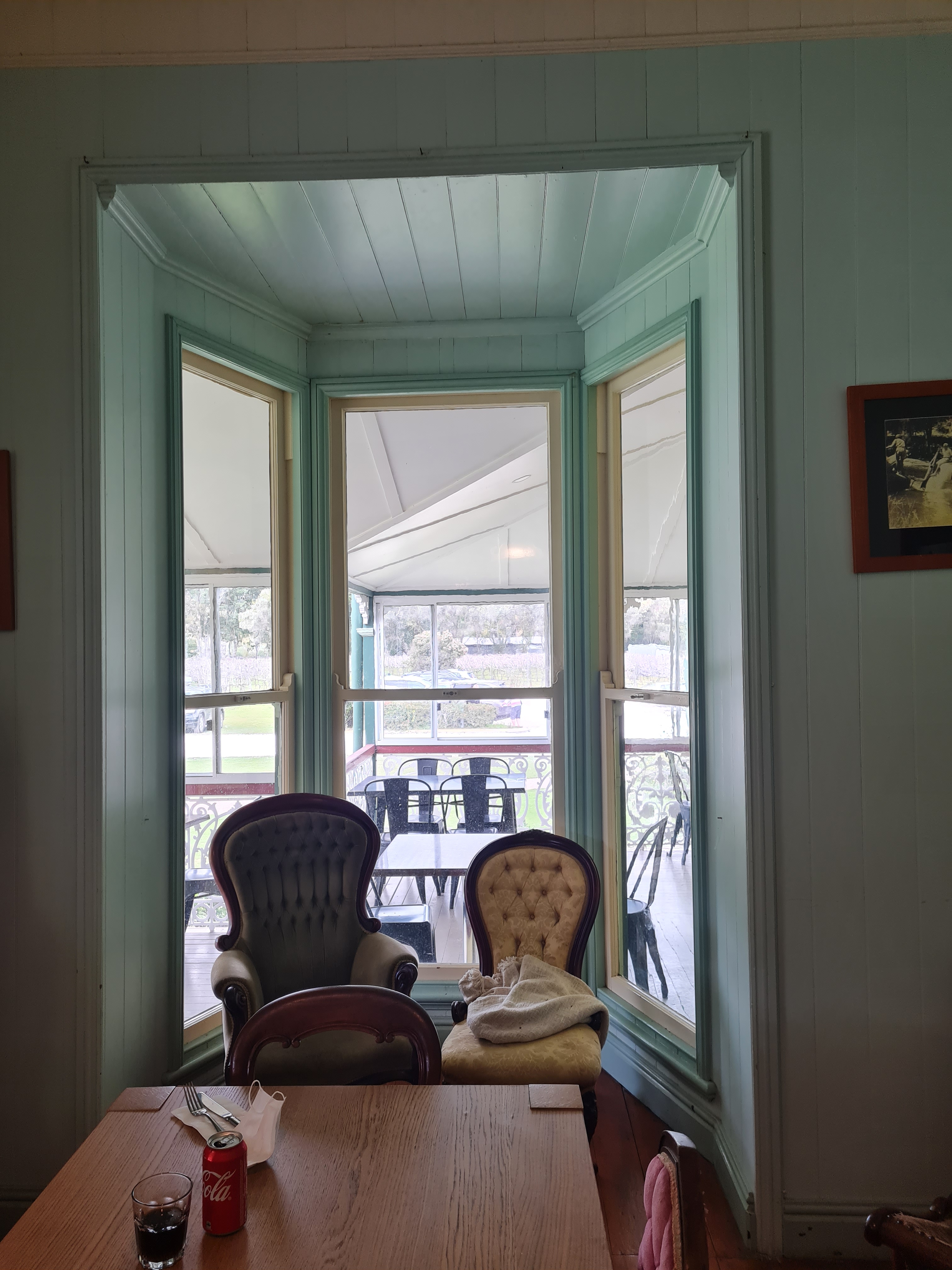
Today we are having lunch in the Platypus room, in the O’Reilly’s vineyard farmhouse, which, if you close your eyes and let your imagination run free, could see it as the master bedroom of a homestead.

Certainly, the building is old, made completely of timber, inside and out, with the traditional high ceilings to keep the heat at bay.

At one end, a large bay window, which would be ideal to sit and view the outside, past the sweeping verandah.  There is a small lawn and a rotunda, but beyond that what might have been extended gardens, is the vineyard.

The homestead is in an ideal position midway between the main road and the river, has the traditional surrounding verandah, and shows signs of being extended on almost all sides.

On the other side of the wide corridor that leads you to the bar, and, coincidentally, down the centre of the house, is a smaller bedroom, also used as a dining room, and ubiquitously named the library.

It may be small but it does have a fireplace, which the assumed master bedroom does not, but now I’m thinking that room might have been the morning room.

Behind the room, we’re in is another bedroom, or perhaps this might be the master because it does have a fireplace and is quite large.  And a name, the Ambassador room.  Now it serves as the pickup place for picnic baskets.

There is another room on the opposite side of the corridor called the Drawing Room but is not open to the public.  But, going into the room with the fireplace adjacent to it, you can sell the aroma of pizzas, so it’s probably an extension of the kitchen, and, walking around the outside that side of the house proves it to be the case.

After all, they do catering for weddings and need a very large food preparation area which I discovered runs down the whole of that side of the house.

At the end of the corridor I’d the bar and spare space, and running off that and behind that is where there is a large dining area, perhaps prior to COVID, the restaurant.

It’s not hard to imagine that area as a very large entertaining area, either for very large dinner parties, or dancing.

As for the food, it’s either a picnic basket or pizzas.  We chose the latter, not realising the bases were not homemade, but bought in.  

The toppings however were both plentiful and tasty.  It could have been hotter, because it was a cold day, and it was cold in the room.

As for something to do other than taste the wine, and buy a few bottles, you can get up close to the vines, which, at this time of the year gave been pruned back and look quite dead, look at or walk an alpaca, even feed it, or all of them, or go down to the river and see if you can spot a Platypus.

Perhaps next time we’ll have a picnic down by the river.