An excerpt from “What Sets Us Apart”, a mystery with a twist

See the excerpt from the story below, just a taste of what’s in store…

http://amzn.to/2Eryfth

whatsetscover

McCallister was old school, a man who would most likely fit in perfectly campaigning on the battlefields of Europe during the Second World War. He’d been like a fish out of water in the army, post-Falklands, and while he retired a hero, he still felt he’d more to give.

He’d applied and was accepted as head of a SWAT team, and, watching him now as he and his men disembarked from the truck in almost military precision, a look passed between Annette, the police liaison officer, and I that said she’d seen it all before. I know I had.

There was a one in four chance his team would be selected for this operation, and she had been hoping it would be one of the other three. While waiting for them to arrive she filled me in on the various teams. His was the least co-operative, and the more likely to make ad-hoc decisions rather than adhere to the plan, or any orders that may come from the officer in charge.

This, she said quite bluntly, was going to end badly.

I still had no idea why Prendergast instructed me to attend the scene of what looked to be a normal domestic operation, but as the nominated expert in the field in these types of situations, it was fairly clear he wasn’t taking any chances. It was always a matter of opinion between us, and generally I lost.

In this case, it was an anonymous report identifying what the authorities believed were explosives in one of the dockside sheds where explosives were not supposed to be.

The only reason why the report was given any credence was the man, while not identifying himself by name, said he’d been an explosive expert once and recognized the boxes. That could mean anything, but the Chief Constable was a cautious man.

With his men settled and preparing their weapons, McCallister came over to the command post, not much more than the SUV my liaison and I arrived in, with weapons, bulletproof vests, and rolls of tape to cordon off the area afterward. We both had coffee, steaming in the cold early morning air. Dawn was slowly approaching and although rain had been forecast it had yet to arrive.

A man by the name of Benson was in charge. He too had groaned when he saw McCallister.

“A fine morning for it.” McCallister was the only enthusiastic one here.

He didn’t say what ‘it’ was, but I thought it might eventually be mayhem.

“Let’s hope the rain stays away. It’s going to be difficult enough without it,” Benson said, rubbing his hands together. We had been waiting for the SWAT team to arrive, and another team to take up their position under the wharf, and who was in the final stages of securing their position.

While we were waiting we drew up the plan. I’d go in first to check on what we were dealing with, and what type of explosives. The SWAT team, in the meantime, were to ensure all the exits to the shed were covered. When I gave the signal, they were to enter and secure the building. We were not expecting anyone inside or out, and no movement had been detected in the last hour since our arrival and deployment.

“What’s the current situation?”

“I’ve got eyes on the building, and a team coming in from the waterside, underneath. Its slow progress, but they’re nearly there. Once they’re in place, we’re sending McKenzie in.”

He looked in my direction.

“With due respect sir, shouldn’t it be one of us?” McCallister glared at me with the contempt that only a decorated military officer could.

“No. I have orders from above, much higher than I care to argue with, so, McCallister, no gung-ho heroics for the moment. Just be ready to move on my command, and make sure you have three teams at the exit points, ready to secure the building.”

McCallister opened his mouth, no doubt to question those orders, but instead closed it again. “Yes sir,” he muttered and turned away heading back to his men.

“You’re not going to have much time before he storms the battlements,” Benson quietly said to me, a hint of exasperation in his tone. “I’m dreading the paperwork.”

It was exactly what my liaison officer said when she saw McCallister arriving.

The water team sent their ‘in position’ signal, and we were ready to go.

In the hour or so we’d been on site nothing had stirred, no arrivals, no departures, and no sign anyone was inside, but that didn’t mean we were alone. Nor did it mean I was going to walk in and see immediately what was going on. If it was a cache of explosives then it was possible the building was booby-trapped in any number of ways, there could be sentries or guards, and they had eyes on us, or it might be a false alarm.

I was hoping for the latter.

I put on the bulletproof vest, thinking it was a poor substitute for full battle armor against an exploding bomb, but we were still treating this as a ‘suspected’ case. I noticed my liaison officer was pulling on her bulletproof vest too.

“You don’t have to go. This is my party, not yours,” I said.

“The Chief Constable told me to stick to you like glue, sir.”

I looked at Benson. “Talk some sense into her please, this is not a kindergarten outing.”

He shrugged. Seeing McCallister had taken all the fight out of him. “Orders are orders. If that’s what the Chief Constable requested …”

Madness. I glared at her, and she gave me a wan smile. “Stay behind me then, and don’t do anything stupid.”

“Believe me, I won’t be.” She pulled out and checked her weapon, chambering the first round. It made a reassuring sound.

Suited up, weapons readied, a last sip of the coffee in a stomach that was already churning from nerves and tension, I looked at the target, one hundred yards distant and thought it was going to be the longest hundred yards I’d ever traversed. At least for this week.

A swirling mist rolled in and caused a slight change in plans.

Because the front of the buildings was constantly illuminated by large overhead arc lamps, my intention had been to approach the building from the rear where there was less light and more cover. Despite the lack of movement, if there were explosives in that building, there’d be ‘enemy’ surveillance somewhere, and, after making that assumption, I believed it was going to be easier and less noticeable to use the darkness as a cover.

It was a result of the consultation, and studying the plans of the warehouse, plans that showed three entrances, the main front hangar type doors, a side entrance for truck entry and exit and a small door in the rear, at the end of an internal passage leading to several offices. I also assumed it was the exit used when smokers needed a break. Our entry would be by the rear door or failing that, the side entrance where a door was built into the larger sliding doors. In both cases, the locks would not present a problem.

The change in the weather made the approach shorter, and given the density of the mist now turning into a fog, we were able to approach by the front, hugging the walls, and moving quickly while there was cover. I could feel the dampness of the mist and shivered more than once.

It was nerves more than the cold.

I could also feel rather than see the presence of Annette behind me, and once felt her breath on my neck when we stopped for a quick reconnaissance.

It was the same for McCallister’s men. I could feel them following us, quickly and quietly, and expected, if I turned around, to see him breathing down my neck too.

It added to the tension.

My plan was still to enter by the back door.

We slipped up the alley between the two sheds to the rear corner and stopped. I heard a noise coming from the rear of the building, and the light tap on the shoulder told me Annette had heard it too. I put my hand up to signal her to wait, and as a swirl of mist rolled in, I slipped around the corner heading towards where I’d last seen the glow of a cigarette.

The mist cleared, and we saw each other at the same time. He was a bearded man in battle fatigues, not the average dockside security guard.

He was quick, but my slight element of surprise was his undoing, and he was down and unconscious in less than a few seconds with barely a sound beyond the body hitting the ground. Zip ties secured his hands and legs, and tape his mouth. Annette joined me a minute after securing him.

A glance at the body then me, “I can see why they, whoever they are, sent you.”

She’d asked who I worked for, and I didn’t answer. It was best she didn’t know.

“Stay behind me,” I said, more urgency in my tone. If there was one, there’d be another.

Luck was with us so far. A man outside smoking meant no booby traps on the back door, and quite possibly there’d be none inside. But it indicated there were more men inside, and if so, it appeared they were very well trained. If that were the case, they would be formidable opponents.

The fear factor increased exponentially.

I slowly opened the door and looked in. A pale light shone from within the warehouse itself, one that was not bright enough to be detected from outside. None of the offices had lights on, so it was possible they were vacant. I realized then they had blacked out the windows. Why hadn’t someone checked this?

Once inside, the door closed behind us, progress was slow and careful. She remained directly behind me, gun ready to shoot anything that moved. I had a momentary thought for McCallister and his men, securing the perimeter.

At the end of the corridor, the extent of the warehouse stretched before us. The pale lighting made it seem like a vast empty cavern, except for a long trestle table along one side, and, behind it, stacks of wooden crates, some opened. It looked like a production line.

To get to the table from where we were was a ten-yard walk in the open. There was no cover. If we stuck to the walls, there was equally no cover and a longer walk.

We needed a distraction.

As if on cue, the two main entrances disintegrated into flying shrapnel accompanied by a deafening explosion that momentarily disoriented both Annette and I. Through the smoke and dust kicked up I saw three men appear from behind the wooden crates, each with what looked like machine guns, spraying bullets in the direction of the incoming SWAT members.

They never had a chance, cut down before they made ten steps into the building.

By the time I’d recovered, my head heavy, eyes watering and ears still ringing, I took several steps towards them, managing to take down two of the gunmen but not the third.

I heard a voice, Annette’s I think, yell out, “Oh, God, he’s got a trigger,” just before another explosion, though all I remember in that split second was a bright flash, the intense heat, something very heavy smashing into my chest knocking the wind out of me, and then the sensation of flying, just before I hit the wall.

I spent four weeks in an induced coma, three months being stitched back together and another six learning to do all those basic actions everyone took for granted. It was twelve months almost to the day when I was released from the hospital, physically, except for a few alterations required after being hit by shrapnel, looking the same as I always had.

But mentally? The document I’d signed on release said it all, ‘not fit for active duty; discharged’.

It was in the name of David Cheney. For all intents and purposes, Alistair McKenzie was killed in that warehouse, and for the first time ever, an agent left the Department, the first to retire alive.

I was not sure I liked the idea of making history.

© Charles Heath 2016-2020

Jump Now – A short story

It was 2 am, the ideal time to assemble a team that would be clandestinely boarding a vessel.

Dark and moonless, it was fortuitous rather than planned, and, dressed in black from head to toe, it was hard to see the others in the inky darkness.  At least something was on our side.

Up until this point, we’d had nothing but bad luck, though I was more of the opinion we had a traitor in our midst because some of the events could not have any other explanation.

It had caused me to be far more selective in who I gave details of the mission to.

Each of the four team members had arrived and let themselves into the shed.  It was not far from the ocean, and a small pier where there was a landing craft waiting.  From there, it would be a half-hour trip out to the ship in question, where, if we got close enough, we would either have to go over the side and swim, or pull alongside, but either way we’d have to go up a rope.

A lot depended on the crew member we had recruited getting a rope overboard, and given the luck we had so far, if there was a flaw in the plan, that was it.

Aside from the four people sitting in front of me, there were only three others privy to what was about to happen.  Now, with recent events, it was hard to imagine that one of them could betray us. That’s why I hadn’t completely told them what they were about to do, just that they needed to be prepared to get wet.

“I’m sure, now we’re here, you can tell us what’s going on.”  Robert was the most trusted of my team and my best friend.

“And why all the hush-hush,”  Linda added.  She had been amused at the secrecy and my explanation.

I was never very good at spinning a story.  She knew that but had not questioned why.

“It’s been touch and go for the last week.  It’s why we’ve all been on standby, with this last-minute call out.  We’ve been waiting for a particular ship to leave port, and now it has.  So, without further ado, let’s get to it.  A boat ride, just enough time to gather the courage to the sticking point, and then with any luck we won’t have to go into the water and swim, but a short shimmy up a rope.  I hope you’ve all been working out.”

The boat ride was in silence.  I’d worked with this group before and they were not big on talking.  Aside from the fact that noise traveled over water, and since we had a specially silenced motor on the boat, there was not going to be any unnecessary conversation.

We could see the ship once we reached the headland, and aside from it’s running lights, there were lights where I presumed the bridge was, and several in the crew quarters.  Closer again, I got the impression it was not moving, or if it was, it was very slow.  It was hard to tell in the darkness.  That same darkness aided our approach.

When we were within several hundred yards I could see that the ship was not moving, and, in fact, had the anchor out.

That was not expected.  Were they waiting for us?  Had they discovered the cream member who was working with us?  We’d know soon enough if there was no rope in the designated point, not far forward of the stern, a spot where we could maneuver the boat under the hull curvature.

The driver piloted the boat slowly to the designated point and the rope was there.  He would stay with the boat and wait.  The four of us would go up and collect what we came for.

I watched the three go up the rope before me, waiting for the last to stop at the top and then go over the side onto the deck.  It took nearly a minute before I got the signal it was clear to follow.

It had been too easy.

I went up the rope slowly, slower than the others, something else other than the object of the exercise on my mind.  Not three days before I had a conversation with my boss, telling him that I’d been doing the job too long and that it was time to retire.  Approaching forty wasn’t exactly retirement age, but in this job, lasting that long was almost a miracle.  The places I’d been, the sights I’d seen, and the people I’d met.  And how many lives I’d used up.

It was a dangerous thing, thinking about anything other than the job when you’re on the job.

I reached the top and pulled myself over the railing and onto the deck.  A little off balance it took a moment to stand.  By then it was too late.

Two of the three other members of the team were sitting by the superstructure, heads on their heads, two members of the crew were watching them, guns at the ready, and Linda had one pointing at me.

“I can’t imagine how MacIntyre thought he was going to convince Petra to defect.  Or how this charade of a rescue attempt was ever going to work.”

I put my hands up.  Not entirely unexpected.  “It was not the mission objective.”

“What…”

I was surprised that she had made her move so early.  If it was my operation, I would wait until we were well into the superstructure, heading to the cabin where Petra would be waiting, and then make the move.

Three seconds, three shots, two guards taken out, and Linda incapacitated.  She would not be moving or fighting back any time soon.  The Petra came out of the shadows, and I collected Linda’s gun and stood near her, just in case Petra missed the target.

Petra cut the two other’s bindings, and said, “get to the side and jump now.”

Linda looked up at me.  “What now?”

I shrugged.  “Time for us to leave.”  I gave Petra a nod, and she went over to the side, took one look back at Linda, shook her head, then jumped.

“You’re just going to leave me here?”

“If it were up to me, I’d shoot you, but MacIntire is getting a little soft in his old age.  But yes, I’m leaving you here.  Now, I really must go.”

I took a last look at Linda, who realized that if she moved it would only worsen her injury, and jumped, not exactly my preferred way of leaving the ship.

The boat came up alongside me and two hands dragged me on board, at the same time we could hear the sound of the anchor chain being pulled up, and the propellers creating a wash as the ship started moving.

Job done, and not one that pleased me.  “Let’s go home,” I told the driver, “it’s past my bedtime.”

—-

© Charles Heath 2020-2021

“Trouble in Store” – Short Stories My Way:  The re-write – Part 12

Now that I’ve gone through the story and made quite a few changes, it’s time to look at the story

…

It took fifteen seconds to disentangle herself from the customer, push him away, get to her feet, and get out into the street, weapon aimed.

At nothing but air.

The girl had gone, and then she had the vague recollection of a shadow passing her as she was facing the other way getting to her feet.

And that same shadow running through the door.

Five more valuable seconds as her brain processed this piece of information before it issued the command to go out the door and see which way she went.

Another few seconds to get out the door and see the police car coming from the same direction she had earlier, screeching to a halt outside the shop, a door opening, and an officer getting out.

Margaret was gesturing for the driver to go further down the road where she assumed the girl had run, managing to yell breathlessly at the office getting out, “She’s gone that way,” and pointing.

The officer relayed the message and closed the door as the car sped off.

“What happened?”

“Shots fired by a woman, more a girl, in the process of a robbery.”

She ran back inside the officer following.

The customer had moved away from the doorway having got to his feet and was checking the damage to his coat where the bullet held felt earlier had passed through the fabric and missed everything else.

“Over behind the counter.”  She pointed at the wall where he had been standing.  There was a shopkeeper.  He was standing there.”

The policeman rounded the end of the counter and looked down.  “He’s here.  It’s not looking good.”

Margaret didn’t hear him.  She was calling an ambulance.

…

© Charles Heath 2016-2024

The cinema of my dreams – I always wanted to see the planets – Episode 9

What’s the worst that could happen?

…

Captains invariably hated the word ‘problem’. I did too, because it conjured up so many different scenarios, each more scarier than the last, and maginified exponentially because we were in space.

We took a closer look, and it was the sort of damage if it was back on Earth, one would associate with weapons fire, lasers to be exact.

Yes, in the 24th century we had ray guns, handheld, and ship bound.

The only problem was, only the cruise class vessels, like the one I was now on, were allowed to have them, and using them, well, the paperwork alone could keep a complement of 20 working day and night for a month.

Test them, yes, less paperwork, use them, no. There had never been a reason to.

But someone had, and on a freighter, which only meant one possibility, that whatever the freighter had been carrying, had been worth violating a thousand regulations and rules.

And bring their ship and selves out into the light.

It was, of course, Space Command’s worst nightmare realised, that the ideal of space exploration as a united effort by everyone, had a member who had decided against unity.

Unless, of course, the improbably had happened, there was life outside our solar system, and we were dealing with a new planet, or people.

Except I would not expect them to use something as conventional as a laser.

Myrtle had put us very close to the damaged area and taken a number of photographs, and the engineer had analysed the damaged area.

Then, cleared to enter the freighter, she took us up to the cargo doors and waited as we watched them open.

It was the same time the engineer’s hand held computer started beeping.

And a warning light on the console in front of Myrtle started flashing, accompanied by a warning klaxon.

Another vessel had just entered our proximity zone.

…

© Charles Heath 2021

A score to settle – The Second Editor’s draft – Day 11

The time has come to work on the second draft for the editor, taking into account all of the suggested changes, and there are quite a few. So much for thinking I could put in an almost flawless manuscript.

…

Lying awake in bed at 3am is bad enough, you get to hear all those strange noises that happen while you’re asleep, and, if you have an active imagination, it doesn’t take long before you start associating those noises with bad things.

That’s only part of it.

I think the main reason I’m still awake is my subconscious telling me that it doesn’t like the title.

Here’s the thing…

It was appropriate when the story was going to shift to finding out who it was that set our main character up for assassination. Yes, I’m writing the parts where those who were complicit are having their backstory relayed where it involves them in the events leading up to it, but I’m beginning to think that’s a story in itself.

I was reviewing the plan, and the chapter list as it stands, and that part of the story will add about 12 to 15 chapters at an average of 2,500 words each.

Added to the 75 others. That’s a lot of words, and work, to fit into the 30 days. So far the word count is around 20,000 for 10 days, so an end is not looking likely by the end of the month.

Not unless I give up the notion of sleep.

So, perhaps it’s not just the title that’s keeping me up.

OK, that was a loud bang and definitely not a cat or possum landing on the roof. I’m going to check, and if I don’t come back…

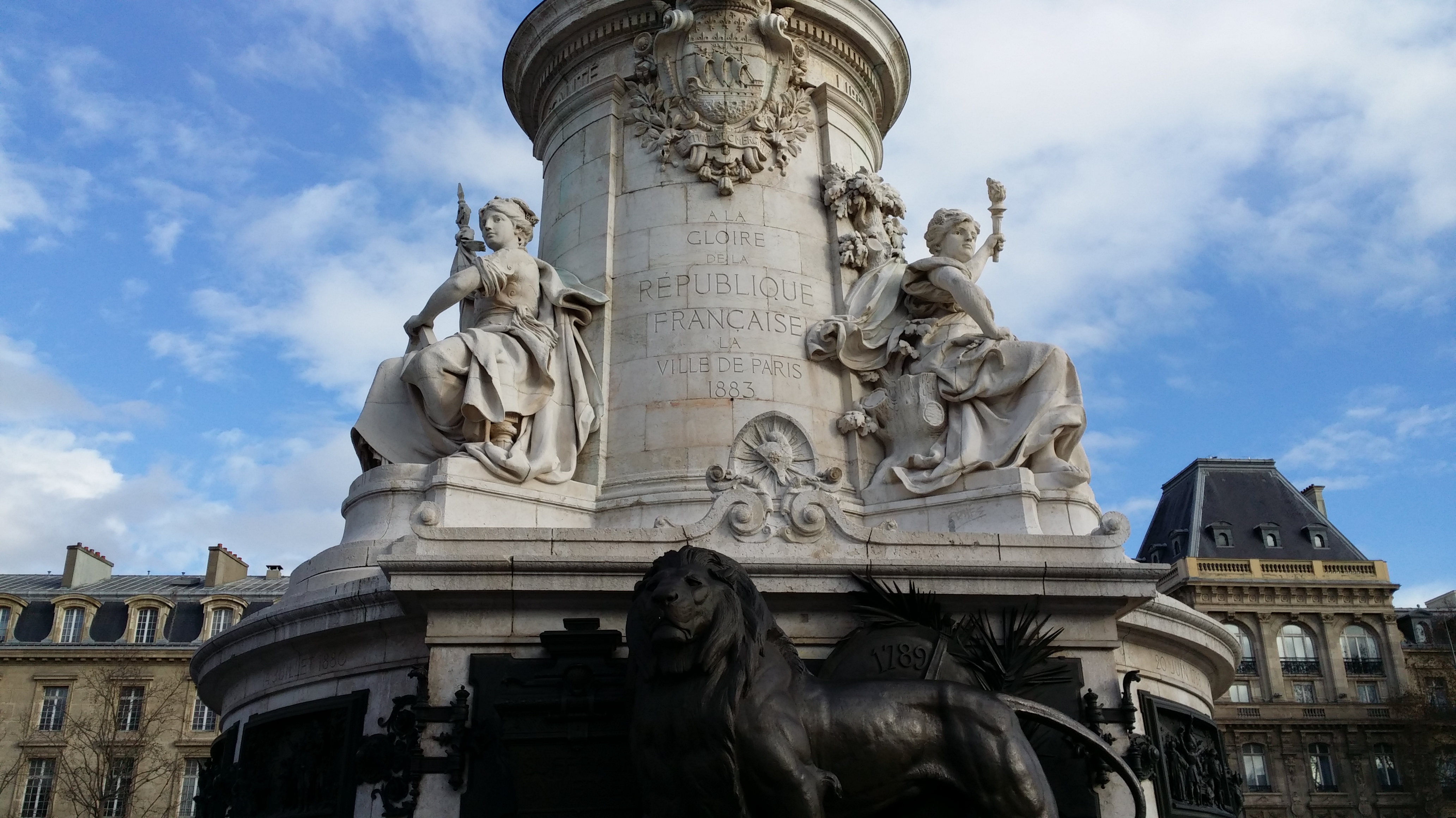
Searching for locations: Paris, France: Place de la Republique

Whilst a rather important place for the French, for us visitors, it has a convenient hotel located just behind the square, and an underground, or Metro station, underneath.

2014-01-07 11.43.05

Added to that was equally convenient cafes, one of which, The Cafe Republique, we had dinner every night.  The service and food were excellent, and we had no problems with the language barriers.

At the top of the monument is a bronze statue of Marianne, said to be the personification of France.

2014-01-07 11.43.41

Surrounding Marianne is three more statues, representing liberty, equality, and fraternity.

2014-01-07 11.43.32

At the base is a lion guarding what is said to be a ballot box.

My 800 words on writing

Writing is one of those occupations that requires a lot of hard work for, sometimes, very little output.  We, as writers, strive to produce a certain number of words per day, or, sometimes, just a few words just to keep oiling the machine and keeping it in working order.

When this creative process stops we tend to call it writer’s block, or something else entirely.  For me it is a point where I have lost the way, and the next chapter, scene, or plot development is not clear.  Time for a shower, sleep, or a walk in the park.

Other times, the creative processes are firing on all 12 cylinders and ideas, thoughts, plot lines, and words are pouring out of you like water over a waterfall at thaw time, or in a flood.

Sorry, shouldn’t be using metaphors, bad writing.

At the moment I have finished my next novel, yes, it sounds really good, and in itself, it gives me a sense of achievement.  In another sense it fills me with dread because I have to start editing, and, more importantly, make sure the first part of the book blends with the new developments that only occurred to me later.

Sometimes I go back and add notes at the appropriate place where the story needs to be corrected, or I just sit there and fix it on the spot.

But, editing is a horrible job.  Making sure of continuity, making sure the characters names didn’t change, or they suddenly go from being short, overweight and red hair to thin, tall and blonde hair.  Making sure the English is correct, grammar correct, spelling correct, and fore’s not confused with four’s.

And not start my sentences with and or but.  Sorry, again, bad habits die hard.

I have read that it’s a good idea to let that first draft sit on the shelf for a few weeks and let the dust settle around it, ruminating on it sub-consciously.  Good idea.  It’s another excuse to put off the inevitable.

So, is it time to have a holiday, take time out from the business of writing, or catch up with all that social media stuff, tweeting, facebooking, tumblring, instagramming, or whatever it is.  Oh yes, that’s right, as an indie author I have to do my own ‘pitching’ to the reading public.

Time to plan a campaign to get my title out there, and generate some interest.

Time in fact to hit the internet and see how others have done it.

42,647,345 hits on Google.  Damn, I didn’t think there were that many writers.  I’m starting to feel very, very insignificant in the greater scheme of things.

OK, that goes in the too hard basket for the moment.  Moving on.

On those days when the creative juices were on overdrive, I fill notebooks with the ideas for stories, short and long.  When out, waiting around for doctors, and others, I have my mobile phone which has a notebook type app called SomNote which I write.  I find it is very easy to lose oneself in a story when there is so much inspiration around.

These notes are then sent via email to my computer and stored in an email directory, ready for me to look at, at a later date.

That later date has arrived.

I start looking through the ‘ideas’ list, a cavalcade of story titles,

Amnesia- the story of a man who wakes up in hospital with amnesia, and then is led to believe he is someone other than who he is.  The plot needs some work, well, a lot of work.

The Will – the story of a grandson trying to stop the greedy and selfish siblings from selling out the family heritage, I’m sure I saw a British movie about this not so long ago

Mistaken Identity – The story of a man who is an illegitimate son, and has a brother who is both an evil man and his exact doppelganger.  He was never told about it, and comes face to face with his doppelganger in extraordinary circumstances.

Strangers in the night – no not the song, but a story about two disparate people who have no time for anything but work and career, who have a chance encounter.

Breaking the rules – a story about a pair of cat burglars who run into each other, on separate heists in the same building.  This has potential.

More than three hours have passed, I’ve been reading the stories, notes, plotlines, and staring at the ceiling looking for inspiration.

Chester, our cat, my friend and confidant, always likes the last word.  He wanders into the office, climbs up on the chair and sits, selecting the pile of papers for The Will.

It will be the title of my next book

‘Sunday in New York’ – A beta reader’s view

I’m not a fan of romance novels but …

There was something about this one that resonated with me.

This is a novel about a world generally ruled by perception, and how people perceive what they see, what they are told, and what they want to believe.

I’ve been guilty of it myself as I’m sure we all have at one time or another.

For the main characters Harry and Alison there are other issues driving their relationship.

For Alison, it is a loss of self-worth through losing her job and from losing her mother and, in a sense, her sister.

For Harry, it is the fact he has a beautiful and desirable wife, and his belief she is the object of other men’s desires, and one in particular, his immediate superior.

Between observation, the less than honest motives of his friends, a lot of jumping to conclusions based on very little fact, and you have the basis of one very interesting story.

When it all comes to a head, Alison finds herself in a desperate situation, she realises only the truth will save their marriage.

But is it all the truth?

What would we do in similar circumstances?

Rarely does a book have me so enthralled that I could not put it down until I knew the result. They might be considered two people who should have known better, but as is often the case, they had to get past what they both thought was the truth.

And the moral of this story, if it could be said there is one, nothing is ever what it seems.

…

Available on Amazon here: amzn.to/2H7ALs8

…

Searching for locations: At large in Paris, France

We have been to Paris a number of times over the years.

The last time we visited Paris we brought the two eldest grandchildren.   We took the Eurostar train from St Pancras station direct to Disneyland, then took the free bus from the station to the hotel.  The train station was directly outside Disneyland.

We stayed at the Dream Castle Hotel, rather than Disneyland itself as it was a cheaper option and we had a family room that was quite large and breakfast was included every morning.  Then it was a matter of getting the free bus to Disneyland.

We spent three days, time which seem to pass far too quickly, and we didn’t get to see everything.  They did, however, find the time to buy two princess dresses, and then spent the rest of the time playing dress-ups whenever they could.

In Paris, we stayed at the Crown Plaza at Republique Square.

We took the children to the Eiffel Tower where the fries, and the carousel at the bottom of the tower, seemed to be more memorable than the tower itself.  The day we visited, the third level was closed.  The day was cold and windy so that probably accounted for the less than memorable visit.  To give you some idea of conditions, it was the shortest queue to get in I’ve ever seen.

We traveled on the Metro where it was pointed out to me that the trains actually ran on rubber tires, something I had not noticed before.  It was a first for both children to travel on a double-decker train.

The same day, we went to the Louvre.

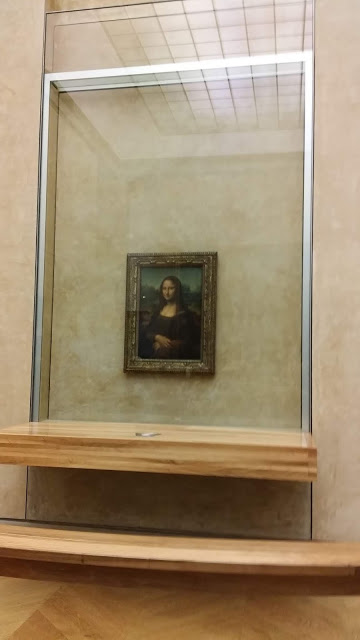
Here, it was cold, wet and windy while we waited,  Once inside we took the girls to the Mona Lisa, and after a walk up and down a considerable numkber of stairs, one said, “and we walked all this way to see this small painting”.

It quickly became obvious their idea of paintings were the much larger ones hanging in other galleries.

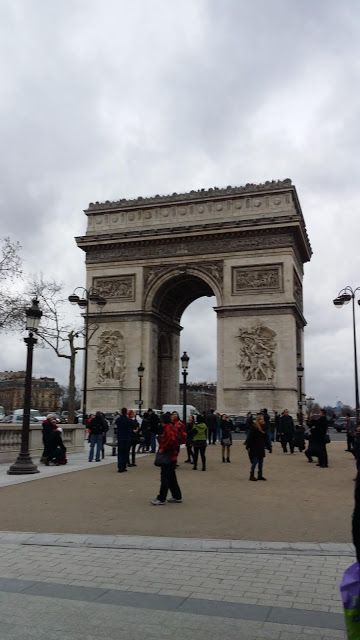
We also took them to the Arc de Triomphe.

We passed, and for some reason had to go into, the Disney shop, which I’m still wondering why after spending a small fortune at Disneyland itself.

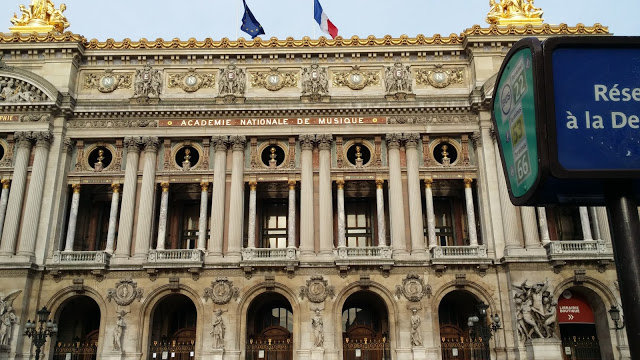
Next on the tour list was the Opera House.

 where one of the children thought she saw the ghost and refused to travel in one of the elevators.  At least it was quite amazing inside with the marble, staircases, and paintings on the roof.

Sadly, I don’t think they were all that interested in architecture, but at the Opera House, they did actually get to see some ballet stars from the Russian Bolshoi ballet company practicing.  As we were leaving the next day we could not go and see a performance.

Last but not least was Notre Dame with its gargoyles and imp[osing architecture.

All in all, traveling with children and experiencing Paris through their eyes made it a more memorable experience.

The first we visited Paris was at the end of a whirlwind bus tour, seven countries in seven days or something like that.  It was a relief to get to Paris and stay two nights if only to catch our breath.

I remember three events from that tour, the visit to the Eiffel Tower, the tour of the night lights, not that we were able to take much in from the inside of the bus, and the farewell dinner in one of the tour guides specially selected restaurants.  The food and atmosphere were incredible.  It was also notable for introducing us to a crepe restaurant in Montmartre, another of the tour guide’s favorite places.

On that trip to Paris, we also spent an afternoon exploring the Palace of Versailles.

The next time we visited Paris we flew in from London.  OK, it was a short flight, but it took all day.  From the hotel to the airport, the wait at the airport, departure, flying through time zones, arrival at Charles De Gaulle airport, now there’s an experience, and waiting for a transfer that never arrived, but that’s another story.

I can’t remember where we stayed the first time, it was somewhere out in the suburbs, but the second time we stayed at the Hilton near both the Eiffel Tower and the Australian Embassy, notable only because the concierge was dating an Australian girl working in the Embassy.  That was our ticket for special treatment, which at times you need to get around in Paris.

It was the year before 2000 and the Eiffel Tower was covered in lights, and every hour or so it looked like a bubbling bottle of champagne.  It was the first time we went to Level 3 of the Tower, and it was well worth it.  The previous tour only included Level 2.  This time we were acquainted with the fries available on the second level, and down below under the tower.

This time we acquainted ourselves with the Metro, the underground railway system, to navigate our way around to the various tourist spots, such as Notre Dame de Paris, The Louvre, Sacre-Coeur Basilica, and Les Invalides, and, of course, the trip to the crepe restaurant.

We also went to the Louvre for the express purpose of seeing the Mona Lisa, and I came away slightly disappointed.  I had thought it to be a much larger painting.  We then went to see the statue of Venus de Milo and spent some time trying to get a photo of it without stray visitors walking in front of us.  Aside from that, we spent the rest of the day looking at the vast number of paintings, and Egyptian artifacts in the Museum.

We also visited the Opera House which was architecturally magnificent.

The third time we visited Paris we took our daughter, who was on her first international holiday.  This time we stayed in a quaint Parisian hotel called Hotel Claude Bernard Saint Germain, (43 Rue Des Ecoles, Paris, 75005, France),  recommended to us by a relation who’d stayed there the year before.  It was small, and the elevator could only fit two people or one person and a suitcase.  Our rooms were on the 4th floor, so climbing the stairs with luggage was out of the question.

It included breakfast and wifi, and it was quite reasonable for the four days we stayed there.

It was close to everything you could want, down the hill to the railway station, and a square where on some days there was a market, and for those days when we were hungry after a day’s exploring, a baguette shop where rolls and salad were very inexpensive and very delicious.

To our daughter we appeared to be experienced travelers, going on the Metro, visiting the Louvre, going, yes once again, to the crepe restaurant and the Basilica at Montmartre, Notre Dame, and this time by boat to the Eiffel Tower.  We were going to do a boat rode on the Seine the last time but ran out of time.

We have some magnificent photos of the Tower from the boat.

Lunch on one of the days was at a restaurant not far from the Arc de Triomphe, where our daughter had a bucket of mussels.  I was not as daring and had a hamburger and fries.  Then we went to the center of the Arch and watched the traffic.

Our first time in Paris the bus driver got into the roundabout just to show us the dangers of driving in an unpredictable situation where drivers seem to take huge risks to get out at their exit.  Needless to say, we survived that experience, though we did make a number of circuits.

An excerpt from “Echoes from the Past”

Available on Amazon Kindle here:  https://amzn.to/2CYKxu4

…

With my attention elsewhere, I walked into a man who was hurrying in the opposite direction.  He was a big man with a scar running down the left side of his face from eye socket to mouth, and who was also wearing a black shirt with a red tie.

That was all I remembered as my heart almost stopped.

He apologized as he stepped to one side, the same way I stepped, as I also muttered an apology.

I kept my eyes down.  He was not the sort of man I wanted to recognize later in a lineup.  I stepped to the other side and so did he.  It was one of those situations.  Finally getting out of sync, he kept going in his direction, and I towards the bus, which was now pulling away from the curb.

Getting my breath back, I just stood riveted to the spot watching it join the traffic.  I looked back over my shoulder, but the man I’d run into had gone.  I shrugged and looked at my watch.  It would be a few minutes before the next bus arrived.

Wait, or walk?  I could also go by subway, but it was a long walk to the station.  What the hell, I needed the exercise.

At the first intersection, the ‘Walk’ sign had just flashed to ‘Don’t Walk’.  I thought I’d save a few minutes by not waiting for the next green light.  As I stepped onto the road, I heard the screeching of tires.

A yellow car stopped inches from me.

It was a high powered sports car, perhaps a Lamborghini.  I knew what they looked like because Marcus Bartleby owned one, as did every other junior executive in the city with a rich father.

Everyone stopped to look at me, then the car.  It was that sort of car.  I could see the driver through the windscreen shaking his fist, and I could see he was yelling too, but I couldn’t hear him.  I stepped back onto the sidewalk, and he drove on.  The moment had passed and everyone went back to their business.

My heart rate hadn’t come down from the last encounter.   Now it was approaching cardiac arrest, so I took a few minutes and several sets of lights to regain composure.

At the next intersection, I waited for the green light, and then a few seconds more, just to be sure.  I was no longer in a hurry.

At the next, I heard what sounded like a gunshot.  A few people looked around, worried expressions on their faces, but when it happened again, I saw it was an old car backfiring.  I also saw another yellow car, much the same as the one before, stopped on the side of the road.  I thought nothing of it, other than it was the second yellow car I’d seen.

At the next intersection, I realized I was subconsciously heading towards Harry’s new bar.   It was somewhere on 6th Avenue, so I continued walking in what I thought was the right direction.

I don’t know why I looked behind me at the next intersection, but I did.  There was another yellow car on the side of the road, not far from me.  It, too, looked the same as the original Lamborghini, and I was starting to think it was not a coincidence.

Moments after crossing the road, I heard the roar of a sports car engine and saw the yellow car accelerate past me.  As it passed by, I saw there were two people in it, and the blurry image of the passenger; a large man with a red tie.

Now my imagination was playing tricks.

It could not be the same man.  He was going in a different direction.

In the few minutes I’d been standing on the pavement, it had started to snow; early for this time of year, and marking the start of what could be a long cold winter.  I shuddered, and it was not necessarily because of the temperature.

I looked up and saw a neon light advertising a bar, coincidentally the one Harry had ‘found’ and, looking once in the direction of the departing yellow car, I decided to go in.  I would have a few drinks and then leave by the back door if it had one.

Just in case.

© Charles Heath 2015-2020

newechocover5rs