The cinema of my dreams – It continued in London – Episode 28

A new mission

…

When we reached the hotel, the countess was met by a man whom I deduced was her brother-in-law.  I stood back because I got the feeling that the meeting was not expected and that his arrival was a shock, rather than a surprise, and not a good one.

I didn’t see her again that night, her personal assistant coming over to advise an urgent matter had come up and the countess was needed elsewhere. 

Nor did I see the Rodby’s who it seemed were diverted from coming to the hotel.  Rodby called and apologised on the countess’s behalf and left it at that.  I went home in the chauffeur-driven car; a small consolation afforded for my participation.

I also got the impression that a certain wife got a bollocking for interfering in matters that were not her concern.  She may have thought so, given their close relationship, she could ‘help’, but European families preferred to sort their own problems out in very definitive styles, something we did quite understand.

I doubted I would have been able to help.  That phrase, ‘lifelong enemy’ told me that another woman had eyes for the count, and her snafu was unexpected and unwanted.  The question was, did it have anything to do with the count’s death.  It was a stretch, but Rodby would not have made that small concession if she did not think either of us could be any assistance.

When I got home, I had a few drinks and put it all out of my mind.

…

Three days later I was sitting in the basement briefing room, after being taken down by Rodby and introduced to what he described as the two best researchers in the organisation.

Anthony Bird, and Alessia Lombardi.

And as a complete, but pleasant surprise, sitting at the other end of the table, looking as her cell phone, Cecilia.  Was her starring role over? Or was working for Rodby her day job?

She heard me come in, looked up, nodded, and then went back to her phone.  Rodby didn’t stay.  Nor had he mentioned at any time, from the moment I arrived outside his office, what this was about.

I sat next to her at the end of the table.

When Rodby left, she said, “We meet again.”

“For a retiree, it seems odd, unless you’ve also retired.”

“I tried.  A starring role wasn’t a good enough excuse.  Good thing they finished filming my scenes.”

“Can I expect to see it soon?”

“It was a pilot.  It’ll probably finish up on the cutting room floor.”

We looked at the two standing up at the front of the room, glaring at us.

Anothony said, “If you are finished?”

She threw her phone on the table and looked at him.  I shrugged.

“I suppose it’s too much to want this to be a guide to setting up a retirement plan.”

I guess not.

A photograph of the countess suddenly came up on the screen on the wall.  Anthony was starting the show, “You will know this woman as Countess Heidi von Burkhardt.  She is nominally the head of the international Burkehardt bank, with headquarters in Geneva, and principal branches in Berlin, Rome, Paris, Vienna, and a few other places.”

“A banker.  I must have missed that.  She doesn’t look like a banker.”

“She isn’t, she inherited the bank from her husband.”

Another photo appeared on the screen; a man I thought looked like a terrorist in an expensive suit.  He continued, “Alessandro Burkehardt, her late husband’s brother.  Claims he should own and run the bank, that it’s a family company that’s the purview of the male line of the Burkehardt family.  Actually, he wants everything she has, and then kick to the kerb for want of a better expression.”

Nice man.  He must be the lifelong enemy she had referred to.  Looking at him, he was not a man I would willingly challenge to a duel.

“I don’t think we’re here to discuss family squabbles.  Money will do that, but it’s not in our purview to settle those scores, is it?”

No answer.  Perhaps Rodby didn’t have anything else going on like a megalomanic trying to take over the world this week.

“Bear with us, it gets better.”

Another photo flashed up on the screen, that of a woman about the same age as the countess.

“Vittoria Romano.  Alessandro Burkehardt’s current squeeze and a very nasty piece of work.  She had already tried to kill the countess twice in twenty years.”

Beautiful but very deadly. 

Another photograph came up on the screen, the same woman, but in a photo with three others, two women, the countess, and Mrs Rodby.  And a teenager.  A girl that looked very much like…”

“Wasn’t that your ex back in Venice, what’s her name yes, Juliet Ambrose?”

Long before she became the disgraced doctor.  Long before any of them had become the old ladies there were now.

“This photograph was taken the week before the countess’s wedding.  The girl, as you say, has the name Juliet, but she, we now believe, was the illegitimate daughter of Vittoria Romano, and the Count.  It’s a very tangled web.

The words ‘lifelong enemy’ came back to me again.

Vittoria.  She had his baby, expected him to marry her, didn’t and like any other normal jilted lover, tried to kill the replacement.

“So just the normal complicated Italian aristocratic family secrets fuelling an equally normal feud.”

“Which you two are going to uncomplicate.  But first, you must find the countess.  She has, as far as we’re aware, not left the country, and hasn’t been seen since she left the hotel shortly after coming home from the Opera.  You were there, I believe.”

“I escorted her to the hotel, and when we arrived, she was intercepted by someone who looked a lot like Alessandro Burkhardt.”

“Most likely Fabio Burkehardt.  He had an altercation with the check-in staff over a lost booking, and shortly after that, she checked out.  A half hour later the surveillance team lost her.  We have her last known location and direction she was heading.”

Alessia came down with two folders and gave one to me and one to Cecilia.

“Everything we have on the relatives, those in the country at the moment, possible locations she could be staying, or being held, and background on the family’s issues.  There’s a list of properties overseas where she may have gone, but we have no active record of her leaving.”

“Planes or ferries are not the only means,” I said.  “Does she or any one of the family own a yacht?”

“She does, but it’s moored at Antibes.  It hasn’t moved for over a month.

“I’m assuming Alfie is out there and will be the go-between?”

“Yes.  Oh, and one more thing.  There’s a bit of an urgency to this because if the countess is not in Geneva in five days’ time to sign the transfer documents, passing complete ownership of everything the Count possessed, she forfeits it to the eldest brother.”

“Doesn’t point a finger at him at all does it,” Cecilia muttered.

Anthony switched off the projector and put all the papers into a folder.  “The clock’s ticking.  Daily reports to the Chief are mandatory.”

© Charles Heath 2023

Motive, means, and opportunity – Opportunity

I’m working on a novella which may boringly be called “Motive, Means and Opportunity” where I will present a chunk of information from which you if you want to, can become the armchair detective.

Here’s the third part, the Opportunity

Where was I last night between 9pm and 3am?

Not with my wife, Wendy. She had gone out before 6 pm, about the time I got home from work. No, she didn’t really say where she was going, or if she did, given the list of the past, I didn’t believe her.

Where was I?

Home, alone.

Could anyone corroborate that?

Sadly no.  Isn’t that always the way, though?

But, the car I was driving was a company car. It had a GPS and tracking system, part of so-called security measures put in by the company I worked for, but in reality there to check after-hours use.

The GPS would show I never left home.  Using the car, that is.

The only other car had been taken by Wendy so the reality was, I hadn’t left home. The other car, the off-road vehicle was in the workshop, still waiting to be repaired. It was the car our son had been killed in, and neither of us had the heart to do anything with it.

But…

Apparently, I had a visitor.

James Burgman had been seen outside my house at 10:30 pm, his car had been found two blocks away in the car park, away from the street, and he was found dead, shot by a gun that used 9mm bullets, at 4:45 am the next morning.

No. I had not been seen leaving the house, but it had been ascertained that it was possible to leave and not be seen, if I tried hard enough.

I hadn’t and had no reason to, but that didn’t seem to matter.

Sitting in the interview room, purportedly to help the police in their enquiries, Detective John Sanderson had detailed quite succinctly how I had a motive, the means, and the opportunity.

Little else mattered, particularly the fact I didn’t do it. It was only a matter of time before the gun was found.

So, there I sat in the station, waiting for a series of test results to come back, mainly gunshot residue on me and on my clothes, not just those I was wearing, but everything I owned.

In the end, there was nothing. They couldn’t prove I left home, or that I shot him. Not then. I was advised not to leave the city, that I was a person of interest.

When I asked whether my wife, Wendy, had been subjected to the same interrogation, the atmosphere changed, and Sanderson had rounded on me quite savagely.

“Her innocence is not in question. In fact, you would not be here if it wasn’t for her statement. She honestly believes you shot him out of pure jealousy, and, quite frankly Mr Winters, so do I, and it will only be a matter of time before I find the evidence to convict you.  Now, get out of my sight.”

© Charles Heath 2019-2023

The cinema of my dreams – Was it just another surveillance job – Episode 16

As we all know, writing by the seat of your pants is almost the same as flying by the seat of your pants, a hazardous occupation.

As it happens, I like writing this way because like the reader, I don’t know what to expect next.

And equally, at times, you can write your self into a corner, much like painting, and then have to go back, make a few changes and//or repairs and then move forward.

It’s part of the writing process, only in this case, the changes occur before you’ve finished the novel if you finish.  Quite often a lot of writers get only so far, then the manuscript hits the bottom drawer, to be brought out on a distant rainy day.

Or your cat has mocked your writing ability one too many times.

Therefore, we’re winding back to Episode 16, and moving forward once again, from there.

O’Connor seemed to be more affluent than I because he was living in a flat located in an upmarket building.  Getting into the ground floor required a passkey, one I suspect might also be needed to get in the front door of his flat, but I’d worry about that later.

My first problem was that front door, and it was not until a tradesman exited that I took the opportunity to appear to arrive at the same time, pretending to find my card, and brushing past him as he was exiting.  He ignored me, his hands full, being in a hurry.

It took a day and a half of watching the building, waiting for an opportunity.  His flat was on the third floor and although there was an elevator, I took the stairs, hoping that I wouldn’t run into anyone.

Quickly and quietly, and thankfully without seeing another resident, I came out into the passageway, and it was about ten steps to his front door.  Number 37.  Not far away, in one direction, the end of the passage, and numbers 38, 39, and 40.  In the other, four more flats and the end of the corridor.  Windows at either end, perhaps an escape route.  I would not use the elevator if I had to leave in a hurry.

There were two elevators and one staircase.  Both elevators were stationary on the ground floor.

I knocked lightly on the door to number 37.

No answer.

I knocked a little harder on the door.  It was quite solid, and I had to wonder if the knocking sound penetrated the solid wood.

I checked the lock.  Simple to open.  We’d been given instruction by a master locksmith, and I’d brought my tools.

I waited a minute, checked to see if the elevators were still on the ground floor, then picked the lock and was inside within a minute.

Silence.

I felt along the wall for a light switch, usually by the door, and found it, and flicked it on.  The sudden light was almost blinding, but then my eyes adjusted.

Trashed, much the same as my flat.

But, with a difference.

A woman was stretched out on the floor, unmoving.  I could see, from where I was standing, she had been hit on the back of the head and could see the wound, and a trickle of blood through her hair.

Five steps to reach her, I reached down to check for a pulse.

Yes, she was alive.

I shook her gently.  She didn’t react.  I shook her a little more roughly and she stirred, then, as expected, lashed out.

I caught her hands, saying, “I just found you.  I’m not your enemy.”

Of course, considering I was a stranger in what could be her flat without permission, I was not surprised she continued to struggle until I tried being reassuring.  Then she stopped and asked, “Who are you?”

“A friend of O’Connor.  I worked with him.  Something happened to him at work and he said if that happened, I was to come here.  He didn’t say anything about you, though.”

“I live here, in the flat next door.  I heard a noise and came to investigate.  That’s all I remember.”

I helped her up into a sitting position, and, holding her head in her hands, looked around.  “Did you do this?”

“No.  Just got here.  But it’s the same at my place.  The people who did this are looking for something.  By the look of it, they didn’t find it here either.”

“I’ll get a damp cloth for your head.  It doesn’t look serious but there might be a slight concussion that might need attention.”

She felt the back of her head, and, when she touched the wound, gasped, “It hurts though.”

I stood and went over to the kitchenette.  O’Connor was not much of a cook, the benches looked new, and there was nothing out.  I looked in a draw near the sink and found a cloth, still with the price tag on it.  So were several utensils in the drawer.  I ran it under the water, then went back to her, now off the floor and sitting on one of the two chairs.  I handed her the wet cloth and she put it against the injured part of her head.

I made a mental note, it didn’t look like O’Connor had been here long, if at all.  Something was not right here, and if that was the case, I should take care when saying anything to this woman.

“Who are you again?” she asked.

“I worked with him.  My name is irrelevant.  It’s unlikely that he mentioned me to you, or anyone.  It’s the nature of our work.”

“Why should I believe you?  You could be my attacker.”

“If that were the case, why would I still be here trying to be helpful.”

A good question that elicited a curious expression.

“What do you do, what did Oliver do?”

Alarm bells were going off.  Oliver was not O’Connor’s first name.

“Nothing very interesting, I can assure you, and definitely nothing that would warrant this happening.  If it had only been me, I would have not thought any more of it, but since we worked together, and this has also happened to him, it seems we are mixed up in something bad.”

“Where is he, by the way?”

“I was hoping you could tell me.  If you live next door and know him well enough to be here, he might have told you.”

“No.  He never spoke about work.”

She was trying to stand so I helped her up and held on when it looked like she was about to collapse.  Last time I had a knock to the head, I had dizziness for a minute of two.  Her knock had been a lot harder.”

“Are you alright?”  She didn’t look it.

“I will be, I’m sure.”

I let her go, and she took several steps, then gave me a rather hard look.  “Why are you here again?”

“Trying to find my friend.”

“How did you get in here?”

Rather than make her disorientated, the knock must have sharpened her senses.  Time to test a theory. 

“I think we should call the police now, and report the break-in.”

I pulled out my phone.

“Look, I don’t want to get mixed up in this.  You go, and I report this when I get back home.  And, if you find him, tell him Josephine is looking for him.”

As I thought.  She was not able to explain to the authorities why she was in this flat, as I’m sure she believed I couldn’t either.

She started walking towards the door.  My staying any longer would raise her suspicions about me, and any search I was going to do would have to wait.  I opened the door, she walked out, and I followed shutting the door after me.

I left her standing outside the door and headed for the stairs.  A last glance back showed her still where I left her.  I went down to the first landing, then stopped.  It was part of the training, to treat everyone as suspicious.

Then I heard her voice, as she passed the top of the staircase, on her way back to her flat.  “He was here, looking for the files.  No, he’s gone.”  A minute’s silence, then “On my way.”

Another minute, I heard the elevator car arrive on the third floor.

I quickly ran down the stairs to the ground floor and waited at the door until she came out of the elevator, heading for the door.

Then as she passed through the front door, I came out into the foyer just in time to see a car stop out the front, and a familiar face out through the rear window.

Nobbin.

© Charles Heath 2019-2022

“The Document” – the editor’s final draft – Day 12

This book has been sitting in the ‘to-be-done’ tray, so this month it is going to get the final revision.

And so it begins…

…

I’m heading into uncharted territory

…

It could equally describe a place or my emotions, though in this case, it is the emotional side.

I’m taking on the persona of the main character, and trying to sort through the emotions of, firstly wondering what it might be like to want the unobtainable, and secondly, what it might be like if circumstances, albeit unfortunate, bring you together.

Yes, it’s the girl. You know how the standard love story goes, boy meets girl, boy loses the girl, boy somehow manages to save the day and win her back. That’s the male side, for women, it might be the other way around.

However, sometimes the unobtainable is just that for a reason. We shall see how this turns out.

On a more interesting note, I have hit the halfway mark for the number of words, 25,118.

I’d like to say it’s all downhill from here, but that’s never the case, is it?

Searching for locations: Gollums Pool, New Zealand

Tawhai Falls is a 13-meter high waterfall located in Tongariro National Park.

It is located about 4 km from the Tongariro National Park Visitor Centre, on State Highway 48.

An easy walk takes just 10-15 minutes to reach the waterfall’s lookout.

2013-03-13 14.47.53

The top of the falls.  There was not much water coming down the river to feed the falls when we were there in May

2013-03-13 14.48.18

Tawhai Falls is also the filming location of Gollum’s pool where Faramir and his archers are watching Gollum fish.

2013-03-13 14.51.45

It’s a rocky walk once you are down at ground level, and it may be not possible to walk along the side of the stream if the falls have more water coming down the river from the mountain.

2013-03-13 14.51.37

Sometimes it’s better to say that an expressed opinion is your own

It’s always a good thing to get that across especially if you work for an organization that could misinterpret what that opinion is, or generally have an opposing opinion.  Of course, by saying your opinions are your own, you’re covering yourself from becoming unemployed, but is this a futile act?

Perhaps its better to not say anything because everything you say and do eventually find its way to those you want most not to hear about it, perhaps one of the big negatives of the internet and social media.

And…

It seems odd to me that you can’t have an opinion of your own, even if it is contrary to that of the organization you work for, and especially if their opinion has changed over time.  An opposing opinion, not delivered in a derogatory manner, would have the expectation of sparking healthy debate, but it doesn’t always end up like that.

I’m sure there are others out there that will disagree, and use the overused word, loyalty’.   Perhaps their mantra will be ‘keep your opinions to yourself’.

This, too, often crops up in personal relationships, and adds weight to the statement, ‘you can pick your friends but not your relatives’.

I’m told I have an opinion on everything, a statement delivered in a manner that suggests sarcasm.  Whether it’s true or not, isn’t the essence of free speech, working within the parameters of not inciting hate, bigotry, racism, or sexism, a fundamental right of anyone in a democracy?

Seems not.

There’s always someone out there, higher up the food chain, with an opinion of their own, obviously the right one, and who will not hesitate to silence yours.  But, isn’t it strange that in order to silence you, they have to use leverage, like your job, to get theirs across.

Well, my opinions are in my writing, and whether or not you agree with them or not, I’m sure you will let me know.  In a robust but respectful manner.

Unlike some, my door is always open.

The story behind the story: A Case of Working With the Jones Brothers

To write a private detective serial has always been one of the items at the top of my to-do list, though trying to write novels and a serial, as well as a blog, and maintain a social media presence, well, you get the idea.

But I made it happen, from a bunch of episodes I wrote a long, long time ago, used these to start it, and then continue on, then as now, never having much of an idea where it was going to end up, or how long it would take to tell the story.

That, I think is the joy of ad hoc writing, even you, as the author, have as much idea of where it’s going as the reader does.

It’s basically been in the mill since 1990, and although I finished it last year, it looks like the beginning to end will have taken exactly 30 years.  Had you asked me 30 years ago if I’d ever get it finished, the answer would be maybe?

My private detective, Harry Walthenson

I’d like to say he’s from that great literary mold of Sam Spade, or Mickey Spillane, or Phillip Marlow, but he’s not.

But, I’ve watched Humphrey Bogart play Sam Spade with much interest, and modelled Harry and his office on it.  Similarly, I’ve watched Robert Micham play Phillip Marlow with great panache, if not detachment, and added a bit of him to the mix.

Other characters come into play, and all of them, no matter what period they’re from, always seem larger than life.  I’m not above stealing a little of Mary Astor, Peter Lorre or Sidney Greenstreet, to breathe life into beguiling women and dangerous men alike.

Then there’s the title, like

The Case of the Unintentional Mummy – this has so many meanings in so many contexts, though I imagine that back in Hollywood in the ’30s and ’40s, this would be excellent fodder for Abbott and Costello

The Case of the Three-Legged Dog – Yes, I suspect there may be a few real-life dogs with three legs, but this plot would involve something more sinister.  And if made out of plaster, yes, they’re always something else inside.

But for mine, to begin with, it was “The Case of the …”, because I had no idea what the case was going to be about, well, I did, but not specifically.

Then I liked the idea of calling it “The Case of the Brother’s Revenge” because I began to have a notion there was a brother no one knew about, but that’s stuff for other stories, not mine, so then went the way of the others.

Now it’s called ‘A Case of Working With the Jones Brothers’, finished the first three drafts, and at the editor for the last.

I have high hopes of publishing it in early 2021.  It even has a cover.

PIWalthJones1

Searching for locations: Kaikoura, New Zealand, and, of course, the whales

I’m sure a lot of people have considered the prospect of whale watching.  I’m not sure how the subject came up on one of our visits to New Zealand, but I suspect it was one of those tourist activity leaflets you find in the foyer of motels, hotels, and guesthouses.

Needless to say, it was only a short detour to go to Kaikoura and check out the prospect.

Yes, the ocean at the time seemed manageable.  My wife has a bad time with sea sickness, but she was prepared to make the trip, after some necessary preparations.  Seasickness tablets and special bands to wear on her wrist were recommended and used.

The boat was large and had two decks, and mostly enclosed.  There were a lot of people on board, and we sat inside for the beginning of the voyage.  The sea wasn’t rough, but there was about a meter and a half swell, easily managed by the boat while it was moving.

It took about a half hour or so to reach the spot where the boat stopped and a member of the crew used a listening device to see if there were any whales.

That led to the first wave of sickness.

We stopped for about ten minutes, and the boat moved up and down on the waves.  It was enough to start the queasy stomachs of a number of passengers.  Myself, it was a matter of going out on deck and taking in the sea air.  Fortunately, I don’t get seasick.

Another longish journey to the next prospective site settled a number of the queasy stomachs, but when we stopped again, the swell had increased, along with the boat’s motion.  Seasick bags were made available for the few that had succumbed.

By the time we reached the site where there was a whale, over half the passengers had been sick, and I was hoping they had enough seasick bags, and then enough bin space for them.

The whale, of course, put on a show for us, and those that could went out on deck to get their photos.

DSCN1026.JPG
DSCN1028.JPG
DSCN1029.JPG

By the end of the voyage, nearly everyone on board was sick, and I was helping to hand out seasick bags.

Despite the anti sickness preparations, my wife had also succumbed.  When we returned and she was asked if the device had worked, she said no.

But perhaps it had because within half an hour we were at a cafe eating lunch, fish and chips of course.

This activity has been crossed off the bucket list, and there’s no more whale watching in our traveling future.  Nor, it seems, will we be going of ocean liners.

Perhaps a cruise down the Rhine might be on the cards.  I don’t think that river, wide as it is in places, will ever have any sort of swell.

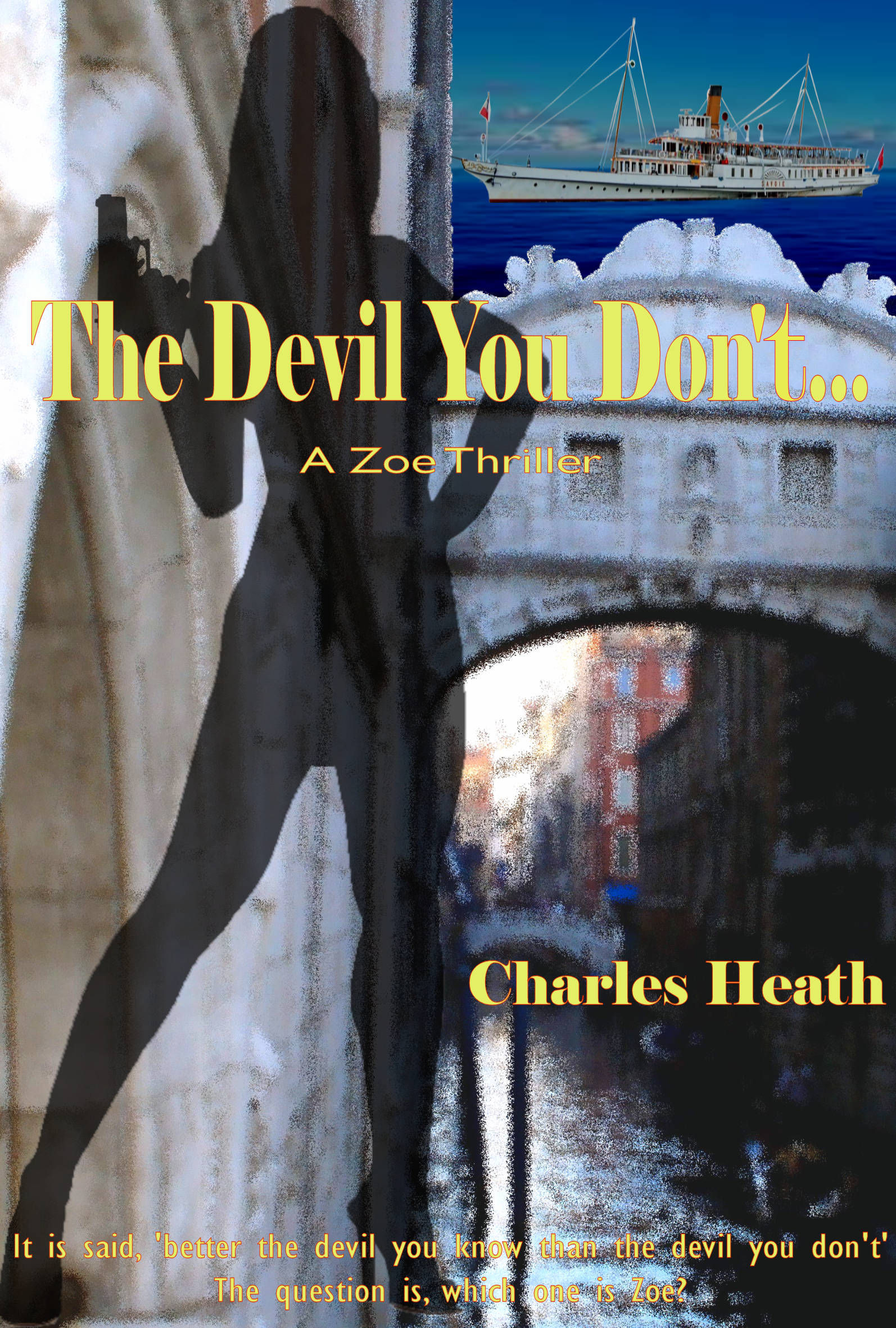
An excerpt from “The Devil You Don’t”

Available on Amazon Kindle here:  https://amzn.to/2Xyh1ow

…

By the time I returned to the Savoie, the rain had finally stopped, and there was a streak of blue sky to offer some hope the day would improve.

The ship was not crowded, the possibility of bad weather perhaps holding back potential passengers.  Of those I saw, a number of them would be aboard for the lunch by Phillippe Chevrier.  I thought about it, but the Concierge had told me about several restaurants in Yvoire and had given me a hand-drawn map of the village.  I think he came from the area because he spoke with the pride and knowledge of a resident.

I was looking down from the upper deck observing the last of the boarding passengers when I saw a woman, notable for her red coat and matching shoes, making a last-minute dash to get on board just before the gangway was removed.  In fact, her ungainly manner of boarding had also captured a few of the other passenger’s attention.  Now they would have something else to talk about, other than the possibility of further rain.

I saw her smile at the deckhand, but he did not smile back.  He was not impressed with her bravado, perhaps because of possible injury.  He looked at her ticket then nodded dismissively, and went back to his duties in getting the ship underway.  I was going to check the departure time, but I, like the other passengers, had my attention diverted to the woman in red.

From what I could see there was something about her.  It struck me when the light caught her as she turned to look down the deck, giving me a perfect profile.  I was going to say she looked foreign, but here, as in almost anywhere in Europe, that described just about everyone.  Perhaps I was just comparing her to Phillipa, so definitively British, whereas this woman was very definitely not.

She was perhaps in her 30’s, slim or perhaps the word I’d use was lissom, and had the look and manner of a model.  I say that because Phillipa had dragged me to most of the showings, whether in Milan, Rome, New York, London, or Paris.  The clothes were familiar, and in the back of my mind, I had a feeling I’d seen her before.

Or perhaps, to me, all models looked the same.

She looked up in my direction, and before I could divert my eyes, she locked on.  I could feel her gaze boring into me, and then it was gone as if she had been looking straight through me.  I remained out on deck as the ship got underway, watching her disappear inside the cabin.  My curiosity was piqued, so I decided to keep an eye out for her.

I could feel the coolness of the air as the ship picked up speed, not that it was going to be very fast.  With stops, the trip would take nearly two hours to get to my destination.  It would turn back almost immediately, but I was going to stay until the evening when it returned at about half eight.  It would give me enough time to sample the local fare, and take a tour of the medieval village.

Few other passengers ventured out on the deck, most staying inside or going to lunch.  After a short time, I came back down to the main deck and headed forward.  I wanted to clear my head by concentrating on the movement of the vessel through the water, breathing in the crisp, clean air, and let the peacefulness of the surroundings envelope me.

It didn’t work.

I knew it wouldn’t be long before I started thinking about why things hadn’t worked, and what part I played in it.  And the usual question that came to mind when something didn’t work out.  What was wrong with me?

I usually blamed it on my upbringing.

I had one of those so-called privileged lives, a nanny till I was old enough to go to boarding school, then sent to the best schools in the land.  There I learned everything I needed to be the son of a Duke, or, as my father called it in one of his lighter moments, nobility in waiting.

Had this been five or six hundred years ago, I would need to have sword and jousting skills, or if it had been a few hundred years later a keen military mind.  If nothing else I could ride a horse, and go on hunts, or did until they became not the thing to do.

I learned six languages, and everything I needed to become a diplomat in the far-flung British Empire, except the Empire had become the Commonwealth, and then, when no-one was looking, Britain’s influence in the world finally disappeared.  I was a man without a cause, without a vocation, and no place to go.

Computers were the new vogue and I had an aptitude for programming.  I guess that went hand in hand with mathematics, which although I hated the subject, I excelled in.  Both I and another noble outcast used to toss ideas around in school, but when it came to the end of our education, he chose to enter the public service, and I took a few of those ideas we had mulled over and turned them into a company.

About a year ago, I was made an offer I couldn’t refuse.  There were so many zeroes on the end of it I just said yes, put the money into a very grateful bank, and was still trying to come to terms with it.

Sadly, I still had no idea what I was going to do with the rest of my life.  My parents had asked me to come back home and help manage the estate, and I did for a few weeks.  It was as long as it took for my parents to drive me insane.

Back in the city, I spent a few months looking for a mundane job, but there were very few that suited the qualifications I had, and the rest, I think I intimidated the interviewer simply because of who I was.  In that time I’d also featured on the cover of the Economist, and through my well-meaning accountant, started involving myself with various charities, earning the title ‘philanthropist’.

And despite all of this exposure, even making one of those ubiquitous ‘eligible bachelor’ lists, I still could not find ‘the one’, the woman I wanted to spend the rest of my life with.  Phillipa seemed to fit the bill, but in time she proved to be a troubled soul with ‘Daddy’ issues.  I knew that in building a relationship compromise was necessary, but with her, in the end, everything was a compromise and what had happened was always going to be the end result.

It was perhaps a by-product of the whole nobility thing.  There was a certain expectation I had to fulfill, to my peers, contemporaries, parents and family, and those who either liked or hated what it represented.  The problem was, I didn’t feel like I belonged.  Not like my friend from schooldays, and now obscure acquaintance, Sebastian.  He had been elevated to his Dukedom early when his father died when he was in his twenties.  He had managed to fade from the limelight and was rarely mentioned either in the papers or the gossip columns.  He was one of the lucky ones.

I had managed to keep a similarly low profile until I met Phillipa.  From that moment, my obscurity disappeared.  It was, I could see now, part of a plan put in place by Phillipa’s father, a man who hogged the limelight with his daughter, to raise the profile of the family name and through it their businesses.  He was nothing if not the consummate self-advertisement.

Perhaps I was supposed to be the last piece of the puzzle, the attachment to the establishment, that link with a class of people he would not normally get in the front door.  There was nothing refined about him or his family, and more than once I’d noticed my contemporaries cringe at the mention of his name, or any reference of my association with him.

Yet could I truthfully say I really wanted to go back to the obscurity I had before Phillipa?  For all her faults, there were times when she had been fun to be with, particularly when I first met her when she had a certain air of unpredictability.  That had slowly disappeared as she became part of her father’s plan for the future.  She just failed to see how much he was using her.

Or perhaps, over time, I had become cynical.

I thought about calling her.  It was one of those moments of weakness when I felt alone, more alone than usual.

I diverted my attention back to my surroundings and the shoreline.  Out of the corner of my eye, I could see the woman in the red coat, making a move.  The red coat was like a beacon, a sort of fire engine red.  It was not the sort of coat most of the women I knew would wear, but on her, it looked terrific.  In fact, her sublime beauty was the one other attribute that was distinctly noticeable, along with the fact her hair was short, rather than long, and jet black.

I had to wrench my attention away from her.

A few minutes later several other passengers came out of the cabin for a walk around the deck, perhaps to get some exercise, perhaps checking up on me, or perhaps I was being paranoid.  I waited till they passed on their way forward, and I turned and headed aft.

I watched the wake sluicing out from under the stern for a few minutes, before retracing my steps to the front of the ship and there I stood against the railing, watching the bow carve its way through the water.  It was almost mesmerizing.  There, I emptied my mind of thoughts about Phillipa, and thoughts about the woman in the red coat.

Until a female voice behind me said, “Having a bad day?”

I started, caught by surprise, and slowly turned.  The woman in the red coat had somehow got very close me without my realizing it.  How did she do that?  I was so surprised I couldn’t answer immediately.

“I do hope you are not contemplating jumping.  I hear the water is very cold.”

Closer up, I could see what I’d missed when I saw her on the main deck.  There was a slight hint of Chinese, or Oriental, in her particularly around the eyes, and of her hair which was jet black.  An ancestor twice or more removed had left their mark, not in a dominant way, but more subtle, and easily missed except from a very short distance away, like now.

Other than that, she was quite possibly Eastern European, perhaps Russian, though that covered a lot of territory.  The incongruity of it was that she spoke with an American accent, and fluent enough for me to believe English was her first language.

Usually, I could ‘read’ people, but she was a clean slate.  Her expression was one of amusement, but with cold eyes.  My first thought, then, was to be careful.

“No.  Not yet.”  I coughed to clear my throat because I could hardly speak.  And blushed, because that was what I did when confronted by a woman, beautiful or otherwise.

The amusement gave way to a hint of a smile that brightened her demeanor as a little warmth reached her eyes.  “So that’s a maybe.  Should I change into my lifesaving gear, just in case?”

It conjured up a rather interesting image in my mind until I reluctantly dismissed it.

“Perhaps I should move away from the edge,” I said, moving sideways until I was back on the main deck, a few feet further away.  Her eyes had followed me, and when I stopped she turned to face me again.  She did not move closer.

I realized then she had removed her beret and it was in her left side coat pocket.  “Thanks for your concern …?”

“Zoe.”

“Thanks for your concern, Zoe.  By the way, my name is John.”

She smiled again, perhaps in an attempt to put me at ease.  “I saw you earlier, you looked so sad, I thought …”

“I might throw myself overboard?”

“An idiotic notion I admit, but it is better to be safe than sorry.”

Then she tilted her head to one side then the other, looking intently at me.  “You seem to be familiar.  Do I know you?”

I tried to think of where I may have seen her before, but all I could remember was what I’d thought earlier when I first saw her; she was a model and had been at one of the showings.  If she was, it would be more likely she would remember Phillipa, not me.  Phillipa always had to sit in the front row.

“Probably not.”  I also didn’t mention the fact she may have seen my picture in the society pages of several tabloid newspapers because she didn’t look the sort of woman who needed a daily dose of the comings and goings, and, more often than not, scandal associated with so-called celebrities.

She gave me a look, one that told me she had just realized who I was.  “Yes, I remember now.  You made the front cover of the Economist.  You sold your company for a small fortune.”

Of course.  She was not the first who had recognized me from that cover.  It had raised my profile considerably, but not the Sternhaven’s.  That article had not mentioned Phillipa or her family.  I suspect Grandmother had something to do with that, and it was, now I thought about it, another nail in the coffin that was my relationship with Phillipa.

“I wouldn’t say it was a fortune, small or otherwise, just fortunate.”  Each time, I found myself playing down the wealth aspect of the business deal.

“Perhaps then, as the journalist wrote, you were lucky.  It is not, I think, a good time for internet-based companies.”

The latter statement was an interesting fact, one she read in the Financial Times which had made that exact comment recently.

“But I am boring you.”  She smiled again.  “I should be minding my own business and leaving you to your thoughts.  I am sorry.”

She turned to leave and took a few steps towards the main cabin.

“You’re not boring me,” I said, thinking I was letting my paranoia get the better of me.  It had been Sebastian on learning of my good fortune, who had warned me against ‘a certain element here and abroad’ whose sole aim would be to separate me from my money.  He was not very subtle when he described their methods.

But I knew he was right.  I should have let her walk away.

She stopped and turned around.  “You seem nothing like the man I read about in the Economist.”

A sudden and awful thought popped into my head.  Those words were part of a very familiar opening gambit.  “Are you a reporter?”

I was not sure if she looked surprised, or amused.  “Do I look like one?”

I silently cursed myself for speaking before thinking, and then immediately ignored my own admonishment.  “People rarely look like what they are.”

I saw the subtle shake of the head and expected her to take her leave.  Instead she astonished me.

“I fear we have got off on the wrong foot.  To be honest, I’m not usually this forward, but you seemed like you needed cheering up when probably the opposite is true.  Aside from the fact this excursion was probably a bad idea.  And,” she added with a little shrug, “perhaps I talk too much.”

I was not sure what I thought of her after that extraordinary admission. It was not something I would do, but it was an interesting way to approach someone and have them ignoring their natural instinct.  I would let Sebastian whisper in my ear for a little longer and see where this was going.

“Oddly enough, I was thinking the same thing.  I was supposed to be traveling with my prospective bride.  I think you can imagine how that turned out.”

“She’s not here?”

“No.”

“She’s in the cabin?”  Her eyes strayed in that direction for a moment then came back to me.  She seemed surprised I might be traveling with someone.

“No.  She is back in England, and the wedding is off.  So is the relationship.  She dumped me by text.”

OK, why was I sharing this humiliating piece of information with her?  I still couldn’t be sure she was not a reporter.

She motioned to an empty seat, back from the edge.  No walking the plank today.  She moved towards it and sat down.  She showed no signs of being cold, nor interested in the breeze upsetting her hair.  Phillipa would be having a tantrum about now, being kept outside, and freaking out over what the breeze might be doing to her appearance.

I wondered, if only for a few seconds if she used this approach with anyone else.  I guess I was a little different, a seemingly rich businessman alone on a ferry on Lake Geneva, contemplating the way his life had gone so completely off track.

She watched as I sat at the other end of the bench, leaving about a yard between us.  After I leaned back and made myself as comfortable as I could, she said, “I have also experienced something similar, though not by text message.  It is difficult, the first few days.”

“I saw it coming.”

“I did not.”  She frowned, a sort of lifeless expression taking over, perhaps brought on by the memory of what had happened to her.  “But it is done, and I moved on.  Was she the love of your life?”

OK, that was unexpected.

When I didn’t answer, she said, “I am sorry.  Sometimes I ask personal questions without realizing what I’m doing.  It is none of my business.”  She shivered.  “Perhaps we should go back inside.”

She stood, and held out her hand.  Should I take it and be drawn into her web?  I thought of Sebastian.  What would he do in this situation?

I took her hand in mine and let her pull me gently to my feet.  “Wise choice,” she said, looking up at the sky.

It just started to rain.

…

© Charles Heath 2015-2023
newdevilcvr6

“The Document” – the editor’s final draft – Day 12

This book has been sitting in the ‘to-be-done’ tray, so this month it is going to get the final revision.

And so it begins…

…

I’m heading into uncharted territory

…

It could equally describe a place or my emotions, though in this case, it is the emotional side.

I’m taking on the persona of the main character, and trying to sort through the emotions of, firstly wondering what it might be like to want the unobtainable, and secondly, what it might be like if circumstances, albeit unfortunate, bring you together.

Yes, it’s the girl. You know how the standard love story goes, boy meets girl, boy loses the girl, boy somehow manages to save the day and win her back. That’s the male side, for women, it might be the other way around.

However, sometimes the unobtainable is just that for a reason. We shall see how this turns out.

On a more interesting note, I have hit the halfway mark for the number of words, 25,118.

I’d like to say it’s all downhill from here, but that’s never the case, is it?