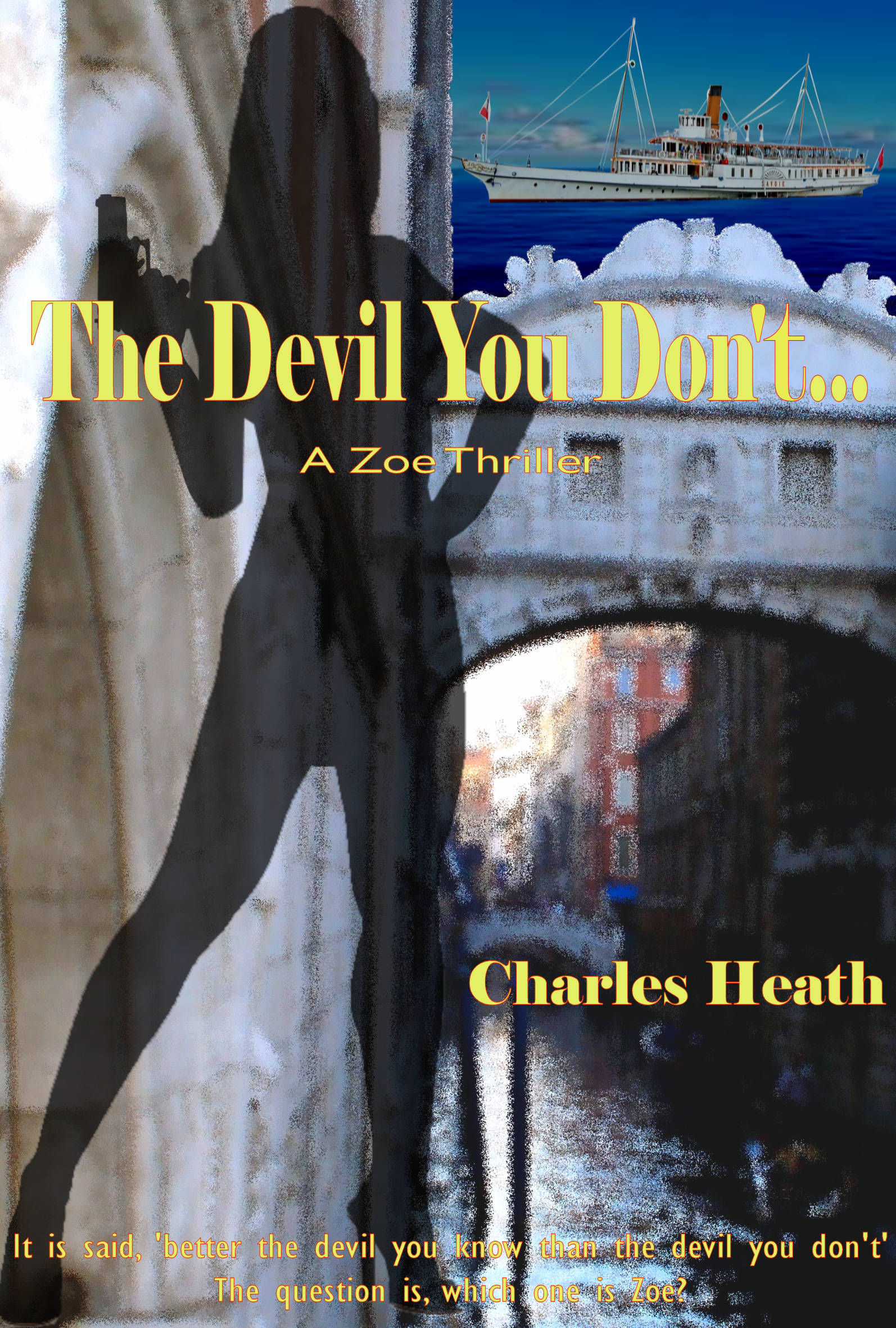
An excerpt from “Echoes from the Past”

Available on Amazon Kindle here:  https://amzn.to/2CYKxu4

With my attention elsewhere, I walked into a man who was hurrying in the opposite direction.  He was a big man with a scar running down the left side of his face from eye socket to mouth, and who was also wearing a black shirt with a red tie.

That was all I remembered as my heart almost stopped.

He apologized as he stepped to one side, the same way I stepped, as I also muttered an apology.

I kept my eyes down.  He was not the sort of man I wanted to recognize later in a lineup.  I stepped to the other side and so did he.  It was one of those situations.  Finally getting out of sync, he kept going in his direction, and I towards the bus, which was now pulling away from the curb.

Getting my breath back, I just stood riveted to the spot watching it join the traffic.  I looked back over my shoulder, but the man I’d run into had gone.  I shrugged and looked at my watch.  It would be a few minutes before the next bus arrived.

Wait, or walk?  I could also go by subway, but it was a long walk to the station.  What the hell, I needed the exercise.

At the first intersection, the ‘Walk’ sign had just flashed to ‘Don’t Walk’.  I thought I’d save a few minutes by not waiting for the next green light.  As I stepped onto the road, I heard the screeching of tires.

A yellow car stopped inches from me.

It was a high powered sports car, perhaps a Lamborghini.  I knew what they looked like because Marcus Bartleby owned one, as did every other junior executive in the city with a rich father.

Everyone stopped to look at me, then the car.  It was that sort of car.  I could see the driver through the windscreen shaking his fist, and I could see he was yelling too, but I couldn’t hear him.  I stepped back onto the sidewalk, and he drove on.  The moment had passed and everyone went back to their business.

My heart rate hadn’t come down from the last encounter.   Now it was approaching cardiac arrest, so I took a few minutes and several sets of lights to regain composure.

At the next intersection, I waited for the green light, and then a few seconds more, just to be sure.  I was no longer in a hurry.

At the next, I heard what sounded like a gunshot.  A few people looked around, worried expressions on their faces, but when it happened again, I saw it was an old car backfiring.  I also saw another yellow car, much the same as the one before, stopped on the side of the road.  I thought nothing of it, other than it was the second yellow car I’d seen.

At the next intersection, I realized I was subconsciously heading towards Harry’s new bar.   It was somewhere on 6th Avenue, so I continued walking in what I thought was the right direction.

I don’t know why I looked behind me at the next intersection, but I did.  There was another yellow car on the side of the road, not far from me.  It, too, looked the same as the original Lamborghini, and I was starting to think it was not a coincidence.

Moments after crossing the road, I heard the roar of a sports car engine and saw the yellow car accelerate past me.  As it passed by, I saw there were two people in it, and the blurry image of the passenger; a large man with a red tie.

Now my imagination was playing tricks.

It could not be the same man.  He was going in a different direction.

In the few minutes I’d been standing on the pavement, it had started to snow; early for this time of year, and marking the start of what could be a long cold winter.  I shuddered, and it was not necessarily because of the temperature.

I looked up and saw a neon light advertising a bar, coincidentally the one Harry had ‘found’ and, looking once in the direction of the departing yellow car, I decided to go in.  I would have a few drinks and then leave by the back door if it had one.

Just in case.

© Charles Heath 2015-2020

newechocover5rs

Inspiration, maybe – Volume 1

50 photographs, 50 stories, of which there is one of the 50 below.

They all start with –

A picture paints … well, as many words as you like.  For instance:

lookingdownfromcoronetpeak

And the story:

It was once said that a desperate man has everything to lose.

The man I was chasing was desperate, but I, on the other hand, was more desperate to catch him.

He’d left a trail of dead people from one end of the island to the other.

The team had put in a lot of effort to locate him, and now his capture was imminent.  We were following the car he was in, from a discrete distance, and, at the appropriate time, we would catch up, pull him over, and make the arrest.

There was nowhere for him to go.

The road led to a dead-end, and the only way off the mountain was back down the road were now on.  Which was why I was somewhat surprised when we discovered where he was.

Where was he going?

“Damn,” I heard Alan mutter.  He was driving, being careful not to get too close, but not far enough away to lose sight of him.

“What?”

“I think he’s made us.”

“How?”

“Dumb bad luck, I’m guessing.  Or he expected we’d follow him up the mountain.  He’s just sped up.”

“How far away?”

“A half-mile.  We should see him higher up when we turn the next corner.”

It took an eternity to get there, and when we did, Alan was right, only he was further on than we thought.”

“Step on it.  Let’s catch him up before he gets to the top.”

Easy to say, not so easy to do.  The road was treacherous, and in places just gravel, and there were no guard rails to stop a three thousand footfall down the mountainside.

Good thing then I had the foresight to have three agents on the hill for just such a scenario.

Ten minutes later, we were in sight of the car, still moving quickly, but we were going slightly faster.  We’d catch up just short of the summit car park.

Or so we thought.

Coming quickly around another corner we almost slammed into the car we’d been chasing.

“What the hell…” Aland muttered.

I was out of the car, and over to see if he was in it, but I knew that it was only a slender possibility.  The car was empty, and no indication where he went.

Certainly not up the road.  It was relatively straightforward for the next mile, at which we would have reached the summit.  Up the mountainside from here, or down.

I looked up.  Nothing.

Alan yelled out, “He’s not going down, not that I can see, but if he did, there’s hardly a foothold and that’s a long fall.”

Then where did he go?

Then a man looking very much like our quarry came out from behind a rock embedded just a short distance up the hill.

“Sorry,” he said quite calmly.  “Had to go if you know what I mean.”

I’d lost him.

It was as simple as that.

I had been led a merry chase up the hill, and all the time he was getting away in a different direction.

I’d fallen for the oldest trick in the book, letting my desperation blind me to the disguise that anyone else would see through in an instant.

It was a lonely sight, looking down that road, knowing that I had to go all that way down again, only this time, without having to throw caution to the wind.

“Maybe next time,” Alan said.

“We’ll get him.  It’s just a matter of time.”

© Charles Heath 2019-2021

Find this and other stories in “Inspiration, maybe”  available soon.

InspirationMaybe1v1

365 Days of writing, 2026 – 6

Day 6 – Writing exercise

Writing exercise

You’ve got a habit of being in the wrong place, don’t you, Sam? But this time…

Everyone was busy.  

The morning meeting, where the boss sat at the head of a long table, and the writing staff sat, waiting for either a bollocking or an assignment, had travelled along the usual path.

The boss was the typical editor, loud, opinionated, and acerbic.  Very few could remember him being complimentary.

I sat at the end of the table, the opposite end, and as far away from him as I could get.  He hated me more than any other.

I looked around.

Whether or not they liked their assignments or the request for a rewrite, it was hard to tell.  No one wanted to be seen shirking.

Yes, he called it shirking if you were not pounding the keyboard, working on tomorrow’s news today.

And because he hated me, I was last, got the full-on death stare and then in those oily words dispensed with forced amiability, “Jacobs, you got the dead guy, what’s his name, Rickard, Richard…”

“Ricardo,” a mousey voice called out, his current ‘favourite’.

“That dead guy.  A thousand scintillating words.”

Then the expansive glare around the table, “Well, what are you lot waiting for?”

Al, just up from me, muttered, under his breath, “A written invitation.”  As he did in every meeting.

Another obituary.  Another nobody that needed life breathed into the corpse. 

A gopher dropped a file on my desk as he went past, not stopping.  Not worth the five minutes of hell from the boss about wasting time on idle chatter.

A single page, a name, and an address.  Several notes that highlighted a nothing life.  Too young to have a life.  Too young to die.  Too young for scintillating words.

Cause of death?  Heart failure.

His photo belied the notion that he had anything remotely wrong with his heart.  Adonis himself would be jealous.

Coroner’s report?  Heart failure, cause unknown.

Not obese, not too thin, none of the danger signs that he was heart attack material, I knew my way around a medical report and this one?

Something was not right.  Was the boss testing me, see if I could see if there was anything more?

Of course, I’d been down this path before and come a cropper.  No, the boss took anything I requested with a grain of salt.

“Just report the facts.  Don’t embellish, don’t add your suspicions, ten times out of ten you’re going to be wrong.”

And infurioratingly he was right.

Which meant I had to get creative.

The name Freddie Ricardo brought up 100,000 plus hits on the search engine, but I found one entry that pointed to an Instagram page that loaded, then disappeared.

Like completely disappeared, returning a 404 error when I tried to reload it.  Someone had deleted it just after I found it.

Why?

Who would care?

From the fleeting look I got of it, it was just a guy’s page that had photos of him and friends guzzling beer and either hunting, fishing or acting stupid.

Very unaccountant-like. 

Next step, go to the address.

A suburban street, quiet, an old house, run down and in need of repair, garden overgrown.  Two car wrecks in the front yard, and an antique car in the driveway.

I sat outside the house for an hour, not a creature stirred, not even a mouse.  The car suggested someone was inside, but they didn’t look out the windows, and they didn’t turn any lights on.

At the end of the hour, I got out of the car and walked over to the front door.  The fence was falling over, the gate off its hinges, held up by the weeds and growth around it.

The door had peeling paint, but the lock and handle were new.  The verandah boards were rotting and in places broken.  They creaked as I walked on them.

I knocked.  No answer. 

I checked the car in the driveway.  A fine film of dust covered it, telling me it hadn’t moved in days, maybe a week.

One of the neighbours came out and looked over.

“Who are you?”  It wasn’t a polite question.

“Does Freddie Ricardo live here?”

“Did.  Who wants to know?”

“I’m from the newspaper, asked to do a small piece on him.”

“No need.  He wouldn’t want it.”

“Anyone else live here?”

“His sister.  She ain’t here at the moment.  I’m keeping an eye on the place.  Now, I suggest you leave.”

A sister.  Rather a large omission in the briefing paper provided.  Research was slipping.

“Fair enough.”

A last look, I went back to the car.  I waited, but the neighbour didn’t leave his porch.  When he reached for his cell phone, I left.

Before going back to the office, I went to the city administration building and met up with an acquaintance who got me a copy of the deed for the house.

It had belonged to the parents, then was handed down to the elder daughter, Bethany.  There were only two of them, Bethany and Freddie.  He didn’t have a stake in the house.

I ran Bethany’s name in the search engine, and it brought back a few thousand hits, the first with a picture of a brother and sister on the front porch.

The second was a photo of her in a gondola in Venice with a man, Italian perhaps.  She didn’t look happy.

From what I could see, the brother and sister were not similar, so maybe step-siblings. 

Bethany also had titles to three other houses in the city.  Perhaps she lived at one of those addresses and let her little brother stay at the address I called on.

Another acquaintance looked up the car registrations, and for the other cars the siblings had, of which there were four, including one for Freddie.

It was not mentioned in the police report at the crime scene, nor was it at the house, so it might still be somewhere else.

I had another five pieces of paper to go with the photo of the victim and the coroner’s report.  It didn’t amount to much.

I thought about inventing a thousand words and making him a traitor, but the boss would see through it.

The alternative wasn’t much better; tell him I had nothing, well, suspicions.

I knocked on the door, and he growled something unintelligible.  Not a good day.

“What have you got?”  He didn’t look up.

“Missing car, expensive.  Job belies the income to have it.   Looks belie the cause of death.”

“And you infer?”

“Drugs, using, selling.  Has a sister in Italy, or not?  Needs a deep dive.”

“Is that it?”

“Been to the house.  Looks like a mess, but I checked the values.  It’s a gold mine for someone.”

“No one home?”

“Not for a week.”

“Talk to your police friends, see if they’ve got a rap sheet.  Police miss the car?”

“Not in their report, not where he died.”

He looked up.  “Find it, find the sister, talk to the neighbours.  Go.”

No third degree, so sarcasm, just barked orders.  But I wasn’t going to count the chickens just yet.

3am was always the best time to surprise people.  My father once said that the best time to get answers was when people were unprepared.

He had been a policeman and kicked doors in at or just before dawn.  Disorientation, gear, terror at dawn.  Worked a treat.

I wasn’t kicking the door in.  I was visiting.

And hopefully the house was still empty.

The back window was unlocked and opened easily.  I was able to get to the back because of a quirk in the planning of the estate.  The house had a narrow walkway behind it, a public thoroughfare.

At 3 a.m., no one would be about.

I hope.

There wasn’t.  The back fence was as bad as the front, with a gap wide enough to squeeze through.  The back yard was worse than the front, three cars hidden by undergrowth.

Tripped once and crashed into a car.  It hurt

It took a few minutes to get inside.  It smelled badly of wet paper and damp.  The floorboards creaked.  Several pilot lights were giving off just enough light to see by, once my eyes adjusted.

Signs of recent habitation.  Fast food wrappers, health drinks, cigarette butts, and beer cans.  Half-eaten food with mould.  A week, perhaps longer, since anyone was there.

Upstairs.

The reason for the bad smell.

A body, not the sister, but a woman. 

No sign of a bag.  Dead, checked while trying not to be sick, downstairs, found the bag, wallet, ID.  Jessie Walker.  This was the residential address; her car was outside.

Long enough to find nothing else.  If the place had been tossed, it was done by a professional.

I left.

Found a phone booth and called the police to report the body.

I got back to my car to find two men waiting.  There wasn’t much use in running.

“At it again, Sam?”

The two cops that my father had asked to keep me on the straight and narrow.

“What do you mean?”

“Don’t insult us, Sam.  You know what we’re talking about.  You can’t be poking around crime scenes.”

How did they know where I’d been?  I’d only just called it in.

They knew.  I’d known my father had not exactly been clean, not as clean as he said he was, and besides, clean cops were not murdered in a mob hit. No, these were two acolytes.

“How do you…”

Lance, the more senior of the two, shook his head. “Tsk, task, Sam.  Wrong place, wrong time.  Don’t make a habit of it now, will you, son?”

I shook my head in that obedient fashion they liked.

“Good boy.”  Borg patted me on the head like I was a good boy.  I was anything but.  A chip off the old block.

“Good lad.  Leave this one alone.”

A parting pat on the back, and they left.  Was I going to heed good advice?  No.  I waited for an hour, and then I started searching for details on the internet.

Jessie Walker was famous.  Over a million hits in the search engine, and fascinating in death as much as she was in life.  For a police commissioner’s wife of three weeks.

She looked so much more interesting alive when splashed all over the front page of the city daily.  In death, she would barely rate a second glance.

And what did she have to do with Freddie and Bethany Riccardo?  Tomorrow was not going to be a good day.

©  Charles Heath  2025

First Dig Two Graves

A sequel to “The Devil You Don’t”

Revenge is a dish best served cold – or preferably so when everything goes right

Of course, it rarely does, as Alistair, Zoe’s handler, discovers to his peril. Enter a wildcard, John, and whatever Alistair’s plan for dealing with Zoe was dies with him.

It leaves Zoe in completely unfamiliar territory.

John’s idyllic romance with a woman who is utterly out of his comfort zone is on borrowed time. She is still trying to reconcile her ambivalence, after being so indifferent for so long.

They agree to take a break, during which she disappears. John, thinking she has left without saying goodbye, refuses to accept the inevitable, calls on an old friend for help in finding her.

After the mayhem and being briefly reunited, she recognises an inevitable truth: there is a price to pay for taking out Alistair; she must leave and find them first, and he would be wise to keep a low profile.

But keeping a low profile just isn’t possible, and enlisting another friend, a private detective and his sister, a deft computer hacker, they track her to the border between Austria and Hungary.

What John doesn’t realise is that another enemy is tracking him to find her too. It could have been a grand tour of Europe. Instead, it becomes a race against time before enemies old and new converge for what will be an inevitable showdown.

In a word: Good

There is a TV show on at the moment called ‘The Good Place’.

It’s really the bad place which makes you wonder if there really is a ‘good place’.

This started me thinking.

How many people do you know, when you ask them how they are, they say ‘good’.

Can we see behind the facade that is their expression how they really feel?

And how many of us reveal our true feelings?

It seems to me there is an acceptable level of understanding that we take people at their word and move on from there.

And how many times when we suspect there is something wrong, we tend to overlook it in what is regarded as respect for that person?

What if something awful happened?

What if we could have prevented it?

What if we could have tried to gently probe deeper?

The problem is we seem to be too polite and there is nothing wrong with that.

But maybe, just maybe, the next time …

It’s just a thought.


An excerpt from “Strangers We’ve Become” – Coming Soon

I wandered back to my villa.

It was in darkness.  I was sure I had left several lights on, especially over the door so I could see to unlock it.

I looked up and saw the globe was broken.

Instant alert.

I went to the first hiding spot for the gun, and it wasn’t there.  I went to the backup and it wasn’t there either.  Someone had found my carefully hidden stash of weapons and removed them.

Who?

There were four hiding spots and all were empty.  Someone had removed the weapons.  That could only mean one possibility.

I had a visitor, not necessarily here for a social call.

But, of course, being the well-trained agent I’d once been and not one to be caught unawares, I crossed over to my neighbor and relieved him of a weapon that, if found, would require a lot of explaining.

Suitably armed, it was time to return the surprise.

There were three entrances to the villa, the front door, the back door, and a rather strange escape hatch.  One of the more interesting attractions of the villa I’d rented was its heritage.  It was built in the late 1700s, by a man who was, by all accounts, a thief.  It had a hidden underground room which had been in the past a vault but was now a wine cellar, and it had an escape hatch by which the man could come and go undetected, particularly if there was a mob outside the door baying for his blood.

It now gave me the means to enter the villa without my visitors being alerted, unless, of course, they were near the vicinity of the doorway inside the villa, but that possibility was unlikely.  It was not where anyone could anticipate or expect a doorway to be.

The secret entrance was at the rear of the villa behind a large copse, two camouflaged wooden doors built into the ground.  I move aside some of the branches that covered them and lifted one side.  After I’d discovered the doors and rusty hinges, I’d oiled and cleaned them, and cleared the passageway of cobwebs and fallen rocks.  It had a mildew smell, but nothing would get rid of that.  I’d left torches at either end so I could see.

I closed the door after me, and went quietly down the steps, enveloped in darkness till I switched on the torch.  I traversed the short passage which turned ninety degrees about halfway to the door at the other end.  I carried the key to this door on the keyring, found it and opened the door.  It too had been oiled and swung open soundlessly.

I stepped in the darkness and closed the door.

I was on the lower level under the kitchen, now the wine cellar, the ‘door’ doubling as a set of shelves which had very little on them, less to fall and alert anyone in the villa.

Silence, an eerie silence.

I took the steps up to the kitchen, stopping when my head was level with the floor, checking to see if anyone was waiting.  There wasn’t.  It seemed to me to be an unlikely spot for an ambush.

I’d already considered the possibility of someone coming after me, especially because it had been Bespalov I’d killed, and I was sure he had friends, all equally as mad as he was.  Equally, I’d also considered it nigh on impossible for anyone to find out it was me who killed him because the only people who knew that were Prendergast, Alisha, a few others in the Department, and Susan.

That raised the question of who told them where I was.

If I was the man I used to be, my first suspect would be Susan.  The departure this morning, and now this was too coincidental.  But I was not that man.

Or was I?

I reached the start of the passageway that led from the kitchen to the front door and peered into the semi-darkness.  My eyes had got used to the dark, and it was no longer an inky void.  Fragments of light leaked in around the door from outside and through the edge of the window curtains where they didn’t fit properly.  A bone of contention upstairs in the morning, when first light shone and invariably woke me up hours before I wanted to.

Still nothing.

I took a moment to consider how I would approach the visitor’s job.  I would get a plan of the villa in my head, all entrances, where a target could be led to or attacked where there would be no escape.

Coming in the front door.  If I was not expecting anything, I’d just open the door and walk-in.  One shot would be all that was required.

Contract complete.

I sidled quietly up the passage staying close to the wall, edging closer to the front door.  There was an alcove where the shooter could be waiting.  It was an ideal spot to wait.

Crunch.

I stepped on some nutshells.

Not my nutshells.

I felt it before I heard it.  The bullet with my name on it.

And how the shooter missed, from point-blank range, and hit me in the arm, I had no idea.  I fired off two shots before a second shot from the shooter went wide and hit the door with a loud thwack.

I saw a red dot wavering as it honed in on me and I fell to the floor, stretching out, looking up where the origin of the light was coming and pulled the trigger three times, evenly spaced, and a second later I heard the sound of a body falling down the stairs and stopping at the bottom, not very far from me.

Two assassins.

I’d not expected that.

The assassin by the door was dead, a lucky shot on my part.  The second was still breathing.

I checked the body for any weapons and found a second gun and two knives.  Armed to the teeth!

I pulled off the balaclava; a man, early thirties, definitely Italian.  I was expecting a Russian.

I slapped his face, waking him up.  Blood was leaking from several slashes on his face when his head had hit the stairs on the way down.  The awkward angle of his arms and legs told me there were broken bones, probably a lot worse internally.  He was not long for this earth.

“Who employed you?”

He looked at me with dead eyes, a pursed mouth, perhaps a smile.  “Not today my friend.  You have made a very bad enemy.”  He coughed and blood poured out of his mouth.  “There will be more …”

Friends of Bespalov, no doubt.

I would have to leave.  Two unexplainable bodies, I’d have a hard time explaining my way out of this mess.  I dragged the two bodies into the lounge, clearing the passageway just in case someone had heard anything.

Just in case anyone was outside at the time, I sat in the dark, at the foot of the stairs, and tried to breathe normally.  I was trying not to connect dots that led back to Susan, but the coincidence was worrying me.

A half-hour passed and I hadn’t moved.  Deep in thought, I’d forgotten about being shot, unaware that blood was running down my arm and dripping onto the floor.

Until I heard a knock on my front door.

Two thoughts, it was either the police, alerted by the neighbors, or it was the second wave, though why would they be knocking on the door?

I stood, and immediately felt a stabbing pain in my arm.  I took out a handkerchief and turned it into a makeshift tourniquet, then wrapped a kitchen towel around the wound.

If it was the police, this was going to be a difficult situation.  Holding the gun behind my back, I opened the door a fraction and looked out.

No police, just Maria.  I hoped she was not part of the next ‘wave’.

“You left your phone behind on the table.  I thought you might be looking for it.”  She held it out in front of her.

When I didn’t open the door any further, she looked at me quizzically, and then asked, “Is anything wrong?”

I was going to thank her for returning the phone, but I heard her breathe in sharply, and add, breathlessly, “You’re bleeding.”

I looked at my arm and realized it was visible through the door, and not only that, the towel was soaked in blood.

“You need to go away now.”

Should I tell her the truth?  It was probably too late, and if she was any sort of law-abiding citizen she would go straight to the police.

She showed no signs of leaving, just an unnerving curiosity.  “What happened?”

I ran through several explanations, but none seemed plausible.  I went with the truth.  “My past caught up with me.”

“You need someone to fix that before you pass out from blood loss.  It doesn’t look good.”

“I can fix it.  You need to leave.  It is not safe to be here with me.”

The pain in my arm was not getting any better, and the blood was starting to run down my arm again as the tourniquet loosened.  She was right, I needed it fixed sooner rather than later.

I opened the door and let her in.  It was a mistake, a huge mistake, and I would have to deal with the consequences.  Once inside, she turned on the light and saw the pool of blood just inside the door and the trail leading to the lounge.  She followed the trail and turned into the lounge, turned on the light, and no doubt saw the two dead men.

I expected her to scream.  She didn’t.

She gave me a good hard look, perhaps trying to see if I was dangerous.  Killing people wasn’t something you looked the other way about.  She would have to go to the police.

“What happened here?”

“I came home from the cafe and two men were waiting for me.  I used to work for the Government, but no longer.  I suspect these men were here to repay a debt.  I was lucky.”

“Not so much, looking at your arm.”

She came closer and inspected it.

“Sit down.”

She found another towel and wrapped it around the wound, retightening the tourniquet to stem the bleeding.

“Do you have medical supplies?”

I nodded.  “Upstairs.”  I had a medical kit, and on the road, I usually made my own running repairs.  Another old habit I hadn’t quite shaken off yet.

She went upstairs, rummaged, and then came back.  I wondered briefly what she would think of the unmade bed though I was not sure why it might interest her.

She helped me remove my shirt, and then cleaned the wound.  Fortunately, she didn’t have to remove a bullet.  It was a clean wound but it would require stitches.

When she’d finished she said, “Your friend said one day this might happen.”

No prizes for guessing who that friend was, and it didn’t please me that she had involved Maria.

“Alisha?”

“She didn’t tell me her name, but I think she cares a lot about you.  She said trouble has a way of finding you, gave me a phone and said to call her if something like this happened.”

“That was wrong of her to do that.”

“Perhaps, perhaps not.  Will you call her?”

“Yes.  I can’t stay here now.  You should go now.  Hopefully, by the time I leave in the morning, no one will ever know what happened here, especially you.”

She smiled.  “As you say, I was never here.”

© Charles Heath 2018-2022

strangerscover9

The cinema of my dreams – I always wanted to write a war story – Episode 28

For a story that was conceived during those long boring hours flying in a steel cocoon, striving to keep away the thoughts that the plane and everyone in it could just simply disappear as planes have in the past, it has come a long way.

Whilst I have always had a fascination with what happened during the second world war, not the battles or fighting, but in the more obscure events that took place, I decided to pen my own little sidebar to what was a long and bitter war.

And, so, it continues…


By the time they reached the outskirts of Munich, what the Standartenfuhrer considered their biggest hurdle, it was quite dark and almost impossible to see where they were going.

The whole city seemed to have disappeared so effectively was the blackout.  

But there was one benefit, there was little or no traffic on the roads, which lessened the chance of running into another car or truck.

And it was time to refill the tank with two more petrol cans, leaving two remaining.  Filling up now, the Standartenfuhrer said, would get them to Innsbruck.

He sounded confident, but Mayer got the distinct impression it was mostly that he was putting on a brave face.  There had been one instance, the checkpoint before Munich where he nearly lost his nerve.  For the first time, there had been SS guards at the checkpoint, and which had been entirely unexpected.

An SS officer of the same rank had been summoned and he had requested their written orders.  They had paperwork, but Mayer wasn’t sure if it related to their current situation, further confirming his belief this had been a very carefully planned operation to get him out of Germany, and that there was a more pressing reason why.  It definitely had something to do with the V2’s, but had their intelligence services found out about something else, something he didn’t know about?

Given the level of risk to the two men with him, and that at every turn there was a possibility of capture or death, given the level of planning and the run so far, one he would have never thought of trying on his own, he didn’t have a very high level of confidence that they would get away with it.

Those in the SS were not fools, trusted no one, believed nothing they were told, and disregarded anything written on paper.  Check, double-check, then check again.  Take nothing as read.  The document he’d been given on what made a first-class SS officer in the eyes of the Reich, was fundamentally not him, nor most of the German population.

The officer at this checkpoint reminded him of the one who had shot the shooting in the hotel, and for at least ten tense minutes, during which time the other two had conferred quietly in English, one suggestion they cut and run.

That would have invited a hail of machine-gun fire that none of them would survive.

Both looked visibly relieved when he returned, having obviously called the name of the officer who had signed the order.  The only explanation he had for this was that the level of discontent among officers Military of SS must be greater than he thought.


They managed to cross over into Austria without any problems, the route they had taken, a series of back roads and tracks which had been given to them.  Once again, Mayer was surprised that so many people could be working against their own country, but, of what he’d seen, conditions were harsh no matter which part of Germany they were in.

The war was not going the way the German people were being told, and it was hard to see any resolution of the conflict any time soon.

Perhaps everyone in the high command was hoping the new V2 rockets were going to change the country’s fortunes in the war.  If they were, they were going to be bitterly disappointed.  What they needed was the jet-propelled fighters and bombers, something that remarkably had not been implemented years earlier, and would have given them air superiority.

He’d worked on those early jet engines and they were remarkable, and faster than anything the British or the Americans had.  It was hard to comprehend why high command had not pushed forward the new jet-propelled planes that Belin had finally decided to implement.  

And just when the trio had agreed that everything would work out about 100 kilometers from Innsbruck, on the road to the Italian border crossing, they took the wrong route.  It was a mistake brought on by tiredness, and a momentary lapse in concentration.

A checkpoint where there shouldn’t be one.

© Charles Heath 2020

A long short story that can’t be tamed – I always wanted to rescue a damsel in distress – 1

One

It was not the practicality of the place, where many, many passengers began or ended their journey, whether to or from a holiday or place of work or something else.

It was not the fact many people worked there, in the cafe, as ticket sellers or collectors, as station assistants helping with the mail, parcels or other types of freight, or just there to assist passengers.

For me, it was a reminder of an ending, an end to the life I once knew and had hoped would last forever.

It was where I said bon-voyage to a very special person, hoping as the train pulled out of the station it was not a goodbye.

Three months later I received a text message that said, basically, she was not coming back, that she had met someone special.

Oddly enough I was at the very same station when I received that fateful text and after a hour’s contemplation, and a sudden realization that I had mentally prepared myself for the inevitable, and in fact had talked about it with her sister Emily, not three days before.

She had told me then she had received a very strange email from Cecile, almost as if it hadn’t been written by her, a prelude to that of not returning home.  She, too, had received a message similar to mine.

We thought it odd, but it was not out of character for her, and although it raised concerns with her parents Emily, and I, thought no more of it.

Not till nearly three months later when both Emily and I received another text, from a blocked number somewhere in England that simply said, “help cee”.

‘Cee’ was a name she had shared with Emily and I and would never necessarily give to anyone else to use, not unless she was very close to them.  Not even her parents could use it.  I had considered it was miss-sent, that it was for her ‘new’ friend and not me.

Not until there was a knock on the door of my apartment, and found Emily, and a packed bag, on my doorstep.

“Something is very wrong,” she said without preamble, then barged past, one of her suitcase wheels running over my foot.

I closed the door and leaned against it.  “What are you talking about?”

“You would have got the same message.  She would not use Cee to anyone other than us.”

She flopped down on the best seat in the room, looking tired and exasperated.

“I thought it was miss-sent.  A new boyfriend that’s keeping her there, surely she would accord him the same privilege.”

“You’re joking.  How long did it take you, before she told you?”

I’d known her since grade school, but it was not until we graduated from university, she accorded that privilege.  But she was right.

“OK.  So why did you come here?  If she’s in trouble, there’s not much I can do from here.”

She dug into a voluminous handbag, pulled out an envelope, and waved it in the air.  “We’re going to London.  Tonight.  Pack a bag.  Your passport is current, and I’ve got all the necessary documentation sorted.  You know my dad; he just made a few calls.”

I thought about it for a minute or two.  London was a large city and the odds of picking up her trail after so long was remote, even if we received the message in the last 24 hours, nor did it mean it emanated from London, but could be from anywhere.  Obviously, she knew something I didn’t.

“You know where that message came from?”

“Yes.  When that message was sent, it was near where she was living.  Dad has been talking to the police over there and said she was not home when they called.  It’s the first place we’re going once we get there.”  Then, a second later, she said, “don’t just stand there, get packing.”

It was like an expression I’d heard often, going from one extreme to the other.

When we left it was the middle of summer and coming down from a high of 42 degrees Celsius, to when we landed at just after 6 am to a temperature that was below zero.  We felt the first force of it going up the gangway, then delayed the full force of the weather until we got off the underground at Wimbledon.

Early morning on a workday people were flooding into the station on their way to work, only to discover delays.  We’d seen the snow come, first in a trickle and then a steady downpour that only eased off when we arrived.

It stopped just as we came out of the station onto Wimbledon Hill Road, and from there it was a short walk to Worple Road.  At least, if it held off long enough, we would get to her flat just cold, not wet and cold.  To be honest, the snow was a novelty for us, because where we lived, it didn’t snow.  We had to go to the mountains a few hundred miles away for that privilege.

But the fact it wasn’t snowing didn’t make it any more pleasant.  If anything, the exertion needed to traverse the icy pathways and nearly slipping over several times made it worse.   Emily wasn’t impressed that she had to carry her case instead of being able to drag it, and it certainly didn’t improve her temper.

For the distance, about a half-mile, it took longer than expected because of the weather and the state of the path.  Added to that, it just started to snow again, lightly at least, but we made it, went inside, and shook off the snow on the ground floor foyer, then went up the stairs to the third floor.

Her flat was 3c and overlooked the main road.

Emily opened the door and we both stood back as the door swung open.

It was not what we expected.

©  Charles Heath  2024

The cinema of my dreams – Was it just another surveillance job – Episode 11

I’m back home and this story has been sitting on a back burner for a few months, waiting for some more to be written.

The trouble is, there are also other stories to write, and I’m not very good at prioritising.

But, here we are, a few minutes opened up and it didn’t take long to get back into the groove.

Just the person to see next


I couldn’t imagine what those details were.  But if it was a setup, it was a very elaborate one, by people who knew our systems and procedures.  Naturally, the first thought that sprang to mind, someone who was working here, or used to.

Then I had another thought, what if none of us was meant to survive the operation, and hat we had been selected specifically because we were new to field operations.  At the briefing, we had been told this was simple surveillance, observe and report, nothing more.

Usually we had one experienced member and three new team members, the experienced member was there to continue on the job training and evaluation.  What worried me was that an experienced member could be taken out apparently as easy as the others.

And my money was not on the guy I’d cornered.  Of course, I could be wrong, and no doubt circumstantial evidence would go a long way towards proving that, but in my estimation, a cornered man like he was, with a thirst and talent for killing, would not have hesitated to kill me before I’d got three words out.

I believed him.  He was scared and, now that I thought about it, confused.  That was anything but the m.o. of a conscienceless killer.

The wrinkle that hadn’t been accounted for was the explosion.  No one could have predicted that, or its effect on the operation.  It might well have saved him, except that I didn’t play by the rules and reconnected with him.  Maybe he had felt safe after taking out the others, and assuming I’d been taken down by the explosion.

Except, if I didn’t think he did the killing, who did, and why?  Severin?  Just who the hell is this Severin?  There’s been no indication he wasn’t one of us.

I was pondering that question when the woman returned and sat down again.  This time her stare wasn’t quite as glacial.

“Describe this Severin.”

She opened her notebook, and had her pencil ready.  Odd that she should be taking notes in pencil.

I described him.  Five feet eight inches tall, 250 pounds, thinning black hair, making him anywhere between 35 and 50, though I thought he was mid-forties.  He wore a tweed suit, rather an odd choice for the climate, and had the aroma of cigarette smoke hanging about him.

Every free moment I saw him, he had a cigarette, so I thought he was quite possibly a chain smoker, and from that, perhaps a man with bad nerves, or who worried a lot.  Now I knew he was not one of us, that could be interpreted as thinking he might get caught.

But he was confident, and outgoing, which meant he was quite sure he wouldn’t get caught, and that meant, quite possibly there was someone within our department that was working for or with him and had covered his comings and goings.  Either that or he had a universal passcode key to come and go as he pleased.

When I finished the description I could see a flicker of recognition.  IT was possible she knew who he might be, and if so, I was betting she knew him by another name.  I asked if that was the case.

“You know who this man is, don’t you?”

The stern reproving look returned.  “What makes you think that?”

“I read faces.  Yours is not a poker face.”

“Well, that disappoints me because I like to play poker.  Perhaps the people I play with have a different view.”

“I’m usually a good judge of character.”

“It’s let you down this time.”  She stood.  “Before you go, one of the supervisors here would like a word with you.  His name is Nobbin.  He works out of another office and is coming here directly.  After that, you’re free to go.”

She didn’t wait to say goodbye, and I was glad I managed to keep a straight face long enough.

Nobbin.  Just the man I wanted to see.


© Charles Heath 2019

365 Days of writing, 2026 – 5

Day 5 – Fiction based on fact

Finding the Balance: When Factual Background Meets Narrative Flow

Introduction
Imagine being immersed in a gripping novel, only to have the story halted by a lengthy explanation of 17th-century tax policies. Or picture a documentary where key context is skipped entirely, leaving you puzzled about the stakes. This is the delicate tightrope every writer walks: providing enough factual background to ground the reader while maintaining a timeline that serves the narrative. Whether you’re crafting fiction, non-fiction, or creative non-fiction, striking this balance is essential to keep your audience engaged and informed.


The Pitfalls of Overloading Factual Background

Factual background gives readers context, but when it overpowers the narrative, it becomes a barrier. Consider these scenarios:

  • Info Dumps: A historical novel that pauses for a 500-word description of a forgotten dynasty halfway through a chase scene.
  • Date Overload: A memoir listing every event in chronological order, turning the story into an encyclopedic list rather than a journey.

Impact on Engagement
Studies show that readers lose interest when factual content disrupts the flow. Excessive background can create “cognitive overload,” where the reader becomes overwhelmed and disengages. For example, a thriller filled with period-accurate military tactics might lose readers who just want to follow the protagonist’s survival.

When It Works
However, rich detail can elevate a story. The Da Vinci Code weaves historical facts into its plot without halting action, using suspense to justify context. The key is integration—not isolation.


The Challenge of Chronological vs. Non-Chronological Timelines

Timelines guide where and how the story unfolds. Sticking to a timeline ensures clarity, but deviations can add depth.

Stick to the Script: When Chronology is Key
In non-fiction, like biographies or historical analysis, strict timelines are essential for accuracy. A book about the Cold War, for example, must present events in order to maintain logical cause-and-effect.

Creative Chronology: Bending Time for Drama
Fiction often thrives on non-linear timelines. The Social Network uses a fragmented structure to build suspense around the founding of Facebook, while Lincoln sticks to a chronological rise. The choice depends on your genre:

  • Fiction: Use flashbacks or parallel timelines to reveal character motivations (e.g., Cloud Atlas by David Mitchell).
  • Non-fiction: A memoir might jump between time periods to highlight personal growth, provided transitions are clear.

The Danger of Anachronisms
Even in creative works, respecting timelines is crucial. A medieval knight quoting Shakespearean phrases or a 1920s novel lacking air travel would shatter credibility. Research is your safeguard.


Techniques to Balance Background and Story

How can writers integrate necessary information without overload? Here are practical strategies:

  1. Show, Don’t Tell
    • Reveal historical context through a character’s actions (e.g., a soldier’s uniform indicating the time period).
    • Use dialogue to drop clues: “The war’s end came as a shock,” a character might say, subtly signalling war’s conclusion.
  2. Summarise, Then Deepen
    • Start with a brief summary of the context. Introduce deeper details only when they’re relevant to the plot. For instance, a character researching a family heirloom can naturally uncover its history.
  3. Pace Your Exposition
    • Introduce background in “micro-doses.” If writing a fantasy novel about a magical kingdom, sprinkle details about its politics through different scenes: a conversation, a newspaper article, or a character’s memory.
  4. Use Tools of the Trade
    • In Media Res: Begin in the middle of the action and provide context as the story unfolds.
    • Signposts: Guide the reader with clear transitions when shifting timelines.

Case Studies in Balance

  • Book Example: Pride and Prejudice assumes readers understand 19th-century social hierarchies—Jane Austen implies, rather than explains, the system through character interactions.
  • Film Example: Inception (2010) layers timelines with clear visual cues, ensuring the complex plot remains graspable.
  • Podcast Example: Serial uses background episodes to build context in a story-heavy format, balancing narration with interviews.

Conclusion: Striking the Right Rhythm

Finding the balance between factual background and narrative flow is as much an art as it is a craft. Ask yourself:

  • Is this detail essential to the story or character development?
  • Would a timeline shift enhance the narrative, or confuse the reader?

Remember, your audience’s expectations matter. A historical mystery might require more context than a modern workplace drama. Use beta readers to pinpoint where facts eclipse the story or where confusion lingers.

Final Takeaway: Trust your reader. Provide enough to ground them, and no more. Let the timeline serve the story, not the other way around. With practice, this balance will transform from a challenge into a narrative strength.

Now, go write—without overwriting!


Call to Action: Share your favourite example of a story that balanced context and narrative perfectly. How did it keep you hooked? Let’s discuss in the comments!