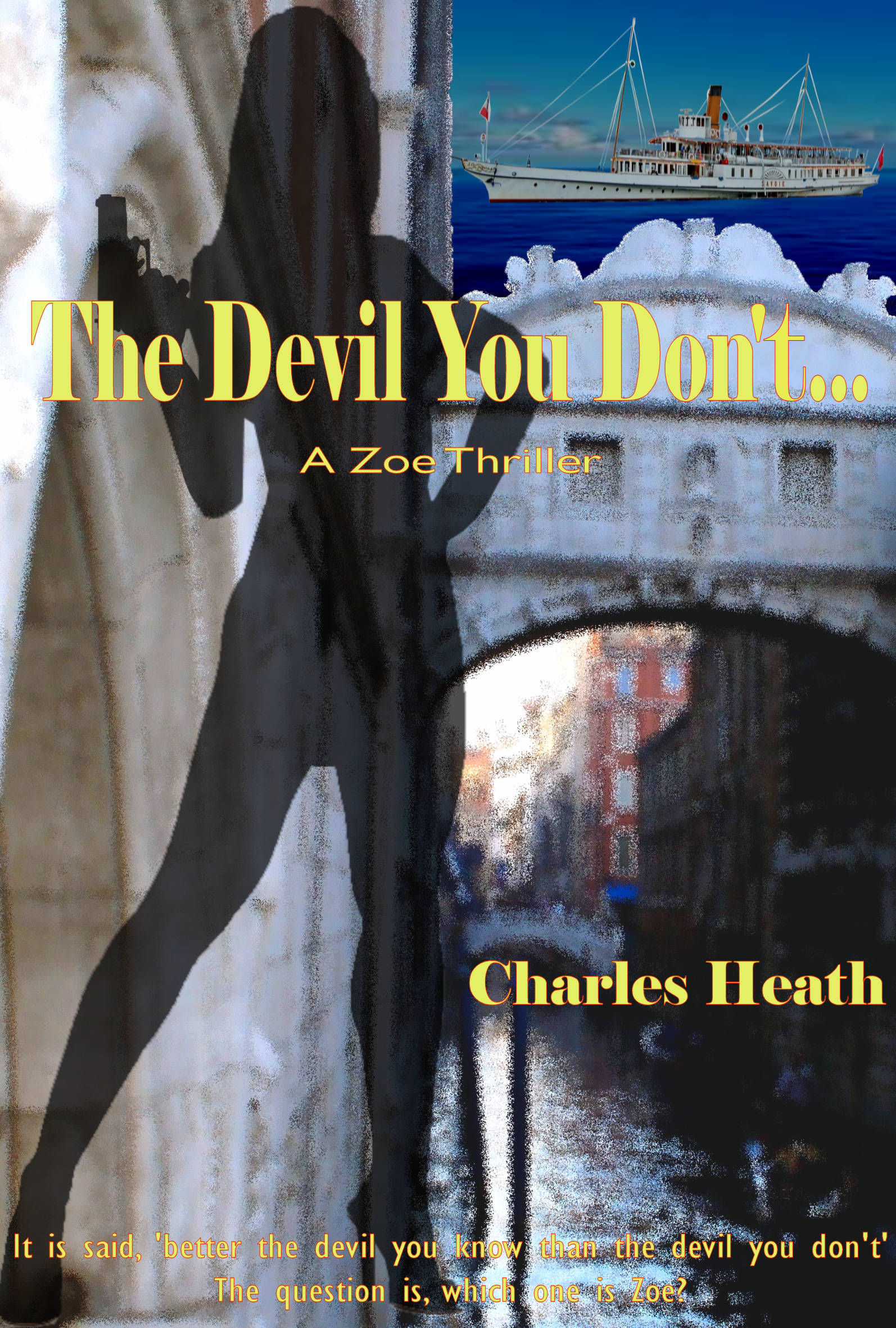
Like any book that is the second in a series, there is that inevitable question – What am I going to write about now?
You’re fighting off the, everyone had at least one book in them, and sitting down staring at that blank page because maybe your character has found the woman of his dreams, and there’s no need to chase anymore.
Who said Zoe had any interest in settling down?
She has missed getting out there and doing a job she is good at.
But rather than have her hunting people down, I thought it would be better if she were the one being hunted.
The thing is, she had managed to make more than one enemy over the years. And given the bounty, it brings old foes and fellow assassins out of the woodwork and into her path.
And a few people she had left behind, intentionally or otherwise.
But, the least expected, armed with a pair of dogged private detectives, is her newest friend, and want-to-be boyfriend.
She should have realised that he was not going to go away like he was supposed to.
But, here’s the thing…
People on both sides are looking for her, each with very different reasons, but all have the same intention…
Crete is a large island with many stunning locations that are far from the main tourist crowds. To help you on your road less travelled, here are five “next best” places and activities offering unique and authentic Cretan experiences.
1. Loutro: The Car-Free Seaside Village
Loutro is one of Crete’s most idyllic hidden gems, tucked away on the southwest coast. It is famously accessible only by boat or on foot, ensuring its protected, tranquil, and car-free atmosphere.
What makes it “Road Less Travelled”: The inability to drive directly to the village makes it a natural barrier to mass tourism. It feels like a remote, car-free island escape.
Activity: Relax on the small pebble beach, swim in the turquoise waters of the Libyan Sea, or use it as a base to hike to nearby coastal attractions.
2. Sarakina Gorge: The Hidden Canyon
While Samaria Gorge is famous and crowded, the Sarakina Gorge (sometimes called Sarantapichos Gorge) offers a shorter, equally stunning, and much less-trafficked hiking adventure in southeastern Crete, near the village of Mithi.
What makes it “Road Less Travelled”: It’s often overlooked by tourists heading to the larger, better-known gorges, offering a raw, untouched hiking experience.
Activity: Hike through the narrow canyon. Be prepared for a challenging trek that involves crossing the riverbed and may require wading through water in some sections, depending on the season.
3. Xerokampos: The Unspoilt Beaches of the East
Located on the far eastern coast of Crete, Xerokampos is a small, quiet settlement known for its collection of unspoilt, undeveloped beaches. The drive there is winding and remote, contributing to its solitude.
What makes it “Road Less Travelled”: Its remote location requires a dedicated drive on mountain roads, meaning few constructions and a distinct lack of crowds, even during high season.
Activity: Enjoy pristine sand and crystal-clear waters on a truly secluded beach day. The landscape is unique, with mountains dropping down to the sea.
4. The Abandoned Village of Aradaina: An Atmospheric Ghost Town
Near the Sfakia region in western Crete, the village of Aradaina was deserted in 1948 following a tragic family vendetta. Today, it stands as an atmospheric ghost town overlooking the dramatic Aradena Gorge.
What makes it “Road Less Travelled”: It is a haunting historical site, not a resort or commercial centre, offering a quiet, slightly eerie, and historically rich stop.
Activity: Stroll through the narrow paths and empty stone houses to experience the region’s complex history. You can access it via a long metal bridge that spans the canyon.
5. Agrotouristic Village of Vamos: Authentic Cultural Immersion
The traditional village of Vamos, 25km southeast of Chania, is a pioneer in eco-tourism. A collective of locals has committed to preserving its authentic character and offering traditional experiences.
What makes it “Road Less Travelled”: This is a chance to move beyond sightseeing and participate in the local, daily life of the island.
Activity: Stay in a preserved old mansion, take part in local activities like making bread in a wood-fired oven, picking olives, or learning to prepare raki, the local pomace brandy.
Yes, it’s that little or big furry thing that’s also known as man’s best friend, a dog.
But the word has a number of other meanings, like a lot of three-letter words.
It can also mean to follow someone closely.
If you are going to the greyhound racing, you could say you’re going to the dogs, or it could mean something entirely different, like deteriorating in manner and ethics.
Then there are those employers who make their workers work very hard, and therefore could be described as making them work like a dog.
Some might even say that it is a dog of a thing, i.e. of poor quality.
There’s a dogleg, which could aptly name some of those monstrous golf course holes that sometimes present the challenge of going through the wood rather than around it.
Tried that and failed many times!
A dog man used to ride the crane load from the ground to the top, an occupation that would not stand the test of occupational health and safety anymore.
And of course, in a battle to the death, it’s really dog eat dog, isn’t it?
It could be said that of all the women one could meet, whether contrived or by sheer luck, what are the odds it would turn out to be the woman who was being paid a very large sum to kill you?
John Pennington is a man who may be lucky in business, but not so lucky in love. He has just broken up with Phillipa Sternhaven, the woman he thought was the one, but relatives and circumstances, and perhaps because she was a ‘princess’, may also have contributed to the end result.
So, what do you do when you are heartbroken?
That is a story that slowly unfolds, from the first meeting with his nemesis on Lake Geneva, all the way to a hotel room in Sorrento, where he learns the shattering truth.
What should have been solace after disappointment turns out to be something else entirely, and from that point, everything goes to hell in a handbasket.
He suddenly realises his so-called friend Sebastian has not exactly told him the truth about a small job he asked him to do, the woman he is falling in love with is not quite who she says she is, and he is caught in the middle of a war between two men who consider people becoming collateral damage as part of their business.
The story paints the characters, cleverly displaying all their flaws and weaknesses. The locations add to the story at times, taking me back down memory lane, especially to Venice, where, in those back streets, I confess it’s not all that hard to get lost.
All in all, a thoroughly entertaining story with, for once, a satisfying end.
That’s a fantastic way to explore Malta! While the island nation is small, it hides numerous incredible spots away from the main tourist crowds.
Here are five places and activities off the well-trodden path in Malta and Gozo:
1. The Three Cities (Vittoriosa, Senglea, and Cospicua)
While not exactly “unknown,” the Three Cities are often overshadowed by Valletta and Mdina, making them a more authentic and less crowded alternative.
Vittoriosa (Birgu): As the oldest of the three, it was the first home of the Knights of St. John in Malta. Wander its narrow, ancient streets, and visit Fort St. Angelo for stunning views across the Grand Harbour back to Valletta.
Senglea (L-Isla): Walk through the charming backstreets and find your way to the Gardjola Gardens for one of the most iconic views of Valletta. The watchtower here has an eye and ear carved into its stone, symbolising vigilance.
2. Wied il-Għasri (Gozo)
For a secluded and unique swimming spot, head to the island of Gozo to find this hidden gem.
The Place: Wied il-Għasri is a spectacular sea gorge, or “fjord,” with crystal-clear turquoise waters. It cuts inland between dramatic cliffs, ending in a tiny pebbly beach.
The Activity: It’s perfect for a quiet swim, snorkelling, or simply enjoying the serenity away from the more crowded beaches. For the adventurous, you can rent a kayak to paddle through the gorge and out into the open sea.
3. Coral Lagoon (Malta)
The Coral Lagoon, also known as the Bilblija Cave, is a stunning natural sea cave located in the north of the main island, near Armier.
The Place: It’s an open-air cave with a large hole in the roof, allowing light to pour into the azure water below. The opening to the sea is small, making the lagoon feel like a massive, natural swimming pool.
The Activity: You can carefully climb down into the water for a unique swim. Many locals also use the surrounding cliff face as a jumping-off point. It requires a short hike to reach and is best visited on a calm day.
4. Il-Majjistral Nature and History Park (Malta)
If you’re looking for a dedicated nature escape, this park on the northwestern coast offers beautiful hiking trails, historical sites, and untouched coastlines.
The Place: The park stretches along the coast from Golden Bay up to Popeye Village. It’s Malta’s only natural park, protecting the area’s geology, archaeology, and ecology.
The Activity: Go for a walk or hike to explore the rural landscape, see the clay cliffs, and discover abandoned military and historical structures. It offers views that are completely different from the fortified cities and coastal resorts.
5. Ta’ Ċenċ Cliffs (Gozo)
While the Dingli Cliffs on the main island of Malta are famous for sunsets, the Ta’ Ċenċ Cliffs on Gozo offer a similar dramatic clifftop experience with far fewer people.
The Place: Located on the southern coast of Gozo, these cliffs are less accessible by major roads, ensuring a peaceful experience. The area is also a designated bird sanctuary.
The Activity: Take a sunset stroll along the top of the cliffs. The vast, uninterrupted views of the Mediterranean Sea are breathtaking, and it’s a perfect spot for nature photography or a picnic. You can also hike along the coastal path toward Xlendi or Mgarr Ix-Xini.
Like any book that is the second in a series, there is that inevitable question – What am I going to write about now?
You’re fighting off the, everyone had at least one book in them, and sitting down staring at that blank page because maybe your character has found the woman of his dreams, and there’s no need to chase anymore.
Who said Zoe had any interest in settling down?
She has missed getting out there and doing a job she is good at.
But rather than have her hunting people down, I thought it would be better if she were the one being hunted.
The thing is, she had managed to make more than one enemy over the years. And given the bounty, it brings old foes and fellow assassins out of the woodwork and into her path.
And a few people she had left behind, intentionally or otherwise.
But, the least expected, armed with a pair of dogged private detectives, is her newest friend, and want-to-be boyfriend.
She should have realised that he was not going to go away like he was supposed to.
But, here’s the thing…
People on both sides are looking for her, each with very different reasons, but all have the same intention…
This story has been ongoing since I was seventeen, and just to let you know, I’m 72 this year.
Yes, it’s taken a long time to get it done.
Why, you might ask.
Well, I never gave it much interest because I started writing it after a small incident when I was 17, and working as a book packer for a book distributor in Melbourne
At the end of my first year, at Christmas, the employer had a Christmas party, and that year, it was at a venue in St Kilda.
I wasn’t going to go because at that age, I was an ordinary boy who was very introverted and basically scared of his own shadow and terrified by girls.
Back then, I would cross the street to avoid them
Also, other members of the staff in the shipping department were rough and ready types who were not backwards in telling me what happened, and being naive, perhaps they knew I’d be either shocked or intrigued.
I was both adamant I wasn’t coming and then got roped in on a dare.
Damn!
So, back then, in the early 70s, people looked the other way when it came to drinking, and of course, Dutch courage always takes away the concerns, especially when normally you wouldn’t do half the stuff you wouldn’t in a million years
I made it to the end, not as drunk and stupid as I thought I might be, and St Kilda being a salacious place if you knew where to look, my new friends decided to give me a surprise.
It didn’t take long to realise these men were ‘men about town’ as they kept saying, and we went on an odyssey. Yes, those backstreet brothels where one could, I was told, have anything they could imagine.
Let me tell you, large quantities of alcohol and imagination were a very bad mix.
So, the odyssey in ‘The things we do’ was based on that, and then the encounter with Diana. Well, let’s just say I learned a great deal about girls that night.
Firstly, not all girls are nasty and spiteful, which seemed to be the case whenever I met one. There was a way to approach, greet, talk to, and behave.
It was also true that I could have had anything I wanted, but I decided what was in my imagination could stay there. She was amused that all I wanted was to talk, but it was my money, and I could spend it how I liked.
And like any 17-year-old naive fool, I fell in love with her and had all these foolish notions. Months later, I went back, but she had moved on, to where no one was saying or knew.
Needless to say, I was heartbroken and had to get over that first loss, which, like any 17-year-old, was like the end of the world.
But it was the best hour I’d ever spent in my life and would remain so until I met the woman I have been married to for the last 48 years.
As Henry, he was in part based on a rebel, the son of rich parents who despised them and their wealth, and he used to regale anyone who would listen about how they had messed up his life
If only I’d come from such a background!
And yes, I was only a run away from climbing up the stairs to get on board a ship, acting as a purser.
I worked for a shipping company and they gave their junior staff members an opportunity to spend a year at sea working as a purser on a cargo ship that sailed between Melbourne, Sydney and Hobart in Australia.
One of the other junior staff members’ turn came, and I would visit him on board when he would tell me stories about life on board, the officers, the crew, and other events. These stories, which sounded incredible to someone so impressionable, were a delight to hear.
Alas, by that time, I had tired of office work and moved on to be a tradesman at the place where my father worked.
It proved to be the right move, as that is where I met my wife. Diana had been right; love would find me when I least expected it.
For a story that was conceived during those long boring hours flying in a steel cocoon, striving to keep away the thoughts that the plane and everyone in it could just simply disappear as planes have in the past, it has come a long way.
Whilst I have always had a fascination with what happened during the second world war, not the battles or fighting, but in the more obscure events that took place, I decided to pen my own little sidebar to what was a long and bitter war.
And, so, it continues…
They reached a point a few kilometers from what was known as Brenner Pass at four in the morning, having navigated their way through patchy snow, icy roads, and bitter cold.
Progress at times was slow and the roads were difficult, the driver, at times, nearly losing control of the car.
The checkpoint appeared almost when they were on top of it, one that hadn’t been marked on the map, so they had not been prepared for it. Too late to turn back, they had to stop.
Once again the soldier that came out of the hut beside the boom was an army Unteroffizier who was more concerned about the cold than those in the car.
The Standartenfuhrer once again explained the nature of their business, and again the sentry went back to his hut and made a call.
While he was there the driver was checking the number of other soldiers were in attendance and had pulled his weapon out from under the seat and had it ready to use.
The Standartenfuhrer had done the same, also having checked the extent of the staffing of the post.
Then the driver said, “This looks like one of several. I think we may have walked into a hornet’s nest. The Brenner Pass is very important to the Germans for supplies from Germany to its soldiers in Italy.”
“You think our luck has finally run out?”
They had both seen the guard change expression, from the languid guard worrying more about the cold than a lone car at night, to a soldier who looked like he was about to attend a Nazi rally.
“I think they’ve finally discovered that our friend Mayer is missing.”
“Which means we’re about to get a small platoon of soldiers down on us. OK. You keep them off as long as you can so Mayer and I can get into the woods.”
The Standartenfuhrer turned to Mayer. “This is it, then end of the line for driving. We’re about to get a lot of unwanted visitors.”
He thrust the folder of plans into Mayer’s hands along with a coat.
“Let’s go.”
“Where?” Mayer was almost panic-stricken. The situation was deteriorating with each passing second. He, like the others, could see six men jogging towards them.
Their only advantage was the lack of illumination.
The driver said, “See you on the other side.”
The Standartenfuhrer leaned over, opened the door, and said, forcefully, “Get out, now.”
Mayer tumbled out almost slipping on the icy surface, and the sudden cold hitting him hard.
The Standartenfuher was right behind him, closing the door, and then literally dragging him off the side of the road and towards the tree line about 50 meters away, just barely visible again the dark sky. Thankfully there was no moon peeking through the clouds. But light snow just began to fall, and it would hide them behind an artificial white wall.
They made it to the edge of the forest just as the soldiers reached the car.
Mayer turned to look and could see the sentry now with a torch, probably checking the car which was now barely visible to them. He had seen three people before, now there was only one.
No time to see the inevitable, the Standartenfuhrer dragged him away with, “We have to go before they bring out the dogs.”
Further into the trees, and moving as quickly as they could through the trees and undergrowth, and at times slipping and sliding on both snow and ice, it was five minutes before they heard six shots in rapid succession, followed by the sound of a machine gun.
“Let’s hope he killed at least six of them before he died.”
The problem was, Mayer thought, there was probably another hundred others waiting to take their place.
Mayer had come totally unprepared for the snow, and the cold. At least he had a coat.
Another problem was that he was hungry and that only added to his discomfort. And now they had no means of transport, it was going to take a lot longer to get to Florence, or anywhere for that matter.
An hour passed as they worked their way steadily through the trees, and cover. The dreaded dogs had not been unleashed on them, but they had to assume that someone at the border checkpoint would raise the alarm that there were fugitives in the area, and probably wait until morning before looking for them,
They could calculate how far they had walked and sent in search teams from there.
Or not.
Four hours after they’d left the car, they stumbled upon a cabin. It was not much, having been abandoned quite some time ago and left for the forest to reclaim, but it was shelter and a place to rest. It was not long before first light, and then they could assess their situation.
It was also time for the Standartenfuhrer to give Mayer all the information he needed once he got to Gaiole because at some point they were going to have to split up and Mayer would have to go alone.
Williams’ Restaurant, East 65th Street, New York, Saturday, 8:00 p.m.
We met the Blaines at Williams’, a rather upmarket restaurant that the Blaines frequently visited and had recommended.
Of course, during the taxi ride there, Alison reminded me that with my new job, we would be able to go to many more places like Williams’. It was, at worst, more emotional blackmail, because as far as Alison was concerned, we were well on our way to posh restaurants, the Trump Tower Apartments, and the trappings of the ‘executive set’.
It would be a miracle if I didn’t strangle Elaine before the night was over. It was she who had filled Alison’s head with all this stuff and nonsense.
Aside from the half-frown, half-smile, Alison was looking stunning. It had been months since she had last dressed up, and she was especially wearing the dress I’d bought her for our 5th anniversary that cost a month’s salary. On her, it was worth it, and I would have paid more if I had to. She had adored it and me, for a week or so after.
For tonight, I think I was close to getting back on that pedestal.
She had the looks and figure to draw attention, the sort movie stars get on the red carpet, and when we walked into the restaurant, I swear there were at least five seconds of silence, and many more gasps.
I even had a sudden loss of breath earlier in the evening when she came out of the dressing room. Once more, I was reminded of how lucky I was that she had agreed to marry me. Amid all those self-doubts, I couldn’t believe she had loved me when there were so many others out there who were more appealing.
Elaine was out of her seat and came over just as the Head Waiter hovered into sight. She personally escorted Alison to the table, allowing me to follow like the Queen’s consort, while she and Alison basked in the admiring glances of the other patrons.
More than once, I heard the muted question, “Who is she?”
Jimmy stood, we shook hands, and then we sat together. It was not the usual boy, girl, boy, girl seating arrangement. Jimmy and I on one side and Elaine and Alison on the other.
The battle lines were drawn.
Jimmy was looking fashionable, with a permanent blade one beard, unkempt hair, and a designer dinner suit that looked like he’d slept in it. Alison insisted I wear a tuxedo, and I looked like the proverbial penguin or just a thinner version of Alfred Hitchcock.
The bow tie had been slightly crooked, but just before we stepped out, she had straightened it. And took the moment to look deeply into my soul. It was one of those moments when words were not necessary.
Then it was gone.
I relived it briefly as I sat and she looked at me. A penetrating look that told me to ‘behave’.
When we were settled, Elaine said, in that breathless, enthusiastic manner of hers when she was excited, “So, Harry, you are finally moving up.” It was not a question, but a statement.
I was not sure what she meant by ‘finally’, but I accepted it with good grace. Sometimes, Elaine was prone to using figures of speech I didn’t understand. I guessed she was talking about the new job. “It was supposed to be a secret.”
She smiled widely. “There are no secrets between Al and me, are there, Al?”
I looked at ‘Al’ and saw a brief look of consternation.
I was not sure Alison liked the idea of being called Al. I tried it once and was admonished. But it was interesting that her ‘best friend forever’ was allowed that distinction when I was not. It was, perhaps, another indicator of how far I’d slipped in her estimation.
Perhaps, I thought, it was a necessary evil. As I understood it, the Blaines were our mentors at the Trump Tower, because they didn’t just let ‘anyone’ in. I didn’t ask if the Blaines thought we were just ‘anyone’ before I got the job offer.
And then there was that look between Alison and Elaine, quickly stolen before Alison realised I was looking at both of them. I was out of my depth, in a place I didn’t belong, with people I didn’t understand. And yet, apparently, Alison did. I must have missed the memo.
“No,” Alison said softly, stealing a glance in my direction, “No secrets between friends.”
No secrets. Her look conveyed something else entirely.
The waiter brought champagne, Krug, and poured glasses for each of us. It was not the cheap stuff, and I was glad I brought a couple of thousand dollars with me. We were going to need it.
Then, a toast.
To a new job and a new life.
“When did you decide?” Elaine was effusive at the best of times, but with the champagne, it was worse.
Alison had a strange expression on her face. It was obvious she had told Elaine it was a done deal, even before I’d made up my mind. Perhaps she’d assumed I might be ‘refreshingly honest’ in front of Elaine, but it could also mean she didn’t really care what I might say or do.
Instead of consternation, she looked happy, and I realised it would be churlish, even silly, if I made a scene. I knew what I wanted to say. I also knew that it would serve little purpose provoking Elaine or upsetting Alison. This was not the time or the place. Alison had been looking forward to coming here, and I was not going to spoil it.
Instead, I said, smiling, “When I woke up this morning and found Alison missing. If she had been there, I would not have noticed the water stain on the roof above our bed, and decided there and then how much I hated the place.” I used my reassuring smile, the one I used with the customers when all hell was breaking loose, and the forest fire was out of control. “It’s the little things. They all add up until one day …” I shrugged. “I guess that one day was today.”
I saw an incredulous look pass between Elaine and Alison, a non-verbal question; perhaps, is he for real? Or, I told you he’d come around.
I had no idea the two were so close.
“How quaint,” Elaine said, which just about summed up her feelings towards me. I think, at that moment, I lost some brownie points. It was all I could come up with at short notice.
“Yes,” I added, with a little more emphasis than I wanted. “Alison was off to get some studying in with one of her friends.”
“Weren’t the two of you off to the Hamptons, a weekend with some friends?” Jimmy piped up and immediately got the ‘shut up, you fool’ look that cut that line of conversation dead. Someone forgot to feed Jimmy his lines.
It was followed by the condescending smile from Elaine, and “I need to powder my nose. Care to join me, Al?”
A frown, then a forced smile for her new best friend. “Yes.”
I watched them leave the table and head in the direction of the restroom, looking like they were in earnest conversation. I thought ‘Al’ looked annoyed, but I could be wrong.
I had to say Jimmy looked more surprised than I did.
There was that odd moment of silence between us, Jimmy still smarting from his death stare, and for me, the Alison and Elaine show. I was quite literally gob-smacked.
I drained my champagne glass, gathering some courage and turned to him. “By the way, we were going to have a weekend away, but this legal tutorial thing came up. You know Alison is doing her law degree.”
He looked startled when he realised I had spoken. He was looking intently at a woman several tables over from us, one who’d obviously forgotten some basic garments when getting dressed. Or perhaps it was deliberate. She’d definitely had some enhancements done.
He dragged his eyes back to me. “Yes. Elaine said something or other about it. But I thought she said the tutor was out of town and it had been postponed until next week. Perhaps I got it wrong. I usually do.”
“Perhaps I’ve got it wrong.” I shrugged as the dark thoughts started swirling in my head again. “This week or next, what does it matter?”
Of course, it mattered to me, and I digested what he said with a sinking heart. It showed there was another problem between Alison and me; she might have been telling me lies. If what he said was true and I had no reason to doubt him, where was she going tomorrow morning, and had she really been with a friend studying today?
We poured some more champagne, had a drink, then he asked, “This promotion thing, what’s it worth?”
“Trouble, I suspect. Definitely more money, but less time at home.”
“Oh,” raised eyebrows. Obviously, the women had not talked about the job in front of him, or, at least, not all the details. “You sure you want to do that?”
At last, the voice of reason. “Me? No.”
“Yet you accepted the job.”
I sucked in a breath or two while I considered whether I could trust him. Even if I couldn’t, I could see my ship was sinking, so it wouldn’t matter what I told him, or what Elaine might find out from him. “Jimmy, between you and me, I haven’t as yet decided one way or another. To be honest, I won’t know until I go up to Barclay’s office and he asks me the question.”
“Barclay?”
“My boss.”
“Elaine’s doing a job for a Barclay who recently moved into the tower a block down from us. I thought I recognised the name.”
“How did Elaine get the job?”
“Oh, Alison put him onto her.”
“When?”
“A couple of months ago. Why?”
I shrugged and tried to keep a straight face, while my insides were churning up like the wake of a supertanker. I felt sick, faint, and wanted to die all at the same moment. “Perhaps she said something about it, but it didn’t connect at the time. Too busy with work, I expect. I think I seriously need to get away for a while.”
I could hardly breathe, my throat was constricted, and I knew I had to keep it together. I could see Elaine and Alison coming back, so I had to calm down. I sucked in some deep breaths and put my ‘manage a complete and utter disaster’ look on my face.
And I had to change the subject, quickly, so I said, “Jimmy, Elaine told Alison, who told me, you were something of a guru of the cause and effects of the global economic meltdown. Now, I have a couple of friends who have been expounding this theory …”
Like flicking a switch, I launched into the well-worn practice of ‘running a distraction’, like at work when we needed to keep the customer from discovering the truth. It was one of the things I was good at, taking over a conversation and pushing it in a different direction. It was salvaging a good result from an utter disaster, and if ever there was a time that it was required, it was right here, right now.
When Alison sat down and looked at me, she knew something had happened between Jimmy and me. I might have looked pale or red-faced, or angry or disappointed, but it didn’t matter. If that didn’t seal the deal for her, the fact that I took over the dining engagement did. She knew well enough that the only time I did that was when everything was about to go to hell in a handbasket. She’d seen me in action before and had been suitably astonished.
But I got into gear, kept the champagne flowing and steered the conversation, as much as one could from a seasoned professional like Elaine, and, I think, in Jimmy’s eyes, he saw the battle lines and knew who took the crown on points. Neither Elaine nor Jimmy suspected anything, and if the truth be told, I had improved my stocks with Elaine. She was at times both surprised and interested, even willing to take a back seat.
Alison, on the other hand, tried poking around the edges, and, once when Elaine and Jimmy had got up to have a cigarette outside, questioned me directly. I chose to ignore her and pretend nothing had happened, rather than tell her how much I was enjoying the evening.
She had her ‘secrets’. I had mine.
At the end of the evening, when I got up to go to the bathroom, I was physically sick from the pent-up tension and the implications of what Jimmy had told me. It took a while for me to pull myself together; so long, in fact, that Jimmy came looking for me. I told him I’d drunk too much champagne, and he seemed satisfied with that excuse. When I returned, both Alison and Elaine noticed how pale I was, but neither made any comment.
It was a sad way to end what was supposed to be a delightful evening, which, to a large degree, it was for the other three. But I had achieved what I set out to do: to play them at their own game, watching the deception once I knew there was one, as warily as a cat watches its prey.
I had also discovered Jimmy’s real calling; a professor of economics at the same University Alison was doing her law degree. It was no surprise in the end, on a night where surprises abounded, that the world could really be that small.
We parted in the early hours of the morning, a taxi whisking us back to the Lower East Side, another taking the Blaines back to the Upper West Side. But, in our case, as Alison reminded me, it would not be for much longer. She showed concern for my health and asked me what was wrong. It took all the courage I could muster to tell her it was most likely something I ate and the champagne, and that I would be fine in the morning.
She could see quite plainly it was anything other than what I told her, but she didn’t pursue it. Perhaps she just didn’t care what I was playing at.
And yet, after everything that had happened, once inside our ‘palace’, the events of the evening were discarded, like her clothing, and she again reminded me of what we had together in the early years before the problems had set in.
It left me confused and lost.
I couldn’t sleep because my mind had now gone down that irreversible path that told me I was losing her, that she had found someone else, and that our marriage was in its last death throes.
And now I knew it had something to do with Barclay.
Every time I close my eyes, I see something different.
I’d like to think the cinema of my dreams is playing a double feature but it’s a bit like a comedy cartoon night on Fox.
But these dreams are nothing to laugh about.
Once again there’s a new instalment of an old feature, and we’re back on the treasure hunt.
Was this going to be the very definition of dining with the devil?
Or was my curiosity going to be the death of me?
It was just one of a dozen questions I asked myself on that trip back to Nadia’s room. One reason I was going there was not in the expectation of a romantic interlude. No, this was something else. I kept reminding myself that Nadia was, first and foremost, a Cossatino, and the Cossatino’s were not people you wanted to be friends with.
When we arrived, she asked for a few minutes so she could change, so I stayed out on the balcony. It was a coolish night, a clear sky, and just a hint of salt in the air. We were not far from the ocean, and it reminded me of another lifetime, one where I was young enough not to have to worry about all that grown-up stuff.
I heard the door open behind me.
“Thanks for waiting.”
I turned, not sure what I was expecting. Certainly not a statuesque woman in training gear. She looked to me ready to go for a training run.
I walked past her into the room, faintly smelling of some perfume, and sat in one of the two chairs in the room. I watched her close the door, go over to the mini bar, get two bottles of beer out, and hand one to me.
It was an odd thought, being in a hotel room with Nadia, the last thing I’d ever be doing with her, let alone any other woman. My choices had always been limited, or so I had thought.
“I had this thought,” she said, leaning against the desk on the opposite side of the room, “that we should try and beat Vince at his own game.”
An interesting thought, was Nadia thinking of joining in Boggs’s treasure hunt, take it over, or was this a ruse, and had she been working with Vince all this time, and using us to get to the prize by another route. Or was it a rivalry with Vince that she wanted to win? Wasn’t it Boggs’s call who joined the expedition?
“We as in you and me, or we as in Boggs and you, or…”
“You’re overthinking it Smidge.”
“A word of advice, Nadia, if you’re trying to appeal to my good side, you might consider dropping the nickname. Only the people I hate use it, and I’m sure you don’t want me to add you to the list.”
Not necessarily warranted, and in my younger days I’d never dare to speak to her like that, but I felt I had the upper hand, at least for a short time.
“OK. Note to self, call Smidge Sam. Old habits are hard to break.”
In more ways than one, I thought.
“Well, overthinking it or not, it’s not my call to make. I’m assuming you want to join in on Boggs’s treasure hunt?”
“That was the idea.”
“You’re assuming that Boggs actually has the real map, or, in fact, there is such a thing. You have to remember that his father created all those maps, and it wouldn’t be hard to make one look more authentic than another, just to get a better price. Everything to do with the treasure seems to me like it’s one big hoax.”
“If that was the case, why do you think Vince is so wound up about it? My point is, Vince is simply all muscle and no brains. He always has been, so you have to assume that my grandfather has decided there’s something in the rumours. Granted he may have been working in league with Boogs senior, but don’t you think that in order to create forgeries, there had to be some sort of map to work from.”
An interesting premise.
“If it led to treasure on an island in the Wast Indies, I’d be more likely to believe in it, but here, a million miles from any of the pirate trading routes, and having a deep abiding disbelieve in hidden treasure still not recovered in this day and age, what do you think?”
“Does Boggs’s know about your scepticism?”
“I’ve told him enough times, but he has this bee in his bonnet, and I’m his best friend, probably his only friend. I humour him. And I doubt seriously if he’ll ever go through with it, because he’s never finished anything in his life. He gave me a copy of the map, but I suspect that was a copy of the one he gave Vince in the end.
“So, you think it’s not a worthwhile exercise?”
“What I think doesn’t matter. But I’ve got a question for you. Why have you come back here?”
“What if I told you it’s possible that the treasure is real.”
“I’d say you’ve been indulging in the drugs your family pedals.”
“What if I said I had proof?”
OK, where is this going? Did that mean she had proof, or that the Cossatino’s had proof, and was she about to open a can of worms?
“I’m listening.”
“That man that you found dead on Rico’s boat. His name was Jacob Stravinsky. He was an authority on pirates and their lost treasure, and had over the years, uncovered evidence that pirates had come here supposedly fleeing from the authorities, and that at least two of them could have hidden some of their treasure somewhere along this coastline. News of the discovery of several gold coins off the coast, not ten miles from here somehow caught Ales Benderby’s ear and he went to visit him.
“No one is sure what happened at that meeting, but I know Alex was there because that’s where I ran into him. And, the fool that he is, got drunk and told me, no bragged about how he was going to find the treasure and prove his worth to his father.”
“Then how did this Stravinsky end up dead on Rico’s boat.”
“Because Alex got what he wanted and made sure no one else found out.”