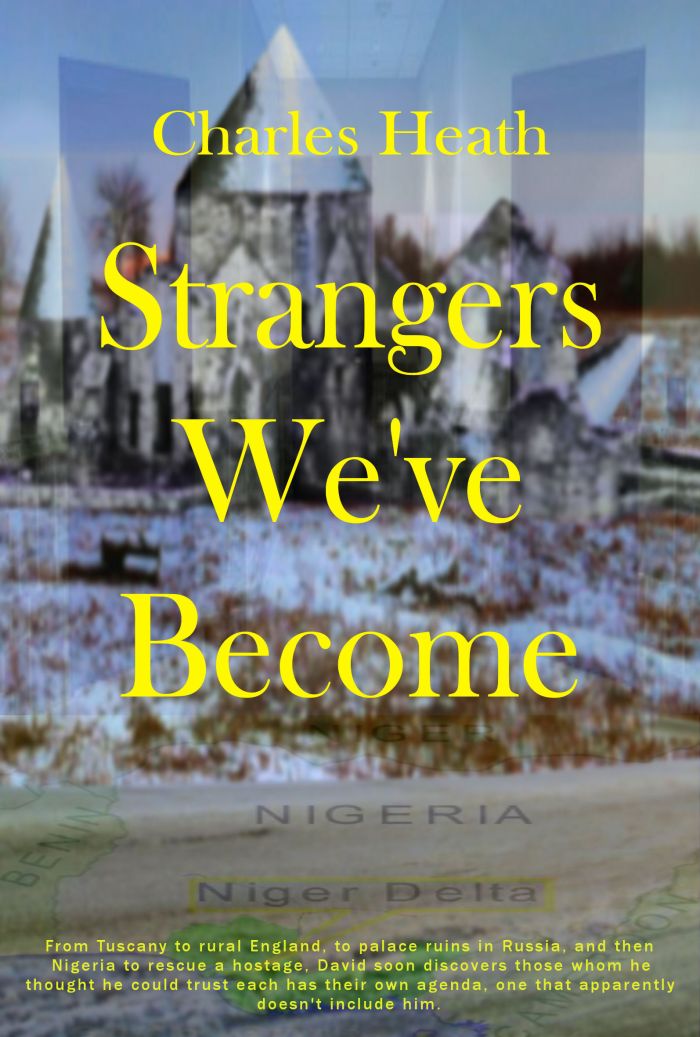
An excerpt from “Strangers We’ve Become” – Coming Soon

I wandered back to my villa.

It was in darkness.  I was sure I had left several lights on, especially over the door so I could see to unlock it.

I looked up and saw the globe was broken.

Instant alert.

I went to the first hiding spot for the gun, and it wasn’t there.  I went to the backup and it wasn’t there either.  Someone had found my carefully hidden stash of weapons and removed them.

Who?

There were four hiding spots and all were empty.  Someone had removed the weapons.  That could only mean one possibility.

I had a visitor, not necessarily here for a social call.

But, of course, being the well-trained agent I’d once been and not one to be caught unawares, I crossed over to my neighbor and relieved him of a weapon that, if found, would require a lot of explaining.

Suitably armed, it was time to return the surprise.

There were three entrances to the villa, the front door, the back door, and a rather strange escape hatch.  One of the more interesting attractions of the villa I’d rented was its heritage.  It was built in the late 1700s, by a man who was, by all accounts, a thief.  It had a hidden underground room which had been in the past a vault but was now a wine cellar, and it had an escape hatch by which the man could come and go undetected, particularly if there was a mob outside the door baying for his blood.

It now gave me the means to enter the villa without my visitors being alerted, unless, of course, they were near the vicinity of the doorway inside the villa, but that possibility was unlikely.  It was not where anyone could anticipate or expect a doorway to be.

The secret entrance was at the rear of the villa behind a large copse, two camouflaged wooden doors built into the ground.  I move aside some of the branches that covered them and lifted one side.  After I’d discovered the doors and rusty hinges, I’d oiled and cleaned them, and cleared the passageway of cobwebs and fallen rocks.  It had a mildew smell, but nothing would get rid of that.  I’d left torches at either end so I could see.

I closed the door after me, and went quietly down the steps, enveloped in darkness till I switched on the torch.  I traversed the short passage which turned ninety degrees about halfway to the door at the other end.  I carried the key to this door on the keyring, found it and opened the door.  It too had been oiled and swung open soundlessly.

I stepped in the darkness and closed the door.

I was on the lower level under the kitchen, now the wine cellar, the ‘door’ doubling as a set of shelves which had very little on them, less to fall and alert anyone in the villa.

Silence, an eerie silence.

I took the steps up to the kitchen, stopping when my head was level with the floor, checking to see if anyone was waiting.  There wasn’t.  It seemed to me to be an unlikely spot for an ambush.

I’d already considered the possibility of someone coming after me, especially because it had been Bespalov I’d killed, and I was sure he had friends, all equally as mad as he was.  Equally, I’d also considered it nigh on impossible for anyone to find out it was me who killed him because the only people who knew that were Prendergast, Alisha, a few others in the Department, and Susan.

That raised the question of who told them where I was.

If I was the man I used to be, my first suspect would be Susan.  The departure this morning, and now this was too coincidental.  But I was not that man.

Or was I?

I reached the start of the passageway that led from the kitchen to the front door and peered into the semi-darkness.  My eyes had got used to the dark, and it was no longer an inky void.  Fragments of light leaked in around the door from outside and through the edge of the window curtains where they didn’t fit properly.  A bone of contention upstairs in the morning, when first light shone and invariably woke me up hours before I wanted to.

Still nothing.

I took a moment to consider how I would approach the visitor’s job.  I would get a plan of the villa in my head, all entrances, where a target could be led to or attacked where there would be no escape.

Coming in the front door.  If I was not expecting anything, I’d just open the door and walk-in.  One shot would be all that was required.

Contract complete.

I sidled quietly up the passage staying close to the wall, edging closer to the front door.  There was an alcove where the shooter could be waiting.  It was an ideal spot to wait.

Crunch.

I stepped on some nutshells.

Not my nutshells.

I felt it before I heard it.  The bullet with my name on it.

And how the shooter missed, from point-blank range, and hit me in the arm, I had no idea.  I fired off two shots before a second shot from the shooter went wide and hit the door with a loud thwack.

I saw a red dot wavering as it honed in on me and I fell to the floor, stretching out, looking up where the origin of the light was coming and pulled the trigger three times, evenly spaced, and a second later I heard the sound of a body falling down the stairs and stopping at the bottom, not very far from me.

Two assassins.

I’d not expected that.

The assassin by the door was dead, a lucky shot on my part.  The second was still breathing.

I checked the body for any weapons and found a second gun and two knives.  Armed to the teeth!

I pulled off the balaclava; a man, early thirties, definitely Italian.  I was expecting a Russian.

I slapped his face, waking him up.  Blood was leaking from several slashes on his face when his head had hit the stairs on the way down.  The awkward angle of his arms and legs told me there were broken bones, probably a lot worse internally.  He was not long for this earth.

“Who employed you?”

He looked at me with dead eyes, a pursed mouth, perhaps a smile.  “Not today my friend.  You have made a very bad enemy.”  He coughed and blood poured out of his mouth.  “There will be more …”

Friends of Bespalov, no doubt.

I would have to leave.  Two unexplainable bodies, I’d have a hard time explaining my way out of this mess.  I dragged the two bodies into the lounge, clearing the passageway just in case someone had heard anything.

Just in case anyone was outside at the time, I sat in the dark, at the foot of the stairs, and tried to breathe normally.  I was trying not to connect dots that led back to Susan, but the coincidence was worrying me.

A half-hour passed and I hadn’t moved.  Deep in thought, I’d forgotten about being shot, unaware that blood was running down my arm and dripping onto the floor.

Until I heard a knock on my front door.

Two thoughts, it was either the police, alerted by the neighbors, or it was the second wave, though why would they be knocking on the door?

I stood, and immediately felt a stabbing pain in my arm.  I took out a handkerchief and turned it into a makeshift tourniquet, then wrapped a kitchen towel around the wound.

If it was the police, this was going to be a difficult situation.  Holding the gun behind my back, I opened the door a fraction and looked out.

No police, just Maria.  I hoped she was not part of the next ‘wave’.

“You left your phone behind on the table.  I thought you might be looking for it.”  She held it out in front of her.

When I didn’t open the door any further, she looked at me quizzically, and then asked, “Is anything wrong?”

I was going to thank her for returning the phone, but I heard her breathe in sharply, and add, breathlessly, “You’re bleeding.”

I looked at my arm and realized it was visible through the door, and not only that, the towel was soaked in blood.

“You need to go away now.”

Should I tell her the truth?  It was probably too late, and if she was any sort of law-abiding citizen she would go straight to the police.

She showed no signs of leaving, just an unnerving curiosity.  “What happened?”

I ran through several explanations, but none seemed plausible.  I went with the truth.  “My past caught up with me.”

“You need someone to fix that before you pass out from blood loss.  It doesn’t look good.”

“I can fix it.  You need to leave.  It is not safe to be here with me.”

The pain in my arm was not getting any better, and the blood was starting to run down my arm again as the tourniquet loosened.  She was right, I needed it fixed sooner rather than later.

I opened the door and let her in.  It was a mistake, a huge mistake, and I would have to deal with the consequences.  Once inside, she turned on the light and saw the pool of blood just inside the door and the trail leading to the lounge.  She followed the trail and turned into the lounge, turned on the light, and no doubt saw the two dead men.

I expected her to scream.  She didn’t.

She gave me a good hard look, perhaps trying to see if I was dangerous.  Killing people wasn’t something you looked the other way about.  She would have to go to the police.

“What happened here?”

“I came home from the cafe and two men were waiting for me.  I used to work for the Government, but no longer.  I suspect these men were here to repay a debt.  I was lucky.”

“Not so much, looking at your arm.”

She came closer and inspected it.

“Sit down.”

She found another towel and wrapped it around the wound, retightening the tourniquet to stem the bleeding.

“Do you have medical supplies?”

I nodded.  “Upstairs.”  I had a medical kit, and on the road, I usually made my own running repairs.  Another old habit I hadn’t quite shaken off yet.

She went upstairs, rummaged, and then came back.  I wondered briefly what she would think of the unmade bed though I was not sure why it might interest her.

She helped me remove my shirt, and then cleaned the wound.  Fortunately, she didn’t have to remove a bullet.  It was a clean wound but it would require stitches.

When she’d finished she said, “Your friend said one day this might happen.”

No prizes for guessing who that friend was, and it didn’t please me that she had involved Maria.

“Alisha?”

“She didn’t tell me her name, but I think she cares a lot about you.  She said trouble has a way of finding you, gave me a phone and said to call her if something like this happened.”

“That was wrong of her to do that.”

“Perhaps, perhaps not.  Will you call her?”

“Yes.  I can’t stay here now.  You should go now.  Hopefully, by the time I leave in the morning, no one will ever know what happened here, especially you.”

She smiled.  “As you say, I was never here.”

© Charles Heath 2018-2022

strangerscover9

NANOWRIMO – November 2025 – Day 18

The Third Son of a Duke

48 plus hours with Margaret can do a lot to simply not think about the war.

His plan to be in Melbourne shortly before the ship leaves is, of course, thwarted by wars and circumstances.

The ship is the Orontes.  It is real, it did leave Melbourne in April of 1915, and it had nearly 600 passengers that I can find, but these ships could take more.  It was also laden with cargo mostly for the mother country, among which would be war materials.

There are also nurses and doctors making the ship’s departure very emotional.

The time in Melbourne is spent in the Grand Hotel, and it’s not entirely clear whether he invites Margaret to stay or she invites herself, but after dinner on that first night, she is there the next morning.

It is not that sort of relationship.  Both are acutely aware of his commitment to Louise.  Margaret is just happy to be spoiled.  He is happy to spend some time with a friend before going to war.

While writing about this odd relationship, I find it hard not to romantically entangle them, but I have taken a step back and considered the ramifications of the day and age, of proprieties, and opinions of young women and the expectations of their peers.

It means having to completely block out current-day sexual mores and the sort of happy-go-lucky attitude and promiscuity that is the modern way of doing things.  Perhaps it happened then, too, but I’m trying to make this simple.

Dinner, dancing, sightseeing, being together — but not.

Of course, reading about the city I grew up in and never really seeing it for what it was then, is fascinating, and some of it is still there; that desire to replace architectural marvels with obscene glass and concrete has not yet completely taken over.

How marvellous it must have been to live in such an age.

1995 words, for a total of 29185 words.

Writing about writing a book – Day 25

We’ve been given the introduction to who Barry McDougall is, or the man otherwise known as ‘Brainless’, and after three days of trying to get it straight, this is the first rough draft of his start in the story.

Barry, whose daring selfless deeds earned him the nickname Brainless because that was the only way to describe the motivation behind them, was one of the regular soldiers, and, for a long time, had been my only true friend.  His was a reputation both friends and foes alike considered awesome.  He’d been in Vietnam, and later just turned up at Davenport’s camp, reporting for duty.

Davenport was more surprised than I was at his arrival, but obviously, after checking his credentials, he was impressed because he let him stay.  And it would be true to say, if he had not, I would not be here now.

So Barry was just the sort of person I needed to help me.

That was the good news.

The bad news was Barry, at the best of times, was either on one of his ‘benders’ using drugs or alcohol, whatever was easier to get at the time, lost to everyone, or locked up in a mental institution, having admitted himself.  He had no interest in participating in life, hadn’t worked in years, and often said, in moments when he was at his lowest, that he did not care if he lived or died.  It had not always been that way, but his demons had all but taken him over, and despite the help, I tried to give him, nothing could shake him out of this lethargy.  He said once he envied me that I could not remember the dark days, and now those memories had returned, I knew what he meant.

For a long time, I could not understand why he didn’t try harder to help himself, and I guess he humoured me by accepting the jobs I’d found him, and the help I offered.  I owed him a great deal, but that was probably the one honourable thing about him, he never expected, nor wanted, anything in return.

He tried to make a go of being a police officer and lasted several years before he resigned over an incident that didn’t reach the papers.  There was, he said, no place for heroics in modern society.  I hadn’t gotten to the bottom of it, but I heard he shot some thieves at a time when the police were trying to promote a pacifist image.

He tried a few other occupations with an equal lack of success, so now he survived on whatever money I gave him.  He lived on the street, and when he was not there, I knew he could be found in a bar, in one of the seedier parts of the city, a ubiquitous underground bar called Jackson’s, named after a man who had a salubrious reputation that hovered between load shark and saint, and who was reputed to be buried under the storeroom floor.  The present owner, or what I assumed to be the owner, was a large, gruff, ex-prizefighter, who had the proverbial heart of gold, most of the time, and who took my money and looked after Barry without making it look like he was.

I’d called the bartender in advance, and he said he was in his usual spot, and that it was at the start of the next cycle, having just discharged himself from the hospital after a bout of pneumonia.  It was, he said, getting worse, and taking longer to recover.

It was probably only a matter of time before it took him, so perhaps this time I would have to try harder to convince him to give up his nomadic lifestyle.

When I walked in, the aroma of spilled beer, stale sweat, and vomit, mingled with the industrial-strength carbolic cleaner almost took my breath away.  In the corner, two construction workers were sitting, quietly smoking and drinking large glasses of beer.  In the other, Barry was being held up by the table, an untouched double scotch sitting in front of him.  Sitting at the bar was a woman of indeterminate age, badly made up, and thin to the point of emaciation.  I was not sure what she was drinking, or what it was she was smoking, but I could smell it from the front doorway.

The bartender, Ogilvy, no first name given, was pretending to polish glasses, standing at the end of the bar, looking at the television, and playing some daytime soap.  He didn’t look over when I came in, but I knew he didn’t miss anything.  I saw him flick a glance at Barry, and then shake his head.  I think he cared as much about Barry as I did but could recognise the sadness within him.  As much as Ogilvy said, which wasn’t much, he too had seen service in Vietnam, and it had affected him too.

I ordered an orange juice, caught glances from the construction workers, and a steely look from the woman, and then went over to Barry’s table and sat down.  Despite the loud scraping noise when I moved the chair, or the creaking as I sat in it, Barry didn’t move.

Whilst the bar had that seedy aroma, Barry was showing the signs of having spent time on the street.  It was one of the disadvantages of having no permanent residence and though there was a shower at the bar which Ogilvy let Barry use from time to time, he obviously hadn’t for a few days.

Getting all of this background in shape is hard work, and having toiled long and hard, tomorrow I’ll have a go at getting Barry back.

© Charles Heath 2016-2025

The cinema of my dreams – I never wanted to go to Africa – Episode 41

Our hero knows he’s in serious trouble.

The problem is, there are familiar faces and a question of who is a friend and who is foe made all the more difficult because of the enemy, if it was the enemy, simply because it didn’t look or sound or act like the enemy.

Now, it appears, his problems stem from another operation he participated in, and because of it, he has now been roped into what might be called a suicide mission.


“That was far to bloody easy.”  I heard Monroe’s voice come over the radio, not long after we left the camp.

“It was a bit easier than I thought.  But I did make it quite clear if we didn’t all leave in one piece we’d reduce his camp to rubble with everyone in it.”

“He knows the territory.  Something’s waiting for us out here.”

Something indeed.

Back at the camp, not only had the commander’s men search for the hidden weapons, and, when everyone checked, were still there, they had also taken off the crates with the film equipment.  I was not sure what the commander was intending to do with the equipment, but what disappointed me was the fact we hadn’t taken the time to rescue the rocket launcher.

Now the commander had it.

If he bothered to search the crates properly.  I suspect he was yet to do so.  What we had rescued and successfully hidden were the C4 explosives and detonators.  They might come in useful at the airstrip.

Just before we reached the fork in the road, where we would be turning left to head towards the airfield, and surprisingly had not run into any of the commander’s men, we stopped and let Monroe and Shurl out to make a sweep towards the airstrip, not too far away.

I also called up Mobley to see how he was.

The Colonel answered.  “Everything is under control now.”

I didn’t like the sound of that.  “What happened?”

“The kidnappers send out a team to intercept us on the way to the airstrip.  It wasn’t a stretch to imagine they would know what we were planning because they’d know we would not be retracing out steps to Uganda.  Got them before they got a shot off.  I suspect there are Government troops at the airstrip, it’s too important to let anything happen to rich foreigners coming to see their wildlife reserve.  There are several troop carriers, and we’ve seen a few men on the outskirts patrolling.  There’s several at the gate if you could call it that.”

“Is there a plane there?”

“As it happens there is.  A grand old DC3.  It’s not a charter plane, so I’m guessing it belongs to an overentitled American big game hunter or the photographic variety.  At least I’m hoping that’s the case.”

“What do you recommend?”

“Not to storm the field.  You’re going to have to find another means of getting here, preferably without any fanfare.”

My first choice was to go in and get out, with as little firefight as possible, particularly in case they started shooting at the plane.  If I was reading between the lines properly, the Colonel was telling me there were more troops there than we could handle quickly and quietly.

“Very good.  Can you get sight on just how many troops are there, and if you can see who’s in charge?”

“Will try.”

Monroe had been standing next to me during the exchange.

“Three in place, two more on the perimeter, if we can cover as many as possible, you might be able to take the rest from the inside.”

Secreting the weapons again, maybe.  It was a possibility, but going in with hidden weapons, and then found by the guards at the gate, who would be more efficient and careful searchers than the kidnappers, it would create hostility and itchy trigger fingers.

“No.  We have to find some way of letting them feel as though they have complete control of the situation.  They know we’re coming; the commander would have told them.”  The only reason why he was still the cat who ate the canary.  He might even have told them he had some men waiting as the first line of defense.

The airstrip commander would then know we were armed and relatively dangerous.

It was time for yet another dangerous gambit.

I picked up the radio.  “Colonel?”

A second later, “Sergeant?”

“Whatever happens in the next twenty minutes or so, just ignore it.  It’s not much of a plan, but it will get us onto the field.”

“And then?”

“Hopefully some divine intervention.”

Monroe looked skeptical.  “You’re going to just drive up to the gate and surrender?”

“Not exactly.  It won’t be fait accompli until we reach the terminal, or hanger, or whatever the commander has set up as headquarters.  They’ll have most of our weapons, yes.  But they won’t have all of us.”

“No.  But they’ll know we have a sniper, so one of you are going to have to allow yourself to be captured, just to ease their minds.”

“Leaving one of us and Mobley and the Ugandans.  Can we trust them?”

“I hope so, otherwise this could go badly.  But, today, I’m an optimist.  We’ve got this far.”

Trying to show more confidence in the plan that I had.  It was always a worry when you had to trust people you didn’t know.  That had been the problem the last time.  At least this time we had managed to get the hostages.  It was always going to be a problem getting them out.

Monroe gave me one of her special, you’re a fool, looks.  “I hope you know what you’re doing.”  She then nodded in Shurl’s direction and they disappeared into the bush again.

I gestured to Davies to come over.

“Did you find out what sort of plane it is?”

“Hopefully.  The Colonel tells men there’s a DC3 off the airstrip.  I assume you can fly one.”

She smiled, the first time since this operation had started.  “Sure can.  I spent three summers putting one back together.  My dad has a sort of airplane museum.  A DC3, a DC4, and a Lancaster, a very sorry looking Lancaster at that.  Shouldn’t be a problem.”

“Then try to not get shot.”

“Do my very best not to.”

Once again, it was time to go.  Going into the unknown was getting to be the norm, but hopefully, this would be the last time.  I didn’t consider it wise to advise the hostages, they had their own problems to worry about.


© Charles Heath 2020

Writing a book in 365 days – My Story 46

More about my story – And more on the subject of Beta readers!

The Beta Reader Gauntlet: Navigating Feedback That Feels Like a Punch to the Gut

Here’s the thing.

Every writer knows this quiet dread, this cold sweat moment that hits long before the manuscript is even finished: What if the beta readers find a fundamental flaw in the story? What if the very foundations you’ve painstakingly laid turn out to be cracked, crumbling, or just plain wonky?

It’s a terrifying thought, but let’s be honest with ourselves: it’s a very real possibility.

The Unseen Chaos of Creation

When you’re deep in the trenches of writing, especially over an extended period, the process itself can create inconsistencies. We’ve all been there:

  • Disjointed Aspects: Plot threads we thought we’d tied up suddenly unravel, or new ones appear from nowhere, leaving logical gaps.
  • Character Trait Drift: Isabel started as a shy introvert, but by chapter 15, she’s leading the charge and cracking jokes. Did she have an arc, or did we just forget her initial persona?
  • Name Changes & Forgotten Details: That minor character, Officer Jenkins, who mysteriously became Sergeant Miller a few chapters later. Or the key plot point about a missing locket, which was actually a ring earlier in the draft.
  • Lost Flow: Life happens. We write in bursts, in fragments, around jobs and families. The initial spark, the driving rhythm of the narrative, can get fragmented, leaving jarring transitions or a meandering pace.

These internal shifts, often invisible to our own eyes because we’re so close to the material, are precisely what beta readers are designed to unearth. And boy, can that unearthing feel brutal.

The Character Conundrum: Loved vs. Loathed

Then there’s the beloved protagonist. You’ve poured your heart and soul into them. They’re complex, relatable, flawed – everything a great character should be. You send your manuscript out, excited for feedback, only to get this:

“I absolutely adore Elara! She’s so resilient and genuine.” …followed by… “Honestly, Elara was pretty annoying. I found her whiny and self-absorbed.”

Is there something wrong with your character? Is the conflicting feedback a sign of a fundamental flaw, or simply a matter of taste? This is where the true beta reader dilemma kicks in.

It’s tempting to panic, to immediately question everything you thought you knew about your protagonist. But before you rewrite their entire personality, let’s unpack this.

The Truth About Character Reception: No character, no matter how perfectly crafted, will be universally loved. Some of the most iconic characters in literature and film are divisive for a reason – their complexity sparks strong opinions. The goal isn’t universal adoration; it’s usually about creating a character who resonates meaningfully with your intended audience, or who effectively serves their role in the story.

Ask Deeper Questions:

  • Why did they find them annoying/likable? Is the “annoying” feedback due to genuine inconsistency or a lack of motivation for their actions? Or is it because the character embodies traits that simply rub that particular reader the wrong way (which might be the point of the character)?
  • Does the character achieve their intended purpose? If your character is meant to be a bit abrasive at first, but grows, then initial annoyance might not be a flaw. If they’re meant to be inspiring, and everyone finds them annoying, that’s a problem.
  • Is there a pattern? If one person finds them annoying and ten others love them, perhaps it’s an outlier opinion. If six out of ten find them annoying, it’s time to investigate further.

The Million-Dollar Question: At What Point Do You Consider Changes?

This is the ultimate balancing act of the beta reader process. You can’t implement every single suggestion, or your story will become a disjointed Frankenstein’s monster. But you also can’t dismiss everything.

Here’s a framework for deciding when to make changes:

  1. Look for Patterns, Not Just Individual Comments: If multiple beta readers (especially those with diverse reading tastes) highlight the same plot hole, character inconsistency, confusing timeline, or pacing issue, pay attention. This is a flashing red light. A single comment might be an anomaly; a pattern is a problem.
  2. Does It Resonate with Your Gut? Often, when a beta reader points out a flaw, there’s a quiet voice in the back of your head that says, “Yeah, I kind of knew that.” Trust that feeling. If the feedback confirms a nagging doubt you already had, it’s likely a change worth making.
  3. Distinguish Between “Preference” and “Problem”:
    • Preference: “I wish the villain had a different motivation,” or “I prefer faster pacing.” These are subjective. Consider them, but don’t feel obligated to change unless they align with a broader pattern or your own vision.
    • Problem: “I didn’t understand why the character did X, it felt out of character,” or “The plot felt like it stopped completely in the middle section.” These indicate a structural or logical issue that needs addressing.
  4. Consider the Scope:
    • Fundamental Flaws: Issues with plot, character arc, world-building logic, or core themes require significant attention. These are the “punch to the gut” feedbacks that, while painful, are vital to fix. They often require rewriting entire sections.
    • Mid-Level Issues: Pacing problems, confusing descriptions, minor character inconsistencies. These might require trimming, expanding, or clearer exposition.
    • Minor Edits: Typos, grammatical errors, word choices. These are easily fixable during the copyediting stage.
  5. Give Yourself Time: Don’t react immediately. Read all the feedback, then walk away for a few days (or even a week). Let your emotions settle. When you return, you’ll be able to assess the comments more objectively.

The beta reader process is less about them finding flaws and more about them helping you find the strongest version of your story. It’s a crucible, yes, but one that hones your craft and your manuscript. Embrace the chaos, learn from the feedback, and have the courage to make the changes that will truly elevate your narrative. Your stronger story (and thicker skin) will thank you for it.

Top 5 sights on the road less travelled – Riga

Beyond the Crowds: Riga’s Top 5 Distinctive & Unforgettable Hidden Gems

Riga. The name itself conjures images of cobblestone streets, vibrant Art Nouveau facades, and the bustling energy of its UNESCO-listed Old Town. And while these iconic sights are undoubtedly charming, sometimes the most profound travel experiences are found just a little off the well-trodden path.

For the discerning traveller who yearns for authenticity without the elbow-to-elbow crowds, who seeks distinctive features and stories that resonate long after the trip is over, Riga holds a treasure trove of quieter wonders. So, put down that mainstream guide and join me on a journey to uncover five visitor attractions in Riga that promise unique character and peaceful exploration.


1. The Zanis Lipke Memorial: A Testament to Humanity

More than just a museum, the Zanis Lipke Memorial is a profound architectural and emotional experience. Hidden away on Ķīpsala island, this striking black tarred wooden structure resembles an inverted Noah’s Ark, built directly over the secret bunker where Zanis Lipke, a dockworker, hid and saved over 50 Jews from the Holocaust during WWII.

Distinctive Features: The building itself is an architectural marvel – stark, symbolic, and deeply moving. Inside, a narrow, dark passage leads down into the actual bunker, immersing you in the chilling reality of those hidden. The design perfectly complements the powerful story of courage and sacrifice, creating a space for quiet introspection and remembrance. It’s rarely crowded, allowing you to absorb its sombre beauty and the incredible human spirit it honours at your own pace.

2. The Latvian Ethnographic Open-Air Museum: A Walk Through Time

Escape the city entirely and step into rural Latvia from centuries past at the Latvian Ethnographic Open-Air Museum. Sprawling across a vast, picturesque forest on the shores of Lake Jugla, this is one of Europe’s largest open-air museums. It features nearly 120 traditional Latvian buildings – farmsteads, churches, windmills, and fishing villages – painstakingly moved from various regions of Latvia and reconstructed here.

Distinctive Features: Each building tells a story, showcasing the lifestyle, crafts, and traditions of Latvian peasants, fishermen, and artisans from the 17th to the 20th centuries. You can wander through authentic homes, see traditional tools, and often witness artisans demonstrating ancient crafts. Due to its sheer size and slightly out-of-the-way location (easily reachable by bus), it rarely feels crowded, offering ample space to stroll, reflect, and enjoy the tranquil natural surroundings. It’s a living history book under the open sky.

3. Kalnciema Quarter: Wooden Architecture & Bohemian Vibes

While parts of Riga are famous for Art Nouveau, the Kalnciema Quarter offers a different, equally captivating architectural experience: beautifully restored wooden buildings. This charming neighbourhood, a bit west of the Old Town, is a vibrant cultural hub, especially on weekends.

Distinctive Features: The cluster of meticulously renovated 19th-century wooden houses, each with intricate carvings and pastel hues, creates an almost fairytale-like atmosphere. Beyond the architecture, the quarter hosts organic food and craft markets, open-air concerts, art exhibitions, and pop-up cafes – all within a relaxed, community-focused setting. While market days bring a lively buzz, it’s a far cry from the tourist throngs, offering a genuine glimpse into Riga’s modern bohemian culture against a stunning historical backdrop.

4. The Corner House (KGB Museum): A Chilling Echo of the Past

For a powerful and sobering experience, visit “The Corner House” (Stūra Māja), the former headquarters of the Soviet KGB in Latvia. This imposing building, now a museum, is a stark reminder of Latvia’s turbulent 20th century.

Distinctive Features: A visit here is not just about exhibits; it’s about walking through history. You can explore the original cells, interrogation rooms, the former waiting rooms, and the chilling exercise yard. The atmosphere is sombre and reflective, offering a raw and unfiltered look at the methods and impact of the Soviet regime. While popular, the nature of the visit (often guided tours through specific areas) means it rarely feels overwhelmingly crowded, allowing for a deeply personal engagement with this poignant piece of history.

5. Miera Iela & The Great Cemetery: Artisanal Charm Meets Serene History

Combine two distinctive, less-trafficked experiences by exploring Miera Iela (Peace Street) and its adjacent Great Cemetery. Miera Iela has earned the nickname “hipster street” for its collection of independent cafes, artisan boutiques, small art galleries, and vintage shops.

Distinctive Features: Miera Iela offers a refreshing contrast to the Old Town, showcasing Riga’s contemporary, creative pulse. Stroll, grab a coffee, browse unique items. Just a stone’s throw away, you’ll find the Great Cemetery (Lielie Kapi). Far from morbid, this historic cemetery is a sprawling, peaceful park adorned with magnificent sculptures, grand mausoleums, and ancient trees. It’s a place of quiet beauty and historical significance, where many notable Latvians are laid to rest, and where you can enjoy a serene walk amidst stunning funerary art and natural tranquillity, almost always in solitude.


Riga is a city that keeps on giving, especially when you’re willing to venture slightly off the beaten path. These five distinctive attractions offer not just sights, but stories, emotions, and a deeper connection to the heart of Latvia, all within the tranquil embrace of fewer crowds.

Have you visited any of these hidden gems in Riga, or found other distinctive, uncrowded spots? Share your experiences in the comments below!

What I learned about writing – Trying not to get into a ‘rut’

I feel like I’m on the outside looking in at this poor fellow struggling to work out what needs to be done, and in the end, getting nothing done.

Writing had suddenly become all that more difficult to do, not because I can’t, there’s an endless supply of ideas running around in my head, it’s just wanting to sit down and do it.

What are my expectations? 

I had set a list of projects I wanted to work on, more episodes for the three continuing stories, and a start to the next episodic story, ‘motive, means, and opportunity’, though for this story I have brought together all the writing I’ve been doing in past few months.

Then there is the completion of ‘the things we do for love’ which at long last now has a completed second draft with a lot of updates and changes to properly reflect the situation of the characters.  I have also got ‘strangers we’ve become’ to a point where it can finally get editorial sign-off. Publishing is not far away after that.

It would be easy to blame COVID 19 for the delays or the lack of commitment to the task, but that’s not the problem.  I’ve been home and had the time, but there have been a number of distractions, and ideas for new stories always seem to divert my attention from what I should be doing.

It’s not writer’s block.  It’s not laziness.  It seems that I just don’t have the time to work on them, and that might be because my subconscious is telling me there are problems with the narrative, and I’m just not ready to address them.

What has got my attention then?

I’m not sure how or why, but something triggered the idea of passing through a portal into another time, in the past.  I think I might have been looking for photographs to write another photo/story, and I came across a covered bridge, and which led to looking for photographs of ghost towns.  What topped it off, there was an old western in black and white, High Noon, which provoked a whole lot of memories of many westerns I’d seen in the past.

What other reason do you need to write your own story?

Then, when visiting my grandchildren, we just happened to do some stargazing, using Google Sky Map, picking out the planets.  Somehow I managed to take a photo, and looking at it, took me back to the days of Star Trek, and the many series, which sort of gave me an idea for another story, which has been running off and on over the last few months.

Equally, I’m always on the lookout for photo opportunities that I can use to write short stories, and these continue apace, the latest, number 150.  These are being formed into anthologies, stories 1 to 50, and stories 51 to 100.  The first has been assembled into book form and is awaiting the editor’s first reading and report.  I’m still working on the second.

And, now there is the next, stories 101 to 150.

Perhaps some of the time has been spent keeping up with Twitter, where over the last six months, and more recently, sales of my books on Amazon have been increasing.  Not to best-seller numbers, but people are reading my stories, and the reviews have been very good.

It has, of course, pushed me to work harder on marketing and that has consumed some of my time, which unfortunately takes me away from writing.  It sometimes feels like a self-defeating exercise, but it is the same for all of us.

Oh, and something else that cropped up this month, my brother has been digging into our family history, and around the middle of the month, he found some interesting revelations about some family members, including a pseudo-Luddite that ended up in Tasmania of all places, and then later on, when chasing down the places that we, as a family, lived, and this brought out some very interesting information about our father.

I’m discovering for what I’d always assumed was an ordinary man, he had done a lot of very interesting things in his life, and not only that, I’ve been fictionalizing the story.  I have potted pieces written over various stages, and, one day, it might come together as a sort of biography.  It is astonishing just how much you don’t know about your family, until much later on, at least for some of us.  Our relatives have always been a mystery to me, and it’s fascinating as each one is brought to life with a new detail here and there.

Looking back on what I’ve just written, perhaps the passing of time had been more productive than I first thought.  It just seems like nothing major has happened.

Another excerpt from ‘Betrayal’; a work in progress

My next destination in the quest was the hotel we believed Anne Merriweather had stayed at.

I was, in a sense, flying blind because we had no concrete evidence she had been there, and the message she had left behind didn’t quite name the hotel or where Vladimir was going to take her.

Mindful of the fact that someone might have been following me, I checked to see if the person I’d assumed had followed me to Elizabeth’s apartment was still in place, but I couldn’t see him. Next, I made a mental note of seven different candidates and committed them to memory.

Then I set off to the hotel, hailing a taxi. There was the possibility the cab driver was one of them, but perhaps I was slightly more paranoid than I should be. I’d been watching the queue, and there were two others before me.

The journey took about an hour, during which time I kept an eye out the back to see if anyone had been following us. If anyone was, I couldn’t see them.

I had the cab drop me off a block from the hotel and then spent the next hour doing a complete circuit of the block the hotel was on, checking the front and rear entrances, the cameras in place, and the siting of the driveway into the underground carpark. There was a camera over the entrance, and one we hadn’t checked for footage. I sent a text message to Fritz to look into it.

The hotel lobby was large and busy, which was exactly what you’d want if you wanted to come and go without standing out. It would be different later at night, but I could see her arriving about mid-afternoon, and anonymous among the type of clientele the hotel attracted.

I spent an hour sitting in various positions in the lobby simply observing. I had already ascertained where the elevator lobby for the rooms was, and the elevator down to the car park. Fortunately, it was not ‘guarded’ but there was a steady stream of concierge staff coming and going to the lower levels, and, just from time to time, guests.

Then, when there was a commotion at the front door, what seemed to be a collision of guests and free-wheeling bags, I saw one of the seven potential taggers sitting by the front door. Waiting for me to leave? Or were they wondering why I was spending so much time there?

Taking advantage of that confusion, I picked my moment to head for the elevators that went down to the car park, pressed the down button, and waited.

The was no car on the ground level, so I had to wait, watching, like several others, the guests untangling themselves at the entrance, and an eye on my potential surveillance, still absorbed in the confusion.

The doors to the left car opened, and a concierge stepped out, gave me a quick look, then headed back to his desk. I stepped into the car, pressed the first level down, the level I expected cars to arrive on, and waited what seemed like a long time for the doors to close.

As they did, I was expecting to see a hand poke through the gap, a latecomer. Nothing happened, and I put it down to a television moment.

There were three basement levels, and for a moment, I let my imagination run wild and considered the possibility that there were more levels. Of course, there was no indication on the control panel that there were any other floors, and I’d yet to see anything like it in reality.

With a shake of my head to return to reality, the car arrived, the doors opened, and I stepped out.

A car pulled up, and the driver stepped out, went around to the rear of his car, and pulled out a case. I half expected him to throw me the keys, but the instant glance he gave me told him was not the concierge, and instead brushed past me like I wasn’t there.

He bashed the up button several times impatiently and cursed when the doors didn’t open immediately. Not a happy man.

Another car drove past on its way down to a lower level.

I looked up and saw the CCTV camera, pointing towards the entrance, visible in the distance. A gate that lifted up was just about back in position and then made a clunk when it finally closed. The footage from the camera would not prove much, even if it had been working, because it didn’t cover the life lobby, only in the direction of the car entrance.

The doors to the other elevator car opened, and a man in a suit stepped out.

“Can I help you, sir? You seem lost.”

Security, or something else. “It seems that way. I went to the elevator lobby, got in, and it went down rather than up. I must have been in the wrong place.”

“Lost it is, then, sir.” I could hear the contempt for Americans in his tone. “If you will accompany me, please.”

He put out a hand ready to guide me back into the elevator. I was only too happy to oblige him. There had been a sign near the button panel that said the basement levels were only to be accessed by the guests.

Once inside, he turned a key and pressed the lobby button. The doors closed, and we went up. He stood, facing the door, not speaking. A few seconds later, he was ushering me out to the lobby.

“Now, sir, if you are a guest…”

“Actually, I’m looking for one. She called me and said she would be staying in this hotel and to come down and visit her. I was trying to get to the sixth floor.”

“Good. Let’s go over the the desk and see what we can do for you.”

I followed him over to the reception desk, where he signalled one of the clerks, a young woman who looked and acted very efficiently, and told her of my request, but then remained to oversee the proceeding.

“Name of guest, sir?”

“Merriweather, Anne. I’m her brother, Alexander.” I reached into my coat pocket and pulled out my passport to prove that I was who I said I was. She glanced cursorily at it.

She typed the name into the computer, and then we waited a few seconds while it considered what to output. Then, she said, “That lady is not in the hotel, sir.”

Time to put on my best-confused look. “But she said she would be staying here for the week. I made a special trip to come here to see her.”

Another puzzled look from the clerk, then, “When did she call you?”

An interesting question to ask, and it set off a warning bell in my head. I couldn’t say today, it would have to be the day she was supposedly taken.

“Last Saturday, about four in the afternoon.”

Another look at the screen, then, “It appears she checked out Sunday morning. I’m afraid you have made a trip in vain.”

Indeed, I had. “Was she staying with anyone?”

I just managed to see the warning pass from the suited man to the clerk. I thought he had shown an interest when I mentioned the name, and now I had confirmation. He knew something about her disappearance. The trouble was, he wasn’t going to volunteer any information because he was more than just hotel security.

“No.”

“Odd,” I muttered. “I thought she told me she was staying with a man named Vladimir something or other. I’m not too good at pronouncing those Russian names. Are you sure?”

She didn’t look back at the screen. “Yes.”

“OK, now one thing I do know about staying in hotels is that you are required to ask guests with foreign passports their next destination, just in case they need to be found. Did she say where she was going next?” It was a long shot, but I thought I’d ask.

“Moscow. As I understand it, she lives in Moscow. That was the only address she gave us.”

I smiled. “Thank you. I know where that is. I probably should have gone there first.”

She didn’t answer; she didn’t have to, her expression did that perfectly.

The suited man spoke again, looking at the clerk. “Thank you.” He swivelled back to me. “I’m sorry we can’t help you.”

“No. You have more than you can know.”

“What was your name again, sir, just in case you still cannot find her?”

“Alexander Merriweather. Her brother. And if she is still missing, I will be posting a very large reward. At the moment, you can best contact me via the American Embassy.”

Money is always a great motivator, and that thoughtful expression on his face suggested he gave a moment’s thought to it.

I left him with that offer and left. If anything, the people who were holding her would know she had a brother, that her brother was looking for her, and equally that brother had money.

© Charles Heath – 2018-2025

Top 5 sights on the road less travelled – Oslo

Oslo’s Quiet Gems: 5 Distinctive Attractions That Skip the Tourist Crowds

Oslo is a city defined by breathtaking fjords, modern architectural marvels, and world-class museums. While favourites like the Opera House and the bustling Vigeland Sculpture Park deserve their accolades, sometimes the best travel memories are forged in the quiet corners—those distinctive spots overlooked by the masses.

If you are seeking authenticity, tranquillity, and attractions that offer a truly unique Norwegian flavour without the elbow-to-elbow experience, put down the guidebook and follow our list.

Here are five distinctive Oslo attractions where you can slow down and savour the discovery.


1. Ekebergparken (Ekeberg Sculpture Park)

While Oslo has many incredible viewpoints, few combine panoramic vistas with world-class contemporary art quite like Ekebergparken. Located on the hillside southeast of the city centre, this park is less of a museum and more of an experience.

What Makes it Distinctive? The park features works by international greats like James Turrell, Marina Abramović, and Louise Bourgeois, cleverly integrated into the natural forest landscape. Beyond the art, the site itself is historically significant, featuring ancient rock carvings and WWII bunkers. Critically, these park trails offer one of the best and least crowded settings for capturing the iconic view immortalised in Edvard Munch’s “The Scream.”

Why It’s Uncrowded: It requires a short tram ride up the hill (Line 18 or 19 to Ekebergparken stop), which deters many tourists from sticking solely to the central harbour area.


2. The Emanuel Vigeland Mausoleum

Prepare yourself for a truly unique, slightly macabre, and deeply rewarding experience. While Gustav Vigeland’s towering statues draw millions, his highly eccentric brother Emanuel created a private, haunting masterpiece—his own mausoleum and final resting place.

What Makes it Distinctive? The entire interior of the small, unmarked structure is a dark, barrel-vaulted room adorned with frescoes collectively titled Vita (Life). The ceiling-to-floor artwork depicts dramatic, often heavy themes of human life, death, and sexuality. The atmosphere is deliberately intense: the lights are kept very low, and the acoustics are so sensitive that a caretaker politely requests silence to enhance the feeling of solemn isolation.

Why It’s Uncrowded: It has extremely limited opening hours (usually Sunday afternoons only), making it challenging to visit—which is exactly why it remains a hidden gem for dedicated travellers.


3. Hovedøya Island (The Main Island)

For an immediate escape from city life, hop on a short ferry ride (Boat B1, B2, B3, or B4) from Aker Brygge and head to Hovedøya, the largest and most historically rich island in the Oslo Fjord.

What Makes it Distinctive? Hovedøya offers a perfect blend of lush nature, bathing spots, and fascinating ruins. Within minutes of arriving, you can explore the preserved Cistercian monastery ruins dating back to 1147. Later, the island served as a military base, and you can still find remnants of old defensive structures. Wander the trails, enjoy a picnic by the water, or simply study the medieval stone walls, all while enjoying the crisp fjord air.

Why It’s Uncrowded: While popular with Oslo locals in the height of summer, international tourists often overlook the entire island system in favour of mainland attractions. The short boat journey feels like a genuine adventure but keeps the large tour groups away.


4. Damstredet and Telthusbakken

While Oslo is a modern capital, pockets of its wooden house past remain beautifully preserved. A short walk uphill from the central areas of the city brings you to the charming, picturesque streets of Damstredet and Telthusbakken.

What Makes it Distinctive? These two winding cobblestone streets feel like stepping into a storybook. Lined with perfectly maintained, brightly colored wooden houses from the 18th and 19th centuries, the whole atmosphere speaks of quiet history. Damstredet in particular offers splendid photo opportunities and a glimpse into how many Oslo residents lived before the major urban modernisation programs.

Why It’s Uncrowded: This attraction is purely residential and free. It requires no ticket and isn’t featured on organised group tours. It’s a perfect addition to a self-guided walking tour between the city centre and the tranquil Vår Frelser Cemetery (another quiet spot worth stopping at).


5. The Tøyen Botanical Garden (Botanisk Hage)

Located just outside the buzzing central districts in the Tøyen neighbourhood, Oslo’s Botanical Garden is a serene and scientifically significant outdoor museum that most tourists walk right past on their way to the newer attractions.

What Makes it Distinctive? Managed by the Natural History Museum, the garden is Norway’s oldest and most diverse living collection. Visitors can explore various climate zones within the beautiful Palm House and the Victoria House (home to massive water lilies). The highlight is often the peaceful Scent Garden, designed specifically for the visually impaired, and the historic Old Garden, showcasing plants used for food and medicine throughout Norwegian history.

Why It’s Uncrowded: Despite its beauty and central location near the Munch Museum, the garden offers ample space and shaded trails, meaning the large foot traffic in the area quickly dissipates once you enter the gates. It’s a perfect green lung for contemplation.


Seeking the Authentic Oslo

By prioritizing these five distinctive, yet uncrowded, locations, you gain a deeper understanding of Oslo’s rich history, its commitment to art integration, and the beautiful relationship Norwegians have with their surrounding nature.

Skip the queue, find your quiet corner, and enjoy the authentic pulse of this incredible Nordic capital.


Have you discovered a quiet spot in Oslo that you love? Share your hidden gem in the comments below!

“Sunday in New York”, a romantic adventure that’s not a walk in the park!

“Sunday in New York” is ultimately a story about trust, and what happens when a marriage is stretched to its limits.

When Harry Steele attends a lunch with his manager, Barclay, to discuss a promotion that any junior executive would accept in a heartbeat, it is the fact his wife, Alison, who previously professed her reservations about Barclay, also agreed to attend, that casts a small element of doubt in his mind.

From that moment, his life, in the company, in deciding what to do, his marriage, his very life, spirals out of control.

There is no one big factor that can prove Harry’s worst fears, that his marriage is over, just a number of small, interconnecting events, when piled on top of each other, points to a cataclysmic end to everything he had believed in.

Trust is lost firstly in his best friend and mentor, Andy, who only hints of impending disaster, Sasha, a woman whom he saved, and who appears to have motives of her own, and then in his wife, Alison, as he discovered piece by piece damning evidence she is about to leave him for another man.

Can we trust what we see with our eyes or trust what we hear?

Haven’t we all jumped to conclusions at least once in our lives?

Can Alison, a woman whose self-belief and confidence is about to be put to the ultimate test, find a way of proving their relationship is as strong as it has ever been?

As they say in the classics, read on!

Purchase:

http://tinyurl.com/Amazon-SundayInNewYork