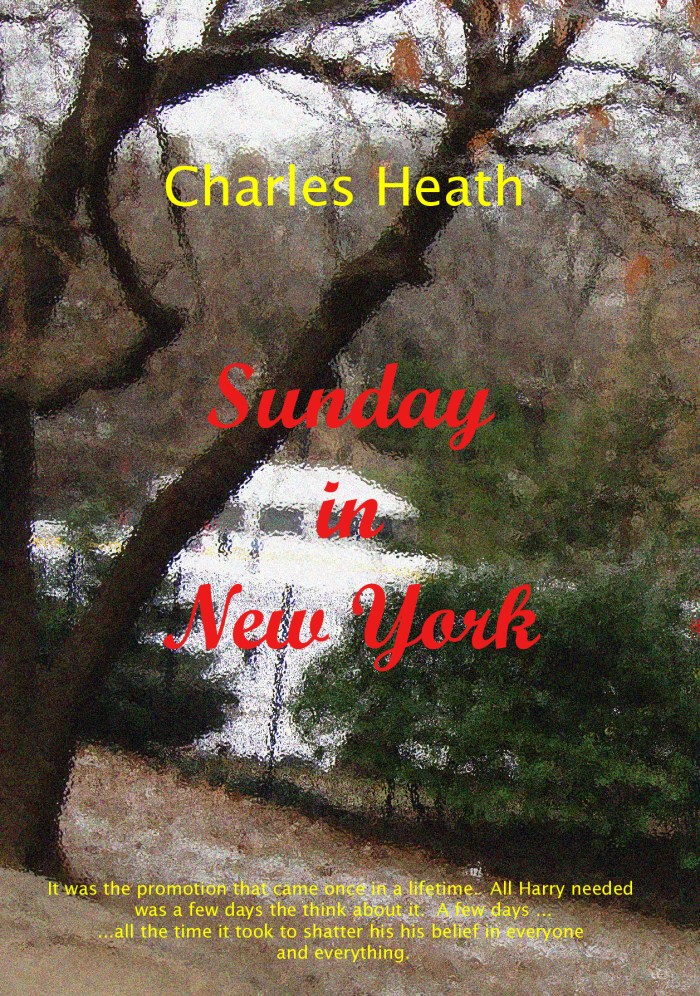
“Sunday in New York”, a romantic adventure that’s not a walk in the park!

“Sunday in New York” is ultimately a story about trust, and what happens when a marriage is stretched to its limits.

When Harry Steele attends a lunch with his manager, Barclay, to discuss a promotion that any junior executive would accept in a heartbeat, it is the fact his wife, Alison, who previously professed her reservations about Barclay, also agreed to attend, that casts a small element of doubt in his mind.

From that moment, his life, in the company, in deciding what to do, his marriage, his very life, spirals out of control.

There is no one big factor that can prove Harry’s worst fears, that his marriage is over, just a number of small, interconnecting events, when piled on top of each other, points to a cataclysmic end to everything he had believed in.

Trust is lost firstly in his best friend and mentor, Andy, who only hints of impending disaster, Sasha, a woman whom he saved, and who appears to have motives of her own, and then in his wife, Alison, as he discovered piece by piece damning evidence she is about to leave him for another man.

Can we trust what we see with our eyes or trust what we hear?

Haven’t we all jumped to conclusions at least once in our lives?

Can Alison, a woman whose self-belief and confidence is about to be put to the ultimate test, find a way of proving their relationship is as strong as it has ever been?

As they say in the classics, read on!

Purchase:

http://tinyurl.com/Amazon-SundayInNewYork

Third son of a Duke – The research behind the story – 4

All stories require some form of research, quite often to place a character in a place at a particular time, especially if it is in a historical context. This series will take you through what it was like in 1914 through 1916.

Setting Sail for Adventure: Decorum and Debauchery in Second Class, 1914

The modern cruise ship, with its all-you-can-eat buffets and poolside revelry, often conjures images of an exuberant, perhaps even uninhibited, youth. It’s easy to imagine young adults embracing a spirit of “live for the moment” on a contemporary voyage. But what about their ancestors, embarking on a similar, albeit far more arduous, journey a century ago? Specifically, what were the acceptable social norms for young people travelling in second class from England to Australia in 1914, and how might they have comported themselves, a world away from today’s cruise ship scene?

The very idea of “acceptable social norms” in 1914 is a stark contrast to our contemporary understanding. Society was far more rigid, with deeply ingrained expectations regarding behaviour, dress, and social interaction, especially for young, unmarried individuals. The journey from England to Australia, often a voyage lasting weeks and involving significant time in close quarters, would have been a microcosm of these societal standards.

Second Class in 1914: A Different Kind of Journey

First class, of course, was the domain of the wealthy and aristocratic, with its own set of gilded rules. But second class, while not as opulent, still offered a degree of comfort and privacy that distinguished it from steerage. Passengers in second class were generally of the middle and upper-middle classes – professionals, skilled tradespeople, and those with respectable means. The expectation was that they would carry themselves with a degree of decorum befitting their social standing.

For young women, the norms were particularly stringent:

  • Chaperonage: Unmarried young women were rarely expected to travel unaccompanied. If they were travelling alone, it was usually for a specific, respectable purpose, like joining family or taking up employment as a governess. Even then, they would have been expected to be discreet and avoid drawing undue attention. If travelling with friends of a similar age, a more senior female relative or acquaintance would ideally be present to offer guidance and supervision.
  • Dress: Modesty was paramount. Dresses would be long-sleeved and ankle-length, with high necklines. Even for leisure, elaborate hats and gloves might be worn for meals or time spent on deck. Casual wear as we know it simply didn’t exist.
  • Social Interaction: Interactions with young men would have been carefully managed. Polite conversation was acceptable, but prolonged or overly familiar interactions would have been frowned upon. Any hint of romantic entanglement would have been a serious matter, potentially impacting a young woman’s reputation and future prospects. Flirtation, if it occurred, would have been subtle and masked by propriety.
  • Activities: While there would have been opportunities for socialising on deck, activities would have been more sedate. Reading, embroidery, letter writing, and quiet conversation would have been common. Group card games or board games might have been played, but always with an air of polite engagement.

For young men, the expectations, while perhaps slightly less restrictive than for women, were still substantial:

  • Respect and Deference: Young men were expected to show respect to their elders and to ladies. Overt displays of bravado or boisterous behaviour would have been considered ill-mannered.
  • Dress: Formal attire was often the norm for dinner, even in second class. Suits, ties, and smart shoes would be expected.
  • Activities: While they might have engaged in more active pursuits on deck, such as deck quoits or walking, they would still have maintained a civil demeanour. Engaging in gambling or heavy drinking would have been seen as unsavoury.
  • Interactions with Women: As with young women, interactions would have been governed by politeness. Overtures towards unmarried women would have been inappropriate and could have led to social ostracisation for both parties.

A Hypothetical Voyage: England to Australia in 1914

So, if those same young people who might now be “perpetually drunk and promiscuous” on a modern cruise were instead on a 1914 voyage from England to Australia in second class, what would their experience likely have been?

Instead of loud music and raucous parties, imagine:

  • Quiet Evenings on Deck: Young women might be found seated with their companions, perhaps engaged in conversation or a quiet game of cards, while young men stroll nearby, exchanging polite greetings.
  • Respectful Pursuits: Reading novels, writing letters home detailing the voyage, or perhaps learning a new skill like sketching the passing scenery. Evenings might involve listening to a fellow passenger play the piano or attending a small, organised lecture.
  • Carefully Navigated Social Circles: Any developing friendships would be nurtured within the watchful gaze of chaperones or the implicit understanding of societal expectations. A stolen glance or a whispered conversation might be the extent of any budding romance.
  • A Sense of Purpose: This was not a holiday for most. Many were emigrating for a new life, seeking opportunities, or reuniting with family. The journey itself was a significant undertaking, often involving a considerable financial and emotional investment. This inherent seriousness would have tempered any inclination towards frivolous behaviour.

What about the “drunk and promiscuous” aspect?

While alcohol was certainly available and consumed, the levels of public intoxication seen on some modern cruises would have been highly scandalous. Drunkenness would have been seen as a sign of poor breeding and lack of self-control. Promiscuity would have been even more damaging, carrying severe social repercussions for all involved. The fear of gossip and the potential ruin of one’s reputation would have been a powerful deterrent.

In essence, the young passengers of 1914, second class, were confined by a much stricter social contract. Their interactions would have been characterised by restraint, politeness, and a keen awareness of their social standing and future prospects. While a spark of youthful exuberance might have still flickered, it would have been expressed through more subtle means – perhaps a shared laugh during a formal dinner, a spirited debate on deck, or the shy exchange of a dance card at a rare shipboard social event. It was a world where decorum reigned, and the consequences of transgressing those norms were far more severe than a few disapproving glances on a modern cruise.

Writing about writing a book – Research – 11

Background material used in researching the Vietnam war and various other aspects of that period

Agent Orange

Agent Orange: The Poisonous Legacy of Environmental Warfare in Vietnam

The Vietnam War was a conflict defined by brutal jungle warfare, unconventional tactics, and an enemy often indistinguishable from the dense landscape. As the war escalated, the U.S. military faced a massive tactical roadblock: the triple-canopy jungle provided impenetrable concealment for Viet Cong forces, allowing ambushes and safeguarding critical supply routes like the Ho Chi Minh Trail.

In response, the U.S. authorized a controversial initiative known as Operation Ranch Hand (1962–1971), a large-scale program of chemical warfare—specifically, the deployment of toxic herbicides designed to strip the jungle bare. At the peak of this effort stood a compound with lasting, devastating consequences: Agent Orange.

This post explores precisely what Agent Orange was, how it was deployed, and the indelible mark it left on both the soldiers who sprayed it and the people whose homeland was poisoned.


1. What Was Agent Orange?

Agent Orange was not a typical battlefield weapon designed to kill immediately. It was a tactical herbicide, an effort in environmental warfare designed to achieve two strategic goals:

  1. Defoliation: Stripping the jungle canopy to deny the Viet Cong cover and increase visibility for aerial surveillance and ground patrols.
  2. Crop Destruction: Eliminating enemy food sources in rural areas to disrupt supply chains and pressure the civilian population.

The Chemical Composition

The compound was a fifty-fifty mix of two powerful, commercially available herbicides: 2,4-D and 2,4,5-T. It was named “Agent Orange” simply because of the distinctive orange stripe painted on the 55-gallon drums used for storage.

The true source of its lethal long-term danger, however, was a byproduct of the manufacturing process for 2,4,5-T: TCDD Dioxin (2,3,7,8-tetrachlorodibenzo-p-dioxin). Dioxin is one of the most toxic substances known to man. Even trace amounts are highly carcinogenic and teratogenic (capable of causing birth defects).

Crucially, when Agent Orange was first deployed, many U.S. personnel were told the chemical was harmless, simply a strong form of weed killer.


2. Deployment: Operation Ranch Hand

The goal of Operation Ranch Hand was summarized chillingly by its crews: “Only you can prevent forests.”

Deployment required a massive, coordinated logistical effort across South Vietnam, Cambodia, and Laos.

Methods of Application

The vast majority of Agent Orange—over 11 million gallons—was deployed via aerial spraying from 1965 to 1970.

  • Fixed-Wing Aircraft: The primary spray platform was the C-123 Provider transport plane. These planes were modified with large tanks and external spray booms, flying low (often just 150 feet above the canopy) and at slow speeds to ensure maximum coverage.
  • Helicopters and Ground Vehicles: Smaller quantities were sprayed by helicopters and applied from backpacks and trucks around base perimeters, supply depots, and waterways.
  • Massive Quantities: The spraying was not targeted or precise. To achieve the required defoliation, the herbicide was often applied at concentrations 6 to 25 times higher than the levels recommended by the manufacturers for ordinary use.

The chemicals soaked the vegetation, the soil, the waterways, and, inevitably, the people and animals caught below.

Environmental Impact

The operational scope resulted in catastrophic ecological damage. Over 10% of South Vietnam’s territory—including vast tracts of dense mangrove forests and inland forests—was sprayed, often multiple times. This not only destroyed the existing ecosystem but contaminated the food chain and rendered countless acres of land useless for agriculture for decades.


3. The Hidden Wound: Effects on Those Deploying It

For U.S. servicemen—whether pilots flying the C-123s, ground crews mixing and loading the drums, or infantry patrolling recently sprayed areas—exposure was unavoidable. They breathed the mist, swam in contaminated rivers, and handled leaking barrels.

The tragic revelation for these veterans was that the “harmless weed killer” they were exposed to led to devastating, delayed-onset health crises decades later.

Recognized Health Conditions

The Department of Veterans Affairs (VA) now recognizes a long list of presumptive illnesses linked to Agent Orange exposure. These include:

  • Cancers: Prostate cancer, respiratory cancers, multiple myeloma, Hodgkin’s and non-Hodgkin’s lymphoma.
  • Systemic Diseases: Parkinson’s disease, Type 2 diabetes, peripheral neuropathy, and ischemic heart disease.
  • Chloracne: A severe, persistent skin disorder caused by dioxin exposure.

Intergenerational Tragedy

Perhaps the most heartbreaking effect on American veterans was the impact on their children and grandchildren. The VA recognizes that veterans’ children may suffer from certain birth defects, particularly Spina Bifida. This realization transformed Agent Orange from a personal battle into an intergenerational health crisis for thousands of American families.

Recognition and compensation for these illnesses were slow, often requiring decades of legal battles and scientific research to confirm the painful connection between their service and their sickness.


4. The Lasting Scars: Effects on the Enemy and Local Population

While U.S. personnel suffered delayed exposure, Vietnamese citizens—especially those living in heavily sprayed areas or near former U.S. bases where chemicals were stored—suffered direct and sustained exposure, leading to environmental disaster and a profound humanitarian crisis that continues today.

Human Health Catastrophe

The effects of high-level dioxin exposure in Vietnam were immediate and catastrophic. Generations have been born with severe and debilitating birth defects, resulting in conditions often referred to collectively as Agent Orange Defects (AO-related disabilities). These include severe cognitive and physical disabilities, missing limbs, profound intellectual impairment, and complex medical issues.

Estimates suggest that up to three million Vietnamese people have been affected by Agent Orange, including hundreds of thousands of children born with birth defects. The physical and economic burden on families caring for severely disabled relatives is immense.

Contamination Hotspots

The dioxin contaminant is highly persistent, bonding closely with soil and sediment. Even decades after the war, high concentrations of dioxin remain in certain “hotspots,” primarily former U.S. airbases (like Bien Hoa and Da Nang) where barrels were handled, spilled, and often buried. These areas continue to poison the local environment and population, contaminating fish, poultry, and crops.


The Enduring Poison

Agent Orange represented a radical departure in modern warfare, relying not on explosions but on systematic environmental destruction. It was intended to be a swift tactical solution to end a jungle war. Instead, it created an enduring humanitarian crisis that continues to plague Vietnam and the U.S. veteran community.

The legacy of Agent Orange serves as a dark reminder that some weapons continue to inflict wounds long after the final shots are fired, forcing governments and societies to reckon with the profound, catastrophic cost of environmental warfare.

Writing a book in 365 days – 321

Day 321

What will happen to the hero?

The Novelist’s Secret: We’re Just As Curious As You Are

We all know the feeling. It’s midnight, the house is dark, and you are gripping the latest thriller, utterly unable to put it down. Your heart pounds, palms sweat, and the only certainty in the universe is the desperate need to know: Will the hero survive?

This is the glorious, undeniable suspense of the reader. We assume this thrill is exclusive to us—the consumers of the story.

But what if I told you that, sitting across the desk, hunched over a lukewarm cup of coffee and a blinking cursor, the person crafting the plot is often experiencing the very same, stomach-dropping curiosity?

The prevailing image of the novelist is that of an omniscient deity, a master architect meticulously placing every brick, knowing how the structure must inevitably fall. While some writers certainly embody this role—the celebrated “plotters”—the deepest, most resonant stories often emerge when the creator surrenders control and becomes, quite simply, the hero’s most dedicated and most anxious first reader.

The suspense of a novel is not only in the reader but also in the novelist, who is equally curious about what will happen to the hero. This is the great secret of discovery writing: The story is not written; it is uncovered.

The Myth of the Master Plan

For those who write by “discovery” (often affectionately termed “pantsers,” because they write by the seat of their pants), the process is less like following a blueprint and more like exploring a vast, uncharted cave. You have a flashlight (your protagonist’s core motivation) and a general direction, but you have no idea if the path ahead leads to a treasure chamber or a sudden, terrifying drop.

When a writer starts a story this way, the suspense is inherent in every word. Every time the protagonist is confronted with a choice, the author holds their breath, asking:

Will he take the risk, or play it safe?
Will she finally tell the truth, even though it ruins everything?
Is this conflict a dead end, or a pivot point?
This is not simple intellectual curiosity; it is a genuine, existential stake in the outcome. The novelist is betting their time, their craft, and the integrity of the entire manuscript on the hero making an organic, believable next move—a move the novelist themselves must wait to witness.

When Characters Take the Wheel

The moment a character truly comes alive is the moment they cease being a puppet for the writer’s agenda and become an autonomous force.

This is the thrilling, terrifying point of no return for the author. The character stops doing what the outline demands and starts doing what they would logically do, given their history, flaws, and desires.

Many authors describe this sensation. Characters rebel. They refuse to fall in love with the intended partner. They walked out of the room when they were supposed to deliver a crucial monologue. They exhibit an inconvenient, but utterly truthful, streak of self-sabotage that the author never planned.

When this happens, the novelist’s job shifts from creator to witness. We are no longer designing the journey; we are scrambling to keep up, racing down the page just to see how our heroes will resolve the mess they’ve just made.

This is the purest form of writerly suspense. We are tied to the narrative not just by obligation, but by a sudden, intense fear for our creation. Will this impulsive decision ruin the story? Or will it, astonishingly, unlock the one perfect plot twist we never saw coming?

The Unique Burden of the Author’s Suspense

The reader’s suspense is passive; it is the anticipation of consumption. The author’s suspense, however, is active; it is the anxiety of creation and execution.

An author’s curiosity isn’t just about what happens, but about how they are going to manage to write it convincingly.

If the hero is trapped in a burning building, the reader wonders: How will he get out?

The novelist wonders: How will he get out, and can I write that scene with enough detail, tension, and structural integrity that the whole book doesn’t collapse at this crucial moment?

The novelist’s curiosity is perpetually interwoven with the demands of craft. We are curious about the outcome, but we are also desperately curious about our own ability to deliver that outcome flawlessly. We are thrilled by the uncertainty, but burdened by the knowledge that we are responsible for making that uncertainty pay off.

The Beautiful Surrender

To create genuine suspense for the reader, the writer must first allow themselves to feel it. The greatest narratives are not those where the author is in total control, but those where the author has surrendered enough control to be genuinely surprised.

If the author already knows every character beat, every twist, and every final line, the writing process can become mechanical and stale—and that flatness will invariably translate to the finished page.

The writer who is slightly nervous, slightly unsure, and deeply invested in the fate of their protagonist is the writer who is pouring genuine, fresh energy into the text.

So the next time you are lost in a book, turning pages in a fever pitch of excitement, remember the person who wrote it. They may have been turning those internal pages just as quickly, hoping, fearing, and discovering the story right alongside you.

This shared curiosity—this simultaneous suspense binding creator and consumer—is perhaps the purest magic of the human-authored novel. It is the moment we realise that writing is not the act of manufacturing an inevitability, but the wondrous challenge of documenting a life that insists on being lived.

Top 5 sights on the road less travelled – Bonn

Beyond Beethoven: Five Unique Experiences on Bonn’s Road Less Travelled

Bonn! The city of Beethoven’s birth, vibrant cherry blossoms, and a rich political past. Most visitors flock to the Beethoven-Haus, stroll along the Rhine, or admire the Münster. And rightly so – these are truly wonderful experiences!

But what if you’ve already “done” the main sights, or simply yearn for a deeper, more authentic connection with a place? What if you’re the kind of traveller who thrives on uncovering hidden gems, exploring local life, and stepping slightly off the well-trodden path?

If that sounds like you, then welcome to Bonn’s road less travelled! Here are five unique things to do that will give you a fresh perspective on this charming Rhineland city.


1. Scale the Petersberg & Soak in Panoramic History

While most tourists head for the Drachenfels for that iconic Siebengebirge view, the Petersberg offers an equally stunning, often quieter, and historically significant alternative. Perched majestically above the Rhine, this mountain is home to the Steigenberger Grandhotel & Spa Petersberg, a legendary venue that served as Germany’s state guesthouse for decades.

Why it’s unique: Imagine dining where world leaders once negotiated treaties, or simply enjoying a coffee with a view that inspired generations. You can hike up through lush forests (multiple trails offer varying difficulties), or take a scenic drive. The views over the Rhine valley, the city of Königswinter, and across to the Drachenfels are simply breathtaking, especially at sunset. It’s less about a specific attraction and more about the serene atmosphere and the weight of history in the air.

Do this: Choose a clear afternoon, pack some snacks, and hike up one of the quieter trails. Reward yourself with a drink on the hotel terrace, soaking in the panoramic vista. Explore the small chapel and reflect on the significant meetings that took place here.


2. Dive into Art & Herstory at the Frauenmuseum Bonn

Move beyond the grand national museums and discover a truly groundbreaking institution: the Frauenmuseum Bonn. Established in 1981, it was the world’s first museum dedicated to female artists and their cultural-historical contributions.

Why it’s unique: This isn’t just another art gallery. The Frauenmuseum is a vibrant, feminist space that constantly challenges perspectives through its diverse and thought-provoking exhibitions. It showcases contemporary art by women, presents historical themes from a female viewpoint, and fosters dialogue about gender roles and societal change. It’s a dynamic place that feels deeply relevant and often sparks lively discussion.

Do this: Check their current exhibition schedule before you go, as they change frequently. Allow yourself to be challenged, inspired, and educated. Don’t forget to browse their small but interesting gift shop for unique souvenirs.


3. Wander Through the Bonn University Botanical Gardens (Poppelsdorfer Gärten)

While the Poppelsdorf Palace is a known landmark, many visitors simply admire its facade without fully exploring its magnificent Botanical Gardens. These aren’t just any gardens; they are among the oldest and most species-rich botanical gardens in Germany, managed by the University of Bonn.

Why it’s unique: Tucked behind the ornate palace, these gardens are a tranquil oasis packed with scientific wonder. From ancient redwoods to tropical greenhouses brimming with exotic plants, you can travel the world’s flora in an afternoon. It’s a place of quiet contemplation, learning, and incredible beauty, often frequented more by students and local residents than tourists.

Do this: Dedicate a good hour or two. Explore the different sections, marvel at the giant water lilies in summer, and step into the warm, humid greenhouses to discover rare orchids and carnivorous plants. It’s especially beautiful in spring and early summer.


4. Get Lost in the Architectural Charm of the Südstadt

Forget the central hubbub for a moment and take a leisurely stroll through Bonn’s Südstadt (South Town). This district is one of Germany’s largest and best-preserved Gründerzeit (late 19th-century) residential areas, boasting stunning historical architecture around every corner.

Why it’s unique: It’s a living, breathing neighbourhood, not a museum district. The Südstadt’s streets are lined with beautifully ornate Wilhelminian-era buildings, each with unique facades, intricate balconies, and charming details. There are no major “attractions” here, just pure aesthetic pleasure and a glimpse into Bonn’s elegant past and present-day local life. You’ll find quiet cafes, small boutiques, and a sense of calm distinct from the city centre.

Do this: Start near Poppelsdorfer Allee and simply wander the side streets like Argelanderstraße, Kaiserstraße, and Bonner Talweg. Look up and admire the architectural details. Stop at a local cafe for Kaffee und Kuchen (coffee and cake) and soak in the atmosphere.


5. Savor Authentic “Bönnsch” at a Traditional Brauhaus

While Bonn isn’t as famous for beer as Cologne, it has its own unique brew and a strong pub culture. Seek out a traditional Bönnsch Brauhaus for an authentic taste of local life and regional cuisine.

Why it’s unique: “Bönnsch” is a specific top-fermented beer brewed only in Bonn, similar to Cologne’s Kölsch but with its own distinct character. These Brauhäuser are more than just pubs; they’re social hubs where locals gather. You’ll find a lively, unpretentious atmosphere, hearty German dishes, and endlessly refilled small glasses (Stangen) of the refreshing local brew. It’s an immersive cultural experience that connects you directly with Bonn’s everyday rhythm.

Do this: Head to a well-regarded local brewery-pub. Order a “Bönnsch” (or just wait for the Köbes/waiter to bring one) and a traditional dish like “Sauerbraten Rheinische Art” (Rhenish pot roast) or “Himmel un Ääd” (Heaven and Earth – blood sausage with mashed potatoes and apple sauce). Don’t be shy; strike up a conversation with a local if the opportunity arises!


Bonn is a city that rewards those willing to peel back its layers. So, next time you’re in this beautiful city, dare to wander a little further, look a little closer, and discover the unique spirit that truly makes Bonn special. Happy travels on the road less travelled!

Have you discovered any other hidden gems in Bonn? Share your finds in the comments below!

What I learned about writing – You can take a day off, even from social media

It’s like dying a literary death.

The silence is deafening.

It seems, after a lot of trial and error, trying this that and the other, I’ve discovered that you only get out of social media what you put into it.

And it means that unless you are on it 24 hours a day, every day, spruiking, or whatever it is we writers are supposed to do promoting ourselves and our work, nothing happens.

Don’t get me wrong, there are those who are raging successes, and I am happy for them.

But for us living on the fringe, and there is quite a lot of us, trying valiantly to reach the public eyes, the battle is just that, a battle.

When do you get time to write?

Is it a choice between writing, or trying to garner support and a following?

The authors who are published by the large publishers will tell you that it is the only way to become an author, where all of the marketing is done by the publisher and all they have to do is put in an appearance and pocket the royalties.

I don’t think that’s necessarily true.

But when I find that happy medium between marketing and writing, I’ll let you know.

Until then, I guess there will be more days like today, and that battle going on in your head that is telling you to give up, it’s never going to get any better.

Maybe not.

But give up? Not today, nor tomorrow.

After all, we live in a world where anything is possible.

“Echoes From The Past”, the past doesn’t necessarily stay there


What happens when your past finally catches up with you?

Christmas is just around the corner, a time to be with family. For Will Mason, an orphan since he was fourteen, it is a time for reflection on what his life could have been, and what it could be.

Until a chance encounter brings back to life the reasons for his twenty years of self-imposed exile from a life only normal people could have. From that moment Will’s life slowly starts to unravel and it’s obvious to him it’s time to move on.

This time, however, there is more at stake.

Will has broken his number one rule, don’t get involved.

With his nemesis, Eddie Jamieson, suddenly within reach, and a blossoming relationship with an office colleague, Maria, about to change everything, Will has to make a choice. Quietly leave, or finally, make a stand.

But as Will soon discovers, when other people are involved there is going to be terrible consequences no matter what choice he makes.

https://amzn.to/2CYKxu4

newechocover5rs

Top 5 sights on the road less travelled – Edinburgh

Beyond the Castle: Unearthing Edinburgh’s Hidden Gems (The Road Less Travelled)

Edinburgh. The name alone conjures images of its majestic castle, the Royal Mile’s bustling crowds, and Arthur’s Seat’s iconic silhouette. And while these are undoubtedly must-sees for any visitor, what if you’re craving a taste of the city that goes deeper, a little off the well-trodden tourist path? If you’ve already ticked off the big hitters or simply fancy an Edinburgh experience that feels more personal and unique, then buckle up. We’re venturing down the road less travelled to uncover five fantastic, alternative experiences in this captivating Scottish capital.

1. Dive into the Artistic Depths of the Dean Village

Forget the galleries packed shoulder-to-shoulder. For a truly enchanting artistic escape, head to Dean Village. This picturesque oasis, nestled on the Water of Leith, feels like stepping back in time. Once a thriving milling community, it’s now a bohemian enclave dotted with stunning Victorian architecture, charming bridges, and lush greenery.

Why it’s off the beaten path: While it’s a beautiful spot for a stroll, many visitors overlook it in favour of more central attractions.

What to do: Wander along the river, admire the intricate buildings of Well Court and the former mills, and soak in the tranquil atmosphere. Keep an eye out for resident artists working in their studios (some even have open days!). It’s a photographer’s paradise and a balm for the soul.

2. Uncover Literary Secrets at the Writer’s Museum

Edinburgh is a UNESCO City of Literature, and while the National Library is impressive, the Writers’ Museum offers a more intimate and characterful glimpse into the lives of Scotland’s literary giants. Housed in a beautiful 17th-century tenement building off the Royal Mile, this museum is dedicated to the lives and works of Robert Burns, Sir Walter Scott, and Robert Louis Stevenson.

Why it’s off the beaten path: It’s tucked away on a side street, and its smaller scale means it’s often bypassed by those seeking grander institutions.

What to do: Explore the rooms filled with personal belongings, manuscripts, portraits, and furniture belonging to these iconic writers. You can almost feel their creative energy lingering in the air. It’s a deeply personal and inspiring experience for any book lover.

3. Explore the Fascinating Underbelly of the Real Mary King’s Close (Beyond the Main Entrance)

Okay, so “Real Mary King’s Close” is a popular attraction, but hear us out. Instead of booking a standard tour, seek out some of the specialist tours or historical reenactments that occasionally run. These often delve deeper into specific aspects of the Close’s history, focusing on social history, specific residents, or even ghost stories with more dramatic flair.

Why it’s off the beaten path: While the main tours are well-marketed, these niche offerings cater to a more dedicated historical interest and have limited availability.

What to do: Look for advertised events or inquire at local historical societies. These tours can offer a more immersive and less crowded experience, allowing you to truly connect with the stories of those who lived and died beneath the city.

4. Take a Tranquil Escape to the Hermitage of Braid Nature Reserve

Need a break from the urban buzz? The Hermitage of Braid Nature Reserve offers a surprisingly wild and peaceful escape within the city limits. This beautiful wooded glen, also along the Water of Leith, is a haven for wildlife and a perfect spot for a contemplative walk.

Why it’s off the beaten path: It’s further south from the city centre and less advertised than the more accessible parks.

What to do: Follow the winding paths through ancient woodlands, discover charming waterfalls, and enjoy the abundant birdlife. There’s a small, historic Hermitage building and a lovely walled garden to explore. It’s the ideal place to recharge your batteries and reconnect with nature.

5. Indulge Your Sweet Tooth (or Savoury Cravings) at the Stockbridge Market

While Edinburgh has plenty of great restaurants, for a truly local and vibrant food experience, head to the Stockbridge Market. Held every Sunday in the charming Stockbridge neighbourhood, this bustling market is a food lover’s paradise, showcasing a diverse array of local producers, artisanal bakers, and talented street food vendors.

Why it’s off the beaten path: It’s a local’s favourite and attracts a more discerning crowd than the typical tourist markets.

What to do: Sample delicious Scottish produce, from artisan cheeses and freshly baked bread to gourmet baked goods and international street food. Grab a coffee, enjoy the lively atmosphere, and perhaps pick up some unique souvenirs. It’s a fantastic way to experience the city’s culinary heart and support local businesses.

So, the next time you find yourself in Edinburgh, dare to stray from the familiar. These five hidden gems offer a different perspective, a chance to discover the soul of the city beyond the postcards. Happy exploring!

What are your favourite “off the beaten path” spots in Edinburgh? Share them in the comments below!

An excerpt from “What Sets Us Apart”, a mystery with a twist

See the excerpt from the story below, just a taste of what’s in store…

http://amzn.to/2Eryfth

whatsetscover

McCallister was old school, a man who would most likely fit in perfectly campaigning on the battlefields of Europe during the Second World War. He’d been like a fish out of water in the army, post-Falklands, and while he retired a hero, he still felt he’d more to give.

He’d applied and was accepted as head of a SWAT team, and, watching him now as he and his men disembarked from the truck in almost military precision, a look passed between Annette, the police liaison officer, and I that said she’d seen it all before. I know I had.

There was a one in four chance his team would be selected for this operation, and she had been hoping it would be one of the other three. While waiting for them to arrive she filled me in on the various teams. His was the least co-operative, and the more likely to make ad-hoc decisions rather than adhere to the plan, or any orders that may come from the officer in charge.

This, she said quite bluntly, was going to end badly.

I still had no idea why Prendergast instructed me to attend the scene of what looked to be a normal domestic operation, but as the nominated expert in the field in these types of situations, it was fairly clear he wasn’t taking any chances. It was always a matter of opinion between us, and generally I lost.

In this case, it was an anonymous report identifying what the authorities believed were explosives in one of the dockside sheds where explosives were not supposed to be.

The only reason why the report was given any credence was the man, while not identifying himself by name, said he’d been an explosive expert once and recognized the boxes. That could mean anything, but the Chief Constable was a cautious man.

With his men settled and preparing their weapons, McCallister came over to the command post, not much more than the SUV my liaison and I arrived in, with weapons, bulletproof vests, and rolls of tape to cordon off the area afterward. We both had coffee, steaming in the cold early morning air. Dawn was slowly approaching and although rain had been forecast it had yet to arrive.

A man by the name of Benson was in charge. He too had groaned when he saw McCallister.

“A fine morning for it.” McCallister was the only enthusiastic one here.

He didn’t say what ‘it’ was, but I thought it might eventually be mayhem.

“Let’s hope the rain stays away. It’s going to be difficult enough without it,” Benson said, rubbing his hands together. We had been waiting for the SWAT team to arrive, and another team to take up their position under the wharf, and who was in the final stages of securing their position.

While we were waiting we drew up the plan. I’d go in first to check on what we were dealing with, and what type of explosives. The SWAT team, in the meantime, were to ensure all the exits to the shed were covered. When I gave the signal, they were to enter and secure the building. We were not expecting anyone inside or out, and no movement had been detected in the last hour since our arrival and deployment.

“What’s the current situation?”

“I’ve got eyes on the building, and a team coming in from the waterside, underneath. Its slow progress, but they’re nearly there. Once they’re in place, we’re sending McKenzie in.”

He looked in my direction.

“With due respect sir, shouldn’t it be one of us?” McCallister glared at me with the contempt that only a decorated military officer could.

“No. I have orders from above, much higher than I care to argue with, so, McCallister, no gung-ho heroics for the moment. Just be ready to move on my command, and make sure you have three teams at the exit points, ready to secure the building.”

McCallister opened his mouth, no doubt to question those orders, but instead closed it again. “Yes sir,” he muttered and turned away heading back to his men.

“You’re not going to have much time before he storms the battlements,” Benson quietly said to me, a hint of exasperation in his tone. “I’m dreading the paperwork.”

It was exactly what my liaison officer said when she saw McCallister arriving.

The water team sent their ‘in position’ signal, and we were ready to go.

In the hour or so we’d been on site nothing had stirred, no arrivals, no departures, and no sign anyone was inside, but that didn’t mean we were alone. Nor did it mean I was going to walk in and see immediately what was going on. If it was a cache of explosives then it was possible the building was booby-trapped in any number of ways, there could be sentries or guards, and they had eyes on us, or it might be a false alarm.

I was hoping for the latter.

I put on the bulletproof vest, thinking it was a poor substitute for full battle armor against an exploding bomb, but we were still treating this as a ‘suspected’ case. I noticed my liaison officer was pulling on her bulletproof vest too.

“You don’t have to go. This is my party, not yours,” I said.

“The Chief Constable told me to stick to you like glue, sir.”

I looked at Benson. “Talk some sense into her please, this is not a kindergarten outing.”

He shrugged. Seeing McCallister had taken all the fight out of him. “Orders are orders. If that’s what the Chief Constable requested …”

Madness. I glared at her, and she gave me a wan smile. “Stay behind me then, and don’t do anything stupid.”

“Believe me, I won’t be.” She pulled out and checked her weapon, chambering the first round. It made a reassuring sound.

Suited up, weapons readied, a last sip of the coffee in a stomach that was already churning from nerves and tension, I looked at the target, one hundred yards distant and thought it was going to be the longest hundred yards I’d ever traversed. At least for this week.

A swirling mist rolled in and caused a slight change in plans.

Because the front of the buildings was constantly illuminated by large overhead arc lamps, my intention had been to approach the building from the rear where there was less light and more cover. Despite the lack of movement, if there were explosives in that building, there’d be ‘enemy’ surveillance somewhere, and, after making that assumption, I believed it was going to be easier and less noticeable to use the darkness as a cover.

It was a result of the consultation, and studying the plans of the warehouse, plans that showed three entrances, the main front hangar type doors, a side entrance for truck entry and exit and a small door in the rear, at the end of an internal passage leading to several offices. I also assumed it was the exit used when smokers needed a break. Our entry would be by the rear door or failing that, the side entrance where a door was built into the larger sliding doors. In both cases, the locks would not present a problem.

The change in the weather made the approach shorter, and given the density of the mist now turning into a fog, we were able to approach by the front, hugging the walls, and moving quickly while there was cover. I could feel the dampness of the mist and shivered more than once.

It was nerves more than the cold.

I could also feel rather than see the presence of Annette behind me, and once felt her breath on my neck when we stopped for a quick reconnaissance.

It was the same for McCallister’s men. I could feel them following us, quickly and quietly, and expected, if I turned around, to see him breathing down my neck too.

It added to the tension.

My plan was still to enter by the back door.

We slipped up the alley between the two sheds to the rear corner and stopped. I heard a noise coming from the rear of the building, and the light tap on the shoulder told me Annette had heard it too. I put my hand up to signal her to wait, and as a swirl of mist rolled in, I slipped around the corner heading towards where I’d last seen the glow of a cigarette.

The mist cleared, and we saw each other at the same time. He was a bearded man in battle fatigues, not the average dockside security guard.

He was quick, but my slight element of surprise was his undoing, and he was down and unconscious in less than a few seconds with barely a sound beyond the body hitting the ground. Zip ties secured his hands and legs, and tape his mouth. Annette joined me a minute after securing him.

A glance at the body then me, “I can see why they, whoever they are, sent you.”

She’d asked who I worked for, and I didn’t answer. It was best she didn’t know.

“Stay behind me,” I said, more urgency in my tone. If there was one, there’d be another.

Luck was with us so far. A man outside smoking meant no booby traps on the back door, and quite possibly there’d be none inside. But it indicated there were more men inside, and if so, it appeared they were very well trained. If that were the case, they would be formidable opponents.

The fear factor increased exponentially.

I slowly opened the door and looked in. A pale light shone from within the warehouse itself, one that was not bright enough to be detected from outside. None of the offices had lights on, so it was possible they were vacant. I realized then they had blacked out the windows. Why hadn’t someone checked this?

Once inside, the door closed behind us, progress was slow and careful. She remained directly behind me, gun ready to shoot anything that moved. I had a momentary thought for McCallister and his men, securing the perimeter.

At the end of the corridor, the extent of the warehouse stretched before us. The pale lighting made it seem like a vast empty cavern, except for a long trestle table along one side, and, behind it, stacks of wooden crates, some opened. It looked like a production line.

To get to the table from where we were was a ten-yard walk in the open. There was no cover. If we stuck to the walls, there was equally no cover and a longer walk.

We needed a distraction.

As if on cue, the two main entrances disintegrated into flying shrapnel accompanied by a deafening explosion that momentarily disoriented both Annette and I. Through the smoke and dust kicked up I saw three men appear from behind the wooden crates, each with what looked like machine guns, spraying bullets in the direction of the incoming SWAT members.

They never had a chance, cut down before they made ten steps into the building.

By the time I’d recovered, my head heavy, eyes watering and ears still ringing, I took several steps towards them, managing to take down two of the gunmen but not the third.

I heard a voice, Annette’s I think, yell out, “Oh, God, he’s got a trigger,” just before another explosion, though all I remember in that split second was a bright flash, the intense heat, something very heavy smashing into my chest knocking the wind out of me, and then the sensation of flying, just before I hit the wall.

I spent four weeks in an induced coma, three months being stitched back together and another six learning to do all those basic actions everyone took for granted. It was twelve months almost to the day when I was released from the hospital, physically, except for a few alterations required after being hit by shrapnel, looking the same as I always had.

But mentally? The document I’d signed on release said it all, ‘not fit for active duty; discharged’.

It was in the name of David Cheney. For all intents and purposes, Alistair McKenzie was killed in that warehouse, and for the first time ever, an agent left the Department, the first to retire alive.

I was not sure I liked the idea of making history.

© Charles Heath 2016-2020
Writing a book in 365 days – 321

Day 321

What will happen to the hero?

The Novelist’s Secret: We’re Just As Curious As You Are

We all know the feeling. It’s midnight, the house is dark, and you are gripping the latest thriller, utterly unable to put it down. Your heart pounds, palms sweat, and the only certainty in the universe is the desperate need to know: Will the hero survive?

This is the glorious, undeniable suspense of the reader. We assume this thrill is exclusive to us—the consumers of the story.

But what if I told you that, sitting across the desk, hunched over a lukewarm cup of coffee and a blinking cursor, the person crafting the plot is often experiencing the very same, stomach-dropping curiosity?

The prevailing image of the novelist is that of an omniscient deity, a master architect meticulously placing every brick, knowing how the structure must inevitably fall. While some writers certainly embody this role—the celebrated “plotters”—the deepest, most resonant stories often emerge when the creator surrenders control and becomes, quite simply, the hero’s most dedicated and most anxious first reader.

The suspense of a novel is not only in the reader but also in the novelist, who is equally curious about what will happen to the hero. This is the great secret of discovery writing: The story is not written; it is uncovered.

The Myth of the Master Plan

For those who write by “discovery” (often affectionately termed “pantsers,” because they write by the seat of their pants), the process is less like following a blueprint and more like exploring a vast, uncharted cave. You have a flashlight (your protagonist’s core motivation) and a general direction, but you have no idea if the path ahead leads to a treasure chamber or a sudden, terrifying drop.

When a writer starts a story this way, the suspense is inherent in every word. Every time the protagonist is confronted with a choice, the author holds their breath, asking:

Will he take the risk, or play it safe?
Will she finally tell the truth, even though it ruins everything?
Is this conflict a dead end, or a pivot point?
This is not simple intellectual curiosity; it is a genuine, existential stake in the outcome. The novelist is betting their time, their craft, and the integrity of the entire manuscript on the hero making an organic, believable next move—a move the novelist themselves must wait to witness.

When Characters Take the Wheel

The moment a character truly comes alive is the moment they cease being a puppet for the writer’s agenda and become an autonomous force.

This is the thrilling, terrifying point of no return for the author. The character stops doing what the outline demands and starts doing what they would logically do, given their history, flaws, and desires.

Many authors describe this sensation. Characters rebel. They refuse to fall in love with the intended partner. They walked out of the room when they were supposed to deliver a crucial monologue. They exhibit an inconvenient, but utterly truthful, streak of self-sabotage that the author never planned.

When this happens, the novelist’s job shifts from creator to witness. We are no longer designing the journey; we are scrambling to keep up, racing down the page just to see how our heroes will resolve the mess they’ve just made.

This is the purest form of writerly suspense. We are tied to the narrative not just by obligation, but by a sudden, intense fear for our creation. Will this impulsive decision ruin the story? Or will it, astonishingly, unlock the one perfect plot twist we never saw coming?

The Unique Burden of the Author’s Suspense

The reader’s suspense is passive; it is the anticipation of consumption. The author’s suspense, however, is active; it is the anxiety of creation and execution.

An author’s curiosity isn’t just about what happens, but about how they are going to manage to write it convincingly.

If the hero is trapped in a burning building, the reader wonders: How will he get out?

The novelist wonders: How will he get out, and can I write that scene with enough detail, tension, and structural integrity that the whole book doesn’t collapse at this crucial moment?

The novelist’s curiosity is perpetually interwoven with the demands of craft. We are curious about the outcome, but we are also desperately curious about our own ability to deliver that outcome flawlessly. We are thrilled by the uncertainty, but burdened by the knowledge that we are responsible for making that uncertainty pay off.

The Beautiful Surrender

To create genuine suspense for the reader, the writer must first allow themselves to feel it. The greatest narratives are not those where the author is in total control, but those where the author has surrendered enough control to be genuinely surprised.

If the author already knows every character beat, every twist, and every final line, the writing process can become mechanical and stale—and that flatness will invariably translate to the finished page.

The writer who is slightly nervous, slightly unsure, and deeply invested in the fate of their protagonist is the writer who is pouring genuine, fresh energy into the text.

So the next time you are lost in a book, turning pages in a fever pitch of excitement, remember the person who wrote it. They may have been turning those internal pages just as quickly, hoping, fearing, and discovering the story right alongside you.

This shared curiosity—this simultaneous suspense binding creator and consumer—is perhaps the purest magic of the human-authored novel. It is the moment we realise that writing is not the act of manufacturing an inevitability, but the wondrous challenge of documenting a life that insists on being lived.