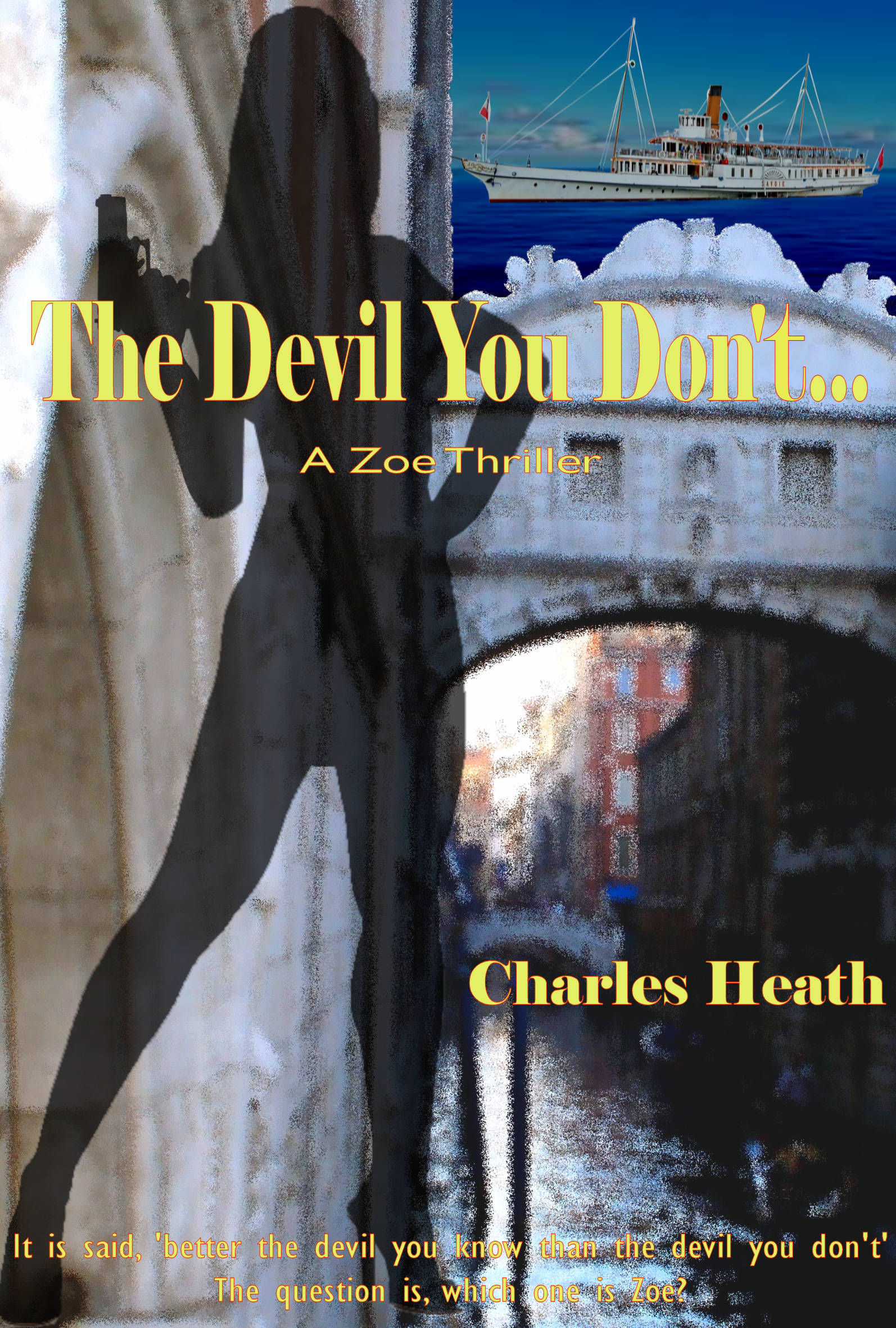
An excerpt from “The Devil You Don’t”

Available on Amazon Kindle here:  https://amzn.to/2Xyh1ow

By the time I returned to the Savoie, the rain had finally stopped, and there was a streak of blue sky to offer some hope that the day would improve.

The ship was not crowded, the possibility of bad weather perhaps holding back potential passengers.  Of those I saw, a number of them would be aboard for the lunch by Phillippe Chevrier.  I thought about it, but the Concierge had told me about several restaurants in Yvoire and had given me a hand-drawn map of the village.  I think he came from the area because he spoke with the pride and knowledge of a resident.

I was looking down from the upper deck observing the last of the boarding passengers when I saw a woman, notable for her red coat and matching shoes, making a last-minute dash to get on board just before the gangway was removed.  In fact, her ungainly manner of boarding had also captured a few of the other passengers’ attention.  Now they would have something else to talk about, other than the possibility of further rain.

I saw her smile at the deckhand, but he did not smile back.  He was not impressed with her bravado, perhaps because of possible injury.  He looked at her ticket, then nodded dismissively and went back to his duties in getting the ship underway.  I was going to check the departure time, but I, like the other passengers, had my attention diverted to the woman in red.

From what I could see, there was something about her.  It struck me when the light caught her as she turned to look down the deck, giving me a perfect profile.  I was going to say she looked foreign, but here, as in almost anywhere in Europe, that described just about everyone.  Perhaps I was just comparing her to Phillipa, so definitively British, whereas this woman was very definitely not.

She was perhaps in her 30’s, slim or perhaps the word I’d use was lissom, and had the look and manner of a model.  I say that because Phillipa had dragged me to most of the showings, whether in Milan, Rome, New York, London, or Paris.  The clothes were familiar, and in the back of my mind, I had a feeling I’d seen her before.

Or perhaps, to me, all models looked the same.

She looked up in my direction, and before I could divert my eyes, she locked on.  I could feel her gaze boring into me, and then it was gone as if she had been looking straight through me.  I remained out on deck as the ship got underway, watching her disappear inside the cabin.  My curiosity was piqued, so I decided to keep an eye out for her.

I could feel the coolness of the air as the ship picked up speed, not that it was going to be very fast.  With stops, the trip would take nearly two hours to get to my destination.  It would turn back almost immediately, but I was going to stay until the evening when it returned at about half eight.  It would give me enough time to sample the local fare and take a tour of the medieval village.

Few other passengers ventured out on the deck, most staying inside or going to lunch.  After a short time, I came back down to the main deck and headed forward.  I wanted to clear my head by concentrating on the movement of the vessel through the water, breathing in the crisp, clean air, and letting the peacefulness of the surroundings envelope me.

It didn’t work.

I knew it wouldn’t be long before I started thinking about why things hadn’t worked and what part I played in it.  And the usual question that came to mind when something didn’t work out.  What was wrong with me?

I usually blamed it on my upbringing.

I had one of those so-called privileged lives, a nanny till I was old enough to go to boarding school, then sent to the best schools in the land.  There I learned everything I needed to be the son of a Duke, or, as my father called it in one of his lighter moments, nobility in waiting.

Had this been five or six hundred years ago, I would have needed to have sword and jousting skills, or if it had been a few hundred years later, a keen military mind.  If nothing else, I could ride a horse and go on hunts, or did until they became not the thing to do.

I learned six languages, and everything I needed to become a diplomat in the far-flung British Empire, except the Empire had become the Commonwealth, and then, when no one was looking, Britain’s influence in the world finally disappeared.  I was a man without a cause, without a vocation, and no place to go.

Computers were the new vogue, and I had an aptitude for programming.  I guess that went hand in hand with mathematics, which, although I hated the subject, I excelled in.  Both I and another noble outcast used to toss ideas around in school, but when it came to the end of our education, he chose to enter the public service, and I took a few of those ideas we had mulled over and turned them into a company.

About a year ago, I was made an offer I couldn’t refuse.  There were so many zeroes on the end of it I just said yes, put the money into a very grateful bank, and was still trying to come to terms with it.

Sadly, I still had no idea what I was going to do with the rest of my life.  My parents had asked me to come back home and help manage the estate, and I did for a few weeks.  It was as long as it took for my parents to drive me insane.

Back in the city, I spent a few months looking for a mundane job, but there were very few that suited my qualifications, and the rest I think I intimidated simply because of who I was.  In that time, I’d also featured on the cover of the Economist and, through my well-meaning accountant, started involving myself with various charities, earning the title ‘philanthropist’.

And despite all of this exposure, even making one of those ubiquitous ‘eligible bachelor’ lists, I still could not find ‘the one’, the woman I wanted to spend the rest of my life with.  Phillipa seemed to fit the bill, but in time, she proved to be a troubled soul with ‘Daddy’ issues.  I knew that in building a relationship, compromise was necessary, but with her, in the end, everything was a compromise, and what had happened was always going to be the end result.

It was perhaps a by-product of the whole nobility thing.  There was a certain expectation I had to fulfil, to my peers, contemporaries, parents and family, and those who either liked or hated what it represented.  The problem was, I didn’t feel like I belonged.  Not like my friend from schooldays, and now obscure acquaintance, Sebastian.  He had been elevated to his Dukedom early when his father died when he was in his twenties.  He had managed to fade from the limelight and was rarely mentioned either in the papers or the gossip columns.  He was one of the lucky ones.

I had managed to keep a similarly low profile until I met Phillipa.  From that moment, my obscurity disappeared.  It was, I could see now, part of a plan put in place by Phillipa’s father, a man who hogged the limelight with his daughter, to raise the profile of the family name and through it their businesses.  He was nothing if not the consummate self-advertisement.

Perhaps I was supposed to be the last piece of the puzzle, the attachment to the establishment, that link with a class of people he would not normally get in the front door.  There was nothing refined about him or his family, and more than once I’d noticed my contemporaries cringe at the mention of his name, or any reference of my association with him.

Yet could I truthfully say I really wanted to go back to the obscurity I had before Phillipa?  For all her faults, there were times when she had been fun to be with, particularly when I first met her, when she had a certain air of unpredictability.  That had slowly disappeared as she became part of her father’s plan for the future.  She just failed to see how much he was using her.

Or perhaps, over time, I had become cynical.

I thought about calling her.  It was one of those moments of weakness when I felt alone, more alone than usual.

I diverted my attention back to my surroundings and the shoreline.  Out of the corner of my eye, I could see the woman in the red coat, making a move.  The red coat was like a beacon, a sort of fire engine red.  It was not the sort of coat most of the women I knew would wear, but on her, it looked terrific.  In fact, her sublime beauty was the other attribute that was distinctly noticeable, along with the fact that her hair was short rather than long and jet-black.

I had to wrench my attention away from her.

A few minutes later, several other passengers came out of the cabin for a walk around the deck, perhaps to get some exercise, perhaps checking up on me, or perhaps I was being paranoid.  I waited till they passed on their way forward, and I turned and headed aft.

I watched the wake sluicing out from under the stern for a few minutes before retracing my steps to the front of the ship, and there I stood against the railing, watching the bow carve its way through the water.  It was almost mesmerising.  There, I emptied my mind of thoughts about Phillipa and thoughts about the woman in the red coat.

Until a female voice behind me said, “Having a bad day?”

I started, caught by surprise, and slowly turned.  The woman in the red coat had somehow got very close to me without my realising it.  How did she do that?  I was so surprised I couldn’t answer immediately.

“I do hope you are not contemplating jumping.  I hear the water is very cold.”

Closer up, I could see what I’d missed when I saw her on the main deck.  There was a slight hint of Chinese, or Oriental, in her, particularly around the eyes, and of her hair, which was jet black.  An ancestor twice or more removed had left their mark, not in a dominant way, but more subtly, and easily missed except from a very short distance away, like now.

Other than that, she was quite possibly Eastern European, perhaps Russian, though that covered a lot of territory.  The incongruity of it was that she spoke with an American accent and was fluent enough for me to believe English was her first language.

Usually, I could ‘read’ people, but she was a clean slate.  Her expression was one of amusement, but with cold eyes.  My first thought, then, was to be careful.

“No.  Not yet.”  I coughed to clear my throat because I could hardly speak.  And blushed, because that was what I did when confronted by a woman, beautiful or otherwise.

The amusement gave way to a hint of a smile that brightened her demeanour as a little warmth reached her eyes.  “So that’s a maybe.  Should I change into my lifesaving gear, just in case?”

It conjured up a rather interesting image in my mind until I reluctantly dismissed it.

“Perhaps I should move away from the edge,” I said, moving sideways until I was back on the main deck, a few feet further away.  Her eyes had followed me, and when I stopped, she turned to face me again.  She did not move closer.

I realised then she had removed her beret and it was in her left side coat pocket.  “Thanks for your concern …?”

“Zoe.”

“Thanks for your concern, Zoe.  By the way, my name is John.”

She smiled again, perhaps in an attempt to put me at ease.  “I saw you earlier, you looked so sad, I thought …”

“I might throw myself overboard?”

“An idiotic notion, I admit, but it is better to be safe than sorry.”

Then she tilted her head to one side, then the other, looking intently at me.  “You seem to be familiar.  Do I know you?”

I tried to think of where I may have seen her before, but all I could remember was what I’d thought earlier when I first saw her; she was a model and had been at one of the showings.  If she were, it would be more likely she would remember Phillipa, not me.  Phillipa always had to sit in the front row.

“Probably not.”  I also didn’t mention the fact that she may have seen my picture in the society pages of several tabloid newspapers because she didn’t look the sort of woman who needed a daily dose of the comings and goings, and, more often than not, scandal associated with so-called celebrities.

She gave me a look, one that told me she had just realised who I was.  “Yes, I remember now.  You made the front cover of the Economist.  You sold your company for a small fortune.”

Of course.  She was not the first who had recognised me from that cover.  It had raised my profile considerably, but not Sternhaven’s.  That article had not mentioned Phillipa or her family.  I suspect Grandmother had something to do with that, and it was, now I thought about it, another nail in the coffin that was my relationship with Phillipa.

“I wouldn’t say it was a fortune, small or otherwise, just fortunate.”  Each time, I found myself playing down the wealth aspect of the business deal.

“Perhaps then, as the journalist wrote, you were lucky.  It is not, I think, a good time for internet-based companies.”

The latter statement was an interesting fact, one she read in the Financial Times, which had made that exact comment recently.

“But I am boring you.”  She smiled again.  “I should be minding my own business and leaving you to your thoughts.  I am sorry.”

She turned to leave and took a few steps towards the main cabin.

“You’re not boring me,” I said, thinking I was letting my paranoia get the better of me.  It had been Sebastian, on learning of my good fortune, who had warned me against ‘a certain element here and abroad’ whose sole aim would be to separate me from my money.  He was not very subtle when he described their methods.

But I knew he was right.  I should have let her walk away.

She stopped and turned around.  “You seem nothing like the man I read about in the Economist.”

A sudden and awful thought popped into my head.  Those words were part of a very familiar opening gambit.  “Are you a reporter?”

I was not sure if she looked surprised or amused.  “Do I look like one?”

I silently cursed myself for speaking before thinking, and then immediately ignored my own admonishment.  “People rarely look like what they are.”

I saw the subtle shake of the head and expected her to take her leave.  Instead, she astonished me.

“I fear we have got off on the wrong foot.  To be honest, I’m not usually this forward, but you seemed like you needed cheering up when probably the opposite is true.  Aside from the fact that this excursion was probably a bad idea.  And,” she added with a little shrug, “perhaps I talk too much.”

I was not sure what I thought of her after that extraordinary admission. It was not something I would do, but it was an interesting way to approach someone and have them ignore their natural instinct.  I would let Sebastian whisper in my ear for a little longer and see where this was going.

“Oddly enough, I was thinking the same thing.  I was supposed to be travelling with my prospective bride.  I think you can imagine how that turned out.”

“She’s not here?”

“No.”

“She’s in the cabin?”  Her eyes strayed in that direction for a moment, then came back to me.  She seemed surprised I might be travelling with someone.

“No.  She is back in England, and the wedding is off.  So is the relationship.  She dumped me by text.”

OK, why was I sharing this humiliating piece of information with her?  I still couldn’t be sure she was not a reporter.

She motioned to an empty seat, back from the edge.  No walking the plank today.  She moved towards it and sat down.  She showed no signs of being cold, nor interested in the breeze upsetting her hair.  Phillipa would be having a tantrum about now, being kept outside, and freaking out over what the breeze might be doing to her appearance.

I wondered, if only for a few seconds, if she used this approach with anyone else.  I guess I was a little different, a seemingly rich businessman alone on a ferry on Lake Geneva, contemplating the way his life had gone so completely off track.

She watched as I sat at the other end of the bench, leaving about a yard between us.  After I leaned back and made myself as comfortable as I could, she said, “I have also experienced something similar, though not by text message.  It is difficult, the first few days.”

“I saw it coming.”

“I did not.”  She frowned, a sort of lifeless expression taking over, perhaps brought on by the memory of what had happened to her.  “But it is done, and I moved on.  Was she the love of your life?”

OK, that was unexpected.

When I didn’t answer, she said, “I am sorry.  Sometimes I ask personal questions without realising what I’m doing.  It is none of my business.”  She shivered.  “Perhaps we should go back inside.”

She stood and held out her hand.  Should I take it and be drawn into her web?  I thought of Sebastian.  What would he do in this situation?

I took her hand in mine and let her pull me gently to my feet.  “Wise choice,” she said, looking up at the sky.

It just started to rain.

© Charles Heath 2015-2023

newdevilcvr6

365 Days of writing, 2026 – 182

Day 182 – How do writers cope with requests

The Burden of “Unpaid Favours”: How Writers Can Protect Their Time and Sanity

If you are a writer, you have undoubtedly felt the sting of “The Ask.”

It starts with a ping in your inbox or a DM on social media: “I love your work! Would you mind just taking a quick look at my manuscript?” or “Could you write a quick blurb?” or “Can I pick your brain for an hour over coffee about how to break into the industry?”

The legendary literary critic Edmund Wilson famously lamented these demands, referring to them as “unpaid favours.” For the recipient, these requests represent a genuine dilemma: you want to be generous and supportive of your community, but your time is your professional capital. If you said “yes” to everyone, you would never write another word of your own.

So, how do you manage the flood of requests without burning bridges—or burning out? Here is a guide to navigating the delicate art of saying “no.”


1. The “Gatekeeper” Strategy: Use a FAQ Page

Prevention is the best medicine. If you have a professional website, create a dedicated “Contact” or “FAQ” page. Clearly outline your current capacity.

Pro-tip: Add a section titled “Mentorship and Inquiries.” State politely but firmly: “Due to my current writing schedule, I am unable to accept requests for manuscript reviews, informational interviews, or unpaid consulting.”

When someone sends a request, you don’t have to draft a long explanation. You can simply link to your policy. It removes the personal nature of the refusal.

2. Master the “Template of Kindness”

You don’t need to be rude to be firm. A “template of kindness” allows you to send a polite refusal in under 30 seconds.

Try this script:

“Hi [Name], thanks so much for reaching out and for your kind words about my work. I’m currently deep in a deadline and have had to step back from all outside projects and consultations to protect my writing time. I’m afraid I can’t help with this request, but I wish you the very best of luck with your [manuscript/project]!”

By keeping it brief, you prevent the “back-and-forth” that often results when you leave the door slightly ajar.

3. Redirect, Don’t Reject

Sometimes, the person asking genuinely needs help but doesn’t know where to turn. Instead of providing the labour yourself, provide a roadmap.

If someone asks for advice on how to get published, direct them to three reliable resources: a specific book on craft, a reputable industry organisation (like Poets & Writers or AWP), or a craft-focused newsletter.

Why this works: You are still being helpful, but you are shifting the burden from your labour to your curation.

4. Set “Consultation Hours”

If you truly want to give back but are overwhelmed, carve out a small, manageable block of time. Perhaps you offer one 30-minute coffee chat per quarter, or you answer one email question a month.

When that slot is full, it’s full. You can then honestly tell people: “My mentorship slots for the year are currently filled, but please check back in January.”

5. Recognize the “Unpaid Favor” Trap

Many writers feel guilty saying no because they fear being labelled “unapproachable” or “stuck up.” It is important to reframe the request: When someone asks for your labour for free, they are asking you to prioritise their career over your own.

You are not obligated to provide free consulting, editing, or networking. Protecting your time is not an act of arrogance; it is an act of professional sustainability. If you don’t save your creative energy for your own work, your work will eventually stop existing—and then you won’t have anything to offer anyone.

The Bottom Line

Edmund Wilson was right: requests for “unpaid favours” are an occupational hazard for any successful writer. But you are the CEO of your own creative practice. You get to decide how your time is spent.

Be polite, be concise, and stay focused on your work. The best way to support the writing community is to keep writing, keep publishing, and keep showing the world that writing is a profession deserving of boundaries.

Are you a writer struggling with boundary-setting? Share how you handle “unpaid favours” in the comments below!


An excerpt from “What Sets Us Apart”, a mystery with a twist

See the excerpt from the story below, just a taste of what’s in store…

http://amzn.to/2Eryfth

whatsetscover

McCallister was old school, a man who would most likely fit in perfectly campaigning on the battlefields of Europe during the Second World War. He’d been like a fish out of water in the army, post-Falklands, and while he retired a hero, he still felt he’d more to give.

He’d applied and was accepted as head of a SWAT team, and, watching him now as he and his men disembarked from the truck in almost military precision, a look passed between Annette, the police liaison officer, and I that said she’d seen it all before. I know I had.

There was a one in four chance his team would be selected for this operation, and she had been hoping it would be one of the other three. While waiting for them to arrive she filled me in on the various teams. His was the least co-operative, and the more likely to make ad-hoc decisions rather than adhere to the plan, or any orders that may come from the officer in charge.

This, she said quite bluntly, was going to end badly.

I still had no idea why Prendergast instructed me to attend the scene of what looked to be a normal domestic operation, but as the nominated expert in the field in these types of situations, it was fairly clear he wasn’t taking any chances. It was always a matter of opinion between us, and generally I lost.

In this case, it was an anonymous report identifying what the authorities believed were explosives in one of the dockside sheds where explosives were not supposed to be.

The only reason why the report was given any credence was the man, while not identifying himself by name, said he’d been an explosive expert once and recognized the boxes. That could mean anything, but the Chief Constable was a cautious man.

With his men settled and preparing their weapons, McCallister came over to the command post, not much more than the SUV my liaison and I arrived in, with weapons, bulletproof vests, and rolls of tape to cordon off the area afterward. We both had coffee, steaming in the cold early morning air. Dawn was slowly approaching and although rain had been forecast it had yet to arrive.

A man by the name of Benson was in charge. He too had groaned when he saw McCallister.

“A fine morning for it.” McCallister was the only enthusiastic one here.

He didn’t say what ‘it’ was, but I thought it might eventually be mayhem.

“Let’s hope the rain stays away. It’s going to be difficult enough without it,” Benson said, rubbing his hands together. We had been waiting for the SWAT team to arrive, and another team to take up their position under the wharf, and who was in the final stages of securing their position.

While we were waiting we drew up the plan. I’d go in first to check on what we were dealing with, and what type of explosives. The SWAT team, in the meantime, were to ensure all the exits to the shed were covered. When I gave the signal, they were to enter and secure the building. We were not expecting anyone inside or out, and no movement had been detected in the last hour since our arrival and deployment.

“What’s the current situation?”

“I’ve got eyes on the building, and a team coming in from the waterside, underneath. Its slow progress, but they’re nearly there. Once they’re in place, we’re sending McKenzie in.”

He looked in my direction.

“With due respect sir, shouldn’t it be one of us?” McCallister glared at me with the contempt that only a decorated military officer could.

“No. I have orders from above, much higher than I care to argue with, so, McCallister, no gung-ho heroics for the moment. Just be ready to move on my command, and make sure you have three teams at the exit points, ready to secure the building.”

McCallister opened his mouth, no doubt to question those orders, but instead closed it again. “Yes sir,” he muttered and turned away heading back to his men.

“You’re not going to have much time before he storms the battlements,” Benson quietly said to me, a hint of exasperation in his tone. “I’m dreading the paperwork.”

It was exactly what my liaison officer said when she saw McCallister arriving.

The water team sent their ‘in position’ signal, and we were ready to go.

In the hour or so we’d been on site nothing had stirred, no arrivals, no departures, and no sign anyone was inside, but that didn’t mean we were alone. Nor did it mean I was going to walk in and see immediately what was going on. If it was a cache of explosives then it was possible the building was booby-trapped in any number of ways, there could be sentries or guards, and they had eyes on us, or it might be a false alarm.

I was hoping for the latter.

I put on the bulletproof vest, thinking it was a poor substitute for full battle armor against an exploding bomb, but we were still treating this as a ‘suspected’ case. I noticed my liaison officer was pulling on her bulletproof vest too.

“You don’t have to go. This is my party, not yours,” I said.

“The Chief Constable told me to stick to you like glue, sir.”

I looked at Benson. “Talk some sense into her please, this is not a kindergarten outing.”

He shrugged. Seeing McCallister had taken all the fight out of him. “Orders are orders. If that’s what the Chief Constable requested …”

Madness. I glared at her, and she gave me a wan smile. “Stay behind me then, and don’t do anything stupid.”

“Believe me, I won’t be.” She pulled out and checked her weapon, chambering the first round. It made a reassuring sound.

Suited up, weapons readied, a last sip of the coffee in a stomach that was already churning from nerves and tension, I looked at the target, one hundred yards distant and thought it was going to be the longest hundred yards I’d ever traversed. At least for this week.

A swirling mist rolled in and caused a slight change in plans.

Because the front of the buildings was constantly illuminated by large overhead arc lamps, my intention had been to approach the building from the rear where there was less light and more cover. Despite the lack of movement, if there were explosives in that building, there’d be ‘enemy’ surveillance somewhere, and, after making that assumption, I believed it was going to be easier and less noticeable to use the darkness as a cover.

It was a result of the consultation, and studying the plans of the warehouse, plans that showed three entrances, the main front hangar type doors, a side entrance for truck entry and exit and a small door in the rear, at the end of an internal passage leading to several offices. I also assumed it was the exit used when smokers needed a break. Our entry would be by the rear door or failing that, the side entrance where a door was built into the larger sliding doors. In both cases, the locks would not present a problem.

The change in the weather made the approach shorter, and given the density of the mist now turning into a fog, we were able to approach by the front, hugging the walls, and moving quickly while there was cover. I could feel the dampness of the mist and shivered more than once.

It was nerves more than the cold.

I could also feel rather than see the presence of Annette behind me, and once felt her breath on my neck when we stopped for a quick reconnaissance.

It was the same for McCallister’s men. I could feel them following us, quickly and quietly, and expected, if I turned around, to see him breathing down my neck too.

It added to the tension.

My plan was still to enter by the back door.

We slipped up the alley between the two sheds to the rear corner and stopped. I heard a noise coming from the rear of the building, and the light tap on the shoulder told me Annette had heard it too. I put my hand up to signal her to wait, and as a swirl of mist rolled in, I slipped around the corner heading towards where I’d last seen the glow of a cigarette.

The mist cleared, and we saw each other at the same time. He was a bearded man in battle fatigues, not the average dockside security guard.

He was quick, but my slight element of surprise was his undoing, and he was down and unconscious in less than a few seconds with barely a sound beyond the body hitting the ground. Zip ties secured his hands and legs, and tape his mouth. Annette joined me a minute after securing him.

A glance at the body then me, “I can see why they, whoever they are, sent you.”

She’d asked who I worked for, and I didn’t answer. It was best she didn’t know.

“Stay behind me,” I said, more urgency in my tone. If there was one, there’d be another.

Luck was with us so far. A man outside smoking meant no booby traps on the back door, and quite possibly there’d be none inside. But it indicated there were more men inside, and if so, it appeared they were very well trained. If that were the case, they would be formidable opponents.

The fear factor increased exponentially.

I slowly opened the door and looked in. A pale light shone from within the warehouse itself, one that was not bright enough to be detected from outside. None of the offices had lights on, so it was possible they were vacant. I realized then they had blacked out the windows. Why hadn’t someone checked this?

Once inside, the door closed behind us, progress was slow and careful. She remained directly behind me, gun ready to shoot anything that moved. I had a momentary thought for McCallister and his men, securing the perimeter.

At the end of the corridor, the extent of the warehouse stretched before us. The pale lighting made it seem like a vast empty cavern, except for a long trestle table along one side, and, behind it, stacks of wooden crates, some opened. It looked like a production line.

To get to the table from where we were was a ten-yard walk in the open. There was no cover. If we stuck to the walls, there was equally no cover and a longer walk.

We needed a distraction.

As if on cue, the two main entrances disintegrated into flying shrapnel accompanied by a deafening explosion that momentarily disoriented both Annette and I. Through the smoke and dust kicked up I saw three men appear from behind the wooden crates, each with what looked like machine guns, spraying bullets in the direction of the incoming SWAT members.

They never had a chance, cut down before they made ten steps into the building.

By the time I’d recovered, my head heavy, eyes watering and ears still ringing, I took several steps towards them, managing to take down two of the gunmen but not the third.

I heard a voice, Annette’s I think, yell out, “Oh, God, he’s got a trigger,” just before another explosion, though all I remember in that split second was a bright flash, the intense heat, something very heavy smashing into my chest knocking the wind out of me, and then the sensation of flying, just before I hit the wall.

I spent four weeks in an induced coma, three months being stitched back together and another six learning to do all those basic actions everyone took for granted. It was twelve months almost to the day when I was released from the hospital, physically, except for a few alterations required after being hit by shrapnel, looking the same as I always had.

But mentally? The document I’d signed on release said it all, ‘not fit for active duty; discharged’.

It was in the name of David Cheney. For all intents and purposes, Alistair McKenzie was killed in that warehouse, and for the first time ever, an agent left the Department, the first to retire alive.

I was not sure I liked the idea of making history.

© Charles Heath 2016-2020

The cinema of my dreams – I always wanted to write a war story – Episode 26

For a story that was conceived during those long boring hours flying in a steel cocoon, striving to keep away the thoughts that the plane and everyone in it could just simply disappear as planes have in the past, it has come a long way.

Whilst I have always had a fascination with what happened during the second world war, not the battles or fighting, but in the more obscure events that took place, I decided to pen my own little sidebar to what was a long and bitter war.

And, so, it continues…


Mayer realized something was terribly wrong when they reached the outskirts of Weimar and passed through the checkpoint on the outskirts of the city.

It was the sixth such checkpoint and each time the Standartenfuhrer told the sentries that they were escorting a valuable prisoner, and being mere German Army soldiers, most of the Obergefreiter rank, and not willing to argue with an SS Colonel.

Then he remembered there was a large Government building in the city and assumed that was where they were talking to him.

Except they were either lost or taking the long way to get there because they were taking back streets.  When he asked why, he was told to be quiet, or they would silence him.

When they reached the outskirts of the city on the other side, still heading south, he knew something else was going on.  It was then he started to think that these men might not necessarily be Nazi’s.  After all, there had to be other people who were sickened by the atrocities that were going on, particularly to the labor from the camps.

He understood the need for labor, just not the way his superiors went about getting it.

They passed through the next checkpoint without any questions and soon caught up to a convoy of trucks with what looked like prisoners in the back.

It was the first time he had seen either of the two officers look worried.

Then a soldier on a motorcycle turned around and came back to check on the vehicle and its occupants.  He flagged them to the side of the road, got off his bike and there was no mistaking the itchy trigger finger on the gun he was loosely holding.

In front of their car, the last truck in the convoy turned a corner and disappeared.

“Where are you going?” the motorcyclist asked.

Mayer noticed he was not army but SS of a lower rank Scharfuhrer, and though of a lower rank, there was still the superiority of just being SS.

The Standartenfuhrer looked the soldier up and down and then opened the door to the car and got out.  He took two steps towards the cyclist.

“Do you know who you are addressing Scharfuhrer, what is your name?  I will take this insubordination to your superior officer.”

Mayer had seen similar men in his unit back at Nordhausen, including one, when in a hotel having lunch heard one of a group of army soldiers being rowdy.  He singled the loudest of them, told him to be less noisy and the soldier laughed at him.

The next thing he remembered was the other solders carrying their dead leader out of the hotel.  The Standartenfuhrer had shot him, on the same charge, insubordination.  Would this Standartenfuhrer do the same?

He had learned that day the SS, especially the higher-ranked officers, didn’t tolerate anything, and as one, he was expected to do the same.

“Sir.  It is my job to ask questions, as you are fully aware.  I was given orders, and I obey those orders.”  Suddenly the man was less confident.

“I understand that.  It is of no concern to you where we are going, only that it is on urgent and classified Reich business.  It is of no concern to anyone but the Oberfuhrer I report to, and I will have to report to him on why I was delayed.  You name Scharfuhrer?”

“I have no wish to delay you, sir.”  He saluted, got back on his motorcycle and left, speeding up to catch up to the rest of the convoy.

The Standartenfuhrer got back in the car.

“That was close,” the driver said.  In English.

Mayer was proficient in English as his father had told him that it would stand him in good stead one day.  He just omitted to tell anyone he worked with, or when he was recruited.  They had asked, and he thought it wisest to say no.

Now, these two men were speaking English.  It was not unknown for SS officers to speak English, as well as several other languages like Dutch, French and Italian. He had a little French, and less Italian.

“Who are you?” Mayer asked again but sticking to German.

The Standartenfuhrer glared at his driver.

“This is the point where it depends on how you answer the next question whether we execute you here, or we continue.  Bear in mind that if you tell us a lie, you will be shot.”  The Standartenfuhrer also spoke in German.

The English Mayer decided was to correct to be from an Englishman, only a German who had learned it as a second language, and definitely as an SS officer.  Perhaps these two were charged with interrogating English prisoners, though that didn’t explain why they had taken him.

All of a sudden, he had a very bad feeling about this kidnapping.  It was a kidnapping, and these men were taking him to a different location, perhaps to torture him.  He had heard rumors, but since it came from a fellow SS officer, he considered it to be true.

“The question?” he stammered, nerves getting the better of him.

“Do you want to get out of Germany?”

What?  IT wasn’t [possible that anyone could know that.  He’d only admitted that sentiment to one person, and he knew he could trust them not to tell anyone.  OR could he?

And, was this a trick question.  If he answered no, it meant they could charge him with crimes against the Reich for having the blueprints of the V2 rocket?  And if he said yes, would they execute him here on the side of the road?

There was no answer that wouldn’t see him shot.

So better to say he was fed up with the conditions he’d been working under, get shot, and never return.

“Yes.”  Of course, there was a pertinent question to add to that reply, “How did you know?”

“You had the plans and specifications outside the bunker.  An executable offense.  I believe you do not like the idea of the German High Command using these rockets as weapons.”

“Most of us on the project do not, but we have to do as we are told.  For obvious reasons.”

“So far so good,” the Standartenfuhrer switched back to English.  “We know you speak English, in fact we know quite a lot about you.  As you’ve obviously guessed, we are not going to and interrogation site, but further south to Italy where there is an escape route set up by the resistance.”

“Who do you work for?”

“OSS.  We are probably worse off than you in that if we get caught, we will be shot as spies.  But, so far we’ve had good luck, except for that nosy motorcyclist.  I expect he will not keep his mouth shut and report us.”

“You won’t get that far.  With petrol rationing, this car is going to run out long before we get to the border.”

“Don’t you worry about the details.  That’s our job.  You just sit back, do as we ask, and everything should be alright.  Very few people question an SS officer of my rank.” 

He looked at his driver. 

“Now, let’s get the hell out of here before that nosy fool comes back with reinforcements.”


© Charles Heath 2020

An excerpt from “The Things We Do for Love”; In love, Henry was all at sea!

In the distance, he could hear the dinner bell ringing and roused himself.  Feeling the dampness of the pillow and fearing the ravages of pent-up emotion, he considered not going down but thought it best not to upset Mrs Mac, especially after he said he would be dining.

In the event, he wished he had reneged, especially when he discovered he was not the only guest staying at the hotel.

Whilst he’d been reminiscing, another guest, a young lady, had arrived.  He’d heard her and Mrs Mac coming up the stairs and then shown to a room on the same floor, perhaps at the other end of the passage.

Henry caught his first glimpse of her when she appeared at the door to the dining room, waiting for Mrs Mac to show her to a table.

She was in her mid-twenties, slim, with long brown hair, and the grace and elegance of a woman associated with countless fashion magazines.  She was, he thought, stunningly beautiful with not a hair out of place, and make-up flawlessly applied.  Her clothes were black, simple, elegant, and expensive, the sort an heiress or wife of a millionaire might condescend to wear to a lesser occasion than dinner.

Then there was her expression; cold, forbidding, almost frightening in its intensity.  And her eyes, piercingly blue and yet laced with pain.  Dracula’s daughter was his immediate description of her.

All in all, he considered, the only thing they had in common was, like him, she seemed totally out of place.

Mrs Mac came out of the kitchen, wiping her hands on her apron.  She was, she informed him earlier, chef, waitress, hotelier, barmaid, and cleaner all rolled into one.  Coming up to the new arrival, she said, “Ah, Miss Andrews, I’m glad you decided to have dinner.  Would you like to sit with Mr Henshaw, or would you like to have a table of your own?”

Henry could feel her icy stare as she sized up his appeal as a dining companion, making the hair on the back of his neck stand up.  He purposely didn’t look back.  In his estimation, his appeal rating was minus six.  Out of a thousand!

“If Mr Henshaw doesn’t mind….”  She looked at him, leaving the query in mid-air.

He didn’t mind and said so.  Perhaps he’d underestimated his rating.

“Good.”  Mrs Mac promptly ushered her over.  Henry stood, made sure she was seated properly and sat.

“Thank you.  You are most kind.”  The way she said it suggested snobbish overtones.

“I try to be when I can.”  It was supposed to nullify her sarcastic tone, but it made him sound a little silly, and when she gave him another of her icy glares, he regretted it.

Mrs Mac quickly intervened, asking, “Would you care for the soup?”

They did, and, after writing the order on her pad, she gave them each a look, imperceptibly shook her head, and returned to the kitchen.

Before Michelle spoke to him again, she had another quick look at him, trying to fathom who and what he might be.  There was something about him.

His eyes mirrored the same sadness she felt, and, yes, there was something else, that it looked like he had been crying.  There was a tinge of redness.

Perhaps, she thought, he was here for the same reason she was.

No.  That wasn’t possible.

Then she said, without thinking, “Do you have any particular reason for coming here?”  Seconds later, she realised she’d spoken it out loud, hadn’t meant to actually ask, it just came out.

It took him by surprise, obviously not the first question he was expecting her to ask of him.

“No, other than it is as far from civilisation, and home as I could get.”

At least we agree on that, she thought.

It was obvious he was running away from something as well.

Given the isolation of the village and lack of geographic hospitality, it was, from her point of view, ideal.  All she had to do was avoid him, and that wouldn’t be difficult.

After getting through this evening first.

“Yes,” she agreed.  “It is that.”

A few seconds passed, and she thought she could feel his eyes on her and wasn’t going to look up.

Until he asked, “What’s your reason?”

Slightly abrupt in manner, perhaps, because of her question and how she asked it.

She looked up.  “Rest.  And have some time to myself.”

She hoped he would notice the emphasis she had placed on the word ‘herself’ and take due note.  No doubt, she thought, she had completely different ideas of what constituted a holiday than he, not that she had said she was here for a holiday.

Mrs Mac arrived at a fortuitous moment to save them from further conversation.

Over the entree, she wondered if she had made a mistake coming to the hotel.  Of course, there had been no conceivable way she could know that anyone else might have booked the same hotel, but she realised it was foolish to think she might end up in it by herself.

Was that what she was expecting?

Not a mistake then, but an unfortunate set of circumstances, which could be overcome by being sensible.

Yet, there he was, and it made her curious, not that he was a man, by himself, in the middle of nowhere, hiding like she was, but for quite varied reasons.

On discreet observation, whilst they ate, she gained the impression his air of light-heartedness was forced, and he had no sense of humour.

This feeling was engendered by his looks, unruly dark hair, and permanent frown.  And then there was his abysmal taste in clothes on a tall, lanky frame.  They were quality but totally unsuited to the wearer.

Rebellion was written all over him.

The only other thought crossing her mind, and incongruously, was that he could do with a decent feed.  In that respect, she knew now from the mountain of food in front of her, he had come to the right place.

“Mr Henshaw?”

He looked up.  “Henshaw is too formal.  Henry sounds much better,” he said, with a slight hint of gruffness.

“Then my name is Michelle.”

Mrs Mac came in to take their order for the only main course, gather up the entree dishes, and then return to the kitchen.

“Staying long?” she asked.

“About three weeks.  Yourself?”

“About the same.”

The conversation dried up.

Neither looked at the other, but rather at the walls, out the window, towards the kitchen, anywhere.  It was, she thought, unbearably awkward.

Mrs Mac returned with a large tray with dishes on it, setting it down on the table next to theirs.

“Not as good as the usual cook,” she said, serving up the dinner expertly, “but it comes a good second, even if I do say so myself.  Care for some wine?”

Henry looked at Michelle.  “What do you think?”

“I’m used to my dining companions making the decision.”

You would, he thought.  He couldn’t help but notice the cutting edge of her tone.  Then, to Mrs Mac, he named a particular White Burgundy he liked, and she bustled off.

“I hope you like it,” he said, acknowledging her previous comment with a smile that had nothing to do with humour.

“Yes, so do I.”

Both made a start on the main course, a concoction of chicken and vegetables that were delicious, Henry thought when compared to the bland food he received at home and sometimes aboard my ship.

It was five minutes before Mrs Mac returned with the bottle and two glasses.  After opening it and pouring the drinks, she left them alone again.

Henry resumed the conversation.  “How did you arrive?  I came by train.”

“By car.”

“Did you drive yourself?”

And he thought, a few seconds later, that was a silly question; otherwise, she would not be alone, and certainly not sitting at this table. With him.

“After a fashion.”

He could see that she was formulating a retort in her mind, then changed it, instead, smiling for the first time, and it served to lighten the atmosphere.

And in doing so, it showed him she had another, more pleasant side despite the fact she was trying not to look happy.

“My father reckons I’m just another of ‘those’ women drivers,” she added.

“Whatever for?”

“The first and only time he came with me, I had an accident.  I ran up the back of another car.  Of course, it didn’t matter to him that the other driver was driving like a startled rabbit.”

“It doesn’t help,” he agreed.

“Do you drive?”

“Mostly people up the wall.”  His attempt at humour failed.  “Actually,” he added quickly, “I’ve got a very old Morris that manages to get me where I’m going.”

The apple pie and cream for dessert came and went, and the rapport between them improved as the wine disappeared and the coffee came.  Both had found, after getting to know each other better, that their first impressions were not necessarily correct.

“Enjoy the food?” Mrs Mac asked, suddenly reappearing.

“Beautifully cooked and delicious to eat,” Michelle said, and Henry endorsed her remarks.

“Ah, it does my heart good to hear such genuine compliments,” she said, smiling.  She collected the last of the dishes and disappeared yet again.

“What do you do for a living?” Michelle asked in an offhand manner.

He had a feeling she was not particularly interested, and it was just making conversation.

“I’m a purser.”

“A what?”

“A purser.  I work on a ship doing the paperwork, that sort of thing.”

“I see.”

“And you?”

“I was a model.”

“Was?”

“Until I had an accident, a rather bad one.”

“Oh, I’m sorry.”

So that explained the odd feeling he had about her.

As the evening wore on, he began to think there might be something wrong, seriously wrong with her because she didn’t look too well.  Even the carefully applied makeup, from close, didn’t hide the very pale, tired look, or the sunken, dark-ringed eyes.

“I try not to think about it, but it doesn’t necessarily work.  I’ve come here for peace and quiet, away from doctors and parents.”

“Then you will not have to worry about me annoying you.  I’m one of those fall-asleep-reading-a-book types.”

Perhaps it would be like ships passing in the night, and then he smiled to himself about the analogy.

Dinner over, they separated.

Henry went back to the lounge to read a few pages of his book before going to bed, and Michelle went up to her room to retire for the night.

But try as he might, he was unable to read, his mind dwelling on the unusual, yet compellingly mysterious person he would be sharing the hotel with.

Overlaying that original blurred image of her standing in the doorway was another of her haunting expressions that had, he finally conceded, taken his breath away, and a look that had sent more than one tingle down his spine.

She may not have thought much of him, but she had certainly made an impression on him.

© Charles Heath 2015-2024

lovecoverfinal1

The cinema of my dreams – I always wanted to go on a treasure hunt – Episode 27

Here’s the thing…

Every time I close my eyes, I see something different.

I’d like to think the cinema of my dreams is playing a double feature but it’s a bit like a comedy cartoon night on Fox.

But these dreams are nothing to laugh about.

Once again there’s a new instalment of an old feature, and we’re back on the treasure hunt.


I was taken to the hospital, despite the fact the paramedics deemed that I might not be as badly concussed as they first thought.  At the very least, I got a ride in the ambulance and painkilling pills that were very effective.

They kept me in the emergency department in between being taken for X-Rays, and I think something they called a CT Scan.  Whatever it was, it didn’t help my claustrophobia.  When that was completed, my mother was waiting in the cubicle.  Benderby, looking concerned, stood behind her.

After the attendant left, he said, “I’ll be going now.  Take all the time you need to recover Sam; I’ll make sure you don’t lose any wages over this.  And you can be assured that it will not happen again, and we will get the people who did this.”

“Thank you, sir.”

“I’m just glad nothing worse happened to you.”

He said something to my mother in hushed tones and then left.  My mother had got over her initial reaction, and a more curious look had replaced the one of fear.

“Tell me you didn’t try to apprehend those thieves yourself, Sam.”

“No, I didn’t.  I didn’t know there was anyone in the building until I was hit from behind.  I’m not sure what they thought they were going to find there that was of any value, it’s just parts for some of the products built there.”

“People will steal anything for money these days.  You should know that.  Times are not as good for some.  Perhaps it’s not a good idea for you to work there is this is going to happen again.”

“You heard Mr Benderby.  He’ll make sure security is improved, and I suspect I was in the wrong place at the wrong time because I don’t normally go into the warehouse itself, that someone else’s purview.  So, stop worrying, and go home.  I’m fine.”

I wished she would go.  I wanted to check if Boggs had been brought in and see what had happened to him.  I also wanted to know if the perpetrator was Vince.  If it was, Nadia was first on my list for a visit when I got out of the hospital.

It seemed to mollify her concern.

“Mr Benderby said to tell you if you need a ride home, to call this number,” she gave me a piece of paper with a phone number on it, “and a driver will come.  He’s been very nice about everything.  You will thank him.”

“I will.  Yes.  Now go home.  Get some rest.  And stop worrying about me.”


Ten minutes later, I got off the bed and stood.  Well, I tried to stand, but my head wasn’t quite ready to accept that it was in command of everything else.  It took only seconds for the room to start spinning, and I had to lie down again.

My reconnaissance was going to have to wait for an hour or so.

A nurse came and checked my blood pressure and pulse, both high but not off the chart, and she went off looking concerned.

A few minutes after that an orderly went by with another bed, empty but recently used, and I recognised him as another of the boys Boggs and I went to school with.  He was destined for bigger things, but it seems he, too, never got out of the neighbourhood.

He saw me looking at him, stopped, and his expression told me he’d recognised me.

“Sam?”

“Angelo?”

“The same.  I’ll be back after I’ve dropped off this bed.  Won’t be long.  I won’t ask how you are, you must be sick if you’re in that bed.”

True.  And it was natural to ask, ‘How are you?’ when you see someone after having not seen them a while, even if you are in a hospital.  A weird custom indeed, which occupied my thoughts till he returned.


Angelo had been the smartest kid in our class, and we had all assumed that he would become a doctor, or a lawyer, one of those jobs that made piles of money.  He was also the boy whom all the girls swooned over.

Being his friend had benefits.

Unfortunately, Boggs and I, not being the two brightest kids, didn’t register on his friend’s scale.  In his favour, he was not a bully like Monty was, but I guess that went with being one of the school’s star athletes, but he did simply ignore us.

Now, it seems the mighty had fallen.  It was a destiny that seemed to befall anyone who came from our neighbourhood.

The same could be said for Monty, who got a sports scholarship to further his sporting career, but he too stumbled at the second hurdle, being done for performance-enhancing drugs, and banished to the boondocks from whence he came.

Now, as far as I knew, he was working for the Colosimo’s.

Angelo seemed bright enough.  That impression was confirmed when he returned with two bottles of soda and handed one to me.

“Hopefully it won’t kill you,” he said, sitting down.

“Shouldn’t.  I’m here because someone hit me over the head.”

“Bar fight?”

Once, in the old days, that might be the case.  “If only I could take the bragging rights, but no.  I work over at Benderby’s warehouse, and someone broke it.  Seems I got in the way.”

“Benderby’s eh?  Thought you said you’d die before ever working for them.”

True, we all said the same, in school, as naïve children who hadn’t yet learned how tough the world was going to be.

“Needs must.  My mother isn’t getting any younger, and it’s a struggle.  But I guess you already know that.  You were going to be a doctor, not a trolley pusher.”

His shook his head.  “As you say, reality trumps dreams.  Education costs, my parents couldn’t raise the money, and, well, I think you know the rest.”

A minute’s silence for the death of whatever dreams we may have had passed.

“Have you seen Boggs.  He’s here somewhere.”

“I saw him in ER, didn’t look too good, but I think it was mostly superficial wounds.  Apparently, some unknown assailants beat him up.  You two still hang out together?”

“Off and on.”

You weren’t with him when this happened.”  He nodded towards the bandage on my head.

“No.”  but, I thought, it was most likely the same person who inflicted both injuries.  Had Boggs set us both up for some reason?  It had to do with the treasure, and now Vince was in on the act.

“Does Boggs still go on about that Pirate treasure he reckons is buried here somewhere?  I mean, his dad used to bang on about it, and there’s no doubt it got him killed.  You reckon someone went after Boggs over it?”

Angelo hadn’t forgotten that even in school, Boggs had said he was going to be a treasure hunter when he grew up, and he had a map that would be the basis of his first quest.  That same map he told me was his father’s.

That same map that had got both of us beaten up.

“Is he here, somewhere?” I asked.

“Next ward.  Last I saw he was out; they gave him a sedative so he could rest.”

Squawking sounds came out of Angelo’s communicator, and only he seemed to know what it meant. 

He stood.  “Got to go now.  Perhaps we can catch up later.”


© Charles Heath 2019

What I learned about writing – When words become more than words

From Page to Panorama: Weaving Mythopoetic Grandeur into the Fabric of Reality

We’ve all experienced it. That moment when a skilled author transports us, not just to a place, but into a feeling, a scent, a visceral understanding of something utterly foreign yet strangely resonant. It’s the magic of descriptive writing, the alchemical process of turning mere words into sensory experiences. But what happens when we take those finely honed fictional tools and turn them towards the canvas of our own reality? What happens when we begin to weave the mythopoetic grandeur, usually reserved for fantastical realms, into the mundane fabric of everyday life?

This is where the truly transformative power emerges. It’s not about escaping reality, but about re-enchanting it. It’s about recognising that the same imaginative muscles that conjured dragons and epic quests can, with a shift in perspective, illuminate the epic within the ordinary.

The Foundation: The Art of Observational Detail

Before we can imbue our reality with mythopoetic grandeur, we must first become masters of observation. Fictional writers are meticulous. They don’t just say a character is sad; they describe the slump of their shoulders, the way their eyes lose their sparkle, the quiet tremor in their voice. They don’t just say a forest is dark; they paint a picture of gnarled branches like skeletal fingers, shafts of light like ethereal swords, the damp, earthy scent of decay and rebirth.

Applying this to real life means waking up our senses. It means noticing the way the morning light bleeds across the linoleum of your kitchen, transforming it into a pool of molten gold. It’s observing the intricate, almost alien architecture of a spiderweb glistening with dew, a delicate, ephemeral fortress. It’s listening to the symphony of a city at dusk – the distant siren a mournful lament, the laughter of children a fleeting melody, the rumble of traffic a subterranean dragon stirring.

The Alchemy: Infusing Significance and Symbolism

Once we have our raw observational material, the next step is the alchemical process of infusing it with meaning. This is where the “mythopoetic” truly takes hold. We move beyond simple description to interpretation, imbuing our observations with layers of significance and symbolism, much like ancient storytellers did.

  • The Mundane Becomes Mythic: A walk to the grocery store isn’t just an errand. It can be a pilgrimage through the daily labyrinth, a quest for sustenance that echoes the ancient hunts. The cashier, with their practised smile, could be a guardian of provisions, a dispenser of earthly blessings.
  • The Everyday Becomes Archetypal: The familiar faces we encounter can be viewed through the lens of archetypes. The wise elder at the park bench might embody the archetype of the Sage. The boisterous teenager could be the Rebel, challenging the established order with youthful energy.
  • The Emotional Landscape Gains Depth: Sadness isn’t just a feeling; it’s a “gathering storm,” a “heavy cloak,” a “deep well of unspoken grief.” Joy isn’t just happiness; it’s a “sunburst,” a “lightness of being,” a “song rising from the soul.”

The Grandeur: Elevating the Narrative of Our Lives

The ultimate goal is to elevate the narrative of our own lives, to recognise the inherent grandeur that often lies dormant beneath the surface of routine. This doesn’t mean fabricating events or pretending our challenges aren’t real. Instead, it’s about framing them within a larger, more resonant context.

Consider a difficult conversation. Instead of simply recalling the angry words, we can describe the “clash of wills,” the “stalemate of emotions,” the “fragile truce that followed.” A moment of quiet contemplation isn’t just zoning out; it’s “diving into the depths of the inner sea,” “listening to the whispers of the subconscious.”

Why Does This Matter?

Turning fictional descriptive skills to the rendering of real life in mythopoetic grandeur is more than just a creative exercise. It’s a way to:

  • Deepen our appreciation for life: By seeing the extraordinary in the ordinary, we cultivate a richer, more vibrant experience of our existence.
  • Foster resilience: Framing challenges as epic struggles or tests of character can empower us to face them with greater courage and determination.
  • Connect with something larger than ourselves: Mythopoetic language often taps into universal themes of creation, struggle, love, and loss, fostering a sense of belonging to something ancient and profound.
  • Communicate more effectively and evocatively: Whether in personal writing, artistic expression, or even everyday conversation, this elevated language can captivate and resonate with others.

The world around us is a vast, intricate tapestry, already rich with potential for wonder and awe. By learning to wield the tools of fictional description with conscious intent, we can begin to see the mythopoetic grandeur woven into the very fabric of our reality. We can stop being passive observers and become active, imaginative narrators of our own magnificent lives. So, open your eyes, awaken your senses, and start painting the world in hues of myth and legend. The grandest stories, after all, are often the ones happening right under our noses.

365 Days of writing, 2026 – 181

Day 181 – Writing Exercise

How can you trust a person you know is telling you outright lies?

There’s nothing worse than being in the wrong place at the wrong time.

I got there by trying to prove myself among a group of four colleagues who had been working together for years.

They clearly didn’t want a fifth wheel.

And they certainly didn’t like the idea of a forcibly retired field agent looking for a quiet berth to see out his service.

The section head in charge told me quite clearly that the department had made a mistake, that his research team did not need another member, and they certainly didn’t want an ex-field agent.

He was miffed because the department head had decided my knowledge and expertise were too valuable to toss on the scrapheap.

No one else in that group had seen field service or understood those who came from it.  To them, the information they provided was 100 per cent useful, when in my particular case, it was not.

In that first meeting when I arrived, and listened to the broad outline of what the team provided, I could have categorically proved that information, sometimes poorly researched, had caused actual deaths of top-line agents, and taking into account my last personal experience, it had led to me unwillingly landing on their doorstep.

Such was the arrogance, I wanted to personally throttle two of them, but I decided it was neither the time or the place.  It was a matter of head down, minding my own business, and only consulting with the others when necessary.

And then only with extreme reluctance.

Which led to the seminal moment.  There was a cafe not far from the office, one I discovered the day I first arrived, where I needed a strong coffee before walking through the door.

The waitress, Angelique, according to her nametag, was bright and cheerful, the exact opposite of what I was feeling.  It was hard not to feel her enthusiasm, and it had lightened my mood.

So much so, I preferred to spend my morning and afternoon breaks in the cafe rather than be ignored in the cafeteria.

Sometimes the others, singly or in pairs, never the whole four at once, would come in.  I deliberately sat where I could not be seen very clearly and observed them.  Those conversations when they sat close enough were priceless.

Angelique brought my coffee and her surprise cake. I always let her decide which cake. Then two of my colleagues came in.  They did not look happy.

Nor did they see me, but then they would have to be deliberately looking for me.  They sat two tables across on the other side of a dividing hedge.

Angelique went over to them and took their order.  Two cappuccinos.  Perhaps the automatic coffee machine in the cafeteria had broken down.

“I’m telling you, Sandra, Roger thinks he’s a spy.”

“Roger jumps at shadows.  Don’t you think it’s time to cut him loose?  He’s never going to leave his wife.  She controls the money.”

“He says it’s complicated.”

“All married men say that.  As for Stevens, he was a spy, could still be a spy, but the reality is, good spies don’t get sent to our corner of the universe unless they failed badly.”

“You don’t think he’s been sent to see why some of the briefings were not quite up to the mark.  I mean that Paris mission…”

My last job.  Not up to the mark?  It provided out-of-date information, a critical schedule change that was missed.

“Roger approved it.  He said he checked it.”

“How, Eva?  He was with you?”

“I’m not to blame here.  That’s up to him to juggle things.  He would have postponed, like he has before, when things get tight.”

“You need to dump him before he takes you down with him, or worse, sets you up to take the fall.”

“He wouldn’t.”

Sandra just shook her head and said nothing.  The coffee arrived.

“Anyway,” Sandra said, “it might well be a moot point.  Roger has a plan to get rid of him.  It worked with the others, and this guy looks about ready to quit anyway.”

“You think so.  I wouldn’t underestimate what he’s capable of if he were an agent.  I’d like to know just how many people he’s killed.”

“You’re just morbid.”

“No.  Practical.  Mark my words.  There’s more to him than meets the eye.”

I was a spy, for want of a better word.  It was made very clear when the department head came to visit me before discharge from the hospital that I would not likely be sent back into the field

It was when he pitched the research job.

By then, I needed something, anything to take my mind off the nightmare.

I went to see him a few weeks later, at his request.  It was the second time I’d been in his office, all dark wood and leather furniture.  The polished almost made my eyes water. 

The cigar smoke did.

“That position I was talking about, it has taken on a new aspect.  The ops manager has completed his review of your mission and found that the briefing reference material was lacking.”

“Wrong.”

“By and large, it was right, except for several crucial details.  The question he raises is whether or not it was deliberate.”

“A traitor?”

“An incompetent fool, more likely.  But that’s for you to determine.  We’re sending you there.  I know the chap who runs it.  He’s going to fight this and make your life hell.”

“So another MacCallister then.”

That was a story.  The man I had to impress to get into the service.  The man who failed 80 per cent of his charges in the first week.  He and I were chalk and cheese.

“Worse.  MacCallister knows when he’s met a worthy opponent.  Roger Ballins doesn’t.  He’s broken every new person we’ve sent.”

I shrugged.  “He hasn’t had the Berkeley twins find his breaking point then.”

The Berkeley twins were the department’s interrogation team.  We all went through what was called the ‘break test’.  It was near the end of the training, and the cause of a lot of the remaining candidates failing.

“Not yet.  Let’s hope it does not come to that.”

So, Roger had a plan.  It bothered me that the two of them had no concept of what secrecy was, or had a modicum of training in how to maintain a certain level of anonymity, given the job they were doing.

It raised the question of whether they frequently discussed their research out of the office.  I doubted anyone was aware of how bad security was at the section.

Especially when it involved another employee, in this case, me.

If their plan involved overloading me with work, it wasn’t working.  Roger had been subtly dumping new requests in my in-tray every morning, and then asking the same afternoon what the status was on them.

The daily meetings each morning saw the others clearing requests while I was not.  Roger hadn’t said anything yet, but that might be the next phase of the plan.

My first day, he’d started with the spiel that it was a tight-knit crew who had been working well together for years, and there was no need for another.

For that reason, I just didn’t get to work with any of the others, and any requests I made of them were either ignored or I was given the excuse that they were too busy.

That then led to them spreading niggling half-truths woven into far larger tales of my aloofness, inability to work in a team, confrontational attitude, and lack of interpersonal skills.

Sadly, half of that was true.  I didn’t want to work with them, and even less so now after overhearing them.  I wished I hadn’t.

I stewed over their comments on the short walk back to the office, and it was no surprise to find Roger waiting for me when I returned.

“Where have you been?”  It wasn’t asked in the politest of tones.

I quickly glanced at the others who had their heads down.

“Out for a head-clearing walk.  It’s marvellous what the London Transport diesel fumes can do for the mind.”

I couldn’t tell him I was up the road having a coffee break.

“You might think….” 

It was as far as he got.  The department head chose that exact moment to walk through the door.  An unannounced visit.

The four others suddenly looked more alert and on their guard.

He looked at me.  “Stevens, you are here.  I was told operations sent you to apply your field experience to improving the relevance of the briefing papers.”  He swung around and looked at Roger.  “I’m sure you’ve been using Stevens as an expert resource to assist the team?”

“I … well.. I was not aware that was the intention.”

He shook his head, then turned back to me.  “Just what has he been using you for?”

“Research, which is what I assumed I was here for.”

“God no.  Operations assured me they would pass on my request that every briefing now has to pass through you to ensure that it’s relevant and correct from the field agents’ perspective.”

He turned back to Roger, who was almost cowering.  “Operations sent me the memo, and your name was on the distribution list.  Go and find it and take the time to find an excuse why you haven’t implemented a direct order.  I’ll be in the cafeteria.  Stevens, you’re with me.”

A last look before I followed him out, it looked like the gang of five just got a very swift kick where it hurt.

Good.

….

“Roger was a washout from the training program about ten years ago, sold operations on the idea that a person who understood the field agents’ perspective would add value to the research process.  Trouble is, he was never in the field.”

“Maybe it was more about resenting the fact he was washed out.”

Coffee in the cafeteria had a very distinctive taste, and one I could see wasn’t appreciated.  I wondered if that meant he would do something about it.

“Maybe he’s just an incompetent fool.  What have you found out?”

“Eva did the Paris report, sent it to Roger.  Thing is, they are having an affair, and if I overheard the conversation correctly, he was too busy spending time with her to check the report.”

“Are you listening at keyholes?”  He seemed surprised.

I was going to tell him that spies were notorious for listening at keyholes, but thought the better of it.

“There’s a Cafe not far up the road.  God knows how many others heard the same conversation.  They don’t seem to know much about security.”

The surprise changed to annoyance, but that was the moment Roger came in, saw us, and came over.

He waited until he was told to sit.

“I’m sorry, sir.  It was buried in a pile of requests.”

I didn’t believe him.  He would have seen it and filed it, hoping no one would ever notice.  Especially the department head.

“That’s the first strike, Roger.  What were your conclusions in the investigation I asked for on the Paris mission?  You’ve had three months.”

“We’ve been busy.”

“You told me categorically that you had sufficient staff to handle the workload.  That was obviously a lie.  I sent someone down to help, and you still seem to be overwhelmed.  That’s the second strike, Roger.”

There was no comeback for that, and it was interesting to see someone else squirm under the intensity of the department head.  Rumour had it he was once an excellent interrogator who didn’t need the usual tools of the trade.

“I … we .. “

“Go back to the office, Roger, before you register that fatal third strike.  I need a little time to consider what we need to do moving forward.  I have to say I’m extremely disappointed.  Go.”

I doubted Roger liked the idea of being dismissed, and it was going to make my position less tenable, being present at his dressing down.

“They might all resign,” I said.

“That wouldn’t be the worst outcome.  There are at least a dozen other candidates that could instantly fill their shoes.”

“I think the problem is not with the staff, it’s the person in charge.”

“Then you can take over and restore some discipline.  Problem solved.”

“Temporarily.”  I had no wish to be running a section full of resentful people.

“Fix this for me, and we’ll talk about where you go next.”  He took another sip of his coffee and made a face.  “This is terrible.  We’ll have to do something about this, too.”

We went back to the office, and the department head sent Roger off on stress leave, then announced my promotion to acting section head.

No one said a word, but the expressions said more than words could.  Each of them blamed me for his removal, and especially Eva.

After the department head left, I called a meeting.  I seriously believed they would simply ignore me, but then they shuffled into the room and sat in their usual chairs.

I looked at each one of them and could feel the resentment.

I looked at Eva.  “Just so you know, I was sent on that Paris mission.  I was lucky, I lived.  Just.  Three others died, and believe me when I tell you, being there and watching them die because someone didn’t do their job properly, well, you are very fortunate I didn’t throttle you the first day I got here.”

“It was not my fault.”  Petulant.

“What do you call fucking your section leader when he should be critiquing your work?”

“How…”

It was said to shock her, and it had the effect I was looking for.  She was arrogant, but arrogance only lasts until the reason for it is broken.  As long as Roger was there, she felt bulletproof.

Now I just had to dispel the notion I had overheard them earlier.  She was clever nonetheless, and I was not going to underestimate her.

“The department carries out periodical checks on staff who are in positions where discretion is paramount.  A foreign agent could quite easily use your illicit affair as leverage.  You do understand what leverage is, don’t you?  The internal report on your report actually suggested that you had been compromised and forced to provide flawed information.”

It was the last nail in the coffin that held her invincibility.  I don’t think any of them had been told of the importance of their work.

There was still a little iron in her tone, but the facade was cracking.  “I would never do that.” 

“You wouldn’t have a choice.  The fact that you left yourself open to the possibility is bad enough.  The real problem is that your mind wasn’t on the job at hand.  The fact that Roger let it happen is even worse.”

She didn’t ask the bigger question: why didn’t she get the sack, which is generally the first option in situations like this?  Instead, she went with, “What’s going to happen to him?”

“You should be more worried about yourself,” Sandra said.  “I told you the bastard would drag you down with him.”

Her friend was right.

“You are very lucky not to have followed him out the door.  Instead, your first job will be to write a report on the complete process beyond the reference paper you wrote for the Paris Mission.  I want all the sources annotated.  You need to tell the truth, and it’s the only chance you will get to keep your job. Am I understood?”

I saw Sandra squeeze her hand.  A tear escaped from watery eyes.  The defiance was gone, replaced by recognition that she was in a very bad place.

“Understood.”

“As for the rest of you, next week you will be attending security briefings.  From now on, not one word of what you do, where you work, or who you work for is to be repeated outside this office.  In a month, we will be changing offices.  I assume you’ve told just anyone who would listen all about this place.  Now you have to tell them that the unit was disbanded and you’ve been reassigned.  Security will also be a lot tighter, and breaches of it will be dealt with summarily.  Anyone who does not want to stay under the new conditions can give notice by the end of the week.”

The four were visibly shellshocked.

“Any questions?”

Sandra looked at me with what I would call an unfathomable expression.  I’d seen it once before, from a person I misjudged.

“How many people have you killed?”

For some reason, I had been expecting it.

“I’d like to say none, but when you are in a life-or-death moment, you are taught to make an instant decision based on the imminent threat to your life.  The simple answer is only when I absolutely had to.  It doesn’t pay to have too many ghosts of your enemies haunting your dreams.”

Question time over, I sent them back to work.

There’s an old saying, “A leopard cannot change its spots”, and unfortunately, Eva was a prime example.

I had hoped that she understood her situation, certainly she did what I had requested and wrote a report that told me that the section was lacking certain specific resources that a simple check would have uncovered.

It means that the section, when it is relocated, would have a resources manager whose sole job will be to keep everything up to date.

Aside from that, it wasn’t hard to see that she had not broken off the relationship with Roger and was in fact, reporting back to him what was happening.

Roger probably believed that he was coming back at the end of his stress leave, a question I asked the department head.  A reply came back to tell me he had been reassigned.

So, he was lying to Eva, but that wasn’t really the issue.  She was violating what was now a golden rule.  No telling anyone the nature of our work or the existence of the office.

Which, unfortunately, led to a request to come to my office when she arrived.  We had just started at the new building, where security was very tight.

She knocked on the door, a half hour after the appointed time.  Some of that arrogance had returned, probably fed to her by Roger telling her that I had no real authority.

I did admonish her for lateness.  I could overlook a lot of minor indiscretions so long as the work ethic was there.

Operations had received an anonymous letter about certain aspects of the section that apparently were not within the department’s guidelines.

It was supposed to be a reflection on my ineptitude in running what a functioning section was, and had now become a disparate and dysfunctional group without proper leadership.

A list of infractions followed.

As soon as she sat down, I handed her the document.

“Quite a damning expose, don’t you think?”

She glanced at the document and tossed the file back on the desk.  “I wouldn’t know, it’s the first time I’ve seen it.”

“But it doesn’t relate to certain events in this office.”

“It appears so.”

“And you had nothing to do with it?”

“No.”

“And you have broken off all relations with Roger?”

A very subtle change in expression.  A seasoned interrogator would pick up on it.

“Yes.”

“When was the last time you spoke to him?”

“The day he left the office.”

“You do realise that when you signed your new employment contract recently, you agreed that the department can, at any time, instigate standard personnel checks to determine your security status.”

The eyes changed, just for a second.  People needed time to process a question and then work on a suitable and believable response.

“That may also include a lie detector test.”

“Are you deliberately handing me grounds for a harassment case?”

I shrugged, opened the top drawer, pulled out a folder and pushed it across the desk.

“You tell me.”

First reaction, she did not want to reach for it.  From the moment she uttered that previous statement until I pulled out the file, she had been smug.

She had also been lying to my face.

I was willing to accept the four of them at face value and treated them all equally and equitably.  I hadn’t expected to get that particular letter, but I knew Roger well enough to know he would retaliate in some way, and that he might reach out to Eva.

“Sandra was right, Eva.  Roger didn’t care that much about you, so he was willing to take you down with him.  I have to say I misjudged you.  I’m usually a better judge of character.”

“What’s in the file?”

“Photographs and a transcript of your conversation.”

“How many people know?”

“The Department head, head of operations and me.  We were expecting it.  You had to know that we would be monitoring you.”

Smug expression gone, but there was still defiance.  She sighed.  “What happens now?”

“You find another job.  You’ve proved that you can’t be trusted, so it cannot be for any government organisation.  Unfortunately, when the authorities came to arrest Roger, he decided not to come in quietly.  There was an exchange of shots, and he didn’t survive.  He left behind a confession that also explains your actions, and that this latest development was your idea for revenge.”

“And now he’s dead, and the lies earlier you will not believe anything I say.”  She shook her head. “Am I free to go?”

“As far as I’m concerned, you are.”

“But…”

“When you leave here, you will be met by a woman.  I suggest you make the time to hear what she has to say.  It may be the only way you will get to see light at the end of a very dark tunnel “

She stood.  “You’re scaring me, now.”

“Good, because that same woman told me that fear was going to be my only friend when the chips were down.  It’s why I’m still here, and still breathing.  Take some advice.  Listen to her.

©  Charles Heath  2026

Top 5 sights on the road less travelled – Seoul

Beyond the Palaces: 5 Unexpected Seoul Delights Off the Beaten Path

Seoul. The name itself conjures images of shimmering skyscrapers, ancient palaces, and the pulsating energy of K-Pop. And while those iconic sights are undeniably breathtaking, what if you’re looking for something a little… different? What if you’ve already ticked off Gyeongbokgung and conquered the Namsan Tower, and your wanderlust craves a Seoul that whispers secrets rather than shouts them?

Fear not, intrepid traveller! Seoul’s magic extends far beyond the well-trodden tourist trails. If you’re ready to immerse yourself in the city’s multifaceted soul, here are five alternative experiences that will leave you with unique memories and a deeper appreciation for this dynamic metropolis.

1. Get Lost (and Found) in a Local Market’s Labyrinth

While Namdaemun and Gwangjang are famous for good reason, venture into one of Seoul’s lesser-known Dongdaemun (east gate) markets for a truly authentic adventure. Think Migun-dong Electronics Market or the sprawling Tongin Market (though it’s gaining popularity, it still offers a more intimate feel than its mega-market counterparts).

Here, you won’t just find souvenirs. You’ll witness the daily rhythm of Seoul locals. Wander through aisles overflowing with everything from vintage cameras and artisanal crafts to the freshest produce and sizzling street food. Engage with vendors, practice your basic Korean greetings, and savor the thrill of discovering treasures you never knew you needed. The vibrant chaos, the cacophony of sounds, and the intoxicating aromas are an experience in themselves.

2. Step Back in Time at a Traditional Tea House in Seongbuk-dong

While Insadong offers a taste of traditional Korea, the charming Seongbuk-dong neighbourhood offers a more serene and authentic tea house experience. Tucked away in its hilly streets are hidden gems like Moonbird Porcelain or O’Sulloc Tea House (Seongbuk Branch).

Imagine this: stepping out of the bustling city into a tranquil haven adorned with traditional Korean architecture. You’ll be presented with delicate porcelain cups, fragrant teas like omija (five-flavour berry) or barley tea, and perhaps a plate of traditional Korean sweets (hangwa). It’s an opportunity to slow down, disconnect, and engage in a centuries-old ritual of mindfulness and conversation. The quiet elegance of these spaces is a welcome antidote to the urban rush.

3. Ascend the Less-Climbed Peaks for Panoramic Views

When most people think of Seoul views, Namsan Tower comes to mind. But for a more rewarding and less crowded panoramic experience, consider hiking some of Seoul’s other magnificent peaks. Bukhansan National Park is a hiker’s paradise, but for a slightly more accessible yet equally stunning vista, try Achasan Mountain.

The trail to Achasan is relatively moderate, and the reward at the summit is immense. You’ll be greeted with breathtaking views of the Han River snaking through the city, with the iconic buildings of Gangnam and Lotte World Tower in the distance. It’s a fantastic spot for sunrise or sunset, offering a different perspective of Seoul’s sprawling beauty. Bonus points if you pack a simple picnic to enjoy amidst nature.

4. Delve into Subculture at a Themed Cafe or an Independent Bookstore

Seoul’s cafe culture is legendary, but move beyond the mainstream and discover its quirky corners. Explore the Hongdae area (beyond the main shopping street) for its abundance of independent bookstores and uniquely themed cafes. Think cat cafes, sheep cafes, board game cafes, or even cafes dedicated to specific K-Pop groups.

For book lovers, Chronicler B’s or Village offer curated selections of art, design, and independent publications, often with cozy reading nooks. These spaces are not just for sipping coffee; they are vibrant hubs of creativity and community, offering a glimpse into Seoul’s subcultures and passions.

5. Discover the Art of Hanji at a Traditional Paper Workshop

Hanji, traditional Korean paper, is renowned for its durability and beauty. While you can admire Hanji crafts in museums, why not try your hand at creating something yourself? Seek out a Hanji workshop in areas like Bukchon Hanok Village or inquire at cultural centres.

These workshops offer a hands-on experience where you can learn about the intricate process of making Hanji, from the Mulberry bark to the final paper. You might even get to create your own small piece of art, try your hand at calligraphy on Hanji, or craft a beautiful lantern. It’s a deeply satisfying way to connect with a traditional Korean craft and take home a truly unique, handmade souvenir.

So, the next time you find yourself in Seoul, dare to stray from the well-worn paths. Embrace the spirit of exploration, and you’ll discover a city that’s not just grand and modern, but also intimate, quirky, and brimming with hidden wonders waiting to be unearthed. Happy adventuring!

In a word: Stern

It’s what I’d always expected of my teachers, having to stand up the front of the classroom and look like they were in control.

These days, not so much, but back in my day, teachers, and particularly the men, were to be feared, and stern expressions were the features of an effective teacher.

So, in this context, it means a hardness or severity of manner.

Whilst in a sense that was frightening to us kids, another form of the word also can be used to express a forbidding or gloomy appearance.

Grandfathers also have that stern look, but it’s more forbidding, more authoritarian, more severe, more austere, well, you get the picture.  A six-year-old would be trembling in his or her boots.

There again, in facing up to either possibility above, you could stand firm with a stern resolve not to buckle under the pressure.

Of course, not a good idea if you’re facing a tank (with a stern-looking tank master)

Then…

If you’re standing at the end of the boat, not the front, but the rear, you would be standing at the stern of the boat, or ship.

Oddly, when issuing instructions to go in reverse, not something you would say if you were on the bridge, you would instead say, or possibly yell, full speed astern, because you’re about to hit an iceberg.

Or some idiot in a jet ski who likes to think he or she can beat the bullet (or 65,000 tonnes of a ship that has very little mobility).