The story behind the story – Echoes from the Past

The novel ‘Echoes from the past’ started out as a short story I wrote about 30 years ago, titled ‘The birthday’.

My idea was to take a normal person out of their comfort zone and led on a short but very frightening journey to a place where a surprise birthday party had been arranged.

Thus the very large man with a scar and a red tie was created.

So was the friend with the limousine who worked as a pilot.

So were the two women, Wendy and Angelina, who were Flight Attendants that the pilot friend asked to join the conspiracy.

I was going to rework the short story, then about ten pages long, into something a little more.

And like all re-writes, especially those I have anything to do with, it turned into a novel.

There was motivation.  I had told some colleagues at the place where I worked at the time that I liked writing, and they wanted a sample.  I was going to give them the re-worked short story.  Instead, I gave them ‘Echoes from the past’

Originally it was not set anywhere in particular.

But when considering a location, I had, at the time, recently been to New York in December, and visited Brooklyn and Queens, as well as a lot of New York itself.  We were there for New Years, and it was an experience I’ll never forget.

One evening we were out late, and finished up in Brooklyn Heights, near the waterfront, and there was rain and snow, it was cold and wet, and there were apartment buildings shimmering in the street light, and I thought, this is the place where my main character will live.

It had a very spooky atmosphere, the sort where ghosts would not be unexpected.  I felt more than one shiver go up and down my spine in the few minutes I was there.

I had taken notes, as I always do, of everywhere we went so I had a ready supply of locations I could use, changing the names in some cases.

Fifth Avenue near the Rockefeller center is amazing at first light, and late at night with the Seasonal decorations and lights.

The original main character was a shy and man of few friends, hence not expecting the surprise party.  I enhanced that shyness into purposely lonely because of an issue from his past that leaves him always looking over his shoulder and ready to move on at the slightest hint of trouble.  No friends, no relationships, just a very low profile.

Then I thought, what if he breaks the cardinal rule, and begins a relationship?

But it is also as much an exploration of a damaged soul, as it is the search for a normal life, without having any idea what normal was, and how the understanding of one person can sometimes make all the difference in what we may think or feel.

And, of course, I wanted a happy ending.

Except for the bad guys.

Get it here:  https://amzn.to/2CYKxu4

newechocover5rs

The first case of PI Walthenson – “A Case of Working With the Jones Brothers”

This case has everything, red herrings, jealous brothers, femme fatales, and at the heart of it all, greed.

See below for an excerpt from the book…

Coming soon!

PIWalthJones1

An excerpt from the book:

When Harry took the time to consider his position, a rather uncomfortable position at that, he concluded that he was somehow involved in another case that meant very little to him.

Not that it wasn’t important in some way he was yet to determine, it was just that his curiosity had got the better of him, and it had led to this: sitting in a chair, securely bound, waiting for someone one of his captors had called Doug.

It was not the name that worried him so much, it was the evil laugh that had come after the name was spoken.

Doug what? Doug the ‘destroyer’, Doug the ‘dangerous’, Doug the ‘deadly’; there was any number of sinister connotations, and perhaps that was the point of the laugh, to make it more frightening than it was.

But there was no doubt about one thing in his mind right then: he’d made a mistake. A very big. and costly, mistake. Just how big the cost, no doubt he would soon find out.

His mother, and his grandmother, the wisest person he had ever known, had once told him never to eavesdrop.

At the time he couldn’t help himself and instead of minding his own business, listening to a one-sided conversation which ended with a time and a place. The very nature of the person receiving the call was, at the very least, sinister, and, because of the cryptic conversation, there appeared to be, or at least to Harry, criminal activity involved.

For several days he had wrestled with the thought of whether he should go. Stay on the fringe, keep out of sight, observe and report to the police if it was a crime. Instead, he had willingly gone down the rabbit hole.

Now, sitting in an uncomfortable chair, several heat lamps hanging over his head, he was perspiring, and if perspiration could be used as a measure of fear, then Harry’s fear was at the highest level.

Another runnel of sweat rolled into his left eye, and, having his hands tied, literally, it made it impossible to clear it. The burning sensation momentarily took his mind off his predicament. He cursed and then shook his head trying to prevent a re-occurrence. It was to no avail.

Let the stinging sensation be a reminder of what was right and what was wrong.

It was obvious that it was the right place and the right time, but in considering his current perilous situation, it definitely was the wrong place to be, at the worst possible time.

It was meant to be his escape, an escape from the generations of lawyers, what were to Harry, dry, dusty men who had been in business since George Washington said to the first Walthenson to step foot on American soil, ‘Why don’t you become a lawyer?” when asked what he could do for the great man.

Or so it was handed down as lore, though Harry didn’t think Washington meant it literally, the Walthenson’s, then as now, were not shy of taking advice.

Except, of course, when it came to Harry.

He was, Harry’s father was prone to saying, the exception to every rule. Harry guessed his father was referring to the fact his son wanted to be a Private Detective rather than a dry, dusty lawyer. Just the clothes were enough to turn Harry off the profession.

So, with a little of the money Harry inherited from one of his aunts, he leased an office in Gramercy Park and had it renovated to look like the Sam Spade detective agency, you know the one, Spade and Archer, and The Maltese Falcon.

There’s a movie and a book by Dashiell Hammett if you’re interested.

So, there it was, painted on the opaque glass inset of the front door, ‘Harold Walthenson, Private Detective’.

There was enough money to hire an assistant, and it took a week before the right person came along, or, more to the point, didn’t just see his business plan as something sinister. Ellen, a tall cool woman in a long black dress, or so the words of a song in his head told him, fitted in perfectly.

She’d seen the movie, but she said with a grin, Harry was no Humphrey Bogart.

Of course not, he said, he didn’t smoke.

Three months on the job, and it had been a few calls, no ‘real’ cases, nothing but missing animals, and other miscellaneous items. What he really wanted was a missing person. Or perhaps a beguiling, sophisticated woman who was as deadly as she was charming, looking for an errant husband, perhaps one that she had already ‘dispatched’.

Or for a tall, dark and handsome foreigner who spoke in riddles and in heavily accented English, a spy, or perhaps an assassin, in town to take out the mayor. The man was such an imbecile Harry had considered doing it himself.

Now, in a back room of a disused warehouse, that wishful thinking might be just about to come to a very abrupt end, with none of the romanticized trappings of the business befalling him. No beguiling women, no sinister criminals, no stupid policemen.

Just a nasty little man whose only concern was how quickly or how slowly Harry’s end was going to be.

© Charles Heath 2019-2024

Writing a book in 365 days – 183

Day 183

Poetry – or my thoughts on it

I have often wondered what the interest in poetry is because I have read those same poems that people wax lyrical about, and it just doesn’t have the same effect.

But…

Then I did some digging…

Poetry requires words written in lines for a specified number of lines about almost anything.

Two, three, four, five lines, and more.

Words that rhyme, words that do not, there are rules and types, and then there is not.

It encompasses anything and everything. It can read at a fast or slow pace, professing undying love or utter hatred, and can describe something familiarly or make the familiar sound like something else.

Objects become feelings, and feelings become objects.

Some poets are famous; there are poets we like and poets we hate.  Some poets are just there.  There are poets we should read and poets we shouldn’t, though why is anyone’s guess.

There are poets we know, not because we have read them but because they are in the collective consciousness, poets like Burns, W B Yeats, Walter Whitman, Shakespeare, and Emily Dickinson.

I even know them because people who are in the TV shows and movies are always reciting them.

Perhaps I appreciate poetry more than I care to admit.

In writing this and taking a deep dive into the world of poems and what it is all about, I have come across some rather meaningful poetry.

Perhaps I might find one that encapsulated my life and ask for it to be read at my funeral.  At the very least, the attendees will be utterly surprised. 

‘Sunday in New York’ – A beta reader’s view

I’m not a fan of romance novels but …

There was something about this one that resonated with me.

This is a novel about a world generally ruled by perception, and how people perceive what they see, what they are told, and what they want to believe.

I’ve been guilty of it myself as I’m sure we all have at one time or another.

For the main characters Harry and Alison there are other issues driving their relationship.

For Alison, it is a loss of self-worth through losing her job and from losing her mother and, in a sense, her sister.

For Harry, it is the fact he has a beautiful and desirable wife, and his belief she is the object of other men’s desires, and one in particular, his immediate superior.

Between observation, the less than honest motives of his friends, a lot of jumping to conclusions based on very little fact, and you have the basis of one very interesting story.

When it all comes to a head, Alison finds herself in a desperate situation, she realises only the truth will save their marriage.

But is it all the truth?

What would we do in similar circumstances?

Rarely does a book have me so enthralled that I could not put it down until I knew the result. They might be considered two people who should have known better, but as is often the case, they had to get past what they both thought was the truth.

And the moral of this story, if it could be said there is one, nothing is ever what it seems.

Available on Amazon here: amzn.to/2H7ALs8

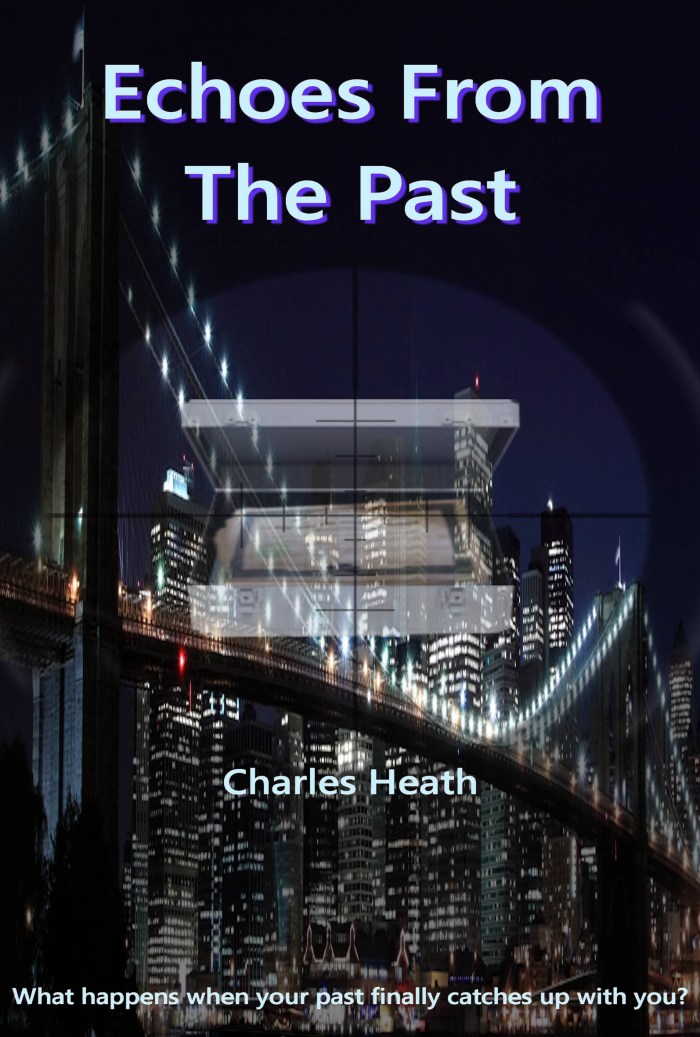
“Echoes From The Past”, the past doesn’t necessarily stay there


What happens when your past finally catches up with you?

Christmas is just around the corner, a time to be with family. For Will Mason, an orphan since he was fourteen, it is a time for reflection on what his life could have been, and what it could be.

Until a chance encounter brings back to life the reasons for his twenty years of self-imposed exile from a life only normal people could have. From that moment Will’s life slowly starts to unravel and it’s obvious to him it’s time to move on.

This time, however, there is more at stake.

Will has broken his number one rule, don’t get involved.

With his nemesis, Eddie Jamieson, suddenly within reach, and a blossoming relationship with an office colleague, Maria, about to change everything, Will has to make a choice. Quietly leave, or finally, make a stand.

But as Will soon discovers, when other people are involved there is going to be terrible consequences no matter what choice he makes.

https://amzn.to/2CYKxu4

newechocover5rs

“Trouble in Store” – Short Stories My Way:  The re-write – Part 2

Now that I’ve gone through the story and made quite a few changes, it’s time to look at the story

It took a second, perhaps three, to sum up the situation.

A young girl, about 16 or 17, scared, looking sideways at a man on the ground, then Alphonse, and then Jack.  He recognized the gun, a Luger, a German relic of WW2, perhaps her father’s souvenir, or more likely a stolen weapon, now pointing at him then Alphonse, then back to him.

Jack took another second or two to consider if he could disarm her.  No, the distance was too great.  He put his hands out where she could see them.  No sudden movements trying to remain calm, and his heart rate was up to the point of cardiac arrest.  No point in making a bad situation worse.

Pointing with the gun, she said, “Move closer to the counter where I can see you better.”

Everything but her hand was steady as a rock.  The only telltale sign of stress was the bead of perspiration on her brow.  It was 40 degrees Fahrenheit in the shop.

Jack shivered and then did as he was told.

A few seconds more for him to decide she was in the unpredictable category.

“What’s wrong with your friend?”  Jack tried the friendly approach after he’d taken the three steps sideways necessary to reach the counter.

The shopkeeper, Alphonse, who, Jack noted seemed to have aged another ten years in the last few months, spoke instead; “I suspect he’s an addict, looking for a score.  At the end of his tether, my guess, and her to get some money.”

A simple hold-up that had gone wrong.  Wrong time, wrong place, in more ways than one Jack thought, now realizing he had walked into a very dangerous situation.  She didn’t look like a user.  The boy on the ground did, and he looked like he was going through the beginnings of withdrawal.

Oddly, though, Jack had noticed a look pass between the shopkeeper and the girl.

“All you had to do was give us the money, and we wouldn’t be here, now.”  She was glaring back at Alphonse.  “You can still make this right.”

A flicker of memory jumped out of the depths of Jack’s mind, something discussed at the dinner table with their neighbours, something about the shop being a pickup point for drugs.

The boy on the floor, he was not here for money.

Jack thought he’d try another approach.  “Look, I don’t want trouble, and you don’t want trouble.  I’ll go, forget this ever happened.  You might want to do the same.”

The girl looked like she was thinking.  The gun, though, still moved between him and the shopkeeper.

Another assessment of the girl; this was not her real home.  She was from a better class of people, a different part of town.  Caught up in a downward spiral because of her friend on the floor.

Caught in a situation she was not equipped to deal with.

© Charles Heath 2016-2024

Writing a book in 365 days – 182

Day 182

He decided that, for once, he was going to ignore everything he knew about living a good life.

At what point do you decide that, having done everything that was asked of you, taken heed of all the advice, and achieved everything possible, your life isn’t a life but an empty shell where a living, vibrant human being should be?

Forty.

It was supposed to be that magical age where everything was supposed to come together. At least, that was what his mother had told him last night at the special dinner held in his honour.

Not just family like he had requested, but over 200 specially selected guests, friends and business connections of his parents, people he knew but didn’t know, people who were an important part of the business network.

And then there was that one comment, some guy he’d never seen before but was what his mother would call a radical, someone who didn’t conform.  Blue shirt and green tie.  Pale blue suit and tan shoes.  A fashion disaster.

He said, quite off-hand, “It’s time for you to go off the rails, forties mate.  Fast cars and younger women.”  He was with his wife, he was fiftyish, she was about twenty, it wasn’t a good look, and the expression on his mother’s face: priceless.

I shook his hand and moved on.

Forty.

Lying in bed the next morning, the first shard of light showing through the curtains, was it time to reassess where I was in the greater scheme of things? 

My hand-picked wife was up and out for her morning run on the specially landscaped path built throughout the extensive gardens that surrounded the manor house.

She had become a clone of my mother.  She was descended from royalty, my mother said, but I had my doubts.  A few too many drinks and her character changed completely, and under that ice queen exterior, there was a real person.

When I asked her about it, she simply denied it existed and then never drank again.

We had two perfect children.  Well, some would say they were perfect, I thought they needed to be allowed to be children, but who listened to me?

Forty.

Life begins at…

It felt like my life was over.  I wanted, I craved for a single moment when I was out of my depth, where I was frightened of the consequences of my actions, scared to make a decision because it was the right one, not one that would please my mother.

I sighed. 

That was never going to happen.

Eloise came back from her run, and it was the only time I saw her, if I saw her, a mess. I liked the mess, said so once, and she was horrified.

“You do realise that you look great.” I decided today I was going to act out of character.

“I’m sorry.  I thought you were asleep.”

“Well, I could be dreaming, and if I am, it’s one of the better ones.”

She smiled.  That was something else about her.  She rarely smiled. That is to say, smiled so that her whole face lit up.

In that moment, it did, and that girl I saw twenty years ago suddenly came back to life.  The one my mother had almost destroyed in her quest to make her a Marron clone.

“You should be up.”

“I don’t want to be up.  What I want is you, right here, right now.  The girl I first met twenty years ago, the girl before my mother turned her into a robot.”

“That girl is gone, Alec.”

“That girl is standing right in front of me.”

She suddenly looked confused.  It was an expression I’d not seen on her face for many years.

I got out of bed, a ridiculously large ocean of self-pity, and all of a sudden, I had no interest in wallowing in it and walked over to her.

The room was as large as a ballroom, and we could have performed a waltz in it.

She watched me warily until I stopped in front of her and took her hands in mine.  “My mother has completely taken her away.  You peer out every now and then, and it makes my heart miss a beat or two when it does.”

She blinked.  Her eyes had tears forming, and then after another blink, a tear escaped, and I watched it slowly run down the side of her face.

“I hate my life,” I said. “I hate everything to do with this place, my work, what it has done to both of us.  I want the girl you were, still are, hiding there behind an almost impenetrable facade.  Please give her back to me.”

I could see more confusion, and I think she thought this might be a test.  In the early days of our relationship, my mother had always been one to look out for signs that she was not doing enough.

In my mind, she was too good for the likes of this family, having seen what my mother had done to my older sister, the one we never mentioned or talked about, and Eloise was almost down that same path.

“I can’t.  You know why I can’t. “

At what point do you choose all of what we had against having a life?  The money, the luxury, the possessions, the power that came with it?  It could be intoxicating, but in truth, it was a curse.

“Is it the money?  Power? The notion that you can wear a hundred thousand dollar dress once and never again?  Or wear that million-dollar diamond necklace?  What do you think you have?”

“Everything I ever wanted.”

“Except freedom.”

She shrugged.  “There is always a price to pay.  It would be the same anywhere else.  With anyone else.  Life is simply a series of compromises.”

That was my mother speaking, right there.  The facade had reappeared, the stony look returning, the one I saw every morning down in the breakfast room.

I sighed, let her go, and kissed her on her forehead.

“Another day, another million dollars.  See you downstairs.  We’ve got that Anderson thing this morning.”

She gave me a last wary look.  “Are you alright?”

I was not surprised she thought I might be ill.  It had been a long time since the last time I acted out of character.

“Sure.  Must have something to do with turning forty.  I’m sure it’s just a guy thing.”

I don’t think she quite believed me.

Of course, had she been in my office the previous afternoon, just before I was about to go home and change for the big birthday bash my mother had organised for me, Alfred H Ribbentop, the Chief Executive lawyer, came to see me.

The last time I’d seen him was the day he read the family my father’s will, nearly six years ago, after he suffered a heart attack and died.

I wanted to believe my mother killed him.  I was still looking for proof.  Apparently, he left everything to her and just small annuities to his children, ensuring we remain her slaves.

That was the last thing my father had wanted for us.

Alfred came in and sat in the seat opposite my desk.  No one ever sat on that seat, no one except my father, and after he passed, my mother.

I didn’t tell him my mother would be very displeased if she found out.

“I have a letter from your father.”

“A miracle then, since he’s been dead neatly six years.”

“You know that the Lord works in mysterious ways.”  He pulled an envelope out of his top pocket and put it on the desk facing me.

It was my father’s handwriting.

“Is it real?”

“Did I forge it? No.  I was in the room when he wrote it because there was some stuff I had to organise.  Read it.”

I shrugged.  What harm could a message from to grave do?

Inside the envelope was a single sheet of paper.

“Alec…

“A man is no good until he turns 40.  I know, that’s how long it took me to realise I was a nincompoop.  You will have been kowtowing to your mother because she thinks she has all the power.  The truth is, I didn’t have the time to stop her.  But the devil is always in the details that she never asked about or was interested in.

“Well, today that ignorance is going to come back and bite her.  As of today, you have 51 per cent of the management company’s shares, which means you are now in total control of what happens.  I figured about five years under her thumb would be long enough.

“And you, of all the children, would have been smart enough to plan for something like this.  After all, Alfred would have dropped his mysterious hints as he always did with me.

“So, run away with Eloise and take the time to enjoy your life because I didn’t and look what happened to me.”

“Dad.”

I looked over at Alfred, a man who rarely smiled.  If it were humanly possible, I would have said he looked amused.

“Is this true?”

“Eldest living son, at age 40.  Yes.”

“Does Mother know?”

“Yes.  She had her legal people go over every line and tried to break it, and tried to set up a new entity and turn your inheritances into a worthless shell.  Your father was three steps ahead of her, even from the grave.  She was 100 shares short of doing anything that meddled with the corporate structure.  And the beauty of it, no one knew who the anonymous shareholder was, but their proxy always sided with you and your eldest sister’s shares, which were the controlling interest.  Your mother alienating her was the biggest mistake of her life.”

“And the mysterious shareholder?”

“It doesn’t matter.  You have the controlling interest, so use it wisely.  You don’t have to be here. You can proxy someone of your choice to do as you wish.  I will ask you to be sensible, as I know you will.  Your mother may have been somewhat misguided when it came to people, but she can run the company.  She just needs the voice of reason in her ear, just as it was when your father was alive.”

He stood.  “Use this information as you wish, but I always find springing subtle surprises are always more fun than just blurting it out.”

With that, he was gone.

I had a lot to think about.

Breakfast, unless we were away from home, was mandatory. 

Mother insisted we all be in attendance so she could make sure we were ready and on point for the day to come.

It’s why I liked being away.  She could not intimidate us, not directly.

We lived at home along with my two younger brothers.  My sister had long escaped the lunatic asylum, as she called it, and I only got to see her when visiting the other side of the country.

I was usually down first, my brother John second, sometimes Eloise, then my other brother Walter and rarely his wife, who wanted to escape but didn’t have the courage to leave.

This morning, when I entered the room, everyone bar Eloise was there, and Mother was presiding like the hanging judge.

When I stepped into the room, all eyes shifted to me. 

“Why aren’t you dressed?” Mothers’ tone was one not to be reckoned with.

I leaned against the doorjamb and crossed my arms.
I’d been reading up on body language, and this meant something like being obstinate.

“I’ve decided to take the day off.  The thing is, I don’t remember the last time I did.”

The other three looked at each other and then stood.  Each said they had somewhere else to be, and mother did not stop them from leaving the room.  Perhaps she knew what was coming.

When we were alone, she said, “What’s this about?”

“I think you know.”

“Alfred.”

“I wouldn’t bother worrying about who or what or when.  It doesn’t matter.  I was always going to be standing here, right at this moment in time, saying what I may or may not say.”

“You think…”

“I don’t care.  You see, you think whatever you say or do will right the ship, your ship, but you can’t.  Your words might have some impact if I did care, but sadly, I don’t.  I did what you asked, and Eloise did as she was asked.  And not once did you acknowledge it.”

“You weren’t raised to be a sob story.”

“I’m sure you weren’t raised to be a tyrannical bitch, but here we are.”

She slowly got out of her chair and took the stance that indicated a pitched battle was about to ensue.  It was meant to intimidate.  Two days ago, it might have.

She put on her ice queen face.  I’d once compared my mother to Bodecia in her war chariot, going into battle.  She thought it amusing.

“Go back upstairs, change, and be down here ready to go in 30 minutes.  We have work to do.  We’ll talk about this, whatever this is, later.”

Two days ago, that bollocking would have been enough.  Today, it was laughable.

I heard movement behind me, and it had to be Eloise.  A moment later, she was behind me, the trademark perfume just reaching out.  She must have heard my mother’s raised voice.  It got louder

I felt her hand on my shoulder.

“There’s nothing to talk about.  Richards is outside the front door waiting for you.  I expect you to handle the meetings today and tomorrow as the Chief Executive.  I spoke to Larry yesterday, and he’s on board with the changes.”

I could see the red tinges in her cheeks, not the rouge but rage.

“This is ridiculous.”

“This is how it will be.  Or you can retire, and I will get someone else to do it.  There will be no discussion.  What will it be?”

“This isn’t over.”

“No, it isn’t.  You have to sign a new contract.  As soon as you arrive at the office.  Otherwise, I will consider your refusal as your resignation.  I would like you to stay on exactly as you are.  You simply have a lesser amount of voting shares.  Talk to Alfred.  He’s got all the details.”

She shook her head and crossed the room.  She stopped when she saw Eloise behind me, and I could feel her shrink back.

I could see the hostility on my mother’s face.

“There are many things I could say, but sadly, it would be like water off a duck’s back.  But I will say this.  Once.  If you think this is defiance brought on by what Alfred told me yesterday, you’re wrong.  I woke up yesterday morning and simply decided I’d had enough.  I was planning to leave this morning, with or without Eloise, and never come back.  Yesterday, I hated you, this place, the company, perhaps even the entire world.  Today, a lot of that hasn’t changed.  I know I wanted my Eloise of old, and I know she’s been very disappointed in me for not defending her right to be herself and that changes now.  You will treat her with respect, or you will have me to deal with, and if you think you can be scary, just remember I learned scary from the very best.  Now, save the bluster, the anger, and all that nonsense you go on about, and go.”

She took a deep breath as if mentally counting to ten, or working on a perfect retort, and i braced myself for the incoming missiles.

“Very good.  Do you want to know when the papers are signed?”

“A brief text will suffice.”

“Agreed.  Good morning.”

Lambert, her personal assistant, was hovering just beyond the door, an incredulous expression on her face.  I guess it was going to be almost permanent.

I turned, reached out and took Eloise’s hand in mine.  “I’m sorry.”

“For what?”

“Not being the man you expected me to be.”

“Perhaps i should apologise too.”

“No.  You were everything I expected and more.”

“OK.  Do we have to stay here?  I want my own place.”

“A mansion?”

“God no.  Just a small cosy house, big enough for the four of us. I think the kids should be taken out of that horrid school and go to a local high school.  I have been looking, you know.”

“I do.  And to that end, after breakfast, we’ll be taking a drive to collect David and Elizabeth from that horrid school, and then, house hunting.”

“Like real people?”

“Like real people.  Just remember not to wear a fifty-thousand-dollar dress.  We don’t want the realtor to think we have a lot of money.”

Well, we were probably going to have to work on that aspect.  Getting unused to being rich was going to be a lot harder than the alternative.

©  Charles Heath  2025

The cinema of my dreams – I always wanted to go on a treasure hunt – Episode 79

Here’s the thing…

Every time I close my eyes, I see something different.

I’d like to think the cinema of my dreams is playing a double feature but it’s a bit like a comedy cartoon night on Fox.

But these dreams are nothing to laugh about.

Once again there’s a new installment of an old feature, and we’re back on the treasure hunt.

Finding the treasure, or something else

It was time to go.

She had stayed with me the whole time, and made sure I’d seen her phone the whole time.  I was sure it was deliberate, and there would be repercussions at the end of this exercise, success or not.

She made no mention of it the whole time too, but it was stewing behind her eyes, and I could feel it.  It was a trait of my mother’s when dealing with my father, whom she never really trusted, and not without reason.  He had let her down, us down, more times than I could remember.

We had just enough light to find our way to the base of the cliff.  The weather forecast was for a cloudy night and the prospect of rain around midnight, when I was hoping we’d either found what we were looking for, or it was a bust.

The wind had picked up after we left the cave and was gusting intermittently by the time we were in position, so between the darkness and the wind, the climb was going to be ‘tricky’.

Boggs said he was up for the challenge.  I was not so sure. 

It was not far upwards to the ledge, but by the time he started, the moon had gone behind the cloud cover, the wind had picked up, and the temperature had dropped dramatically.  A minute later, he had disappeared into the darkness, leaving only a trailing rope behind that I was loosely holding.

The wind overtook the noise of him ascending, and the hammering of pitons into the rock crevices, so it felt like we were alone on the beach.  Nadia was standing about 10 feet away looking upwards.

Was she tracking Boggs progress, or waiting for something else?

The moon shed little light on our position, in between passing clouds, not enough to work solely by it. We had torches, and intermittently I could see approximately where Boggs was, and it seemed to me he had been at the same spot for at least ten minutes.

Had he reached an impasse?

We had no means of communication, I wasn’t going to call out to him, nor, I was sure, would he call out to me.  At least, only if it was necessary.

Then, I felt a slight tug on the rope, the sign her had made it to the ledge.  If he had not found it, the plan was we would leave, and go back to square one.

I went over to Nadia.  “We’re up, you’re next.”

“I’d rather stay on the ground.  I don’t need to be scaling rocks.”

“We agreed, we’d all go up.”

“Are you sure this is not about you having trust issues.”

“No.  It’s time, unless you know something I don’t.”

“Like?”

“You tell me if there are any surprises waiting for us up there?”  It was as close as I was going to get saying that she had betrayed us, and, knowing what was waiting, didn’t want to be there to face our disappointment.

“When have I had time to arrange anything.  You’ve been with me the whole time.”

I had, though it was not for that purpose, but not an unreasonable assumption on her part given the circumstances.

I shook my head.  I think deep down I was expecting some sort of development, even though I had hoped that she would be as good as her word.  It also annoyed me that she was making it so I was put in a position where the only assumption she could make was that I didn’t trust her.

It was like being painted into a corner.

And it was clever on her part because she left the onus on me, absolving herself of any blame, whether on not she was telling the truth or not.

I was the bad person.

“As you wish,” I said.  “Go home, there’s no need for you to stay.  It’s probably the last place you should be when everything goes pear shaped.”

“I’m happy to be the last line of defence.”

“When the shit hits the fan, Vince isn’t going to care whether you share the same surname or not.  Best you’re not here at all.”

“Are you expecting him?”

“We’re trespassing on Cossatino land.  If he finds out…  Best if you were not here, seriously.”

“You do realise what he’ll do if he does find you.”

It was a statement, not a question, and yes, I did.  And I’d kept Boggs waiting long enough.  “I’ll let you know what we find.”

Enough sparring, I turned and headed back to the base of the cliff. 

Scaling the cliff was not that hard, Boggs had said to keep a tight hold on the rope and used the pitons he’d places strategically as footsteps on a ladder.

When I reached the ledge, Boggs was waiting and pulled me up the last of the climb onto the narrow alleyway between rocks.

“Took your time,” he muttered.

“Nadia is having reservations about joining us.”

“Sending the lambs to the slaughter, eh.”

I’d expected that reaction, and I could see how he’d reach such a conclusion.

“She is not a climber.”

“Neither are you, but…”

“I don’t think it matters which side she’s on, in the end.  We’re not here by invitation, especially if Vince turns up.  Let’s get on with it before we get cold feet.”

“You don’t have to be here, you know.”

“Actually, I do.  You asked me along for the ride, and I let you down.”

I’d thought about it, and it seemed to me everyone, one way or another, had let him down.  If I put myself in his shoes, I’d be terribly disappointed.

“You’re here now, that says a lot.  But, enough talk, let’s see where this goes.”

I looked up and could just see the overhang, an almost flat slab of rock almost suspended in mid-air.  If it fell, we might be crushed, on it would land on or crumble, over the outer wall, which in itself looked to be part of the original wall split away.

What was once most likely a ledge, was now was tunnel.  The ledge would have been much wider, before the fall, and in this current form, narrower than it used to be.  If there was a chest or two to take away, it wouldn’t be wide enough.

I followed behind, the small torch beam picking out the sharp edges and avoiding jutting pieces of rock, making progress slow.

Ahead I could see Boggs had stopped, and was examining the wall.  When I joined him, he was standing in front of wood panelling.  A closer inspection showed it to be a door.

“That’s a good sign,” he said.  He rapped on the door and it sounded dull, like it was hollow.

To one side there was a rusty handle and a large lock, equally rusty.  I picked up a rock and with one hit, it snapped of and clattered on the ground.

I then pounded on one of the wooden panels and it disintegrated.  It had rotted over time, how much time was moot, and didn’t take much to bash an opening wide enough to fit through.

The air coming out was quite pungent, if not foul.

“Not exactly a welcome.”

“It smells of death.”

Boggs gave me a look that might have translated to ‘keep your opinion to yourself please’.

“Well soon find out.”  After selling the torch light as far in as he could, and not seeing any immediate danger, stepped over the threshold.

“Beware of any possible boobytraps.”  I’d seen too many films with similar situations, and if there was treasure in this cavern, the pirate would not let it be taken without a fight.

“Seriously, Sam.”  He turned a put his light on me. “That’s just a myth perpetuated by Hollywood.”

“Just saying, be careful.”

I saw him shrug, and turn back.  Perhaps as a nod to my warning, he reached out, checking for trip wires, as I ailed my torch at his feet, and saw what looked to be a rope strung six inches above the ground.  It looked as rotting as the door timber.

“On the ground,” I said.

He moved his light to join mine, saw the rope, and traced it from the floor, upwards to the roof.  If he had tripped over it, might it bring the roof down, or part of it?

He stepped back, kicked through it, and it disintegrated into dust.  Nothing happened.  It had to be the rope had rotted and couldn’t be used to spring the trap. 

“So far, so good.”

A flimsy rope wasn’t going to stop him.

“Just be careful.”

We used both torches to light both sides of the cave, and the roof, just in case.  The torch light did not reach the end, so it was slow progress.

Twenty paces later, we came to a larger cavern, and a quick look around showed parts of it had been man made.  A shiver went through me, and I thought that might be a ghost passing through me.

“You feel that?” I asked Boggs, now several steps in front of me.

“It’s just cold Sam.”

“I reckon there’s a body down here, somewhere.”

Suddenly his torch stopped, near the floor, adjacent to what looked like a ledge.  The corner of the cavern.  There were torn rags scattered. 

I joined him and added the light from my torch, widening the display.

The involuntary gasp was mine.  A skull, still attached to the skeleton, partially covered by cloth sitting in the corner, as if that was his final resting place.

“I was not expecting that,” Boggs said, the slightest of cracks in his voice.

I shuddered. 

I moved my torchlight along the wall, and found two more skeletons, both lying down on the ground in front of the ledge, as if they had been dragged there.  It wasn’t hard to deduce how at least one died, a sword appeared to be through the middle of the torso.

“Pirates who didn’t like their share of the treasure,” he said.

“Or raiders, who weren’t expecting guards?”

All three looked as though they were from the 17th and 18th centuries, and had not been disturbed for a long, long time.

A view of the cavern showed nothing else, except for what looked like beds made of straw on the ledges, and several chests that were in better condition than the door to the cave.  There was more clothing and other supplies, like pewter mugs and plates, and pottery bottles, some of which had liquid in them.

We didn’t say much, there wasn’t much to say. 

Except the obvious, we were the first visitors in a long, long time.

There was a passage off to one side, not visible from the entry point to the cavern, and now that we had established there was no treasure, headed towards it.

Boggs shine his torch in the entrance, and it appeared longer than the beam travelled.  The sides of this cavern were damp, and I could hear a slow dripping sound in the distance.

If my orientation was right, we would not be going,  further into the cliff, but running parallel with the shoreline.

“Ready?”  Boggs asked. 

There was no mistaking that hint of fear in his voice but whether he didn’t feel safe, or perhaps because of what we might find, like more dead pirates, I was feeling equally apprehensive.

‘As I’ll ever be.”

He took a few tentative steps, checking the walls as he went.  I followed.

It was damp underfoot, and several times I stepped in a small puddle.  We were surrounded by the aroma of salty water and a mouldy dank smell of dampness.

The next cavern was just beyond the initial torch beam, but slowly came into view as we approached it.  This cave showed signs of being dug out, and the cavern definitely so.  This was not a natural part of the cave system.

This cavern was slightly larger than the last one, had just one ledge which had three chests set out equidistant on it.  It was the first sight our torches displayed.

Was this the treasure?

Boggs headed straight towards them.  I was a little more circumspect, and slowly ran my torch around the rest of the room, until I found another body.

This one was definitely not as old as the other three.  In fact, my guess, it was either Ormiston, or, dare I consider it possible, Boggs senior.

By this time Boggs had opened the first chest and muttered, “nothing”, letting it slam down quite loudly and making me jump.

“Hey,” I said, “There’s another body here, but it’s not a pirate.”

He swung around and pointed his torch on the body, and gasped.  “No.  It can’t be.” 

He went over and knelt beside the body.  The clothes were still intact, and although damp and grimy, were still recognisable.

I saw him check the pockets first of the coat, then the pants, finding what looked like a wallet.  He carefully opened it, then fell backwards, surprise or disbelief.

“Is it.”

He held up the wallet.  “My father.  How did he get here?”

“No treasure in the chest?”

“Empty.  If it was there, it’s long gone.”

So, Boggs senior had known where the treasure was, as he had said, just before he disappeared.  Had he led the others here, and they had incapacitated him, then left him to die?

I checked the other two chests, the second nit holing treasure, but another body, jammed into the space, in slightly better condition than Boggs, but there was no mistaking the cracks in the skull.

It was another man, and if I was to make a guess, it would be Ormiston.  Had Boggs and Ormiston joined forces, or had they turned up at the same time and attacked each other.

“I think that the body in this chest is Ormiston,” I said, closing the lid to the chest.  “It would be interesting to know if they ran into each other, and whether they had found the empty chests too.”

Boggs hadn’t moved.  I could see him struggling with the fact he had found his father, and the location of the treasure, where it had once rested. 

The fact Ormiston had head injuries suggested the treasure was here, and someone had removed it.

Cossatino?

But, the question was, how did they get here if they didn’t come in via the door we’d broken down.  There was another cave leading off this cavern, but it looked as though it led into the hill, rather than head towards the shoreline.

I was heading towards that entrance when I heard a scream cut short, coming from the direction we had just entered the cavern.

Nadia?  Had she changed her mind, followed us, and found the pirates?

© Charles Heath 2020-2022

Inspiration, maybe – Volume 1

50 photographs, 50 stories, of which there is one of the 50 below.

They all start with –

A picture paints … well, as many words as you like.  For instance:

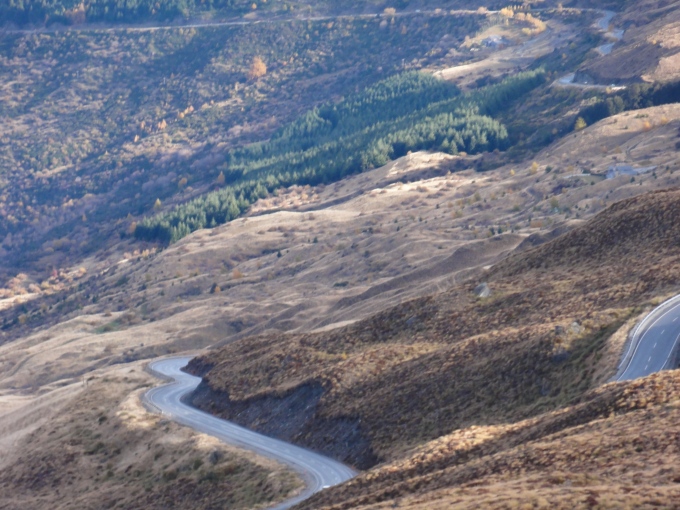
lookingdownfromcoronetpeak

And the story:

It was once said that a desperate man has everything to lose.

The man I was chasing was desperate, but I, on the other hand, was more desperate to catch him.

He’d left a trail of dead people from one end of the island to the other.

The team had put in a lot of effort to locate him, and now his capture was imminent.  We were following the car he was in, from a discrete distance, and, at the appropriate time, we would catch up, pull him over, and make the arrest.

There was nowhere for him to go.

The road led to a dead-end, and the only way off the mountain was back down the road were now on.  Which was why I was somewhat surprised when we discovered where he was.

Where was he going?

“Damn,” I heard Alan mutter.  He was driving, being careful not to get too close, but not far enough away to lose sight of him.

“What?”

“I think he’s made us.”

“How?”

“Dumb bad luck, I’m guessing.  Or he expected we’d follow him up the mountain.  He’s just sped up.”

“How far away?”

“A half-mile.  We should see him higher up when we turn the next corner.”

It took an eternity to get there, and when we did, Alan was right, only he was further on than we thought.”

“Step on it.  Let’s catch him up before he gets to the top.”

Easy to say, not so easy to do.  The road was treacherous, and in places just gravel, and there were no guard rails to stop a three thousand footfall down the mountainside.

Good thing then I had the foresight to have three agents on the hill for just such a scenario.

Ten minutes later, we were in sight of the car, still moving quickly, but we were going slightly faster.  We’d catch up just short of the summit car park.

Or so we thought.

Coming quickly around another corner we almost slammed into the car we’d been chasing.

“What the hell…” Aland muttered.

I was out of the car, and over to see if he was in it, but I knew that it was only a slender possibility.  The car was empty, and no indication where he went.

Certainly not up the road.  It was relatively straightforward for the next mile, at which we would have reached the summit.  Up the mountainside from here, or down.

I looked up.  Nothing.

Alan yelled out, “He’s not going down, not that I can see, but if he did, there’s hardly a foothold and that’s a long fall.”

Then where did he go?

Then a man looking very much like our quarry came out from behind a rock embedded just a short distance up the hill.

“Sorry,” he said quite calmly.  “Had to go if you know what I mean.”

I’d lost him.

It was as simple as that.

I had been led a merry chase up the hill, and all the time he was getting away in a different direction.

I’d fallen for the oldest trick in the book, letting my desperation blind me to the disguise that anyone else would see through in an instant.

It was a lonely sight, looking down that road, knowing that I had to go all that way down again, only this time, without having to throw caution to the wind.

“Maybe next time,” Alan said.

“We’ll get him.  It’s just a matter of time.”

© Charles Heath 2019-2021

Find this and other stories in “Inspiration, maybe”  available soon.

InspirationMaybe1v1

First Dig Two Graves

A sequel to “The Devil You Don’t”

Revenge is a dish best served cold – or preferably so when everything goes right

Of course, it rarely does, as Alistair, Zoe’s handler, discovers to his peril. Enter a wildcard, John, and whatever Alistair’s plan for dealing with Zoe was dies with him.

It leaves Zoe in completely unfamiliar territory.

John’s idyllic romance with a woman who is utterly out of his comfort zone is on borrowed time. She is still trying to reconcile her ambivalence, after being so indifferent for so long.

They agree to take a break, during which she disappears. John, thinking she has left without saying goodbye, refuses to accept the inevitable, calls on an old friend for help in finding her.

After the mayhem and being briefly reunited, she recognises an inevitable truth: there is a price to pay for taking out Alistair; she must leave and find them first, and he would be wise to keep a low profile.

But keeping a low profile just isn’t possible, and enlisting another friend, a private detective and his sister, a deft computer hacker, they track her to the border between Austria and Hungary.

What John doesn’t realise is that another enemy is tracking him to find her too. It could have been a grand tour of Europe. Instead, it becomes a race against time before enemies old and new converge for what will be an inevitable showdown.